






Abstract
This study examined the speed of initial research impact and dissemination for 619 articles published in Psychology of Music (POM) from 1973 to 2012. A computer script calculated the time elapsed from publication to receiving a first-citation from a referencing journal and discipline. Journal references (n = 7,969) to POM were extracted from Google Scholar and divided into business, education, medical, music, music education, natural science, psychology, social science, and technology collections. Stratified plots revealed that journals in the disciplines of music education and psychology cited POM articles more quickly than other fields; music psychology journals cited POM more quickly than music education journals from US and worldwide sources, and POM articles published from 1973–1992 were more quickly cited by journals in music education, while articles from 1993–2012 by those in music psychology. Cox regression indicated research-uptake accelerated with later decades, publishers, editor eras, and increased article impact. Results confirm the importance of recent POM articles to journals in the discipline of music psychology and earlier articles to journals in the field of music education. POM was cited broadly, though adoption speeds were slower for journals in fields beyond music education and psychology.
Keywords
This research project is part of an ongoing examination of published research’s impact and dissemination by authors and journals related to music education. Following up on the first author’s study titled, “Stratification of time to first citation for articles published in the Journal of Research in Music Education from 1988 to 2013: A bibliographic analysis,” (Hancock, 2015) this study turns its attention to Psychology of Music (POM). Generally, the scholarship in POM encompasses the psychological aspects of music and related areas. However, POM is also considered among the top tier of research journals in music education, along with the Journal of Research in Music Education (JRME) and Bulletin of the Council for Research in Music Education (BCRME). These three journals accounted for 81% of the citations in the music education field across 15 related journals (Hamann & Lucas, 1998).
Citation speeds
Almost 30 years ago, Schubert and Glänzel (1986) pioneered the measurement of citation speeds to determine the receptivity of published research, and it continues to be used as a significant bibliometric indicator for assessing aspects of journals and authors (e.g., Garner, Porter, & Newman, 2014; Wolfgang, Rousseau, & Zhang, 2012). Previous research speaks to citation speed, including one by Bornmann and Daniel (2010), who tested the validity of editorial decisions by the leading international chemistry journal, Angewandte Chemie International Edition, and found that accepted articles received their first citation more quickly than did the rejected articles published in other journals.
Time to first citation is an important measure of a journal’s impact on a profession and can be demonstrated with response-time curves that classify journals by research dissemination speed (Glänzel, Rousseau, & Zhang, 2012). Burrell (2001) identified a strong link between the first citation and obsolescence time distributions; characterizing articles that had a strong initial influence but diminished quickly. Articles’ impacts in the humanities indicated that it was 5 years before half of the articles were cited for the first time and 15 years when half of the articles were no longer cited (Wang, 2013). Glänzel et al. (2012) examined the time to first citation for a series of articles in cellular biology and found that one journal (Cell) was significantly faster at receiving citations after publication than the others examined. Some recent scholars have carried out studies of bibliographic aspects of the JRME (e.g., Diaz & Silveira, 2014; Miksza & Johnson, 2012).
One extensive review of literature makes the point for the need for bibliographic studies of research in the field of music education (Hancock, 2015). It examined the first citations of 617 articles published in the JRME from 1988 to 2013 and found that the cumulative first citation probability reached 0.75 by the fifth year and the year-to-year probability peaked at the sixth year; these findings were faster than those that Wang (2013) found for journals in the humanities. Reference speeds to JRME studies occur in the following order from fastest to slowest, but still highly cited: JRME, BCRME, Update: Applications of Research in Music Education (UPDATE), POM, Journal of Music Teacher Education, and the Journal of Music Therapy. Those data indicate that POM was on the upper level of citing JRME, but cited in three US publications more frequently. We should note that the JRME is from the US and POM the UK, with both now published by SAGE and having international reputations.
Psychology of Music
POM began in 1973 and it has the second highest SCImago Journal Rank in the world after Music Perception (MP) and is just ahead of the JRME, which began publication in 1953. These ranks were taken at the time this article was written, but they can change over time.
The original parent organization of POM was the Society of Research in Psychology of Music and Music Education (SRPMME) and some of its aims included supporting research in psychology of music and music education, in addition to publishing POM. As SRPMME developed, it evolved to the Society for Education, Music, and Psychology Research (SEMPRE). Because of its different foci than JRME, a case can be made that POM has variances in its perspectives and article purposes (Cox, Crickmore, Plummeridge, & Sergeant, 2012), but there is considerable overlap with JRME. Kemp (1999) indicated that there was indeed a considerable difference between research in psychology of music and music education. In other words, while POM focuses across psychology, music, and education, even though there are differences, a considerable portion of its research does occur in the field of music education. Historically, we also know of differences as stated by different editors, which may have had an effect on the content of POM (Cox et al., 2012; Sloboda, 1990). Sloboda (1990) was very clear about this issue when as the editor he stated, “Our journal is perhaps unique in the juxtaposition of papers addressing educational practice alongside papers addressing theoretical aspects of music psychology” (1990, p. 3). From its beginning there was a concern for the balance needed between educational and psychological topics (Cox, et al., 2012) and this issue continues.
We have decided to examine the reception and dissemination of scholarship published in POM by measuring the first citation speed of articles to begin to get an understanding of its role in the field of music education and who is citing it in which journals and fields. We predicted that there were distinct journal–journal relationships between POM and other prominent music journals (e.g., MP, JRME), groups of journals (e.g., music psychology journals, music education journals), and journals in different disciplines (e.g., business, medical, psychology, technology), and these relationships were discernible in the speed of research uptake. The following research questions were examined:
What is the first citation speed for articles published in POM from 1973 to 2012?
Is the first citation speed affected by referencing journal or discipline?
Is the first citation speed affected when referencing journals are grouped into music psychology and regional music education collections?
Did the characteristics of an article, such as decade published, editor era, article impact, journal publisher, and multi-authorship, alter the first citation speed?
Method
Data collection
Data for 619 articles published in POM from 1973 (volume 1, issue 1) to 2012 (volume 40, issue 6) were imported into the first matrix of a customized relational database first developed by Hancock (2015) for bibliographic research. References (N = 16,261) citing the articles were located by following Google Scholar (GS) links on the SAGE Publications web portal for POM (http://pom.sagepub.com) and reference data were extracted, tagged, and imported into the second matrix.
Since the strengths and limits of GS output are well-documented (Kulkarni, Aziz, Shams, & Busse, 2009; Meho & Yang, 2007; Nourbakhsh, Nugent, Wang, Cevik, & Nugent, 2012; Van Aalst, 2010), we manually examined references for false positives, incorrect information, and missing data. Supplemental GS searches aided reconstruction of incomplete fields and verified article citations. Unverified references were discarded after reviewing five pages of search results. The remaining references comprised 15,011 entries originating from 8,163 (54.4%) journal articles, 2,736 (18.2%) books and book sections, 2,622 (17.5%) dissertations and theses, 1,156 (7.7%) conference proceedings and papers, 179 (1.2%) manuscripts and class projects, 110 (0.7%) reports and pamphlets, and 45 (0.3%) miscellaneous sources (e.g., websites, fliers).
We confirmed whether the references from journal articles originated from a source listed in the Ulrichsweb Global Serials Directory (http://ulrichsweb.serialssolutions.com) and discarded those from unlisted journals and other sources (e.g., books, dissertations)—7,969 (97.6%) records were retained in the second data matrix. The subject areas of the referencing journals were imported into a third data matrix and linked to the references by journal title.
Referencing journal collections
We curated the references among three journal collections, which were purposefully created to determine the initial impact of POM publications on journals varying in proximity to music education and music psychology research. Each reference was tagged by originating discipline, music-field, and journal.
Discipline-based collection
The discipline-based collection was organized by the subject area of the referencing journals as described in the Ulrichsweb Global Serials Directory. We examined the subject areas and coded the referencing journals into nine major groups aimed at business, education, medical, music education, music, natural science, psychology, social science, and technology.
Select journals collection
The relationships between POM and journals in music education and music psychology form a fundamental node in the network of scholarly communication in these areas which could serve as a proxy for understanding knowledge transfer when examined with bibliometric methods (Hancock, 2015; Moed, 2006). We selected referencing journals with at least 100 citations to POM for detailed study. The 11 examined journals were the British Journal of Music Education (BJME), BCRME, International Journal of Music Education (IJME), JRME, Music Education Research (MER), MP, Musicae Scientiae (MS), POM, Psychomusicology: Music, Mind, and Brain (PM), Research Studies in Music Education (RSME), and UPDATE.
Music-field collection
The music-field collection was derived from the insights chronicled in Cox et al. (2012) and Price, Madsen, Cornacchio, and Webb (2010) which include:
the interdisciplinary features of POM in music, psychology, and education;
“eclectic approaches within music psychology” (Cox et al., 2012, p. 530) characterized by the major music psychology journals;
worldwide distribution of POM by SAGE publications; and
propensity for researchers to cite publications from their country or region.
We ranked all journals by the number of citations, selected those with more than 100 citations to POM, and divided the references into three categories. The music psychology category included references from MP, MS, PM, and POM. The worldwide music education category comprised references from BJME, IJME, MER, and RSME. The US music education category encompassed references from BCRME, JRME, and UPDATE.
Prime covariates
Author number
Research investigating the impact of studies with multiple authors found a “broad tendency for teams to produce more highly cited work than individual authors” (Wuchty, Jones, & Uzzi, 2007, p. 1037), which varies by discipline, even among the social sciences (Levitt, 2015). Moreover, a Cox regression analysis of the JRME found faster first citation velocities for multi-author over single-author research (Hancock, 2015). We recorded the number of discrete authors for each article to investigate a similar relationship for POM.
Editor era
A seven-level variable was constructed to capture possible changes in publication and consumption practices experienced during the terms of POM editors from 1973 to 2012 (e.g., Cox et al., 2012). We examined editor columns for evidence signifying when an incoming editor assumed full responsibility for publication of an issue. The ranges were set by volume and issue numbers as shown in Table 1.
Estimated Psychology of Music Editor eras.
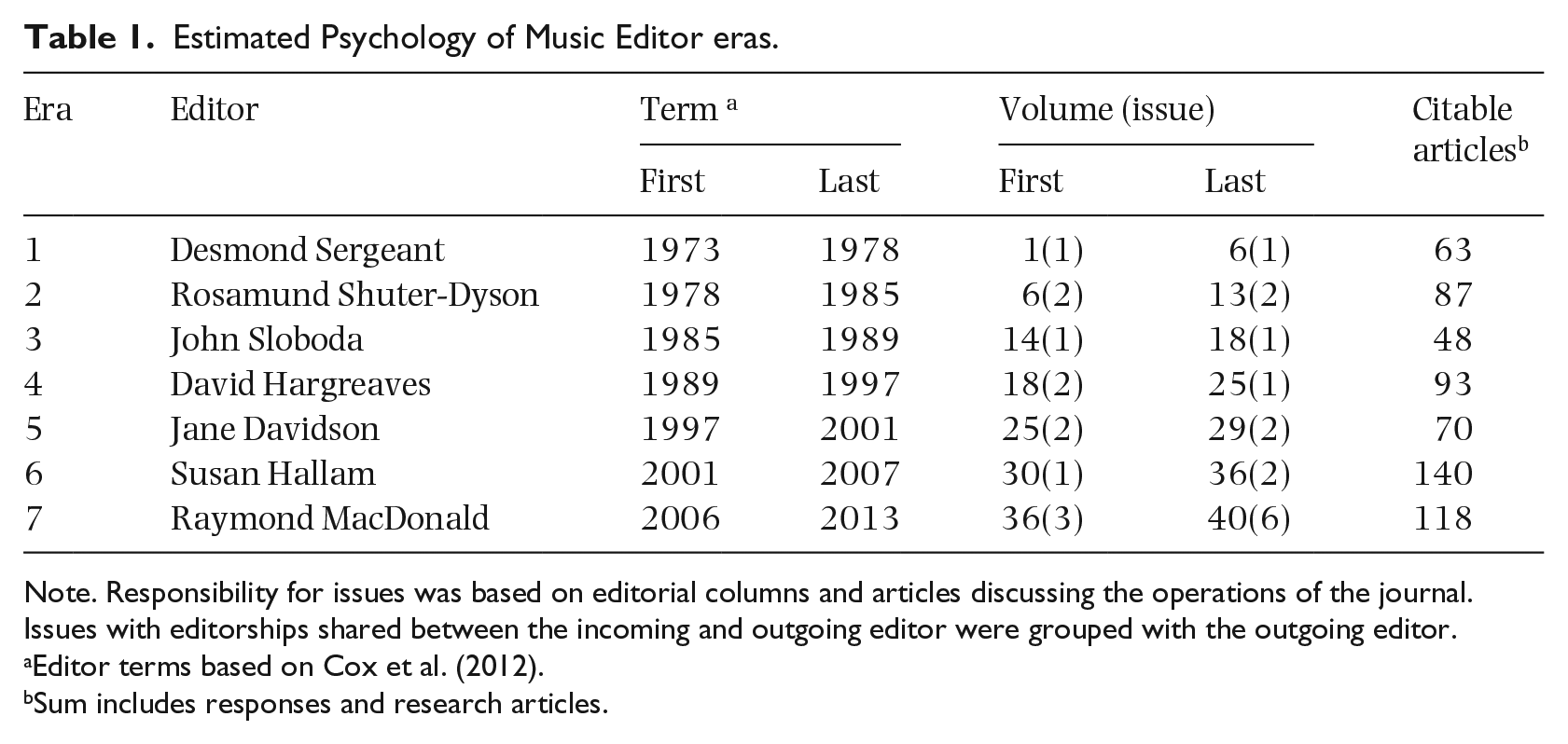
Note. Responsibility for issues was based on editorial columns and articles discussing the operations of the journal. Issues with editorships shared between the incoming and outgoing editor were grouped with the outgoing editor.
Editor terms based on Cox et al. (2012).
Sum includes responses and research articles.
Publication decade
A four-level variable was created by dividing POM articles by year of publication into consecutive decades (1973–1982, 1983–1992, 1993–2002, 2003–2012).
Article impact
Prior bibliometric research found, “Highly cited papers typically obtain[ed] citations from a large number of different journals and from papers representing both close and remote fields” (Aksnes, 2003, p. 159). Since initial data screening of the total citations a POM article received was related to first citation speed, a median split was used to divide the articles into two categories: articles with 26 or more citations originating from journals were coded as 1, and all other articles as 0.
SAGE publications
A two-level variable was created to represent the increased journal circulation and raised profile of SEMPRE publications experienced after the society partnered with SAGE Publications beginning January 2003 (Cox et al., 2012, p. 531; Hallam, 2002). Articles produced by SAGE were coded as 1, and all other articles as 0.
Data preparation for survival–failure analysis
Survival–failure analysis is used to project the time elapsed before an event of interest occurs such as the onset of illness, employee departure, or mechanical failure. To conduct a survival–failure analysis of first citation speed, we created an event variable for article citation status (cited/not cited) and time elapsed from publication of a POM article to first citation. Furthermore, we determined which POM articles were uncited by the conclusion of the study (i.e., right-censored; Cleves, Gould, Gutierrez, & Marchenko, 2008). We reprogrammed a computer script from an earlier study to generate the required data and instructed it to loop 619 times to assess the first citation status for each POM article. The script ignored citations that occurred before an article was published in an issue of the journal and skipped over self-citations originating from the author or co-author(s). The script was executed 24 times to determine the first citation speed for the examined journal collections (9 disciplines, 11 select journals, and 3 music-fields) and for references originating from any journal.
Statistical analysis
We used STATA (version 13.1) to calculate the first citation failure rates and graph the smoothed hazard ratios and Kaplan–Meier cumulative failure functions. Nonparametric Tarone–Ware (Tarone & Ware, 1997) tests with pairwise comparisons were employed to test the equality of the functions among strata in the four referencing journal collections. Cox proportional hazard modeling with modifications for multiple unordered failure events of different types was used to test the effect of covariates on the first citation speed and adjustments to the robust standard errors were made to compensate for clustered data (Cleves, 2009). Results from postestimation linktest routines—a STATA command—confirmed the inclusion of covariates and structure for the Cox models. Additional post-hoc examination with the estat phtest command statistically verified proportional-hazard assumptions for Cox regression (Cleves et al., 2008). A pseudo R2 for each model was performed using the strph2 command detailed in Royston (2006).
Results
First citation speed for POM
Overall velocity
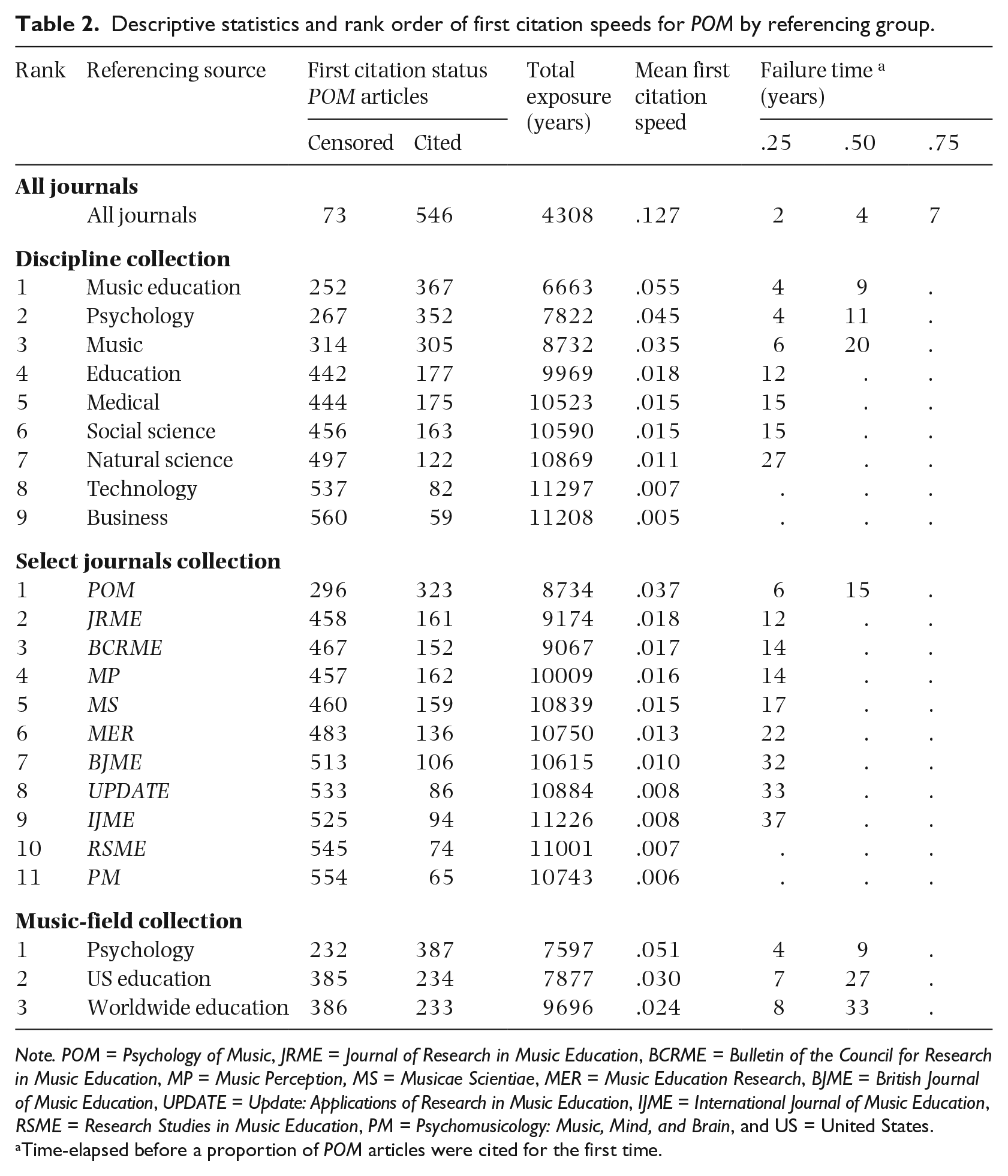
The first analysis utilized the Kaplan–Meier cumulative failure function to establish a baseline first citation speed for articles published in POM from 1973 to 2012 with citations originating from any journal. Results in Table 2 under the “Failure time” heading for the “All journals” section indicated that the probability of a POM article receiving its first citation after publication was 0.25 after 2 years, 0.50 after 4 years, and 0.75 after 7 years. A graph of the Kaplan–Meier cumulative failure function in Figure 1 illustrated the first citation speed in years elapsed from publication to first citation with benchmarks indicating when the proportion-cited curve crossed the 0.25, 0.50, and 0.75 quartiles. Additional data in Table 2 indicated that the mean rate of a POM article receiving its first citation in any year after publication was 0.127 and the curve in Figure 2 illustrates the distribution as a smoothed hazard function over time. In general, the likelihood of a POM article receiving its first citation from any journal after publication was highest during the first 7 years and fell over the subsequent 8 years.
Descriptive statistics and rank order of first citation speeds for POM by referencing group.
Note. POM = Psychology of Music, JRME = Journal of Research in Music Education, BCRME = Bulletin of the Council for Research in Music Education, MP = Music Perception, MS = Musicae Scientiae, MER = Music Education Research, BJME = British Journal of Music Education, UPDATE = Update: Applications of Research in Music Education, IJME = International Journal of Music Education, RSME = Research Studies in Music Education, PM = Psychomusicology: Music, Mind, and Brain, and US = United States.
Time-elapsed before a proportion of POM articles were cited for the first time.
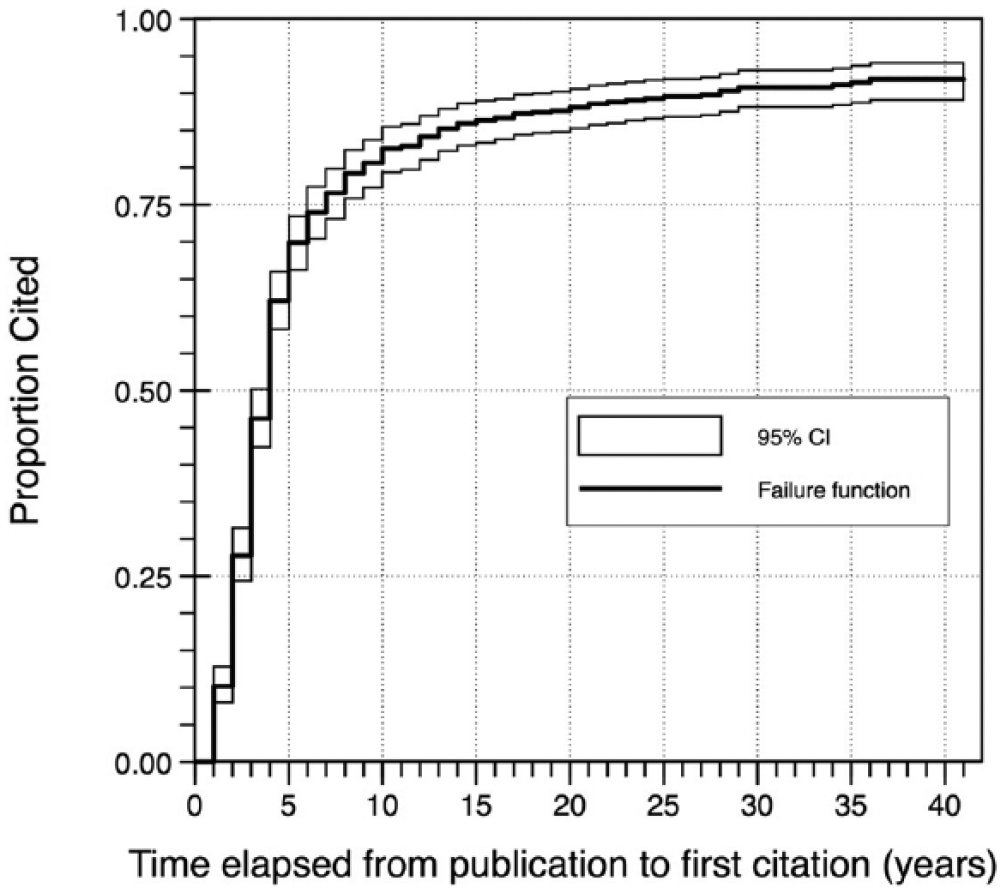
Kaplan–Meier failure function plot with 95% confidence interval for the proportion of POM articles receiving a first citation from another article after publication. Milestone quartiles (e.g., 0.25, 0.50, 0.75) emphasized.
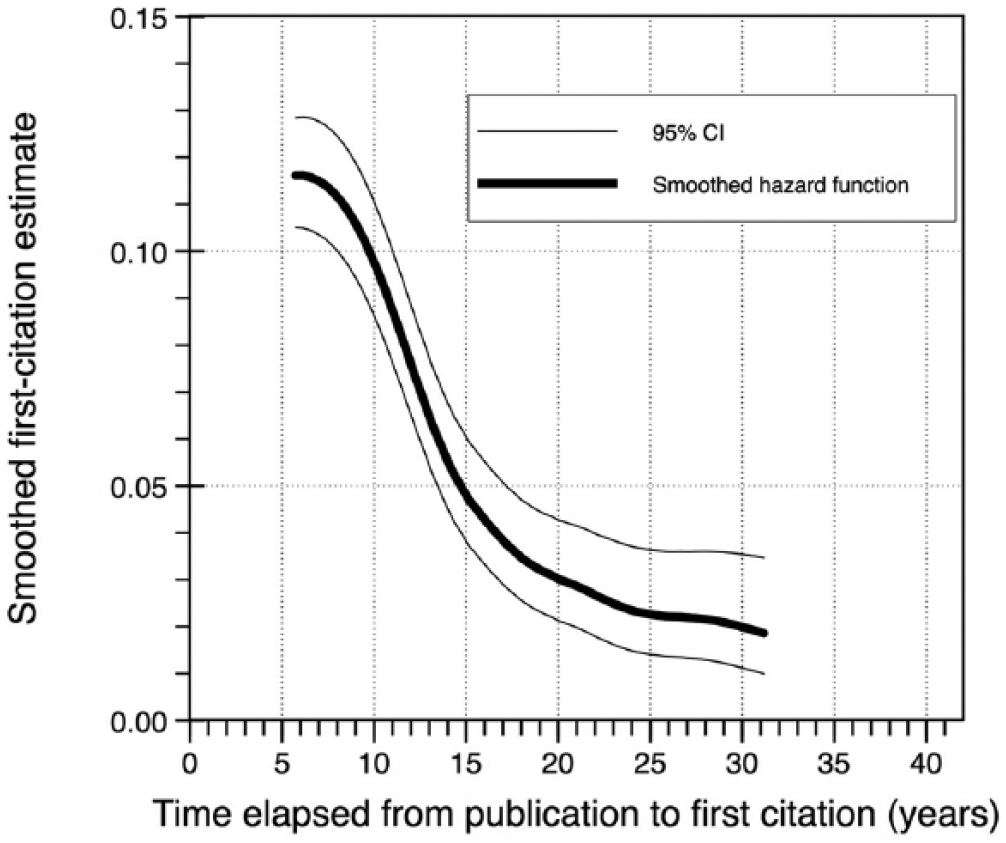
Kaplan–Meier smoothed hazard function plot with 95% confidence interval of the probability of a POM article receiving its first citation from another article after publication.
Discipline-based velocities
To estimate how quickly the articles published in POM were cited across disciplines, the Kaplan–Meier cumulative failure function was stratified by discipline, as shown in Figure 3, and statistically compared. Results from a Tarone–Ware test indicated the first citation speeds to POM varied by discipline, χ2 (8) = 888.71, p < .001, and significant pairwise comparisons (p < .001) suggested the first citation speeds were divisible into five tiers. When these results were combined with the ranked mean citation incidence rates and quartile times found under the “Discipline collection” section in Table 2, the journals in music education and psychology were the fastest to cite POM articles and together formed the first tier of research impacted by POM. A second tier included journals in music. A third tier included education, medical, and social science journals, which was followed by a fourth tier comprised of natural science journals. Finally, a fifth tier encompassed technology and business journals.
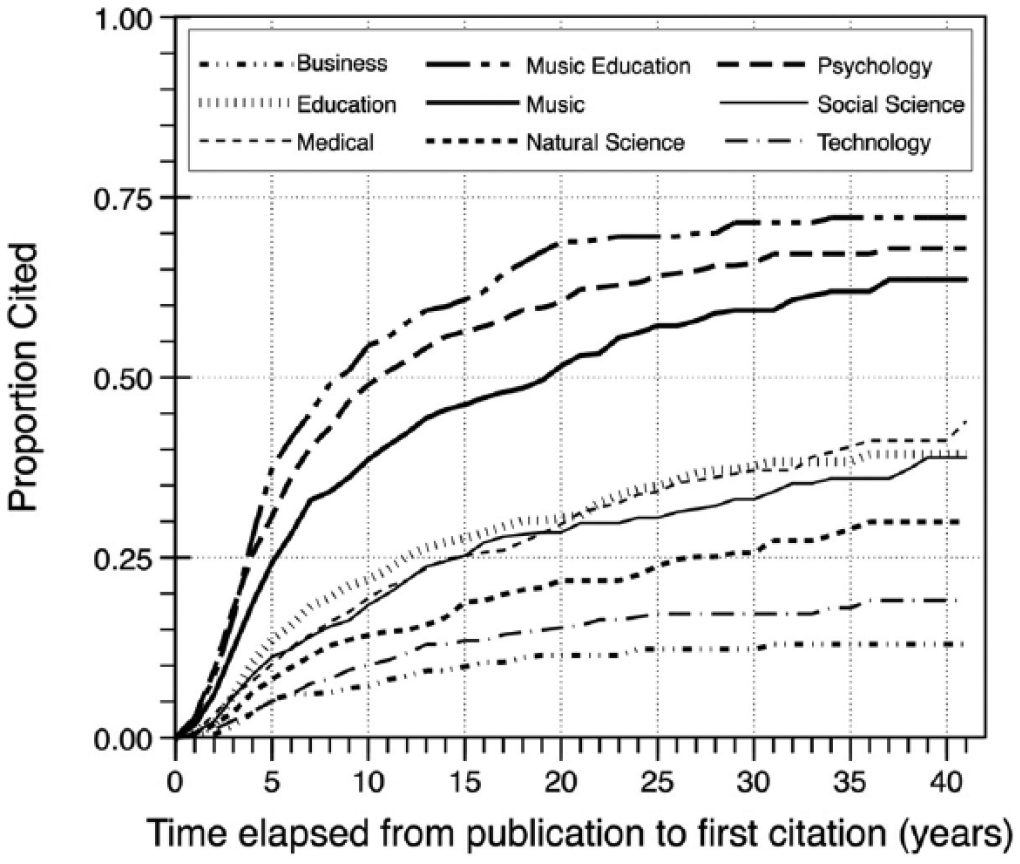
Stratified Kaplan–Meier failure function plot for POM articles receiving a first citation from journals in different disciplines. Failure functions are illustrated with smoothed lines to improve readability.
Select journal velocities
To examine the relationship between POM and other journals in music education and music psychology, we compared stratified Kaplan–Meier cumulative failure-functions for the 11 journals listed under the “Select journals collection” heading in Table 2, plotted the Kaplan–Meier cumulative failure function by journal as shown in Figure 4, and noted the failure time in years for the proportion of first-cited POM articles to reach the 0.25, 0.50, and 0.75 quartiles. Results indicated that these journals cited POM at different speeds, χ2 (10) = 540.41, p < .001. In general, the order of presentation in Table 2 represents the speed in which these journals initially cite a POM article; although significant planned pairwise comparisons between journals (p < .001), the rank order of journals in Table 2, and the history of music psychology, music education, and POM, as described in Cox et al. (2012), suggested BCRME, JRME, MP, MS, PM, and POM formed a distinct group of journals, perhaps indicative of a unique node of journal–journal relationships. In addition, results from a covariate analysis indicated POM articles published in different decades were cited at different speeds by these journals. Together, these results intimated a possible interaction with time that was noted in the evolution of POM’s general perspective and purpose (Cox et al., 2012).
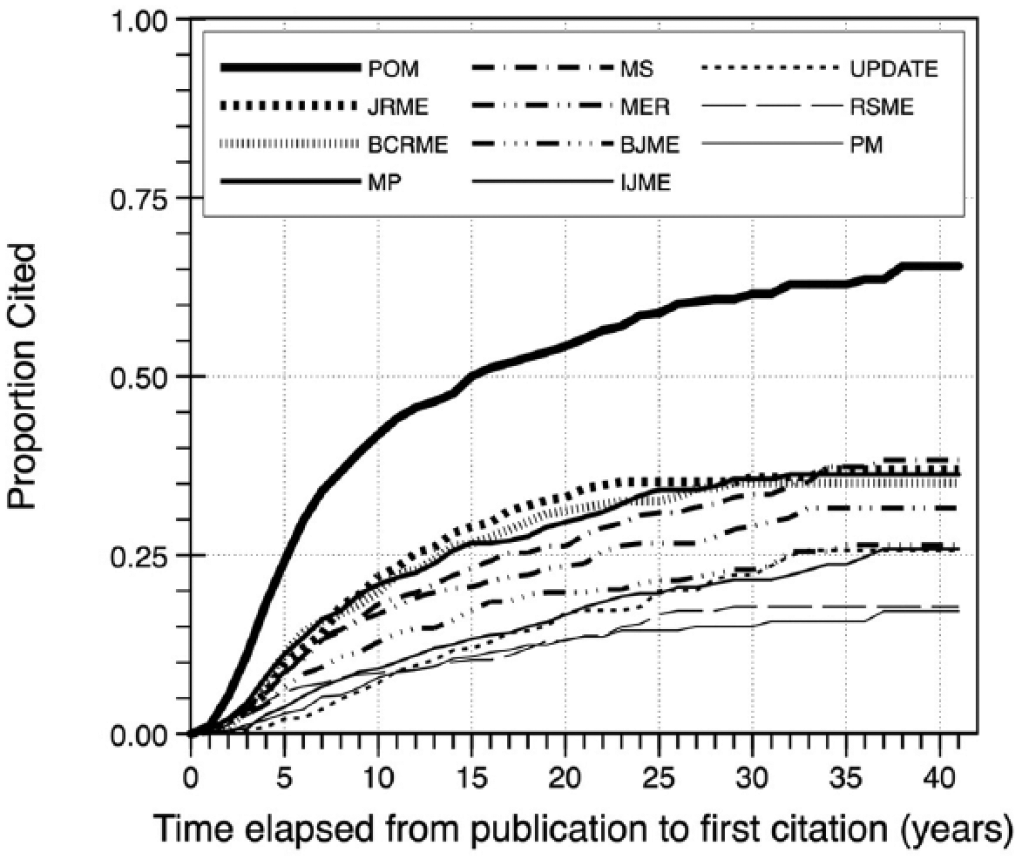
Stratified Kaplan–Meier failure function plot for POM articles receiving a first citation from select journals in music education and psychology after publication. Failure functions are illustrated with smoothed lines to improve readability.
To examine this possible interaction, stratified Kaplan–Meier cumulative failure functions for BCRME, JRME, MP, MS, PM, and POM were graphed for 1973–1992 and 1993–2012; first citation speeds to POM differed by journal for both periods, χ2 (5) = 95.77, p < .001 and χ2 (5) = 360.14, p < .001. The 1973–1992 graph in Figure 5 illustrates how POM articles published in this era were more quickly cited by BCRME and JRME—prominent music education journals (Hamann & Lucas, 1998)—than the four music psychology journals (MP, MS, PM, POM). However, in the 1993–2012 graph, POM articles published in this era were rapidly cited by another article in POM and two of the other music psychology journals, MS and MP, which eclipsed the two music education journals (BCRME, JRME). Pairwise comparisons by journal and time period revealed significantly faster first citation speeds to the 1993–2012 POM for MP, MS, and POM (p < .001); slower speeds for BCRME (p < .001); and somewhat slower speeds for JRME (p = .193).
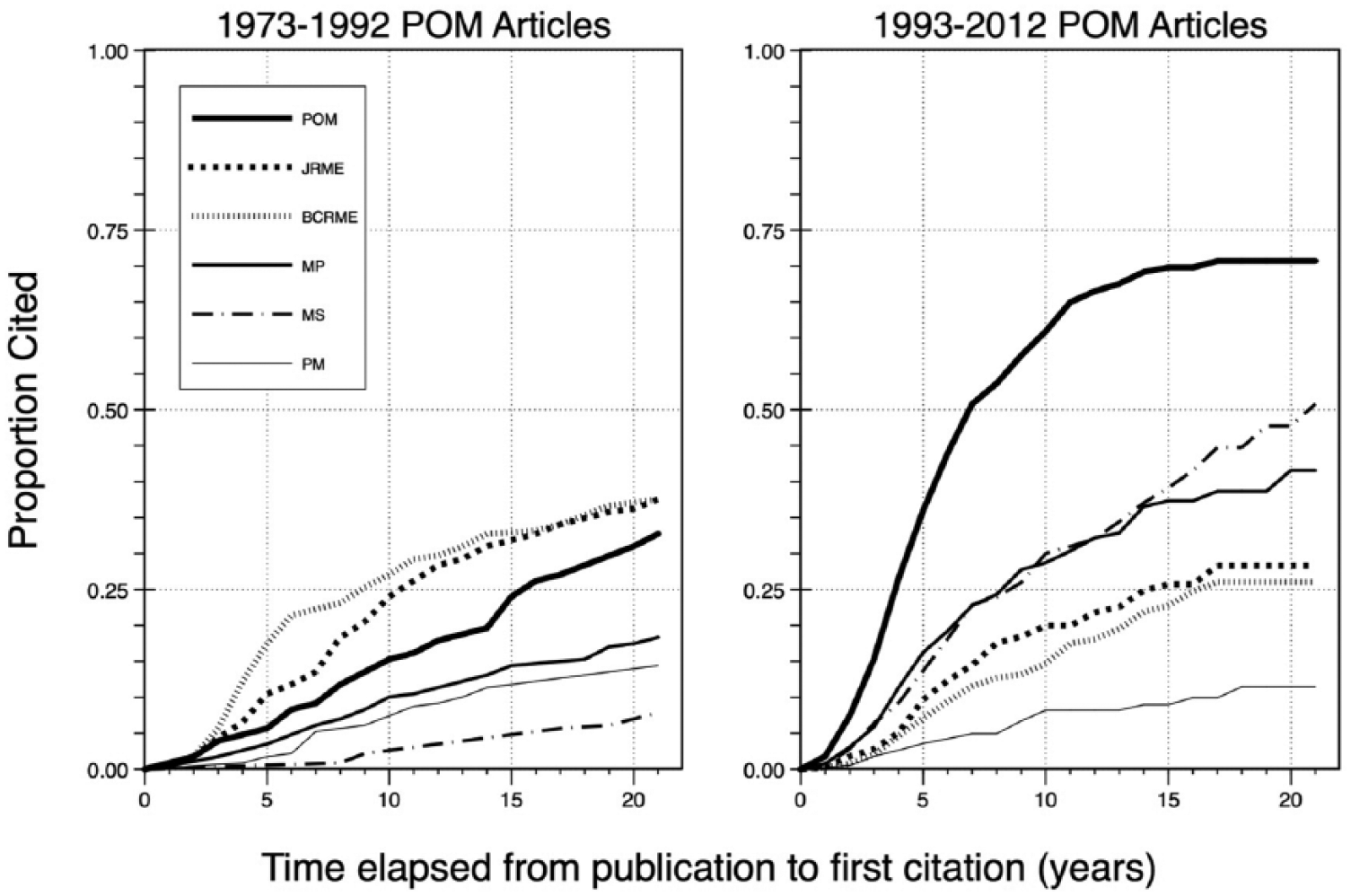
Kaplan–Meier failure function plots for POM articles in 1973–1992 and 1993–2012. Failure functions are illustrated with smoothed lines to improve readability.
The evolution of POM also coincided with the maturation and emergence of several music education journals. To examine the journal-journal relationships of POM to these publications over time, stratified Kaplan–Meier cumulative failure functions for BCRME, BJME, JRME, IJME, MER, UPDATE, and RSME were graphed in Figure 6 and compared for 1973–1992 and 1993–2012. First citation speeds to POM significantly differed by journal for both periods, χ2 (6) =167.31, p < .001 and χ2 (6) = 47.03, p < .001. Pairwise comparisons revealed significantly faster first citation speeds to POM articles published in 1993–2012 over those from 1973–1992 for BJME, IJME, MER, and RSME (p < .001). A visual examination of the two plots revealed the quickest first citation speeds originated from BCRME and JRME for POM articles published in 1973–1992 and from MER for those published in 1993–2012.
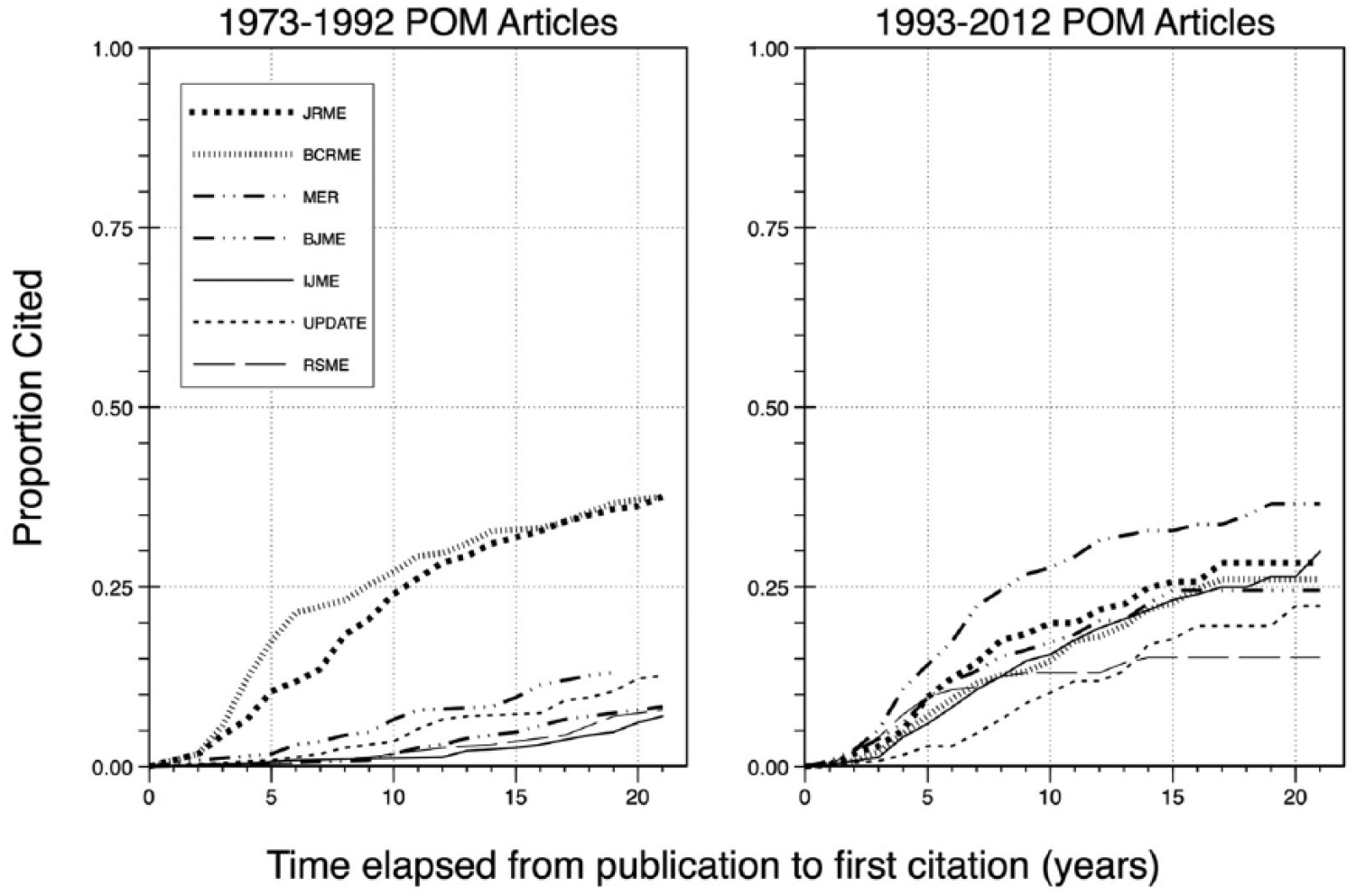
Kaplan–Meier failure function plots for 1973–1992 and 1993–2012 POM articles indicating the first citation speed for POM from music education journals. Failure functions are illustrated with smoothed lines to improve readability.
Music-field velocities
The stratified Kaplan–Meier cumulative failure functions illustrated in Figure 7 juxtaposed select journals in music psychology, US music education, and worldwide music education. Journals selected for the music psychology group emphasized the relationship between MP, MS, PM, and POM as noted by Cox et al. (2012), while journals in the music education groups were parsed by US or worldwide origins. Significant results from a Tarone–Ware test, χ2 (3) = 98.64, p < .001, and significant pairwise comparisons (p < .001) indicated the music psychology group of journals adopted scholarship published in POM more quickly than journals in the two music education groups, which was confirmed by the order of the mean citation incidence rates and quartile times found under the music-field collection section of Table 2.
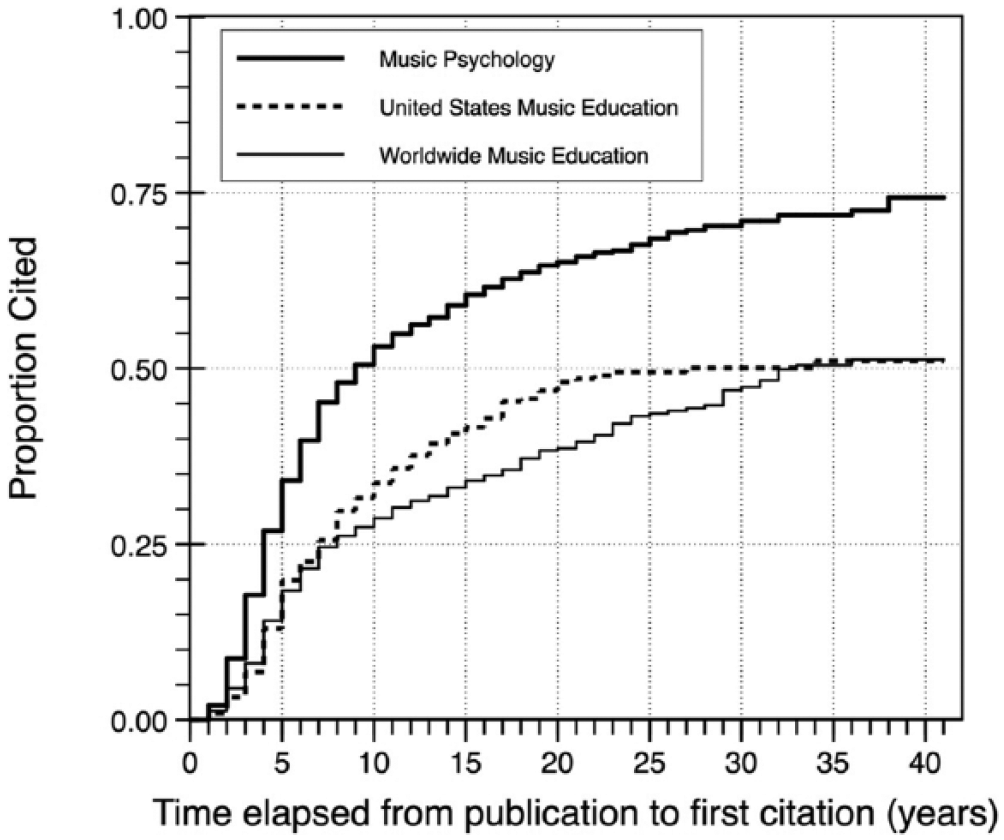
Stratified Kaplan–Meier failure function plot for POM articles receiving a first citation from journals in three music-field collections.
Covariates affecting first citation speed
To examine possible factors that might affect the first citation speeds of articles published in POM, four Cox regression hazard analyses were performed with bidirectional elimination to assess the influence of five covariates on the first citation speed observed in the earlier analyses. Table 3 describes the significant models and hazard ratios for the retained covariates. In general, different combinations of factors influence first citation speeds when comparing the impact of POM under different journals (e.g., all, select) and journal collections (e.g., discipline-based, music-field).
Hazard ratios for covariates affecting the first citation speed for POM by referencing group.
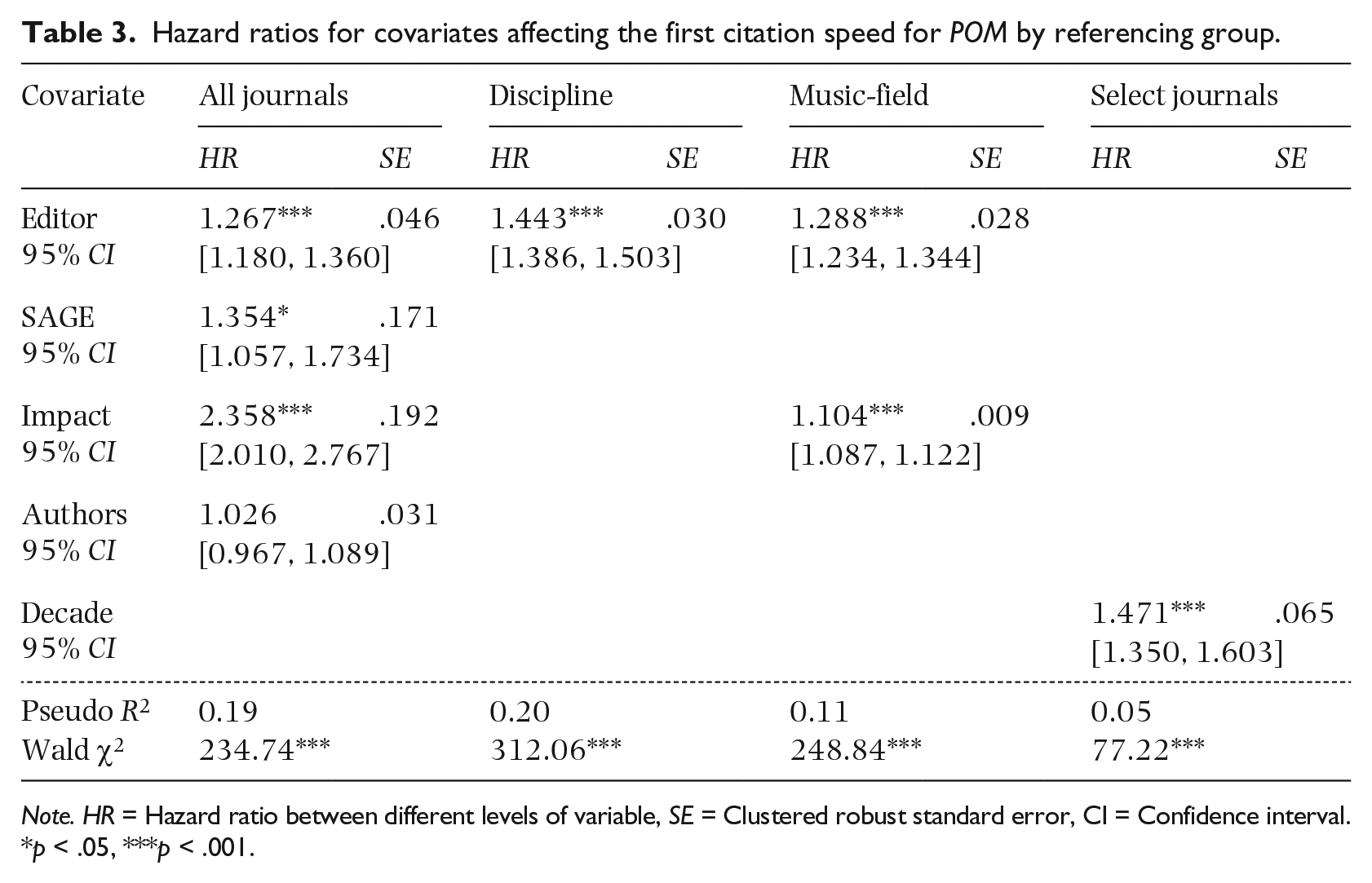
Note. HR = Hazard ratio between different levels of variable, SE = Clustered robust standard error, CI = Confidence interval.
p < .05, ***p < .001.
All journals collection
An examination of the overall first citation speed of POM found that all of the covariates, except for publication decade and number of authors, significantly affected the time to first citation when the citation originated from any journal. High-impact POM articles—articles that accumulated 26 or more citations by 2012—were 2.358 times more likely to receive their first citation in a given year after publication than low-impact articles. In addition, articles published under subsequently later editors were 26.7% more likely to receive a citation for the first time in a given year than those published under preceding editors. Finally, POM articles published under SAGE were 35.4% more likely to receive a first citation in a given year than those published before SAGE.
Discipline-based collection
Analysis of the citations grouped in the discipline collection revealed how the covariate for Editor effected the first citation speed of POM across subject areas. Generally, POM articles published under successively later editors were 44.3% more likely to receive a first citation in a given year.
Music-field collection
The music-field analysis revealed how the editor era and article impact covariates affected the first citation speed when citation speeds were compared between references in music psychology, US music education, and worldwide music education. In general, POM articles published under successively later editors were 28.8% more likely to receive a first citation over articles published under an earlier editor and high-impact articles were 10.4% more likely to receive a first citation than low-impact articles.
Select journals collection
Results from the select journal analysis identified publication decade as the only covariate for inclusion in the Cox regression and the variable was a significant predictor of a POM article receiving a first citation from these sources. When comparing first citation speeds between the examined music journals, POM articles published under successively later decades were generally 47.1% more likely to receive a first citation in a given year than POM articles published in an earlier decade.
Discussion
This study was an examination of research dissemination and impact of POM as determined by the referencing speed of individual journals and those grouped by discipline to articles published in POM from 1973 to 2012. Overall, the speed of a first citation to a POM article originating from any journal and discipline was fastest during the initial 7 years after publication with the cumulative proportion of POM articles receiving a first citation exceeding .25 after 2 years, .50 after 4 years, and .75 after 7; this was followed by a falling-off in the year-to-year probability of a first citation over the next 8 years. A comparison of our results with known first citation speeds suggests that the initial research uptake for articles in POM was slightly slower, but nonetheless comparable to JRME, which supports the previously identified position of POM as an eminent journal in music education research (Hamann & Lucas, 1998). However, it is important to bear in mind that the range of examined years for POM was 1973–2012 (40 years) with JRME from 1988–2013 (25 years). Moreover, it should be noted that the breadth of research topics in POM, as categorized in Cox et al. (2012), denotes it as an interdisciplinary journal serving multiple fields, which should be also considered when interpreting citation velocities between serials (Glänzel et al., 2012; Moed, 2006).
Observations of first citation speeds by discipline
When these data were analyzed by discipline, we see that the stratification of citation curves indicated a hierarchy among areas of journals referencing POM articles; the top tier of journals quickly citing POM were in music education and psychology with music being the second level, as can be seen clearly in Figure 3. After these first two layers, there is a drop before the next level that is education, social science and medical areas. In general, fields in closer proximity to POM took less time to cite than more distant fields. POM has a long and storied history of serving multiple fields going back to its founding discussions of music psychology and music education and ongoing discussion by editors and SEMPRE (Cox et al., 2012). Results from this study suggest that the uptake speeds are indicative of a journal publishing scholarship with a cross-disciplinary appeal and, as suggested by Cox et al., may reflect the changing nature of not just POM, but of the field of music psychology.
Another consideration is that the referencing of POM by distant fields (e.g., Business, Medical, Natural Science) fits the “widespread belief that societal challenges and ‘tough problems’ call for research that draws upon … research findings that span usual disciplinary boundaries” (Garner et al., 2014, p. 688) which may unintentionally frame POM’s initial struggle and eventual embrace of articles covering different topics, as a timely tussle reflecting broader scientific changes/arguments. Indeed, Porter and Rafols (2009) mapped interdisciplinary research published in six science fields from 1975 to 2005 and observed a 50% increase in the number of cited disciplines per article. However, most of the cited fields were in close proximity to the target journal and citations to distant fields increased by a meager 5%. The high ranking of POM among three related psychology fields (education, applied, experimental) in the 2014 Journal Citation Reports® (as cited by http://pom.sagepub.com) lends evidence for the fast adoption by psychology journals and results from our study indicated most POM articles quickly attracted citations from disciplines closely related to the journal such as music education and psychology, yet the journal was broadly cited.
First citation speeds for music collections and serials
Interestingly, music psychology journals cited POM articles more quickly than did either the US or worldwide music education journals. The rapid research uptake of POM articles by the four music psychology journals, as a group, suggests POM is an important node of scholarship for scholars publishing in the discipline since, “papers published in high-impact journals will tend to get cited closer and faster” (Garner et al., 2014, p. 15). However, it is also possible that this relationship could be interpreted as POM citing itself more quickly because psychological-based music journals view it as more relevant than do the music education (US or worldwide) serials.
We should note that in addition to POM and JRME, BCRME, MP, and MS were the top five journals that quickly cite research in POM. This analysis also indicated that the decade of publication was a significant predictor. There was a change in the balance of journals citing POM across time, with music education journals (JRME, BCRME) citing articles published during 1973–1992 more quickly and psychology of music journals (POM, MS, MP) citing articles published from 1993–2012. In addition, there was a change among music education research journals with MR citing articles published from 1993 to 2012 more quickly than the other music education journals. Whether these observations are the result of POM articles shifting from an emphasis in music education to music psychology, a maturation of music psychology as a field, a change in topics explored by music education researchers, or the emergence of new outlets for psychology and music education research, we need to note the differences that have occurred and flag it as an area in need of additional research.
Characteristics impacting first citation speed
As indicated by our hazard models, the overall article impact, editor era, and publication of an article by SAGE affected the first citation speeds of POM articles when the analysis focused on a citation originating from any referencing journal. The influence of these factors on citations largely confirms prior bibliographic research measuring impact in the sciences and humanities (e.g., Aksnes, 2003; Wuchty et al., 2007) and Hancock’s (2015) work on citation velocity in music education. However, the significance of predictors was dependent on the selected referencing journal collection. For example, when discussing research uptake between specific journals such as JRME and BCRME, the decade a POM article was published in should be considered, since articles published in later decades were cited more quickly than those published in earlier decades. In another example, when discussing the relationship of research uptake by journals published in different disciplines such as psychology, education, or music, articles published under later editors were cited more quickly than those under prior editors and publishing decade was not influential. These subtle differences are interesting to consider, since conversations about the impact of journals in the humanities are largely anecdotal (Moed, 2006) and suggest different citation practices from those in the sciences (de Solla Price, 1965).
Influence of publication by SAGE
It is interesting to note that once SAGE published POM, articles were 35.4% more likely to have a first citation within a year. Clearly, SAGE has had an impact on the timing of the first citation to articles in POM from 2003 to 2012 which coincided with improvements in journal circulation, profile, and availability after the partnership between SEMPRE and SAGE was forged (Cox et al., 2012). Hancock (2015) indicated a similar effect on article first citation speeds with JRME after the National Association for Music Education (NAfME, formerly known as MENC) partnered with SAGE, and surmised that improvements in electronic access, article production, and the increased pace of global knowledge production in contemporary society were key factors in the speed of research dissemination and uptake. Additional factors to consider include understanding how the partnership with SAGE resulted in the availability of Online First versions of articles, which began in 2007, and POM publishing more articles per year, with an increase in 2003 from two to four issues and an increase to six issues in 2012. The number of issues per year produced by a journal and availability of articles before publication in an issue certainly introduces some variability in the measurement of citation speeds and needs investigation. It is not clear whether the influence of SAGE will have an effect on other POM bibliometrics.
Conclusion
There are numerous issues that affect first citation speed and other bibliometrics, regarding POM. The information provided in our current research does give us a sense of the importance and distribution of the articles across a variety of serials and disciplines. There is a strong relationship among some journals citing POM; these strong citing sources include music education journals, among others.
The range of bibliometrics that can be carried out in music education and psychology of music serials, and their relationships to each other and other serials, is quite extensive; this is partly a result of the newness of this analysis approach applied in these and other areas. Even when only dealing with the data from POM, we have some reasonable questions that can be pursued. Interests that go beyond this serial could also provide an understanding of these two areas of research. Pursuing bibliometrics can help us to understand the role of similar and related journals, along with internal fields and beyond them. It can provide a sense of their impact across their fields and on themselves.
Footnotes
Acknowledgements
The authors would like to acknowledge the assistance of graduate students Brian Coates and Timothy Heath with collecting references examined in this study.
Funding
The author(s) received no financial support for the research, authorship, and/or publication of this article.