







Abstract
Early research investigating the personality of college-aged student and professional musicians examined traits of music performers, composers, and music teachers. Subsequent research studies followed with examinations of personality in university music programs, several of which employed the Myers-Briggs Personality Inventory (MBTI). The prevalence of MBTI types has not been examined amongst the diversity of music programs currently offered in many universities. The purpose of this study was to examine the prevalence of MBTI psychological type of university music students (N = 217) across six different music majors (i.e., Music Business, Music Composition, Music Education, Music Engineering, Music Performance, and Music Therapy). The MBTI mental function of Intuitive–Feeling was found to be highly over-represented in the total music sample as compared to national norms, while several other personality preferences significantly dominated or were sparse in the music majors. The findings extend the personality and music research literature and have practical implications for music educators, academic counsellors, college-aged music students, and students who are considering music as a study and career.
Personality
Personality theory and measurement are undergoing a new phase of growth and stability (Nettle, 2007). Personality traits are understood to be meaningful, stable, long-lived, and partly inherited characteristics of persons. They are measurable by use of rating scales and have predictive power. As such, personality traits have been found to be a significantly strong predictor of university major and career choice even when skill and interest are accounted for (Larson et al., 2010). A frequently used measure of college-major personality is the Myers-Briggs Type Indicator (MBTI), which describes persons’ psychological preferences and the prevalence of those preferences in college majors and careers (Balsamo, Lauriola, & Saggino, 2012; Briggs Myers, McCaulley, Quenk, & Hammer, 2003).
The aims of the current study were to examine the prevalence of MBTI psychological preferences amongst university-aged music majors and discuss why certain MBTI preferences might be attracted to particular music majors. Students choosing university music majors and those already enrolled in music degrees may benefit from knowing more about personality and the degree to which it is represented in music majors. Students, school counsellors, parents, and professors, may want to understand why certain personality characteristics are represented more frequently than others. This study should illuminate such aims through an investigation of music major and personality using the MBTI.
History and structure of the Myers-Briggs Type Inventory
Isabel Briggs Myers, along with her mother Katharine Briggs, created a personality inventory based on Carl Jung’s writings of psychological types (Jung, 1971; Briggs Myers et al., 2003). Their initial work, which began in 1942, involved devising an instrument to reflect a conscious mental preference of extraversion/introversion. Over the next six decades the type indicator was revised and several inventory forms were developed (Lawrence, Martin, McCaulley, & Orr, 2001). The inventory was designed to examine preferred mental strategies that are observable. The mother–daughter team theorized that variation in human behavior was a logical result from a few basic, observable differences in mental strategies (Myers & Myers, 1995).
The inventory has been used extensively to form effective team communication in business organizations (Husczco, 2010), to enhance communication in intimate or close relationships (Jones & Sherman, 2011), and for self-understanding of how one’s conscious mental strategies respond when under stress (Quenk, 2000). The MBTI is also frequently used by high school and college counsellors when advising students into their majors and specialties within majors (Provost & Anchors, 2003). Moreover, the MBTI inventory has been used in research that examines typology in university majors, one of which includes music (Briggs Myers et al., 2003).
The four MBTI dichotomies
The MBTI contains four dichotomous mental preferences: extraversion–introversion (EI), sensing–intuition (SN), thinking–feeling (TF), and judging–perceiving (JP). The dichotomous preferences of psychological type describe how individuals prefer to use their energy to interact with others and ideas (E or I), how they gather information (S or N), how they come to decisions or conclusions (T or F), and which work attitude they prefer, structured or open (J or P). These preferences interact such that they influence what a person attends to and how they draw conclusions. The MBTI classifies the first and last dichotomies (i.e., E and I; J and P) as attitudes and the middle two (i.e., S and N; T and F) as functions. Preference is given to one of each dichotomous pair, which then combine to a four-letter psychological type totaling 16 possible type combinations (e.g., INTJ). The psychological types are mental frameworks or distinct ways of processing experiences and each of the 16 types is described in full as a profile (Lawrence & Martin, 2000). Each of the 16 types also has a preferred dominant function, alias the most favored conscious mental strategy, located in one of the functions, S or N, or T or F. When one is highly stressed the least favored conscious mental strategy, referred to as the inferior function and opposite to the dominant function, is drawn upon (Quenk, 2000).
The first dichotomy, Extraversion (E) and Introversion (I), refers to how individuals direct their energy, either outwardly or inwardly. For example, individuals who prefer Extraversion are energized by active interacting with events and people, and are often perceived as “people-persons.” Conversely, individuals who prefer Introversion receive their energy from focusing their attention inwardly on ideas, memories, and reactions. Those with introversion are often seen as calming to others. Thus, those with introversion reflect first, then act, and those with extraversion act first, then reflect (Lawrence & Martin, 2000).
The second dichotomy, Sensing (S) and Intuition (N), refers to the function of perceiving or how one gathers information. A person with Sensing preference is sensory oriented, attending to practical and factual details, as opposed to attending mainly to ideas, when gathering information. They tend to be pragmatic and work from the details to the big picture. In contrast, a person with an Intuitive preference focuses on ideas, speculates about meaning or theories, and draws associations. Working from the big picture to the facts, working with metaphors and symbols, as opposed to literal meaning, satisfies a person with this preference (Lawrence & Martin, 2000).
The third dichotomy, Thinking (T) and Feeling (F), refers to the function of judging or how one comes to a decision. The Thinking preference refers to using logical analysis, with a focus on objectivity, when coming to conclusions or in decision making. Noticing inconsistencies and removing personal concern from decision making is typical of a person with this preference. Feeling, not intended to mean emotional, refers to weighing the worthwhileness of a decision and coming to conclusions with a more personal approach. A person with this preference accesses the values of others or self and strives for harmonious outcomes in groups (Briggs Myers et al., 2003).
The fourth dichotomy of the MBTI, Judging and Perceiving, refers to attitudes of dealing with the outer world (Briggs Myers et al., 2003). Judging, not to be interpreted as a negative or critical stance, refers to coming to conclusions as to what has been perceived. Evaluation, choice, decision making and selecting a response after perceiving a stimulus describe this preference. A planned, orderly way, liking to have things settled often satisfies a person with this preference (Briggs Myers et al., 2003). Perception refers to being open and resisting closure in order to gain more information. The characteristics of flexibility and spontaneity when perceiving a stimulus describes this preference (Briggs Myers et al., 2003).
Perceiving and Judging (PJ) functions
Particularly for career choices, and for understanding cognitive and learning styles, the combination of the perceiving (S/N) and judgment (T/F) functions were viewed as most informative by Isabel Myers (Briggs Myers et al., 2003). There are four pairings of these functions: Sensing Thinking (ST), Sensing Feeling (SF), Intuitive Feeling (NF) and Intuitive Thinking (NT). The ST types tend to be practical and base their decisions on concrete facts and objective analysis, and predominate in fields of economics, business, surgery, law, and production. The SF types, similarly to the ST types, focus on facts but use a subjective personal approach making decisions. With a focus on facts about people, rather than things, they tend to be friendly and sympathetic and predominate in early teaching grades, pediatrics, nursing, and fields of direct patient care. The NF types, similarly to the SF types, have the same personal warmth and use a value-based decision-making process. However, their focus is on possibilities and theoretical relationships and less on concrete situations. Because of the Feeling preference they apply this focus to human relationships. This type tends to be enthusiastic and insightful, predominating in fields of teaching upper grades and college, counselling, writing and research. The NT type, while sharing the same focus on possibilities and theoretical relationships as the NF type, differ in their use of an objective, logical decision-making process. This type predominates in fields of scientific research, mathematics, finance, and pioneering areas of varied technical and administrative areas (Briggs Myers et al., 2003).
Music and personality research
Kemp (1996) studied and wrote extensively about personality traits of musician performers. He described musicians, especially instrumentalists, as having traits of introversion, subjectivity, independence, anxiety, and emotional lability (referred to as pathemia). He described evolving music performers as individuals who had grown up seeing themselves as special and who committed themselves to hard work. From studies utilizing factor analysis he concluded that core performer characteristics included intelligence, introversion, and pathemia, and that their cognitive style was one in which they could “withdraw into a colorful and imaginative mental life” (Kemp, 1982, p. 12). He also associated the performer characteristic of anxiety to vulnerability, and, finally, that perfectionism as a trait came from continual striving for excellence.
Kemp reported that composers were found to have similar traits to performers but composers had a more intense level of the traits, albeit study responses were based mainly on responses from males. They were found to have a high degree of introversion, pathemia, subjectivity, and were not rule bound by external expectations (Kemp, 1981). Their high level of introversion indicated a high level of independence and was interpreted by Kemp as a bold introversion, as opposed to a timid withdrawal (Kemp, 1996). Kemp concluded that the more extreme trait scores of the composers explained the few numbers of musicians who pursued composition.
While Kemp conducted a limited number of unpublished studies with MBTI, he referred to the prevalence of the MBTI Intuitive–Feeling types (i.e., ENFP, ENFJ, INFP, and INFJ) as being highly represented in musicians. He recognized that the anxiety characteristic commonly found in musicians manifested itself by way of the MBTI inferior function, the least used conscious mental strategy arising when one is under stress (Quenk, 2000). Overly critical and analytical thinking, and feeling that one is inadequate, is a common experience for the ENFP or ENFJ type under stress. The INFP or INFJ type under stress might obsessively organize their environment or become overly obsessed in their music practice routines (Quenk, 2000; Kemp, 1996).
Music programs and the Myers-Briggs Type Inventory
Music performance and music composition
Music Performance degree programs typically require core music classes of music history, theory, arranging, aural skills, conducting, applied lessons, ensemble and recital performances, and electives (NASM, 2017). Prevalence of MBTI types have been examined in middle-school (Lesiuk, 1989) and high-school music programs (MacLellan, 2011) and, as well, undergraduate music performance degree programs (Lanning, 1990). MacLellan (2011) surveyed 355 high school music majors who participated in at least one year of band, orchestra, or choir. Differences in MBTI types among the music ensemble membership and a comparison to high school norms were examined. As per the MBTI Extraversion–Introversion dichotomy, there was a significantly greater number of students with extraversion in choir than in orchestra. As per the differences between the total music sample and high school norms there was a significant over-representation of students with Intuition and Feeling preferences in the high school music sample. This finding from the high school music sample is echoed in type preference of undergraduate music performance majors. Lanning (1990) reported a significant prevalence of Intuitive–Feeling types when she surveyed 607 undergraduate majors across seven universities in Oklahoma. Earlier studies reflect very similar findings. From a study of MBTI types in undergraduate music majors Henderson (1984) showed a prevalence of the ENFP type, reinforcing literature that shows the Intuitive–Feeling core is attracted to music as a career.
Music Composition degree programs are similar to music performance in curriculum requirements, except often composition performances replace recital performances. In an unpublished study of MBTI type and composers, Kemp found a predominance of the INFP type, reiterating the creative personality of INFP also found in writers, mathematicians, and architects (Kemp, 1996).
Music education and music therapy
Music Education programs under the auspices of the National Association for Music Education (NAfME, 2017) and respective state associations require students to gain knowledge in core music knowledge and performance, and music education theory, methods, and practice teaching. Music Education majors are highly represented by the ENFJ type with the Judging preference being of great help to the organizational demands in educational settings (Todd & Roberts, 1981). This same MBTI type was reported for Music Education majors by Wubbenhorst (1991) with the exception that there was a split in Extraversion/Introversion (i.e., E/I NFJ).
Music Therapy programs, approved by the Standards of Education and Clinical Training, American Music Therapy Association, require student competencies and curriculum of core music knowledge and performance, psychological theory and basic counselling, and music therapy theory, methods and clinical practice (AMTA, 2014). Steele and Young (2008) found Intuitive–Feeling types were significantly over-represented in a sample of 382 Music Education and Music Therapy undergraduate students from across several universities. Most notably, from the total sample there was a clear preference for Intuition, and a very clear preference for Feeling. The most frequent MBTI type reported for both majors was ENFP, and extraversion was found to be higher amongst the music education students. The researchers concluded that the Intuitive–Feeling type was a good fit for the needs of both the majors’ professional organizations, which encourage candidates to have desired traits such as being caring, creative, imaginative, and having the ability to work with others.
Moreover, the same MBTI mental functions of Intuitive–Feeling in these two majors were also found to be over-represented in professional music educators and music therapists (Steele and Young, 2011). However, a difference in the orienting preference, that of Judging and Perceiving, distinguished the professionals from the students, with the professionals having more Judging preference than the students. Of interest, the organization tasks required of both the music educators and music therapists may influence the development of this trait over time in the professionals.
Music business and music engineering
Music business programs typically emphasize best business practices and prepare students for entry-level professionalism in the music entertainment industry. Students learn to analyze past practices in the face of new music business issues and gain the skill of adaptability for the business needs of recording, publishing, and promoting music (Bruenger, 2015). Students need to develop analytical, conceptual, and problem-solving tools to cultivate expertise for this field.
Music engineering programs typically require students to gain knowledge and solve theoretical and technical problems in audio engineering technology. Students typically study core music courses, applied math, physics, hearing science, digital audio programming, and electronic engineering. They also expected to work on multi-disciplinary teams and develop leadership skills (Bureau of Labor Statistics, 2017). To date, there are no research investigations examining MBTI psychological type in Music Business or Music Engineering degree programs.
Aim
The prevalence of MBTI types has not been examined amongst the diversity of music programs currently offered in many universities. The purpose of this study is to examine the prevalence of MBTI psychological type across six different music majors (i.e., Music Business, Music Composition, Music Education, Music Engineering, Music Performance, and Music Therapy). The findings will extend the personality and music research literature and have practical implications for music educators, academic counsellors, and students who are considering music as a study and career path.
Research questions
What is the prevalence of the 16 MBTI psychological types, the four mental functions (i.e., ST, SF, NF, NT) and the preferences (i.e., E/I, S/N, T/F, J/P) of the total music sample? Specifically, is N and F, as found in the full MBTI type, the mental functions, and the preferences the most prevalent type in the music sample?
What is the prevalence of the four MBTI mental functions (i.e., ST, SF, NF, NT) by music major? Specifically, is NF, characterized by personal warmth, the most prevalent function in Music Education, Music Performance, and Music Therapy? Is NT, characterized by logic, the most prevalent function in Music Engineering? Is ST, characterized by pragmatics, the most prevalent function in Music Business?
What is the prevalence of the MBTI preferences (i.e., E/I, S/N, T/F, J/P) by music major? Do the proportions of the preferences differ significantly within each music major, given their independence? If so, how?
Method
Participants and procedure
A convenience sample of 217 music majors (males = 98, females = 119) was surveyed at a large university music school in Florida. The music majors were provided university research board approved packets that held a personal background information questionnaire and the Myers-Briggs Personality Inventory, Form M (Myers & Myers, 1998). Students completed the personal demographic items, along with an open-answer question, and the MBTI. Results for this study are given based on the demographic and MBTI questionnaire responses.
The average age of the total music sample (N = 217) was 22.73 years, SD = 5.66. The average age of the undergraduate students (n = 147) was 20.19 years, SD = 3.14. Graduate students were either master’s level (n = 43) with a mean age of 26.14 years, SD = 5.61, or doctoral/PhD level (n = 27) with a mean age of 30.81 years, SD = 5.41. See Table 1 for student numbers by music major, current education level, and gender.
Number of students, education level, gender by music program.
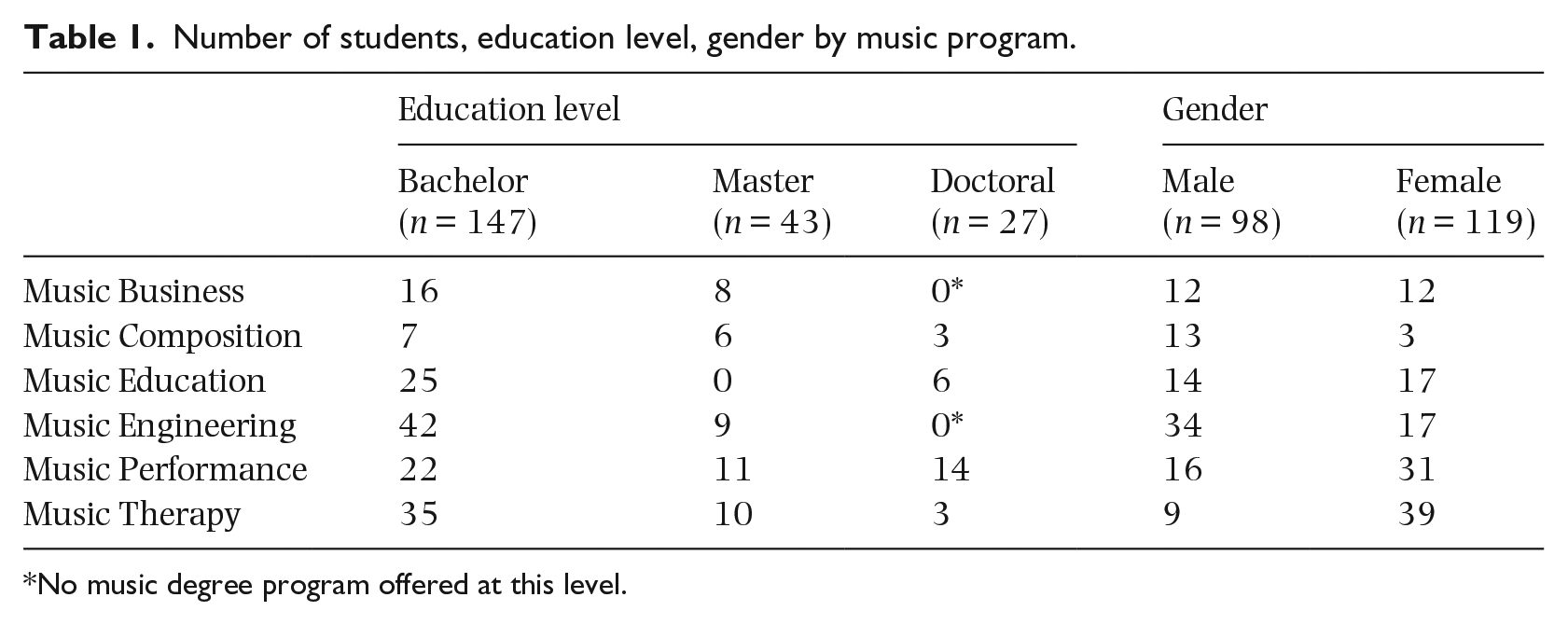
No music degree program offered at this level.
Participant race consisted largely of white (57%) followed by Hispanic/Latino (18%), Asian (16%), Black (6%), and Other (3%). Principal instruments and type of styles, including classical, jazz, and contemporary, varied across students. However, only type of instrument was recorded, with the greatest number of students being voice principals (34%), followed by piano (17%), string (13%), and the remaining principals, in order of highest to lowest numbers, comprised of woodwinds, guitar, brass, percussion, and other, such as multi-media.
Measures
Personal background information questionnaire
A researcher-designed questionnaire was used to gather participant demographic information of age, gender, race, music major, current education level, and principal instrument. There were six music major programs represented consisting of Music Business, Music Composition, Music Education, Music Engineering, Music Performance, and Music Therapy. Current education level categories included bachelor’s, master’s, or doctoral/PhD.
A second part of the questionnaire requested participants’ self-reflections about their personality and choice of music major. Specifically, they were asked “How do you think your personality influenced your choice of music major? What personality characteristics do you feel were influential?” The responses from this question were collected and matched to the quantitative outcomes. They are briefly presented in this article.
Myers-Briggs Type Indicator (MBTI)
Form M is a 93-item self-report measure and is the current standard measure of the MBTI (Myers & Myers, 1998). It contains eight different personality characteristics, as described above, that constitute four dichotomous pairs of mental preferences. The highest score on each dichotomous pair indicates the individual’s mental preference. For example, a score of 10 for Extraversion and a score of 12 for Introversion indicates a preference for Introversion. Four dichotomous preferences create a four-letter psychological type (e.g., INTJ).
All MBTI preference subscales demonstrate high internal reliability (Cronbach’s alpha = .91), as well as high test–retest reliability (.83–.94; Briggs Myers et al., 2003). In career counselling and business practice use of the inventory, qualified MBTI practitioners are expected to verify participant responses with a person-to-person follow-up discussion. However, the MBTI may be administered without such follow-up when utilized for research purposes. The author is a qualified administrator of the MBTI. The internal reliabilities for this study are acceptable by the parameters as defined by Payne (2003). Coefficient alpha for E/I is .86, S/N is .83, T/F is .83, and J/P is .86.
Analysis
Significant prevalence differences found in the national MBTI mental functions by gender (Briggs Myers et al., 2003) are compared to the prevalence of these functions in the music sample. Descriptive data of MBTI type, mental functions, and preference prevalence in the total music sample and by major are also given. Results from chi-square tests of independence are presented to show significant differences within music majors.
Four 6 × 2 chi-square tests of independence were used to determine significant differences between the dichotomous personality preferences and choice of music major. Chi-square tests of independence were also used to determine significant associations between the four mental functions and gender, and the four mental functions and music major. Alpha was set at .05. Adjusted standardized residuals, based on Agresti (2013) were required to meet a minimum of 2.0 to report significant differences. Cramer’s V values and effect sizes (Cohen, 1988) are provided for statistically significant outcomes. References to Agresti (2013) and Cohen (1988) are not repeated throughout the reporting of the results.
Results
Question 1: What is the prevalence of the full MBTI psychological types, the four mental functions, and the preferences of the total music sample? Do the proportions of the preferences differ significantly within the total music sample (i.e., by gender), given their independence? If so, how?
Table 2 illustrates the most prevalent MBTI type in the music sample is ENFP (16%), while in the national representation sample (NRS; Briggs Myers et al., 2003) ENFP is represented 11.25%. Over-representation of MBTI type in the total music sample is also found in the three next most prevalent types, as with ENFJ (14%; NRS = 1.6%), INFJ (12%; NRS = 1.3%) and INFP (11%; NRS = 4.1%). In common to all four of these types is the mental function of NF, which comprises 52% of total music sample. The national prevalence rates of the 16 MBTI types by gender are available, but are not reported here so as to not further subdivide the data.
Frequency of MBTI psychological types in the music sample (N = 217).
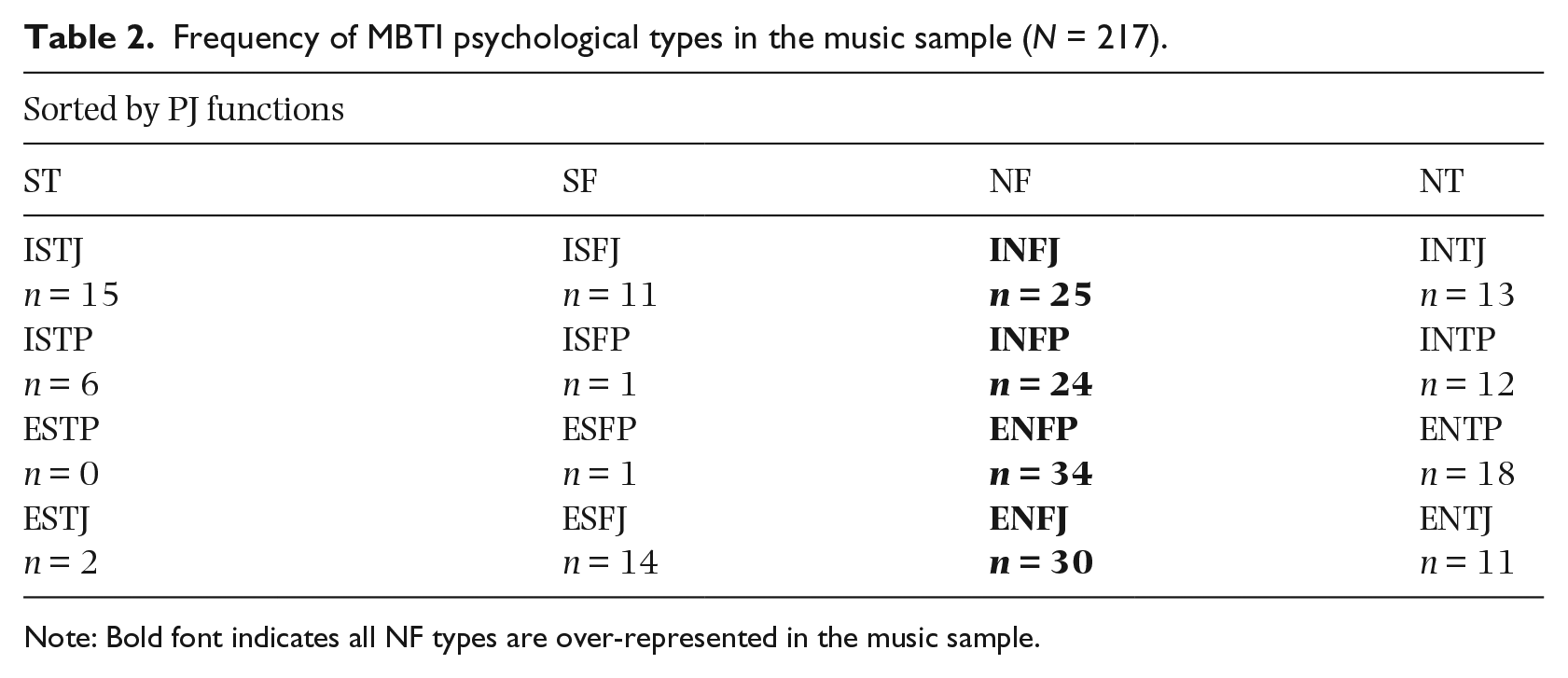
Note: Bold font indicates all NF types are over-represented in the music sample.
Substantial differences are found between the MBTI four mental functions and the preferences in the music sample when compared to the general population. MBTI reports the normative data by gender and therefore the data is displayed by gender (Briggs Myers et al., 2003). Figure 1 shows the high percent of NFs within each gender of the music sample. In comparison to the national gender norm, there is a significant over-representation in the music sample of NFs for males and females, a significant under-representation of SF for males and females, and a significant under-representation of ST for music males.
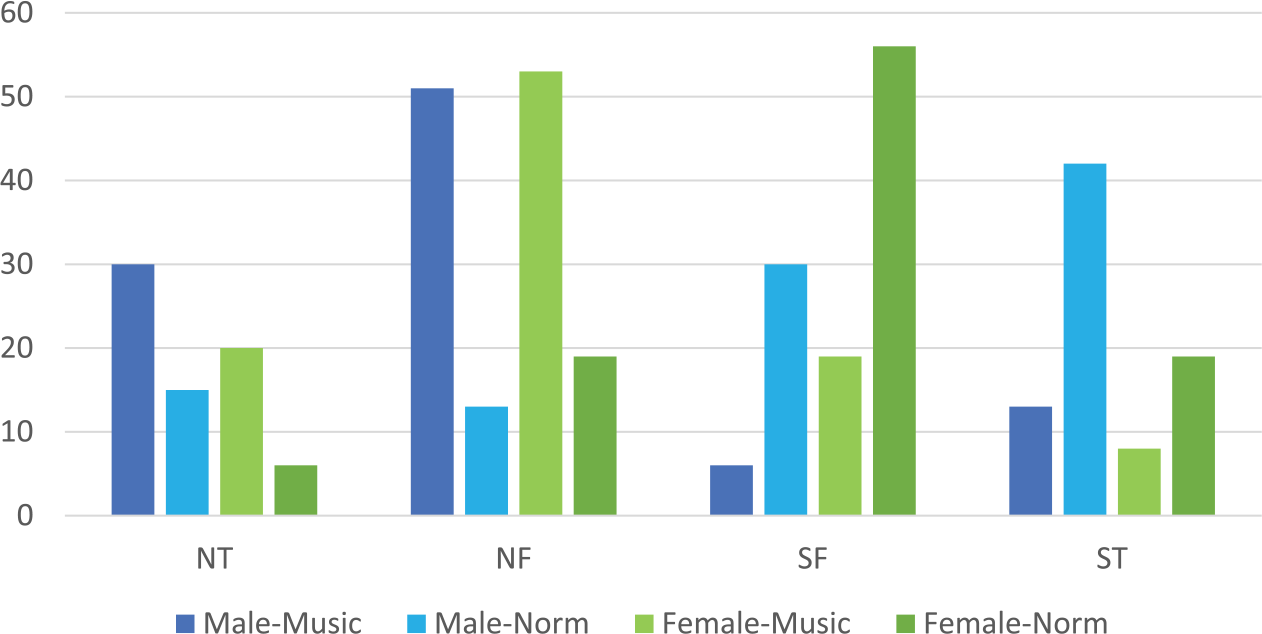
Percent of the four MBTI mental functions by males (n = 98) and females (n = 119) in the music sample and national gender norms.
The preferences
The Chi-square test of independence shows a statistically significant association between gender and T/F, χ²(1) = 6.749, p = .009. More specifically, based on the adjusted standardized residual there were significantly more F than T preference for females (z = 2.6), and more T than F preference for males (z = 2.6), than chance would prescribe. Cramer’s V for effect size is .175 based on 1 df, which indicates a large effect.
The Chi-square test of independence shows a statistically significant association between gender and J/P, χ²(1) = 6.362, p = .012. More specifically, based on the adjusted standardized residual there were significantly more J than P preference for females (z = 2.6), and significantly more P preference than J for males (z = 2.6), than chance would prescribe. Cramer’s V for effect size is .178 based on 1 df, which indicates a large effect.
Question 2: What is the prevalence of the full MBTI psychological type and the four MBTI mental functions by music major? Do the proportions of the mental functions differ significantly within each music major, given their independence? If so, how?
There is a wide representation of the 16 MBTI types within and across each music major and only the most prevalent type per major is reported here. The greatest number of type for Music Business is ENFP, Music Composition is ENFP, Music Education is INFJ, Music Engineering is ENTP, Music Performance is ENFJ, and Music Therapy is E/I-NFJ.
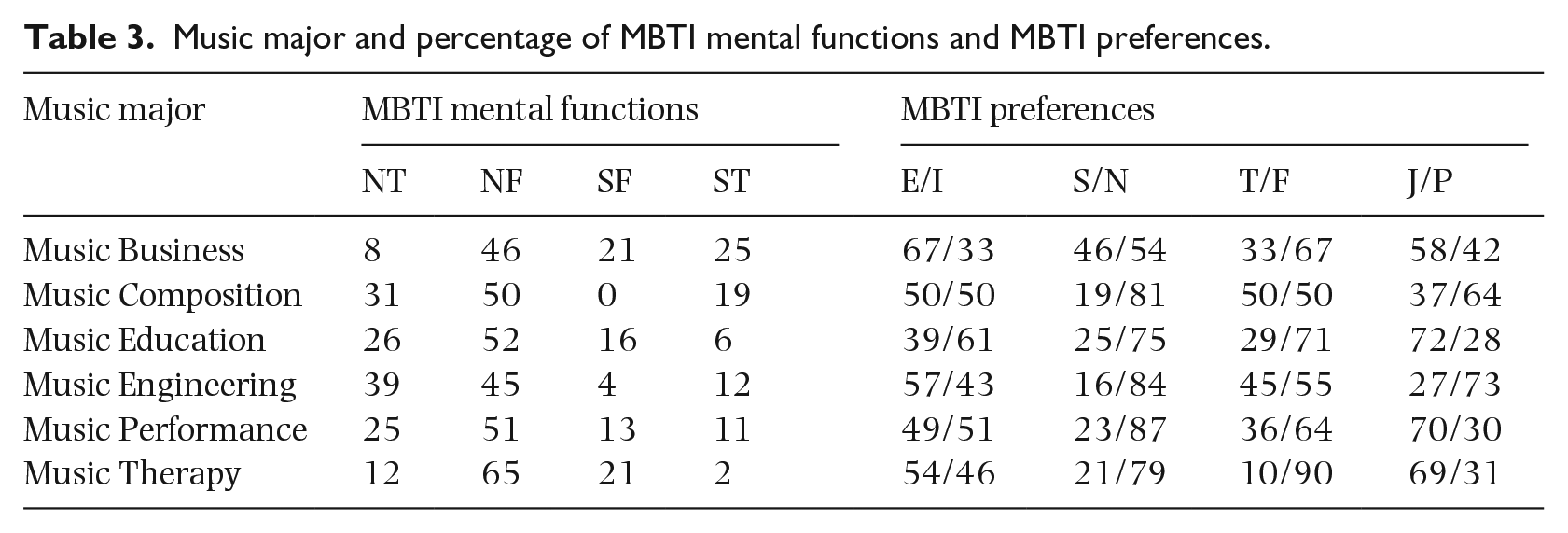
Concerning the four mental functions, Music Engineering possesses the highest percentage of NTs (39%), Music Business has the highest percentage of STs (25%), Music Therapy has the highest percentage of NFs (65%) and both Music Therapy and Music Business have the highest scores of SFs (21%). The Chi-square test of independence shows a statistically significant association of these four mental functions across music majors, χ²(15) = 30.947, p = .009. More specifically, based on the adjusted standardized residual there were significantly more NT types (z = 2.8) and significantly less SF types (z = −2.2) in Music Engineering, significantly more ST types (z = 2.4) in Music Business, and significantly less NT (z = −2.2) and significantly less ST (z = −2.2) in Music Therapy than chance would prescribe. Cramer’s V for effect size is .218 based on 15 df, which indicates a medium effect. See Table 3 for the four MBTI mental functions within and across music majors.
Music major and percentage of MBTI mental functions and MBTI preferences.
Question 3: What is the prevalence of the MBTI preferences by music major? Do the proportions of the preferences differ significantly within each music major, given their independence? If so, how?
Extraversion (E) and Introversion (I)
Descriptive statistical comparisons across music majors reveal that Music Business has the highest percentage of E (67%) and Music Education has the highest percentage of I (61%). The Chi-square test of independence shows no significant association between music major and the E/I preference, χ²(5) = 4.024, p = .546. In other words, the proportion of E versus I types was as expected within each music major. See Table 3 for E/I prevalence within and across music majors.
Sensing (S) and Intuition (N)
Descriptive statistical comparisons across music majors reveal that Music Business has the highest percentage of S (46%) and Music Performance has the highest percentage of N (87%). The Chi-square test of independence shows no significant association between music major and the S/I preference, χ²(5) = 8.892, p = .113. In other words, the proportion of S versus N types was as expected within each music major. See Table 3 for S/N prevalence within and across music majors.
Thinking (T) and Feeling (F)
T/F descriptive statistical comparisons across music majors reveal that Music Composition has the highest percentage of T (50%) and Music Therapy has the highest percentage of F (90%). The Chi-square test of independence shows a statistically significant association between music major and the T/F preference, χ²(5) = 16.828, p = .005. More specifically, based on the adjusted standardized residual there were significantly more T than F preference for Music Engineering majors (z = 2.2) and significantly more F than T preference for Music Therapy majors (z = 3.7) than chance would prescribe. Cramer’s V for effect size is .283 based on 5 df, which indicates a large effect. See Table 3 for T/F prevalence within and across music majors.
Judging (J) and Perceiving (P)
J/P descriptive statistical comparisons across music majors reveal that Music Education has the highest percentage of Judging (72%) and Music Engineering has the highest percentage of Perceiving (73%). The Chi-square test of independence shows a statistically significant association between music major and the J/P, χ²(5) = 26.948, p < .001. More specifically, based on the adjusted standardized residual there were significantly more P than J preference for Music Engineering majors (z = 4.6), significantly more J than P types for Music Performance majors (z = 2.3), and significantly more J than P types for Music Therapy majors (z = 2.1) than chance would prescribe. Cramer’s V for effect size is. 367 based on 5 df, which indicates a large effect. See Table 3 for J/P prevalence within and across music majors.
Discussion
This study examined the prevalence of Myers-Briggs psychological types of 217 university music majors from six different music programs: Music Business, Music Composition, Music Education, Music Engineering, Music Performance, and Music Therapy. The prevalence of the MBTI four-letter types is identified, and the four mental functions and the eight preferences across the music majors are compared to general norms. Significant proportions of the preferences and mental functions within each major were also examined. Discussion of the findings follows below with each re-stated research aim.
Aim 1. Prevalence of MBTI psychological types, the four mental functions, and the preferences of the total music sample
The MBTI four-letter type ENFP was most highly represented in the total music sample. The ENFP type is described by Martin (1997) with keywords such as enthusiastic, visionary, energetic, creative, and warmth. The ENFP types are led by their dominant function of N and these individuals are reported to constantly search for new things to take part in or to do the familiar in a new way. Under stress, they may take on too many projects, have difficulty saying no and, as a result, experience depression and physical exhaustion (Quenk, 2000). Ways of returning to equilibrium include meditating and receiving support, as opposed to experiencing patronization by others (Quenk, 2000). Previous studies found this same MBTI type to be prevalent in music majors (Henderson, 1984; Steele & Young, 2008). With a focus on being people oriented (extraversion) and creativity (intuition) and harmony with others (feeling), the ENFP type is well suited to contribute to music ensembles. Select narrative responses provided from the music majors reflect the characteristics of ENFP.
Creating and organizing things is something I’m very passionate about. I thoroughly enjoy bringing people together, and music is one of the best ways to do that; composition adds another layer to the opportunity to do just that. I feel that my being sociable and my appreciation for the work that goes into a completed project really steered me to this direction. (Music Composition, ENFP) I felt it was my calling to help people, to encourage and inspire as I experienced myself as a student. (Music Education, ENFP) I think my personality very much influenced my choice of major. I love meeting new people and trying new things. I am very outgoing and love sharing experiences with others. I love sharing in, and with, others the sense of connectivity that playing in an orchestra brings. I love the intimacy and vulnerability that playing solo can have. (Music Performance, ENFP)
Along with ENFP type, the next three most prevalent MBTI types found in the total music sample all have in common the NF core (i.e., E
The NF mental function and the N preference are over-represented in the music sample as compared to the national norms. The study, performance, and career of music appear to attract individuals with this preference and may be explained by the openness to experience and subjectivity that music experiences afford.
Gender also showed significant associations in regard to preference. Females in the total music sample had a greater proportion of the J preference versus the P preference, resulting in nearly a two to one ratio of J to P. This finding is in opposition to the general female population norms that report only slightly higher rates of J versus P. In contrast, males in the total music sample had a slightly greater proportion of P versus J than seen in the general male population norms. These results may reflect gender differences characterized by music students and may also be explained by gender characteristics found in specific music majors, as discussed below.
Aim 2. The prevalence of the four MBTI mental functions by music major
The mental function of NT was significantly prevalent in Music Engineering, while the SF function was significantly sparse in this major. NT types may be well suited to this major as they speculate about possibilities, and are skilled at technical problem-solving tasks, which are common requirements of engineers (Bureau of Labor Statistics, 2017). In contrast, SF types approach the evaluation of facts through their feelings and such an approach to gathering information may be contraindicated in the study and practice of music engineering; thus, the significantly low proportion of SFs reported in this major.
I think being logical and creative led me to choosing music engineering because you need both inventive/creative thoughts along with systematic and logical decisions when creating projects. (Music Engineering, ENTJ)
The finding of a significantly greater proportion of ST function in Music Business may reflect a “good-fit” relationship between person and task requirements. ST types tend to verify facts through their senses and are practical and matter-of-fact, qualities often needed in day-to-day business practice (Bruenger, 2015). The same mental function (ST), as well as NT, is significantly under-represented in Music Therapy perhaps for the same reasons it is needed for business. Clinical music therapy practice requires personal connection with others and use of intuition to understand the emotional status of clients (AMTA, 2014), thus perhaps the goodness of fit of the NF function to this major.
I enjoy when things are straight forward and clear but I also enjoy creative things. Music business felt to me like the perfect blend of those two qualities. (Music Business, ISTJ) I believe that my compassion for others led me to choose the music therapy major. I am dedicated to serve others in any way that will benefit their well-being. My creativity may have also played a part of my choice of major. (Music Therapy, ENFP)
Aim 3. The prevalence of the MBTI preferences by music major
Of all four pairs of the MBTI preferences a stark difference in proportion was found in the perceiving function of S versus N. In the general population, there are typically three S types to every one N type (Briggs Myers et al., 2003). In contrast to these reported norms, the opposite ratio of three N to one S type is found in every music major, except for Music Business where the ratio is nearly even. Since those with S preference are attracted to facts and pragmatics, Music Business may appeal to them as a sensible area of study and career. Thus, it follows that a small number of S preferences are also found in Music Performance, an area of study that may be experienced by the S preference as somewhat intangible.
I like spending time alone, so a major that requires a lot of solitary practice time suited me well. I also make a lot of decisions based on emotions and gut reactions, so a major that constantly requires emotional expression fits me well. (Music Performance, INFJ)
Each music major had a greater proportion of F than T preference, except for Music Composition which had an even ratio. However, Music Engineering, while still having a greater percent of F than T preference, had a significantly greater proportion of T preference than expected. This finding is perhaps not surprising given that the use of logic and analysis is required in this music major and career, which involves technical precision and theoretical analysis. Music Therapy had a significantly greater proportion of F preference than expected. The personal qualities of desiring harmony in groups and weighing decisions in a subjective manner is conducive to the practice of music therapy and, not surprisingly, this attracts individuals who prefer the F preference.
Differences in preferences across the majors were also found by gender. More specifically, there was a significantly greater representation of P preferences for males in Music Engineering; indeed, a four to one ratio of Perceiving to Judging. In contrast, Music Education and Music Therapy majors, highly represented by females, had nearly a three to one ratio of J to P. These findings may be a carryover from the majors that attract genders, as well as the tasks required of each study and career area. Music Engineering tasks that involve systems development often benefit from exploring new options and avoiding hasty decision making, an attitude espoused by the P preference. In contrast, organization and structure are needed for classroom management of large music groups, and for evidence-based practice of clinical music therapy; such qualities are well served by the J preference.
Limitations and recommendations
This study was limited by a relatively small sample size. A larger sample size collected from different universities is recommended. Investigating music majors by education level is also recommended. Likely a larger number of doctoral music research students will show type prevalence that differs from undergraduate music majors. Moreover, investigation of personality type by music major and instrument type and style might yield interesting findings. External validity can be improved by comparing music major personality to non-music majors and/or increasing the number of participants with music majors from other schools.
Conclusion
The N preference is highly over-represented by males and females in the total music sample as compared to the national representative norms reported by Briggs Myers et al. (2003). While almost three S types to every one N type are reported in the national sample, it is the opposite ratio for females, with an even greater ratio of four to one for the males. This strong representation of N may indicate that seeking patterns and associations, and creating new possibilities are found in music experiences, regardless of the music program, and are highly attractive to those with the N preference. Although the S preference is under-represented in the music sample, one should not infer that students with an S preference are ill-fitted to study music. Simply, a student with this preference will tend to focus and gather information on practical and factual details and be more attentive to the present. Indeed, those with S preference who share their orientation with others may help bring those with N preference into the moment by encouraging focus on the senses, rather than abstracting ideas.
Implications for music study and teaching should be examined given the over-representation of N and under-representation of S in music student groups. Future research should investigate how behaviors associated with the preferences are related to music tasks. For example, perhaps those with S preference more easily experience attentiveness to the moment when performing. Understanding differences in type and encouraging music students to share their approaches to decision making and to taking in information may be helpful in terms of practicing attitudes that are not as comfortable or familiar to one’s preference. Further, understanding one’s inferior function under stress and how to best facilitate preventing or undoing self-harm (Quenk, 2000) may be of benefit to music students, especially when stress is caused by performance requirements (e.g., Gibbons, 1991).
A natural transition to exploring one’s opposite preferences occurs around mid-life so that one’s personality growth is fully complemented (Jung, 1971; Lawrence et al., 2001). Perhaps the exploration of the lesser preferred preferences can be practiced more consciously by music students, albeit most in their young adult years, who may need those mental strategies for particular music study or career demands. This examination of MBTI type prevalence and associated characteristics should inform music researchers and educators, parents, high-school and college counsellors, and potential and current music students of the dynamics of psychological type in music programs. Knowledge of type characteristics should support and inform students who are deciding whether to pursue a music major. Further, students who are currently enrolled in a music major may find knowledge of type characteristics helps to deepen their understanding of the similarities and differences of those they find in themselves and those they observe in their peers. This knowledge and awareness can further enhance communication with peers in general settings and, more specifically, in the study and careers of music business, composition, education, performance, and clinical work.
Footnotes
Funding
The author received no financial support for the research, authorship, and/or publication of this article.