






Abstract
Keywords
North Korea is an illustrative limit case for exploring contributions of an aesthetic approach to ‘decentering’ IR and taking seriously non-Western subject positions and agencies. 1 North Korea is an international problem of human rights, poverty and security that sits across an enemy line, a line where empathy ends and the terrible begins. There are good reasons to condemn, hate and close down our ability to imagine subject positions – the source of life – across this enemy line. Here we can point to its notorious labour reeducation camps and frequent political purges and executions. 2 Taking North Korean subject positions on their own terms also becomes a problem because scholarship, art and culture are completely conceived in unity with its statecraft under the North Korean ideology, juche. 3 In literal translation juche means ‘one body’ and is often translated as ‘self-reliance’, which highlights the primacy of national autonomy and self-sufficiency in economy, politics, culture and knowledge. What is terrible about juche is how life is equated with sovereignty, and as the literal translation gestures, juche is a doctrine of oneness, of the total alignment of the social, political and biological cohered through the Kim dynasty. To dissent is to be cast out and purged from the circle of togetherness. In short, from this perspective, it is hard to imagine how North Korean art and texts on aesthetics could be sources of knowledge to advance our understanding of international politics, security, peace or aesthetics.
This article is too short to explain what is wrong with how our good reasons are formulated, and the accompanying pictures of North Korean politics, state violence and everyday life. In a sense, an aesthetic approach is exactly what is needed in cases like North Korea to creatively complicate the subject-object binary that runs deep in our engagements with the international. This article takes this argument on aesthetics further and hopes to demonstrate how aesthetic IR has much to gain from close encounters with North Korean aesthetics and politics. To start, North Korean art and aesthetics raise questions about limits in relation to non-Western sources and subject positions: Are there spaces that we cannot go into or ways of listening to worlds beyond the established West that cannot be accepted on normative grounds? Do we only listen to new voices, sources and actors that are innocent, admirable or at the very least those we can morally stomach? Efforts to establish limits, I argue, inevitably reify relations of domination and reaffirm the privileged location of the West in defining the parameters of politics, culture and knowledge. An aesthetic approach has something to offer here in questioning boundaries and limits. I have been thinking about this as an art of losing, a cultivation of vulnerability that refuses to craft the ‘I’ that thinks ‘[e]verything must hold together. In my craving for logic of being, i (sic) cannot help but loathe the threats of interruptions, disseminations, and suspensions’. 4 After a brief outline of this perspective, I illustrate by way of an image read in three ways: critical, imaginative and dissonant.
Losing to One’s Enemy
Rather than synchrony or submissive integration, an aesthetic mode draws upon dissonance of different faculties when seeking political insight. As other contributions do in this forum, I latch on to how Roland Bleiker writes about this as a matter of refocusing on the inescapable gaps between representation and the represented for ‘a more diverse but also a more direct encounter with the political’. 5 Reclaiming the political value of aesthetics, Bleiker argues, ‘allows for productive interactions across different faculties, including sensibility, imagination and reason, without any of them annihilating the unique position and insight of the other’. 6 I am interested in amplifying the dissonance that interactions across human faculties create to explore how experiences of vulnerability and disorientation can shift how we write the international.
As Bleiker puts it, ‘searching for a language that provides us different eyes, different ways of perceiving what we already know’ is imperative in IR and it is particularly important for thinking through the question of enmity. 7
Defined as above, aesthetics as a concept could allow a more direct encounter with the political in the face of the terrible, i.e. across an enemy line where vulnerability appears least effective or relevant. It takes us further in thinking about what we can do in the face of the terrible. Stephen Chan wrote a decade ago, ‘To enlarge the dot, to bring it to life, like a spear passing through, like a silent dropping to one knee before someone terrible, this should be the mission of understanding and meaning of IR’. 8 In using the analogy of the terrible, Chan highlights how IR must be concerned not only with the limit line of what is imaginable, but also of what is acceptable and tolerable. This is not a hark back to liberalism, that is, a politics of inclusion wherein the circle of humanity and equity is extended to those we understand or can accept. Rather, it is an art of losing and falling on one knee and from this position of vulnerability and humility, imagining the humanity in the terrible Other. It is to ask, how do we practise an art of losing and exhibit vulnerability fully perceiving the terror of sovereign politics?
An Image
Ri Song Bong’s ‘Multiplication Table’ (Figure 1) is a productive site for thinking through the art of losing across enemy lines.
9
This portrait of children memorising the multiplication was part of a collection on loan from Pyongyang’s National Art Gallery to the Museum of Applied Arts in Vienna in 2010. As mentioned earlier, under the juche ideology, art together with culture and scholarship are all cohered with statecraft. Art under juche is supposed to inspire and educate people in the truth of their value and dignity as autonomous beings. Yun Chong-sŏng writes,
As taught by Juche Ideology, sovereign human being is a being that has become the master of one’s destiny, a human being that realises this truth and struggles to put this truth into practice and in all social activities maintain the sovereign and creative position, and is a human being that struggles for this sovereignty.
10
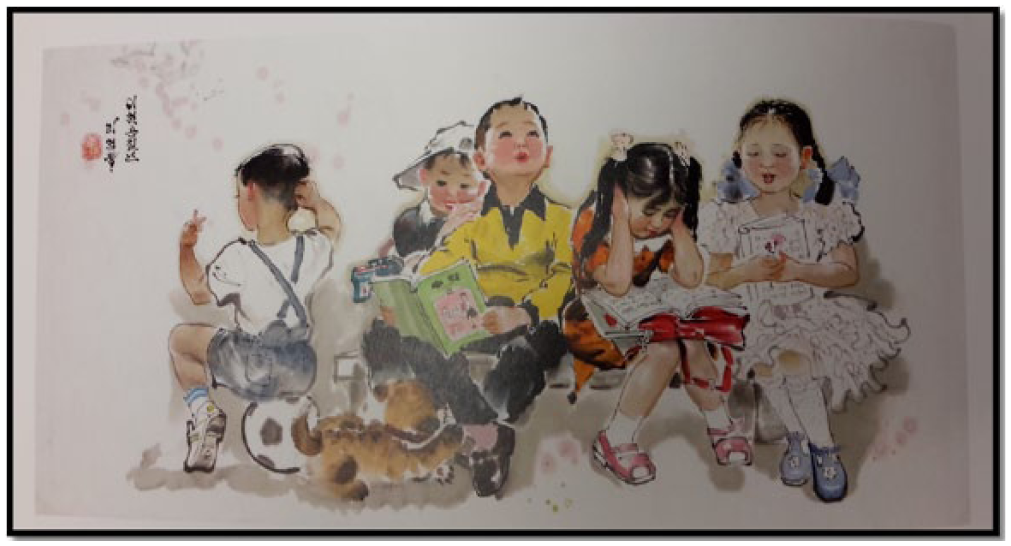
Multiplication Table, Ri Song Bong, 2007, National Art Gallery, Pyongyang.
In short, juche teaches, people follow, and art enables this teaching and following in the name of cultivating sovereign and creative positions. In this respect, art props up politics and for this reason the North Korean gallery loaned Ri’s painting for the high profile art exhibition in Europe. The political meaning of the portrait might be apparent to some, but it may feel obscure to others, especially when viewed next to depictions of historical revolutionary scenes or portraits of the two Kims that largely composed this collection.
View One: Critical
Consequently, one reading is to view the attractive subjects in the painting as part of art following the politically mandated juche aesthetics of drawing bright active subjects that reflect ‘our national [soft and clear] colour aesthetics’. 11 It is drawn in an ink and brush style, which as chosunhwa (chosun means ‘Korea’ in North Korean lexicon) is an ‘indigenous’ art form that emerged from the 1960s–70s debate in North Korea as the exemplary form of juche art because, contra oil painting, it is a non-Western ‘our style’ (urishik) tradition. 12 Exemplary juche aesthetic of brightness and clarity is easily embodied and is natural to traditional brush and ink paintings that leave the background space of the paper empty. It is moreover clear lined and exemplifies the chosunhwa technique of concentration and simplification which removes details and highlights the essence, for instance in one broad stroke technique that creates ‘photographic clarity’. 13
While it is not surprising that a nationalist political doctrine would embrace a painting style that can be easily claimed as ‘indigenous’, this emphasis on clarity and brightness is also integral to the pedagogical function of juche art. Art must not disturb, depress or stagnate but inspire, affirm, and propel; the bright colours, clarity of lines and aesthetically pleasing forms are mobilised for the latter. Kim Chae-hong explains the importance of positive feelings in art in a theoretical language. He writes, ‘Emotions we have toward beauty is related to the creation and understanding of a subject that meets a person’s autonomous demand (yogu) and orientation (jihyang). As a result, this emotion is experienced through happiness, pleasure, awe and love, optimism and pride’. 14 In this formulation, beauty is a material phenomenon that is grasped as an affirmative emotion, because beauty is subsumed under juche politics that values sovereignty above all. As Yun Chong-sŏng asserts, ‘A people that loses national sovereignty is not only a being without social and political life but is also unable to maintain life of the body’. 15
What we learn here is how suppression and violence can be represented in light, airy, innocent form. This wonderfully light scene of ‘Multiplication Table’ is also a quiet scene of violence: one back turned, eyes closed, ears shut, a puppy ignored, all because the multiplication table has to be memorised, the lesson has to be learned and this learning requires shutting the world out of minds and dulling the senses to do so. I want to highlight here how it does not take North Korean specificity to understand the violence of the scene. We can turn to the shared experiences of living in modernity and how we try to gain so much, travel such distances that we follow numbers, formulas, approximations in the name of arriving at the correct answers and destinations. To follow numbers is to follow the outlines of the world we inhabit through harmonisation of our senses. The painting could be experienced to illustrate how the world is made to disappear when we harmonise our senses.
But if the scene of harmonisation of senses still allows for this reading of shared failures at autonomy, the violence of this scene can be returned to North Korean specificity by the perched toy gun in the scene. With this gun at the centre of our visual experience, the image directly contributes to North Korea’s political mantra, ‘Gangseong taeguk!’ (Strong, prosperous great nation!). The presence of the toy gun also aligns with the growing depiction of children using guns in children’s books and cartoons, which some have argued is symptomatic of the militarisation of North Korean society. 16
View Two: Imagination Gone Wild?
All in all, Ri’s ‘Multiplication Table’ follows the well-established conventions of ‘our style’ (urishik) aesthetics, which is nationally conceived as much as it is ‘populous’ in intention. However, this populous intention is important. It can serve as an entryway to engage North Korean art and aesthetics as not simply an object of our critical thinking, but also at the same time a subject with sources of life, meaning and agency that cannot be subsumed under a singular critical lens. While state sanctioned art functions as a tool for juche teachings, for juche art to possess this life-giving pedagogical function, art needs to love and be loved by the people. Yun explains, ‘Juche art theory recognises that the people judge and decide the value of art. The true judges of art are the people and there are no higher critics of art. For art to be good, the people must love and appreciate a work of art’. 17 Art earns people’s love by having the people as its focus, by capturing the beauty in their lives and by being accessible. 18 Art’s accessibility is sacred because art’s love for the people is affirmed only when the people return the love that art labours to earn.
In other words, there is something alluring about this painting that works not through instructing what people should do, but by attracting people to the image by mobilising existing shared sensibilities about emotion, beauty and taste. The surface of the message is as much the message as its content. Its concentrated brush stroke is moving in its simplicity, its exactness of movement, its grace and softness. The scene is light, ethereal, joyful because its cartoonish subject – the cute, adorable children – are in a decidedly oriental brush and ink tradition, in bright primary colours of yellow, red and blue with jet black eyes and hair set in contrast to the blank background. Like a page from a good graphic novel or an illustrated storybook, the image is easy on our senses yet its active, life-leading mode of depicting reality (i.e. realistic, not abstract) is pregnant with stories. It is an image that wants to tell stories.
What I am trying to bring into view and imagine is how the power struggle in juche as a political doctrine is real: Juche art seeks to touch and move people to become what they see. It is in their struggle to emulate the representation that people supposedly learn to love and affirm art from this elevated position that art visualises for them. Yet, while art is pedagogical and hierarchic, art is always beholden to juche that dictates art gains form, not in the language of the artist, but in the language of the people, or, to be more precise, in the language of the everyday. Yun writes,
A human being that has life is a human being that lives and leads a life. To lead a life is a human method of existing. A human being that does not have a life, a human being without a life to lead does not in reality exist. Thus to draw a being that is alive is to draw a being that leads a life.
19
Rejecting abstract art, impressionism and surrealism as class oppression or destructive to life, juche realism is an art of making visible a world that can and should exist in semblance of human life as lived by everyone. 20 In other words, realism is seen as the form that gives life and is born out of an attachment to living as a method of existence and art. If this is ‘brainwashing’, then ‘brainwashing’ is a complex populous driven enterprise that values the everyday and human life. Egalitarianism is its intent.
The reviewers of an earlier version of this essay requested that I make my normative position explicit, so let me make my point about dissonance crystal clear (yes, I am aware of the painful irony of this sentence). I am suggesting the two readings side by side: the first reading, which is critical and exhibits a clear normative stance, and the second reading, which tries to encounter juche art with a little more imagination that may raise alarm bells about my morals and politics. These are just two illustrative views and there are multiple other directions the image can take us. For me, the contribution of an aesthetic approach to IR lies in creating a space for asking questions in ways that bring into view these multiple readings side by side, in full contradiction, in dissonance. Critical readings of North Korean images, texts, social institutions and policies will variously suffer from the problem of reifying Cold War divisions, mobilise the impulse to distance ourselves from what we perceive as the terrible Other, take a position of knowingness that shuts down dialogue. This problem calls for more creativity and not competition for higher moral grounds.
About that Gun: A Case for Dissonance
It is in this expanded reading of the image that I return to the surreally positioned toy gun squeezed into a space that defies our commonsensical expectation, for instance a hand holding the gun. The toy gun is remarkable in its ambiguity. It does not exhibit the clarity of lines and shape promoted by juche aesthetics. It is a blue blob that has the rough outline of a toy gun. Moreover, it is attached innocuously to the two boys leaning on each other in a position that is akin to surrealism more than realism. As discussed earlier, ‘realistically’, it makes sense for a toy gun to accompany children at play in juche art but the gun looks like an afterthought, a reluctant or perhaps a pressured addition and an object that should not be there. Viewed as a surrealist gun, it could become a shared object of dissonance. Reading it simply as an effect of state propaganda is to stay with harmonisation of the senses to separate us from them, to distance ourselves from what we perceive as perverse or dark.
The point of the art of losing is to lose and in this losing not so much gain but share and create something that is otherwise impossible. This creative engagement must have in its foundation North Korean sources of life, peace, love on their terms, no buts, no what-ifs. To locate North Korean sources and definitions of peace, love, life, etc. as part of what could transform not only North Korea, but also international politics is itself always a work of translation. As postcolonial scholarship on translation has long stressed, translation is a relational practice of knowledge and creation. There is no romanticisation of the authentic North Korean other, this is not another naïve search for innocent natives. For me, turning to non-Western sources is an art of losing, i.e. creating something relationally in the silence of falling on one’s knees in the face of the terrible. It is to turn IR into an expansive practice in the face of incommensurable differences, in the midst of war, under subjection of realpolitik. It is about learning to be expansive – calming down our breath, questioning our certainties – through cultivation of vulnerability as a form of being in the world. As Trinh Minh-ha put it beautifully, ‘Perhaps, to practice the erotic science of breath is to learn how to perform simple activities such as to make a sound, to say a word, to pause, to be silent’. 21
Footnotes
Acknowledgements
I would like to thank Aida Hozić and Maria Deiana for generously thinking through this piece with me. I also want to thank the anonymous reviewers for their challenging comments on an earlier version of this article.
Funding
This research received no specific grant from any funding agency in the public, commercial, or not-for-profit sectors.
1.
By ‘decentering’ I have in mind not only Nayak and Selbin’s book, Decentering International Relations, but also feminist, postcolonial, decolonial, queer and other critical/creative IR scholarship. Meghana Nayak and Eric Selbin, Decentering International Relations (Lanham: Zed Books, 2010); Branwen Gruffydd Jones, ed. Decolonizing International Relations (New York: Rowman and Littlefield, 2006); Anna M. Agathangelou and L. H. M. Ling, Transforming World Politics: From Empire to Multiple Worlds (London and New York: Routledge, 2009); Christine Sylvester, Feminist International Relations: An Unfinished Journey (Cambridge and New York: Cambridge University Press, 2002); Marysia Zalewski, Feminist International Relations: Exquisite Corpse (Oxon: Routledge, 2013); Cynthia Weber, Queer International Relations: Sovereignty, Sexuality and the Will to Knowledge (New York: Oxford University Press, 2016).
2.
For recent narratives, see Blaine Harden, Escape from Camp 14: One Man’s Remarkable Odyssey from North Korea to Freedom in the West (New York: Penguin Books, 2012); Jang Jin-sung, Dear Leader: Poet, Spy, Escapee – a Look Inside North Korea, trans. Shirley Lee (New York: 37 Ink/Atria, 2014); Krys Lee, How I Became A North Korean: A Novel (New York: Penguin Random House, 2016).
3.
A list of insightful scholarship here might include: Suk-young Kim, Illusive Utopia: Theater, Film, and Everyday Performance of North Korea (Ann Arbor: University of Michigan Press, 2010); Sonia Ryang, Reading North Korea: An Ethnological Inquiry (Cambridge: Harvard University Press, 2012); Jeon Young-sun, Kŭl kwa Sajin ŭro ponŭn Pukhan ŭi Sahoe wa Munhwa [Looking at North Korean Society and Culture Through Words and Pictures] (Seoul: Kyungjin, 2016).
4.
Trinh Minh-ha, ‘Difference: “A Special Third World Women Issue”’, Discourse 8 (1986–87): 27.
5.
Roland Bleiker, Aesthetics and World Politics (Basingstoke: Palgrave Macmillan, 2009), 20.
6.
Ibid., 20.
7.
Ibid., 94.
8.
Stephen Chan, ‘A Story Beyond Telos: Redeeming the Shield of Achilles for a Realism of Rights in IR’, in The Zen of International Relations, eds. Stephen Chan, Peter Mandaville, and Roland Bleiker (Basingstoke: Palgrave Macmillan, 2001), 85, emphasis added.
9.
From the exhibition catalogue, Flowers for Kim Il Sung: Art and Architecture from Democratic People’s Republic of Korea, curated by Peter Noever for the Museum of Applied Arts, Vienna in 2010.
10.
Yun Chong-sŏng, Chuch’e ŭi Yesul Iron 2 [Juche Theory of the Arts 2] (Pyongyang: Korea Social Science Publishing House, 2010), 40, added emphasis. All translations of this text in this article are my own.
11.
Kim Chae-hong, Chuch’e ŭi Miron [Juche Art Theory] (Pyongyang: Literature and Art Publishing House, 1993), 167, my translation; also Yun, Chuch’e ŭi Yesul Iron, 290.
12.
Frank Hoffman, ‘Brush, Ink, and Props: The Birth of Korean Painting’, in Exploring North Korean Arts, ed. Rudiger Frank (Vienna: Universitat Wien, 2010), 162–71; Hong Ji-suk, ‘Foundations of North Korean Art’ [‘Bukhan Misul ŭi Kiwon’], in Sŭt’ail ŭi T’ansaeng: Pukhan Munhak Yesul ŭi Hyŏngsŏng Kwajŏng [Birth of a Style: Formation of North Korean Art and Literature], Tan’guk Taehakkyo Pusŏl Han’guk Munhwa Kisul Yŏn’guso p’yŏn (Seoul: Kyungjin, 2014),198–206.
13.
Hong Ji-suk, ‘Bukhan ŭi Minjok Hyungsik gua Chosunmi Damron’ [‘Discourse on North Korean National style and Chosun Aesthetics’], in Chuch’e ŭi Hwanyŏng: Pukhan Munye Iron e Taehan Pip’anjŏk Ihae [The Illusions of Juche: A Critical Understanding of North Korean Art and Literature Theory], Tan’guk Taehakkyo Pusŏl Han’guk Munhwa Kisul Yŏn’guso p’yŏn (Kyung-gi: Kyungjin Munhwa, 2011), 192–203; Yun, Chuch’e eui yesul iron, 284–93; Kim, Chuch’e ui miron, 161–71.
14.
Kim, Chuch’e ui miron, 12.
15.
Yun Chong-sŏng, Chuch’e ŭi Yesul Iron 2 [Juche Theory of the Arts 2] (Pyongyang: Korea Social Science Publishing House, 2010), 41. All translations of this text in this article are my own.
16.
Dafna Zur, ‘Engineering Utopia: The Turn to Science in Postwar North Korea’ and Jeon Young-sun, ‘North Korea’s Post-1972 Child Education Policy As Seen through Animation’ (papers presented at Association for Asian Studies Annual Conference, Chicago, USA, 26–9 March 2015).
17.
Kim, Chuch’e ŭi Miron, 57, emphasis added.
18.
Ibid., 56–7.
19.
Ibid., 36.
20.
Yun, Chuch’e ŭi Yesul Iron 2, 279–84.
21.
Trinh Minh-ha, Elsewhere Within Here: Immigration, Refugeeism and Boundary Event (Oxon: Routledge, 2011), 83.