







Abstract
Motivated by an industrial Research and Development project, this article presents the development of a teaching module that helps to motivate the discussion of published articles. This module is part of a new activity called Assessing Published Results for the Advanced Experimental Engineering senior course. Using theory, experiment and computation, the module explores the question of how to properly measure the Young's Modulus of cantilevered beams subject to external loads. At the end of the analysis, we conclude that using standard theory may create artifacts that could erroneously be interpreted as load-dependent changes in elasticity. Our analysis demonstrates conclusively that the Euler-Bernoulli theory artificially produces a load-dependent Young's Modulus, whereas the Elastica theory correctly returns a constant value.
Keywords
Introduction
The teaching ideas presented here were motivated by an industrial research project. One of the authors (FRZ) did industrial R&D consulting on measuring mechanical properties of nanowires. The project hinged on previous research that found that, due to microstructural changes, nanowires under large stresses soften. 1 The company wanted to know whether the softening was real or a measuring artifact. The original experiment was performed on cantilevered nanowires loaded at one end by a micromanipulator, while their deflection was monitored in situ by a scanning electron microscope. The analysis of the experiment was done using Euler-Bernoulli theory of bending beams and predicted a smaller Young's modulus for large bending. Even though the experiments were done within the elastic regime, the company suspected of the results because the Euler-Bernoulli theory range of applicability is limited to small bending, while the experiments included large bending. In what follows we refer to the general theory of a bent rod as the Elastica, 2 and the limit of small deflections as Euler-Bernoulli.3,4
As our department has been actively seeking and implementing teaching activities at the intersection of experiment, theory and computation that are relevant to the industrial career aims of our students, this R&D project presents an ideal opportunity. The results of this paper have been tested as a new module, Assessing Published Results in the Advanced Experimental Engineering course that we teach once a year. In particular, we focus on the subject of interpreting and working with published results, a topic of immense intellectual and practical value that receives little attention in standard physics curricula.
Assessing published results is a key step to engage genuinely with the experimental nature of engineering. When students are encouraged to show understanding of their reading, they must identify relevant variables, predict outcomes, and connect theory with observation—processes that deepen both conceptual understanding and experimental reasoning.5,6 Explicit instruction and practice of this active learning process promote meaningful experimental design and foster reflection on evidence and on uncertainty. 7 Embedding this practice in laboratory work thus promotes students to think and act as practical engineers, using critical thinking as purposeful tool for further inquiry.
We began the activity by sharing the paper, reference 1, with students, and asking them to produce preliminary comments based on their reading. These ideas were logged and used after performing our own experiments to reevaluate them and reach final conclusions based on the additional knowledge gained. Students learn experiments, computation and theory, motivated by the central aim of coming up with their own individual surmises – the instructor made every effort to promote educated speculation to reach informed postulates. In this way we developed the class activity as an ongoing open-ended, but guided, discussion rather than a typical presentation with a predetermined final product. For our experiments, we substituted the nanowires with ∼10-in long cantilevered beams loaded at the end, while the scanning electron microscope monitoring system was replaced by an optical camera. Figure 1 shows a picture of such an arrangement.
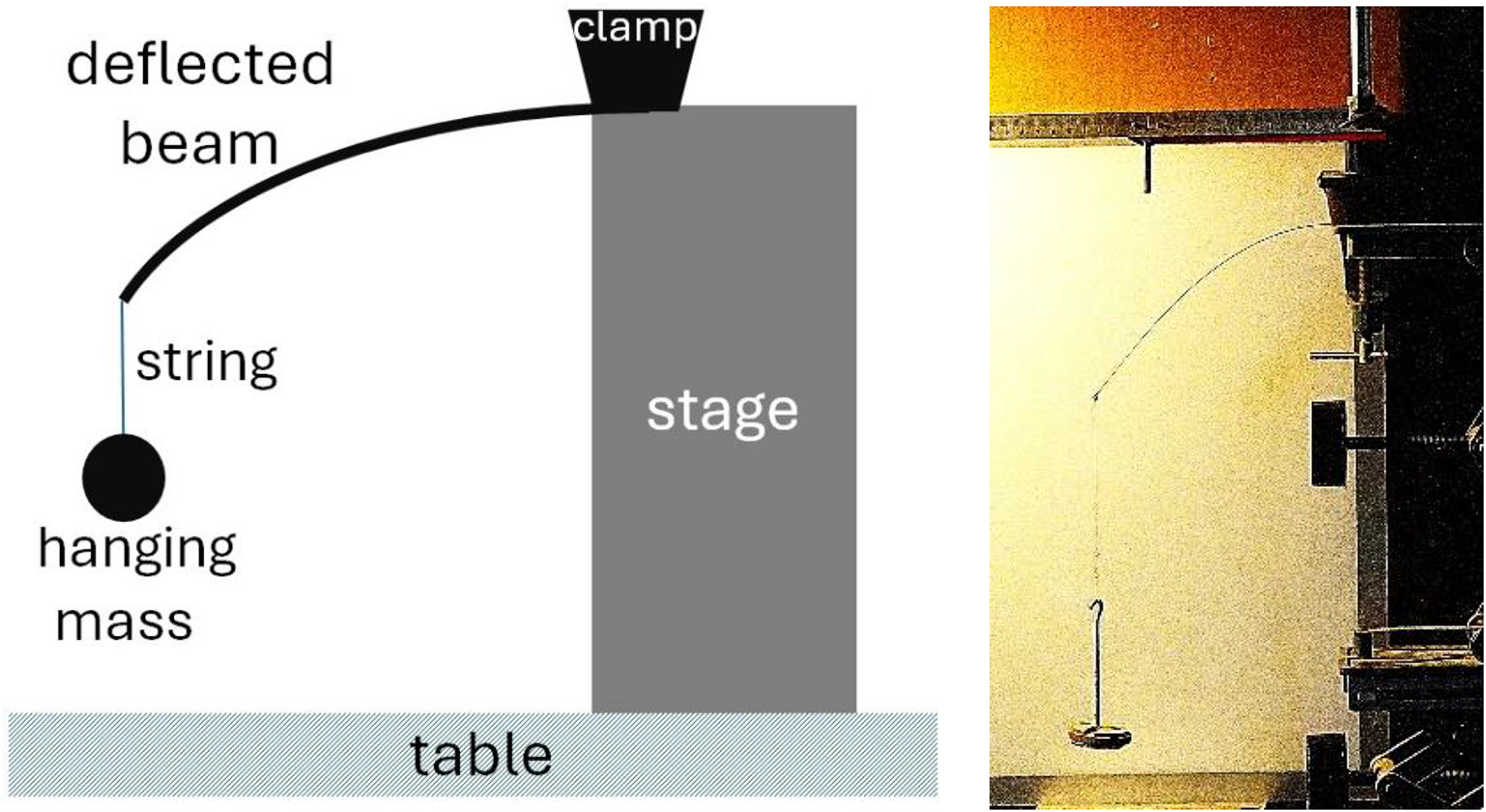
Schematic diagram of the experimental setup, and photo of cantilever beam deflected down by 80-gram weights at its free end.
Specifically, we used a tempered steel feeler stock Starrett model 015 as the bending beam. 8 The feeler stock is 0.015 inches thick, 0.5 inches wide,12 inches long (30.48 cm), and was held fixed on a vise (top right of figure 1) – the fixed end of the cantilever. Out of 30.48 cm, 10.48 cm on the right are clamped by the vise, leaving a 20 cm free-hanging beam.
The goal of the experiment is to understand whether the use of Euler-Bernoulli's theory to analyze bent beams leads to inaccurate predictions of the Young's modulus for large deflections. Before starting the experiment, students already have an idea that large deflections should present a problem. Indeed, based on their prior knowledge on mechanics of materials, students know that the Euler-Bernoulli equation is derived under the assumption that the beam is only slightly bent.
Experiment
A camera 9 was placed 3.4 m away from the setup, and photographs were taken of the beam bent under different loads, up to 120 grams. Each picture was subsequently uploaded into Plotdigitizer 10 to extract the coordinates along the beam. An output example of such a conversion is shown in Table 1.
Cartesian coordinates of the cantilever beam under the influence of an 80-g weight as in figure 1.

Table 1 shows 17 cartesian coordinates along the beam. A graph of those points is shown in figure 2. The origin is taken at the clamped end. The abscissas are positive to the left, and the ordinates are positive downward.
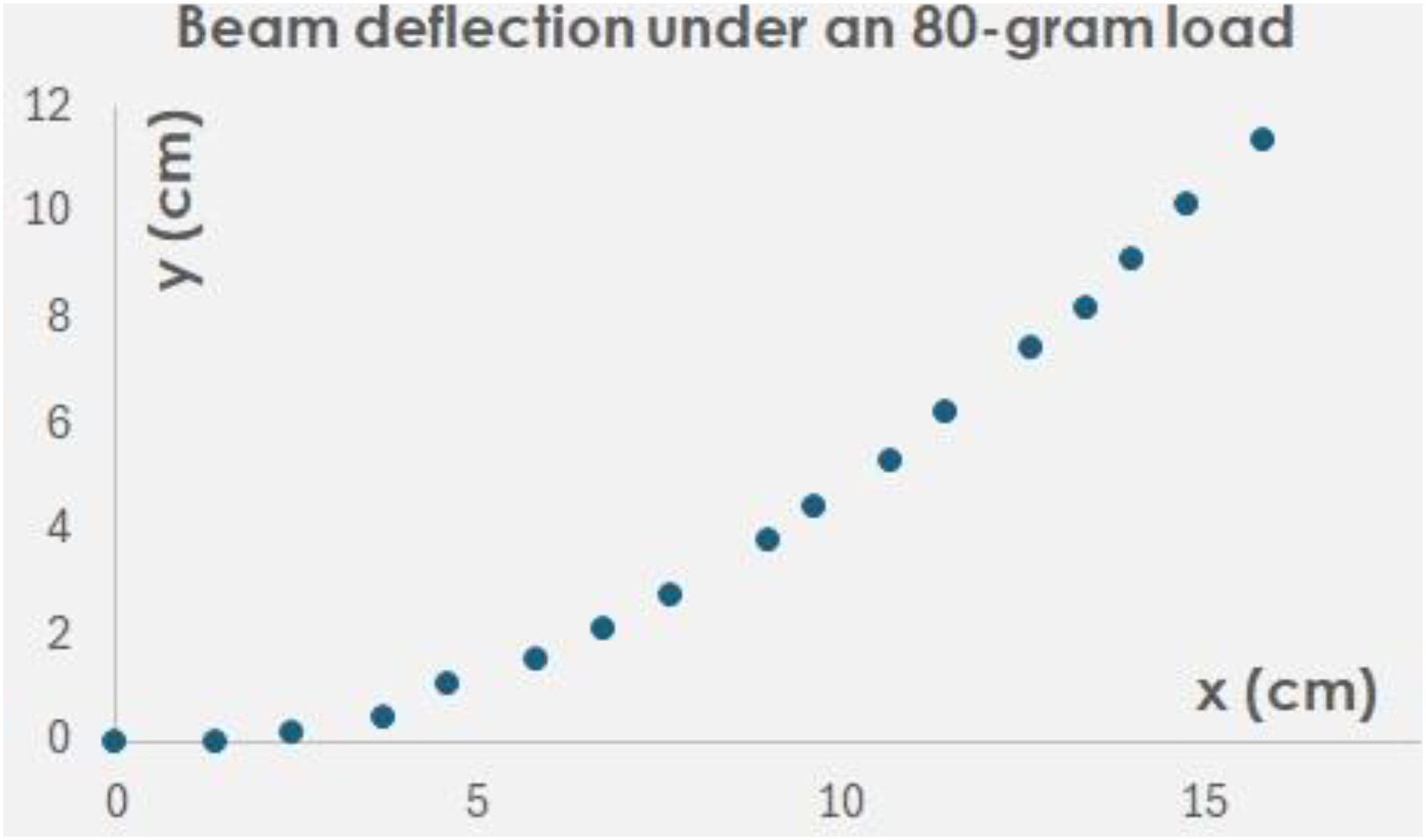
Figure 3 shows graphically the data collected for weights up to 120 grams in steps of 20 grams.
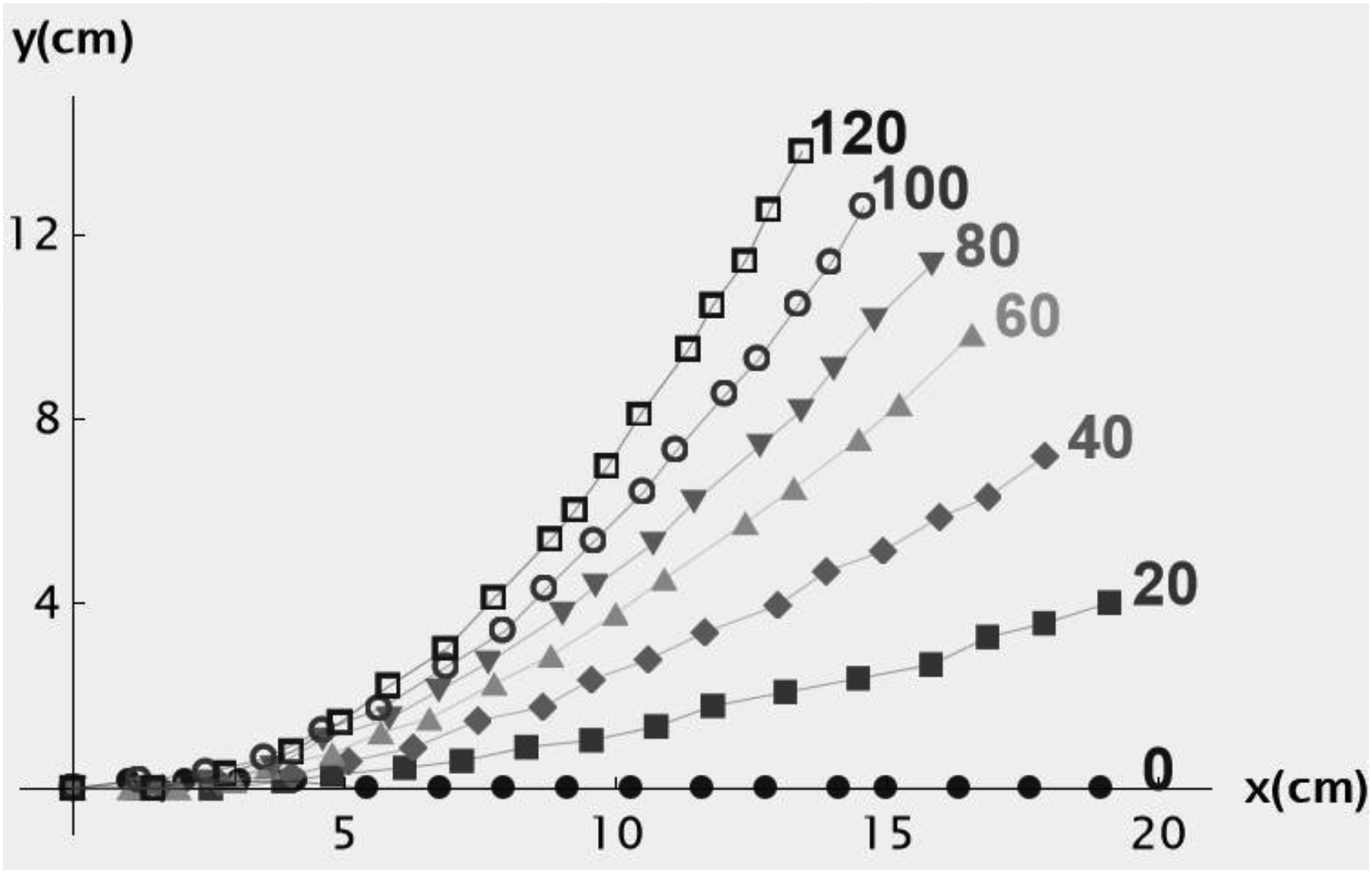
Coordinates extracted from pictures of the bent beam under loads up to 120 grams. The labels at the end of each curve corresponds to the weight in grams. The lines between the points are just straight segments to aid the eye follow each weight instance.
The data in figure 3 is subsequently used to measure the Young's Modulus of the beam, and to explore the effect of load on its value.
Theory
In subsections 3a and 3b, we will establish the theoretical expressions that will be used to fit to experiments. In 3a, we consider the general case, and in 3b we analyze the restricted case of small-deflection beams.
Shape of the Elastica
Figure 4 shows a diagram of the bent cantilever, including the parameters used for the analysis.
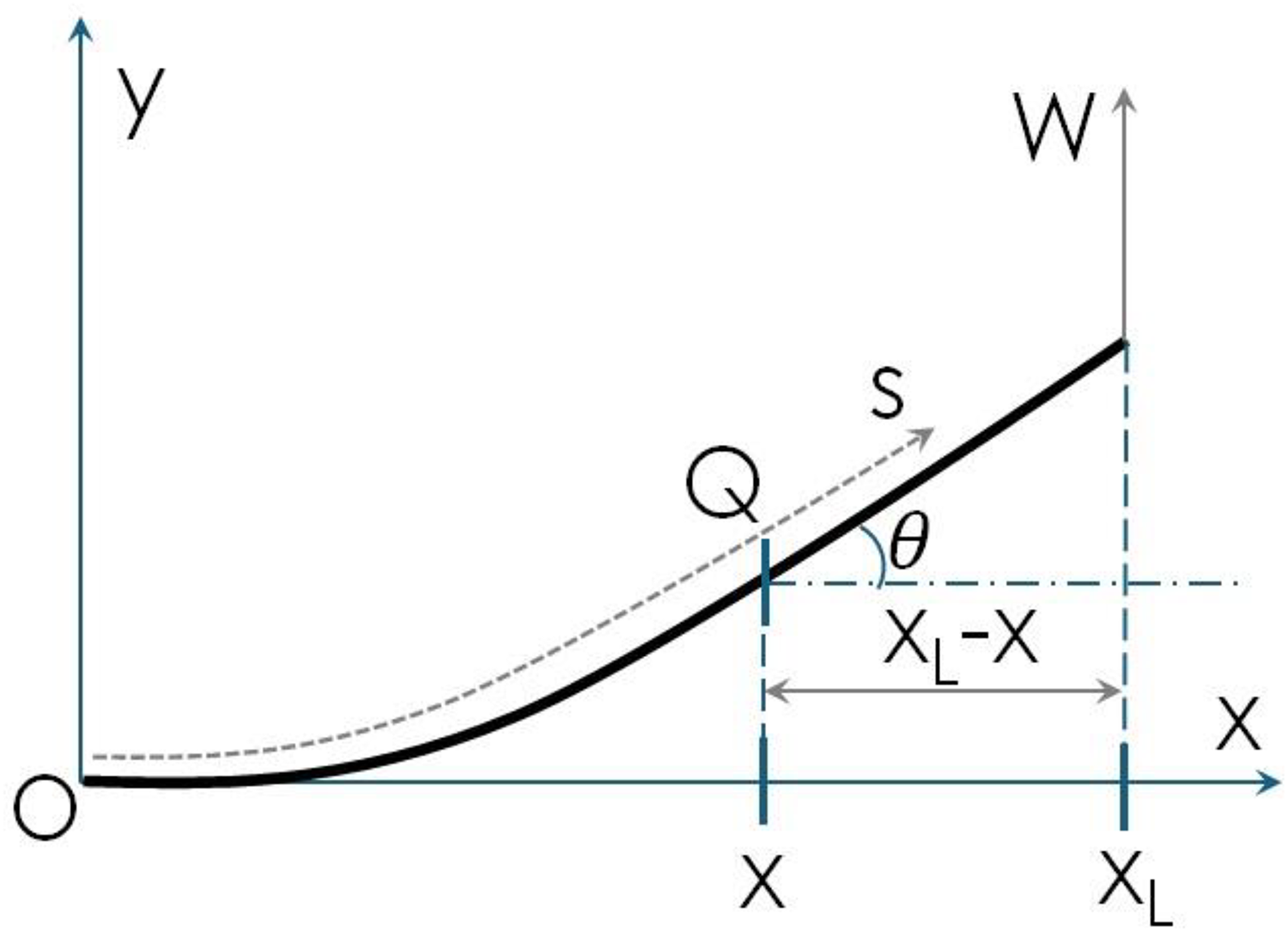
Diagram of the bent cantilever, with gravity acting in the positive y-direction.
The cantilever beam is held fixed at point O (the origin). It is bent by a weight W applied at the hanging extreme. The arclength, s, measures the distance of a point along the beam from the origin. At the hanging end we have
We begin with the connection between geometry and torque. When a beam is bent, it responds by producing an internal torque, easily felt for example when bending a fishing rod. For small and large bending, as long as it is within the elastic regime, we have,
11

Next, the curvature is the derivative of the slope of the curve with respect to the arclength,
12

In addition, from figure 4, we see that the torque at point Q, due to W on the right (in equilibrium, the reaction forces and torque at the origin produce at Q the same torque in opposite sense) is,
Using equations (1), (2) and (3),
Taking the derivative with respect to s on both sides of equation (4) gives,
Since, from figure 4, we have that 
Equation (6) can be integrated once with respect to s,
Where 
Where 
Where we have kept only the positive sign of the square root because
Since the bar has stiffness, one boundary condition is that it is horizontal at the contact point (see figure 1), that means that at
In preparation to fit to the experimental data of figure 3, we now proceed to find the theoretical shape y(x), starting from the observations that, in addition to the already used 
Using that the integral on the right-hand side of equation (10) has an analytical form [[13]], we have,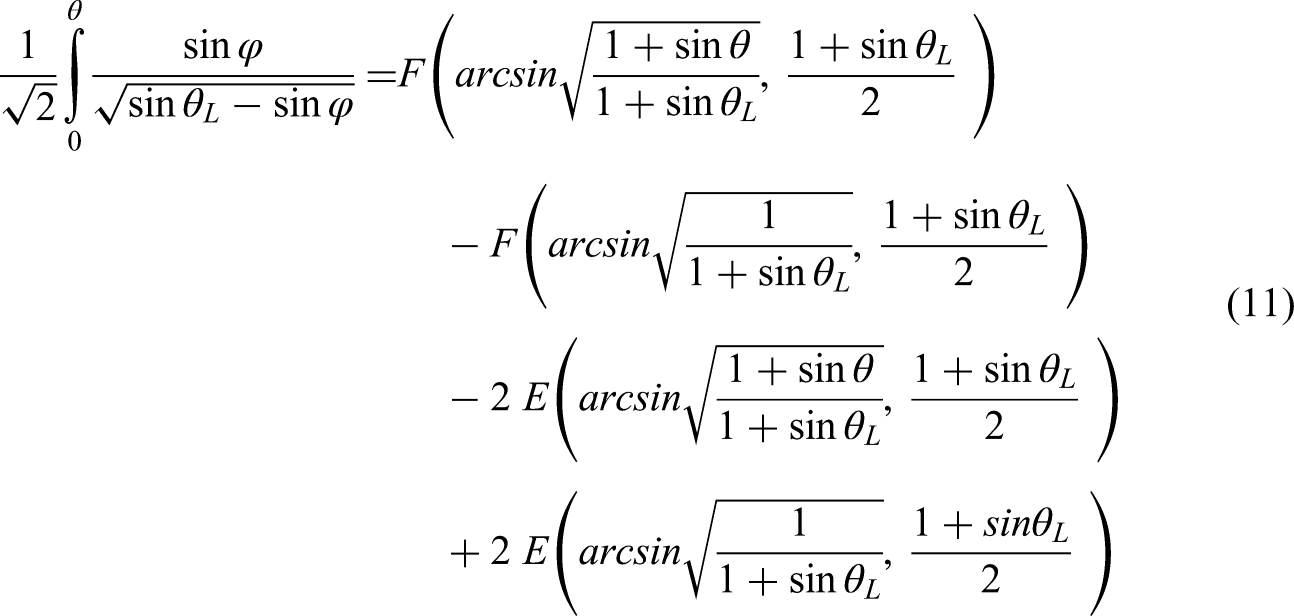
Which gives y as a function of 
Where
To find the x coordinate we proceed similarly,
The integral in equation (13) can be calculated readily and has a simple expression,
Since
For a beam of given E and I, under a load W (and corresponding end angle
Euler-Bernoulli. Small deflections
When equations (12) and (14) are considered in the limit of small deflections, that is, small W and consistently small 

In this small-deflection limit, equation (16) for 
Where we replaced x by L, since for small deflections, the largest x coordinate coincides with the length of the rod.
Solving for 
Which is exactly the solution to the Euler-Bernoulli equation for a cantilever beam under a force W at its extreme. It is nice and gratifying to obtain this result without explicitly using the standard approach to the Euler-Bernoulli theory. 15 In the next section, we will use the results of this section to obtain the Young's Modulus of the beam.
Data analysis
Next, we analyze the experimental results of figure 3. Specifically, we measure the Young's Modulus, E, by first fitting the Elastica Theory (equations 12 and 14), and second by fitting the Euler-Bernoulli theory (equation 18) to the experimental data.
Figure 5 shows the results of fitting the Elastica theoretical expressions of section 3 to experiment. Each curve corresponds to a fitted value of Young's modulus. Figure 6 shows the result of the analysis and as reasonably expected, the value of E remains constant. To compare our results with the literature, we use all the values in figure 6 and obtain
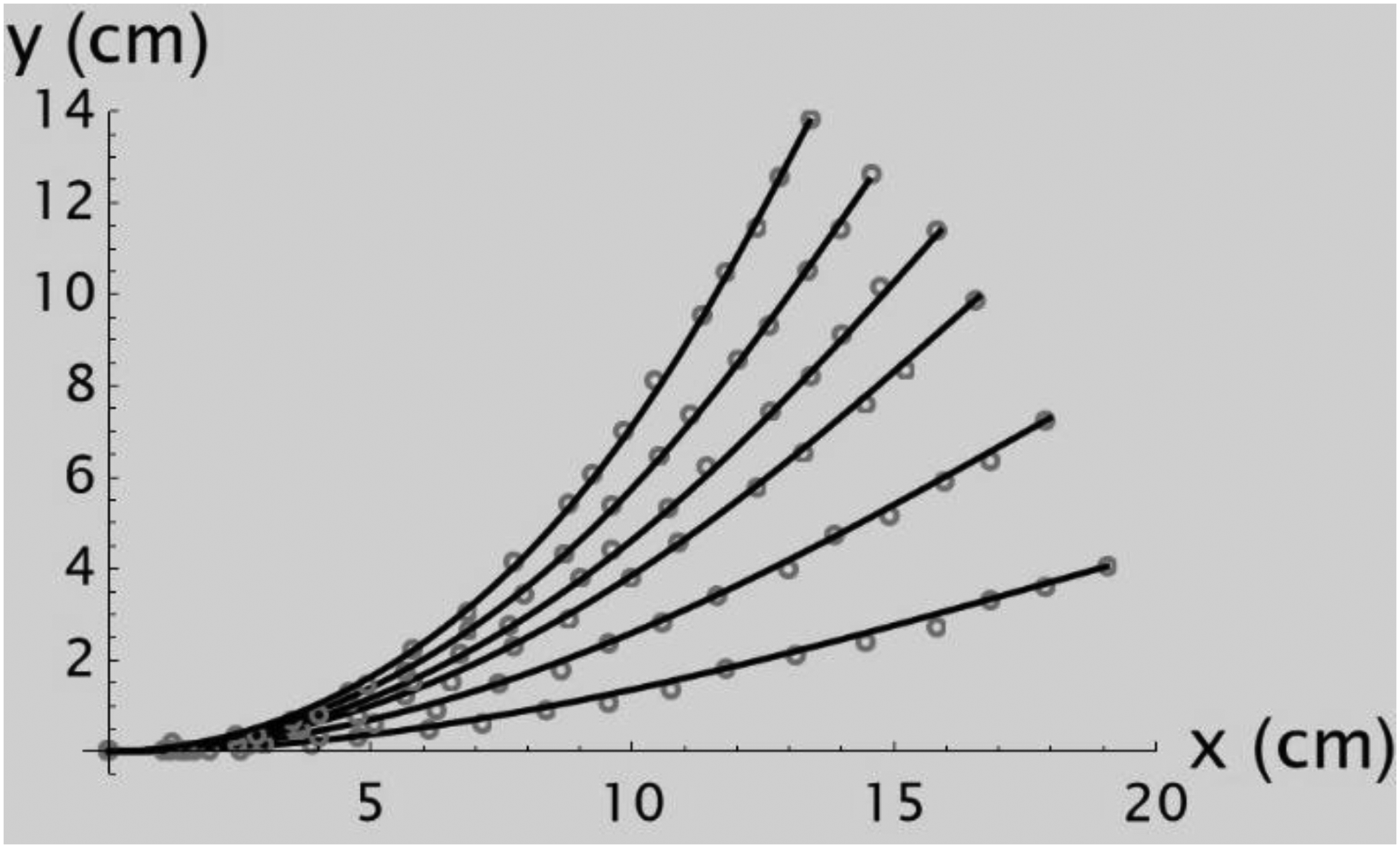
Fit of the Elastica theory to experiment for 20, 40, 60, 80, 100 and 120 grams hanging weights.
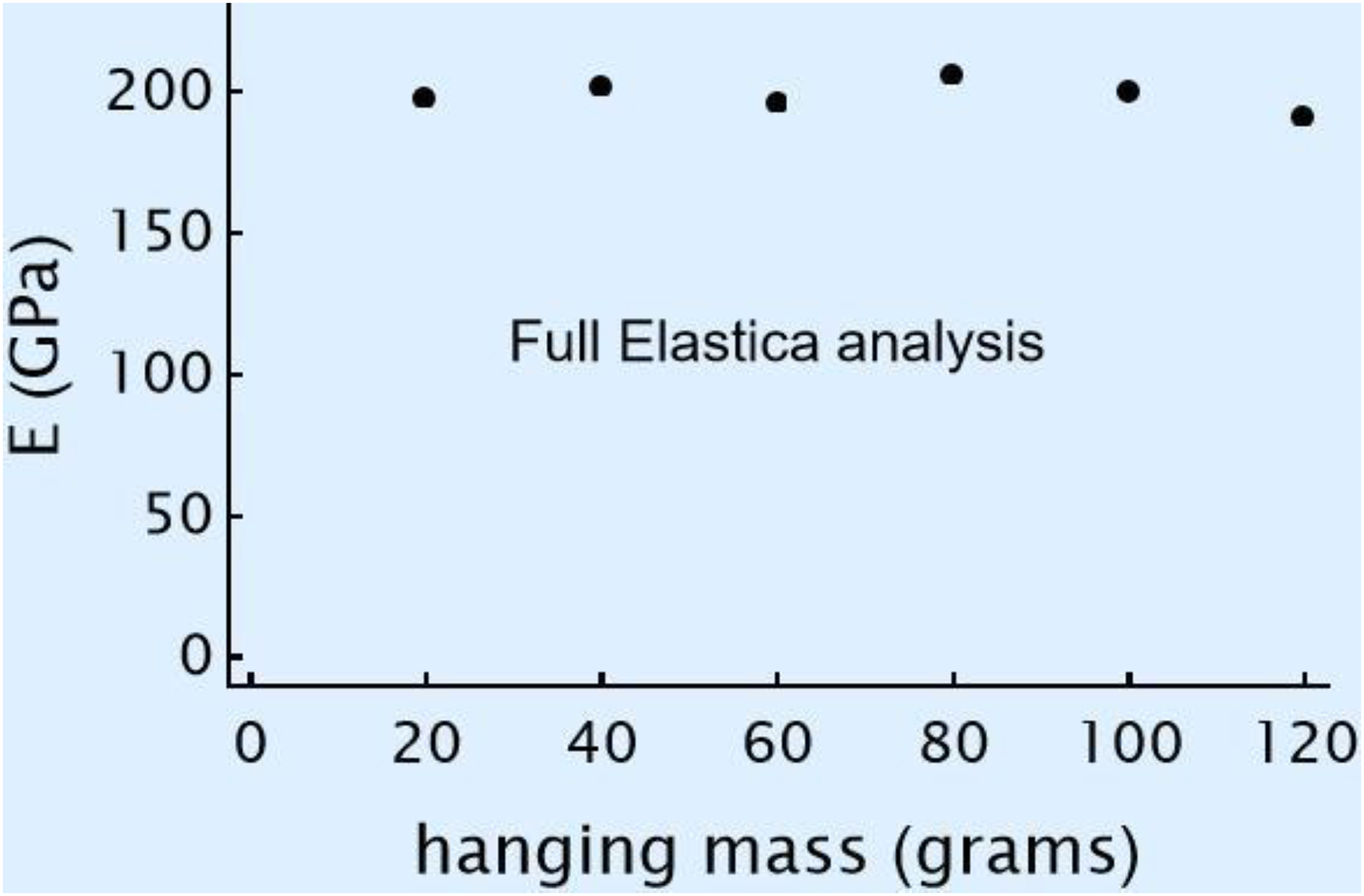
Young's Modulus measurements for hanging weights of up to 120 grams using the Elastica Theory.
Figure 7 shows the fits of Euler-Bernoulli theory to the experimental data. Here we see that, as expected, the fits are good for small loads, but tend to further depart from experiments with increasing load. Again, each curve corresponds to tuning the single parameter, E. Its dependence on weight is shown in figure 8.
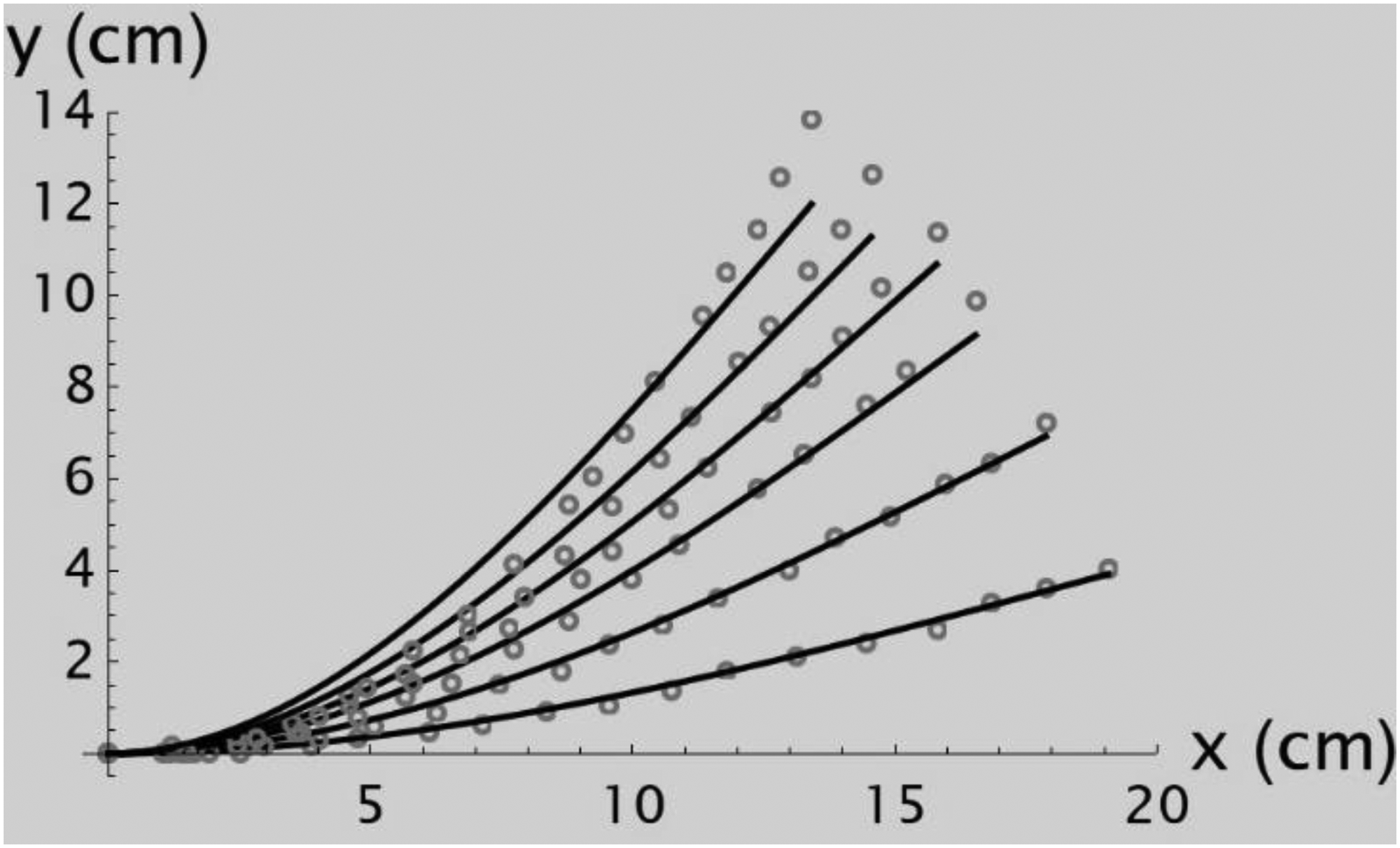
Fit of Euler-Bernoulli theory to experiment for 20, 40, 60, 80, 100 and 120-gram hanging weight.
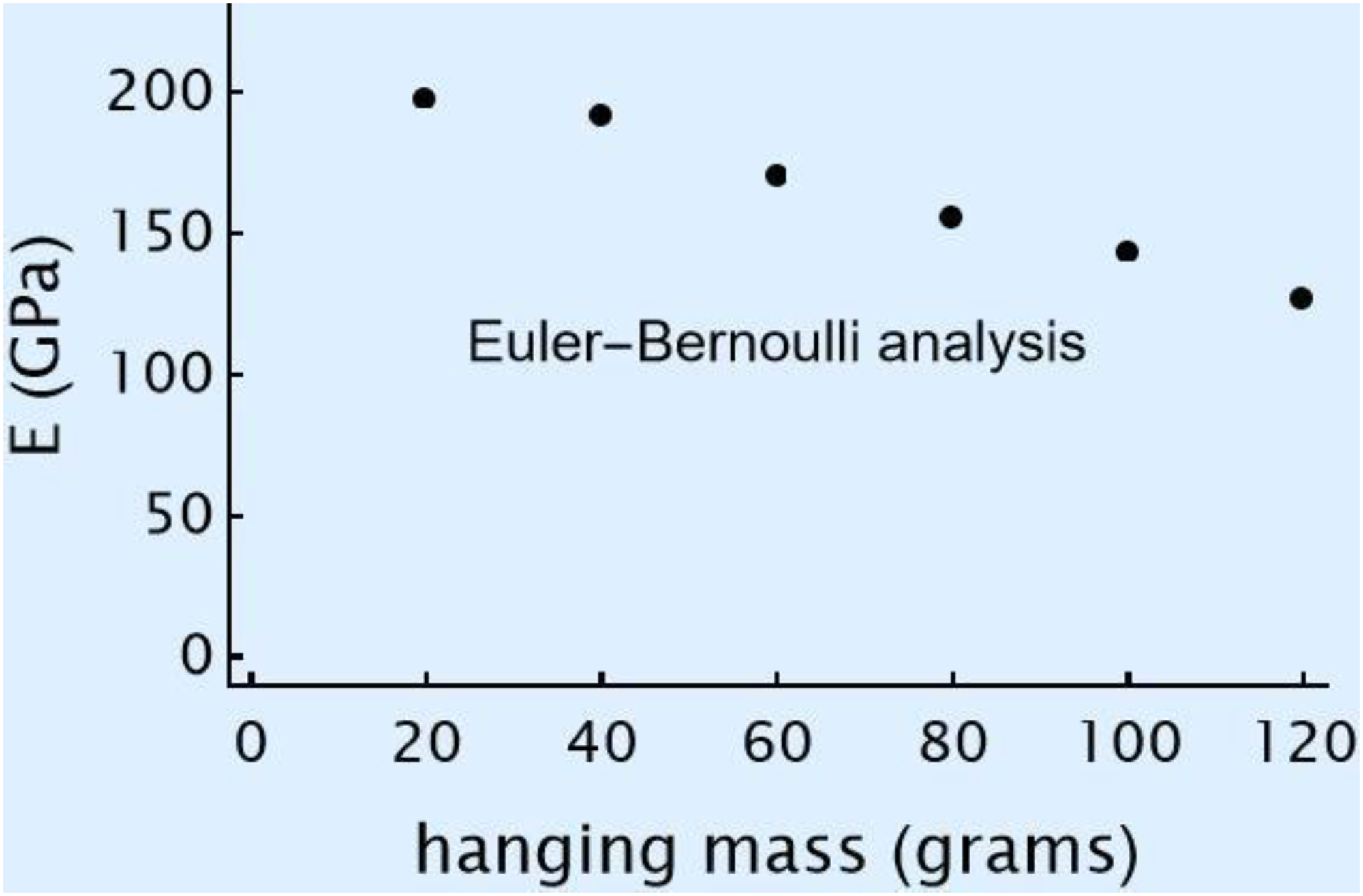
Young's Modulus measurements for hanging weights of up to 120 grams using the Euler-Bernoulli theory.
We see in figure 8 that for small loads
Pedagogical design, implementation, and methods
Learning outcome and instructional rationale
The student learning outcome was to enable students to critically interpret published results in elasticity, particularly identifying theoretical assumptions and assessing their range of applicability. A published article that analyzed cantilever beam bending was selected. The authors of that article analyzed situations involving small and large deflections using Euler–Bernoulli theory without properly addressing its limitations. This furnished a natural context for students to ponder when an unchecked typical assumption is used outside of its range of validity.
The instructional design intentionally linked the reading of the research article with an in-house experiment that brought forward the measurement of Young's modulus via different models. By asking students to make theoretical predictions of strains and compare them with measured data in both the small and large deflection regimes, and draw conclusions on the published analysis and results, the activity directly supported the proposed outcome of assessing published studies with particular emphasis on model domain of validity.
Evidence of achieving the learning outcome
Confirmation of learning was gathered via the following unified elements:
These elements demonstrate that students were able to understand the published paper, perform experimental tests, and decide on the validity of underlying assumptions.
Activity delivery
Pre-Class preparation
After giving students the research article, the instructor prompted them to find relevant equations, identify stated and unstated assumptions, and specifically comment on the conditions under which Euler–Bernoulli analysis would be accurate or not. A lecture reviewed and outlined the physical meaning of small-deflection assumptions and highlighted the distinction between Euler-Bernoulli and the Elastica theories.
Guided discussion
In class, groups focused on different concepts related to the paper: boundary conditions, deflection formulas, and interpretation of large-deflection data. Each group reported on its topic, preparing the whole class to be ready for the experimental part and analysis.
Laboratory experiment
Students performed a cantilever bending experiment using an elastic beam of known properties. Loads were applied incrementally to span both the small-deflection regime (accurately modeled by Euler–Bernoulli) and beyond (where the full Elastica becomes necessary). Students measured deflection, computed analytical predictions and compared experiments to theory.
Post-Lab synthesis
Students performed an analysis relating agreement to Euler-Bernoulli in the small-deflection regime and increasing deviations at larger deflections, to the paper's omission of the presence of large slopes. A class conversation emphasized the broader concept that published results must always be weighed against their underlying assumptions.
Conclusions
Motivated by an industrial research project, we have developed a teaching module focused on properly measuring Young's Modulus. In addition to explicitly motivating students to become independent thinkers by evaluating evidence and proposing explanations, this module also organically merges experiment, theory and computation. The experiment is in the form of a cantilevered bar bent by external loads, the theories developed to analyze the experiment are the Euler-Bermoulli's theory valid for small deflections, and the Elastica theory valid also for large deflections. Computation is used to gather data, and to fit the theories to experiment. The results of our analysis show that the Elastica theory predicts a constant value of Young's modulus, irrespective of external load. On the other hand, the analysis of the data using the Euler-Bernoulli Theory predicts a decreasing Young's Modulus with increasing load, which could be interpreted as a load-induced softening of the beam. We know that this interpretation is incorrect based on the results of the full Elastica. Based on these findings, students learn that load does not induce softening or, more accurately, if softening did truly exist, an analysis using Euler-Bernoulli will create the artifact of enhancing the effect. Vice versa, if a beam hardened under an external load, an analysis using Euler-Bernoulli may obscure the effect. It is beyond the scope of this article to investigate whether the nanowire that motivated the development of this teaching module does soften or not, however it is clear that to settle the issue the full Elastica theory must be used. While we show here the results for a stainless-steel beam, the analysis could be enhanced by considering polymeric materials that can be easily 3D printed. This direction opens up the possibility to easily experiment with different materials and geometric dimensions. Students’ response was very positive. In the evaluation form of the course that they fill out at the end of the semester, all students last semester highlighted this new activity as the most enjoyable of the class because it is the most intellectually free in the sense that they are given substantial flexibility for educated speculation. In addition, students report a deeper understanding of Euler-Bernoulli theory limitations as compared to what they had before they took the Advanced Experimental Engineering class.
Footnotes
Acknowledgments
This work was supported by YU Sabbatical (FZ), the Bertha Kressel Research Fund and the Drs. Kenneth Chelst, Bertram Schreiber, and Fred Zwas grant. FZ thanks Lamont-Doherty Earth Observatory of Columbia University for hosting him during his sabbatical.
Ethical considerations
Ethical approval was not required for this work; the study does not involve living organisms.
Consent to participate
No humans were involved in this work.
Consent for publication
The author has not used materials published elsewhere.
Funding
The authors disclosed receipt of the following financial support for the research, authorship, and/or publication of this article: This work was supported by YU Sabbatical, the Bertha Kressel Research Fund and the Drs. Kenneth Chelst, Bertram Schreiber, and Fred Zwas grant.
Declaration of conflicting interests
The authors declared no potential conflicts of interest with respect to the research, authorship, and/or publication of this article.
Data availability statement
All the data is contained within the article. Figure 3 contains all the data used. In addition,  shows numerical values for the 80-gram case.