






Abstract
Research investigating paedo-hebepho-ephebophilic sexual interests, a spectrum of atypical sexual interests toward minors under the age of 16 years old, has largely focused on men samples, while little is known about women. The present study aimed to contribute to this area by investigating the relationship between measures of experienced childhood trauma, empathy (dispositional as well as towards children), loneliness, intimacy, and paedo-hebepho-ephebophilic sexual interests or antisocial behaviour involving children in a community sample of 304 women – from the UK, Canada and USA – recruited through an online survey. Results revealed that between .7% (N = 2) and 4.6% (N = 14) reported different paedo-hebepho-ephebophilic sexual interests. Multiple regression analysis revealed that experiences of emotional abuse, physical abuse, sexual abuse, physical neglect, empathy towards victims, and empathic concern were significant predictors of paedo-hebepho-ephebophilic sexual interests. These results have several implications that will be discussed in this paper.
Plain Language Summary
This study examines the prevalence and correlates of paedo-hebepho-ephebophilic sexual interests or antisocial behaviour involving children, a spectrum of atypical interests toward minors under the age of 16, in a community sample of 304 women from the UK, Canada and the USA. The majority of the existing literature within this field focuses on convicted or clinical samples. Therefore, little is known about women exhibiting these atypical sexual interests in the general population. We identified strong associations between these atypical sexual interests, previous childhood abuses and a lack of empathy. By examining these atypical sexual interests in a non-incarcerated and non-clinical sample, our work addresses a significant gap in the literature and offers insights into their prevalence and potential correlates.
Keywords
Introduction
Office for National Statistics (2019) revealed that approximately 7.5% of adults had experienced some form of child sexual abuse. It is estimated that 92% of child sexual abuse is perpetrated by men, 4% is perpetrated by both men and women, and 4% is perpetrated by women alone (Cortoni et al., 2010). However, victimisation self-reported surveys revealed that the prevalence of women’s sexual offending might be more prevalent than previously thought (Cortoni et al., 2010). This is supported by Augarde and Rydon-Grange (2022), who reported that women are responsible for up to 20% of child sexual abuse.
As previous research has suggested, the words “sexual assault,” “child sexual abuse,” and “child molestation” tend to conjure up images of men perpetrators and women victims (Byers & O’Sullivan, 1998). Furthermore, gender stereotypes suggest that women are typically more nurturing and caring than men due to their maternal instincts and are perceived as more protective and trustworthy (Tozdan et al., 2019). Therefore, society may find it difficult to accept that women are also capable of sexually abusing children. Such a societal taboo can deter victims from disclosing their abuse, and it can make it more likely that the victims are unaware that the behaviours perpetrated against them are sexually abusive (Kramer & Bowman, 2021). This can result in marked underreporting of child sexual abuse committed by women (Augarde & Rydon-Grange, 2022; Stemple et al., 2017) or victims even hiding the gender of their abuser from professionals (Tozdan et al., 2019).
Although child sexual abuse has gained widespread attention over the years, child sexual abuse committed by women is still understudied and largely misunderstood (Gannon et al., 2008). The early literature suggested that sexual offending among women was so rare it was of little significance, and in some instances, it was even claimed that women paedophiles do not exist at all (Freund et al., 1984). Moreover, the American Psychiatric Association (1994) declared that child sexual abuse perpetrated by women was a rare phenomenon. However, later research began to acknowledge the existence of women’s perpetration (e.g., Saradjian, 1996). Furthermore, early studies that investigated sexual interest in children among women have reported prevalence rates between 1 and 4% (Briere et al., 1992; Fromuth & Conn, 1997; Smiljanich & Briere, 1996).
Recent studies on women-perpetrated child sexual abuse and women’s sexual interest in children support earlier estimates. For example, Wurtele et al. (2014) found that 4.2% of 262 women reported some sexual interest in children. Tozdan et al. (2019) found that the international prevalence of women child sexual offenders ranges between 1.4% and 12.0%. Longpré et al. (2022) found that 2.4% of 166 women reported paedo-hebepho-ebephilic fantasy (e.g., cognitive experience) and 4.2% reported paedo-hebepho-ebephilic arousal (e.g., physiological experience). Paedo-hebepho-ebephilia covers a spectrum of atypical sexual interests toward minors under the age of 16, with paedophilia referring to a sexual attraction in prepubescent children under 11 years old, hebephilia referring to a sexual attraction toward pubescent children between 11 and 14 years old, and ephebophilia referring to a sexual attraction toward adolescents between 15 and 16 years old (Longpré et al., 2022). Stefanska et al. (2022) found that 3.8% of 83 women reported paedophilic fantasy and 4.8% reported paedophilic behaviours. Further studies have found that between 3.4% and 5.5% of women have admitted to watching child sexual exploitation materials (Seigfried-Spellar & Rogers, 2013). This suggests that the prevalence of women presenting sexual interest toward children, or perpetrating child sexual abuse, is not as rare as was once thought (Snow & Longpré, 2025).
Traditional Sexual Scripts
Research has suggested that the lack of recognition of women perpetrators is partly due to traditional sexual scripts that portray women as incapable of committing sexual violence (Denov, 2001). Traditional sexual scripts are characterised by an active man and a passive woman, depicting the man as being sexually aggressive and excluding the idea that men can be victims of sexual violence. Moreover, traditional sexual scripts also exclude women as being sexually aggressive, initiating sex, and showing sexual interest (Byers & O’Sullivan, 1998; Stefanska et al., 2022). Consequently, the perception of a woman as a perpetrator of child sexual abuse contradicts the traditional beliefs that women are nurturing, caring, protecting, nonaggressive, and nonsexual. This contributes to the belief that women are incapable of committing sexual violence (Anderson & Struckman-Johnson, 1998).
Furthermore, many victims experience fear and anxiety when reporting child sexual abuse perpetrated by women, since it challenges traditional sexual scripts (Mellor & Deering, 2010). This is likely to affect how women perpetrators are identified and treated (Denov, 2003). For example, research has found that cases of child sexual abuse perpetrated by women were less likely to result in arrest or prosecution, and when women perpetrators are sentenced, they tend to receive more lenient sentences (Burgstedt et al., 2022). This suggests that professionals within the criminal justice system may be more comfortable prosecuting men perpetrators of child sexual abuse, as this fits the traditional stereotypes of sexual violence (Denov, 2003). Consequently, many victims of child sexual abuse perpetrated by women are often disbelieved, and their experiences are trivialised by society and professionals (Gerke et al., 2024). This could explain why victims might find it significantly harder to report and acknowledge the abuse committed by women when compared to men (Kramer & Bowman, 2021).
The Nature of Harms: Perception Versus Reality
Despite the growing literature on women perpetrators, recent research has shown that when a child has been molested by a woman, individuals tend to perceive this assault as less harmful and less representative of child sexual abuse compared to a child who has been molested by a man (Muniz & Powers, 2021). Women are traditionally viewed as nurturing and protective, which creates a cognitive bias that minimises the severity of their sexually abusive behaviours (Munroe & Shumway, 2020). This is further reinforced by the rape myth that sexual abuse committed by women is less aggressive and the societal narrative that the abuse was somehow desirable (e.g., teacher-lover) (Beckett et al., 2025). Moreover, several studies have revealed that people tend to perceive abuse perpetrated by men as more serious than equivalent offences perpetrated by women, despite both scenarios being morally and legally identical (Banton & West, 2019).
Regardless of society’s perceptions, the impact of women-perpetrated child sexual abuse on victims can be equally as severe as that of men-perpetrated child sexual abuse (Gerke et al., 2023). Research has highlighted the long-term consequences of women-perpetrated child sexual abuse, including depression, anxiety, post-traumatic stress disorder (PTSD), substance abuse, strained relationships with women, identity issues, low self-esteem, and emotional dysregulation (Denov, 2004; Schröder et al., 2023). Although similar to the long-term psychological difficulties of men-perpetrated child sexual abuse, the lack of recognition and support for victims of women perpetrators often worsens these outcomes (Schröder et al., 2023). This is supported by Neofytou (2022), who found that victims who have been sexually abused by both men and women reported that the women’s abuse was more damaging than the men’s abuse.
Victim-Offender Overlap
There is a significant amount of evidence suggesting that perpetrators of child sexual abuse were victims of childhood sexual abuse themselves (Longpré et al., 2018b), known as the victim-offender overlap (H. C. O. Chan, 2020). This appears to be particularly apparent among women perpetrators (Berner et al., 2009). However, it is important to note that most victims of child sexual abuse will never commit sexual violence, and it is estimated that less than 5% present a victim-offender overlap (H. C. O. Chan, 2020). It has been reported that, when compared to their men counterparts, women perpetrators tend to have first experienced sexual abuse at an earlier age, the abuse often involved penetration, they were abused either by both men and women perpetrators or by multiple perpetrators, and they were abused over a longer period (Fromuth & Conn, 1997).
Furthermore, women perpetrators tend to have experienced significantly greater childhood trauma—including sexual, physical, and emotional abuse—than women who perpetrated non-sexual offences and women of the general population (Fromuth & Conn, 1997; Lewis & Stanley, 2000; Nathan & Ward, 2002; Strickland, 2008). A history of child sexual abuse is a consistent and strong predictor of sexual violence perpetration in developmental models (i.e., Longpré et al., 2018a). Such childhood trauma can contribute to emotional and psychological difficulties later in life (Longpré et al., 2022). Several studies have supported that a majority of women perpetrators tend to suffer from poor mental health, including depression, post-traumatic stress disorder, personality disorders, substance abuse, and low self-esteem (Centre for Sex Offender Management, 2019). It has also been found that women perpetrators tend to be more impulsive and exhibit low levels of emotional self-regulation and often experience a lack of intimacy (Tozdan et al., 2019). Furthermore, women perpetrators who were abused themselves are more likely to continue to be victimised in abusive relationships throughout their lives, including domestic abuse and intimate partner violence (Lewis & Stanley, 2000).
Consequences of Past Abuses
Witnessing or experiencing abuse disrupts and inhibits the development of a secure sense of self (Strickland, 2008). Thus, victims of abuse do not typically possess the skills needed to develop and maintain healthy, positive relationships in adulthood to meet their emotional and sexual needs (Marshall & Barbaree, 1990; Strickland, 2008). In addition to the severe and enduring abuse suffered in childhood, many perpetrators of sexual violence tend to have experienced poor early attachment relationships (Strickland, 2008). This can hinder interpersonal and social skills, contributing to maladaptive coping mechanisms, poor communication skills, a lack of empathy, and low self-esteem (Cortoni et al., 2010).
Women perpetrators who experienced domestic abuse may struggle with interpersonal relationships (Parent et al., 2018). Poor early attachment relationships can hinder intimacy in adult relationships, ultimately resulting in loneliness (Maniglio, 2012). In fact, intimacy deficits, a desire for intimacy, and using sex to fulfil intimacy needs have been linked with women’s child sexual abuse perpetration (Darling et al., 2018; Gannon et al., 2008; Nathan & Ward, 2002; Saradjian, 1996). Some women might offend against children to obtain intimacy with their victim or men co-perpetrator (Gannon et al., 2008), while poor social skills and isolation may further contribute to this behaviour (Darling et al., 2018). Additionally, studies have shown that women perpetrators are motivated by loneliness, social isolation, and unmet emotional needs (Gannon et al., 2008). Consequently, loneliness, fear of intimacy, and inability to develop healthy adult relationships may result in women perpetrators seeking inappropriate sexual contact with children to satisfy their emotional and sexual needs (Maniglio, 2012).
Aims of the Present Study
The aim of this study was to investigate whether there is an association between previous child sexual victimisation, lack of empathy, intimacy deficits, loneliness, and paedo-hebepho-ephebophilic sexual interests (PHE-SI) among a sample of women from the general population. Because of the low base rate of women’s sexual interests toward children, especially in the general population (i.e., roughly around 4%; Parent et al., 2018), a wider age range of sexual interests was explored in the current study. Therefore, the term PHE-SI was used to measure sexual interests toward anyone under the age of 16, the legal age of consent in most countries.
To prevent paedo-hebepho-ephebophilic sexual abuse, it can be helpful to research factors that are associated with the likelihood of sexually offending among women, including sexual interests. Understanding these factors can help develop interventions and treatment strategies to reduce offending against children, particularly among women.
Based on the previous literature, it is hypothesised that:
Methods
Participants
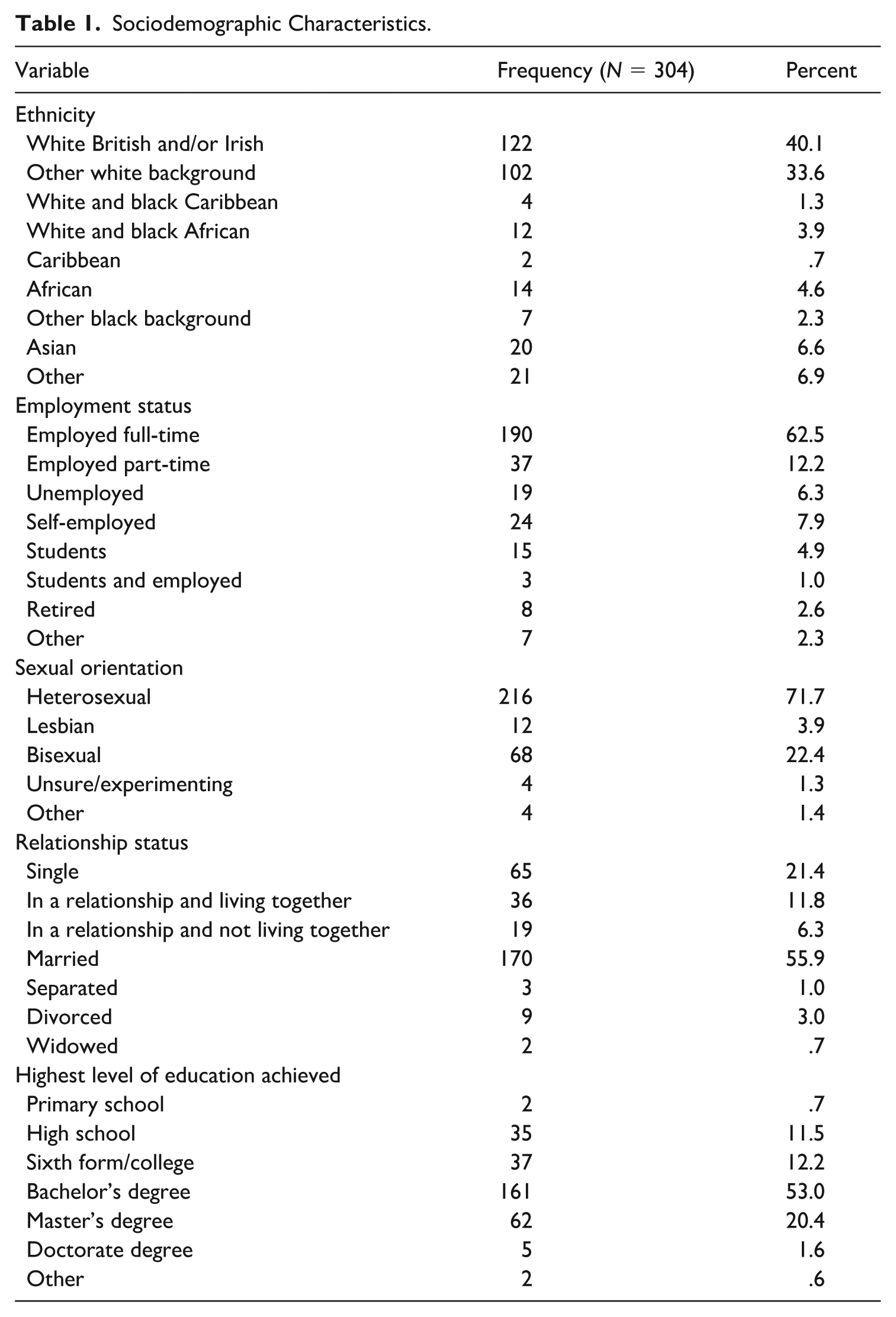
A community sample of N = 342 women from the UK, Canada and the USA was recruited for this study. Participants who did not fully complete the survey were removed from the data set. The final number of participants was n = 304. The age ranged between 18 and 76 years, with a mean age of 36.89 years (SD = 11.88 years). The full demographics of the sample can be found in Table 1.
Sociodemographic Characteristics.
Procedure
The study received ethical approval from a University in England and Wales before data collection. Due to the nature of the survey, participants were recruited via volunteer sampling on Amazon Mechanical Turk (MTurk), an online marketplace allowing researchers to find participants online in exchange for monetary compensation. This allows researchers to recruit participants remotely and from specific locations anywhere in the world. A Qualtrics (Qualtrics®, Provo, UTs) link was shared on MTurk. This ensured anonymity of the participant as there was no direct contact between the participants and researchers. Several safeguards – such as higher monetary compensation, GPS coordinate screening, randomly generated code, study of response patterns, and reading time – were used to detect automated programs (bots) that automatically fill out questionnaires. All suspicious participants were rejected before payment.
Whilst only women participants were eligible to participate, there was no specific inclusion criterion for race, ethnicity, or sexual orientation. The participants were required to consent before accessing the study. Participants were informed that the survey was anonymous and that they had the right to withdraw at any point. The study took no longer than 45 min to complete, and the participants received monetary compensation in return. The participants were debriefed at the end of the study and were provided with links to external organisations if they needed support due to the sensitive nature of the study.
Scales
Paedo-hebepho-ephebophilia and Antisocial Behaviours
PHE-SI was measured by using an adapted version of the Sexual Interest in Children and Antisocial Behaviours Scale (SICABS; Wurtele et al., 2014). Participants first rated the likelihood that they would commit a variety of antisocial and criminal offences if they were assured that they would not get caught or punished. Examples of items range from “drive faster than the speed limit” to “sexually assault an adult.” Embedded within this scale were two items measuring sexual interest in children, “view child porn on the web,” and “engage in sexual activity with a child.” For each item, participants indicated, on a 6-point Likert-type scale, the likelihood (1 = highly unlikely to 6 = highly likely) of engaging in the behaviour.
An additional three home-made items to further measure sexual interest in children were added, including “send sexually explicit photos or videos to a child under 16,” “send sexually explicit text messages or emails to a child under 16,” and “possess and distribute indecent photos of children under 16.” For each item, participants indicated, on a 6-point Likert-type scale, the likelihood (1 = highly unlikely to 6 = highly likely) of engaging in the behaviour.
The second part of the scale explicitly measures the extent to which participants agree with three statements regarding sexual interest in children, such as “I fantasise about having sex with a child.” A further item was added to this scale: “I have engaged in sexual activity with a child under 16.” For each item, participants indicated the extent to which they agree or disagree (1 = strongly disagree; 6 = strongly agree).
The 9 items were combined to create the PHE-SI scale. Similar to the original study (e.g., Wurtele et al., 2014), items were dichotomised as absent (0) or present (1), with a total score ranging from 0 to 9. Participants who responded highly unlikely/ strongly disagree (1) were coded as 0, and all other responses (2–6) were coded as 1. In the present study, the Kuder-Richardson-20 was .93.
The Childhood Trauma Questionnaire—Short Form (CTQ-SF; Bernstein et al., 2003)
The CTQ-SF is a self-report, retrospective scale, consisting of 28 items measuring five dimensions of childhood abuse: (1) emotional abuse, (2) emotional neglect, (3) physical abuse, (4) physical neglect, and (5) sexual abuse. An example of items includes “someone tried to touch me in a sexual way or make me touch them.” The score can range from 0 to 112, with items measured on a five-point Likert scale, from “never true” to “very often true.” Total scores for each subscale were calculated: the higher the score, the greater the level of abuse or neglect experienced. Previous studies report Cronbach’s alphas ranging between .70 and .91 in a Turkish sample (Rezan & Erogul, 2012), between .85 to .94 in a Danish sample (Kongerslev et al., 2019), and between .72 and .90 in an Anglo-Saxon sample (Longpré et al., 2022). In the present study, the Cronbach’s alpha was .93.
The Child Molester Empathy Measure (CMEM; Fernandez et al., 1999)
The CMEM consists of 150 items measuring victim empathy towards children, split between three vignettes. Each vignette has two parts: the first asks participants to rate the child’s emotional response, while the second assesses the participant’s feelings about the child’s experience. Items are rated on an eleven-point Likert Scale, from “not at all” to “very much.” Total scores, ranging from 0 to 300 for part A and 0 to 200 for part B, indicate levels of victim empathy, with higher scores reflecting greater empathy. Fernandez et al. (1999) reported Cronbach’s alpha coefficients above .80 for each subscale, and in this study, the Cronbach’s alpha was .98.
The University of California, Los Angeles, Loneliness Scale—Version 3 (UCLA-LS; Russell, 1996)
This is a self-report measure of loneliness and social isolation. The UCLA-LS consists of 20 items, such as “How often do you feel alone?” The participant is required to indicate how often each of the statements is descriptive of them on a four-point Likert scale, from “never” to “often.” The higher the score, the greater the degree of loneliness, with a total score ranging from 0 to 80. Russell (1996) reported Cronbach’s alpha coefficients ranging from .89 to .94. In the present study, the Cronbach’s alpha was .92.
The Fear of Intimacy Scale (FIS; Descutner & Thelen, 1991)
This is a self-report measure of emotions related to romantic relationships, consisting of 35 items. The first 30 items measure intimacy in hypothetical relationships, such as “a part of me would be afraid to make a long-term commitment to my partner.” The subsequent five items measure intimacy in past relationships, such as “I have held back my true feelings in past relationships.” Participants rate each statement on a five-point Likert scale, ranging from “not at all characteristic of me” to “extremely characteristic of me.” A total score for all 35 items is calculated, ranging from 35 to 175, with a higher score indicating a higher fear of intimacy. Descutner and Thelen (1991) reported a Cronbach’s alpha coefficient of .93, which was also found in this study.
The Interpersonal Reactivity Index (IRI; Davis, 1983)
This is a self-report measure of dispositional empathy, consisting of 28 items exploring the participant’s thoughts and feelings in a variety of situations, measured on a five-point Likert scale from “does not describe me well” to “describes me very well.” It includes four subscales: (1) perspective taking, (2) fantasy seeking, (3) empathic concern, and (4) personal distress. An example of items includes “I sometimes try to understand my friends better by imagining how things look from their perspective.” Lower scores on each subscale, ranging from 7 to 35, indicate less empathy in that domain. Baldner and McGinley (2014) reported Cronbach’s alpha ranging from .70 to .78, with the present study’s Cronbach’s alphas of .76 for perspective taking, .66 for fantasy seeking, .71 for empathic concern, and .77 for personal distress.
Analyses
Statistical analyses were carried out using the Statistical Package for Social Sciences (SPSS) v26 (IBM, New York, USA). Skewness and kurtosis values were within the acceptable ranges, indicating that the data were normally distributed, and parametric analyses were carried out. First, Pearson’s Product-Moment correlations were carried out to assess the interrelation between the different scales (for more details, see Table 1 in the Supplemental Material). Scales that were too highly correlated (over .90) were removed due to potential multicollinearity issues in the regression model.
Secondly, a multiple regression analysis was conducted, with PHE-SI as the outcome variable. The selected predictors, which were informed by the Pearson’s Product-Moment correlations analyses, were previous childhood abuse, as measured by the emotional abuse, physical abuse, physical neglect, and sexual abuse subscales; dispositional empathy, as measured by the perspective taking, fantasy seeking, empathic concern, and personal distress subscales; victim empathy, as measured by each part of the CMEM; fear of intimacy; and loneliness. The descriptive statistics of independent and dependent variables can be found in Table 2.
Descriptive Data of Independent and Dependent Variables.
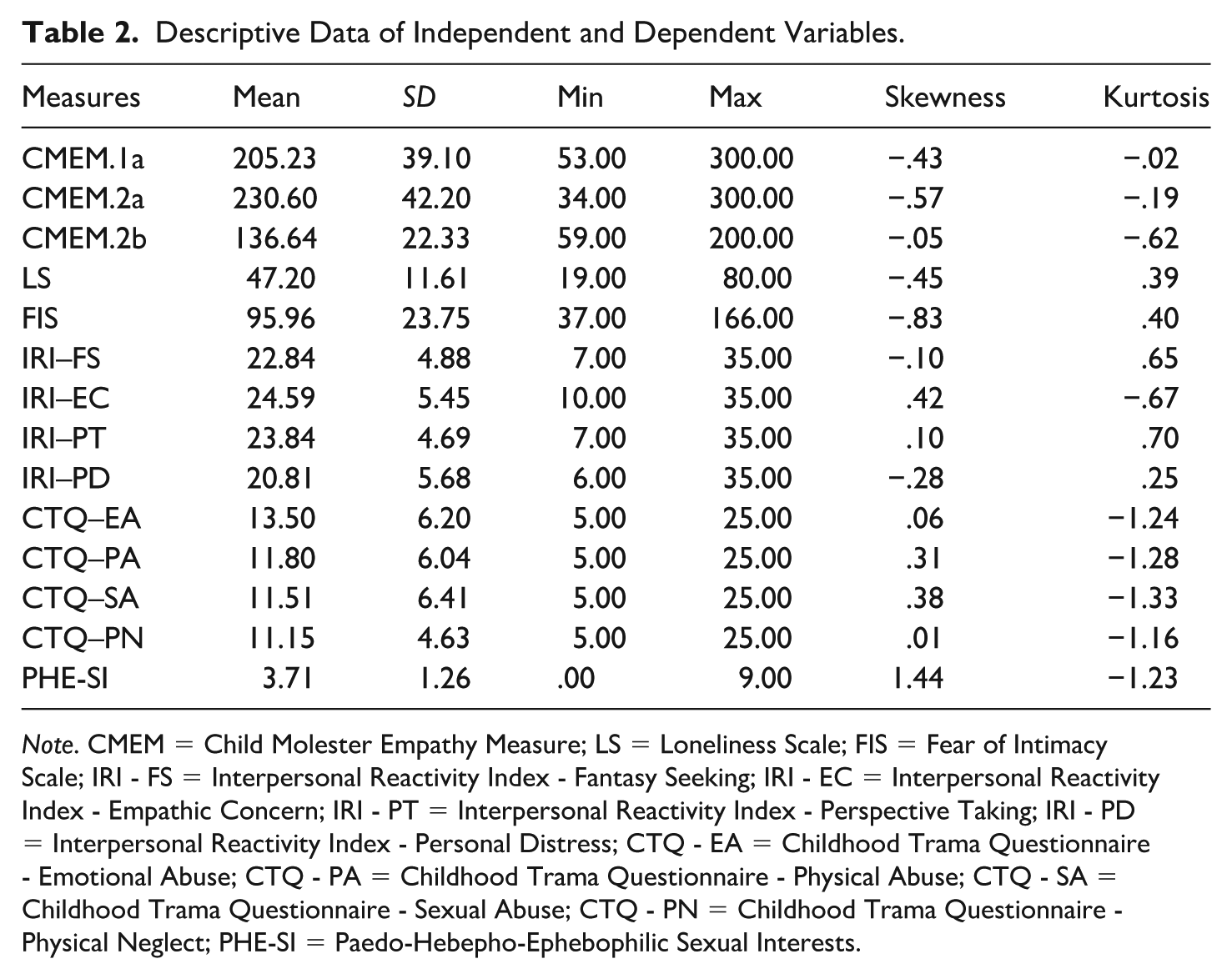
Note. CMEM = Child Molester Empathy Measure; LS = Loneliness Scale; FIS = Fear of Intimacy Scale; IRI - FS = Interpersonal Reactivity Index - Fantasy Seeking; IRI - EC = Interpersonal Reactivity Index - Empathic Concern; IRI - PT = Interpersonal Reactivity Index - Perspective Taking; IRI - PD = Interpersonal Reactivity Index - Personal Distress; CTQ - EA = Childhood Trama Questionnaire - Emotional Abuse; CTQ - PA = Childhood Trama Questionnaire - Physical Abuse; CTQ - SA = Childhood Trama Questionnaire - Sexual Abuse; CTQ - PN = Childhood Trama Questionnaire - Physical Neglect; PHE-SI = Paedo-Hebepho-Ephebophilic Sexual Interests.
Results
Frequency analyses revealed that, if the women participants were assured that they would not get caught or face any ramifications for their actions, 1% (n = 3) would watch child sexual exploitation material, .7% (n = 2) would engage in paedo-hebepho-ephebophilia sexual activities, 3.1% (n = 9) would send sexually explicit photos or videos to a child under 16, 4.2% (n = 12) would send sexually explicit text messages or emails to a child under 16; and 4.6% (n = 14) would possess and distribute indecent images of a child under 16. It was also found that .3% (n = 1) have fantasised about having sex with a child under 16, 1.7% (n = 5) are sexually attracted to children under 16, and 4.2% (n = 12) masturbate to paedo-hebepho-ephebophilia fantasies.
Multiple Regression Analysis
The regression model was statistically significant (F (14, 279) = 80, p < .001) and 79% of the variance was accounted for by the predictor variables, after adjustment. The unadjusted estimate of variance was 80%. Emotional abuse, β = .20, t(279) = −4.31, p < .001; physical abuse, β = .31, t(279) = 5.93, p < .001; sexual abuse, β = .31, t(279) = 7.30, p < .001; physical neglect, β = .34, t(279) = 6.25, p < .001; part 2a of the CMEM, β = −.15, t(279) = −3.15, p = .002; and empathic concern, β = −.15, t(279) = −3.55, p < .001, were all significant predictors of PHE-SI. For more details, see Table 3.
Multiple Regression Analysis for Variables Predicting Paedo-Hebepho-Ephebophilic Sexual Interests.
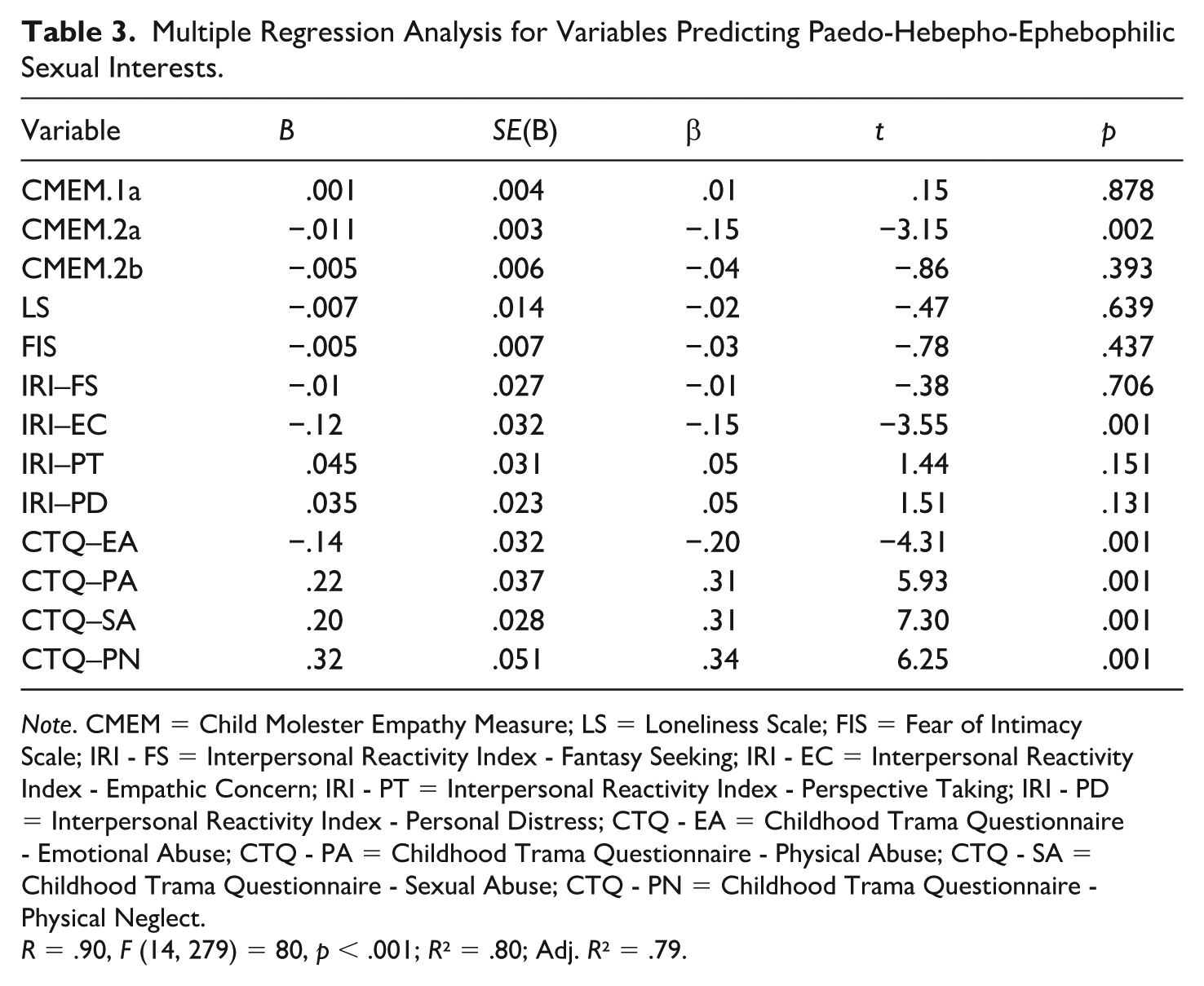
Note. CMEM = Child Molester Empathy Measure; LS = Loneliness Scale; FIS = Fear of Intimacy Scale; IRI - FS = Interpersonal Reactivity Index - Fantasy Seeking; IRI - EC = Interpersonal Reactivity Index - Empathic Concern; IRI - PT = Interpersonal Reactivity Index - Perspective Taking; IRI - PD = Interpersonal Reactivity Index - Personal Distress; CTQ - EA = Childhood Trama Questionnaire - Emotional Abuse; CTQ - PA = Childhood Trama Questionnaire - Physical Abuse; CTQ - SA = Childhood Trama Questionnaire - Sexual Abuse; CTQ - PN = Childhood Trama Questionnaire - Physical Neglect.
R = .90, F (14, 279) = 80, p < .001; R² = .80; Adj. R² = .79.
Discussion
Overview of Results
The current study aimed to investigate whether there is an association between childhood victimisation, lack of empathy, intimacy deficits, loneliness and paedo-hebepho-ephebophilic sexual interests (PHE-SI) among a community sample of women who volunteered to participate in this study. In the current study, children were defined as anyone under the age of 16, the legal age of consent in most countries, allowing us to cover the PHE-SI spectrum.
Between .7% (n = 2) and 4.6% (n = 12) of the sample reported some level of PHE-SI. Most of the findings in this study are in line with those reported in previous research, with prevalence rates ranging between .3% and 4.9% (Baur et al., 2016; Briere et al., 1992; Fromuth & Conn, 1997; Longpré et al., 2022; Smiljanich & Briere, 1996; Stefanska et al., 2022; Wurtele et al., 2014). Previous studies have used different age thresholds (e.g., Fromuth & Conn, 1997)– for example, Baur et al. (2016) measured sexual interest towards children up to the age of 12, whereas Wurtele et al. (2014) defined a child as anyone under the age of 16– or did not define the term “child” (e.g., Smiljanich & Briere, 1996). Our results are interesting, with prevalence rates remaining consistent despite the present study’s expansion of the age range to up to 16 years.
In the preliminary analyses, significant positive correlations were found between PHE-SI and several correlates. Notably, emotional abuse, physical abuse, sexual abuse, and physical neglect were all strongly associated with PHE-SI. Additionally, loneliness, fear of intimacy, and personal distress showed significant positive correlations with PHE-SI. However, victim empathy and empathic concern were found to be significantly and negatively correlated with PHE-SI. Finally, a multiple regression analysis revealed that emotional abuse, physical abuse, sexual abuse, physical neglect, and a lack of empathy were significant predictors of PHE-SI.
These results have implications. Firstly, they support the developmental and trauma-based models of paraphilias, proposing that adverse childhood experiences like abuse and neglect disrupt psychosexual development (Longpré et al., 2022; Marshall & Barbaree, 1990). Furthermore, whilst there is an association between childhood trauma and sexual offending, there has been limited exploration of the correlates of PHE-SI. Therefore, this study contributes to the evidence base suggesting that childhood abuse and neglect are associated with PHE-SI among women.
Secondly, if childhood abuse and neglect are associated with PHE-SI, then trauma-focused therapies may be useful for prevention and treatment approaches (Taylor & Hocken, 2021). For example, eye-movement desensitisation and reprocessing (EMDR) can help individuals to process unresolved trauma and disrupt maladaptive thought patterns that may underlie or reinforce PHE-SI (Ricci et al., 2006). This can be particularly relevant for non-offending individuals who may be seeking help for their distressing sexual interests, for whom early intervention could reduce both personal suffering and potential risk of offending.
Furthermore, the association between empathy deficits and PHE-SI further supports models linking emotional dysregulation to paraphilias (de Roos et al., 2025; Knight & Sims-Knight, 2011; Marshall & Barbaree, 1990). This highlights the need to include empathy, particularly empathy deficits, into models of PHE-SI. This can allow for more targeted interventions aimed at preventing, reducing, or managing paraphilic interests, including empathy training, emotional regulation skills and interpersonal functioning. Moreover, this underscores the importance of including measures of empathy in forensic risk assessments to improve the identification of individuals at increased risk of PHE-SI.
History of Childhood Sexual Abuse
As expected, a history of childhood sexual abuse was found to be a significant predictor of PHE-SI. This is consistent with earlier research, suggesting that childhood sexual abuse is associated with the development of paedophilic tendencies and child sexual abuse among women (H. C. O. Chan, 2020; Seto, 2008). Furthermore, it has been found that women perpetrators, especially those with paedophilic tendencies, may suffer from unresolved trauma stemming from their own experiences of childhood sexual abuse (Neofytou, 2022; Strickland, 2008). This suggests that early sexual trauma can contribute to the development of maladaptive internal working models and distorted sexual schemas in women later in life (Rellini & Meston, 2010). As a result, this might influence patterns of sexual attraction and arousal, including sexual preferences that deviate from the norm, such as PHE-SI. Furthermore, the concept of repetition compulsion suggests that some individuals who have experienced trauma may unconsciously reenact traumatic events later in life. For some women, this could involve engaging in sexual behaviours that reflect their abusive past, including perpetrating abuse themselves. This is supported by Matthews et al. (1991), who hypothesised that unresolved trauma among women perpetrators may lead to the reenactment or distorted patterns of intimacy, sometimes with children. Collectively, these findings highlight the complex interplay between early sexual trauma and later deviant sexual development, reinforcing previous findings that childhood sexual abuse is a critical factor in long-term negative psychological outcomes.
Whilst there is evidence connecting childhood sexual abuse to sexual deviance later in life (H. C. Chan, 2021), the relationship between other forms of childhood abuse and maladaptive sexual interests, particularly among women, remains largely under-researched. However, as previous research has found, women who have experienced childhood abuse can often suffer from impairments in attachment and emotional regulation (Burns et al., 2010; H. C. Chan, 2021). Such impairments can lead to low self-esteem and an inability to develop healthy boundaries, which can lead to greater difficulties in establishing and maintaining relationships (Bowlby, 1969). This is supported by Colman and Widom (2004), who found that women victims of childhood abuse were more likely to struggle with maintaining intimate relationships later in life. These challenges could increase the risk of developing sexual behaviours that are considered unconventional, or that reflect unhealthy power dynamics or exploitation, which are sometimes observed in paraphilias (H. C. Chan, 2021).
Moreover, women who were physically and emotionally abused in childhood may develop a warped view of sexuality and healthy relationships (Gannon et al., 2008). This is supported by research findings that physical and emotional abuse during childhood can lead to psychological trauma that may disrupt healthy sexual development among women (Pulverman et al., 2018). Therefore, if victims of abuse hold cognitive distortions that harmful sexual activity and abuse are a way of gaining power or coping with distress, this could increase the risk of developing sexually deviant interests and behaviours. Furthermore, victims of childhood abuse may act out abusive scenarios as a way of processing unresolved trauma (Briere, 1996), which may manifest as paraphilic interests, fantasies, and behaviours (Longpré et al., 2022).
However, whilst a significant correlation was found between all forms of childhood abuse and the development of PHE-SI, it was not found to be the strongest predictor in this study. Interestingly, physical neglect was found to be a better predictor of PHE-SI than all three forms of childhood abuse. This indicates that women who experienced higher levels of physical neglect in childhood were more likely to present PHE-SI than those who experienced other forms of childhood maltreatment. This suggests that the absence of basic care and unmet needs may have a particularly lasting impact, potentially due to its chronic and pervasive nature and its role in disrupting fundamental aspects of development.
Empathy and Loneliness
The perspective-taking and fantasy-seeking subscales were not shown to be significant predictors of PHE-SI. This suggests that overall cognitive empathy was not a predictor of PHE-SI in the current study. Historically, the relationship between cognitive empathy and sexual violence has been described as complex, with cognitive empathy serving as a mediator between cognitive distortions and sexual violence, rather than a predictor of sexual violence (Gijsbers & Keulen-de Vos, 2025). Therefore, it is not totally surprising that we found no relationship between cognitive empathy and PHE-SI. Additionally, whilst the personal distress facet of affective empathy was not found to be significantly associated with PHE-SI, a lack of empathic concern was. This is consistent with the literature suggesting that a lack of empathy is significantly associated with PHE-SI (Craissati et al., 2002). While the current study used a retrospective research design and warrants a careful interpretation, one possible explanation for this could be due to the subjective nature of the scale used to measure empathy. This scale required participants to rate their cognitive and emotional reactions to various interpersonal situations. However, some participants may have lacked this ability and may have been unable to accurately evaluate their own empathetic ability, leading some participants to over- or under-reported their empathic ability, which could have impacted the results.
Similarly, this issue could also explain why a fear of intimacy was not found to be a significant predictor of PHE-SI. Some participants may be unsatisfied with their relationship or may not be aware of their own thoughts and feelings towards their partners, contributing to an inability to accurately evaluate the extent of their intimacy fears. Additionally, over a quarter of the sample was not currently in a relationship. As a result, these participants may have struggled to complete the FIS. Furthermore, the participants’ mood during the study might have influenced their responses. For example, if they had recently argued with their partner, this might have negatively affected their attitude towards them, resulting in under- or over-reported fears of intimacy.
Finally, loneliness was also not a significant predictor of PHE-SI. This could be due to social desirability bias, as some participants may have altered their responses to avoid embarrassment or shame about their responses. Therefore, these participants may not have answered truthfully to appear in a positive light, which could have influenced the findings.
Implications for Public and Professional Awareness
The stark lack of knowledge about women perpetrators inevitably results in poorer quality of child protection and treatment services (Tozdan et al., 2019). Considering this, it is important to increase public awareness toward women child sexual abuse to improve the overall understanding and attitude towards such abuse. Training initiatives can be introduced for professionals to promote awareness about women’s perpetration and educate them about the harm that abuse can have on victims. Moreover, this might help to challenge the common misconceptions held by some individuals, as well as inform them of the potentially damaging consequences that inadequate interventions can have (Denov, 2004). These strategies can ultimately help to reduce the fear surrounding the disclosure of sexual abuse perpetrated by women, subsequently increasing the likelihood that victims will report their abuse.
Limitations
This study is not without limitations. Firstly, the study relied on self-report measures to collect data. This is a weakness, as some of the participants may have suffered from recall bias. For example, in the CTQ-SF, participants were asked to recall negative or traumatic experiences from their childhood. Some participants may have found this difficult as they might not have remembered certain aspects of their childhood, or they might have repressed such memories, which consequently resulted in inexact responses. Consequently, the findings may be impacted by under- or over-estimations. Several safeguards were implemented to minimise inaccurate responses, including voluntary participation, anonymity, financial compensation, and analysis of completion time to reduce social desirability bias. While our results are consistent with previous studies, they should be interpreted with caution.
Secondly, this study used a community sample of 304 women. Although this provides more accurate conclusions regarding PHE-SI among women in the general population, the sample is not representative of all perpetrators, and the findings might not apply to women convicted of child sexual offences. For example, a significant proportion of our sample was highly educated (for more details on this issue, see Beckett & Longpré, 2026), which is not representative of convicted child sexual offender populations (CSEW; 2019). Furthermore, although the sample size was adequate to detect significant associations, a sample of 304 participants is on the smaller end of statistical power (Longpré et al., 2023). The factors influencing PHE-SI among women from the general population might differ from those in convicted child sexual offenders. The likelihood of committing a certain behaviour and committing a certain behaviour are not the same, and our results must be interpreted accordingly. For details on this issue, see Longpré et al. (2025). Therefore, future research is needed to investigate which of our findings apply to incarcerated women who perpetrate paedo-hebepho-ephebophilic sexual offences and needs to be replicated in larger community samples.
Finally, because of the low base rate of women’s sexual attraction toward children, the umbrella spectrum of paedo-hebepho-ephebophilic sexual interest (PHE-SI) was used in the current study. While this umbrella term is not limited to our paper, and was used in previous studies (i.e., Chronos & Jahnke, 2025), using the PHE-SI spectrum rather than measuring 3 distinct categories comes with some limitations. Furthermore, the PHE-SI was dichotomised using a progressive scoring similar to the original study, with participants responding highly unlikely/ strongly disagree (1) coded as 0 (No), and all other responses (2–6) coded as 1 (Yes). A more conservative approach, such as scoring 1–3 as “No” and 4–6 as “Yes,” might have yielded slightly different results. While our results are consistent with previous studies, they should be interpreted with caution and should be replicated in bigger samples measuring paedophilia, hebephophilia and ephebophilia independently.
Conclusion
The present study aimed to assess the relationship between childhood abuse and neglect, intimacy, empathy, loneliness, and PHE-SI among women from the general population. Firstly, the associations found between childhood maltreatment variables, fear of intimacy, empathy deficits, loneliness, and PHE-SI align with prior literature, suggesting that early traumatic experiences can disrupt healthy psychosexual development. Secondly, regression analysis revealed that childhood abuse, childhood neglect, and a lack of empathy were significant predictors of PHE-SI among women. This suggests that adverse childhood experiences and impairments in empathy may increase the likelihood of developing PHE-SI. However, the results of this study cannot be interpreted deterministically. Most women who experience childhood abuse, neglect, and empathy deficits do not develop PHE-SI. Therefore, future research should study potential mediators of these relationships and consider longitudinal designs to clarify causal pathways.
Furthermore, this study provides updated support for existing findings that PHE-SI is more common among women than previously thought. Such evidence challenges the longstanding assumptions that PHE-SI occurs exclusively in men. Stronger evidence of higher women’s prevalence could influence significant changes within the criminal justice system, as well as improved training programmes aimed at professionals. Ultimately, this could improve practices and protective measures for vulnerable populations.
Supplemental Material
sj-docx-1-ijo-10.1177_0306624X261464481 – Supplemental material for Investigating Paedo-Hebepho-Ephebophilic Sexual Interests and Underlying Correlates Among Women in a Community Sample From the UK, Canada and USA
Supplemental material, sj-docx-1-ijo-10.1177_0306624X261464481 for Investigating Paedo-Hebepho-Ephebophilic Sexual Interests and Underlying Correlates Among Women in a Community Sample From the UK, Canada and USA by Holly Bickell and Nicholas Longpré in International Journal of Offender Therapy and Comparative Criminology
Footnotes
Acknowledgements
Not applicable.

Ethical Considerations
All procedures performed in studies involving human participants were in accordance with the ethical standards of the institutional and/or national research committee and with the 1964 Declaration of Helsinki and its later amendments or comparable ethical standards.
Consent to Participate
Consent to participate was obtained from all individual participants included in the study.
Consent for Publication
Consent for publication was obtained from all individual participants included in the study.
Funding
The authors received no financial support for the research, authorship, and/or publication of this article.
Declaration of Conflicting Interests
The authors declared no potential conflicts of interest with respect to the research, authorship, and/or publication of this article.
Data Availability Statement
Available on request.
Supplemental Material
Supplemental material for this article is available online.
References
Supplementary Material
Please find the following supplemental material available below.
For Open Access articles published under a Creative Commons License, all supplemental material carries the same license as the article it is associated with.
For non-Open Access articles published, all supplemental material carries a non-exclusive license, and permission requests for re-use of supplemental material or any part of supplemental material shall be sent directly to the copyright owner as specified in the copyright notice associated with the article.
