







Abstract
Statement of context
Driving is ‘a skill that goes beyond man and machine’ (Peräaho et al., 2003). It can be viewed as a hierarchical system of interconnecting components. The level with most authority, and the power to determine a person’s fitness to drive, is that of cognition. A driver’s ability to make safe decisions, process the road situation and recognise their own limitations has an overriding influence over the physical act of driving (Hatakka et al., 2002).
A client attending for a driving assessment will often need to undergo cognitive screening prior to an on-road assessment. Although some tests are specifically designed to focus on driving skills they continue to have poor face validity. For example, a client may have difficulty equating their ability to remove a cork from a tube with their ability to drive a vehicle, as in the behavioural assessment of the dysexecutive syndrome (Wilson et al., 1996). The client may not obviously see the purpose of the test and it may cause added anxiety on a day when they are under threat of losing their driving licence. Much research has been carried out to identify which cognitive tests may be most usefully used in assessing fitness to drive. Asimakopulos et al. (2012) conducted a useful review of assessment tools used to highlight problems with executive function that may impact upon a driver’s performance. They could find no single assessment tool that evaluated all the necessary cognitive components necessary for safe driving.
It is fair to say that it is now accepted that there is no office-based cognitive test currently available that will allow us to accurately predict a client’s ability to drive safely. The usefulness of these tests prior to a driving assessment is still a controversial topic. It is also recognised that early or mild changes in executive function are notoriously difficult to detect with traditional psychometric testing. Would it not, therefore, be more valuable to use a form of cognitive testing that could be used by a therapist in an on-road situation?
The use of an assessment tool, while a client is driving, may be more meaningful and have higher face validity. This should have the effect of engaging the client more, reducing anxiety and enabling the client to give of their best.
The task of parking a vehicle in a store car park was chosen as a focal area to develop this idea. The ability to park your vehicle is an important part of the driving process that cannot be avoided. It involves a complex sequence of physical and cognitive tasks. The driver must attend to multiple tasks and be acutely aware of other drivers. They must process information, make timely decisions and manoeuvre the vehicle in an area with tight physical constraints. These skills can be compromised due to the normal ageing process or the effects of neuropathology.
Parking within a car park can be seen to be a universal activity. Driving to the shops has become increasingly vital as community facilities diminish and are replaced by out of town supermarkets and shopping complexes. Even older drivers, who limit their driving, will continue to use store car parks. Research of older drivers carried out by Musselwhite and Haddad (2010) concluded that the use of a vehicle to do shopping came top of the list of priorities for drivers. With this in mind, we can assume that the majority of drivers seen for assessment continue to use their vehicle for shopping purposes. Therefore, it is hoped that observing this task will be a more meaningful exercise for the client and will form a useful part of the assessment process.
Critical reflection on practice
The on-road driving assessment conducted by Driving Assessment Centres often includes a simple parking exercise to assess a driver’s ability to merge safely with traffic and manoeuvre the vehicle accurately. However, current standardised guidelines for scoring an on-road assessment focus on rating driving errors observed. Little emphasis has been placed on analysing and scoring behaviour in the light of cognitive failures. This kind of analysis could be viewed as being difficult to measure and standardise in an objective way. This will be one of the hurdles faced in developing this new approach to on road assessment.
Task analysis of parking.
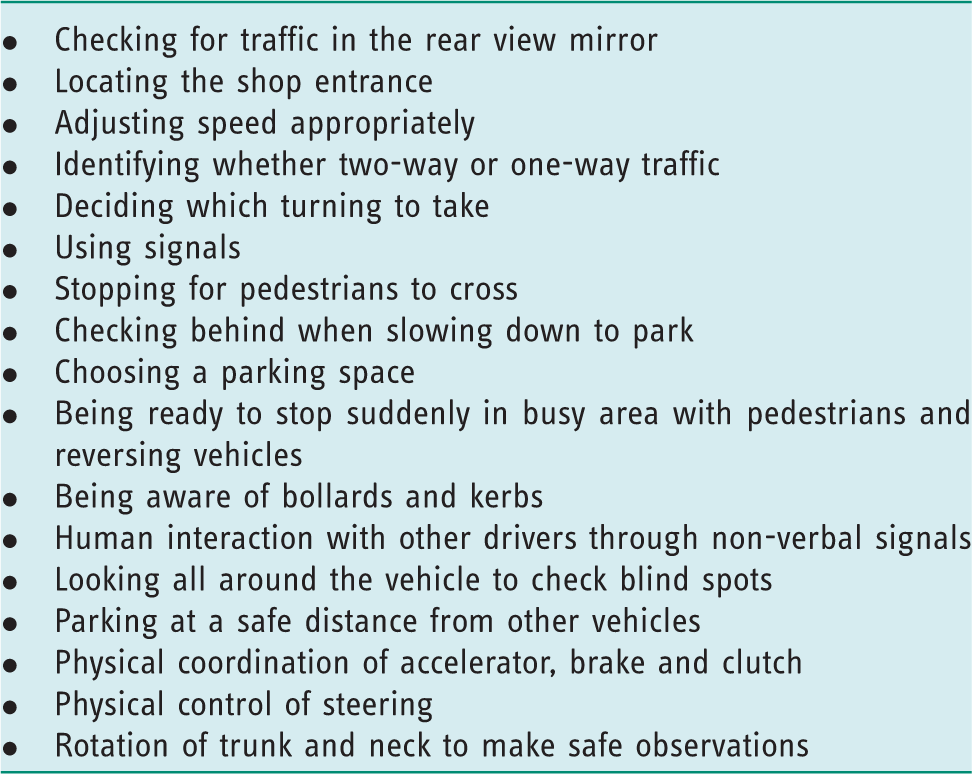
Driving and domains of cognition
Cognitive domains and associated driving skills.
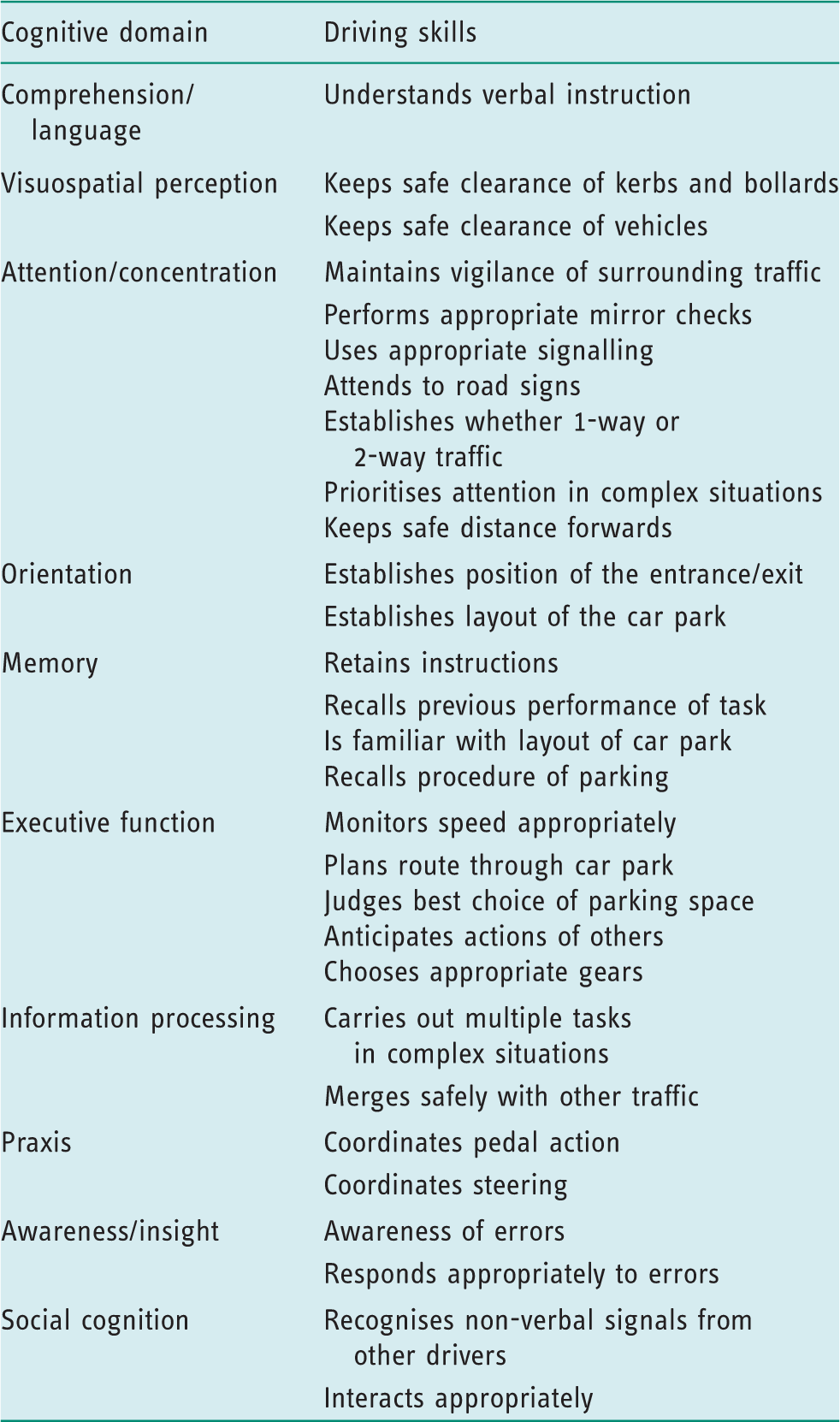
Table 2 was used as the basis for developing a working assessment guide that could be used to identify errors and deficits in particular cognitive domains. It serves to highlight the complexity of the parking task and the variety of cognitive skills that are required to perform this universal activity.
The multiple errands test
This practice analysis describes how the principles and methods used in the Multiple Errands Test -- Hospital Version (MET-HV) were applied to the development of a parking exercise within a store car park. Also, how its effectiveness as a tool for assessing a client’s cognition and fitness to drive were explored.
The MET was originally described by Shallice and Burgess (1991) in an attempt to observe and assess cognitive function in patients performing everyday tasks in an environment that was true to life. They acknowledged that many neuropsychological assessment procedures performed in the clinical setting did not effectively recognise executive impairments experienced in everyday functioning. Morrison et al. (2013) found the MET reliable in identifying problems in executive function in people with mild cerebrovascular accidents. These people had shown little or no impairment when traditionally assessed with office-based psychometric tests before discharge, but had gone on to experience difficulty adapting to community life.
The MET requires the participant to follow written instructions and perform a series of tasks that are bound by rules while being observed by an assessor. It has the potential to be applied to a variety of assessment situations. The MET-HV (Knight et al., 2002), for example, was adapted for use within the hospital grounds. It requires the participant to follow written instructions to complete a number of tasks, such as buying a stamp, finding an address and posting a letter. The participant is asked how well they think they will perform, and this is compared with the perception of their actual performance to give an indication of insight. The tasks are bound by rules such as not being permitted to return to a location previously visited. Also, the participant is required to remember some elements such as telling the assessor when they have finished the test. In this way, a patient is tested over a sustained period and on tasks that require subtle planning, monitoring and decision making. ‘It is a reliable and ecologically valid assessment that provides a standard way of categorizing executive performance errors in a naturalistic environment’ (Dawson et al., 2009).
Applying the MET-HV to the task of parking
The MET-HV has specific components to standardise its use and an attempt was made to incorporate these into a new assessment tool.
A rating scale for efficiency of parking performance as quantified by the driver. The MET-HV uses a 10-point Likert-type scale with weighted end points (1 = hopeless, 10 = excellent) in order to gauge the level of insight a driver has and their perception of their performance compared with actual errors. The rating is done both before and after the task. A rating scale for familiarity of the task. The MET-HV uses a four-point scale (0 = not at all, 1 = somewhat, 2 = fairly, 3 = very well) in order to rate how familiar the task feels to the participant and ensure that the task is a valid one. A set of driving tasks to complete having received verbal and written instructions. Information for the driver to gather. For example, noting the speed limit within the designated area. Rules to be followed by the driver to establish whether a driver can monitor behaviour. For example, avoid parking next to a kerb. Recording of errors while parking according to the following:
inefficiencies – where a more effective strategy could be applied; rule breaks – where a specific rule was broken; interpretation failures – where the task had been misunderstood; task failure – where a task had not been completed.
Instructions for participants
The driving adviser will request that the driver stops in a quiet area in the immediate vicinity of a store car park. They will explain that they are to be asked to park the vehicle as they normally would. Before starting, both efficiency and familiarity ratings are obtained.
How would you rate your parking skills on a scale of 1 to 10? How familiar is this task to you on a scale of 0 to 3?
The following instructions are given to the driver. I would like you to imagine that you are using this store. Please enter the car park and park in your usual way and tell me when you have finished. Please avoid parking next to a kerb. I would like you to note the speed limit and tell me on completion of the task. Take as little time as possible without rushing excessively. There is no time limit to completing the task. Is that clear? Do you have any questions? Now tell me what you must do. Please begin when you are ready.
Progress to date
This assessment tool has been piloted with a small cohort of clients attending for a driving assessment with a diagnosis carrying potential for cognitive decline. Initial findings suggest that this parking exercise has the potential to identify problems in cognitive domains that are relevant to a client’s overall safety to drive. For instance, an older driver who had difficulty processing multiple tasks, and made errors in gear selection in this complex environment, was subsequently found unfit to drive. Conversely, a 93-year-old gentleman was able to display a high level of cognitive function, reversed his vehicle safely and confidently, and performed well in all aspects of his on-road assessment.
The development of this assessment process is very much in its infancy but is being piloted at a Forum accredited Driving Assessment Centre with support from a team of neuropsychologists. Once the finer details are clarified there is a plan to begin to collect normative data which will be vital to begin standardisation of this assessment tool.
Summary
The purpose of this project was to explore the use of a more reality-based parking exercise for use in the assessment of cognitively impaired clients attending for a driving assessment. In doing so, the cognitive domains required to park a vehicle safely have been examined more closely. The assessor is then more able to give concrete examples of driving behaviour that are linked with specific areas of cognitive impairment. This process has highlighted the vast extent of higher driving skills that are required in the everyday task of parking a vehicle. There is evidence to suggest that the use of a standardised cognitive test, to be used while a client is driving, could be more meaningful both to the driver and the assessor. The success of this test relies heavily on all driving assessors having a detailed knowledge of normal driving behaviour and how cognitive deficits can impact upon driving performance in this highly specialised field.
Key messages
The effectiveness and suitability of office-based cognitive tests to assess driving skills is controversial. It may be possible to develop a standardised assessment tool to be used on road.
Footnotes
Acknowledgements
The author gratefully acknowledges the ongoing input and guidance given by Dr Gavin Newby, Consultant Clinical Neuropsychologist, and Dr Hayley Entwistle, Clinical Psychologist, at the Cheshire and Wirral Partnership NHS Foundation Trust Acquired Brain Injury Service.
Research ethics
Ethics approval was not required for this study.
Declaration of conflicting interests
None declared.
Funding
This research received no specific grant support from any funding agency in the public, commercial, or not-for-profit sectors.