






Abstract
Introduction
Mindfulness is associated with psychological wellbeing and quality of life. The focus on body awareness in definitions of mindfulness suggests that an individual’s sensory processing pattern may influence mindfulness abilities. Therefore, this study seeks to examine the relationship between sensory processing styles and multiple aspects of mindfulness including components of attention, awareness, and acceptance in healthy adults.
Method
151 participants, aged 18 to 60 (mean 25.24 ± 8.8), completed the Adolescent/Adult Sensory Profile, mindful attention and awareness scale, and cognitive and affective mindfulness scale.
Findings
Aspects of mindfulness associated with attention and awareness were significantly negatively related to sensory processing patterns associated with passive behavioral strategies (low registration and sensory sensitivity).
Conclusion
Individuals whose sensory processing patterns are characterized by poor awareness experience more mind wandering and distraction in daily life. Occupational therapists should consider mindfulness techniques when treating individuals with sensory processing disorders. In addition, information about sensory processing styles should be incorporated into relaxation and mindfulness-based interventions.
Introduction and literature review
Mindfulness
Mindfulness is described as way of bringing attention to the present moment with an open and non-judgmental awareness (Kabet-Zinn, 2003). While the roots of mindfulness are found in Buddhist notions regarding the meaning of suffering, western interest in mindfulness can be traced to Kabet-Zinn’s (1982) introduction of mindfulness-based stress reduction (MBSR) as an adjunctive therapy for individuals with chronic health conditions. MBSR includes a variety of formal meditation practices, such as focused breathing, sitting meditation, and yoga, that occur during weekly group interventions (Kabet-Zinn, 2003). Studies have found that MBSR improves mood and wellbeing in individuals with cancer (Kabet-Zinn, 1982) as well as healthy adults (Shapiro et al., 1998). Since the introduction of MBSR, a variety of other mindfulness-based treatment packages have been developed, including mindfulness-based cognitive therapy (Segal et al., 2002) and dialectical behavioral therapy (Linehan, 1993). While targeting different clinical populations, all these interventions view mindfulness as the core mechanism by which therapeutic change occurs. A growing body of research (Baer, 2003) indicates that these programs provide significant benefits for a diverse group of individuals, including those with anxiety, depression, chronic pain, cancer, and fibromyalgia. Benefits range from improvements in psychological wellbeing (Brown and Ryan, 2003), to affect regulation (Brown et al., 2007), mood, and stress (Baer, 2003).
Mindfulness, however, is distinct from meditation. Mindfulness describes a qualitative state of consciousness that involves the ability to be fully engaged in the present moment (Brown et al., 2007). In contrast, meditation is the process most commonly used to facilitate this state of conscious engagement. An individual’s ability to enter into the mindfulness state is influenced both by long-term personality and short-term situational factors as well as experience with formalized meditation practices. Full engagement in the present moment involves the ability to bring attention and awareness to all of the sensory, cognitive, and emotional aspects of a given experience. In addition, many authors suggest that mindful engagement requires approaching experiences with a curious, open, and non-judgmental attitude (Feldman et al., 2007; Kabet-Zinn, 2003). Understanding how individual differences in these factors are associated with the conscious state of mindfulness is important for occupational therapists looking to improve wellbeing in daily life. This is because previous work has found that less mindful individuals report more distress and less psychological wellbeing on a daily basis (Baer et al., 2006; Brown and Ryan, 2003).
The specific mechanisms required for mindful engagement with an experience to occur are not well understood. It has been suggested that the ability to focus attention and an awareness of bodily sensations are two skills necessary to mindfully engage in the present moment (Hölzel et al., 2011). Laboratory studies indicate that individuals high in mindfulness display a greater ability to focus attention (Jha et al., 2007). The ability to focus attention is also increased following exposure to formalized meditation programs (Tang et al., 2007). The role of bodily sensory awareness has been less studied, although awareness of tactile sensations has been found to be higher in experienced practitioners of tai chi (Kerr et al., 2008), a meditational activity often included in mindfulness programs. The relationship between mindfulness and sensory awareness and processing more broadly defined remains to be explored.
The inherent relationship between mindfulness and occupational engagement has been recognized by occupational therapists (Elliot, 2011; Reid, 2011). Elliot (2011) and Reid (2011) highlight the fact that full engagement in occupations creates a sense of heightened involvement and awareness that is similar to classic definitions of mindfulness. Mindfulness during occupations has been differentiated from the related concept of flow. Flow occurs in situations when an individual with a high skill level engages in a high challenge activity (Reid, 2011). The key factor delineating a flow experience is full emersion in a goal-directed activity with an accompanying loss of time (Wright et al., 2006). Mindfulness experiences require no inherent challenge and can include ordinary activities of daily life (Elliot, 2011). It is the degree to which an individual is attuned to and consciously aware of engagement in the occupation that points to the presence of mindfulness (Reid, 2011). The importance of sensory, cognitive, emotional, and attitudinal factors in mindful occupational engagement has not been well explored. Occupational therapists would benefit from understanding which factors are most important to facilitate mindful engagement with daily occupations.
Sensory processing
Sensory processing refers to how an individual takes in, organizes, and responds to sensory information in the environment (Dunn, 2001). According to Dunn’s (1997) model, sensory processing styles are comprised of the interaction between a neurological threshold and behavioral self-regulation strategies. Neurological thresholds exist on a continuum from low (requires little stimulation) to high (requires a lot of stimulation). Sensory processing difficulties can exist at either end of this continuum, with individuals displaying sensory hypersensitivity (low thresholds) or hyposensitivity (high thresholds) (Miller et al., 2007).
Previous work with healthy adults has shown that sensory hypersensitivity may be related to depression (Liss et al., 2008), pain sensitivity (Kinnealey and Fuiek, 1999), sleep disturbances (Engel-Yeger and Shochat, 2012), and negative mood (Engel-Yeger and Dunn, 2011). Preliminary work with clinical populations also suggests that adults with mental health conditions including obsessive-compulsive disorder (Reike and Anderson, 2009) and post-traumatic stress disorder (Engel-Yeger et al., 2013) have sensory patterns characterized by sensory hypersensitivity. In contrast, less is known about adults with sensory hyposensitivity, although evidence suggests that it may be associated with schizophrenia (Brown et al., 2002).
While sensory thresholds are thought to reflect the state of the nervous system (Dunn, 1997), individuals have a range of behavioral self-regulation strategies available for coping with their sensory thresholds. At one end of the continuum, individuals engage in active strategies to control the amount and type of sensory input experienced in everyday life. These strategies may include modifying the environment or using cognitive or emotional techniques to reframe a sensory experience (Dunn, 2001). Other individuals are passive in the face of sensory information, making no effort to increase or reduce stimulation but simply letting events happen and then responding accordingly (Ben-Avi et al., 2012; Dunn, 2001). Models of sensory processing disagree on the importance of strategy use in addressing sensory inputs. For example, Dunn’s (1997) model considers the use of passive and active strategies as consistent with normal sensory processing. In contrast, some authors view passive strategies as a sign of sensory disorder (Kimball et al., 2012) while others view active strategies as disordered (Miller et al., 2007). It is not clear why some individuals do not actively modify their sensory environments, although reduced awareness of sensory information or the cognitive-emotional strategies that could be used to modify sensory inputs may play a role (Dunn, 2001).
Sensory processing patterns vary within individuals both across sensory systems (such as tactile or vestibular) and across environmental settings (home versus work). The Adolescent/Adult Sensory Profile (AASP) (Brown and Dunn, 2002) provides estimates of sensory processing within four broad patterns resulting from the interaction of the neurological threshold and self-regulation strategies in Dunn’s (1997) model. These broad sensory processing styles include low registration, sensation seeking, sensory sensitivity, and sensation avoiding. The low registration processing style reflects passive responding to a high neurological threshold, with individuals responding to sensory stimuli slowly or not at all. The sensation-seeking style reflects active responding to a high neurological threshold, with individuals seeking high intensity stimulation. The sensory sensitivity style reflects a low neurological threshold and a passive behavioral response, with individuals feeling overwhelmed by sensory information that most people find normal. The sensation avoiding style reflects a low neurological threshold with an active behavioral response.
The inclusion of awareness of bodily sensations in definitions of mindfulness (Brown and Ryan, 2003; Kabet-Zinn, 2003) and the significant effects that sensory processing patterns have on engagement with daily life suggests that how a person processes sensory information may affect their ability to be mindfully engaged with daily life. A lack of knowledge exists regarding the relationship between sensory processing styles and mindfulness. This information is important for understanding how mindfulness could be used as a tool to increase occupational engagement. Currently, occupational therapists addressing sensory processing use primarily systematic exposure to structured information in the form of sensory diets and environmental modifications. Mindfulness techniques may be a useful supplement to addressing sensory processing difficulties in a range of individuals. For example, an adult who experiences low movement registration could be taught to bring sustained engaged attention to the act of climbing stairs to reduce fall risks. An individual with sensitivity to light tactile information could be taught to use deep breathing techniques to redirect the focus of awareness when getting a haircut.
Aims of the study
The purpose of the present study is to examine the relationship between mindfulness and sensory processing styles. To fully explore this relationship, two measures of mindfulness were examined that differ substantially in their focus on the relative importance of attention, awareness, and acceptance factors in defining mindfulness. Because mindfulness involves systematically paying attention to the sensory components of daily experiences, it is expected to vary across sensory processing styles. In particular, sensory styles characterized by reduced awareness of sensory inputs, such as low registration, are expected to be associated with less mindfulness during daily experiences. Conversely, increased mindfulness would be expected to be related to sensory styles characterized by successfully paying attention to and engaging with sensory information. Although the AASP does not define a “healthy” processing pattern, sensory seeking is most associated with normal behavioral and emotional functions (Brown and Dunn, 2002).
Method
Participants
One hundred and fifty-one healthy individuals (53 males, 98 females) ranging in age from 18–60 (mean 25.24 ± 8.8) participated in this study. Participants were recruited after receiving ethical approval from the university institutional review board (IRB). Participants were recruited by flyers posted at a large university campus and downtown com munity in the Midwestern United States. Participants self-reported that they were generally healthy and had no history of psychiatric conditions. Exclusion criteria included a history of neurological or psychological disorder. Experienced meditators, defined as having participated in a formalized meditation course of at least 4 hours’ duration, were excluded from this study because the goal was to understand the relationship between sensory styles and mindfulness in typical adults.
Measures
Mindful Attention Awareness Scale (MAAS) (Brown and Ryan, 2003)
This 15-item questionnaire assesses the frequency of present-moment experiences in everyday life. Unlike most other measures of mindfulness, the MAAS has individuals report the frequency of mind wandering or distraction episodes that occur on a daily basis. These experiences of absence are theorized to be more accessible to introspection in individuals without exposure to formal meditation training. The frequency of each experience is rated on a six-point scale ranging from 1 (almost always) to 6 (almost never). Sample questions include “I find it difficult to stay focused on what’s happening in the present” and “I rush through activities without being really attentive to them.” Responses are averaged across items, resulting in a score ranging continuously from 1 to 6 with higher scores reflecting greater mindfulness (that is, fewer episodes of mind wandering). The scale has high internal consistency (α = .87) and test–retest reliability (r = .81). Although no clinical cutoffs exist, lower scores are associated with increased distress and reduced psychological wellbeing in normal, healthy populations (Brown and Ryan, 2003). Previous studies have developed mindfulness categories based on normal ratings in healthy individuals with 3.67 (33% of the population) as a cutoff for high mind wandering, 3.68–4.39 for typical mind wandering (34% of the population), and 4.40 (33% of the population) as a cutoff for low mind wandering (Palmer and Rodger, 2009).
Cognitive and Affective Mindfulness Scale – Revised (CAMS-R) (Feldman et al., 2007)
This 12-item questionnaire is designed to examine both attentional and attitudinal components of mindfulness in individuals with no previous meditation experience. It assesses four theoretical domains of mindfulness: attention; present-focus; awareness; and acceptance. Responses are rated on a four-point scale ranging from 1 (rarely/not at all) to 4 (almost always). Sample questions include “I can accept things I cannot change” and “I am able to focus on the present moment.” Responses are summed across domains into a single score ranging from 12 to 48 with higher scores reflecting more mindfulness. The overall scale has good internal consistency (α = .77).
Adolescent/Adult Sensory Profile (AASP) (Brown and Dunn, 2002)
This 60-item questionnaire assesses the frequency with which individuals engage in everyday behaviors in various sensory systems. Participants rate their responses on a five-point scale from 1 (almost never) to 5 (almost always). Responses are sorted into four quadrants based on Dunn’s model of sensory processing (Dunn, 1997). These quadrants include: low registration (for example, “I do not seem to notice when someone touches my arm or back”); sensation seeking (for example, “I seek out all kinds of movement activities”); sensory sensitivity (for example, “I startle easily to unexpected or loud noises”); and sensory avoiding (for example, “I wear gloves or avoid activities that will make my hands messy”). Responses are summed in each sensory processing quadrant into a score ranging from 15 to 75. The five categories of responses for each sensory processing pattern were identified using the norms for the 18–64 age range in the AASP manual (Brown and Dunn, 2002). These five categories consist of: much less than most people (2% of the population); less than most people (14% of the population); similar to most people (68% of the population); more than most people (14% of the population); and much more than most people (2% of the population). In this study the five levels were collapsed into three to allow for sufficient numbers at each level. Processing patterns were merged as follows: (1) “Less than most people” (consisting of “Much less than most people” and “Less than most people,” representing greater than 1 SD below the mean); (2) “Similar to most people” (not changed from AASP manual, representing the population from –1 SD to 1 SD); and (3) “More than most people” (consisting of “Much more than most people” and “More than most people,” representing greater than 1 SD above the mean).
The questionnaire has good internal consistency for the adult population (α = .692) for low registration, for sensation seeking (α = .639), for sensory sensitivity (α = .657), and for sensory avoiding (α = .699) (Pohl et al., 2003).
Procedure
After providing written informed consent to participate in this study, participants completed a battery of questionnaires, including the AASP, CAMS-R, and MAAS, as well as experimental measures assessing cognitive and emotional responding, in the primary investigator’s laboratory.
Analysis
Pearson correlations were used to determine the strength of the relationship between AASP scores and the two measures of mindfulness. To assess differences in the AASP styles of individuals high and low in mindfulness, participants were divided into three mind-wandering groups based on the distribution of MAAS scores (low wandering <3.67, medium wandering 3.68–4.39, high wandering >4.40) in a normal population (see Palmer and Rodger, 2009). Chi-square tests were used to assess group differences in the number of participants in each of the three category levels for the four sensory processing quadrants.
Linear regressions were used to examine if the frequency of mind wandering (total MAAS score) could be predicted by sensory processing style. A multiple linear regression was used to examine the relative contribution of each sensory processing style to the overall frequency of mind wandering. Due to the presence of collinearity in sensory processing styles, single linear regressions are also reported. Only frequency of mind wandering (MAAS scores) was assessed due to the largely nonsignificant relationships between sensory processing styles and total CAMS-R scores.
Significance was identified as p < .05 for all analyses. Data were analyzed using SPSS (SPSS Inc. Chicago) and R statistical software.
Results
Gender differences were examined using two multivariate analysis of variance (MANOVA) procedures with Wilks’ Lambda criterion (Polit, 1996). There were no significant differences between men and women for sensory processing scores (F6,144 = .399, NS) or mindfulness scores (F6,144 = .62, NS). Therefore, results were collapsed across gender. Age effects were examined by computing Pearson’s correlations between participant age and sensory processing and mindfulness scores. Age was positively correlated with scores on the MAAS (r = .233, p < .05). Therefore, partial correlations controlling for the effects of age are reported. Participants in this study displayed a similar distribution of sensory processing ranges to the norms presented in the AASP manual (Brown and Dunn, 2002).
Relationship between mindfulness and sensory processing styles
Correlations between sensory processing styles and mindfulness.

MAAS: Mindful Attention Awareness scale; CAMS: Cognitive and Affective Mindfulness Scale;
p < .05; **p < .01
The relationship between the CAMS-R and MAAS was modest (r = .34, p < .001), reflecting the fact that these two scales were designed to measure different but overlapping aspects of mindfulness processing.
Differences in sensory processing styles between high, medium, and low mind wandering individuals
Group distributions of the sensory processing response categories were significantly different than expected for the low registration and sensory sensitive processing styles (see Figure 1). For low registration, high mind wanders were overrepresented in the more than most people range while low mind wanders were overrepresented in the less than most people range: X2(4, N = 151) = 32.42, p < .001. This indicates that individuals who frequently experience mind wandering have more difficulty registering sensory information. Similar results were found for sensory sensitivity; high mind wanders were overrepresented in the more than most range and low mind wanders were overrepresented in the less than most range: X2(4, N = 151) = 24.35, p < .001. This suggests that individuals that are more sensitive to sensory information experience greater levels of mind wandering.
Number of participants classified as high, medium, and low in mind wandering on the mindful attention and awareness scale by sensory processing style.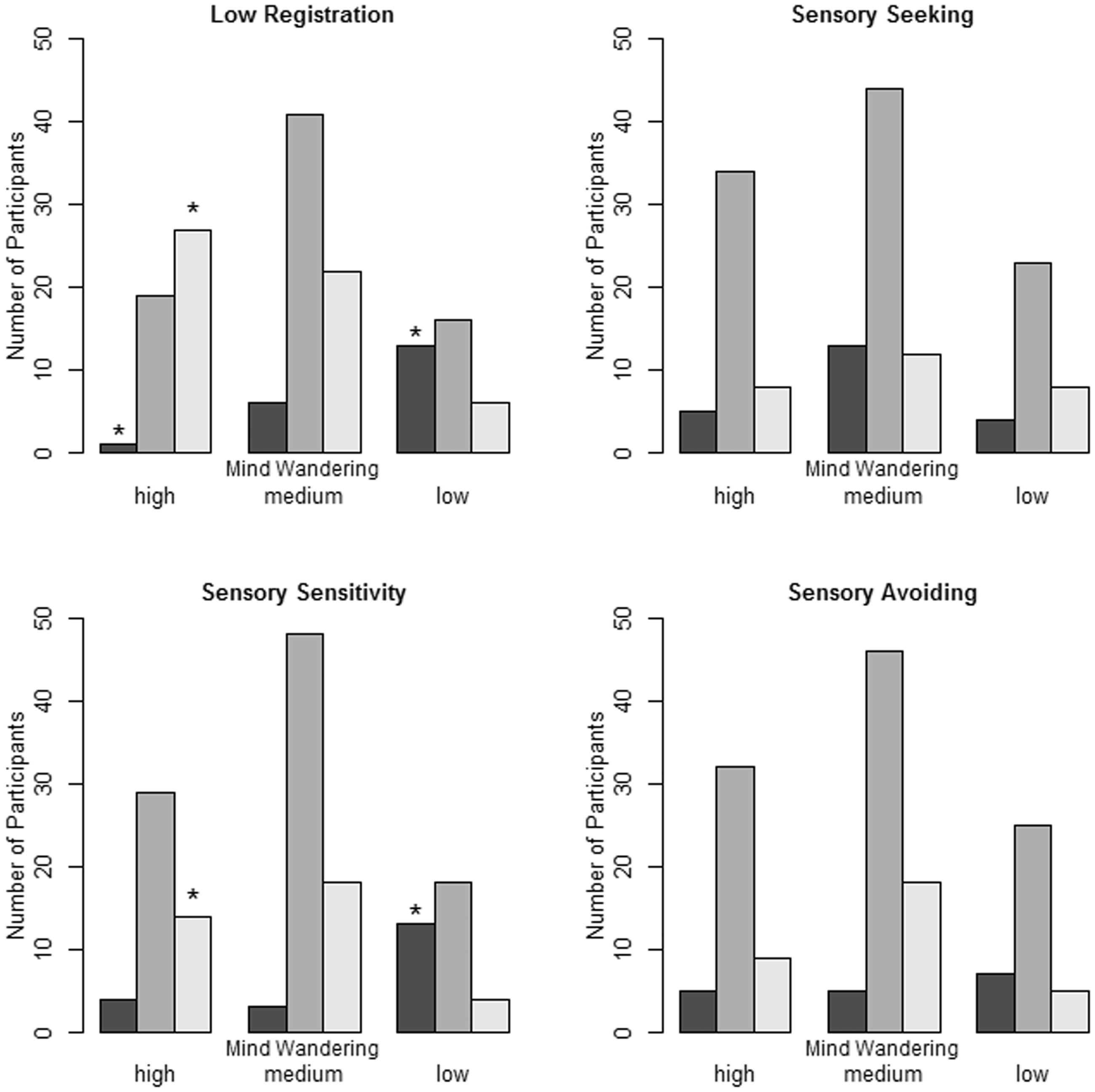
Predicting mind wandering by sensory processing styles
Sensory processing predictors of mind wandering (total MAAS).

MAAS: Mindful Attention Awareness Scale **p < .001
Due to the presence of significant correlations between several sensory processing patterns scores (ranging from 0.2 to 0.6), single linear regressions were also calculated for each sensory processing pattern. Increased low registration scores significantly predicted mind wandering (F[1,149] = 31.34, p < .001), accounting for 17.4% of the variance. Increased sensory sensitivity scores significantly predicted mind wandering (F[1,149] = 12.98, p < .001), accounting for 8% of the variance. Increased sensory avoiding scores also significantly predicted mind wandering (F[1,149] = 4.24, p < .05), but only accounted for 2.8% of the variance.
Discussion
This study found that differences in sensory processing patterns are related to mindfulness in daily life. Specifically, individuals with a sensory style characterized by engagement in passive self-regulation strategies (low registration and sensory sensitivity) displayed more mind wandering in daily life. In addition, individuals with low registration also displayed less of the attitudinal (open and accepting) components of mindfulness. It is likely that different mechanisms modulate the relationship between sensory awareness and mindfulness in these two sensory styles.
In low registration, the high sensory threshold increases the time needed for sensory information to be noticed by the nervous system. Without constant sensory cues from the environment, episodes of mind wandering become more severe and more likely to interfere with daily activities. This disengagement from the environment may also characterize the identified relationship between low registration and schizophrenia (Brown et al., 2002), given that schizophrenia involves an intense preoccupation with internal thoughts and slowed processing speed (American Psychiatric Association, 2013). It is notable that low registration was the only sensory processing style associated with the attitudinal components of mindfulness. It is plausible that the ability to have an accepting attitude towards difficult thoughts and emotions is reduced in low registration because the ability to notice these difficult thoughts is decreased. The low registration sensory processing style is associated with increased rates of impulsivity in health adults (Hebert, 2015), suggesting that difficulty in noticing and accepting difficult thoughts may result in behavioral responses that are impulsive in nature.
The sensory sensitivity processing style was associated with increased rates of mind wandering in this study. In contrast to low registration, the low sensory threshold experienced by individuals with sensory sensitivity suggests that awareness of sensory information is preserved. This information may be so intensely experienced, however, that it occupies extra cognitive resources, leading to mind wandering from the task at hand to the sensory aspects of the environment. This hypersensitivity to sensory information with an associated reduction in cognitive resources could also explain findings of increase rates of internalizing conditions (such as anxiety, depression, or pain) in individuals with sensory sensitivity (Engel-Yeger and Dunn, 2011; Kinnealey and Fuiek, 1999; Liss et al., 2008).
Contrary to expectations, sensory processing characterized by high engagement in active self-regulation strategies (in particular sensation-seeking styles) did not display a correspondingly positive relationship with mindfulness. The reason for this lack of a relationship is unclear, although the active engagement in mindfulness may be fundamentally different from that utilized in response to sensory inputs. The ability to flexibly utilize both active non-engagement and modulation is important as on a daily basis an individual will encounter a range of environments. For example, at home modification of the sensory environment may be optimal while in a crowded workplace mindful non-engagement may be the best strategy.
In the present study, stronger relationships were found between sensory processing styles and everyday mindfulness as measured by the MAAS. Brown and Ryan (2003) suggest their scale is uniquely designed to tap mind-wandering episodes which involve a loss of awareness due to either internal bodily sensations or distractions caused by external sensory stimuli. Other measures, like the CAMS-R, have a stronger focus on the attitudinal components of acceptance and non-judgment that are primarily reflective of internal processing (Feldman et al., 2007). The current study suggests that attitudinal components of mindfulness likely reflect personality and social factors which are not related to sensory processing styles, as evidenced by the lack of a relationship between most sensory processing styles and responses on the CAMS-R. In fact, only low registration, a sensory style characterized by poor awareness, was associated with reduced acceptance and non-judgment of internal thoughts. The most commonly used mindfulness measures vary in the number and scope of components considered crucial in defining this complex phenomenon (Baer et al., 2006; Brown and Ryan, 2003; Feldman et al., 2007). The finding that these measures are not equally related to other person factors suggests that the decision of which mindfulness measure to use in future research should be guided by the theoretical research question. For example, exploring mindfulness in the context of occupational activities that occur in complex sensory environments may require mind wandering measures like the MAAS. In contrast, understanding how mindfulness relates to resiliency in predicting adjustment to chronic disability may benefit from measures like the CAMS-R.
Although every moment-to-moment experience has sensory, cognitive, and emotional components, individuals vary in their ability to bring attention and awareness to these independent components. This difficulty is recognized in the clinical literature in the focus on different skill sets across the various treatment packages. For example, mindfulness-based cognitive therapy focuses on the skill of cognitive attention in individuals with depression (Segal et al., 2002). In contrast, dialectical behavioral therapy addresses emotional regulation skills in individuals with borderline personality disorder (Linehan, 1993). Despite these differences, meditation activities that address general bodily awareness (such as awareness of the breath through deep breathing) or the sensory aspects of everyday tasks (for example, eating a raisin, brushing teeth) are common to many mindfulness programs. It has been suggested that the ability to observe and notice sensations both within and outside the body (such as smells, sounds, and visual images) is the mindfulness skill most influenced by exposure to formal practice (Baer et al., 2006). This suggests that occupational therapists, with their extensive knowledge of sensory processing, can provide unique contributions to both mindfulness interventions and the theoretical literature.
Limitations and future directions
This study was based on a convenience sample of healthy adults without experience in mindfulness training. Concern has been raised that populations without formal meditation training may interpret self-report questions about mindfulness differently than experienced practitioners because of the lack of familiarity with certain concepts (Baer et al., 2006; Buchheld et al., 2001). Despite this, both mindfulness questionnaires used in this study have been well validated in samples of healthy community-dwelling adults similar to those included in this study (Brown and Ryan, 2003; Feldman et al., 2007). This study explored rates of mindful engagement in healthy individuals with a range of normal sensory processing styles. Because sensory awareness is complex, future work should examine which components are specifically related to mind wandering (as measured by both self-report and laboratory tasks). The impact of interventions designed to teach self-regulation strategies on rates of mind wandering in a variety of populations should also be systematically explored. More generally, future work should examine if occupational engagement reduces mind wandering by systematically probing mind wandering prior to, during, and after occupational activities.
Examining sensory processing (using both self-report and laboratory based measures) in experienced meditators or following exposure to a training program could provide additional insight into the relationship between these two factors. Differences in baseline mindfulness abilities and the impact of various training techniques in individuals with sensory processing dysfunction also warrant further study.
Implications for occupational therapy
Occupational therapists routinely treat individuals with sensory processing dysfunction. This includes children with identified sensory modulation disorders (Miller et al., 2007) and adults with a variety of psychological conditions associated with sensory dysfunction (such as obsessive-compulsive disorder, post-traumatic stress disorder, anxiety, and depression). Therapists involved in providing interventions to these populations should consider including mindfulness techniques to increase awareness of the sensory inputs that occur in daily life. Mindfulness skills of self-awareness, focused attention, and emotional awareness and regulation fit readily into occupational therapy’s scope of practice, particularly when taught in the context of daily occupations. These skills can be used to help clients maintain emotional calm in the face of distressing sensory experiences in environments that are not easily amenable to modification. For example, an individual with post-traumatic stress disorder may be taught to use mindfulness skills in conjunction with noise canceling headphones to manage the anxiety associated with abrupt loud noises that occur when riding the subway.
In addition, therapists working on cognitively complex activities may find it helpful to utilize the sensory profile to gain insight into which environments provide appropriate sensory challenges in daily life. For example, an individual with poor sensory awareness may be taught to systematically stop when completing homework and notice if their mind is on task. If frequent mind wandering is experienced, then sensory stimulation could be either added (for example, by putting on music) or removed (for example, by moving to a quite bedroom) to maximize the fit between sensory needs and the environment. In this way, occupational therapists can use their unique knowledge of sensory processing skills to help identify situations when mindfulness techniques may be particularly helpful for a range of clients.
Conclusion
A relationship exists between mindfulness and sensory processing patterns characterized by poor awareness (low registration). Individuals who are more extreme in this processing style display greater rates of distraction and attention-wandering on a daily basis. These findings suggest that mindfulness training may be useful for individuals with sensory processing dysfunction. Additional information about sensory processing styles may prove helpful when teaching individuals how and when to utilize mindfulness techniques in daily life.
Key findings
Mindfulness abilities may be related to how a person processes sensory inputs. Occupational therapists should consider sensory processing patterns and mindfulness techniques when planning interventions for individuals with psychological conditions.
What the study has added
This study demonstrates that individuals with low registration and sensory sensitivity processing styles have an increased frequency of mind wandering.
Footnotes
Research ethics
Ethical approval was obtained from the University of Missouri Institutional Review Board #1210945 (July 7 2014–July 7 2015).
Declaration of conflicting interests
The authors confirm that there is no conflict of interest.
Funding
This research received no specific grant support from any funding agency in the public, commercial, or not-for-profit sectors.