






Abstract
Parliamentary libraries play a crucial role in providing information support to decision-makers around the world. These institutions have faced an unprecedented situation with the COVID-19 pandemic. Many have had to modify their practices considerably to keep serving their users. This article explores how the National Assembly of Quebec Library has responded to this issue and redefined its services during the pandemic. The author presents the challenges and opportunities met while adapting virtual services, redefining document handling and improving team communication, and foresees future obstacles for the institution. This case study shares best practices and the lessons learned in the hope of informing and advising similar institutions facing challenges during this pandemic.
Keywords
Introduction
The COVID-19 pandemic has affected every aspect of society; no institution has emerged unscathed from this crisis. Libraries are no exception and have had to reinvent themselves to continue to fulfil their mission. While much has been said on the challenges faced by public and academic libraries, little information has been provided about special libraries, which often operate in atypical contexts. Among these, the experience of parliamentary libraries tends to remain unknown, even though these institutions play a fundamental role in providing reliable and quality information to decision-makers. Many experts have stressed how important it is that parliaments remain functional during the coronavirus crisis, as pillars of democratic governance and oversight (e.g. Mills, 2020). Parliamentary libraries have faced an unprecedented situation with the COVID-19 pandemic, and many have had to modify their practices considerably to keep serving their users. This article explores how the National Assembly of Quebec Library has responded to this issue and redefined its services during the pandemic. The author presents the challenges and opportunities met while adapting virtual services, redefining document handling and improving team communication, and foresees future obstacles for the institution.
The National Assembly of Quebec Library: a cornerstone institution for decision-making
The National Assembly of Quebec Library contributes to the political and parliamentary life of the province of Quebec with a rich and diverse collection of over two million documents. It provides reliable and impartial information and analysis for its patrons. As Gallichan (2002) states, the library’s main mandate is to assist legislators in the accomplishment of their work by catering to their information and research needs.
The parliamentary patrons are diverse and include: Members of the National Assembly and their staff; administrative employees of the National Assembly; the five public bodies designated by the National Assembly – namely, the Ethics Commissioner, the Lobbyists Commissioner, the Chief Electoral Officer, the Quebec Ombudsman and the Auditor General; the Lieutenant Governor and his staff; and the Press Gallery. Despite these patrons having precedence, assistance and research guidance are offered to all citizens on-site, by email or by phone.
Pelletier (2017) describes the library’s four departments as complementary. The Reference Service offers information, assistance, training, selection and documentary research services in order to support the library’s patrons in their work. The Research Department carries out research and analysis work for Members of the National Assembly, parliamentary committees and parliamentary delegations. It also contributes to knowledge production and dissemination regarding the history and evolution of parliamentarism and parliamentary institutions. The Acquisition, Processing and Indexing Department is responsible for acquiring and processing the documentary resources of the library, as well as rendering them accessible through the library’s catalogue. It also produces the indexes of the National Assembly Debates. Finally, the Archives and Digitization Department manages the parliamentary, institutional and administrative records of the National Assembly. In addition, the staff share their expertise and consulting services on collection digitization and digital curating.
Ensuring continuity of service: broadening the library’s digital offering
When COVID-19 was declared an international pandemic in March 2020, the National Assembly’s speaker, Mr François Paradis, announced that the parliament would be closed to visitors. On 17 March, all parliamentary business was suspended until 13 May 2020. The library’s physical premises were closed, and staff were sent home with directives regarding teleworking. Rapid changes had to be made to provide remote reference services for patrons.
Remote reference services
With the library’s building closed, the public could no longer access on-site resources until further notice. Nonetheless, information and research requests were answered remotely using digital collections and resources. Fortunately, as mentioned in the library’s 2014–2015 annual report (Buteau et al., 2015), in 2014 the Archives and Digitization Department updated the digitization policy of the National Assembly, setting up a new institutional digitization programme and procedures. Since then, administrative documents, parliamentary documents and institutional publications have been prioritized in the digitization chain, which has led to a significant increase in the number of documents available in the library’s digital collection. Optical character recognition is performed on the documents that are digitized. This work has proved to be very useful for remote reference services, as most of the parliamentary documents consulted are now available digitally. It has been shown (Falt and Pratim Das, 2020) that digital libraries can ensure continuity of learning and human development in crisis situations.
As Watt (2020) mentions it in an IFLA survey conducted on parliamentary libraries’s experience during COVID-19, “as the pandemic demanded swift and radical policy choices there was a parallel requirement for informed parliamentary scrutiny and approval – the need, and potential demand, for quality information and research services increased, they could not simply be suspended.” This challenge was experienced by the Quebec National Assembly Library as soon as the pandemic was declared an international crisis in March 2020.
During the first two weeks after the suspension of parliamentary business, the Reference Service was swamped with information requests from the National Assembly’s administrative staff. Monitoring requests were particularly abundant, as many employees wanted to be kept informed on the evolution of the pandemic and its impact on parliamentary business. The National Assembly’s top management created a steering committee to manoeuvre through the crisis, which asked the library to produce a monitoring newsletter with the aim of helping them to make informed decisions. The Reference Service’s expertise was thus put to good use, but reference librarians had to manoeuvre through an increase of information requests they did not foresee.
Another challenge mentioned by Watt (2020) is that “effective service depends on close contacts with Members and their support staff – those interactions and routine acquisition of knowledge of clients and policy issues were impoverished overnight”. In the case of the Quebec National Assembly Library, contacts with users and patrons were indeed extremely reduced at the start of the pandemic. However, the implementation of Microsoft Office 365 and its collaboration app Teams which was previously scheduled to occur in Spring 2020 did counterbalance that new reality as best as possible, with additional help provided by the Library’s traditional online tools such as emails to patrons, information letters, and use of the Assembly’s portal for employees. As the Library adapted to the use of Microsoft Teams, it became possible to provide online assistance and training for tools and databases remotely available to patrons.
The library’s crucial role in the National Assembly’s monitoring committees
In April 2020, the National Assembly’s steering committee concluded that it would not be capable of processing alone the voluminous amount of information regarding COVID-19. As Valika et al. (2020) demonstrate, the number of articles published on the virus was growing exponentially every month. Instantaneous access and the novelty of the virus provided a perfect situation for information overload. Considering this situation, the National Assembly’s steering committee created four monitoring committees to filter and render intelligible the vast quantity of information available. The four monitoring cells were:
Parliamentary Business – responsible for decision-making regarding parliamentary business (committees and plenary sittings);
Strategic Risk Management – in charge of assessing the risks that could threaten the National Assembly and identifying how to prevent those risks from happening;
Efficiency and Well-Being at Work – responsible for evaluating the impact of the crisis on human resources and the work environment;
Process Optimization – in charge of identifying and implementing the necessary changes to go back to work after the crisis.
Both the Reference Service and the Research Department were involved in this new structure, as a reference librarian and a research analyst were part of each cell. The reference librarians provided information monitoring of the topics covered by the cells, while the research analysts produced analyses and reports based on the resources selected by the librarians. Information and reports were presented to the committees, which decided what had to be transferred to the steering committee for further action. Comparative research focusing on parliaments’ management of the COVID-19 crisis was performed and proved very useful for the National Assembly’s top management. This was an important opportunity for the library to reiterate its relevance and show how innovative it was. Also, it prevented staff from different departments working in silos and duplicating work.
The monitoring committee on parliamentary business enabled the Library to contribute to the adaptation of parliamentary work during the pandemic. Reference librarians carried out research on elements specific to parliamentary reality such as:
Plenary sittings with a limited presence of Members: how many MNAs can fit in the House while respecting social distancing, should the House's doors be kept opened to reduce contamination possibilities, adding circulation signals in the Chamber, etc.;
Voting methods: how voting could be performed with a reduced number of MNAs, in a hybrid mode, or entirely virtually; considering different methods chosen by other parliaments such as proxy voting, pairing, or using an electronic platform;
Reducing paper use: developing a platform to present and table documents electronically;
Virtual plenary sittings: adapting question period and motions if plenary sittings were to occur in a virtual mode;
Virtual committee stage of bills: how bills can be amended and studied article by article in virtual committee sittings;
Adaptation of protocol: if meetings were to be held virtually, how to adapt the speaker’s entrance in the Chamber, the presentation of the procedural mass, and the moment of reflection, which are requirements of Standing Orders;
Parliaments sitting in unusual places: listing parliaments which have decided to sit in other buildings to allow social distancing with all Members present.
Comparative research was thus performed to find answers to these specific information needs. The experience of other parliaments, especially the Westminster parliament (which is known as “the mother of parliaments”), proved very helpful, both regarding adaptations implemented and challenges met. Comparative tables and briefing notes were produced by reference librarians to present these adaptations. A clear and concise bullet-point format was favored since the Assembly’s high management needed to make informed decisions quickly. Once again, the Library made sure to adapt its work to its patrons’ needs. Reference librarians also attended webinars organized by parliamentary research chairs or interparliamentary organizations where parliamentary staff from around the world shared their experiences. A concise summary was then handed over to managers. It should be noted that all this research had to be carried out in a very short amount of time, emphasising yet again the importance of quick reference work – often performed under pressure – as one of the main characteristics of parliamentary libraries.
The monitoring committee on strategic risk management also enabled reference librarians to perform important work for the Assembly’s high management. This committee analyzed potential risks to the institution and passed them on to other monitoring committees for further action to prevent the risks from occurring. Reference librarians therefore drafted risk analysis information sheets on the following risks, among others:
COVID-19 outbreak in the workplace;
Shortage in the supply of sanitary equipment;
Technological problems and network overload;
Potential aggravation of staff’s morale;
Violent demonstrations outside of parliament;
Ventilation issues affecting virus propagation.
Thanks to these information sheets, resources were deployed when necessary. Afterwards, the reference librarian attached to this monitoring committee did continue to monitor foreseeable future risks. The recent events which occurred at the United States’ Capitol reiterated the importance of continuous monitoring in risk management.
For both these committees, the Library had the opportunity to develop new types of documents for its patrons’ needs and to develop new forms of expertise. As stated by Watt (2020), parliamentary library and research services are often delivering highly customised products because of the unique information context surrounding them. Even though the pandemic made this delivery of customised information products more difficult, the National Assembly Library rose up to the challenge by creating new COVID-19 formatted documents.
Creating a COVID-19 New Acquisitions list
Since 2009, the Reference Service has published a New Acquisitions list each Wednesday to inform the library’s patrons of new publications in its collections. This list includes between 15 and 20 references, which are indexed using a controlled vocabulary. The references are entered each week in an internal database. It serves two purposes: (1) to present a selection of interest of the new acquisitions to the library’s patrons and (2) to keep track of references that are relevant for answering future information and research requests.
The number of publications regarding COVID-19 led the Reference Service to transform its New Acquisitions list into a COVID-19 New Acquisitions list (Figure 1). Only references concerning COVID-19 were included. This decision was also motivated by the fact that the novelty of the virus led many patrons to want reliable information to be able to learn about this unprecedented situation. Since COVID-19 has had an impact on all spheres of knowledge, research institutions of all kinds (chairs, universities, think tanks, etc.) started to publish studies related to the pandemic. The COVID-19 New Acquisitions list was thus launched on 25 March 2020. It used the same format and the same controlled vocabulary as the regular list to ensure easy tracking. It was sent out every week until the end of the parliamentary session on 12 June 2020.

Excerpt from the COVID-19 New Acquisitions list.
Although the COVID-19 list proved very useful and was appreciated by patrons, concerns eventually arose within the Reference Service regarding the lack of exposure for non-COVID-related documents published during the pandemic’s first months. To remedy the situation, the Reference Service went back to its regular New Acquisitions list after 12 June. Since then, the New Acquisitions list has included documents on all topics, with a COVID-19 section that can hold up to 10 references per week.
Improving research tools and working methods
The library’s physical premises reopened to staff and priority patrons on 13 May 2020, when parliamentary business was resumed. However, access to the building was restricted to a maximum of five people on-site and was forbidden to the public. With its physical premises less accessible, the library’s departments had to review their research methods, improve their tools, and reinvent their working protocols and procedures.
The Reference Service, for example, enhanced its internal databases. The content of the Myrand databases (Figure 2), which allows to search in full text through the debates occurring in plenary and committee sittings, and through the annual Quebec Statutes, was improved. The PDF documents indexed in those databases lacked standardization. Some PDF files were created from the digitization of annual binders, and in some cases, one document ended in the middle of a page and the next started in the second half of the page. In these cases, the page containing the end of one document and the beginning of another was found in both scanned documents, which could add duplicates and noise to a search. To avoid this, it was necessary to modify the PDFs to crop the pages in question, which also implied redoing OCR on these documents. Under the supervision of a library technician, two office agents performed these tasks. This allowed the Library to improve its research tools available online – a priority with COVID-19 - while providing additional tasks to office agents who usually worked at the loan counter before teleworking. Also, continuous updates were made to the Myrand databases in order to provide users with the most recent debates.
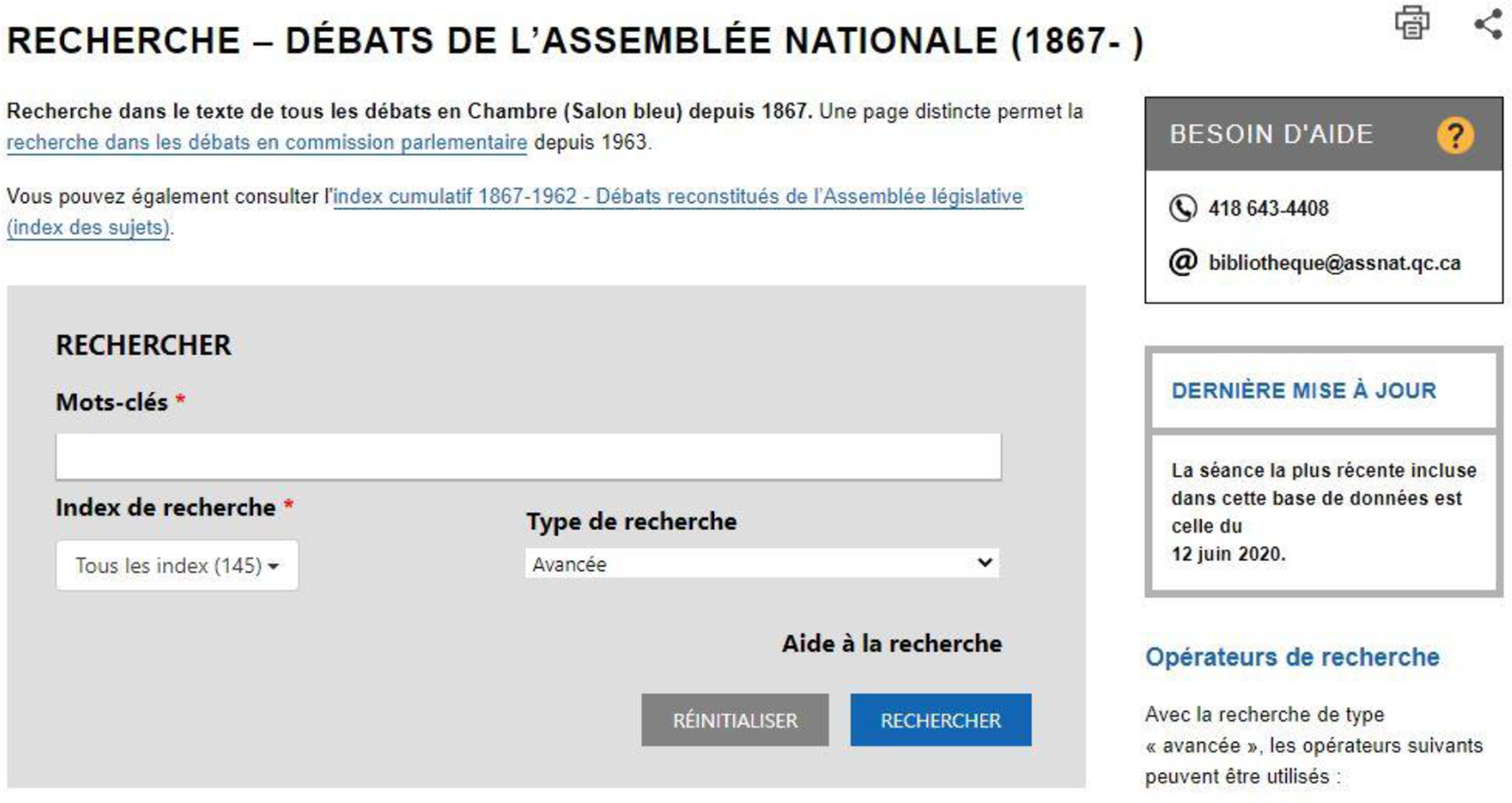
Interface of the Myrand database built by the Reference Service.
The Reference Service staff also had to research additional online sources of information to remedy the inaccessibility of physical documents. Monitoring think tanks, research chairs, information centres, e-publishers and open-source databases proved even more important in this new context. The Reference Service staff performed their monitoring tasks using mostly WebSite-Watcher, subscriptions to newsletters and RSS feeds.
The Archives and Digitization Department, for its part, reviewed its loaning procedures in conjunction with patrons and employees. With the deployment of Microsoft Office 365 throughout the whole institution in March 2020, it worked to make sure that integrated records management was intertwined with the new software. Remote customer support was also implemented. In addition, integrated records management became indispensable for accessible, efficient and secure information management during the pandemic. The department worked to ensure perfect synchronization with the arrival of Office 365 at the National Assembly.
Meanwhile, the Research Department had to adjust its service offer very quickly because of various changes in parliamentary procedures. Since parliamentary committees decided to meet virtually in May 2020, the Research Department had to adapt to remote and paperless working sessions. In order to do so, it developed a PowerPoint presentation template and an editing protocol to help its research officers when preparing their interventions in committee sittings. Before the pandemic, the Research Department had considered for some time developing such a template since most committee sittings would benefit from a visual support. With virtual committee sittings, a PowerPoint template became essential since the Research Department could no longer distribute hard copies of its work to the committee members. It now needed to present its research results in a virtual format. The PowerPoint presentation template had several advantages:
It gave structure to the presentation;
It facilitated the follow-up of the members regarding the different sections of the research or its progression;
It made possible to clarify certain remarks from research officers by using tables, graphs or illustrations;
It ensured a more effective communication of the essential points of the research.
The department also contacted parliamentary research departments in Ottawa (Library of Parliament) and Toronto (Legislative Assembly of Ontario) to survey their managers on the services offered, work organization and resources at their disposal. Meetings are planned to take place shortly. Also, the research analyst associated with the Public Accounts Committee (Commission de l’administration publique – CAP) surveyed other Canadian parliaments to learn about the adaptations of public accounts committees across the country. This compilation was very useful since public accounts committees play an important role in ensuring parliaments can fulfill their oversight duties.
Promoting services and resources
The unforeseen character of the pandemic resulted in many changes in the library’s service offer and stressed the importance of promoting its services and resources. As Dempsey (2020) states, it is extremely important for libraries to keep proving their value when their communities change. Patrons’ needs were changing, and the library’s services changed accordingly. In order to ensure that the parliamentary communities were informed of these changes, the Reference Service reached out to the research services of political parties and independent Members of the National Assembly. Moreover, information was regularly updated on the National Assembly’s internal e-portal for administrative staff.
Several studies have shown the importance of social media in promoting library services (e.g. Friday et al., 2020). With a presence on Facebook, Twitter and Instagram, the library used these channels to inform patrons about the continuity of its services and the resources available to them. It promoted its exhibition on parliamentary writers and invited people to visit its virtual counterpart. Furthermore, the library’s social media team created fun posts to defuse the tension of this stressful time and engage in a friendly way with its communities online. For example, social distancing was explained in a humorous manner in two Instagram posts. One showed the distance of 2 metres as equivalent to 30 debates books when seen by library staff, while the other showed the distance of 2 metres as equivalent to 6 linear boxes when seen by archives staff (see Figure 3).
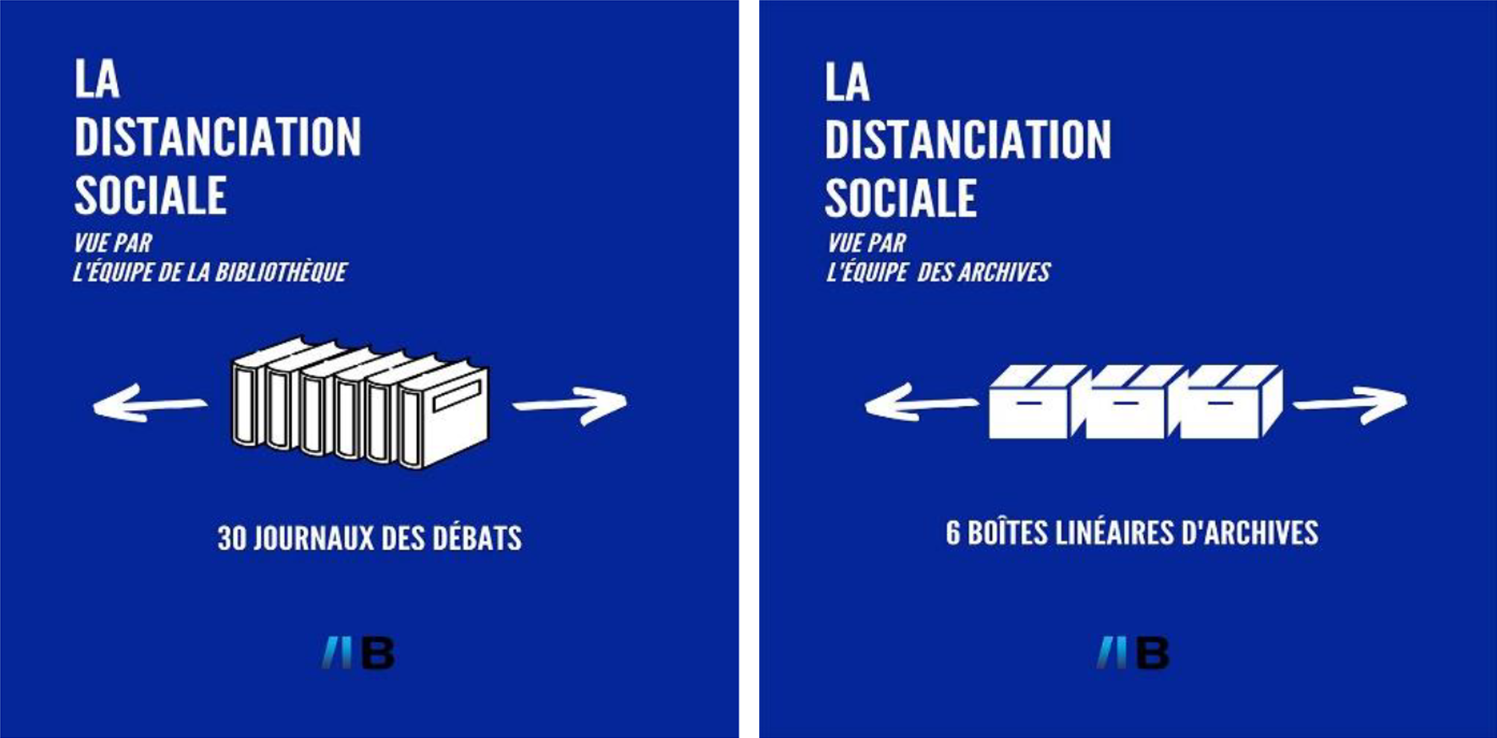
Instagram posts explaining social distancing in a fun way in a library and archives context.
Finally, the library’s project of creating a blog to showcase its achievements has been brought forward by the pandemic. Recently launched, the library’s blog (Figure 4) is part of the objective of better promoting its expertise. Furthermore, the pandemic has made it extremely relevant to have an additional virtual platform dedicated to the dissemination of research carried out at the library.
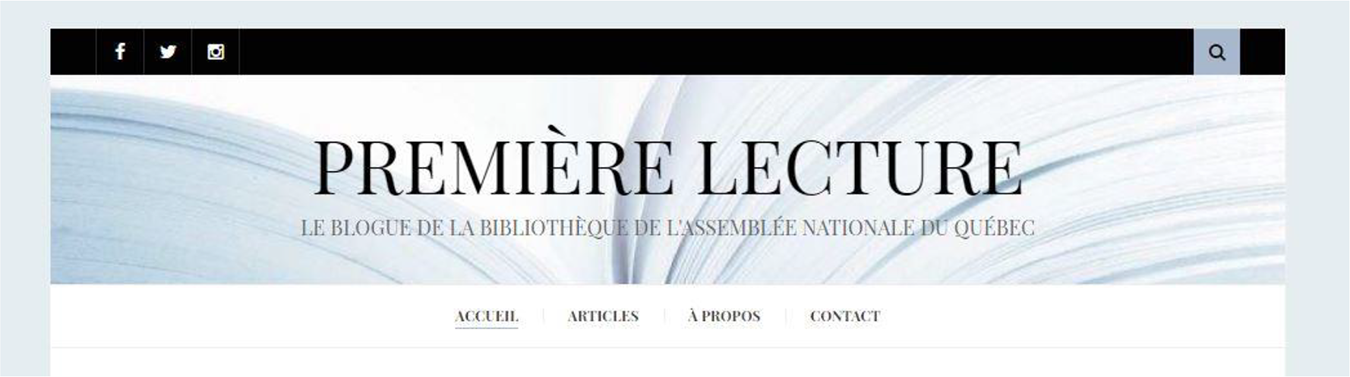
The library’s blog heading.
Document handling and protective equipment
The highly contagious nature of the virus and its rapid spread caused the library to adopt sanitary measures related to materials handling, staff protection and collection management.
Sanitation control measures for collections
When the library’s premises closed in March 2020, loans and interlibrary loans were suspended. All pre-existing loans were automatically renewed until 13 May. The ban on consulting and borrowing documents from the newspaper and periodicals collection lasted for nearly four months and was lifted only in September 2020. Digitization was privileged to provide articles for patrons. Implemented before the pandemic, the Reference Service’s platform for subscription to tables of contents allowed patrons to subscribe to contents from periodicals available at the library (Figure 5). Subscribers received an email alert when a new issue was available, along with the issue’s table of contents. The popularity of this service increased during the crisis since it allowed users to browse periodicals and select the articles they wished to receive by email.
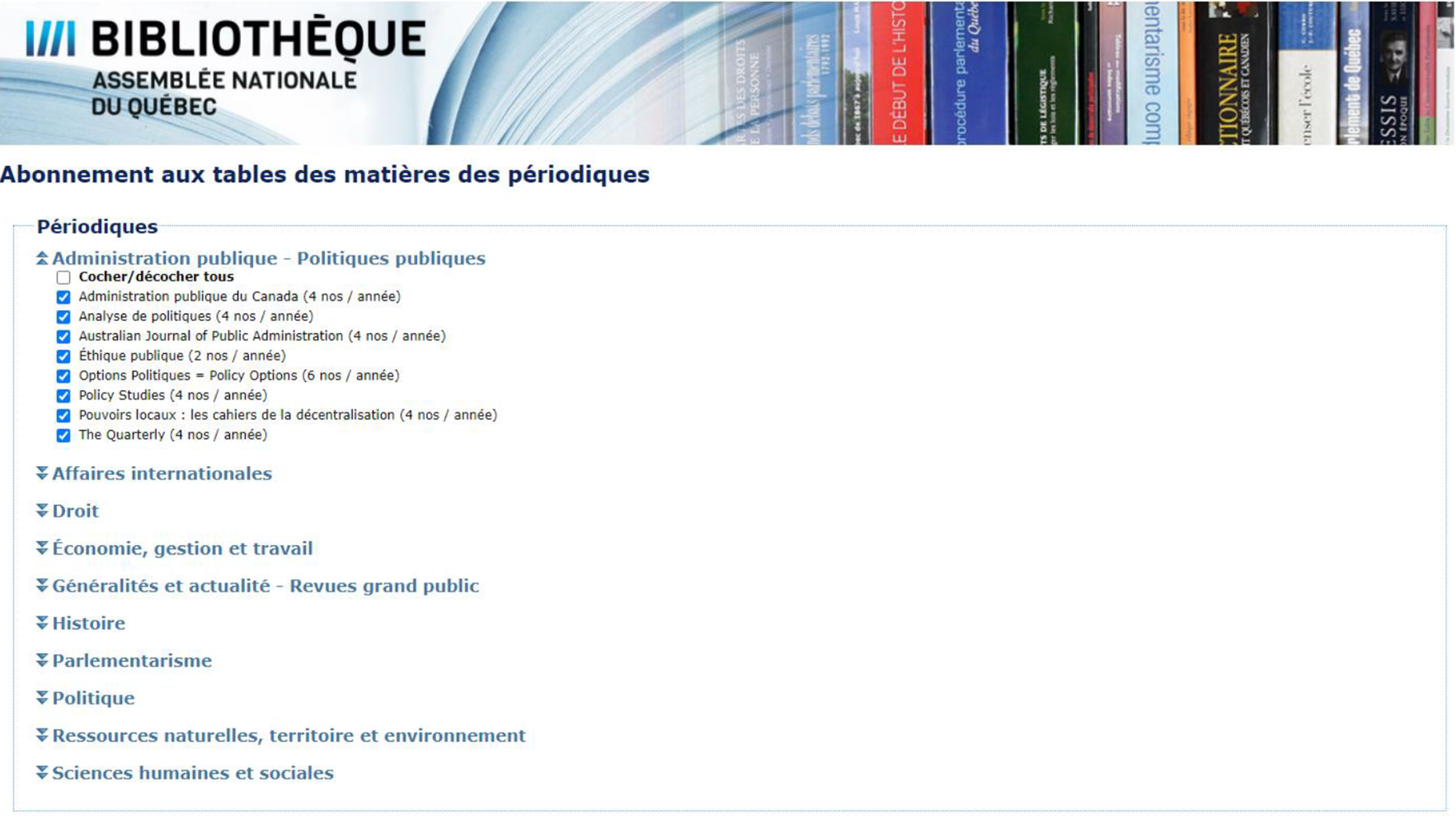
The Reference Service’s platform for subscription to tables of contents.
When parliamentary business resumed on 13 May, the library partially reopened its on-site services. Loans were reinstated but interlibrary loans were delayed, depending on other libraries’ rules. Despite having access to the library, patrons were forbidden from browsing the shelves as only staff were authorized to handle documents, with the aim of preventing possible contamination. Research was conducted to find out how the virus behaved on books and other materials. Government guidelines (Commission, 2020) recommended quarantining documents for at least 24 hours before handling them. A docking station for incoming and outgoing mail was set up.
Protecting staff while safeguarding access to information
An important challenge stressed by library professionals (Cox, 2020) in the wake of the pandemic is to balance equity of access with employee safety. Following the resumption of parliamentary business in May 2020, employees were scheduled to be on-site at the reference counter during sitting days. Plexiglass panels were installed at the reference counter and loan counter to prevent possible contamination (see Figure 6). Chairs were removed from the library’s reading spaces to respect social-distancing requirements, and the library’s basement was closed to patrons to prevent the handling of periodicals and newspapers. Protective equipment such as masks and gloves was distributed to employees, and antibacterial gel stations were put up at different places in the library. Disinfectant wipes were provided at the reference and loan counters as both counters had to be cleaned at the end of the day. Circulation signs regarding public spaces (stairs, elevators, bathrooms, kitchens, etc.) were put up by the National Assembly’s Communications Department.
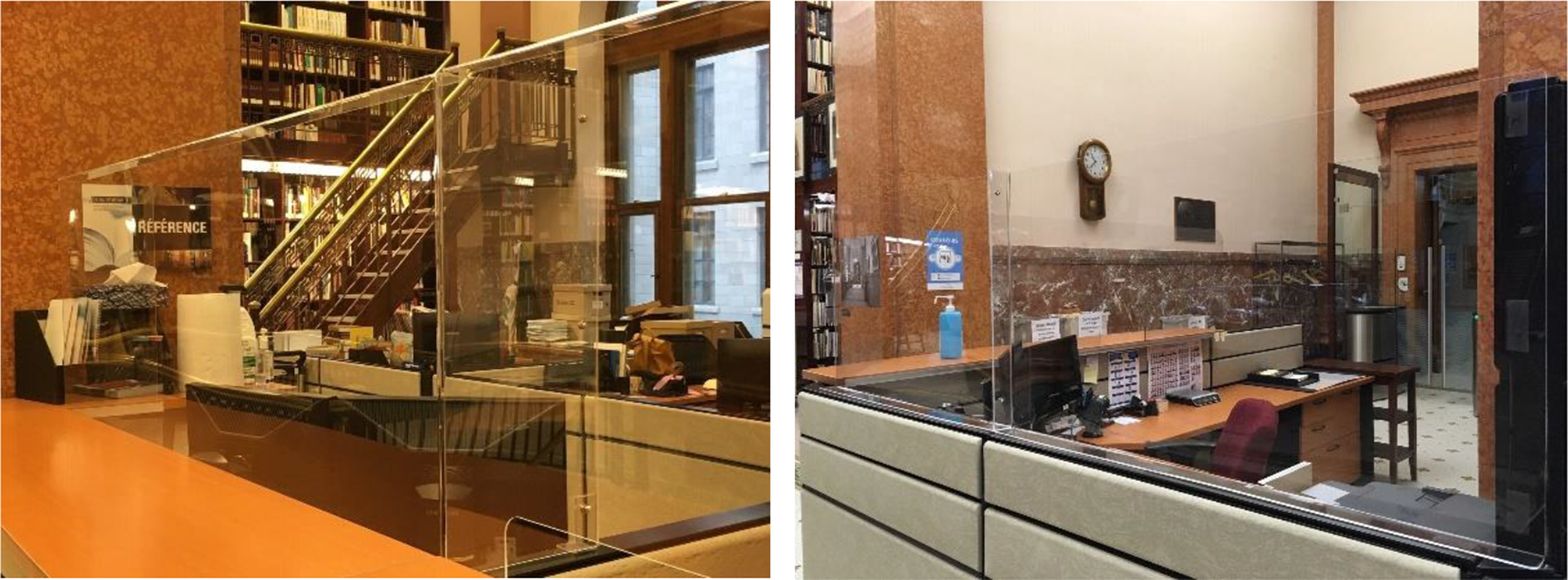
Plexiglass screens at the loan counter (left) and reference counter (right).
Collection management and development
Delays were caused by the inability to acquire, process and weed documents while working remotely. In the Acquisition, Processing and Indexing Department, performing tasks on-site while respecting health measures proved to be a major challenge. The department had to review its electronic document-processing chain and daily work tools to be efficient. It also created collaborative monitoring tools – an efficient and sustainable practice that will be carried on after the pandemic. In addition, the pandemic forced the implementation of paperless procedures and the digitization of paper tools such as indexing slips, the guide to indexing procedures, and the index of tabled documents.
On the other hand, the Archives and Digitization Department experienced a surprising increase in efficiency through teleworking regarding the processing of its digitized archives. Reduced travel time for most employees made the department more productive and even led to the reactivation of projects that had been put on hold due to lack of time and resources. Hold-ups were nevertheless experienced in the restoration of heritage archives and objects. The processing of artefacts was also delayed due to restrictions on access to physical premises. Partial staff access to scanners and cameras resulted in the postponement of digitization and photographing activities.
Team communication and workload issues
Communication breakdown
The COVID-19 crisis brought many challenges regarding team communications. As stated by Watt (2020) in the IFLA’s final report on ‘[t]he response of parliamentary library and research services’, the library’s managers were concerned about team cohesion and morale being threatened by the pandemic. Teleworking made communication between employees difficult, and isolation was seen as a potential threat to employees’ mental health. However, the implementation of Microsoft Office 365 and its collaboration application, Microsoft Teams, helped keep communication channels open and flowing with information regarding the development of the pandemic. Surprisingly, the four departments of the library experienced greater collaboration between employees, between departments and even with other divisions of the National Assembly through more sustained virtual contact. Therefore, the risk of isolation for employees did not prove to be as important as anticipated.
Nevertheless, Microsoft Teams meant adaptations, mostly for the Reference Service and the Research Department. It has been noted (Narcisi and Alspach, 2020) that Microsoft Teams is a very easy platform to use, with many operating modes being accessible. It is thus important to have procedures in place before launching this tool to ensure standardized use. The sudden nature of the pandemic did not render this possible at the National Assembly. Consequently, as soon as the application was launched, reference librarians and research officers received information requests directly through Microsoft Teams instead of through the library’s email inbox. Therefore, staff had to adjust to a faster and more direct influx of information requests, especially at the start of the pandemic.
Collaborating with Canadian parliamentary libraries
As Levine-Clark and Emery (2020) stress it, collaboration between institutions is fundamental in the library field. The COVID-19 pandemic halted collaboration by isolating many institutions with the forced closure of buildings and the pausing of interlibrary loans, for example. However, collaboration between Canadian parliamentary libraries before COVID-19 was strong and the tools used before the pandemic proved very useful to maintain collaboration during the crisis. The Canadian parliamentary libraries are grouped in an organization called the Association of Parliamentary Libraries in Canada (APLIC), which includes provincial and territorial legislative libraries, and the federal parliamentary library. APLIC has been collaborating for years using, amongst other tools, various listservs. For reference staff, the email diffusion list allowed reference librarians to ask a question to their colleagues throughout the country, and to obtain fast answers to reference questions that focussed on a Canadian comparative approach. During the pandemic, this listserv has proven to be even more useful, especially in supporting the Assembly’s monitoring committees’ work on parliamentary business.
The APLIC also produces twice a year a newsletter in which each library describes its recent developments, accomplishments and challenges. Last July, parliamentary libraries presented their new COVID-19 reality and how they have adapted to the pandemic. Furthermore, on November 24, 2020, an online session entitled “The Changes and challenges to our libraries during the COVID-19 Pandemic,” was organised by the Library of the Ontario Legislative Assembly. It featured speakers from the legislative libraries in British Columbia, Alberta and Ontario, and served as a test for a potential future virtual conference. Lastly, discussions are underway regarding the organisation of the 2022 APLIC annual conference, to be held in Quebec City.
Addressing the risk of overwork
The distribution of the workload proved to be an important challenge for the library at the start of the pandemic. During March and April, schools and day-care centres were closed. Many employees had thus to juggle work and family responsibilities. Consequently, a significant number of the library’s staff could not work full days every week, which created an imbalance in the distribution of the workload. The situation was eventually resolved with the reopening of schools and day-care centres in May, but it presented the library staff with the risk of overwork and raised questions about how to distribute work fairly during a crisis.
Anticipating future challenges: what is in store for the library?
Offering continuity of service
Remote working became essential during the pandemic, but experts worry about its use in the post-pandemic period (e.g. Johnson and Suskewicz, 2020). Employees will have to come back to work at various times and speeds, and the use of teleworking will have to be re-evaluated and remodelled according to the reality after the pandemic. The library will have to evaluate how to combine teleworking with its on-site services. Its service offer will need to be constantly evaluated, reframed and reinvented depending on the government’s decisions and the sanitary measures in place. Delays in projects and mandates are foreseen.
In order to ensure the continuity of the services offered, several works have stressed the importance of having a business continuity plan (e.g. BMS Canada Risk Services, 2020). Emergency procedures in the case of natural disasters are in place at the library, but no continuity plan has been drafted. The library’s risk management has been focused on its collections, but it should have been on services as well. Natural disasters have been perceived as the main hazard for the institution, but the suspension of parliamentary business is equally as important. Ideally, a business continuity plan should be developed in accordance with the National Assembly’s to make sure it meets patrons’ needs.
Discussions are underway regarding the development of an integrated risk management policy at the Assembly. A risk management steering committee would oversee the implementation and follow-up of this policy. Integrated risk management is a systematic approach aiming at identifying risks, assessing them and implementing mitigation measures. Each department at the National Assembly – including the Library – would be responsible for risk analysis and control within its premises. A centralized support unit would help managers in this task. The Library would have to answer a questionnaire to identify risks, participate in two working and information meetings and collaborate with other managers of the Assembly to assess the risks. It would then have to put in place risk mitigation measures. A risk register would also be created based on the risks identified by the departments.
Welcoming new employees
Another challenge regarding human resources during public health emergencies lies in the hiring of new employees. Employees who were hired just before the start of the pandemic in March 2020 had to learn most of their work in teleworking mode, which was obviously not ideal. The fall of 2020 also saw the first employees to be hired during the pandemic. Training and communication had to be adapted to respect social distancing and sanitary measures. The digitization of protocols and procedures was very helpful. In addition to this challenge, the library must find ways to make sure that its employees can continue their career development with online training, conferences and workshops.
Conclusion
Even though the COVID-19 pandemic has turned the library world upside down, it has shown the importance and relevance of parliamentary libraries in a crisis. This article has presented the experience of the National Assembly of Quebec Library as a case study for other institutions looking for ways to adapt their services and resources. In times of crisis, it remains important for libraries to share their best practices and lessons learned. As the crisis continues, libraries – and especially parliamentary libraries – must stay alert and continue to monitor the situation in order to foresee future changes and the risks they present. While the future remains unknown and there is still much to learn, information-sharing and open collaboration channels between libraries can provide institutions with innovative ways to fulfil their mandates.
Footnotes
Declaration of conflicting interests
The author declared no potential conflicts of interest with respect to the research, authorship and/or publication of this article.
Funding
The author received no financial support for the research, authorship and/or publication of this article.
