






Abstract
First-time university students lack the practical and complex skills to harness, evaluate, use and create information to achieve their educational, occupational, social and personal information goals. The purpose of this study was to explore students’ perceptions of user education programmes at the North-West University, South Africa. A structured questionnaire was used to collect data from 320 students across two faculties. The study’s findings reveal that the majority of first-year students had participated in different user education programmes, with 80.7% of the students indicating that they were satisfied with the content and quality of the programmes. Over 90% of the students who participated in the programmes affirmed that they had enhanced their capacity to make effective searches for information and improved their skills in correctly citating and referencing information sources for their assignments. The majority of the students searched for information and resources independently of librarians. This article draws several conclusions and makes recommendations based on the findings.
Keywords
Introduction
Students, especially first-year students, enter universities with the enthusiasm of moving from a lower-level to a higher-level academic setting. Some are curious, not knowing what to expect, while others may be better informed (Abah at al., 2016). As a result, user education programmes have evolved in academic libraries because librarians have taken note of the literacy gaps on the part of students who join universities with few intellectual skills, as well as a lack of practical and complex skills to harness, evaluate, use and create information effectively to achieve their educational, occupational, social and personal information goals (Akakandelwa, 2010; Kumar and Phi, 2009). Studies have shown that despite the availability of different types of user education programmes organized for new students, many still lack the necessary skills to use a library (Abah et al., 2016). Titi Abah et al., 2016 further argue that first-year students lack the basic skills and competencies that are required for the utilization of library resources and services on their entrance into higher institutions of learning. They emphasize the point by attributing the inadequacies of first-year students to the fact that the majority may never have been to a library, or at least a well-managed library. Observations have shown that such students, when admitted to an institution of higher learning, often ignore library orientation programmes and other library user education programmes because of ignorance, until they have assignments, tests or examinations to complete.
Research has shown that there has been an increase in user education programmes in academic libraries over the past few years. Such programmes have been considered a ‘dire necessity’ for equipping first-year students with the necessary skills to fully utilize libraries and their resources (Busayo, 2013). These programmes have become more important with the overproliferation of information and communications technologies, which have revolutionized today’s libraries and thus make the relevance of user education programmes even more significant (Majumder and Singh, 2007). The aforementioned researchers stress that in order to use automated libraries consisting of various databases and providing access to online databases and other digital collections, users need to be educated on how to use retrieval tools such as open public access catalogues and other techniques of information retrieval. They further argue that user education programmes not only acquaint users with various sources of information, but also help them to be less dependent on library staff, who often provide assistance with how to use a library independently to save their valuable time.
The purpose of this study was to assess the perceptions of first-year students of the user education programmes offered by the library at North-West University (NWU), South Africa, with special focus on the following objectives: To examine the types of user education programmes available at the NWU library; To determine the frequency with which students attended the available user education programmes; To assess the quality of the user education programmes offered at NWU; To examine the effectiveness of the user education programmes in improving students’ ability to use the NWU library; To examine the role or need for librarians in the provision of user education programmes at NWU.
User education programmes: a brief literature review
According to Abiodun (2013), there are various terms used in the field of library science to describe user education programme. Such terms include ‘information literacy’, ‘user education’ and ‘bibliographic instruction’, among others. As outlined by Abiodun (2013), there are several methods or elements in the user education programmes that are used in academic libraries. These methods include library orientation, which is usually the first method of user education that librarians conduct at the beginning of each year. Other methods include guided tours, basic and more advanced bibliographic instruction, and the use of audio and visual materials. A common denominator of user education programmes is that they apply to the process of educating library users to be independent users of the library and able to use its resources effectively and efficiently.
Chinyere (2014) defines a user education programme as an academic programme that is designed by higher education institutions to educate library users on how to successfully utilize the library and its resources. Uwakwe et al. (2016: 71) highlight some ‘fundamental objectives’ of user education in their definition of it as being to ‘familiarize and instill in the library user, the basic knowledge or understanding and skills which are essential for effective and efficient use of the library services and resources’. One thing that is central to these scholars’ definitions of user education is the ultimate optimum application of library resources. The general consensus is that it does not matter how large the collection of a library is if its facilities and resources are not fully exploited – then, such a library would become a ‘white’ elephant project’ (Ogunmendede and Emeahara, 2010; Uwakwe et al., 2016; Wickramananyake, 2015b).
There are various types of user education programmes and they can be categorized into two groups. The first is a traditional user education programme, which includes an orientation programme, an introduction to audiovisual materials, a library tour, lectures, seminars and workshops, and printed guides (Kumar and Phi, 2009), while the second group of the programmes revolve around a modern education system, and focus on online resources. While the latter is flexible, student-centred and low-cost, the former reinforces punctuality, extracurricular activities and face-to-face interactions (Ahmed, 2015). According to Idoniboye-Obu (2017), who conducted a study on user education programmes in four academic libraries in KwaZulu-Natal Province, South Africa, the concept ‘user education programme’ goes by different names, including ‘library orientation’, ‘library instruction’, ‘bibliographic instruction’, ‘reader instruction’ and ‘information literacy’.
User education programmes have been largely documented in developed nations, with developing countries only recently emerging as contributors of knowledge in this subject domain (Wickramananyake, 2015a). Some of the countries where extensive studies on user education programmes have been made include England, the USA, Sri Lanka, Pakistan, China, Kenya, Ghana, Nigeria and South Africa. Wickramananyake (2015a) stresses that these countries have evolved in terms of their methodology within the area of library science, and the development of the library as a profession. He further writes that other countries, categorized as underdeveloped or developing, have not taken substantial measures to record or study the historical development of user education.
It has been demonstrated that the African continent has made some strides in recent years in its contribution to the growing literature on user education programmes, with most of the studies carried out in Nigeria. There are several studies by African scholars that have looked at the growth and development of user education programmes across selected universities in Africa (see Agyen-Gyasi, 2008; Ahenkorah-Marfo and Teye, 2010; Akakandelwa, 2010; Akalumhe, 2006; Busayo, 2013; Jiyane and Onyancha, 2010; Moyane et al., 2015; Ogunmodede and Emeahara, 2010; Phillip, 2015; Abah et al., 2016).
User education programmes in academic libraries have not been without their challenges, and some scholars have indicated that such challenges have been experienced by libraries prior, during and after the establishment and introduction of user education programmes. In their study at the Kwame Nkrumah University of Science Technology library in Ghana, Ahenkorah-Marfo and Teye (2010) found that the guided tours, which had been traditionally used in the library, were not effective and was subsequently by video presentations in the 2006–2007 academic year. In the video presentations, the university librarians and heads of various departments introduced students to the resources in the library and demonstrated how to access them. However, this method also proved not to be fully effective. Ahenkorah-Marfo and Teye (2010) found that a new form of user education (a credit-earning programme), which sought to be more appropriate in an electronic environment, would be part of the university curriculum following approval by its academic board.
Abah at al. (2016) found that the major problem for many academic libraries is how to effectively organize user education programmes to be more inclusive of the university’s diverse student needs and expectations. Their study recommends that library user education should include library tours, which should be offered in the first semester before first-year students use the library. They argue that library orientation should be conducted at the beginning of the year before library instruction to make sure that the latter is built on the former. Gunasekera (2010) found that undergraduate students did not fully utilize library resources simply because they were not aware of these resources or did not consider them to be important for their studies. He recommends that libraries and the wider university community should take responsibility for advertising the library’s resources and services to students.
Aderibigbe and Ajiboye (2013) conducted a study on user education programmes at the Nimbe Adedipe University library in Nigeria, using questionnaires to collect data. The study focused on how to improve the user education programmes at the library with an emphasis on the library’s electronic resources. The findings show that most users suggested that the user education programmes should be computer-based with practical guidance on how to search for, retrieve and evaluate information for research. Looking at the literature on user education, it is evident that there is still a need to review such programmes in terms of their effectiveness and relevance to users. But, most importantly, these programmes should be integrated into the university curriculum to make them compulsory for students to attend (Aderibigbe and Ajiboye, 2011; Agyen-Gyasi, 2008; Wickramanayake, 2015a).
Moyane et al. (2015) conducted a study of user education programmes at the University of KwaZulu-Natal in South Africa and found there was a need to reassess their content, mode, scope, and general significance and appropriateness in line with various user needs. Akakandelwa (2010) states that user education has come of age, but many issues are yet to be resolved. A major issue is the difficulty in integrating it with other aspects of library services in many institutions. This reflects the situation at Vaal Triangle Campus (VTC) at NWU, where the user education programme is not yet part of the university curriculum. To be more effective, user education programmes should be integrated into the curriculum and be a credit-earning course for undergraduate students (Aderibigbe and Ajiboye, 2013; Agyen-Gyasi, 2008; Wickramanayake, 2015a).
Uwakwe et al. (2016) also point out some problems that militate against effective user education programmes – that is, large student numbers, a lack of resources, insufficient and unqualified staff, students’ negative attitude towards the programmes, and a library environment that is not conducive to learning. Mendrinos (1994) stresses that library user education programmes need to be student-centred. He notes that faculties and academic librarians may be the designers and facilitators of user education programmes but often it is the students who make the decisions on how to make use of existing resources to solve their research problems. Chen and Lin (2011) argue that to provide maximum benefit to students, faculties and librarians should design well-structured user education programmes that will help them to acquire the skills to search for information, analyse it, evaluate it and be able to distinguish information from true knowledge. Farmer (1992) presents a rather different view in proposing that librarians should have an attitudinal change and see themselves not merely as disseminators of information, but also as facilitators, who empower users to become independent learners through resource-based activities away from the classroom.
The role of librarians in the provision of user education programmes cannot be overemphasized. In a study that was conducted in KwaZulu-Natal Province in South Africa, Idoniboye-Obu (2017) found that subject librarians played a vital role in designing and/or implementing the programmes in universities. Okoye (2013) could not have put it better when he notes that librarians should teach library users (students) how to search for resources whilst bearing in mind that they come from diverse cultural backgrounds and have varying levels of library skills. He goes on to say that such education has benefits as it helps students to achieve better grades because they have acquired the skills to search for relevant and reliable information resources to support their studies. Buckland (1991: p. 75) underscores that ‘giving users physical access to information does not guarantee that they become informed’. Torras and Skagen (2006) argue that the learning objectives of user education should include activities that encourage students to reflect on the information process by choosing their own research questions and formulating and combining their own keywords. They stress that the goal of such activities is to help students identify their information needs and find strategies to meet those needs.
Research methodology
This study adopted a quantitative research approach, which Maree (2007) describes as a systematic and objective approach using numerical data from only a chosen subgroup of a population to generalize the findings to the population within a given context. A quantitative approach was used for this study because it had the capacity to provide statistical data on the user education programmes, including the information literacy skills and competencies of first-year students and their assessment of these programmes. The NWU library at the VTC was the unit of analysis in the study. A survey targeting first-year students was conducted to assess the user education programmes that are offered at the library. A survey was deemed an appropriate research design as it enabled the researchers to numerically ‘describe the trends, attitudes, or opinions by studying a sample of a population’ (Quantitative Designs, para. 2) (Creswell and Creswell, 2018:). The survey enabled us to quantitatively study the first-year students’ perceptions of the user education programmes offered at the NWU VTC library.
The study population comprised all of the first-year students (N = 1885) from both the Faculty of Humanities and the Faculty of Economic and Management Sciences and Information Technology. Systematic sampling techniques were used to select a representative sample of students from whom data was collected. A sample size of 320 students was determined using online SurveyMonkey and Raosoft (2017) sample size determination calculators. The use of these two online calculators was meant to validate the sample size. Indeed, the two calculators yielded the same sample size.
A structured questionnaire was prepared in relation to the objectives of the study and distributed to all 320 respondents between January and March 2020 to obtain information about their perceptions of the user education programmes. The questionnaire items were obtained from different sources, including the published literature and our experiences as academic librarians. Of the 320 questionnaires distributed to students, 266 (83.1%) were returned and found to be valid for analysis; a higher number of questionnaires was returned by the Faculty of Humanities (181, 68%), while there were 85 (32%) questionnaires returned from the Faculty of Economic and Management Sciences and Information Technology. The data collected from the first-year students was analysed using frequencies and percentages, and presented in tables and charts. In addition, a weighted mean was computed to determine the variables that most students considered to be more appropriate than others.
Limitations of the study
This study was conducted at one of the campuses of the NWU. The study was limited not only to one university campus but also one university in the Republic of South Africa, which has 26 public universities. This article reports the findings obtained from incoming first-year students and excludes the librarians who offer the user education and information literacy programmes. Students in other years of study were not considered. The librarians were not included due to the fact that this article reports the findings on users’ perceptions of the user education programmes at NWU.
Results and discussion
Types of user education programmes offered at the NWU library
According to Idoniboye-Obu (2017: 2), user education programmes are given different names in different settings – for example, in some libraries they are called ‘library instruction’, ‘library orientation’, ‘staff guidance’, ‘bibliographic instruction’ or ‘information literacy’. In the USA, they are often referred to as ‘bibliographic instruction’, while in South Africa user education is often called ‘information literacy’. Previous studies have revealed that there has been an increase in user education programmes in academic libraries over the past few years (Busayo, 2013).
The NWU VTC library provides several user education programmes to first-year students (see Table 1). Table 1 shows that most of the students attended a library orientation session as opposed to other forms of user education programmes. With regard to information literacy training, the majority of the students (102, 68%) acknowledged that they had only attended the programme once. Of the 150 respondents who said that they had attended at least one user education programme, all of them reported having attended the library orientation once, while only 29 (19.3%) had attended endnote training and 98 (65.3%) had taken part in a library tour once. The results show that endnote training was the least frequently attended programme, with 105 (70%) students reporting never to have attended such training since they had become a student at NWU.
Frequency of attendance of user education programmes since joining NWU (n = 150).

The study further reveals that library orientation was the most popular user education programme, with the majority of the first-year students attending this programme. It should be noted that library orientation is offered at the beginning of the year just after students have registered. During the library orientation, first-year students are introduced to the various services of the library and given brief training on the library databases and library catalogue. The popularity of this programme is not unique to the NWU VTC library. Nneka and Idoko (2018) also found that it was the most popular form of user education at the National Open University of Nigeria. It does not come as a surprise that most students at VTC attend library orientation because this programme is held at the beginning of the year directly after students have registered and this gives the majority of students an opportunity to attend. However, the findings reveal that the majority of the students did not attend endnote training, and this result is also not surprising considering the fact that the NWU VTC library does not regularly offer this training, particularly for first-year students.
The non-attendance of some of the user education programmes may imply a need for a rigorous re-evaluation of the content and scope of the programme to make sure that it is aligned with the needs of students as an enrichment course in the university curriculum. Moyane et al. (2015) conducted a study on the user education programme at the University of KwaZulu-Natal and found that although there was some sound content in the programme, there was still a need to reconsider its content, mode, scope, and general significance and suitability in line with various user needs. Mendrinos (1994) has also discussed the scope and content of user education programmes in academic libraries, stressing that library courses need to be student-centred. Faculties and librarians may be the designers, creators and facilitators of user education programmes, but it is quite often the students who choose how to utilize the available resources to solve their research problems. Moyane at al. (2015) therefore suggest that what is fundamental to the success of user education programmes is that the users as well as the library must appreciate the value of the programmes. It is only when a user appreciates and understands the value of a user education programme that they will reap the benefits that the programme provides for them.
Table 2 reveals that a considerable number of first-year students did not attend the user education programmes for a variety of reasons. There was a total of 116 students who did not attend any user education programmes at NWU VTC library. A total of 79 (68.1%) of the respondents did not attend these programmes because they did not know about the programmes, which reinforces the earlier suggestion that the library should find alternative channels to adequately advertise these programmes so that students are aware of them. The results also show that 55 (47.6%) respondents did not attend the programmes because they were not interested in them. Additionally, 57 (49.1%) did not attend the programmes because of a lack of time. Lastly, the findings reveal that 59 (50.8%) of the respondents did not attend the programmes because they felt that they did not need them. Although the study shows that the majority of the first-year students attended the user education programmes, it is still problematic that a handful of them failed to attend. It is very important for the library to make the programmes visible to all students, as well as develop and make available different platforms to market these programmes so that students are fully aware of their existence.
Reasons for not attending user education programmes (n = 116).

Note. Students were allowed to pick one or more reasons.
Quality of user education programmes offered at NWU
User education is essential in today’s library environment. It helps publicize library services and improves the image of the library (Chalukya, 2015). Lamptey (2010) emphasizes that by improving awareness, competency and the skills necessary to explore library services and resources, usage and the demand for them will also increase as a result. Uwakwe et al. (2016) stress that user education should teach students to make efficient use of a library by making them aware of the resources available in the widest sense. Ultimately, user education has a great impact on undergraduates’ utilization of library resources and essentially makes them aware of the scope of the library (Ahemba and Terwase 2018).
The results in Table 3 indicate that most of the students at NWU VTC were satisfied with the quality of most of the user education programmes they had attended since coming to the university. It can be seen that 42.7% of the students rated the quality of the library orientation as good. The weighted mean reveals that the students placed a higher premium on library orientation (X¯ = 4.51) than library tours (X¯ = 4.20), information literacy (X¯ = 4.07) and endnote training (X¯ = 2.33). It seems like the popularity of the programmes is linked to their quality. The library orientation, which was the most popular among first-year students, was considered to be of high quality.
Quality of training in user education programmes (n = 150).

The results also reveal that the majority of the first-year students (80.7%) believed that the training they had received from these programmes had helped them to improve their overall ability to use the library. In their study, Ahemba and Terwase (2018) found that user education programmes helped students to improve their ability to retrieve information from the library. User education programmes have the ability to minimize so-called ‘library phobia’ amongst first-year students. Through these programmes, they acquire the skills that are essential to locate library resources and services, which in turn enhances the visibility and utilization of the resources available in the library (Punchihewa at al., 2018). This assertion is supported by Uwakwe et al. (2016), who found that the provision of user education programmes ultimately helped popularize the library and improved its image and usage among students.
As shown in Table 4, many of the first-year students (48.7%) affirmed that the programmes had helped them to carry out correct referencing, while many of them thought that the programmes had helped them to search the library catalogue. These results corroborate Mohammadi et al.’s (2008) study, which found that over 76.9% of students in Iran reported that user education was very important in teaching them how to use reference resources. The majority of the first-year students (40.7%) at NWU rated the quality of the library orientation received at the beginning of the year highly when asked about their general perception of these programmes. Many of them (44%) also found the information literacy training they received during the course of the year to be of value in their academic work. The weighted means confirm that the user education programmes had enabled students to, in descending order of impact, search for journal articles (X¯ = 3.44), search the catalogue (X¯ = 3.34), locate relevant resources (X¯ = 3.22) and carry out correct referencing (X¯ = 2.95).
Effectiveness of user education programmes in improving students’ ability to use the library (n = 121).

Students’ perceptions of the roles of librarians in user education programmes
This section of the questionnaire required students to assess the role of librarians in the provision of user education programmes at NWU. The basis for this question was the assumption that librarians play an important role in the delivery of user education programmes in libraries, and that students will more often than not consult librarians for assistance in accessing and using library resources. Students’ perceived importance of the librarians’ role is therefore paramount for their enrolment and/or participation in user education programmes in academic libraries, and particularly at the NWU VTC library. To achieve this objective, the students were asked several questions, including: ‘When you visit the library, do you consult librarians to help you find relevant information?’; ‘If the answer is yes, how often do you consult librarians when seeking information in the library?’; ‘If your module requires you to use the library resources to do your assignment, what would you do?’; ‘How do you rate the role of librarians in your quest to find relevant information in the library?’; and ‘Overall, have librarians performed a great job in teaching students on how to use library resources and services?’.
In responding to the question on whether or not they consulted librarians to help them find relevant information when visiting the library, the majority of the students (142, 53%) said that they did not consult librarians for help in finding relevant information when they visited the library. However, 124 (47%) indicated that they did consult librarians to find relevant information when they visited the library (see Figure 1).
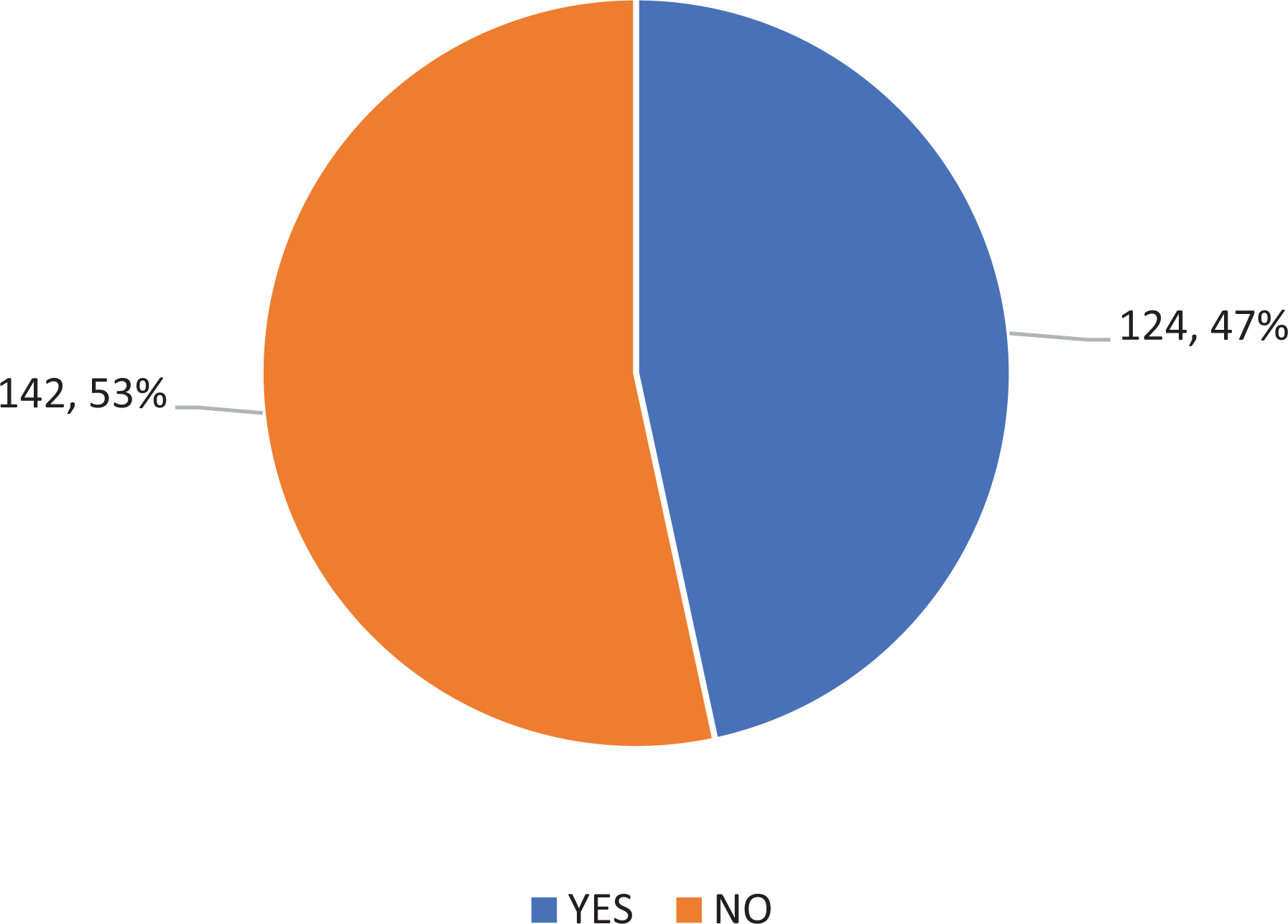
Consultation with librarians for the purpose of finding relevant information (n = 266).
The students who consulted librarians when they visited the library (n = 124) were asked to state how often they consulted librarians. The results show that only 20 (16.1%) of the respondents regularly consulted librarians when they visited the library; 42 (33.8%) of the respondents said that they consulted librarians often, while another 42 (33.8%) said that they consulted librarians sometimes. The other 20 (16.1%) did not specify the frequency of their consultations with librarians (see Figure 2).

Frequency distribution of students’ consultations with librarians when seeking information (n = 124).
All respondents (n = 266) were asked to state what actions they undertook when they searched for information when a module required them to do so. The results show that 115 (43.2%) of the respondents were most likely to research the topic on Google or Wikipedia. It can also been seen that 59 (22.1%) of the respondents were most likely to ask a librarian for help, while 88 (33.1%) were likely to ask a friend for help (see Table 5).
What students do when a module requires them to use library resources for an assignment (n = 266).

In response to the question on how the students got the information they needed in the library, a high number (184, 69.1%) responded that they consulted library resources independently or asked their friends for help. The results indicate that most of the respondents (53.9%) were not interested in asking a librarian for help. This suggests that either they do not trust librarians or they can find the information they need without the assistance of a librarian.
The results further reveal that 124 respondents consulted librarians when they visited the library. The respondents were then asked to rate the role of the librarians at the NWU VTC library in terms of their helpfulness in their quest to find relevant information in the library (see Figure 3). The results reveal that 44 (35.4%) of the respondents rated the role of the librarians as good and 25 (20.2%) of the respondents rated the role of the librarians as excellent, while 32 (26%) thought that the role of the librarians was fair and 15 (12%) declined to comment. These findings contradict the earlier finding which suggests that the role of the librarians was not overly recognized by the first-year students.

Rating of librarians’ role in helping students to find relevant information in the library (n = 124).
However, the overall feeling among the respondents was that the librarians did a good job in teaching them how to use the library resources and services. Figure 4 shows that 60 (48.4%) of the respondents agreed that the librarians did a great job in teaching students to use the library resources and services and 30 (24.2%) strongly agreed that the librarians did a great job, while 10 (8.1%) disagreed and 20 (16.1%) had no opinion on the overall performance of the librarians.

Levels of agreement on whether librarians did a great job in teaching students how to use library resources and services (n = 124).
Evidently, librarians play a huge role in the user education programmes as well as in the provision of related services to students. It is gratifying to note that many of the first-year students (35.4%) were very satisfied with the role librarians played in helping them find relevant information. They believed that the librarians did a good job (48.4%) in teaching them to use the library resources and services. This finding supports that of Mar-Rounds (2011), who observes that, in general, academic communities value the services offered by librarians. However, he argues that gratitude for the contribution that librarians make to the educative mission of universities is not always apparent. According to Lindstrom and Shonrock (2000), as the significance of user education develops within academic libraries, so will the importance of the role of librarians as fundamental members of the teaching and learning mission of college and universities.
The published literature, however, has suggested that the librarian’s role will ultimately change in today’s digital age – that is, librarians cannot afford to simply be information providers or information keepers. According to Otiango (2016), the role of the librarian will become more that of information manager, educator, information consultant, information custodian, information provider, information publisher and change agent, as well as custodian of public library facilities. Agyen-Gyasi et al. (2010) write that the changing roles of academic librarians from information keepers to knowledge managers emphasize the need for librarians to continuously upskill, reskill, upgrade and update, or acquire new skills and knowledge to remain relevant in today’s changing library environment. Moyane at al. (2015) have summed it up eloquently when they say that, for a start, as custodians of user education programmes, it is imperative for librarians to be knowledgeable in pedagogy and instructional design, and they further conclude that, as important as their knowledge is, it is equally important that it should be aligned with the diversity of the university population. Liu et al. (2016:) conclude that ‘the way in which students think about the services of reference/information services librarians could potentially influence the extent to which they are willing to participate in library user education programmes’.
Conclusion
The discussion of user education in libraries has continued to attract the attention of scholars and researchers in academia because of its critical role in shaping information retrieval and the ability to conduct independent research. For some years, the pattern has been changing because of the presence of new technologies, which has led to changes in the roles of librarians and information creation, management and dissemination. This study serves as a contribution to the discourse with a focus on the first-year students of NWU in South Africa. Although there are established user education programmes, which are usually targeted at the first-year students in the university, there is evidence of a lack of interest among some students in participating in the programmes, probably because the courses are not examinable and appear to be optional. The students who actively participated in the programmes confirmed a remarkable improvement in their ability to access and utilize the available information resources in the library for overall improved performance in their academic programmes. It is interesting to note that the majority of the students did not approach librarians for support when seeking information resources in the library – a situation that may imply students’ self-reliance or independence. However, librarians continue to play a central role in assisting students to maximize the use of the academic library, as reported by the students who turned to librarians for assistance in accessing information in the library. The library orientation and tours were the most preferred and popular user education programmes at the library. Given that the current study has focused on one academic library in South Africa and, as such, its results cannot be generalized beyond the NWU VTC library, it is recommended that a similar study be conducted in other sites to investigate and compare user education programmes across South Africa with a view to developing a framework for the provision of such programmes.
Implications of the study
This study has revealed some disparities in the user education programmes offered at NWU in relation to other programmes at the university, as they are optional for students and not examinable. This creates room for some students to ignore the programmes, which obviously affects their academic performance since they will lack the required skills to access and utilize information appropriately. We agree with Moyane at al. (2015), who stress the need to reconsider the content, mode, scope, and general significance and suitability of user education programmes in line with varied user needs. The librarians who coordinate user education programmes should also adopt effective marketing strategies to create awareness of the programmes among students. The fact that students are satisfied with the quality of the user education programmes they attend and ultimately are able to effectively use the library is an advantage the librarians can explore to market the programmes as enrichment courses that should be compulsory for all first-year students. Improved awareness will result in increased demand for and usage of resources, leading to improved competencies and skills among library patrons (Lamptey, 2010). The study’s finding that many students did not consult librarians for support when seeking information in the NWU VTC library is an area that may require further investigation and/or a paradigm shift in the provision of user services in the library and other academic libraries.
It is recommended that user education programmes at NWU should be fully incorporated into relevant courses and subjects. The NWU’s recent exploration of the introduction of a Bachelor’s degree in Library and Information Science will provide the library administration with an opportunity to integrate user education programmes in the proposed qualification. The courses and subjects in which user education programmes are offered should be made signature courses and subjects for first-year students, as is the case with basic communication skills and English-language courses. This approach will also ensure that students will attend and participate in all of the user education programmes.
Footnotes
Declaration of conflicting interests
The authors declared no potential conflicts of interest with respect to the research, authorship and/or publication of this article.
Funding
The authors received no financial support for the research, authorship and/or publication of this article.
