






Abstract
Background:
In pediatric patients, anterior cruciate ligament (ACL) reconstruction is controversial; however, delaying surgery until skeletal maturity is complete may increase the risk of secondary meniscal and articular cartilage injury.
Purpose:
To assess the risk of meniscal and chondral injuries with delay of ACL reconstruction.
Study Design:
Cohort study; Level of evidence, 3.
Methods:
Records were reviewed in patients younger than 17 years (median age, 14 years) who had ACL reconstruction. Patients were consecutively enrolled and assigned to 1 of 3 surgical groups based on timing of surgery: acute (<6 weeks after surgery), subacute (6-12 weeks), or chronic (>3 months). The type and grade of meniscal injuries was documented according to the International Society of Arthroscopy, Knee Surgery, and Orthopaedic Sports Medicine (ISAKOS) meniscal classification criteria. International Cartilage Repair Society (ICRS) criteria were used to document location and grade of chondral injuries. Associations between patient characteristics and meniscal injury were tested using rank sum and chi-square tests. Regression analyses were conducted to model incidence and severity of lateral and medial meniscal tears. There were 130 patients who had 135 ACL reconstructions between the years of 2000 and 2012.
Results:
Sixty-two ACL injuries were treated acutely, 37 were subacute, and 36 were chronic. Meniscal injuries (n = 112) included 70 lateral and 42 medial tears. Time to surgery had bivariate association with lateral and medial meniscal tears (P = .016 and .007, respectively). Independent risk factors for incidence of lateral meniscal tears were younger age (P = .028) and return to sports activities before surgery (P = .007). Patients with 1 episode of instability had 3-fold higher odds of higher grade lateral meniscal tear (95% CI, 1.30-7.60). Compared with acute reconstruction, subacute and chronic reconstruction patients had 1.45 and 2.82 times higher odds, respectively, of lateral meniscal tear severity (P = .12). Independent risk factors for incidence of medial meniscal tears were female sex (P = .03), older age (P = .01), and any episode of instability (P = .01). Adjusted odds ratio for medial meniscal tear was 4.7 for an instability episode (vs no episode; P = .01). Adjusted odds ratio for increased severity of medial meniscal tears included any instability episode, 5.6 (P < .01); playing sports before reconstruction, 15.2 (P < .01); and time to surgery greater than 3 months, 4.3 (P = .046). Seventeen patients had 23 chondral injuries. The risk factors for chondral injury included increased time to surgery (P = .005) and any instability episode (P = .001). For increased grade of chondral injury, risk factors were time to surgery (P ≤ .001) and any instability episode (P = .003).
Conclusion:
Delayed ACL reconstruction increased the risks of secondary meniscal and chondral injuries in this population of pediatric patients.
The increase in anterior cruciate ligament (ACL) tears among children and adolescents has intensified the debate about the optimal method of treatment for these injuries. Historically, ACL injuries in children have been treated nonoperatively, with physical therapy, bracing, and restriction of activity. This treatment choice presents several important advantages. Delaying surgery allows for greater skeletal maturation, avoids iatrogenic growth plate disturbance with attendant leg-length discrepancy or angular deformity, and allows the patient to gain psychological maturity, which increases compliance with postoperative therapy. Despite these advantages, a growing body of evidence suggests that delaying surgery results in recurrent instability, secondary meniscal damage, and degenerative changes.4,7,14 Consequently, many recommend reconstruction as the treatment of choice.1,2,6,8,11,14,17,18,21
The purpose of this retrospective cohort study was to assess the risk of meniscal and chondral injury with delayed ACL reconstruction in children and adolescents. We hypothesized that increased time from injury to surgery, recurrent instability, and resumption of sport activities before reconstruction were associated with a higher rate of meniscal and articular cartilage injuries.
Methods
Study Design and Patient Selection
This study was a retrospective review of patient records from 2000 to 2012. Inclusion criteria were age younger than 17 years and a history of ACL reconstruction. Exclusion criteria included prior knee surgery, partial ACL tears, multi-ligament knee injuries, and tibial spine fractures. The patients were consecutively enrolled. Institutional review board approval was obtained, and informed consent was waived.
Objective
The primary objective was to determine the risk of meniscal injury due to delayed ACL reconstruction in pediatric patients. Secondary objectives included determining the type and grade of lateral or medial meniscal tears and the location and grade of chondral injuries. Patient records and arthroscopic images were reviewed for demographic information, type of meniscal injury, number of days from ACL injury to surgery, number of instability episodes, and resumption of sports activities before the ACL reconstruction. Patients were assigned to 1 of 3 treatment groups based on the time from injury to surgery: acute (<6 weeks), subacute (6-12 weeks), or chronic (>3 months).
The type and grade of lateral and medial meniscal tears were documented with operative reports and arthroscopic pictures in every case. The location and grade of chondral injuries was also recorded.
Meniscal tears were categorized by the criteria of the International Society of Arthroscopy and Knee Surgery and Orthopaedic Sports Medicine (ISAKOS) meniscal classification system. 3 The tears were graded on a scale of 1 to 5, where 1 = nonsurgical tear and 5 = irreparable tear involving >50% of the meniscus. 14 Meniscal repair was attempted in all cases except patients who had stable tears; small, radial tears in the central one-third; or small, oblique tears of the posterior horn attachment of the lateral meniscus.
The articular cartilage lesions were graded on the International Cartilage Repair Society (ICRS) system, including size, location, and depth. 9 The method of ACL reconstruction was based on the patient’s sexual maturity and skeletal age. Patients in Tanner stages I and II (prepubescent males ≤12 years old and females ≤11 years old) and patients in early Tanner stage III (males 12-13 years old and females 11-12 years old) received a transepiphyseal physeal-sparing reconstruction with quadrupled hamstring autografts. This procedure was performed by creating anatomic femoral and tibial drill holes that did not transgress either physes. An Endobutton continuous loop and washer (Smith & Nephew) were used for proximal fixation, and distal fixation was obtained with sutures tied over a tibial metaphyseal screw. 2 Patients in Tanner stages III and IV (pubescent males 14-16 years old and females 13-14 years old) received a transphyseal reconstruction with hamstring autografts using an Endobutton for proximal and tibial metaphyseal screw for distal fixation. 22 Patients in Tanner stage V (males 16 years old, females >14 years old) received autograft bone–patellar tendon–bone reconstructions with bioabsorbable interference screws for fixation.
Statistical Analysis
Patient characteristics and risk factors for frequency and severity of meniscal and chondral injuries were summarized by patient outcome using descriptive statistics and compared using rank sum and chi-square tests. No adjustment was made for multiple bivariate comparisons because tests for differences across injury are used only to contrast with the multivariable model results. 1
A multivariable logistic regression was used to assess the relationship of surgical delay and the presence of meniscal tearing while adjusting for potential confounding variables. Specifically, sex, age, type of injury, number of instability episodes, and return to sports were included.
A proportional odds model was used to assess the relationship between surgery delay and severity of meniscal tear (as measured by grade) while adjusting for the same set of potential confounders used for the regression analysis. This model used all patient data, classifying those without injury as the lowest grade.
To account for possible nonlinear associations, age was included in the models using restricted cubic splines. Because of low occurrence (n = 17), any chondral injury was considered as the event of interest (not separated by number or type); regression was not performed for chondral injury.
The acute, subacute, and chronic categories of time to surgery were selected a priori; all models were repeated with time as a continuous exposure (results were similar and are not shown). R software 2.15.1 (www.r-project.org) was used for data analyses. The set of potential confounders were prespecified in the analysis plan dated December 2012.
Results
A total of 130 patients were included in the analysis. Of these patients, 5 sustained contralateral ACL tears after recovery from the initial surgery. The additional 5 ACL tears were included in the analysis as independent observations. Of the 135 total reconstructions, time to surgery was primarily acute (n = 62; within 6 weeks of ACL injury) (Table 1). The number of patients in the subacute (within 6-12 weeks) and chronic (>12 weeks) surgery categories was similar (n = 37 and n = 36, respectively). The median patient age was 14 years (range, 8-16 years). The majority of patients were male (64%).
Patient Characteristics and Outcomes by Chronicity of Anterior Cruciate Ligament Tears Among Children and Adolescents
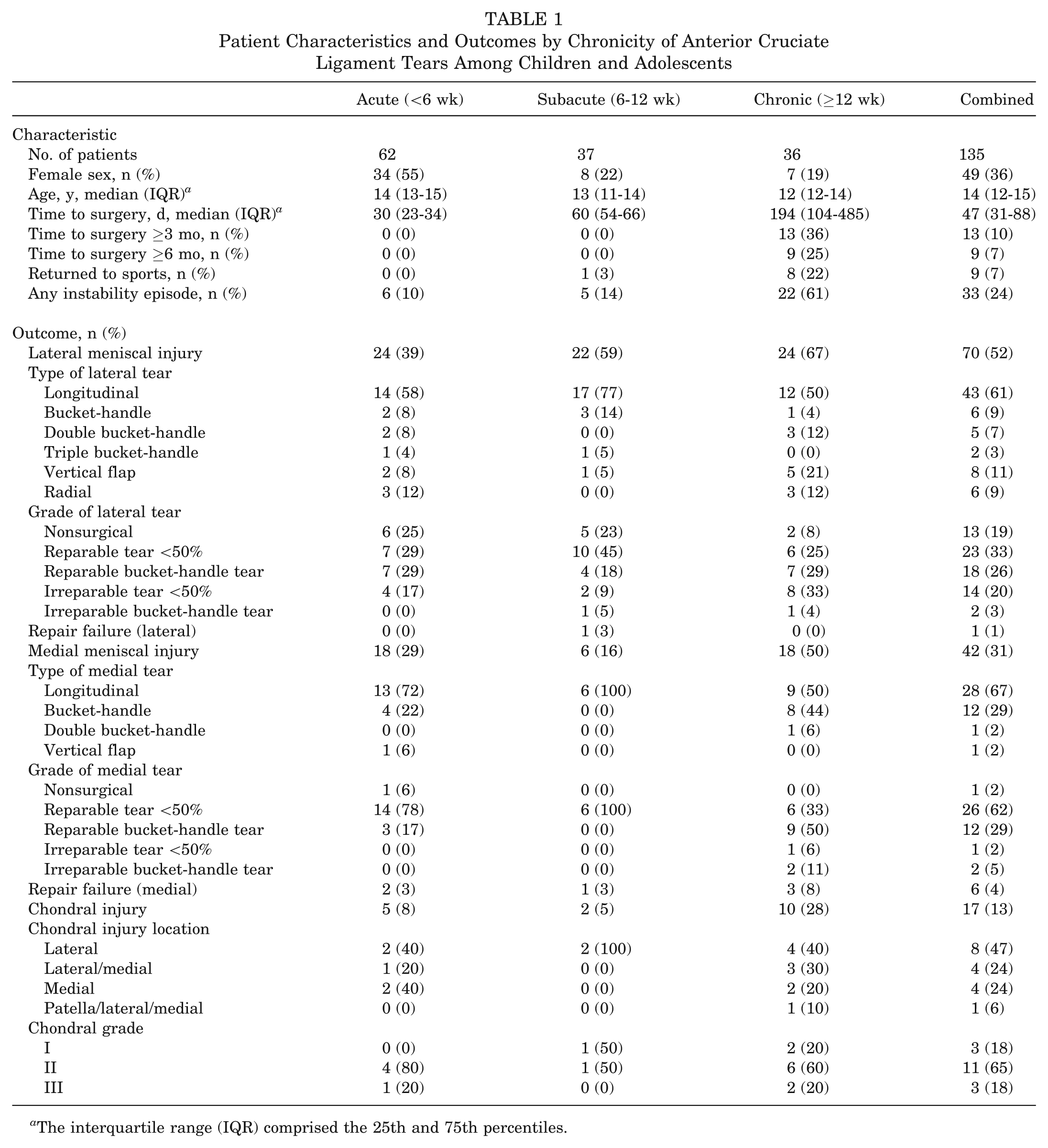
The interquartile range (IQR) comprised the 25th and 75th percentiles.
All Meniscal Tears
This cohort had 112 meniscal tears (70 lateral, 42 medial). Thirteen of the lateral meniscal tears and 1 medial meniscal tear were small and stable and therefore did not require treatment. Forty-one lateral meniscal tears and 38 medial meniscal tears were repaired. Of these repairs, 1 of the lateral meniscus and 6 of the medial meniscal subsequently failed. For analysis, these tears were considered irreparable.
Nineteen meniscal tears were excised. Fourteen irreparable lateral meniscal tears (small radial or small oblique lateral meniscal root tears involving less than 10% of the meniscus) and 2 irreparable bucket-handle tears were excised. One irreparable medial meniscal tear involving less than 50% of the meniscus and 2 irreparable bucket-handle tears were excised.
The descriptive analysis by age group found at least 1 torn meniscus in 73% of patients 8 to 12 years old (30/41) and 67% of patients 13 to 16 years old (63/94) (see the Appendix, available online at http://ajsm.sagepub.com/supplemental). Statistically significant differences were found among age groups for lateral and medial meniscal tears. Lateral meniscal injuries occurred in 71% of the 8- to 12-year-old group and 44% of the 13- to 16-year-old group (P = .007). Medial meniscal injuries occurred in 10% of the younger group and 40% of the older group (P < .001). The severity grade of meniscal tears was greater in the older group (P = .042).
Lateral Meniscal Tears
Among those with lateral meniscal tears, 74% were female, median age was 13 years, and median time to surgery was 60 days. A statistically significant bivariate association was found for female sex (P = .034), age (P = .007), and time to surgery (P = .016) with lateral meniscal tears (see Appendix Table A2, available online). The probability of lateral meniscal tear was independently associated with age and return to sports in the regression model (see Model 1 in Table 2). While we failed to detect a statistically significant independent association between time to surgery and lateral meniscal tear (P = .31), the point estimate corresponds to increasing odds of lateral meniscal tear for patients in the subacute and chronic surgical categories compared with the acute category (Model 1 in Table 2).
Four Multivariable Models of Meniscal Injury a

In models 1 and 3, logistic regression was used to predict the probability of meniscal injury. In models 2 and 4, proportional odds ratios (PORs) were used to predict the odds of sustaining a high-grade versus a low-grade meniscal injury (models 2 and 4); n = 135 for each model. OR, odds ratio.
A statistically significant bivariate association was found for severity of lateral meniscal tears with age (P = .009), instability episodes (P = .007), and increasing time to surgery (P = .045; see Appendix Table A3, available online). History of any instability was associated with greater than 3 times the odds of a high- versus low-grade lateral meniscal injury (Model 2 in Table 2). In the analysis of time to surgery, patients who underwent reconstruction >3 months after injury had higher grade injuries than patients who underwent acute reconstruction (proportional odds ratio [POR] = 2.82; 95% CI, 1.05-7.59).
Medial Meniscal Tears
Among those with medial meniscal tears, 50% were female, median age was 14 years, and the median time to surgery was 59 days. Statistically significant bivariate associations with medial meniscal tears were found for female sex (P = .042), age (P = .001), time to surgery (P = .007), resumption of sports activities (P = .044), and any episode of instability (P < .001) (see Appendix Table A4, available online). Independent risk factors for medial meniscal tear using multivariable logistic regression included female sex (P = .03), older age (P = .01), and any episode of instability (P = .01) (Model 3 in Table 2). Although no independent association was detected between time to surgery and odds of medial meniscal tear (P = .20), the odds estimates increased for patients in the chronic reconstruction group compared with the acute group (POR = 3.51; 95% CI, 0.79-15.6).
The severity of medial meniscal tears had bivariate association with age (P = .006), increasing time to surgery (P = .002), resumption of sports activities before reconstruction (P < .001) and any instability episode (P < .001) (see Appendix Table A5, available online). Results from the proportional odds model (Model 4 in Table 2) show that a 16-year-old has nearly 8 times higher odds of high- versus low-grade medial meniscal tears compared with a 12-year-old (P = .001). Other independent risk factors for high-grade medial meniscal injury include any episode of instability (P = .002), resumed sport activities before reconstruction (P = .005), and time to surgery >3 months (P = .046).
Chondral Injury
Seventeen knees (13%) had 23 chondral injuries. Among those with chondral injury, 41% were in female patients, median patient age was 14 years, and median time to surgery was 186 days (Table 3). Factors associated with chondral injury were increased time to surgery (P = .005) and any instability episode (P = .001) (Table 3). Factors associated with increased grade of chondral injuries were time to surgery >3 months (P < .001), any instability episode (P = .003), and failure of meniscal repair (P = .023) (see Appendix Table A6, available online).
Patient Characteristics by Any Chondral Injury
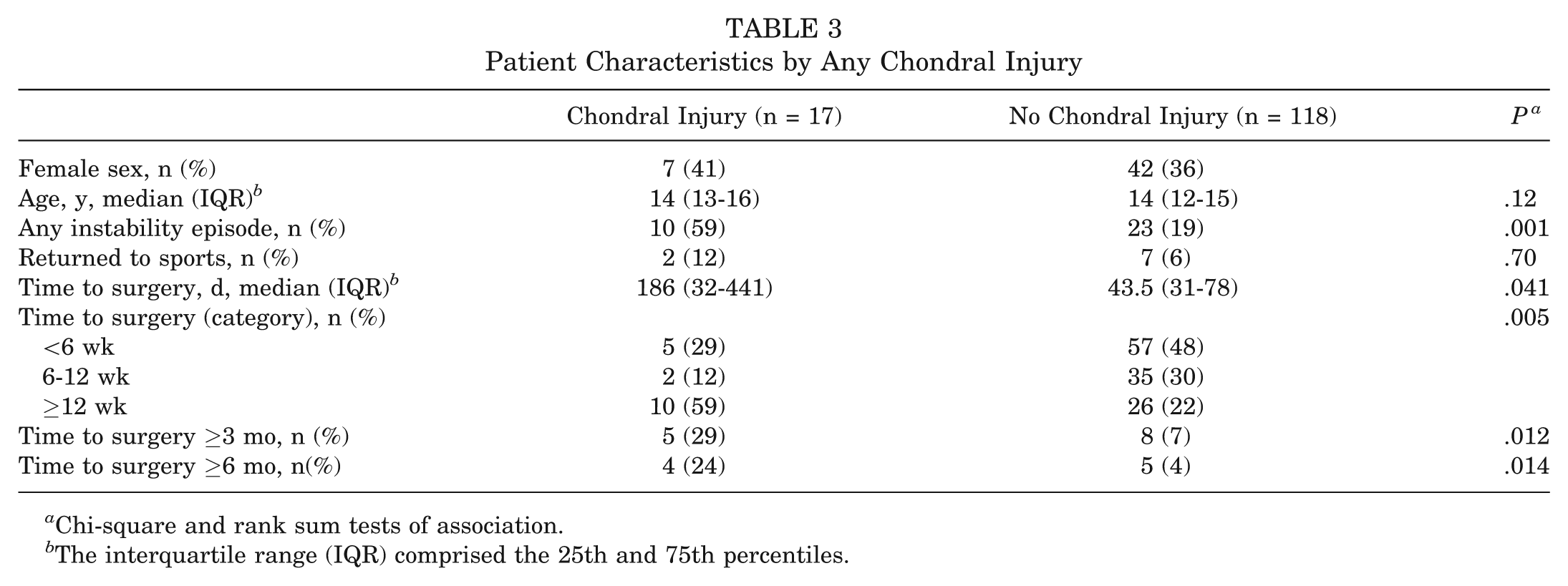
Chi-square and rank sum tests of association.
The interquartile range (IQR) comprised the 25th and 75th percentiles.
Discussion
Treatment options for pediatric ACL tears include nonoperative management, early surgical reconstruction, and delayed surgical reconstruction until skeletal maturity. Physicians are often faced with a treatment dilemma when managing skeletally immature patients with ACL tears because clinical and basic science studies have demonstrated risk of iatrogenic growth disturbance with reconstruction, and nonoperative or delayed surgical management has been associated with a risk of recurrent instability, meniscal tears, and sports-related disability. Determining which of these is the best treatment option has been complicated by methodological limitations of studies in the literature. Although several small, evidence level 4 studies indicate that nonoperative treatment or delayed reconstruction until skeletal maturity results in poor outcomes,1,6,10,11,16-18,20 other studies, with similar design, support the use of nonoperative treatment algorithms in skeletally immature patients.19,26 Consequently, in the older literature, surgeons may find support for any of these methods of treatment.
Recently, several studies with a higher level of evidence have evaluated the consequences associated with delay in ACL reconstruction. In a cohort study of 70 patients, Lawrence and colleagues 14 determined with logistic regression analysis that time to surgical reconstruction greater than 12 weeks and a single episode of knee instability were independently associated with medial meniscal tears (odds ratio = 4.1 and 11.4, respectively). Time to surgery was also independently associated with medial and lateral compartment chondral injuries (odds ratio = 5.6 and 11.3, respectively).
Other studies have evaluated additional injuries related to delay in ACL reconstruction by at least 6 months after the initial injury. In a retrospective study comparing patients with surgery delayed by a mean of 30 months with those who had surgery delayed by 13.5 months, Henry and coworkers 8 found a statistically higher rate of medial meniscal tears (41% vs 16%) and lower subjective IKDC scores (83.4 vs 94.6) in the group with surgery delayed by 30 months. Dumont et al 4 evaluated the incidence of meniscal and chondral injuries in patients undergoing early (≤150 days; n = 241) compared with delayed ACL reconstruction (>150 days; n = 129). Medial meniscal tears were significantly more common in the delayed treatment group (odds ratio = 1.8), but the incidence of lateral meniscal tears were similar between groups. They also found that patients with meniscal tears were more likely to have chondral injuries in the same compartment. Guenther and colleagues 7 conducted a retrospective review of 112 adolescents with a mean age of 15 years. A comparison of MRI findings after the initial injury (mean, 77 days) with surgical findings at the time of reconstruction (mean, 342 days) showed patients with new or worsened medial meniscal tears had waited significantly longer for surgery (445 vs 290 days). Additionally, bucket-handle medial meniscal tears increased steadily in frequency for more than a year after ACL injury. 7
Similar to previous research,4,7,8,14 the current study also demonstrated that delay in surgical reconstruction resulted in a significant increase in medial meniscal tears and chondral injuries. Furthermore, similar to the study by Lawrence and colleagues, 14 the present study also demonstrates an increased rate of meniscal and chondral injuries with a history of any episode of knee instability. However, unlike studies by Lawrence et al 14 and Dumont et al, 4 our data demonstrated a resumption of sports before reconstruction was a risk factor for increased meniscal and articular cartilage injuries. Another substantial difference between the present study and previous reports was the increased incidence and severity of lateral meniscal tears found in this study with delayed reconstruction. The reason for this difference is unclear, but it may be due to differences in ages of the patients, length of delay to surgery, or evaluation of lateral meniscal tears by different surgeons. Even so, our results are similar to those of Samora et al, 23 who reported on 124 skeletally immature patients (average age, 14.2 years) who had ACL reconstruction within 3 months of injury. The prevalence of meniscal tears was 69% in their study, and the lateral meniscus was torn in 70 patients and the medial meniscus was torn in 36 patients. Shieh et al 24 also found that the lateral meniscus was torn more frequently than the medial meniscus in children and adolescents with an ACL tear. Despite some methodological similarities, differences in the cohorts, the length of delay until surgery, methods of evaluation, grading of meniscal and chondral injuries, and potential for unmeasured confounding factors limit the comparability between previous research and the current study.
Preservation of the menisci may theoretically reduce the chances of articular cartilage degeneration and the additional risk of osteoarthritis. Therefore, repair was performed in 41 of 43 lateral meniscal tears and 36 of 38 substantial medial meniscal tears. Meniscectomies were only performed in small radial tears or posterior horn tears of lateral meniscus when less than 10% of the meniscus was removed or severe, degenerated meniscal tears. Increasing severity of meniscal tears, failure of repair, and irreparable medial meniscal tears were all more commonly associated with delay in reconstruction.
While this study assessed the risk of meniscal and chondral injury associated with delayed ACL reconstruction in pediatric patients, it does not address the question of whether the results of surgical reconstruction are any safer or better.5,12,13,15,25 No growth disturbances occurred in this cohort. Frosch et al, 5 in a meta-analysis of 55 studies including 935 patients, found that the risk of leg-length discrepancy or angular deformity after surgical treatment was 1.8%. 5 In a systematic review of 31 studies (n = 479 patients), Vavken and Murray 25 found that 3 patients developed angular defects and 2 had leg-length discrepancies. The authors also analyzed the literature to determine if surgical treatment was the best option for pediatric ACL tears. Nine studies with evidence level 2 or 3 compared surgical treatment versus nonsurgical treatment (n = 6), immediate with delayed reconstruction (n = 2), and surgical treatment in mature versus immature patients (n = 1). These studies unanimously reported significantly better clinical scores and knee laxity after surgical reconstruction compared with nonoperative treatment. There was also no difference in the risk of growth disturbance.
This study has several limitations. The date of the initial injury, number of instability episodes, and return to sports before surgery was dependent on patient recall, which may have introduced bias. Other anthropomorphic data that may affect rates of meniscal and chondral injuries such as height, weight, and body mass index were not evaluated. The arthroscopic documentation of meniscal and chondral injuries was dependent upon the accurate assessment and grading by a single experienced surgeon. It is conceivable that some injuries were missed or incorrectly graded and that some meniscal tears could have been successfully repaired by other surgeons. In observational studies, such as this one, patients are not randomly assigned to treatment delay; therefore, some selection bias may exist. Finally, the results of this study pertain only to this cohort of pediatric patients and may not be generalizable to all pediatric patients with an ACL tear.
Conclusion
This study demonstrates a delay in ACL reconstruction, history of any instability, and return to sports participation before reconstruction are associated with increased risk of meniscal and chondral injuries. These results corroborate the growing body of evidence in the literature that early reconstruction may be the treatment of choice for pediatric ACL tears.
Footnotes
Presented at the 40th annual meeting of the AOSSM, Seattle, Washington, July 2014.
The authors declared that they have no conflicts of interest in the authorship and publication of this contribution.
References
Supplementary Material
Please find the following supplemental material available below.
For Open Access articles published under a Creative Commons License, all supplemental material carries the same license as the article it is associated with.
For non-Open Access articles published, all supplemental material carries a non-exclusive license, and permission requests for re-use of supplemental material or any part of supplemental material shall be sent directly to the copyright owner as specified in the copyright notice associated with the article.
