






Abstract
Background:
Current literature suggests a higher rate of rotator cuff disease development in patients with dyslipidemia (DL). Moderate to high levels of DL are associated with higher rates of retear and revision surgery after arthroscopic rotator cuff repair. Statins protect against development of rotator cuff disease and mitigate the need for rotator cuff repair.
Purpose:
We aimed to investigate the influence of DL and statin use on postoperative functional outcomes.
Study Design:
Cohort study; Level of evidence, 3.
Methods:
Between 2010 and 2016, 266 patients underwent arthroscopic double-row rotator cuff repair for atraumatic full-thickness tears. Evaluation was conducted preoperatively and at 3, 6, 12, and 24 months postoperatively. Three functional outcome measures were used (Constant Shoulder Score [CSS], Oxford Shoulder Score [OXF], and University of California, Los Angeles, Shoulder Rating Scale [UCLASS]), as well as a visual analog scale (VAS) for pain. DL and non-DL were classified through screening of health and assessment of lipid levels within 6 months of surgery (triglycerides, total cholesterol, low-density lipoprotein, and high-density lipoprotein). Patients with DL were divided into statin users and nonusers. Types and dosages of statins were recorded, and intensity and equivalency charts were employed for standardization. Mann-Whitney U test and Pearson chi-square test were used for analysis. Generalized estimating equations and linear mixed models were used to examine the influence of DL and statin dosage, respectively on percentage change of postoperative outcome scores.
Results:
Increased age was associated with a higher incidence of DL (P < .001), and 86% of the DL group was taking statins. The DL group also exhibited poorer scores preoperatively (CSS, P = .001; OXF, P = .032). No significant difference in scores was elicited between the DL and non-DL groups at 24 months. However, patients with DL experienced greater percentage improvement of CSS and OXF from preoperative baseline than did patients without DL (P = .008 and P = .034, respectively) at 24 months. There was no significant difference in 24-month functional outcomes between statin users and nonusers. No statistically significant change of CSS; OXF; UCLASS; or VAS was noted with increasing statin doses at 24 months.
Conclusion:
Patients with DL with perioperative statin usage did not have poorer 24-month functional outcomes after arthroscopic rotator cuff surgery compared with those in patients without DL.
Rotator cuff disease is a common condition that often leads to debilitating pain and functional impairment. It has an estimated prevalence of 9.7% in patients aged ≤20 years and shows marked increased in prevalence after 50 years of age. 21 A study by Milgrom et al 21 suggested that asymptomatic rotator cuff disease was present in as many as 50% of dominant shoulders in the seventh decade and in 80% of patients exceeding 80 years old.
The pathogenesis of rotator cuff pathologies is multifactorial. Well-established factors associated with development of rotator cuff disease include structural factors, such as impingement, hypovascularity, local inflammation, 23 and mechanical overuse, as well as patient factors, including age, 4 smoking, family history, 25 obesity, and corticosteroid use. 10 Atraumatic rotator cuff tears can, at times, also be due to a normal aging process. 21
Interesting associations have been drawn between dyslipidemia (DL) and development of rotator cuff disease. 29 In a recent landmark article involving a database of 26,664 patients, Lin et al 18 established that hyperlipidemia increased the risk of developing rotator cuff disease. Apart from development of rotator cuff diseases, significant associations have been demonstrated between moderate to high levels of DL and rate of tendon retear 8 and, consequently, the need for revision surgery 5 after primary arthroscopic repair. 2 DL has been shown to mechanistically relate to rotator cuff disease and the maintenance of the integrity of rotator cuff tears owing to the accumulation of lipids within the extracellular matrix of the tendon, which can influence its mechanical properties11,21 and subsequently affect tendon-to-bone healing after surgical repair.
The most common therapeutic modality for treatment of DL 20 is statins, also known as 3-hydroxy-3-methylglutaryl-coenzyme A reductase inhibitors. 26 Statins are generally safe, with minor side effects, 20 and are commonly used because of their ability to significantly reduce the incidence of coronary events in primary and secondary prevention from such treatment.9,17 Interestingly, apart from their primary effects, statins have a protective factor against the development of rotator cuff disease 18 and are thought to mitigate the need for revision rotator cuff repair.9,15
Use of statins has been associated with reduced risk of developing rotator cuff disease as compared with no statin use. 18 However, to date, there remains a paucity of literature describing postoperative functional outcomes in patients with DL and statin users after arthroscopic rotator cuff surgery. Thus, the objective of our study was to assess the influence of perioperative DL and usage of statins on 24-month functional outcomes after arthroscopic rotator cuff tear repair.
Methods
Population Selection and Inclusion and Exclusion Criteria
This study was reviewed and approved by our local institutional review board. A retrospective analysis of electronic medical records was conducted, yielding 266 patients who underwent arthroscopic double-row rotator cuff repair by a fellowship-trained shoulder surgeon (D.T.T.L.) in a single high-volume institution between 2010 and 2016. All patients had atraumatic full-thickness rotator cuff tears confirmed on imaging. In all included patients, nonoperative management—consisting of drugs, physiotherapy, or rest—had failed, and they continued to experience debilitating pain or functional impairment in the affected shoulder. All patients with partial-thickness cuff tears, traumatic tears, isolated subscapularis tendon tears, or concomitant adhesive capsulitis or glenohumeral instability were excluded from the study. Traumatic cuff tears were defined as tears sustained secondary to shoulder dislocation. Preoperative patient characteristics are presented in Table 1.
Patient Characteristics and Pre- and Postoperative Outcome Measures: Dyslipidemia vs Nondyslipidemia a

CSS, Constant Shoulder Score; HDL, high-density lipoprotein; LDL, low-density lipoprotein; OXF, Oxford Shoulder Score; TC, total cholesterol; TG, triglycerides; UCLASS, University of California, Los Angeles, Shoulder Rating Scale; VAS, visual analog scale for pain.
Data Collection
Patients were evaluated preoperatively and at 3, 6, 12, and 24 months postoperatively. Primary functional outcome measures 16 included 3 validated scoring systems: Constant Shoulder Score (CSS), Oxford Shoulder Score (OXF), and University of California, Los Angeles Shoulder Rating Scale (UCLASS). Additionally, a visual analog scale (VAS) was used for pain assessment.
Diagnosis and segregation of DL and non-DL were determined through screening of existing health records for preexisting diagnosis, established with reference to our local guidelines, and drawn from the guidelines of the National Cholesterol Education Program’s Adult Treatment Panel, as shown in Table 2. If available, lipid levels within 6 months of surgery (triglycerides, total cholesterol, low-density lipoprotein [LDL], and high-density lipoprotein [HDL]) were also assessed to further screen for DL.
Classification of Total, LDL, and HDL Cholesterol and Triglyceride Levels a
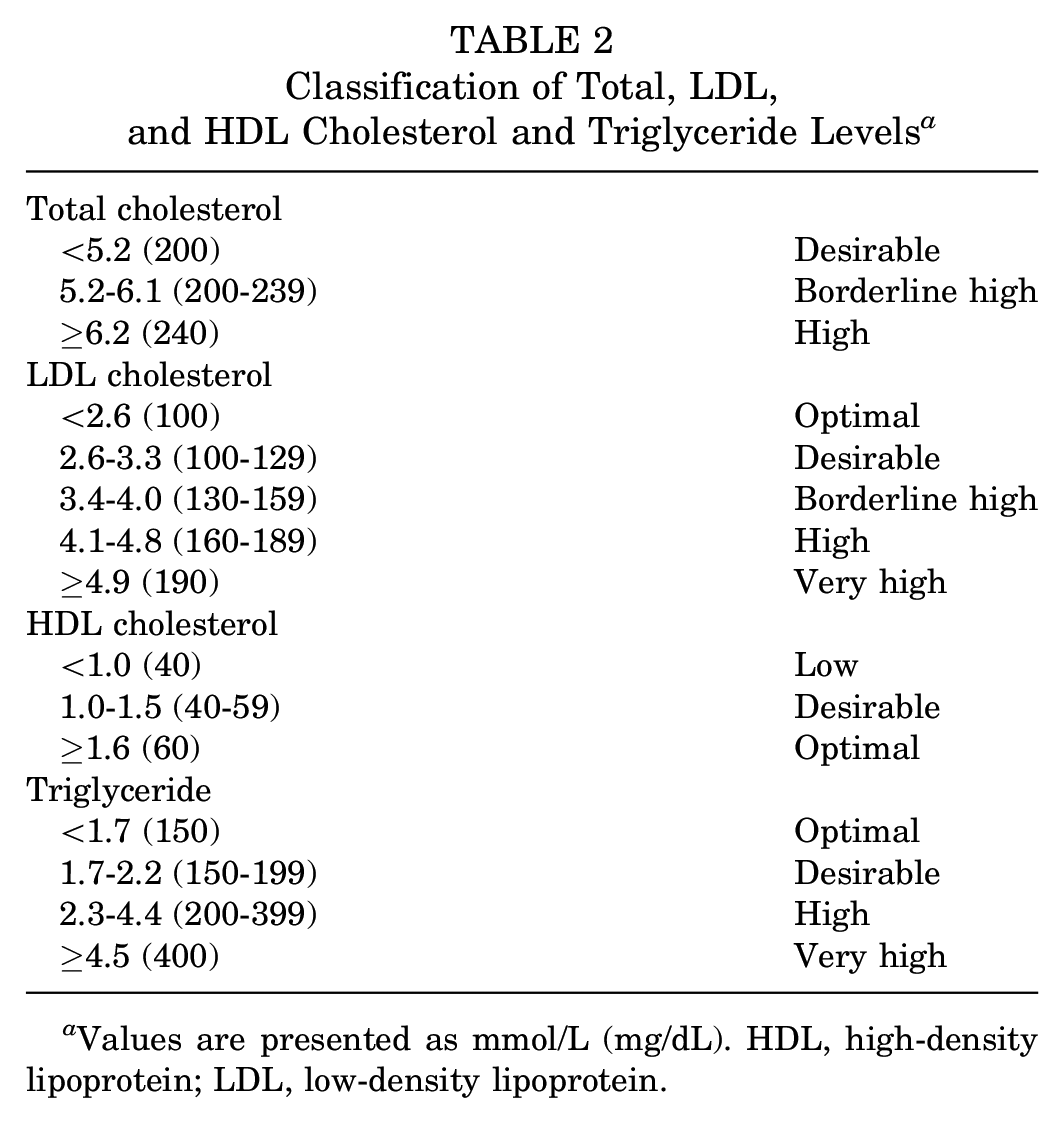
Values are presented as mmol/L (mg/dL). HDL, high-density lipoprotein; LDL, low-density lipoprotein.
Patients with DL were divided into statin users and nonusers. Subgroup analyses were performed to compare outcomes between statin users and nonusers. Patients were considered statin users if they were on active treatment within 6 months preceding the date of surgery (arthroscopic rotator cuff repair).
Information on dose, duration of use, and specific type of statins used was recorded, and a statin dose intensity and equivalency chart was employed for standardization per the guidelines of the American College of Cardiology and the American Heart Association. 22
Statistical Analysis
We compared baseline data between DL and non-DL groups. The Mann-Whitney U test was used to compare continuous variables, while the Pearson chi-square test was used for categorical variables. Generalized estimating equations and linear mixed models were used to examine the influence of DL and statin dosage, respectively, on percentage change of postoperative functional outcome scores. All statistical analyses were carried out using SPSS (Version 25.0; IBM Corp). Statistical significance was defined as a P value ≤.05.
Results
Patient Characteristics
Table 1 describes the characteristics of our study group. A total of 266 patients met the criteria for inclusion in our study. Of the 266 patients, 117 (44.0%) were men, and the mean ± SD age was 61.34 ± 9.8 years; 134 (50.4%) patients were documented to have DL. Among patients with DL, 115 (85.8%) were statin users. The mean follow-up period for all patients exceeded 24 months. At the end of 24 months, the dropout rate was 3%.
Evaluation of patient data showed a significant association between increased age of patients and presence of DL (P < .001), as illustrated in Table 1.
Outcome Scores
Preoperatively, the DL group had poorer CSS, VAS, and OXF scores (P = .001, P = .002, and P = .032, respectively) (Table 1). At 24-month follow-up, there was no significant difference between the DL and non-DL groups in terms of absolute CSS, OXF, UCLASS, and VAS scores (P = .553, P = .857, P = .694, and P = .443), as all had improved to similar levels (Figure 1).

Progression of 4 primary outcome measures in dyslipidemia vs nondyslipidemia groups over 24 months. CONS, Constant Shoulder Score; OXF, Oxford Shoulder Score; UCLA, University of California, Los Angeles, Shoulder Rating Scale; VAS, visual analog scale for pain.
However, mean percentage improvement from baseline to 24-month follow-up in DL as opposed to non-DL was 24.0% higher for CSS scores and 3.8% higher for OXF scores, and these values were statistically significant (P = .008 and P = .034, respectively) (Table 3). There was no statistically significant difference in mean percentage improvement of CSS, OXF, UCLASS, or VAS between statin users and nonusers at 24 months (Table 4). Additionally, within the statin group, no statistically significant change of CSS, OXF, UCLASS, or VAS was noted with increasing statin doses at 24 months (Table 5).
GEE Model for Percentage Change From Baseline to 24-Month Follow-up: DL vs Non-DL a
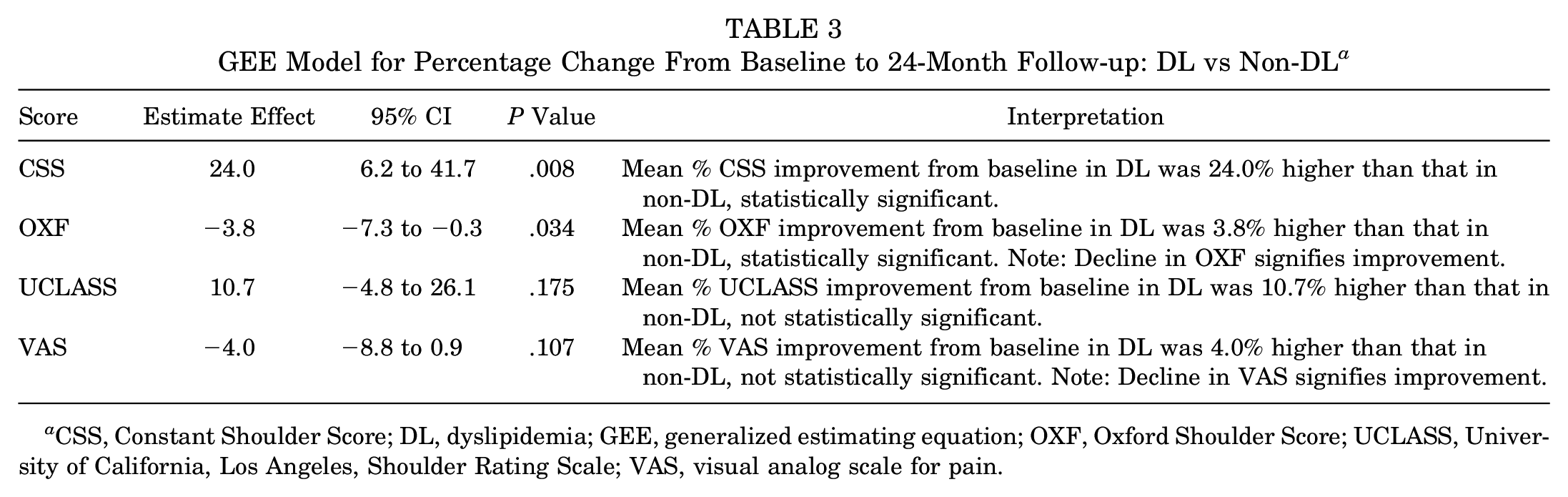
CSS, Constant Shoulder Score; DL, dyslipidemia; GEE, generalized estimating equation; OXF, Oxford Shoulder Score; UCLASS, University of California, Los Angeles, Shoulder Rating Scale; VAS, visual analog scale for pain.
GEE Model for Percentage Change From Baseline to 24-Month Follow-up: Statin Users vs Nonusers a

CSS, Constant Shoulder Score; GEE, generalized estimating equation; OXF, Oxford Shoulder Score; UCLASS, University of California, Los Angeles, Shoulder Rating Scale; VAS, visual analog scale for pain.
Linear Mixed Models for Absolute Change in Outcome Measures With Increasing Dose of Statins at 24 Months, Holding Other Factors Constant (Time, Age, Sex, and BMI) a

Individual statin types and doses are standardized on the basis of simvastatin via the statin dose intensity and equivalency chart of the American College of Cardiology and the American Heart Association. BMI, body mass index; CSS, Constant Shoulder Score; OXF, Oxford Shoulder Score; UCLASS, University of California, Los Angeles, Shoulder Rating Scale; VAS, visual analog scale for pain.
Increase in 1 mg of simvastatin.
Discussion
To our knowledge, this is the first analytic study to date that has investigated the influence of DL and the use of statins on midterm functional outcome after primary arthroscopic rotator cuff repair. In this study, we concluded that patients with DL with perioperative statin usage did not have poorer postoperative outcomes when compared with patients without DL at 24 months. At 24 months, increased dose of statins also did not significantly affect functional outcomes.
DL as a risk factor for development of rotator cuff disease has been extensively studied and demonstrated in previous work.1,15,18 It is also known to adversely affect treatment of rotator cuff tendinopathy with or without tear. 13 The odds of rotator cuff disease developing in patients with DL has been reported to be 2.17 times (95% CI, 1.46-3.23) higher than that in patients without DL. 15 A recent study by Cancienne et al 5 also found a significant association between moderate to high DL and the rate of revision surgery after arthroscopic rotator cuff repair. In a study by Garcia et al 8 involving postoperative ultrasound evaluation, hyperlipidemia was reported to lead to a 6-fold increase in the risk of retear after arthroscopic repair. However, no studies have evaluated the effect of DL on overall clinical outcomes.
In this study, patients with DL exhibited poorer preoperative baseline scores. The difference in preoperative scores was small and, despite being statistically significant, unlikely to be clinically significant, as it did not reach the known minimal clinically important difference of the individual scores.14,19,28
Postoperatively, differences in functional outcome scores were also small and did not reach the known minimal clinically important difference. In our study, 86% of patients with DL were taking statins. At 24 months, we theorized that this observed lack of difference in functional outcomes might be due to perioperative usage of statins. We also noted that patients with DL had greater percentage improvement than did those without, presumably because of poorer baseline scores.
In a previous study, Cancienne et al 5 suggested that there was a significant association between moderate to high perioperative total cholesterol/LDL and rate of revision surgery after primary repair owing to higher retear rates. However, rotator cuff retear after surgery may not necessarily correspond to worsening of clinical outcomes. Possible explanations that can reconcile this difference were addressed in previous studies by Oh et al, 24 who demonstrated that functional outcome was not correlated with the anatomic postoperative cuff integrity, and Jost et al, 12 who showed that clinical outcomes can still undergo significant improvement despite structural failure of rotator cuff repairs. While our study did not address retears, we are of the opinion that, with good DL control through statins, good clinical outcomes can be maintained, regardless of the presence of retears.
Finally, our analysis suggested that statin usage alone did not lead to statistically significant improvement in primary outcome measures, regardless of dose. While there have been no preceding studies detailing statins’ direct effect on functional outcome, there have been various other studies suggesting no difference3,6,26 in tendon rupture rates despite usage. However, we are of the opinion that its usage remains relevant, especially in providing good DL control to achieve favorable outcomes.
In an experimental study, Esenkaya et al 7 compared rabbits that were administered atorvastatin with surgical control groups and observed no statistical difference in tendon healing after surgical repair. A previous case-control study by Beri et al 3 and a systematic review by Teichtahl et al 27 demonstrated concurring opinions that there is no overall association between statin use and tendon rupture.
While statins alone may not be effective, statin usage in the proper context, such as treatment of DL, may provide favorable outcomes in the same way that it mitigates the need for revision rotator cuff repair. 5
A significant strength of our study is that all arthroscopic repairs of randomized controlled trials were performed by a single high-volume surgeon from a tertiary institution. This reduced heterogeneity in surgical technique and postoperative care. Moreover, our study exhibited a uniform follow-up period with a low dropout rate and was thus able to accurately track the changes in outcome scores at multiple points. At the end of 24 months, the dropout rate remained low at 3%.
Limitations
One limitation of our study is that a significant number of patients lacked LDL and HDL values, as these data were gathered only if available within 6 months of surgery. We were thus unable to reliably perform a separate analysis of LDL and HDL. Another limitation of this study is that it lacks postoperative imaging to assess rotator cuff repair integrity. We did not perform routine postoperative imaging for all patients, as we adopted a cost-efficient approach to treatment.
Conclusion
In conclusion, we found that patients with DL with perioperative statin use did not have poorer 24-month functional outcomes scores after arthroscopic rotator cuff surgery when compared with patients without DL. Good DL control through conscientious use of statins should be advocated preoperatively to retain favorable outcomes after arthroscopic rotator cuff surgery. Larger well-designed prospective studies focused on concurrently assessing clinical and radiological postoperative outcomes would be useful to validate our finding.
Footnotes
Submitted October 3, 2019; accepted May 5, 2020.
One or more of the authors has declared the following potential conflict of interest or source of funding: Funding was provided by Singhealth Academic Medicine Research Grant Call 2018, grant AM/TP005/2018 (SRDUKAMR18T5). AOSSM checks author disclosures against the Open Payments Database (OPD). AOSSM has not conducted an independent investigation on the OPD and disclaims any liability or responsibility relating thereto.
References
Supplementary Material
Please find the following supplemental material available below.
For Open Access articles published under a Creative Commons License, all supplemental material carries the same license as the article it is associated with.
For non-Open Access articles published, all supplemental material carries a non-exclusive license, and permission requests for re-use of supplemental material or any part of supplemental material shall be sent directly to the copyright owner as specified in the copyright notice associated with the article.
