






Abstract
Background:
Autologous chondrocyte implantation (ACI) is an established procedure for the treatment of cartilage damage in the knee joint. At present, it is still unclear how previous surgery influences outcome after ACI.
Purpose:
To evaluate the effect of previous knee surgery related or nonrelated to the treated cartilage defect on clinical outcome after ACI for knee cartilage defects.
Study Design:
Cohort study; Level of evidence, 3.
Methods:
An overall 730 patients with ACI who underwent previous unspecific knee surgery, whether related to the defect being currently treated or not, were identified from a cohort of 5961 patients registered in the German Cartilage Registry. Propensity score matching was used to match these patients to 690 patients with analogous characteristics but without previous surgery. Subsequently, 317 patients with previously failed cartilage treatment at the defect site were identified and compared with a matched collective of 254 patients without previous cartilage treatment. In a subgroup analysis, the type of previous cartilage surgery was additionally investigated. Outcome was evaluated by Knee injury and Osteoarthritis Outcome Score (KOOS), visual analog scale for pain, rate of reintervention, and patient satisfaction up to 36 months. A chi-square test was used to compare categorial variables and an unpaired t test to compare continuous variables.
Results:
Patients with previous knee surgery not related to the cartilage defect showed a lower KOOS at 6 months (68.3 vs 70.8; P = .026), while patients with previous cartilage surgery showed significantly lower KOOS values at all follow-up time points when compared with patients without any previous knee or cartilage surgery (all P < .05). A comparison of KOOS values in patients with previous therapy at the cartilage defect with ACI versus bone marrow stimulation did not show any significant differences at any follow-up.
Conclusion:
Previously failed cartilage treatment at the defect site represents a negative prognostic factor up to 3 years after ACI. However, this influence appears to be independent of the type of previous treatment at the defect site and applies equally to failed bone marrow stimulation as well as previous ACI. In contrast, a negative effect of previous surgery to the knee unrelated to the cartilage defect could not be shown in the 3-year follow-up.
Since the introduction of autologous chondrocyte implantation (ACI) for the treatment of cartilage defects of the knee, defining the best indication regarding patient-specific parameters for this type of treatment has been prioritized in the literature. 3 When the first recommendation about the indication for ACI was given by the German Society for Orthopaedics and Trauma (DGOU) in 2004, 2 there was little evidence supporting it. Although some parameters justifying the use of ACI were based on limitations of a comparator treatment (eg, lesion size as a major limitation of bone marrow stimulation [BMS]), 12 others were based on expert opinions (eg, integrity of the corresponding joint surface). Most of these have not been proven scientifically to the full extent, suggesting that valid evidence is still elusive. Nevertheless, there have been multiple studies on potential risk factors for treatment failure after ACI. With regard to these studies, various factors have been identified. These include patient-specific parameters such as increased body mass index, smoking, and others.4,8,15
Interestingly, there are controversial recommendations in terms of whether ACI qualifies as an appropriate treatment as a first- or second-line approach in intermediate-sized cartilage defects (2.5-10 cm2). In the first German recommendation in 2004, the general advice was to use ACI for defects >4 cm2 as first-line treatment. Despite some early studies indicating a worse outcome after ACI as second-line treatment, its use for smaller defects (2.5-4 cm2) was suggested in case of failure after previous cartilage treatment. 2 In a subsequent publication, this recommendation was not confirmed, and the additional indication of ACI as a second-line treatment was dropped. 14 As a result, the general opinion of ACI qualifying as first-line treatment was established. Over time, more studies revealed that previously failed BMS should be especially considered a negative prognostic factor for ACI,10,13,17 as confirmed by a recent systematic review. 20 Following this, the UK National Institute for Health and Care Excellence recommends ACI as the best available treatment for cartilage defects >2 cm2 and as first-line treatment but denied reimbursement in revision cases. 11
Considering all these circumstances, in recent years there has been a clear trend toward ACI as first-line treatment, as previous BMS was considered a risk factor for failure by many experts. Nevertheless, with regard to the available scientific evidence, it has never been shown whether previous cartilage repair at the defect site actually leads to an inferior outcome or whether the higher failure rate is related to general previous surgery to the knee (PSK). Therefore, the present study was initiated to evaluate a large cohort of patients prospectively involved in the German Cartilage Registry (KnorpelRegister DGOU). A propensity score–matched study was initiated to isolate and analyze the influence of PSK and previous cartilage repair surgery at the defect site. The aim was to compare functional outcomes using standardized patient-reported outcome parameters and the need for revision surgery, as well as subjective patient satisfaction.
Methods
Data Collection
Data from the German Cartilage Registry were used for the present study. The German Cartilage Registry is supported by a grant from the Oscar-Helene-Stiftung eV and the Deutsche Arthrosehilfe eV. The KnorpelRegister DGOU is an observational, nationwide, and longitudinal multicenter registry of patients assigned for surgical treatment of cartilage defects of the knee, and it aims to determine real-life treatment patterns and clinical outcomes. The registry was initiated by the Clinical Tissue Regeneration Working Group of the DGOU in 2013. 9 At present, more than 100 centers are sharing data for this registry. The registry is conducted in accordance with the Declaration of Helsinki and registered at GermanCTR.de (DRKS00005617). The current study was approved by the ethics commission of the Medical Center–University of Freiburg (EK-FR 105/13_130795).
All patients aged ≥18 years meeting the following criteria were eligible to take part in the German Cartilage Registry: surgical treatment of cartilage defects of the knee, ankle, or hip joint at a participating site; signed informed consent; and possession of a personal email address. As of December 2020, 5961 patients assigned for surgical treatment of cartilage defects of the knee had been included in the registry.
Data collection was performed using RDE-Light, a web-based remote data entry system that was developed by the Clinical Trials Unit (Freiburg) as an electronic data entry interface and data management system for clinical studies and other projects in clinical research. Data were collected paperless and directly on-site via an internet browser. Forms were based on HTML and PDF format. RDE-Light is available in various languages and validated according to GAMP 5. Furthermore, it fulfills all requirements of good clinical practice. Established security standards were applied, such as cryptographic security protocols (Secure Sockets Layer (SSL)/Transport Layer Security (TLS)), user authentication protocols, and authorization concepts.
After the patient signed the informed consent form, the patient was registered in the database. Patient- and defect-specific parameters were reported by the treating physician at the time of surgery.
Patient satisfaction was evaluated using a 4-item score (not satisfied, partially satisfied, satisfied, very satisfied) at every follow-up point (6, 12, 24, and 36 months postoperatively). Patient-reported outcome measures were completed as an online self-assessment tool at every follow-up point; the delta Knee injury and Osteoarthritis Outcome Score (KOOS) was generated automatically by calculation of the difference between the KOOS at each follow-up and the preoperative value.
Data Selection
The present study included 1494 patients who had (1) chondral lesions treated with ACI, (2) intact menisci, and (3) PSK or no PSK (nPSK) (Figure 1). Baseline characteristics from the registry are shown in Table 1. In a second analysis, a cohort of 1492 patients with intact menisci and chondral lesions treated with ACI was divided into 2 groups: those with previous chondral treatment (PCT) or no PCT (nPCT) at the defect site before ACI.

Selection process of patients included in PSK and nPSK groups (left arm) and PCT and nPCT groups (right arm). ACI, autologous chondrocyte implantation; BMI, body mass index.
Baseline Characteristics in the Original Cohort of 5961 patients From the Registry a

Values are presented as mean (SD) or percentage. ACI, autologous chondrocyte implantation; BMS, bone marrow stimulation; ICRS, International Cartilage Regeneration & Joint Preservation Society; LFC, lateral femoral condyle; LTP, lateral tibial plateau; M-BMS, matrix-augmented bone marrow stimulation; MFC, medial femoral condyle; MTP, medial tibial plateau.
Traumatic, trauma <6 months before ACI; posttraumatic, trauma >6 months before ACI; degenerative, neither.
Last, a subgroup analysis between patients with PSK and patients with previously failed cartilage treatment was performed to determine any difference regarding the kind of previous surgery that a patient had undergone. To specify the effect of different chondral procedures as previous surgery, the outcome was compared between patients with BMS and those with ACI in their medical history.
Propensity Score Matching and Statistical Analysis
To reduce the bias resulting from the nonrandomized nature of the present study and to enhance comparability between the control and treatment groups (nPSK vs PSK; nPCT vs PCT), 1:1 propensity score matching was performed with the built-in Propensity Score plug-in of SPSS Version 27 (IBM). Propensity score–matching settings for the final matching in each cohort were with replacement, with prioritization for exact matching, without minimization of memory, but with shuffling turned on. Patients were then matched by propensity score according to age, sex, body mass index, duration of symptoms, smoking status, size of defect, International Cartilage Regeneration & Joint Preservation Society grading of cartilage defect, localization of defect, cause of defect, and integrity of corresponding joint surface. Because the categorial variable status of the meniscus could not be matched, only patients with intact menisci in both compartments were analyzed. After final matching with a tolerance of 0.001, 690 patients with nPSK before ACI were matched to 730 patients with PSK before ACI, with similar patient characteristics. To analyze patients in the PCT and nPCT groups, final matching with tolerance 0.0001 was performed. An overall 254 patients without previous surgery to the chondral defect responsible for the treatment before ACI were matched to 317 patients with previous surgery to the chondral defect responsible for the treatment before ACI, with similar patient characteristics. Naturally, group sizes were not equal owing to the use of replacements. This technique used controls as a match for multiple-intervention cases, not impairing the quality of the study as the effect was considered by adjusting each variance.
A chi-square test was used to compare categorial variables and an unpaired t test to compare continuous variables. P values <.05 were considered statistically significant. No corrections for multiple comparisons were performed. SPSS Version 27 was used to analyze the data.
Results
Previous Surgery to the Knee Joint
Patient Characteristics
From 1495 patients originally qualifying for inclusion, 731 reported PSK and 764 did not. After the final propensity score match, 730 (99%) patients in the PSK group and 690 (90%) in the nPSK group were included for analyses. Matching eliminated any significant differences in baseline characteristics, allowing for direct comparison regarding the parameters in question. A detailed presentation of baseline characteristics is given in Table 2.
Baseline Characteristics After Propensity Score Matching: PSK vs nPSK a

Values are presented as mean (SD) or percentage. ACI, autologous chondrocyte implantation; ICRS, International Cartilage Regeneration & Joint Preservation Society; LFC, lateral femoral condyle; LTP, lateral tibial plateau; MFC, medial femoral condyle; MTP, medial tibial plateau; nPSK, no previous surgery to the knee; PSK, previous surgery to the knee.
There were no significant differences between cohorts after propensity score matching.
Traumatic, trauma <6 months before ACI; posttraumatic, trauma >6 months before ACI; degenerative, neither.
Overall Outcome
Preoperatively, patients in the PSK group showed significantly lower KOOS values (mean ± SD, 57 ± 17.3 vs 61.3 ± 16.5; P < .001). As illustrated in Figure 2, 6 months after surgery the difference continued to be statistically significant favoring the nPSK group but could not be observed during later follow-up times. The delta KOOS shows the statistically significant explanation: patients with PSK achieved a higher gain in KOOS until 24 months, resulting in similar levels of function after 1, 2, and 3 years (Table 3).
Outcome Values: PSK vs nPSK a
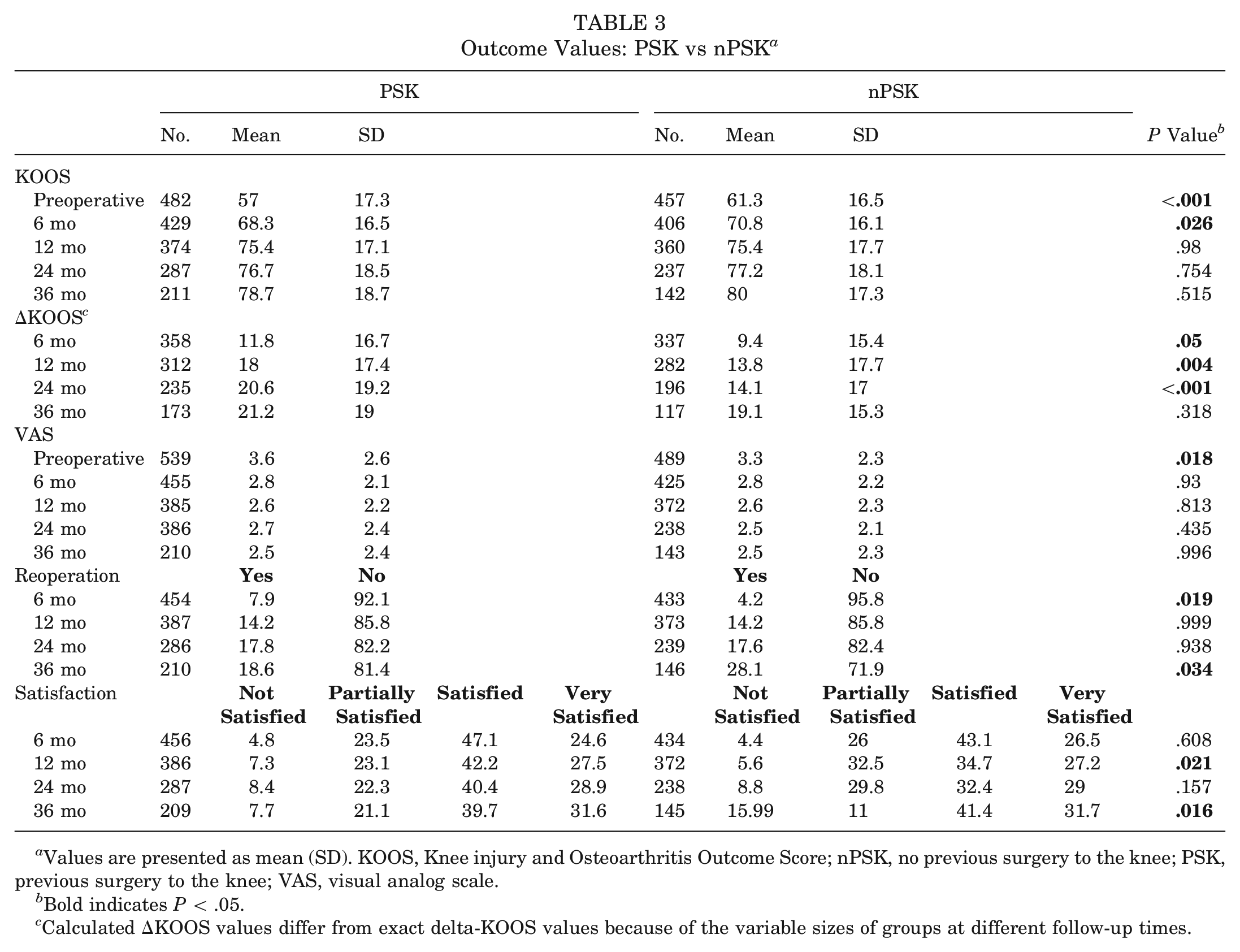
Values are presented as mean (SD). KOOS, Knee injury and Osteoarthritis Outcome Score; nPSK, no previous surgery to the knee; PSK, previous surgery to the knee; VAS, visual analog scale.
Bold indicates P < .05.
Calculated ΔKOOS values differ from exact delta-KOOS values because of the variable sizes of groups at different follow-up times.

Box plots comparing KOOS values: PSK vs nPSK and PCT vs nPCT. Data are presented as median (line), interquartile range (box), maximum-minimum (extensions), and outliers (circles). Gray, preoperative; white, 6 mo; lines, 12 mo; dots, 24 mo; crosses, 36 mo. Data are based on Tables 3 and 5. *P < .05. KOOS, Knee injury and Osteoarthritis Outcome Score; nPCT, no previous chondral treatment; nPSK, no previous surgery to the knee; PCT, previous chondral treatment; PSK, previous surgery to the knee.
Data from patients in the PSK group are always mentioned first in the tables provided. Although patients with PSK showed significantly higher visual analog scale (VAS) scores for pain preoperatively (3.6 ± 2.6 vs 3.3 ± 2.3; P = .018), no difference occurred up to the 36-month follow-up. After 6 months patients in the PSK group underwent significantly more surgical reinterventions (7.9% vs 4.2%; P = .019). Opposingly, patients in the nPSK group needed reoperation significantly more often at 3-year follow-up (Table 3). Individual patient satisfaction was statistically different at 12- and 36-month follow-up. The values show significantly more individual satisfaction in patients with PSK at both follow-up times.
Previously Failed Chondral Treatment at the Defect Site
Patient Characteristics
From the 1492 patients originally qualifying for inclusion, 317 reported a previously failed chondral treatment at the defect site (PCT group) and 1175 did not (nPCT group). After the final propensity score match, 317 patients (100%) in the PCT group and 254 patients (22%) in the nPCT group were included for analyses. Matching eliminated any significant differences in baseline characteristics, allowing for direct comparison regarding the parameters in question. A detailed presentation of baseline characteristics is given in Table 4.
Baseline Characteristics After Propensity Score Matching: PCT vs nPCT a

Values are presented as mean (SD) or percentage. ACI, autologous chondrocyte implantation; ICRS, International Cartilage Regeneration & Joint Preservation Society; LFC, lateral femoral condyle; LTP, lateral tibial plateau; MFC, medial femoral condyle; MTP, medial tibial plateau; nPCT, no previous cartilage treatment; PCT, previous cartilage treatment.
There were no significant differences between cohorts after propensity score matching.
Traumatic, trauma <6 months before ACI; posttraumatic, trauma >6 months before ACI; degenerative, neither.
Overall Outcome
Preoperatively and during the entire follow-up period of 36 months, patients in the PCT group showed statistically significantly lower KOOS values, as illustrated in Figure 2. Regarding the delta KOOS, there were significant differences after 2 and 3 years favoring the PCT group. Patients with previously failed chondral treatment at the defect site reported higher pain scores per the VAS preoperatively (4.1 ± 2.7 vs 3.2 ± 2.5; P < .001) and at 6 months (3 ± 2.1 vs 2.6 ± 1.9; P = .039). Data from patients in the PCT group are always mentioned first in the tables provided (Table 5).
No difference between the groups regarding rate of reintervention was found at all follow-up times. Both groups showed similar individual satisfaction rates on a high level at 6, 12, and 24 months postoperatively (Table 5). Yet in the 3-year follow-up, patients with PCT demonstrated significantly higher levels of satisfaction regarding knee function.
Outcome Values: PCT vs nPCT a

Values are presented as mean (SD). KOOS, Knee injury and Osteoarthritis Outcome Score; nPCT, no previous cartilage treatment; PCT, previous cartilage treatment; VAS, visual analog scale.
Bold indicates P < .05.
Calculated ΔKOOS values differ from exact delta-KOOS values because of the variable sizes of groups at different follow-up times.
Overall Outcome: Patients With PSK vs Failed PCT at the Defect Site
With the object to evaluate whether PSK of an unspecified nature is a relevant predictor for outcome after ACI as compared with previous surgery to the chondral lesion being treated with ACI, both groups were put into contrast in the same manner as before. This way of comparison ensures a transparent and impartial way of analyzing. Values are shown in Table 6.
Outcome Values: PSK vs PCT a

Values are presented as mean (SD). KOOS, Knee injury and Osteoarthritis Outcome Score; PCT, previous cartilage treatment; PSK, previous surgery to the knee; VAS, visual analog scale.
Bold indicates P < .05.
Calculated ΔKOOS values differ from exact delta-KOOS values because of the variable sizes of groups at different follow-up times.
As Figure 2 clearly highlights, at presurgery as well as after 12 and 36 months, patients with previous surgery to the defect had a significantly lower KOOS. There was no difference in delta KOOS at all times (Table 6). Patients with previously failed chondral treatment at the defect site reported higher pain scores per the VAS for preoperatively (3.6 ± 2.6 vs 4.1 ± 2.7; P < .024) and at 12 months (2.6 ± 2.2 vs 3 ± 2.2; P = .023). At 6-month follow-up, patients in the PSK group needed to be treated with surgical reintervention more often than patients in the PCT group. In contrast to these findings, patients in the PCT group had to undergo surgical reintervention more often 24 months after the initial surgery. Regarding patient satisfaction, patients with previous surgery to the chondral defect were significantly less satisfied at 12, 24, and 36 months.
Functional Outcome: Patients With BMS vs ACI as Previous Surgery
In terms of the difference in the KOOS and delta KOOS of patients with 2 major cartilage procedures in the registry, no statistically significant distinction can be observed. As shown in Table 7, the groups did not differ regarding the functional outcome at all follow-up times.
Functional Outcome Values: BMS vs ACI as Previous Surgery a

ACI, autologous chondrocyte implantation; BMS, bone marrow stimulation; KOOS, Knee injury and Osteoarthritis Outcome Score.
There were no significant differences between cohorts after propensity score matching.
Calculated ΔKOOS values differ from exact delta-KOOS values because of the variable sizes of groups at different follow-up times.
Similarity between groups was ensured by previous matching. Patient characteristics are presented in Table 8.
Baseline Characteristics: BMS vs ACI as Previous Surgery a

Values are presented as mean (SD). ACI, autologous chondrocyte implantation; BMS, bone marrow stimulation; ICRS, International Cartilage Regeneration & Joint Preservation Society; LFC, lateral femoral condyle; LTP, lateral tibial plateau; MFC, medial femoral condyle; MTP, medial tibial plateau.
Bold indicates P < .05.
There were more ex-smokers in the ACI group.
Traumatic, trauma <6 months before ACI; posttraumatic, trauma >6 months before ACI; degenerative, neither.
Discussion
The aim of this study was to investigate whether previous knee surgery affects the outcome of patients after ACI for treatment of cartilage defects of the knee. Furthermore, previous knee surgery independent of the cartilage defects was compared with specific treatments of the affected cartilage defect. One of the most important findings of the present study is that PSK affects the rehabilitation process and recovery time because of its reduction of early clinical outcome up to 6-month follow-up. In contrast, previous surgical treatment of the cartilage defect significantly affected clinical outcome over time and worsened the prognosis of ACI treatment. Patients with a previously failed chondral procedure had lower absolute KOOS values than patients without one: 12.1 points lower at 6-month follow-up (P < .001) and 6 points lower at 36-month follow-up (P = .027). As discussed later, we consider this difference clinically significant. Interestingly, the PCT group demonstrated this negative trend regardless of what type of previous cartilage treatment failed (BMS or ACI). Nevertheless, even if absolute KOOS was lower in revision cases, the individual increase over time was higher when compared with primary ACI cases. Interestingly, the reintervention rate was lower and the subjective satisfaction higher in the revision ACI subgroups, almost always in combination with greater delta KOOS values, underlining the subjective nature of the data used for the present study. This leads to the conclusion that even in the context of lower absolute KOOS values, ACI should be considered in a revision situation.
The current study was initiated in the context of earlier publications that reported an inferior outcome of ACI in patients with previous BMS.10,13,17 Nevertheless, because these studies focused on reintervention or treatment failure rather than comparing functional outcome on a prospective level, their conclusion was preliminary. Other studies did not find any differences when outcome was compared between first- and second-line ACI treatment. 21 Furthermore, when the influence of previous surgery was evaluated, an analysis of different types of previous surgery was elusive in most cases. To our knowledge, this is the first study that discriminates previous knee surgery from previous cartilage surgery and even differentiates between previous BMS techniques and cell transplantation in the subgroup of patients with previous cartilage treatment. Therefore, this study helps to better understand the context of previous surgery and outcome after ACI as revision surgery.
At first sight, the results of the present study confirm earlier published data: after a previous failed cartilage repair, ACI as revision surgery leads to inferior functional outcome as compared with first-line ACI. Nevertheless, this seems not to be an effect of previous BMS but could be shown for patients with a previously failed ACI. In spite of the assumptions made in earlier studies, these data support that inferior outcome does not result from perforation of subchondral bone. Therefore, it seems an appropriate conclusion that patients with failed previous cartilage surgery are generally more likely to have an inferior functional outcome after revision surgery. Nevertheless, in this large cohort of patients, no increased rate of reintervention was observed, and subjective satisfaction was even higher in patients with revision cases. This might be explained upon closer examination of the preoperative KOOS score, which was significantly lower in the revision ACI group. This interesting observation of lower KOOS score preoperatively and throughout the postoperative period in the revision group, though with a greater change in score compared with the control group, leads to the conclusion that the use of ACI should not be restricted to first-line treatment. Positive effects even in patients with a lower objective functional outcome can be regularly demonstrated in the revision situation. Nevertheless, the aforementioned data were not able to distinguish if previous cartilage surgery or any type of PSK with potential trauma to the knee joint was associated with an inferior KOOS at the end of the study period. For this purpose, the current study added a comparison with a cohort of patients with PSK not related to the cartilage defect.
Regarding the functional outcome conducted via the KOOS, patients who had undergone previous surgery to the knee had lower KOOS values than patients without PSK at 6-month follow-up, which is in line with a statistically significant difference preoperatively favoring patients without PSK (Table 3). Yet at 12-, 24-, and 36-month follow-ups, no difference was observed, which indicates a slight delay in early rehabilitation after ACI with a similar functional outcome after 3 years. These findings therefore demonstrate that PSK can be considered a temporary factor associated with a prolonged clinical course after ACI.
To answer whether PSK is a negative predictor after ACI, reoperation rates after 36 months are of extraordinary interest. Table 3 illustrates a significantly lower occurrence of surgical reinterventions after 3 years in the PSK group. To quantify the possible effect of reluctance for another operation after a previous procedure, one has to look at the difference in satisfaction rates of both patient groups: patients with knee surgery before ACI show significantly higher satisfaction levels after 3 years in comparison with patients without knee surgery before ACI, thus making it less likely for any reluctance of patients or doctors to play a major role in the decision making before a second operation. It rather supports the argument of patients with PSK being generally more satisfied with the outcome and therefore not deciding for a reintervention after ACI. This finding strongly denies a negative effect on the functional outcome of PSK after ACI. In the context of clinical decision making, our results demonstrate the importance of differentiating the kind of surgery that a patient has had when planning a treatment with ACI.
A limitation of the present study is the heterogeneity of the data collected. Because the nature of registries is to gather a large quantity of information and translate that into various values, evaluating a specific factor for prognosis can be difficult. The objective of the current work was to focus on the effect that previous surgery has on the outcome after ACI. Even though the number of patients involved in this cohort can be considered rather large, other factors can be seen as being very influential to the outcome and are viewed as confounders. Such factors can include difference in sex, status of meniscus, integrity of corresponding joint surface, duration of symptoms, defect size, and others. For the purpose of confounder homogeneity, 1 to 1 nearest-neighbor matching was performed using propensity score matching. By doing so, the baseline characteristics of all groups used for direct comparison were similar, with 1 minor exception (Table 8). Thus, an evaluation was established of the effect of PSK or cartilage defect before ACI in the most objective and transparent manner possible.
A general statistical limitation to discuss is the potential effect of not using a correction of multiple comparisons, such as the Bonferroni correction. This method is used to decrease the chance of a type I error, the mistaken rejection of the null hypothesis in multiple tests. 1 When multiple tests were used in this study, the focus was predominantly on testing for differences in baseline characteristics (Tables 2, 4, and 8) to check the quality of propensity score matching. Performing Bonferroni correction in this case would increase chances of a type II error. Mistakenly accepting the similarity between groups (type II error) would negatively affect the interpretation of the data more than mistakenly rejecting the similarity (type I error) with the consequence to simply run propensity score matching again. Additionally, most conclusions from this study can be drawn from the results of single t tests, in which a Bonferroni correction is not applicable.
The effect of loss to follow-up needs to be considered when interpreting the results of this study. As in all longitudinal registries, a larger number of enrolled patients at the time of intervention as compared with any follow-up is natural. This is especially true for the registry used for this study, as the number of entries has been on a high level for over a consecutive 3 years.5,16 On the other hand, the gap between patients included in any analysis and patients with values for the time of sign-up (preoperatively) is not explained by the nature of data collection. For example, 730 patients with PSK were enrolled after matching, but there were just 482 values for the preoperative KOOS (Table 3); as such, a different explanation needs to be found. Our hypothesis is that, to a certain level, data entries are being made primarily during small time windows, as it is especially relevant in the German health care system with focus on orthopaedic surgery for reasons of quality control. For example, responsible doctors often do not have the time to contribute a reliable KOOS value. To avoid negatively affecting the quality of the registry data, no entry was made. This idea is fueled by the consistency of the lack of values at preoperative time points across all groups. The reason for this seems to be of an organizational nature, thus not affecting the results. We therefore conclude that the large number of patients lost to follow-up does not necessarily impair interpretation of the results that can be drawn from this study.
Last, the results of patient satisfaction seem to be partially contrary to patient-reported outcome measures such as the KOOS. For example, patients with secondary ACI after a failed chondral procedure were generally more satisfied but had lower scores on patient-reported outcome measures than patients with primary ACI, who in contrast had lower rates of satisfaction yet higher scores on patient-reported outcome measures. This at first counterintuitive finding can be well explained by the higher relative gain in functional outcome in patients with a previously failed chondral treatment. As stated previously, patients with a higher gain in knee function (high delta KOOS) almost always showed greater levels of satisfaction, independent of absolute KOOS achieved. This logic appears to be limited upon examination of the single comparison of patient satisfaction between the group with PSK and that with previous surgery to the defect. In this example, the previous cartilage procedure constituted a predictor for unsatisfied patients, whereas the delta KOOS did not show any statistically significant difference between the groups. In spite of this exception, one has to note that in no single comparison were higher rates of satisfaction ever paired with lower levels of a delta KOOS.
To understand the substantial influence on patient satisfaction, the subjective expectation before surgery is a crucial factor to examine. However, this relevant and impactful factor for understanding the occurrence of patient satisfaction is not included in the German Cartilage Registry and should be considered in further studies. In this context, the amount of improvement in KOOS detected in this study needs to be discussed in terms of clinical relevance. The high number of patients enrolled in this study increased the sensitivity and power of the present analyses. Therefore, the risk for overinterpreting small differences between groups needs to be addressed. This is also relevant for the present study, and the minimal clinically important difference (MCID) has thus been considered. 7 A recent analysis determined the MCID to be between 3.0 points for the KOOS Symptoms subscale and 15.4 for the KOOS Pain subscale, 6 which is in the range of most differences detected in this analysis. Because it varies between patient populations and scientific context 18 and because the overall KOOS was used for evaluation, a clear cutoff is difficult to define. Yet, a clinically significant delta KOOS of 8 to 10 points has been described for patients after reconstruction of the anterior cruciate ligament. 19 Therefore, it can be concluded that results detected in this study are in the range of the MCID.
For an even better quantification of the effect of different patient-specific factors, we consider investigation into the context of objective measurements of knee function to be fruitful, and we believe that this topic should be addressed in further studies.
Conclusion
With regard to the data from the present study, previously failed surgery of a chondral lesion can be considered a negative predictor for functional outcome after ACI, whereas previous surgery of the knee cannot. Whether previous surgery to the defect entailed failed ACI or failed BMS did not seem to change the effect on the outcome after secondary ACI. Therefore, a specific negative effect of previous BMS as suggested by earlier studies could not be found.
Nevertheless, this does not mean that ACI should not be considered in revision cases. Interestingly, patients with previous surgery to the same knee showed lower rates of reintervention and higher rates of subjective satisfaction as compared with patients with primary ACI, almost always in combination with a greater gain of knee function after PSK or even after previously failed cartilage treatment.
Footnotes
Submitted May 13, 2021; accepted November 15, 2021.
The authors declared that they have no conflicts of interest in the authorship and publication of this contribution. AOSSM checks author disclosures against the Open Payments Database (OPD). AOSSM has not conducted an independent investigation on the OPD and disclaims any liability or responsibility relating thereto.