






Abstract
Effects of volume fraction and random dispersion of carbon nanotubes on effective mechanical properties of carbon nanotube-reinforced nanocomposites are studied at continuum level using finite element methods. Utilizing a continuum model of tubes with specific pairing of elastic properties and wall thickness for describing carbon nanotubes, representative volume elements with non-uniform distribution of uniaxial nanotubes within a base matrix are generated. Furthermore, a dispersion quantification technique is employed to quantify nanotubes’ dispersion degree. Finite element simulations are carried out in six independent loading conditions, while applying periodic boundary conditions to the models. Homogenizing the models and using the formulations of linear elasticity, equivalent mechanical properties of the models are computed and the effects of the aforementioned influential parameters as well as the modeling volume size are investigated. The results demonstrate that in volume fractions higher than 5%, the effects of carbon nanotubes’ dispersion become more significant and if increasing the volume fraction leads to bigger agglomerations and subsequently worse dispersion, the effective properties of the composite as a whole will decrease. Moreover, the pre- and post-processing procedures implemented are verified by analyzing previously studied models available in the literature and comparing the corresponding results.
Introduction
Carbon nanotubes (CNTs) possess incredible properties that are of interest in various disciplines such as mechanics and electrics, thus their use as reinforcing elements has been a novel subject of research and application.1,2 However, due to the presence of many influential parameters such as nanotubes’ mechanical properties, structure, size, volume fraction, orientation, and degree of dispersion, the design and optimization of CNT-reinforced materials have been limited.
Various results have been reported for CNTs’ mechanical properties evaluated through experimental observations,3–6 atomistic simulations,7–9 and continuum modelings10–14 over the past two decades. The results of many molecular dynamics (MD) simulations indicate that as long as proper attention is given to the definition of wall modulus and thickness, nanotube walls could be modeled accurately based on elastic shells theory. 12 Pantano et al. 12 presented a continuum shell theory/finite element (FE) approach for modeling CNTs. Using an equivalent-continuum model, Odegard et al. 13 developed a method for modeling a nanotube and its surrounding polymer along with their interface as an effective fiber.
One of the key elements that directly influences the effectiveness of CNTs as reinforcing materials is the state of their distribution within the base matrix. Because of their small size and the Van der Waals interactions between them, CNTs tend to stay close to one another and form agglomerations. The presence of these agglomerations reduces the interactions between CNTs and matrix and consequently their efficiency as reinforcement mechanism. Several experimental works15–18 have been conducted on studying the effects of CNT dispersion and orientation on effective mechanical properties of CNT-reinforced composites. But, in order to analyze the effects of non-uniform dispersion, it is necessary to define a parameter that can properly represent the state of dispersion. Numerous methods have been proposed to quantify the dispersion using various concepts, such as average deviation from uniform distribution19,20 and average inter-particle distance.21,22 Reviewing some of the proposed methods, Khare and Burris
23
developed a simple and broadly applicable dispersion quantification technique that directly reflects the reinforcement mechanism at nanoscale. They defined the free-space length,
Apart from experimental approaches, theoretical (e.g. Mori–Tanaka) 27 and numerical methods at nano- and macro-scale have been implemented to study the mechanical behavior of nanocomposites.28–30 Sheng et al. 29 employed both numerical and analytical models based on the “effective clay particle” to evaluate the overall elastic modulus of amorphous and semi-crystalline polymer/clay nanocomposites. Using FE methods, Hbaieb et al. 30 studied the overall stiffness of 2D and 3D polymer-based nanocomposites with random distribution of nanoclay particles. They compared their results with corresponding results derived by Mori–Tanaka model and realized that it cannot accurately estimate the stiffness for randomly oriented particles and volume fractions of over 5%. Moreover, they demonstrated that 2D models of the nanocomposites cannot accurately predict the stiffness either.
Numerical approaches based on MD can be useful at nanoscale, e.g. for studying the structure of nanotubes and their interactions with surrounding matrix. But, implementing them to investigate the macroscopic properties of an entire nanocomposite is very complicated as well as computationally expensive and will restrict the simulations to small models. Adnan et al. 31 analyzed the influence of filler size on elastic properties of polymer nanocomposites by MD simulations. Han and Elliott 32 performed classical MD simulations on polymer/CNT composite models constructed by embedding a single wall CNT into two different amorphous polymer matrices with different volume fractions. Their results show that CNTs can be used to mechanically reinforce an appropriate polymer matrix, especially in the longitudinal direction of the nanotube. Continuum mechanics-based approaches are still practical for studying the interfacial interactions between CNT and the matrix and the macroscopic properties of nanocomposites; as reviewed by Rafiee et al. 33 The interaction between CNT and matrix, which is defined as an interphase region in continuum modeling, is the key element in stress transferring and thus the reinforcement phenomena. In order to study the load transfer at the interface and thus its effects on macroscopic properties at continuum level, using numerical simulations, some researchers have considered a separate material region between CNT and the matrix (e.g. Wan et al. 34 and Ayatollahi et al. 35 ) and some others modeled this region using variable elements such as truss, or spring; where they achieved the properties of the elements by Lennard-Jones potentials (e.g. Li and Chou 36 and Montazeri and Naghdabadi 37 ). Using FE analysis on square representative volume elements (RVEs), Chen and Liu 38 evaluated the effective mechanical properties of CNT-based composites with uniform dispersion of CNTs. Utilizing the effective fiber model, 13 Luo et al. 39 investigated the effects of distribution state and geometry of CNTs (regular and staggered arrays of straight and wavy CNTs) on overall mechanical properties of nanocomposites based on multi-scale homogenization theory. Leclerc and Surville 40 studied the effects of fiber dispersion on effective elastic properties of 2D overlapping random fiber composites and observed that the clustering phenomenon undermines the reinforcement of fibers.
It can be observed that most of the simulations are carried out on models with uniform distribution of CNTs. However, random distributions must be considered in order for studies to be more realistic and practical. In the present paper, 3D RVEs with non-uniform dispersion of uniaxial CNTs within the base matrix are generated and a dispersion quantification technique 23 is employed to evaluate the dispersion state of CNTs, thus enabling the study of dispersion effects. Applying six independent load cases to the modeling volumes together with periodic boundary conditions (PBCs), 41 the FE simulations are conducted. Subsequently, by homogenizing the models, effective mechanical properties of the materials are evaluated and the effects of two influential parameters, namely CNTs’ volume fraction and dispersion, are studied. Moreover, the pre- and post-processing procedures are verified by analyzing previously studied models available in the literature and comparing the corresponding results.
Modeling
The first step in numerical simulations is to define a modeling volume that could represent the whole medium under study. In the subject of studying the behavior of nanocomposites with non-uniform dispersion of nanotubes, because of the large difference between the size of the whole model and the smallest dimension, which is related to nanotubes, analyzing the whole nanocomposite is not practically possible. Therefore, it is necessary to select a volume element which could stand for the effective behavior of the medium with least deviation from it and at the same time does not cause exceeding computational cost. Moreover, in order to be able to study the nanocomposite model by analyzing an RVE, the use of PBCs is required. The primary requirement to apply PBCs to a model is to observe the constraints of periodicity in generating the RVE which means that if a particle passes through a boundary face, the remaining part of it must continue from the opposite face. Thus by repeating the modeling volume in three dimensions, the whole medium can be generated without any void or discontinuity.
Based on the above constraint, a code was written in MATLAB
42
that could generate models of nanocomposites with random non-uniform distribution of uniaxial nanotubes within the base matrix and consequently generate the required script for modeling the RVE in Abaqus.
43
A typical model of the RVE studied in present research is shown in Figure 1. The nanotubes are modeled as tubes with a specific pairing of elastic properties and tube wall thickness, as modeled by Pantano et al.,
12
with length of Isometric view of the RVE with a periodic structure.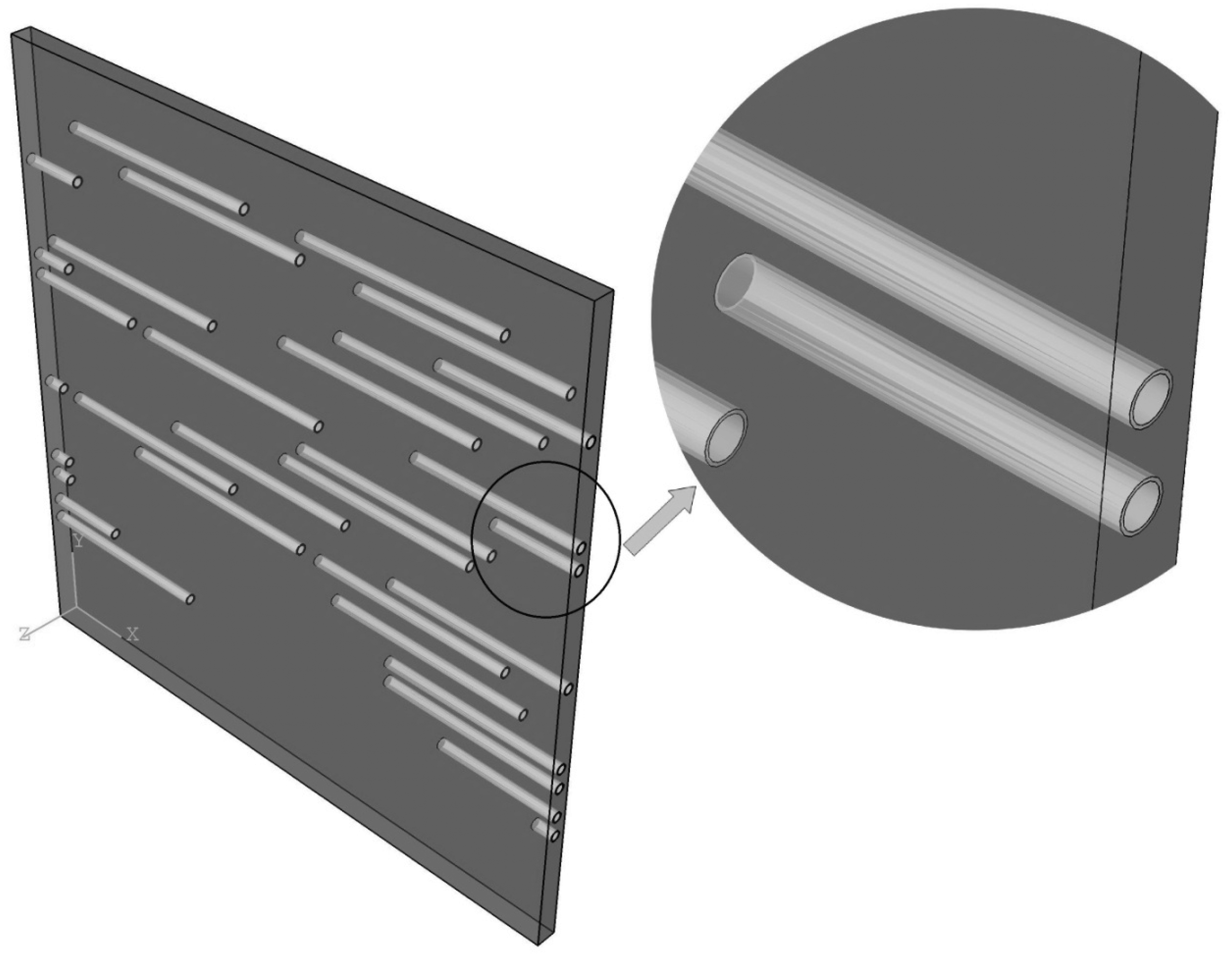
Free-space length,
As it was mentioned earlier, nanoparticles play their role as reinforcing materials best when they are well dispersed within a base matrix. But they are not often dispersed regularly and tend to form agglomerations which can be very detrimental in higher volume fractions. In other words, in higher volume fractions, an increase in nanoparticles loading without considering their state of distribution would not guarantee increase in effective mechanical behavior of nanocomposite.
Primarily, a dispersion characterization technique should be applied, a technique that can evaluate a quantity for state of nanoparticles’ distribution within the base matrix. In 2010, Khare and Burris
23
developed the free-space length method for quantifying the nanocomposite dispersion. They reviewed the previously proposed methods, and stated that using “uniform distribution” and “inter-particle distance” as dispersion characterization tools, those methods were insensitive to “filler size and loading” and “dispersion quality”, respectively. Therefore, none of those methods have been widely adopted in the field. The free-space length method, on the other hand, appropriately reflects the reinforcement mechanisms at nanoscale, has a physically intuitive output, and is simple and broadly applicable. They introduced the free-space length
The algorithm that was proposed by Khare and Burris
23
was used to evaluate the free-space length
Figure 2 illustrates the above procedure for an example RVE. It can be seen that for square lengths of 30 and 20 nm the modes are 170 and 68, respectively. In this example the free-space length was evaluated as 10 nm. It means that the mode will be zero for any square size smaller than 10 nm, but it will not become zero for larger square sizes.
Applying the dispersion quantification technique,
23
to a square RVE of size 60 nm.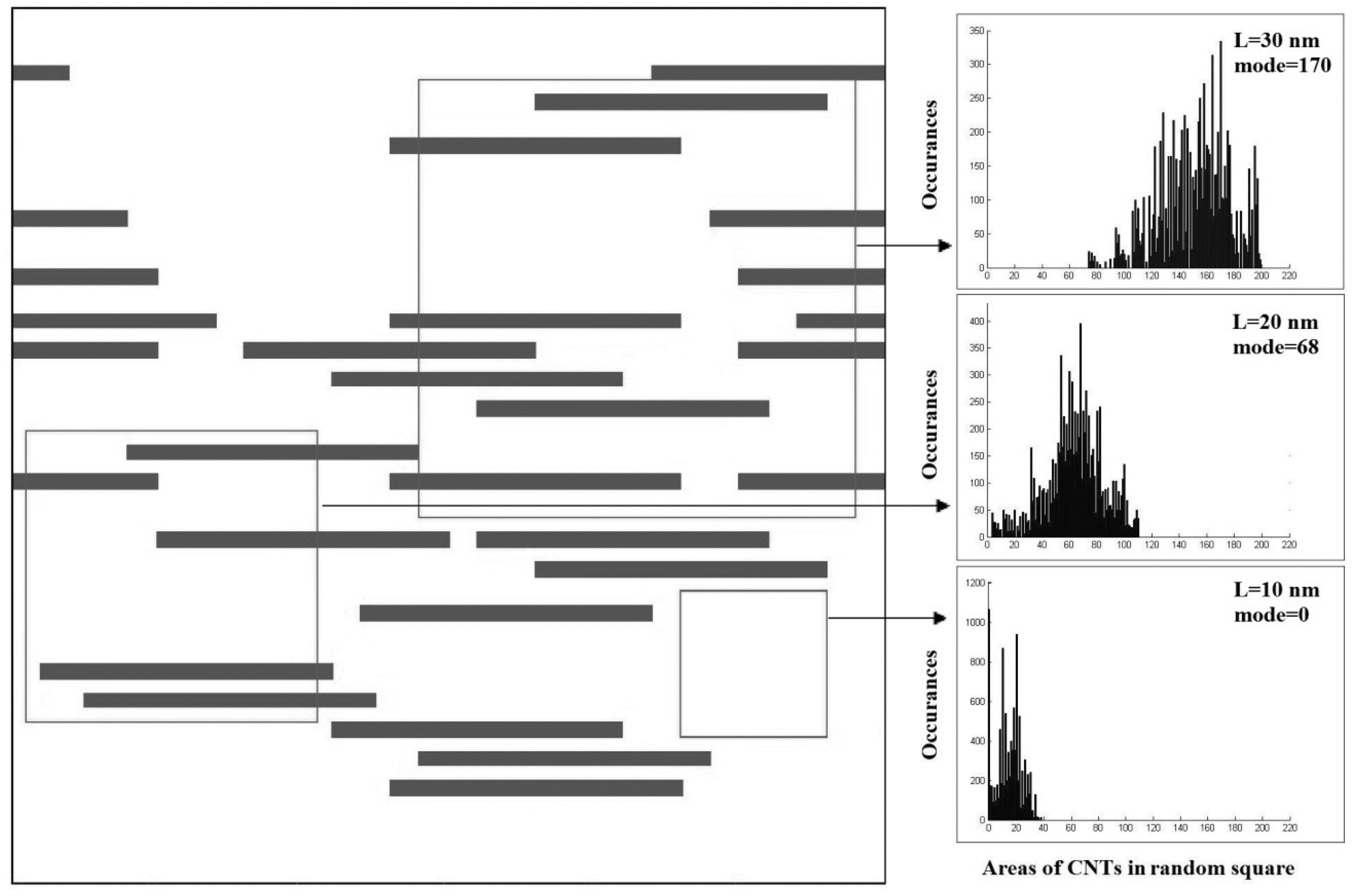
Governing equations
The constitutive equation for linear elastic behavior of materials is written as
Since the plane which cuts the thickness of the present models in half is a plane of elastic symmetry, the whole nanocomposite is then monoclinic and its stiffness tensor, having 13 independent components, has the form
If the material has two perpendicular planes of symmetry, it is orthotropic and its C matrix is further reduced to
In addition, the inverse of C matrix, compliance matrix, for orthotropic materials can be written based on the elastic constants as
FE simulations
A computer code is developed in MATLAB that generates required script to mesh each RVE in Abaqus. Using a combination of C3D8R and C3D6 elements together with an appropriate partitioning algorithm, allowed generating a regular and fine mesh that enabled applying PBCs to 3D models, which needs the nodes on opposite faces to be symmetric. Because of the small size of the nanotubes’ thickness compared to the RVE size, it is very important that elements become smaller around the nanotubes gradually and with no distortion. Moreover, perfect bonding is applied between CNTs and the base matrix by use of necessary partitioning and seeding on CNTs and their surrounding matrix. Figure 3 shows a meshed RVE studied in current paper.
Isometric view of a meshed RVE.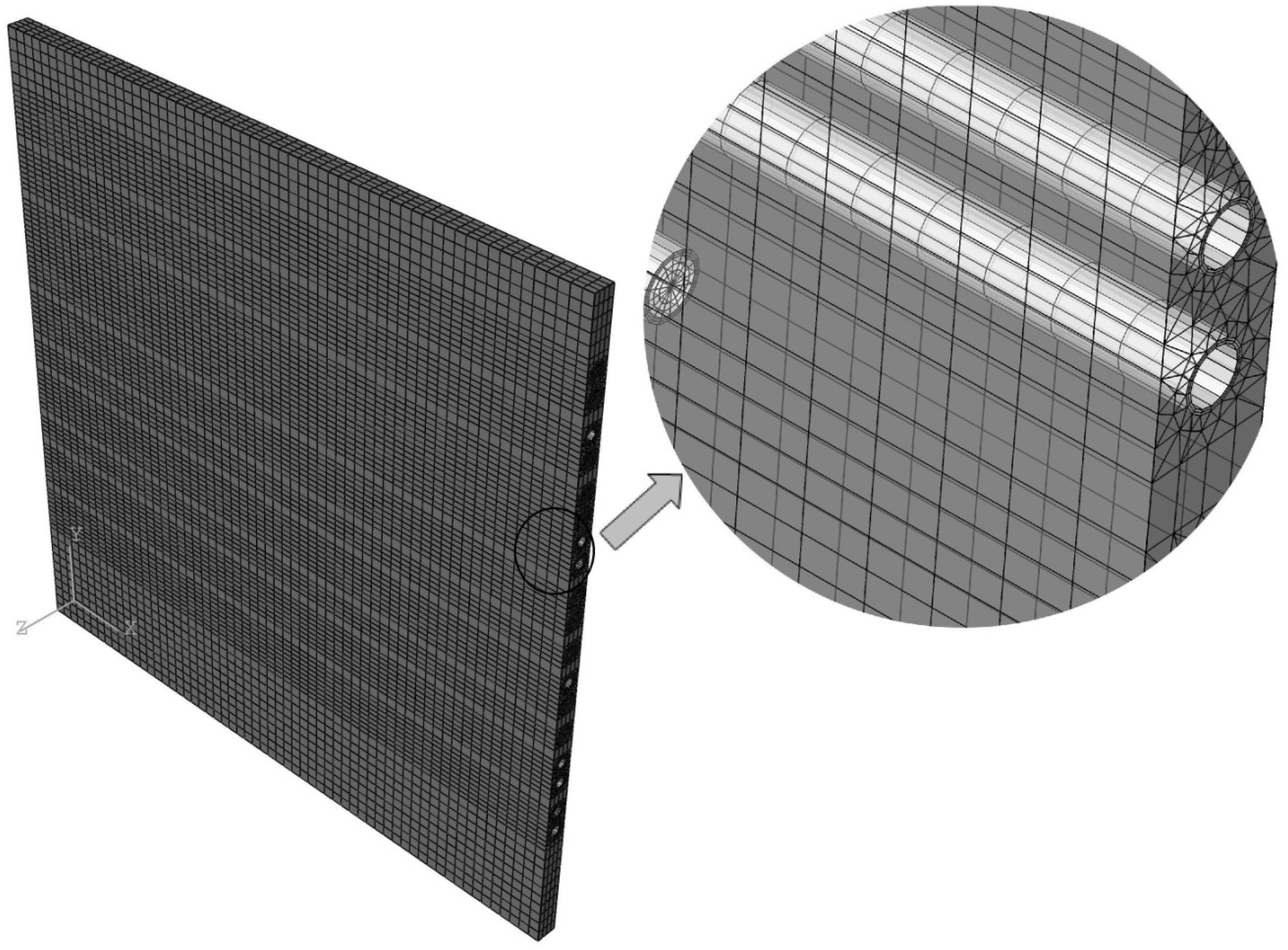
Periodic boundary conditions
In addition to the necessity of observing periodic structure in the models, which guarantees generation of the whole medium by repeating the RVE in three dimensions with no discontinuity, proper constraint relations should be applied on the boundaries so that the models can maintain their repeatability after deformation under loadings. In other words, opposite faces are required to deform identically so that by copying the RVE in three dimensions after deformation they could match each other completely. PBCs as well as rigid body constraints are applied to the models, based on the formulation developed by Abolfathi et al. 41
In order to apply PBCs to the RVE, at first it is necessary to create node sets of nodes on boundary faces and edges in which node numbers are sorted according to their coordinates; so that each two opposite nodes are mentioned in their node sets in same order as each other. For this purpose, a separate simulation is executed on each model and the coordinates and numberings of boundary nodes are reported as outputs of the simulation. Subsequently, the reported file is inserted as input data in another MATLAB code, which divides the nodes into node sets and sorts them with respect to their locations and finally generates equations of periodicity between them.
Homogenization
To evaluate the effective elastic properties associated with the homogenized models of the RVEs studied, six independent loading cases (three axial and three shear forces) along with the aforementioned boundary conditions are applied to them and FE simulations are carried out. Getting stress and strain components on the models as outputs of the analysis, their average over the entire volume is calculated using the following equations
Subsequently, the effective mechanical properties of the homogenized models are computed by employing the inverse of constitutive equation (1) which is written as
The loading conditions are employed in such a way that in each case, all the average stress components except one of them, the one which corresponds to that particular loading condition, become zero. Therefore, the components of each column of
Finally, after all the components of the effective compliance matrix are derived, the effective stiffness matrix can be evaluated with the following:
Models with uniform CNT dispersion
In order to verify the accuracy of pre- and post-processing procedures utilized in present research, they are applied to a number of polymer composite models reinforced with regular arrays of straight CNTs. The macroscopic mechanical properties of composites are obtained employing the effective continuum fiber model, proposed by Odegard et al., 13 and they are compared with their counterparts in research of Luo et al. 39
Descriptions of squarely arranged fibers and the repeating unit cell studied here are illustrated in Figure 4.
Illustrations of the regular arrays of straight fibers. a) View in 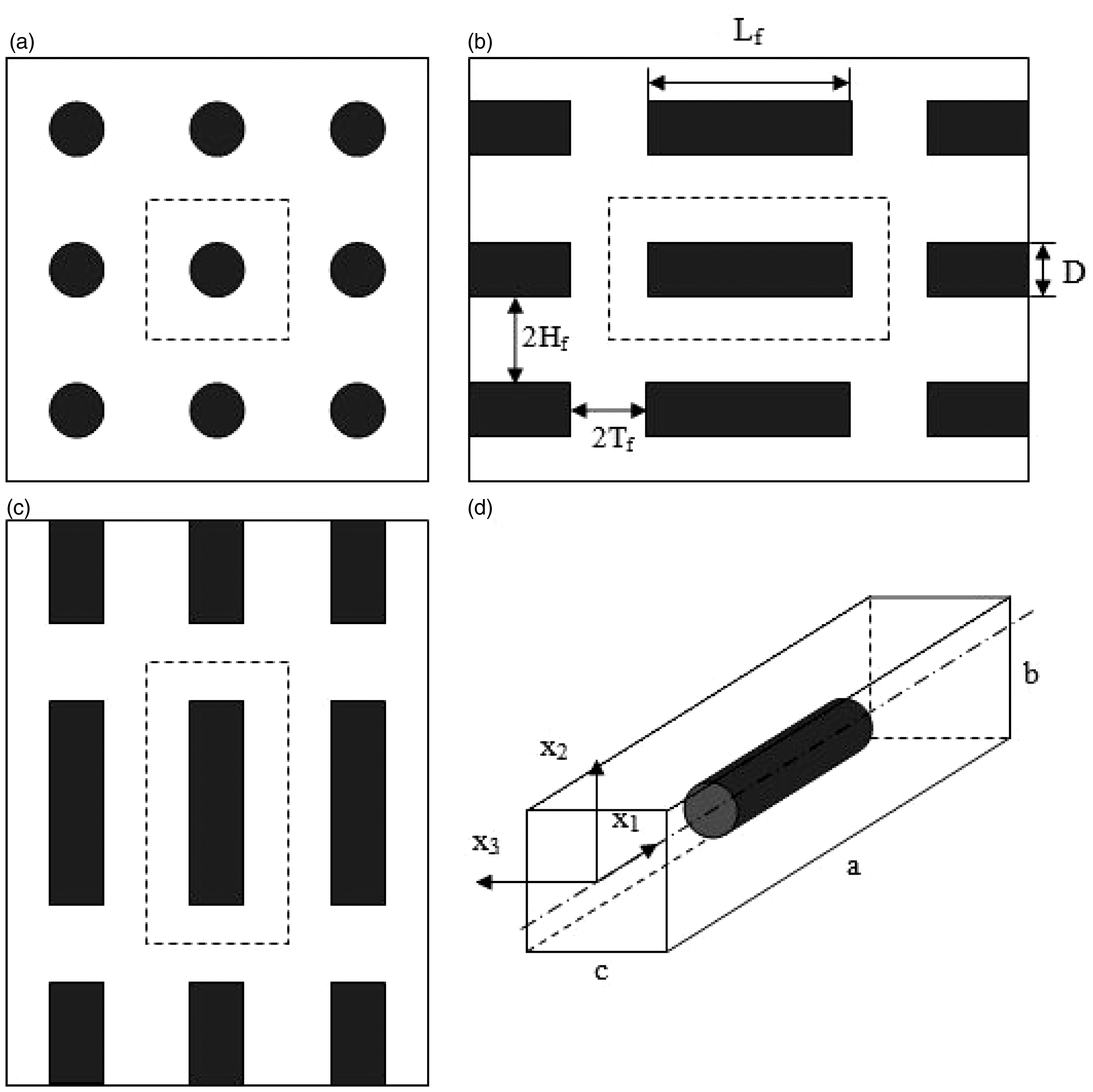
Three views of the models are depicted in Figure 4(a) to (c) and an isotropic view of the simulated periodic unit cell is depicted in Figure 4(d). The diameter and length of the effective fibers are D and Lf, respectively, and parameters
Nanocomposite reinforced by regular arrays of straight fibers which is simulated using the periodic RVE depicted in Figure 4(d) is approximately assumed as transversely isotropic material. The Hooke’s law for these materials is written as:
Note that subscripts 1, 2, and 3 in equation (10) refer to x1, x2, and x3 directions of the coordinate system as shown in Figure 4(d). By applying the PBCs to the unit cells and subjecting them to four load cases (two axial forces along x1 and x2 directions and two shear forces in
Numerical results
Following the procedures explained in previous sections, the described models are studied and numerical results are derived. Primarily the results used for verifying the procedures of current paper are presented and subsequently, the main numerical results of the paper are presented.
The polymer matrix utilized throughout the present research is LaRC-SI and its mechanical properties, found in Odegard et al.,
13
are Young’s modulus
Repeating unit cells of regular array of straight fibers with aspect ratio Variations of effective elastic constants with fibers volume fraction. Comparison of the present results (solid lines, filled markers) with previous ones from Luo et al.
39
(dashed lines, empty markers). a) Triangular marker, blue lines,: 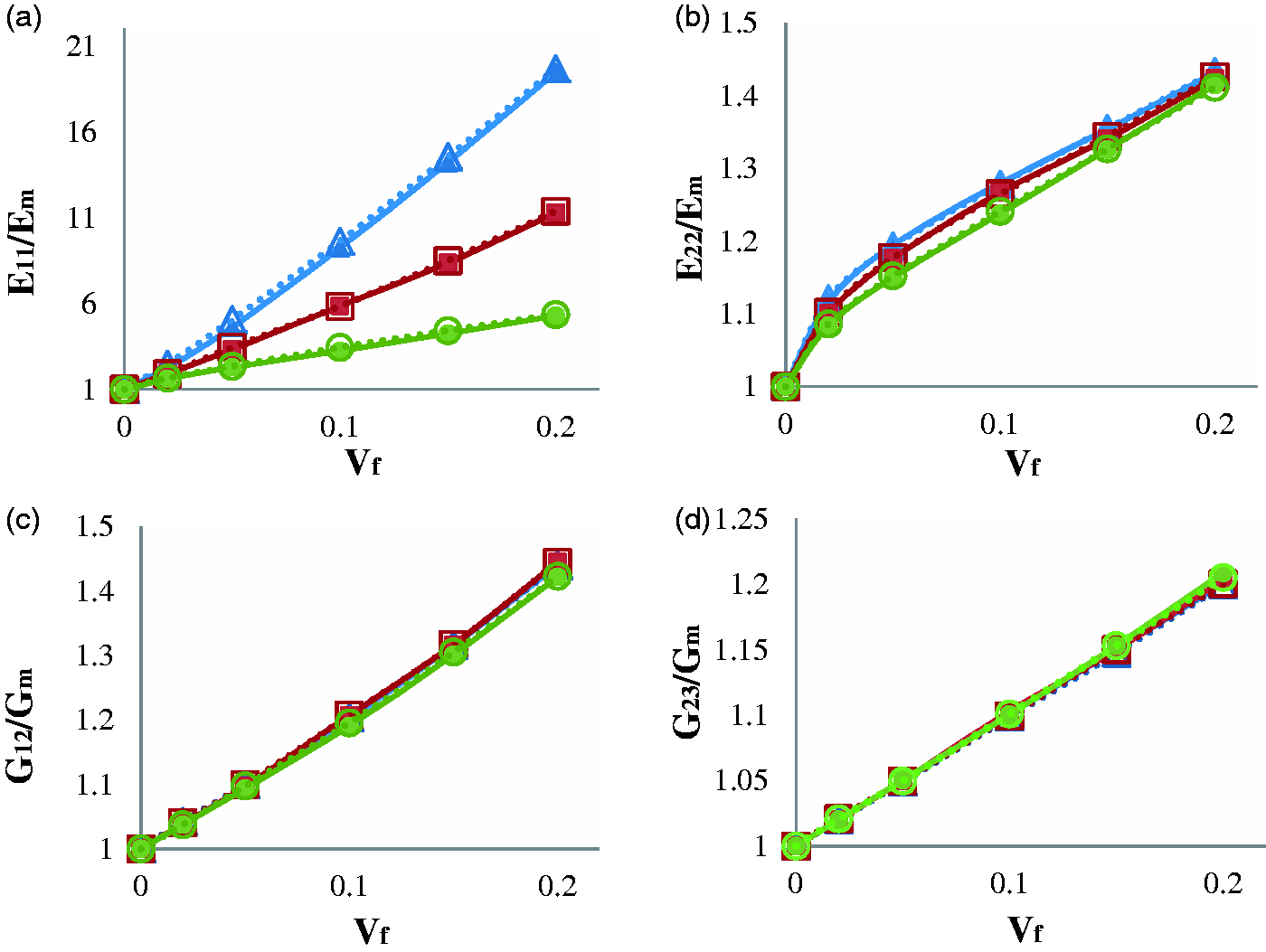
As it was mentioned in the “Modeling” section, the CNTs in present paper are modeled based on the continuum shell theory/FE modeling proposed by Pantano et al.
12
The properties of CNTs are modulus of elasticity
Firstly, a mesh sensitivity study is conducted for an example model studied in this research in order to evaluate the proper sizing of elements by which the results have reasonable accuracy with appropriate computational cost. For a square matrix length Mesh sensitivity study for an RVE with 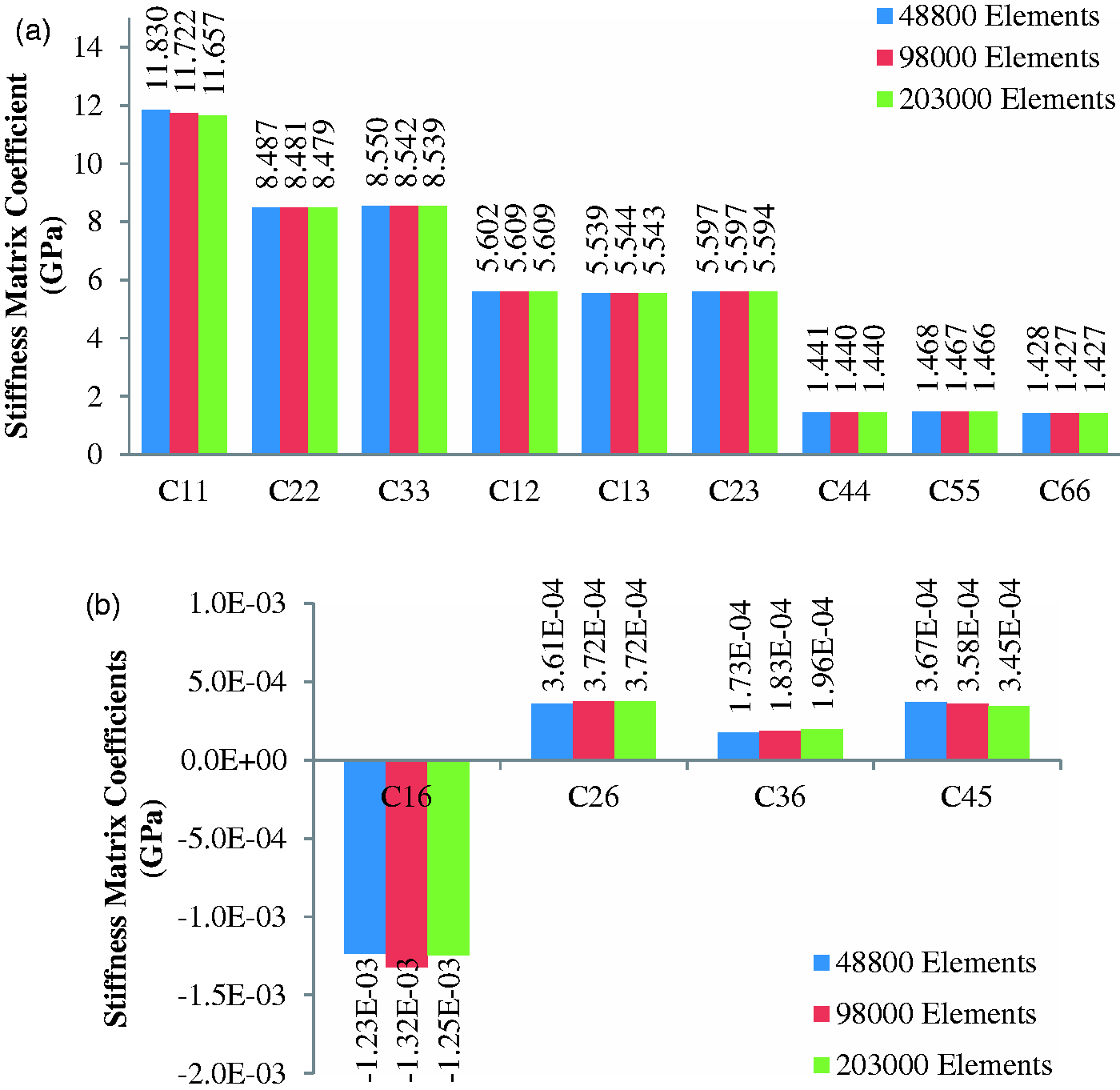
Moreover, it is obviously noticed that the scale of the stiffness tensor components in Figure 6(b) is three to four orders smaller than the components shown in Figure 6(a), thus they can be assumed to be equal to zero. Therefore, the effective stiffness tensor of the homogenized models gets the form of orthotropic materials and the models can be approximately assumed to act as orthotropic materials with stiffness and compliance tensors in the forms of equations (4) and (5), respectively. This is because the application of PBCs in the simulation process repeats the RVEs in three dimensions infinitely to create the entire nanocomposite and thus the two orthogonal planes perpendicular to length and height of the RVEs approximately behave as two other planes of elastic symmetry for the RVEs. Consequently, in the following sections, equation (5) is used to evaluate the effective elastic properties of the homogenized nanocomposite models.
As it was mentioned earlier, proper size should be defined for RVE to perform numerical simulation.
Here, for evaluating the appropriate size for the RVE, a dimensionless parameter Variations of effective elastic constants with respect to dimensionless size of the RVE for CNT volume fraction of 3% and free-space length of 12 nm.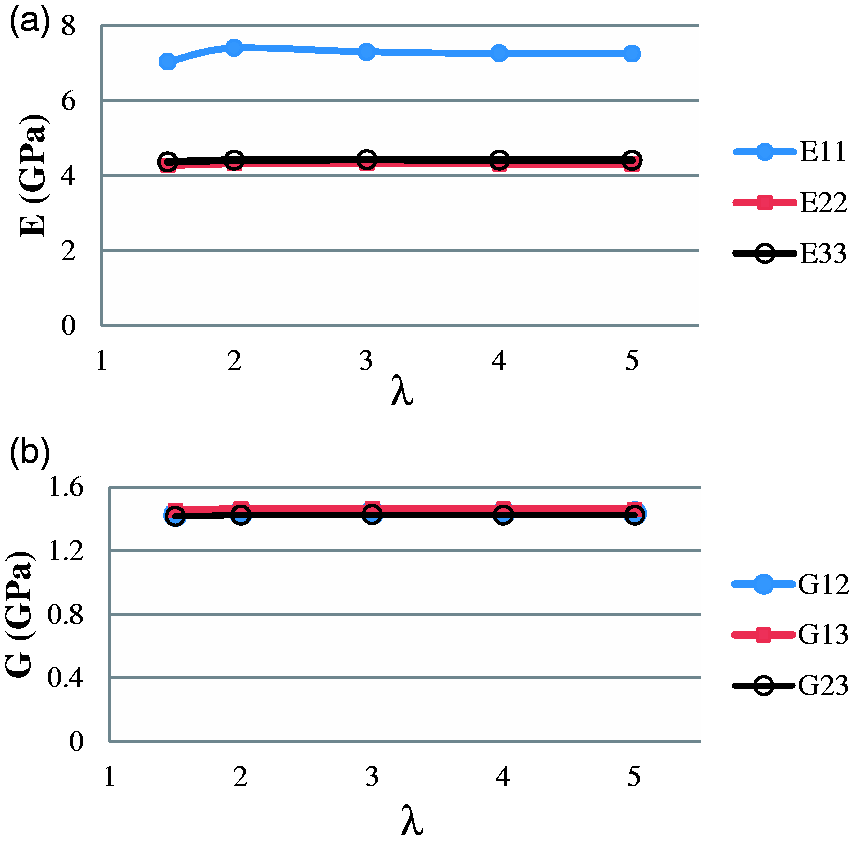
In order to evaluate the effects of influential parameters on mechanical behavior of nanocomposites, random models with various CNT volume fractions ( Variations of effective coefficients with CNT volume fraction and for 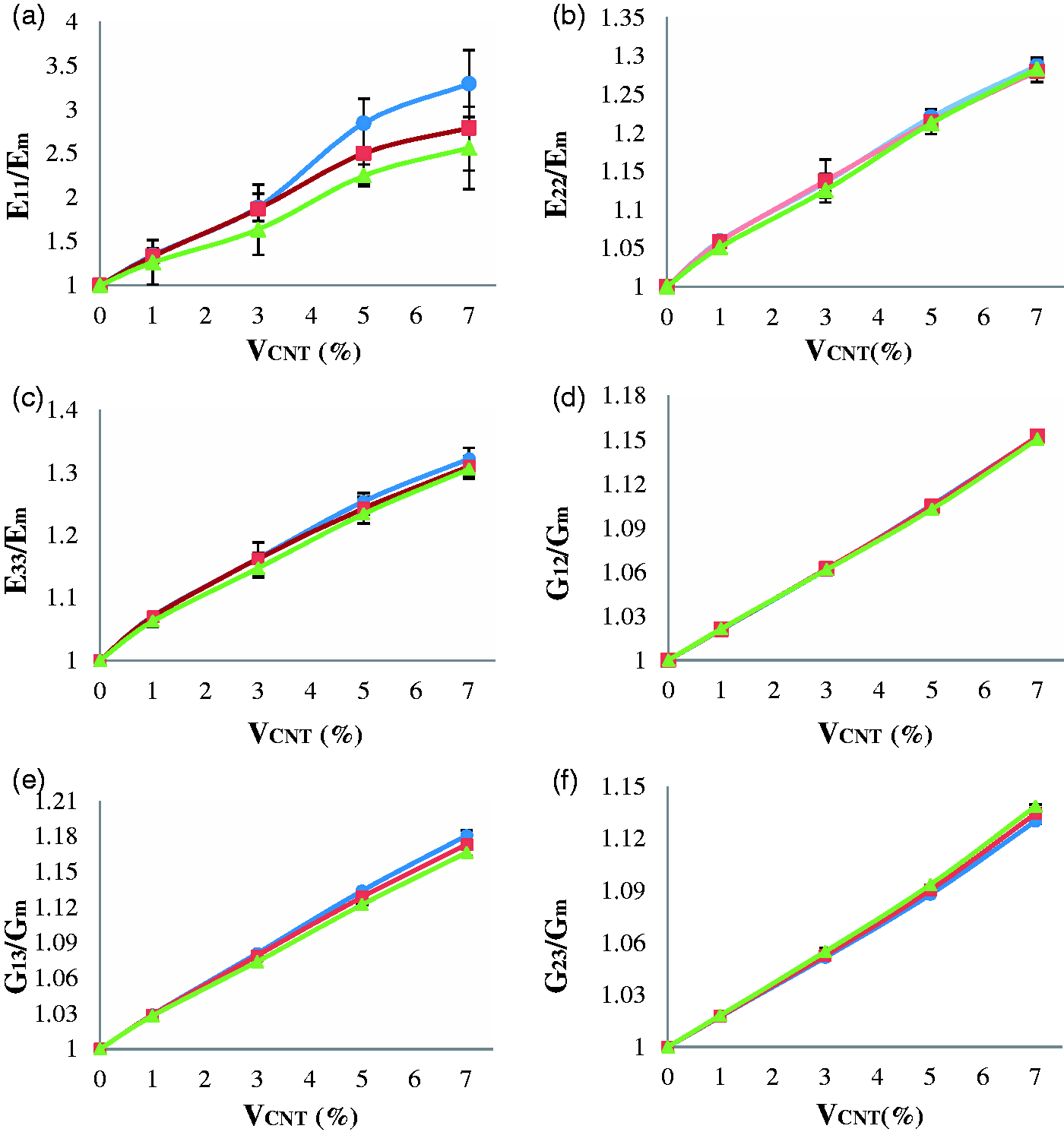
It is shown that as CNT volume fraction increases, all the effective elastic constants increase, but the most improvement is in Young’s modulus along CNTs direction.
Moreover, it can be seen that as free-space length
Although nanocomposites studied in current research contain uniaxially dispersed CNTs, it must be mentioned that a truly random distribution would include random orientations of nanotubes within the nanocomposite. It is known that the stress is transferred from the matrix to CNTs at their interfaces through shear stress, 45 which is a result of the difference between axial displacements of matrix and CNT. In a random orientation of a nanotube, an increase in the angle between nanotube axis and loading direction, would decrease the equivalent aspect ratio of the nanotube and thus the load transfer efficiency reduces. 46 Therefore, for a nanocomposite with aligned CNTs, much larger increase in effective mechanical properties will be achieved.
Figure 9 shows the normal stress Stress contour on an RVE subjected to tension in one direction and effects of CNT neighboring conditions on their load carrying capacities, a) CNTs with close end-to-end distance, b) isolated CNTs, and c) overlapped CNTs.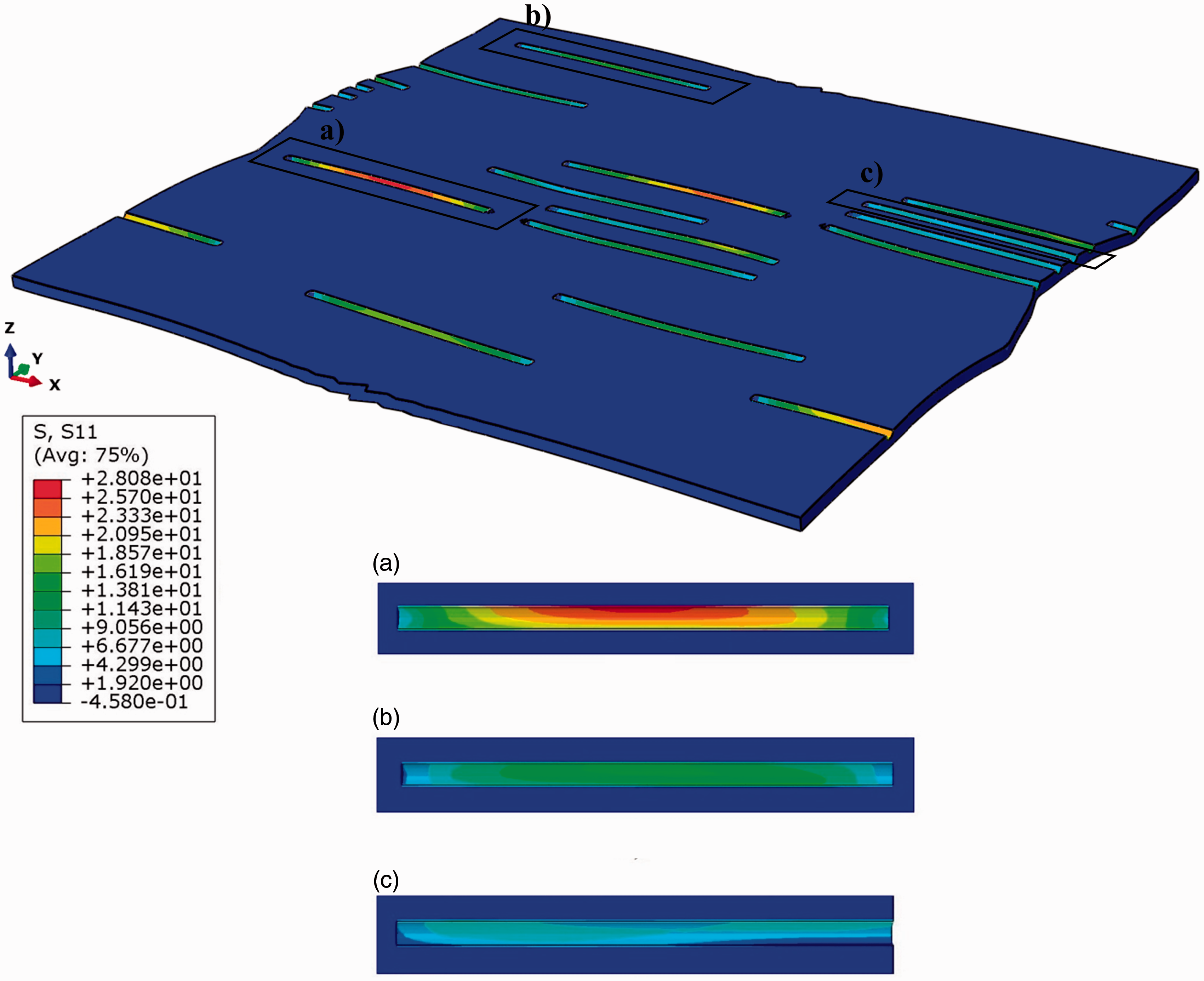
Conclusion
The effects of CNT volume fraction and dispersion on the effective behavior of CNT-reinforced nanocomposites are investigated using FE simulations. A MATLAB code is developed to both generate periodic RVEs of randomly distributed CNTs within a base matrix and generate the required script to model and mesh the modeling volumes in Abaqus. Quantifying the dispersion of CNTs in the base matrix using a dispersion characterization technique enabled studying the effects of dispersion on effective mechanical properties of nanocomposites in detail. PBCs are applied to the models and they are analyzed under six independent loading conditions. Homogenizing the models and computing the equivalent stiffness tensor, it is observed that because of applying PBCs to the models, they approximately act as orthotropic materials. Therefore, constitutive relations for orthotropic materials are utilized to calculate the effective elastic constants of the homogenized models.
By defining the dimensionless size λ for the periodic RVEs, the effects of RVE size are studied and it is determined that
Footnotes
Conflict of interest
None declared.
Funding
This research received no specific grant from any funding agency in the public, commercial, or not-for-profit sectors.