







Abstract
This study explored how working conditions influence the psychological outcomes of paid family and non-family home care workers, focusing on the interaction between institutional and recipient effects. Using data from the 2019 Korean Long-Term Care Survey (N = 998), we performed regression analyses on home care workers’ stress and turnover intention. For both types of home care-workers, inadequate working conditions and high occupational hazards influenced stress, while good working conditions and low occupational hazards influenced turnover intention. Overall, the findings suggest that wages, working hours, and work intensity must be reformed in a home care-worker-friendly manner; the wages for home care workers must be raised to a level appropriate to their care work; the services provided by home care workers should be explicitly stipulated; and, to eliminate occupational hazards, environments for fostering cordial relationships between recipients and home care workers must be developed.
This study explored the effects of working conditions on the psychological outcomes of paid family home care workers and non-family care workers under the Korean Long-Term Care Insurance (LTCI) system. This study classified working conditions into four conditions based on interactions between institutional and recipient effects and explored the link between stress and turnover intention. This study explored the difference between working-condition types in regard to influencing the stress levels and turnover intention of paid family home care workers and non-family care workers by applying an ordinary least squares regression for stress and logistic regression for turnover intention.
The results suggest policy options for eliminating the negative effects of working conditions on the stress and turnover of home care workers. The results can form a basis of a reform of the LTCI scheme in order to build high-quality home- and community-based services with the engagement of home care workers. The results suggest policy directions for restructuring the roles of related social subjects, such as home care workers, recipients, and home care agencies.What this paper adds
Applications of study findings
Introduction
The Republic of Korea faces two demographic challenges: rapid population aging and the increasing gap between life expectancy and healthy life expectancy. While the need for care for older persons is increasing, changes in the roles of family members and the acceleration of the spatial separation between older persons and their children have caused a care deficit (Ha, 2019). To address these challenges, in 2008 the government introduced the Long-Term Care Insurance (LTCI) system, which encompasses both home care services and facility-based care services (Kim & Kwon, 2021).
Studies have shown that unfavorable working conditions affect home care workers’ morale, stress levels, and turnover rates, leading to inadequate care services for house-bound older persons (Chon & Kim, 2020; Scales, 2020; Stone et al., 2017). High job stress is likely to lead to high turnover intention (Lee & Ku, 2020), and turnover negatively influences care-service quality because new workers can have difficulty learning the demands and needs of recipients (Denton et al., 2007).
Studies have characterized care work as an activity at the intersection of the relationships among the state, market, and family (Daly & Lewis, 2000; Han & Kim, 2019). Thus, to understand the stress levels and turnover intention of home care workers, we should consider the mechanism by which the relationship among home care workers’ institutions, care recipients, and care recipients’ families influences their working conditions (Oh, 2021). There are two types of licensed home care workers in Korea: non-family home care workers and paid family home care workers (e.g., recipients’ spouses, children, and other relatives). The mechanism of the working conditions could differ from one type of home care worker to another (Jeon & Kim, 2016). Paid family home care workers, who care for their family members under contract with a long-term-care agency, have limited working hours, as the LTCI aims to alleviate the care burden imposed upon family members. Meanwhile, non-family home care workers work, without limitation on working hours, based on the law of supply and demand (MOHW, 2022). This regulation on working hours differentiates the salaries of the two types of home care workers.
In Korea, some studies have explored, among home care workers, the relationship between working conditions and psychological outcomes (Lee & Ku, 2020; Lim, 2021); however, no studies have considered how the intersections among institution, the market (recipients and care workers), and care recipients’ families influence working conditions. Hence, this article examines the influence of the working conditions, incorporated with the effects of institutions and recipients, on respective home care workers’ stress levels and turnover intention to shed light on improvements in the working conditions of home care workers.
Literature Review
Home care workers’ job satisfaction and turnover intention are strongly linked to their employment stability (Liu et al., 2022). While economic reward is a significant factor for reducing stress among both paid family home care workers and non-family home care workers (Kim & Shim, 2011), workload and time pressures induce stress, leading to turnover intention (Delp et al., 2010; Faul et al., 2010).
In Korea, paid family home care workers experience high stress due to their need to provide ongoing care to family members, leaving little time for themselves (Han et al., 2014). Moreover, the tasks associated with caring can exhaust home care workers, leading to stress and turnover (Karlsson et al., 2020; Lim, 2021). Further, occupational hazards, such as on-the-job injuries and illness at work, are consistently positively correlated with turnover intention (Stone et al., 2017); thus, in the home care-worker context, mistreatments, such as bullying, physical and verbal abuse, and sexual harassment, are also associated with lower job satisfaction and increased turnover (Karlsson et al., 2020; Ravenswood et al., 2017).
Research Framework and Hypotheses
Types of Home Care Workers
In Korea, long-term care services mainly provide in-kind benefits; in-cash benefits are allowed only for remote areas, such as islands. The government allows family members to be paid home care workers, as care recipients generally prefer family care and because it accords with the social demands of filial piety (Jeon & Kim, 2016). Home care workers other than paid family home care workers are called “non-family home care workers.”
According to the Long-term Care Insurance Act, both home care-worker types obtain a care workers’ license using the same criteria: completing a caregiver education curriculum and passing a qualifying examination. However, there are institutional differences between the two home care-worker types regarding their working conditions. The working hours of paid family home care workers are generally limited to 20 days per month of 60 minutes per day; under special conditions, such as when the recipient is a spouse or is showing symptoms of violent inclination, inappropriate behavior, or delusion of persecution, the limit is extended to 31 days a month of 90 minutes per day. In addition, paid family home care workers are not allowed to work more than 160 hours per month in other workplaces. However, there is no work-hour limit for non-family home care workers (MOHW, 2022).
In 2019, paid home care workers received approximately 374,803 won ($321.41) for working 20 days and 871,417 won ($747.29) for working 31 days (MOHW, 2022). Meanwhile, non-family home care workers worked an average of 75.8 hours per month and received 425,413 won ($1218.19) (Kang et al., 2019). In 2020, the number of recipients of home care from paid family home care workers was 102,294, representing 22% of the total number of home care-service recipients (Kim et al., 2021).
Working Conditions of Home care Workers and Hypotheses.
According to the Job Demands–Resources (JD–R) Model of Burnout, job demands interact with job resources to influence employee outcomes such as job satisfaction and turnover intention (Bakker & Demerouti, 2007). Job demands are defined as stressors such as workload, time pressure, bullying, abuse, and occupational accidents, and job resources are defined as health-protecting factors that mitigate job demands and their associated physiological and psychological costs (Demerouti et al., 2001). Gaining insights from the JD-R Model, we adopted a conceptual framework in which institutional and care-recipient effects interact with working conditions, influencing home care workers’ psychological outcomes, stress, and turnover intention. Institutional effects can be defined as the extent to which working conditions are institutionally regulated; this effect generally relates to securing workers’ rights and safety. “Hi-institutional effects” implies working conditions that are managed by institutions, whereas “lo-institutional effects” implies working conditions that are not or are inadequately managed by institutions. Care-recipient effects can be defined as the extent to which working conditions are influenced by the care-recipients and/or their families; this can include undue requests of carers, unsafe and unpredictable workplaces, and lack of basic equipment, which are generally unpredictable, unstandardized, and challenging to manage systematically by institutions. “Hi-recipient effects” implies working conditions that are influenced by risks from care recipients, whereas “lo-recipient effects” implies working conditions that are not, or are less, influenced by risks from care-recipients.
For our analytical framework, we needed to classify each working condition based on the relative influence of institutional or recipient effects. The value of care work is often underestimated, and it is commonly characterized by low wages and inappropriate working hours (Hussein, 2017; Osterman, 2019). Home care workers are employed in various temporary forms, such as hourly wages and on-call status, which results in job instability (Kyung et al., 2017; Seok, 2020). In the Korean context, home care workers must be affiliated with long-term care agencies, but can choose between individual and corporate bodies. Home care workers decide their employment status (full-time or part-time) and type of agency depending on their situation and market. According to the LTCI Act, care work can only be performed within a predetermined time and scope; however, home care workers often, on the care-recipient’s demands, provide care beyond the prescribed time without receiving due wages (Bae & Kim, 2022). This additional work is performed because, otherwise, the care recipient may terminate the service contract, leading to job and income loss (Kwon et al., 2018). Thus, the subordinate relationship between caregivers and care recipients produces job risks for home care workers. Unlike hospitals and long-term care facilities, the working conditions of home care workers are not standardized, making it difficult to systematically manage care work through guidelines (Seok, 2020).
Additionally, protection against infectious diseases in institutional settings is absent in the home environment. Moreover, the mixture of relational specificity between caregivers and care recipients and their spatial closeness exposes home care workers to risks such as violence and verbal abuse as they work, without supervision and guidance, in recipients’ private spaces (Green & Ayalon, 2018).
We classified home care workers’ working conditions into four types, depending on the relative influence of institutions and recipients (Figure 1 Research framework.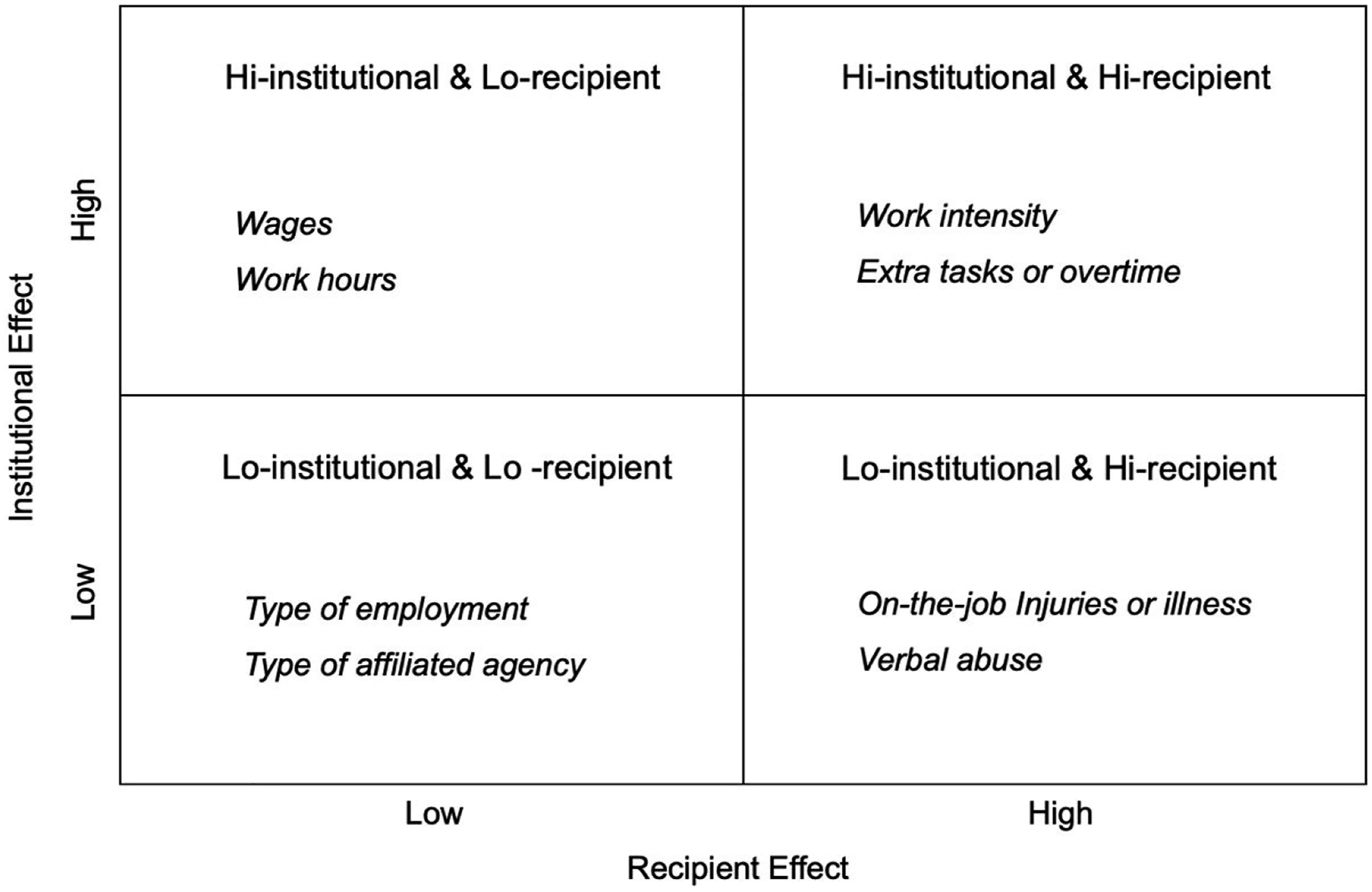
Our research goal was to examine the extent to which four types of working conditions influence home care workers’ stress and turnover intention, and how the influence of these working conditions differs between paid family home care workers and non-family home care workers. To achieve our research goal, we developed the following four hypotheses:
“Lo-institutional & lo-recipient” working conditions (e.g., employment type and affiliated agency), in which there is inadequate or no institutional security for home care workers’ rights and safety and low or no risk from care recipients, do not significantly increase home care workers’ stress and turnover intention.
“Lo-institutional & hi-recipient” working conditions (e.g., injuries/illness at work and verbal abuse), in which there is inadequate or no institutional security for home care workers’ rights and safety and high risks from care recipients, can significantly increase home care workers’ stress and turnover intention.
“Hi-institutional & lo-recipient” working conditions (e.g., wages and working hours), in which there is high institutional security for home care workers’ rights and safety and low or no risks from care recipients, can significantly reduce home care workers’ stress and turnover intention.
“Hi-institutional & hi-recipient effects” (e.g., work intensity and extra tasks/overtime), in which there is high institutional security for home care workers’ rights and safety and high risks from care recipients, do not significantly increase home care workers’ stress and turnover intention.
Method
Sample
This study analyzed data from the 2019 Long-Term Care Survey (LTCS), a national survey conducted by the Ministry of Health and Welfare and the Korea Institute for Health and Social Affairs. The survey collected data regarding care recipients and their families, facilities, and care workers. Our sample comprised 298 paid family home care workers and 700 non-family home care workers.
Measures
Dependent Variables
We adopted stress and turnover intention as dependent variables for our models. Stress was measured based on a single question: “Do you experience much stress while performing long-term care work?” which was answered using an inversely coded five-point Likert scale (1 = “not at all”; 5 = “very much”). Regarding turnover intention, the item “Are you willing to change jobs in the future?” was used, and responses were converted into a dichotomous form (0 = “no intention of turnover”; 1 = “turnover intention”).
Independent Variables
ptDegree of satisfaction with wages, working hours, and work intensity (as regulated by the LTCI Act) was assessed using a five-point inversely coded Likert scale (1 = “not at all”; 5 = “very much”). Experience of extra tasks/overtime, verbal abuse, and injuries/illnesses were measured in a dichotomous form (0 = “not experienced”; 1 = “experienced”). Employment status (0 = “part-time”; 1 = “full-time”) and affiliated agency (0 = “individual”; 1 = “corporate body”) were also measured using dichotomous forms. Gender (0 = “male”; 1 = “female”), age (≤ 49 years, 50–59 years, 60–69 years, and ≥70 years), and education level (≤ high school = 0; ≥ college graduate = 1) were included as covariates in the models.
Analyses
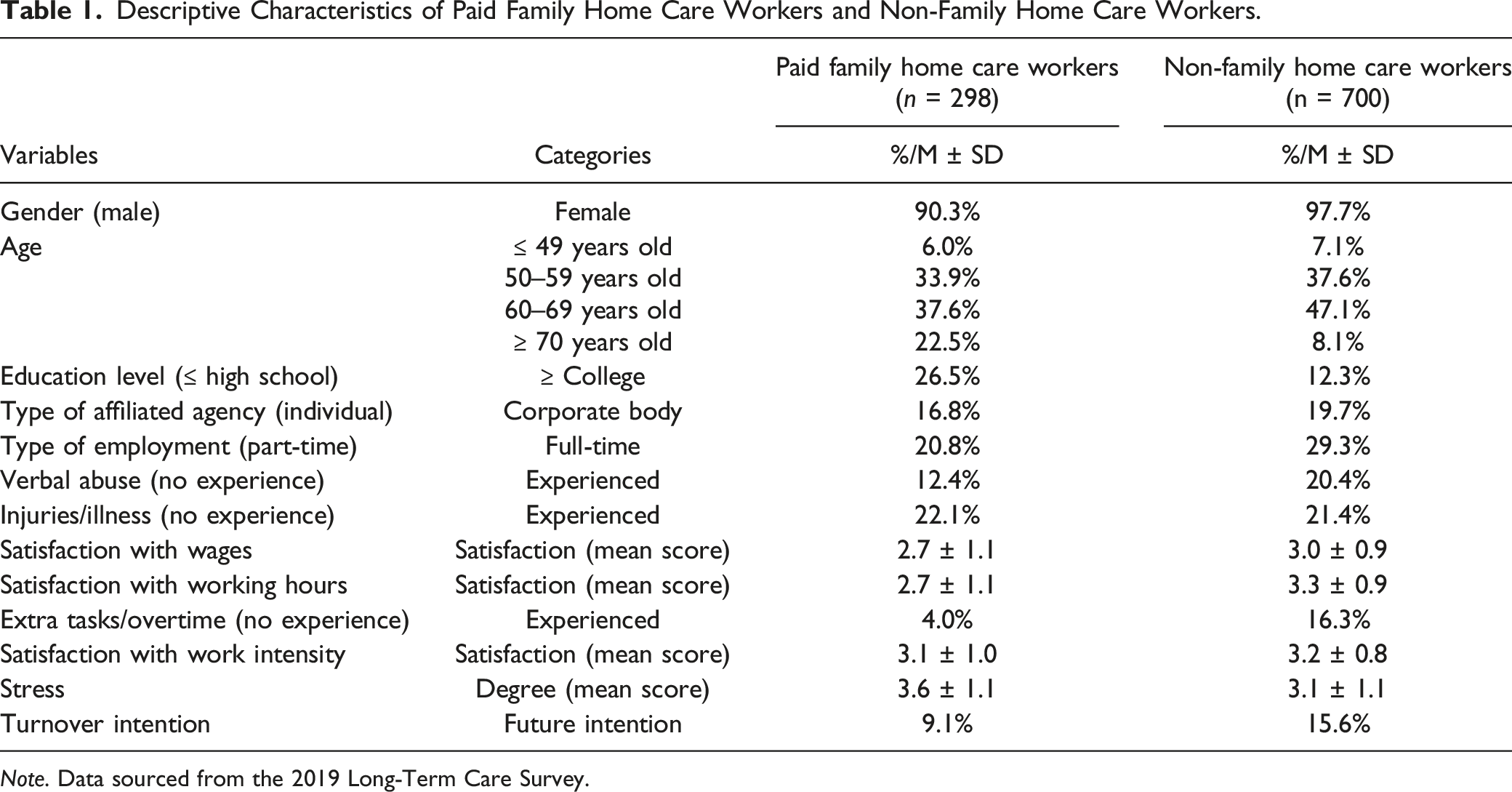
Descriptive Characteristics of Paid Family Home Care Workers and Non-Family Home Care Workers.
Note. Data sourced from the 2019 Long-Term Care Survey.
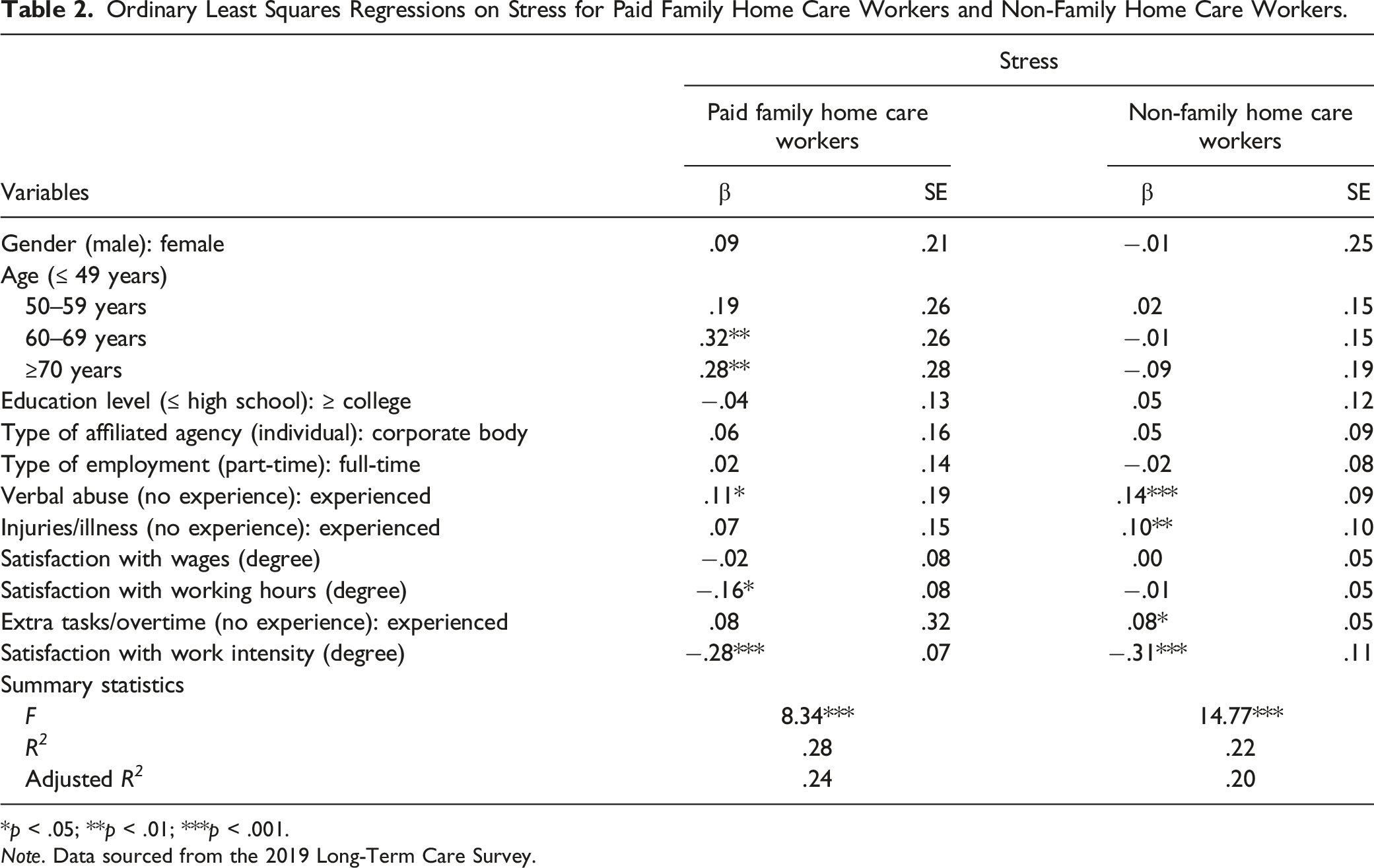
Ordinary Least Squares Regressions on Stress for Paid Family Home Care Workers and Non-Family Home Care Workers.
*p < .05; **p < .01; ***p < .001.
Note. Data sourced from the 2019 Long-Term Care Survey.
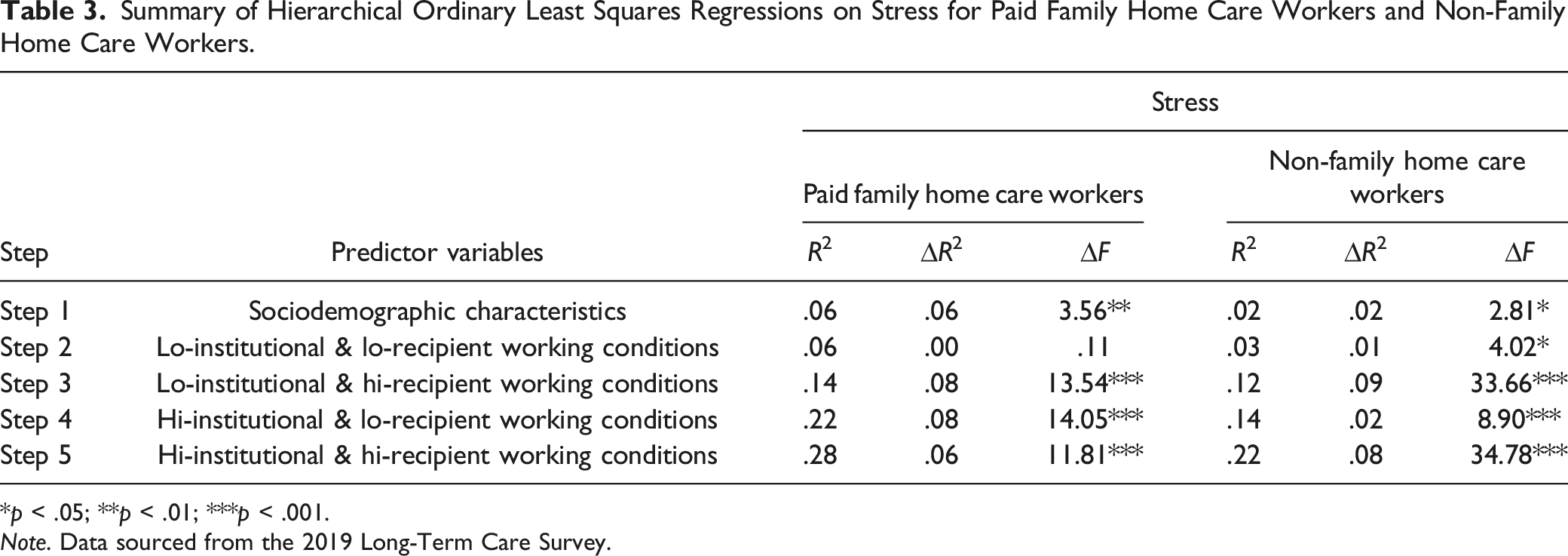
Summary of Hierarchical Ordinary Least Squares Regressions on Stress for Paid Family Home Care Workers and Non-Family Home Care Workers.
*p < .05; **p < .01; ***p < .001.
Note. Data sourced from the 2019 Long-Term Care Survey.
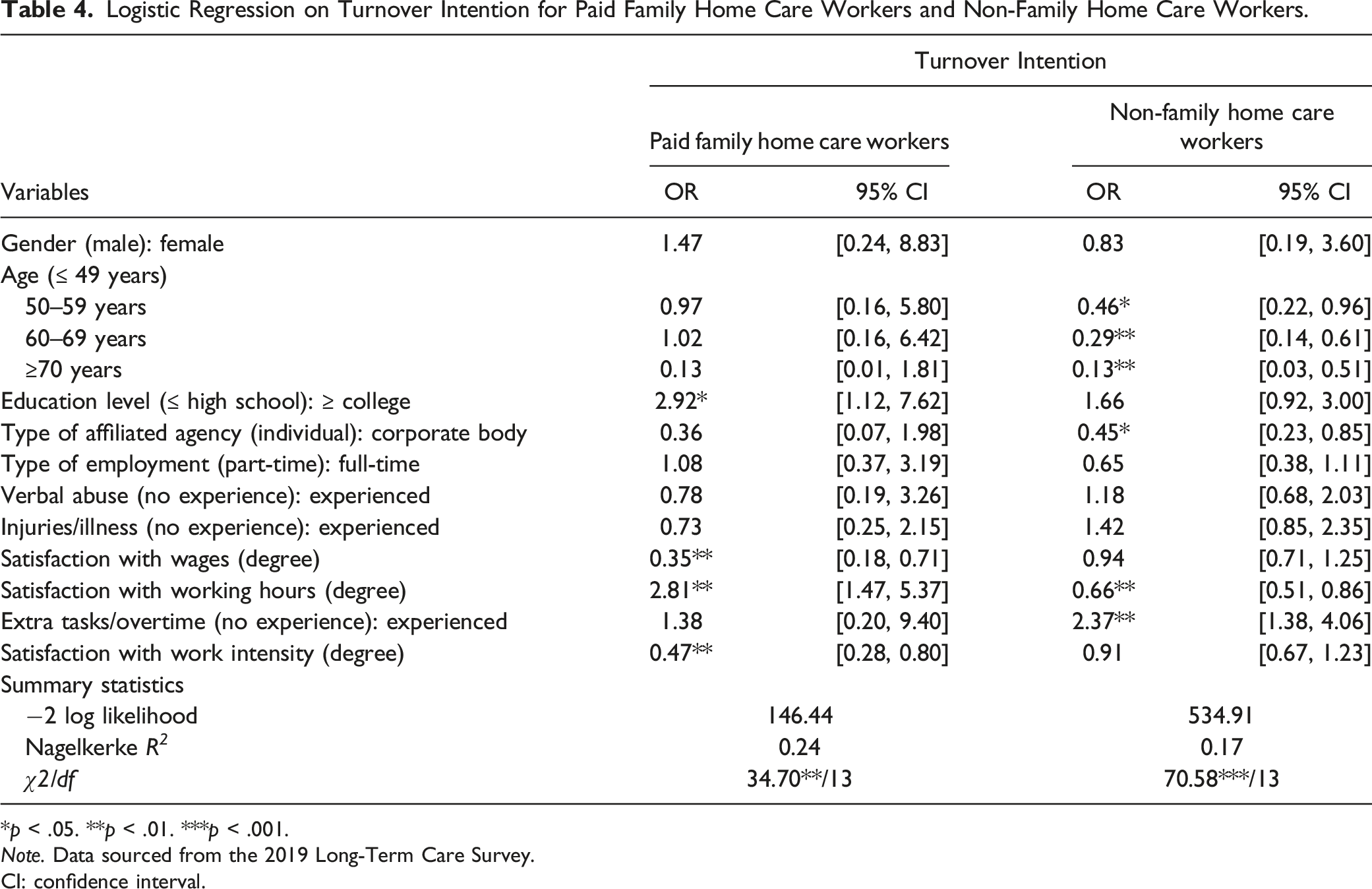
Logistic Regression on Turnover Intention for Paid Family Home Care Workers and Non-Family Home Care Workers.
*p < .05. **p < .01. ***p < .001.
Note. Data sourced from the 2019 Long-Term Care Survey.
CI: confidence interval.
Results
Descriptive Analyses
The sample predominantly comprised women in their 50s and 60s (see Table 1). Paid family home care workers were characterized by higher education levels than their counterparts.
Multivariate Analyses
Models for Stress.
In the OLS models (see Table 2), paid family home care workers showed significant stress (adjusted R 2 values = .24). Among the covariates, age was the only significant predictor; being 60–69 years old (β = .32, p < .01) and ≥70 years (β = .28, p < .01) were positively associated with stress relative to being ≤49 years. In lo-institutional & hi-recipient work conditions, verbal abuse (β = .11, p < .05) significantly increased stress. In hi-institutional & lo-recipient working conditions, satisfaction with working hours (β = −.16, p < .05) decreased stress. In hi-institutional & hi-recipient working conditions, satisfaction with work intensity (β = −.28, p < .001) decreased stress. For non-family home care workers, the results of the OLS model for stress were significant (adjusted R 2 value = .20). In lo-institutional & hi-recipient working conditions, verbal abuse (β = .14, p < .001) and injuries/illnesses at work (β = .10, p < .01) increased stress. In hi-institutional & hi-recipient working conditions, extra tasks/overtime (β = .08, p < .05) increased stress, and satisfaction with work intensity (β = −.31, p < .001) decreased stress.
Table 3 presents a summary of the hierarchical OLS regression for stress for both home care-worker types. For paid family home care workers, the change in R 2 (∆R 2 ) revealed that 8.0% of the variance in stress was accounted for by lo-institutional & hi-recipient working conditions, that 8.0% was accounted for by hi-institutional & lo-recipient working conditions, and that 6.0% was accounted for by hi-institutional & hi-recipient working conditions. However, the variance in stress accounted for by lo-institutional & lo-recipient working conditions was insignificant.
For non-family home care workers, according to the change in ∆R 2, the variance in stress was the highest for lo-institutional & hi-recipient working conditions (9.0%), followed by hi-institutional & hi-recipient working conditions (8.0%), hi-institutional & lo-recipient working conditions (2.0%), and lo-institutional & lo-recipient working conditions (1.0%), respectively.
Models for Turnover Intention.
The results of the logistic regression analysis for turnover intention are presented in Table 4. For paid family home care workers, higher education level (OR = 2.92, p < .05) indicated a higher probability of turnover intention. Among hi-institutional & lo-recipient working conditions, increased satisfaction with wages (OR = 0.35, p < .01) decreased turnover intention, whereas increased satisfaction with working hours (OR = 2.81, p < .01) increased turnover intention. Among hi-institutional & hi-recipient working conditions, increased satisfaction with work intensity (OR = 0.47, p < .01) decreased turnover intention.
Turning to non-family home care workers, those 50–59 years (OR = 0.46, p < .05), 60–69 years (OR = 0.29, p < .01), and ≥70 years (OR = 0.13, p < .01) showed lower probabilities of turnover intention than those aged ≤49 years. Among lo-institutional & lo-recipient working conditions, affiliated agency (OR = 0.45, p < .05) was significant; being affiliated with a corporate body decreased turnover intention. Among hi-institutional & lo-recipient working conditions, increased satisfaction with working hours (OR = 0.66, p < .01) decreased turnover intention. Among hi-institutional & hi-recipient working conditions, extra tasks/overtime (OR = 2.37, p < .01) increased turnover intention.
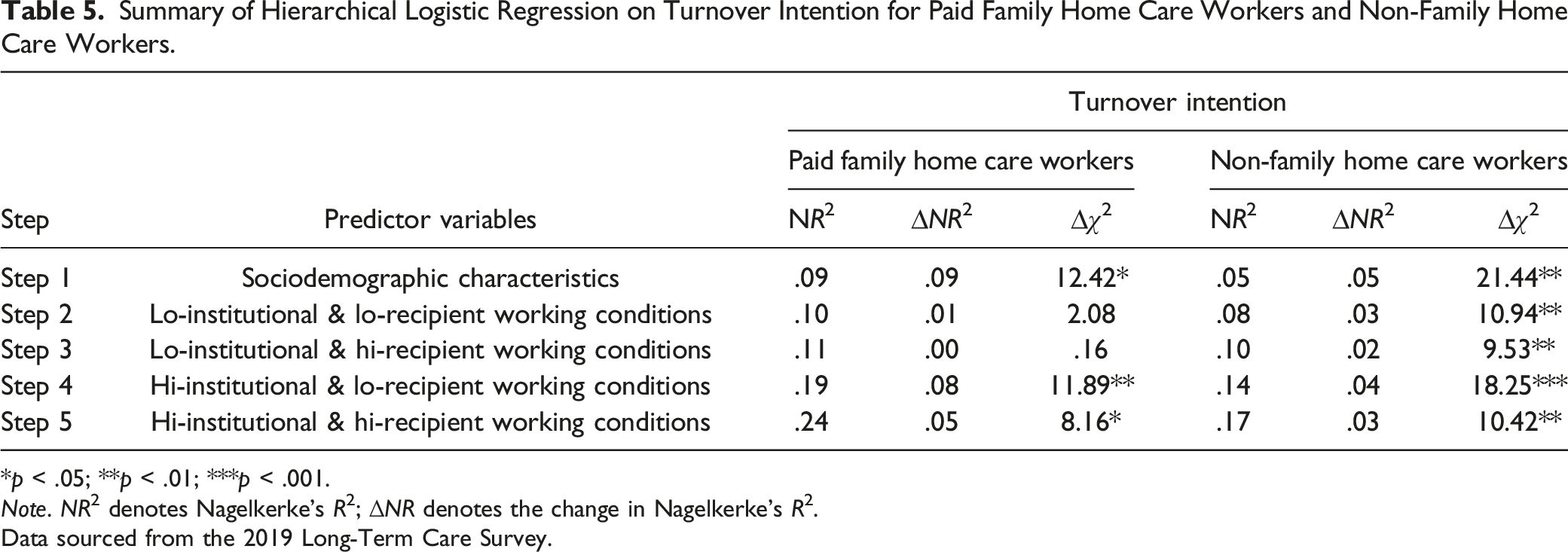
Summary of Hierarchical Logistic Regression on Turnover Intention for Paid Family Home Care Workers and Non-Family Home Care Workers.
*p < .05; **p < .01; ***p < .001.
Note. NR2 denotes Nagelkerke’s R2;
Data sourced from the 2019 Long-Term Care Survey.
For non-family home care workers, the change in ∆NR2 revealed that the variance in turnover intention was the highest (4.0%) for hi-institutional & lo-recipient working conditions, followed by hi-institutional & hi-recipient working conditions (3.0%), lo-institutional & lo-recipient working conditions (3.0%), and lo-institutional & hi-recipient working conditions (2.0%), respectively.
Discussion
Our research goal was to explore the influence of home care workers’ working conditions, in terms of institutional and care-recipient factors, on their stress and turnover intention. Interestingly, we found that older paid family home care workers who become stressed tend not to quit their jobs; this implies that they feel obligated to care for their family members regardless of their stress (Mehta & Leng, 2017). Regarding non-family home care workers, older workers might derive advantages from the flexibility and relatively few hours of their home care work (Butler et al., 2014; Karlsson et al., 2020).
We found that paid family home care workers with higher education levels were more likely to express turnover intention, implying that higher-educated workers can become unsatisfied with caring for family at home and the associated low income, instead wishing to obtain jobs outside the home (Oh, 2021). Such an association did not emerge among non-family home care workers, implying that they consider home care work a profession.
The regression analyses supported H1; for both home-care-worker types, type of employment and affiliated agency did not increase stress and turnover intention. The only exception was that, for non-family home care workers, affiliated agency appeared to reduce turnover intention, which might be because affiliation with corporate bodies rather than individual agencies is generally better for securing a stable supply of care work, although home care workers’ rights are not restricted regarding choosing between corporate-body and individual-agency affiliation. Park and Kyoung (2022) similarly revealed that the risk of turnover for care workers is 2.249 times higher among those working with individual agencies than those with corporate bodies.
H2 was supported for stress, but not for turnover intention. While injuries/illness at work and verbal abuse increased stress for non-family care workers and verbal abuse increased stress for paid family care workers, these appeared to have an insignificant effect on turnover intention. This insignificant association with turnover intention indicates that non-family home care workers tended to bear risks, such as injuries/illness and verbal abuse, rather than quitting care work. In this regard, Bae and Kim (2022) argued in their study that non-family home care workers do not respond to transgressions such as verbal abuse because they fear losing their jobs. Meanwhile, paid family home care workers may bear verbal abuse and injuries/illness at work rather than express turnover intention because of a sense of obligation or because they have few alternatives. Lee and Kim (2018) demonstrated that paid family home care workers could not find persons to replace themselves, in caring for older families, due to the increase in nuclear family and female labor force participation. Thus, lo-institutional & hi-recipient working conditions are likely to increase stress but not to lead to turnover intention as a result of socio-cultural contexts, including means of living, obligations, lack of substitutes due to change in family structure, etc.
H3 was partially supported; working hours reduced stress among paid family home care workers and turnover intention among non-family home care workers, and wages reduced turnover intention among paid family home care workers. However, among non-family home care workers, the associations of working hours and wages with stress and of wages with turnover intention appeared to be insignificant. This suggests that, although working hours and wages are prescribed by law, some care workers are unsatisfied with the prescribed working conditions (Feldman et al., 2019). Thus, some working conditions, even those decided institutionally, must meet the social expectations of workers. Meanwhile, working hours appeared, unexpectedly, to increase paid home care workers’ turnover intention; this implies that paid family home care workers who are satisfied with their working hours and, thus, have a relatively large amount of time to spare, tend to seek other jobs (Vicente et al., 2022).
H4 was partially supported: extra tasks/overtime had an insignificant effect on paid family home care workers’ stress and turnover intention, and work intensity had an insignificant effect on non-family home care workers’ turnover intention. Unexpectedly, the analyses revealed that, for non-family home care workers, extra tasks/overtime increase stress and turnover intention, while work intensity increases stress only. A possible explanation is that non-family home care workers tend to be intolerant of undue requests from recipients, implying a hi-recipient effect that is larger than the hi-institutional effect. This finding is supported by Kyung et al. (2017), who found that, although their working hours are limited by law, recipients and their families frequently request extra working hours without adequate payment. Similarly, Lim (2021) stated that, due to the ambiguity of care work, home care workers are often forced to perform non-prescribed tasks on the requests of the recipients or their families. Also unexpectedly, work intensity increased stress and turnover intention among paid family home care workers. One possible explanation is that even paid family home care workers might find the long-term continuity of arduous care work unbearable if the work intensity is strong.
Limitations
This study features limitations and strengths. One limitation is that, due to the cross-sectional design of the original data collection, we cannot draw causal inferences among the study variables. In future, longitudinal surveys should be designed to examine the effects of working conditions on turnover. In practice, it is difficult to measure the institutional and recipient effects separately for each working condition because they can vary according to country, period, type of occupation, etc. Further research is needed to develop criteria for objectively classifying working conditions according to the relative influence of institutional and recipient effects. Nevertheless, the present survey featured a representative sample of home care workers that has been utilized in many studies on care (Kang, 2021; Oh & Chun, 2022). However, this is the first study based on these data to separate the paid family home care workers and non-family home care workers.
Conclusions
While, for paid family home care workers and non-family home care workers, lo-institutional & hi-recipient working conditions appear to have the strongest effect on stress, for turnover intention hi-institutional & lo-recipient working conditions appear to have the strongest effect. Therefore, we suggest that, to reduce the stress experienced by both home care-worker types, occupational risks, including on-the-job injuries, illnesses at work, and/or verbal abuse, should be minimized. Such efforts must be made in various ways, including monitoring the field of care work, establishing safe work environments, and counseling recipients or their families. Environments that foster cordial relationships between recipients and non-family home care workers must be developed to reduce stress and turnover intention resulting from these working conditions.
We also suggest that improvement of institutional factors relating to the working conditions of home care workers, including working hours and wages, is important for reducing the turnover of both home care-worker types. For instance, hourly wages should be raised to reflect the inflation rate; specifically, the wage level for paid family home care workers should be raised by extending the care time eligible for payment to a level appropriate to the continuous arduous care work they perform for families (Kim et al., 2018).
The second most important factor influencing the stress of paid family home care workers and the second most important factor influencing the turnover intention of both home care-worker types are hi-institutional & hi-recipient working conditions. There are several reasons non-family home care workers do not refuse requests from care recipients or their family members to perform extra tasks or overtime; the main reasons are concerns that, unless they comply, the care relationship will be terminated or that they will lose their job and ambiguity between care work and chores (Lim, 2021; Small et al., 2022). As such, the services provided by home care workers should be stipulated as precisely as possible. A pre-education program on the regulations of care work, including service time, needs to be provided to recipients and their families. Work intensity must also be developed in a home care, worker-friendly manner.
Although lo-institutional & lo-recipient working conditions represent less of the variance in home care workers’ stress and turnover intention than the other work-condition types, it is notable that, among non-family home care workers, employment stability needs to be strengthened. Regardless of the type of affiliated agency, there must be legislation requiring home care agencies to make continuous efforts to provide care work, be responsible for stabilizing their employment, and guarantee a wage to live a professional life (Seok, 2020).
Supplemental Material
Supplemental Material - Working Conditions Affecting Home Care Workers’ Stress and Turnover Intention
Supplemental Material for Working Conditions Affecting Home Care Workers’ Stress and Turnover Intention by Samsik Lee, and Gyeongrim Oh in Journal of Applied Gerontology
Footnotes
Author’s Note
This study was approved by the Institutional Review Board (IRB) of Hanyang University (IRB protocol number HYUIRB-202204-005)
Declaration of Conflicting Interests
The author(s) declared no potential conflicts of interest with respect to the research, authorship, and/or publication of this article.
Funding
The author(s) received no financial support for the research, authorship, and/or publication of this article.

Supplemental Material
Supplemental material for this article is available online.
References
Supplementary Material
Please find the following supplemental material available below.
For Open Access articles published under a Creative Commons License, all supplemental material carries the same license as the article it is associated with.
For non-Open Access articles published, all supplemental material carries a non-exclusive license, and permission requests for re-use of supplemental material or any part of supplemental material shall be sent directly to the copyright owner as specified in the copyright notice associated with the article.
