







Abstract
Background
Older adults with complex health needs frequently utilize emergency medical services (EMS), reflecting gaps in community-based support systems. Community paramedicine, in which EMS professionals operate in expanded support roles, offers interventions to address multiple domains of wellbeing. However, research on the relationship between mental and physical health suggests it is important to better understand both domains.
Objective
This exploratory study assessed baseline data collected by the Pinellas Park, Florida, CARES (Community Assistance Resources, Education, and Safety) program, with the goal of better understanding the needs of frequent 9-1-1 callers to guide future interventions.
Methods
Pinellas Park Fire Department staff identified frequent 9-1-1 callers and developed a survey concerning their needs and resources. Staff administered the survey during a home visit with those who agreed to participate. Data were analyzed using Fisher’s exact test to evaluate the relationship between participants’ mental health and other variables.
Results
A Fisher’s Exact Test indicated an association between mental and physical health (p = .004, Φ = .62). Specifically, 76.2% of participants who reported better mental health also reported better physical health. Similarly, 90% of those reporting better mental health endorsed that their life had purpose (p = .005, Φ = .66).
Conclusion
The association between physical and mental health aligns with existing literature on the relationship between these domains in older adults. Future EMS interventions may benefit from addressing callers’ mental health and psychosocial factors.
Keywords
• Demonstrates a strong association between self-rated mental and physical health among; frequent 911 callers, a population rarely examined in community paramedicine research • Identifies psychosocial factors, such as sense of purpose, as key correlates of mental health in EMS-dependent older adults • Shows the utility of program-developed surveys for exploratory work while emphasizing the need for validated measurement tools in future studies.
• Community paramedicine programs should integrate routine mental health screenings and psychosocial assessments during home visits to identify risk factors for repeated EMS use • Holistic interventions addressing physical health, emotional wellbeing, and social connection may help reduce emergency call frequency • Fire departments and EMS agencies may serve as trusted access points for aging-in-place support, offering opportunities for policy development and service integrationWhat This Paper Adds
Applications of Study Findings
Introduction
As the older adult population grows, there is increasing urgency to understand and address both mental and physical health needs in this population. Nearly 80% of older adults in the U.S. live with two or more chronic conditions requiring ongoing self-management. Approximately 12% experience mental illness, with rates increasing for those with limited functional abilities, such as walking and managing household tasks (Brookings Institution, 2024). The number of individuals with joint functional and mental health impairment is expected to grow as the population continues to age (Brookings Institution, 2024). When health care and social support systems fall short, older adults with intertwined physical and mental health needs often rely on emergency medical services (Lee et al., 2008; Martinez et al., 2023; Shah et al., 2011).
Community paramedicine is an emerging model in which EMS professionals operate in expanded roles outside of traditional emergency response to provide community-based health services. It offers a cost-effective way to fill gaps in home-based care for older adults, with research showing its potential to reduce emergency calls and improve outcomes related to falls, diabetes, and cardiovascular health (Agarwal et al., 2018; Boland et al., 2023; Leyenaar et al., 2021; Ulintz & Quatman, 2024). While many 9-1-1 callers have unaddressed mental health needs (Agarwal et al., 2019; Martinez et al., 2023), and such calls are often related to mental illness, substance abuse, or homelessness (Knowlton, 2013), the relationship between the mental health needs of the broader population of older adults and emergency service utilization is less well understood (Evans et al., 2017; Tuzcu & Ekşi, 2025). The present study contributes to the literature on community paramedicine by assessing the varied physical, mental, and psychosocial needs of frequent 9-1-1 callers from a sample of older adults who live independently in their homes.
The Pinellas Park, Florida, Fire Department developed the Community Assistance Resources Education & Safety (CARES) program to understand and manage the number of older adults in their service area who called 9-1-1 frequently, defined as three or more calls in a month’s time. The EMS needs and calling patterns of older adults are a concern in this community, where more than 40% of the city’s population is 50 or older. The purpose of this exploratory study was to better understand the varied needs of a sample of frequent 9-1-1 callers involved in the CARES program and the associations between mental health, physical health, and other variables such as community connections, home clutter, and access to health services. Results have the potential to guide future intervention research concerning emergency service needs of older adults and frequent 9-1-1 callers.
Methods
Study Design and Participants
This exploratory, observational study examined data from a survey of older adults conducted as part of the Pinellas Park Fire Department CARES program in 2024. CARES aimed to establish a continuing, community-based program in which fire department staff conduct home visits with frequent 9-1-1 callers and enroll those who agree to participate in monitoring and needs assessment. Frequent caller status was defined as three or more 9-1-1 calls within a month. Of 184 eligible individuals identified, 73 agreed to enroll, and 26 completed the baseline survey analyzed in this study. Participation was voluntary; eligibility criteria included being age 50 or older, living in the community (not in a nursing home or assisted living), receiving a CARES referral due to frequent 9-1-1 utilization, and being able to participate in the survey.
Procedure and Variables
Pinellas Park Fire Department staff identified frequent callers and conducted a home visit with those who agreed to participate in a study of their needs related to usage of the 9-1-1 system. During the home visit, fire department staff conducted a survey including questions concerning factors that may lead to frequent 9-1-1 calls. The quantitative survey contained 19 items assessing participants’ physical health, mental health, and other abilities and perceptions (e.g., “I would rate my physical health as good,” “My home is free from clutter allowing me to live comfortably and safely,” “My life has purpose and direction.”). To reduce participant burden, each question required only a yes/no answer. (See Appendix for the survey items.) This study was determined to be program evaluation/quality improvement (PE/QI), not human subjects research.
Statistical Analysis
Descriptive statistics summarized participant demographics and dichotomous survey responses. Because of the small sample size, Fisher’s exact test was used to evaluate the association between participants’ self-assessed mental health and other variables. Three survey questions (1, 5, & 13) were reverse scored in the analysis to account for positive/negative variations in question wording. All analyses were conducted using SPSS version 30.
Results
A total of 26 individuals participated in the present study. Their ages ranged from 53 to 95 years (M = 78.82, SD = 11.40), including 16 women (61.5%) and 10 men (38.5%). Most participants identified as White (96.1%), with 88.5% reporting at least one chronic medical condition (e.g., hypertension and diabetes). Among the participants, 80.8% reported better mental health and 61.5% reported better physical health.
Association between self-assessed mental health and selected variables
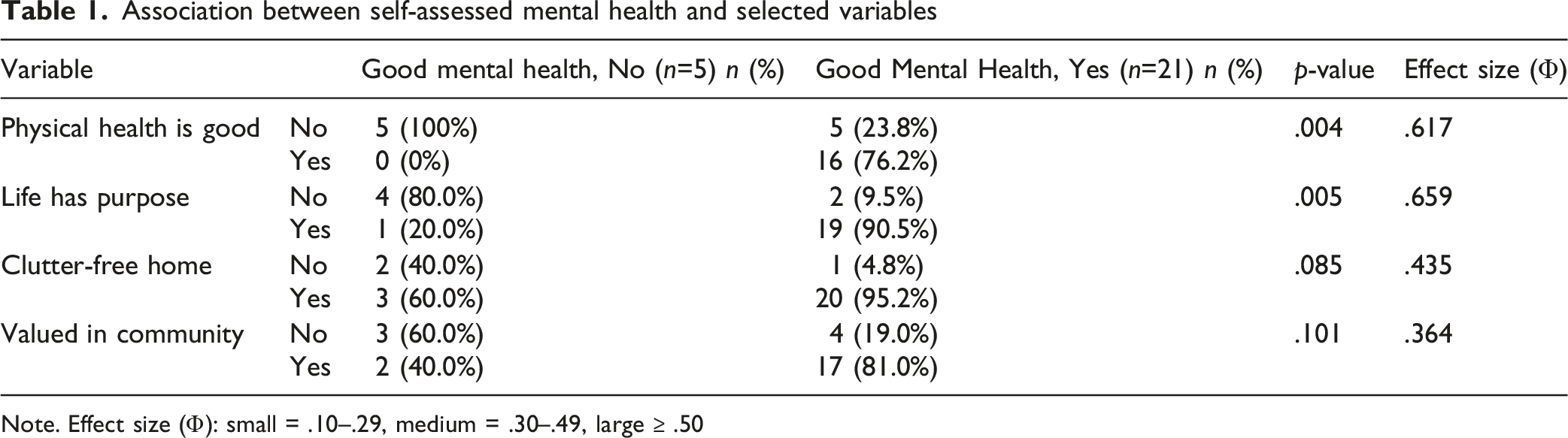
Note. Effect size (Φ): small = .10–.29, medium = .30–.49, large ≥ .50
Other associations did not reach statistical significance but suggested moderate effect sizes. For example, 95.2% of participants reporting better mental health also reported having a clutter-free home, compared to 60% of those with worse mental health (p = .085, Φ = .44). Similarly, we observed a borderline association between reporting better mental health and feeling valued in the community, with 81% of those reporting better mental health endorsing this perception, while only 40.0% of those with worse mental health perceived they were valued in the community (p = .101, Φ = .36). Associations with other survey items were non-significant with small to negligible effect sizes.
Discussion
This exploratory study analyzed baseline data from the Pinellas Park CARES program concerning mental health, physical health, and related psychosocial factors among frequent 9-1-1 callers. The significant association between mental and physical health is consistent with existing literature on the relationship between these domains in older adults (Bobo et al., 2022; James et al., 2023; Morin et al., 2020; Scott et al., 2016), and may reflect patterns relevant to EMS use, though the cross-sectional, exploratory nature of this study precludes causal conclusions.
Our results also found a strong relationship between mental health and participants’ perceptions that their lives had purpose and direction, with some evidence of a tie between mental health and feeling valued in the community. Prior research has found that a greater sense of purpose is associated with lower levels of depression and anxiety (Boreham & Schutte, 2023; Sutin et al., 2022). A further finding in the present research is that mental health may be associated with living in a clutter-free home. Clutter may reflect an unmanaged mental health condition. Conversely, a cluttered environment may contribute to mental health challenges (U.S. Special Senate Committee on Aging, 2024).
Overall, this exploratory study provides preliminary insight into the potential value of considering mental health challenges and associated factors (e.g., sense of purpose) among older adults living in the community who call 9-1-1 frequently. These findings apply to a specific local sample and are not generalizable. Nevertheless, they present baseline evidence that can inform future intervention research building on existing models such as the HEART program in Durham, N.C. (City of Durham, 2023) and the Community Paramedicine at Home (CP@home) intervention (Agarwal et al., 2024).
Limitations
Several limitations should be noted. The small sample size (n = 26) and predominantly White composition severely limit generalizability; these preliminary, exploratory findings should not be applied beyond this specific sample. The cross-sectional analysis could not establish temporal relationships or causality and reliance on self-reported dichotomous variables may have reduced sensitivity. Replication with larger samples and validated instruments is needed before findings can inform program changes.
Conclusion
We found physical and mental health are significantly associated among a group of frequent 9-1-1 callers in Pinellas Park, Florida, aligning with existing literature on the relationship between these domains among older adults. Other exploratory results concerning mental health, sense of purpose, community connection, and home clutter suggest that future research with larger samples should consider integrated approaches addressing frequent callers’ varied needs. This study provides baseline evidence from a unique local program and suggests that first responders have the potential to serve as access points for aging-in-place outreach.
Supplemental Material
Supplemental Material - Relationship Between Mental and Physical Health Among Frequent 9-1-1 Callers: A Preliminary Report
Supplemental Material for Relationship Between Mental and Physical Health Among Frequent 9-1-1 Callers: A Preliminary Report by Jessica A. VanderWerf, Lindsay J. Peterson, Jonathan Clapp, Britney Veal in Journal of Applied Gerontology
Footnotes
Acknowledgments
The authors would like to thank Erin Giblin, the CARES Coordinator, and the Fire Rescue Team in Pinellas Park, Florida, for their support.

Funding
The authors received no financial support for the research, authorship, and/or publication of this article.
Declaration of Conflicting Interests
The authors declared no potential conflicts of interest with respect to the research, authorship, and/or publication of this article.
Data Availability Statement
For data access or related inquiries, please contact the authors directly.
Declaration of Generative AI Use
During the preparation of this manuscript, the authors used Julius AI to verify statistical calculations and Goblin AI to assist with spelling and clarity. In both cases, the authors reviewed and edited all content manually. The authors take full responsibility for the integrity and content of this publication.
Supplemental Material
Supplemental material for this article is available online.
References
Supplementary Material
Please find the following supplemental material available below.
For Open Access articles published under a Creative Commons License, all supplemental material carries the same license as the article it is associated with.
For non-Open Access articles published, all supplemental material carries a non-exclusive license, and permission requests for re-use of supplemental material or any part of supplemental material shall be sent directly to the copyright owner as specified in the copyright notice associated with the article.
