







Abstract
Objectives
Social participation is a key pathway to promoting active and healthy aging. While existing studies have examined the relationship between social participation and cognitive health, relatively little is known about how different patterns of participation are associated with cognitive outcomes.
Methods
Drawing on the perspective of personal–family balance, this study utilizes data from the 2018 and 2020 waves of the China Health and Retirement Longitudinal Study (CHARLS). Based on older adults’ engagement in personal life domains (personal recreation, learning & socializing, economic activities, and volunteer work) and family life domains (caring for parents and grandchildren), we conducted latent class analysis to categorize social participation patterns into four types: personal-centered, family-centered, balanced, and low-participation. We then examine the associations of these patterns with cognitive decline among older adults.
Results
(1) Compared with the low-participation type, the personal-centered, family-centered, and balanced types are all significantly associated with a reduced risk of cognitive decline; (2) None of the three participation patterns shows a significant association with cognitive decline among older people in urban areas, whereas the personal-centered and balanced patterns are significantly associated with lower risk of cognitive decline among older people in rural areas; (3) The personal-centered pattern significantly reduces the risk of cognitive decline among the middle and oldest groups, with a stronger protective association observed in the latter. In contrast, the balanced pattern of social participation significantly reduces the risk of cognitive decline among the youngest group, but shows a positive association with cognitive decline among the oldest group.
Discussion
These findings highlight that optimizing the structure of social participation, promoting engagement among rural older adults, and adopting age-responsive approaches across different stages of later life are essential strategies for improving cognitive health.
This study extends the literature on social participation and cognitive health by examining older adults’ social participation patterns from a personal–family balance perspective. Using latent class analysis, the study identifies four distinct social participation patterns among older Chinese older adults: personal-centered, family-centered, balanced, and low-participation. The study constructs a multidimensional indicator of cognitive decline using two-wave CHARLS data and finds that the associations between social participation patterns and cognitive decline vary across urban–rural contexts and age groups.
Policies promoting healthy aging should focus on optimizing the structure and quality of social participation rather than merely increasing participation frequency. Greater institutional and community support should be provided for rural older adults to improve access to social participation opportunities and reduce urban–rural disparities in participation resources. Social participation interventions should adopt age-responsive approaches by encouraging diversified participation among the youngest group and more personally meaningful participation among the oldest group.What This Paper Adds
Applications of Study Findings
Introduction
With the rapid acceleration of global population aging, cognitive decline has become a major public health challenge and pressing social issue. According to the World Health Organization (WHO), by 2030, the number of people aged 60 and above worldwide will reach 1.4 billion, accounting for one-sixth of the global population (WHO, 2023). In China, the proportion of population aged 60 and above is projected to exceed 30% by 2035, signaling a transition to an increasingly aging population (Wang et al., 2025). Data from the Seventh National Population Census indicate that more than 180 million (68.2%) older adults in China suffer from chronic diseases, and approximately 15.07 million (5.7%) are diagnosed with dementia, reflecting a concerning outlook for cognitive health among the elderly (Zhou et al., 2024). Furthermore, the Report on the Status and Development of Care Services for Older Adults with Dementia further predicts that the number of dementia patients in China will rise to 22.2 million by 2030, showing a rapidly growing prevalence of cognitive disorders. Cognitive impairment not only reduces quality of life in later life but also imposes substantial burdens on families and society (Hsiao et al., 2016; Jia et al., 2020; Liew, 2019). Given its insidious onset and limited curability (Deary et al., 2009; Ngandu et al., 2015), an urgent priority in the current stage is to identify effective approaches to improve cognitive function and mitigate the progression of cognitive decline among older adults.
Cognitive decline in later life is influenced by multiple factors, including genetic inheritance, life experiences, personal characteristics, and family attributes, with social participation recognized as one of the key modifiable determinants (Marioni et al., 2015; Ruan et al., 2025; Tomioka et al., 2018). Two theoretical perspectives explain how social participation influences cognitive aging: the use and disuse theory and cognitive reserve theory. The former suggests that cognitive abilities decline when they are not regularly exercised (Spencer, 1873), whereas active engagement in socially and cognitively stimulating activities helps maintain cognitive functioning (Querbes et al., 2009). Conversely, reduced social participation leads to decreased gray matter volume in brain regions associated with cognitive function (Felix et al., 2021). Cognitive reserve theory further posits that individuals can flexibly utilize neural resources to compensate for brain pathology (Stern, 2002), thereby mitigating cognitive decline in later life (Esiri & Chance, 2012). Empirical studies also show that social participation can expand social networks and provide emotional, informational, and instrumental support, which helps older adults cope with cognitive deterioration (Ho, 2015; Tomioka et al., 2018). Moreover, different forms and levels of social participation may exert varying effects on cognitive outcomes, with active engagement generally associated with a lower risk of cognitive decline (Lee & Kim, 2016; Luo et al., 2022; Xie et al., 2021).
Beyond the overall level of participation, the way older adults allocate their time and roles across different life domains may also shape their patterns of social participation. Work–family balance theory provides a useful perspective for understanding this process. The “scarcity hypothesis” suggests that individuals have limited resources and may experience conflict when facing multiple role demands, whereas the “enhancement hypothesis” proposes that engagement in multiple roles can generate positive spillover effects (Aryee et al., 2005; Edwards & Rothbard, 2000; Greenhaus et al., 2003; Moen et al., 1995). In general, as older adults retire from the workforce in China, their social roles gradually shift from work and family responsibilities toward personal and family life. Meanwhile, with increasing life expectancy, it has become common for individuals in their 50s and 60s to provide care for parents in their 70s and 80s. Consequently, older adults often balance personal social participation with family caregiving, leading to diverse participation patterns that may be associated with differences in cognitive outcomes.
Although research on social participation and cognitive function among older adults has yielded valuable insights, several limitations remain. First, existing studies primarily classify social participation patterns based on activity types or participation frequency, less exploring heterogenous social participation patterns under individual–family balance perspective. Second, existing studies have primarily focused on contemporaneous cognitive scores, with relatively limited attention to the construction of indices capturing cognitive vulnerability, which may constrain a more comprehensive understanding of cognitive health.
To address these gaps, this study utilizes data from the China Health and Retirement Longitudinal Study (CHARLS) to classify social participation patterns based on the personal–family balance framework. A lagged regression model is then employed to examine the associations between different social participation patterns and cognitive decline among older adults.
Research Design
Data and Sample
The data used in this study are drawn from the China Health and Retirement Longitudinal Study (CHARLS), conducted and organized by Peking University. The baseline survey began in 2011, with follow-up waves carried out in 2013, 2015, 2018, and 2020. CHARLS employs a multi-stage stratified sampling design and collects micro-level data from individuals aged 45 and above and their households, covering 28 provinces, 150 county-level units, and 450 village-level units nationwide. The survey includes approximately 19,000 individuals from around 10,000 households, providing a nationally representative sample. Based on the research questions of this study and data availability, the 2018 and 2020 waves were used for analysis. To address missing data and potential deviations from normality, we applied full information maximum likelihood estimation with robust standard errors (MLR). This method incorporates information from cases with incomplete observations into the estimation process, which helps minimize bias and improves statistical efficiency (Cham et al., 2017; Li & Liu, 2025). After selecting respondents aged 60 and above and excluding participants with missing values in the variables of interest, a final sample of 9,651 participants was obtained. The sample selection process is shown in Figure 1. Sample selection criteria and procedure in this study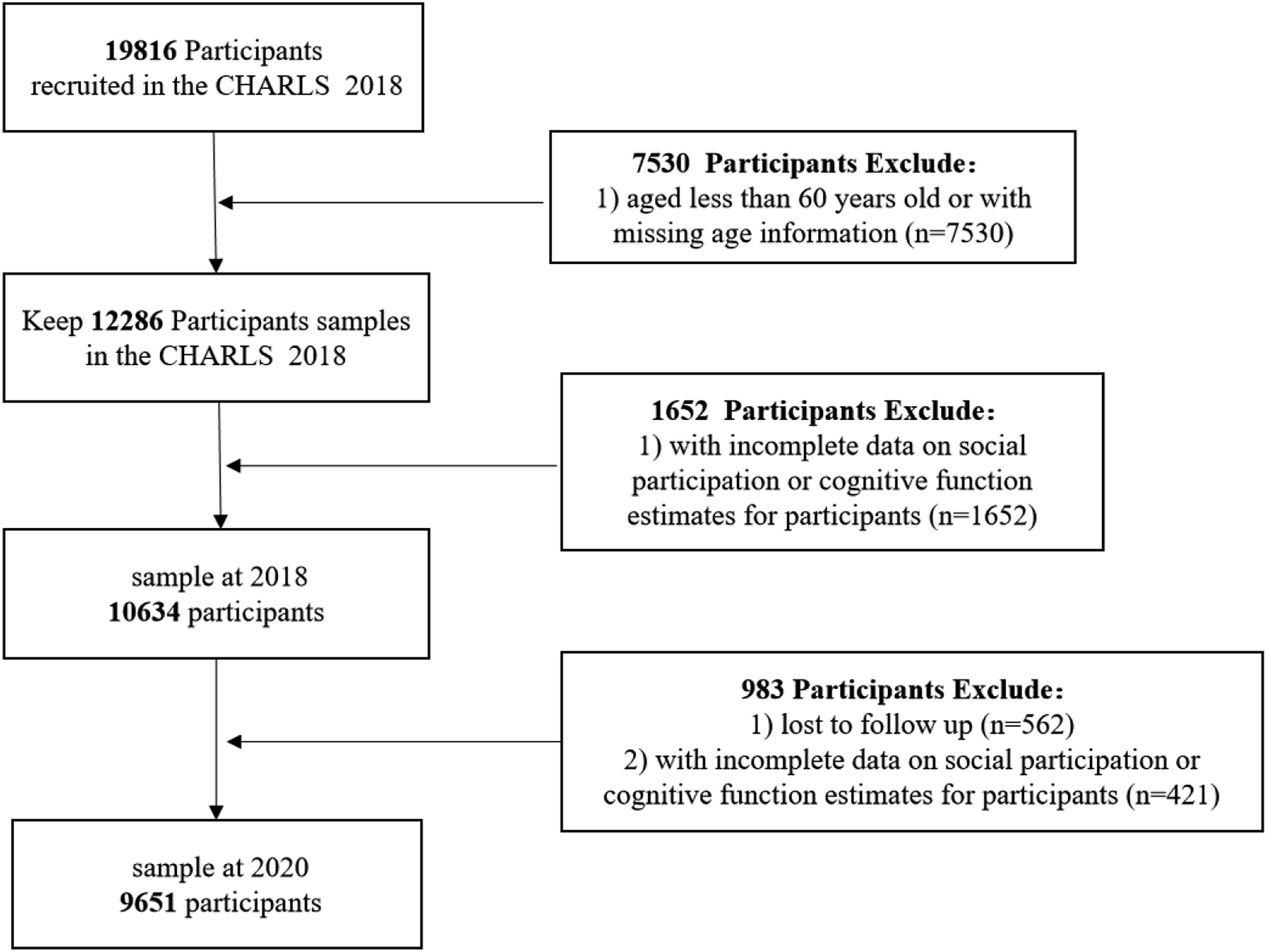
Measures
Cognitive Decline
The dependent variable in this study is cognitive decline. Following previous research (Liu et al., 2022), a cognitive vulnerability function (Y), also referred to as the probability of dementia, was constructed. This function serves as a prospective measure of cognitive decline, capturing the likelihood of older adults developing dementia in the future. The Minimum Mental State Examination (MMSE) covers core cognitive domains such as memory, orientation, and calculation, enabling the assessment of overall cognitive functioning and making it suitable for examining the association between social participation as a composite behavior and overall cognitive status. In CHARLS, cognitive function among older adults is assessed using 30 items covering daily orientation, immediate recall, delayed recall, and numeracy. Daily orientation is measured by asking respondents to report the current date (year, month, and day), day of the week, and season, with one point awarded for each correct answer, for a total of 5 points. Immediate and delayed recall are assessed by asking respondents to recall 10 words, with one point given for each correctly recalled word, yielding a combined total of 20 points. Numeracy is measured using the serial subtraction task of subtracting 7 from 100 five consecutive times, with one point awarded for each correct calculation, for a total of 5 points. The overall cognitive score ranges from 0 to 30, with higher scores indicating better cognitive functioning.
Individuals with different levels of education may exhibit systematic differences in cognitive test performance. Therefore, based on previous studies (Kong et al., 2025; Wu et al., 2024), this study adjusts the cognitive function cutoff values according to educational level when measuring cognitive vulnerability. Specifically, the cutoff scores are used to identify cognitive function, with thresholds set at 17 for illiterate individuals, 20 for those with primary school education or below, and 24 for those with junior high school education or above. Individuals scoring below the respective thresholds are classified as cognitively impaired. Assuming that cognitive test scores follow a normal distribution, the cognitive vulnerability index can be calculated using the following formula. In the formula,

Social Participation Patterns
The independent variable in this study is the social participation patterns of older adults. Based on the individual–family framework proposed in this study, social participation in later life reflects the allocation of resources and role configurations between personal developmental needs and family responsibilities, rather than merely differences in a single continuous level of participation intensity. As a person-centered approach, latent class analysis is better suited to capturing heterogeneity across individuals and identifying qualitatively distinct subgroups, which may be obscured by variable-centered methods based on continuous scores. Older adults tend to form relatively stable yet heterogeneous participation patterns in balancing personal engagement and family involvement, which are more consistent with a categorical structure than with linear continuous variation. Accordingly, this study employs latent class analysis to identify distinct types of social participation among older adults. Specifically, based on relevant items in the CHARLS questionnaire and adopting an individual–family perspective, social participation activities were classified into two domains: personal life and family life. The personal life domain includes learning and social activities (e.g., attending school or training courses, visiting neighbors, socializing with friends, and participating in club activities), economic activity (currently engaged in paid work), personal recreation (e.g., playing mahjong, chess, or cards; visiting community activity rooms; dancing; exercising; or practicing qigong), and volunteer activities (e.g., participating in volunteer or charitable activities, helping non-co-residing relatives or neighbors, and caring for non-co-residing patients or disabled individuals). The family life domain includes caring for parents (providing assistance such as household chores, cooking, laundry, shopping, and financial management) and caring for grandchildren (spending time caring for (grand)children in the past year). Participation in each activity was coded as 1 and non-participation as 0.
Control Variables
Following previous studies (Li et al., 2025; Sakamoto et al., 2017; Tomioka et al., 2018), this study includes control variables at both the personal and family levels. Personal-level control variables comprise gender, age, place of residence, educational attainment, marital status, self-rated health, depression level, baseline cognitive ability, and baseline cognitive vulnerability. Family-level control variables include annual household income and co-residence with children.
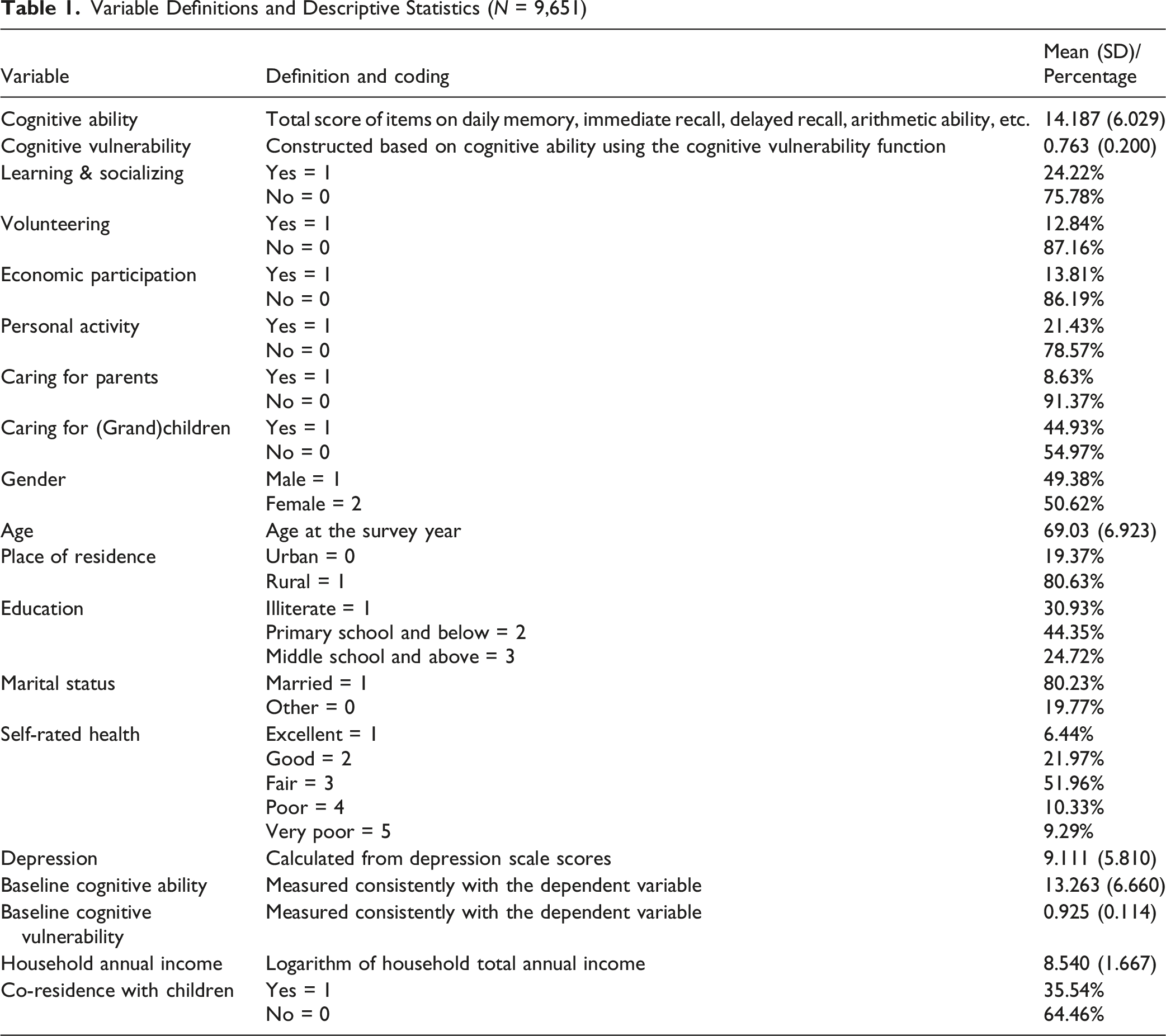
Descriptive Statistics
Variable Definitions and Descriptive Statistics (N = 9,651)
Regression Model
To obtain more precise estimates of the associations between social participation patterns and cognitive decline, we specify the model as follows:
Results
Classification of Social Participation Patterns
Model fit statistics are reported in Table S1. Models with one to five classes were compared using AIC, BIC, adjusted BIC, entropy, and likelihood ratio tests (Weller et al., 2020). Although the five-class model showed slightly improved information criteria, its entropy was below 0.8, indicating reduced classification precision (Lubke & Muthén, 2005). Considering overall fit, classification quality, and theoretical interpretability, the four-class solution was retained. The conditional probabilities for each class are presented in Table S2. The four identified patterns include a low-participation type (42.6%), a balanced type (33.2%), a family-centered type (18.8%), and a personal-centered type (5.4%). More detailed class-specific probabilities are provided in the Supplemental Materials. The conditional probability distributions of each class across social activities are illustrated in Figure 2. Conditional probability distribution of social participation patterns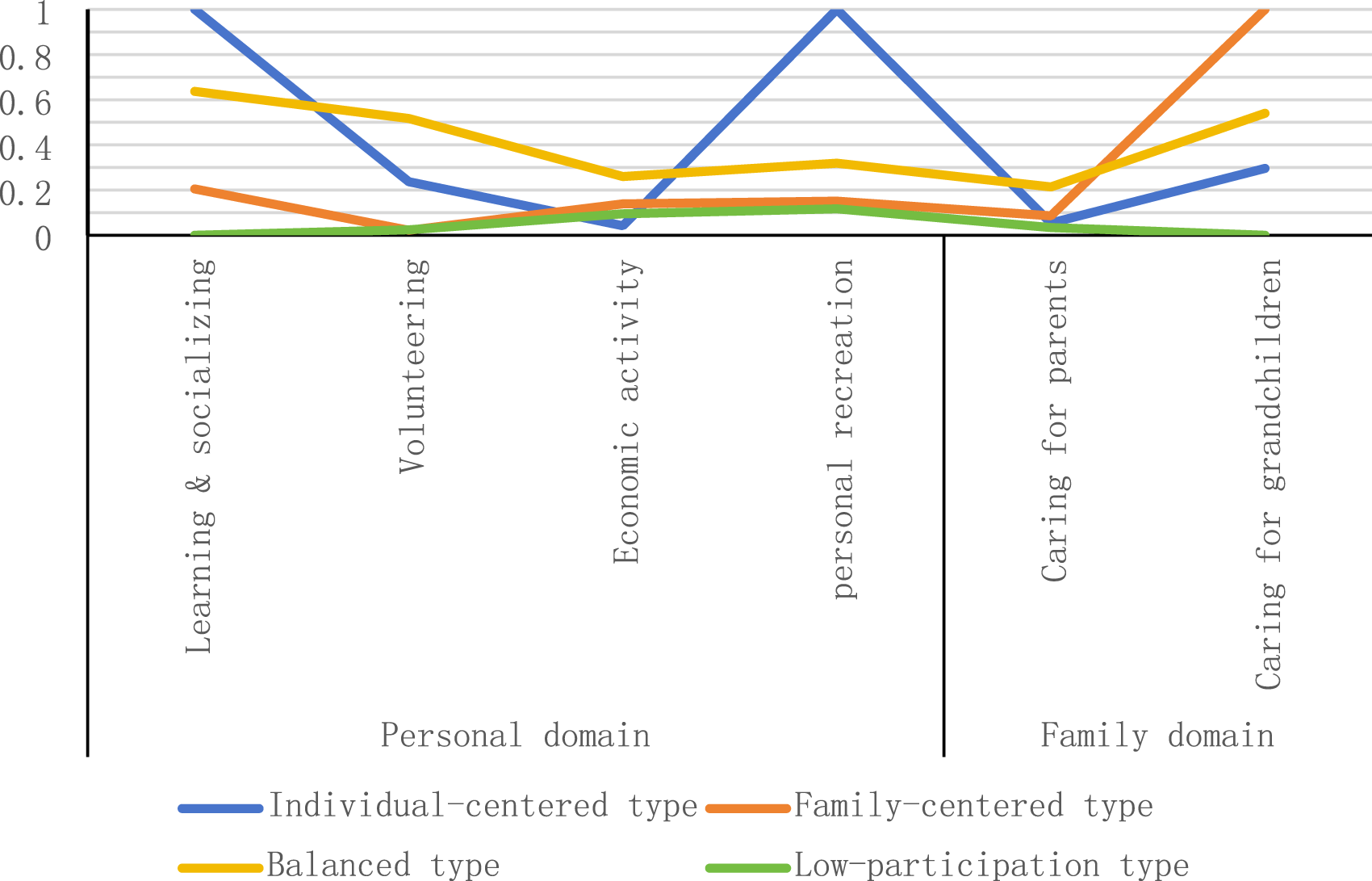
The Associations Between Social Participation Patterns and Cognitive Decline
Associations Between Social Participation Patterns and Cognitive Decline among Older Adults
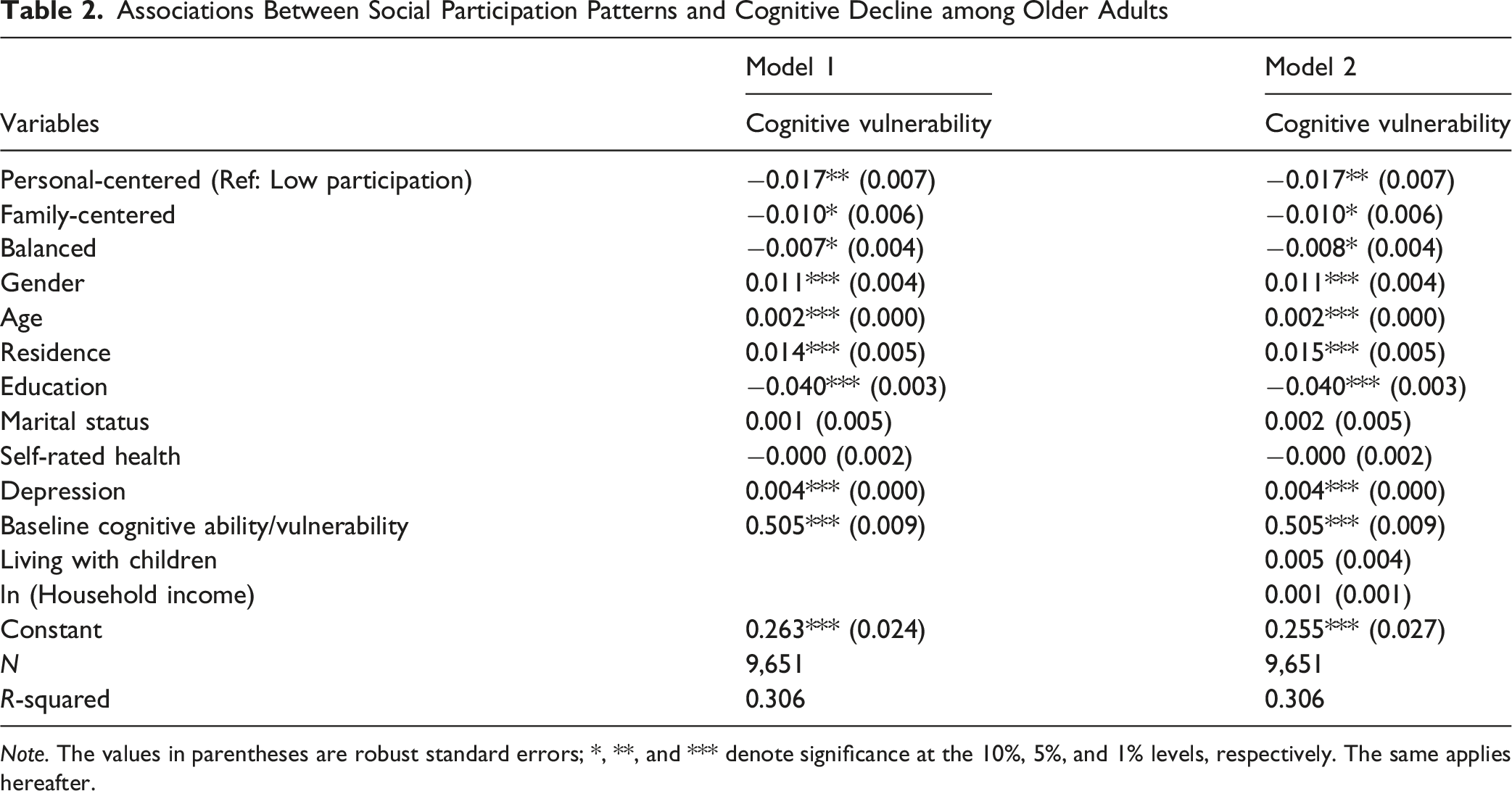
Note. The values in parentheses are robust standard errors; *, **, and *** denote significance at the 10%, 5%, and 1% levels, respectively. The same applies hereafter.
Heterogeneity Analysis
Urban–Rural Heterogeneity
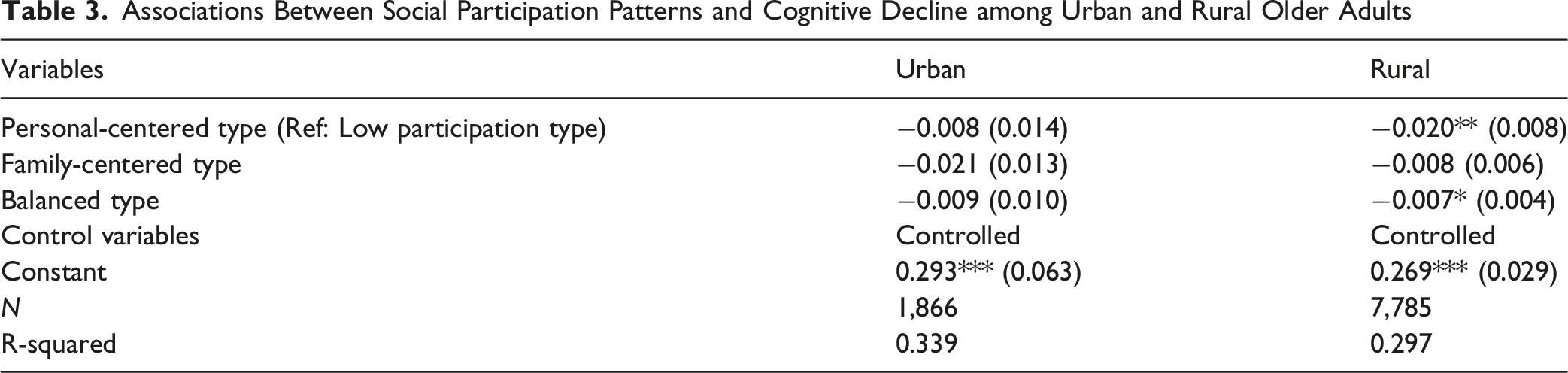
Associations Between Social Participation Patterns and Cognitive Decline among Urban and Rural Older Adults
Age Heterogeneity
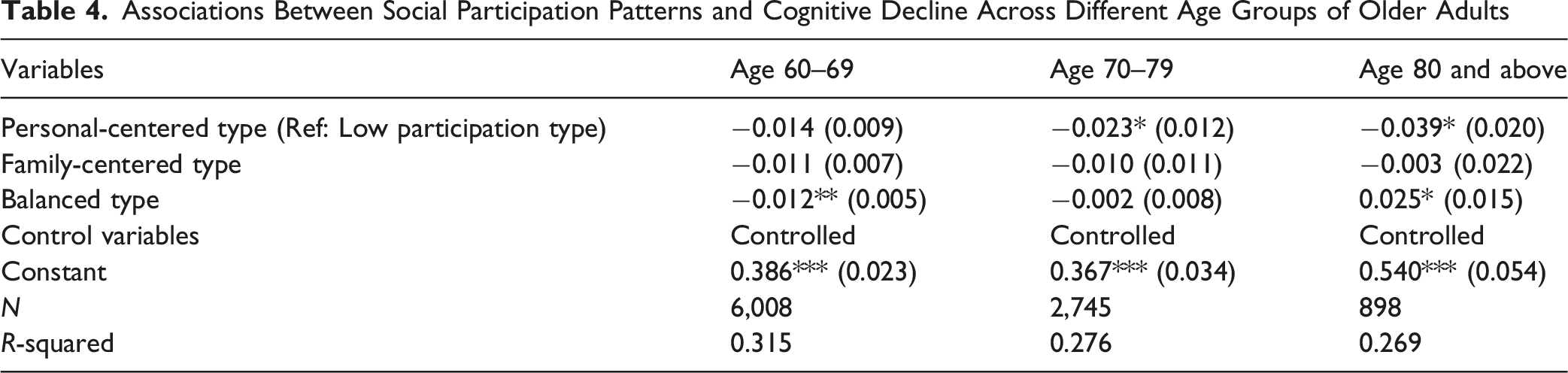
Associations Between Social Participation Patterns and Cognitive Decline Across Different Age Groups of Older Adults
Discussion
Using data from the 2018 and 2020 waves of CHARLS, this study employed LCA method to classify older adults’ social participation patterns into four types from a personal–family balance perspective, personal-centered, family-centered, balanced, and low-participation, accounting for 5.4%, 18.8%, 33.2%, and 42.6% of the sample, respectively. Then, the study employed a lagged regression model to examine the associations between different social participation patterns and cognitive decline, with further exploration of rural-urban and age differences in these associations.
Personal-centered, family-centered, and balanced types are all significantly related to lower risk of cognitive decline, indicating that social participation can reduce the future risk of cognitive impairment. This finding supports the use and disuse theory (Spencer, 1873); it is also consistent with a large body of empirical research (Dause & Kirby, 2019; Querbes et al., 2009). Engagement in social activities provides continuous cognitive stimulation and opportunities for social interaction, which facilitate information processing, memory retention, and executive functioning (Tomioka et al., 2018). At the same time, participation can enhance social connectedness and emotional support, thereby reducing loneliness and psychological stress (Ge et al., 2024; Li et al., 2025), both of which are closely associated with cognitive decline. Building on this, the present study further extends the existing literature by incorporating an individual–family framework. From this perspective, social participation in later life reflects how older adults allocate time and resources between personal development and family involvement after exiting the labor market. Although these participation patterns differ in their orientations, they all help maintain connections with the external environment and prevent social disengagement. Therefore, when participation patterns are aligned with older adults’ functional conditions and role expectations, they are more likely to generate sustained cognitive benefits. This suggests that social participation patterns aligned with older adults’ actual needs play a crucial protective role in delaying cognitive deterioration (Li et al., 2025; Sakamoto et al., 2017).
The associations between social participation patterns with cognitive decline exhibit clear urban–rural differences. Among older people in urban areas, all types of social participation patterns are not significantly associated with cognitive decline. In contrast, among older people in rural areas, the personal-centered and balanced social participation patterns are significantly related to lower levels of cognitive decline. These disparities may be related to differences in educational attainment and cognitive reserve between urban and rural populations (Wilson et al., 2019). Urban older adults generally have higher levels of education and stronger cognitive reserve (Wight et al., 2006), which may buffer cognitive decline to some extent. Therefore, the mitigating effect of social participation on cognitive decline is relatively weak. By contrast, rural areas tend to have relatively homogeneous living environments and more limited formal social activity resources (Levasseur et al., 2015), resulting in fewer channels for cognitive stimulation. Under such conditions, various forms of social participation whether personal or balanced can provide meaningful cognitive engagement, thereby significantly reducing the risk of cognitive decline.
The associations between social participation patterns with cognitive decline vary significantly across age groups. The personal-centered pattern significantly reduces the risk of cognitive decline among the middle and oldest groups, with a stronger protective association observed in the latter. In contrast, the balanced pattern of social participation significantly reduces the risk of cognitive decline among the youngest group, but shows a positive association with cognitive decline among the oldest group. These differences can be understood from the perspectives of cognitive aging processes and changes in social roles (Park, 2002). First, the rate of cognitive decline varies across age groups. The youngest group is generally in a stage of gradual cognitive decline, whereas the rate of decline accelerates among the middle and oldest groups (Guo & Zheng, 2023). In this context, personal-centered activities (e.g., learning and self-directed leisure) provide more direct and sustained cognitive stimulation for the middle and oldest groups, thereby generating a more pronounced marginal protective association. This finding is broadly consistent with prior research suggesting that social participation is particularly beneficial in mitigating cognitive decline among the oldest group (Lee & Kim, 2016). Second, as age increases, older adults’ family roles and social responsibilities tend to shift. Youngest group typically maintain relatively good physical functioning, enabling them to engage in both personal interest activities and certain family caregiving responsibilities (Gauthier & Smeeding, 2010; Silverstein et al., 2006). Such diversified participation may offer richer sources of cognitive stimulation, thereby slowing cognitive decline. However, as individuals reach more advanced ages, some gradually withdraw from caregiving roles, and their forms of social participation become more limited (Pinto & Neri, 2017). Consequently, maintaining cognitive function increasingly depends on participation centered on personal development, making the protective association of the personal-centered pattern more prominent. In addition, the balanced participation pattern is positively related to cognitive decline among the oldest group, which may be explained by socioemotional selectivity theory, which suggests that as individuals age, they increasingly prioritize activities that provide emotional meaning and personal value (Carstensen, 2021). For adults aged 80–89, due to declines in physical functioning, diverse forms of participation may become burdensome, thereby increasing cognitive vulnerability, whereas personal social participation is often voluntarily chosen based on individual interests and may help maintain cognitive stimulation.
Based on the above findings, this study proposes the following policy implications: First, efforts to promote cognitive health among older adults should focus on optimizing the structure of social participation rather than merely increasing participation frequency. Given the heterogeneity in the associations of different participation patterns with cognitive outcomes, policymakers should create more flexible and diverse participation environments that enable older adults to develop relatively stable and adaptive participation structures according to their functional capacities and family role positions. Second, considering personal-centered and balanced social participation showed significant negative association with the risk of cognitive decline in rural areas. It is necessary to improve conditions for rural older adults’ participation and reduce urban–rural disparities in participation environments and resource access, thereby strengthening the institutional foundation for sustained engagement. Third, given that youngest group benefits from balance social participation, both 70–79 group and 80 and above group gain from personal-centered social participation, and 80 and above group suffer from balanced social participation. Accordingly, social participation initiatives and institutional arrangements should respect life-course characteristics and avoid uniform or homogeneous participation orientations. For example, the youngest group can be encouraged to engage in more diverse forms of social participation, while the oldest group can be encouraged to focus more on individual participation and reduce excessive or unnecessary involvement.
The limitations of this study are as follows: First, constrained by data availability, this study only considers the number of roles in measurement, failing to capture differences in role engagement, time allocation, and energy expenditure. Future research could build on this line of work by incorporating more detailed measures of social participation, such as time spent, frequency of involvement, or subjective engagement, to better distinguish heterogeneous participation patterns and their health implications. Second, the follow-up in this study was limited to approximately 2 years, and cognitive decline often has a multi-year preclinical trajectory, making it impossible to rule out reverse causation. Future research could use longer-term longitudinal data or apply methods such as fixed-effects models or instrumental variable approaches to further investigate the dynamic relationship between social participation and cognitive function. Third, the MMSE has ceiling effects and is more sensitive at lower levels of cognitive functioning, although we adjusted the cutoff values of cognitive function according to respondent’s educational level, these limitations do not fully eliminate. Future studies could employ more comprehensive and sensitive cognitive assessment tools to improve the accuracy of cognitive measurement.
Supplemental Material
Supplemental material—Associations Between Social Participation Patterns and Cognitive Decline in Older Adults: A Person–Family Balance Perspective
Supplemental material for Associations Between Social Participation Patterns and Cognitive Decline in Older Adults: A Person–Family Balance Perspective by Weifang Cui, Xueyan Yang, Zhibin Li, and Jinxiang Cao in Journal of Applied Gerontology.
Footnotes

Author Contributions
W.C. conducted the data analysis and drafted the initial manuscript. X.Y. supervised the research process and provided overall guidance on the manuscript. Z.L. and J.C. contributed to the revision of the manuscript. All authors reviewed previous versions of the manuscript and approved the final version for submission.
Funding
This study was supported by the General Program of the National Natural Science Foundation of China, “Patterns, Mechanisms, and Policy Implications of Women’s Work–Family Relations in the Context of Fertility Policy Transition” (Grant No. 72574180), Award Recipient: Xueyan Yang.
Declaration of Conflicting Interests
The authors declared no potential conflicts of interest with respect to the research, authorship, and/or publication of this article.
Supplemental Material
Supplemental Material for this article is available online.
References
Supplementary Material
Please find the following supplemental material available below.
For Open Access articles published under a Creative Commons License, all supplemental material carries the same license as the article it is associated with.
For non-Open Access articles published, all supplemental material carries a non-exclusive license, and permission requests for re-use of supplemental material or any part of supplemental material shall be sent directly to the copyright owner as specified in the copyright notice associated with the article.
