







Abstract
Research shows that public preferences about justice system approaches to decreasing illegal behavior distinguish between adult and juvenile offending. We also know that fear of crime and perceived risk of victimization typically strengthen support for harsh punishments and reduce support for rehabilitation. What has yet to be demonstrated—and that we examine here—is whether there are youth-specific differences in the way that crime salience affects public support for punitive versus rehabilitative policies and to what extent confidence in the criminal and juvenile justice systems affects punishment orientations toward adults and juveniles. Essentially, we examine why some Americans support “child saving” yet condemn adults. This exploratory study’s findings indicate that while crime salience increases the likelihood that one will support harsh adult criminal measures, it is not associated with similar attitudes toward juvenile delinquents. Further, those for whom crime salience is lower have a greater probability of supporting rehabilitation for both juveniles and adults. Finally, results show that support for the rehabilitation of youth persists despite crime salience among those who are otherwise punitive toward adults. Justice ideology appears unaffected by confidence in the justice systems. Policy implications and recommendations for future research are offered.
It is increasingly apparent that the harsh treatment of juvenile offenders within the American justice system comes at a steep personal, social, and financial cost. Studies have demonstrated countless short- and long-term detrimental effects of arrest, incarceration, and solitary confinement on youth and their communities, with little benefit (Seigle, Walsh, & Weber, 2014). Yet the juvenile justice system (JJS) has not always been so punitive. Until recent decades, its orientation toward rehabilitating delinquents and “child saving” through prevention was balanced with punishment (Bernard & Kurlychek, 2010), an attribute that has long distinguished it from the relative harshness of the adult criminal justice system (CJS). However, during the “get-tough” movement that began in the 1980s, the public expressed greater punitiveness toward all offenders. Research has shown that public attitudes like this can have a profound effect on public policies, including those of the justice system (Green, 2006; Roberts, 2004), which helps to partially explain the vast expansion and intensification of social controls during that time. Among the influences that can shape attitudes about punishment, crime salience has an important effect on public punitiveness in a range of circumstances (Bernard & Kurlychek, 2010), with concern, fear of crime, and perceived risk of victimization exacerbating the extent to which the public prefers severe punishments over rehabilitation (Callanan, 2005; Mascini & Houtman, 2006). There is also reason to believe that public confidence in the justice system’s ability to reduce crime and delinquency should affect people’s preferences for sanctions (Simon, 2007), although the limited research assessing this relationship has produced mixed results (Nagin, Piquero, Scott, & Steinberg, 2006; Piquero & Steinberg, 2010; Sundt, Schwaeble, & Merritt, 2017; Unnever & Cullen, 2010). Regardless, the public has appeared to remain more supportive of rehabilitative objectives for juveniles than it has for adults (Applegate, Davis, & Cullen, 2008; Piquero & Steinberg, 2010; Roberts, 2004). What is unclear is why some who are punitive toward adult criminals endorse rehabilitation for delinquents—essentially espousing child saving while damning adults.
This study is the first to endeavor to account for this counterintuitive phenomenon. The fundamental question we begin to explore is under what circumstances do people not give up on kids, even when they are otherwise punitive. The answer to this question may shed light on how to best convey crime and delinquency information to the public, particularly as it may affect concerns about crime and confidence in the justice system, in order to expand public support for more productive anti-offending strategies. Ultimately, that support may manifest in policy changes by lawmakers. Using multivariate analyses of national survey data, we explore the degree to which crime salience and confidence in the criminal justice system and juvenile justice system influence the public’s orientation toward punishment versus rehabilitation for youth and adults. The results demonstrate the importance of assuaging both fear of crime and perceived risk of victimization for increasing public support for rehabilitative justice, and they establish the need for a new avenue of research that would unpack why crime salience matters. Given recent White House initiatives to turn away from rehabilitative principles for juveniles (Pilkington, 2018) and to portray both adult and juveniles offenders as more fearsome and less capable of reform (Bump, 2018), this line of inquiry has particular urgency.
Public Perspectives on Adult Versus Juvenile Justice
American enthusiasm for punitive criminal justice policies is now well-established. Many of the severe anti-crime policies were implemented and sustained over the last four decades because of politicians and their constituents who sought to declare an unofficial war on drug users, gang members, perceived predators, and repeat “three-strikes” felons, despite consistently declining crime rates since the mid-1990s (Simon, 2007). Until recent bipartisan endorsements of criminal justice reform (Hulse & Steinhauer, 2015), this widely supported punitive movement brought harsher sentencing policies that led to longer punishments and various mandatory penalties for drug and firearm users and recidivists, among others (Enns, 2014; Ramirez, 2013). It lengthened terms of probation, further restricted inmate activities, and applied official labels to offenders, which effectively limited options for postincarcerative reform. Unsurprisingly, few supported a rehabilitative approach to criminal justice during this get-tough period, during which policy makers and the public prioritized retribution, incapacitation, and deterrence (Simon, 2007). Funding and opportunities for treatment and addiction services were broadly reduced (National Research Council, 2014). Instead, this ideological shift elevated prison and jail populations to the unprecedented peak of about 2.3 million adults (1 in 100) who were incarcerated in 2007 (U.S. Department of Justice, 2016). That same year, over 5 million offenders (2.24 in 100) were on probation or parole, with a total of over 7.3 million adults (1 in 31) under some form of criminal control, making the U.S. justice system the single harshest among advanced industrialized nations in the world (U.S. Department of Justice, 2016).
Notwithstanding the punitive sentiments that promoted the war on adult crime, Americans have consistently advocated for comparatively mild responses to juvenile offending. Ever since the child saving movement of the early 1900s that sought to integrate both rehabilitation and punishment into the treatment of children in order to protect them from the abuses of the adult system and to promote behavioral reform (Mears, Pickett, & Mancini, 2015), the public has generally maintained the perspective that juveniles are qualitatively different from adults and should, therefore, receive different treatment when they violate laws (Cullen, Fisher, & Applegate, 2000; Jonson, Cullen, & Lux, 2013; Mears et al., 2015; Zimring, 2005). Youth are perceived as more innocent than adults and particularly deserving of protection (Pickett, Welch, Chiricos, & Gertz, 2014). Further, the belief that juveniles have a greater potential for reform may contribute to their receiving a “youth discount” in court (Leiber, Peck, & Beaudry-Cyr, 2016). Hence, when it comes to children, the public has regularly supported early intervention and crime prevention over more punitive alternatives (Conner & Rosen, 2016; Cullen et al., 2000; Moon, Sundt, Cullen, & Wright, 2000; Piquero, Cullen, Unnever, Piquero, & Gordon, 2010), despite ideological shifts that have promoted less rehabilitative responses at certain times (Baker, Cleary, Pickett, & Gertz, 2016; Monahan, Steinberg, & Piquero, 2015). The general principle of parens patriae (“state as parent”), together with evidence suggesting that youth are not yet as emotionally, cognitively, or socially responsible as adults for their behavior (Applegate et al., 2008; Scott, 2000), contributed to the development of a separate juvenile justice system and a continuing framework for preventive programming that began at the turn of the 20th century (Bernard & Kurlychek, 2010).
Although the public remained more supportive of rehabilitation for juveniles than it was for adults (Applegate, Cullen, & Fisher, 1997; Jonson et al., 2013), it became increasingly punitive toward juveniles over time (Bernard & Kurlychek, 2010; Miller & Applegate, 2015). In the 1980s, amid panic that a growing generation of violent juvenile “super-predators” would soon conquer the law-abiding nation (DiIulio, 1995), public fear and concern about security intensified, and demands for harshly punishing delinquents who were believed to be morally destitute and remorseless became pervasive (Piquero et al., 2010). Accordingly, rehabilitation as an objective of the juvenile justice system lost much of its appeal, and American society proceeded to endure the demoralizing and costly “burden of juvenile justice” (Cook & Laub, 1998, p. 34). The promise of public safety—albeit a tenuous prospect—was suddenly more compelling than the goal of juvenile protection and reform. As a result, most states lowered the age at which juveniles could be considered adults in court and increased the number and variety of crimes for which minors would be eligible for transfer to the criminal justice system, thereby disqualifying them from any juvenile justice protections (Miller & Applegate, 2015). Policies and penalties for juveniles became harsher, with an array of new mandatory and minimum punishments, increased use of solitary confinement, and more sentences of life imprisonment without the possibility of parole (Applegate et al., 2008; Sanborn & Salerno, 2005). It is only since 2012, with the Miller v. Alabama U.S. Supreme Court ruling that, for juveniles, mandatory life sentences without the possibility of parole are unconstitutional, coupled with the recognition that juvenile cognitive development remains ongoing (Monahan et al., 2015), that bipartisan efforts to slowly retreat from this punitive orientation that paradoxically seems to have exacerbated crime and injustice, emerged (Stevenson, 2014).
Support for Harshly Punishing Offenders
There are a number of influences on the punitive sentiments that helped facilitate the enactment of harsh adult and juvenile crime policies (Welch, 2007). Particular contexts and settings appear to increase public support for harsh criminal and delinquent sanctions. Individuals have exhibited greater approval of treating law violators severely when they live in areas with higher homicide rates (Baumer, Messner, & Rosenfeld, 2003), higher unemployment rates (King & Wheelock, 2007; Pickett, Welch et al., 2014), more conservative political climates (Baumer et al., 2003), and a larger Black population (Baker, Metcalfe, Berenblum, Aviv, & Gertz, 2015; Baumer et al., 2003; King & Wheelock, 2007), as well as when they live in inner cities (Ramirez, 2015). Although question wording can affect punishment preferences (Jonson et al., 2013), characteristics about actual or hypothetical crimes and offenders also influence attitudes. Research demonstrates that the public is more supportive of severe sanctions when offenders commit violence (Applegate et al., 2008; Piquero & Steinburg, 2010) or drug crimes (Miller & Applegate, 2015) and when offenders are believed to be more responsible for their actions (Allen, Trzcinski, & Kubiak, 2012; Metcalfe, Pickett, & Mancini, 2015). Offenders with prior criminal records similarly elicit harsh policy preferences (Miller & Applegate, 2015).
Myriad individual demographic, experiential, and attitudinal characteristics also influence the degree to which members of the public endorse harsh sanctions for both adult and juvenile offenders. Research demonstrates that general punitiveness is more common among men (Baker et al., 2015; Miller & Applegate, 2015), Whites (Johnson, 2008; Kubiak & Allen, 2011), parents (Leverentz, 2011; Welch, 2011), and those with less education (Pickett & Baker, 2014; Welch, Payne, Chiricos, & Gertz, 2011), among others. Attitudinal and dispositional traits that are broadly associated with greater punitiveness include ideological conservatism (Baker et al., 2015; Frost, 2010; Miller & Applegate, 2015), tea party membership (Pickett, Tope, & Bellandi, 2014), religious fundamentalism (Frost, 2010; King & Wheelock, 2007), and economic individualism (Kornhauser, 2015). Because of the strong association made by many between Blacks and crime (Welch, 2007), some research concludes that racial priming (Graham & Lowery, 2004), racial prejudice (Jonson et al., 2013; Pickett, Welch et al., 2014), racial resentment (Pickett & Chiricos, 2012), racial animus (Unnever & Cullen, 2010), and White racism (Unnever & Cullen, 2007) intensify punitiveness.
Support for Rehabilitating Offenders
Independent of whether or not individuals also express punitive support, many have advocated for prevention and rehabilitation as objectives of criminal and juvenile justice. A number of circumstances and personal attributes have contributed to support for rehabilitating offenders, although there is substantially less research on these influences than on those that tend to expand punitiveness. Nonetheless, there are several conclusions across studies assessing rehabilitative support for both adults and juveniles, which are worth reviewing. With regard to offense type, rehabilitation is likelier to be endorsed for nonviolent offenders (Jonson et al., 2013) and for offenders whom the public believes are capable of being reformed (Jonson et al., 2013; Mears et al., 2015). The perception of few crime problems in ones’ neighborhood also increases favorable attitudes toward offender treatment (Piquero et al., 2010). When individuals believe both punitive and rehabilitative approaches will have equal efficacy in reducing subsequent offending, they favor subsidizing prevention and reform rather than harsh interventions (Baker et al., 2016; Cohen, Rust, & Steen, 2006; Nagin et al., 2006; Piquero & Steinberg, 2010), although one study found the public’s confidence in the justice system’s ability to rehabilitate juveniles does not affect support for any philosophical approach to sanctioning (Mears et al., 2015).
Among individuals, rehabilitation appears to be a somewhat favored justice response among women (Falco & Turner, 2014; Piquero et al., 2010; Sims & Johnston, 2004), racial minorities (Cohen et al., 2006; Frost, 2010), and those with more education (Baker et al., 2015; Piquero et al., 2010). Ideological liberals (Applegate et al., 1997; Falco & Turner, 2014; Sims & Johnston, 2004), those without full-time employment (Pickett, Chiricos, & Gertz, 2014), and those who do not believe their taxes are too high (and, thus, presumably willing to pay for rehabilitation) also tend to support these objectives (Piquero et al., 2010).
The Role of Crime Salience on Justice Ideology
Aside from these contextual and individual attributes that shape attitudes toward law violators generally, the fact remains that Americans maintain substantially different perspectives on how adult and juvenile offenders should be handled by the justice system; a rehabilitative orientation is more common when it comes to addressing the behavior of young people (Applegate et. al., 2008; Cullen, Vose, Jonson, & Unnever, 2007). One explanation for divergent attitudes toward punishing adult criminals and juvenile delinquents is that these two groups of offenders may represent a dissimilar threat to the public, with juveniles perceived as less dangerous than adults. It also seems likely that juveniles, due to their still developing frontal lobes and prefrontal cortexes, are perceived as less blameworthy than adult offenders who presumably have the advantage of greater impulse control (Monahan et al., 2015). Perceptions of differential culpability or proclivities for crime and violence between minors and adults may elicit different levels of fear and perceived victimization risk (Jonson et al., 2013). Although the impact of crime salience on punitive and rehabilitative philosophies has been somewhat inconsistent in prior analyses, fear of crime and perceived risk of victimization may help explain some degree of the difference in justice system philosophy toward adult versus juvenile offenders (Costelloe, Chiricos & Gertz, 2009). Yet, this possibility has never been tested.
Crime salience may be manifested in conceptually distinct ways (Costelloe et al., 2009). Using a variety of different measurements, prior research has found that fear of crime is a multidimensional emotive response to one’s appraisal of danger coupled with feelings of threat, worry, or personal concern about victimization (Baker et al., 2015; Farrall, Jackson, & Gray, 2009; Gray, Jackson, & Farrall, 2011). Crime salience has also been represented by measures of perceived risk of victimization, which is a more cognitive rather than emotional response to beliefs about the likelihood of victimization (Baker et al., 2016). Yet the perceived risk of victimization tends to have only a tenuous link to one’s actual risk of victimization (Ferraro, 1995; Gray et al., 2011). Both fear of crime and perceived risk of victimization have the capacity to engender a variety of behavioral and personal responses from those experiencing them, some of which are probably helpful (and may increase safety), but many of which are unproductive (Bitton & Shavit, 2015; Pearson & Breetzke, 2014) and may influence policy (Simon, 2007).
Crime salience and juvenile justice ideology
Prior research has produced limited findings about the influence of crime salience on views toward juvenile punishment, in particular. With regard to juvenile offending, emotion-driven fear of crime and victimization appears to somewhat increase support for a range of harsh policies (Pickett, Chirico et al., 2014) including juvenile death penalty (Boots, Heide, & Cochran, 2004; Cochran, Boots, & Heide, 2003; Evans & Adams, 2003), younger eligibility for adult criminal justice jurisdiction (Evans & Adams, 2003), transfers to the adult criminal justice system for property crimes (Schwartz, Guo, & Kerbs, 1993), and punishment for drug crimes and violence (Schwartz et al., 1993; Wu, 2000), as well as a willingness to pay for these harsh measures (Baker et al., 2016). Accordingly, when individuals are worried about victimization, they are less committed to allocating money toward prevention programs for juveniles (Cohen et al., 2006). Further, fear of victimization increases punitiveness toward juvenile offenders even though the impact of fear has been negligible when it comes to adult offenders (Pickett, Welch et al., 2014).
Cognitive assessments about the actual risk of victimization, concern about crime, and threats to community safety that are presented by youthful offenders tend to also intensify support for a range of punitive juvenile justice measures (Pickett & Chiricos, 2012; Pickett, Chiricos et al., 2014; Pickett, Tope et al., 2014; Welch, 2011), which includes lowering the age at which juveniles may be considered adults by the justice system (Pickett & Chiricos, 2012). People who are more concerned about public safety are also less likely to believe juveniles deserve rehabilitative intervention, and they are more apt to believe that either there is no age below which juveniles are able to be saved or that the age at which juveniles are believed beyond redemption is younger (Piquero et al., 2010). Surprisingly, the perception that general violence is increasing has been associated with favoring a ban on juvenile executions (Sharp, McGhee, Hope, & Coyne, 2007).
Crime salience and adult justice ideology
Emotional fear of crime does not consistently elevate punitiveness toward adults in prior research, although some studies find that it is, in fact, associated with support for certain harsh policies (Gerber & Jackson, 2016; Johnson, 2008; Kleck & Jackson, 2016). Individuals expressing fear of crime prefer to allocate more resources to arresting and punishing offenders (Baker et al., 2015) and believe that prisons should be focused on punishing lawbreakers rather than teaching them to be law-abiding citizens (Langworthy & Whitehead, 1986). Further, fear appears to induce people to favor “repression” (as opposed to rehabilitation) because of an associated presumption that adults are not capable of changing (Mascini & Houtman, 2006). In one study, worry for the safety of one’s family members increased support for punitive adult sanctions, although fear about personal danger did not (Leverentz, 2011). Women who express fear of crime are more supportive of the death penalty and believe rehabilitation is an unimportant objective of prisons (Applegate, Cullen, & Fisher, 2002). Research on rehabilitative attitudes toward adult offenders finds that fear of crime has no impact (Falco & Turner, 2014; Mascini & Houtman, 2006).
Perceived risk of victimization has fostered some harshness toward adult criminals, as well, although the results across studies have been mixed. In one study, perceptions of victimization risk increased punitiveness and decreased support for rehabilitation until the separate influence of fear of crime rendered the cognitive influence only marginally significant (Baker et al., 2015). In another study comparing emotional and cognitive assessments of crime salience in a racial context, nonemotive concern about the crime problem significantly predicted punitiveness toward adults among Whites, Blacks, and non-Black minorities, whereas fear did not (Pickett, Welch et al., 2014). Further, those expressing the most concern about crime are significantly more punitive toward adults than those expressing lower levels of concern (Chiricos, Welch, & Gertz, 2004; Rossi & Berk, 1997; Tyler & Boeckmann, 1997; Welch, 2011).
The Role of Justice System Confidence on Justice Ideology
It is plausible that public confidence in the justice system could affect preferences for sanctions; trust in criminal and juvenile justice institutions and the belief that they are operating effectively or decreasing crime may shape one’s justice ideology (Simon, 2007). There has been only a very limited amount of research, however, that has explored the possibility that positive or negative views of the justice system influence punitiveness or support for rehabilitation. Moreover, the studies that have tested for this relationship have produced mixed results. Some studies have found that positive views of the justice system are associated with rehabilitative support (Brookman & Wiener, 2017; Nagin et al., 2006; Piquero & Steinberg, 2010), while others have found it is related to support for harsher sanctions (Sundt, Schwaeble, & Merritt, 2017). Other studies have found no relationship whatsoever between confidence or trust in the justice system and preferred criminal or juvenile justice orientations (Mears et al., 2015; Tyler & Boeckmann, 1997; Unnever & Cullen, 2010).
It is possible that the results of prior research testing for an effect of criminal justice system or juvenile justice sysemt attitudes on justice ideology are inconsistent because of the ways that views of justice institutions have been measured. For example, confidence in the justice system has been operationalized as perceived efficacy of particular criminal justice practitioners (e.g., judges, prosecutors), institutions (e.g., prisons, courts), and treatments (e.g., drug rehabilitation, capital punishment) or a belief that justice practices “work” (Mears et al., 2015; Sundt et al., 2017). Justice system confidence (or lack thereof) has also been measured as the perceived ability to reduce crime (Nagin et al., 2006; Unnever & Cullen, 2010), institutional distrust (Unnever & Cullen, 2010), and self-reported confidence in the justice system (Brookman & Wiener, 2017).
Another possible explanation for such inconsistent findings between confidence and justice ideology is that the effects of confidence in the criminal justice system or juvenile justice system are conditioned by respondents’ characteristics. For example, one study discovered a race-dependent influence of confidence on punishment ideology; institutional distrust among Whites increased support for the death penalty, while, among Blacks, it decreased death penalty support (Messner, Baumer, & Rosenfeld, 2006). It has also been suggested that U.S. studies and those that are recent are systematically different from others (Brookman & Wiener, 2017).
What has not been explored in prior research is whether confidence in the justice system is dependent on which justice system—criminal or juvenile—is the subject of confidence, and whether the purported target of the sanction is an adult or a minor. It would be reasonable to expect that a belief that the CJS is doing a good job with adult criminals or that the JJS is doing a bad job with young lawbreakers could affect one’s opinions about how those institutions should be dealing with offenders. As described, the prior studies analyzing this effect have had a limited scope in the following ways: They focus on punishment preferences for only adults or only juveniles, they have been unspecific about the age status of the offender, or they have not specified in which of the two justice systems they were assessing confidence. It is evident that there is much room to better understand public confidence in the justice systems and how it bears on attitudinal research on justice preferences; the role of confidence in the juvenile justice system and criminal justice system in shaping justice ideology warrants further investigation.
The Current Study
It is clear that there is some effect, at least in certain instances, in which crime salience affects individual justice system ideological perspectives, typically by strengthening support for harsh measures and reducing support for rehabilitative ones. The relationship between justice system confidence and justice ideology, on the other hand, remains ambiguous. With regard to offending, we know that the public holds views about justice system responses that distinguish between adults and juveniles. What has yet to be demonstrated is whether there are youth-specific differences in the ways that crime salience and justice system confidence affect public support for punitive versus rehabilitative policies, and what contributes to a rehabilitative stance toward juveniles among individuals who are otherwise punitive. The question of central importance here is this: In what circumstances, do people retain hope that an offender can be reformed? There are some people whose ideology toward both adults and juveniles will be consistently punitive and others whose ideology will be consistently rehabilitative. But there are still others—the primary focus of the present study—who are not ideologically bound one way or the other and, thus, express rehabilitativeness toward kids despite apparently having given up on the possibility of reform for adults. We aim to learn more about what influences this outlook.
In this exploratory study, we are the first to examine whether crime salience manifests in differential justice system preferences based on the status of offenders as either juveniles or adults, investigating what influences some people to support juvenile rehabilitation despite their harshness toward adults. This is also the first test of whether confidence in the criminal justice system and juvenile justice system affects individuals’ support for punitiveness or rehabilitation differently for adult and juvenile offenders. Accordingly, we explore the following research questions:
These answers may reveal key attitudinal dynamics that have been consequential for American justice policy.
Data and Method
Data Collection and Sample
To explore how crime salience, confidence in the CJS and JJS, and other characteristics affect punitive and rehabilitative support for adult and juvenile offenders, we use previously collected data from a national survey of adults that were collected between January and March 2009. 1 Random-digit dialing and the request to speak with the adult with the most recent birthday produced 400 interviews, with a final sample size of 343 respondents after omitting cases for which the questions representing this study’s dependent variables were not able to be coded according to the criteria described below. Using the American Association for Public Opinion Research’s (2004) standard calculation for Response Rate 6, the overall response rate was 36.3%, and the completion rate was 71%. Among the respondents in this survey, 49% are male, 85% are White, 34% reside in the South, and the average age is nearly 51. Although this distribution is disproportionately older and White relative to the 2009 national population, 2 it is not atypical for telephone survey research (Tuckel & O’Neill, 2002). The generalizability of this study’s findings is addressed in the Discussion and Conclusion sections.
Dependent variables
To examine the extent to which the public supports punitive or rehabilitative policies as well as what influences support for juvenile rehabilitation among those who support punitiveness toward adults, this study includes five dichotomous dependent variables, as detailed (along with this study’s other variables) in Table 1. All outcome measures are derived from two survey questions that asked “Which of the following areas do you believe your state’s CJS needs to focus more resources?” and “Which of the following areas do you believe your state’s JJS needs to focus more resources?” 3 Respondents selected a single answer from the following answer options: (a) prevention through early intervention, (b) arresting offenders, (c) treatment, (d) skills and employment training, or (e) punishing offenders. Alternate responses offered by respondents were recorded and later coded, when possible. For the variable punitive toward adults, the response options of arresting and punishing offenders (as well as punitive “other” replies) with regard to the CJS focus were coded 1; other responses were coded 0. Responses representing the variable rehabilitative toward juveniles (=1) include the answer options of prevention through early intervention, treatment, skills and employment training, and other specified types of rehabilitation, in accordance with the respective justice system. 4 A greater percentage of respondents expressed punitiveness toward adults (37%) than toward juveniles (27%); put another way, there was greater rehabilitative support for juveniles (73%) than for adults (63%). It is worth noting, however, that most respondents preferred rehabilitative outcomes for both juveniles and adults. Consistently punitive (=1) is a measure calculated according to whether respondents answered punitively about both adult and juvenile offenders (21%), and consistently rehabilitative (=1) is constructed according to whether respondents supported rehabilitation for both adult and juvenile offenders (57%). The final dependent measure of central importance, child saving only (=1), represents simultaneous rehabilitative support for juvenile offenders yet punitiveness toward adults; 16% of the respondents expressed this outlook.
Descriptive Statistics.
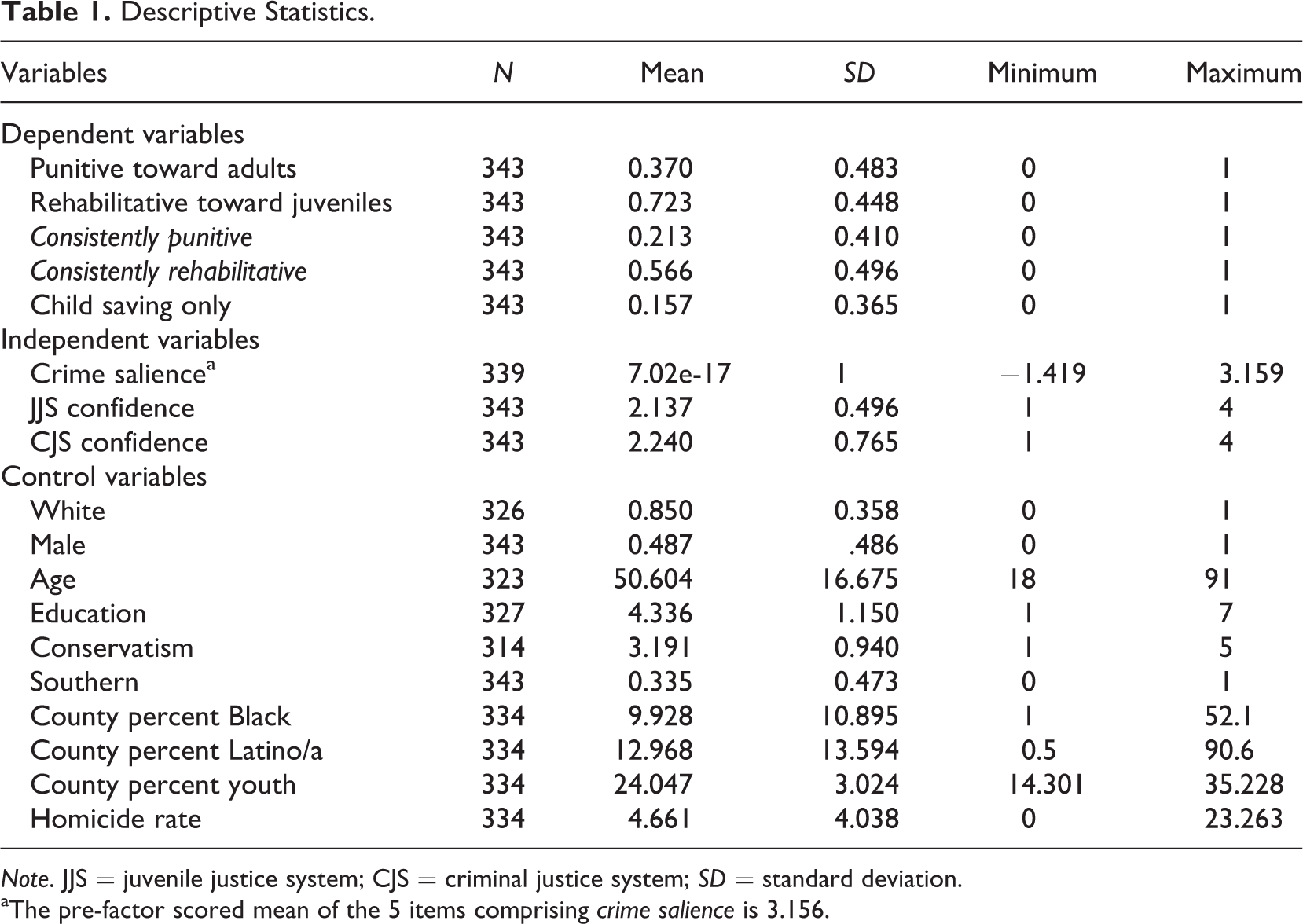
Note. JJS = juvenile justice system; CJS = criminal justice system; SD = standard deviation.
aThe pre-factor scored mean of the 5 items comprising crime salience is 3.156.
Independent variables
In this study, we examined responses to five questions gauging emotional and cognitive crime salience. To measure fear of victimization, respondents were asked (with mean responses following in parentheses), “On a scale from 0 to 10, with 0 being not at all afraid and 10 being very fearful, how much would you say you fear (a) being murdered? (1.92), (b) being robbed or mugged? (3.09), and (c) having your home broken into? (3.65).” The questions measuring respondents’ cognitive perceived risk of victimization are “Now I want you to rate the chance that the following type of crime will happen to you or someone close to you during the coming year. On a scale from 0 to 10, where 0 means not at all likely and 10 means very likely, how likely do you think it is that you or someone close to you will (a) be a victim of a violent crime? (2.93) and (b) be a victim of a non-violent crime?” (4.19). Because of conceptual similarities and because preliminary analyses of variance inflation factors (VIFs) and tolerance levels indicated the presence of multicollinearity among these items, we explored the need for creating separate fear and perceived risk indexes that would properly weight each individual variable contributing to the overall scales (Kim & Mueller, 1978). Principal component varimax-rotated factor analysis indicated that, in fact, a single factor score for the construct crime salience (α = .826) best represents these 5 items, the pre-factor scored mean for which is 3.156.
Since perceptions of the CJS and the JJS may influence one’s orientation toward punishment, measures representing the two variables CJS confidence and JJS confidence were created from questions asking “Overall, would you say your state’s (a) criminal justice system/(b) juvenile justice system is doing an excellent, good, fair, or poor job?” Response options were excellent (=4), good (=3), fair (=2), or poor job (=1). The means of 2.24 for CJS confidence and 2.14 for JJS confidence indicate that people believe both systems are doing between a fair and good job but that the CJS is doing a slightly better job. 5
Additional predictor variables
The inclusion of additional predictor variables controls for other potential influences on the primary relationships examined in this study and expands the scope of exploration. As with previous research on attitudes about punishment orientation (Borg, 1997; Chiricos et al., 2004; Rossi & Berk, 1997; Welch, 2011), we include race, sex, and southern residence, which are dichotomous and operationalized as White, male, and southern (=1). Age is measured in years (Rossi & Berk, 1997). Education was coded according to level of achievement, as follows: less than high school (=1), 9th–11th grade (=2), high school degree (=3), some college or an associate’s degree (=4), bachelor’s degree (=5), master’s, law, or similar nondoctoral degree (=6), PhD, medical degree, or other degree beyond a master’s (=7; Costelloe et al., 2009). Political ideology was measured on a 5-item scale that asked whether people describe themselves as politically very liberal (=1), liberal (=2), middle of the road (=3), conservative (=4), or very conservative (=5; Welch et al., 2011). Because previous research has demonstrated that regional contexts can influence views about crime and punishment (Baumer et al., 2003), our analyses also include characteristics of respondents’ counties. Census data from 2010 (the closest year to data collection) allow the inclusion of variables for the percentage of the county that is Black (county percent Black) and Latino/a (county percent Latino/a), which have both been associated with increased punitiveness. Since the proportion of youth in a community could conceivably influence views about how to best handle delinquency, we include a measure of the percentage of a county that is younger than 18 years old (county percent youth). Further, we control for an objective risk of crime, which is predicted to increase punitiveness, by including the average homicide rate from the Uniform Crime Report (U.S. Department of Justice, 2009) in the respondents’ counties from 2007 to 2009.
Analytic approach
Means, standard deviations, and value ranges for the variables in the analyses are provided in Table 1. To address missing values, we use multiple imputation (m = 20) in order to preserve the sample size and avoid the potential bias that various deletion methods would introduce (Allison, 2002). We used the multiple imputation with chained equations command in Stata 14. Twenty imputed data sets were generated using an equation that included all the variables in our study. Pooled parameter estimates were then calculated using mi estimate.
In Table 2, a correlation matrix using Pearson correlation coefficients indicates how individual items are related to one another. Logistic regression is used to estimate this study’s multivariate models, since each dependent measure in these analyses is dichotomous. Because four of this study’s predictor variables are measured at the county level, we tested whether a multilevel model would best fit the data. There was no significant variance of punitive toward adults, punitive toward juveniles, consistently rehabilitative, or child saving only at the county level (interclass correlations were 9.57e-22, 1.67e−21, 9.42e-26, and 5.87e-16, respectively). Two percent of the variance of consistently punitive was found at the county level, but it was not statistically significant (intraclass correlation coefficient (ICC) = .028, p = .31). Thus, the use of hierarchical modeling is unnecessary (Castro, 2002). Tests indicate no multicollinearity in this study’s models (all VIFs < 10; condition indexes < 30; Belsey, Kuh, & Welsch, 2004).
Bivariate Correlations.

Note. N = 334. Pearson’s r is used for calculations. JJS = juvenile justice system; CJS = criminal justice system.
*p < .05.
A series of five multivariate models are estimated in accordance with this study’s research questions. First, punitive toward adults and, separately, rehabilitative toward juveniles are regressed on crime salience, CJS confidence, JJS confidence, and all control variables. We next examine the effect of crime salience, CJS confidence, and JJS confidence on being consistently punitive toward both adults and juveniles, followed by the effect of those same three measures on being consistently rehabilitative toward both adults and juveniles. The final logistic regression model examines the effect of the independent and control variables on child saving only. In all analyses, two-tailed t values determine statistical significance.
Results
The dependent variables’ means displayed in Table 1 indicate that respondents are more punitive toward adult offenders and more willing to offer rehabilitative solutions to juvenile offenders. This initially suggests that a child saving perspective among the public endures. However, a majority of respondents—more than twice as many—expressed support for rehabilitative aims across both adult CJS and JJS (57%) compared to those who are consistently punitive toward both adults and juveniles (21%). Only a limited portion (nearly 16%) of the sample supported rehabilitation for juveniles while simultaneously supporting punitive objectives for adults.
As expected, Table 2—not accounting for other effects—shows that crime salience is associated with greater punitiveness and less support for rehabilitation for adults and juveniles, both individually (more punitive toward adults as well as less rehabilitative toward juveniles) and combined (more consistently punitive as well as less consistently rehabilitative). Those for whom crime salience is higher are more likely to support child saving only. JJS confidence is correlated with being less consistently punitive, less consistently rehabilitative, and more likely to advocate for child saving only. CJS confidence is correlated with being less rehabilitative toward juveniles and less consistently rehabilitative.
Results of the binary logistic regression estimates presented in the first model of Table 3 show the effects of crime salience, CJS confidence, and the control variables on adult punitiveness. JJS confidence is omitted in this model because it is not theoretically expected to influence attitudes about the adult justice system. 6 This model indicates that crime salience is significantly associated with punitive toward adults (b = .520, p < .001); for every one-unit increase in crime salience, the odds of supporting the harsh justice system responses of arresting or punishing adult offenders increases by 68%. Also with greater odds of indicating punitiveness toward adults are males, conservatives, and those with less formal education. Confidence in the CJS is not associated with views about adult punishment. In the model predicting rehabilitative toward juveniles in Table 3, results indicate that only females and ideological liberals have greater odds of endorsing prevention through early intervention, treatment, or skills and employment training, for juvenile offenders; male and conservatism are negatively related to the dependent measure. Crime salience and JJS confidence are not associated with support for juvenile rehabilitation.
Logistic Regression Examining the Effect of Crime Salience and Justice System Confidence on Support for Punitive Adult and Rehabilitative Juvenile Policies.
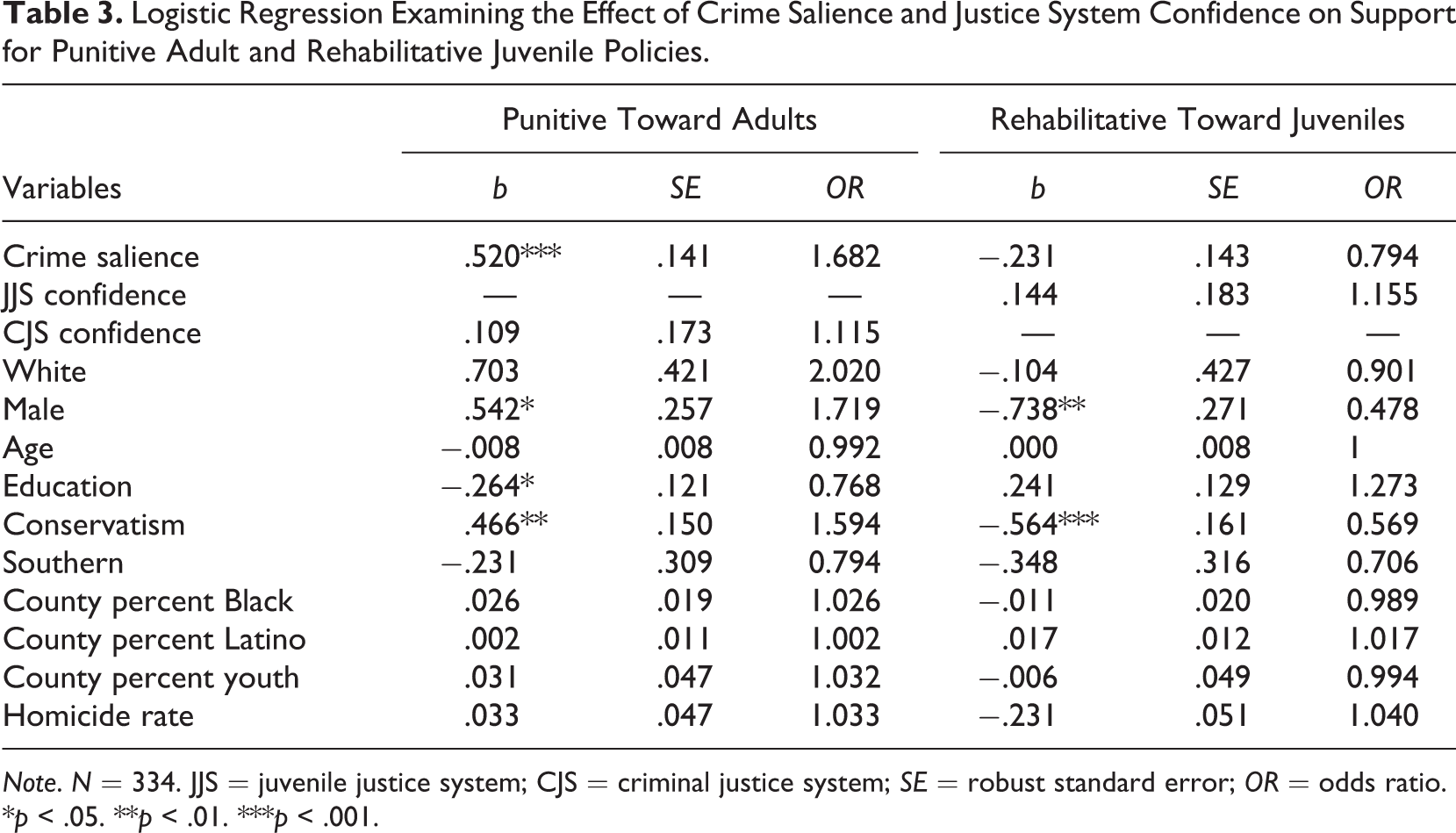
Note. N = 334. JJS = juvenile justice system; CJS = criminal justice system; SE = robust standard error; OR = odds ratio.
*p < .05. **p < .01. ***p < .001.
Table 4 shows the logistic regression results for the three models predicting (1) punitiveness toward both adult and juvenile offenders, (2) rehabilitativeness toward both adult and juvenile offenders, and (3) support for harsh adult punishment and concurrent support for juvenile rehabilitation. The model predicting being consistently punitive about crime and delinquency shows only marginal effects of crime salience (b = .283, p = .068). Confidence is unrelated to consistently punitive. Significantly associated with simultaneous punitiveness toward both adults and juveniles is only male and conservatism. In the model predicting consistently rehabilitative, on the other hand, the coefficient for crime salience is negative and statistically significant (b = −.514, p < .001); for every one-unit increase in crime salience, the odds of supporting rehabilitation for both adult and juvenile offenders decreases by 40%. As with before, the belief that the CJS or JJS is doing a good job is unrelated to punishment orientation—there is no association between JJS confidence or CJS confidence and consistently rehabilitative. Men and ideological conservatives have lower odds than women and ideological liberals of being consistently rehabilitative, and those with more education have a greater probability of supporting rehabilitation for adult and juvenile offenders.
Logistic Regression Examining the Effect of Crime Salience and Justice System Confidence on Consistent Punitiveness, Consistent Rehabilitativeness, and Simultaneous Support for Rehabilitative Juvenile Policies and Punitive Adult Policies.
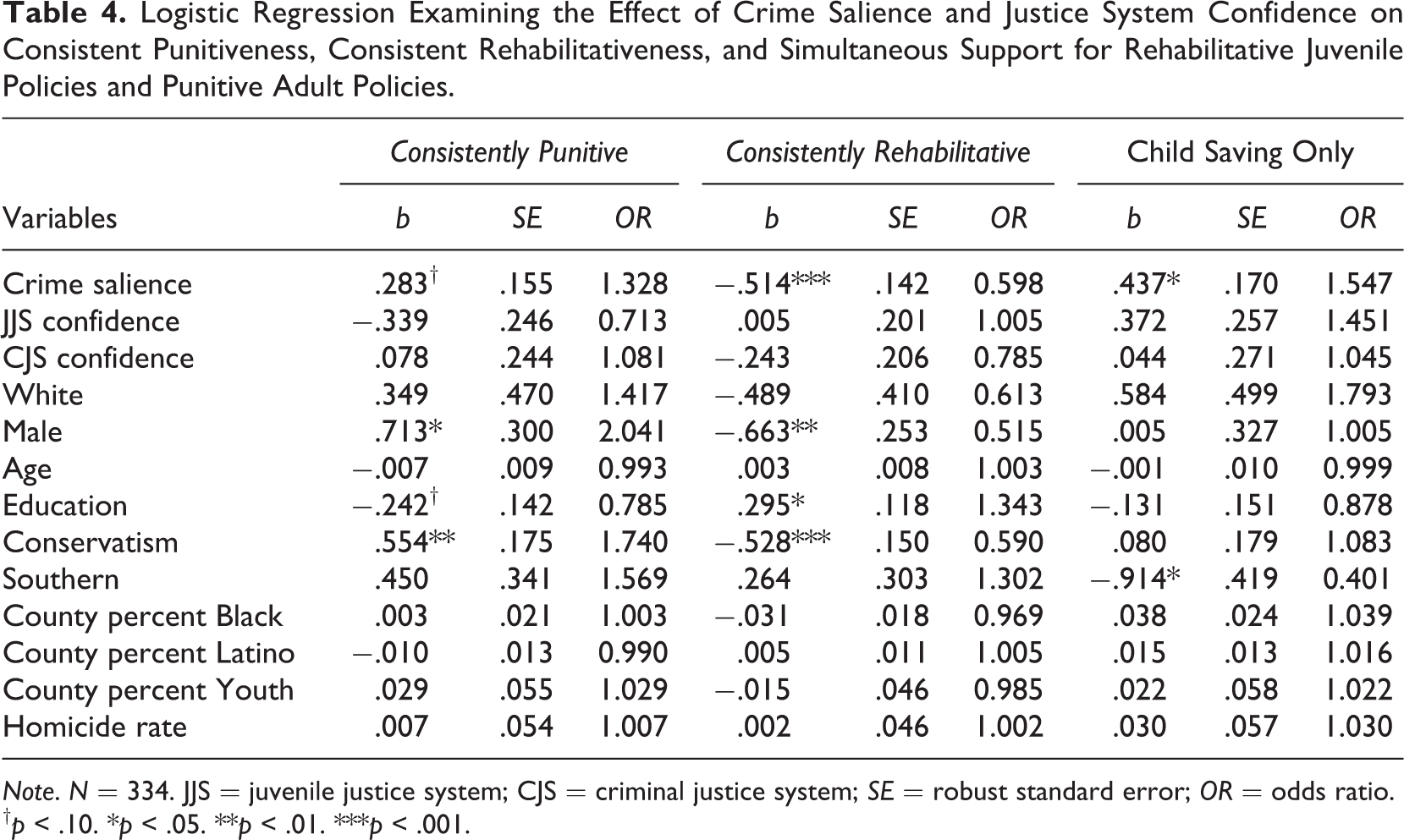
Note. N = 334. JJS = juvenile justice system; CJS = criminal justice system; SE = robust standard error; OR = odds ratio.
† p < .10. *p < .05. **p < .01. ***p < .001.
Finally, the third model in Table 4 explores what influences people to support child saving for juvenile offenders yet harsher treatment for adult criminals. This analysis affirms the role of crime salience as an important influence on justice system ideology that differentially prioritizes juvenile rehabilitation. Here, results indicate that fear of crime and perceived risk of victimization are related to the belief that juveniles should be rehabilitated even though adults should be treated punitively in the CJS; crime salience is associated with a greater likelihood of supporting child saving only (b = .437, p = .01). A one-unit increase in crime salience increases the odds of endorsing child saving only by 55%. Once again, JJS confidence and CJS confidence are not significantly related to child saving only. Notably, for the first time in any of the multivariate analyses, southern is not only statistically significant (p = .029), but it is the only other significant influence on the likelihood of having child saving only views; southerners are 40% less likely than those living in other U.S. regions to support child saving only.
Discussion
With the Trump administration’s recent indication that it intends to reduce the availability and use of rehabilitative treatments for all offenders, redefine juveniles in the justice system as more menacing and irredeemable, and to intensify the harshness of punishment for offenders of all ages (Bump, 2018; Pilkington, 2018), now is a particularly important time to unpack how the public (including constituents who may influence executive directives and others) comes to support either get-tough policies or reform. Taking a closer look at the cut point that separates punitiveness from rehabilitativeness among those who share both views, but for different classes of offenders, could help us understand more about the nature of how those views develop. If public sentiment has the power to influence public policy, as many have shown (Green, 2006; Roberts, 2004), learning about how those sentiments form is critical. Identifying the forces driving some people to support rehabilitation for certain offenders but not others could contribute to expanding the scope of to whom the public endorses extending rehabilitative sanctions. And this change could have the potential to inspire some meaningful policy initiatives by government leaders or possibly stymie certain less thoughtful policies.
This study is the first to explore the possibility that crime salience and confidence in the CJS and JJS contribute to promoting child saving for juvenile delinquents yet harsher treatment for adult criminals. We also examined whether crime salience and justice system confidence were related to supporting harsh policies toward criminals or rehabilitative policies toward juveniles. Further, our analyses assessed these potential influences on being simultaneously punitive or simultaneously rehabilitative toward both adults and youth. This research has revealed nuances in these relationships that are important to understand because of the well-documented negative consequences of harsh treatment for offenders—particularly for juvenile offenders—and the promising effects of rehabilitation.
The answers to our four research questions correspond with Jonson, Cullen, and Lux (2013) observation that “although a healthy reservoir of public punitiveness exists, these sentiments are often overestimated by traditional public opinion research,” research that frequently fails to detect nuance or account for differential effects (p. 52). The present study was an attempt to reveal certain complexities in ideology about punishment and to potentially offer ways by which public opinion could be better informed about crime and justice, with the ultimate objective of promoting more productive crime and delinquency policies and practices.
As with prior research, the answer to the Research Question 1 corroborates the finding that fear of crime and perceived risk intensify punitive dispositions and decrease support for rehabilitation but only when the offenders are adults. Crime salience appears to have no effect on views about juvenile-specific sanctions, suggesting that perhaps crime fear and perceived risk are partially the result of perceptions of adult offenders as more threatening, more culpable, or less able to change their criminal ways than minors. Thus, when crime seems like a bigger problem, many may perceive that adults are largely responsible for it and should, therefore, be punished harshly and not receive rehabilitation. The lack of effect of crime salience on views of juvenile-specific treatment indicates that regardless of whether crime is prominent in one’s consciousness, individuals may already be likelier to support rehabilitation for kids. It would be striking if either of these explanations is true, given the way that moral panic over supposed juvenile super-predators generated a range of harsh policies in earlier decades. These results demonstrate that public emotion about crime and calculations of risk do not manifest in punitiveness toward juveniles, even though they do when it comes to adults. However, with new initiatives to reorient the JJS toward harsh punishment and depict juvenile offenders as a public threat (as opposed to troubled youth who need extra help), it would not come as a surprise if the public begins to, once again, succumb to a new moral panic. It would be useful for research to establish how people typify criminals as either adults or juveniles and to incorporate these elements into future questions about the effects of crime salience.
With regard to the role of confidence in the CJS and JJS, the findings produced here suggest that not only do these views have no meaningful effect on preferences for harsh adult punishment or rehabilitative juvenile treatment (as was the focus of Research Question 1), but that they have no effect on justice ideology in any of this study’s other multivariate analyses (i.e. Research Questions 2 and 3). This finding may be troubling to concerned taxpayers who expect particular outcomes from justice expenditures. For better or worse, the public’s punishment orientation is unaffected by whether it believes the CJS or JJS is doing a good job or a poor job. It would be useful for future research to assess what features of either justice system might give respondents confidence in them (or not) and in what ways those features are related to how these institutions are expected to carry out “justice.” In the present study, we cannot tell whether confidence is gained from successful rehabilitation, decreased recidivism, organization, or efficient budgeting, for example. It is also possible that if individuals believe the justice systems should just be delivering retribution, doing a “good job” may not actually be what some members of the public want from these institutions. More specific questions in future research may reveal effects on punishment ideology that this study was not able to uncover.
In the analyses exploring our Research Question 2 about the consistency of justice ideologies, an intriguing pattern emerged. Crime salience does not contribute to the odds of being punitive toward offenders of all ages; high fear and perceived risk do not matter. But, low crime salience is, in fact, associated with a greater likelihood of supporting rehabilitative justice system responses for both adults and juveniles. It is very possible that individuals who are consistently punitive believe that harsh justice system responses are simply good policy or that juvenile offenders should be treated the same as adults, no matter how problematic crime seems. Those who consistently support rehabilitation, however, have an ideological preference that is less impervious to personal fear or perceived risk. This seems to suggest that the public imagines the typical criminal as an adult, so when crime appears to be a bigger problem, it may be supportive of harshly punishing adults (the perceived source of the threat) but not change its support for reforming kids. When it comes to youth, violations of the law may be perceived as less threatening. Thus, the lack of relationship between crime salience and consistent punitiveness may be a function of salience increasing punitiveness toward adults but not kids. Again, we could benefit from future research that tests whether crime salience is amplified by perceptions of adult criminals—but not juvenile delinquents—as dangerous, blameworthy, or irredeemable because, in the present study, we are unable to know why low salience seems to magnify support for constructive approaches to adult and juvenile offending, but high salience does not similarly enhance support for punitive adult and juvenile approaches to justice.
Our Research Question 3 was the centerpiece of this study. In exploring the influences on a child saving only perspectives, we found further evidence that crime salience matters for attitudes toward adult offenders but not toward juveniles. Crime salience does, in fact, increase the likelihood that one will adopt a pro-reform stance toward kids in spite of being otherwise punitive toward adult criminals. It is plausible that adult offenders are so strongly associated with crime threat that people’s views toward youthful offenders remain unaffected by the perceived prominence of crime. Moreover, when it comes to juveniles, fear and perceived risk might actually elicit a desire to be more protective of a young population that may be perceived as more vulnerable and less culpable, with a greater capacity to be reformed. Learning more about how crime becomes salient and about beliefs regarding who is typified as criminally threatening would be a valuable subject of future research.
In answering our Research Question 4 about the effects of other characteristics and conditions on justice ideology, we found that, for the most part, women, political liberals and moderates, and those with more education favor rehabilitating law violators, regardless of whether the lawbreakers are adults or youth. These results comport with the findings of prior research. However, we were surprised to find that southerners are not more likely than others in the United States to be punitive toward adults or less likely to be rehabilitative toward juveniles. Southern residence also did not relate to consistently harsh or consistently rehabilitative perspectives. This presents a contrast to prior research on the “southern subculture of punitiveness” (Borg, 1997), which has found consistent evidence that southerners are more supportive of harsh punishments than others. Yet, aside from those opposing findings, in this study, southerners are less likely than nonsoutherners to advocate for juvenile rehabilitation while supporting punitive criminal policies, demonstrating the degree to which nonsoutherners support juvenile rehabilitation despite adult punitiveness. The evidence that southerners are less likely to maintain a child saving perspective in the face of harshness toward adults is a phenomenon that would benefit from further exploration. Given the detrimental effects of harsh legal sanctions (particularly for kids), it would be useful to know what contributes to non-southerners’ clear distinctions between delinquents and criminals in order to promote similar frameworks elsewhere. It would be valuable for future research to also explore the possible effects of other influences on ideology.
Results indicated that there were no contextual influences on punishment ideology. In none of the multivariate analyses was Black composition, Latino/a composition, youth composition, or the homicide rate associated with justice system orientation, which is a substantial finding in itself. Although the percentage of Blacks and Latino/as indicated a possible minority threat effect (wherein harsher social controls are expected when a perceived threat to the White majority is presented by a growing population of persons of color) in the bivariate analyses, racial and ethnic composition did not appear to matter for justice ideology when other potential influences were taken into account. Similarly, although one might expect people to be more punitive and less rehabilitative in areas with high crime—particularly with high homicide rates—this did not bear out in these analyses. The contextual influence of living in areas with proportionally more juveniles also did not inspire greater rehabilitativeness toward juveniles (or harshness, for that matter) and did not manifest in an ideological difference toward juvenile and adult offenders. We could benefit from future research that explores to what extent these results are a function of the counties being represented, the wording of the questions comprising the justice system approaches, or the separate consideration of adults and youth.
These conclusions should be weighed in light of several study limitations. Among them, the sample is older and includes proportionally more White respondents than the national population, thus limiting the generalizability of these findings. The use of cross-sectional data precludes determining causality between individual traits and justice system philosophies, a limitation that could be avoided with longitudinal approaches. It is important to consider that many of the variables included in the models here were measured according to respondent perceptions, an inherent quality of survey research. Accordingly, because of the limited range of measures available to us, we do not know to what extent respondents were able to accurately distinguish between the criminal justice system and the juvenile justice system; had we been able to ensure this distinction was appreciated, some significant relationships between confidence in the systems and preferred justice outcomes might have emerged. Additionally, research that is able to assess the elements that promote confidence in the justice systems could help us better understand the relationship with justice ideology. Further, because survey respondents were allowed to select only a single preferred justice objective, the variables for punitiveness and rehabilitativeness were mutually exclusive of each other. Yet research has shown that support for rehabilitative and preventive aims is not necessarily incongruous with concurrent support for punishment (Jonson et al., 2013; Mascini & Houtman, 2006; Pickett & Baker, 2014; Pickett, Chirico et al., 2014). We encourage future research that is able to explore these multilayered perspectives in greater detail.
Conclusion
Despite these limitations, this study offers a new look at the dynamics involved in the development of justice philosophies toward adult and youthful offenders, with results that imply some pathways for potentially expanding public support for rehabilitation. We found that when crime seems like a big problem, people will become resistant to rehabilitation and instead translate those perceptions into support for harsher policies—but only for adults. Reducing public fear of crime and associated beliefs about the likelihood of victimization could result in more widespread advocacy for adult offender treatment and reform. If policy makers were to undertake campaigns to reduce crime salience, by encouraging the media or by toning down their own panicked rhetoric about crime, we might see less support for destructive and costly criminal justice practices. This study also demonstrated the importance of understanding why it is the case that perceptions of crime prominence do not make people want harsher policies for kids who break the law. Why does crime prominence not translate into harsher positions toward youth? At what age do people believe individuals become more responsible for their actions or more dangerous? At what point do we give up hope that an offender can be reformed into someone who is law abiding? The answers to these questions may help establish more productive ways of conveying information about crime and justice, thereby indirectly reducing some troubling consequences of unnecessarily punitive offender treatment and expanding constructive policies and programs with demonstrated success, such as drug treatment, education, and employment opportunities that both precede and follow convictions and adjudications. These answers may also help avert a potential new moral panic about crime and delinquency.
Footnotes
Acknowledgments
The authors gratefully acknowledge Thomas Baker for his helpful ideas at early stages of this project and Jerusha Conner and Emily Carson for feedback at later stages. They also thank Denise Wison for assistance collecting literature.
Declaration of Conflicting Interests
The authors declared no potential conflicts of interest with respect to the research, authorship, and/or publication of this article.
Funding
The authors received no financial support for the research, authorship, and/or publication of this article.
