






Abstract
As a step towards comprehending what drives the management of construction waste in the occupied Palestinian territory, this paper quantifies construction waste generation and examines how the local contractors’ waste management attitudes and behaviour are influenced. Collection of data was based on a survey, carried out in the southern part of the West Bank between April and May 2010. The survey targeted contractors who specialized in the construction of buildings. A logistic regression model was used to investigate the relationship between various attributes and the attitudes and behaviour that the local contractors demonstrate towards waste management. The results showed that during the construction of buildings, 17 to 81 kg of construction waste are generated per square metre of building floor. Although the area of a building is the key factor determining 74.8% of the variation of construction waste generation, the employment of labour-intensive techniques in the study area means that human factors such as the contractor’s attitude and behaviour towards waste management, exert a key influence on waste generation. Attitudes towards the 3Rs of waste minimization and behaviour towards waste disposal are generally positive with smaller contractors exhibiting more positive attitudes and more satisfactory behaviour towards waste management. Overall, while contractors’ behaviour towards waste sorting and disposal tends to be more satisfactory among contractors who are more conscious about the potential environmental impacts of construction waste, it was generally observed that in the absence of a regulatory framework, the voluntary attitudes and behaviour among the local contractors are mostly driven by direct economic considerations.
Keywords
Introduction
The construction of a new building (fixing of steel load-bearing frames or reinforcement, mixing and casting of concrete, tiling and plastering etc.) generates a growing stream of waste which absorbs significant parts of the landfill capacities in many parts of the world (Dong et al., 2001; Hsiao et al., 2002; Ingalls, 2000; Ortiz et al., 2010; Stokoe et al., 1999; Wang et al., 2008). In this context, the management of this waste stream emerges as one of the key environmental priorities for developed and increasingly for developing countries.
The well known hierarchy of waste management, listed in order of importance, comprises the 3Rs of waste minimization, i.e. source Reduction (also referred to as prevention), Reuse and Recycling (Tam, 2009; Wang et al., 2010), followed by incineration with energy recovery and safe disposal.
Indisputably the top ‘R’ of the hierarchy, Reduction, is the most desirable form of waste management and construction waste is not an exception to this rule as source reduction offers not only environmental advantages in comparison with other options but also direct economic ones (Begum et al., 2006; Esin and Cosgun, 2007; Guthrie et al., 1999; Poon, 2007).
Nevertheless, since construction materials have high potential for on-site reuse and off-site recycling (Hettiaratchi et al., 2010) the options of the other two ‘R’s: Reuse and Recycling also become attractive. In the European Union, the 2008 Waste Framework Directive (Anonymous, 2008) requires the EU Member States to take any necessary measures to achieve the reuse, recycling and other material recovery of construction and demolition waste to a level exceeding the target of 70% by 2020. For many developing regions, however, such ambitious recycling, reuse and recovery targets seem rather unrealistic due to several challenges faced, including the lack of a specific legislative framework, the treatment of this stream together with municipal solid waste despite the differences in physical and chemical properties (Agamuthu, 2008), financial constraints as well as the lack of public cooperation and participation (Kofoworola and Gheewala, 2009).
Background
Construction waste generation
According to Yost and Halstead (1996) estimates of the overall volumes of construction waste generated, have often been based on per capita multipliers in a similar way to municipal solid waste estimates. However, per capita construction waste generation rates vary considerably both among countries – values cited in literature illustrated in Figure 1 range from 18 kg capita−1 in Thailand (Kofoworola and Gheewala, 2009) to 5900 kg capita−1 in Luxembourg (Fischer and Werge, 2009) – but also from year to year (Yost and Halstead, 1996). Such variations do not reflect only actual spatial and temporal differences to the construction activity but also differences in the definitions and procedures for registration of this type of waste (Brodersen et al., 2002; Fischer and Werge, 2009). Due to these shortcomings, the use of per capita multipliers in extrapolations from a sample to a population has been criticized by previous research (Donovan, 1990; Keller, 1989; Yost and Halstead, 1996). According to Hettiaratchi et al. (2010) the inability to predict time-dependent and activity-specific waste generation rates is a key barrier to the successful implementation of a construction waste minimization programme.

Summary of per capita estimates of construction waste generation in different countries from literature [Source: (1) Fischer and Werge (2009); (2) Nunes et al. (2007); (3) Kofoworola and Gheewala (2009); (4) DSM Environmental 2008].
For buildings, quantification of construction waste can typically rely upon variables which reflect the size of the project, for example, the financial value of building permits (Yost and Halstead, 1996), the quantities of input materials (Bossink and Brouwers, 1996; Solís-Guzmán et al., 2009) and the area of constructed building floor (Fatta et al., 2003; Kartam et al., 2004; Kofoworola and Gheewala, 2009; Lauritzen, 1994). Although the size of the project is the most significant variable affecting waste generation, it is not the sole factor influencing waste generation. Several authors have examined construction waste on a project basis (Bossink and Brouwers, 1996; Craven et al., 1994; Ekanayake and Ofori, 2004; Gavilan and Bernold, 1994; Innes, 2004; Keys et al., 2000) and identified several factors affecting its generation including the design, the quality of procurement, the construction techniques applied and the performance of the contractor.
The performance of the contractor is a particularly complicated element in the waste generation equation. Due to the labour-intensive nature, human factors – an emerging topic for research in this field (Yuan and Shen, 2011) – reflected by attitudes towards waste management and therefore related behavioural impediments, are likely to exert key influence to waste generation and management (Loosemore et al., 2002; Teo et al., 2000).
Attitude and behaviour
‘Attitude’ is the positive or negative feeling towards a specific object and ‘behaviour’ is an action towards that object. Attitudes are generally based upon the positive or negative evaluation of the consequences of a given behaviour and on personal beliefs about those consequences (Teo and Loosemore, 2001; Wang and Yuan, 2010). At the same time behavioural decisions are frequently based on attitudes towards that object, whether consciously or not (Begum et al., 2009). However the relationship between the two can be quite complex (Barr et al., 2001) and the empirical research on the attitude-behaviour link has been yielding contradictory results (Van Doorn et al., 2007). The attitudes of people involved in the construction industry play a critical role in controlling the waste generation. Interdisciplinary approaches between all stakeholders are essential for successful waste management practices (Graham and Smithers, 1996). The importance of human factors in waste minimization was highlighted by Loosemore et al. (2002) and Skoyles and Skoyles (1987) who argued that waste can be prevented by changing people’s attitudes. According to Begum et al. (2009) factors such as the contractor’s size, the education and training background of the workers and the waste management practices applied including source reduction, reuse and recycling measures, frequency of waste collection and waste disposal, influence the attitude and behaviour of a contractor towards waste management.
The specific situation of the occupied Palestinian territory
Over the last decade, the occupied Palestinian territory has been subject to intense construction activity, mainly a result of extensive damage to private and public buildings suffered in the context of the ongoing conflict. Construction of new buildings in the West Bank of the occupied Palestinian territory accounted for 85% of the total new surface area licensed for construction activities in 1999 (United Nations, 2004). This cycle of destruction and upgrading activities produces large amounts of construction waste. However, no sanitary landfills currently exist in the occupied Palestinian territory, construction waste is not subject to a specific regulatory framework and no published research has looked into construction waste management in this region.
In comparison with other construction activities, building construction is highly labour intensive and thus more likely to be influenced by attitude and behaviour. The present paper quantifies waste generation from building construction in the West Bank of the occupied Palestinian territory and, by considering factors which can potentially affect the related attitude and behaviour of the local contractors, examines how the local contractors’ waste management attitudes and behaviour are influenced.
Research methods
Data collection and sampling
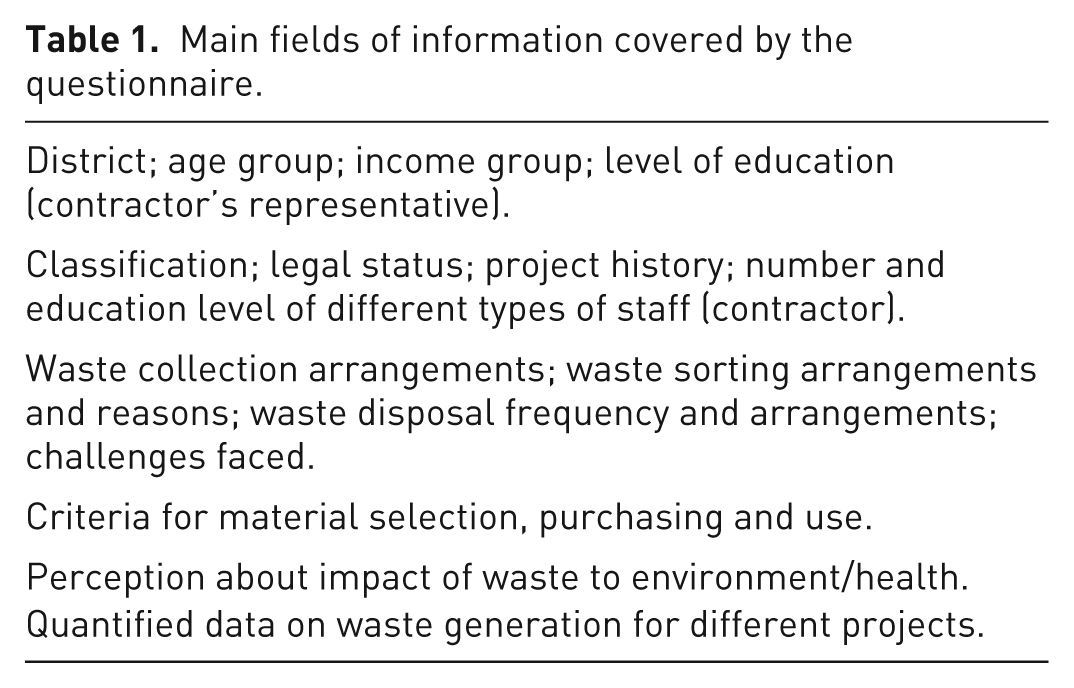
A structured questionnaire was designed to determine whether contractors attitudes towards the 3Rs of waste minimization, are positive or not and whether their behaviour towards waste sorting and disposal are satisfactory or not, while allowing a quantification of construction waste generation and a determination of disposal practice in the occupied Palestinian territory. The questionnaire also included targeted questions to collect information on those factors which, according to Begum et al. (2009), influence a contractor’s attitude and behaviour towards waste management: contractor’s type, size and experience, education and training background of the workers and waste management practices applied (Table 1).
Main fields of information covered by the questionnaire.
A survey was carried out among building contractors operating in the area under study. For sampling purposes, the population of 103 relevant contractors registered at the Palestinian Contractors Union (PCU) (PCU, 2009) at the study’s cut-off date (1 February 2010), was stratified into three groups, each covering two consecutive categories of the PCU’s classification system for building construction specialization. Hence the sample stratification was based on the same criteria used for this classification: contractor’s capital; work experience; professional licence; human resources and their qualifications; office infrastructure.
A total sample size of 83 contractors (Table 2) was determined from the population of 103, using the following formulae (Hogg and Tannis, 1997) for each stratum:
where m is the sample size of unlimited population; n is sample size of limited population; Z is the standardization value corresponding to confidence level (Z = 1.95 for 95% confidence level); P is the proportion of success (assumed 50%); and ϵ is the maximum error of the point estimate.
Stratified sample size of survey.

The questionnaire was completed through direct interviews of the targeted sample population. The contractors were represented by persons familiar with onsite practices, in most cases the project managers. Prior to the interviews, contractors in the sample were contacted in person and briefed about the survey and its objectives. This contributed to achieving a survey response rate of 100%.
Data analysis
The statistical analysis was carried out using the statistical package for social sciences software (SPSS Inc., Chicago, IL, USA.), version 15. The cross tabulation and frequencies tests were applied to determine the contractors’ attitudes and behaviour. Furthermore, a logistic regression model (LRM) was used to identify the most significant factors affecting the contractors’ attitudes and behaviour towards construction waste management. The same model was also used to determine the direction of the relationship between these factors and the attitude and behaviour of the contractors in the study area (Begum et al., 2009).
where Pi = 1 if contractor’s attitude or behaviour towards construction waste management is positive or satisfactory respectively, and Pi = 0 if not; Xi are the independent variables, listed in Table 3; β0 is a constant term, assumed zero; β i are the coefficients of the independent variables; e is the error term; and i = 1, 2, …, n is the number of variables in the model. The direction of the relationship between the dependent variable Pi (attitude or behaviour) and the independent variable Xi is determined by the sign of the coefficient β i .
Summary of independent variables in the LRM.

Once the dependent variables were transformed into logistic variables, the maximum likelihood method was used (Gujrati (2003), cited in Begum et al. (2009); Thomas, 1985) to estimate the parameters in the LRM. The probability of certain event occurring was estimated by logistic regression through calculating the changes in the logarithm of the dependent variable. The likelihood function expresses the values of β in terms of known and fixed values for y (β is related to P) and is derived from the probability distribution of the dependent variable so that the values of β that maximize the output of this equation are the maximum likelihood estimates (Begum et al., 2009).
The Wald test was used to evaluate the significance of each coefficient in the model (Begum et al., 2009).
where i = 1, 2, …, n and S.E is the standard error.
The model was evaluated using five different tests: the log-likelihood function, the omnibus test, Cox and Snell R2, Naglekerke Ř2, and the Hosmer–Lemeshow test.
The log-likelihood function, used to measure how the model fits the data, is defined as (Begum et al., 2009)
where Yi is the actual result;
The omnibus test was employed to test the coefficients in the model. This test indicates goodness-of-fit if the observed chi-squared is greater than the tabulated one (i.e. the assumption of all coefficients equal zero is refused if the significance value is less than 0.05), which in turn indicates the adequacy of the model for such data type.
Cox and Snell R2 was used to evaluate the goodness-of-fit because it determines the proportion of the variation in the dependent variable made by the independent variable of the model.
As Cox and Snell R2 cannot achieve a maximum value of 1, Nagelkerke Ř2 was also used. This also determines the variation proportion in the outcome made by the independent variables of the model.
Finally, the Hosmer–Lemeshow test was employed. This test indicates that the model fits the data well if the significance value corresponding to chi-squared is greater than 0.05 (i.e. the null hypothesis of the model that means there is no difference between observed and predicted values, will not be rejected). As such, the larger the chi-squared is, the better the model fits the data.
Results and discussion
Construction waste generation
The quantification of waste generation was based on the data provided by the 83 contractors in the survey sample. That data related to 47 construction sites of residential, commercial, and public building projects of different sizes. On the basis of this data the quantity of waste generated during the construction of buildings in the study area ranged between 17 and 81 kg m−2 of building floor. This generation rate range is comparable to the 20 to 50 kg m−2 estimated by Lauritzen (1994), to the 21.4 and 45 kg m−2 assumed by Kofoworola and Gheewala (2009) and Kartam et al. (2004) respectively, and the 75 kg m−2 calculated on the basis of the assumptions made by Fatta et al. (2003) is also within this range, albeit closer to the maximum value.
The values were also plotted in a graph, as shown in Figure 2. The data fitted the following linear relationship

Quantity of waste as a function of constructed building floor area from 47 served construction sites.
where Q is the quantity of construction waste (excluding any demolition or excavation waste) in metric tonnes and A is the building floor area in m2.
A strong relationship between the quantity of waste and the area of the building floor was observed with 74.8% of the variation in waste generation being determined by the variation in the building area. Residual variation is influenced by several other factors, as previously identified, including human factors reflected by the attitude and behaviour of the contractor.
Disposal practice
The survey showed that, due to the absence of regulations covering construction waste and of sanitary landfills in the occupied Palestinian territory, construction waste is mostly disposed to various types of private and municipal dumpsites. However 16.3% of contractors indicated that construction waste is disposed randomly on open land and beside public roads and 15.1% to other inappropriate locations. These, non-negligible shares, may even be an underestimate when considering that waste disposal is often sub-contracted to truck drivers which act beyond the control of the main contractor.
Municipal solid wastes dump sites as well as private or municipal construction waste dump sites are considered to be the best available options in the study area. For the purpose of this study, disposal at those sites is considered to be a satisfactory behaviour.
Factors affecting contractors’ attitudes
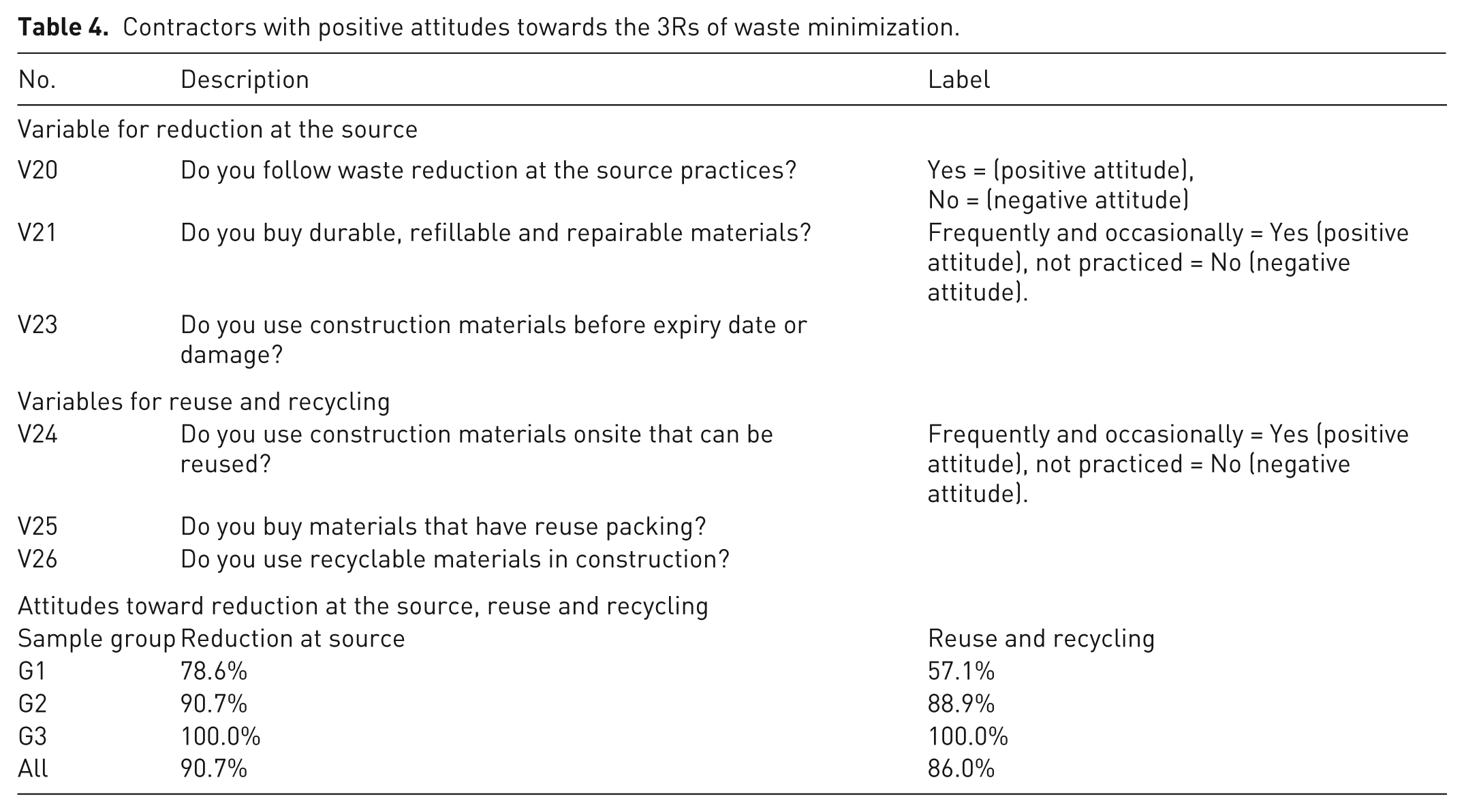
The analysis of the survey responses, as shown in Table 4, has shown that the attitudes of the local contractors towards the 3Rs of waste minimization are in principle positive. This is in line with the findings of other authors (Lingard et al., 2000; McDonald and Smithers, 1998; Teo et al., 2000).
Contractors with positive attitudes towards the 3Rs of waste minimization.
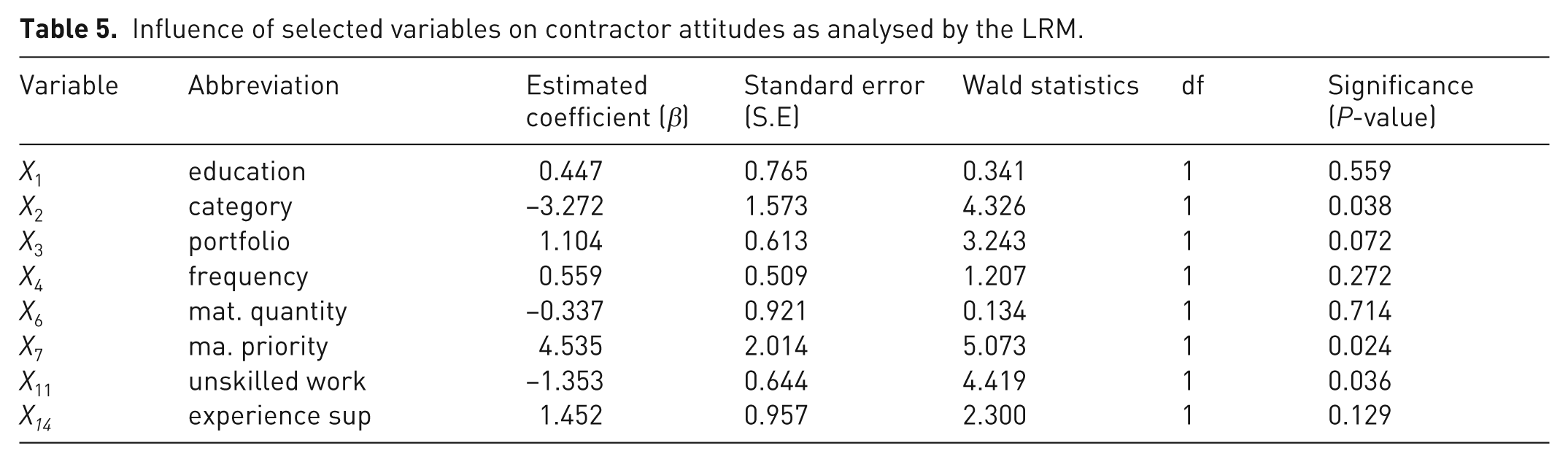
The LRM was used to identify which of the investigated factors have the most significant influence to the contractors’ attitudes towards waste minimization and to determine their relationship.
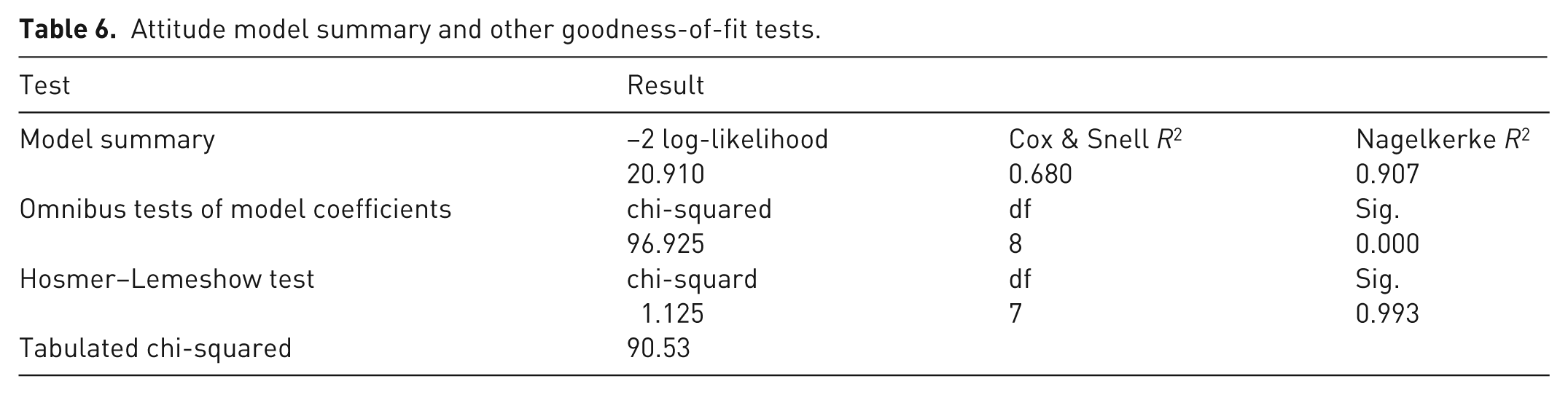
The model output, as shown in Table 5, suggests that material prioritization, number of unskilled employees and the category of the contractor are statistically the three most significant factors. Those contractors who are keen to optimize the use of construction materials, mostly driven by economic considerations since material waste implies loss of profit and competitiveness (Ekanayake and Ofori, 2004), have also more positive attitude not only towards reduction of waste at source but also for reuse and recycling. On the other hand, higher numbers of unskilled workers contribute to less positive attitudes towards waste minimization, possibly as a result of lower awareness of the impacts of construction waste amongst the workforce, misconception of the quality of recycled products, lower motivation linked to lower wages and less effective supervision. Furthermore, in contrast to Begum et al. (2009) who found that larger Malaysian contractors had more positive attitudes towards waste management, this study showed a reverse relationship between the size of Palestinian building contractors, reflected by their category, and their attitudes, with smaller contractors demonstrating more positive attitudes towards waste minimization than medium and large size contractors. The authors attribute this relationship to the higher competition among low-category contractors in the study area which results to lower profit margins: smaller contractors tend to be more vigorous towards the net economic benefits from waste minimization. The model summary and the results of the tests used to measure how the model fits the data are summarized in Table 6.
Influence of selected variables on contractor attitudes as analysed by the LRM.
Attitude model summary and other goodness-of-fit tests.
Factors affecting contractors’ behaviour
The results showed that the number of contractors demonstrating satisfactory and unsatisfactory behaviour towards waste sorting is relatively balanced among all three sample groups. With regards to waste disposal, behaviour, as shown in Table 7, is generally positive although the number of contractors demonstrating unsatisfactory behaviour and dispose waste on open land and beside roads is not negligible.
Contractors with satisfactory behaviour towards construction waste sorting and disposal.
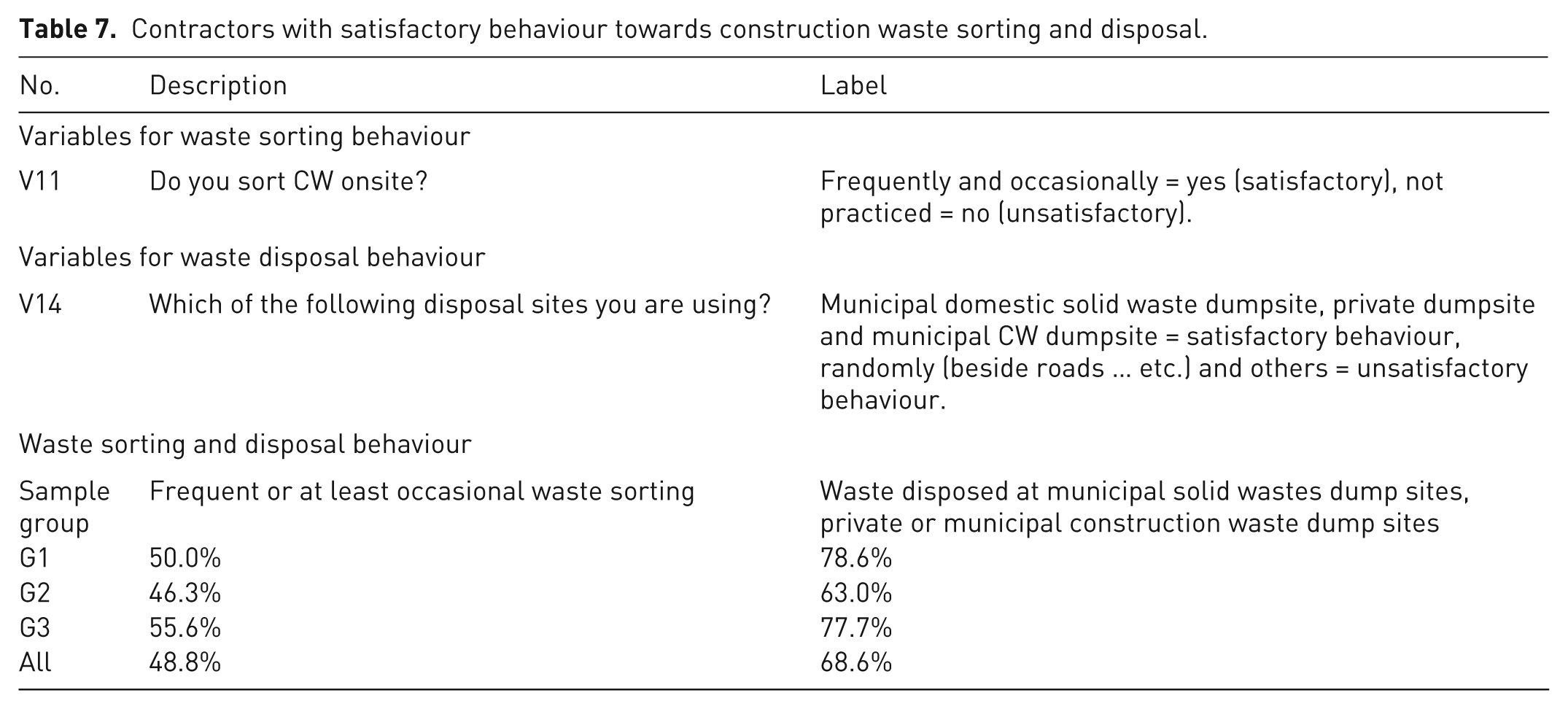
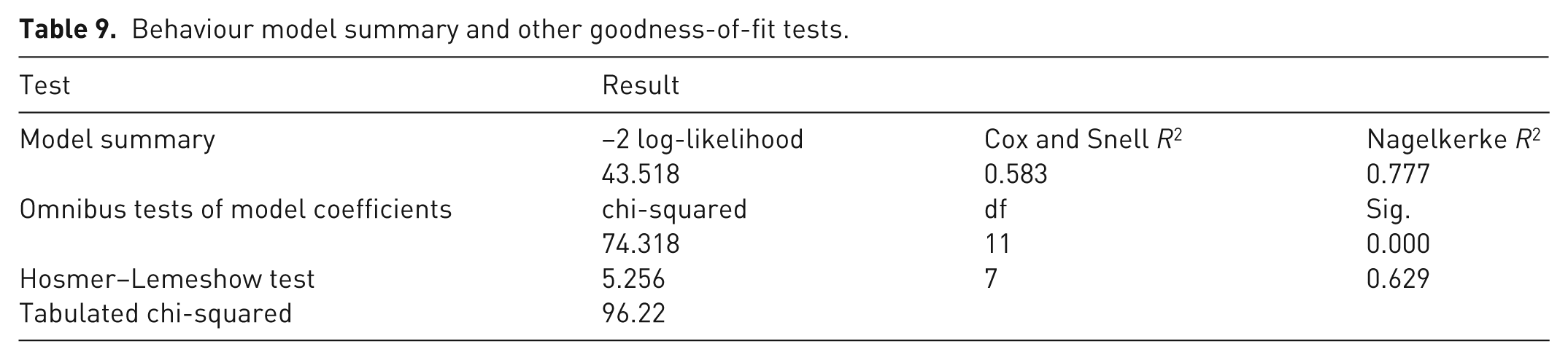
The LRM output (Table 8) suggests that the contractor’s perception of the impact of construction waste to the environment, the number of skilled employees, and the contractor’s attention to optimization of material purchasing, are statistically the most significant factors which influence contractors’ behaviour towards waste sorting and disposal. In particular, contractors’ behaviour towards waste sorting and disposal tends to be less satisfactory amongst contractors that are less conscious about the potential environmental impacts from construction waste. Furthermore the data analysis showed that contractors with higher numbers of skilled workers tend to show less satisfactory behaviour towards waste sorting and disposal. Finally those contractors who are keen to optimize the purchasing of construction materials also exhibit more positive behaviour. These findings support the presumption that, in the absence of a regulatory framework, the voluntary attitudes and behaviour among the contractors is motivated by the occurrence or not of a direct economic benefit. The model summary and the results of the tests used to measure how the model fits the data are summarized in Table 9.
Influence of selected variables on contractor behaviour as analysed by the LRM.
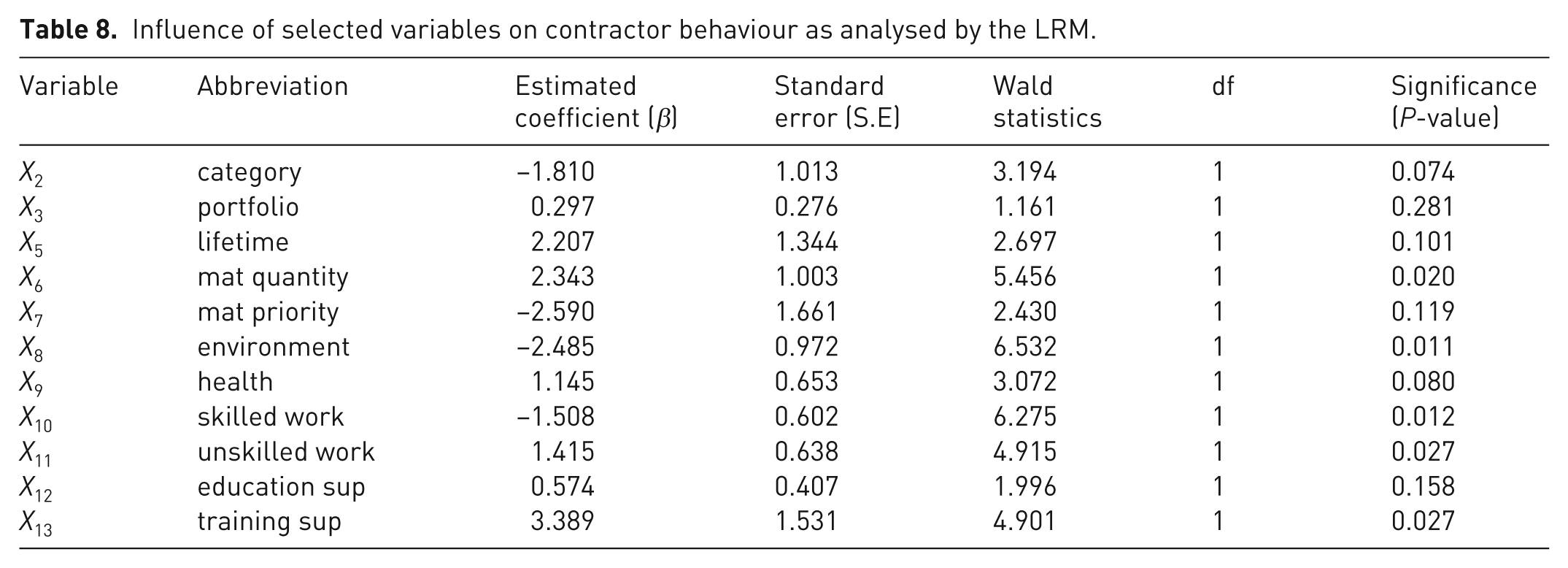
Behaviour model summary and other goodness-of-fit tests.
Conclusion
This study estimated that the quantity of waste generated during building construction in the southern part of the West Bank ranged between 17 and 81 kg m−2 of building floor. Although the area of the building determines 74.8% of the variation of construction waste generation, human factors such as the contractor’s attitude and behaviour towards waste management exert key influence to waste generation especially since labour-intensive techniques are employed.
The attitudes of the Palestinian contractors towards the 3Rs of waste minimization are generally positive. Taking into account the absence of sanitary landfills in the occupied Palestinian territory and of regulations covering construction waste, the overall behaviour of contractors towards waste disposal is considered satisfactory although the number of contractors disposing waste on open land and beside roads is not negligible. In general, smaller contractors, facing greater competition and lower profit margins, exhibit more positive attitudes towards waste minimization and more satisfactory behaviour towards waste sorting and disposal, in comparison with medium and large contractors.
The contractor’s approach with regards to the purchasing and use of construction materials has significant influence to the contractor’s attitude and behaviour towards waste management. Material waste implies loss of profit and competitiveness for the contractor. Hence contractors who are more eager to optimize material flows have generally more positive attitude and satisfactory behaviour.
Higher numbers of unskilled workers were found to have a negative influence on the contractor’s attitudes towards waste minimization and behaviour towards waste sorting and disposal. This is possibly a result of lower awareness of the impacts of construction, misconception of the quality of recycled products, lower motivation linked to lower wages and less effective supervision.
Overall, although contractors’ behaviour towards waste sorting and disposal tends to be more satisfactory among contractors who are more conscious about the potential environmental impacts from construction waste, it was generally observed that in the absence of a regulatory framework, the voluntary attitudes and behaviour of the contractors are currently driven by the occurrence of a direct economic benefit.
Footnotes
Appendix
Contractor’s classification criteria for building construction specialization
| Category | Classification requirements | ||||||||||||
|---|---|---|---|---|---|---|---|---|---|---|---|---|---|
| Capital | Experience (executed projects) | Professional license | Engineers | Accountant | Administrator | Office | |||||||
| 1 A | JD 400 000.0 | Total projects JD 6.0 million | One project of JD 2.0 million; or two projects each of JD 1.5 million. | Yes | Office engineer | Technical manager of 10 years experience | Quantity surveyor | BSc degree with 2 years experience; or diploma with 5 years experience | Work contract | BSc degree in business | Area of 150 m2 | Rent contract | Drawing |
| 1B | JD 250 000.0 | Total projects JD 3.0 million | One project of JD 650 000; or two projects each of JD 500 000. | Yes | Office engineer | Technical manager of 10 years experience | Quantity surveyor | BSc degree with 2 years experience; or diploma with 5 years experience | Work contract | BSc degree in business | Area of 125 m2 | Rent contract | Drawing |
| 2 | JD 100 000.0 | Total projects JD 3.0 million | One project of JD 333 000; or two projects each of JD 250 000. | Yes | Office engineer | Technical manager of 8 years experience | Quantity surveyor | BSc degree with 2 years experience; or diploma with 5 years experience | Work contract | BSc degree in business | Area of 100 m2 | Rent contract | Drawing |
| 3 | JD 75 000.0 | Total projects JD 0.5 million | One project of JD 166 000; or two projects each of JD 125 000. | Yes | Office engineer | Technical manager of 6 years experience | BSc degree with 2 years experience; or diploma with 5 years experience | Work contract | BSc degree in business | Area of 75 m2 | Rent contract | Drawing | |
| 4 | JD 30 000.0 | Total projects JD 150,000 | One project of JD 65 000; or two projects each of JD 50 000. | Yes | Technical manager of 4 years experience | BSc degree with 2 years experience; or diploma with 5 years experience | Work contract | – | Area of 50 m2 | Rent contract | Drawing | ||
| 5 | JD 30 000.0 | – | – | Yes | – | – | – | – | – | – | Area of 30 m2 | Rent contract | Drawing |

Acknowledgements
The authors would like to express their appreciation and gratitude to the Palestinian Contractors Union for the kind collaboration and to all individuals who took part in our survey.
This research received no specific grant from any funding agency in the public, commercial, or not-for-profit sectors.