







Abstract
For the first time in Austria, fundamental technological and economic studies on recovering secondary raw materials from large landfills have been carried out, based on the ‘LAMIS – Landfill Mining Austria’ pilot project. A main focus of the research – and the subject of this article – was to develop an assessment or decision-making procedure that allows landfill owners to thoroughly examine the feasibility of a landfill mining project in advance. Currently there are no standard procedures that would sufficiently cover all the multiple-criteria requirements. The basic structure of the multiple attribute decision making process was used to narrow down on selection, conceptual design and assessment of suitable procedures. Along with a breakdown into preliminary and main assessment, the entire foundation required was created, such as definitions of requirements to an assessment method, selection and accurate description of the various assessment criteria and classification of the target system for the present ‘landfill mining’ vs. ‘retaining the landfill in after-care’ decision-making problem. Based on these studies, cost-utility analysis and the analytical-hierarchy process were selected from the range of multiple attribute decision-making procedures and examined in detail. Overall, both methods have their pros and cons with regard to their use for assessing landfill mining projects. Merging these methods or connecting them with single-criteria decision-making methods (like the net present value method) may turn out to be reasonable and constitute an appropriate assessment method.
Keywords
Introduction
While assessing the qualitative and quantitative potentials of secondary raw materials (see also Nispel and Gäth, 2014) in selected Austrian pilot landfills and elaborating the accordingly required technological framework, the ‘LAMIS – Landfill Mining Austria’ research project also develops a comprehensive economic and ecological assessment and decision-making procedure for landfill owners. Owners of promising landfills are facing the initial decision of whether to keep their landfills in after-care or to initiate an environmentally sustainable re-use or clean-up, potentially realised in the course of a landfill mining project. However, apart from knowledge of the specific local conditions and data, the landfill owner also needs appropriate assessment and decision-making procedures to make such a decision. This article addresses fundamental studies of the approach to assessment, selection and application of available procedures. There are no standard tools for complete multiple-criteria assessment that would fully cover all relevant decision-making situations, criteria and available information and which therefore would be capable of coping with the complexity of the problem.
Concerning the assessment of landfill mining projects, mainly economic feasibility discussions have been published so far, presented as cost and revenue calculations (Bernhard et al., 2011; Bölte and Geiping, 2011; Gäth and Nispel, 2010; Nispel, 2012; Rettenberger, 2012).
For reducing complexity, current approaches to assessing landfill mining projects are limited to a few parameters, hence, they do not take all applying parameters into account. Focusing on economic variables, for instance, reveals that a couple of important matters are not covered, such as avoided after-care and compliance costs, or taxes on activities that are liable to payment, such as the return of non-recoverable materials to the landfill, changes of the fair market value of cleared sites on the real-estate market or fictitious/potential revenue from regained landfill capacity generated by landfill mining (Nispel, 2012). Other ecological, organisational or socio-economic criteria like potential hazards, public interventions by incentives like facilitated approval procedures or re-use scenarios, are currently little taken into account, either. To lower the risk of landfill owners making wrong decisions, all of these criteria must be included in the development of such an assessment and decision-making procedure. Applicability and feasibility, limited data available from landfill owners and use by different private or public stakeholders are obstacles that may not be ignored, either.
Basic studies to define relevant parameters and system boundaries in space and time have been executed by Hermann et al. (2014a). The results presented in this article are based on them.
Assessment of landfill mining is a very complex affair that has to include many qualitative and quantitative criteria. Therefore, multiple-criteria decision analysis (MCDA) procedures have to be applied. Single-criterion decision-making (SCDM) procedures (that is, procedures addressing one target variable only, like comparing profits or net present value) can achieve a full analysis only if either all the criteria may be included in this target variable or if a sequential application is feasible. This is neither suitable nor reasonable when assessing landfill mining projects, however. The applicability of SCDM procedures to landfill mining projects will, therefore, not be discussed any further here, not even of those that apply differing target variables. They are useful, though, as supplemental or parallel procedures that help evaluate the absolute favourability of certain options or gather information for decision-making (Schuh, 2001).
When assessing landfill mining projects, the assessment and decision-making procedures chosen have to meet specific requirements that must be taken into account before the preferred method is selected (Hermann et al., 2014b).
Materials and methods
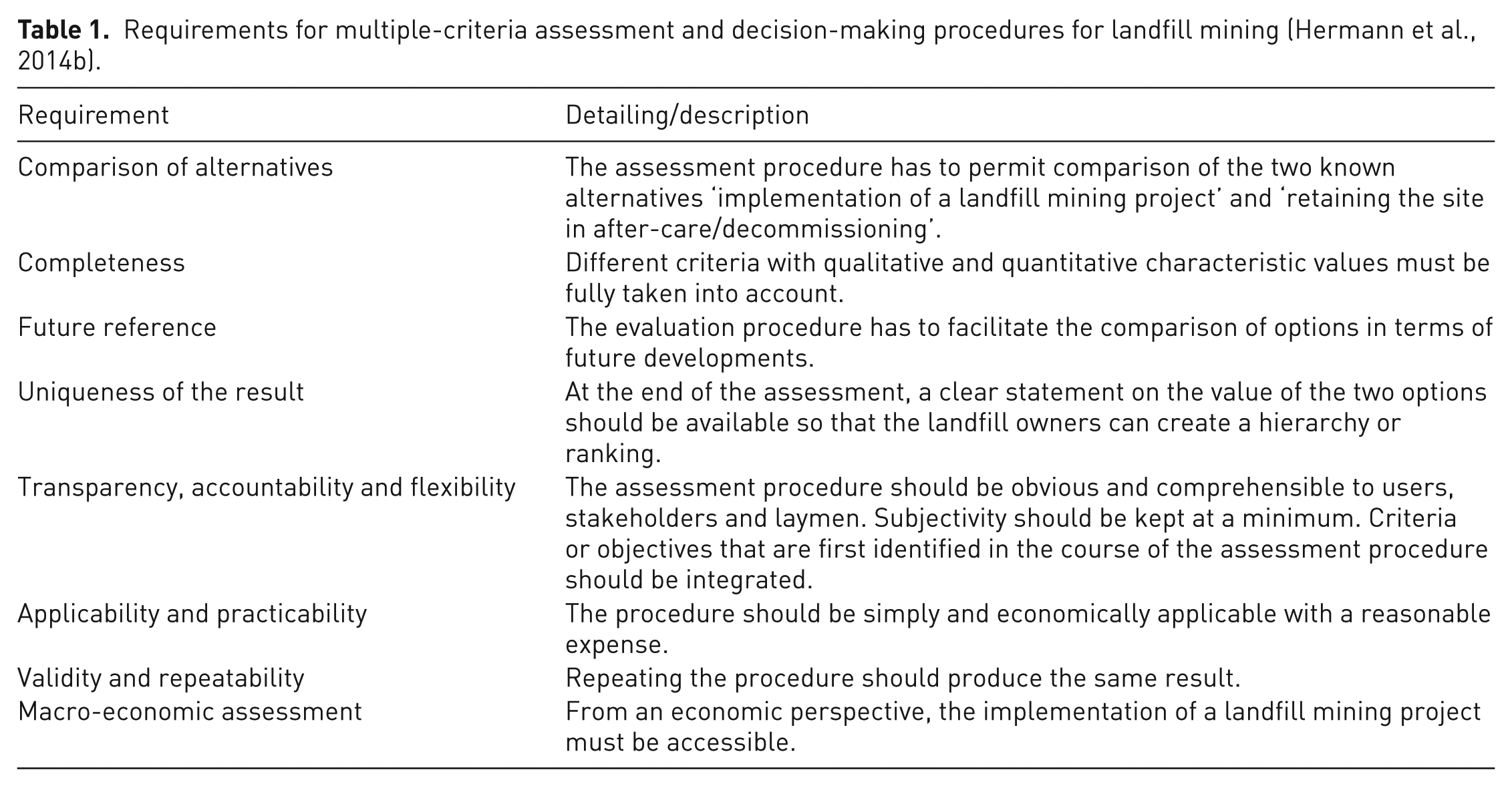
Based on the requirements given in Table 1 and the fact that many different criteria have to be taken into account for landfill mining projects, MCDA was the procedure of choice (Wolfslehner et al., 2005).
Requirements for multiple-criteria assessment and decision-making procedures for landfill mining (Hermann et al., 2014b).
One key objective of landfill owners is to achieve the highest added value that may be obtained in landfill mining. From focusing on just this one criterion, however, does not necessarily follow that the general project will succeed because recovering the largest possible landfill surface, avoiding adverse effects on the environment and local residents or producing the best social benefits have to be considered, too. In this context, MCDA procedures have already been thoroughly examined in various scientific articles on environmental issues (Solomon and Hughey, 2007), conservation management (Rohr, 2004) and groundwater management (Schneck, 2006).
Among MCDA procedures, procedures for multiple-objective decision-making (MODM) and multi-attribute decision-making (MADM) are distinguished (Hwang and Yoon, 1981). In MODM, one out of an uncountable set of options is obtained, while MADM compares countable and known options that can be clearly distinguished (Zimmermann and Gutsche, 1991).
Figure 1 shows a classification of the MCDA procedures and essential associated methods for decision-making that address multiple-criteria target variables, according to Schuh (2001).
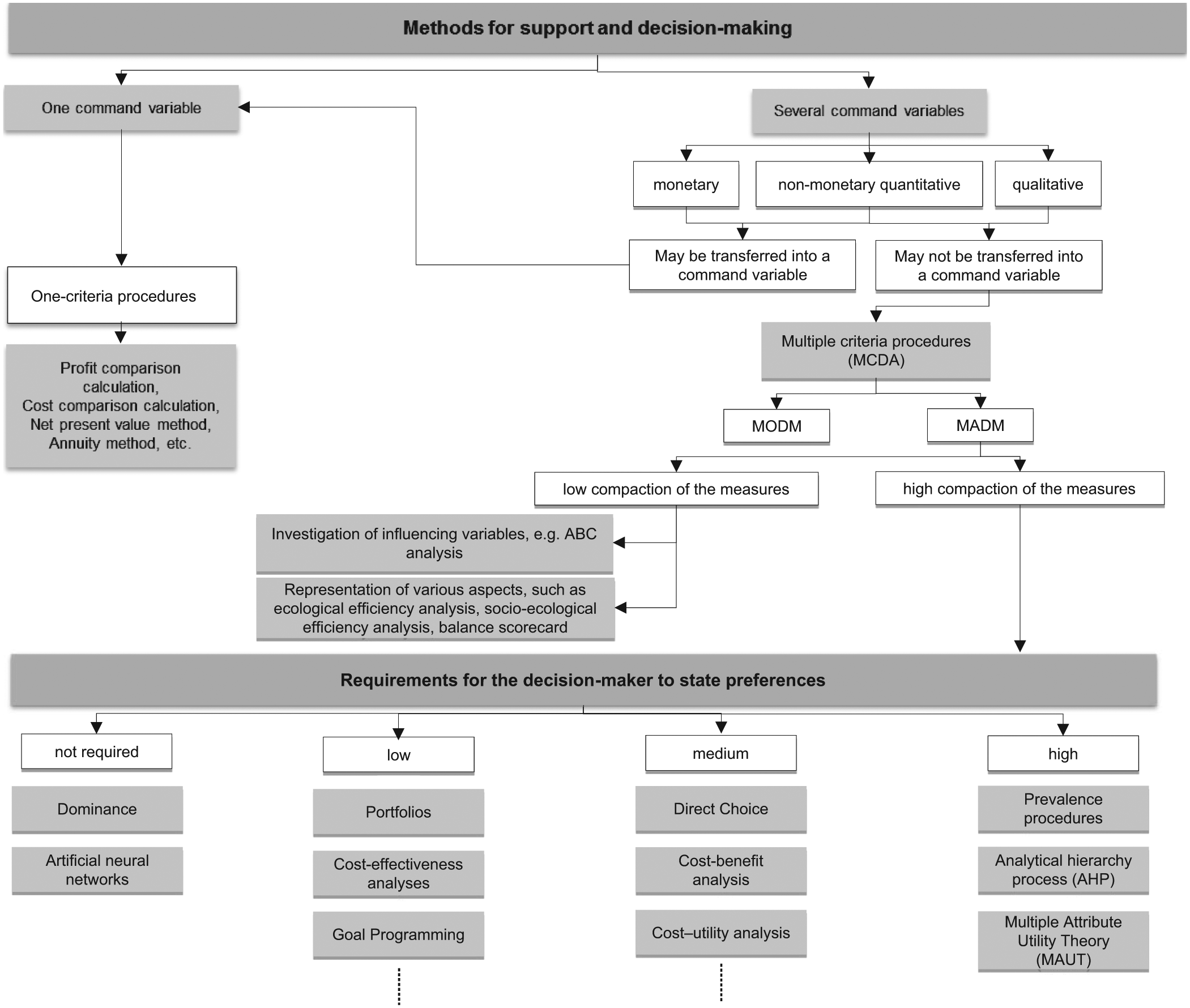
Decision-making procedures and methods (Schuh, 2001).
Since there are essentially only two alternative options for landfill mining projects (‘landfill mining’ or ‘after-care’), this problem has been allocated to the group of MADM procedures. Based on that allocation, the basic structure of the MADM flow of Belton and Stewart (2003) and Geldermann and Lerche (2013) has been applied to further processing the specific selection, design and assessing of decision-making procedures for assessing landfill mining projects. Figure 2 shows the process adapted to the present problem.
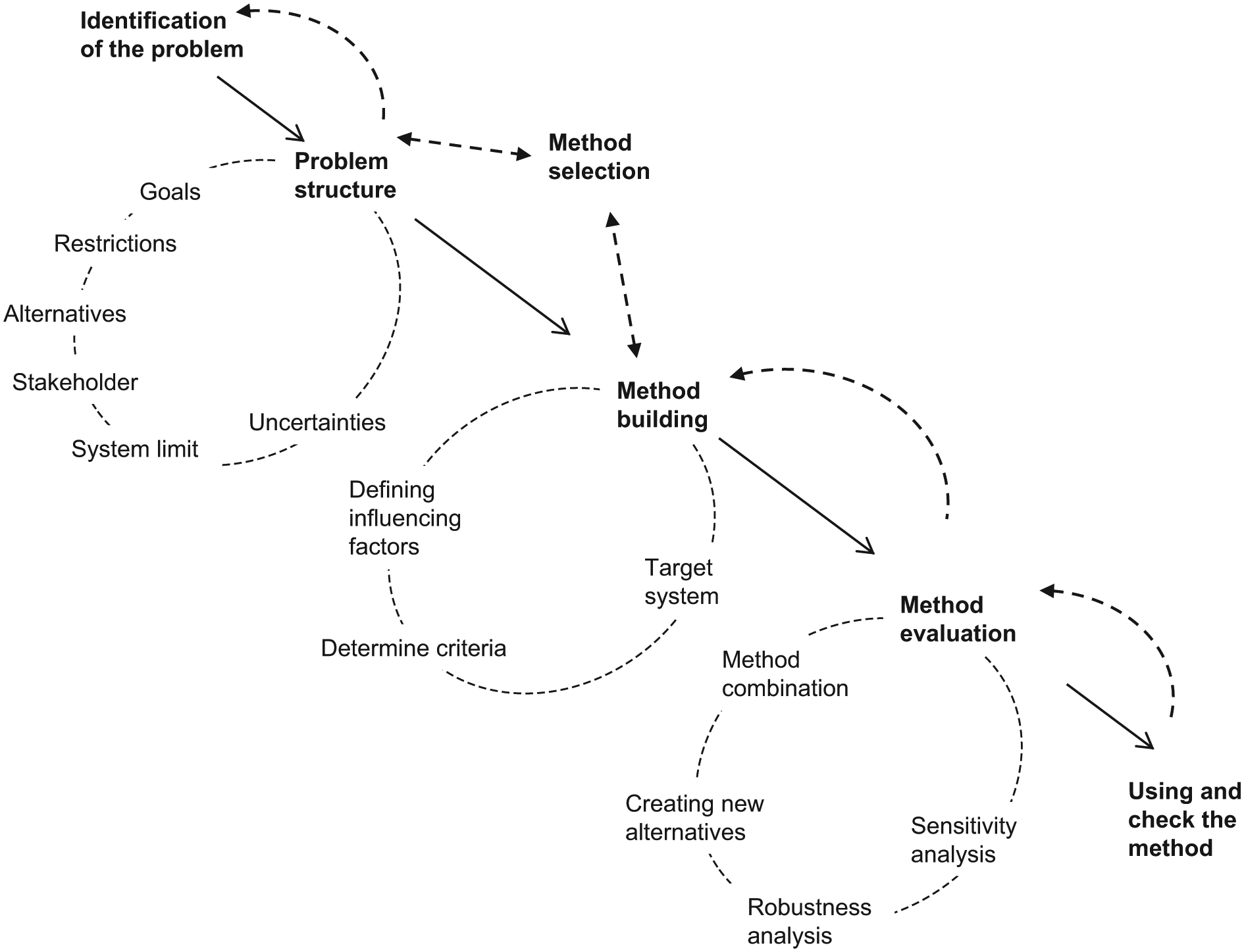
MADM process according to (Belton and Stewart, 2003).
The result was obtained and discussed in the individual sub-process stages jointly with Montanuniversität Leoben, Graz University of Technology, landfill owners, waste management companies, recycling companies, processing and sorting machine makers and public agents in guided workshops and expert meetings.
Identification of the problem.
Problem structure.
Method building.
Method selection.
Method evaluation.
Application of the method (not covered by this article).
Individual interviews and group discussions with various public and private landfill owners have been taken at the same time, such as with:
- communities and countries;
- waste management associations;
- operators of public private partnerships (PPP) models; and
- companies;
being both decision makers and future users of the decision-making procedure. This approach ensures common understanding of the decision-making problem, while warranting that the selected procedure is generally applicable despite conflicting interests. For that reason, this article chiefly refers to sources on MCDA procedures and on expert workshops including in-depth discussions with stakeholders in the range of the MADM process (Figure 2). Data and information presented in ‘Results and discussion’ have been prepared in this manner.
Results and discussion
Results
Identification of the problem and problem structure
As stated in the previous section, MADM procedures are the foundation of the decision-making process for landfill mining projects. They need comprehensive treatment of the prevailing decision-making problem, involving all stakeholders participating in the project.
As a matter of principle, the first stage of the MCDA process is to define the ‘landfill mining project feasibility test’ as the overarching (or overall) objective and decision-making problem, examining various influencing criteria and system boundaries (Hermann et al., 2014a). The overarching objective is a foundation of the required target system, divided into main criteria and sub-criteria. ‘Landfill mining’ and ‘retaining the landfill in after-care’ were defined as options to be compared. Figure 3 shows the target system described for the entire decision-making problem.
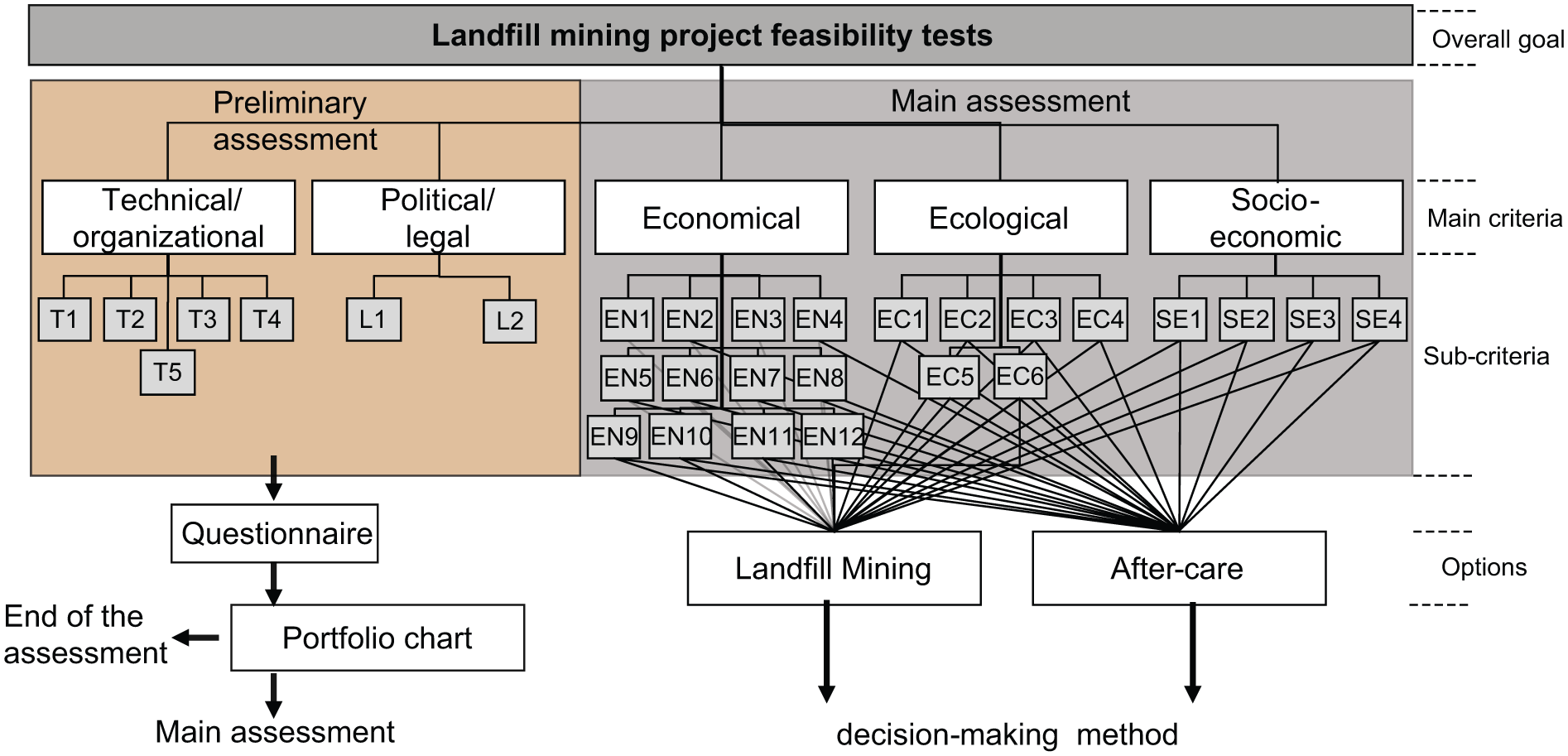
Target system of the decision-making problem according to (Hermann et al., 2014b).
Method building
Based on expert interviews, the entire assessment procedure has been divided into preliminary and main assessment and different main criteria have been allocated to the two stages (Figure 3). The reason was that a preliminary assessment of the landfill should precede the actual (main) assessment to check the landfill’s general suitability for landfill mining.
Preliminary assessment
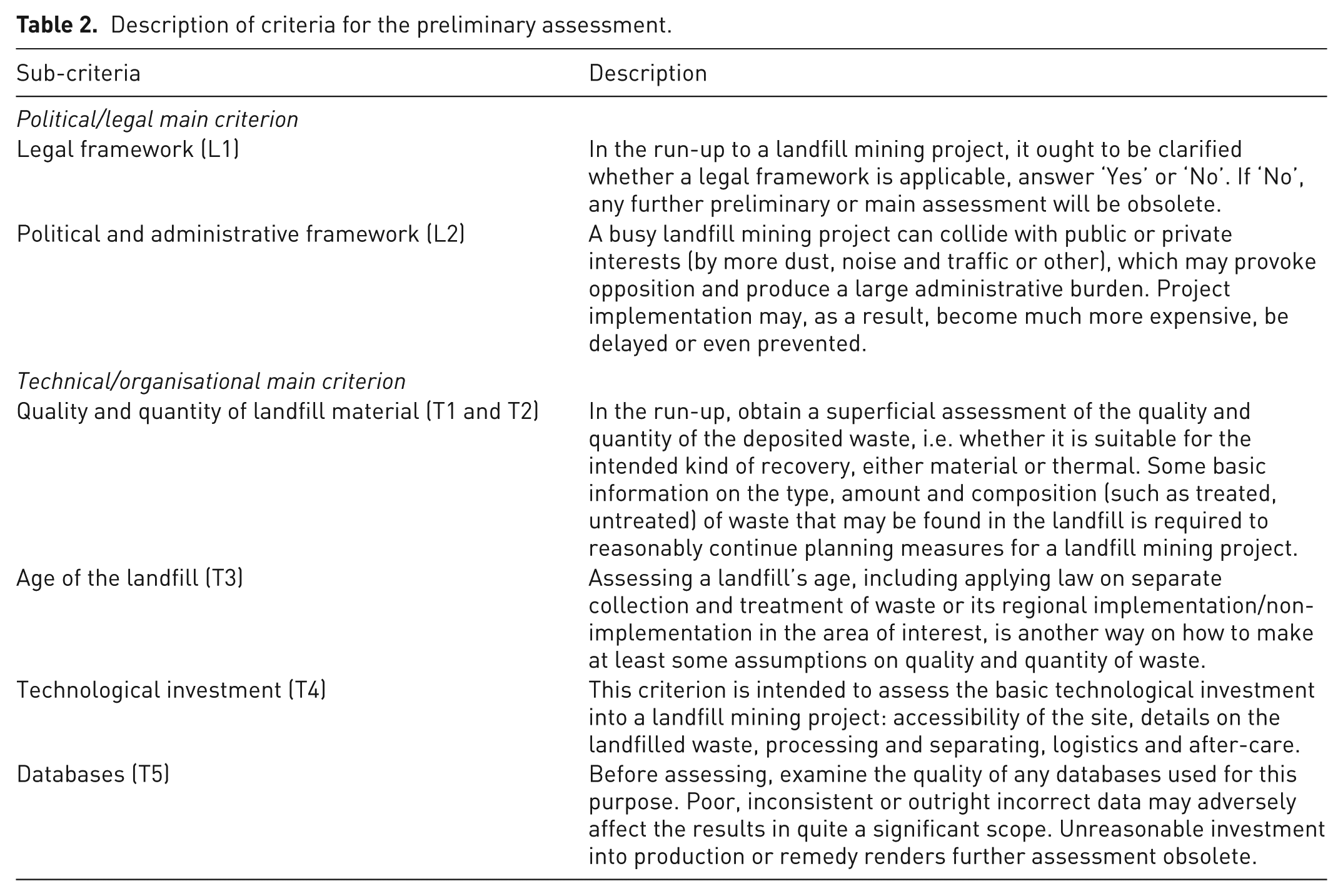
This was based on a checklist that consists of 12 questions covering the technological/organisational main criterion with five sub-criteria (T1–T5) and the legal/political main criterion with two sub-criteria (L1, L2) (see Figure 3). The first legal sub-criterion L1 was addressed by a question about the legal framework of the project. When answered ‘no’, any further assessment is irrelevant.
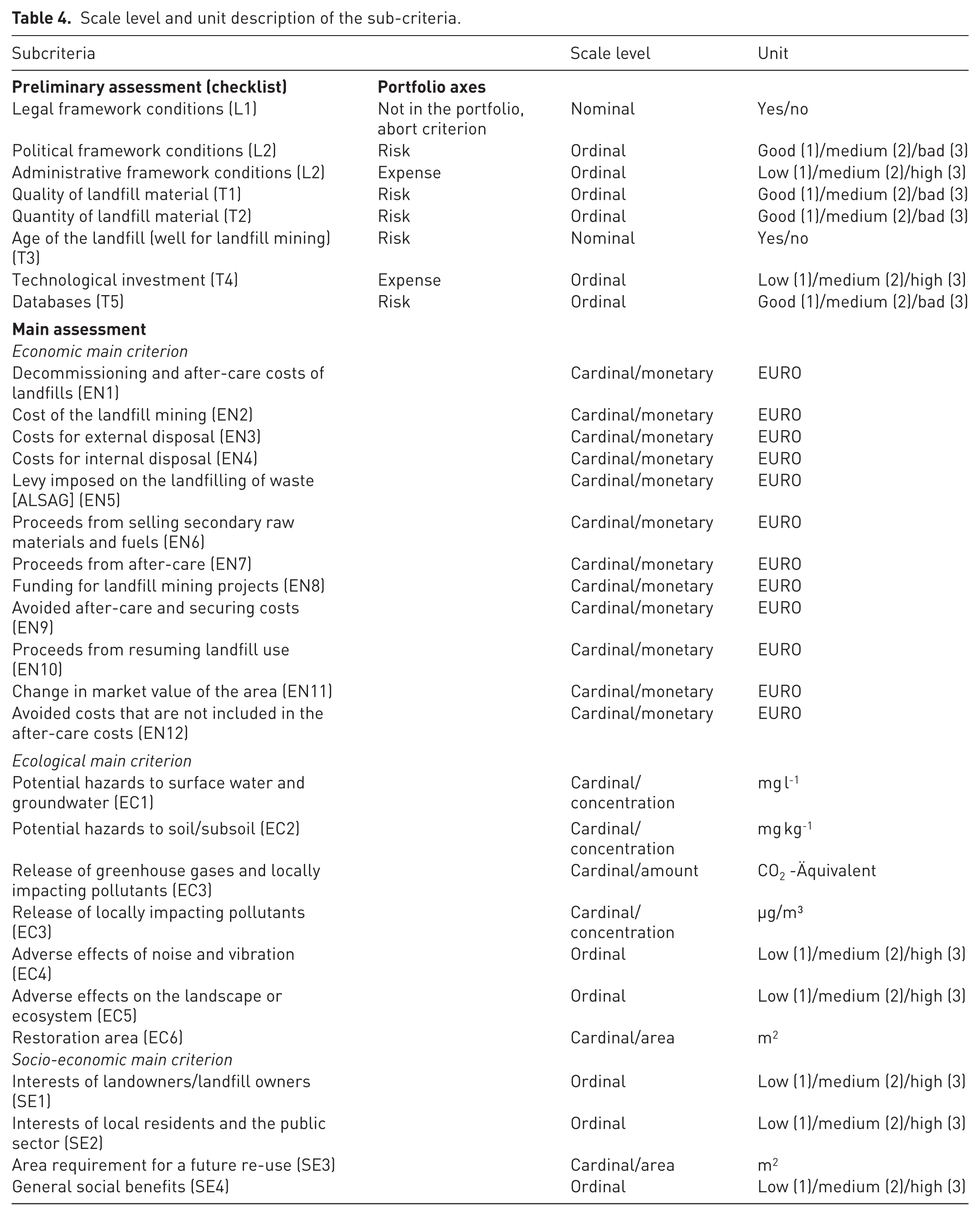
The other questions are divided into assessing the risk and assessing the expense of the landfill mining project with a score of low/good (1) via medium (2) to high/bad (3) (Table 4). Two out of the 12 questions from the questionnaire are listed here.
Risk How do you rate the current evidence and documentation of the landfill?
good (1)/medium (2)/bad (3)
Expense How high do you estimate the approval and administrative expense?
low (1)/medium (2)/high (3)
The results of this questionnaire enter a portfolio chart, representing a matrix of nine fields, that has been established jointly with the landfill owners. The expense is entered on the abscissa and the risk with its subdivisions of low/good (1), medium (2) and high/bad (3) on the ordinate.
The superficial initial rating of the landfill mining project assessed is represented by a dot in the portfolio describing the expected expense and risk. The location of the dot emerges from the computed mean value of the summed scores (1–3) obtained from the individual questions on risk and expense.
Depending on its location in the matrix and the individual conditions of the site, landfill owners may conclude on whether a more detailed main assessment of the given project is feasible. Figure 4 shows what a portfolio chart of a preliminary landfill mining project assessment may look like, note the black dot. Here, risk and expense of a landfill mining project are both rated as low. Therefore, continued main assessment is recommended.
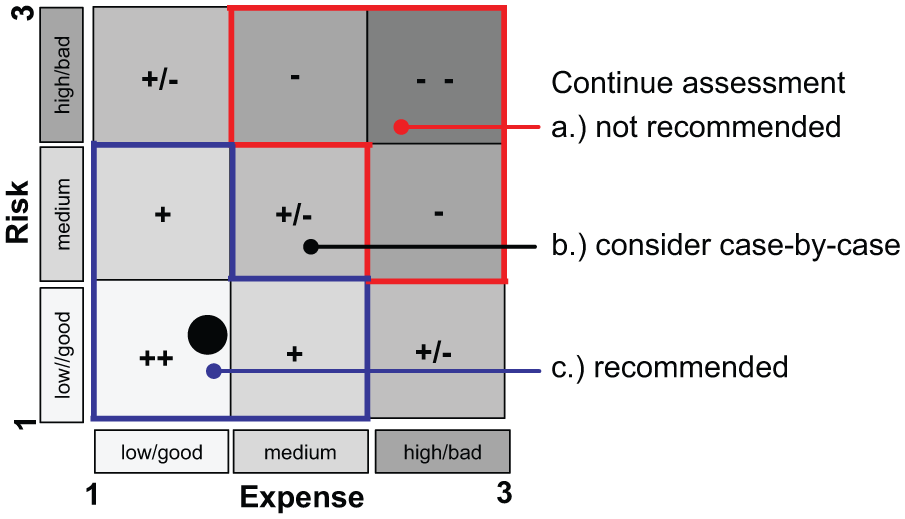
Sample portfolio chart of the preliminary assessment.
The exact definition and description of the various sub-criteria is a prerequisite for a generally applicable and accepted assessment and decision-making procedure. The following sub-criteria were defined in consultation with stakeholders in workshops and discussions. They are listed below and their main features described (Table 2).
Description of criteria for the preliminary assessment.
Main assessment
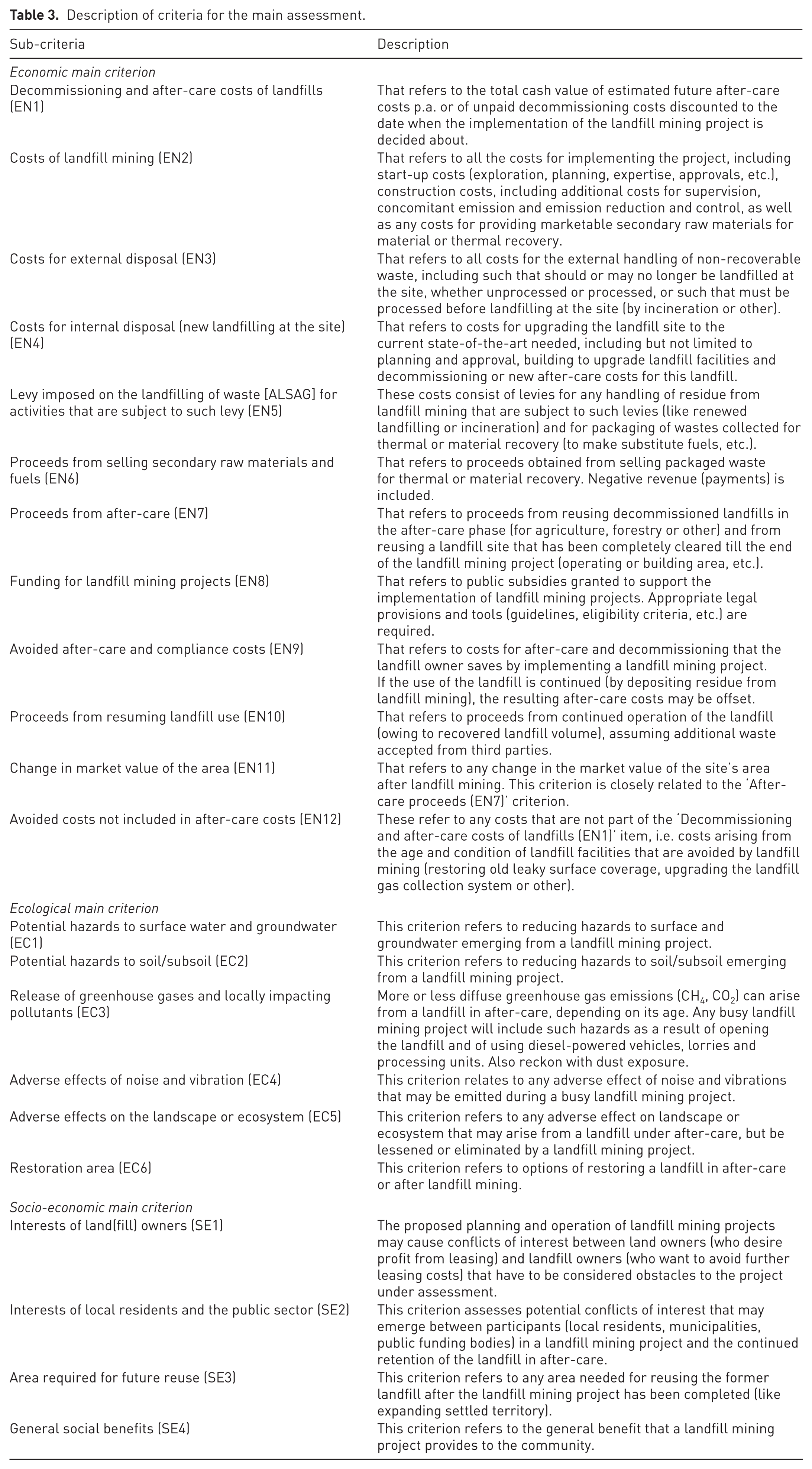
Economic, ecological and socio-economic criteria including division into sub-criteria were defined in the target system for the following main assessment, based on the notes of Hermann et al. (2014a).
The technological/organisational and political/legal main criteria and associated sub-criteria have already been included in the overall procedure with the preliminary assessment; they are therefore not reproduced here. The exact definition and description of the various sub-criteria is needed for the main assessment, as for the preliminary assessment (Table 3).
Description of criteria for the main assessment.
Quantifying the criteria to obtain attributes requires their specification by allocating a unit and an indication of maximisation or minimisation (Geldermann and Lerche, 2013). Measuring the criteria is supported by the general approach to assessing landfill mining projects.
Nominal scales: Classifications like Yes or No.
Ordinal scales: Measurements that may be attributed with ‘low’ to ‘high’.
Cardinal scales: Obtaining quantifiable values, such as numbers.
Some effects of landfill mining cannot be definitely rated in cardinally quantifiable and/or monetary terms. The differing level of data available from different landfill owners means that some information needed to assess a project may not be available. Hence, its environmental impact may be verified only with a couple of caveats that may affect the assessment of the project as a whole, despite the formulation of objectives (Lisson, 2013).
Table 4 shows the sub-criteria described, including units and scales and the allocation of preliminary assessment criteria to the axes of the chart.
Scale level and unit description of the sub-criteria.
Method selection
Figure 5 from Götze (2008) was preliminarily applied to select appropriate methods (from the group of MADM procedures) with regard to their applicability to landfill mining projects.
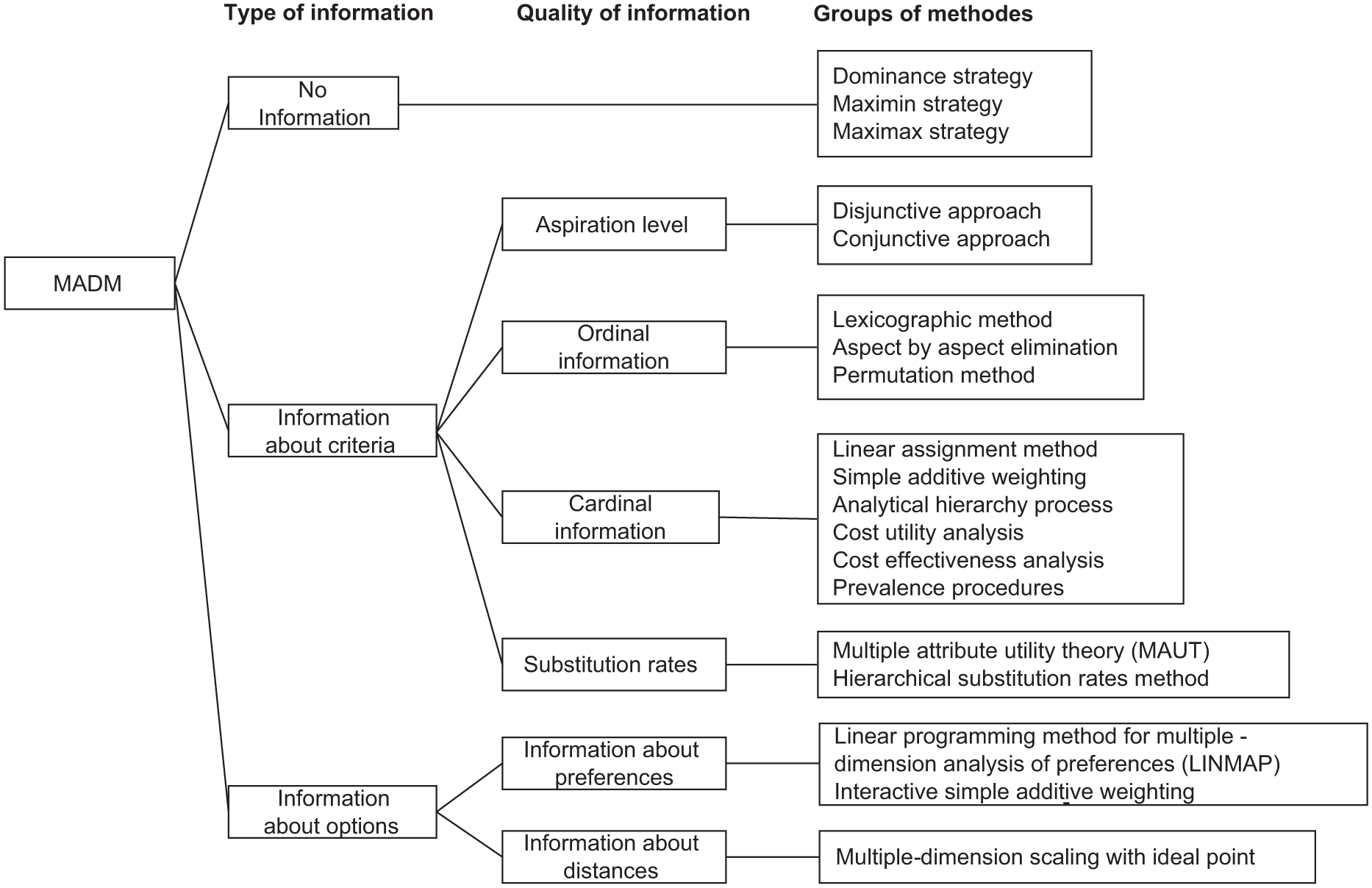
Classification of MADM methods according to the type of information (Götze, 2008).
The classification of the MADM methods in Figure 5 basically refers to the type and quality of information available from decision-makers that has been used (landfill owners). It must be considered whether there is any available at all and if it relates rather to the criteria or to the two ‘landfill mining’ and ‘retaining the landfill in after-care’ options. Information available for landfill mining projects will essentially relate to the criteria and be set in cardinal or ordinal form (see Table 4).
The requirements for ranking the preferences of landfill owners in Figure 1 are simultaneously integrated into the selection procedure, as well as the target system defined in this article. Discussions and workshops with the landfill owners have helped derive a shortlist of assessment and decision-making methods to be included, whose ranking was classified as ‘medium’ to ‘high’ (see Figure 1). This way, landfill operators may satisfyingly contribute their own preferences with regard to criteria in the decision-making procedure.
If these allocations are applied to the selection procedure by which the applicability of suitable MCDM procedures is assessed (Moffett and Sarkar, 2006) and to the specific requirements for the assessment and decision-making procedures in Table 1, the cost-utility analysis and the analytical-hierarchy process emerge as appropriate to the present assessment. For this reason both methods are discussed and evaluated below.
Method evaluation
• Cost-utility analysis (CUA)
CUA is a method for assessing options; here ‘landfill mining’ vs. ‘retaining the landfill in after-care’. An essential indicator of CUA is an established hierarchical target system (see Figure 3) with the total utility value at the top, and the cardinally or ordinally scaled sub-criteria at the bottom. This is a multiple-dimension method that may even include non-monetary variables, like in the assessment of landfill mining projects. Options are listed and associated weighted sub-criteria provided. The ranking of all criteria is collected and transferred to target values based on measurement scales. These target values may be interpreted as grades, like in school (say, 1 to 5) (Heinisch, 2010). They are multiplied by the target weights and thereby transformed into partial utility values that are then added up, including the weightings, to result in distinct total utility values for both options (Götze, 2008). The option of choice emerges from comparing the utility values and favouring the one that provides the higher value. The special significance of the CUA is its merger of cost-benefit analysis (CBA) and cost-effectiveness analysis (CEA) (Schneeweiss, 1991). Otherwise more emphasis can be placed on the costs by attaching a CEA to the CUA. Consider the CEA as a continuation of the CUA and not a distinct procedure.
The CUA is a common, handy and viable procedure with little computational effort for decision-making in multiple-objective problems. It also quantifies the non-monetary benefits of options, allows comparisons to be made and to derive rankings according to the preferences of decision-makers (landfill owners).
Its cons are the purely subjective rating and assessment of target criteria and weightings, the required cardinal measurement level and the mutual independence of the criteria (or groups of criteria), which is currently contested. Minor shifts in weighting or scoring may alter the order of the ranking.
• The analytical hierarchy process (AHP)
The AHP was developed by Thomas L Saaty in the early 1970s for analysing complex decision-making situations (Saaty, 1987). The ‘landfill mining project feasibility testing’ problem addressed here is hierarchical and split into sub-problems for easier handling. Different target and/or criteria levels are created on the lowest hierarchy level that cover the options to be evaluated: ‘landfill mining’ vs. ‘retaining the landfill in after-care’ (see Figure 3).
With AHP, both qualitative and quantitative criteria can be examined. The rating of the individual criteria is separately determined for each element of the higher level using paired comparisons (Götze, 2008).
According to Rohr (2004), basic characteristics of the AHP method are:
· easy use;
· applicable to individuals and groups;
· promoting compromise and consensus;
· no extraordinary specialisation of the decision-maker is required;
· results can be passed on and are clearly understood.
In solving multiple-objective problems, the AHP serves many purposes, such as predicting future developments. It can also involve uncertainties about future environmental conditions by including either a level with various kinds of such conditions or scenarios in the hierarchy. Uncertainties about preferences expressed in the paired comparison ratings can be examined with sensitivity analysis (Götze, 2008). A drawback against the CUA that should not be ignored is the high investment in time and effort required to obtain data or to compute the AHP, because all pairs of sub-criteria on any level have to be compared with each element of the next higher level. For details of the procedure, see Götze (2008).
Discussion
Dividing the assessment procedure into preliminary and main assessment is advantageous with regard to providing an option for landfill operators to obtain a preliminary assessment of a landfill mining project’s feasibility with little effort in advance. That is conveniently achieved with the described questionnaire and the ranking in a portfolio chart. A subsequent, more elaborate main assessment is only advisable if the preliminary assessment has had a positive result. CUA and AHP were the best choices for the main assessment from the group of MADM methods, according to research presented in this article.
Comparing the pros and cons of both methods with regard to assessing landfill mining projects, their merger may be beneficial. This can be recommended insofar as the AHP may be applied to a CUA framework for weighting the target criteria by paired comparison. Furthermore, combining with SCDM methods, like the net present value method, may be considered to derive the economic part of the main assessment from the net present value method, and the ecological and sociological part from the CUA or AHP. Verifying the validity of assessment results by sensitivity analysis is essential in this context. The extent to which the final assessment results – especially the ranking of the two options – are sensitive to variations of the input parameters is examined here, i.e. how they vary themselves. This check is needed because a large number of input parameters, whether factual data or weightings, cannot be determined with perfect accuracy owing to uncertainties in data collection, and even more in forecasting, as well as value judgements, that may be contested. If the sensitivity analysis reveals that the order of the two options is stable in spite of varying input variables (mainly forecasts and weightings), then a validated assessment can be assumed (Benz et al., 1998).
Note, however, that the decision-making procedure for assessing landfill mining is only as good and accurate as any data entered. Unreliable or missing input data will produce unreliable results.
Conclusions
Basically, there are no proven standard decision-making methods for the overall assessment of landfill mining projects that could be applied without corresponding adaptation.
Based on the studies presented in this article, the entire procedure is divided into preliminary and main assessment, the former obtained by a questionnaire and the latter by methods chosen from the group of MADM procedures. Since a variety of criteria and influencing factors are involved in such projects, and two options – ‘landfill mining’ or ‘retaining the landfill in after-care’ – have to be compared, applying selected MADM procedures is the obvious choice. The CUA and the AHP were chosen from this group and assessed as stand-alone methods. Both approaches have pros and cons that can, however, be solved by merging the methods.
The findings presented here show that more research is needed in various fields. Above all, further testing the MADM methods in actual projects would be desirable for checking the transparency, accountability, flexibility, applicability and practicality of the MCDM methods examined and defined here by applying real data from different landfills.
Another focus is studies on merging multiple and single-criteria methods, especially economic methods like the net present value method paired with CUA and AHP, as described in this article.
Testing the quality and quantity of landfill material deposited in advance of a landfill mining project is a problem of its own. Landfill owners are often lacking consistent data on the material deposited in the past. Complex and costly investigations of the landfill are then required to obtain such data. Simple approximations or estimate ratings of landfill contents would help operators reduce costs and limit the overhead. Finally, reviewing the quality and quantity of input data required for decision-making procedures to evaluate different scenarios will need more research too.
Footnotes
Acknowledgements
The authors would like to thank Andreas Budischowsky, Tanja Wolfsberger and Harald Wipfler for assistance in the discussion about the decision-making procedures.
Declaration of conflicting interests
The authors declare that there is no conflict of interest.
Funding
This work was financed by the Austrian Research Promotion Agency (FFG).