






Abstract
The current study provided evidence for the factor structure of the Academic Expectation Stress Inventory (AESI) in a sample of 213 Mainland Chinese and 184 South Korean high school students. We examined cross-national invariance of the AESI using multiple-group confirmatory factor analysis across two Asian cultural samples. Results suggested a unidimension rather than two-factor structure (self and teachers/parents) in both settings. Results also showed evidence of reliability, convergent validity (significant correlations with depression, emotional exhaustion, and cynicism), and divergent validity (nonsignificant correlations with amotivation and efficacy reduction). ANCOVA results indicated that perceived overall academic expectation stress was significantly higher among Mainland Chinese students than for their South Korean counterparts. Furthermore, there were no differences between males and females for the Korean adolescents while females reported higher expectation scores than males in the Chinese adolescent sample.
Keywords
Students’ perceived stress of expectations come mainly from two sources: themselves who have been socialized to value hard work and diligence for upward social mobility; and parents/teachers from whom individuals gain supports to prevent from the exclusion and feelings of shame (Ang & Huan, 2006). The purpose of the current study was to validate Academic Expectation Stress Inventory (AESI; Ang & Huan, 2006) using high school students from Mainland China and South Korea.
This research represents three major advances over the validation work that has already been completed on AESI. First, this study accurately elaborates on the differences and similarities of expectation stress among two national samples with similar cultural backgrounds. Second, both China (Hansen & Woronov, 2013) and Korea (Rojewski, Lee, & Hill, 2014) have two different institutions for secondary education: general and vocational high school. We took this into account and ensured that differences of the responses were based on culture, not type of school. Third, the present study also highlights gender differences regarding stress arising from expectations.
Method
Participants and Procedure
Participants were 397 high school students (10th-12th grade) from China (n = 213) and Korea (n = 184) at general public schools located in middle-to-lower socioeconomic status (SES) areas. Participants from China were 98.9% Han, 43.19% female with a mean age of 17.06 (SD = 3.23) years; those from Korea were 100% Korean, 53.26% female with a mean age of 16.96 (SD = 3.69) years. Questionnaires were administered in Chinese for Chinese and in Korean for Korean students.
Measures
AESI
The original nine-item AESI (Ang & Huan, 2006) includes Expectation of Others (five items) and Expectation of Self (four items) ranging from 1 = never true to 5 = almost always true.
Zung Self-Rating Depression Scale (SDS)
The original 20-item unidimensional SDS was developed to assess the level of depression (Zung, 1965) ranging from 1 = a little of the time to 4 = most of the time. SDS has been used in China (Wang, Wang, & Ma, 1999) and Korea (Y. H. Lee & Song, 1991). In the present study, the scale showed good reliability (Cronbach’s α = .89) and validity (comparative fit index [CFI] = .96,root mean square error of approximation [RMSEA] = .06).
Self-Regulation Questionnaire–Academic (SRQ-A; Amotivation)
The Amotivation scale (six items) was selected from SRQ-A (Ryan & Connell, 1989), ranging from 1 = very untrue to 5 = very true. SRQ has been used in China (Vansteenkiste, Zhou, Lens, & Soenens, 2005) and Korea (Kim, 2002). In the present study, the scale showed good reliability (Cronbach’s α = .76) and validity (CFI = .94, RMSEA = .07).
The Maslach Burnout Inventory–Student Survey (MBI-SS)
The original 15-item MBI-SS includes three scales: Exhaustion (5 items), Cynicism (4 items), and Efficacy Reduction (6 items) ranging from 0 = never to 6 = always (Schaufeli, Martinez, Pinto, Salanova, & Bakker, 2002). This scale has been used in China (Hu & Schaufeli, 2009) and Korea (J. Lee et al., 2010). In the present study, the scale showed good reliability (Cronbach’s α = .78-.89) and validity (CFI = .92, RMSEA = .06).
Data Analysis
Multiple-group confirmatory factor analysis (MGCFA) was conducted to test the equivalence of measurements across groups using the Maximum Likelihood estimation method by MPlus. Converge validity of the AESI was obtained using bivariate correlation analyses between AESI and SDS, MBI-emotional exhaustion, and MBI-cynicism; discriminant validity was obtained by correlating AESI with Amotivation scale and MBI-efficacy reduction. Finally, an ANCOVA was conducted to examine the cultural and gender differences.
Results
Descriptive Statistics
The Cronbach’s alpha estimates of AESI used for the Chinese and Korean samples were .88 and .92, respectively. The results suggested that measurements were internally consistent across both settings.
Psychometric Properties
Baseline factor structure
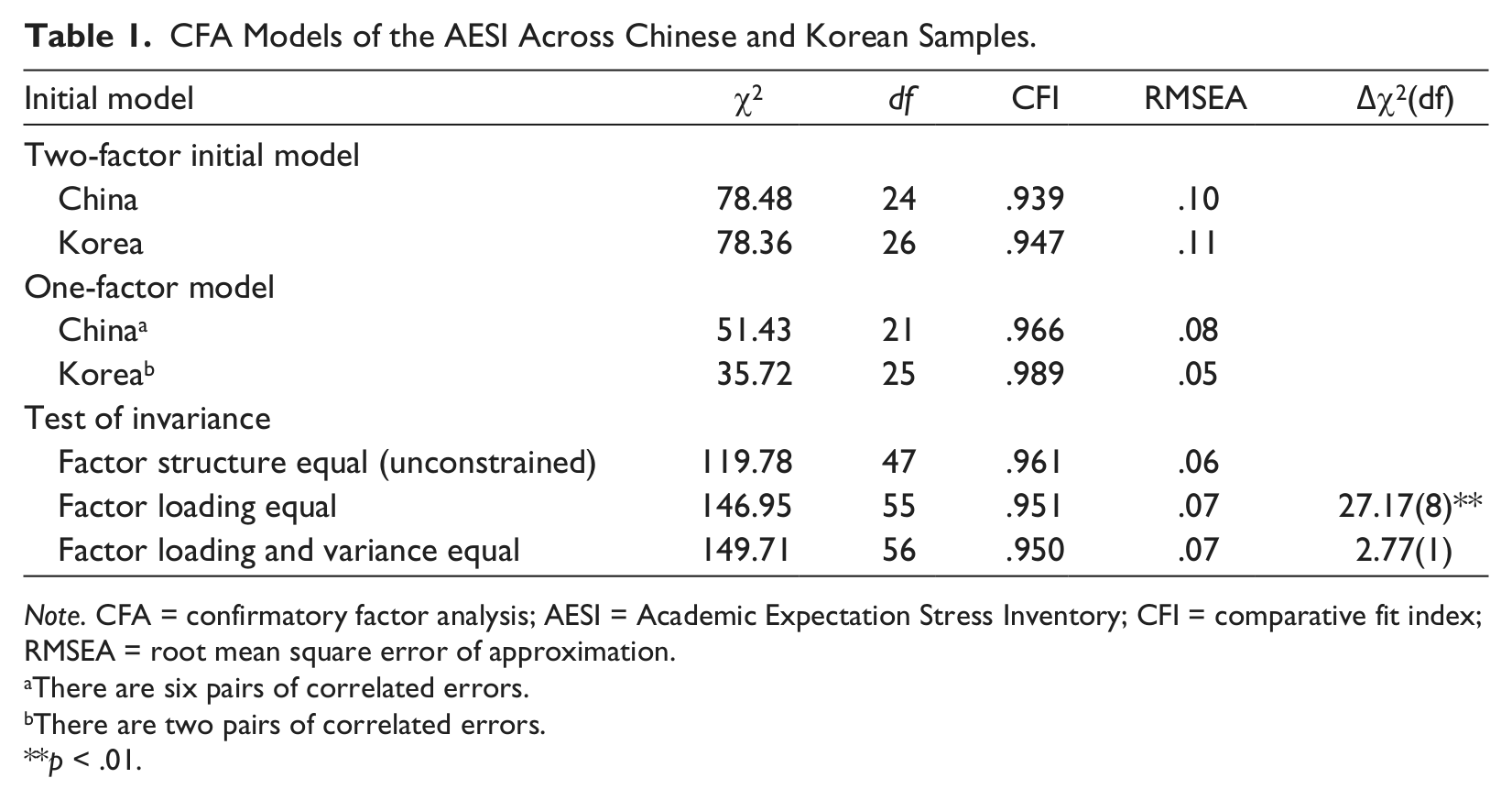
The data did not fit well to the multidimensional structure of AESI (CFI = 0.939, RMSEA = 0.10 for Chinese; CFI = 0.947, RMSEA = 0.11 for Korean) after modifying. A unidimensional structure model was recommend based on the correlation matrix among items.
In the one-factor model, overall fit of the model for the Chinese was adequate with six pairs of correlated errors after correction: CFI = 0.966, RMSEA = 0.06. The best-fitting baseline model for the Korean was also the one-factor model with two pairs of correlated errors after correction: CFI = 0.989, RMSEA = 0.05 (see Table 1). Based on the modification index, the correlations of the item errors with similar meanings were added.
CFA Models of the AESI Across Chinese and Korean Samples.
Note. CFA = confirmatory factor analysis; AESI = Academic Expectation Stress Inventory; CFI = comparative fit index; RMSEA = root mean square error of approximation.
There are six pairs of correlated errors.
There are two pairs of correlated errors.
p < .01.
Tests of cross-national invariance
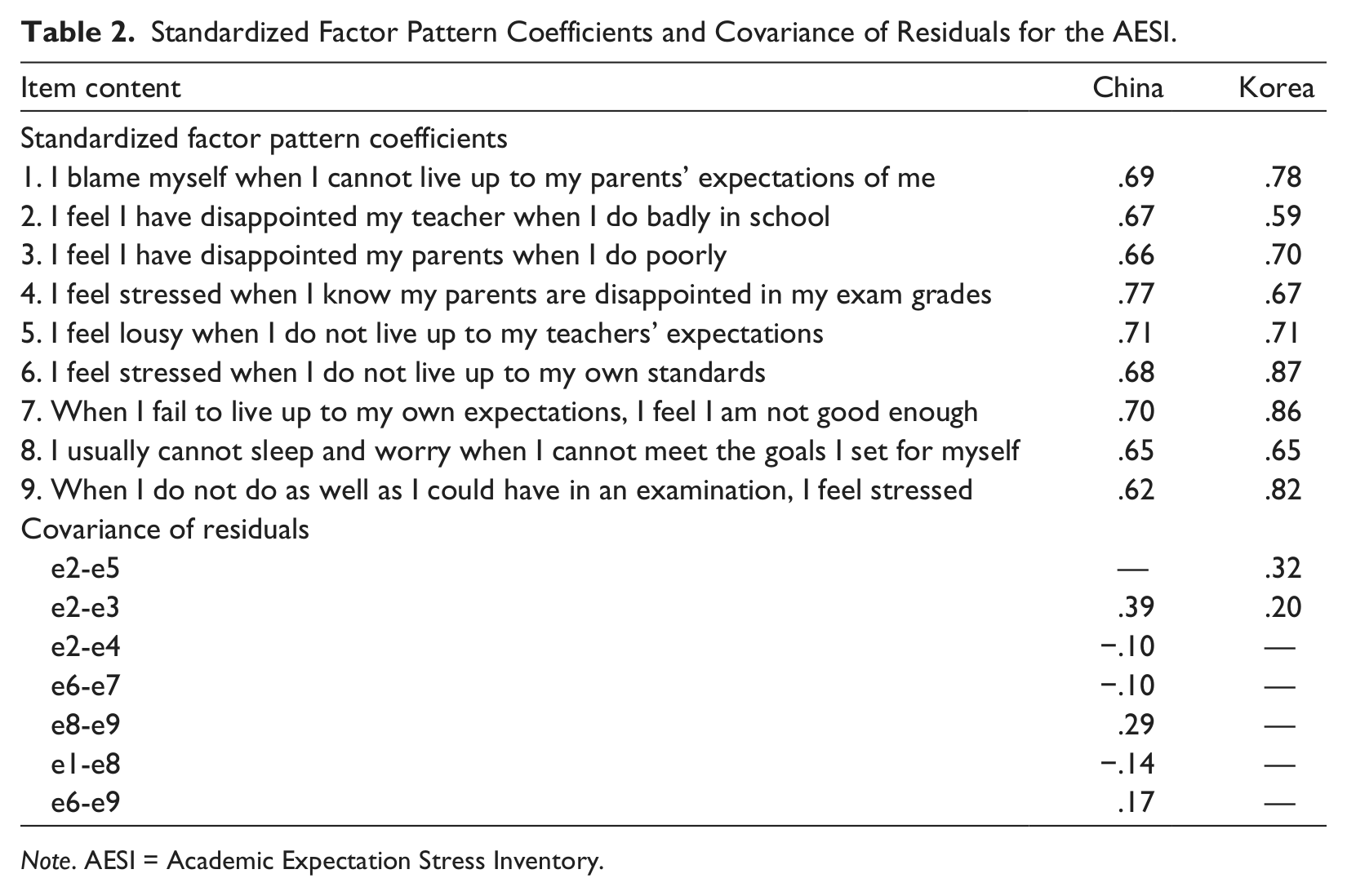
The results suggested the unconstrained model tested across the two samples fit the data well (CFI = 0.961, RMSEA = 0.06), indicating a common factor structure which is known as configural invariance (see Table 1). The factor loadings were subsequently constrained, which resulted in a drop in fit, Δχ2 = 27.17 (Δdf = 8), p < .01, within an acceptable change of CFI (ΔCFI = 0.010), indicating a metric invariance. The intercepts were then constrained in addition to factor loading. This resulted in a nonsignificant drop in the fit index, Δχ2 = 2.77 (Δdf = 1), p = .10, associated with a minimal change in CFI (ΔCFI = .001) suggesting scalar invariance. Table 2 shows standardized factor pattern coefficients and the covariance of residuals.
Standardized Factor Pattern Coefficients and Covariance of Residuals for the AESI.
Note. AESI = Academic Expectation Stress Inventory.
Convergent and Discriminant Validity
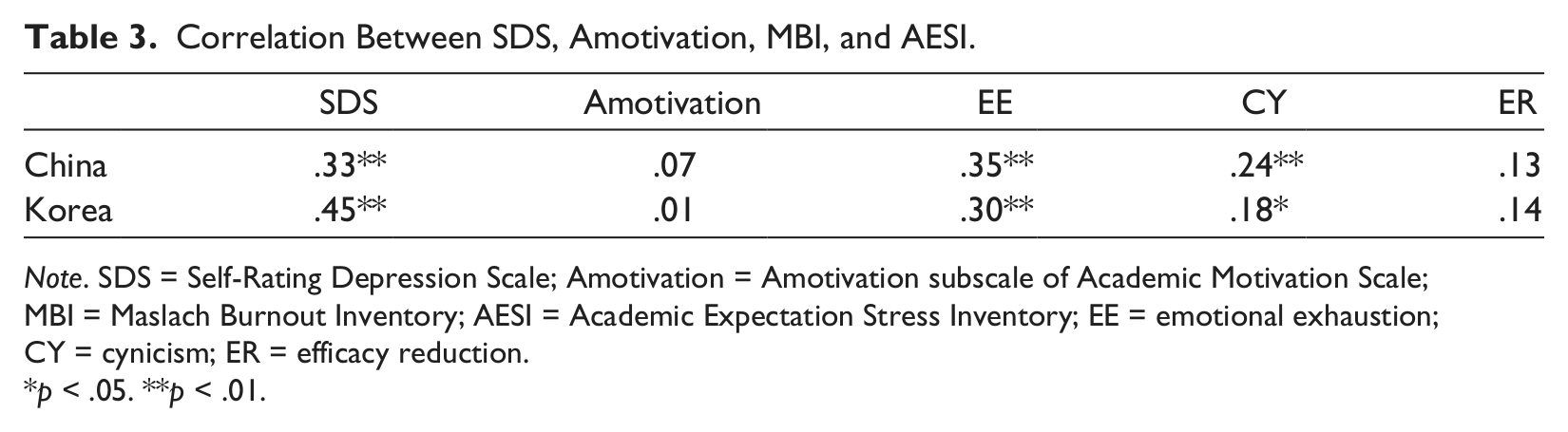
As predicted, significant positive relationships between the factors of AESI and SDS were found (see Table 3), rs = .33 (Chinese) and rs = .45 (Korean), ps < .01. The AESI was also positively related to emotional exhaustion and cynicism (i.e., Chinese rs = .35 and .24, ps < .01; Korean rs = .30 and .18, ps < .01/.05). By contrast, the factors of AESI had no significant relationship with amotivation or efficacy reduction, which was consistent with the hypotheses.
Correlation Between SDS, Amotivation, MBI, and AESI.
Note. SDS = Self-Rating Depression Scale; Amotivation = Amotivation subscale of Academic Motivation Scale; MBI = Maslach Burnout Inventory; AESI = Academic Expectation Stress Inventory; EE = emotional exhaustion; CY = cynicism; ER = efficacy reduction.
p < .05. **p < .01.
ANCOVA
AESI had been validated across groups with scalar invariance; thereby, factor means can be compared across groups (Chen, 2008). Two-way (Country × Gender) ANCOVAs with grade as a covariate were performed on AESI. Controlling for the grade, an interaction effect between country and gender was found on the AESI, F(1, 392) = 6.44, p < .05, η2 = 0.02. Specifically, there were no differences between males and females within Korean adolescents, p > .05, whereas females reported higher expectation scores than males within Chinese adolescents, p < .05 (Figure 1).
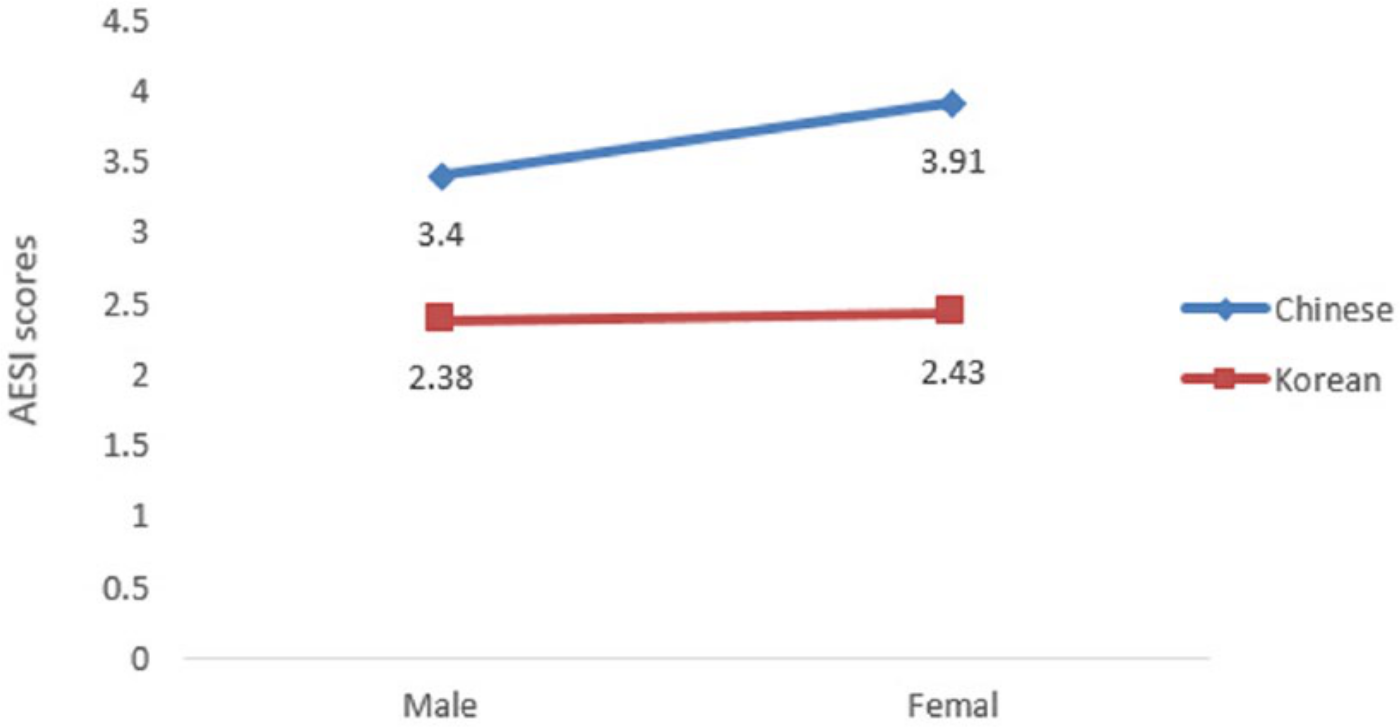
Interaction effect of nation and gender on AESI scores.
The findings indicated a main effect of nation for the AESI, F(1, 392) = 186.58, p < .01, η2 = 0.32, with Chinese adolescents scoring significantly higher than Korean. It also found a main effect of gender, F(1, 392) = 8.99, p < .01, η2 = 0.02, with females scoring significantly higher than males.
Discussion
The purpose of the present study was threefold. First, results demonstrated a unidimensional structure of AESI across both samples, which was different from the original structure developed among Singapore sample. Research supports the association between parental and students’ expectations (Beutel & Anderson, 2008; Rutchick, Smyth, Lopoo, & Dusek, 2009), called the “internalization of norms” (Yamamoto & Holloway, 2010). Furthermore, the strength of this linkage varied across different ethnic groups and could be identified via the communication between parents and students about schooling (Yamamoto & Holloway, 2010). Different from China and Korea, Singapore is a cosmopolitan society and with four official languages that include English, Malay, Mandarin, and Tamil (King & Wilder, 2003). For some families, it may be difficult to communicate clearly about schooling because parents may speak different language than their children and be unfamiliar with the educational systems. Thus, due to communication, Chinese and Korean adolescents may have higher levels of internalization of their parents’ expectations than Singaporean, and may not differentiate expectations from significant others and self.
Second, Korean students reported less academic expectation stress. One possible explanation was that Chinese individuals experience more academic pressure than their Korean counterparts (Sun, Dunne, Hou, & Xu, 2013). For example, Chinese students have reported higher levels of stress when compared with students from Korea, Japan, and the United States (Sun et al., 2013). Hofstede (1991) has also found that Chinese society is more competitive and adopts more achievement-oriented values than Korean society.
The findings also illustrated that Chinese females experience more stress than males, with no gender differences in the Korean adolescents. This could be explained by differences between Chinese and Korean cultures. In China, females are often expected to work even after getting married, whereas females in Korea usually choose to leave work and take care of their family at home when they get married (Organisation for Economic Co-Operation and Development, 2013). In addition, females in China need a better academic performance than males to secure employment, due to traditional ideology (Du & Zheng, 2005). These factors put more pressure on Chinese females, likely accounting for gender differences.
The present study has some limitations that call for more research in the future. First, AESI was assessed with small samples and self-report measures. Second, expectations from peers were missing in AESI. Peers always play an important role in academic performance and mental health during adolescence (Wentzel, 2009). In conclusion, this finding underscored the importance of research related to measurement invariance across cultures.
Footnotes
Declaration of Conflicting Interests
The author(s) declared no potential conflicts of interest with respect to the research, authorship, and/or publication of this article.
Funding
The author(s) received no financial support for the research, authorship, and/or publication of this article.