






Abstract
This study presents a cross-cultural validation of the recently developed Resiliency Scale for Young Adults (RSYA) with a sample of 289 Canadian university students and 259 Italian university students. The RSYA demonstrated good internal consistency across the two samples and acceptable retest reliability for the Canadian sample. Confirmatory factor analysis supported the three-factor, 10-facet structure of the RSYA, and comparison of the two country samples found metric invariance. As expected, positive correlations also emerged between resiliency and trait emotional intelligence in both samples. Finally, correlations with personality variables were explored in both samples. The present findings provide further support for the RSYA as a valid and reliable measure of personal resiliency for both Canadian and Italian young adults, and for the cross-cultural generalizability of the three-factor model of personal resiliency upon which it is based.
Keywords
Personal resiliency is the ability to overcome and thrive in the face of obstacles or adversity and is relevant throughout all stages of development (Masten, 2001, 2014; Masten et al., 2004; Masten & Wright, 2009). The constructs of resilience and personal resiliency have been defined from multiple perspectives (Rutter, 1987; Ellis, Bianchi, Griskevicius, & Frankenhuis, 2017; Luthar, 2006; Masten, 2007; Prince-Embury & Saklofske, 2013, 2014). After extensive research, definitions of personal resiliency have evolved from examining the circumstances that allow some “extraordinary individuals” to survive in the face of adversity (Werner, 1997; Werner & Smith, 1982, 1992) to Masten’s (2001, 2014) view of resilience as rooted in basic developmental systems. The significance of this transition in definition, is that it grounds the study of personal resiliency in already established developmental research and theory. In addition, the concept of personal resiliency is extended to a wide range of individuals and is not limited to an extraordinary few (Masten, 2001, 2014).
Consistent with Masten’s view of personal resilience grounded in basic developmental systems, Prince-Embury (2006, 2007, 2014) has proposed a three-factor model of personal resiliency. Support for the three-factor model was based on a thorough review of developmental theory, clinical experience, and empirical support for the three-factor structure (Prince-Embury & Courville, 2008a) as well as invariance of the three-factor structure across age groups (Prince-Embury & Courville, 2008b). The importance of the three-factor model is threefold. It is grounded in developmental theory that has consistently been related with personal resiliency; it considers personal resiliency as a multivariate construct while maintaining a relatively simple and easy-to-apply framework, and it allows for operationalizing the construct and simultaneous consideration of three core developmental systems. The three-factor model of personal resiliency is described in detail with supporting evidence in Prince-Embury (2014).
The three-factor model is based on previously identified aspects of personal experience related to three core developmental systems—Sense of Mastery, Sense of Relatedness, and Emotional Reactivity—and the relationship of these factors to one another. Sense of Mastery (Bandura, 1977, 2006; Masten & Coatsworth, 1998; White, 1959), Sense of Relatedness (Luthar, 2006), and Emotional Reactivity (Rothbart & Derryberry, 1981; Siegel, 1999) have all been identified as core developmental constructs. The Resiliency Scale for Children and Adolescents (RSCA; Prince-Embury, 2006, 2007) and the Resiliency Scale for Young Adults (RSYA; Prince-Embury, Saklofske, & Nordstokke, 2017) operationalize the three core constructs of the three-factor model of personal resiliency. Sense of Mastery consists of three subscales: Optimism, Self-Efficacy, and Adaptability. Sense of Relatedness includes four subscales: Trust, Comfort With Others, Sense of Support, and Tolerance. Finally, Emotional Reactivity consists of Sensitivity, Recovery Time, and Impairment. These three primary factors and 10 facets have demonstrated consistent factor structure unlike other measures of personal resiliency (Prince-Embury, 2006, 2007, 2014; Prince-Embury, Saklofske, & Nordstokke, 2017).
An earlier pilot version of the RSYA (RSYA-A; Saklofske et al., 2013) provided preliminary support for the three-factor structure and the expected correlations with emotional intelligence (EI), subjective well-being, and the Big 5 personality description. Previous confirmatory factor analysis of the RSYA with Canadian young adults found overall good fit for the 10-facet, three-factor structure, supporting the three-factor model of personal resiliency (Prince-Embury et al., 2017). Alpha coefficients for the three global scales were excellent and acceptable for the 10 subscales. Convergent validity analyses for the RSYA showed that Mastery and Relatedness global scale and subscale scores correlated positively with other measures of personal resources and well-being such as EI, satisfaction with life, and psychological flourishing. However, the Emotional Reactivity factor and subscale scores correlated negatively with resource scores and positively with risk-related scores such as depression, anxiety, and stress (Prince-Embury et al., 2017). Although studies using the current RSYA have not yet investigated the relationships between resiliency and personality traits, other past research has demonstrated that resiliency is generally positively correlated with positive personality traits such as extraversion, conscientiousness, agreeableness, and openness, and negatively correlated with negative personality traits such as neuroticism (e.g., Friborg, Barlaug, Martinussen, Rosenvinge, & Hjemdal, 2005; Riolli, Savicki, & Cepani, 2002; Saklofske et al., 2013). In addition, previous research has indicated that resiliency is positively correlated with measures of personal resources such as EI (Armstrong, Galligan, & Critchley, 2011; Howell & Miller-Graff, 2014).
Objective
This study contributes to the literature by building on previous efforts (Prince-Embury, 2006, 2007, 2014; Prince-Embury et al., 2017; Saklofske et al., 2013) to simplify and operationalize basic constructs of personal resilliency, and to establish stability in underlying constructs of personal resiliency across age and culture. This study seeks to replicate the factor structure of the RSYA with a second Canadian sample as well as expand on previous reliability findings by examining test–retest reliability. This study will also present the cultural invariance and factor structure of the RSYA in a sample of Italian young adults. Finally, authors intend to replicate previous convergent validity findings by examining trait EI, a previously indicated protective factor (Prince-Embury, 2013), as well as present new construct validity evidence by exploring the relationships between the RSYA and general personality variables in both Canadian and Italian samples.
Method
Participants and Procedure
The Canadian sample consisted of 289 undergraduate university students (226 females, 63 males) from a central Canadian university. Students’ ages ranged from 17 to 25 years (Mage = 17.94 years, SD = 0.81 years) and they completed a series of online questionnaires for course credit and a prize draw. A subset of the original Canadian sample (N = 123; 104 females, 19 males; Mage = 17.97 years, SD = 0.65 years) completed the same online questionnaires three months later. The Italian sample of 259 undergraduate students (173 females, 86 males; Mage = 23.27 years, SD = 2.81 years) from a large university in central Italy completed a series of questionnaires using a paper and pencil format. The RSYA was translated into Italian using standard assessment translating procedures by subject matter experts fluent in Italian and English, to ensure both content equivalence and lexical difficulty level were maintained (e.g., Hambleton & Lee, 2013). All additional study measures employed the existing Italian versions.
Measures
Resiliency
The RSYA (Prince-Embury et al., 2017) is a 50-item questionnaire consisting of 10 facets and three factors including Sense of Mastery, Sense of Relatedness, and Emotional Reactivity. Responses are made on a five-point Likert-type scale ranging from 0 (never) to 4 (almost always). Initial analyses have supported the factor structure and demonstrated excellent reliability at the factor and facet levels (Prince-Embury et al., 2017).
EI
Global trait EI was measured using the 30-item short form of the Trait Emotional Intelligence Questionnaire (TEIQue-SF; Petrides & Furnham, 2004). Participants responded to items on a seven-point Likert-type scale ranging from 1 (completely disagree) to 7 (completely agree). Italian participants responded to the Italian version of the TEIQue-SF (Di Fabio & Palazzeschi, 2011). Previous research supports the reliability and validity of the TEIQue-SF (e.g., Siegling, Vesely, Petrides, & Saklofske, 2015).
HEXACO Personality Inventory—Revised (HEXACO-60)
The 60-item HEXACO Personality Inventory–Revised (HEXACO-60; Ashton & Lee, 2009) assessed honesty–humility, emotionality, extraversion, agreeableness, conscientiousness, and openness in the Italian sample. Participants responded to items on the Italian version, which consists of a five-point Likert-type scale ranging from 1 (strongly disagree) to 5 (strongly agree; Di Fabio & Saklofske, in press). Previous research supports the reliability and validity of the HEXACO-60 (e.g., Lee & Ashton, 2013).
Mini–International Personality Item Pool (Mini-IPIP)
Extraversion, conscientiousness, openness, agreeableness, and neuroticism were assessed in the Canadian sample using the Mini-IPIP Scale (Donnellan, Oswald, Baird, & Lucas, 2006). The 20 items are assessed on a five-point Likert-type scale ranging from 1 (very inaccurate) to 5 (very accurate). Research has indicated acceptable reliability and validity of the Mini-IPIP (e.g., Baldasaro, Shanahan, & Bauer, 2013).
Data Analytic Strategy
To test for convergent validity of the RSYA, authors evaluated correlations between the RSYA and relevant personality variables using SPSS Version 22 (IBM, 2013). Internal consistency and test–retest reliability were also examined using SPSS Version 22. A confirmatory factor analysis was conducted using Mplus Version 7.4 (Muthén & Muthén, 1998-2012) to test the dimensionality of the RSYA at the facet level among both the Canadian and Italian samples. Maximum likelihood robust (MLR) estimator was used to correct standard errors for nonnormality in the data. To evaluate cultural invariance of the RSYA across Canadian and Italian samples, a series of nested models were tested using maximum likelihood and compared using chi-square, comparative fit index (CFI), and root mean square error approximation (RMSEA) difference tests.
Results
Descriptive Statistics and Convergent Validity
Descriptive statistics and bivariate correlations between the RSYA 10 facets, three factors, trait EI, and general personality variables for the Canadian and Italian samples are presented in Tables 1 and 2, respectively.
Reliabilities, Descriptive Statistics, and Bivariate Correlations for Study Variables in the Canadian Sample.
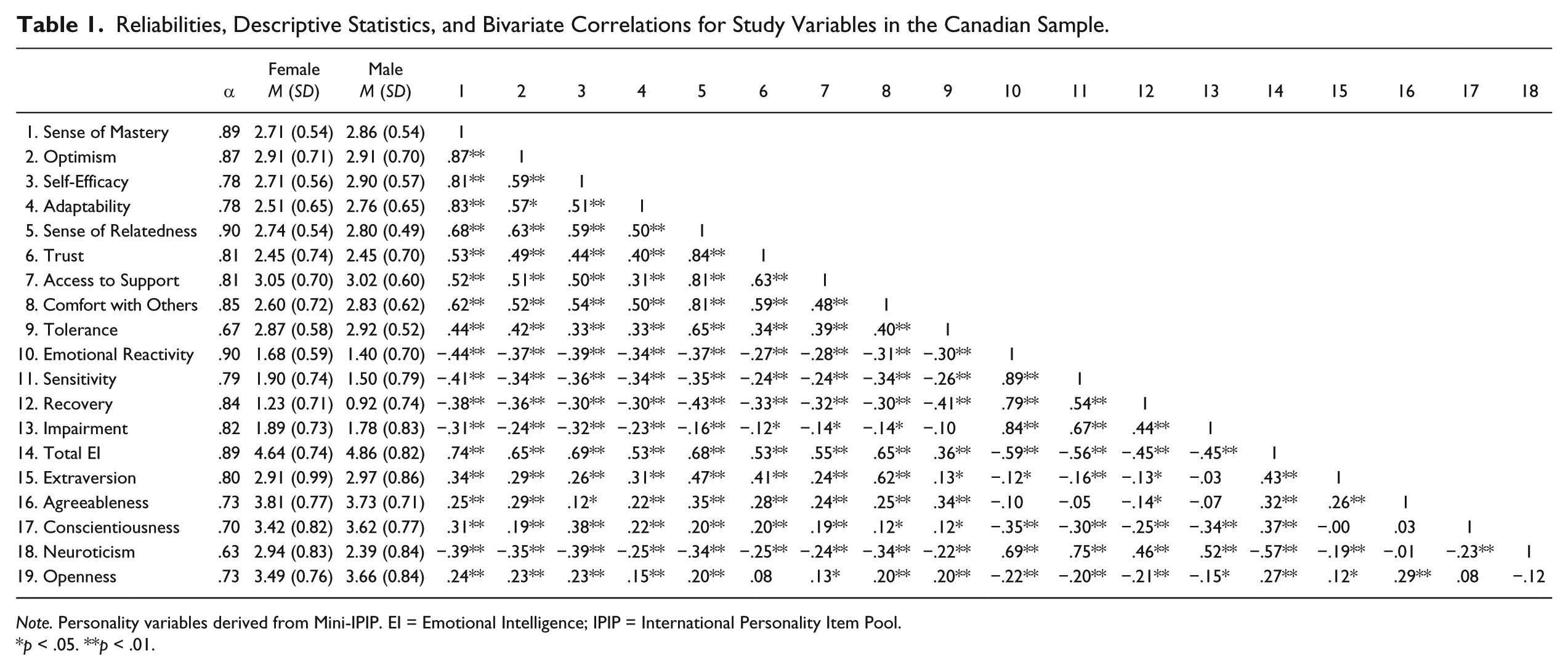
Note. Personality variables derived from Mini-IPIP. EI = Emotional Intelligence; IPIP = International Personality Item Pool.
p < .05. **p < .01.
Reliabilities, Descriptive Statistics, and Bivariate Correlations for Study Variables in the Italian Sample.
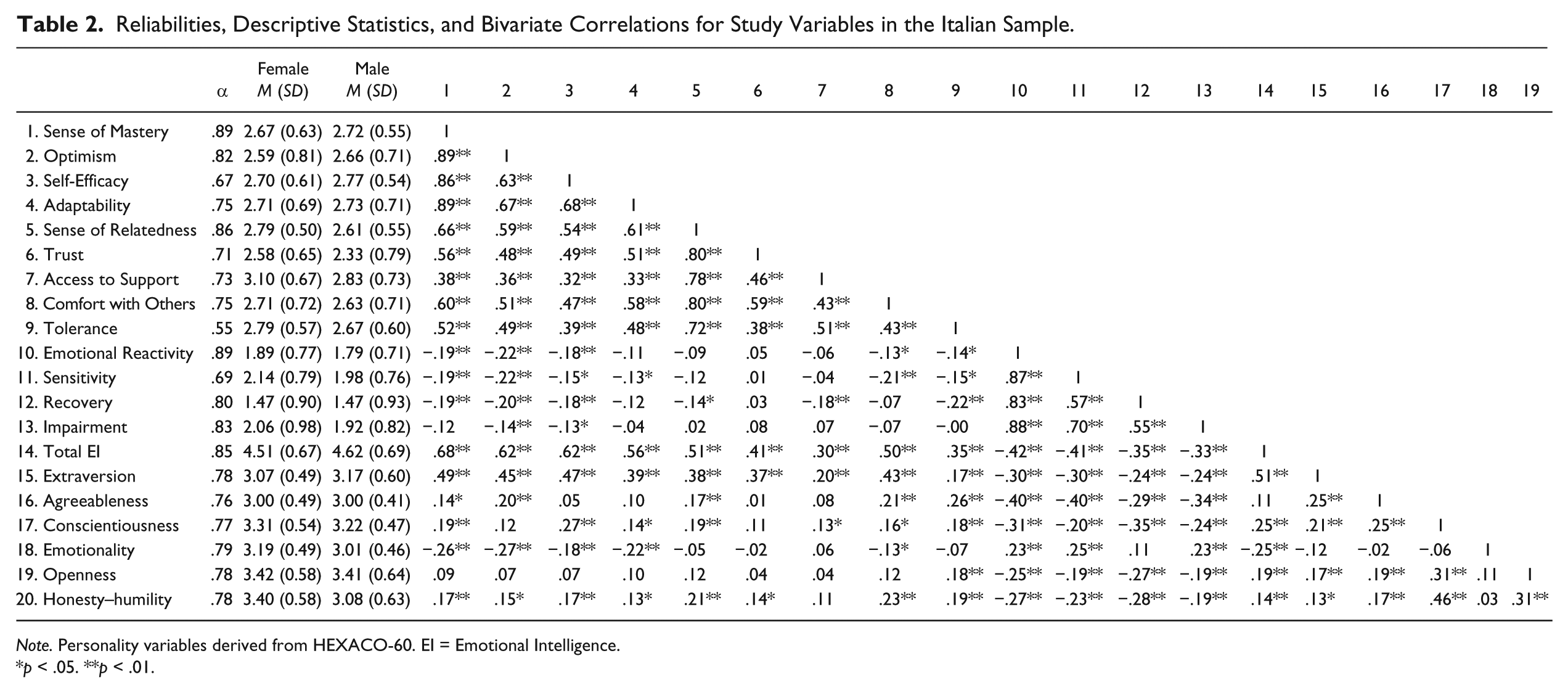
Note. Personality variables derived from HEXACO-60. EI = Emotional Intelligence.
p < .05. **p < .01.
In the Canadian sample, RSYA internal consistency values for the three factors were high (α = .89-.90). Subscale internal consistency values ranged from acceptable to good (α = .67-.87). Consistent with past research using the RSYA (Prince-Embury et al., 2017), the Tolerance subscale showed the lowest alpha value. Internal consistency values were high for trait EI and Mini-IPIP variables, with the exception of the Neuroticism subscale (α = .63). One item was removed from the original subscale (“I seldom feel blue”) and the internal consistency alpha increased from .58 to .63. Test–retest reliabilities of the RSYA factors over a 3-month period were also calculated for the Canadian sample and showed good test–retest reliability (Sense of Mastery r = .67, Sense of Relatedness r = .79, Emotional Reactivity = .76).
In the Italian sample, internal consistency values for the RSYA were high for the three factors (α = .86-.89). Like the Canadian sample, RSYA Subscale alphas ranged from adequate to good (α = .67-.83), again with the exception of a lower alpha value for the Tolerance Subscale (α = .55). Internal consistency values for trait EI and the HEXACO-60 variables were high (α = .76-.85).
Consistent with the initial hypotheses, Sense of Mastery and Sense of Relatedness factors and their corresponding facets were strongly and positively correlated with one another across both samples. Interestingly, Emotional Reactivity was significantly and negatively related to Sense of Mastery and Sense of Relatedness in the Canadian sample as expected, but was essentially uncorrelated with Sense of Relatedness in the Italian sample. Consistent with current research (Prince-Embury et al., 2017), trait EI was strongly positively correlated with Sense of Relatedness and Sense of Mastery, and negatively related to Emotional Reactivity in both samples.
In the Canadian sample, Sense of Mastery and Sense of Relatedness were positively related to extraversion, agreeableness, conscientiousness, and openness, and negatively related to neuroticism. Emotional Reactivity was strongly and positively related to neuroticism, and negatively related to conscientiousness, openness, and extraversion. No relationship, however, emerged between Emotional Reactivity and agreeableness.
By comparison, in the Italian sample, the Sense of Mastery and Sense of Relatedness factors were strongly and positively related to extraversion. Both factors also showed small positive relationships with agreeableness, conscientiousness, and honesty–humility. Sense of Mastery was negatively related to emotionality; however, there was no significant relationship between Sense of Relatedness and emotionality. Both Sense of Mastery and Sense of Relatedness were generally unrelated to openness. Similar to the Canadian sample, Emotional Reactivity was negatively related to extraversion, agreeableness, conscientiousness, openness, and honesty–humility, and positively related to emotionality.
Confirmatory Factor Analysis of RSYA in Canadian and Italian Samples
Two separate three-factor measurement models examining the dimensionality of the RSYA subscales in the Canadian and Italian samples were tested using confirmatory factor analytic procedures. For the Canadian sample, the overall model fit was acceptable: χ2(32) = 100.66, RMSEA = .086 (90% confidence interval [CI] = [0.067, 0.105]), CFI = .927, Tucker–Lewis index (TLI) = .897. All facets loaded strongly onto their respective factors, ranging from .52 (Tolerance) to .90 (Sensitivity). For the Italian sample, model fit was adequate: χ2(32) = 100.88, RMSEA = .091 (90% CI = [0.071, 0.112]), CFI = .929, TLI = .901. Like the Canadian sample, all facets loaded strongly onto their respective factors, ranging from .59 (Access to Support) to .85 (Adaptability), providing additional empirical evidence for the RSYA’s three-dimensional structure.
Cultural Invariance for the RSYA
A series of nested models were tested to assess the cultural invariance of the RSYA across the Canadian and Italian samples (see Table 3). Configural model fit was acceptable, χ2(64) = 299.94, RMSEA = .097 (90% CI = [0.084, 0.111]), CFI = .928, TLI = .899. According to the chi-square difference test, the metric model with constrained factor loadings across the Canadian and Italian sample was significantly different than the unconstrained model, Δχ2(7) = 16.80, p < .05. However, the CFI (ΔCFI = .004) and the RMSEA (ΔRMSEA = .002), difference tests displayed metric invariance indicating the factor loadings for the RSYA did not vary significantly across cultures. However, the scalar invariance model fit significantly worse compared with the metric invariance model, Δχ2(7) = 89.28, p < .01, ΔCFI = .035. This indicates that the endorsed levels of the underlying facets (i.e., intercepts) differed significantly across Canadian and Italian samples. Examination of these intercepts revealed that those in the Italian sample scored consistently higher on Emotional Reactivity compared with those in the Canadian sample.
Cultural Invariance Fit Indices.
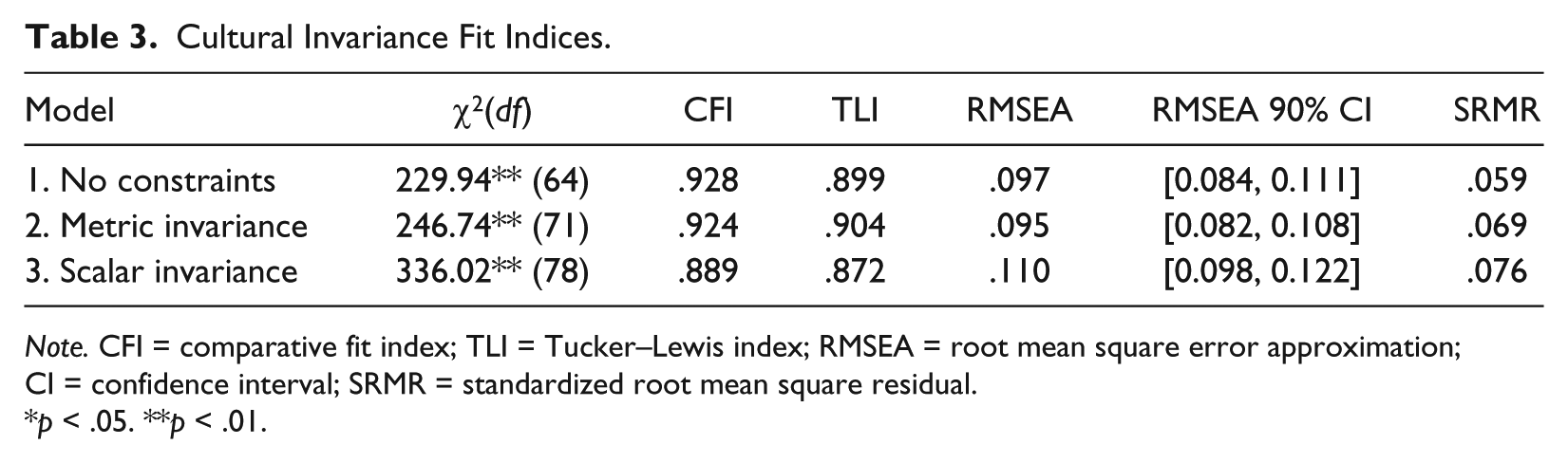
Note. CFI = comparative fit index; TLI = Tucker–Lewis index; RMSEA = root mean square error approximation; CI = confidence interval; SRMR = standardized root mean square residual.
p < .05. **p < .01.
Discussion
This study aimed to replicate the three-factor model of personal resiliency (Prince-Embury, 2006, 2007, 2014) and provide additional empirical support to demonstrate that the RSYA is a valid measure of personal resiliency for both Canadian and Italian young adult samples. Reliability analyses for the three factors and underlying subscales ranged from good to excellent for the Canadian sample and from adequate to excellent for the Italian sample. One exception to this finding in both samples was the Tolerance subscale with the internal consistency being adequate in the Canadian sample and poor in the Italian sample. Subsequent inspection of item correlations indicated that in the Italian sample, the item “I don’t hold grudges” was weakly correlated with the remaining Tolerance items, which is consistent with the speculation that this item may be lowering the internal consistency of the Tolerance subscale (Prince-Embury et al., 2017). Furthermore, an additional Tolerance item (“I can forgive my family”) was also weakly correlated with the remaining items in both samples (see the online supplementary material). It would appear that items in the Tolerance subscale may need to be revised going forward, as these findings are not unique to one sample.
This study was the first to investigate test–retest reliability of the RSYA. In the Canadian sample, RSYA scores measured three months apart revealed good test–retest reliability on all three factors. However, the correlation between Time 1 and Time 2 on the Sense of Mastery factor was slightly weaker than the other two factors. One possible explanation is that the Canadian sample consisted primarily of first-year undergraduate students who were entering postsecondary education for the first time; and, although Mastery is a relatively enduring trait, experiencing such a significant life transition such as entering postsecondary education could likely result in slight fluctuations in optimism, self-efficacy, and adaptability while adjusting to new academic and personal demands and requirements (e.g., Stelnicki, Nordstokke, & Saklofske, 2015).
In line with previous findings (Prince-Embury et al., 2017), convergent validity was demonstrated with positive correlations between trait EI and Sense of Mastery and Sense of Relatedness, and a negative correlation between trait EI and Emotional Reactivity in both samples. Examining the relationship between major personality traits and the RSYA factors was based on previous findings that have indicated resiliency is consistently positively correlated with extraversion, conscientiousness, agreeableness, openness, and negatively correlated with neuroticism (e.g., Friborg et al., 2005; Riolli et al., 2002). This indicates that individuals high in resiliency are typically expressive, socially adept, inquisitive, diligent, cooperative, and patient. However, those high in resiliency tend not to be fearful, dependent, or anxious.
The current study largely supported these findings, with a few exceptions. In the Canadian sample, there was a nonsignificant relationship between Emotional Reactivity and agreeableness. The Mini-IPIP assesses characteristics of agreeableness such as sympathy for others and interest in others’ well-being (Donnellan et al., 2006). Emotional Reactivity, as defined by the RSYA, is one’s preexisting tolerance and sensitivity for adverse events, length of emotional recovery time, and level of disruption following an emotionally upsetting event (Prince-Embury et al., 2017). These characteristics surrounding sensitivity and tolerance to emotionally adverse events are conceptually unrelated to the features of agreeableness. Thus, the nonsignificant relationship between Emotional Reactivity and agreeableness was not surprising.
In the Italian sample, Sense of Relatedness was negatively, albeit nonsignificantly correlated with emotionality. Sense of Relatedness is defined by such features as a perceived sense of trust, support accessibility, and comfort with others (Prince-Embury et al., 2017), whereas HEXACO emotionality is characterized by anxiety across a variety of contexts, fear of prospective harm, and dependence on others for emotional support (Ashton & Lee, 2009). Although Emotional Reactivity reflects a tendency to seek out emotional support from others, this reflects a need to alleviate anxiety, whereas Sense of Relatedness is described as a healthy protective factor of personal resiliency.
Openness (e.g., inquisitiveness, creativity, aesthetic appreciation) was not significantly related to either Sense of Relatedness or Sense of Mastery in the Italian sample. Individuals high in openness are curious about and absorbed in aesthetic beauty of nature and art. They are imaginative and demonstrate interest in unconventional ideas (Ashton & Lee, 2009). These features are conceptually unrelated to Sense of Mastery (i.e., one’s general perceived competence and efficacy) and Sense of Relatedness. These findings are also consistent with previous studies that have found weak or nonsignificant relationships between resiliency and agreeableness and openness, especially compared with the other personality factors (e.g., Campbell-Sills, Cohan, & Stein, 2006). The use of the HEXACO-60 in the Italian sample also allowed for examination of correlations between resiliency and honesty–humility. Both Sense of Mastery and Sense of Relatedness showed small, albeit significant relationships with honesty–humility, providing evidence for the notion that those scoring high on Mastery and Relatedness subscales tend to be modest, unwilling to take advantage of others, greed avoidant, and sincere in interpersonal relationships. Emotional Reactivity showed a negative relationship with honesty–humility. It is possible that because individuals high in Emotional Reactivity display little tolerance for anxiety-provoking situations, they may manipulate others to reach a goal, or be motivated to present themselves in such a way as to increase their social status.
Especially important is the support for the three-factor model of personal resiliency reflected in the RSYA (Prince-Embury et al., 2017) in both the Canadian and Italian samples. The three-factor, 10-facet dimensionality was supported with confirmatory factor analyses demonstrating good fit in both samples. The 10 facets loaded strongly on their respective latent factors with all loadings greater than .52. Furthermore, this study is the first to investigate cultural invariance with the RSYA. Metric invariance was supported using CFI and RMSEA difference tests, indicating that the factor loadings were similar between the Canadian and Italian samples. However, scalar invariance was not supported, and examination of the intercepts indicated that the Italian students had higher mean facet scores, primarily on the Recovery and Impairment facets of the Emotional Reactivity factor. This finding suggests that perhaps there are cultural differences in Emotional Reactivity, with some cultures viewing emotionality as being more or less socially acceptable. In addition, the finding that Emotional Reactivity was essentially uncorrelated with Sense of Relatedness in the Italian sample may further reflect cultural differences in how Emotional Reactivity is perceived within relationships. Some cultures may view strong emotionality as a more integrated aspect of relatedness, whereas other cultures might view it as an impediment to building a sense of relatedness. Differences on the mean facet scores for the Mastery and Relatedness facets were minimal.
Limitations and Future Directions
Limitations of the RSYA primarily include those suggested in previous research (Prince-Embury et al., 2017). The RSYA is a self-report scale, and shares the limitations of other assessments using this type of measurement format. Furthermore, it does not capture all features of personal resiliency across various situations and contexts, and the predictive validity of the RSYA has yet to be explored. With regard to the current study, similar to previous research, the two samples were limited to university students. Although the scale is intended for youth and young adults, future studies should assess the predictive utility of the RSYA in more diverse groups of young adults. Furthermore, there was a gender imbalance in the two samples with the participants consisting predominantly of females. This limitation should be considered when interpreting the results. Although findings of the personality–resiliency relationships were similar, the use of two different personality scales and the resulting correlations with the RSYA may have resulted in differential correlations across samples, and cannot be strictly compared across cultures. Finally, the test–retest reliabilities were only conducted with the Canadian sample; therefore, this has yet to be replicated and evaluated in an Italian sample. Overall, the current study provided an empirical evaluation and confirmation that the RSYA is a valid measure of the three-factor model of personal resiliency in a Canadian sample. Furthermore, it provided evidence that the RSYA is a promising measure for use with Italian young adults.
Footnotes
Declaration of Conflicting Interests
The author(s) declared no potential conflicts of interest with respect to the research, authorship, and/or publication of this article.
Funding
The author(s) received no financial support for the research, authorship, and/or publication of this article.
Supplemental Material
Supplementary material for this artile is available online.
References
Supplementary Material
Please find the following supplemental material available below.
For Open Access articles published under a Creative Commons License, all supplemental material carries the same license as the article it is associated with.
For non-Open Access articles published, all supplemental material carries a non-exclusive license, and permission requests for re-use of supplemental material or any part of supplemental material shall be sent directly to the copyright owner as specified in the copyright notice associated with the article.
