






Abstract
This study aimed to conceptualize socially shared regulated learning competency (SSRLC) and develop a valid and reliable instrument for junior secondary school students. Based on a review of relevant literature and two rounds of Delphi consultation with 16 experts, a theoretically grounded indicator system was established, comprising five dimensions: clarifying collaborative tasks, planning, monitoring, adaptation, and evaluation and reflection. On this basis, a 30-item Socially Shared Regulated Learning Competency Test (SSRLCT) was developed. The instrument was piloted with 225 students and subsequently validated with 955 students. Results showed satisfactory item functioning, strong internal consistency, and stable model-based reliability. Confirmatory factor analyses supported a correlated five-factor structure, and measurement invariance across gender was established. Criterion-related validity was further supported by a significant positive association with students’ collaboration. The study provides both a conceptual framework and a psychometrically supported tool for assessing SSRLC in junior secondary school students.
Keywords
Introduction
Socially shared regulated learning (SSRL) can be viewed as a “response” emerging from the integration of self-regulation of learning (SRL) and collaborative learning. It originates from the field of learning research, specifically rooted in SRL (Zimmerman & Schunk, 2011). SRL is understood as an individual cognitive constructive activity (Winne, 1997), whereas contemporary perspectives on learning emphasize the co-construction of knowledge—shifting from an individual constructivist to a sociocultural constructivist view. While SRL incorporates a degree of social influence, the social context is typically treated merely as a backdrop or influencing factor, rather than a central focus (Su, 2019). In response to this limitation, researchers have introduced the concept of social regulation of learning based on theoretical foundations such as social cognitive theory (Hadwin & Oshige, 2011; Zimmerman, 2000), sociocultural theory (McCaslin, 2009), and situated learning theory (Järvenoja et al., 2015; Greeno, 2006). This perspective highlights the inherently social nature of learning, with SSRL representing one form of regulation at the group level. In SSRL, regulatory activities shift from an individual (“I” or “you”) to a collective (“we”) orientation (Schunk & Greene, 2017). Thus, SSRL inherits certain mechanisms from SRL while also extending the situational and interactive features of collaborative learning. SSRL emphasizes high levels of participation and shared responsibility among group members. Integrating SSRL into collaborative learning brings a theoretical lens that foregrounds the co-construction process among learners, fosters a shared regulatory mindset, promotes role accountability, and enhances social interactions within the group.
Understanding Socially Shared Regulated Learning Competency (SSRLC)
There are two main perspectives on the concept of SSRL. One perspective conflates SSRL with social regulation of learning, viewing it as encompassing all social processes used by a group to regulate their shared learning tasks (Rogat & Linnenbrink-Garcia, 2011). However, Hadwin et al. (2017) argue that socially shared regulation is not synonymous with social regulation; rather, it represents a specific form within the category of social regulation of learning, which refers to a group’s deliberate, strategic, and transactive planning, task enactment, reflection, and adaptation. It encompasses cognitive, metacognitive, motivational, and emotional dimensions, and includes the processes such as task comprehension, goal setting, planning, monitoring, evaluation, and reflection (Hadwin et al., 2017).
Summary of Theoretical Models of Socially Shared Regulated Learning
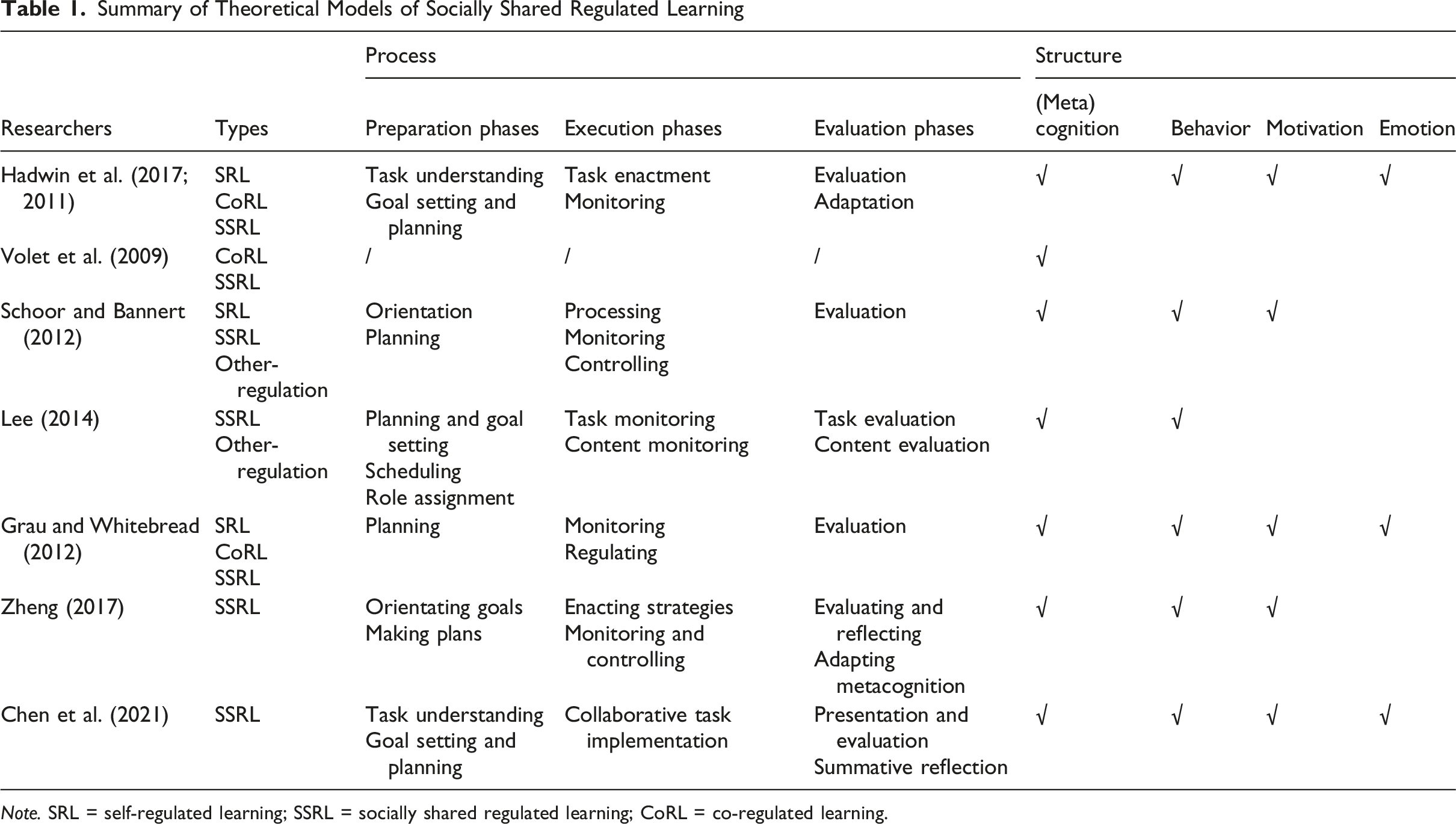
Note. SRL = self-regulated learning; SSRL = socially shared regulated learning; CoRL = co-regulated learning.
Among the regulatory types addressed in existing models, Zheng and Chen’s team has proposed a model specifically targeting SSRL. However, their model was developed within the context of computer-supported collaborative learning and is primarily oriented toward the development learning platforms for SSRL. Other scholars do not distinguish SSRL from co-regulated learning or other-regulated learning in terms of process stages or content components. Additionally, some researchers conceptualize self-regulated learning, co-regulated learning, and socially shared regulated learning as forming a continuum, which underemphasizes the distinctiveness of SSRL.
In terms of structural components, the studies conducted by Chen’s team, Hadwin’s team, as well as Grau and Whitebread, all encompass four key dimensions: (meta)cognition, behavior, motivation, and emotion. Other researchers have focused solely on (meta)cognition and behavior, offering a relatively limited perspective. These structural components are essential for deepening the understanding of the composition of SSRLC.
With respect to process components, most scholars generally divide the SSRL process into three phases: preparation, execution, and evaluation. However, the specific steps within each phase vary. The preparation phase typically involves task clarification, goal setting, and planning; the execution phase includes task or strategy implementation and monitoring; and the evaluation phase focuses on assessment and adaptation. These process divisions provide valuable guidance for conceptualizing SSRLC and constructing its indicator system.
Conceptualizing SSRLC
Research on socially shared regulated learning generally follows two main approaches: one focuses on the dynamic processes, while the other emphasizes its static structural components. The present study integrates both perspectives, taking the process of SSRL as the primary framework and further refining the internal elements of each process stage to conceptualize socially shared regulated learning competency.
As discussed above, many researchers have proposed theoretical models of SSRL. Among them, Hadwin is considered one of the leading scholars in the field of regulated learning. The influential SSRL model, developed based on the COPES model of self-regulated learning (Hadwin et al., 2011, 2017), has made a significant impact on the field. However, the model lacks detailed descriptions of the specific processes involved in SSRL. Furthermore, it was developed within the context of computer-supported collaborative learning, and its applicability to face-to-face classroom settings remains to be further validated. Therefore, in conceptualizing socially shared regulated learning competency, the present study partially draws on Hadwin’s SSRL model while further elaborating its process components through a review of relevant literature.
Specifically, Hadwin et al. (2017) proposed that SSRL unfolds through four key phases. In the first phase, group members negotiate and construct a shared task perception based on internal and external task conditions, thereby forming a collective understanding of the task. In the second phase, the group collaboratively sets shared goals, standards, and plans based on task conditions, context, and anticipated outcomes. The third phase involves task execution, during which members jointly and flexibly apply cognitive, emotional, behavioral, and motivational strategies to coordinate their collaboration. In the fourth phase, the entire regulation process—including progress and outcomes—is jointly monitored and evaluated, guiding the team to make adaptive adjustments to collaboration processes, pacing, and products when needed to optimize learning (Hadwin et al., 2017).
From this framework, six key processes of SSRL can be identified: the first phase can be summarized as clarifying collaborative tasks; the second phase corresponds to setting shared goals and planning; the third phase refers to executing collaborative tasks; and the fourth phase encompasses monitoring, evaluation, and adaptation. These phases are not strictly linear; instead, group members engage in dynamic and continuous regulation throughout the collaborative learning process. In the present study, these six processes were treated as core sub-competencies of socially shared regulated learning competency.
Clarifying collaborative tasks serves as the foundation for selecting effective goals, plans, and task strategies (Miller, 2015). In this study, this dimension includes task comprehension and task evaluation. Task comprehension refers to understanding the task’s requirements, standards, and related expectations, whereas task evaluation involves assessing the available conditions and resources, as well as the perceived difficulty of the task (Hadwin et al., 2011). Setting shared goals and planning is widely recognized by researchers as a critical process in socially shared regulated learning (Hadwin et al., 2017; Lee, 2014). It refers to the team collaboratively negotiating and formulating common task goals and standards, as well as developing strategic plans for task completion (Hadwin et al., 2017; Lee, 2014). This process includes establishing shared standards, such as timelines, quality expectations, and anticipated outcomes, and developing a detailed plan for task completion, including scheduling and the division of labor among team members. Executing collaborative tasks emphasizes the implementation of plans and the commencement of task-related actions. During this phase, team members jointly and flexibly apply cognitive, behavioral, motivational, and emotional strategies to coordinate their learning (Hadwin et al., 2017).
Monitoring refers to evaluating progress thus far, comparing the current state with the desired state, and judging the extent to which goals have been achieved (Hadwin et al., 2011). In socially shared regulated learning, monitoring encompasses cognitive, behavioral, motivational, and emotional dimensions (Grau & Whitebread, 2012; Sobocinski et al., 2020). Cognitive monitoring primarily involves overseeing task comprehension, resource use, time management, and strategy application. Behavioral monitoring refers to tracking behavioral performance and participation. Motivational monitoring involves observing goal orientation, interest levels, and the degree of effort exerted. Emotional monitoring includes assessing the collaborative atmosphere and the emotional states of team members. Evaluation focuses on performance evaluation and reflective summarization. It involves determining the effectiveness of the collaboration, drawing lessons from the experience, and identifying areas for improvement (Grau & Whitebread, 2012; Hadwin et al., 2017; Lee, 2014). Adaptation refers to making adjustments in response to challenges or problems and may occur within a specific phase of SSRL or across multiple phases. It may involve changes in cognition, behavior, motivation, and emotion, such as resetting goals, revising plans, adopting alternative strategies, altering task understanding, or regulating motivation and emotion to complete the task successfully (Hadwin et al., 2017; Winne & Hadwin, 2008). Accordingly, this study categorizes adaptation into four dimensions: cognitive adaptation, behavioral adaptation, motivational adaptation, and emotional adaptation.
Taken together, the present study conceptualizes SSRLC primarily through process elements while also taking structural components into account. Specifically, process elements provide the main framework for defining sub-competencies, whereas structural components—particularly cognition, behavior, motivation, and emotion—help clarify the internal composition of specific sub-competencies, especially monitoring, executing collaborative tasks, and adaptation. This conceptualization provided the basis for the subsequent development of the indicator system and the SSRLCT.
Assessing Socially Shared Regulated Learning Competency (SSRLC)
At present, some researchers have conducted assessments of SSRL from various perspectives. Researchers in the field of educational technology typically analyze students’ socially shared regulation of learning processes by either reviewing video recordings of face-to-face classroom interactions or examining activity logs generated from online collaborative learning platforms (Zheng, 2017). The quantity and content of data collected through these methods are inherently limited. On one hand, due to constraints in time and resources, most studies involve only small sample sizes, making it difficult to obtain large-scale data. On the other hand, researchers can only capture the observable behaviors of students, while important psychological experiences or regulatory processes that occur internally may remain undetected. Therefore, many researchers in educational psychology and the learning sciences have turned to the development or adaptation of standardized instruments to measure learners’ levels of socially shared regulation.
For example, Olakanmi (2016) developed the Co-regulated Strategies for Learning Questionnaire (CRSLQ), conceptualizing socially shared regulation as a kind of co-regulation. Analysis of data from a sample of 214 science students in a high school revealed that the CRSLQ comprises four dimensions: planning, monitoring, help-seeking and help-giving, and effort regulation. The Cronbach’s alpha coefficients for the subscales ranged from 0.87 to 0.92, and the overall reliability of the questionnaire was 0.95.
Su (2019) adapted Olakanmi’s CRSLQ to a survey instrument for assessing social regulation of learning, conceptualizing socially shared regulation as a component of social regulation. The revised scale includes 27 items using a five-point Likert format and is divided into six dimensions: goal planning, process monitoring, effort regulation, providing help, help-seeking strategies, and evaluation strategies. The researcher administered the scale to a sample of 180 second-year undergraduate students enrolled in a college English course at a key university in Beijing. Exploratory factor analysis identified six distinct dimensions, with all item factor loadings exceeding 0.60. Internal consistency analysis showed that the overall Cronbach’s alpha coefficient for the scale was 0.88, and the alpha coefficients for the six subscales ranged from 0.71 to 0.84.
However, both of the above instruments lack a clear conceptualization of SSRLC, instead subsuming it under co-regulated learning or social regulation of learning. Moreover, the psychometric evidence reported for these instruments is relatively limited, focusing mainly on overall reliability and exploratory analyses while providing less detailed examination of structural validity and item quality. Nevertheless, these studies represent important efforts that advanced the use of questionnaire-based measures of regulation of learning from individual learning contexts to collaborative learning contexts.
In addition, several scholars have developed instruments targeting specific components of SSRL, such as (meta)cognitive, motivational, and emotional regulation. For instance, Biasutti and Frate (2018) developed the Group Metacognition Scale (GMS), which consists of 20 items using a five-point Likert scale format. The scale comprises four dimensions: cognitive knowledge, monitoring, evaluation, and planning. The internal consistency coefficients for the subscales ranged from 0.80 to 0.86, with an overall reliability coefficient of 0.91. Additionally, Järvenoja and Järvelä (2009) developed the Adaptive Instrument for Regulation of Emotions (AIRE), which comprises four sub-questionnaires: personal task-specific goals, socio-emotional challenges during collaborative learning, regulation of emotions, and goal attainment.
Taken together, the review of existing instruments suggests three main points. First, SSRL-related assessment is generally multidimensional, as prior instruments typically include multiple regulatory processes or components rather than treating SSRL as a unidimensional construct. Second, existing measures have primarily been developed for specific aspects of SSRL or for broader constructs such as co-regulation or social regulation, rather than for SSRLC as a clearly defined and integrated competency. Third, the available instruments have mainly been used with older learners, especially secondary or higher education students, and their psychometric evidence has often emphasized internal consistency and exploratory analyses more than comprehensive validation of internal structure and item quality. These limitations indicate the need for a more clearly conceptualized and psychometrically rigorous instrument for assessing SSRLC. Accordingly, the present study aimed to develop and validate a multidimensional test of socially shared regulated learning competency for junior secondary school students.
Limitations of Existing Research
Despite increasing scholarly attention to SSRL, current research still exhibits several notable limitations. First, many scholars conflate SSRL with related forms of regulation, such as CoRL, and have proposed several process-oriented theoretical models of SSRL. However, limited attention has been given to the attributes of SSRLC, resulting in a weak theoretical foundation for assessing individuals’ SSRLC. Second, existing assessment approaches often focus on dynamic process tracing (e.g., discourse analysis or log data in CSCL environments), while standardized instruments targeting SSRL competency in real classroom remain scarce. Third, many available instruments are developed for adult or university populations and are rarely validated among junior secondary students. Additionally, they tend to focus on isolated dimensions (e.g., metacognition, emotion regulation) rather than capturing the full scope of SSRLC. Fourth, prior measurement instruments have rarely been validated using large-scale samples, and their reported psychometric evidence has largely been limited to internal consistency indices (e.g., Cronbach’s alpha), with little evidence of content or structural validity. These limitations highlight the need for a more clearly conceptualized and psychometrically rigorous instrument for assessing SSRLC among junior secondary school students.
Present Study
This study aims to conceptualize SSRLC and to develop and validate a measurement instrument for junior secondary school students. To achieve this goal, the study was conducted in two connected stages. Study 1 focused on the conceptualization of SSRLC and the construction and revision of its indicator system through literature review and expert consultation. Study 2 focused on the development of the SSRLCT based on the finalized indicator system and on the psychometric evaluation of the instrument (DeVellis & Thorpe, 2022).
Accordingly, the study was guided by the following specific research questions. RQ1. What is the conceptual meaning of SSRLC, and how should its indicator system be constructed? RQ2. To what extent do experts agree on the appropriateness and importance of the proposed indicator system for SSRLC? RQ3. How can the SSRLCT for junior secondary school students be developed based on the indicator system? RQ4. To what extent does the SSRLCT demonstrate sound psychometric properties, including item quality, reliability, and validity?
Study 1
Method
Study 1 aimed to construct and refine the indicator system of SSRLC through literature review and expert consultation, thereby providing the basis for item development and psychometric testing in Study 2.
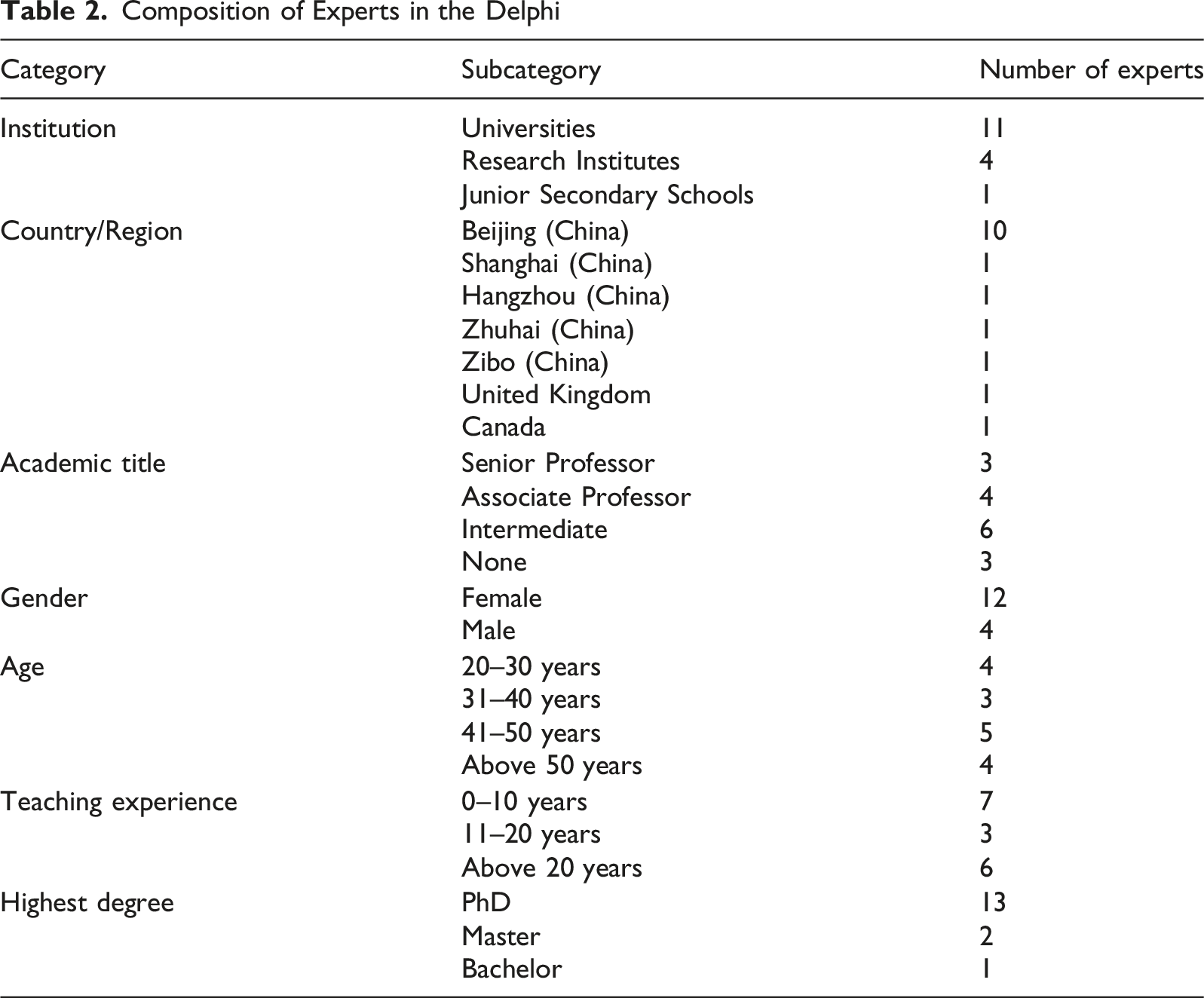
Participants
Composition of Experts in the Delphi
Measures
The researcher developed the first-round and second-round expert consultation questionnaires for use in the Delphi process. The questionnaires were designed to collect expert judgments on the importance and appropriateness of the proposed first-level and second-level indicators, as well as comments and suggestions for revision. The first-round questionnaire (see Appendix A) included 6 first-level indicators and 18 second-level indicators, rated on a 5-point Likert scale ranging from 1 (“not important at all”) to 5 (“extremely important”). It also collected expert background information, self-reported familiarity with the field (Cs), and the basis of expert judgment (Ca). A second-round questionnaire was subsequently developed based on the revised indicator system derived from the first-round consultation.
Procedure and Data Analysis
Study 1 was conducted in two stages. First, based on the literature review, a preliminary theoretical version of the SSRLC indicator system was constructed. In this process, studies from multiple disciplines were reviewed and screened. Both empirical and theoretical studies addressing SSRL or closely related constructs (e.g., social regulation of learning, co-regulation of learning, socially shared metacognition) were considered. The literature search was conducted using major academic databases, such as Web of Science, ProQuest, Scopus, and CNKI. Only peer-reviewed and formally published sources, such as journal articles, edited book chapters, research reports, and doctoral dissertations, were retained. All included studies had to be written in English or Chinese. In addition, reference lists of key articles were examined to identify further relevant studies through a snowballing approach. Through a review of the literature, the researcher analyzed the conceptual connotations and theoretical models of socially shared regulation of learning, integrated relevant findings, and preliminarily established a theoretical indicator system.
Second, a two-round Delphi consultation was conducted to evaluate and refine the theoretical indicator system. In Round 1, experts evaluated the theoretical indicator system and provided written suggestions for revision. The reliability of the consultation process was examined through the expert positive coefficient, the expert authority coefficient (Cr), the degree of expert opinion concentration, and the degree of expert opinion coordination (Keeney et al., 2001). The expert positive coefficient was represented by the questionnaire response rate, and Cr was calculated as Cr = (Ca + Cs)/2 (Keeney et al., 2001). Indicators were evaluated using the mean score, standard deviation, and coefficient of variation (CV). In this study, the filter criteria were set at a mean score below 4.00 or a CV above 20% (Shi et al., 2020).
In Round 2, the revised indicator system and a feedback document were sent to the same experts who had responded in Round 1. They were asked to reevaluate each indicator after considering the group feedback. The mean score, standard deviation, and CV were calculated again for the second-round results. Based on the quantitative results and expert feedback from the two rounds, the indicator system was further refined and finalized. Data were analyzed using SPSS 29.0 and Excel.
Results
Preliminary Construction of the Socially Shared Regulated Learning Competency Indicator System
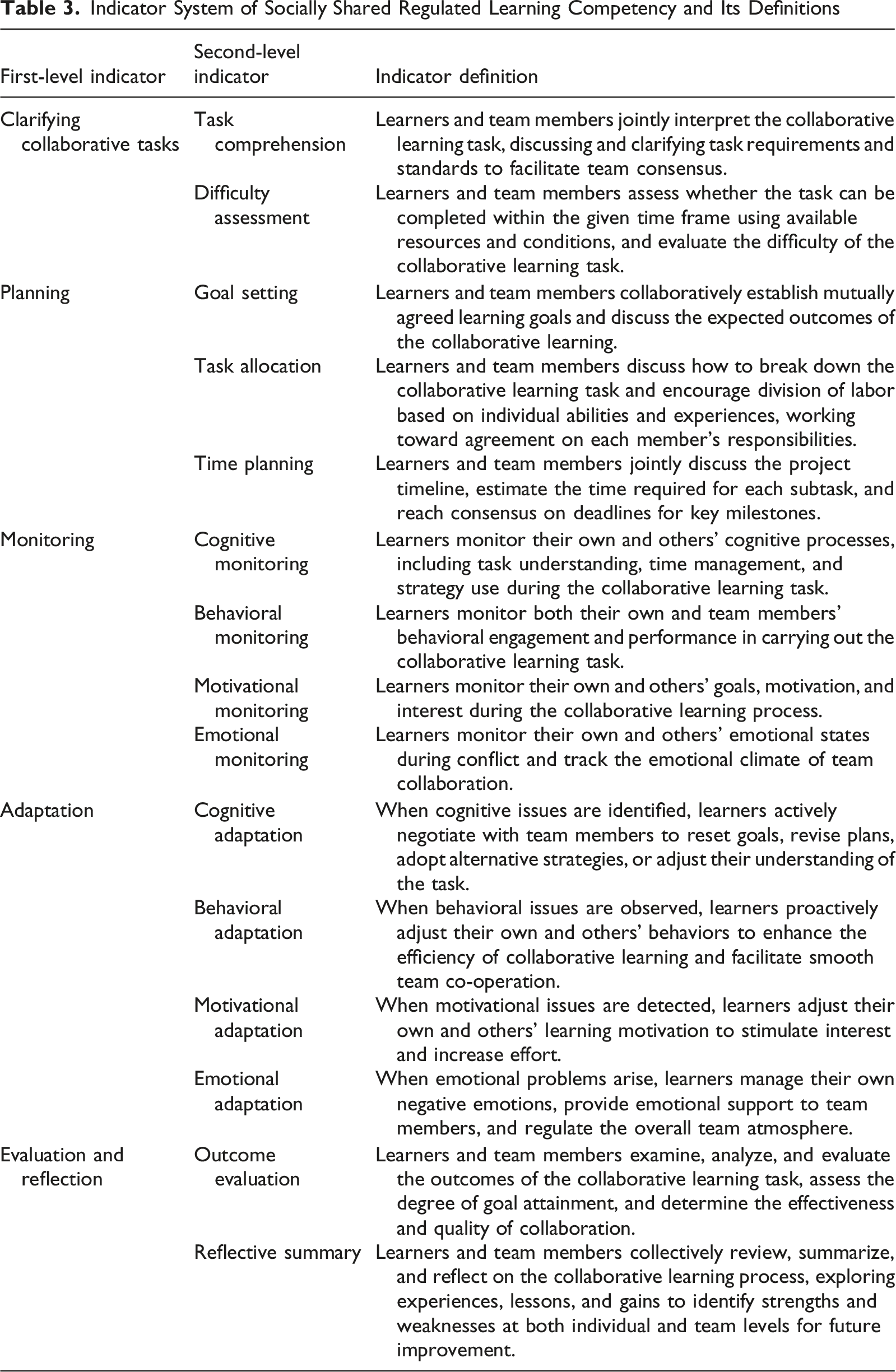
Based on the conceptual framework of socially shared regulated learning competency outlined in Section 1.2, this study preliminarily constructed the indicator system of SSRLC by taking the process of SSRL as the primary framework and further refining the internal elements of each process stage. Hadwin’s SSRL model served as an important reference in this process. According to this preliminary framework, six process-oriented first-level indicators were identified: clarifying collaborative tasks, setting shared goals and planning, executing collaborative tasks, monitoring, evaluation, and adaptation. Drawing on relevant literature, each first-level indicator was further elaborated into corresponding second-level indicators, resulting in the preliminary theoretical version of the SSRLC indicator system.
Specifically, clarifying collaborative tasks included task comprehension and task evaluation; setting shared goals and planning included establishing standards and developing plans; executing collaborative tasks included the use of cognitive, behavioral, motivational, and emotional strategies; monitoring included cognitive, behavioral, motivational, and emotional monitoring; evaluation included performance evaluation and reflective summarization; and adaptation included cognitive, behavioral, motivational, and emotional adaptation.
Indicator System of Socially Shared Regulated Learning Competency and Its Definitions
Revision of the Socially Shared Regulated Learning Competency Indicator System
The researcher conducted two rounds of revision and validation using the Delphi method. In the first round, consultation questionnaires were distributed to 20 experts, and 16 valid responses were collected, yielding an expert response rate of 80%, indicating a high level of engagement (Hasson et al., 2000). Cs and Ca were 0.94 and 0.53, respectively, resulting in Cr of 0.74, which exceeds the commonly accepted threshold of 0.70 for indicating high expert authority and reliable consultation results in Delphi studies (Shi et al., 2020).
This study analyzed each indicator from three aspects: the mean importance rating, the full score ratio, and the CV (Sun et al., 2024). In the first round of the Delphi consultation, the boundary value method and expert feedback were jointly used to revise the SSRLC indicator system. According to the results, the mean importance rating for all indicators was 4.84, with a standard deviation of 0.39, and a boundary value of 4.45. All indicators had mean importance ratings above 3, and none fell below the boundary value. The full score ratio for all indicators exceeded 40%. The mean CV was 0.07, with a standard deviation of 0.03 and a boundary value of 0.10. The CV for four indicators—implementation of cognitive strategies (0.11), implementation of motivational strategies (0.13), emotional monitoring (0.11), and adaptive adaptation (0.13)—slightly exceeded the boundary value, though the values themselves remained relatively low. Also, a total of 57 expert comments were collected during the first round of consultation. Based on these expert suggestions and existing research, this study further refined the indicator system.
Empirical Validation of the Socially Shared Regulated Learning Competency Indicator System
The second-round expert consultation questionnaires were distributed to the 16 experts who responded in the first round, and all 16 valid responses were collected, resulting in an expert response rate of 100%, indicating a high level of engagement. The second round maintained the 5-point rating scale. The mean importance rating for all indicators was 4.86, representing a slight increase of 0.02 compared to the first round. The standard deviation was 0.34, 0.05 lower than in the first round. The boundary value was 4.52, higher than that of the first round. All indicators had mean importance ratings exceeding the boundary value, and all full score ratios were above 40%, with an average of 86.25%. The mean CV was 0.06, a decrease of 0.01 from the first round. The standard deviation was 0.04, and the boundary value remained at 0.10. Only motivational monitoring had a coefficient of variation (0.11) slightly exceeding the boundary by 0.01, however, the value itself was still relatively low.
In addition, a total of 13 expert comments were collected during the second round of consultation. Most of these focused on refining the connotations of the second-level indicators and addressing wording-related details. In response, the study further revised and improved the definitions of the relevant secondary indicators based on expert feedback. Ultimately, this study established the final indicator system for socially shared regulated learning competency, with all indicators and their definitions presented in Table 3. Based on this system, the definition of socially shared regulated learning competency was revised as follows: it refers to the totality of individual psychological characteristics formed during collaborative learning, built upon specific knowledge and skills, and necessary for the successful completion of collaborative learning tasks. It involves cognitive, metacognitive, behavioral, motivational, and emotional dimensions, and includes five sub-competencies: clarifying collaborative tasks, planning, monitoring, adaptation, and evaluation and reflection.
Study 2
Method
Based on the finalized indicator system derived from Study 1, Study 2 aimed to develop the socially shared regulated learning competency test (SSRLCT) for junior secondary school students and to examine its psychometric properties. The study included item development and refinement, pilot testing, and final psychometric evaluation.
Participants
During the test development phase, after the initial item construction by the researcher, the test was reviewed by a panel consisting of two experts in educational measurement and evaluation, two experts in educational psychology, two teachers in junior secondary school, one instructor, and one editor from a national-level educational publishing house.
The pilot testing phase was conducted in a province in eastern China. A total of 278 students from eight classes at one junior secondary school participated in the pilot test. Invalid responses were excluded based on the following criteria: (1) identical responses to all items; (2) excessive missing responses; and (3) missing or incorrectly filled student ID information. After data cleaning, 225 valid cases remained, including 107 male students.
For the final testing phase, 1,036 students from 23 classes across three junior secondary schools in the same province participated. After removing invalid responses, 955 valid cases were retained, including 519 male students (54.3%).
Measures
Based on the finalized indicator system of SSRLC developed in Study 1, the researcher collected, adapted, and supplemented existing test items to construct the Socially Shared Regulated Learning Competency Test. The final version of the test (see Appendix B) consisted of 30 items, covering five sub-competencies of socially shared regulated learning, and each first-level dimension included at least three items. Each item includes three response options—A, B, and C—representing three levels of competency (low, medium, and high) within the given context.
The background task serves both as a prerequisite for SSRL and as the contextual foundation for assessing the competency. Drawing on literature and educational practices, and through consultation with experienced junior secondary school teachers, the background task was designed as follows: students work in groups to read a selected excerpt from The Chameleon, analyze the character portrayals, and adapt selected scenes into a short drama performance. The text features a range of vivid characters, providing students with sufficient material to collaboratively explore character traits and co-construct a dramatic adaptation. This open-ended task does not have fixed answers; students are free to select different characters and scenes for adaptation. Furthermore, the task is interdisciplinary in nature, integrating elements of both language and the arts. It requires learners to possess basic disciplinary literacy rather than in-depth subject knowledge, aligns well with the cognitive developmental characteristics of junior secondary school students.
Given the lack of an ideal instrument for SSRLC, this study adopted the collaboration-related scales from the Study of Social and Emotional Skills 2019 organized by OECD as a criterion measure. This choice was based on two considerations: first, these scales assess competencies related to collaborative learning among adolescents, which are conceptually revelant to socially shared regulated learning competency; second, the instrument was developed by an OECD expert team and has been validated in large samples across multiple countries. The instrument consists of 19 items in a five-point Likert format and comprises three subscales: Co-operation, Trust, and Empathy (OECD, 2019). Based on the 2019 SSES data for 15-year-old students in China, the Cronbach’s alpha coefficients were 0.81 for Co-operation, 0.87 for Trust, and 0.76 for Empathy (Zhang et al., 2021).
Data Analysis
In the pilot test, item fit and the appropriateness of response categories were analyzed using Excel, SPSS 29.0, and Winsteps 5.4.1. Specifically, Winsteps was used to examine item fit and response category functioning based on the Partial Credit Model (PCM), which is widely applied to evaluate polytomous items within the framework of item response theory (Bond, 2015). Excel and SPSS were used for response distribution checks and basic data preparation. The results were used to refine problematic items and response formats prior to the final test.
In the final test, a series of complementary analyses were conducted to examine the psychometric properties of the revised scale. First, item-level psychometric quality was examined within an item response theory framework. The Generalized Partial Credit Model (GPCM) was applied separately to the five dimensions of the SSRLCT to estimate item discrimination and step difficulty parameters for the three-category items. Item discrimination was interpreted according to Baker’s guideline (Baker, 2001), and ordered thresholds (b1 < b2) were taken as evidence of appropriate category functioning. In addition, item fit and response category functioning were further examined using PCM implemented in Winsteps 5.4.1. Infit and Outfit mean square (MNSQ) values between 0.50 and 1.50 were considered acceptable (Linacre, 1991).
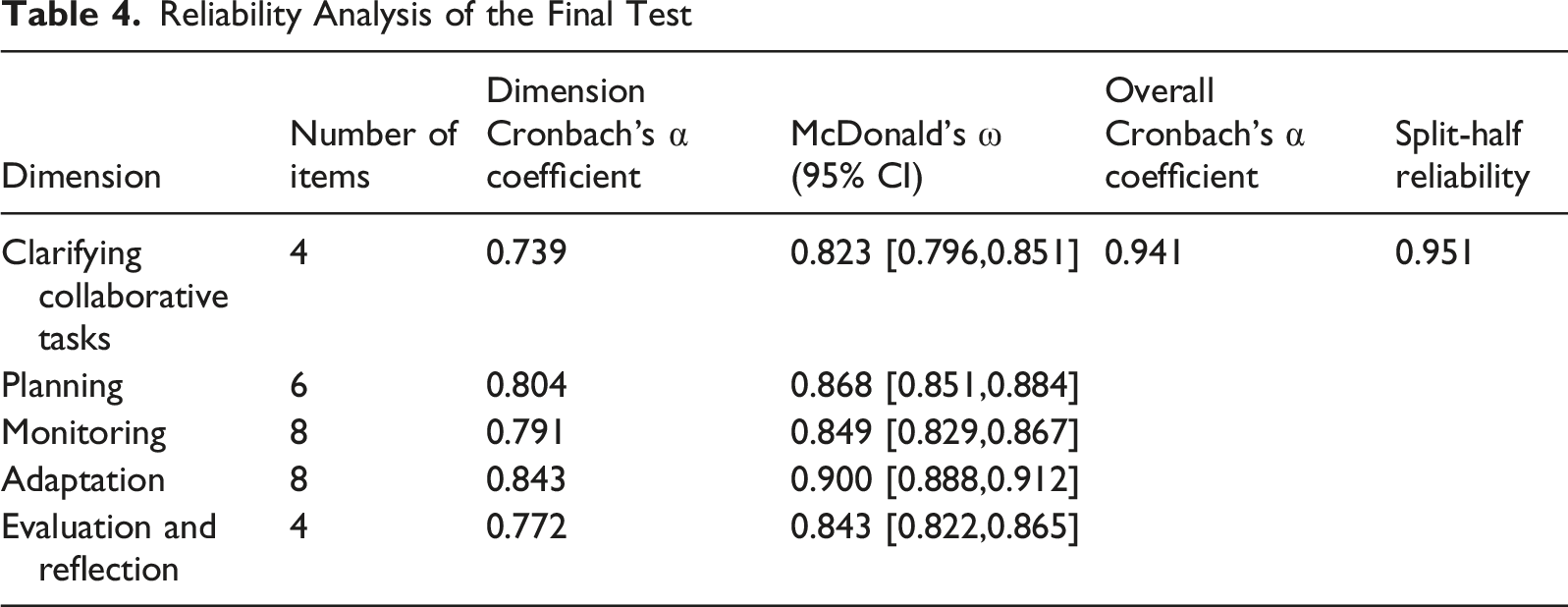
Second, reliability analyses were conducted using SPSS 29.0 and R version 4.5.3, including internal consistency reliability (Cronbach’s α), split-half reliability, and McDonald’s omega with 95% bootstrap confidence intervals, to assess the consistency and stability of the instrument (Rios & Wells, 2014).
Finally, validity analyses were performed. Correlations among subscales and between each subscale and the total scores were calculated to describe the internal relations among dimensions. Confirmatory Factor Analysis (CFA) was conducted using Mplus 8.3 to test three competing models, namely a one-factor model, a correlated five-factor model, and a second-order five-factor model. Model fit was evaluated using χ2, CFI, TLI, RMSEA, and SRMR. Following commonly used criteria, CFI and TLI values of 0.90 or above indicated acceptable fit and values of 0.95 or above indicated good fit, whereas RMSEA and SRMR values below 0.08 indicated acceptable fit and RMSEA values below 0.06 indicated good fit (Hu & Bentler, 1999). Measurement invariance across gender was examined using configural, metric, and scalar models, and invariance was considered supported when ΔCFI was no greater than 0.010 and ΔRMSEA was no greater than 0.015 (Chen, 2007; Cheung & Rensvold, 2002). Criterion-related validity was assessed using correlations with an external criterion measure (Indu et al., 2025).
Results
Pilot Testing: Item Quality Analysis and Revisions
Item Fit
Each item included three response options, labeled A to C, representing increasing levels of performance on the corresponding sub-competency. PCM was employed to analyze the full set of 30 items comprising the instrument. The results indicated that the SSRLCT for junior secondary school students had a KMO value of 0.899, exceeded the recommended threshold of 0.80, indicating meritorious sampling adequacy (Kaiser, 1974). Bartlett’s test of sphericity yielded a chi-square value of 1926.570 (p < 0.001), suggesting that the correlation matrix was suitable for factor analysis (Tabachnick & Fidell, 2019). The eigenvalue of the first factor was 8.386, while that of the second factor was 1.473. The ratio of the first to the second eigenvalue was 5.69, exceeding the threshold of 5, indicating that the test satisfies the unidimensionality assumption and is thus suitable for PCM analysis (Masters, 1982).
Subsequently, the fit between the observed data and the model-predicted values was examined. The Infit Mean Square (MNSQ) values for all items ranged from 0.87 to 1.26, and the Outfit Mean Square (MNSQ) values ranged from 0.74 to 1.34, all falling within the recommended range of 0.5 to 1.5 (Linacre, 1991). The absolute differences between Point–Measure Correlation Observed (PT-MEASURE OBS) and Point–Measure Correlation Expected (PT-MEASURE EXP.) ranged from 0 to 0.14, indicating minimal discrepancies (Linacre, 1991). These results suggest a good model-data fit. The Person Separation index was 2.71, indicating that the test effectively differentiates individuals with three levels of ability (Boone et al., 2014). The Person Reliability was 0.88, further demonstrating the test’s strong capacity to distinguish among participants with different competency levels. The Item Separation and Item Reliability were 3.05 and 0.90, respectively, both meeting established psychometric standards (Boone et al., 2014).
Appropriateness of Response Category Thresholds
The Wright map illustrates the alignment between the difficulty levels of each response option and students’ ability levels (Linacre, 1991). Overall, the difficulty values from Level 1 to Level 3 for each item exhibit a unidirectional increase. However, for Item T1, there is overlap between the difficulty levels of Option A and Option B and those of higher-level options. The researcher modified both Option A and Option B of item T1 to reduce their difficulty levels.
Category probability curves were also examined to determine whether each response option functioned distinctly across the latent trait continuum. Ideally, each category should show a clear peak, indicating that it is most likely to be selected within a specific range of ability. Most items showed appropriate category functioning. However, for five items, Option 2 did not show a clear peak, suggesting that the middle-level response was not sufficiently distinct from the adjacent categories. These options were therefore revised. For two additional items, Option 2 showed a relatively narrow peak range. Because the other item-functioning indicators were acceptable, these items were retained for further observation in the final test.
Results of the Psychometric Quality Analysis From the Final Test
Item Difficulty and Discrimination
The item discrimination parameters ranged from 1.00 to 2.39, indicating that the items demonstrated moderate to very high discrimination according to Baker’s guideline (Baker, 2001). The step difficulty parameters ranged from −2.04 to −0.57 for the first threshold and from −0.62 to 1.14 for the second threshold, suggesting that the items covered a reasonable range of difficulty across response categories. In addition, all items showed properly ordered thresholds (b1 < b2), supporting the intended functioning of the three-category response format.
Item Fit
The Infit MNSQ values for all items ranged from 0.84 to 1.21, and the Outfit MNSQ values ranged from 0.81 to 1.22, all falling within the recommended range of 0.5 to 1.5. These results indicate a good fit between the items and the model (Linacre, 1991).
Appropriateness of Response Category Thresholds
The difficulty values of each item increase progressively from Level 1 to Level 3, and the 90 response options collectively span the full range of student ability levels. In addition, the category probability curves for all items in the final test exhibit distinct peaks, indicating that the scoring structure of the items is well defined (Linacre, 1991).
Reliability
Reliability Analysis of the Final Test
Validity
Correlations among dimensions and with total score. The five dimensions of SSRLC were moderately and significantly correlated with one another, with correlation coefficients ranging from 0.58 to 0.76. This suggests that the dimensions assess related yet distinguishable aspects of SSRLC. Correlations between each subscale and the total score ranged from 0.80 to 0.91, all statistically significant at the 0.001 level, indicating that each dimension was strongly associated with the overall construct (Rios & Wells, 2014).
Fit Indices For Competing CFA Models of the SSRLCT
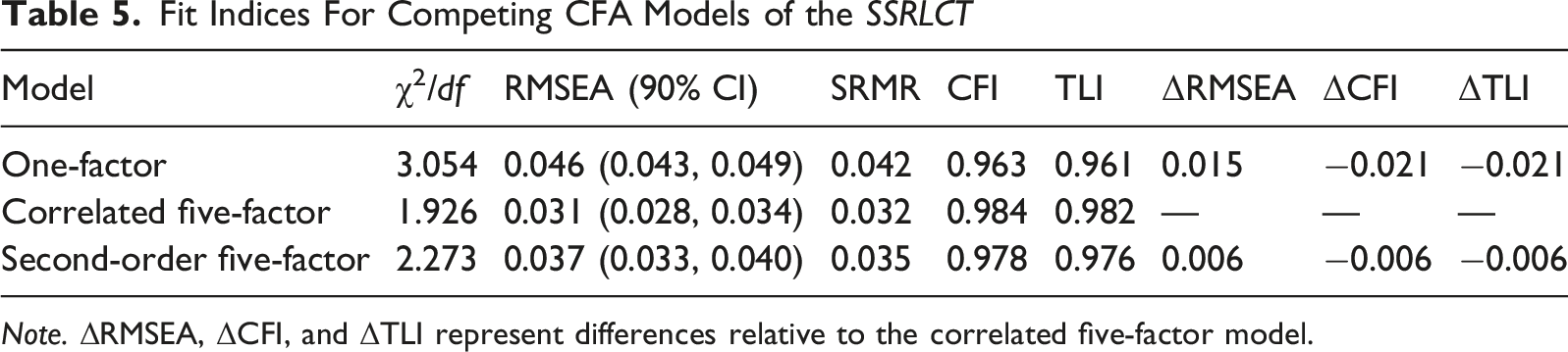
Note. ΔRMSEA, ΔCFI, and ΔTLI represent differences relative to the correlated five-factor model.
Measurement Invariance Across Gender
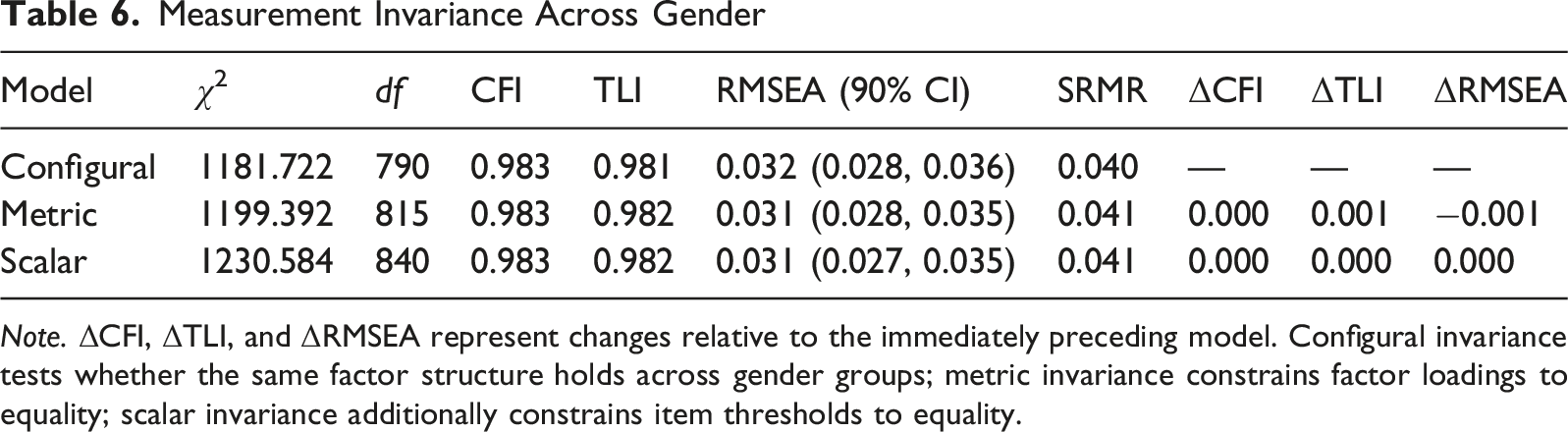
Note. ΔCFI, ΔTLI, and ΔRMSEA represent changes relative to the immediately preceding model. Configural invariance tests whether the same factor structure holds across gender groups; metric invariance constrains factor loadings to equality; scalar invariance additionally constrains item thresholds to equality.
Criterion-related validity. The correlation between SSRLC and collaboration was 0.520 (p < 0.001), indicating a statistically significant moderate association. This result suggests that the two constructs are meaningfully related but not redundant, thereby providing support for the criterion-related validity of the SSCRLT (Kline, 2023).
Discussion
The present study aimed to conceptualize SSRLC and to develop a corresponding measurement instrument for junior secondary school students. The findings support SSRLC as a multidimensional construct that can be represented through five interrelated process-oriented dimensions: clarifying collaborative tasks, planning, monitoring, adaptation, and evaluation and reflection. This conceptualization is broadly consistent with prior SSRL research, which has emphasized that socially shared regulation unfolds through coordinated processes such as task understanding, goal setting, planning, monitoring, evaluation, and adaptation in collaborative learning (Grau & Whitebread, 2012; Hadwin et al., 2011, 2017).
A key contribution of this study lies in the way SSRLC was conceptualized. Research on SSRL has generally highlighted two aspects of the construct: dynamic process elements and structural components. In the present study, these two perspectives were integrated, but they were not given the same role in the assessment framework. The process elements were treated as the primary framework, whereas the structural components were used to further clarify the internal composition of specific sub-competencies. Specifically, the first-level dimensions were defined from a process perspective, while structural elements such as cognition, behavior, motivation, and emotion were incorporated into the further specification of certain dimensions, especially monitoring and adaptation. This approach helps retain the theoretical richness of SSRL while keeping the indicator system sufficiently focused, parsimonious, and interpretable for assessment purposes. The emphasis on monitoring and adaptation is also consistent with prior research suggesting that these processes are central to socially shared regulation because they connect ongoing group progress with necessary regulatory adjustments (Hadwin et al., 2017; Sobocinski et al., 2020, 2022).
The revised psychometric analyses further strengthened support for the SSRLCT. At the item level, the item response analyses indicated acceptable discrimination, ordered thresholds, and satisfactory fit, suggesting that the three-category items functioned as intended. At the test level, reliability was supported by Cronbach’s alpha, split-half reliability, and McDonald’s omega with 95% confidence intervals. In terms of internal structure, the correlated five-factor model fit the data better than the one-factor and second-order models, indicating that the five dimensions are closely related yet empirically distinguishable. In addition, full measurement invariance across gender supports the interpretability of comparisons between boys and girls. Taken together, these findings provide stronger psychometric support for the use of the SSRLCT in assessing junior secondary school students’ socially shared regulated learning competency.
Another important point concerns the level at which SSRLC should be understood and assessed. Although SSRLC is manifested in collaborative settings, it fundamentally reflects an individual-level competency. The assessment of SSRLC should not depend solely on whether a group produces a successful solution or a high-quality outcome, because students within the same group may differ substantially in how effectively they participate in socially shared regulation. Likewise, the average score of a group cannot represent the competency level of each individual member. In addition, collaborative outcomes are often influenced by group composition, meaning that working with different peers may lead to different results. This position is consistent with research showing that shared regulation emerges through the participation and contributions of individual members and is closely tied to how learners attune to and build on one another’s contributions during collaboration (Isohätälä et al., 2017). For these reasons, this study adopted a cautious approach in constructing the indicator system and writing the test items, with the aim of capturing individuals’ competency in engaging in shared regulation within collaborative learning contexts.
This consideration also explains the use of hypothetical and situationally embedded items in the SSRLCT. In authentic classroom settings, learning tasks and group composition are often shaped by situational constraints, and certain sub-competencies of SSRLC may not always be activated in a single activity. To reduce this limitation, the test items incorporated a range of hypothetical collaborative situations. This is particularly evident in the items related to adaptation, many of which resemble situational judgment formats. Such items help reduce dependence on any single classroom activity and enable a broader assessment of how students are likely to respond when collaborative learning encounters challenges or problems (Lievens & Motowidlo, 2016).
The response format adopted in this study is another noteworthy feature. Rather than using a conventional Likert scale, each item provides three response options corresponding to low, medium, and high levels of competency. This format was intended to better capture the hierarchical nature of sub-competency performance. The psychometric analyses supported this design by showing that the response options generally functioned as intended and reflected increasing levels of the latent trait. In this sense, the SSRLCT attempts to move beyond traditional Likert-style self-report formats by using information- and behavior-based response options to elicit more specific and meaningful student responses (Hau, 2024).
Limitations and Future Directions
Several limitations should be noted. First, the present study focused only on junior secondary school students, and the findings should not be generalized directly to other populations without further adaptation and validation. Second, the test was developed and validated within a single collaborative learning context based on The Chameleon task. Future research should examine whether the SSRLCT functions similarly across different collaborative learning tasks and subject contexts. Third, the present study assessed SSRLC in traditional face-to-face classroom settings using a paper-based self-report measure. As collaborative learning increasingly occurs in more diverse and technology-rich environments, future studies may explore how SSRLC can be assessed in digital and AI-supported contexts and whether multiple evaluators or mixed assessment methods could provide a more comprehensive understanding of students’ socially shared regulated learning competency.
Supplemental Material
Supplemental Material - Development and Validation of Socially Shared Regulated Learning Competency Test
Supplemental Material for Development and Validation of Socially Shared Regulated Learning Competency Test by Yi An in Journal of Psychoeducational Assessment
Footnotes
Acknowledgments
The author gratefully acknowledges the experts who provided valuable input during the instrument development process, as well as the students who participated in the study.

Funding
The author received no financial support for the research, authorship, and/or publication of this article.
Declaration of Conflicting Interests
The author declared no potential conflicts of interest with respect to the research, authorship, and/or publication of this article.
Data Availability Statement
The participants of this study did not give written consent for their data to be shared publicly. Supporting data is therefore not available.
Supplemental Material
Supplemental material for this article is available online.
References
Supplementary Material
Please find the following supplemental material available below.
For Open Access articles published under a Creative Commons License, all supplemental material carries the same license as the article it is associated with.
For non-Open Access articles published, all supplemental material carries a non-exclusive license, and permission requests for re-use of supplemental material or any part of supplemental material shall be sent directly to the copyright owner as specified in the copyright notice associated with the article.
