







Abstract
What defines a good civil servant is not self-evident. In fact, when you ask civil servants what it means “to be a good civil servant” and “to do a good job,” you receive differing responses based on the various values that guide the way each individual approaches their job. The differing values can be traced to well-established perspectives in the literatures of public administration, governance, and political science. Each perspective defines “good government” and “being a good civil servant” in different ways, elevating differing values in the process. These perspectives are institutionalized and internalized in the present-day reality of public administration. Therefore, a present-day civil servant works amid a variety of competing perspectives about what “good government” and “being a good civil servant” mean. It is interesting how various perspectives on “good governance” and “being a good civil servant” play out in the working-practice of civil servants: How do values from the various governance perspectives guide the practical actions of civil servants? To answer this question, we conducted a research project to look for patterns in the values that guide the work of civil servants. We distinguished four governance perspectives from literature on governance. We translated these four governance perspectives into typical value statements that guide practical action, and used Q-methodology to survey civil servants with these perspectives as options. We found four distinct profiles of combined values that apparently guide the practical actions of civil servants. The profiles help us better understand the variety of values that guide practical actions of civil servants.
Introduction: The Inherent Ambiguity of Being a Good Civil Servant
Civil servants want to do a good job. The same is true of organizational managers, human resource (HR) managers, and executives responsible for the performance of public organizations. The essence of the idea of public service motivation (Brewer, Selden, & Facer, 2000; Campbell & Im, 2015; Gould-Williams, 2004; Perry, 1996; Tummers & Knies, 2013; Vandenabeele, 2008; Wright & Grant, 2010) is that civil servants are strongly inclined and intrinsically motivated to do a good job, provide good public services, and thus improve societal quality.
However, what it means to be a good civil servant and what good governance actually means is ambiguous. Definitions of good governance constantly shift, changing in response to and along with the trends and circumstances of their time; the dominance of certain ideas and perspectives fade and evolve, and so do ideas concerning good governance along with them. A review of public administration literature reveals four distinct governance perspectives that each highlights unique values: “Old” Public Administration, “New” Public Management, Network Governance, and Societal Self-organization. These perspectives guide civil servants’ perception of government’s role in society and of their role more specifically as civil servants. It influences their perception of politicians’ responsibilities, and the value, place, and interplay of citizens with government at large (Bozeman, 2007; Mosher, 1982).
Although perspectives are related to particular periods of time, they are not “timeless” entities (Howlett, 2014). For instance, New Public Management (NPM) was a product of a particular time-period, and was designed to address some of the recurring and pressing problems of that time, including waste, slack, inefficiency, and an overemphasis on the organizing principles of the market. However, most public organizations still use NPM as an approach for tackling these same recurrent issues. Or, as Bourgon (2009) argues, “Some values and preferences remain constant; while others change as societies confront new situations and evolve. Periodically, new values surface whose energy transforms the role of government and the practices of public administration” (p. 309). Over time, values change in their prominence, and perspectives are added to the spectrum. The discourse and debate concerning “good governance” is a continuous, living debate (Bourgon, 2009; Mosher, 1971; Stoker, 2006; van der Steen, Scherpenisse, Hajer, Van Gerwen, & Kruitwagen, 2015; van der Steen, van Twist, Chin-A-Fat, & Kwakkelstein, 2013).
Perspectives do not simply combine into a coherent set of values to guide actions. Civil servants have to be selective in the perspectives they follow. That begs the question which values they subscribe to in consideration of their work. Note that this is a distinctly different question from “how do they cope with the variety of perspectives?” We are interested in discovering how civil servants apparently combine values into clusters, which then guide their practical actions. This is important, because it helps us understand why civil servants act the way they do. These insights can inform strategic personnel management, strategic organizational management, conflict resolution, collaboration between different organizations, and the design of a more effective governance repertoire.
The layering of different perspectives is highly relevant now because of the recent momentum of the perspective of societal self-organization (Bourgon, 2011; Bovaird, 2007; Nederhand, Bekkers, & Voorberg, 2016; Pestoff, 2009; Sørensen & Torfing, 2016; van der Steen et al., 2014; van der Steen et al., 2015). What do legitimacy and equal treatment mean in the case of active citizens who organize their own library or “manage” their own children’s playground in a public park? These are practical questions that are prevalent in the work of civil servants in many different policy fields. It is interesting to learn how they deal with these issues and how that fits values from the other three governance perspectives.
Therefore, the research question of this article is as follows:
The answer to this question is interesting for employees of public organizations, as well as for those who collaborate with them. This research has the potential to contribute to our understanding of what motivates civil servants. It also helps us better understand how civil servants relate to the fourth perspective and how they mix that perspective with others. This is important, because the fourth perspective is (re-)gaining momentum in practice within the public sector, and calls for more deliberate and strategic responses from civil servants, public organizations, and governance arrangements.
Outline of the Article
We start with a description of the research on public sector values, followed by a description of the four theoretical perspectives on government steering, and the values that comprise those perspectives. After that, we outline our research methods, before discussing the results of the survey we conducted and the qualitative data we gathered. In our conclusion, we analyze our findings, discuss some of their limitations, and present a possible direction for future research.
Research on Public Sector Values
The study of public values is a recurring topic in the study of public administration, and it is characterized by two central problems: a problem of definition and issues of measurement (Bright, 2005; Goodsell, 1989; Inglehart, 2015; Perry et al., 2006; Jorgensen, 2006; Jorgensen & Bozeman, 2007; Thompson, 2017; van der Wal, 2010; Van Dyke, 1962; Van Wart, 1998).
The first problem is that there is no uniform definition of public values (van der Wal, de Graaf, & Lasthuizen, 2008; Van Wart, 1998). Public value is an essentially contested concept (de Graaf, 2003). Nonetheless, Bozeman (2007) identifies the central aspects of public value, which we will use as conceptualization for “value” in this research: public values are those providing normative consensus about (a) the rights, benefits, and prerogatives to which citizens should (and should not) be entitled; (b) the obligations of citizens to society, the state, and one other; and (c) the principles on which government and policies should be based. (p. 132)
This definition balances the different elements of the value-concept in a way that allows empirical research in the manifestation of values in the everyday practice of public governance.
The second problem for researching public values is if and how values can be measured. Schmidt and Posner (1986) explain the problem as follows: “they [values, ed.] are so deep-seated that we never actually ‘see’ values themselves. What we ‘see’ are the ways in which people’s values manifest themselves: in opinions, attitudes, preferences, fears, and so on” (p. 448). Values cannot be easily detected like a person’s appearance or personality traits; they only become recognizable through indirect observation—in manifestation, for example, in an expressed opinion, in answers to a question, in observed behavior, in stated or enacted preferences, or in visible emotions. Therefore, it is important to use research methods that have internal checks and balances, and preferably also include external reflections and validation by research subjects or relevant resources—for example, colleagues, managers, or peers.
In this article, we look at the intermixture of public sector values from different governance perspectives. We look at the spectrum of values that the governance perspectives consider “public” and at the contradictions within that spectrum (Tummers et al., 2012; de Graaf & van der Wal, 2010; Kettl, 2015; Thacher & Rein, 2004). Being a good civil servant requires the ability to mediate conflicting values in concrete terms within a specific organizational and institutional context (Le Grand, 2007; Noordegraaf, 2007). Rather than the theoretical construction of a set—or sets—of coherent values, we look at how civil servants mediate, construct, or “bricolage” values from different governance perspectives. What are patterns in the values celebrated by different governance perspectives that guide the actions of civil servants? Moreover, is it possible for us to take these patterns and establish civil servants profiles from them by distinguishing and defining recurring combinations of values from different governance perspectives that are relevant to civil servants and their work practice?
Exploring the Spectrum of Values: Four Perspectives on Governance
The literature on public governance distinguishes four different governance perspectives (Bourgon, 2011; van der Steen et al., 2015; Eijck, 2014): Traditional Public Administration, New Public Management, Networked Governance, and Societal Self-Organization. We briefly discuss the key points of each perspective here.
Traditional Public Administration, also known as Old Public Administration (Aberbach, Putnam, & Rockman, 1981; Barzelay, 1992; Kaufman, 1967; Mosher, 1982, 1971; Eijck, 2014; M. Weber, 1978; W. Wilson, 1889; J. Q. Wilson, 1989), is the classic perspective of government as a traditional bureaucracy (M. Weber, 1978; Wilson, 1989). This perspective centers the role of government on legality, the rule of law, the political process, and the separation between a representative political system and the civil service. For civil servants, this perspective emphasizes values like civil servants’ loyalty, precision, and independence (Kaufman, 1967; W. Wilson, 1887; J. Q. Wilson, 1989). Being a good civil servant is a legalistic, procedural, neutral, and supportive task (Frederickson, 1997; Goodsell, 2003; Kohlberg, Levine & Hewer 1983; Reich, 1985). Public goals are determined in political processes, and policies are formulated for translating political decision into concrete actions; civil servants subsequently execute and perform these policies in practice, without further addition or coloring of the politically defined goals. The bureaucracy ensures the standardization of response by government. Public interest and objectivity are important values, as well as equality and equity. The loyalty of civil servants is highly important, and civil servants execute what the hierarchy of the organization asks them to with constant reference to rules, laws, and procedures to prevent subjectivity (Hartley, 2005; Kaufman, 1967; van Eijck, 2011; J. Q. Wilson, 1989).
The perspective of New Public Management (Ferlie, 1996; D. Osborne & Gaebler, 1992; Pollitt & Bouckaert, 2004; Frederickson, 2005) emerged in the early 1990s and centers around the efficient and effective delivery of output by public organizations (Hood, 1991; Peters & Pierre, 2000; Pollitt & Bouckaert, 2011; Rhodes, 1996). NPM represented a turn in the debate about governance, lamenting what is seen as widespread “waste” in traditional governmental bureaucracy. Legalistic values still matter, but are instrumental for achieving results (D. Osborne & Gaebler, 1992). As NPM grew in prominence, many private-sector management techniques and instruments were introduced into public organizations, such as performance targets, deregulation, efficiency, contract management, and financial control. These were translated into values for civil servants: a focus on measurable “SMART” results, and efficient and effective execution of policies (Eijck, 2014; Pollitt & Bouckaert, 2004).
The perspective of Networked Governance focuses on the collaboration of government organizations and societal actors and reflects the displacement of government as the central actor (Ansell & Gash, 2007; Bogdanor, 2005; Hanf, & Scharpf, 1978; Klijn & Koppenjan, 2000; Klijn, Steijn, & Edelenbos, 2010; Kooiman, 2003; Marin & Mayntz, 1991; S. P. Osborne, 2010; Pollitt, 2003; Sørensen, 2002; Sørensen & Torfing, 2007; Stoker, 2006). This is often related to the move from government to governance, and the solving of wicked problems (Christensen & Lægreid, 2007; Head, 2008; Head & Alford, 2015; Van Bueren, Klijn, & Koppenjan, 2003) and “super-wicked problems” (Levin, Cashore, Bernstein & Auld, 2012) that typically require cross-institutional action. That is why civil servants have to operate in networks. Public Private Partnerships (PPPs) and network management are typical prototypes of this perspective (Klijn & Koppenjan, 2000; Klijn & Teisman, 2003; S. P. Osborne, 2002; Peters & Pierre, 2000; Reijniers, 1994; Steijn, Klijn, & Edelenbos, 2011). This inherently involves interaction, finding mutually acceptable definitions of the problem and looking for joint solutions. As a result, other actors become guiding factors in the process. In this perspective, a “good civil servant” is a networker who builds relations with other social actors to create and execute policies that are co-produced with others (Alford, 2009; Brandsen & Pestoff, 2006; Dentchev & Heene, 2004; Hartley, 2005; Klijn & Koppenjan, 2000; Pestoff, 2006; Stoker, 2006).
Recently, the governance perspective of “societal self-organization” has gained increased academic and practical attention (Bekkers, 2007; Bourgon, 2011, 2009; Edelenbos, 2005; Karré, van der Steen, & van Twist, 2013; Nederhand et al., 2016; Sørensen & Torfing, 2011, 2016; van der Steen et al., 2014; van der Steen et al., 2015; Voorberg, Bekkers, & Tummers, 2015). This perspective centers the production of public value on a self-reliant citizenry. Societal actors produce public value for their own reasons, and are guided by their own preferences and priorities (Bourgon, 2011; van der Steen et al., 2015). Citizens can undertake this independently, as well as through self-organized networks and cooperatives. It is important to note that this is still acknowledges a role for government, but that it is a departure from other models in that societal actors are primarily responsible for producing value via a bottom-up relationship (Bovaird, 2007; Nederhand et al., 2016; Pestoff, 2009; Sørensen & Torfing, 2016). This type of value production happens within the bounds of government responsibility, as self-organizing citizens still have to follow the law and act according to norms and standards (Sørensen & Torfing, 2016). Self-reliance is not an equivalent of a “laissez-faire” approach to government. The key point of this perspective is that the dynamics that produce public value start within society and that government relates to that; for example, do nothing, let go, block, facilitate, attempt to “organize” more self-organization (Bekkers, 2007; Boons, 2008; Boonstra & Boelens, 2011; De Wolf & Holvoet, 2005; Glasman, 2010; Nederhand et al., 2016; Portugali, 2000; Stoker, 2006).
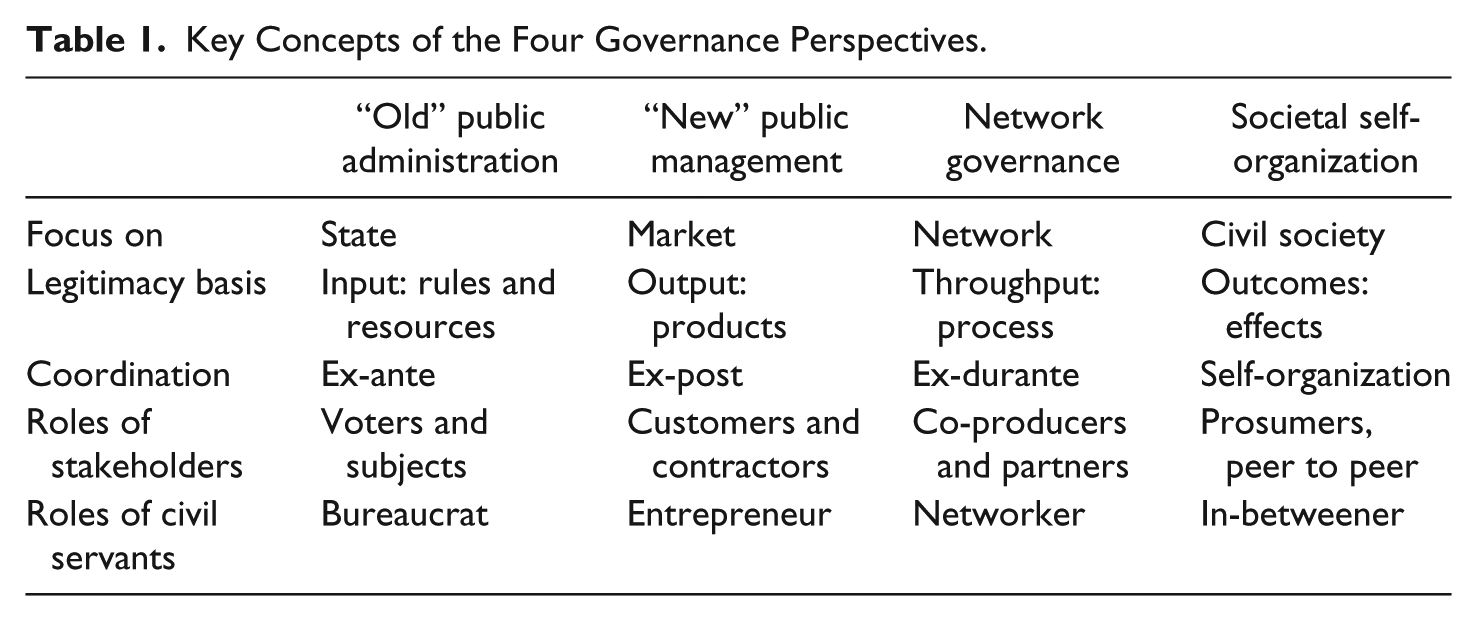
The four governance perspectives all stress different answers to questions of what defines good governance, and what it means to be good a civil servant. They are different interpretations of the same concept, but celebrate different values as essential for doing a good job in public service. Table 1 summarizes the key concepts of the governance perspectives.
Key Concepts of the Four Governance Perspectives.
Methodology: Finding the Value Sets That Guide the Actions of Civil Servants
From Governance Perspectives to Civil Servants Profiles
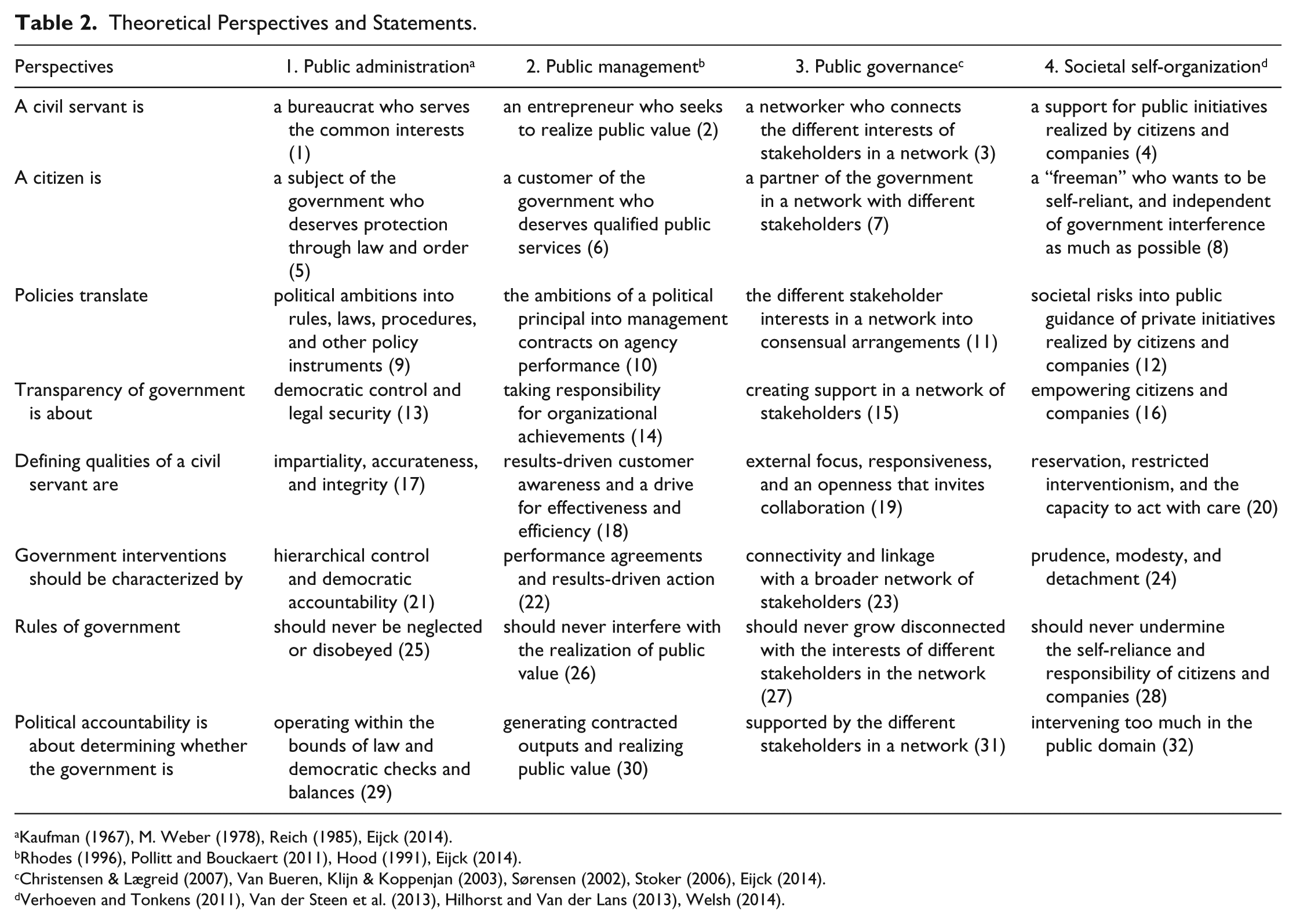
We used Q-methodology to determine which values civil servants cluster together from the different governance perspectives. We translated the core concepts of the different governance perspectives into basic statements for the Q-sort (see Table 2) and asked respondents to cluster. These clusters could entirely represent the perspectives, but probably combine values from different perspectives. Recurring clusters of combined values can be understood as value profiles for civil servants, which help elucidate, in a general sense, how civil servants perceive “doing a good job” and “being a good civil servant.” We will now further elaborate on the Q-sort we designed for this research.
Theoretical Perspectives and Statements.
Christensen & Lægreid (2007), Van Bueren, Klijn & Koppenjan (2003), Sørensen (2002), Stoker (2006), Eijck (2014).
Q-Methodology
The Q-methodology is a productive means for conducting study of public values, because it “provides a foundation for the systematic study of subjectivity” (Brown, 1980; Brown, 1993, p. 93; see also: van Exel & de Graaf, 2005). Q-methodology asks respondents to prioritize between values, which explicates their implicit “ranking” of the spectrum of possible values. Every civil servant values effectiveness, efficiency, the rule of law, the importance of citizen participation, and societal support for decisions. However, in the Q-sort, they have to answer what they value most; this provides us with more insight in what matters most to them.
We took three steps in applying the Q-methodology to this study. We will briefly elaborate on each of the steps here.
The Q-Set
First, we formulated and selected relevant statements for this study. To formulate statements covering an entire topic, it is important to establish a “concourse” around a particular topic (Brown, 1993; McKeown & Thomas, 2013). This concourse has to encompass all the existing opinions on a particular topic, thereby representing “the breadth of debate around a particular topic.” The concourse can be derived from different verbal products, such as interviews, newspapers, magazines, or scientific literature such as papers, essays, and books (van Exel & de Graaf, 2005). In this research, we based the 32 statements on the theoretical governance perspectives from the governance literature to identify the concourse, which we translated into value statement for civil servants. We asked several potential respondents to check the statements, to make sure they were easily understood. We used their feedback to finalize the statements in our Q-set. The final statements can be found in Appendix A.
The P-Set
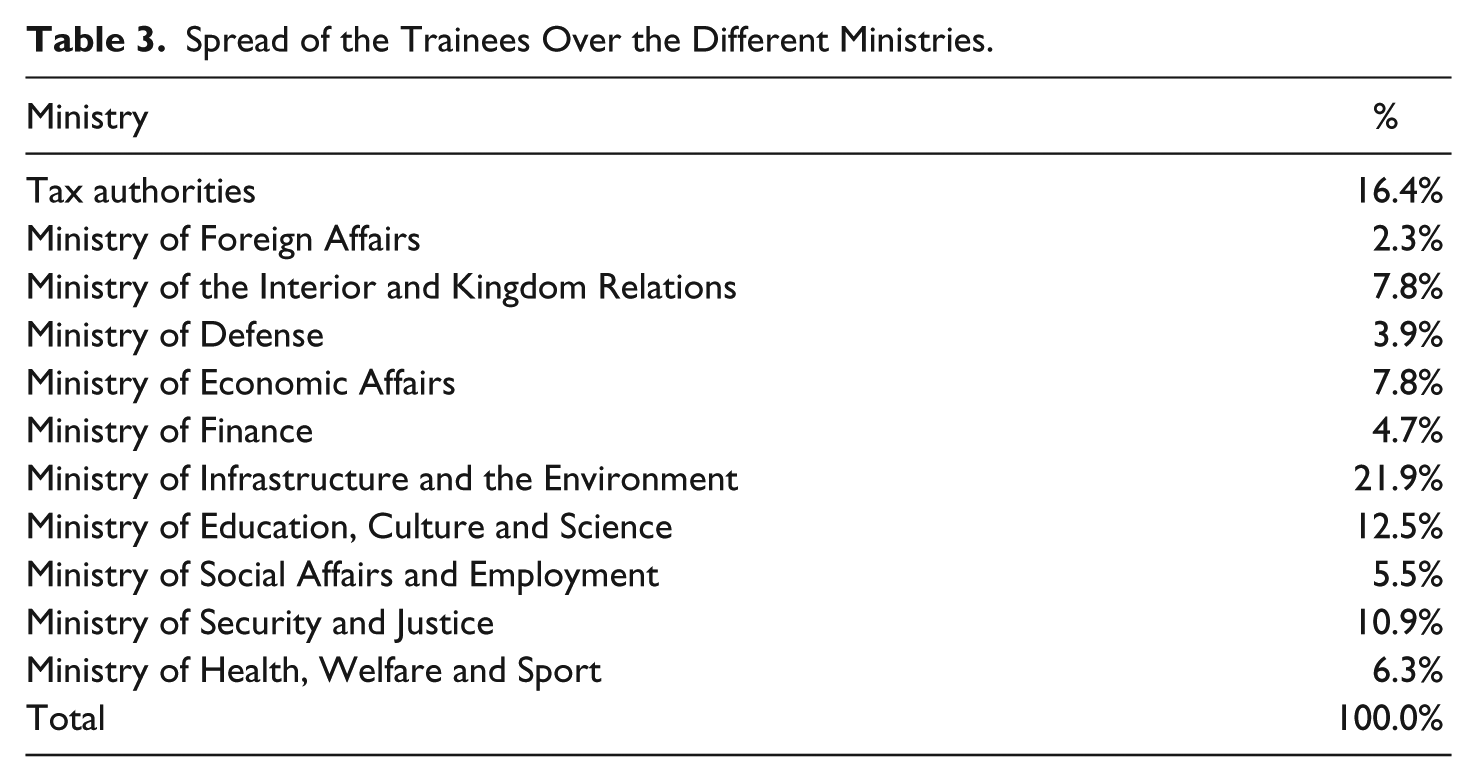
The research was conducted in 2014. Our respondents all participated in the 2-year “combined traineeship program” offered by the national government ministries of the Netherlands. We invited a total of 128 trainees to participate, of which 116 agreed to fill out the Q-sort; respondents included individuals from each of the 11 Dutch ministries. Table 3 shows the spread of the trainees over the different ministries.
Spread of the Trainees Over the Different Ministries.
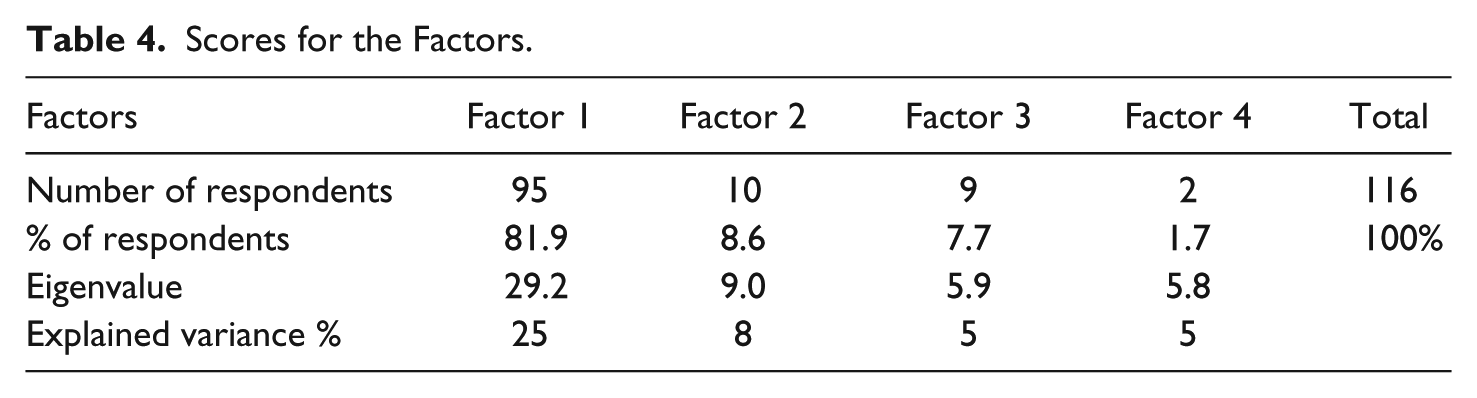
Scores for the Factors.
We targeted this particular group of civil servants for our research for a variety of reasons. First, the “trainee-program” is a high-profile program for civil service in the Netherlands. Trainees are selected from a candidate pool totaling in the thousands and are required to undergo several rounds of intense assessments and testing.
Second, the candidates are highly motivated to work in the civil service; they did not end up working in public service “by coincidence.” They deliberately chose to work in the public sector instead of the private sector, which suggests they have strong feelings about “publicness” and civic virtue.
Third, we debated a lot about whether the age group of these respondents was impactful. The age of the group (trainees are only allowed to apply if their work experience totals 2 years or less) was not stipulated or predetermined when we were choosing among respondents. Much more important for us was the access we had to this group of individuals, and the way in which they embodied the previous two characteristics, among several other factors. We considered it interesting to have a group with broad placement throughout all of the ministries.
A fourth point for debate is whether research on civil servants from the Netherlands has implications for civil servants in other countries. The Netherlands is a good locus for research on the clusters within the population of statements, but does not allow us to generalize toward individual civil servants in other countries—or even in the Netherlands for that matter. However, for the focus of this research—to determine how values celebrated by different governance perspectives guide the practical action of civil servants—it is appropriate. Further research could translate the underlying coherence into a theory applicable to other countries.
The Q-Sort
By Q-sorting, people give subjective meaning to the set of statements. In the Q-methodology, respondents rank each of the statements relative to one another. In the first round, the respondents sort the statements into three categories: agree, disagree, and neutral. In the second round, respondents are asked to sort these three categories into the most (dis)agreeable statements. The statements are ordered in a pyramid-shaped figure and graded on a scale; the (most) disagreeable statements are scored “−4” and the (most) agreeable statements are scored “4.” Also, respondents can add notes to explain why they ranked certain statements as most agreeable and others as most disagreeable. That provides a qualitative element to the data.
The Q-Analysis
We used the individual profiles to calculate a correlation matrix and a factor analysis. This analysis is conducted by the program PQMethod 2.33 (The extraction method: centroid, rotated method, varimax) and led to four factors. Each factor was interpreted and described using the “characterizing” and “distinguishing” statements, as well as the explanations provided by respondents. The distinguishing statements are the most “typical” statements of a factor. The program calculated z scores for each respondent on each of the factors. The respondents’ z scores tell us which factors best match the respondent’s preferences. Notes of respondents give additional insight into the choices and considerations of the respondents.
Results: Four “Value Clusters” of Civil Servants
Factors
The results show that “pure” theoretical perspectives do not exist in the “minds” of civil servants; respondents agree or disagree with statements from various perspectives and thus mix elements from different perspectives. However, this mixture is not random; the factor analyses reveal four strong patterns in the mixtures of statements by respondents (see also apendix B):
Factor 1 (81.9% of respondents, eigenvalue 29.2) shows a positive (agreement) on statements of public administration and on statements of network governance. Factor 1 scores negative on statements of societal self-organization. The statements regarding the perspective of public management have both positive and negative scores on the first factor.
Factor 2 (8.6% of respondents, eigenvalue 9.0) has positive scores on the perspective of network governance and has negative scores on the perspectives of societal self-organization and public administration. The perspective of network governance scores both positive and negative on this second factor.
Factor 3 (7.7% of respondents, eigenvalue 5.9) scores positive on the perspective of societal self-organization and public administration. The perspectives of public management and network governance score negative on this factor.
Factor 4 (1.7% of respondents, eigenvalue 5.8) scores positive on the perspective of public management and negative on the perspective of network governance and the perspective of societal self-organization. The statements of the perspective of public administration score both positive and negative on this factor.
We also checked the variance of scores over the different ministries; this did not produce interesting variance; the general pattern of the factors was similar in the various ministries, which is not surprising given the large share of Factor 1.
Table 5 summarizes the meaning of the factors in terms of the governance perspectives. We counted the positive, negative, and neutral scores on statements from the four governance perspectives and coded them: “++” or “+” implies relatively many positive scores on statements of a perspective; “−−” or “−” indicates relatively many negative scores on statements of a perspective, “±” indicates both consistent mixture of positive and negative scores of statements of a theoretical perspective.
Distinguishing Statements on the Four Factors.
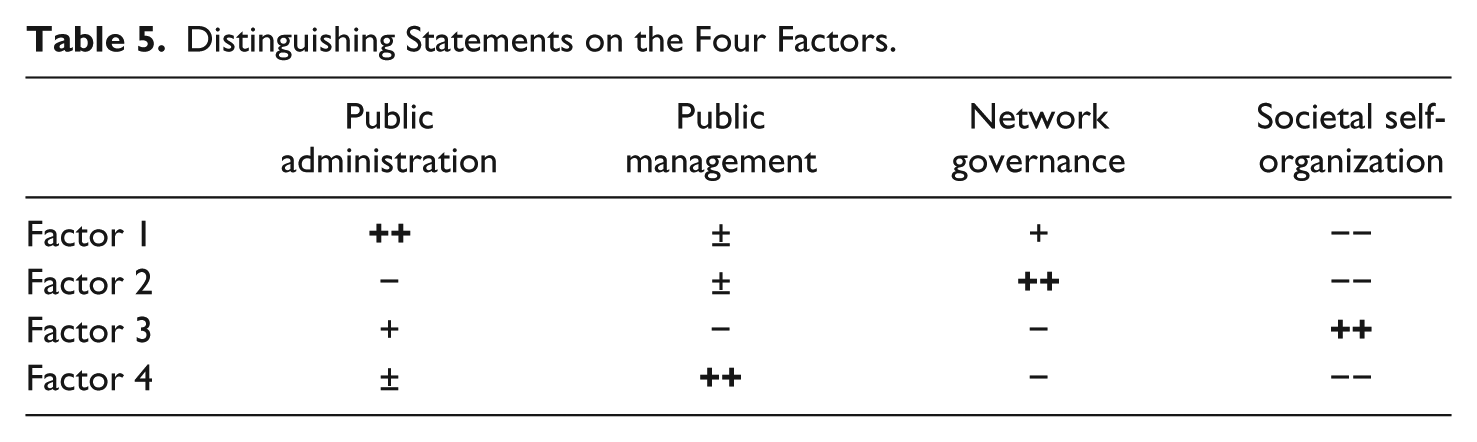
The factor analysis shows that Factor 1 is the strongest cluster of statements; it includes the most statements, and more than 80% of the respondents portray this pattern in their statements. The cluster is a mixture of traditional public administration and more modern values from networked governance and new public management. The respondents are very negative about societal self-organization, which they see as a problematic “mode” of governance.
Factors 2 and 3 are almost equal in terms of respondents. Both factors highlight more externally oriented values for government: Factor 2 in terms of networked governance and government-organized networking, and Factor 3 in terms of societal resilience and the more bottom-up mode of interaction between society and government. Interesting also is that although both factors stress the external dimension of governance, they are negative about each other; apparently, a positive score on societal resilience is combined with a negative view on networked governance, and vice versa. Interesting also is that the societal resilience perspective shows positive scores on statements that represent the public administration perspective. Apparently, societal resilience is combined with a strong sense of the more traditional values, and respondents still see an important role of government in society. Factor 2 scores strongly on values of networked governance, but very negatively on values of traditional public administration. Networked governance combines more positively with scores on the NPM perspective than with values from traditional public administration.
The small size of Factor 4 (few respondents and few statements) is surprising. In Q-sort, factors with an eigenvalue above 1.0 that are recognized by at least one respondent (factor loading of respondent above 0.40) are considered relevant (see Jeffares & Skelcher, 2011). Factor 4 has an eigenvalue of 5.8, but only two respondents adhere to it. This factor stresses the importance of the values from the new public management perspective, denotes the more externally oriented perspectives, and is neutral about the public administration perspective. Given the dominant role of the new public management values in the design, structure, and also organizational culture of the ministries in The Netherlands, it is interesting to see that these are not reflected in how respondents appreciate values.
Interpretation of the Factors: Four Clusters of Combined Values
The data show four patterns that can be translated into value profiles of civil servants. We discuss each of the four profiles here, in which we use the statements that the respondents scored to describe the factors in more detail.
Factor 1: “Traditional civil servant”
In this profile, values from the traditional public administration perspective dominate. Respondents see themselves as servants of the general interest; they have to be loyal to the government and subservient to the political primacy. They are civil servants in the traditional sense of the word; a civil servant should contribute to society, does not take risks, and holds himself bounded by the rule of law and the political primacy. The quality of civil servants can be characterized by diligence, impartiality, and integrity. “If a civil servant does not have these values, the person is per definition not suitable for the job,” argues a respondent. In addition, values such as legality and democratic control are highly valued. Respondents in this profile value the foundations of the classical bureaucracy and the rule of law and base their actions on these principles.
Civil servants in this profile see the government and citizens as two very separate entities. As one respondent states, “In some cases the government knows better than citizens what is good for citizens and society as a whole.” However, respondents are not blind to the limitations of government bureaucracy; they explain that government is confronted with a complex network of actors that never fully agree about problems and solutions: “when this was the case, government would have an easy position and could send top-down letters that fit the social reality.” Therefore, values celebrated by network governance also play a role in this profile.
Respondents do not value statements that stress the importance of bottom-up initiatives by citizens and “self-organizing” capacity. Instead, civil servants in this perspective see that as a risk. They feel strongly that a well-functioning government best serves the public interest, not individual actions in the public space. They are wary of the risk of possible inequality that can arise from self-organization and of the possibility of negative spillover effects of bottom-up initiatives. Moreover, civil servants feel that if government does a good job, then self-organization in the public domain should not be necessary. Respondents in this cluster are equally critical of the “business-style” values of new public management; they consider businesslike acts by government as risky and do not see citizens as “customers.” They are not “against” efficiency but do not see it as a key value for government, at least not when confronted with values such as fair and equal treatment.
Factor 2: “Practical networker”
Values from the Network Governance perspective dominate this profile. Civil servants who adhere to this perspective consider policy networks important, and see governing in networks as a good way for government to achieve policy goals; that is why we call them “practical networkers.” “To formulate supported policies, it is important to be a networker,” one respondent claims. Policies need to be realized in collaboration with other entities, such as other governments, other public institutions, private actors, entrepreneurs, and citizens. Effective policies ask for collaboration, for which civil servants take the initiative and that they manage as “network managers.” Policy making and implementation require the ability to organize processes of effective collaboration. Civil servants in this profile see themselves as connectors in networks, who are able to deal with different interests of parties and bring them together into concerted efforts. Citizens and public or private organizations are partners of the government.
Practical networkers are proactive; they do not want government to respond to the initiatives of others but to go out and organize collaboration as part of a governance strategy. That is probably why that although respondents are positive of governance networks, they are negative about societal self-organization. They consider that as a passive form of collaboration and see it as a sign of government without ambition. Practical networkers are quite negative about the traditional values of public administration; they see an important role for government in networks, and this calls for “bending” of traditional values such as equality. They are not “against it,” but feel that these values should be dealt with in a pragmatic manner, as instruments in a process that is essentially about achieving public goals in collaboration with others.
Factor 3: “In-betweeners”
The perspective of societal self-organization is dominant in this profile. The main characteristic of this profile is that citizens are seen as independent self-reliant actors in the public domain, who look after themselves and take initiatives in the public space. Government has to wait and see what citizens do, and respond productively to what citizens come up with; that is why we call these civil servants “in-betweeners”; they balance the outside dynamics of bottom-up initiatives and self-organization with the internal workings of government and the achievement of public goals. They do not lay government and policy goals aside, but explicitly see their role as civil servant in connecting the dynamics in society with the world of governance and policy. From this perspective, citizens are seen as people who prefer to determine their own priorities and create their own rules—not everywhere, but more and more, and this is something that government should support. This role is responsive because it reacts to what citizens do, but it is also proactive when civil servants attempt to create conditions that stimulate or nurture self-organization. Government should not make rules and regulations that restrict the initiatives of citizens. Respondents in this profile emphasized that too much government interference in society paralyzes citizens; government can still take responsibility where it is necessary, but should first look, and wait and see, where citizens can organize public values by themselves.
This is probably also why they are critical of network governance; although this is also a collaborative mode of governance that looks out for interaction of government with society, network governance focuses on interaction organized by government. Citizens and other external stakeholders participate in networks that are organized by government; in-betweening civil servants see this more as a blocker than as an enabler for societal self-organization. This is closely connected to the positive relation to statements from the traditional public administration perspective; in-betweening civil servants are well aware of the traditional values of governance and want to safeguard them properly. They are looking for new ways to reinterpret values such as equality, fairness, and the rule of law in a context of self-organization. They do not see these values as blockers, but as important values that government should look after—but not necessarily in the traditional way. Furthermore, the in-betweening civil servant is highly critical of statements that relate to new public management; it does not see citizens as “consumers” of government services, but as active stakeholders in and initiators of solutions to problems in the public domain.
Factor 4: “Public entrepreneur”
Values from the New Public Management perspective dominate this profile. Much attention is paid to management qualities of civil servants. As one respondent notes, “A civil servant should be committed to the society, take initiatives and show perseverance.” Taking risks and civil servants’ orientation toward results are highly valued by civil servants in this profile; not for the sake of risk taking, but because this can help to innovate and create a more productive and efficient public sector. That is way we call this type of civil servant “public entrepreneurs,” because it stresses the entrepreneurial spirit in government.
This profile emphasizes the practical orientation of civil servants. Carefulness and integrity are highly important values, and civil servants are expected to work accordingly; but they are conditions for doing the job efficiently and effectively, which is the main task. As one respondent states, “too many rules or regulations create barriers to citizens. Rules should stimulate positive ambitions of citizens.” Civil servants should not wait for society, but should proactively create public value and satisfy “its customers”—the citizens. Respondents in this profile argue that it is important for government to make decisions and to realize ambitions, and not rely on and wait for societal self-organization. Civil servants in this profile not only value an efficiency-oriented approach but also emphasize the unique nature of the public domain. They do not see government as a business, but consider efficiency and effectiveness crucial for the “publicness” of government. Citizens deserve efficient and effective services; civil servants should produce carefully planned and managed practical and effective solutions and support a modest role for government.
Discussion: Four Value Clusters That Guide the Behavior of Civil Servants
The four theoretical perspectives on public governance in the literature provide different values for guiding the everyday work of civil servants. Perspectives co-exist, but although they are “out there” simultaneously, perspectives contrast one another in their guiding values. Civil servants cannot adhere to every perspective, but will have to make selections and “mix” values from perspectives as they go through their working day. Our Q-sort research provides insight into the clusters of the mixes of values that civil servants hold. The Q-sort shows patterns in the mixing of values by the respondents; it shows which statements respondents relate positively or negatively to. We were able to identify four factors within the endless variety of values from different perspectives and labeled them according to their content; the traditional civil servant, the public entrepreneur, the practical networker, and the in-betweener. These clustered combinations of values guide the actions of civil servants in practice.
We were surprised to see that Factor 1 (the traditional civil servant) was by far the strongest factor (eigenvalue) and held (factor loaded) the most respondents. In a Q-sort, it is not uncommon that the largest factor attracts more respondents, but this factor is very large. This shows that the traditional values of public administration resonate very strongly with respondents, as core-elements of being a good civil servant. In addition to these traditional values, these respondents work in more networked modes and also see merit in the practice of new public management. They are negative about self-organization, which they consider risky and passive.
The size of Factor 1 means that the remaining factors are much smaller. However, there is room for three clear other factors. Respondents who adhere to Factor 2 are practical networkers who feel that government should be externally oriented and work alongside others. They are quite negative about the more traditional values because they block or complicate the ability to go out and work in networks with external stakeholders. They are also negative about the other more externally oriented perspective, societal self-organization; they consider this passive and ad hoc. For practical networkers, government remains the most important actor in the public domain; it is necessary to work together with others, but government should take the initiative for that. They are relatively positive about new public management values, which they consider helpful to organize efficient and effective network practices.
Equally strong as Factor 2 is Factor 3 that stresses the importance of societal self-organization; we call these civil servants in-betweeners. This factor also stresses the external orientation of governance, but sees the initiative for it within society rather than with government. The role of government is to facilitate and support societal self-organization, not to proactively organize collaboration and participation. Very interesting is that in-betweeners relate positively to the traditional values of public administration. Self-organization seems “far away” from the traditional values of governance, but in contrast respondents see very strong ties. They are looking for new combinations between the two; they are well aware of the risk of inequality and problems of fair and equal treatment and want to find new modes to represent these important traditional values. Also interesting is that in-betweeners relate negatively to network governance, because it takes the initiative away from society. According to in-betweeners, networked governance attempts to “capture” the network rather than nurture it.
Therefore, to our surprise, the two more externally oriented factors are very critical of each other; there does not appear to be a spectrum of external orientation, where civil servants see networked governance and self-organization as complementary strategies to achieve the same goal; the two see each other as blocker rather than enabler.
The weakest factor is Factor 4, which stresses the importance of new public management, and is critical of the external and collaborative oriented values. It is neutral about traditional values. The fact that this factor is very small in relation to Factors 1, 2, and 3 is very significant. The principles of new public management are deeply rooted in the organizational instruments, procedures, protocols, and other structural elements that dominate the environment in which civil servants do their work. This indicates a gap between the dominant logic for organizing and of the civil servants who work in government organizations. Much of the repertoire of public management is built from the logic of new public management, which we found to be incongruent with the values of civil servants who are doing the work. Civil servants work within the structures of new public management, but do not support the underlying values as important.
Interesting is also the attitude toward the more emerging external and collaborative role of government. This is especially visible in the role of networked governance in the various factors; networked governance is partly supported in Factor 1 and forms the core of Factor 2. Respondents in these factors are positive about the importance of external stakeholders, but are negative about self-organization, which they consider risky and passive. Moreover, respondents who adhere to Factor 3, the in-betweeners, see self-organization as a crucial mode of governance; they are critical about network management, but emphasize the importance of traditional values. They are looking to reinterpret traditional values in the context of emerging initiatives from actors in society. The practical networks of Factor 2 have much less eye for the traditional values, which they see as a limitation to build coalitions around pressing problems; they are quite pragmatic and their profile relates more to the values of new public management than to public administration. For them, organizing networks is not a step toward societal self-organization, just like in-betweeners do not see network management as helpful in the interaction of government with society. These three factors show that a more externally oriented role of government and governance ignites tensions between values, beyond simple patterns of “for” or “against.” There are questions of not only what the best strategy is to connect to external stakeholders (Factor 2 vs. Factor 3) but also how external orientation relates to traditional values of public administration (Factor 1 and 3 vs. Factor 2).
The analysis of the value patterns helps to better understand the contradictions in governance. Based on the factors in the Q-sort, we distinguish three contradictions. The first contradiction can be found between the various governance perspectives. In spite of their attitude toward networks or self-organizing citizens, civil servants are increasingly confronted with such practices. They work on issues that cannot be solved without the deep involvement of other actors. Moreover, citizens and social entrepreneurs are taking more and more initiatives, whether civil servants and government supports it or not. Our Q-sort explores what civil servants consider core values of governance and what they reject as important; but the world of governance does not stop there. Quite a large share of the 82% of respondents in Factor 1 will be or become involved in practices of network management or will have to deal with citizen initiatives. Whether they “believe” in the perspective or not, they will have to find a way to deal relate to this emerging repertoire in governance, simply because it is out there and it is growing in importance.
The second contradiction we observed is between the organizational structure of government (routines, procedures, structure, formats) and the values of the agents (the civil servants) who work inside government. The civil servants in our Q-sort show little appreciation for the underlying values of new public management, even though its principles are dominant in the discourse of public management. The respondents almost all work in organizations designed from the principles of new public management, which is translated in performance management, organizational efficiency, and businesslike operational management. Respondents are not entirely against that, but see it more as a practical necessity that should not be in the way of the “real work.” However, many respondents feel like the latter; respondents who adhere to the Factors 1 and 3 are negative of NPM values and they make up more than 90% of our sample. These civil servants do their work according to values they themselves hold dear, but within organizational structures that are rooted in a different set of values. This tension will not be resolved by itself, and it is highly likely that it will become more problematic in the coming years when government needs to find answers to recurring “wicked policy problems.”
The third contradiction that we observe and foresee is between individual civil servants. More than 80% of the civil servants relate positively to Factor 1, which suggests that most civil servants agree strongly with each other about the values of governance. However, that also means that one out of five civil servants supports a different mix of values differently. Public organizations are “mixed zones” of civil servants with different values have to work together on concrete policy project. The same goes for the relation of public managers and personnel. Variety within an organization can be strength, especially when the environment is complex and varied as well; however, variety can easily induce unproductive conflict or resort in one-sided internal selection that pushes minorities out. This requires systematic attention from personnel management in public organizations, to channel the variety to productive use for the organization.
For the organization and management of public organizations, and for the organization and management of public personnel, it is essential to organize systematic attention for these contradictions. The variety of governance perspectives has the potential to enrich the repertoire of public organizations for dealing with external complexity, but simultaneously adds internal complexity, contradiction, and conflict to the organization. Perspectives and value orientations exist next to each other in an organization, and even within a single civil servant. The variety itself is not the problem, but it does require systematic effort to put it to productive use for solving urgent problems.
Footnotes
Appendix A
Appendix B
Declaration of Conflicting Interests
The author(s) declared no potential conflicts of interest with respect to the research, authorship, and/or publication of this article.
Funding
The author(s) received no financial support for the research, authorship, and/or publication of this article.