







Abstract
In public organizations, telework quickly went from being a practice only occasionally adopted to an established way of performing job tasks. Despite the rapid spread of telework in the last few years, research on its motivational impact is still limited. Drawing from insights from social-exchange theory, self-determination theory, and the expectancy-disconfirmation model, we conducted a survey-in-the-field experiment in an Italian municipal government organization to explore how teleworking arrangements impact organizational commitment, relatedness, and work enjoyment. Our findings show that requiring public employees to work entirely from the office has a negative impact on organizational commitment and work enjoyment. Moreover, the disconfirmation of expectations toward teleworking arrangements negatively impacts our outcomes. As for relatedness, we observe that a mix of telework and work from the office makes public employees feel more connected to their colleagues, compared to requiring them to work entirely from either the office or home.
Introduction
Telework arrangements have been one of the distinguishing features of the recent pandemic period in public organizations. When public service delivery could not be interrupted, the forced adoption of this mode of working turned out to facilitate organizational resilience (Ridde et al., 2022; Singh et al., 2021; Todisco et al., 2023). Prior to the pandemic, scholars and practitioners had already explored challenges and opportunities presented by the incremental introduction of telework (Caillier, 2012; De Vries et al., 2019), but no actor was ready to implement it so suddenly and on such a large scale (Centre of Expertise for Good Governance, 2020; Dandalt, 2021; Madureira & Rando, 2022). This unexpected transition significantly affected demands for workplace flexibility, as most people who worked remotely during the pandemic would want to keep doing it (Parker et al., 2020). Not surprisingly, the International Labour Organization claims that telework is a practice that is here to stay and advises public and private organizations to rethink their employment strategies to promote both employees’ well-being and the continuity of their productivity levels (ILO, 2020; Madureira & Rando, 2022).
Public managers are urged to implement and develop these new technology-intensive arrangements, which can be disruptive for traditional bureaucracies’ managerial processes (Taskin & Edwards, 2007). Moreover, these working arrangements are often characterized by a negative stereotype, which is visible both within public organizations, as existing evidence shows that public employees prefer to work with non-teleworking colleagues (Mele et al., 2021), and in the broad public debate, as testified by some public declarations by key figures in the political arena. 1 Therefore, it is not surprising that, in public organizations, working remotely has long been commonly considered something comparable to a holiday (Centre of Expertise for Good Governance, 2020).
However, moving beyond this stereotype, the relationship between telework and performance in public organizations has been investigated by several scientific studies, both before (S. Y. Lee & Hong, 2011; Mahler, 2012; Metselaar et al., 2023) and after (da Silva & da Rosa, 2023; Fischer et al., 2023; Y. Zhang & Hu, 2023) the outbreak of the pandemic, at both the individual (Mahler, 2012; Metselaar et al., 2023; Williamson et al., 2023) and the organizational level (S. Y. Lee & Hong, 2011; Lopes Júnior & Daniel, 2022; Y. Zhang & Hu, 2023). Evidence is still shaky, as these studies mostly rely on observational designs and self-reported measures of performance. More needs to be done to understand what factors associated with telework might improve or undermine performance. On the positive side, teleworking arrangements can be seen as an opportunity to motivate public employees, even more so in the public sector, where traditional monetary incentives do not seem to work as well as in the private industry (Perry et al., 2009). The literature has identified several explanations for this failure, including ineffective performance appraisal and performance management practices in public organizations (Marsden & Richardson, 1994), specific institutional characteristics, like the need to be transparent and strict budget constraints (Colella et al., 2007; Miller & Whitford, 2007), and intrinsic motivation playing a major role among public employees than their private counterparts (Bellé, 2015; Buelens & Van den Broeck, 2007; Georgellis et al., 2011). In such a complex context, the opportunity to work from home can be seen as a non-monetary benefit that can positively affect public employees’ motivation, public organizations’ attractiveness, and, ultimately, their performance.
In this study, we focus on the impact of telework on three factors that have been widely shown to drive public employees’ work motivation (Brooks & Wallace, 2006; Esteve & Schuster, 2019), namely organizational commitment, relatedness, and work enjoyment. We do so in the new post-pandemic context, in which public workers’ preferences for telework and expectations about appropriate working conditions might have changed. Limited and controversial evidence exists on the relationship between telework and these motivational drivers in public organizations, mainly focusing on organizational commitment (e.g., Caillier, 2012, 2013; De Vries et al., 2019; Kim & Lee, 2020) and primarily relying on observational data collected before the Covid-19 outbreak. We aim to fill this gap using a survey-in-the-field experiment carried out in one of the wealthiest and largest Italian municipalities.
Survey-in-the-field experiments have already been used to study human resource management in public contexts (Cantarelli et al., 2020). They depart from conventional survey experiments in that subjects participating in the experiment are from the actual field of study and the experimental scenarios include some field context in the information set that subjects can use. The contribution of this study is threefold. First, from a theoretical point of view, we bridge the literature on social exchange theory (Cropanzano & Mitchell 2005) with the literature on the expectancy-disconfirmation model (Van Ryzin, 2004, 2006; J. Zhang et al., 2022) to explain how public employees’ normative expectations (Favero & Kim, 2021; Petrovsky et al., 2017) about telework arrangements, coupled with disconfirmation of such preferences, can play a role in shaping their attitudes. Second, from a methodological standpoint, most studies on telework in public settings have relied on observational data, with only a few exceptions (e.g., Mele et al., 2021). We provide new experimental evidence on the causal effect of teleworking arrangements on motivational factors. Third, this work attempts to contribute to the professional discipline of public administration by embracing a managerial perspective and by trying to fill the gap between theory and practice in public administration. Our findings will assist public managers involved in enhancing teleworking arrangements in considering the opportunities and challenges that come with their implementation.
Theoretical Framework
Telework is a practice that allows employees to perform their job tasks from outside the office (Baruch, 2001; Kwon & Jeon, 2017; Mele et al., 2021). Many expressions have been used to describe slightly different versions of this practice. For example, remote work emphasizes that civil servants work outside of the geographic area of the public agency’s office (Mele et al., 2021); telework provides both workplace and time flexibility (Kwon & Jeon, 2017); smart work commonly refers to a hybrid mode that involves both on site and remote days of work and the “deployment of the creative mix of emerging technologies and innovation in the public sector” (Gil-Garcia et al., 2014, p. 12). All these concepts capture different nuances of the same practice. In this study, we refer to telework as the general practice that disrupts the traditional control practices related to employees’ visibility and presence, shifting the emphasis from where they are to what they do (Baruch, 2001; Taskin & Edwards, 2007).
Academic interest in teleworking started to expand in the 1970s, especially in the management literature, because of its potential to reduce organizational costs (T. D. Allen et al., 2015; Baruch, 2001). In the public administration literature, telework has been studied from different perspectives. Some scholars study this practice as a tool to address crucial problems of modern workplaces by including it among family-friendly policies for public employees (Feeney & Stritch, 2019). Other scholars identify key variables that can make telework programs effective, such as a performance-oriented culture and supportive leadership (Kwon & Jeon, 2017; Kwon et al., 2021). Quite a few studies observe that telework has a positive effect on the job satisfaction of public employees (Bae & Kim, 2016; Caillier, 2012; D. Lee & Kim, 2018; Kim & Lee, 2020).
A more recent and still relatively scant strand of public administration research focuses on the effects of telework on factors that drive work motivation, such as organizational commitment, work engagement, and professional isolation. More specifically, the available evidence on the relationship between organizational commitment and telework is mixed, with some studies detecting a positive association (Caillier, 2013), other reporting a negative association (De Vries et al., 2019), and others eventually failing to observe any significant relationship (Caillier, 2012; Kim & Lee, 2020). As for professional isolation and work engagement, De Vries et al. (2019) use a diary study design to show that teleworkers experience greater professional isolation, defined as beliefs regarding insufficient professional and social connectedness, compared to the days they work from the office. Still, they find no significant relationship between telework and work engagement.
In this study, we focus on the relationship between telework and three variables, namely organizational commitment, job relatedness (or isolation), and work enjoyment, that have been widely shown to be relevant sources of motivation in the public sector (Esteve & Schuster, 2019). The role of organizational commitment in motivating public employees lies on the assumption that committed employees would exert higher levels of effort (Hur & Perry, 2020; Mowday et al., 1982). A fair amount of work shows how this can happen (Chelte & Tausky, 1986; Esteve & Schuster, 2019; Kaufman, 2006). The emphasis on relatedness as a source of motivation mostly comes from cognitive evaluation theory (Deci & Ryan, 1985), positing that relatedness can intrinsically motivate staff. Importantly, relatedness might be particularly relevant in public organizations, as evidence exists showing that public employees care about positive working relationships with others more than their private counterparts (e.g., Posner & Schmidt, 1996). Enjoyment is strictly related to intrinsic motivation, defined by Deci and Ryan (1985) as the undertaking of an activity just for the satisfaction of performing the activity itself. A fair amount of research shows that this is particularly valuable in public organizations (Buelens & Van den Broeck, 2007; Esteve & Schuster, 2019; Perry & Wise, 1990; Weibel et al., 2010). In what follows, we delve deeper into each of these motivational drivers. Drawing on previous literature, we develop hypotheses on their relationship with teleworking arrangements and the disconfirmation of public employees’ normative expectations toward telework.
Organizational Commitment
Organizational commitment refers to employees’ affirmation of the agency’s goals and values, loyalty, and desire to remain with the organization (Bozeman & Perrewe, 2001; Steers, 1977). N. J. Allen and Meyer (1990) define organizational commitment as a three-dimensional concept. Affective commitment is manifested in the emotional connection to an organization, up to the point that the individual identifies with it. Normative commitment sees moral obligation as the primary linkage between the worker and the organization. In contrast, continuance commitment focuses on the bond created by the costs associated with leaving a specific group in which benefits are enjoyed. Esteve and Schuster (2019) identify organizational commitment as a key source of motivation, as public employees may be more motivated to exert additional effort to attain positive outcomes for an organization with which they identify. The relevance of organizational commitment in the public context is testified by studies observing a strong association between organizational commitment, increased performance, and satisfaction (Camilleri & Van Der Heijden, 2007; de Geus et al., 2020; Meyer et al., 2002; Podsakoff et al., 2009). This aspect can be particularly important in the public sector, where managers look for ways to increase performance and innovate without offering financial incentives (de Geus et al., 2020; Steinhaus & Perry, 1996; Wilson, 2019). In addition, from a public organization’s perspective, organizational commitment is highly desirable because it increases employee retention, thereby reducing costs associated with turnover (Caillier, 2012).
Social exchange theory can be instrumental in explaining the relationship between telework and organizational commitment. It is not by chance that previous studies focusing on this relationship have widely drawn from this theory (e.g., Caillier, 2012; de Vries et al., 2019). At its core, social exchange theory posits that employees reciprocate the benefits and rewards offered by the organization by their effort in a series of interdependent and subsequent interactions (Cropanzano & Mitchell, 2005). In this context, teleworking arrangements can be a benefit for employees, who can conduct their tasks autonomously and flexibly. Therefore, such working arrangements can trigger higher levels of commitment to the organization in exchange. Using a diary study methodology in the public sector, De Vries et al. (2019) do not find support for a positive relationship between working from home and organizational commitment. Nonetheless, Caillier (2013) finds that flexible working policies aimed at increasing autonomy are positively associated with organizational commitment in a large sample of US federal employees (Caillier, 2013). In the management literature, a meta-analysis of 22 studies conducted by Martin and MacDonnell (2012) shows that telework is positively related to organizational commitment and other beneficial organizational outcomes. Based on this literature, we formulate our first hypothesis:
H1: Organizational commitment is higher (lower) for public employees who can telework more (fewer) days per week.
Relatedness
The concept of relatedness refers to the desire to create high-quality relationships and collaborations with others at work (Esteve & Schuster, 2019). Informal interactions and social exchanges reinforce this feeling, which is essential for job satisfaction (Golden & Veiga, 2005), as well as for personal well-being and motivation (Dawson-Howard et al., 2013). It stands opposite to the idea of isolation, which several studies have examined in association with telework (de Vries et al., 2019, Håkansta, 2022). Even though recent innovations in communication technologies allow us to connect almost instantly and perfectly worldwide, electronic means of communication might still create a sense of detachment in the workplace (Dawson-Howard et al., 2013), which might be quite worrying given that limiting face interactions has been found to possibly decrease performance (Golden et al., 2008). It is intuitive to expect that a higher degree of telework will result in a weaker sense of relatedness to others at work. Anderson et al. (2015) corroborate this intuition in a public context, identifying a loss of social relatedness as the major negative impact of telework. In addition, Mele et al. (2021) point to how remote workers might experience a “permanent estrangement” (p. 791) effect concerning their non-teleworking colleagues.
Ultimately, this effect can have adverse outcomes for both the civil servants and the agency’s overall productivity and flexibility. Additional evidence is provided by organizational surveys administered during the initial phase of the pandemic in 2020 in the Italian public sector when public workers were forced to telework: feelings of isolation and insufficient communication were the major problems identified by workers in the Italian public administration (Osservatorio Smart Working, 2021). Whereas some evidence exists that, in the private sector, the relationships between colleagues are not affected by remote work arrangements (Brummelhuis et al., 2012; Gajendran & Harrison, 2007), it is also true that private sector workers are usually motivated by different factors and might not emphasize relatedness as much as their public sector counterparts (Esteve & Schuster, 2019). Therefore, we formulate our second hypothesis:
H2: Relatedness is lower (higher) for public employees who can telework more (fewer) days per week.
Work Enjoyment
Self-determination theory (Deci & Ryan, 1985) differentiates between extrinsic motivation, driven by the desire to obtain a specific outcome, and intrinsic motivation, defined as the undertaking of an activity just for the satisfaction of performing the activity itself. Evidence has shown that intrinsic motivation is particularly valuable in public sector settings and leads to strongly desirable organizational outcomes (Buelens & Van den Broeck, 2007; Esteve & Schuster, 2019; Perry & Wise, 1990; Weibel et al., 2010). As public employees can be less sensitive to extrinsic monetary rewards than those in the private sector (e.g., Buelens & Van den Broeck, 2007), public managers must rely on non-extrinsic incentives to improve motivation and performance (Perry & Wise, 1990). Moreover, they need to consider that, in some cases, a crowding-out effect might even occur: introducing extrinsic incentives for intrinsically motivated workers can decrease their overall motivation and effort (Weibel et al., 2010).
Esteve and Schuster (2019) use the term enjoyment to summarize the factors generally included as determinants of intrinsically motivating tasks. Self-determination theory identifies three main feelings as intrinsically motivating: competence, autonomy, and interest (Deci & Ryan, 1985). Telework will likely influence the autonomy dimension, allowing individuals greater flexibility in performing their tasks. Moreover, a meta-analysis of 46 studies by Gajendran and Harrison (2007) finds a positive relationship between telework and perceived autonomy. Based on this evidence, we formulate our third hypothesis:
H3: Enjoyment is higher (lower) for public employees who can telework more (fewer) days per week.
Disconfirmation
It is worth noticing that, in the aftermath of the COVID-19 pandemic, public employees may have specific expectations about the appropriate amount of telework that should be granted to them. The extraordinary circumstances leading the majority of public employees to experience teleworking arrangements might have changed the psychological contract between the employer and the employees (Rousseau, 2001; Wenzel et al., 2019). Such a psychological contract establishes an informal schema identified by mutual beliefs and expectations of employment (Rousseau, 2001). Whether these expectations are met or not can have an impact on public employees’ organizational commitment, relatedness, and enjoyment. Disconfirmation of previous expectations has been shown to play an important role in shaping individuals’ risk perceptions (Sweeny & Dillard, 2014) and consumers’ behavior (e.g., Oliver, 1977; Spreng et al., 1996). In public administration, several studies apply the expectancy-disconfirmation model (Oliver, 1977; Spreng et al., 1996) to show how disconfirmation can impact citizens’ judgment of government action and their satisfaction with public service delivery (Van Ryzin, 2004, 2006; J. Zhang et al., 2022). Given the importance of expectations and disconfirmation in social exchange theory (Rousseau, 2001), here we apply the same reasoning to public employees’ organizational commitment, relatedness, and enjoyment, testing how disconfirmation of teleworking expectations could affect these outcomes. Recent studies applying the expectancy-disconfirmation model point to the importance of distinguishing between predictive (or empirical) and normative expectations (Favero & Kim, 2021; Petrovsky et al., 2017), showing that the latter are more strongly related than the former to citizens’ satisfaction. Whereas predictive expectations focus on what individuals think will happen, indicating their best prediction of some future event, normative expectations concern what individuals believe should happen, measuring their preferences about future events. By focusing on normative preferences, we formulate our final hypotheses:
H4: Disconfirmation of normative expectations about the number of teleworking days per week has a negative impact on organizational commitment.
H5: Disconfirmation of normative expectations about the number of teleworking days per week has a negative impact on relatedness.
H6: Disconfirmation of normative expectations about the number of teleworking days per week has a negative impact on enjoyment.
Research Strategy
Empirical Context
The empirical context of our study is one of the wealthiest and largest Italian municipalities, which directly employs about 14,000 workers, including police officers and social workers. This public organization is a good fit for our study for at least two reasons. First, it is committed to improving its employees’ work-life balance, which is why they were interested in participating in the research project and giving us access to their environment. Second, they already had considerable experience implementing teleworking arrangements, as they started with experimental pilots in 2014, long before the COVID-19 outbreak. During the 2020 emergency period, they put in place an extraordinary plan, allowing about 7,500 employees of the municipality to work entirely from home. Most recently, the municipal government approved a planning and organizational document named “POLA” (Piano Organizzativo per il Lavoro Agile - Organizational Plan for Agile Work) for the period 2021 to 2023, which contains guidelines, instructions and objectives related to telework, according to the best practices indicated by the European Council and the Italian Ministry of Public Administration.
The relevance of telework in the Italian public debate drastically increased after March 2020; the Decreto Rilancio of May 2020 installed it as the standard work modality for the Italian public administration until September 2021 (DPCM 23/09) due to the pandemic state of emergency. At the moment, eventual teleworking arrangements need to be negotiated individually, with specific indications and limits in time and objectives. Focusing only on the telework-compatible agencies in the Italian public administration, before 2019, only about half of them had started the required procedures to implement it, and only 5% of the eligible workers adopted teleworking practices (Batani, 2020), a trend that is not that different from the one observed in the European Union overall (Korunka et al., 2018). Nonetheless, nowadays, most civil servants have had some experience with telework, at least during the most challenging pandemic in 2020. Increased reliance on telework shows no signs of slowing down. According to ILO estimates, approximately 18% of the global workforce could work from home (ILO, 2020).
Research Design and Participants
To test our hypotheses, we designed a survey-in-the-field experiment, which have already been used to study human resource management in public contexts (Cantarelli et al., 2020). They depart from conventional survey experiments in that subjects participating in the experiment are from the actual field of study and the experimental scenario includes some field context in the information set that subjects can use. Participants in our experiment were 500 public workers from the municipality described in the previous section. As a first step, we ran several focus groups with members from the Sustainable Organizational Development Unit within the Organization and the Human Resources Directorate of the municipality, which oversees the implementation of teleworking policies within the municipality. These focus groups were essential to building mutual trust with our key informants in the public organization (Bauer & Gaskell, 2000), which was pivotal in helping us refine our experimental vignettes to strengthen the ecological validity of our work (Morton & Williams, 2010).
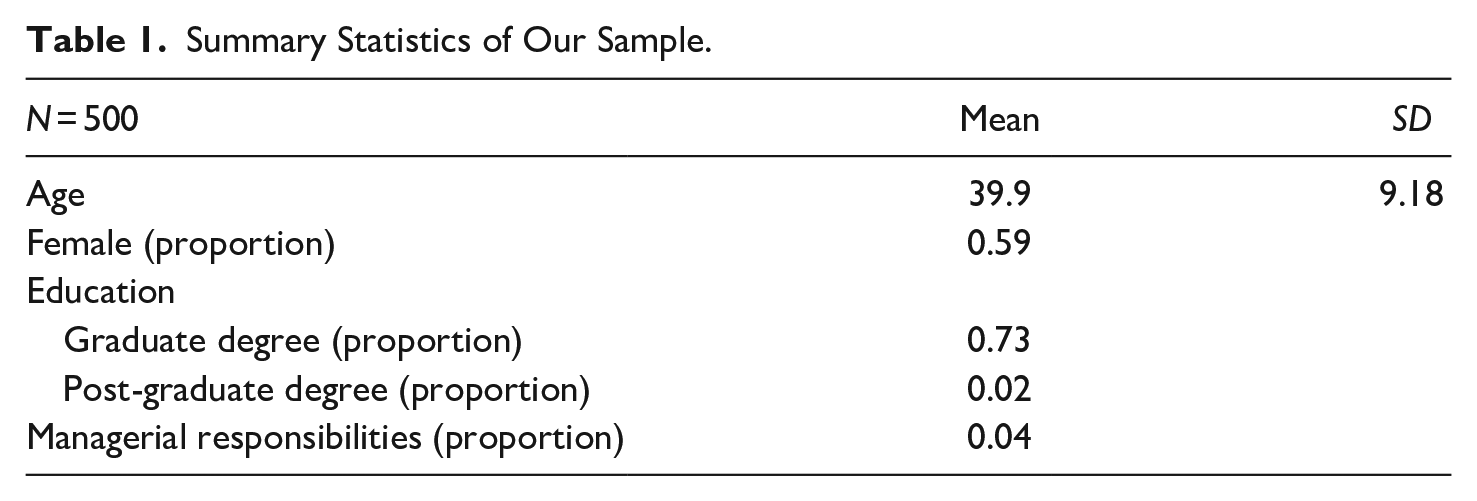
We distributed the survey during the summer of 2022 through Qualtrics. Invitation emails were sent by the Human Resources Department to 2,240 employees who were hired after December 2018. Police officers and social workers were excluded from the study, given that they are excluded from telework programs. All the other employees of the municipality had at least some experience with telework during the pandemic. Public workers invited to participate received an email with information about the purpose of the research and instructions to complete the survey. Before filling in the questionnaire, each subject had to give their consent, consistent with the ethical approval from our university. We obtained 500 complete responses for a 20.5% response rate. Table 1 displays summary statistics of our sample. The average age of participants was 39.9 years (SD = 9.18), females were 58.8%, and males were 41.2%. Regarding education, about 72.8% had a college degree, and 1.8% had a postgraduate degree. About 3.4% of participants had some form of managerial responsibility.
Summary Statistics of Our Sample.
Experimental Procedure
Participants in the experiment were asked to imagine that working arrangements would change starting from September 2022. We manipulated the hypothetical working arrangements so that subjects were randomly assigned to one of three experimental conditions:
- 0 days of telework per week: the new arrangements will require them to work from the office 5 days per week;
- 2 days of telework per week: the new arrangements will require them to work from the office 3 days per week and remotely 2 days per week;
- 5 days of telework per week: the new arrangements will require them to work remotely 5 days per week.
These experimental conditions were designed based on working arrangements implemented in the municipality before or during the pandemic. In this way, we increased the contextual relevance of our study and made it easier for participants to understand the hypothetical working arrangements. The English translation of the experimental scenarios is included in the Appendix.
Dependent Variables
After being presented with information on the new working arrangements, public employees from our sample were asked to indicate their level of agreement (from 1—strongly disagree to 5—strongly agree) with a set of items to measure the selected dependent variables. Our first outcome variable is Organizational Commitment, measured using 4 items adapted from previously validated scales (N. J. Allen & Meyer, 1990), already adopted in the context of telework (De Vries et al., 2019). Cronbach’s alpha for this scale was .87. Enjoyment is our second outcome of interest, measured by translating 2 items drawn from McMillan and O’Driscoll (2004). Cronbach’s alpha was .94. Finally, we adapted items from other studies conducted in the context of telework to measure Relatedness (De Vries et al., 2019; Golden et al., 2008), our third outcome of interest, with a Cronbach’s alpha of .63. The English translation of the items used to measure our three outcomes is included in the Appendix.
Additional Explanatory Variables
Besides control variables used to describe our sample, at the beginning of the survey and before the experimental scenario was presented to subjects, we included 1 item measuring their prior preferences with telework. In particular, the item asked participants to indicate how many days per week respondents would telework, instead of working from the office, if they could decide autonomously, on a scale from 1 to 5 days/week. The text of this item is included in the Appendix. The rationale for including such an item is twofold. First, it is an attempt to control for social desirability bias and strategic responses from our participants, as previous research has found that the vast majority of European and Italian civil servants have a favorable view of telework and they would be willing to expand opportunities to benefit from it (Edelmann et al., 2021; Forum PA, 2020). Second, this item captures participants’ normative expectations (Favero & Kim, 2021; Petrovsky et al., 2017), allowing us to quantify another potential explanatory variable: disconfirmation. We measure the latter as the absolute difference between normative expectations and the actual number of days of telework participants were assigned based on their specific experimental condition.
Results
Table 2 reports descriptive statistics of normative expectations toward teleworking arrangements, disconfirmation of such expectations, and our three outcome variables, namely organizational commitment, relatedness, and enjoyment. Experimental groups were balanced across experimental conditions for age, gender, education, and managerial responsibilities (balance tests are included in the Appendix).
Descriptives of Key Variables.
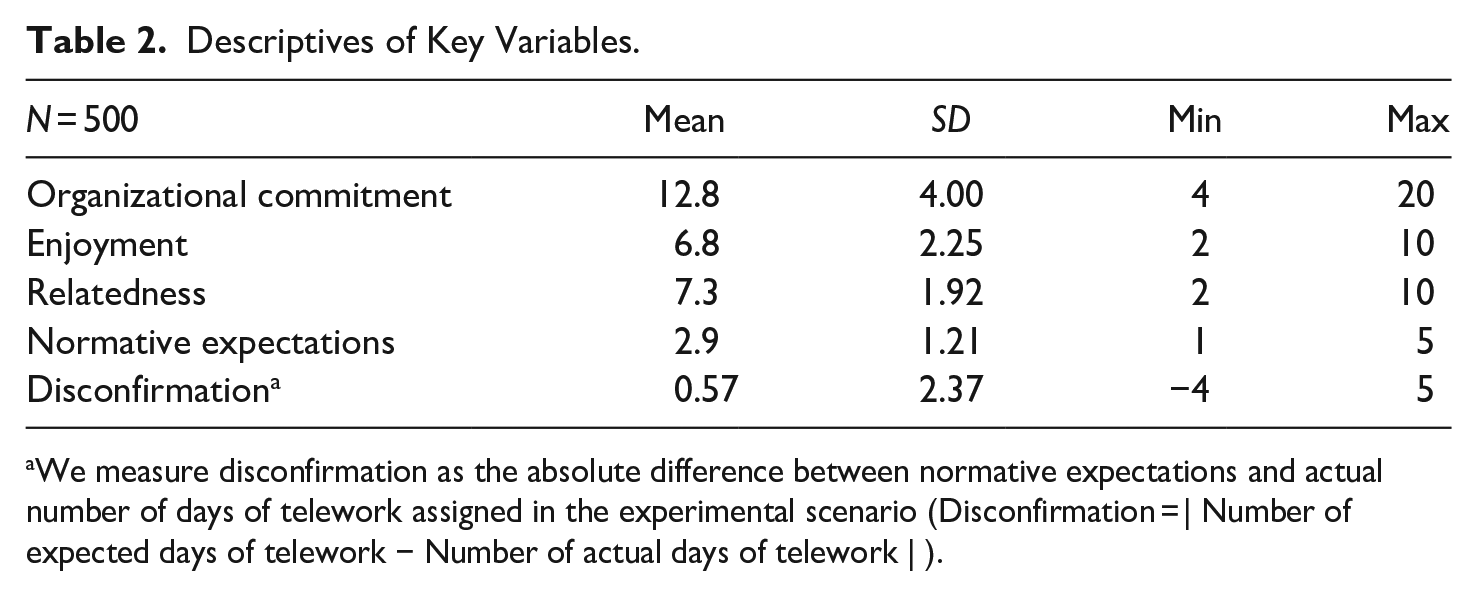
We measure disconfirmation as the absolute difference between normative expectations and actual number of days of telework assigned in the experimental scenario (Disconfirmation = | Number of expected days of telework − Number of actual days of telework | ).
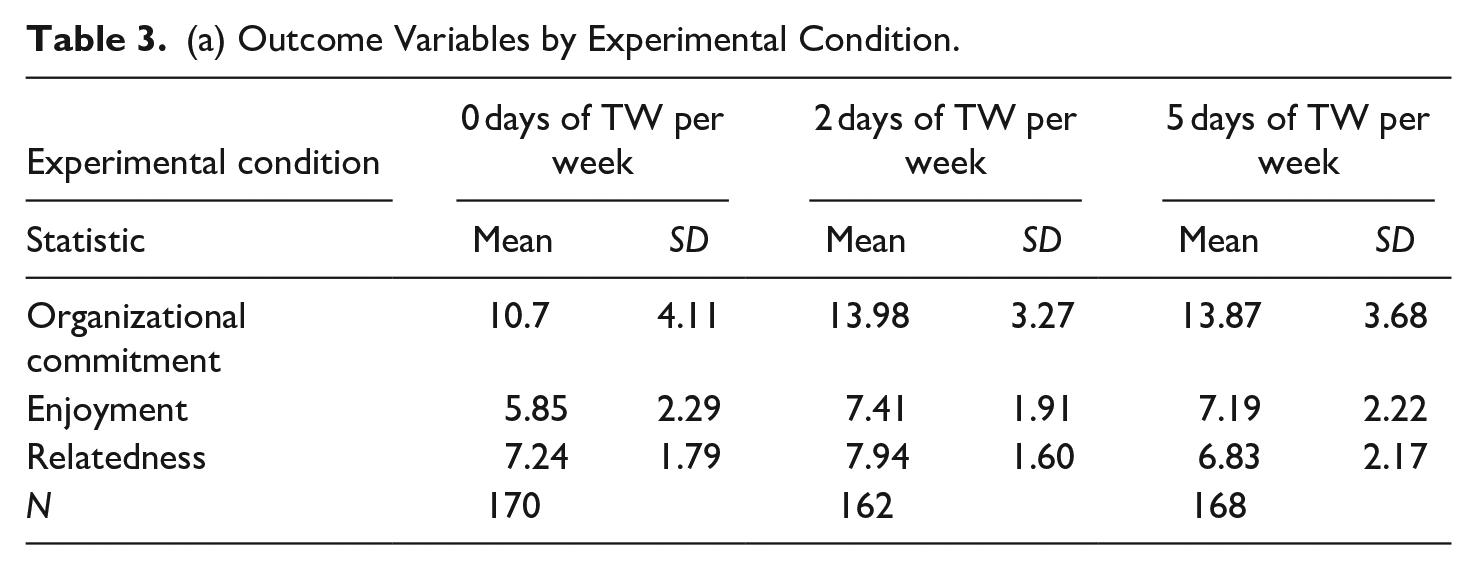
Table 3a reports means and standard deviations for the three motivational drivers—organizational commitment, relatedness, and enjoyment—by condition. Table 3(b) displays the differences in the means of the three motivational outcomes for the experimental group exposed to the condition “2 days of telework per week” and the experimental group exposed to the condition “5 days of telework per week,” compared to the experimental group “0 days of telework per week.” An analysis of variance provides strong evidence that organizational commitment and enjoyment differed significantly across the groups. More specifically, exposing public employees to working arrangements that contemplate either 2 or 5 days of telework per week increases organizational commitment by more than three-quarters of a standard deviation compared to working arrangements that require public employees to work from the office 5 days/week. It is worth noting that organizational commitment is not statistically different between the two groups exposed to at least some telework. The same pattern of results can be observed for public employees’ enjoyment, as offering public employees either 2 or 5 days of telework per week increases enjoyment by more than half a standard deviation. Enjoyment is not statistically different between the two groups exposed to at least some telework compared to public employees required to work from the office 5 days/week. Therefore, whereas hypotheses 1 and 3 propose a linear relationship between telework and organizational commitment and enjoyment, respectively, we do not observe any difference between experimental groups exposed to two and five teleworking days. We delve deeper into these findings in the discussion.
(a) Outcome Variables by Experimental Condition.
(b) Differences in Group Means of Outcome Variables Compared to Control Group.
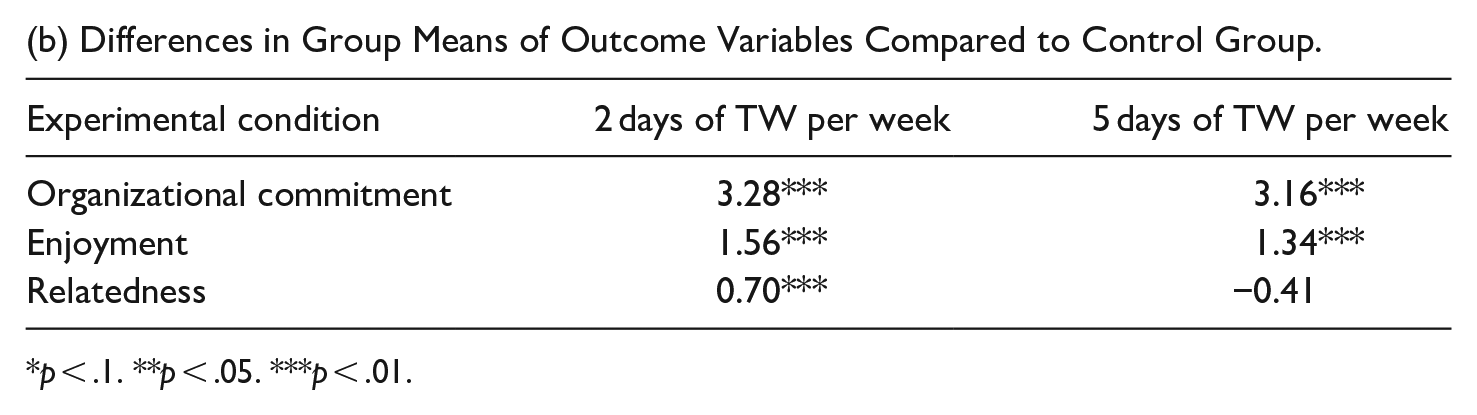
p < .1. **p < .05. ***p < .01.
As for relatedness, whereas requiring public employees to work from home 2 days/week significantly increases relatedness by almost half a standard deviation, this is not the case when public employees are required to work from home 5 days/week. More precisely, despite not being significant, the sign of the latter coefficient is negative (p = .128). Hypothesis 2 predicted that relatedness would be lower for public employees who are required to telework more days per week. This is not confirmed by our data, which suggest an inverted U-shaped relationship such that a mix of telework and work from the office makes public employees feel more related to their colleagues, compared to requiring them to work entirely from either the office or home. We elaborate on this finding in the discussion.
Table 4 reports estimates from ordinary least squares models testing our hypotheses on the effect of disconfirmation on our outcomes. For each outcome, we include two different models: one testing the simple effect of disconfirmation on the outcome (model 1) and the other testing the same effect while controlling for normative expectations (model 2). The coefficient of disconfirmation is consistently negative across outcomes and models. More specifically, other things being equal, organizational commitment decreases by 1.50 scale points (about one third of a standard deviation) when the absolute difference between normative expectations and the actual number of days of telework increases by one unit. Relatedness and enjoyment decrease by 0.53 and 0.77 scale points, respectively, (about one fourth and two fifths of their standard deviation) when the absolute difference between normative expectations and the actual number of days of telework increases by one unit. These findings confirm our hypotheses on the role of disconfirmation in affecting organizational commitment, relatedness, and enjoyment.
OLS Models on Disconfirmation, by Outcome.
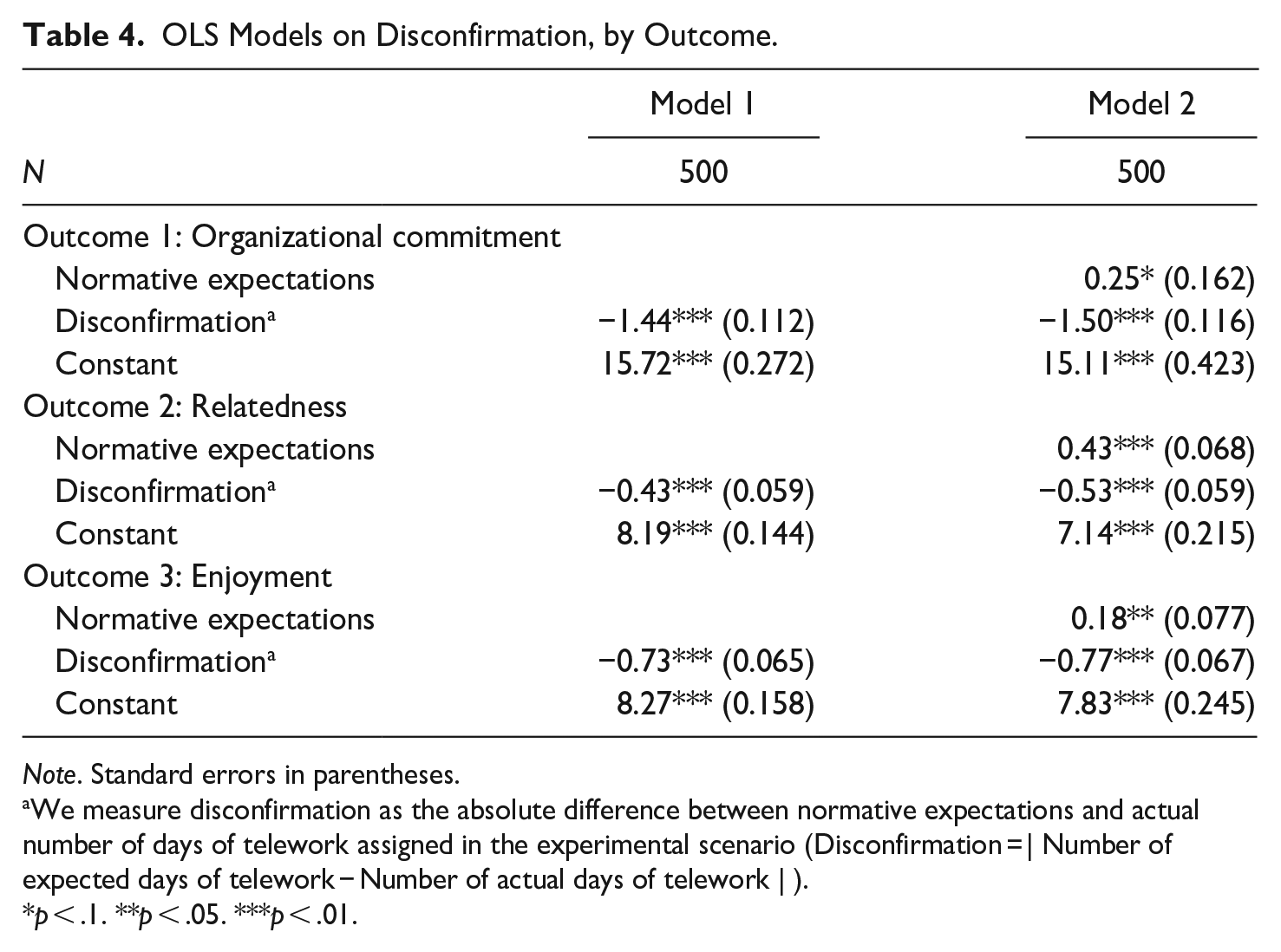
Note. Standard errors in parentheses.
We measure disconfirmation as the absolute difference between normative expectations and actual number of days of telework assigned in the experimental scenario (Disconfirmation = | Number of expected days of telework − Number of actual days of telework | ).
p < .1. **p < .05. ***p < .01.
Discussion
In this study, we developed hypotheses on the relationship between telework and organizational commitment, relatedness (or isolation), and work enjoyment. We tested these hypotheses through a survey-in-the-field experiment in an Italian municipality. Organizational commitment was lower among participants who were exposed to teleworking arrangements requiring them to work from the office 5 days/week compared to their colleagues exposed to teleworking arrangements requiring them to work from the office either 3 days/week or 0 days/week. We did not find any meaningful difference in organizational commitment of employees having the possibility to work from home either 2 or 5 days a week. Our first hypothesis predicted a linear relationship between teleworking days and organizational commitment that was therefore not confirmed.
It is the possibility to telework at least some days that seems to matter in increasing organizational commitment, not the actual number of days. We observe a similar pattern of results when analyzing work enjoyment. More specifically, work enjoyment was lower among participants who were exposed to teleworking arrangements requiring them to work from the office 5 days per week compared to their colleagues exposed to teleworking arrangements requiring at least some telework. As it was the case with organizational commitment, we did not confirm our expected linear positive relationship between teleworking days and work enjoyment, as this was not significantly different between those exposed to two teleworking days and those exposed to five teleworking days per week. As for relatedness, we observe an inverted U-shaped relationship, such that a mix of telework and work from the office makes public employees feel more related to their colleagues, compared to requiring them to work entirely from either the office or home. Public employees in our experiment feel more isolated when they are required to work from the same place, either from the office or from home, 5 days/week, compared to having some variation in their workplace during the week.
These results are consistent with previous research from the private sector showing that telework can indeed benefit relationships with colleagues, but that high-intensity teleworking—more than 2.5 days—can harm them (Gajendran & Harrison, 2007). It is worth noticing that other scholars have found such an inverted U-shaped relationship between telework and job satisfaction (Golden & Veiga, 2005; Virick et al., 2010), and they have proposed moderating and mediating variables, such as task interdependence, job discretion, and performance outcome orientation, that can help explain this type of relationship and point to promising future directions for research on telework and relatedness. Completing our findings, the disconfirmation of normative expectations toward teleworking arrangements negatively impacted organizational commitment, relatedness, and work enjoyment, supporting our hypotheses on the relationship between telework, disconfirmation of employees’ expectations, and our outcomes.
Telework in public administration has gained momentum in the last few years and it has become essential to evaluate its impact on public employees’ attitudes. The evidence from our experiment provides insights that can be particularly useful now that the pandemic crisis is over. The available evidence of the impact of telework on the functioning of public organizations is not only limited, but it is also primarily based on studies that were conducted before the pandemic outbreak. It is not surprising that our findings contrast with some of the results obtained before the pandemic. For example, De Vries et al. (2019) did not find support for a positive relationship between teleworking and organizational commitment. Another example concerns a specific argument by Mele et al. (2021), who point to a “permanent estrangement” effect of workers who constantly alternate remote working and physical presence in the office. Public employees in our survey-in-the-field experiment seem to experience the opposite: a higher feeling of relatedness when they can alternate their working location. Among the possible reasons for this is that external relations can mediate the negative impact of remote work, as previously shown by Anderson et al. (2015); therefore, the isolation experienced during the pandemic period (Osservatorio Smart Working, 2021) might have disappeared as soon as people started again to have social relations outside working time. Another explanation lies in a sort of learning process. The pandemic period has allowed workers to learn how to manage telework by experimenting with different ways to carry out informal social interactions. In any case, the pandemic has likely reset perceptions of telework among public managers and employees, leading to a “normalization” of these arrangements in public organizations. For this reason, we are in great need of updated evidence on the impact of telework in public organizations.
Our work contributes to satisfying this need. First, we advance theory in this field by bridging the literature on social exchange theory (Cropanzano & Mitchell, 2005) with the literature on the expectancy-disconfirmation model (Van Ryzin, 2004, 2006; J. Zhang et al., 2022). This allows factoring in the role of public employees’ normative expectations (Favero & Kim, 2021; Petrovsky et al., 2017) and their disconfirmation when trying to explain the relationship between teleworking arrangements and public employees’ attitudes. In fact, the pandemic might have changed the psychological contract between the employer and the employees (Rousseau, 2001; Wenzel et al., 2019), making telework a more desired and widespread practice, even in workplaces where it previously had a negative connotation, such as in public administrations. We argue that disconfirming expectations entailed in such a renewed psychological contract can impact public employees’ organizational commitment, relatedness, and work enjoyment. Second, methodologically, we provide experimental evidence on the causal effect of teleworking arrangements on employees’ attitudes within public organizations, whose study has been characterized by observational studies, with only a few exceptions (e.g., Mele et al., 2021).
Third, this work aims to address the disconnect between theory and practice in the field of public administration. Public managers engaged in improving teleworking arrangements will find our findings helpful when thinking about opportunities and challenges arising with their implementation. They shall be aware of the potentially beneficial effects of teleworking arrangements on motivational drivers. Based on our findings, whereas teleworking 2 days/week has benefits on all motivational drivers, high-intensity teleworking does not produce additional benefits for organizational commitment and enjoyment and is even detrimental to relatedness. This suggests that teleworking only a few days per week could maximize benefits on organizational commitment, relatedness, and enjoyment. In addition, public managers should pay attention to their employees’ preferences and expectations, especially for recently hired employees, whose expectations might be very different from those of public workers hired in the past. Younger workers might be less inclined to an office-based working culture and public organizations should be open to innovations in working arrangement, so as to be able to attract and retain Generation Z skilled workers without demotivating them.
Our work is not immune to limitations, and our findings should be interpreted accordingly. First, as is commonly the case with experiments, the external validity of our design might be limited. Even though participants were actual public workers who were asked to consider hypothetical scenarios that could be easily applied to their real working environments, we cannot be sure that our findings would hold across other experimental units, treatments, operations, and settings (Shadish et al., 2002). For example, we cannot know whether and how results would change if the operationalization of teleworking arrangements was such that public employees were offered the possibility to work from home up to 2 (or 5) days/week, instead of exactly 2 (or 5) days/week, as it is the case in our vignette. Second, the scale of our item measuring normative expectations did not include zero. This is not particularly problematic, given that about 90% of the respondents preferred at least two teleworking days per week. Nonetheless, we cannot be sure that results would be the same with a zero option.
Future research should try to replicate our findings by overcoming such limitations and by paying particular attention to the adjustment from the past exceptional circumstances of the pandemic period. More specifically, scholars might delve deeper into the reasons behind the observed non-linear relationships, by testing mediating and moderating variables that can help understand better these non-linear relationships in a public context, as existing research from the private sector has shown that, for example, work exhaustion mediates the relationship between telework and organizational commitment (Golden, 2006). Moreover, the literature is controversial on whether excessive telework negatively affects public employees’ sense of belonging and their opportunities to receive feedback, as some evidence suggests it does (Gajendran & Harrison, 2007; Golden & Fromen, 2011) and some other evidence suggests it does not (Caillier, 2013). Shedding light on these dynamics may improve our understanding of such non-linear relationships between telework and motivational drivers.
Footnotes
Appendix
English translation of the experimental scenarios (manipulation in italics)
“Imagine that, starting from September, the new working arrangements at the Municipality will require you to conduct your work activities entirely from home [work remotely 2 days per week, and work from the office 3 days per week] [conduct your work activities entirely from the office]”
English translation of the items used to measure outcome variables, answers from 1 (strongly disagree) to 5 (strongly agree)
Declaration of Conflicting Interests
The author(s) declared no potential conflicts of interest with respect to the research, authorship, and/or publication of this article.
Funding
The author(s) received no financial support for the research, authorship, and/or publication of this article.
Ethical Approval
The study was approved by the Research Ethics Committee of the London School of Economics and Political Science (Reference 92214).
