







Abstract
Across the globe, ethnic minorities experience discrimination and exclusion in contexts of rising majoritarianism. Yet many minorities suffer in silence, fearing that asserting ethnic identity and participating in protest will challenge their commitment to the nation in the eyes of broader society. In this article, I theorize that collective action frames that draw on national symbols and portray ethnic grievances as pertaining to the nation, more broadly, can strengthen support for protest among ethnic minorities. I test this theory through two original survey experiments with a sample of Indian Muslims (N = 1311) in the context of rising Hindu nationalism. The findings reveal that “national identity frames” strengthen support for ethnic resistance while “ethnic identity frames” weaken support under exclusionary nationalism. The findings suggest that minorities are more supportive of protest movements that employ collective action frames depicting ethnic resistance as an act of patriotism.
Introduction
In December 2019, thousands of Indian Muslims took to the streets, joining the mass protests against the passing of the contentious Citizenship Amendment Bill. The bill was widely criticized for using religion as a criterion for citizenship, and its transition into law caused widespread anger and fear among the Muslim community who questioned their place in a country increasingly resembling a “majoritarian state” (Chatterji et al., 2019) or an “ethnic democracy” (Jaffrelot, 2021a). Waving the Tricolour Indian flag and chanting the national anthem, Indian Muslims openly denounced the marginalization of religious minorities in India. The mass mobilization of Indian Muslims in 2019 stood in stark contrast with a prolonged period of “Muslim silence” preceding the approval of the bill. Political commentators periodically referred to this “puzzling silence” in the context of deepening nationalist exclusion (Ahmed, 2019; Chakravarty, 2019), and some concluded that Hindu nationalist hegemony had fostered the “apparent withdrawal of Muslims to restricted enclaves of political action” (Kurshid, 2019, p. 218).
When do marginalized groups stay silent when faced with exclusionary policies, and when are they more likely to react by voicing their grievances openly? Political parties defending exclusionary nationalism are gaining ground across the world. Yet, while some findings suggest that minorities are likely to assert their ethnic identity (Bisin et al., 2011; Fouka, 2020) and mobilize as a response to exclusionary policies (Oskooii, 2020; Weiss et al., 2023)—at least under some conditions (Cho et al., 2006; Pantoja et al., 2001)—other findings suggest that minorities disassociate from their devalued identity (Fouka, 2019; Mussweiler et al., 2000) or retreat from public life (Hobbs and Lajevardi, 2019; Schildkraut, 2005).
Drawing on research from the social identity tradition (Reicher, 2004; Tajfel and Turner, 1986) and research on protest behavior among ethnic minorities (Bonilla and Tillery, 2020; Klandermans, 2014), I provide a theoretical framework aimed at improving our understanding of the link between social identity and support for collective action among marginalized groups. 1 I propose two interrelated arguments, building on the conjecture that many ethnic minorities aspire to be fully accepted as part of the national community, yet do not wish to disassociate from their ethnic identity. First, I suggest that where nationalism is exclusionary (where the dominant ethnic group is viewed as central to national identity), minorities may be wary of asserting their ethnic identity and articulating ethnic interests, as this could be construed as “anti-national”. Second, building on the previous argument, I propose that certain narratives of mobilization promoted by political entrepreneurs and protest participants can counteract minorities’ tendency to retreat from public life. I theorize that collective action frames that draw on national symbols and portray ethnic grievances as pertaining to the nation, more broadly, can strengthen support for resistance among minorities who experience insecure national belonging. Where minorities are made to feel as though they must choose between minority and national identity, narratives that portray ethnic protest as an act of patriotism are expected to encourage collective action and thus enable opportunities for social change.
To evaluate the theoretical argument, I conduct two original survey experiments in India, a context in which Muslims increasingly face insecure national belonging amid growing Hindu nationalism (Jaffrelot, 2021b). A total of 1311 Indian Muslims participated in the survey experiments, which were fielded between March and April 2021. In the survey, respondents receive short descriptions of three different protest movements and are asked to what extent they endorse each movement. I examine whether support for these movements is lower under exclusionary nationalism by randomly assigning respondents an exercise designed to strengthen the perceived centrality of Hindu identity to the Indian nation. Subsequently, I evaluate the central argument regarding the role of collective action frames in mobilizing support by randomly assigning additional descriptions and visual illustrations to each of the three protest movements according to either a (1) national identity frame, (2) an ethnic identity frame or (3) a neutral frame.
The findings reveal that support for collective action is lower among Muslim respondents when the centrality of Hindu identity to the Indian nation is salient. The findings also show that respondents are less willing to openly reveal their Muslim identity under such conditions. When asked to select a social media avatar—some of which clearly signal Muslim identity while others do not—to represent them in an online interaction, Muslim respondents in the treatment group become 6 percentage points less likely to select an avatar that clearly signals Muslim identity. Together, these findings indicate that minorities are less likely to assert ethnic identity and more likely to decline opportunities to articulate ethnic grievances when their belonging as “true” members of the nation is challenged.
Under what conditions are minorities more likely to challenge their oppression, in contexts where asserting minority identity is viewed as unpatriotic or “anti-national” behavior in the eyes of broader society? In line with the theoretical argument, the findings underscore the importance of narratives of mobilization in shaping preferences for resistance among individuals who experience insecure national belonging. I find that collective action frames that portray minorities’ grievances as pertaining to the secular nation, more broadly, strengthen support for resistance among marginalized groups, while ethnic or “particularistic” frames dissuade minorities from endorsing or participating in protest.
Understanding the obstacles that minorities face when deciding whether to mobilize is of critical importance. Because ethnic and religious minorities are systematically underrepresented in formal political institutions across much of the world (Bird et al., 2011; Dancygier et al., 2021), protest often constitutes one of the few available channels through which they can meaningfully express grievances and make claims. In India, for instance, Muslims face entrenched barriers to political inclusion or representation, even by secular parties (Allie, 2026; Farooqui, 2020). Although protest may appear unlikely to succeed or directly achieve policy change for minority communities, research shows that it can generate important spillover effects on public opinion and legislative behavior (Gause, 2022; Wasow, 2020).
My research provides new insights into the behavior of ethnic minorities in contexts of nationalist exclusion (Haas and Lindstam, 2024; Majumdar, 2026) and contributes to broader debates on nationalism and ethnicity in South Asia (Badrinathan et al., 2024; Kalin and Siddiqui, 2020; Malik, 2025). It also contributes to the social identity tradition, which seeks to explain the conditions under which resistance among marginalized groups emerges (Klandermans, 2014; Tajfel and Turner, 1986). By bridging this framework with research on collective action frames (Benford and Snow, 2000; Bonilla and Tillery, 2020) and the effects of narratives (Williamson and Malik, 2021), my work highlights how framing can generate short-term openings for mobilization in contexts where minorities might otherwise downplay their identities. It also provides new insights into how minorities “manage” their identities in settings where asserting minority identity is viewed as unpatriotic or “anti-national.” As such, it contributes to research on the relationship between minority and national identity, and how dual identities among minorities can be formed and sustained (Alrababah et al., 2021; Charnysh et al., 2015; Simonsen, 2016).
My research also contributes to a strand of literature examining responses to exclusion and discrimination among disadvantaged groups (Abdelgadir and Fouka, 2020; Hobbs and Lajevardi, 2019; Oskooii, 2020), and whether being targeted by exclusionary policies mobilizes or demobilizes (Oskooii, 2016; Weiss et al., 2023). I theorize that minorities are likely to feel torn between a wish to defend their rights and a desire to secure recognition as full members of the nation. Accordingly, they should be more likely to mobilize as a response to exclusionary policies when protest is framed in a way that makes participation less likely to challenge their commitment to the nation in the eyes of broader society.
Finally, the article engages with longstanding questions in comparative politics about the conditions under which marginalized groups mobilize. Classic theories of collective action emphasize that mobilization depends not only on grievances, but also on resources, opportunities, group consciousness, and the perceived legitimacy of protest (Chenoweth and Stephan, 2011; McAdam, 1999; Tarrow, 2022). Exclusion and repression raise the social and political costs of protest, often deterring mobilization even among highly dissatisfied groups (Davenport, 2007). In such settings, minorities may falsify their preferences or refrain from action unless new cues render protest more socially permissible or create common knowledge that others share similar intentions (Chwe, 2013; Kuran, 1991). My research speaks to this literature by highlighting how certain collective action frames can enable individuals who would otherwise keep their preferences private to support protest movements by reducing the perceived costs of dissent.
Theoretical framework
Dual identity, insecure belonging and preferences for resistance
Under what conditions do marginalized groups support collective action? The social identity tradition (Tajfel and Turner, 1986) offers a rich framework for understanding when collective action among disadvantaged groups is more or less likely. According to this perspective, individuals who belong to devalued social groups are likely to respond to negative social identity in one of two ways: by attempting to dissociate from the stigmatized group through assimilation or “passing,” or by engaging in collective efforts to improve the group's status. The former response weakens group cohesion and “creates obstacles to mobilizing group members for collective action over common interests” (Tajfel and Turner, 1986, p. 288). In contrast, maintaining strong identification with the subordinate group—despite incentives to disassociate—makes collective action a viable pathway to restore group status and recognition. Consistent with this logic, a large body of research finds that ethnic identification is a key predictor of protest participation among minorities (Merseth, 2018; Van Stekelenburg and Klandermans, 2013; Ufkes et al., 2016).
Strong identification with a disadvantaged group, however, is not in itself sufficient to predict mobilization. Many marginalized individuals maintain deep attachment to their ethnic or religious community yet refrain from engaging in collective action. Fear of reprisals, lack of leadership or efficacy, or internalized inferiority may partly explain this reluctance (Allie, 2025; Reicher and Haslam, 2006; Rozenas and Zhukov, 2019), but other mechanisms—consistent with the social identity framework—are also likely at play. Individuals rarely define themselves through a single group membership. Members of minority communities often identify simultaneously with their ethnic or religious group and the broader national community—a pattern commonly referred to as dual identification (Simon and Ruhs, 2008; Klandermans, 2014). This dual attachment is prevalent across diverse contexts, including among immigrant, ethnic, and religious minorities (Hopkins, 2011; Fleischmann and Verkuyten, 2016). Such dual attachments raise important questions about how multiple identities interact in shaping minorities’ pursuit of positive social identity. In particular, when efforts to enhance the status of the minority group risk undermining group members’ claim to belong to national community, individuals may face complex trade-offs over how to best advance their group's social standing.
I theorize that, in certain contexts, minorities face a trade-off between mobilizing to improve the social standing of their ethnic group and maintaining credibility as loyal members of the nation. The extent to which this trade-off emerges depends on the type of nationalism that is salient in a given context and period—that is, on how the dominant group imagines the national community as either inclusive or exclusive of ethnic minorities. Nationalisms vary in their degree of ascriptiveness: the extent to which membership in the nation is defined by descent-based attributes such as ethnicity, religion, or language (Mylonas and Tudor, 2023; Singh, 2022). As the recent global rise of ethnic nationalism illustrates, elites often promote competing national narratives whose relative salience shifts over time. While more inclusionary narratives tend to depict all citizens as equal members of the nation, more exclusionary or ascriptive narratives delineate a national “core” of authentic members and a “periphery” of those who, while nominally included, are never fully accepted as equal members of the nation (Haas and Lindstam, 2024; Pandey, 1999). These “cores” are not naturally occurring; rather they are actively constructed through strategic boundary-making (Chandra, 2012; Singh, 2015). I argue that, in contexts where elites in power promote ascriptive national narratives and exclusionary nationalism is salient, minorities are more likely to feel torn between a desire to mobilize for social change, and incentives to signal loyalty to the “core” national community.
Under exclusionary nationalism, marginalized group members bear the burden of proving their genuine belonging through various means, such as frequently asserting their patriotism or strictly conforming to norms of conduct promoted by the dominant group. Deviations from these norms are likely to be met with suspicion, interpreted as signs of “otherness,” or used to justify the group's inferior status. Cammett et al. (2024) describe this dynamic as “defensive cooperation,” noting that minorities “face the additional burden of adhering to perceived expectations from the majority group, which in turn shapes norms of ingroup policing to protect the group image in a hostile sociopolitical environment” (Cammett et al., 2024, pp. 322–323). Consistently, Williams (2015) shows that minorities in India often refrain from protesting out of fear of being blamed for causing communal tensions. These dynamics are likely to be amplified in contexts where ethnic minorities are portrayed as less than full members of the nation and where expressing ethnic grievances may further threaten already fragile claims to national belonging.
Protest, in particular, is often perceived as inherently unpatriotic (Klandermans, 2014), especially when carried out by ethnic minorities (Manekin and Mitts, 2022) to advance minority group interests (Hopkins and Blackwood, 2011). As a result, minority citizens striving for recognition as full members of the nation may forgo opportunities to assert ethnic identity publicly, or articulate group-based demands or engage in collective action. In this sense, protest participation can present a zero-sum dilemma: voicing ethnic grievances and engaging in collective action could strengthen the standing of one identity (ethnic), but the cost of being marginalized from another (national). Given the symbolic and material benefits associated with national identity—including status, recognition and protection from discrimination—many minorities may strategically refrain.
2
I argue that under exclusionary nationalism, asserting minority identity becomes more costly for ethnic minorities, as it undermines their perceived credibility as loyal members of the nation, and as a consequence, support for collective action declines.
3
Identity frames and mobilization
How do opportunities for collective action and social change arise in contexts where asserting minority identity is viewed as unpatriotic, or even “anti-national” behavior? I propose that whether or not minorities will mobilize depends—in part—on the particular narratives of mobilization employed by political entrepreneurs. Support for resistance may therefore rise and fall, depending on the extent to which particular movements frame resistance in ways that resonate with ethnic minorities’ aspirations for national inclusion. Certain narratives of mobilization can counteract the tendency among minorities who experience insecure national belonging to retreat from public life. More specifically, collective action frames that portray resistance as a manifestation of patriotism or commitment to the nation could foster support for collective action. Thus, narratives, interpretations, and symbols matter in mobilizing support for collective action (Benford and Snow, 2000; Johnston and Noakes, 2005) and support for protest movements may rise or fall depending on how resistance is framed.
The theoretical argument highlights the importance of collective action frames in shaping support for protest among marginalized groups, especially under exclusionary nationalism. Collective action frames have been defined as “schemata of interpretation that enable individuals to locate, perceive, identify and label” events in their lives and the broader world (Goffman, 1974, p. 21). They are “action oriented sets of beliefs and meanings that inspire and legitimate social movement activities” (Snow and Benford, 1992). Collective action frames can develop in the streets as protesters mobilize, or they can be the product of social movement entrepreneurs “making practical decisions in response to the styles, forms and normative codes of the target audience” (Johnston and Noakes, 2005, p. 7). A particular grievance can be framed in many different ways, and this framing may carry consequences for who turns out to protest, why and when. 4
Gamson (1995) refers to different components of collective action frames, one of which is the identity component. The identity component of collective action frames refers to the process of defining “we”. It conveys who is experiencing certain grievances and thereby who should act collectively for social change. In framing minorities’ grievances, collective action frames vary in the extent to which they emphasize ethnic identities, superordinate identities, or intersectional identities (Bonilla and Tillery, 2020), 5 as well as in their use of different symbols (e.g. images, flags, heroes) in highlighting these different identities (Gamson, 1995; Williams, 2004). The lens of social identity therefore provides different interpretations of the social world and can carry consequences for whether or not action is viewed as legitimate in the eyes of protest participants as well as broader society.
I theorize that frames that highlight national identity can strengthen support for resistance movements among marginalized group members by reducing concern that protest will challenge their commitment to the nation in the eyes of broader society. In continuation, I distinguish between “ethnic identity frames” and “national identity frames”. “Ethnic identity frames” are defined as schemata of interpretation that portray grievances as pertaining uniquely to the ethnic group and that draw on group-specific ethnic symbols (such as ethnic flags, songs, attire etc.). “National identity frames”, in turn, are defined as schemata of interpretation that portray grievances as pertaining to the secular nation, more broadly, and that draw on national symbols (such as the national flag or constitution). While ethnic identity frames justify and seek to motivate resistance in a way that could more easily be construed as being at odds with the national interest, national identity frames lend legitimacy to acts of resistance by framing protest participation as an act of patriotism. National identity frames link or connect ethnic and national identity depicting the categories as sum-positive rather than zero-sum. Framing resistance in this way implies that protecting ethnic interests also means acting in defense of the nation. Accordingly, protest participation should be less likely to challenge minorities’ commitment to the nation in the eyes of broader society.
The hypothesis outlined above (H3) is not universal, but should apply in certain settings. For instance, national identity frames are not necessarily more effective in mobilizing support for resistance than ethnic identity frames where ethnic minorities are recognized as unquestioned members of the nation. Above all, national identity frames should strengthen support for resistance under exclusionary nationalism, when minorities are asked to “prove” their commitment to the nation. Similarly, ethnic identity frames should weaken support for resistance when the dominant ethnic group is viewed as central:
In summary, nations are constructed as “cores”—the essential, natural, unquestioned members—and “peripheries”—those who “might be allowed to be part of the nation, but ‘never quite’” (Pandey, 1999, p. 608). Where ethnic minorities are viewed as peripheral yet aspire to be recognized as full members of the nation, ethnic minorities become less willing to assert minority identity as it diminishes their credibility as committed members of the nation (H1) and less willing to support collective action for social change (H2). In such contexts, national identity frames may be particularly effective in mobilizing support for collective action as participation is less likely to be viewed as “anti-national” by mainstream society (H3a). Ethnic identity frames, on the other hand, will be less likely to mobilize support (H3b). The stronger the perceived centrality of the dominant ethnic group to national identity, the more effective national identity frames (H4a) and the less effective ethnic identity frames (H4b) should be in mobilizing support for collective action.
Empirical setting
Case selection
Empirically evaluating the theoretical argument regarding the role of identity frames requires a careful case selection; not all cases fall within the boundaries to which the theory applies. First, the theory applies in contexts where a large proportion of ethnic minorities identify with their ethnic group yet aspire to be accepted by broader society as full members of the nation (i.e. minorities hold “dual identities”). Second, the theory applies in contexts where a dominant ethnic group is viewed as central to national identity—at least among large pockets of society. Taking this into account, I evaluate the theoretical argument in India, focusing on preferences for resistance among members of India's Muslim minority.
Many Indian Muslims hold dual identities. According to a recent representative survey carried out by Pew Research Center on Tolerance and Segregation in India, 6 99% of Muslims report feeling “proud to be an Indian.” An equal proportion of respondents report also feeling “proud to be a Muslim.” It appears, therefore, that the great majority of Indian Muslims simultaneously identify at both the superordinate level (as Indian) and at the subgroup level (as Muslim). India is also a context in which the dominant ethnicity is viewed by many as central to national identity. According to the survey by Pew Research Center, 81% of Hindus agree or fully agree that it is important to be a Hindu in order to be “truly Indian.” Although Muslim minorities in India have been viewed as “foreigners” and accused of divided loyalties since the days of Partition (Habib, 2017; Pandey, 1999), the community is facing deepening marginalization and exclusion from India as an “imagined community” in recent years (Ahmed, 2019). The ruling Bharatiya Janata Party (BJP)—in power since 2014—has dedicated itself to erasing India's Muslim heritage and re-writing history according to Hindu nationalist ideology (Chatterji et al., 2019). As Hindu identity has become increasingly central to national identity, Muslims' national belonging has become increasingly insecure.
Muslim protest in India
In recent years, several events could have sparked large-scale protests among Indian Muslims but failed to do so. Such events include the many cases of cow-related gang violence and the related lack of police responsiveness (Dhillon, 2019), the Supreme Court's verdict on Ayodhya allowing a Hindu temple to be built on the contested site (Varadarajan, 2019), the renaming of Muslim-sounding cities and streets across the country (Ahmad, 2018), and the passing of new anti-conversion laws and amendments (Jamil, 2021). Observers noted that rather than mobilize politically as a response to such events, many Muslims preferred to keep a low profile, or “become invisible” in the political sphere (Chakravarty, 2019; Kurshid, 2019).
In December 2019, the Muslim silence ended abruptly as thousands of Indian Muslims joined in the mass protests against the passing of the Citizenship Amendment Act (CAA) (Khan, 2020). The act was widely criticized for discriminating on the basis of religion in granting access to citizenship and caused widespread anger and concern among members of the Muslim community. 7 As protests erupted across the country, domestic and international observers noted the extensive use of national symbols such as the Tricolour flag, the national anthem, and the Constitution among protest participants (Biswas, 2020; Khan, 2020). Elaborating on the use of these symbols, academics and activists alike highlighted their function in signaling patriotism and warding off accusations of “anti-nationalism.” According to history professor Rohit De “the Narendra Modi-led ruling Hindu nationalist BJP government has painted almost all opposition to its policies as ‘anti-national’. By using the constitution, the protesters can continue to assert their patriotism, use national symbols and songs and challenge the discourse of ‘anti-nationalism’ with constitutional patriotism” (Biswas, 2020). According to anti-CAA activist Umar Khalid, the use of nationalist symbols was an attempt by Muslims to “redefine nationalism” (Khan, 2020), asserting a sum-positive identity by which Muslim identity and Indian identity are not at odds. These anecdotes suggest that “national identity frames” may play an important role in mobilizing ethnic minorities, and that the impact of different identity frames on preferences for resistance deserves further attention. 8
Research design
I evaluate the theoretical framework through two survey experiments in India with a sample of Muslim respondents. In the first experiment, respondents are randomly assigned to a treatment condition aimed to strengthen the perceived centrality of Hindu identity to the Indian nation. Subsequently, respondents are asked to what extent they endorse, and would be willing to participate in, three different protest movements. In the second experiment, a collective action frame is randomly assigned to each protest description, highlighting (1) national identity, (2) ethnic (Muslim) identity or (3) no specific identity. Figure 1 illustrates the steps of the design.
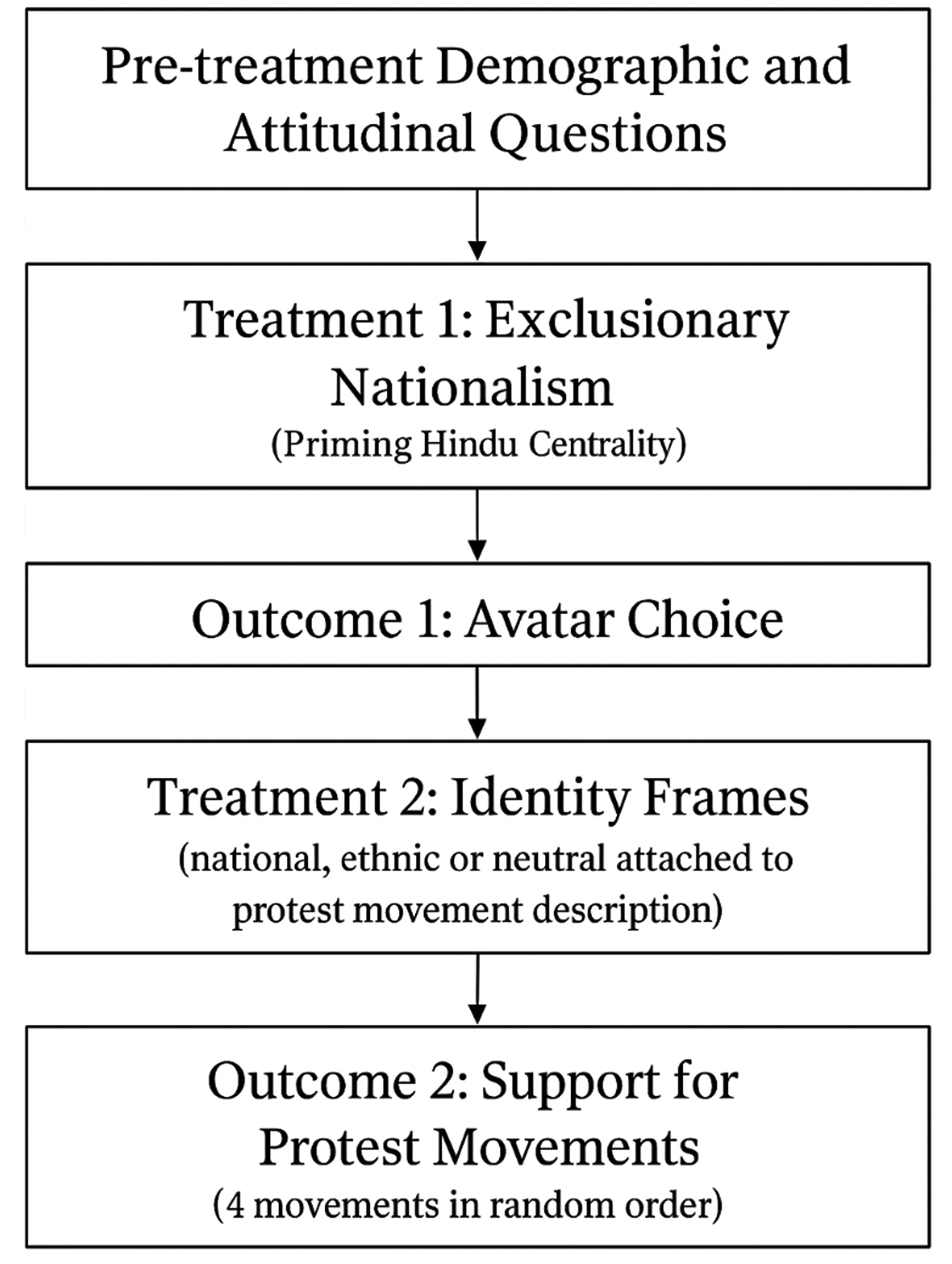
Experimental design.
Sample
The experimental study was conducted with a sample of 1311 Indian Muslims recruited via the online sampling tool Lucid (now Cint). Potential respondents are invited to participate through email invitation links, and respondents who completed the survey received participation fees in the form of e-rewards/e-currency. Sampling took place across India between March and April 2021, with quotas set for region (north/west/east/south) to ensure the representation of Indian Muslims from across the country. Although the sample is not representative of the full Muslim population, respondents come from diverse backgrounds in terms of gender, caste, income, urban/rural residency, and education. 9 Respondents were able to complete the survey either in English or in Hindi. 10
Treatment 1: Hindu centrality
The theory suggests that, under exclusionary nationalism, ethnic minorities become less willing to assert their minority identity and less inclined to support collective action. Exclusionary nationalism constructs the nation around the dominant ethnocultural group, portraying minorities as less authentically national. To assess these implications, I design a treatment that captures this key feature of exclusionary nationalism: the perceived centrality of the dominant group to the nation. Specifically, the treatment primes respondents with images and narratives of prominent Hindu figures described as “Indian heroes,” thereby reinforcing the idea that Hindu identity lies at the symbolic core of the nation.
Respondents in this treatment first view images of five different historical figures and are asked to select the hero they believe to be the most popular in broader society. The options include a range of figures, some commonly celebrated by the Hindu right, such as Chhatrapati Shivaji or VD Savarkar. Subsequently, respondents receive a piece of information about a specific contribution to the Indian nation, namely information about the author of the Indian national song, “Vande Mataram” (a Hindu nationalist). A manipulation check indicates that the treatment lowers respondents’ perceptions of Muslims’ contributions to the Indian nation, suggesting that it successfully primes Hindu centrality (see Online Appendix Sections C.2 and C.4 for more details). 11
Asserting Muslim identity
I examine respondents’ willingness to openly reveal or “affirm” their minority identity in a short exercise. I provide respondents with a selection of six avatars from which they are asked to indicate which avatar they would select if they were to play an online game with other people (see Online Appendix Figure C1). The provided avatar options vary in the degree to which they signal Muslim identity. 12 The exercise is designed to elicit thoughts of how respondents would like to represent themselves in a social interaction with other Indians and is meant to capture their willingness to “reveal” their minority identity. The item is therefore slightly different from more standard measures aiming to capture respondents’ self-perceived social identity. The avatar options are gender congruent (women see only female avatars and men see male avatars). Three of these avatars clearly signal Muslim identity. 13 One avatar looks “neutral” (i.e. not easily identifiable as Hindu or Muslim), while two avatars signal Hindu identity. When designing the avatars, I took care to include variation in the avatars’ style of dress (modern vs. traditional), so that participants who identify as Muslim did not feel forced into selecting a traditional or pious religious stereotype to express that identity. I construct a dummy variable indicating whether or not the avatar signals Muslim identity. 14
Support for collective action
After completing the two exercises on Indian heroes and social identity, respondents proceed to the second part of the study in which they are asked to state their support for a series of protest movements. I measure support for these movements using two items. The first captures respondents’ endorsement of the protest movement (five-point scale) and the second captures respondents’ willingness to participate in the protest activity (four-point scale). Respondents are asked about their support for three different movements, all of which aim to improve conditions for Indian Muslims. These are the (1) anti-CAA protests, (2) protests against the Supreme Court's judgment on the case of Ayodhya and (3) protests against cow-related gang violence. All three movements are intended to capture support for movements that protest discriminatory policies or practices against Indian Muslims, albeit along different dimensions. 15 Each movement is briefly described, and respondents are then asked about their own support for the cause and their personal willingness to participate in the movement. I ask respondents about their support for three different movements in order to (1) be able to draw more general conclusions regarding the role of identity frames and ensure that the findings do not only apply to one specific movement and (2) compare effect sizes across movements that are already likely to be associated with different types of collective action frames. For instance, while the anti-CAA movement witnessed widespread mobilization drawing on national identity frames, protests surrounding the Ayodhya verdict and cow-related violence remained largely latent—potential rather than established arenas of collective action with less clearly defined frames. See Figure 2 for the descriptions of each movement.
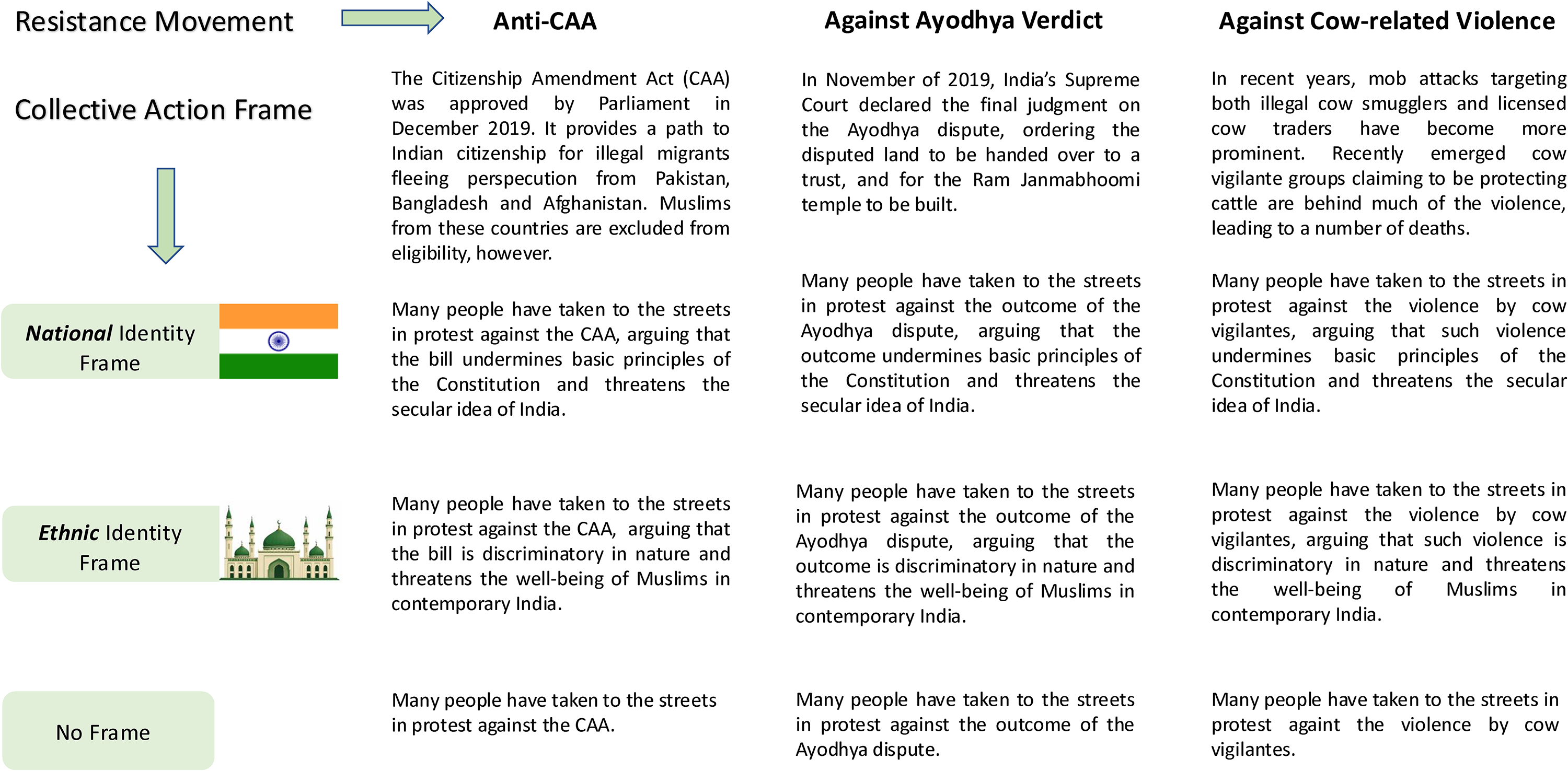
Identity frames.
In addition to the three protest movements described, respondents are asked about their support for a fourth movement: protest against corruption. I include this movement as a benchmark, allowing me to compare support for movements that protest discriminatory policies and practice with support for more general protest activity. Anti-corruption protests are common in India but are not directly related to Muslim exclusion. Overall, participation in this type of protest is less likely to be viewed as sensitive or “unpatriotic.”
Treatment 2: National and ethnic frames
To examine the effect of identity frames on support for collective action, I randomly assign an additional sentence to the description of the protest movements, framing grievances as either (1) specific to the Muslim community (“ethnic identity frame”) or (2) as pertaining more generally to the secular nation (“national identity frame”). 16 In addition, I include a visual image in order to amplify the respective frame: either an image of a mosque or in the national frame—an image of the Indian flag. 17 The different frames are randomly attached to the protest descriptions outlined above. Each respondent is asked about his or her support for three different protest movements and is exposed to one national identity frame, one ethnic identity frame and one control frame. For instance, some respondents will read a description of the anti-CAA protests according to an ethnic identity frame, a description of the Ayodhya court case according to a national identity frame and a description of protest against cow-related gang violence with no particular frame. Other respondents will be exposed to different combinations of resistance movements and identity frames. The order of the frames and movements is randomized. The design allows me to examine the effect of identity frames independent of the particular protest movement, while at the same time allowing me to explore whether the effectiveness of a given frames applies only to a particular movement, or more generally. The wording used for each separate identity frame is held constant across protest descriptions. See Figure 2 for the exact item wordings.
Empirical strategy and ethics
Empirical strategy
In the main analysis, I run a series of ordinary least squares regressions to compare the outcome measures between each treatment and the control group, respectively. I report average treatment effects as well as point estimates of the mean levels of the outcomes of interest across treatment conditions. Results are reported both excluding and including pre-treatment demographic controls. 18 When investigating the effects of the national and ethnic identity frames (relative to the control), I analyse the data in long-format. Since each respondent reports their support for three different protest movements (each associated with a different identity frame), each respondent appears three times in the long dataset. When analysing the data in long-format, I cluster standard errors at the respondent-level. See Online Appendix Section C.5 for my pre-specified model specifications. 19
Results
The main results section is organized as follows: I begin by examining how exclusionary nationalism affects respondents’ willingness to assert minority identity (H1) and support collective action (H2). I continue by testing the main hypotheses regarding the role of identity frames in mobilizing support for resistance (H3). Finally, I examine whether respondents’ sensitivity to identity frames depends on the extent to which Hindu identity is depicted as central to the Indian nation (H4). 20
Hindu centrality and willingness to assert minority identity
According to H1, minorities should be less willing to openly assert their minority identity under exclusionary nationalism. Results are reported in Figure 3. As illustrated, respondents assigned to the “Hindu centrality” treatment are indeed less willing to assert minority identity than respondents assigned to the control condition (95% CI [−0.11, −0.00]). In substantive terms, average willingness to pick a Muslim avatar reduces from a probability of 0.81 (95% CI [0.77; 0.85]) in the control group to 0.75 (95% CI [0.71; 0.79]) in the Hindu centrality group.
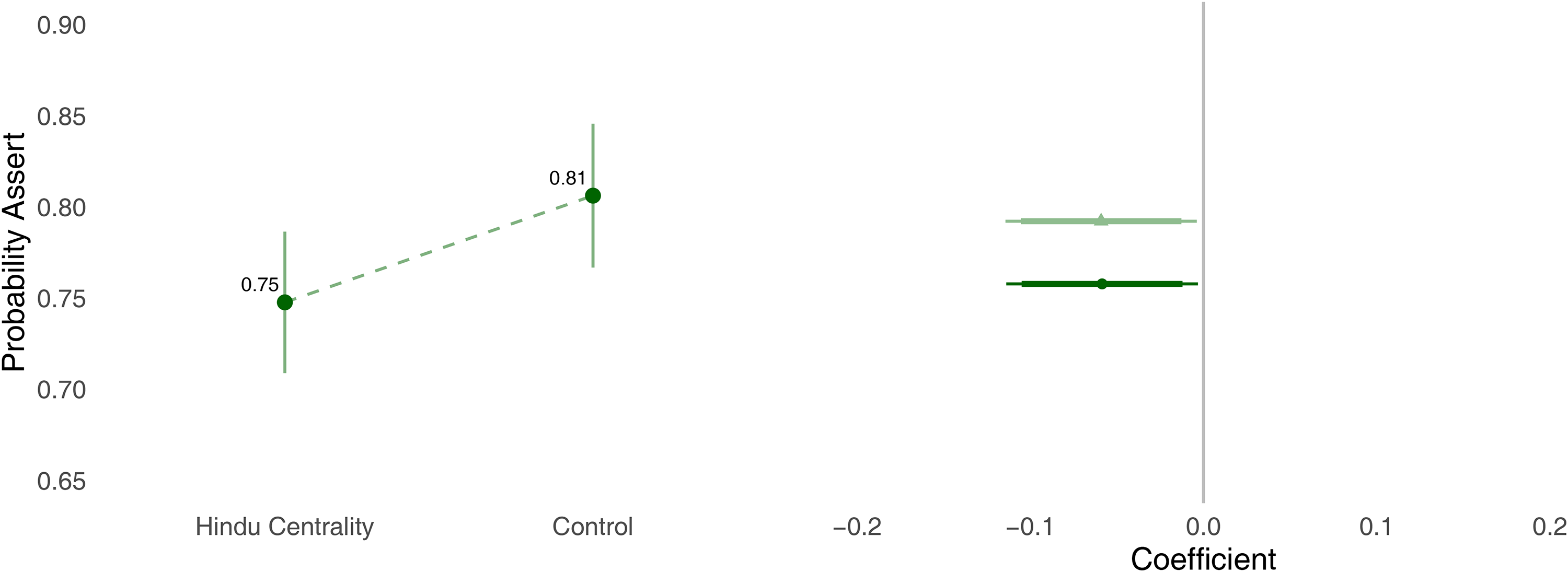
Avatar choice. Note: this figure shows treatment effects of Hindu centrality on willingness to assert minority identity among Muslims. Coefficient plots are based on linear regression models excluding controls (dark line) and including sociodemographic controls (bright line); 95% (thin line) and 90% (thick line) confidence intervals are shown; N = 1311. See Online Appendix Table F7 for full regression model output.
The evidence therefore supports the notion that minorities are less willing to affirm or reveal their minority identity when their belonging to the nation is experienced as less secure (H1).
Hindu centrality and support for collective action
According to my second hypotheses (H2), support for collective action should be lower among ethnic minorities under exclusionary nationalism. To explore this hypothesis, I examine whether being assigned to the “Hindu Centrality” treatment weakens support for collective action. 21 Results are reported in Figure 4. The top panels show how the centrality treatment affects endorsements of the resistance movements, while the bottom panels show respondents’ reported willingness to participate in the movement. I find evidence in favor of H2. Respondents in the “Hindu Centrality” treatment are less willing to endorse the resistance movement and less willing to report that they would be willing to participate in the movement than respondents in the control condition. While average endorsement of the resistance movements is 3.81 (95% CI [3.66; 3.96]) in the control condition, it is 3.55 (95% CI [3.53; 3.82]) in the “Hindu Centrality” group. The difference is statistically significant at the 5% level.
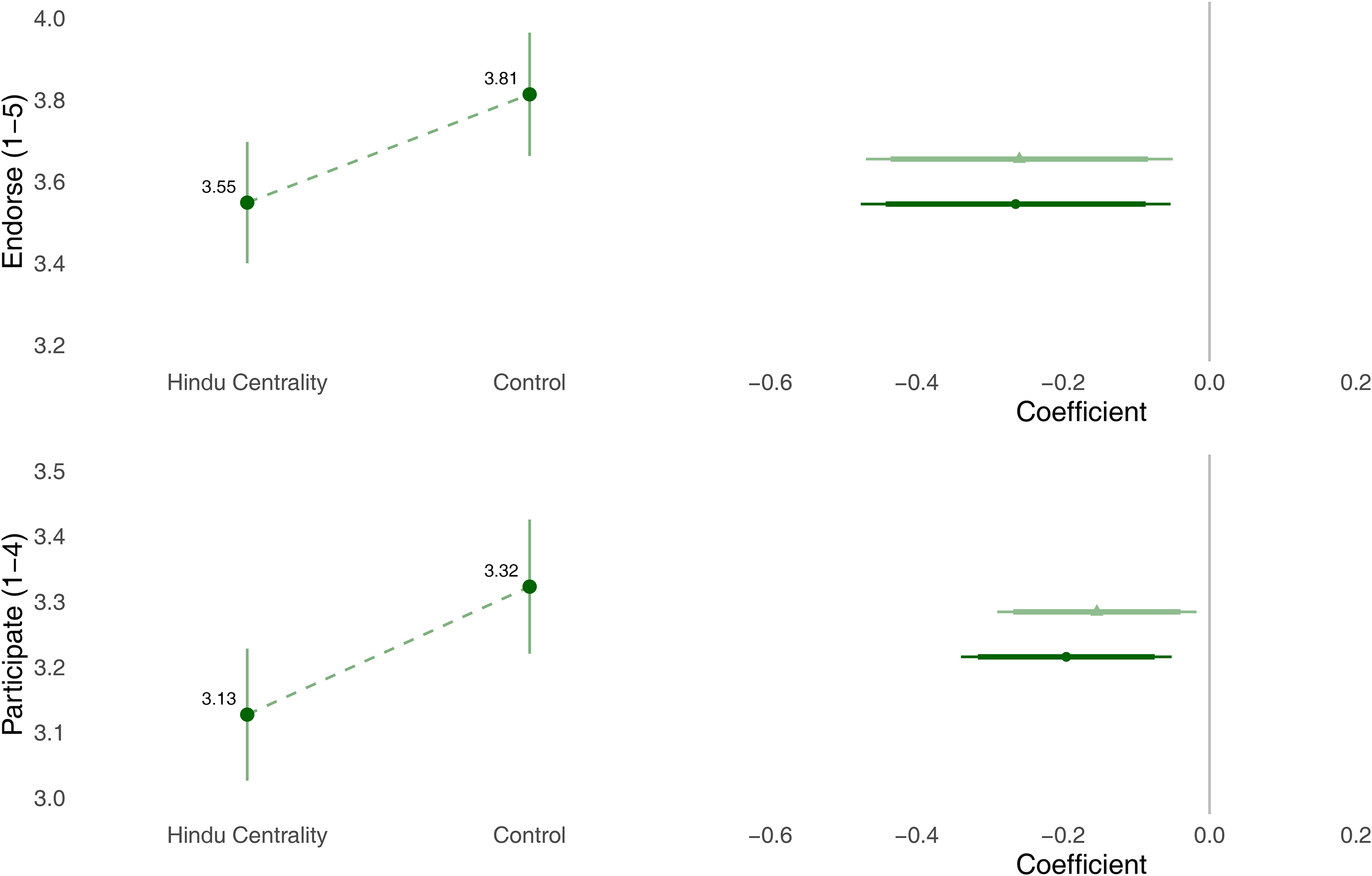
Hindu centrality and preferences for resistance. Note: this figure shows treatment effects of Hindu centrality on support for resistance among Muslims. Coefficient plots are based on linear regression models excluding controls (dark line) and including sociodemographic controls (bright line); 95% (thin line) and 90% (thick line) confidence intervals are shown; N = 1311. See Online Appendix Table F8 for full regression model output.
Identity frames and support for collective action
In the following subsection, I examine H3 concerning the role of identity frames in shaping support for resistance. I examine endorsement of the resistance movement and willingness to participate in the movement separately. Results are reported in Figure 5. I find evidence in favor of H3a. National identity frames strengthen support for resistance among respondents. In substantive terms, the national identity frame enhances average endorsements of the movement by 0.15 on a 1–5 scale and willingness to participate in the movement by 0.06 on a 1–4 scale when pooling observations across all movements. While support for resistance is 3.65 (95% CI [3.56; 3.73]) for movements with no particular frame, support rises to 3.80 (95% CI [3.73; 3.89]) for movements described using a national frame. Although the substantive effects are not large, they are not trivial. As shown in the figure, average support for anti-corruption protests (our benchmark) is 3.88. National identity frames thus strengthen support for ethnic resistance movements to levels that are almost equal to those of our benchmark. The effect size is also comparable with those in similar experiments. 22 Although the evidence is supportive of H3a, I do not find evidence in favor of H3b. Ethnic identity frames do not affect levels of support as compared to the control condition, on average. 23
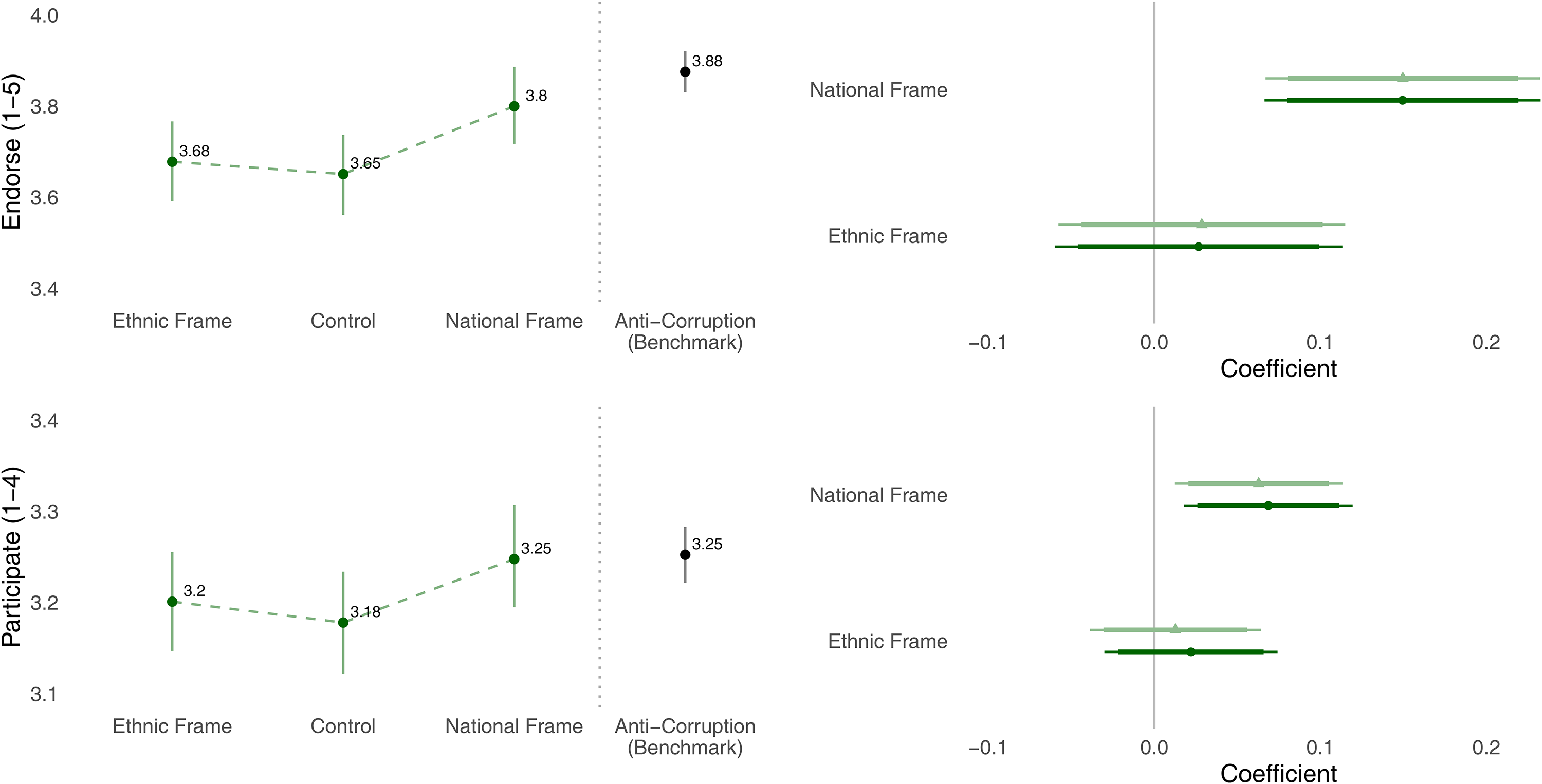
Identity frames and support for resistance. Note: this figure shows treatment effects of identity frames on support for resistance. Coefficient plots are based on linear regression models excluding controls (dark line) and including sociodemographic controls (bright line); 95% (thin line) and 90% (thick line) confidence intervals are shown; N = 3933. See Online Appendix Table F9 for full regression model output.
The conditional effects of identity frames
Next, I examine how the strength of identity frames in shaping support for collective action depends on Hindu centrality (H4). Results are reported in Figure 6. As can be observed, Hindu Centrality does condition the effects of the identity frames, according to H4. While ethnic identity frames enhance support for resistance in the control condition, the same frame clearly reduces support for protest when Hindu centrality is salient. This pattern is illustrated in the right panel of Figure 6. As the figure illustrates, the ethnic identity frame enhances average support for resistance with respect to the control group by 0.17 (95% CI [0.02; 0.32]) on a 1–5 scale in the control condition, while it reduces support for resistance by 0.16 (95% CI [−0.30; −0.02]) with respect to the control when the centrality of Hindu identity is salient. This finding is consistent with the theoretical argument that ethnic frames reduce support under exclusionary nationalism (H4b).
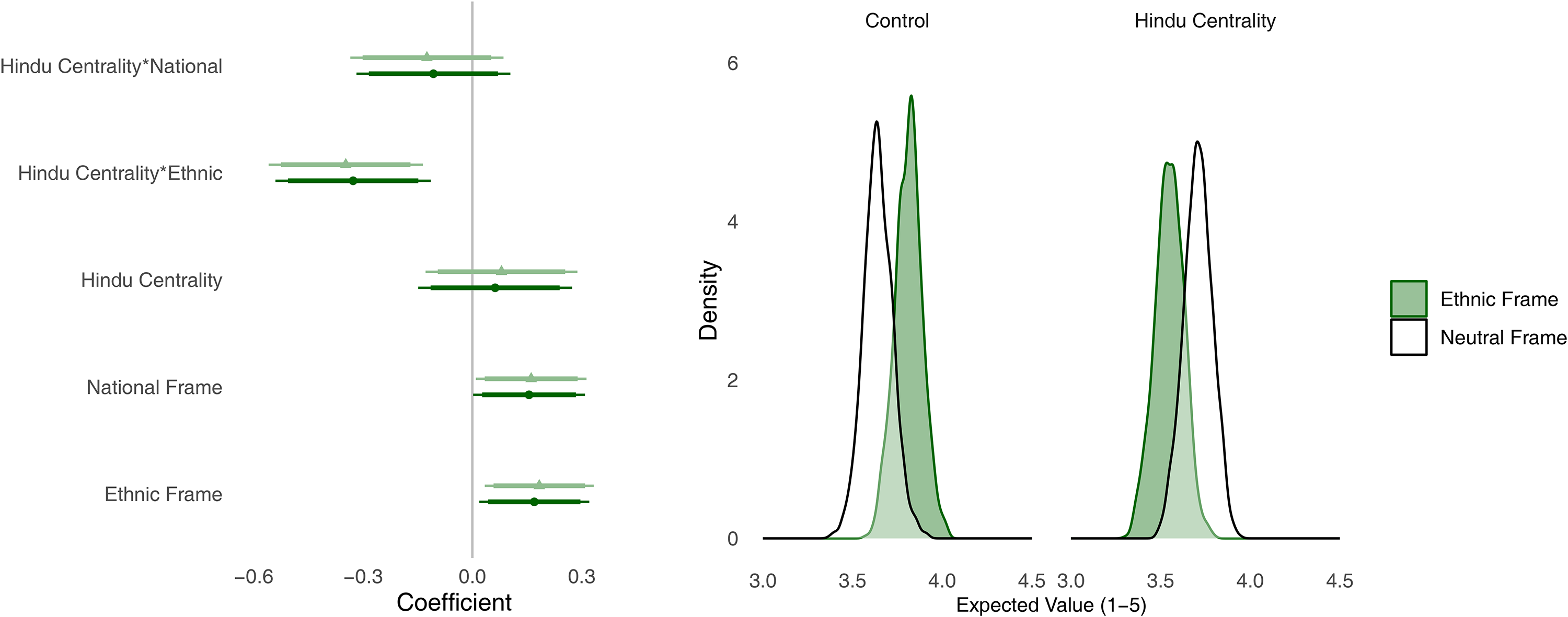
Interaction effect. Note: this figure shows treatment effects of identity frames on support for resistance conditional on Hindu Centrality. Coefficient plots (left) are based on linear regression models excluding controls (dark line) and including sociodemographic controls (bright line); 95% (thin line) and 90% (thick line) confidence intervals are shown. The right panel shows simulated sampling distributions for respondents in the control and “Hindu Centrality” treatments; N = 3933. See Online Appendix Table F10 for full regression model output.
While respondents are more sensitive to the ethnic identity frame when Hindu centrality is salient, H4a states that respondents should also be more sensitive to national identity frames when the centrality of Hindu identity to the Indian nation is salient. The evidence does not support this proposition, however. The effects of the national identity frame are not statistically distinguishable from one another in the different treatment conditions. In sum, while respondents react more negatively to ethnic frames when the centrality of Hindu identity to the Indian nation is salient, respondents act positively to the national identity frames across all treatment conditions.
Mechanisms
The results suggest that Muslim minorities become less willing to assert ethnic identity (H1) and less willing to support collective action (H2) under exclusionary nationalism. In addition, my findings suggest that narratives of mobilization that draw on national symbols and portray ethnic grievances as a subset of national grievances, strengthen support for collective action (H3a). While I do not find that ethnic identity frames weaken support for protest on average (H3b), ethnic identity frames have a negative effect on support for protest under exclusionary nationalism (H4b). To explore the mechanisms driving these patterns, I consider additional implications of the theoretical argument.
National identification and collective action
According to the argument developed above, minorities who aspire to be recognized as full members of the nation may hesitate to defend their group rights under exclusionary nationalism, fearing that protest could undermine their credibility as committed members of the nation. This reasoning implies heterogeneity among Muslims—between those who do and those who do not aspire to be accepted as core members of the national in-group. As detailed in Online Appendix Section A, the argument suggests that, assuming high levels of ethnic identification, we should observe (1) stronger negative effects of exclusionary nationalism on minorities’ willingness to support collective action among respondents with high levels of national identification, and (2) stronger positive effects of national identity frames among these same respondents.
The survey includes a pre-treatment measure of national identification, which asks respondents to rate how important different groups are to their sense of self on a scale from 0 to 100. To examine heterogeneous treatment effects, I interact national identification with each of the two central treatments: (1) Hindu centrality and (2) identity frames. Figure 7 presents conditional treatment effects across the range of national identification values. Panel (A) shows that the negative effect of priming Hindu centrality emerges only among individuals with strong national identification (holding ethnic identification constant). The interaction is statistically significant at the 90% level, and the pattern is consistent with theoretical expectations. Panel (B) indicates that the effects of the national identity frames are also evident only among respondents with a strong sense of national identity, and not among those who identify less strongly with the nation. Note, however, that this interaction coefficient does not reach conventional significance levels. This may reflect limited statistical power, as few respondents exhibit low levels of national identification. The findings should therefore be interpreted as suggestive.
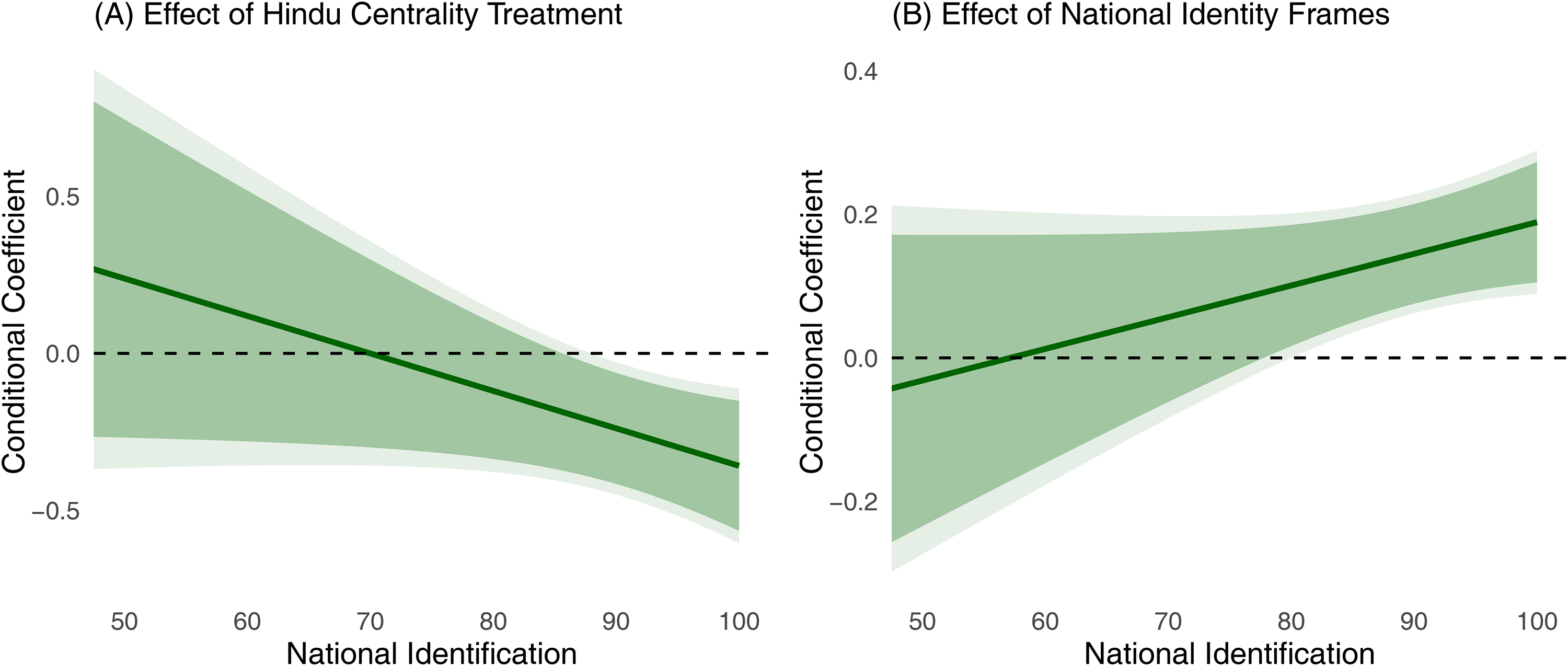
The moderating role of national identification. Note: This figure shows treatment effects of (A) Hindu centrality and (B) national identity frames on support for collective action, conditional on national identification. Conditional treatment effects are based on linear regression models including controls; 95% (light) and 90% (dark) confidence intervals are shown. See Online Appendix Table F11 for full regression model output.
Second-order beliefs
The argument also suggests that identity frames influence willingness to protest by differentially shaping beliefs about how the mainstream community will perceive the protest movement. Specifically, (1) ethnic identity frames should increase beliefs that mainstream society will view protest as anti-national, and (2) national identity frames should reduce such beliefs relative to the neutral frame. I therefore examine how identity frames shape perceptions of how protest will be viewed by the broader society. Figure 8 presents the results. On average, national identity frames do not significantly reduce perceptions that mainstream society will view protest as anti-national. In contrast, ethnic identity frames increase such perceptions, helping to explain why these frames reduce support for protest under exclusionary nationalism.
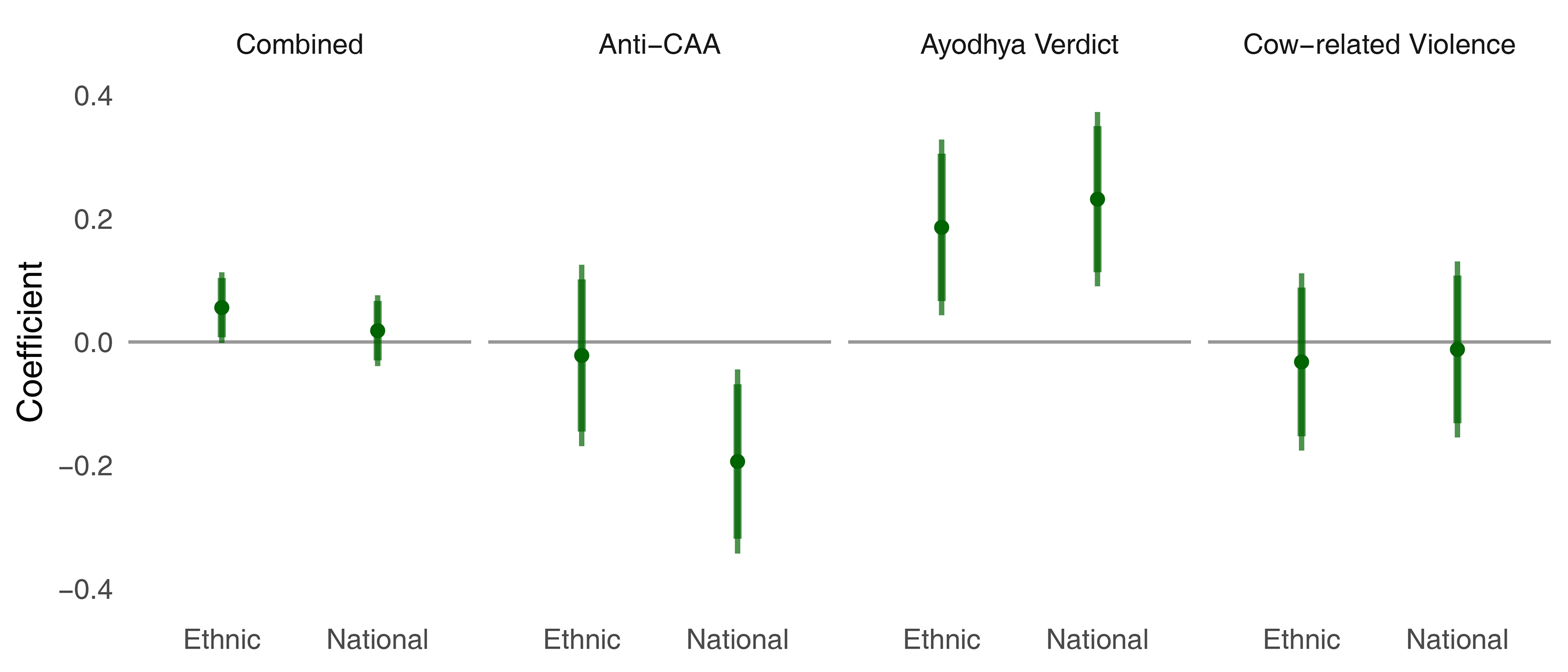
Identity frames and second-order beliefs. Note: Treatment effects of identity frames on beliefs that protest will be viewed as anti-national by protest movement. Coefficient plots are based on linear regression models including controls; 95% (thin line) and 90% (thick line) confidence intervals are shown. See Online Appendix Table F12 for full regression model output.
Figure 8 also disaggregates the results by protest movement, revealing interesting heterogeneity. Notably, for the anti-CAA movement, national identity frames significantly reduce perceptions that protest will be viewed as anti-national, consistent with theoretical expectations. For the other protest movements, however, different patterns emerge. For the Ayodhya verdict, both ethnic and national identity frames heighten perceptions that protest would appear anti-national. This pattern may reflect strong prevailing associations of Ayodhya with Muslim identity, which constrain the extent to which it can be reframed in national terms. No consistent pattern emerges in the case of cow-related violence.
Interpretation
Overall, the findings present a set of mixed results. On the one hand, exclusionary nationalism exerts a stronger negative effect on support for protest among individuals with a deeper attachment to the nation, suggesting that aspirations to belong may inhibit support for collective action among certain groups. On the other hand, the positive effects of national identity frames probably operate through multiple, partly overlapping mechanisms. The analysis here focuses primarily on the perceived repercussions of protest—whether intangible threats related to loss of self-worth and belonging, or tangible threats such as backlash and discrimination. 24 However, expectations of protest success may also play an important role. As Wasow (2020) argues, how mainstream media frames protest can shape the likelihood of its success, and minorities’ may be making such considerations into account. Moreover, minorities’ willingness to participate may also depend on their expectations about whether members of the dominant group may join the protests, which could also be affected by identity frames. Finally, identity frames may also affect minorities’ feelings of entitlement to protest. As shown in Online Appendix Figure H8, exposure to national identity frames increases minorities’ sense of having the right to protest against the Ayodhya verdict. The precise mechanisms remain difficult to disentangle with the data at hand and most likely operate simultaneously. Future research could explore these questions using samples with more variation in degrees of identification and using survey instruments specifically designed to disentangle these mechanisms. 25
Discussion
In this article, I have highlighted the role of narratives of mobilization in shaping support for collective action among marginalized groups. The empirical findings show that collective action frames that draw on national symbols and interpret ethnic grievances as a threat to national principles are particularly likely to mobilize support for protest among Indian Muslims. These findings raise two broader questions: to what extent are they likely to generalize to other minority groups or settings; and what are the broader implications of understanding minorities’ proclivity to support or participate in protest?
External validity
How likely are these results to be externally valid within the context of India? The results are based on responses from an online sample that is not representative of the broader Muslim population. Baseline support for the protest movements is relatively high, suggesting that participants in this sample are more predisposed toward collective action than the broader population. While this limits generalizability, the fact that national identity frames produce effects even among a politically engaged and mobilization-prone group could imply that the observed effects represent conservative, lower-bound estimates.
More broadly, how might these findings generalize to other minority groups and contexts? The results are likely to extend to groups who hold dual identities and experience insecure national belonging. In this study, I experimentally primed the centrality of Hindu identity to the India nation, in order to explore how experiencing insecure national belonging affects support for collective action. In practice, the experience of insecure belonging can vary both within groups across time, as elites promote more exclusionary or inclusionary forms of nationalism, and across groups, depending on their degree of perceived “foreignness”. As Zou and Cheryan (2017) and Pérez et al. (2025) argue, minority groups differ in the extent to which they are perceived as foreign rather than simply lower in the social hierarchy. For example, in the United States, Hispanic Americans are often viewed as more “foreign” than Black Americans, even though both face racism and structural discrimination. This distinction is crucial: the more a group's belonging to the nation is questioned, the more powerful national identity frames are likely to be in motivating collective action.
That said, most minority groups can be portrayed as “foreign,” even when they have long been native to the nation. This applies to Indian Muslims, whose belonging has been periodically questioned, but also to minorities elsewhere, such as Kurds in Turkey or non-Malays in Malaysia. National belonging is not fixed: it expands under inclusive narratives and contracts under exclusionary ones. As a result, the perceived “foreignness” of minorities varies across time and context. For instance, Varshney and Staggs (2024) draw direct parallels between Muslims in India and Black Americans under Jim Crow. While Black Americans’ national inclusion has become more secure since that era, Indian Muslims today face increasingly similar threats to those once experienced by Black Americans under white supremacy.
Consistently, shifts in the type of nationalism promoted by political elites may help explain how minority framing strategies evolve over time. During the secular decades following independence, Muslim protests were often framed along ethnic lines. For example, in the 1985 Shah Bano case, thousands protested in defense of Muslim personal law and cultural autonomy. As Hindu nationalism gained strength, Muslim protest became became less frequent and the “Muslim silence” was only broken with the eruption of the anti-CAA protests, which employed a markedly different collective action frame. In the United States, leaders of the Civil Rights Movement employed national identity frames, aligning their goals with the nation's foundational promises and invoking ideals such as the American Dream and principles of justice and freedom. In contrast, the Black Lives Matter movement challenges mainstream values, embraces an “unapologetically Black” identity, and draws on Black nationalist frames (Bonilla and Tillery, 2020). These shifts in framing stratgies—from ethnic to national in India and from national to ethnic in the United States—are consistent with the theoretical argument advanced here.
Implications and conclusion
This article has examined the conditions under which marginalized groups are more likely to support collective action. The theoretical argument rests on the assumption that protest can, under some circumstances, yield meaningful benefits for disadvantaged groups—enhancing their social standing and postive social identity. Yet one might ask whether it is ever rational for minorities to protest, given their numerical disadvantage and the multiple potential repercussions of protest. Recent work in American politics suggests that minority protest can, under certain conditions, be strategically advantageous. Gause (2022) argues that legislators may, in fact, be more responsive to the demands of racial and ethnic minority groups than those of white or more affluent constituencies. Because participating in protest is generally more costly for marginalized communities, such actions send especially credible signals of issue salience to policymakers. Wasow (2020) shows that subordinate group's protest strategies play a critical role in shaping how minority concerns are framed by the majority-oriented press. When framing is favorable, protest can shift public opinion toward coalitions more aligned with the subordinate group's interests.
In the Indian context, specifically, the findings speak directly to ongoing debates within civil society about how Muslims should voice their grievances. The types of collective action frames examined in this study are actively contested across activist, political, and academic circles. The question of which frames work is not merely theoretical but central to strategic discussions among organizers and opinion leaders. For instance, at Jamia Millia Islamia University, students reportedly clashed over whether protests against the CAA should be framed as an attack on Muslims and Islam—serving as an entry point for Muslim assertion—or described in more secular, civic terms (Amin and Mushtaq, 2019). Similarly, public commentary in prominent Indian outlets has questioned whether Muslim visibility in protest risks reinforcing the Hindu–Muslim binary, thereby consolidating Hindu nationalist support, or whether visible Muslim participation is necessary to articulate a viable alternative to Hindutva. 26
To conclude, the findings suggest that the willingness of marginalized groups to mobilize depends on the interplay between minority identification, the nationalist narratives advanced by elites, and the framing strategies activists employ to make their struggles resonate. Future research should build on this work by more precisely unpacking the mechanisms that link these factors to patterns of collective action. In particular, scholars could examine how these dynamics vary among minorities with differing levels of ethnic and national identification, across groups that differ in their perceived “foreignness,” and in contexts where national belonging is more or less secure. Doing so would deepen our understanding of when and how different narratives of mobilization can either constrain or enable political participation among marginalized groups.
Supplemental Material
sj-pdf-1-cmp-10.1177_07388942261457944 - Supplemental material for Aspirations for national belonging and support for collective action among marginalized groups
Supplemental material, sj-pdf-1-cmp-10.1177_07388942261457944 for Aspirations for national belonging and support for collective action among marginalized groups by Emmy Lindstam in Conflict Management and Peace Science
Footnotes
Acknowledgements
I would like to thank Sabine Carey, Vasiliki Fouka and Harald Schoen, as well as participants at the 2023 EMPESA workshop. This study was pre-registered and has undergone ethical review. I gratefully acknowledge funding support from Lars Hiertas Minne Foundation.

Ethical standards
The author declares that the human subjects research in this article was reviewed and approved by the ethical committee at the University of Mannheim.
Funding
I gratefully acknowledge funding support from Lars Hiertas Minne Foundation.
Declaration of conflicting interests
The authors declared no potential conflicts of interest with respect to the research, authorship, and/or publication of this article.
AI disclosure
Data availability statement
Supplemental material
Supplemental material for this article is available online.
Notes
References
Supplementary Material
Please find the following supplemental material available below.
For Open Access articles published under a Creative Commons License, all supplemental material carries the same license as the article it is associated with.
For non-Open Access articles published, all supplemental material carries a non-exclusive license, and permission requests for re-use of supplemental material or any part of supplemental material shall be sent directly to the copyright owner as specified in the copyright notice associated with the article.
