







Abstract
Restorative transitional justice—mechanisms that prioritize truth-telling, reparation, and stakeholder participation over punitive sanction—is an increasingly prominent feature of post-conflict peacebuilding. Its success depends fundamentally on participation by all stakeholders, including perpetrators, who have strong incentives not to engage. Why, then, do some perpetrators participate while others do not, even when facing identical incentives? We argue that post-traumatic stress disorder, specifically the avoidance and arousal symptoms characteristic of perpetration-induced trauma, increases the likelihood of perpetrator participation by motivating pro-social engagement as a coping mechanism. We test this argument using original survey data from 299 former members of the Colombian Armed Forces implicated in the “false positives” extrajudicial killing scandal, all of whom face proceedings before Colombia's Special Jurisdiction for Peace. Logistic regression results support both hypotheses: increasing severity of both avoidance and arousal post-traumatic stress disorder symptoms independently increases the probability of perpetrator participation in restorative transitional justice, even under conditions of institutional abandonment and personal risk.
When civil wars and internal conflicts end, communities may struggle to rebuild societies damaged by political violence. To redress these legacies of atrocity, states and the international community often implement transitional justice (TJ), a set of measures aiming to increase peace and stability in the wake of mass human rights abuses perpetrated during radical political change (Teitel, 2002). A nascent trend in TJ mechanisms is the incorporation of principles of restorative justice, a philosophical approach to righting wrongs that focuses on truth telling and restitution through participation of stakeholders: victims, perpetrators, and civil society. In its idealized form, restorative justice has four goals: reparation, restoration, reconciliation, and reintegration (Zehr and Mika, 1998).
This paper seeks to expand our understanding of participation in restorative justice owing to its increasing use, peacebuilding potential, and policy implications. We define restorative transitional justice as the implementation of policies meant to heal war-plagued countries by having broad stakeholder participation in reconstruction projects. Such policies “can potentially play a valuable role in such societies, bringing together the people who have been harmed by crimes and the individuals responsible for those harms … to address the offense and its consequences” (ICTJ, 2024, p. 1). If restorative transitional justice works as designed, we generally expect that: (1) a diverse group of individuals will participate (including representatives of the state, individual victims and perpetrators, and representatives of civil society groups); (2) participants will be less likely to feel acrimonious and more likely to feel optimistic than if they did not participate; and (3) the prospects for peace and stability in the community will improve. Here we explore the first of these hypothesized stipulations: all, or as many as possible, stakeholders must participate in restorative justice. This includes the state, the victims, and the perpetrators, as well as civil society.
While victims have a strong desire to seek truth and justice, conventional wisdom suggests that perpetrators do not. Instead, at the war's end, perpetrators should be more likely to avoid calling attention to their human rights violations for fear of incarceration, retribution and stigmatization. It stands to reason that they might be more likely to reveal the truth in exchange for immunity, or judicial benefits. Despite this intuition, perpetrators do participate in restorative justice. For example, we surveyed nearly 300 combatants from the Colombian civil war, all of whom stand accused of extrajudicial killing and all of whom have been offered the opportunity to participate in restorative transitional justice as an alternative to more punitive sanctions. Despite being offered the same incentives to participate, however, we found that participation varied across perpetrators: of 299 respondents, 160 (53.5%) had participated in at least one restorative transitional justice project while the other 139 (46.5%) had not. What explains this variance? Why does participation in restorative justice vary across perpetrators of atrocity, even when the atrocious act and incentives to participate do not?
We submit that the personal situation of the individual, and in particular, those characteristics associated with one of the most common mental health challenges facing all former combatants—post traumatic stress disorder (PTSD)—will play a critical role in influencing the willingness of former combatants and especially those charged with or involved in human rights abuses, to participate in restorative transitional justice. We hypothesize that those individuals who exhibit signs of PTSD are more likely than others to become involved in restorative transitional justice for personal and health reasons. As research on pro-sociality after conflict violence (Bauer et al., 2016) and public health research on PTSD (Held et al., 2017; Held et al., 2018; Heward et al., 2024) find, there is evidence that this type of social engagement can be helpful for all those involved in restorative transitional justice. In what follows, we review relevant literatures, develop our theory, test our hypotheses on original survey data, and conclude with implications for scholars and practitioners.
Restorative justice as transitional justice
Transitional justice is “the conception of justice associated with periods of political change, characterized by legal responses to confront the wrongdoing of repressive predecessor regimes” (Teitel, 2017, p. 489). Some forms are retributive, and others are non-retributive. The former are designed to hold perpetrators accountable for atrocities and human rights abuse; they are backward-looking and perpetrator-focused, aimed at punishing bad actors after violence so that justice can be done. Retributive transitional justice typically takes the form of national or international criminal prosecution. The condemnation and sentencing of the guilty is intended to communicate to local and international audiences that there is no impunity for such crimes and thereby deter future, would-be, war criminals from undertaking their human right violations. Non-retributive forms of transitional justice are designed to offer tangible and intangible compensation to victims; they are forward-looking and victim-centered, aimed at rebuilding and reintegrating post-conflict society. Mechanisms include truth commissions, material and symbolic reparations, and memory projects (Roark and DeMeritt, 2023).
While transitional justice is specifically designed for cases where international law has been violated during political upheaval, restorative justice is a more general philosophical approach to how we think about punishment for wrongful acts. It can be defined as “as an approach toward achieving justice that, to the best extent possible, involves all the stakeholders involved in a crime to address the harms, needs, and obligations arising from the crime by putting right and enabling healing to the greatest extent possible” (Zehr, 2015, p. 2). It addresses the needs and roles of victims, perpetrators, and communities as opposed to a strict legal framework that holds offenders purely in relation to their violations of law. Restorative justice has three pillars: harm, needs, and obligations. It takes a range of forms in practice, including (for example) apologies, restitutions, and acknowledgements of harm and injury, all while extending other efforts to provide healing and reintegrate perpetrators into their communities. All involve some form of direct communication between victims and offenders, with at least some representation of the affected community. The process is completely voluntary for all participants. If such processes work as intended, the offender accepts responsibility for harm; the truth is provided about their illegal acts, and participants collectively agree on an appropriate method of repairing that harm (Llewellyn and Howse, 1998).
Philosophically, non-retributive TJ mechanisms embody restorative principles; in practice, restorative justice has long been central to non-judicial remedies like truth commissions, operating at both institutional and interpersonal levels (Weitekamp et al., 2006). More recently, there has been a growing trend of restorative justice being explicitly integrated into traditionally retributive TJ processes aimed at criminal accountability. Consider, for example, Northern Ireland, Timor Leste, and Uganda: restorative justice was part of the societal response to widespread atrocities in each of these cases, although its application varied from the more institutional, national level (e.g. Northern Ireland) to the less formal, local level (e.g. Uganda). In South Africa, the Truth and Reconciliation Commission encouraged participation by those who committed human rights violations during the Apartheid era by giving amnesty to those who gave a full and truthful accounting of their crimes.
In each of these cases, TJ mechanisms embody the core principles of restorative justice. This is also true in the case of Colombia's Special Jurisdiction for the Peace (JEP), which is a transitional justice mechanism created by the 2016 peace agreement between the Colombian government and the guerrilla group Revolutionary Armed Forces of Colombia (FARC-EP). The JEP was established to investigate, prosecute, and sanction those who committed international crimes during the Colombian armed conflict; it does this with a focus on achieving truth, justice, reparation, and non-repetition. Another main objective is the reintegration of offenders. This observed trend in transitional justice practices suggests an important new topic for academic research: restorative transitional justice. As described by the JEP, restorative transitional justice is: a form of participatory, collaborative, and prospective justice that seeks to address the harm and damage caused in the context of the armed conflict, reintegrate the parties into society, and restore the social fabric through processes of acknowledgment and accountability, contributions to comprehensive reparation and the restoration of dignity, as well as measures for prevention, protection, and guarantees of non-repetition.
Individual-level participation in transitional justice
Perpetrators have many incentives not to participate in restorative transitional justice and reveal their truths. Suspected perpetrators may wish to conceal their histories for fear that revealing such information may cause a loss of reputation, imprisonment, stigmatization, or even violence if their testimonies reveal the secrets of powerful people. The question we address is why do some perpetrators participate in these TJ mechanisms and others do not? Why do some fear facing the victims, while others feel compelled to? Why are some only willing to talk if given extensive judicial benefits, while others talk without such guarantees? What ultimately accounts for the participation by suspected perpetrators in restorative transitional justice?
Much of the early work on participation in transitional justice focuses on why participation is important (see Daly, 2018; Evrard et al., 2021; Firchow and Selim, 2022). These works generally are concerned with understanding the choices made by national governments, international organizations, and donor organizations to support and fund transitional justice. Hence, while the international community often makes the appropriate signals about the desirability of public participation in these efforts, often such participation has been limited to preliminary stages of peacebuilding, has not been defined in a meaningful way and is a lesser priority than addressing institutional needs (Firchow and Selim, 2022). Thus, the literature on participation in transitional justice has mostly focused on the design and objectives of these mechanisms and whether they provide for or discourage public participation writ large.
In the emerging research on the impact of transitional justice on political outcomes after internal conflict and contestation, scholars are finding that transitional justice in general is not always fulfilling the myriad and ambitious goals that have been set forth (Meernik, 2015; Mendeloff, 2004; Snyder and Vinjamuri, 2003/04; Wiebelhaus-Brahm, 2010), especially providing macro-level peace for societies (Appel, 2018; Nalepa, 2022; Sikking and Walling, 2007), and that the effects are often contingent on combining trials, truth commissions and amnesties (Olson et al., 2010).
There has been extensive work on public opinion about transitional justice. Understanding what kinds of experiences people have had in transitional justice mechanisms; their perceptions regarding what they gained from the process and what they believe is broken about such systems has inspired a great deal of research (Brounéus, 2010; Clark, 2014, Hodžić, 2010; King and Meernik, 2017; Meernik, 2015; Meernik and King, 2019; Mendeloff, 2004; Orentlicher, 2008; Stover, 2005). Much of this scholarship has focused on the experiences and assessments of the victims (Brounéus, 2010; King and Meernik, 2017; Meernik and Guerrero, 2014; Meernik and King, 2019; Nussio et al., 2015; Stepakoff et al., 2015). There is also a largely separate research focus on the experiences of ex-combatants, although participation in transitional justice does not feature prominently (Daly, 2018; Kaplan and Nussio, 2018a, 2018b; Nussio, 2012). Empirical work (e.g. Aguilar et al., 2011; King and Meernik, 2017; Meernik and King, 2019) has found that public attitudes toward transitional justice are a mix of personal, familial, and contextual factors. Some find that individuals develop positive attitudes and engage in socially constructive activities in the aftermath of conflict violence (e.g. Bauer et al., 2016; Elcheroth and Spini, 2009; Hall et al., 2018; King and Meernik, 2017; Schulte and Karakuş, 2026), while other research does not find evidence of any particular impact (Nussio et al., 2015; Rettberg and Ugarriza, 2016). Recent work finds that the relationship between trauma and support for specific TJ mechanisms like truth commissions is more conditional than early scholarship suggested, with conflict exposure alone insufficient to predict public backing for such processes (Godefroidt and Dyrstad, 2025). Hall et al. (2018, p. 350) also find, “that while exposure to heinous war crimes increases support for retributive justice (stemming from the wartime logic of deterrence), interdependence with perpetrators increases victims’ support for restorative justice”. Such findings are echoed in research by Elcheroth and Spini (2009) and Elcheroth (2006), who find, like Rettberg and Ugarriza (2016), that those who were subject to the most trauma were less likely to support punitive transitional justice measures.
Our question, however, is why do individuals, specifically perpetrators, participate in restorative transitional justice activities? Daly studies the attitudes of perpetrators and former combatants about transitional justice and writes that (2018, p. 657): We have a surprisingly limited understanding of perpetrators and former combatants’ views and acceptance of transitional justice policies (Grossman et al., 2015). There has not been systemic evidence brought to bear on former fighters’ experiences with transitional justice. Yet ex-combatants vary significantly in their views toward victims of the conflict and methods of justice during times of transition.
Research by Zvobgo (2019) suggests that while no single factor determines perpetrator participation in transitional justice, the design of transitional justice institutions can impede participation if there is fear that testimony in one setting can be used in separate, legal proceedings. Others have found that truth commissions, with their proffers of amnesty for truth, can be effective in encouraging perpetrators to come forward (Gaviria et al., 2022; Schabas, 2004). Other scholars have found that shame, fear of reprisals, and concern for future prosecutions discourage individuals from speaking their truths (Meernik et al., 2025; Ntsebeza, 2000; Wierda et al., 2002).
Mental health and PTSD in perpetrators
The study of the mental health challenges facing veterans and others in general, especially those dealing with PTSD, on mental and social functioning has attracted voluminous attention given its prevalence and substantial mental and physical health effects (Aprile, 2009; Connor et al., 2021; de la Espriella Et al., 2010; Gaviria et al., 2016; Kruppa et al., 1995; Spitzer et al., 2001). Our goal is not to assess the state of this literature and its foci on diagnosis, prediction, and treatments, but rather to highlight those findings that pertain to behaviors undertaken after the traumatic event.
According to the Diagnostic and Statistical Manual of Mental Disorders, 5th edition (American Psychiatric Association, 2013; DSM-5), PTSD is diagnosed based on the presence of five criteria: criterion A is exposure to trauma; criterion B includes intrusion symptoms such as flashbacks and traumatic nightmares; criterion C is avoidance of trauma-related thoughts, feelings, and external reminders; criterion D includes negative alterations in cognition and mood (e.g. persistent negative emotions, diminished interest in activities and attachments, emotional numbness); and criterion E includes alterations in arousal and reactivity (e.g. irritability, hypervigilance, self-destructive behavior, concentration problems).
Importantly, the nature of the traumatic event affects which sets of symptoms are most prevalent afterwards. Traditional victims—people who experienced or witnessed perpetration and reactive violence—most commonly re-experience symptoms, which is criterion B: intrusion. They experience dreams, flashbacks, thoughts and memories of the event that evoke high levels of distress including panic and auditory and/or visual hallucination memories (Bell et al., 2012; Elsass, 2001; Gaviria et al., 2016; Sullivan et al., 2023). Differently, individuals who have taken part in the perpetration of human rights abuses and extra judicial killing are not typically studied in research on PTSD, which instead emphasizes how victims and those who are innocent of any wrongdoing suffer from these experiences (Aprile, 2009; Eyerman, 2019 Giesen, 2004; Heins and Langenohl, 2015; Morag, 2013). As Mahlako et al. (2024, p. 337; see also Karam, 2019; Mohamed, 2015) write, it is, “considered unimaginable how an offender or perpetrator might experience psychological trauma when inflicting violence and pain on others.” However, scholars have begun exploring the causes of perpetrator trauma in more depth (Heward-Belle et al., 2024). As Eyerman (2019, pp. 167–168) writes: Perpetrator trauma occurs when individuals and collectives feel they have acted in ways that are contrary to their own deeply held moral beliefs. These beliefs are so foundational that when one contravenes them, one's identity and self-esteem can feel as though they have been shattered, a sense that gives rise to a strong emotional response including feelings of guilt and remorse. In some cases, pathological symptoms can occur. With regard to individuals, perpetrator trauma is currently couched under the umbrella concept post-traumatic stress disorder (PTSD), a diagnosis that has exploded and expanded in recent years. PTSD has been applied to both victims and perpetrators, though the focus has been primarily on the former.
The other DSM-5 criteria are relevant to understanding PTSD broadly but stand in a different relationship to the theoretical dynamics we explore here. Criterion A—trauma exposure—is a diagnostic prerequisite rather than a behavioral predictor. In our sample, all respondents have experienced traumatic events by virtue of their participation in extrajudicial killing, making criterion A effectively constant rather than variable across cases. Criterion B—intrusion and re-experiencing symptoms such as flashbacks and nightmares—is the hallmark symptom cluster for victim PTSD, but is substantially less documented among those who have perpetrated violence; the PIT literature consistently identifies avoidance (C) and arousal/reactivity (E) as the characteristic symptom profiles of perpetrators (McNair, 2003; Kruppa et al., 1995; Pollock, 1999). Criterion D—negative alterations in cognition and mood—is also present in PIT, but largely co-occurs with criterion E symptoms among perpetrators and is not separately captured by our measurement instrument. Accordingly, our hypotheses focus on criteria C and E, which are the most theoretically and empirically distinctive predictors of behavior in this perpetrator-specific context.
Perpetrators, PTSD, and participation in restorative transitional justice
The above-noted, PTSD-based mental health challenges may increase the risk of other mental and physical health problems, as well as adequate functioning and overall happiness. Prima facie, then, perpetrator trauma would seem to reduce the likelihood of participation in restorative transitional justice. However, research on post conflict pro-sociality has found that individuals who have experienced conflict violence are more likely to become involved in social activities, take a leadership role in these activities, exhibit greater trust and likelihood of voting, and other positive behaviors. As Bauer et al. (2016, 250) write: The evidence suggests that war affects behavior in a range of situations, real and experimental. People exposed to more war-related violence tend to increase their social participation by joining more local social and civic groups or taking on more leadership roles in their communities. They also take actions intended to benefit others, such as altruistic giving, in experimental laboratory games. Our meta-analysis also suggests the effects of wartime violence are persistent and fairly consistent across cases. Moreover, we see little systematic difference by the type of violence experienced (including crime victimization, as examined by a related body of studies), or across studies with different empirical strategies. The results appear to hold for men and women, as well as children and adults exposed to violence, and are remarkably similar for both the victims and perpetrators of violence. Finally, the impacts of exposure do not diminish with time; indeed, if anything, the opposite seems to be true.
Other scholars studying PTSD and similar mental health challenges have noted that social engagement is critical to helping individuals address their social isolation; sense of self and a mitigation of their symptoms (Wisco et al., 2014). As Armenta et al. (2018, p. 47) find: An important aspect of PTSD treatment is having adequate social support. We found that being bothered a lot by not having someone to turn to was associated with persistent PTSD at the second followup. Research shows that social relationships can help with treatment compliance, coping with intrusive symptoms, and sharing feelings and thoughts that are experienced with PTSD. Social support both during and following deployment has been shown to be associated with lower PTSD severity.
Research design
New data from perpetrators of atrocity
The authors surveyed 299 former members of the Colombian armed forces. Respondents are exclusively male, with an average age of 46 years (SD = 5.5) and an average of 18 years of military service (SD = 7.35). The median rank is professional soldier (rank = 1), although the mean rank of 4.2 (SD = 4.1) reflects a wide distribution from regular soldiers through colonel, indicating that the false positives implicated personnel across the enlisted hierarchy. Average educational attainment is technical school (mean = 7, SD = 2), roughly equivalent to a post-secondary vocational credential. All of our respondents participated in the “false positives” extrajudicial killing that occurred between roughly 2002 and 2008. During that time, the Colombian military were under tremendous pressure to show results in their fight against the leftist rebels of the FARC-EP. One strategy leaders used was to incentivize each FARC casualty; rewards included, for example, extra pay and vacations. Receiving these orders, members of the armed forces sometimes obeyed and killed FARC combatants. All too often, though, they instead targeted civilians (commonly “invisible people” like sex workers, unhoused people, and people with disabilities), then dressed them in FARC uniforms to claim them as combat kills. Estimates are that at least 6000–7000 non-combatants were killed as false positives.
All of our survey respondents are members of our partner organization for this work, the Reconciliation Committee Foundation (Fundación Comité de Reconciliación, RCF). Founded by Major (ret.) César Maldonado, the RCF is a Colombian non-profit that provides legal and psychosocial support to military members who participated in the false positives and have cases before JEP or another court in the Colombian legal system. The RCF also assists members in designing their TOAR (Works and Activities with a Reparative Content) plans and advocates for members’ social, educational, housing, health, and employment needs. As of this writing, the RCF has 1666 members, all of whom are also JEP respondents; our 299 survey respondents therefore represent approximately 18% of the total RCF membership. 1 The RCF has regional offices throughout the country and invited respondents to attend survey administration at those offices. Importantly, this survey was designed and administered by the RCF itself to assess the status and needs of its membership—the results are used to document ex-combatant needs and advocate on members’ behalf. Respondents were thus not responding to a researcher's instrument but to a needs assessment by their own support organization, which reduces researcher demand effects and increases candor. No external incentives were offered for participation. Respondents were asked 181 questions, and each could choose to decline the survey altogether or stop at any time. Surveys took place between September 2023 and May 2024; all responses were coded anonymously. The survey, dataset, and replication materials are available on the corresponding author's website.
We acknowledge two important limitations of this sample. First, RCF membership is itself a form of engagement with the transitional justice process: members have sought out an organization that actively supports truth-telling and reparation. It is therefore possible that RCF members are systematically more inclined toward participation in restorative transitional justice than the broader population of false positives defendants—indeed, than false positives perpetrators who have not affiliated with any support organization. Second, because the RCF serves members of the Colombian Public Force specifically, the sample does not capture perpetrators from other armed actors in the Colombian conflict (e.g. FARC combatants or paramilitary members). These features of the sample affect the scope of inference: our findings describe the correlates of participatory variation among a population already oriented toward engagement, rather than making claims about all false positives perpetrators or all perpetrators in post-conflict settings. We discuss these constraints further in our conclusion and encourage future research to replicate our analysis with broader samples.
Next, several features of the survey instrument and administration warrant discussion. The survey contains 181 questions; our dataset includes a larger number of variables because multi-part items were expanded into separate columns during data preparation. The PTSD symptom battery begins at Q108, approximately 60% of the way through the instrument, and key participation items appear from Q100 onward. While survey fatigue is a legitimate concern for items placed in the latter half of a long instrument, the symptom items use a consistent five-point frequency scale that reduces cognitive burden, and the in-person administration context—in which respondents understood the survey's purpose and had an interest in accurate reporting—reduces the incentive to satisfice. The survey does not include formal attention checks, as it was designed by the RCF for needs-assessment rather than research purposes; we note this as a limitation. Missingness on our key variables is low: all arousal symptom items and two avoidance items have no missing values, and individual items in the PTSD battery are missing for between 4 and 7% of respondents. The composite participation dependent variable (DV) is missing for 13.4% of respondents, reflecting its multi-item construction. Respondents missing on the DV show slightly lower average PTSD symptom scores than those with complete data, suggesting missingness may not be entirely random; we encourage readers to interpret our findings with this in mind.
Operationalization
Dependent variable
Our outcome of interest is self-reported individual-level perpetrator participation in restorative transitional justice. To measure this, we create a variable that indicates whether at least one of the following is true:
Respondent has participated in “a restorative justice process.” Respondent has participated in “any reconciliation efforts with victims of the Colombian Army.” Respondent has participated in “the Truth Clarification Commission.” Respondent has participated in “actions of the Unit for the Search for Missing Persons.” and/or Respondent is “currently undertaking an activity, work or work with remedial or restorative content as a product of your own or an alternative sanction.”
Of the 299 respondents who answered these questions, 160 (53.5%) have participated in at least one form of restorative transitional justice. These types of participation range from involvement in reconciliation events with victims; providing information to the Colombian Truth Commission; assisting with locating the missing, and through involvement in TOAR (Work and Activities with a Reparative Content), where those who have committed wrongdoing during the conflict assist communities affected by the violence.
Independent variables
Our key explanans are criteria C (avoidance) and E (arousal and reactivity) PTSD symptoms, since these are the ones that most often present in PTSD specifically caused by the perpetration of violence. We use the following survey questions to measure avoidance symptoms:
Do you feel marginalized or stigmatized by your time in the military? How often do you find out or are told by others that you have done something you don't remember? How often do you feel as if you are divided into two people and one is watching what the other is doing? How often do you feel that you are the only one who has suffered from these events? How often do you “keep quiet and keep my thoughts and emotions to myself”? Owing to the process of appearance [before the JEP as a perpetrator], have you felt ashamed?
We use these survey items to measure arousal and reactivity symptoms:
Have you experienced insomnia and/or nightmares after your time in the military? Owing to the arraignment process, have you manifested or experienced frustration? Owing to the arraignment process, have you manifested or experienced anger? Owing to the arraignment process, have you manifested or experienced anxiety? How often do you experience feeling hopeless?
Unfortunately, there is no formula for how to translate those symptoms into explicit measures of “C” and “E,” which are what we need to test our hypotheses. Instead, these are latent concepts—underlying variables that explain patterns of behavior but cannot be directly measured or observed. To move from our observed symptoms to measures of the latent concepts, we use a technique called factor analysis which identifies underlying relationships among observed variables by discovering a smaller number of unobserved factors that explain the correlations between them.
In this case, our two concepts are related and we want to account for their correlation in the model. We are interested in how they related to each other, while also wanting to ensure the factors are distinct from each other (discriminant validity). Finally, we are alert to the potential for cross-loading between sets. For all these reasons, we use factor analysis with polychoric correlation to extract the two theoretically driven latent variables. We will also use factor rotation, which simplifies the structure of the solution pursuing the goal of having each variable load highly on one factor and minimally on others. This is especially useful because it redistributes variance among factors without changing the total variance explained, clarifies factor composition by maximizing high loadings and minimizing low ones, and improves interpretability by making it clearer which variables define each factor. Importantly, it does this while maintaining the mathematical properties of the solution. Because we believe the factors are correlated with each other, we use promax rotation with oblique (correlated) factors. This shows the unique relationship between each variable and factor after accounting for correlations between factors. It will allow us to assess whether the factors we extract from our survey questions do indeed mimic avoidance and arousal PTSD symptoms.
Potential confounders
In addition to the PTSD factors, our model includes three control variables. These are potentially confounding factors that we expect influence both PTSD and participation. Including them lets us draw more accurate and reliable conclusions about how PTSD affects perpetrator participation in RTJ. First, we control for exposure to trauma other than the conflict violence being studied here. We consider a respondent exposed—and code this variable as 1—if they answered at least one of these questions in the affirmative: “In your childhood and/or adolescence did you live in areas of violence?” or “have you been recognized as a victim [by the state, under Colombia's Victims and Land Restitution Law of 2011]?” If neither question applies to a respondent, the exposure variable is coded 0. Next, we control for a respondent's uncertainty about their own future, particularly given the legal proceedings against them within the JEP judicial system: “What is the level of uncertainty regarding your future in the JEP?” where 0 is certain, 1 is neither certain nor uncertain, and 2 is uncertain. Finally, we control for time spent incarcerated. We ask: “Have you been deprived of liberty and, if so, for how many years?” We code the responses so that 0 = has not been deprived of liberty, 1 = imprisoned 1–5 years, 2 = imprisoned 5–10 years, and 3 = imprisoned more than 10 years. 2
Model specification
All models and marginal effects are estimated using generalized linear model with a logit link to account for the binary structure of our dependent variable; our results are robust to a probit specification. We report heteroskedasticity-robust standard errors, which are comparable with the uncorrected estimates. 3
Results
Factor analysis
Our goal here is to produce measures of PTSD from the symptoms our respondents reported experiencing. We include the following symptoms because we think they capture criterion C (avoidance) PTSD symptoms: feeling stigmatized, feeling ashamed, feeling as though one is alone in suffering from these events, feeling as though one is two people, forgetting one's own actions, and keeping to oneself. We also include the following, which we think capture criterion E (arousal and reactivity) symptoms: insomnia, frustration, anger, anxiety, and hopelessness. To convert this list of symptoms to measures of PTSD, we conduct the factor analysis described above. Factor analysis, first, examines the relationships among our symptoms and identifies clusters of variables that are highly related to each other but less correlated with variables in other clusters. Each cluster represents one factor, and variables that load highly on the same factor measure aspects of the same underlying concept (here, different aspects of PTSD).
The results of our factor analysis are displayed in Figure 1. This is a scree plot where the x-axis is each cluster or factor of variables and the y-axis is that factor's eigenvalue. The eigenvalue is the amount of variance explained by each factor, so larger is always better. We want to extract or save some of these factors as our measures of PTSD, but which ones? One rule is the Kaiser criterion, which tells us to retain all factors with an eigenvalue greater than one. Following this rule, we would keep two factors. Another is the elbow rule, which suggests that we look for the elbow or break point where the steep drop in eigenvalues levels off to a more gradual decline. Following this rule, we would keep three factors. A third option is to let theory guide our decision of how many factors to retain. In this case, our theory suggests two sets of PTSD symptoms are at work and therefore that we should keep two factors. On balance, we choose to retain two; our results are statistically robust to keeping three factors but are much more difficult to interpret or explain theoretically.
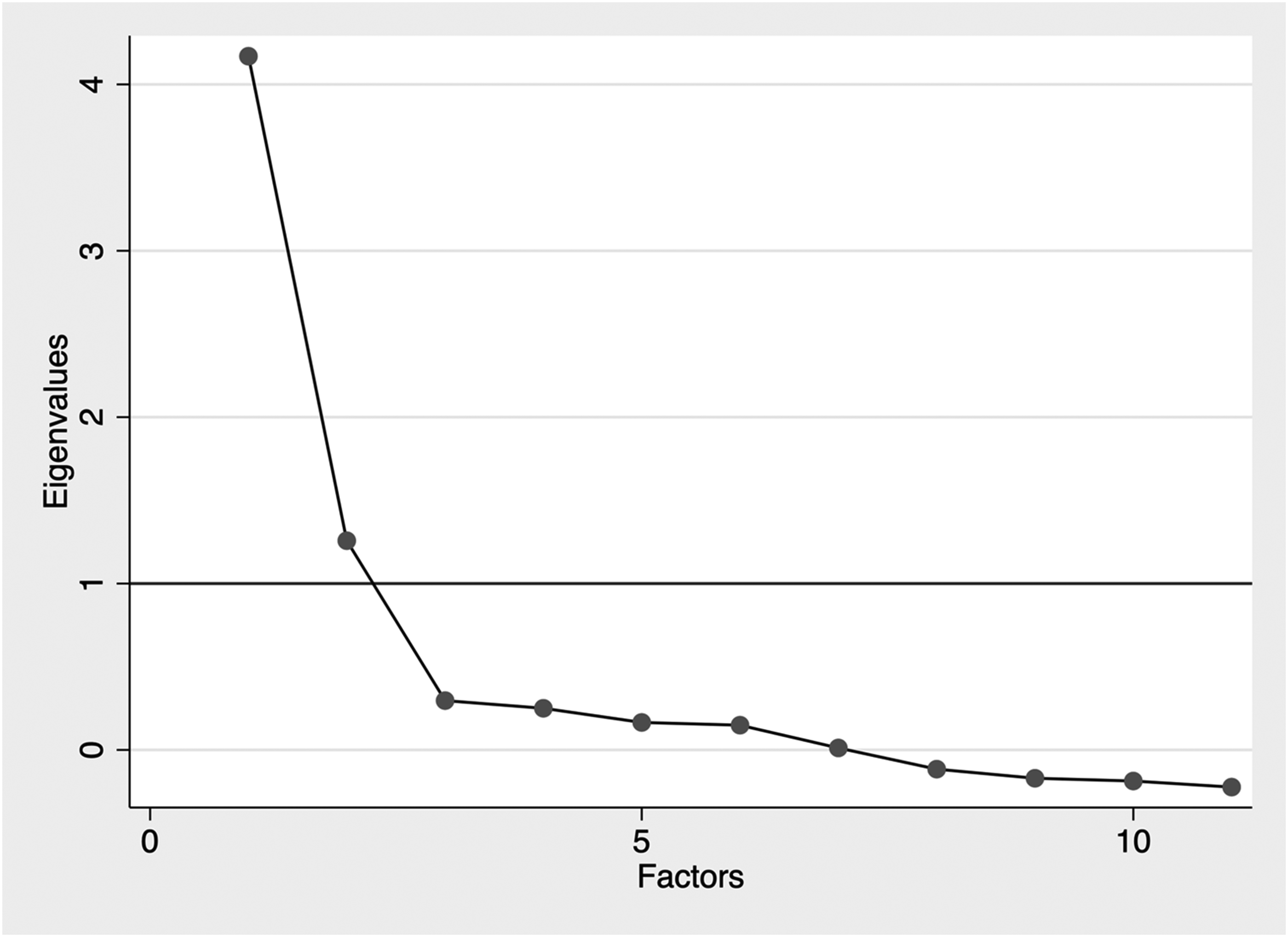
Scree plot of eigenvalues after factor analysis.
The factor analysis thus far supports our expectation of two related latent factors, which we expect are criteria C (avoidance) and E (arousal and reactivity) PTSD symptoms. Now, how does each observed variable contribute to each factor? For this we can interpret the rotated factor loadings by looking at the pattern matrix, presented in Table 1. Factor loadings are in the first two numeric columns; these represent the strength and direction of the relationship between each observed variable and each factor. In each cell, we interpret two key pieces of information: the sign captures whether the relationship between each variable and factor is positive or negative, while the magnitude indicates how strongly each variable loads onto each factor.
Rotated factor loadings (pattern matrix)
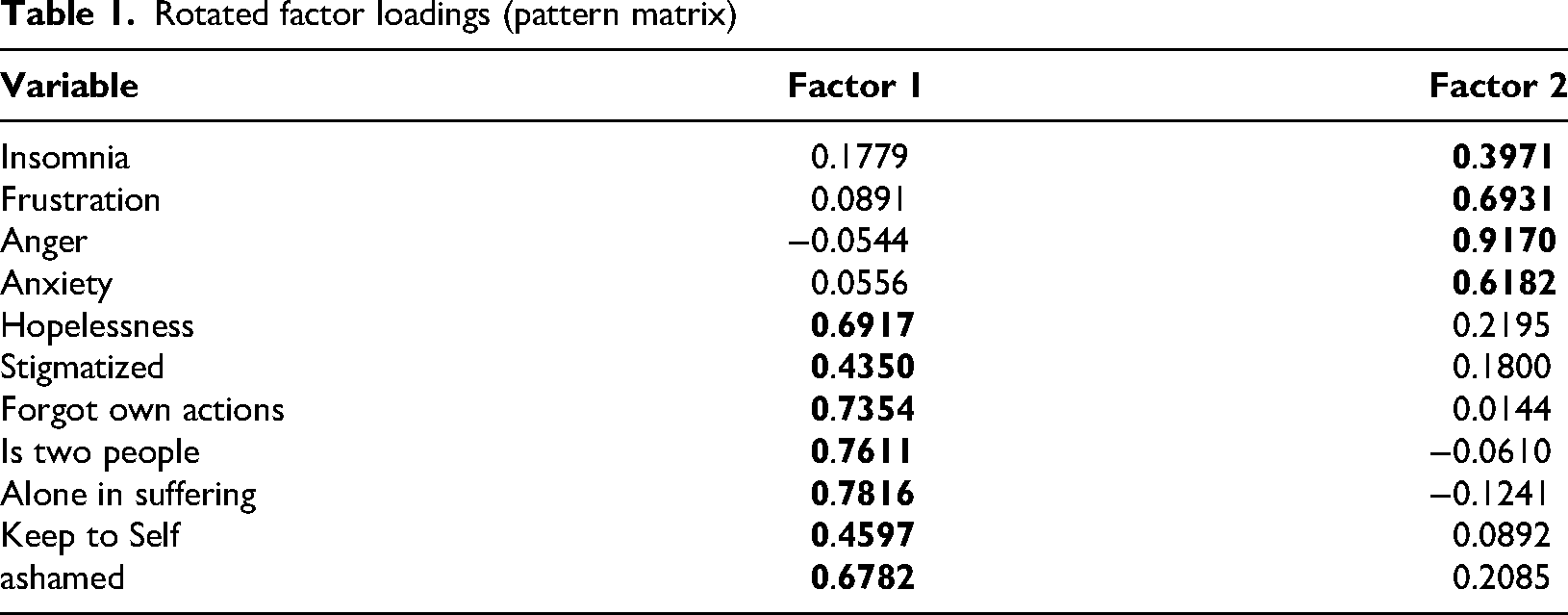
Looking first at factor 1, we focus on the bolded variables. These are the ones with factor loadings ≥0.4 because we interpret these as variables that contribute meaningfully to the underlying latent concept. They include feeling alone in one's suffering and experiences, feeling as though one is two people, forgetting one's own actions, hopelessness, shame, keeping to oneself, and feeling stigmatized. This set of major contributors to factor 1 includes all the variables we intended to capture criterion C symptoms, as well as hopelessness which we had expected to be a part of E. Each is signed positively, indicating (again in line with expectations) that more severe symptoms relate to increasingly severe PTSD. We therefore call factor 1 “avoidance PTSD.”
Turning to factor 2, the variables with factor loadings ≥0.4 are feelings of anger, frustration, anxiety, and insomnia. This set of major contributors to factor 2 includes four of the five variables we intended to capture criterion E symptoms—all except for hopelessness. Again, each is signed positively so that more severe symptoms relate to increasingly severe PTSD. We therefore call factor 2 “arousal PTSD.”
Our last task with the factor analysis is to extract factor scores: each respondent's score on each of the two extracted factors. This produces two variables, capturing each respondent's avoidance and arousal scores. In what follow, we use these variables to conduct hypothesis tests and assess how PTSD in perpetrators affects their participation in restorative transitional justice.
Statistical relationships
Table 2 reports descriptive statistics for our dependent, key independent, and control variables. Table 3 presents the results of our logit estimations, which are statistical tests of our hypotheses about the effects of PTSD on participation in restorative transitional justice. In the first column, Model 1 includes only our PTSD factors as independent variables. In the second column, Model 2 includes those factors as well as our three control variables.
Descriptive statistics
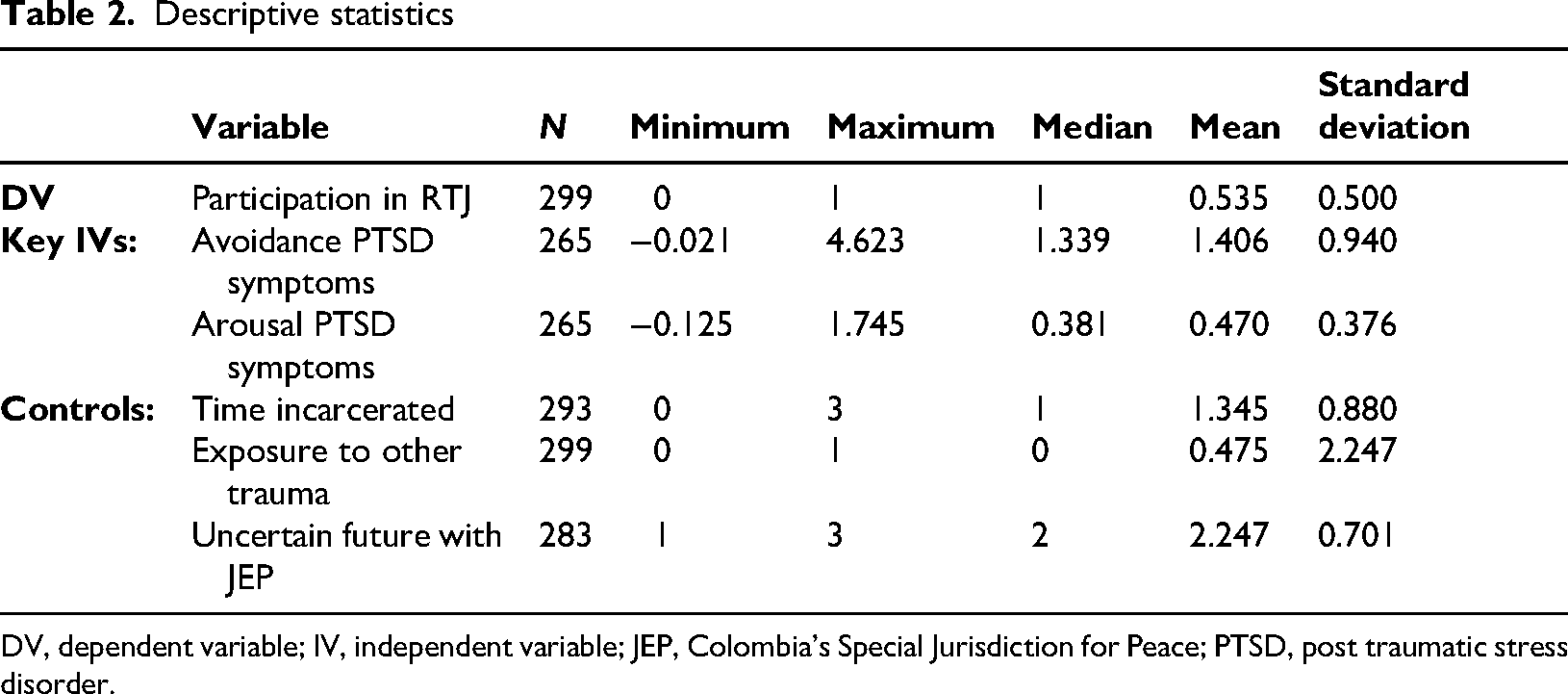
DV, dependent variable; IV, independent variable; JEP, Colombia's Special Jurisdiction for Peace; PTSD, post traumatic stress disorder.
Estimated effects of PTSD factors on participation in restorative transitional justice
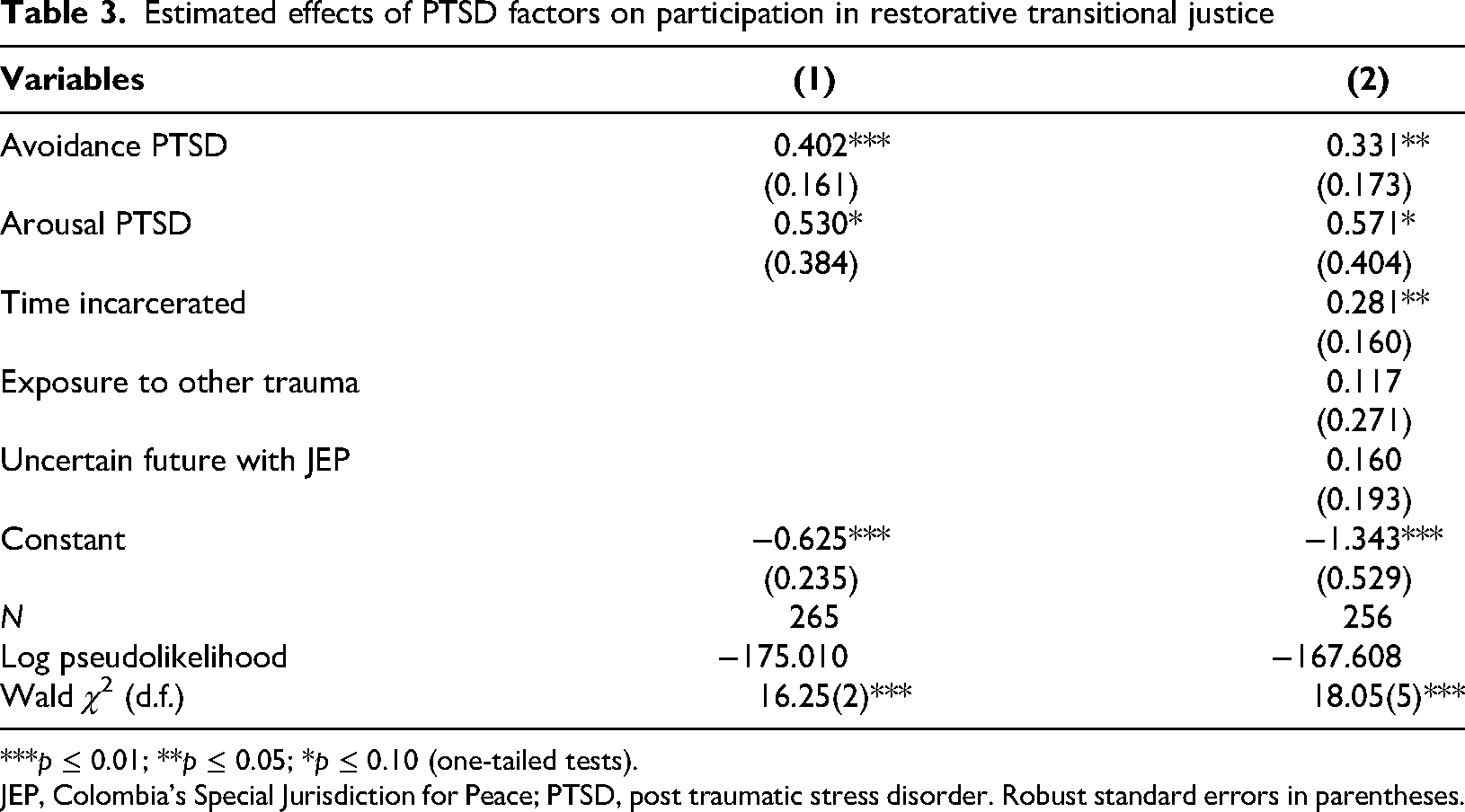
***p ≤ 0.01; **p ≤ 0.05; *p ≤ 0.10 (one-tailed tests).
JEP, Colombia's Special Jurisdiction for Peace; PTSD, post traumatic stress disorder. Robust standard errors in parentheses.
Hypothesis 1 expected that increasing avoidance PTSD symptoms, which is criterion C, should increase the likelihood that a given perpetrator participates in restorative transitional justice. In both models, this coefficient is signed positively and is statistically significant, indicating that increasing arousal symptoms do indeed correlate with increasingly probable participation. Hypothesis 2 held that increasing arousal PTSD symptoms, criterion E, should also increase the probability that a given perpetrator participates in RTJ. Again the coefficient is positive and statistically significant, supporting our hypothesis and suggesting that the more severe arousal symptoms a given perpetrator has, all else equal, they are increasingly likely to participate in restorative transitional justice events.
Turning to our control variables, we expected that increasing the time a perpetrator has spent incarcerated should increase the probability of participation. So, too, should exposure to trauma other than perpetration and increasing uncertainty about one's future vis-à-vis the Special Jurisdiction for the Peace. As expected, all three coefficients are positively signed, but only time incarcerated reaches traditional levels of statistical significance. This suggests that time incarcerated raises the probability of participation in RTJ, while in this model neither exposure nor uncertainty has an effect. This set of results supports our theoretical framework and increases confidence in our key hypothesis tests. Below, we examine the substantive impacts of the variables that were statistically significant in these models.
Substantive effects
Above, we found that increasingly-severe PTSD symptoms—whether criterion C or criterion E—increase the likelihood of perpetrator participation in restorative transitional justice events. Knowing that these factors matter is an important next step is seeing the magnitude of those effects. To that end, Figure 2 presents estimated marginal effects of each of these variables on the likelihood that each perpetrator participates in restorative transitional justice, based on results in model 2 including controls. The top panel shows the result of a min–max change in criterion C (avoidance) symptoms, while the bottom panel shows what happens given a min–max change in criterion E (arousal and reactivity) symptoms. For each prediction, the dot is the average marginal effect and the bars surrounding that average are 90% confidence intervals. All other variables are held at their median values.
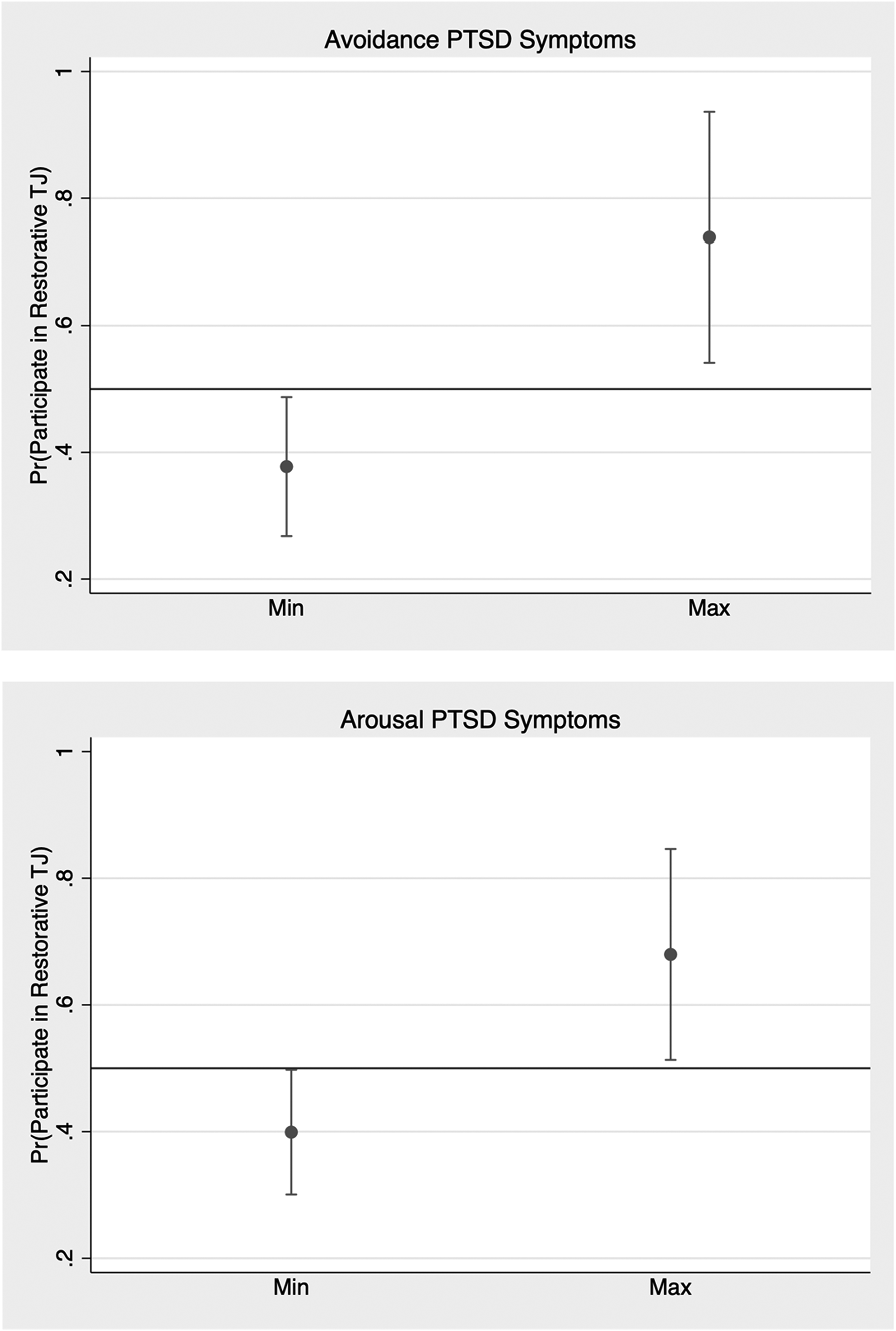
Substantive effects.
Starting at the top, we examine the estimated effect of increasing criterion C avoidance symptoms from their minimum in-sample level to their maximum in-sample level. Our model predicts that a perpetrator who is average on all our measures except for avoidance PTSD, where they are at the minimum possible level of symptoms, has a 37.8% probability of participation in restorative transitional justice. We are 90% confident that this value falls between 26.8% and 48.7%. Holding everything constant again, but increasing avoidance PTSD to the maximum possible level, yields a 73.9% probability of participation with a 90% confidence interval of 54.1%, 93.6%. This analysis produces two important results: first, a min–max increase in criterion C avoidance PTSD raises the probability of perpetrator participation in RTJ by 36.1%; second, and more importantly, this increase raises the likelihood of participation from less than 50% to more—all else equal, a min–max change in avoidance PTSD is the difference between a perpetrator participating in RTJ or not.
Moving to the bottom panel, we examine the estimated effect of increasing criterion E arousal symptoms from their minimum in-sample level to their maximum in-sample level. Our model predicts that a perpetrator who is average on all our measures except for arousal PTSD, where they are at the minimum possible level of symptoms, has a 39.9% probability of participation in restorative transitional justice. We are 90% certain that this value falls between 30.1 and 49.8%. Holding everything constant again, but increasing arousal PTSD to the maximum possible level yields a 68.0% probability of participation with a 90% confidence interval of 51.3, 84.6%. Again, we have two important results: first, a min–max increase in criterion E arousal PTSD raises the probability of perpetrator participation in RTJ by 28.1%; second, and again importantly, this increase raises the likelihood of participation from less than 50% to more—all else equal, a min–max change in arousal PTSD is the difference between a perpetrator participating in RTJ or not.
Participation in other forms of post-conflict pro-social activities
Scholars have shown diverse effects between conflict violence and post-conflict civic and political engagement (e.g. Matanock, 2017; Paffenholz and Spurk, 2006). Given that, we might ask whether perpetrators with PTSD symptoms also seek out other forms of post-conflict pro-social activities, or whether the effects are specific for transitional justice-related engagement. To explore the possibility, we leverage a survey question that asks “How often do you participate in social activities in your community?,” generating a binary variable that is 0 if the respondent never participates and that is 1 if participation is rare, monthly, weekly, or daily (Table 4).
Estimated effects of PTSD factors on participation in other pro-social activities
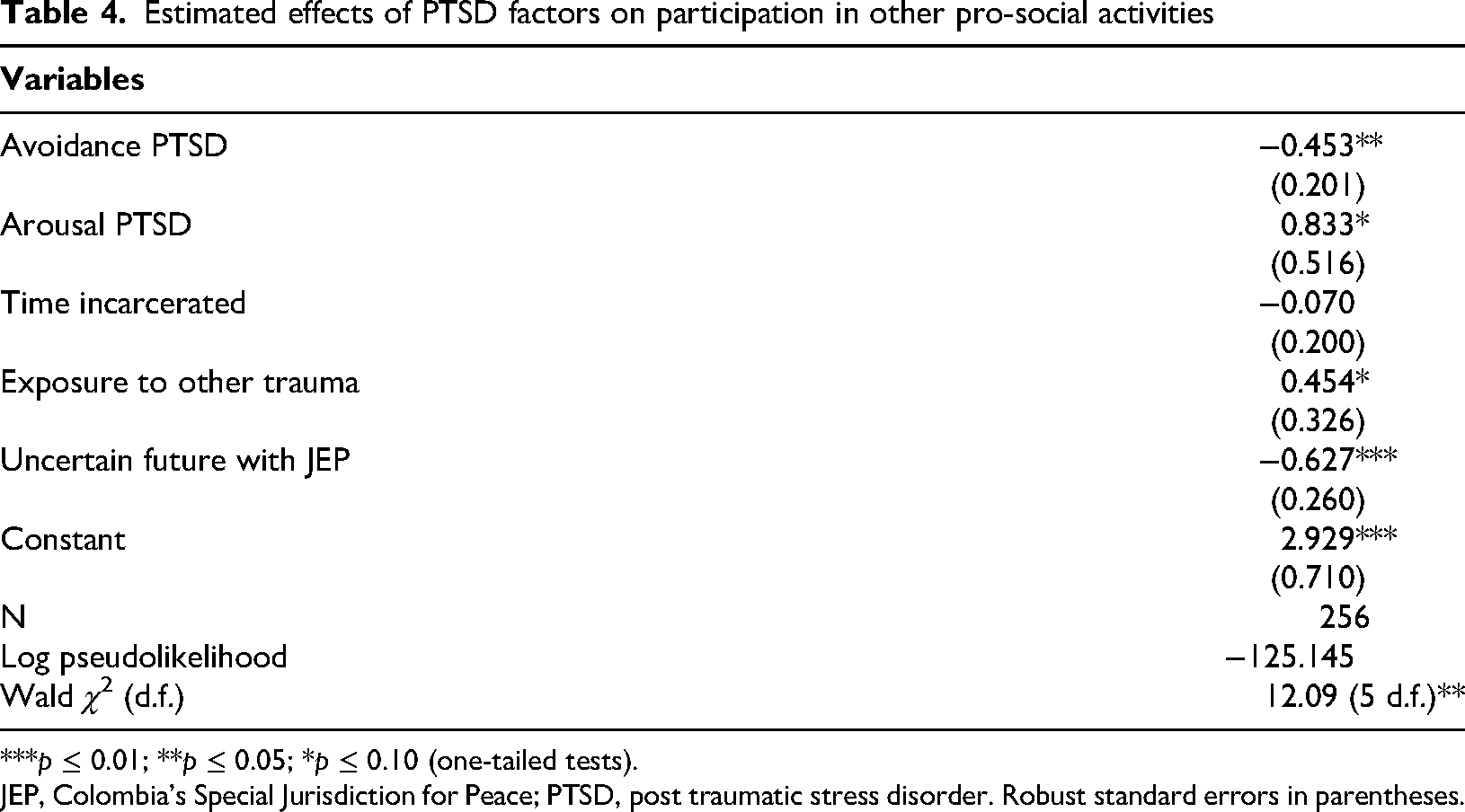
***p ≤ 0.01; **p ≤ 0.05; *p ≤ 0.10 (one-tailed tests).
JEP, Colombia's Special Jurisdiction for Peace; PTSD, post traumatic stress disorder. Robust standard errors in parentheses.
Results show that Type 1 (avoidance) PTSD reduces the probability of such participation while Type 2 (arousal) PTSD increases that probability. While arousal symptoms seem to drive participation in both TJ-specific and other post-conflict pro-social activities, avoidance symptoms increase the former and suppress the latter. This makes intuitive sense: perpetrators driven to self-isolate are more likely to participate when surrounded by empathetic peers than others, while those driven to act are likely to do so regardless of the context of that action. Interestingly, the results on some of our potential confounders change as well: increasing incarceration time has no effect on participation in events other than restorative transitional justice, while uncertainty regarding one's future with the JEP reduces its probability. Taken together, these results suggest that engagement related to transitional justice may be different from other forms of post-conflict civic and political engagement; this is an important topic for future exploration.
Discussion: Insights for scholars and practitioners
It is worth situating our results in the political and institutional environment in which our respondents made their participation decisions. In Colombia, public narratives about the armed conflict remain deeply contested, and acknowledgment of responsibility by state agents—particularly soldiers—is frequently met with hostility from parts of the military establishment and segments of Colombian society. Soldiers who participate in truth-telling processes risk being perceived internally as disloyal or as undermining the institutional legitimacy of the armed forces; they may face social stigma, professional repercussions, and in some cases, threats to their physical safety. This dynamic is clearly visible in our own data: 91.3% of respondents reported receiving no institutional support from the Colombian Army during the JEP process; 23.7% reported believing their safety would be at risk if they exposed their truth; and 53.2% reported fearing security-related consequences from their JEP appearance. Nearly one in five (19.7%) had been approached with proposals to join illegal groups. Participation in restorative transitional justice for these individuals is therefore not institutionally encouraged or socially costless—it occurs under structurally adverse conditions. And yet, 70.4% of respondents believe that reconciliation between former military personnel and the victims of their actions is possible, and only 1.7% believe it is not—even as optimism about reconciliation among all Colombians is considerably more muted (48.2% yes). That such optimism coexists with institutional abandonment and personal risk amplifies the significance of our central finding: that PTSD symptoms, rather than institutional incentives or social support, are among the factors driving participation. If perpetrators are willing to participate despite the absence of institutional backing and the presence of meaningful personal risk, the psychological mechanisms we identify may be more powerful motivators than existing theory has recognized.
This context carries direct implications for policy. Existing scholarship on perpetrator participation in transitional justice has tended to focus on the design of judicial incentives—amnesties, plea arrangements, reduced sentences—as the primary levers for encouraging truth-telling. Our findings suggest that psychological factors operate independently of, and in our sample despite, the institutional environment. Policymakers seeking to expand perpetrator participation in restorative justice mechanisms should therefore attend not only to the design of judicial incentives but also to the reduction of the institutional and social costs that currently deter engagement. Concretely, this might mean creating protected spaces for truth-telling that insulate participants from internal military retaliation, investing in psychosocial support structures that address the PTSD symptoms our analysis links to participation, and building public narratives that reframe truth-telling as an act of courage rather than institutional betrayal.
Like all forms of restorative justice, RTJ rests on the ideas that: (1) all stakeholders will participate; (2) all participants will emerge feeling less acrimonious and more optimistic; and (3) the prospects for peace and stability in the community will improve. Perpetrators are perhaps the least likely stakeholders to participate, and our data show that this participation does indeed vary. As we noted in our introduction, 54% of our respondents had participated in at least one restorative transitional justice project while the remaining 46% had not.
For scholars, this is a puzzle that ought to be solved. In this project, we submitted that one important influence on perpetrator participation is post-traumatic stress disorder. In Colombia, perpetrators of extrajudicial killing vary on both criterion C avoidance and criterion E arousal PTSD symptoms, as expected by the literature on perpetration-induced trauma. We found that increasing the severity of these symptoms in turn increases the probability of a given perpetrator participating in restorative transitional justice. Is this result consistent across space and time? How does PTSD affect perpetrator participation in countries other than Colombia, and regions outside of Latin America? How might this relationship change in the future, as RTJ becomes more common and known to these potential participants? Researchers could also investigate the second and third steps in successful RTJ. Once participation is ensured, what factors affect the participants’ feelings of relative optimism during and after the RTJ project? How does variance in participation and feelings of optimism affect the prospects of transitional justice?
Several features of our sample bound our inferences and point toward productive future work. Our respondents are members of the RCF, an organization that actively supports truth-telling and reparation; as such, they may be more inclined toward participation in restorative transitional justice than false positives defendants who have not sought out such organizational support. Our findings therefore describe the correlates of participatory variation within a population already oriented toward engagement, rather than characterizing all false positives perpetrators or post-conflict perpetrators more broadly. The sample is also limited to members of the Colombian Public Force, and does not capture the experiences of perpetrators from other armed actors in the conflict. Future research should seek to replicate and extend these findings with broader samples—including non-affiliated defendants and perpetrators from non-state armed groups—to assess whether the relationship between perpetration-induced trauma and participation in restorative transitional justice generalizes across these populations.
In sum, this research begins to study a new and promising form of transitional justice, in which the goal is restorative rather than punitive. Restorative transitional justice is increasingly popular among policymakers and practitioners, who need to understand the forces that lead to success and/or failure. Our findings emerge from a context of notable institutional hostility toward truth-telling—one in which participation requires individual actors to absorb social and security costs that their institution does not offset—and future research should examine whether the psychological mechanisms we identify operate similarly in contexts where institutional support for perpetrator participation is stronger.
Supplemental Material
sj-do-1-cmp-10.1177_07388942261458245 - Supplemental material for PTSD and perpetrator participation in restorative transitional justice
Supplemental material, sj-do-1-cmp-10.1177_07388942261458245 for PTSD and perpetrator participation in restorative transitional justice by James Meernik, Jacqueline DeMeritt and Diego Esparza in Conflict Management and Peace Science
Supplemental Material
sj-dta-2-cmp-10.1177_07388942261458245 - Supplemental material for PTSD and perpetrator participation in restorative transitional justice
Supplemental material, sj-dta-2-cmp-10.1177_07388942261458245 for PTSD and perpetrator participation in restorative transitional justice by James Meernik, Jacqueline DeMeritt and Diego Esparza in Conflict Management and Peace Science
Footnotes

Funding
The authors received no financial support for the research, authorship, and/or publication of this article.
Declaration of conflicting interests
The authors declared no potential conflicts of interest with respect to the research, authorship, and/or publication of this article.
Supplemental material
Supplemental material for this article is available online.
Notes
References
Supplementary Material
Please find the following supplemental material available below.
For Open Access articles published under a Creative Commons License, all supplemental material carries the same license as the article it is associated with.
For non-Open Access articles published, all supplemental material carries a non-exclusive license, and permission requests for re-use of supplemental material or any part of supplemental material shall be sent directly to the copyright owner as specified in the copyright notice associated with the article.
