







Abstract
One hundred dyads of low-income, Spanish-speaking mothers and their bilingual children (age = 12-18; M = 14.12, SD = 1.89) who have language brokered for the mother (i.e., culturally or linguistically mediated between the mother and English speakers) were surveyed. Multiple goals theory posits that mothers and children who do not recognize and attend to instrumental, relational, and identity interaction goals during language brokering have lower communication quality and thus experience negative repercussions. Four instruments were developed and validated for situationally relevant brokering interaction goals (BIG) of children (BIG-C), mothers (BIG-M), child perception of mother goals (BIG-CM), and mother perception of child goals (BIG-MC). Each measure included a subset of goals (e.g., BIG-C included five goals: respect mother, respect English speaker, alter messages, act American, and act Latino/a). Mothers and children pursued multiple, conflicting goals, but inaccurately perceived each other’s goals. These measures provide brokering communication quality assessments and identify potential mother-child misunderstandings.
Keywords
Parents with limited or no English-proficiency skills often rely on their bilingual children to act as interpreters and translators (De Ment, Buriel, & Villanueva, 2005; Morales & Hanson, 2005). This process is commonly termed language brokering, in which an untrained, bilingual child or adolescent culturally and linguistically mediates for a monolingual adult (most commonly the mother; Kam & Lazarevic, 2014). Language brokering has received increasing attention due to the ubiquity of this task (Morales & Hanson, 2005) and the potential severity of positive and negative outcomes for both mother and child (e.g., health care experience, depression; Green, Free, Bhavnani, & Newman, 2005; Love & Buriel, 2007). Studies have examined various aspects of the brokering process, such as brokering frequency and settings (Morales & Hanson, 2005), child characteristics (e.g., acculturation, literacy; Kam, 2011; McQuillan & Tse, 1995), and characteristics of the parent-child relationship (Love & Buriel, 2007). However, the brokering interaction itself and communication between parent and child has been largely ignored, even though communication quality may shape brokering success, child or parent outcomes, and the parent-child relationship (Kam & Lazarevic, 2014). Scholars have called for research describing successful (or less successful) communication during brokering and have suggested multiple goals theory as a useful framework (Kam & Lazarevic, 2014). A multiple goals perspective identifies broker and mother cognitions that shape communication practices (Caughlin, 2010).
The current study proposes and validates a typology of brokering interaction goal (BIG) measures for brokering goals pursued by the child (BIG-C), mothers (BIG-M), and as perceived by the other (i.e., mother perceptions of child goals [BIG-MC], and child perceptions of mother goals [BIG-CM]). One hundred low-income, Latino mother-child dyads were surveyed to examine measure psychometrics, how mothers and children prioritize goals, and the extent to which partner perceptions matched reported-goal importance.
Multiple Goals Theory as a Framework for Language Brokering
Individuals have multiple, potentially conflicting, interaction goals—or desired end states achieved through communication—for a given situation, which shape their communication practices (Wilson, 2002). Certain interaction goals are expected in particular situations, such as language brokering, and that individuals who do not recognize and pursue these goals will produce less sophisticated communication (O’Keefe, 1988). Interaction goals can be studied in a single conversation, or can be generalized across one type of situation in which two individuals frequently engage (e.g., a mother and child in language brokering scenarios; Caughlin, 2010). Studying generalized interaction goals that are typically pursued by each party allows for examination of broader outcomes (e.g., mother-child relationship; Caughlin, 2010) and may be more appropriate for language brokering scenarios, as Orellana (2009) notes that brokering outcomes may be due to the cumulative effect of brokering over time, rather than a single interaction. Thus, BIG are proposed for mother and children when the child is brokering between the mother and an English speaker.
Brokering Interaction Goals for the Child (BIG-C)
Children may have interaction goals related to their identity (e.g., ethnic identity) and relationships (i.e., with their mother, with the English speaker; Clark & Delia, 1979). Child BIG may include respecting the mother and respecting the English speaker. Latino children are culturally expected to be obedient and respectful to adults (Dixon, Graber, & Brooks-Gunn, 2008), and language brokering highlights maternal respect (Chao, 2006), and English-speaker authority and child-adult power dynamics. Orellana, Dorner, and Pulido (2003) note that “most [language brokering interactions] are deliberate, heightened encounters with authority figures with very real consequences for families” (p. 519), including medical, legal, and financial conversations (McQuillan & Tse, 1995). Along with attention to respect, brokers aware of potential identity and relational threats inherent in translating certain messages may prioritize the goal of altering messages. Brokers sometimes modify parent wording when saying the message in English (Hall & Sham, 2007; Orellana et al., 2003), in order to “improve” the parent’s social identity or face (Brown & Levinson, 1987). In addition, brokers alter Spanish messages to avoid embarrassing, angering, or upsetting the mother (e.g., bad news or racist comments; Hall & Sham, 2007), or that are deemed relationally inappropriate (e.g., a son avoiding questions about his mother’s sexual health; Green et al., 2005).
Ethnic identity issues arise in language brokering (Kam, 2011; Weisskirch, 2005), as brokers may attempt to both act American and act Latino/a (Orellana, 2009). Mexican American youth reported cultural dissonance between behavioral expectations at home and school; they were expected to be assertive and behave as an American at school, and quiet and respectful at home (De Ment et al., 2005). Communication accommodation theory (Giles & Ogay, 2006) describes how individuals strategically communicate to align with, or distance themselves from, identification with a particular group (e.g., Latinos, Americans). Brokers may want to ethnically align with mothers to show respect and be culturally appropriate, but may also prioritize an acting American goal in the attempt to signal social inclusiveness with the English speaker and garner a favorable attitude through in-group association (Giles & Ogay, 2006).
Brokering Interaction Goals for the Mother (BIG-M)
Mothers may also find that language brokering conversations require management of multiple, potentially conflicting goals, including task and parental issues, although only relational or child-related goals are discussed. Mothers engage children as language brokers to accomplish a task or end, such as talking to salesperson about a purchase or getting a loan from a bank manager (Morales & Hanson, 2005). This mother instrumental goal is the understood purpose of the interaction and the impetus that requires the child to broker (Wilson, 2002). Mothers may also have the goal of control, enacted through monitoring her child’s brokering, to ensure the child is accurately interpreting. Mothers may want to control child interpreting because mothers cannot accomplish their task if children do not interpret successfully (Orellana et al., 2003), and because mother-child power dynamics indicate the parent is the authority figure (McQuillan & Tse, 1995). Given the difficultly of some language brokering tasks and the mother’s role as a parent, mothers may prioritize the goal of child support, in communicating that the child is liked, perceived as competent, and seen as capable of handling the situation autonomously (i.e., attend to the child’s face; Brown & Levinson, 1987). Mothers may recognize that a language brokering interaction is a situation in which children can feel empowered and independent, or stressed and burdened (Kam & Lazarevic, 2014) and therefore may be conscious of attempting to maintain, protect, or build up a child’s social identity.
Perceptions of Partner Brokering Interaction Goals
Interaction goals shape an individual’s communication and behavior, and individuals simultaneously assess the interaction goals and motivations of their conversational partner (Caughlin, 2010). In other words, individuals will have perceptions of interaction goals that they typically pursue as well as perceptions of goals their partner typically pursues, and both of these aspects shape interpretation of dyadic interactions. For language brokering, mothers will have perceptions about their child’s typical BIG (BIG-MC), and children will have perceptions about their mother’s general BIG (BIG-CM). Parents and children may conceptualize the same interaction differently and often do not accurately perceive what the other is thinking (Sillars, Smith, & Koerner, 2010). Discrepancies in goal perceptions may be important to understanding thoughts, feelings, and outcomes of language brokering. For example, mothers may report that the goal of support is very important, but if children do not share this perception (i.e., children perceive that the support goal is not as important to mothers), mother-child communication and outcomes may differ than if child perceptions aligned with mother reports.
Broad issues that are likely to be salient for child and mother goals are proposed, but the goal factor structures are unclear as items could factor in several ways that would be theoretically consistent. For example, for the child goals, respecting the mother might factor into its own goal, may load with “acting Latino/a” items, or may be subsumed under a broader “respect adults” factor, which includes respecting the mother and respecting the English speakers. Thus, psychometric examination of these factors is first needed. Second, descriptive information about the validated goal variables and the extent of agreement between reported goals and partner perceptions of goals is needed to fully understand language brokering goals importance. Thus, the following research questions are posed:
Method
Participants
One hundred mother-child dyads were recruited for the current study, in which the mother was primarily Spanish speaking, and the child was bilingual in English and Spanish and had acted as a language broker for the mother at least once (although all children had brokered numerous times). All families were low income. Children’s ages ranged from 12 to 18 years (M = 14.12, SD = 1.89), with corresponding education levels ranging from fifth grade to completing high school (M = 8.49, SD = 2.03). Children were predominately female (females = 58, males = 40, missing = 2) and were born in the United States (n = 63). The child taking the survey was often the sibling that translated the most for the mother (n = 80), and the age that the child first acted as a translator ranged from age 3 to 15 (M = 8.47, SD = 2.52). The mothers’ age ranged from 26 to 56 years old (M = 39.38, SD = 6.42). The majority of mothers were born in Mexico (n = 95; United States = 2, Venezuela = 2, Dominican Republic = 1). Mothers lived in the United States between 4 and 37 years (M = 15.64, SD = 5.96) and were educated up to the eighth grade on average (ranging from no education to completing college).
Procedure
Two bilingual extension program employees recruited low-income mother-child dyads from Lake County, Indiana. As the recruiters were extension agents and prominent community members, they used their knowledge and familiarity with the community to identify and approach potential participants to explain the study and offer participation. Additional recruiting was accomplished through snowballing and face-to-face recruitment at various locations commonly frequented by the target population (e.g., churches). Dyads were compensated US$25 for their time. Children were given the option of taking the survey in Spanish or English; only two children chose the Spanish version. Mothers took the survey in Spanish. A bilingual assistant was present to answer any questions, and mothers had the option of having the survey read aloud to them by the assistant (which many mothers opted to do).
Item Creation
Given that items pertaining to the interactional goals in a language brokering situation were created for the current study, DeVellis’ (2003) recommended steps for scale development were followed. First, a larger pool of items was generated than was used in the actual survey instruments (DeVellis, 2003). All items were written at a Flesch-Kincaid seventh grade reading level, given the projected education level of the sample. The items were measured on a 5-point scale (1 = strongly disagree, 5 = strongly agree). For the child goals, 40 items were created; 18 items were created for the mother’s goals. When assessing perceptions of the partner’s goals (i.e., for the 40 BIG-MC items and the 18 BIG-CM items), the exact same wording was used, with the tense altered (e.g., “I want to show my mother respect no matter what when I translate” was altered to “My child wants to show me respect no matter what when she or he translates”). Items were worded to solicit goals that are typically important to mothers and children during language brokering, rather than referring to one particular language brokering interaction.
Second, the pool of items was reviewed by two panels of experts: representative participants and social science researchers. In the former group, five Spanish-English bilingual students who grew up brokering were asked to read the items aloud and state aloud any thoughts that they had while reading; in addition, two Spanish-speaking mothers from the sample demographic were asked to read the mother’s questionnaire (Dillman, 2000). After this process, five social science researchers reviewed the items for theoretical and methodological appropriateness. Each professor specialized in an area of relevant expertise: interactional goal theorizing, parent-child relationships, child development, acculturation and interpreting, and psychometrics. Items that were confusing, ambiguous, culturally inappropriate, or unclear were rewritten or replaced. Third, finalized measures were translated using standard translation procedures, such as back translation and decentering (Brislin, 1970).
Results
There was no evidence that the 1.71% of mother and child missing data were not missing at random. Thus, expectation maximization was used (Olinsky, Chen, & Harlow, 2003).
Exploratory Factor Analyses (EFA)
Research Question 1 pertained to the factor structures for the four measures of BIG: BIG-C (child reported), BIG-M (mother reported), BIG-CM (child reported), and BIG-MC (mother reported). Given the lack of prior knowledge about goal structures, four principal-axis EFAs with direct oblimin rotation were conducted on the items (Hayes, Matthes, & Reid, 2011). The Kaiser-Meyer-Olkin measure of sampling adequacy was computed for each EFA; all four EFAs were above .77, which meets sample size adequacy requirements (Kaiser, 1970). Parallel analysis with Monte Carlo simulations were used to assess the eigenvalue coefficient necessary for a factor to be considered a “true” factor given the number of items and sample size (Zwick & Velicer, 1986). This procedure is used in place of the traditional practice of using an arbitrary eigenvalue coefficient cutoff of 1 to determine the number of underlying factors present.
For all EFAs, items that did not load on the factors meeting the Monte Carlo cutoff criteria and items that cross-loaded weakly on multiple factors (i.e., loaded between .3 and .4 on multiple factors) were dropped. EFAs were then rerun, and only items that loaded above .5 on the primary factor and below .3 on all other factors were retained. Two exceptions to the latter rule were made (described in detail below). EFA results are reported in Tables 1, 2, 3 and 4. Cronbach’s alpha was above .73 for all variables (see Table 5), and all items loaded above .47. The Spanish versions of the measures are available on the author’s website.
EFA: BIG-C.
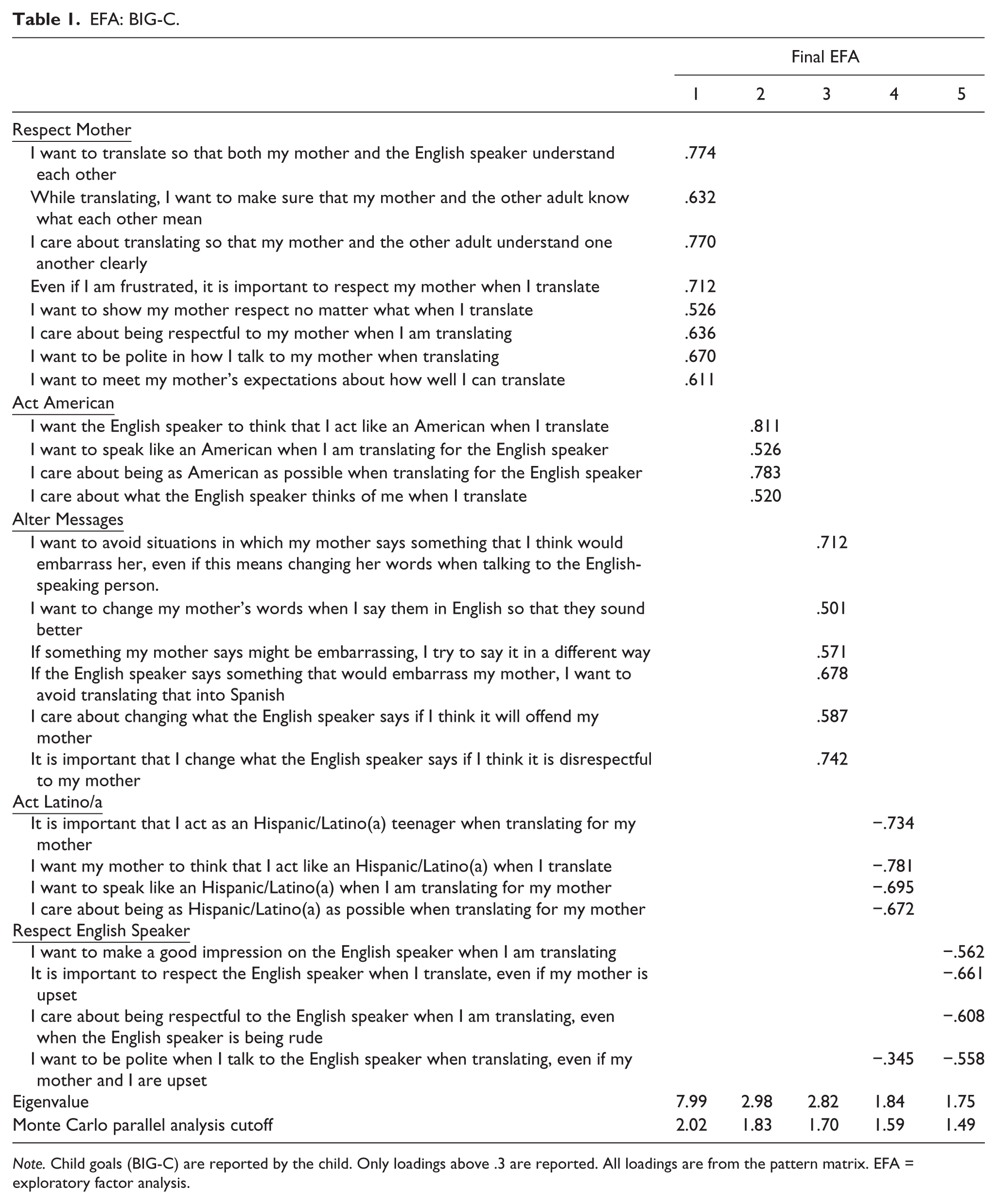
Note. Child goals (BIG-C) are reported by the child. Only loadings above .3 are reported. All loadings are from the pattern matrix. EFA = exploratory factor analysis.
EFA: BIG-MC.
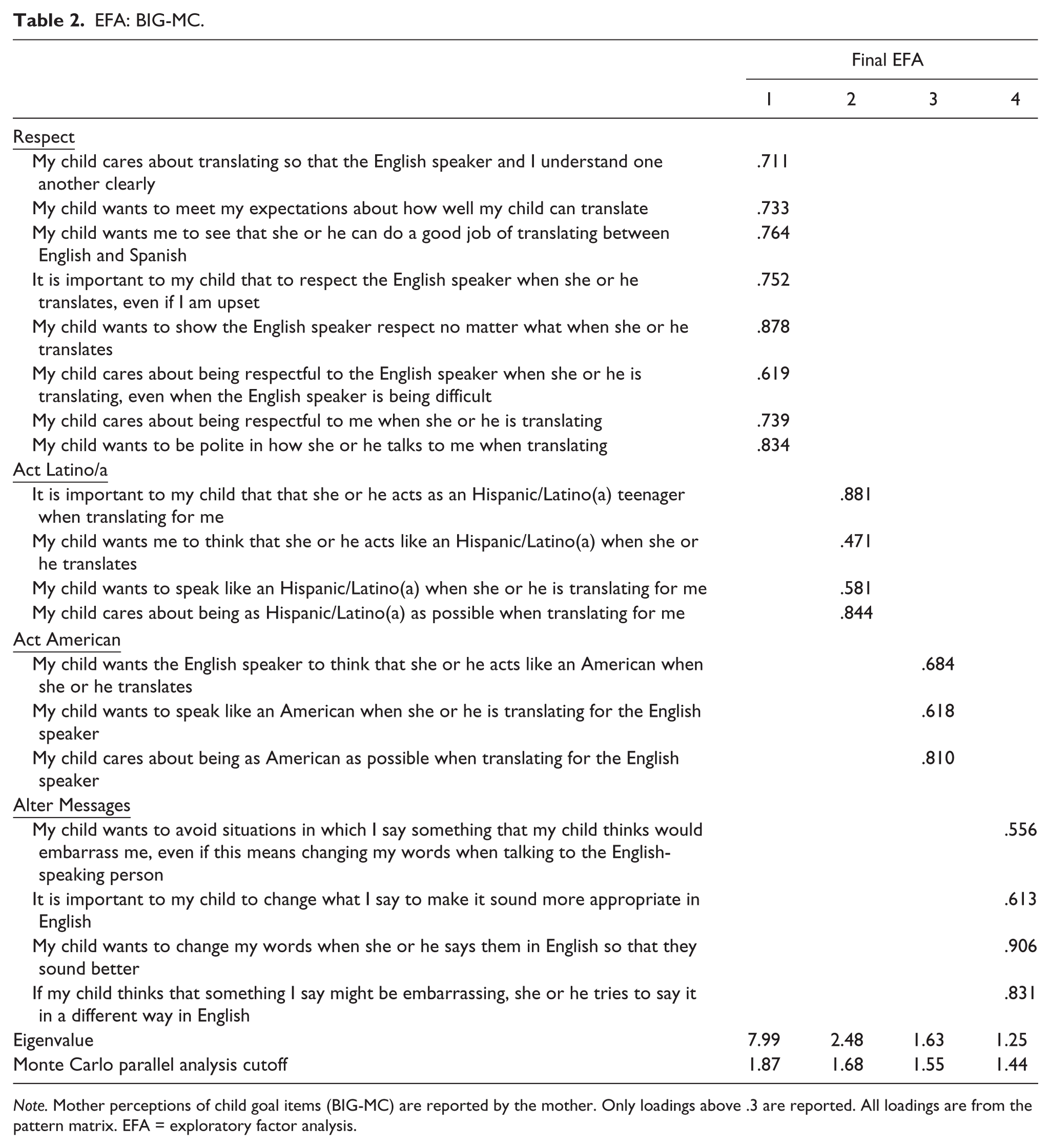
Note. Mother perceptions of child goal items (BIG-MC) are reported by the mother. Only loadings above .3 are reported. All loadings are from the pattern matrix. EFA = exploratory factor analysis.
EFA: BIG-M.
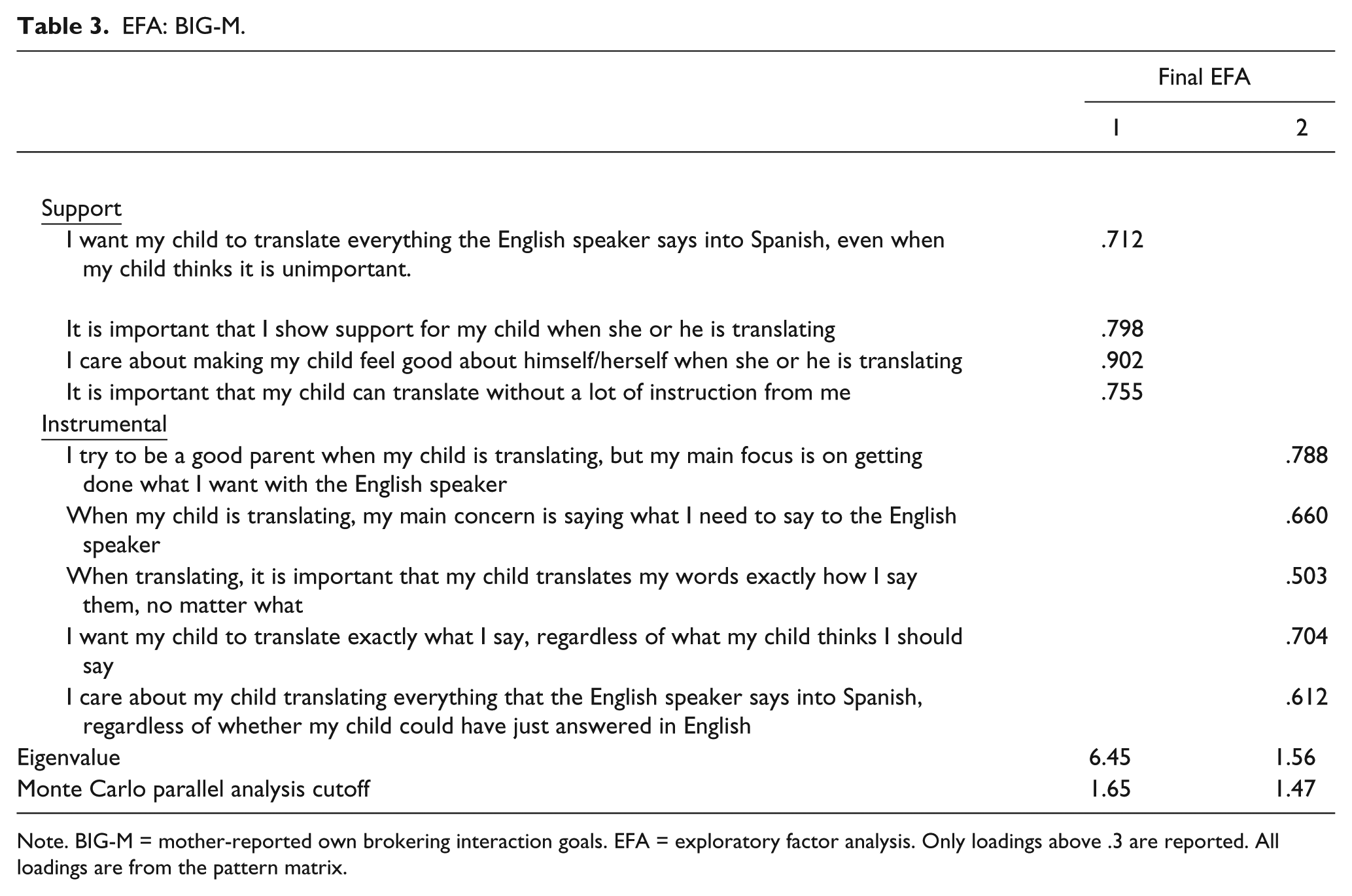
Note. BIG-M = mother-reported own brokering interaction goals. EFA = exploratory factor analysis. Only loadings above .3 are reported. All loadings are from the pattern matrix.
EFA: BIG-CM.
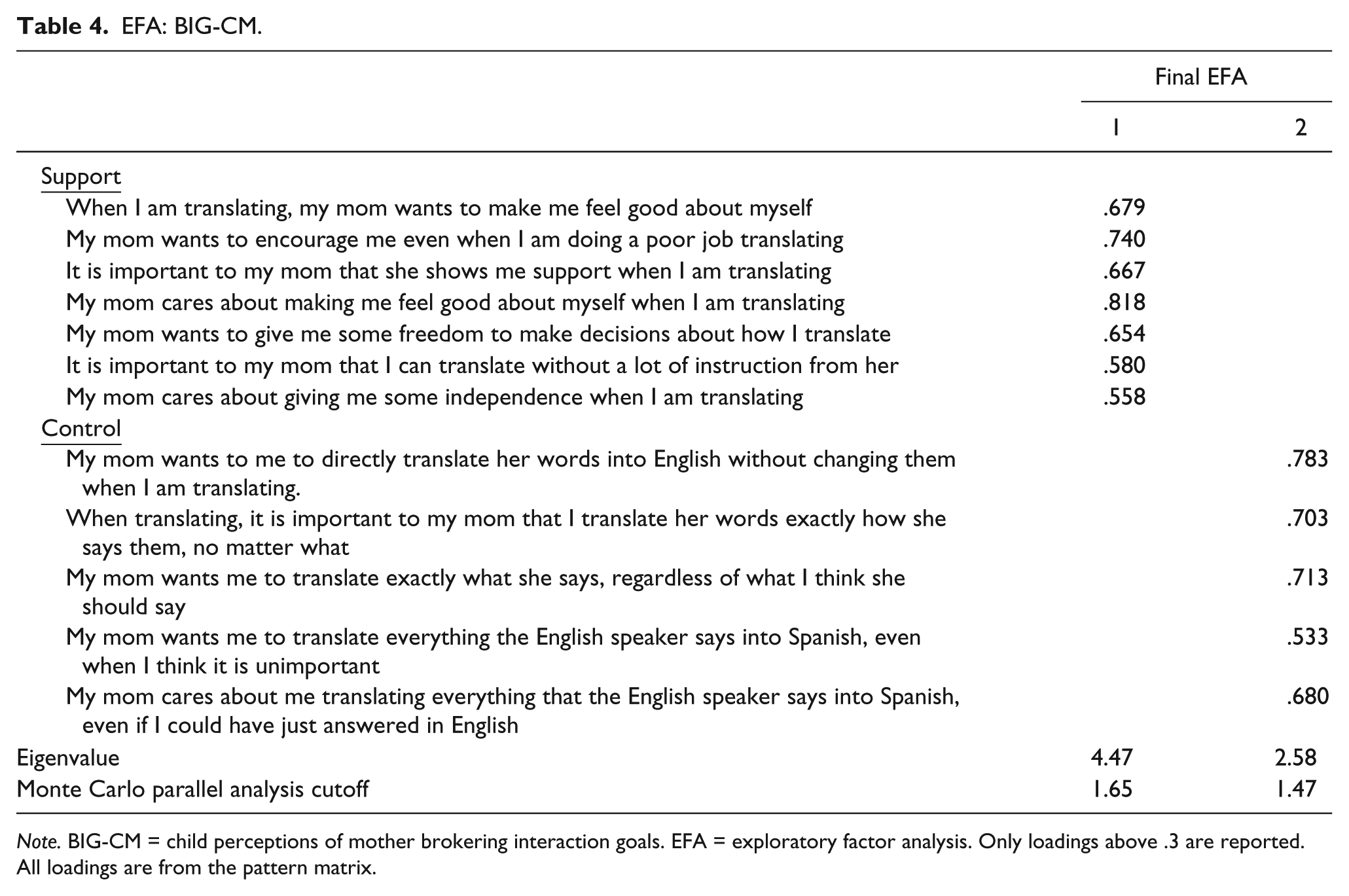
Note. BIG-CM = child perceptions of mother brokering interaction goals. EFA = exploratory factor analysis. Only loadings above .3 are reported. All loadings are from the pattern matrix.
Descriptive Statistics.
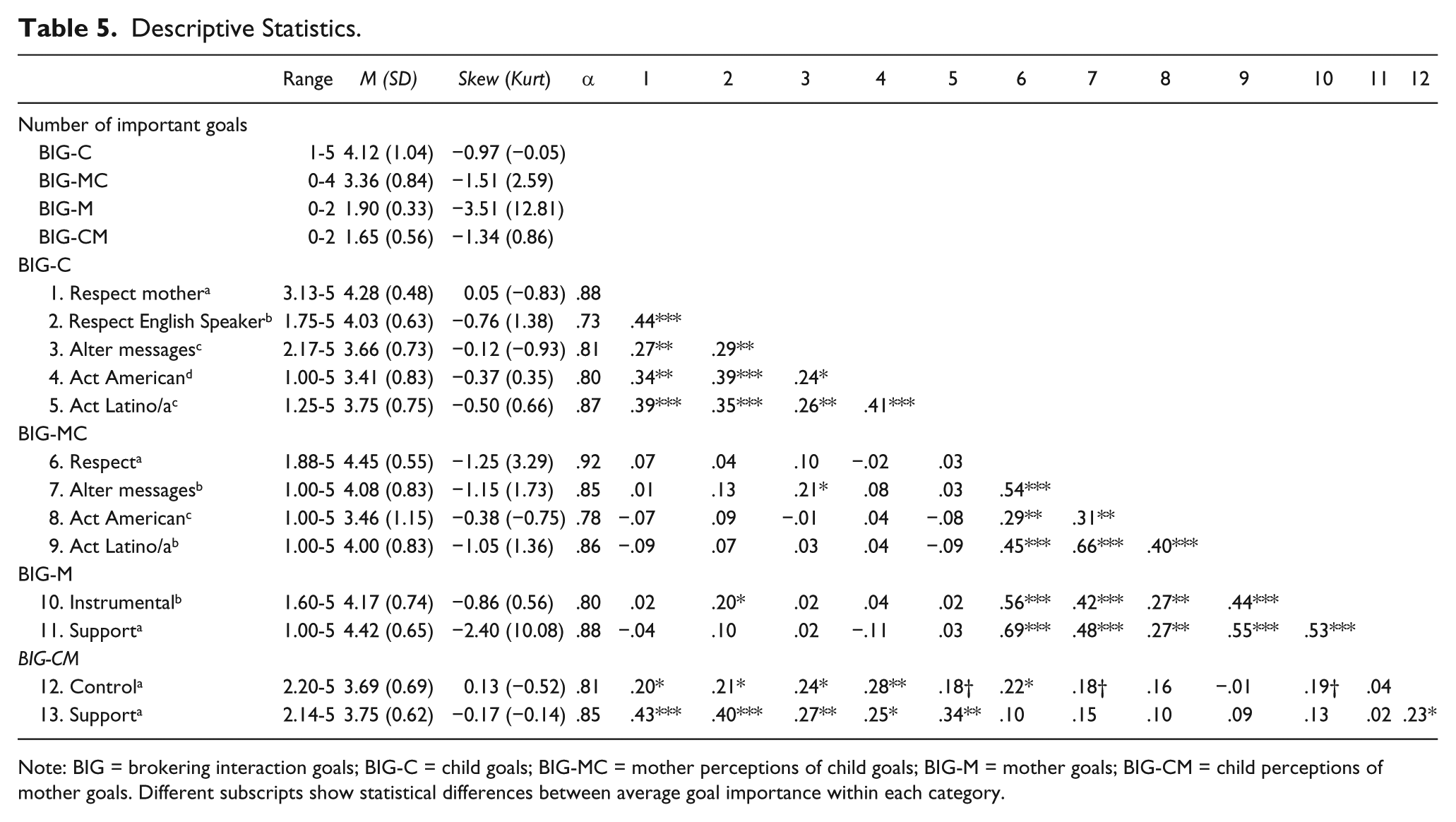
Note: BIG = brokering interaction goals; BIG-C = child goals; BIG-MC = mother perceptions of child goals; BIG-M = mother goals; BIG-CM = child perceptions of mother goals. Different subscripts show statistical differences between average goal importance within each category.
BIG-C
The first EFA included the 40 items answered by children to assess the child’s own-reported brokering interaction goals (BIG-C). Nine factors had eigenvalues over 1, although the Monte Carlo parallel analysis recommended a five-factor solution. Items were dropped according to the criteria outlined above, retaining 26 items. Eight items loaded on the first factor, which explained 28.5% of the variance. The first factor contained items pertaining to creating understanding between the mother and English speaker (three items), meeting the mother’s expectations (one item), and respecting the mother (four items). Given that attempting to translate well could be viewed as a sign of respect to the mother (i.e., doing what the mother asks), this factor was labeled as respecting mother (e.g., “I care about being respectful to my mother when I am translating”). Four items loaded on the second factor explained 10.6% of the variance and pertained to the importance of the child acting American (e.g., “I want to speak like an American when I am translating for the English speaker”). The third factor included six items that explained 10.1% of the variance: three items indicated the child’s want to alter messages in English (e.g., “If something my mother says might be embarrassing, I try to say it in a different way”), and three items indicated the child’s want to avoid translating something into Spanish that could offend, embarrass, or disrespect the mother (e.g., “It is important that I change what the English speaker says if I think it is disrespectful to my mother”). Therefore, the factor was labeled altering messages. The fourth factor included four items pertaining to the importance of the child acting Latino/a (e.g., “I want to speak like a Hispanic/Latino(a) when I am translating for my mother”) and explained 6.6% of the variance. Finally, four items loaded on the fifth factor, which explained 6.3% of the variance, with the theme of respecting the English speaker. Item 36 (“I want to be polite when I talk to the English speaker when translating, even if my mother and I are upset”) loaded primarily on this factor (at −.558), although it also loaded on the acting Latino/a factor (at −.345). However, the item was retained as the respecting the English speaker items were not internally reliable when this item was excluded (α = .65).
BIG-MC
To ascertain the mother’s perceptions of the child’s brokering interaction goals (BIG-MC), the mother answered the same 40 items reworded to reflect the mother’s perspective. An EFA of these 40 items revealed nine factors that had eigenvalues over 1, although the Monte Carlo parallel analysis recommended a three-factor solution. Even though the fourth factor was just under the Monte Carlo cutoff, the factor supported one of the variables that paralleled the child alter messages goal variable and was retained. Items were dropped according to the criteria outlined above, retaining 19 items. The first factor was composed of eight items relating to the mother’s perception of the importance of respect to the child: the child’s want to create an understanding between the mother and English speaker (one item), meeting the mother’s expectations (two items), respecting the English speaker (three items), and respecting the mother (two items). This factor explained 42.1% of the variance. The second factor loaded four items pertaining to the mother’s perception of the importance of the child acting Latino/a (e.g., “My child wants me to think that she or he acts like a Hispanic/Latino(a) when she or he translates”) and explained 13.1% of the variance. The third factor included three items pertaining to the mother’s perception of the importance of the child acting American (e.g., “My child wants to speak like an American when she or he is translating for the English speaker”) and explained 8.6% of the variance. The fourth factor was composed of four items pertaining to the mother’s perception of the importance of the child altering messages when translating into English (e.g., “If my child thinks that something I say might be embarrassing, she or he tries to say it in a different way in English”) and explained 6.6% of the variance.
BIG-M
The 18 items written to ascertain the mother’s brokering interaction goals (BIG-M) were submitted to a third EFA. The EFA revealed four factors with eigenvalues above 1, but only two factors that met the requirements of the Monte Carlo parallel analyses. Items were dropped according to the criteria outlined above, retaining 11 items. The first factor included five items: One item described the importance of the mother accomplishing her instrumental goal, one item described the importance of the mother’s desire for the child to translate everything into Spanish, and three items described the mother’s want to protect the child’s face. The internal reliability of the five items was acceptable (α = .87) but was slightly higher if the item pertaining to the mother’s instrumental goal was dropped (α = .88). Given that dropping this item made more sense conceptually, four items were retained and the factor was labeled as the mother’s goal of support for the child (e.g., “It is important that I show support for my child when she or he is translating”). The factor explained 48.8% of the variance. Five items loaded onto the second factor, all of which pertain to the mother’s instrumental goal. These items referred to the mother’s want to accomplish what she needed out of the interaction (two items) and also to control the child’s translating to ensure accuracy in translating from Spanish to English and vice versa (three items; for example, “I want my child to translate exactly what I say, regardless of what my child thinks I should say”). The factor explained 15.6% of the variance.
BIG-CM
The child’s perceptions of the mother’s brokering interaction goals (BIG-CM) EFA of the 18 items revealed four factors with eigenvalues above 1 but only two factors that met the requirements of the Monte Carlo parallel analyses. Items were dropped according to the criteria outlined above, retaining 12 items. The first factor was composed of seven items pertaining to mother support goal for the child (e.g., “My mom cares about making me feel good about myself when I am translating”) and explained 34.4% of the variance. The second factor included five items pertaining to the mother’s desire to control child translation both from Spanish to English and vice versa (e.g., “My mom wants me to translate exactly what she says, regardless of what I think she should say”) and explained 19.9% of the variance.
Descriptive Statistics and Order of Goal Importance
Descriptive statistics for all goal variables are shown in Table 5 (variables were created by averaging the items). Paired t tests were conducted to determine which goals were most important to children and mothers, in answer to Research Question 2. On average, the goal of respecting the mother was most important to children, followed by the goal of respecting the English speaker (t = 4.11, p < .001). The goals of acting Latino/a (t = 3.54, p < .001) and altering messages (t = 4.11, p < .001) were third most important, with no statistical difference between importance of these two goals (t = 0.97, p = .34). The goal of acting American had the lowest mean (acting Latino/a: t = 2.67, p < .01; altering messages: t = 4.01, p < .001). For the BIG-MC, mothers perceived the goal of respect to be the most important to children on average, followed by the altering messages (t = 5.21, p < .001) and acting Latino/a goals, which were not statistically different (t = 1.15, p = .26). Mothers perceived the goal of acting American to be the least important to the child (t = 4.83, p < .001). Mothers prioritized the support goal over their instrumental goal (t = 3.72, p < .001), but children perceived that the goals of control and support were equally important to the mother (t = 0.68, p = .50).
Number of Important Goals
To address the second portion of Research Question 2, the number of child and mother important goals was determined following criteria used by Samp (2006): “by computing the number of goals rated above the scale midpoint (= 3) on the goal importance measures” (p. 105). On average, children reported attending to an average of 4.12 (SD = 1.04) out of five goals during language brokering. Only one child reported attending to one goal, and 48 children reported attending to all five goals. Mothers perceived their children attended to an average of 3.36 (SD = 0.84) out of four goals. One mother reported that her child did not attend to any goals, and 53 mothers said their children attended to all four goals. For the mother’s two goals, 91 mothers reported attending to both (M = 1.90, SD = 0.33); children perceived their mothers attended to 1.65 goals on average (SD = 0.56).
Accuracy of Mother and Child Goal Perceptions
Correlations are shown in Table 5 to demonstrate how own-reported and other-perceived similar goals were aligned (or not aligned), as asked in Research Question 3. Overall, BIG-MC goals were not consistent with BIG-C similar goal. The mother-perceived child respect goal (consisting of both respecting the mother and English speaker items) was not correlated with the child goals of respecting the mother (r = .07, p = .52) or respecting the English speaker (r = .04, p = .68). The mother-perceived child goal of altering messages was marginally correlated with the child goal of altering messages (r = .20, p = .06). Mother perceptions of child acting American goal were not correlated with the child acting American goal (r = .05, p = .62), and mother perceptions of child acting Latino/a goal were not correlated with the child acting Latino/a goal (r = −.09, p = .36). For mother goals, child perceptions of the mother control goal was correlated with the mother instrumental goal (which included control items; r = .23, p = .03). However, child perceptions of mother support was not correlated with mother support goal reports (r = .04, p = .69).
Discussion
The current study surveyed 100 mother-child, low-income, Latino dyads to understand typical interaction goals that both mothers and children pursue during language brokering. Child and mother BIG were identified, ranked in terms of importance and multiple goal recognition, and examined from both the individual-reported and partner-perceived perspective. Theoretically, the current results supported multiple goal theory propositions that interaction goals can be generalized across language brokering scenarios and tested theory by examining partner perceptions of goals and their association with goal reports (Caughlin, 2010). Practically, understanding expected interaction goals and potential communication tensions provides language brokering researchers with a framework for assessing mother-child communication quality. Children and mothers who do not recognize—or recognize but choose to ignore—these language brokering goals will likely be less skillful and sophisticated in facilitating positive language brokering outcomes (Goldsmith, 2004; O’Keefe, 1988).
Four measures of BIG were examined in the current study: BIG-C, BIG-MC, BIG-M, and BIG-CM. Five BIG-C were identified: respect mother, respect English speaker, alter messages, act Latino/a, and act American. Overall, many child participants recognized the importance of all five goals, as the average number of child-reported important goals was 4.12 out of 5. Maintaining or attending to the mother-child relationship was a top priority for children, as all children rated respecting their mother as important (i.e., above a 3 on a 5-point scale), and, on average, children rated this goal as most important compared with the other goals. The other goals also highlight unique aspects of a language brokering situation that can be difficult to navigate: Children must attend to their relationship with the mother and English speaker, and their ethnic identities. The concept that children may orient their identities at a group level (i.e., American, Latino/a) rather than merely an interpersonal level is an extension of how interaction goals are typically conceptualized. Furthermore, the alter messages goal indicated that some children are conscious of their unique role as a language broker and their ability to mediate information from one party to another as they see fit, particularly if they feel the information may hurt the mother-child relationship or present the mother in a negative light. Overall, these goals speak to the complexity and difficulties inherent in language brokering communication. Children in this study recognized this complexity and the need to attend to multiple goals.
Mothers perceived four child goals that paralleled child-reported goals (BIG-MC): respect, alter messages, act Latino/a, and act American. Some conceptual differences emerged between child-reported and mother-perceived child goals. The mother-perceived child respect goal included both respecting the mother and respecting the English speaker. In addition, while child reports of altering messages included both English to Spanish and Spanish to English message adjustment, mother perceptions of this goal only included Spanish to English modifications. Overall, mothers perceived that children recognized multiple goals as important and mirrored child reports in terms of the order of goal importance.
The uniqueness of language brokering situations also played a role in mother’s interaction goals (BIG-M). Mother goals included their instrumental goal (i.e., task and controlling the child’s translation) and support for the child. For language brokering interactions, mothers conceptualized controlling the child’s translation as part of the process for accomplishing their instrumental goal. Children perceived similar goals for their mothers (BIG-CM), with the control translation items forming one factor (i.e., control goal) and child support forming the other. While mothers reported that child support was their most important goal, children did not share this view, rating control and support as equally important to mothers. Mothers may view themselves acting as caring parents during language brokering, but if children do not share this view, both parties may experience negative repercussions.
The current study extended multiple goals theory into an unexplored population by demonstrating that goal tendencies are salient for low-income, Mexican-heritage mother-child dyads. Both children and mothers think that multiple, potentially conflicting, interaction goals are relevant in language brokering situations. Furthermore, the more children and mothers recognized one interaction goal as important, the more they were likely to be cognizant of all other goals (i.e., reported goals were positively correlated with all other goals). Individuals who are conscious of certain social norms may be more likely to holistically recognize situational complexities. Bringing these issues to child and mother attention may have the potential to help them recognize multiple goals, and thus, increase language brokering communication quality.
While mother and child ranking of goal importance broadly matched, the individual mother and child dyads were not accurate in perceiving each other’s goals. Overall, mother perceptions of child goal importance did not match the child’s importance ratings of these goals (and vice versa). These disjointed perspectives are consistent with past parent-child research that suggests that parents and children do not always have similar perceptions about what is happening in the same conversation (Sillars, Koerner, & Fitzpatrick, 2005; Sillars et al., 2010). Multiple goals theory (Caughlin, 2010) posits that dyadic partners use goal perceptions to attribute meaning to behavior; mothers and children who have misaligned perceptions of goal intent may interpret language brokering interactions quite differently. Community center workers, social workers, and school staff or teachers could help to facilitate understanding between mother and child, reminding mothers that their relationship with their child is especially salient during brokering interactions and that mothers may need to be more explicit with support, as children may evaluate messages at face value and perceive this goal to a lesser extent than mothers report. These community workers can help children to recognize all situationally relevant goals, think about mother motivations and meaning behind her messages, and help both parties recognize the other’s motivations and perspectives.
Future Directions
The proposed BIG measures provide a springboard for future research on language brokering, although the measures should be validated with confirmatory factor analyses. Identifying children and mothers who are less likely to recognize and pursue multiple goals would illuminate specific families at risk for lower communication quality; for example, child language ability likely links to goal pursuit (i.e., children who do not have the language abilities to adequately interpret likely are not going to attend to multiple goals), and mother’s parenting style may drive mother-child communication behaviors. In addition, mothers and children with higher brokering communication quality may experience more positive and less negative outcomes. Future research that establishes characteristics that drive goal pursuit or how goal pursuit impacts outcomes could serve as an intervention point, as communication quality is a controllable aspect of language brokering. The current measures can facilitate understanding of communication tensions, expectations, and issues inherent in quality brokering communication.
Footnotes
Acknowledgements
The author thanks Steve Wilson for his help and support in completing this project and for his comments on an earlier draft. The insights of John Caughlin, Jake Jensen, Felicia Roberts, and Shawn White are also greatly appreciated.
Declaration of Conflicting Interests
The author declared no potential conflicts of interest with respect to the research, authorship, and/or publication of this article.
Funding
The author disclosed receipt of the following financial support for the research, authorship, and/or publication of this article: This research was partially funded by a grant from the Center for Families and the Office of the Vice President for Research at Purdue University.