







Abstract
Thematic analysis was used to explore how emerging adults explained their preferences for two marriage traditions: marriage proposals and surname changes. Quantitative analyses were subsequently used to examine the association between benevolent sexism and participants’ marriage-tradition preferences. A sample of 277 undergraduates (M = 19 years) completed a survey that included open- and closed-ended questions about attitudes toward marriage traditions and gender-role ideology. Results of the thematic analysis indicated that both women and men tended to hold traditional marriage preferences—especially with regards to marriage proposals. Multiple regression indicated that endorsing benevolent sexism was related to holding more traditional preferences. The findings are interpreted in relation to the role that hidden power may play in many heterosexual romantic relationships.
Throughout the past several decades, the United States has seen a steady increase in women’s status. Overt sexism is on the decline and women are becoming increasingly well represented in prestigious, high-paying jobs. Despite these welcome improvements, many gender-typed norms related to heterosexual courtship and marriage have remained remarkably stable over time (Eaton & Rose, 2011). For example, it is relatively rare for women to propose marriage to men. In addition, the majority of women still take their husband’s last name upon marriage, whereas few men consider taking their wife’s last name (Scheuble & Johnson, 2005). People typically adhere to marriage-related norms in the name of tradition or romance (Twenge, 1997). However, there is also reason to believe that these norms are subtle manifestations of sexism within heterosexual romantic relationships (Boxer & Gritsenko, 2005; Scheuble & Johnson, 2005). In the present study, we sought to establish an empirical connection between women’s and men’s marriage-tradition preferences and their level of sexism. We began by examining participants’ personal preferences regarding marriage proposals and marital name changes. We then tested whether endorsing benevolent sexism was predictive of holding traditional marriage preferences.
The Developmental Context
The average age of marriage in the United States is currently about 25 years for women and 27 years for men (U.S. Census Bureau, 2006). Although these statistics may initially imply that an undergraduate sample is somewhat young for a study on marriage-tradition preferences, a number of theorists have noted that engaging in meaningful, intimate relationships is an important feature of late adolescence and emerging adulthood (Beyers & Seiffge-Krenke, 2010; Feldman, Gowen, & Fisher, 1998). Perhaps most notably, Erikson (1968) argued that establishing an intimate relationship is the most important developmental task for young adults. More recently, Arnett (2004) proposed that emerging adulthood is distinct from other developmental periods in that it involves identity exploration in three major domains, one of which is love. Moreover, much empirical work has examined emerging adults’ attitudes about conventional dating scripts (Eaton & Rose, 2011; Laner & Ventrone, 2000). The present study seeks to extend this body of work by examining emerging adults’ preferences for marriage traditions.
Prior Research on Marriage-Related Norms
Who initiates the marriage proposal?
The belief that the man should propose to the woman is widespread; it is fairly rare to hear stories or see examples of women initiating a proposal. Schweingruber and his colleagues are among the few investigators to examine women’s and men’s attitudes about marriage proposals. In one study, Schweingruber, Anahita, and Berns (2004) asked engaged couples to identify the important elements of marriage proposals. Results revealed that the following expectations were shared by almost all participants: First, the man should propose to the woman; second, the man should get down on one knee; and, third, the man should present the woman with a diamond ring. In a subsequent study, Schweingruber, Cast, and Anahita (2008) examined women’s and men’s ratings of hypothetical couples whose proposals either did or did not align with the key marriage proposal elements identified in the earlier study. Results indicated that participants perceived couples with a nontraditional marriage proposal as having a weaker relationship than couples with a traditional marriage proposal. Taken together, these two studies suggest that there are widely held and strongly endorsed beliefs about what constitutes a typical marriage proposal. One major goal of the present research was to better understand why this is the case. Specifically, we examined the reasoning behind women’s and men’s marriage proposal preferences.
Who changes their last name after getting married?
Prior to the 19th century in the United States and much of the world, a woman was considered to be her husband’s property and was therefore expected to take his last name after getting married (Boxer & Gritsenko, 2005). Name-change practices began to be called into question as women’s suffrage gained popularity in the early 20th century, but women in some states were still legally required to take their husband’s name until 1975 (Scheuble & Johnson, 1993). Although women no longer face legal barriers to keeping their birth name after marrying, it remains fairly uncommon for them to do so. For example, in a study using data from the 2004 American Community Survey (N = 251,358), Gooding and Kreider (2009) found that 94% of married, native-born U.S. women had taken their husband’s last name. Some research even suggests that the percentage of women who have retained their birth name has declined in the past decade (Goldin & Shim, 2004; Kopelman, Fossen, Paraskevas, Lawter, & Prottas, 2009). For example, after conducting a decade-by-decade analysis of marriage announcements in the New York Times, Kopelman and colleagues (2009) found that the following percentages of women elected to keep their birth name: 9% in the 1980s, 23% in the 1990s, and 18% in the 2000s.
Several studies have examined the reasoning that women provide when explaining their name-change preferences. For example, Twenge (1997) found that women who expressed a desire to take their husband’s last name wanted to do so out of tradition, for practical reasons, out of love or respect for their husband, or because doing so represents unification of the married couple. Conversely, women who wanted to keep their birth name cited professional reasons, noted that losing their birth name would signify a loss of identity, or expressed a desire to pass on their surname. Other research shows similar response patterns in diverse samples of women (Boxer & Gritsenko, 2005; Hoffnung, 2006).
In-depth examinations of men’s name-change preferences are uncommon. Most of the relevant studies have asked men about the expectations they have for their significant other. For example, a study of Dutch undergraduates found that 82% of male participants hoped that their future wife would either hyphenate or change her last name completely (Noordewier, van Horen, Ruys, & Stapel, 2010). Another study that used a sample of American undergraduates found that only 57% of men (vs. 92% of women) felt it was acceptable for a woman to keep her birth name after getting married (Hamilton, Geist, & Powell, 2011; Scheuble & Johnson, 1993). Although these studies provide important information about men’s name-change preferences, they are limited because they do not provide insight into why men hold the preferences that they do. Therefore, the present study aimed to attain a more thorough understanding of the reasoning that underlies both women’s and men’s name-change preferences.
Benevolent Sexism as a Predictor of Marriage Preferences
In the present study, we tested the hypothesis that traditional marriage preferences would be related to women’s and men’s endorsement of benevolent sexism. In their model of ambivalent sexism, Glick and Fiske (1996) distinguished between two interrelated attitudes toward women known as hostile sexism and benevolent sexism. Hostile sexism is characterized by overtly negative sentiment that is typically directed at women whose behavior violates the feminine-stereotyped gender role. For example, people who believe that women are incapable of successfully running a business are exhibiting hostile sexism. In contrast, benevolent sexism is characterized by the belief that men should protect, cherish, and provide for women; it is typically directed at women whose behavior aligns with the feminine-stereotyped gender role. For example, people who believe that the man should always pay for dinner when on a date with a woman are exhibiting benevolent sexism. The present study focused on the benevolent facet of ambivalent sexism because it has been linked theoretically and empirically to both women’s and men’s romantic relationship preferences (de Lemus, Moya, & Glick, 2010; Glick & Fiske, 1996; Glick & Hilt, 2000; Viki, Abrams, & Hutchinson, 2003).
Although behaviors associated with benevolent sexism such as chivalry may initially seem appealing, they reinforce differences in women’s and men’s status and power by rewarding women for conforming to traditional gender roles at the expense of their individual agency (Anderson, 2010; Glick & Fiske, 1996; Glick & Hilt, 2000; Goodwin & Fiske, 2001; Lee, Fiske, Glick, & Chen, 2010). Indeed, Glick and colleagues’ (2000) cross-cultural work demonstrated that women and men who live in nations that are low in gender equality tend to endorse benevolent sexism to a greater extent than women and men who live in nations that are high in gender equality. In addition, Lee and colleagues (2010) found that benevolent sexism predicted women’s and men’s ideals for close romantic relationships and argued that benevolent sexism is a way for men to control these relationships through romance. Similarly, Viki and colleagues (2003) found that chivalrous dating behavior was related to benevolent sexism but not hostile sexism. The authors concluded that “high benevolent sexist individuals prefer intimate male-female relationships in which men wield the power” (p. 536).
The existence of gender-based power differentials in heterosexual romantic relationships has received much attention in recent years, and numerous researchers have noted that these power differentials mirror those found in patriarchal social structures (Ferree, 1990; Fox & Murry, 2000; Knudson-Martin & Mahoney, 1998; Komter, 1989; Kulik, 1999; Lee et al., 2010; Wilkie, Ferree, & Ratcliff, 1998; Zipp, Prohaska, & Bemiller, 2004). Men’s dominance in heterosexual romantic relationships is thought to originate from a subtle form of power known as hidden power (Komter, 1989; Zipp et al., 2004), which is derived from entrenched institutional practices and norms that are rarely questioned even if they do a disservice to the subordinate group (Knudson-Martin & Mahoney, 1998; Komter, 1989; Lukes, 1974). Given this definition, the similarities between hidden power and benevolent sexism are plain: Benevolent sexism shapes adherence to traditional gender roles in the same way that hidden power shapes adherence to the dominant culture and ideology (Komter, 1989; Lukes, 1974; Zipp et al., 2004). Hence, we argue that benevolent sexism is a manifestation of hidden power that is especially likely to emerge in heterosexual romantic relationships. This connection is not inconsequential. Adherence to marriage traditions is typically viewed as harmless (or even beneficial), but this belief would be called into question if benevolent sexism were linked to marriage-tradition preferences. Specifically, such a finding would suggest that aspects of marriage traditions reflect gender-based power differentials in heterosexual romantic relationships and society on the whole. We will return to this possibility in the Discussion section.
The Present Research
The goal of the present study was twofold. First, we aimed to assess emerging adults’ attitudes about marriage proposals and marital name changes. In so doing, we took an inductive approach and conducted a thematic analysis of participants’ responses to open-ended questions about their proposal and name-change preferences. These analyses were designed to identify the kinds of reasons that women and men provided for their preferences.
Our second goal was to test the hypothesis that benevolent sexism would predict the extent to which participants hold traditional marriage preferences after controlling for relevant extraneous variables in a regression model. First, we included participants’ age in the regression to control for changes in marriage-related attitudes that may occur during the transition from late adolescence to young adulthood. Second, participants’ gender was controlled. It follows from our earlier review of benevolent sexism that traditional marriage preferences tend to privilege men; therefore, women and men may differ in their investment in these practices. Third, we took into account the participants’ self-identified ethnic background. Prior studies have reported average ethnic differences in gender attitudes (Kane, 2000), which may affect attitudes toward marriage traditions. Fourth, individuals from more traditional families might be more likely to favor traditional gender attitudes; we therefore considered the relative difference in educational attainment between the participants’ fathers and mothers as an index of gender parity among the parents (Eagly & Wood, 1999; Glick et al., 2000; United Nations Development Programme, 2010). Finally, we controlled for the participants’ religiosity because researchers have observed an association between religiosity and traditional gender-role beliefs (Frieze et al., 2003; Morgan, 1987; Tasdemir & Sakalli-Ugurlu, 2010).
Method
Participants
Participants were 292 undergraduates at a public university in Northern California. Of these participants, 15 (5%) identified as gay or lesbian and were not included in the current study given its focus on heterosexual marriage preferences. The final sample was composed of 277 participants (141 women and 136 men) who ranged in age from 17 to 26 (M = 19.29, SD = 1.33) and identified as European American (53%), East Asian (17%), Latino/a (14%), Middle Eastern (3%), South Asian (2%), African American (1%), and Other (10%). According to the participants’ reports of their parents’ highest level of education, mothers and fathers had, on an average, completed some college. Although we did not collect information on students’ political attitudes, a recent campus survey of the entering undergraduates indicates that most students hold liberal attitudes at higher rates than students at other public universities.
Procedure
The participants completed an online survey titled “What It Means to Be a Student.” The survey was composed of questions pertaining to participants’ demographic background, gender-role ideology, marriage preferences, and several additional measures that were not examined in the present study. The participants received partial course credit for their participation.
Measures
Religiosity
The strength of the participants’ religious affiliation was measured with six items from a scale Morgan (1987) used to measure religious devoutness. The participants were provided with a list of religious activities and were asked to specify how frequently they had engaged in those activities over the past year. Sample items include “attended a religious service” and “read the Bible.” Participants rated the frequency of their engagement in these activities on a scale ranging from 1 (never) to 5 (very often), such that higher scores reflect higher religiosity. The items comprising this measure were averaged to create a composite measure of religiosity (α = .82).
Mothers’ and fathers’ relative levels of education
Participants separately indicated their mothers’ and fathers’ level of education on the following scale: 1 = elementary school, 2 = some high school, 3 = high school, 4 = some college, 5 = bachelor’s degree, 6 = some graduate school, or 7 = graduate degree. To assess the discrepancy in education between mothers and fathers, we created a difference score by subtracting the mother’s level of education from the father’s level of education. Thus, higher scores reflect higher educational status among the participants’ fathers than mothers. Gender parity in educational achievement is considered a key index of gender equality in a society (Eagly & Wood, 1999; Glick et al., 2000; United Nations Development Programme, 2010). By extension, we reasoned it would also reflect differences in the relative status of the participants’ mothers and fathers.
Benevolent sexism
Benevolent sexism was measured with six items from the corresponding subscale of the Ambivalent Sexism Inventory (Glick & Fiske, 1996). Benevolent sexism is characterized by the belief that women, especially those who conform to traditional gender roles, should be protected and cherished by men. Sample items include “A good woman should be set on a pedestal by her man” and “In a disaster, women ought to be rescued before men.” These items were averaged to create a composite measure of benevolent sexism (α = .81). Ratings could range from 1 (strongly disagree) to 6 (strongly agree), such that higher scores indicate higher levels of benevolent sexism.
Marriage tradition preferences
To assess marriage proposal preferences, participants were presented with the following prompt: “If you were to get engaged, who would you want to propose?” The participants indicated their preference on a scale ranging from 1 (I would definitely want to propose) to 5 (I would definitely want my partner to propose). Following this question was an open-ended question that asked the participants to explain why they would or would not want to propose.
To assess marital name-change preferences, the participants were presented with the following prompt: “If you were to get married, to what extent would you be willing to take your partner’s last name?” Participants indicated their preference on a scale ranging from 1 (very unwilling) to 5 (very willing). Following this question was an open-ended question that asked the participants to explain why they would or would not want to take their partner’s last name after getting married.
In order to create an outcome variable for use in the quantitative analyses, responses to the two closed-ended questions assessing marriage proposal and name-change preferences were averaged to create a composite measure of marriage-tradition preferences. Prior to averaging responses to the two questions, men’s scores on both questions were reversed; hence, higher scores on the composite reflect more traditional preferences for both women and men.
Coding Open-Ended Responses
An inductive approach to thematic analysis was used to code responses to the open-ended questions that asked about the participants’ marriage proposal and name-change preferences. Specifically, we followed the process outlined by Braun and Clarke (2006). The first step in this iterative process involves immersing oneself in the data by reading the participants’ responses multiple times. Subsequent steps involve generating coding categories and grouping these categories into meaningful themes. We conducted the coding from an essentialist epistemological standpoint in that we assumed that the participants’ responses accurately reflected their personal preferences (Braun & Clarke, 2006). In addition, the themes were not mutually exclusive: If a participant provided multiple rationales, each was coded. The first author began by reading through a subset of participants’ responses to identify themes. Next, the first author and an undergraduate research assistant used these themes to separately code 20 responses for each of the two questions. Disagreements in the coding were resolved through discussion and/or making minor modifications to the criteria that characterized the theme in question. Last, the first author and the research assistant double-coded 30 responses for each of the two questions. The intercoder reliability for the themes was high (κ = .73 to .92) according to Fleiss’s (1981) guidelines.
Results
The findings are broken into three sections. The participants’ responses to the questions about their preferences regarding marriage proposals and marital name changes are presented in the first and second sections, respectively. In the third section, we use quantitative methods to test the hypothesis that benevolent sexism would predict participants’ marriage-tradition preferences.
Marriage Proposal Preferences
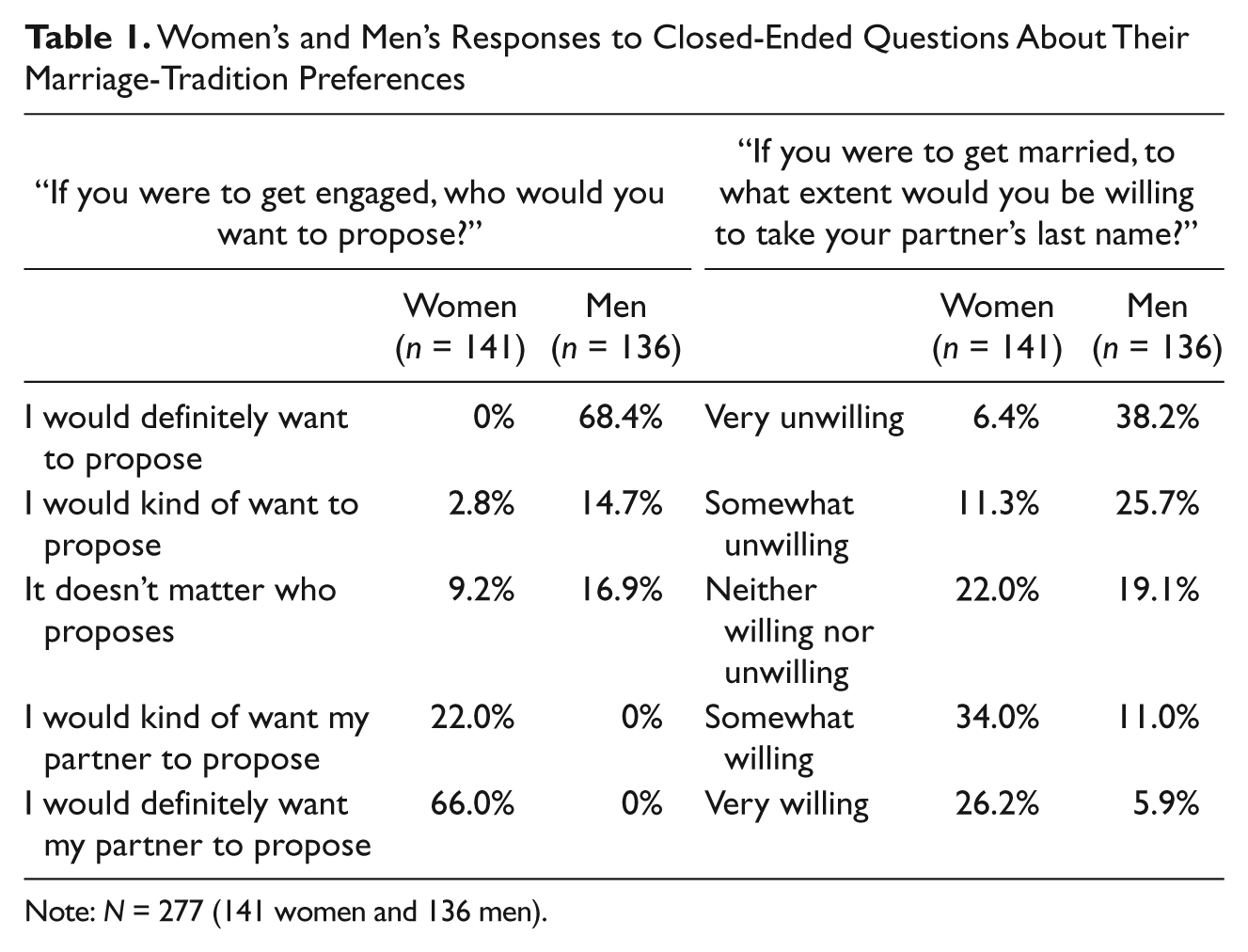
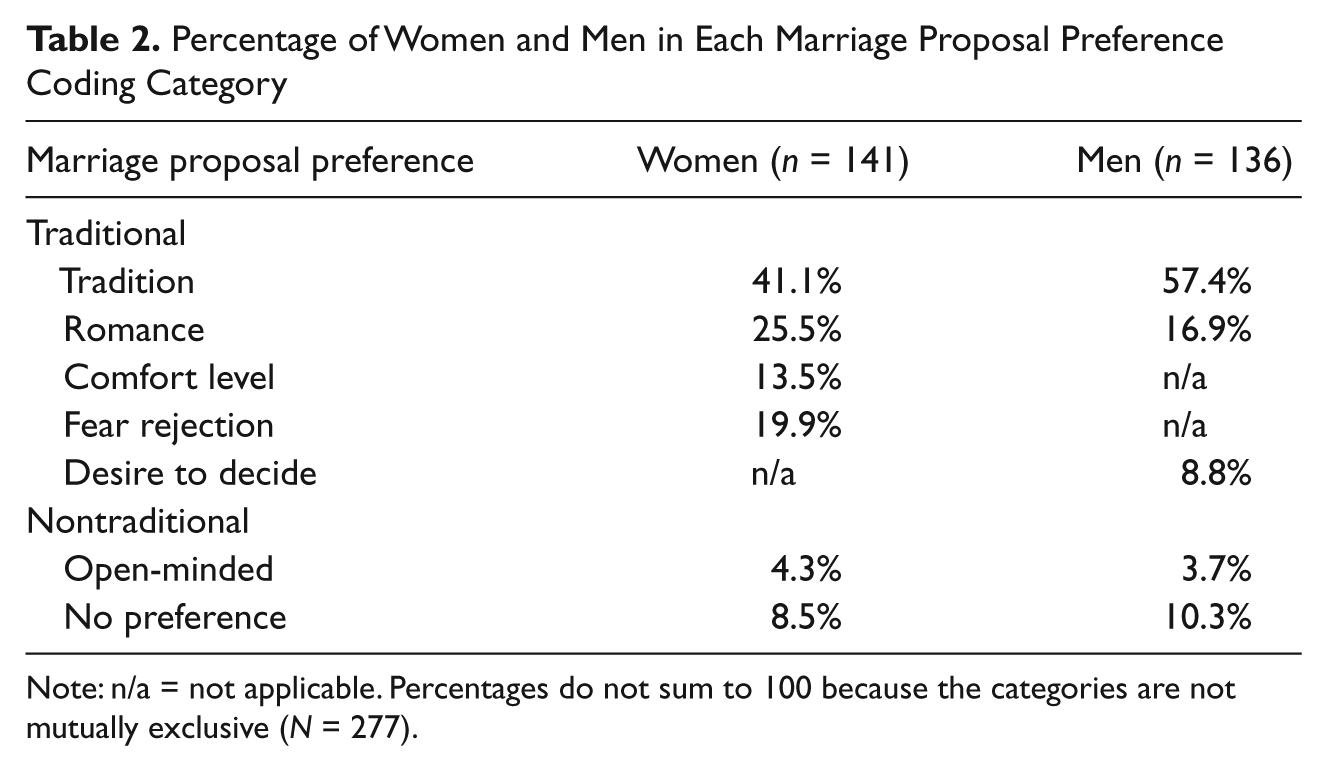
Table 1 provides a summary of the participants’ responses to the closed-ended question, “If you were to get engaged, who would you want to propose?” Approximately two thirds of both women and men indicated that they would “definitely” want the man to propose. Even more notably, none of the women and men in the sample indicated that they would “definitely” want the woman to propose. The participants’ responses to this closed-ended question closely mirrored their responses to the corresponding open-ended question. For example, 97% of the participants who expressed a desire for the man to propose on the closed-ended question expressed the same desire in their response to the open-ended question. The types of reasoning participants provided when explaining their preferences are delineated below. The themes are grouped according to whether they reflect a preference for the man to propose (“Traditional”) versus some other preference (“Nontraditional”). A summary of the themes and the percentage of participants falling into each can be found in Table 2.
Women’s and Men’s Responses to Closed-Ended Questions About Their Marriage-Tradition Preferences
Note: N = 277 (141 women and 136 men)
Percentage of Women and Men in Each Marriage Proposal Preference Coding Category
Note: n/a = not applicable. Percentages do not sum to 100 because the categories are not mutually exclusive (N = 277).
Traditional Themes
Five traditional themes were identified from the participants’ responses: gender-role traditions, romance, comfort level, fear of rejection, and desire to decide. Gender-role traditions and romance are two themes that occurred among women and men. Comfort level and fear of rejection were seen only among women, whereas desire to decide was seen only among men. Each of these five themes is described below.
Gender-role traditions
The most commonly occurring traditional theme for both women and men was gender-role traditions, which was referenced by 41% of women and 57% of men. The participants whose responses aligned with this theme often made explicit reference to gender roles. In particular, some individuals mentioned that violating gender-role norms would make them feel uncomfortable. For example, a man wrote that he would want to propose because “that is what is expected of us men. If I do not do that, I would feel emasculated.” Similarly, a woman commented, “I don’t think that, culturally, women should propose to men. It would be very awkward.” Although many participants who referenced gender-role traditions highlighted the negative implications of violating gender-role norms, other participants simply referenced their gender without providing any additional rationale (e.g., “I would want to propose because I’m the man”). These types of responses highlight the close ties between gender roles and marriage proposal scripts. That is, simply listing one’s gender is viewed as a sufficient rationale because there exists a widespread and shared understanding that men typically initiate the proposal.
Romance
Another traditional theme that was common for both women and men was romance, which was referenced by 26% of the women and 17% of the men. These participants often equated a traditional proposal with a romantic proposal. For example, a woman wrote, “I feel that it would be much more romantic if the man proposed. I would be able to tell the story to my girlfriends without feeling awkward.” Another woman stated, “I just think the guy should propose (not because of gender roles!). It’s just sweeter and he is telling you that he wants to be with you.” Thus, whereas gender-role traditions responses tended to characterize gender-role adherence as inherently desirable, romance responses tended to characterize gender-role adherence as desirable because it is consistent with commonly held notions of romance.
Comfort level
The theme of comfort level was referenced by 14% of the women. Women in this category said that they would not want to propose because doing so would lead to general discomfort (e.g., stress, anxiety, awkwardness) that was not explicitly linked to gender-role violations. These women typically referenced their own personality traits to explain why they were not well suited to initiating a proposal. For example, a woman noted, “I would not want to propose because I’m lazy and that’s a lot of pressure!” Along a similar vein, another woman wrote, “I am very shy and do not think I could get up the courage to propose.” Although the prospect of gender-role violations may have contributed to these women’s reluctance to propose, it is also quite likely that some women dislike the thought of initiating a proposal for reasons largely independent of gender-role norms.
Fear of rejection
Another traditional theme that characterized only women’s responses is fear of rejection, which was referenced by 20% of the women. These women said that they would not want to propose because they would be too afraid of rejection. For example, one woman explained that she would not propose because “I don’t wanna get shot down! Same reason I wait to be asked on dates and kissed; don’t wanna come on too strong.” Other women whose responses fit into this category expressed a desire for their partner to propose because then they could be certain that he was ready to commit. For example, a woman wrote, “I would want my partner to propose because I believe that shows he is willing to marry me.” A few women noted that although they would not want to ask out of the fear of rejection, they would dislike waiting on the man. For example, a woman stated, “I would not want to propose because I’d be unsure of when my partner was ready, but I’d hate having to wait on a man just so he could dictate when we got engaged or married.” As a whole, the fear of rejection responses highlight the expectation that men will “make the first move” within romantic contexts (Rose & Frieze, 1993).
Desire to decide
The final traditional theme is the desire to decide, which was referenced by 9% of the men. These men indicated that they would like to propose because they want to be the one who decides when the proposal happens. For example, a man wrote, “I want to be the one to make my own serious decision if I am going to be with [her] for the rest of my life.” Similarly, another man commented, “I want to be the one that asks the question. If I get asked, then I will feel like I gave in. If I ask, I will feel like I pushed and got something.” This theme plays an interesting foil to the fear of rejection theme described above: Women may fear rejection because they assume (perhaps accurately) that men want to be in control of the proposal.
Nontraditional
Two types of responses were considered relatively nontraditional. These included being open-minded and expressing no preference. Each type of response is described below.
Open minded
Although none of the participants expressed a clear-cut preference for a nontraditional proposal (i.e., a proposal where the woman proposes), some were relatively open minded about the nature of the proposal. First, 4% of the women and 4% of the men provided responses that were classified as open minded. These participants typically said that they would like a traditional proposal but added that they would be willing to entertain other options. For example, a man stated that he would like to propose himself, but would “love it if [his] fiancé felt strongly enough to ask first.”
No preference
The other nontraditional theme was no preference, which included responses from 9% of the women and 10% of the men. Typically these participants indicated that the details of the proposal did not matter as long as both parties were in love and ready to get engaged. For example, a man offered, “At the point of marriage, there should be no question about whether the partners want to spend the rest of their lives together, so I think either partner could propose. Either way, it should be the same answer.”
Marital Last Name Preferences
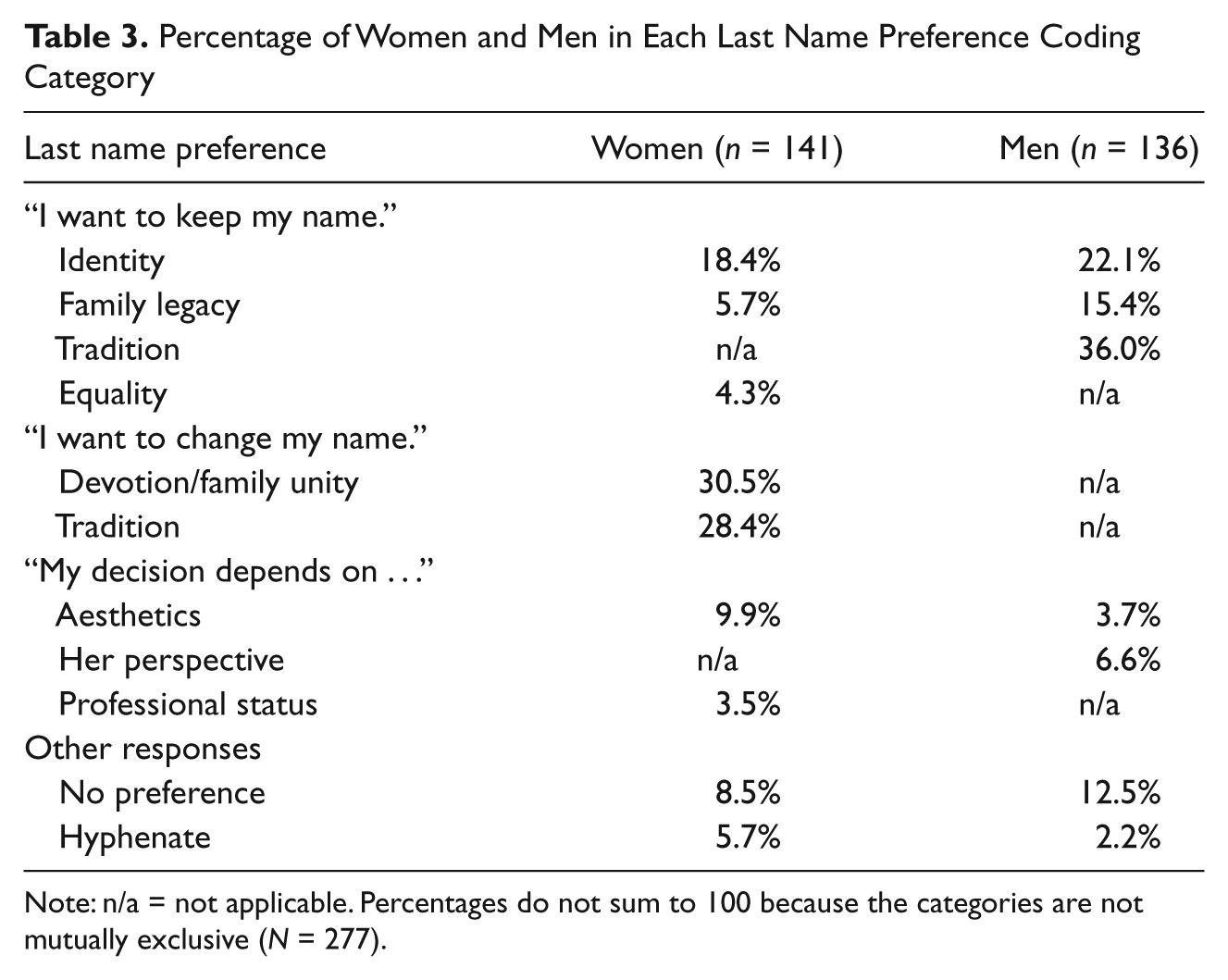
Table 1 provides a summary of the participants’ responses to the closed-ended question, “If you were to get married, to what extent would you be willing to take your partner’s last name?” The majority of the women (60%) indicated that they would be “somewhat willing” or “very willing” to take their husband’s last name, whereas the majority of the men (64%) indicated that they would be “somewhat unwilling” or “very unwilling” to take their wife’s last name. As before, the participants’ responses to this closed-ended question overlapped substantially with their responses to the corresponding open-ended question. For example, 85% of the participants who expressed a traditional preference (i.e., men who want to keep their last name and women who want to take their partner’s last name) on the closed-ended question expressed the same preference in their response to the open-ended question. The types of reasoning participants provided when explaining their name-change preferences are delineated below. The themes are grouped according to whether the participants wanted to keep their name, change their name, or had specific criteria that factored into their decision. The themes and the percentage of participants falling into each are summarized in Table 3.
Percentage of Women and Men in Each Last Name Preference Coding Category
Note: n/a = not applicable. Percentages do not sum to 100 because the categories are not mutually exclusive (N = 277).
“I Want to Keep My Name”
There were four kinds of responses that reflected the desire to keep one’s own name. These included themes emphasizing identity, family legacy, gender-role tradition, and equality. Identity and family legacy were seen among both women and men. In contrast, gender-role tradition was expressed only among men, whereas equality was expressed only among women.
Identity
Among those who wanted to keep their own last name after marriage, a commonly cited rationale was identity, which was referenced by 18% of the women and 22% of the men. These participants typically indicated that they did not want to change their name because doing so would mark a loss of identity. For example, a woman noted, “I would not want to take my partner’s last name because getting married doesn’t mean I need to lose a part of myself.” Many participants in this category also indicated that they derive esteem from their last name and its heritage. For example, one man commented, “I love my name. I care about the men who have passed this name on for the last 400 years.”
Family legacy
A similar theme among participants who wanted to keep their name was family legacy, which was mentioned by 6% of the women and 15% of the men. These responses were characterized by a desire to uphold the family lineage by passing their surname to offspring. A sense of obligation or duty was central to many of the responses in this category. For example, a man said, “I’m the last Smithson [pseudonym] boy in my family. I need to pass on my name.” Such responses contrast with those comprising the identity theme, which typically characterized keeping one’s last name as desirable for reasons related to self-identity. Although men were more likely than women to provide family legacy responses, several women also expressed a desire to keep their surname so it could be passed on to later generations. However, these women typically expressed more ambivalence about their preference than men did. For example, a woman wrote, “I’m the last in my family with this name and the only blood child, so I wish to carry on my father’s name a bit. I want my husband’s name, but I want to keep my own too.”
Gender-role traditions
A sizeable portion of the men (36%) provided responses that were grouped into a gender-role traditions theme. These men often explicitly referenced gender-role tradition in their responses. For example, a man observed, “Traditionally the man keeps his name. The woman/partner in the relationship can keep her maiden name but can also adopt a new last name.” Similar to the gender-role traditions theme that was observed in the participants’ marriage-proposal preferences, a number of men solely referenced their gender (e.g., “Because I’m a man”) in explaining why they would like to keep their last name.
Equality
Last, 4% of the women made some reference to equality while explaining their name-change preference. That is, they stated that they would not want to change their name because doing so reflects gender inequality. For example, one woman wrote, “I think it’s important to be seen as an individual and not as the property of my spouse.”
“I Want to Change My Name”
The next two themes, devotion/family unity and gender-role tradition, are composed of responses from women who expressed a desire to change their last name. Notably, none of the men in the sample expressed a clear preference for changing their last name, so the following two themes are comprised only of women’s responses.
Devotion and family unity
A common theme among women who wanted to change their last name was devotion and family unity, which was referenced by 31% of the women. These women characterized changing their last name as an important gesture that serves to unite the couple (and any children they might have) under the same surname. For example, a woman who emphasized unification with the husband explained that she would change her name because “it’s an expression of your love for one another and shows everyone that you are devoted to that certain individual.” Other women focused more on family unification. One such woman noted, “When I get married, it would be due to me preparing to have a family. It’s a nice concept for everyone in the family to have the same last name.” It bears mentioning that although the concept of unification connotes reciprocity and mutuality, women are typically expected to make the change that accomplishes this end.
Gender-role traditions
Another theme that was common among women who wanted to change their last name was gender-role traditions, which was referenced by 28% of the women. These women expressed a desire to keep their name because doing so is in line with gender-role tradition. Some women explicitly cited tradition (e.g., “It is tradition and that is how things are done. There’s really nothing bad about changing your last name to your husband’s”). Other women did not mention tradition, but their responses nonetheless highlighted the prescriptive nature of gender roles as they relate to marriage-related traditions. For example, one woman explained, “I would take my husband’s last name because that’s just what you’re supposed to do.”
“My Decision Depends On . . .”
Some of the participants observed that certain contextual factors would play a role in their decision to keep or change their name. These included aesthetic considerations, the partner’s perspective, and one’s professional status. Aesthetic concerns were noted both by women and men, whereas the partner’s perspective arose only among men, and professional status arose only among women.
Aesthetics
One conditional factor was aesthetics, which was composed of responses from 10% of the women and 4% of the men. These participants noted that aesthetic concerns about their own last name or their partner’s would influence their decision. For example, a woman wrote, “I would take my husband’s last name unless he had an odd last name that didn’t suit me.”
Her perspective
Some of the men (7%) provided responses that were grouped into a her perspective theme. These men indicated that their name-change preference would be informed by their partner’s stance on the issue, although most also noted that they would prefer to keep their own last name (e.g., “If for some reason my partner really wanted me to take her last name, I would. However, if there’s no reason, I would keep my name.”).
Professional status
Last, 4% of the women indicated that their professional status would influence whether or not they changed their name. These women typically expressed a desire to take their husband’s last name, but added that they would keep their own name if doing so would be professionally beneficial. For example, a woman wrote, “It depends on my job. If I need to keep my last name for business reasons, I will. If not, I would rather take his last name.”
Other Response Types
A final set of participants did not provide a clear preference for changing or keeping their last name. These options included hyphenating the two names or expressing no preference. Both types of responses were seen among women and men.
Hyphenate
Six percent of the women and 2% of the men expressed a desire to hyphenate their surname with that of their spouse. For example, one participant wrote, “It’s not fair that a man’s last name gets to be preserved for generations, so I’d rather have it hyphenated so it could be equal.” Interestingly, a handful of the participants noted that they were opposed to hyphenation (e.g., “It would be incredibly confusing if we hyphenated our names.”). Such responses suggest that hyphenation, a relatively common alternative for women who want to keep their last name, may be experiencing a degree of backlash in some groups of emerging adults.
No preference
Last, 9% of the women and 13% of the men wrote that they had no preference for changing or keeping their last name. These responses typically contained egalitarian sentiments, even if they did not explicitly refer to gender equality. For example, a man wrote, “It really doesn’t matter. It’s only a name and I don’t think we should be caught up in such trivial matters.”
Marriage Tradition Preferences in Relation to Benevolent Sexism
The present study also tested the hypothesis that benevolent sexism would predict participants’ marriage-tradition preferences. To test this hypothesis, we conducted a hierarchical linear regression in which the association between benevolent sexism and marriage-tradition preferences was assessed after controlling for background factors. As explained in the Method section, our measure of marriage-tradition preferences was created by averaging participants’ responses to two closed-ended questions about their marriage proposal and name-change preferences. The two measures yielded similar findings when analyzed in separate regression analyses with the study’s predictor variables. Moreover, combining the two measures was desirable because it provided a more normally distributed outcome variable than either measure examined alone.
Preliminary analyses
We conducted preliminary tests for gender and ethnic differences in each of the predictors examined in the present study. With regard to gender differences, two significant differences emerged. First, the women (M = 19.45, SD = 1.43) were slightly older than the men (M = 19.12, SD = 1.20), F = 4.62, p = .03, partial η2 = .02. Second, the men (M = 4.29, SD = .92) were somewhat higher in benevolent sexism than the women (M = 3.69, SD = 1.06), F = 25.12, p < .001, partial η2 = .08.
With regard to ethnic differences, there were significant group differences for age (F = 4.04, p = .019, partial η2 = .03) and religiosity (F = 3.94, p = .02, partial η2 = .03). Post hoc tests carried out with Tukey’s HSD revealed that Latino/a participants (M = 18.82, SD = 1.05) were significantly younger than European American participants (M = 19.20, SD = 1.32) and Asian American participants (M = 19.61, SD = 1.34). In addition, Latino/a participants (M = 2.09, SD = 0.82) were significantly higher in religiosity than European American participants (M = 1.68, SD = 0.78) and Asian American participants (M = 1.74, SD = 0.91).
Regression analyses
Hierarchical linear regression was used to examine whether participants’ level of benevolent sexism predicted their marriage-tradition preferences. In particular, we were interested in whether benevolent sexism would significantly add to the model after controlling for background factors. The first step of the regression included the following background variables: age, three dummy-coded (0 = no, 1 = yes) categories for ethnic background (Asian American, European American, and Latino/a), one dummy-coded category for gender (0 = female, 1 = male), father–mother relative education levels, and religiosity. The second step included benevolent sexism. Sample means were imputed in the case of missing data. This occurred for fewer than 7% of participants across all variables included in the analyses. All continuous predictor variables were centered (Aiken & West, 1991) to improve interpretability and reduce the likelihood of multicollinearity. There was no evidence that multicollinearity was a problem (maximum VIF in final model = 2.20).
Results revealed that Step 1 of the model, which included the background variables, was nonsignificant. The inclusion of benevolent sexism at Step 2 significantly added to the model (see Table 4). In this step, benevolent sexism was the only significant predictor of marriage-tradition preferences (β = .27, p < .001). Hence, consistent with expectations, higher benevolent sexism predicted holding more traditional marriage-tradition preferences after controlling for background factors.
Final Model of Hierarchical Regression Assessing Predictors of Traditional Marriage Preferences
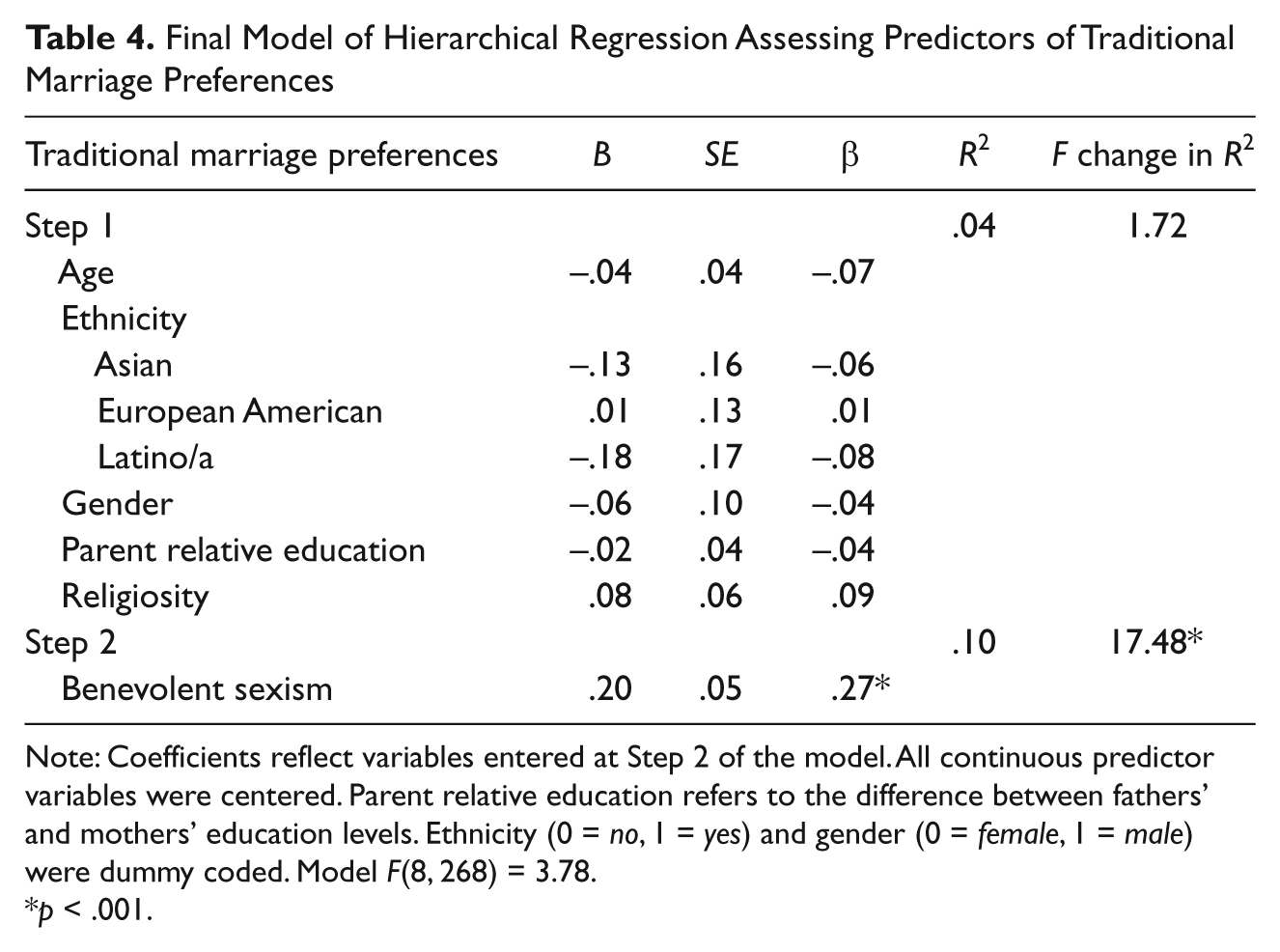
Note: Coefficients reflect variables entered at Step 2 of the model. All continuous predictor variables were centered. Parent relative education refers to the difference between fathers’ and mothers’ education levels. Ethnicity (0 = no, 1 = yes) and gender (0 = female, 1 = male) were dummy coded. Model F(8, 268) = 3.78.
p < .001.
Discussion
The present study had two goals. First, we sought to provide insight into the reasoning behind emerging adults’ preferences for two marriage traditions: marriage proposals and surname changes. Second, we examined whether there was a link between traditional marriage preferences and benevolent sexism. Below, we detail our main findings and discuss how they speak to gender-related power differentials in heterosexual romantic relationships. We close by highlighting several limitations and directions for future research.
When we asked women and men to discuss their marriage-tradition preferences, we observed several notable patterns. With regard to proposing marriage, none of the participants said that they would “definitely” want a nontraditional proposal. The most commonly cited reason for wanting the man to initiate the proposal was a desire to adhere to gender-role traditions. Likewise, the majority of participants held traditional name-change preferences. As with the marriage proposal responses, desire to adhere to gender-role traditions was a frequently cited justification. This finding accords with prior research on adults’ cited preferences for marital name changes (Lockwood, Burton, & Boersma, 2011; Twenge, 1997).
Given the prevalence of liberal attitudes among students at the university where data collection took place, it is striking that so many participants held traditional preferences. Even more surprising is that many participants overtly stated that their preferences were driven by a desire to adhere to gender-role traditions. In this regard, the present study’s findings join a growing body of research suggesting that heterosexual romantic relationship scripts are especially resistant to gender-role change in society (Eaton & Rose, 2011; Morr Serewicz & Gale, 2008; Rose & Frieze, 1993).
The present study also tested for links between benevolent sexism and marriage preferences. In the first step of the regression model, we controlled for background variables (age, gender, ethnicity, father–mother educational disparity, and religiosity). As hypothesized, benevolent sexism emerged as a significant predictor of traditional marriage preferences after controlling for these factors. Indeed, it was the only significant predictor in the model. This finding builds on past research that has tied benevolent sexism to heterosexual-dating scripts and courtship behavior (e.g., de Lemus et al., 2010; Viki et al., 2003) by demonstrating that the connection between benevolent sexism and gender-typed relationship practices can be observed beyond the early stages of a relationship.
Marriage Traditions and Gender-Based Power Differentials
Having established a link between benevolent sexism and marriage-tradition preferences, we will now explore the implications of this finding. As explained in the Introduction, benevolent sexism can be conceptualized as a manifestation of hidden power, a subtle form of power that stems from entrenched institutional practices that go unquestioned (Knudson-Martin & Mahoney, 1998; Komter, 1989; Lukes, 1974). Moreover, past research has drawn connections between benevolent sexism and power differentials in heterosexual romantic relationships (Lee et al., 2010; Viki et al., 2003). Hence, the finding that benevolent sexism predicts marriage-tradition preferences implies that certain features of marriage traditions may reflect gender-based power differentials.
Several of the themes that emerged in participants’ responses to questions about their marriage preferences provided insight into the relationship between marriage traditions and gender-based power differentials. For example, among women, the most common response to the last names question was devotion and family unity. Women who provided this rationale said that they would like to change their last name to that of their husband because doing so demonstrates devotion to their husband and/or promotes family unity. For instance, one woman explained that she would like to take her husband’s last name because doing so is “an expression of your love for one another, and shows everyone that you are devoted to that certain individual.” Spousal devotion and family unity are both desirable, but it is telling that women are typically responsible for making the change that theoretically leads to these outcomes. Such a pattern is consistent with research showing that women are more likely than men to accommodate to the needs of their spouse, which has been attributed to men’s hidden power (Knudson-Martin & Mahoney, 1998; Walker, 1996).
Other researchers have called attention to power differentials in heterosexual romantic relationships by noting that gender-role socialization contributes to men feeling more comfortable making decisions and women feeling more comfortable reacting to these decisions (Rose & Frieze, 1993). Indeed, two themes derived from responses to the marriage-proposal question, fear of rejection and desire to decide, closely parallel the proactive–reactive distinction. For example, a woman said that she would not propose because “I don’t wanna get shot down! Same reason I wait to be asked on dates and kissed; don’t wanna come on too strong.” This woman’s reluctance to propose seems justified when juxtaposed with responses from men who emphasized the value that they place on initiating the proposal. As a man commented, “I want to be the one to make my own serious decision if I am going to be with [her] for the rest of my life.” Of course, a woman who is proposed to also makes a serious decision when deciding whether to accept, but it is ultimately still the man who decides when and where the proposal occurs.
Limitations and Future Directions
Our study constitutes one of the few investigations into emerging adults’ attitudes about marriage-related traditions, especially as they pertain to marriage-proposal preferences. We encourage other researchers to build on our work. Accordingly, we will discuss several limitations and highlight corresponding directions for future research. First, it would be worthwhile to examine marriage-tradition preferences in older samples. Our sample was composed of undergraduates with a mean age of 19 years; thus, it is likely that most of our participants were several years away from seriously considering marriage themselves. Moreover, we did not collect data on participants’ involvement in committed romantic relationships, which is a factor that could play an important role in marriage-related attitudes. That being said, it merits noting there are similarities between our results and previous research conducted with participants who were already married (Boxer & Gritsenko, 2005). Hence, it may be the case that marriage-tradition preferences do not undergo substantial change as marriage becomes an increasingly self-relevant possibility.
Our second recommendation for future research is to conduct longitudinal studies that aim to elucidate the causal relationship between benevolent sexism and marriage-tradition preferences. On the one hand, benevolent sexism typically emerges during early adolescence (Glick & Hilt, 2000) before youth become involved in long-term romantic relationships. On the other hand, researchers find that even young children are aware of traditional heterosexual scripts (Thorne & Luria, 1986). Thus, it may be that benevolent sexism and marriage-related preferences are interrelated and emerge in tandem.
Third, we propose further exploration of the association between religiosity and marriage preferences. Our measure of religiosity mainly pertains to the Judeo-Christian faith and therefore may not have been applicable to participants of other religious backgrounds. In addition, it is important to consider the distinction between strict fundamentalist religions that are highly patriarchal and more reformed religions that are relatively gender-egalitarian (Hunsberger, Owusu, & Duck, 1999; Kirkpatrick, 1993). Hence, a more refined measure of religiosity may be useful in future research.
There were also several other important background factors not examined in the present study that may prove revealing in future research. For example, it would have been useful to control for parent marital status because it has been linked to emerging adults’ romantic relationship preferences (Whitton, Rhodes, Stanley, & Markman, 2008). We also did not account for social and political values such as feminist ideology, which has been identified as a predictor of women’s name-change preferences in past research (Hamilton et al., 2011; Hoffnung, 2006; Twenge, 1997).
A final suggestion for future research is to consider whether the present study’s findings extend to lesbians, gay men, bisexuals, and other sexual minorities. Lesbian and gay couples may legally marry in some countries and in a few states within the United States, and the question of how these couples negotiate marriage-related traditions is underresearched. In one of the few studies addressing this topic, Clarke, Burns, and Burgoyne (2008) found that some lesbian and gay couples struggled to balance their motivation to portray themselves as a family (i.e., through having the same last name) with their desire to reject heteronormative romantic relationship practices. Future research should further examine how same-sex couples navigate these competing desires.
In conclusion, the results of the present study suggest that traditional marriage preferences are quite prevalent during the early stages of emerging adulthood. Moreover, an overt desire to adhere to gender-role traditions is a common justification for holding traditional preferences. Hence, despite rapid gender-role change across many domains of Western society, marriage traditions remain a stubborn vestige of relatively strict gender-role adherence (Eaton & Rose, 2011). As West and Zimmerman (1987) noted, “Some occasions are organized to routinely display and celebrate behaviors that are conventionally linked to one or the other sex category. On such occasions, everyone knows his or her place in the interactional scheme of things” (p. 139). The present study also established a link between benevolent sexism and the participants’ marriage-tradition preferences. This finding implies that gender-based power differentials may underlie some aspects of marriage traditions. Our hope is that the findings of the present study will spur heightened attention to marriage traditions and other heterosexual romantic relationship practices that have the distinction of being both ubiquitous and seldom questioned.
Footnotes
Author’s Note
Preliminary findings from this study were presented at the 2010 Gender Development Research Conference in San Francisco, California. We thank Timea Farkas for her comments on an early version of this paper. We also thank Ashley Hyde-Smith and Daniel Nissenbaum for their help with the coding.
Declaration of Conflicting Interests
The author(s) declared no potential conflicts of interest with respect to the research, authorship, and/or publication of this article.
Funding
The author(s) disclosed receipt of the following financial support for the research, authorship, and/or publication of this article: This research was funded by NIH predoctoral training grant T32 HD46423 to the first author and by grants to the second author from the Academic Senate and the Social Sciences Division of the University of California, Santa Cruz.