







Abstract
In this article, we examine the roles of Coleman’s social capital in university attendance among Cambodian young adults, utilizing grounded theory that includes in-depth interviews with 10 purposefully selected third-year university students. Results indicate that self-motivation, parental expectations, extended family assistance, mentors’ assistance, sibling inspirations, and social norms serve as student-acquired resources that facilitate university attendance. Under Coleman’s framework, numerous studies concentrate on the role of authoritative figures (e.g., parents or parents’ networks) in children’s developmental trajectories, viewing parents as sole distributors of resources to children whose outcomes depend on what they receive—in the absence of which, their positive developmental outcomes would be negated. This study, however, provides further evidence that children are capable of assisting each other, motivating themselves, and overcoming adverse social norms to help them advance academically, in the absence or lack of parental attention and/or involvement. This study suggests that individuals’ self-motivation be integral in social capital concepts.
Studies on students’ decisions to attend university have been well-documented. Factors such as students’ own academic performance in high school (Hossler & Stage, 1992; Manski & Wise, 1983; Rouse, 1994), their quest for personal and intellectual development (Côté & Levine, 2000), college aspirations (Cabrera & La Nasa, 2001; Martin, Galentino, & Townsend, 2014), and their motivation to prove their self-worth that they can succeed in college (Guiffrida, Lynch, Wall, & Abel, 2013; Phinney, Dennis, & Osorio, 2006) have been found as predictors for university attendance. Parents’ expectations for college and involvement (Cabrera & La Nasa, 2001) and family obligation (Phinney et al., 2006; Sánchez, Esparza, Colón, & Davis, 2010) have also been shown to predict university attendance. Besides these individual and family factors, studies have also shown the role of financial aid package availability (Domina, 2014; Linsenmeier, Rosen, & Rouse, 2006; Rouse, 1994), tuition rates (Heller, 1997; Hemelt & Marcotte, 2011; McPherson & Schapiro, 1991; St. John, 1990; Savoca, 1990), high school and college counseling programs (Belasco, 2013), and social media (Wohn, Ellison, Khan, Fewins-Bliss, & Gray, 2013) in university aspirations, attendance, and retention. However, to date, there have not been any studies on factors associated with university attendance among the Cambodian population. Based on social capital theory, the study attempts to delve into various intangible resources embedded within family, community, social context, and the network of relationships among these various contexts that the students utilize to help them to get into and remain in a university.
Cambodian Educational and Cultural Context
The most recent demographic data from Cambodia indicate that only 1.9% of the female and 4% of the male population aged 6 years and older attain more than 12 years of education (National Institute of Statistics, Directorate General for Health, & ICF Macro, 2011). That same level of educational attainment among the male population is remarkably lower for rural residents (1.3%) than for their urban counterparts (16%); for the female population, the rate for rural residents is also lower (0.5%) than their urban counterparts (7.9%). The latest figures show that only 1.76% (or 246,033) of the total Cambodian population (14 million) were enrolled in higher education institutions in both public and private, in the 2012-2013 academic year, ranging from 2-year college to doctoral levels (Hang, 2014). The present study seeks to examine students in the 1.76% group who have already enrolled in university in order to understand social capital–related factors that have helped facilitate their universities attendance.
Cambodia, similar to other Southeast Asian countries, has a tradition of staying connected with the wisdom and experiences of elders, whether they are still alive or are already deceased (Smith-Hefner, 1993). In addition, nuclear and extended family ties have been traditionally viewed as the most important sources of social capital in Cambodia, with relationships outside of the family given less regard (Colletta & Cullen, 2000). Approximately, 80% Cambodian elders share a home with at least one of their children (Knodel, Kim, Zimmer, & Puch, 2005). This tendency is stronger in rural provinces than in the capital city of Phnom Penh. In Phnom Penh, however, younger relatives from rural provinces are commonly sent to live with family members in the city in order to have access to better educational opportunities in the city.
Cambodia’s recent traumatic history cannot be ignored as it shapes the way parents socialize their children. Rousseau, Drapeau, and Platt (1999) described “children and grandchildren of the survivors of the massacre, who inherit the implicit obligation to succeed for the sake of those no longer among the living” (p. 1270). Campbell (1992) interviewed Cambodian women who had been through the genocidal regime and found that the women expected that their children would succeed to bring back family dignity lost during the war. A Cambodian lullaby titled “Sleep Well My Child,” which mothers or grandmothers sing to children, may exemplify this compensation pattern.
Sleep well my child. We have gone through three fields. The field of death, the field of chains and prison and the field of remembrance. My child you should remember this. The regimes of separating and killing. You should remember and must never forget. If you want your country to live study hard, cooperate and gather together. (Mitchell, 2005)
While certain resources involving personal and family factors can be available to some students in Cambodia, institutional resources such as student loans, subsidized housing in dormitories, and financial aid can be extremely limited in the Cambodian educational context. Therefore, the question is, given the limited amount of institutional resources and support, limited parental education, and general poverty in Cambodia, what are other resources that students use to help facilitate their journeys to university?
Theoretical Framework
This study considers two closely related approaches that can be used to explain developmental outcomes of adolescents from sociological and human development approaches: Coleman’s social capital and Bronfenbrenner’s human ecological model, with stronger emphasis given to the former. Within human development literature, it is well established that children are active agents who are capable of influencing their own development within the various contexts in which they are embedded. Bronfenbrenner’s (1999) theory of ecology of human development is perhaps the most cited in human development literature, stating that “human development takes place through processes of progressively more complex reciprocal interaction between an active, evolving biopsychological human organism and the persons, objects, and symbols in its immediate external environment” (p. 5). The theory further elaborates that the way in which development is affected varies considerably depending on
the characteristics of the developing person, the environment—both immediate and more remote—in which the processes are taking place, the nature of the developmental outcomes under consideration, and the social continuities and changes occurring over time during the historical period through which the person has lived. (Bronfenbrenner, 1999, p. 5)
Bronfenbrenner’s framework, therefore, suggests bidirectionality of human development in that children and adolescents co-construct their educational experiences and aspirations in various contexts in which they are embedded.
In sociology theory, however, the way in which a developing person is shaped by or influences the context is not well understood, and therefore, this present study seeks to provide an explanation on the role individual persons play in acquiring resources within the various contexts. Coleman’s (1988) social capital is perhaps the closest attempt in sociology theory to bridge between individual and structure. While social structure is the core principle of social capital, Coleman also considers the importance of relations between actors and among actors, depending on its function, that lead to the creation of certain resources within the social structure. Coleman’s view on actors takes more than just an individual person form, but extends to considering purposive organizations also as actors (or corporate actors) in which relations among these organizations will result in information sharing and social networks that will produce an outcome of interest for these entities. Coleman’s social capital, therefore, places a great emphasis on “relations” among actors or social organizations in the creation of other forms of capitals: human and instrumental.
While the “relations” concept is central to social capital, studies utilizing this theory have heavily focused on the sole role of social structures in individual persons’ outcomes, which is unidirectional rather than relational. Studies have been well-established within social capital literature with the focus placed on the role of authoritative figures (parents, teachers, or important adults in children’s lives) in children’s developmental outcomes. These studies view parents as sole distributors of resources, attention, and expectations, and children as passive beings whose outcomes depend on what is available to them—in the absence of which, their positive developmental outcomes would be negated. For instance, studies have found an association between parental involvement (often conceptualized as social capital) and students’ college aspirations and actual college attendance (e.g., Hossler, Schmit, & Vesper, 1999; Perna, 2000; Perna & Titus, 2005; Sandefur, Meier, & Campbell, 2006; Swail & Perna, 2001; Tierney, 2002). Perna and Titus’s (2005) research “supports Coleman’s (1988) conceptualization of parental involvement as a form of social capital that promotes college enrollment by conveying norms and standards” (p. 507). The fact that parental involvement conveys norms and standards discounts the central concept of “relations” between parents and children. In fact, parents are seen as sole distributors of resources (e.g., involvement) such that the opportunity for their children to attend college depends on the amount of resources their parents are able to provide them.
Although Coleman’s concept of social capital acknowledges the balance of structure-individual actor linkage, well-established measures of social capital are primarily based on the former—the social structure—where actions governed by authoritative figures such as parents, teachers, and important adults surrounding a child’s life and family structure (e.g., Coleman, 1988; Crosnoe, 2004; Furstenberg & Hughes, 1995; Teachman, Paasch, & Carver, 1996) facilitate children’s developmental outcomes. These measures, even the ones used by Coleman himself (e.g., number of children, parents’ college expectations, and parents’ marital structure), seem to treat these figures as exclusive distributors of attention and resources, and children as receivers whose outcomes depend on their parents—in the absence of which their positive developmental outcomes would be negated.
For example, while Coleman (1988) argued “younger sibs and children in large families have less adult attention, which produces weaker educational outcomes” (p. S112), this present study, based on grounded theory method, attempts to show that older siblings provide not only social, emotional support but also academic support and guidance that pave the way for the younger ones to follow and be successful in their educational journey. Thus, rather than viewing parents as solely attention distributors and children as receivers, this study seeks to provide further evidence that children themselves are capable of assisting each other in the absence or lack of parental attention and/or involvement.
Questions remain unanswered within the social capital framework as to the extent to which only certain members of the family are able to capitalize on resources when they are equally available for every member of the family. Specifically, in a family where the parents share equal college expectations and their extended family networks are equally supportive for all children, why would certain members remain academically disadvantaged and others advance academically? This necessitates a close examination of the role of individuals as active human beings in creating and capitalizing on resources that are readily available to them within their environment. This perhaps provides further support to studies that show mixed or reversed results based on social capital measures used in their study (Büchel & Duncan, 1998; Furstenberg & Hughes, 1995). Furstenberg and Hughes (1995), for example, found in some cases “a few measures showed effects the reverse of those expected” (p. 589), which necessitates additional evidence in terms of the multidimensionality of social capital measures. To balance structural-individual linkage of the social capital concept, the role of individual persons in navigating toward and negotiating for social capital within their social environments needs further examination.
The Current Study
Based on in-depth interviews with students from different socioeconomic backgrounds and from different parts of Cambodia who have already made their way to university, this study examines various social capital–related factors that help enable these students to advance academically. This study explores the ways in which these students capitalize on various resources, from within their own family, extended family, or other social networks, and norm-embedded values to help mobilize them on the social and academic ladder. Based on grounded theory, this study also attempts to show that individual beings are central in the social capital concept as it signifies a bidirectional relationship between and among actors to facilitate certain actions—a concept that is missing the current social capital literature.
Method
The present study used a grounded theory approach. Grounded theory seeks to examine/understand social processes through the understanding of patterns and relationships that relate to causes, contexts, contingencies, consequences, covariance, and conditions within social processes (Strauss & Corbin, 1998). As student success had not been sufficiently studied within the Cambodian culture, the authors found the use of grounded theory particularly relevant for several reasons: the question of process (why/how students succeed to the point of university-level study), spheres of influence and various roads to success for students, and finally discerning within patterns of success, the practical implications for practitioners that would inform culturally appropriate approaches to encourage success.
Participants
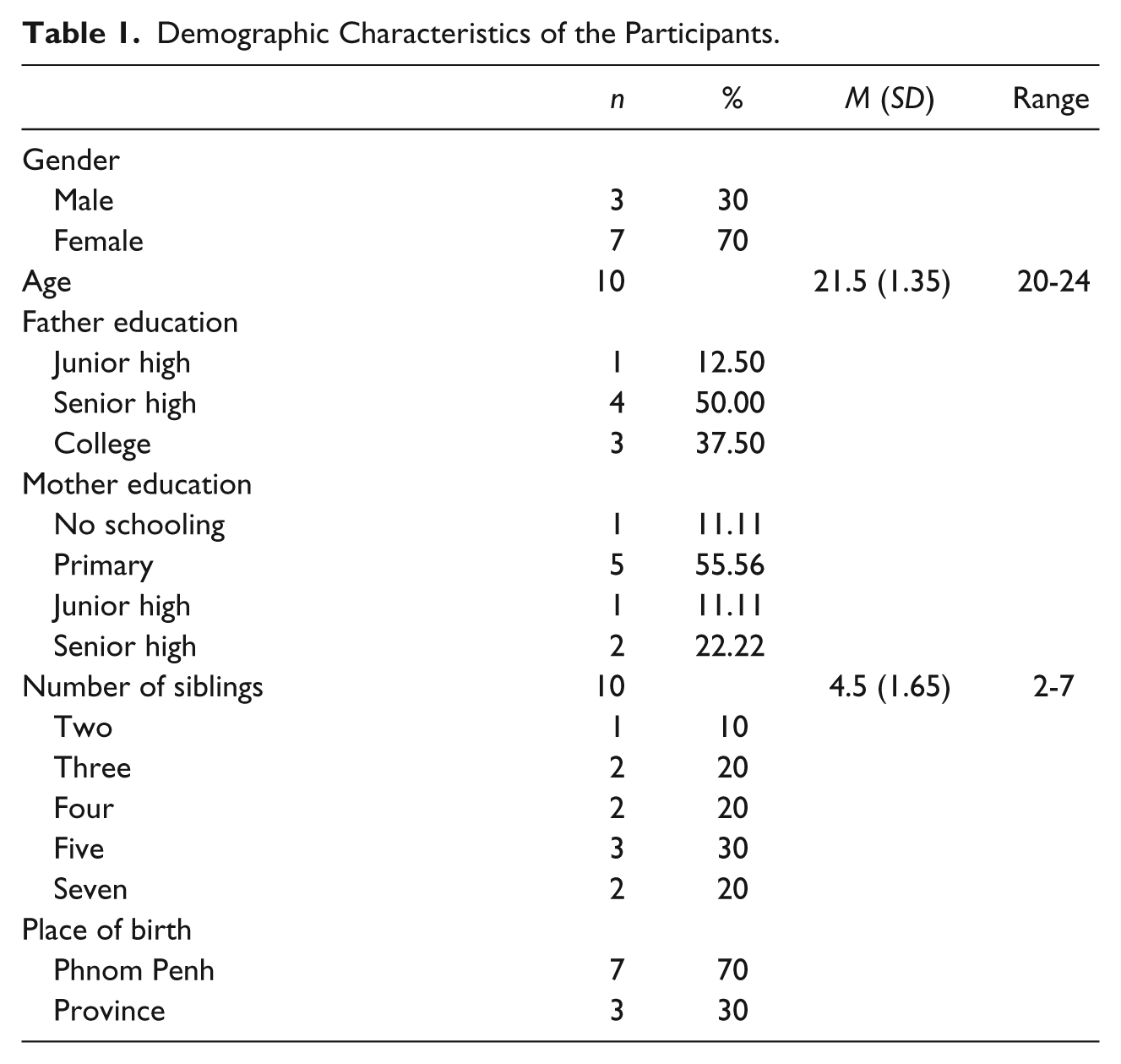
The 10 students interviewed were from a psychology department. These students were recruited through departmental contacts at the university (see Table 1 for demographic characteristics of the students). Sampling was purposeful (theoretical), as recommended for grounded theory techniques on specific populations that aimed to formulate theory, allowing for the selection of participants based on the emerging analysis and theory being developed from the data (Corbin & Strauss, 1990). The sampling frame was full-time students at one large public university in the capital city of Phnom Penh. The student sample was selected to include representation of students based on original place of residence (rural vs. urban areas). While residence in the capital city is associated with higher educational obtainment (e.g., Chealy, 2009), in the process of data collection, we decided to purposefully include students whose families were not from the capital city. This allowed us to understand resources that the students used to help them to pursue a degree at a university where dormitories are not available and investigate if differences in challenges and support systems were reported between urban and rural students. Such a specification of the sampling frame was an intentional decision, as recommended by Barbour (2001), in order to provide sample coverage and a framework for analysis. This further aligns with suggestions by Guest, Bunce, and Johnson (2006) concerning the creation of a participant pool that was focused on narrow selection criteria in nature.
Demographic Characteristics of the Participants.
Much has been written concerning educational reform needs in Cambodia (e.g., Ayres, 2000; Chealy, 2009; Rany, Zain, & Jamil, 2012; Tan, 2007). For the purpose of this study, the authors chose to interview only psychology students from one public university. By making this part of the sampling criteria, entrance requirements, differences between public/private universities, and government supplements to students were thus held constant. These were important considerations, as these factors vary between departments and from university to university (e.g., Rany et al., 2012; Velasco, 2004). It was felt that such variations between departments and/or universities could thus impede theory development. The university selected to participate in the study is known throughout the country for the high quality of education provided, historical roots, and, comparatively speaking, the foundational, government-recognized research focus (e.g., Chealy, 2009; Rany et al., 2012).
Strauss and Corbin (1998) noted that highly selective sampling is important in grounded theory. While past sample size suggestions for grounded theory have ranged from six to 30 participants (e.g., Creswell, 1998), the deciding factor in grounded theory is that the sample needs to be large enough for saturation (e.g., Strauss & Corbin, 1998). This occurs when categories are well defined, and no new variation is discovered (e.g., Glaser, 1978; Strauss & Corbin, 1998). Guest et al. (2006) found that, in studies where the author(s) possess(es) cultural competence, a degree of expertise in the area of inquiry, homogeneous factors related to a narrow participant group and the focus of research is fairly narrow, the sample size needed to reach saturation in grounded theory studies could be small. Based on the findings and initial coding, a total of 10 participants were interviewed for this study. Malterud (2001) noted that larger samples can actually deter from the research process; amount of material might become a hindrance, resulting in superficial analysis as the researchers would not be able to test for reflexivity and consider counterhypotheses.
Procedures
During data collection, students were asked to discuss their life, including how and why they attended the university, what kinds of help they had along the way, any barriers they faced, how they prepared themselves academically, their current lives, how they met their daily needs, sources of social support, and about their relationships with both their families and with people outside of their families. They provided basic demographic information about where their families lived, residential patterns as a university student, their parents’ education, and what their families expected of them. Expectations were shared in terms of their academic progress, their support for other family members, and their long-term goals. The interview guide was developed by our research team based on questions raised during data collection for a prior study of Cambodian high school students and their parents. The prior study was quantitative and left the authors wishing for more in-depth information concerning process, outcome paths, and measurements of success.
During the interview period, we pursued research transparency through a variety of techniques. Research trustworthiness was sought by consulting with the chair of the psychology department of the Royal University of Phnom Penh. As an experienced qualitative researcher, she acted as a peer debriefer (Lincoln & Guba, 1985) offering guidance/feedback on sampling criteria, memoing, emerging data, cultural appropriateness related to the study topic, and interviews throughout the collection period. Although a peer debriefer is not required in grounded theory research as a frequent consultant during the data collection process, her feedback concerning the interviews helped refine a more precise focus for the study.
Interviews were audio recorded by the primary author of this article in his native Khmer and were later translated by the primary researcher into English for coding. A second round of comparison of the original recordings and transcript was conducted with each interview. Following this, a spot-check of interviews was conducted in which random sections of the translated interviews were back-translated and compared with the original Khmer interviews for accuracy. While no major translation issues were discovered, questions concerning the best use of precise language in English and differences in translation were resolved via discussion of the text in context (e.g., Esposito, 2001; Twinn, 1997). Interviews were approximately 60 minutes in length, with the most in-depth interviews lasting up to 1½ hours. A total of 10 translated/coded interviews were used to derive research findings.
Steps were built into the study to help insure the ethical treatment of participants and data collected. Participation was voluntary and confidential; each individual who opted to participate was free at any point in the study to conclude participation in the project. Before individual data were collected, each participant was given an informed consent, in Khmer, providing a general overview of the project. This study was approved by an institutional review board. Questions concerning the data collection process, analysis, and confidentiality were fielded prior to and at the time of participation. The participants were provided with contact information for the first author, allowing them the opportunity to contact the researcher at a later date if desired.
Data Analysis
Coding of the translated interviews was initially completed by a co-author of this article with experience in qualitative methods and extensive overseas experience working with other Asian cultures (though not specifically Cambodian). Notes relating to issues associated with reflexivity were taken by the primary and secondary coders throughout the data collection and analysis process. After initial coding was complete, the coder met with the primary author/translator to clarify any culturally dependent points and to discuss initial categories derived from the coding process. After each category was discussed and considered, categories were reviewed extensively by all three authors through a series of discussions focused on categories and cultural influences possibly related to each of the categories.
Coding was based on three phases: open, axial, and selective coding with memoing occurring throughout the coding process (e.g., Corbin & Strauss, 1990). The first of the three phases of coding established by Corbin and Strauss (1990) was open coding. In open coding, data were organized and compared to evaluate for similarities and differences prior to being conceptually labeled. Categories and subcategories were then developed based on the coded concepts. Concepts were based on words, sentences, and phrases. The concepts were then grouped into categories (abstract or concrete) and were compared with each other in relation to dimension and properties. For example, the category “student success” was developed. Student success included, among other examples, how students viewed success, how their families and community viewed success, and characteristics of success.
The second coding step was axial coding (e.g., Corbin & Strauss, 1990). At this step, categories were investigated in relation to subcategories’ relationships and then tested against data. Once the central phenomenon had been identified, data were identified to find what caused the phenomenon to occur, what strategies or actions the participants used in response to the phenomenon, what the context did to influence the strategies, and what the consequences were of the strategies employed. At this stage, the categories were further developed and the systematic variations of phenomena were investigated. Expanding on the original example from our study “student success,” at this point, encouragement, hindrances, and challenges to success were more deeply investigated.
Finally, selective coding was performed (e.g., Corbin & Strauss, 1990). At this stage of the coding, categories were centralized around core categories that required further clarification/explanation. In the analysis of emerging categories, the authors faced questions such as how to explain variations between/among categories and what new information was gleaned in light of the analysis. Building on the “student success” example provided throughout this section, an example here would be the role that students attributed to peers in their success.
After the interviews were completed, coded, and analyzed, trustworthiness was confirmed via member checking (e.g., Lincoln & Guba, 1985). Four of the participants, representing the rural/urban and male/female student experiences, rated the results of the interpretation on a scale of 1 to 5, where 1 indicated strongly disagree and 5 strongly agree. The results were read out loud to the participants and they were asked to evaluate how credible the interpretations were. Each participant selected the rating of 5.
Results
The purpose of the present study was to explore factors that facilitate the journey to university among students in Cambodia. Against the backdrop of the systematic devastation by the Khmer Rouge, including the eradication of the educated classes in the mid 1970s, students described ingenious uses of resources, their self-determination, and the development of social capital in order to achieve higher education. The results are structured based on five main themes including (a) self-motivation, (b) social norms, (c) assistance of extended family, (d) assistance of mentors, and (e) sibling inspiration.
Self-Motivation: Family and Self
The majority of the students (eight out of 10 students) mentioned self-motivation as a reason for their decision to attend university. Their self-motivation was driven by two interdependent forces: by family expectations and by themselves, who made their own decisions whether or not to attend university. For example, Participant 2 (P2) saw her motivation as a result of her father’s expectation for her to attend university:
Firstly, I would say my personal factor. I myself want to study and want to know, because when I was young, my father kept telling us that by getting higher education, we can work in the office and can earn good money. Secondly, I would say my parents’ factor . . . My father pushes and encourages us to go to school a lot. So we cannot stop.
A 22-year-old female, P9, echoed P2, noting,
The reason that I study every day is for them [my parents]. Like they don’t have high education, so they have to try to get their children to university. They say if there are opportunities for me to study, I have to do so.
The role of parental expectations was also stated by P3, a 22-year-old female:
Because I want to follow my dad’s purpose. When I was young, my dad encouraged me to study a lot. He positively reinforced when I did well at school. He advised me to study so that I would be better off in the future. He had a big plan for me. He said if he did not have enough money for me to continue to university, he would sell a piece of land to support my schooling. He did not see me come to university though. He died before I came to university. And I love him the most.
P7, a 20-year-old female, also mentioned the influence of her father on her decision to come to university, noting, “He wants me to study in university even if we don’t have any money. In the worst case, he will borrow money from others for his children to study. Or he sells something just for his children to study.”
However, some participants also mentioned how their siblings failed to follow their parents’ expectations. At this point, the participants stressed the role of one’s self-motivation in addition to their parents’ expectations as the ultimate driving force leading them to university. When asked whether her parent only encouraged her, but not her siblings, to continue to higher education, P3 said,
He did the same thing with all of my sisters. My other sister did not continue after she finished high school because she wanted to get a job and was thinking that she could come back to school anytime later on. So our dad finished his advice to you once you finished high school, and this is your time to think to yourself whether you want to continue to university or not. You know they cannot force us to continue schooling. If we stop here, it will end here. Now I am by myself (thinking and stuff).
Similar to P3, P9 noted regarding her parent’s college expectations of her sister, “My mom wanted her to go to college, but she said that she would rather stay at home and try to earn money to support her others siblings to go to school instead.” For P9 herself, staying at home and doing business were not her preference, and coupled with her interest in further studies, she said, “So I have to come to university.” For P7, he compared himself with his sister who had no college education and brother with a college education, saying that “I think I am the only one who motivated myself to do things.” P4, a 23-year-old male, said, although his mother used to try to stop him from going to school as a punishment for his deviant behavior such as hanging out with a group of gangsters, he was determined to become a good person in order to keep himself in school:
I was unhappy when I heard she wanted to stop me from going to school. So then, I worked so hard at home, like helping her do some housework and I woke up early in the morning to go to school. Then, she allowed me to go to school again. You know my mom stopped me from going to school often. But I did not stop. For my brothers, when they heard my mom stop them from going to school, they would not go.
Furthermore, P1, a 24-year-old male whose first of three siblings stopped going to school when she was in Grade 7, said her parents wanted her to further her studies as far as she could, but she “decided to stop herself” because “she did not have any ability to study.”
Some of these self-motivated students emphasized their motivation to prove to people around them including their peers, parents, their relatives, and neighbors that they were capable of attaining social status. A 21-year-old male (P10), whose father left his mother for another woman and his mother later died, said,
I think it is my self-determination. I am really angry with people around me because they always look down upon me and they say “leaves never drop far away from the tree,” meaning that whatever the father is, their children will be similar to him. And I want to get away from this belief. You know my other relatives said that I will not be getting any better life. So I want to overcome this belief.
P1 wanted to prove to his peers who said that only very few can come to Phnom Penh for university after graduating from high school at their province, stating, “But I did not believe them, so I tried very hard to achieve. So this can be said that this is my self-determination factor that encouraged me to come to university.” This participant also continued to prove to his classmates that although his parents were poor, “now they can send their three children to come to Phnom Penh for university.” P9 linked her competition with other classmates as a way to prove herself being a good student, “Like when I tried to compete with someone, I actually gain higher scores . . . I just want to show other classmates that I am also good.” P4, who mentioned that he used to be a bad-behaving child and that his mother tried to stop him from going to school multiple times, said that now “my neighbors and relatives admire me a lot when I come home [to his province] each time. They all are very enthusiastic about my achievement. So this motivates me a lot.” His motivation to prove that he is a worthwhile person after behaving badly when he was in high school extends to his efforts in bringing all of his family members including parents and siblings to live with him and start a business in the capital city, Phnom Penh. He continued to mention that he even facilitated the reunion of his parents after many years of separation.
Social Norms
Students mentioned how going to university had become a fashion at the time they graduated from high school. P7 said, “I haven’t thought of anything. Just feel that I have to study and come to university because it depends on the time you are graduating. During the time that I finished my high school, students just headed to university.” She continued to mention shame associated with not having a university degree, “Look, all my friends are in a university, so I would be shameful if I do not go to university. At least I have a university degree like others.” A 20-year-old female, P6, whose family struggled with financial difficulty, had planned to work right after high school graduation in order to help alleviate her parents’ financial hardship. P6 remarked on the trend of going to university and how it is different between now and before:
You know my generation is different from my brother’s. He stayed home for about 2-3 years until he went to university. At that time it was likely that after graduation they are hopeless to find a job, so they didn’t have motivation to go to school. But my generation is different. You will see everyone goes to university after high school. It’s become a trend. So I have to go too . . . We have to follow them.
The establishment of private universities created a norm of an alternative type of higher educational institution that provided an opportunity for those who were less qualified to attend an alternative to public, tuition-free university. Before the creation of private universities in 1997, those who did not pass the national entrance exam had no chance to study in university unless they were able to put future plans on hold while waiting to retake the exam in a later year. If they still did not pass the exam, they would not be able to attend university. One student who did poorly (Grade E out of A-F, where F is fail) in her national entrance exam explained,
I got an E. So I cannot go to a public university directly. You know I wanted to take an exam to study at the Institute of Foreign Language, but I was not allowed to take the exam because I got an E grade on my high school exam. (P2)
Two participants (P4 and P6) who also did poorly in their national entrance exam found an alternative by enrolling in a private university, noting that their scores were too low to be admitted to a tuition-free program. One student saw private university as an easy alternative in which he did not have to take the exam, “I never wanted to take exam to come to university because I have money to pay for private university” (P1).
The norm associated with gaining social status through higher educational attainment is highly valued by the society. Students emphasized the values associated with being a university student, social status, and career opportunities after university graduation. One student said,
I am impressed with the university when I ride my bike across this university. You know at that time, people around my house had their children coming to the university, and I wanted to be like them. University students look cool, so I want to be called a university student. (P2)
Another student referred to the status of being a Niseth (or a university student in Khmer) saying, “I think my belief about being a Niseth is privileged and is respected by all people. You will look cool as being a Niseth. So that’s why I want to become a Niseth too” (P1). One student mentioned how he was usually looked down upon because his mother died and he had to live with a relative, said, “I expect that after graduating from the university, I can get a good job, and gain social status and money” (P10). Another student noted a norm that recognizes and values educated people, saying, “Because now the society values educated people, so when you finished university, you are going to be recognized” (P9).
The Assistance of Extended Family
Extended family members played multiple essential roles in students’ success in attaining entrance to and maintaining attendance in the university. Among these roles was the provision of physical help, including a place for the student to live while attending secondary school and/or university, making financial contributions to the student’s education, social networking to help the student gain admission to a chosen program of study, setting standards of achievement for the student, and providing employment. This theme emerged mainly among participants coming from a province outside of the capital city. For example, one student remarked,
Actually, I used to fail the high school exam. Then, my mom wanted me to stop going to school, but when my uncle in the city knew that, they asked my dad to get me to the city under their sponsorship. (P8)
The same participant further emphasized the encouragement from her aunt and uncle, “My aunt and uncle encouraged me to study until I graduate. They are happy and keep asking me about my study.”
Other students’ relatives provided housing and made them welcome, despite already having full houses: “Now I stay with my relative in the city, and I help them clean house and cook, and I give them only $10 a month” (P1). The important role of extended family assistance was further revealed when the participant mentioned about the challenges that he faced in everyday life living with his relative, but had to stay because there were no other alternatives. He said,
I feel like I am disappointed with my father. He should understand that living with other people is not comfortable. But why he did not decide to come to live in Phnom Penh? I used to live with others several times already. It is not good at all to live with others. In the future when I have kids, I will not let them stay with others. (P1)
The challenge that he mentioned was “my relationship with my aunt’s children is not good. We are not very friendly to each other. I talk to them whenever it is important to talk.”
Some participants whose houses were already in the city mentioned the assistance of extended family in a different way, mainly in financial support for tuition. One student said, “My uncle paid tuition for my first year . . . He helped me in other things like buying clothes for me, giving me meals, and money to take extra classes like English lessons” (P4). Another participant who lives in the city, where her mother is a vendor and her father is retired and stays home, mentioned the financial support from her grandmother who lives in the United States, “Without her help, I think it will be hard for me” (P6). Her financial difficulty was further mentioned when asked about her plan after graduation, “I want to continue my study if I am capable of doing so. I am not good at studying and I also have financial difficulty too,” suggesting that without the support of her grandmother, she would have extra difficulty remaining in school.
The Assistance of Mentors
When the participants were asked directly whether they had a mentor who encouraged them to continue their studies and to pursue higher education, each of them could name at least one individual who played a role in encouraging or assisting them to pursue higher education. Trends revealed included the predominance of fathers as mentors, the importance of the mentor’s level of education, and the dominance of male mentors for both male and female students. These trends are demonstrated in the following selected quotes: “My father pushed and encouraged us to go to school a lot. So we cannot stop” (P2). Another said, “he guides me a lot, like every second. When he sees someone who is good at something, he tried to tell me about that person. So when he is at home, he keeps advising his children a lot” (P7). Another student’s father died before she started university, but his influence continued to encourage her: “I think of my father. When I was in high school, he usually talked to me that in the future I should study this and that. So, it is only my father.” The same student noted,
Since I was young, my dad encouraged me to study a lot. He advised me to study so that I will be better off in the future . . . you know it’s been my dad since I was young who raised me to get a good education. (P3)
Females in particular noted that fathers were guiding forces or mentors in their lives. Yet others, both in and outside of the family, played roles in student’s lives. One student noted the role that her teachers played in mentoring her: “My teachers also told me about the advantages of education. They said that education is good for your future” (P2), while another student noted that older students who had already entered the university played the important role of advising her in which department to study: “I have senior students in the university who advised me to study psychology so it will be easy for me to get a job in the future” (P7).
Two students named their uncles as mentors. The first noted that her uncle was also educated. The second student studied in the department where his uncle was an instructor and noted that he both mentored the student and paid for school and other necessities. Only one student named any female other than a sibling as a mentor. The student lived with an aunt until ninth grade and stated that she went to that aunt first with problems and only later to her parents. Two students named siblings as mentors. The first had a sister who was a translator in a factory. She encouraged her younger sister to study and get a job in an office so that the younger sister’s life would be easier than hers. The other named his brother as “the smartest person in our house” (P6). Worth noting is the emphasis on honor given based on gender—the phrase that followed was “Moreover, he is male” (P6). He said he had tried to mimic his older brother and that his brother had helped him “along the way” by assisting in completing forms for school. “Most of the time he guided me . . . Now he is in Korea. When he calls, he still keeps asking me if I hang out too much” (P6). As indicated in the following section, siblings played a variety of roles in the students’ lives.
While father serving a role as a mentor resembles the notion mentioned in the first theme, parents as a source for self-motivation, they are two different concepts: the latter refers to just the general expectations of the parents that attach to the collectivistic culture where an individual is not separable from the family, and the former (father as a mentor) refers to the actual mentorship from the father (e.g., male as a role model). Mentorship plays a different relationship dynamic in which it involves trust and reciprocity between father and child. Mentorship is more dynamic and undergoes constant interactions and advice from the father to the child. In a sense, it is more of an active involvement from the father.
Sibling Inspirations
In four interviews, students indicated that they had at least one sibling who was also in college. One student noted that her family could afford to pay for other siblings to study, but no one had made that decision except her. Her two older sisters had studied through high school but had not continued, the three sisters after her quit after ninth grade, and her youngest sister dropped out of school after sixth grade. This same student explained how one of her sisters played an important role for her when she was in elementary school. The student asked her mother to allow her to quit school because other students were beating her up. Her mother refused, and an older sister protected her, allowing her to continue her studies. Physical protection from bullying was also provided by another female student’s older brother. A sister played a different sort of role in guiding higher education for another young woman.
I like psychopathology, kind of abnormal stuff because you know my sister may have this kind of problem. Before I came to the university, she may have had somatoform disorder. She was kind of sick frequently. We took her to Vietnam to treat her illness, but the doctor told us that she had not big problem and no need to worry about . . . Until now, she is still having this kind of problem. (P2)
This same student noted her desire to go into research after graduation in part to help support her family and in part to learn new things that would be useful to society.
Older siblings paved the way for younger siblings to study at the university. Some noted that financial assistance from older siblings allowed them to study at the university, while others noted that just seeing an older sibling achieve university status inspired them to also work hard: “Well, I also thought that if my brother can come to college, I also can come” (P1). While students varied on the types and amounts of influence siblings had on their lives, from positive to negative, the influence was seen clearly in the interviews. One student noted that her older brother would comment that she was more patient and worked more independently than before she started her studies. He also encouraged her often to “go play” with the Internet because he knew that this was a good skill for her to develop.
Discussion
The results of this study reveal that Cambodian students capitalize on various intangible resources within their immediate and extended family networks and community to help facilitate their university attendance. We see the strengths of these students in overcoming structural constraints placed upon them in terms of inadequate financial resources, and other structural opportunities that were available to them for their university transition. Their strengths were facilitated by multiple factors in the context in which they were embedded, where self-determination was central to their success.
While a common argument of social capital emphasizes primarily the role of parents’ expectations and involvement in their children’s education (e.g., Coleman, 1988), the present study suggests that individual motivation of children is also a central element, in the absence of which educational outcomes would differ. Although Coleman acknowledges the fact that social capital connects structure, individual agency, and the relationship between them in his theory, the former receives much more attention than the latter. For instance, the argument that the number of siblings in the family is found to be associated with increasing dropout rates because of less attention available to all children indicates the influential role of parents. Another perspective would be to treat children as active beings who are capable of motivating themselves to capitalize on available resources in other networks to help them mobilize upwardly in their educational journey. Although students in the present study come from the same family with the same parental expectations, only those who are self-motivated are able to use the social capital that is available to them within their immediate and extended family networks and other value-embedded norms to help with their university transition. In this case, parents’ expectations must be reciprocated with their children’s expectations for certain actions to be realized. This study’s results suggest that measures of social capital should be extended to including beliefs, attitudes, and expectations of an individual person in addition to the expectations and involvement governed by authoritative figures such as parents, teachers, and other important adults.
The current study potentially provides further support to Furstenberg and Hughes’s (1995) longitudinal study with 252 children of teenage mothers, that showed a complex relationship between social capital measures and various adolescent developmental outcomes (i.e., high school graduation, enrollment in college, labor force participation, stable economic status, avoided live birth, avoided criminal activity, and robust mental health) and in some cases “a few measures showed effects the reverse of those expected” (p. 589). Furstenberg and Hughes concluded that “despite its attractiveness as a general construct for a theory of adolescent development, social capital undoubtedly subsumed a number of discrete dimensions” (p. 589). In addition, the present study also adds to the findings by Büchel and Duncan (1998) with their German children sample that showed the weak/mixed support of social capital activities (e.g., social, cultural, political, sport events) of both mothers and fathers on children’s educational attainment, in terms of the complexity and multidimensionality issues of social capital. Measures used in both Furstenberg and Hughes’s and Büchel and Duncan’s study were mostly actions governed by children’s parents and networks within the community, but not on how adolescents perceived the actions and their reciprocity of those actions. Adolescents’ beliefs, attitudes, and expectations that mediate the capitalization of resources within the family and other social contexts facilitating their resilience should be considered as one dimension of social capital theory.
Siblings also played a key role in these young adults’ university transition in various forms, including providing physical protection from bullying, guiding a major of study and future research interests, paving the way for younger siblings to attend university, providing financial assistance and accommodation while at university, and serving as sources of inspiration that set a standard of achievement for the younger ones to follow. While Coleman (1988) argued “younger sibs and children in large families have less adult attention, which produces weaker educational outcomes” (p. S112), this present study suggests that older siblings provide not only social and emotional support but also academic support and guidance that pave the way for the younger ones to be successful in their educational journeys. More importantly, this study suggests the role of siblings, in addition to that of parents—the authoritative figure, in the guiding and facilitating of other siblings in the family to be able to adjust socially, emotionally, and academically. Thus, rather than viewing parents as solely attention distributors and children as receivers, this study provides further evidence that children themselves are capable of assisting each other in the absence or lack of parental attention and/or involvement.
Norm-embedded values such as the trend and popularity of attending a university, the prestige of being a university student, and the perceived prosperity associated with better employment opportunities with a university degree provide inspirations for the students to advance academically. While these are positive norms that help facilitate the actions, they primarily constitute the influence of social structure on individuals’ actions through conformity, leaving no room for explanation as to how individual persons act/react upon, or take action to challenge existing unfavorable norms to achieve certain outcomes. As shown in the present study, some of these students challenge some of the negative norms based on their self-determination attitudes to prove to themselves, their families, and their community that positive outcomes can be achieved through personal efforts. One student in this study, whose father left for another woman and his mother later died, said he has challenged the enforcing norm that was placed upon him, noting that he was angry and wanted to overcome this social norm. Another student who lived in a province proved to his peers who said only very few can come to the city to study: “But I did not believe them, so I tried very hard to achieve.” He continued to prove to his classmates that, although his parents were poor, “now they can send their three children to come to Phnom Penh for university.” The other student, who challenged the negative norm associated with having separated parents, determined to advance himself to university and later successfully facilitated the reunion of his parents by having them live with him in his rented house. Coleman’s (1988) emphasis on norms that facilitate or sanction certain individual persons’ outcomes downplays individual persons as active human beings who are capable of seeking their own solutions to certain negative, prescribed norms. This study’s results clearly show that, even with adversely enforcing norms, these students were capable of navigating and challenging the social structure, and that they ultimately advanced themselves to higher education.
The present study demonstrates various social, intangible resources embedded in the family and within the community via social norms of valuing social status and higher education that students use to facilitate their university attendance, in the absence of structural opportunities such as the bank loans and dormitories to which American students typically have access. This study also contributes to social capital theory in that it adds the individual person element in his or her own quest for mobilizing himself or herself in the educational journey. This study weighs the balance between the role of structure and the individual actor linkage, where, when social capital is equally available to every member of the family, only those who are self-motivated will benefit more from the resources and view the resources as meaningful to them.
The present study also potentially adds to human development literature based on Bronfenbrenner’s human ecological approach as it provides specific mechanism to explain how or the way in which a developing person reacts, influences, or are shaped by their environment. What we know thus far based on human ecological theory is that “behavior evolves as a function of the interplay between person and environment” (Bronfenbrenner, 1977, p. 16); however, the specific mechanisms explored with the outcomes in this study had not yet been clearly explained. This present study suggests that under mesosystem (i.e., extended family support, fewer availability of the dormitories, fewer availability of university in rural provinces), exosystem (i.e., social norms that value higher education—Niseth), and macrosystem (i.e., the history of Cambodian genocide and struggling economic development at the societal level), individuals are able to capitalize on various resources to facilitate their university attendance through self-determination, proving oneself as capable being, creating social networks, being obligated to making family success, and providing support and protection toward one another (i.e., microsystem).
Strengths and Limitations of the Study
One of the strengths of the present study is also one of its limitations. As a qualitative study, it was able to gain rich data and explore areas that were not previously understood about the role of individuals as active beings in the creation of social capital. However, these findings have limited generalizability. The next step may be to develop quantitative measures that tap the issues raised by the participants in the present study, then to administer these measures on a broader scale to a more diverse group of Cambodian students and students of Cambodian ancestry living in other countries. Moreover, the overwhelming, most popular degree in Cambodia to pursue at both public and private universities is business; however, there is a slow growing acceptance of the social sciences and other programs (e.g., Ayres, 2000; Chealy, 2009; Rany et al., 2012). While the experiences of the students in this study may not be generalizable to all students pursuing higher education in Cambodia, it does provide important groundwork in theorizing student challenges, achievements, and success. It is possible that our findings might be particularly germane to students in fields of study outside the field of business.
Footnotes
Acknowledgements
The authors would like to thank Whitney Szmodis and Audree Chase-Mayoral for their thoughtful comments on earlier version of this article.
Declaration of Conflicting Interests
The author(s) declared no potential conflicts of interest with respect to the research, authorship, and/or publication of this article.
Funding
The author(s) received no financial support for the research, authorship, and/or publication of this article.