







Abstract
Intergroup attitudes of Muslim immigrant youth and native youth in the Netherlands were examined in relation to perceived parental socialization. Our aim was to gain insights into parent-child (dis)similarity in antagonistic and egalitarian attitudes and to understand differences between these two groups in this respect. Data come from qualitative interviews with 22 Turkish Dutch, Moroccan Dutch, and native Dutch youth (aged 16-22) who were prone either to intergroup antagonism (i.e., held hostile and negative attitudes toward out-groups) or to egalitarianism (held egalitarian attitudes). Interviews were analyzed using the constant comparison method. Results show that in the majority youth group, egalitarianism as well as intergroup antagonism were quite comparable across two generations. The attitudes of Muslim minority youth diverged more from those of their parents and appeared to be related to the pedagogic relationship between parents and children. Minority youth prone to antagonism perceived a lack of adequate parental responses to their negative experiences in the context of Islamophobia. Egalitarian minority youth reported that their parents were quite sensitive to their communications about perceived exclusion and that they responded with advice and support. Findings are discussed with reference to the social learning theory and the ethnic socialization strategies identified by Hughes et al.
Keywords
Adolescence is the time when youth develop personal, social, and political identities, and form new social relationships (Erikson, 1968). During late adolescence, in particular, attitudes toward ethnic or religious “others” (out-group members) develop (Vollenbergh, Iedema, & Raaijmakers, 2001). In this article, we focus on the two opposing positions that adolescents may adopt toward ethno-religious others: egalitarianism and intergroup antagonism. By intergroup antagonism, we refer to beliefs, attitudes, and behaviors (collectively referred to as attitudes) toward out-group members characterized by one or more of the following elements: hostility, superiority, mistrust, and rejection on the basis of ethnic or religious group differences. Alternatively, egalitarianism refers to out-group attitudes based on equality, viewing others as equal regardless of their ethnicity, culture, or religion. Importantly, egalitarianism should not be equated with the idea of uncritically accepting all differences (Nussbaum, 1997). This article aims to understand the development of intergroup antagonism as well as egalitarianism among Dutch minority Muslim youth in comparison with Dutch native youth, focusing on the relation with parental ethnic socialization as perceived by them.
Context: Polarized Intergroup Relations in Western Europe
There is reason to believe that teaching children about culture, religion, and intergroup relations has become an increasingly challenging task for parents in contemporary Western European societies (Pels & de Ruyter, 2012). Turkish and Moroccan immigrants and their children are the largest Muslims groups as well as the largest immigrant groups in the Netherlands (5% of the population; all non-Western immigrants are 13% of the population). The socioeconomic position of the Turks and Moroccans is disadvantaged compared with that of the Dutch majority, which is reflected in lower educational attainment levels, higher unemployment rates, and health inequalities (Maliepaard & Gijsberts, 2012). The socio-political climate of several Western European countries, including the Netherlands, is increasingly characterized by polarization (Van Bergen, Feddes, Doosje, & Pels, 2016), which has given rise to (perceived) intergroup conflicts that may eventually evolve into intergroup antagonism. It is likely that Muslim immigrant youth and their parents meet stigmatization or Islamophobia in the media, politics, and the other social contexts in which they interact (Velasco González, Verkuyten, Weesie, & Poppe, 2008). The native Dutch population has become more assimilative in its orientation toward migrants over the past 15 years; Islamic traditions are perceived as incompatible with mainstream values by over one third of the native Dutch population (Maliepaard & Gijsberts, 2012). Further, one out of two majority (i.e., native) youth reported having negative feelings about Muslims (Velasco González et al., 2008), and one out of three secondary schools reported fights between native youth and majority youth (Dutch Inspectorate of Education, 2007).
Research has shown that the intersecting positions of Muslim adolescents as minorities and Muslims vis-à-vis a mostly secular and sometimes hostile society indeed have an impact on their intergroup attitudes. For example, among Dutch Muslims, 72% believed that the majority of the natives held too negative opinions about Islam (Maliepaard & Gijsberts, 2012). Further, almost half of Turkish and Moroccan Dutch Muslim youth believed that Islam was under attack by modern society and was a focal point of political conflict (Slootman & Tillie, 2006).
Ethnic Socialization by Muslim Minority Parents and Majority Parents
It is likely that the climate of Western societies increases the complexity of child rearing by Muslim parents, in particular, with regard to educating children about culture, religion, and intergroup relations (Pels & de Ruyter, 2012). This climate shift may have a profound impact on their children, as parents have a pivotal position as a reference category, due to the dependency of children on their parents (Hughes et al., 2008). Research in Europe and the United States has shown that the intergenerational transmission of values and attitudes influences adolescents’ perceptions of intergroup relations and their susceptibility toward antagonism as well as egalitarianism (Degner & Dalege, 2013). Quantitative and qualitative research has shown that youngsters are more likely to voice democratic, egalitarian, and pro-diversity ideals if their parents have such ideals as well (Hughes et al., 2008; Iqbal, 2014; Miklikowska & Hurme, 2011). Furthermore, a quantitative meta-review of U.S. and European samples (Degner & Dalege, 2013) revealed that parental attitudes also have an impact on the development of their child’s antagonism and negative intergroup attitudes (e.g., prejudice, stereotypes, and discrimination); the parent-child correlation in the study was significant and had a moderate effect size (Degner & Dalege, 2013). Survey research among German, Belgian, and Dutch majority youth indicated that such similarity is also present regarding anti-immigrant sentiments (Vollenbergh et al., 2001), xenophobia (Duriez & Soenens, 2009), and right-wing extremism (Gniewosz & Noack, 2006).
Interestingly, Degner and Dalege (2013) showed that children in high-status majority groups tended to be more similar to their parents than children in low-status minority groups regarding factors closely related to antagonism (e.g., prejudice, bias, and discrimination). While youth of both native and immigrant families may develop antagonism, the underlying processes are likely to differ between and within these groups and deserve further examination. Due to power inequalities between the minority and the majority (based on numerical representation or socioeconomic (dis)advantage), the groups’ positions are shaped differently and unequally (van Osch & Breugelmans, 2012). For this reason, it is important to examine and understand the processes by which parent-child (dis)similarity in antagonistic views and egalitarianism differ across minority and majority populations.
Literature suggests that parental ethnic socialization is particularly important to the emergence of antagonism or egalitarianism in youth. Parental ethnic socialization refers to the processes by which parents pass on their values and ideals concerning ethnicity, race, culture, religion, and interethnic group relations to their children (see Hughes et al., 2008). According to Hughes and colleagues (2008), parents may use four ethnic socialization strategies to educate their children about intergroup relations: (a) cultural socialization (i.e., transmission of culture, cultural loyalties, and heritage), (b) egalitarianism (i.e., stressing that all humans are equal and sometimes combined with the idea that diversity is something valuable, also referred to as “pro-diversity”), (c) bias (i.e., emphasizing inequality and discrimination), and (d) mistrust (i.e., the message to be on your guard for the “other”). We aim to explore in which way these four ethnic socialization strategies underlie the manifestation of antagonism or egalitarianism among Dutch minority and majority youth.
In order to understand how (perceived) parental ethnic socialization influences the intergenerational transmission of out-group attitudes, social cognitive learning theory (Bandura, 1986) is also relevant. This theory suggests that parents provide their children with informative feedback and expressions through nonverbal and verbal communication. If children recognize their parents’ expressions and behaviors as meaningful and consistent with their own needs, these parental cues are subsequently cognitively processed and retained. In terms of the topic under investigation, social learning theory presumes that children learn their antagonistic or egalitarian attitudes toward ethno-religious “others” (and the concomitant motives, rationalizations, and attitudes) by observing the behaviors, expressions, and emotions of significant others, most notably their parents. However, adolescents will only adopt the attitudes of their parents if they perceive their parents’ expressions as meaningful. We, therefore, posit that the quality of the parent-child relationship is an important moderating factor of this process; that is, if parents and adolescents have a poor relationship, there will likely be less similarity between the attitudes of parents and children.
This article aims to obtain insights into the similarity or dissimilarity regarding antagonistic versus egalitarian attitudes of youth and their parents, as perceived by them. We focus on Muslim minority and native youth. Based on the literature, we expect to find more similarities between the attitudes of majority youth and their parents, as they perceive them, compared with minority youth. We will consider our findings in the light of the social learning theory and the ethnic socialization strategies identified by Hughes et al. (2008).
Method
Research Procedures
This study concentrates on the analysis of in-depth interviews with a subset of participants in a survey focused on intergroup antagonism among youth of Turkish, Moroccan, and Dutch descent. The survey was distributed in a digital version at 11 secondary schools from April until July 2011. To increase the pool of minority youth, the survey was subsequently dispersed through two websites that function as community platforms with news, forums, and dating services for youth of Moroccan and Turkish descent (see Maroc.nl and Hababam.nl). The introduction of the school survey and digital survey stated, “University researchers want to learn how youth of different backgrounds perceive each other.” For the in-depth interviews, we invited students who were between 16 and 22 years old, who had indicated their willingness to be interviewed, and who had scored either high or low on two or more of the following survey items: engagement in conflicts or fights for ethnic/religious reasons, a favorable attitude toward violence in defense of the in-group, feelings of in-group superiority, and a social distance to out-groups (all important to antagonism, see Doosje, Van den Bos, Loseman, Feddes, & Mann, 2012; Van Bergen et al., 2016). Youth were interviewed in 2012. The study did not include parents, but investigated parental ethnic socialization as perceived by youth. The interviewer was a woman of Dutch descent (first author), who was trained in interviewing minorities on sensitive topics. The interviews lasted between 40 and 120 minutes, and took place in a lunch café, school, or in a park.
Sample
From possible survey respondents, we interviewed the first 60 youth (20 of Turkish, 20 of Moroccan, 20 of Dutch descent) who agreed by informed written consent to participate and whose profile matched the survey criteria listed under “research procedures.” For this article, a subsample of 22 youth were selected for whom we established in the analysis of the interviews (coding, see procedures) that they were either prone to antagonism or held strong egalitarian views. Hence, interviews with 38 youth whose out-group attitudes did not fully match antagonistic or egalitarian attitudes were omitted from further analysis. Thus, we abided by procedures of “extreme case sampling” (Teddlie & Yu, 2007), which is conducted for the purpose of constantly comparing or contrasting cases that are maximally different from each other (i.e., extreme cases distributed within the spectrum of antagonism on the one end and egalitarianism on the other end). In borderline cases, all three authors discussed if these constituted a match with egalitarianism or antagonism, until consensus was reached.
In the analytic sample for the current study (N = 22), nine youth were of native descent (two Christians), eight of Turkish descent (all Muslims), and five of Moroccan descent (all Muslims). Two-thirds of the participants were male (n = 15). The majority of interviewees came from the school survey (n = 14). Demographic characteristics of each participant are shown in Tables 1 and 2. The educational level of the students was classified according to the Dutch system of secondary and tertiary education (Herweijer, 2011): lowest level of education (vmbo and mbo, n = 6), higher level of education (havo, n = 9), and highest level of education (vwo, hbo, and wo, n = 7). The share of minority respondents of Turkish and Moroccan background enrolled in higher educational levels (30%) was higher compared with the general population of same-aged pupils of these groups (10%, see Herweijer, 2011), which was a consequence of the fact that more schools offering higher levels of education wanted to participate in the study. Interviewees were more often teenagers (16-19, n = 15) than young adults (19-22, n = 7), and lived mostly in cities (n = 19). All minority interviewees belonged to the second generation of immigrants, except one interviewee who was a third-generation immigrant. In line with the Dutch immigrant population, most minority parents had received a low level of education, based on information that youth provided (see Table 1 and 2). We aimed to match the native participants on this aspect, yet parents of native interviewees were, on average, educated at a higher level.
Demographic Information of Interviewees and Parent-Child Similarity in Pattern 1.
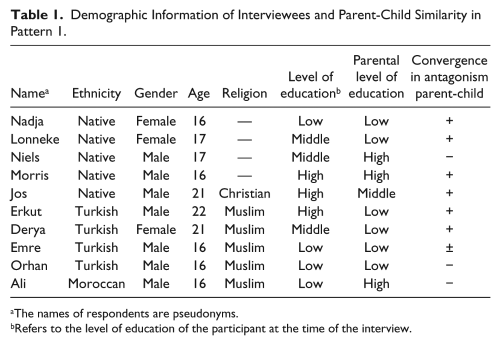
The names of respondents are pseudonyms.
Refers to the level of education of the participant at the time of the interview.
Demographic Information of Interviewees Parent-Child Similarity in Pattern 2.
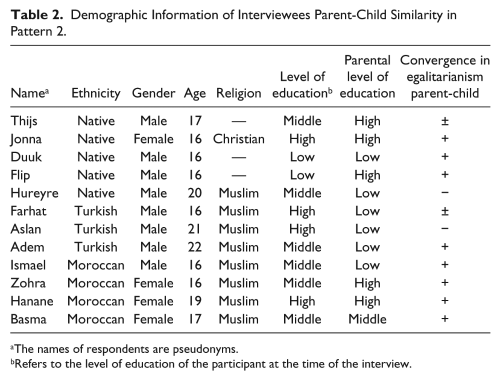
The names of respondents are pseudonyms.
Refers to the level of education of the participant at the time of the interview.
Method
Few studies have included the voices of adolescents, Muslims in particular, regarding intergroup relations in the post-9/11 era. We therefore chose the method of qualitative interviewing as we expected that it would best reveal the multiple and dynamic realities of intergroup attitudes from youth’s own views. Using a narrative approach, youth were encouraged to share stories about their actual experiences in addition to expressing their views and attitudes (Wengraf, 2002), and to describe their parents’ responses, behavior, and attitudes. The interviewer paid special attention to obtaining information about events, the emotions involved, and the subsequent unfolding responses of the participants. The interview focused on five pre-identified topics, although its format offered abundant space for additional emerging themes. The five topics included ethnic and religious identification, views, and behaviors toward out-groups, perceived treatment and/or stigmatization of the in-group, parental in/out-group views, and parental ethnic socialization in relation to the above topics (Doosje et al., 2012; Hughes et al., 2008; Van Bergen et al., 2016). Examples of questions for each topic (Turkish Dutch youth) include, “Do you feel Turkish?” “Is Islam important to you?” “How do you feel about non-Muslims?” “Has it ever happened to you that you felt unfairly treated as a Turk/ Muslim?” “Do you think a person’s ethnic background is relevant?” Once youth had shared their own views and experiences, they were asked to describe their parents’ responses, behavior, and viewpoints in relation to these topics, for instance, by asking the question, “How do your parents feel about this?”
Analysis
All interviews were recorded and transcribed verbatim, and coded in Atlas.ti software. Using the constant comparison method (Strauss & Corbin, 1990), commonalities and differences regarding the youth’s experiences, attitudes, and perceptions of their parents’ (ethnic) socialization were searched for in and across interviews. A coding list was developed first deductively (based on the topic list) and subsequently inductively (based on emerging themes from within the data; Strauss & Corbin, 1990). The coding list was developed by the first author and a research assistant (a master’s student), and the last author read the coding list to examine if she agreed. The last author offered several additions and refinements to the coding, which were approved by the first author and the research assistant.
The coding was conducted by the first author and the research assistant separately; the first author double-checked all coding. There was agreement between the first author and the research assistant in approximately 90% of the cases, and in case of disagreement, they discussed until consensus was reached. In the initial analysis, we identified and coded the themes based on emerging themes regarding (the risk of) antagonism that were derived directly from the transcriptions. From these codes, patterns were constructed, linked, elaborated, and integrated.
Results
We found two patterns among the respondents, that is, youth whom we categorized as prone to antagonism (n = 10) versus those who held egalitarian attitudes (n = 12). For each pattern, first, a description is offered of the characteristics of youth belonging to the pattern. Subsequently, the narratives of youth (own experiences and attitudes) regarding antagonism and egalitarianism will be portrayed. Next, the perceptions youth held of their parents’ perspectives regarding antagonism and egalitarianism will be presented for each pattern respectively, and the divergence or convergence between youth and their parents is described and elaborated.
Pattern 1. Intergroup Antagonism and Aggression Based on In-Group Superiority and Perceived Injustice
Youth in this pattern demonstrated antagonistic attitudes toward out-groups, which became evident through their expressions of ethnic or religious superiority, and the clashes they perceived on account of contrasting in-group versus out-group norms and values. Their narratives reflected strong distinctions of Us against Them, attributing negative traits to out-groups. Youth believed that out-groups received better treatment (more minorities felt this way than natives), which (re)enforced intergroup hostility. For some minorities, antagonism led to physical fights inspired by ethno-religious conflicts. Ten youth fell into this pattern.
Majority youth
Majority youth belonging to this pattern perceived a strong threat of immigrants, whom they believed to be too positively treated in the Netherlands, and they believed that this treatment jeopardized the societal position of native Dutch. Their perceptions fueled their hostility and anger toward immigrants. As Nadja (female, 16) said, “I think their [immigrant youth] parents have taught them that they should take power, that they want to take over everything here, and I cannot stand it!” Another example was given by Niels (male, 17), who had become an activist in a political party with an anti-Islam agenda: “I find the Qur’an a disgusting book. Look at Nigeria with its radical Islam; people coming from these countries pose a huge danger.” Niels stated that he would be prepared to use violence in defense of the Dutch national identity against “the tsunami of radical Islam.” Youth with narratives of this kind were also dismayed by “the lack of good morality” they perceived among immigrants, in particular, regarding gender relations and “decency.” As Lonneke (17, female) said, “In Muslim families, the father has the power. I don’t consider that normal for the Netherlands”; Nadja stated, “My mother taught me how to behave properly, but my Turkish colleagues run around and scream out loud in the shop,” and she explained that she believed that Turks lacked good manners.
A recurring conviction of youth with narratives of this kind was that immigrants needed to assimilate into Dutch society, as the “norms of native Dutch” were argued to be superior as they reflected the “Dutch” virtues of “tolerance, gay rights, and gender equality.” In the case of one young man (Jos, Christian, 21), his sense of superiority was based on his Christian faith that, according to him, featured compassion, which he argued to be in sharp contrast to Islam as “Muslims have violent tendencies.” Youth with narratives of this type considered conforming to “Dutch standards” critical for immigrant integration. As one boy (Morris, 16) stated, “Migrants should be open to how we interact with each other in the Netherlands, to how we as Dutchmen think that one should adapt, and too little of that adaptation is happening.” Maintaining a minority culture and language was perceived by these youth as undesirable and a hindrance to assimilation.
Minority youth
In a similar vein to majority youth in this pattern, minority youth perceived their culture and religious values as distinct from and better than those of natives. As Erkut (male, 22, Turkish descent) said, “They (Dutch values) just don’t match with us (Muslims).” The most disturbing conflicts, Erkut perceived, were related to gender and sexuality: “It’s in my culture that if a woman wears a tiny dress, she loses her worth.” Minority youth of this pattern had become attracted to Turkish nationalism (2 youth) or radical Islam (1 youth) on account of their sense of ethnic or religious superiority. Derya (female, 21) and Emre (male, 16) were convinced of Turkish supremacy: “We are racially superior to other nations” (Derya). Derya and her family belonged to a Turkish fascist movement, the Grey Wolves (the ideology of the Grey Wolves emphasizes and glorifies Turkish history, in particular, the establishment of the first Turkish States in Central Asia. Their ideology is based on the “superiority” of the Turkish race, see Atkins, 2004). Derya, for instance, measured the skulls of her relatives to check if they were “ethnically pure Turks.” Emre’s nationalism seemed to be inspired by his peers: “If I am not among Turks, I don’t feel comfortable. My friends and I often get together and talk about the Turkish Empire for hours.”
For many participants with narratives of this type, stigmatization as minorities and/or Muslims had gravely upset them and appeared to have strengthened their sense of superiority. They mentioned unfair treatment at school or at their traineeship. Their (perceived) victimization led them to believe that minorities in the Netherlands are “treated as second-class citizens,” as Erkut stated. He was often turned down for traineeships, and when he did find a place, he was called names by his colleagues (“terrorist”). Emre, who also was rejected for a traineeship, was convinced about the bias of the native Dutch: “People always give priority to their own race.” Youth in this pattern were also certain that there were fundamental differences between ethnicities. As Orhan (Turkish descent, 16) explained, “Dutch teachers will never click with a Turkish student. Deep in their heart they will always be in conflict.” Youth in this pattern were also sensitive to negative evaluations by majority Dutch, and this seemed to have influenced their anticipation of stigmatization. For example, Orhan’s situation resembled a “catch-22”: He felt frustrated because he thought majority individuals disapproved of his orthodox Islam. This widened the social distance he believed existed between them, which led him to further resort to Islam. Yet, he remained sensitive to the public disapproval by natives who watched his increasing orthodoxy with suspicion: “If I were to wear the jellabiya (Islamic male dress) people would stare at me, being repulsed.”
Emre, Orhan, and Ali (Moroccan descent, male, 16) had engaged in physical fights in defense of their ethnic or religious group, and two others had (also) made a plan to do so (Derya and Orhan). The denigration they had experienced toward their in-group and/or a sense of ethnic or religious pride influenced their attitudes toward such violence. Orhan declared himself to be willing to become a jihadi martyr. Orhan had also regularly engaged in fights over perceived discrimination, although he had (unsuccessfully) attempted to curtail his aggression: “even my friends think I am too aggressive.” Ali had been involved in a violent incident with a majority youth by whom he felt discriminated against at a nightclub. He had also physically attacked a Moroccan Dutch girl who did not abide by the Islamic dress code, because he believed she had disgraced the in-group.
Derya’s violent intent in defense of the in-group was not induced by stigmatization but was linked to the Grey Wolves ideology. Previously, she had planned to move to Turkey to fight for a reunion of “all ethnically pure Turks,” but canceled this plan when she discovered that many Turks in Turkey did not share this cause. However, Derya was still “willing to give my life for Turkey, even if there would be good chance of getting a bullet.”
Perceived Parental Out-Group Attitudes and Ethnic Socialization in Pattern 1
Majority youth
In most (four out of five) of the majority cases, youth indicated that their parents also had negative views toward out-groups in which social class, perceived injustice, and mistrust as well as “Dutch” or Christian values and assimilationist attitudes played a role. In families in the study belonging to the lower socioeconomic strata (Nadja and Lonneke), collective deprivation and a resentment of favoritism toward minorities were felt, for example, in terms of diminished chances in the labor market for majority Dutch. Lonneke, for example, said that her mother had stated that “Poles steal jobs” of the natives in their region, while Nadja mentioned how she and her mother found it “very unfair” that only Muslim kids got a day off on Eid (Islamic holiday) when she was in primary school: “My mother said to the principal: ‘We have Dutch Eid now, my kids are also free today.’” It seemed that Nadja had listened to and agreed to her mother’s rationale, giving the following comment on this episode: “Yes, they (Muslim kids) were treated with more respect.” In terms of ethnic socialization strategies, Nadja’s account indicated that her mother had expressed that bias existed against the in-group, that “Majority Dutch weren’t given the treatment they deserved.” Some youth in this pattern stated that their parents had warned them about immigrants and their children, in line with an ethnic socialization strategy of mistrust. Nadja and Lonneke mentioned that their parents had declared that they should never consider bringing home a “foreign” boyfriend: “I will break your arms!” (Nadja). In terms of the social learning theory, it seemed that powerful negative statements by parents regarding immigrants had set an example for these youth. It became clear from youth’s explanation that they considered these statements by their parents as true.
A number of youth in this pattern (regardless of their social class) reported that their parents argued that “correct and decent behavior” was in contrast to what they observed among Muslims, and hereby, parents seemed to set an example for their children. Morris explained that it would be a true disgrace if a Muslim girl with a headscarf were to accompany him to an official gathering, because wearing such a scarf is against formal dress codes. This conviction seemed related to his upbringing in an upper class family in which Morris had heard from his father that etiquette was crucial; his father could not stand people who did not adhere to correct norms, including dress codes. Next, the idea that immigrants needed to assimilate into mainstream culture was found in majority families in this pattern, regardless of their class background. For example, the Christian family of Jos had difficulties with Islam; they felt the presence of mosques threatened the Christian roots of the country.
In one case, however, a youngster (Niels) seemed far more negative than his parents. Niels portrayed his parents, particularly his father, as supportive of multiculturalism and to be left-wing oriented: “My father thinks the Netherlands should open their borders to even more immigrants. We are both stubborn, so we never convince each other.” According to Niels, his father considered the discussions they had on immigrants as “entertaining,” and he described his father as being enthusiastic about his activities for a national anti-immigrant party—in spite of this being completely against the father’s apparent egalitarian convictions.
Youth in this pattern also mentioned influences outside the family context regarding their views of immigrants. Jos, for example, mentioned that his annoyance about the presence of mosques in the Netherlands was also influenced by his “Christian-conservative” fraternity (Jos’ original wording). The family was not the only site for social learning, as standpoints toward immigrants expressed by peers seemed to be echoed by some of these youth.
Minority youth
The similarity in antagonism between children and parents was less present in minority cases compared with majority Dutch cases (see Table 1). The resemblance in antagonism was most evident in the case of Derya, whose father had been passing on Turkish nationalism since her birth. Derya explained how her father had devoted much time to cultural socialization (he had spent hours teaching her about Turkish history) and how expressions of mistrust of out-groups were part of her ethnic socialization: “My father said, I don’t want you to bring home a Moroccan [as a friend], nor blacks, or another race.” Derya’s self-expressed loyalty for the in-group, her exclusively Turkish circle of friends, and her willingness to use violence in defense of her ethnicity suggested that she had learnt from and taken in her father’s feedback about interracial friendship and mimicked his ideology. Derya was close to her father but not to her mother. Derya portrayed her mother as sub-assertive and mentioned her mother was not so outspoken about Turkish nationalism. Erkut also held views similar to those of his parents, who had stated that they, as Turks and Muslims, hold different values than the Dutch and who stressed the righteousness of “their values.” While they also pointed out some virtues they perceived among the Dutch, Erkut’s parents perceived Turkish culture and Islam as crucial markers, producing different values that they ranked in a certain hierarchy. An in-between position in this pattern was occupied by Emre and his father. Emre stated how his father, like himself, held the opinion that Turks were insulted and discriminated against in the Netherlands. As Emre emphasized his firm agreement with how his father perceived this topic, social learning processes in his family seemed to be at work. However, Emre was disappointed that his parents were not as nationalistic as he was; thus, regarding Emre’s ethnic pride, his parents had not served as an example.
In two cases, we did not find any similarity of antagonism in minority youth and their parents (Ali, Orhan); neither did these youth’s accounts reflect that their parents held egalitarian views. Ali reported that his stepfather demanded that Ali had to live according to the Qur’an, while his mother did not want to give him an Islamic upbringing. These conflicting parental messages seemed to confuse Ali about the position he was to take up in life. Orhan, who had become radical in his Islam, mentioned how this had taken his parents by surprise, and that his parents were not very religious, neither did they share his antagonism toward majority Dutch. In the accounts of both Ali and Orhan, few indicators for social learning about intergroup attitudes at home were found.
The stories of Orhan, Ali, and Emre indicated that their parents had not provided them with a helpful response regarding issues related to being an ethnic minority and Muslim in a liberal, (mostly) secular society or how to cope with the stigma. Emre was upset by what he regarded as a fatalistic response to discrimination of his father: When Emre was rejected for a traineeship, his father had said, “stay calm and carry on; once you will be given a chance,” Ali narrated that his father emphasized cultural and religious messages to make him follow “the right path.” His father had told Ali he should closer abide by his religion and culture, that is, not going out anymore and no alcohol consumption when Ali got into trouble due to antagonism (physical fights); this view was not shared by Ali. Orhan mentioned that his mother responded in an authoritarian manner when she found out that he wanted to fight in Palestine: “My mother grabbed the remote control and changed the channel when the war in Palestine was on TV, but I just ran upstairs to watch it in my room.” These parental responses may have hindered youth’s ability to obtain a secure position as a Muslim minority in Dutch society.
Pattern 2. Pro-Diversity Attitudes Based on Appreciation of Diversity and on Egalitarian Views
The responses and views of youth with pro-diversity attitudes and egalitarian views consisted of color blindness (i.e., perceiving ethnicity as nonimportant) or of pro-diversity. Youth in this pattern did not experience intergroup antagonism, neither did they feel superior to others on the basis of their ethnicity or religion, as they held explicitly positive ideas about out-groups and did not approve of violence in defense of the in-group. Youth with narratives of this type stressed cross-cultural similarities. If they perceived cultural and religious differences, they thought of these as hardly relevant to the relationships they held with out-group members as these differences did not change their mutual understanding and appreciation of one another. Some youth explicitly emphasized pro-diversity views. They did observe a number of cultural or religious differences between themselves and out-groups, yet perceived these differences as valuable and interesting. The pattern consisted of 12 youth.
Majority youth
Majority youth with narratives of this type showed a great interest in cultures and religions different from their own, and argued that a multicultural and multi-religious society has much to offer: “[‘foreigners’] bring progress. If you only have your own culture, then you will hold on to it” (Thijs, male, 17). Another example was a Christian girl (Jonna, female, 16), who asked her church to teach about different religions in their youth meetings. If these youth observed differences in cultural or religious perspectives between themselves and their out-group peers that would be irreconcilable, these were lightheartedly put aside. Many youth with narratives of this type concentrated on the similarities in themselves and out-group peers: “My Turkish and Moroccan friends, to me they are Dutch because they talk Dutch and they look Dutch to me” (Duuk, 16, native). These youth explained that sharing a sense of humor, “a click,” and the ability to discuss one another’s ideas and views had been important in establishing a friendship, and not ethnicity or religion.
Youth were also asked how they viewed their own pro-diversity views in relation to the current assimilationist political climate in the Netherlands. They responded that misconduct of some Muslim youth did not justify the stigmatization of an entire ethnic or religious group. They also gave socioeconomic explanations when the disproportionate rates of crime perpetrated by immigrants were discussed.
Different from the native youth in Pattern 1, these youth did not speak of their own values as linked to “Dutch culture.” They did not bring up the topic of intergroup tensions at all; when asked by the interviewer, they explicitly distanced themselves from antagonism and re-emphasized ideas reflecting equal group status and/or pro-diversity.
Minority youth
The narratives of minority youth in this pattern were similar to those of native youth: Many of them believed that cultural diversity was valuable or a matter of fact: “I don’t know what there is to be discussed about ethnic background at all. The Netherlands is multicultural anyway” (Hureyre, male, 20, Turkish descent, Muslim). Even more firmly than majority youth, minority youth argued that nobody should be judged on the basis of their ethnicity, skin color, or faith: “We are all people of flesh and bone” (Ismail, male, 16, Moroccan descent). Similar to majority youth, a positive attitude about “ethno-religious” others of these youth was also reflected in their multicultural choice of friends. As Farhat (16, Turkish descent) explained, “We don’t distinguish on the basis of religion in my circle of friends, everyone is welcome really . . . and we always want to try the food of each other’s culture.”
Regarding their religion (Islam), these youth observed commonalities with Christianity rather than conflicts: “I said to my [Christian] friend, ‘Abraham? We also have someone like that in my faith called Ibrahim . . .’ We saw similarities, making us closer and stuff” (Ismael, 16, Moroccan descent). Some Muslim youth mentioned that their faith was “the best” for them, but they also emphasized that this did not imply that others were, therefore, worse off than they were. Youth explained that their faith had taught them to treat other religions and their followers with respect; they also thought that whichever faith people wanted to adhere to was up to them: “I don’t want to decide for other people what is a good life; they will know for themselves what is wrong and what is right” (Zohra, female, 16, Moroccan descent).
Minority youth did not put much emphasis on their ethno-cultural background, whereas youth in Pattern 1 pictured their ethno-cultural background as critical and, moreover, as a basis for superiority. Furthermore, in contrast to minority youth in Pattern 1, these youth appeared to be willing and able to integrate or bridge cultural differences: “I try to take the best of both worlds. In Turkish culture—that’s the hospitality and generosity—and from Dutch culture, it is self-development and individualism” (Aslan, male, 21, Turkish descent).
Minority youth belonging to this pattern perceived stigmatization differently from youth in Pattern 1. These youth did not think stigmatization was strongly present in society. Moreover, these youth had found coping mechanisms to deal with stigmatization, such as ignoring or downplaying it, to be helpful. “It is only a small group of people in the Netherlands who hold negative ideas of Muslims” (Zohra); “It is not important what other people think of me” (Farhat). Some youth applied problem solving or discussion as a coping mechanism to stigmatization. Selma (female, 19, Moroccan descent), who was frequently scolded (“Penguin!”) by her neighbor (by which he referred to her Islamic dress), reported this to the police. Selma had also been asked by a stranger in the street, “Why don’t you have any respect for this country?” Selma then calmly replied, “What makes you think that I would not have respect for this country?” and tried to discuss this issue. These examples show that minorities with narratives of this kind did not let stigma get “under their skin”; this approach seemed to be helpful against the emergence of antagonism.
Perceived Parental Out-Group Attitudes and Ethnic Socialization in Pattern 2
Majority youth
In three out of four cases, youth reported that their parents held similar positive views on diversity as they did; for example, they mentioned that their parents also had a strong interest in ethnic and religious “others.” It seemed that for these youth, their parents were a social model for a “pro-diversity” stance; their parents had friends from a variety of ethno-religious backgrounds. Additionally, youth mentioned that intergroup contact was promoted during their upbringing, either explicitly reinforced (e.g., parental encouragement of meeting peers from all kinds of ethnic backgrounds) and/or more implicitly stimulated (e.g., the child was enrolled to a multicultural school). Some parents—like the children themselves—were described by them as color blind: “My parents just see everyone as a normal person. They do not perceive an Islamic person or an Indonesian differently” (Flip, male, 16). In some majority families, anti-Islam sentiments found in the media were contradicted by putting forward historical facts: “My parents say that we (Dutchmen) invited them (immigrants), and if they have been living here for 10 years they have as much right to study here as we have” (Jonna). It seemed that Jonna had taken in this line of argumentation as it was explained to her by her parents.
Thus, different from the native youth in Pattern 1, most youth in this pattern said their parents expressed egalitarianism, and that their parents offered a rationale behind their egalitarian attitudes to their children. Furthermore, many parents seemed to act in accordance with pro-diversity ideals (e.g., sending children to multicultural schools).
In one case, the view of an egalitarian youth (Thijs) diverged from that of one of his parents. Thijs explained that his positive view of immigrants was grounded in friendships with Moroccan Dutch peers when he was young and that his views were in line with his mother’s ideas. By contrast, Thijs found that his father was negative toward “foreigners”: “My father says things like: ‘These rotten foreigners made a mess in the street again.’” Thijs then argued with his father by pointing out that anyone—regardless of their ethnicity—can misbehave.
Minority youth
In six out of eight cases, minority youth indicated that their parents also held egalitarian ideals. Similar to natives in this pattern, minority youth described their parents as having a multicultural circle of friends and being open to other cultures: “In the neighborhood where I grew up, Dutch parents were very welcoming to me, and my parents were the same the other way around” (Adem, 22, male, Turkish descent). Some minority youth stated that their parents had stressed the importance of respect for different ethnicities: “My father taught me to have respect for everyone, regardless of whether it was a Turk, a Moroccan, or a Dutchman. He said other people will then also accept me” (Basma, female, 17, Moroccan descent). Different from youth in Pattern 1, these youth explained that their parents did not refer to humans in terms of ethnicity or culture: “At home, we don’t talk like: ‘We Moroccans . . .’ I don’t find that acceptable either, because I see all humans as one” (Basma). “My father isn’t a man who is very culture bound. He attaches much more value to being a good person” (Selma, 19, Moroccan descent). It seemed that these youth had learned from their parents’ perspectives; they did not believe their ethnicity or culture to be very important. Some youth remembered that their parents had explicitly questioned and corrected youth’s siblings when they had called a peer a bad name with reference to ethnicity. Different from minorities in Pattern 1, youth in this pattern mentioned that there was little in their upbringing that they considered to be “Moroccan” or “Turkish.” They pointed out that their families held values similar to those of natives and spoke Dutch all the time.
In the case of Selma, her increasingly religious orthodoxy seemed to pose a challenge to her parents, who were aware of the political climate in which Islam was criticized. Selma mentioned that her father worried if she would be able to find a job and how her father was initially upset about her becoming orthodox (e.g., not shaking hands with men; wearing long Islamic dress and veil). In the end, her father accepted her wishes, yet he would still talk with her about the importance of being “open to people of other ethnicities and religions.”
Minority youth belonging to this pattern told of more family support than youth in Pattern 1. Moreover, these youth had received parental guidance in dealing with stigmatization, whereas youth in Pattern 1 had not. For example, Selma mentioned that her father had advised her to report the verbal harassment (“Penguin”) to the police. Basma’s brother had a word with the principal about the school’s new rule that made it obligatory to wear a blazer on top of the Islamic dress, with which Basma disagreed. One youth (Farhat) indicated that his father did not want him to become pessimistic about his position in society, and therefore, his father would not discuss the issue of discrimination.
In two cases, the pro-diversity views of minority youth diverged from their parent(s)’ views. Two minority youth of Turkish descent (Aslan and Hureyre) explained how their mothers were somewhat frightened of mainstream society as they did not know the Dutch language and lived a rather isolated life. Aslan and Hureyre explained how their mothers had also been negative in the past about the interreligious contacts of their children, pointing out the lack of morality of non-Muslims that they perceived. Aslan mentioned how he had adopted his mother’s words when he was young, but that he gradually “realized it was not true, so I left all these ideas behind me.” Aslan’s school education and self-study of the Qur’an seemed to have influenced his changing perspective toward ethno-religious others, as he described he now believed his parental messages to be a blend of cultures with a hint of Islam. Aslan’s reflections had also resulted in reverse ethnic socialization, that is, he attempted to encourage his parents to embrace diversity. “I try to warm them up to other cultures, I tell my mum to talk to a Dutch person for two minutes and see how it goes!”
Discussion
By examining 22 qualitative interviews with Muslim and native youth in the Netherlands, we shed light on an emerging social phenomenon in Western Europe, that is, strained intergroup attitudes among youth along the lines of religion and ethnicity. The study analyzed antagonism and its opposite, egalitarianism, in youth of Turkish, Moroccan, and native descent and aimed to qualitatively capture the role of perceived parental ethnic socialization in the development of these attitudes.
The results confirm Degner and Delege’s (2013) findings that the parent and child dyads of the majority group are more similar with respect to antagonism compared with minorities (Pattern 1). Among native youth in this study who held antagonistic attitudes toward out-group(s) fueled by perceived superiority, cultural clashes, negativity, and mistrust, a large similarity was shown with their parents (four out of five cases). These youth explicitly supported the prejudiced ideas they said to have heard from their parents. The current societal climate, in which anti-Islam sentiments are widespread, may have played a role: These youth mentioned that their parents felt legitimized to express negative attitudes toward migrants. The accounts of these majority youth indicated the role of the ethnic socialization strategy of “bias” (Hughes et al., 2008), and also underpin quantitative results showing similarity between antagonistic attitudes in native European children and their parents (Duriez & Soenens, 2009; Gniewosz & Noack, 2006; Vollenbergh et al., 2001). Next, the assimilationist rhetoric expressed by a popular political party with an anti-Islam agenda seemed to have been an inspiration for a majority youth whose views did not correspond with his parents.
Of the five minority cases of antagonism, there was one medium to strong match and one strong match. The strong match concerned a young woman who belonged to a fascist Turkish movement. Her father had successfully prohibited intergroup contact. This resulted in the girl exhibiting out-group hostility. This finding underpins the work by Meeusen (2014), who found that parents who deny children cross-group friendships enhanced influence prejudice in their children. Furthermore, the father of this Turkish Dutch girl had seemingly transmitted a wariness toward ethnic out-groups through the socialization of mistrust, one of the strategies identified by Hughes et al. (2008). The other four minority youth mentioned that their parents were somewhat ambivalent, indifferent, or moderately positive toward out-group(s), or disagreed with each other. Notably, according to these youth, their parents did not always recognize the struggles of their children with ethno-religious conflicts and/or victimization. Instead of a response focused on action, which youth seemed to be looking for in their parents, parents responded either with silence or in insensitive manner and offered little support when told about negative treatment. An explanation for the nonresponsive behavior of the minority parents may be that these parents are afraid to address stigma and to teach their children about bias as they assume that such communication may diminish their children’s hope of a successful future (see also Lesane-Brown, 2006). Nevertheless, many of the antagonistic minority youth seemed to be disappointed about the unresponsive attitude of their parents. This gives indication that our expectation, that is, that the quality of the pedagogical relationship between parents and children is a moderator in understanding youths’ intergroup attitudes, might be correct. This suggestion is in line with a study on radicalizing Dutch native youth, which indicated the significance of the pedagogical quality of the home (Van San, Sieckelinck, & De Winter, 2010).
Almost all minority and majority youth in the opposite Pattern 2, having positive (egalitarian or pro-diversity) attitudes toward out-groups, reported comparable positive attitudes in their parents. Youth with positive views pictured their parents as having a multicultural circle of friends and having taught them that explanations featuring ethnicity or religion as the cause of a social problem were inept and stereotypical. As parents in this pattern were portrayed by youth as promotors of positive intergroup attitudes and interethnic friendships, and as involved in positive intergroup interactions (e.g., friendships), our findings underpin the work by Hughes et al. (2008) on the parental ethnic socialization strategy of egalitarianism. This finding is also consistent with studies showing that children of parents who express egalitarianism and encourage cross ethnic friendships are more likely to develop such attitudes and friendships themselves (Meeusen, 2014; Miklikowska & Hurme, 2011).
Again, the pedagogical relationship seems to matter in processes of social learning, for egalitarian minority youth also reported that their parents responded sensitively and offered guidance when they told about experiences of discrimination. In one case, a participant indicated that her father regularly monitored her increasing interest in orthodox Islam to check whether she was still “open to others.”
In both Patterns 1 and 2, we found one case in which majority youth reported a less consistent input and teaching from their parents, as the attitudes of the father and mother diverted. In these cases, youth often expressed out-group attitudes similar to those of the parent with whom they reported having the better relationship. Thus, the quality of the parent-child relationship, from the perspective of youth, was an important moderator of intergenerational transmission of out-group views via social learning from parents at home. The results also underpin Sinclair, Dunn, and Lowery (2005), who showed that White U.S. children were more likely to have views of Blacks similar to those of their parents, if they identified more with their parents, while identification is more likely to occur in high-quality parent-child relationships. In terms of the social learning theory, identification with parents might increase the chance that youth evaluate their communication as meaningful to them.
Altogether, the results imply the relevance of the social learning theory (Bandura, 1986) to understand antagonist versus egalitarian views in youth. According to youth, their parents gave verbal and nonverbal cues in relation to intergroup attitudes by providing feedback and explaining their views, expressing their grievances, offering advice and reflections, and taking action, by silence or by the ethnic make-up of their social networks. According to youth’s narratives, in 14 out of all the 22 cases, both parents and children shared their antagonistic or egalitarian views, while in eight of all cases, children diverted from one or both of their parents. As already noted, the higher divergence for minority youth (six out of 13) than for majority youth (two out of nine) is in line with Degner and Delege (2013). As proposed by Osch and Breugelmans (2012), minority groups’ low status and disadvantaged position might play a role here. According to studies on parenting in the Netherlands, Muslim minority parents experience more ambivalence and uncertainty regarding the rearing of their children compared with native parents (Pels et al., 2009). Both the tensions caused by migration, (resulting in a relatively deprived position), and experiences of stigmatization as a migrant and Muslim, contributed to this parental uncertainty (Pels et al., 2009). Thus, the social learning theory (Bandura, 1986) helps us to understand ethnic differences in the extent to which social learning takes place regarding out-group views. An assumption of this theory is that youth should recognize their parents’ communication as meaningful in order to follow their example. For many minority youth prone to antagonism, this was not the case as parental responses or suggested coping style did not meet children’s needs and/or youth could not connect them to their own emotions. The political context that consisted of polarization and Islamophobia also affected experiences of minority youth (e.g., increasing hostility), but according to youth, their parents struggled to address these influences and give adequate responses.
We found indications that the family is not the only site for social learning. Youth of majority and minority ethnicities, whether egalitarian or antagonistic, mentioned they shared (similar) experiences and emotions toward the in-group and out-group with their same-ethnic peers. It also seemed that especially among youth in Pattern 1, victimization by out-group peers at school and traineeships contributed to their vulnerability toward antagonism. This supports the idea that over the course of adolescence, peers become increasingly important for developing out-group attitudes (Van Bergen et al., 2015). Next, echoing Pels et al. (2009), socialization is a transactional process in which not only parents set an example for their children but children may also influence their parents. This process of reversed influence was observed in two minority cases, with children teaching their parents—who had little familiarity with out-groups due to a lack of acculturation—about pro-diversity.
Some demographics seemed relevant to our results. In line with epidemiological findings from developmental psychology (Carr, 2006), the initiation of physical fights due to antagonism were only reported by boys with a low level of education. Next, in this study, minority parents had a lower level of education compared with majority parents (which, however, is in line with the Dutch immigrant population). Remarkably, in the few cases in which parents of minority youth had received middle to high level of education, most minority youth (three out of four) reported strong egalitarian views. This echoes research among majority Dutch youth (Vollenbergh et al., 2001) and majority Flemish youth (Duriez & Soenens, 2009) showing that a higher level of education is associated with more egalitarian out-group views. In our study, the level of education of minority youth’s parents seemed to be positively associated with the acculturation of those parents: They had more intergroup contacts and more knowledge of the Dutch language and mainstream society. In line with studies on parenting in the Dutch migration context (Deković, Pels, & Model, 2006), more acculturation went hand in hand with minority parents’ inclination to offer response and support to youth in this study. Therefore, it is plausible that if we had included more minority youth with higher educated parents, we may have found more parent-child similarity in the minority group.
Limitations and Directions for Future Research
This study also had limitations. We have accentuated youth’s views of parental socialization, while it would also be valuable to also incorporate parents’ own views on ethnic socialization. This would also shed more light on bidirectional transmission processes. Next, natives in the study had a somewhat higher social class background; a future study would need to better control for this aspect. Moreover, this study was conducted by interviews at one point in time, whereas it would be an asset to monitor youth’s narratives of intergroup antagonism or egalitarianism over time (see Hammack, 2006). In addition, future studies could adopt a design in which potential effects of the ethnicity of the interviewer are weighted in. For example, Van Gemert (2002) suggests that Moroccan Dutch youth are reluctant to provide information that would give their ethnic group a bad name. This may have led to an underestimation of ethno-religious fights admitted by Dutch Moroccan youth in our study.
Conclusion
To conclude, this research has underlined that parents, as the primary educators of their children, play an influential role with respect to children’s intergroup attitudes. Parents seem to struggle with competencies in rearing their children in the existing polarized climate. This is particularly relevant to Muslim minority children, who are more affected by discrimination than majority children, and who (in case of the antagonistic youth) indicated that they were not satisfied with their parental responses regarding bias (Pels & de Ruyter, 2012). Therefore, it is critical to develop support for parents in communicating with their children and assisting them in finding their way in the context of high ethno-cultural diversity and conflict. This is of foremost importance if we want to turn the tide of polarization in Western European societies and develop more peaceful intergroup relations among children.
Footnotes
Declaration of Conflicting Interests
The author(s) declared no potential conflicts of interest with respect to the research, authorship, and/or publication of this article.
Funding
The author(s) received financial support for the research, authorship, and/or publication of this article: The study was supported by a grant of the Netherlands Organization for Scientific Research (NWO), W 07.68.107.00.