







Abstract
We conducted a mixed-methods study to explore the characteristics of Chinese adolescents with suicidal ideation, using both quantitative and qualitative data and analysis. Participants were N = 244 adolescents, who completed self-report assessments of suicidal ideation, as well as indices of psychological functioning and well-being. A subset of n = 6 high and n = 6 low suicidal ideation adolescents participated in the follow-up interviews. Among the quantitative results, as compared with adolescents with low suicidal ideation, adolescents with high suicidal ideation reported significantly higher scores for stressful life events, coping-avoidant strategies, loneliness, and depression, as well as significantly lower scores for coping-approach strategies. Among the qualitative results, adolescents with high suicidal ideation demonstrated the following characteristics: (a) most troubled by academic pressures and relations, (b) negative self-evaluations, (c) maladaptive understanding of life and death, (d) individual-oriented attributions, and (e) negative coping strategies and self-fulfilling prophesy. These findings contribute to the early identification of adolescents who are at higher risk for suicide, further expand the stress and coping model with the distress-to-meaninglessness framework, and suggest that improving positive self-evaluation may be a focus of prevention and intervention.
Suicide is the third leading cause of death among adolescents (Klonsky, May, & Saffer, 2016; Wasserman, Cheng, & Jiang, 2005). Adolescents worldwide are more likely to die by suicide than any medical illness or disease (Patton et al., 2009). Suicidal ideation (SI) was shown as a strong predictor of suicide (Burke & Alloy, 2016) and found to peak in adolescence in China (Phillips, Li, & Zhang, 2002; Rueter & Kwon, 2005; Shah, 2007). Given that suicide and suicidal behavior are major public health problems, it is important to identify the features of the adolescent who is more likely to die by suicide, for the purpose of developing methods of preventive intervention.
Adolescence is a developmental stage that is associated with increased suicidal thoughts and behaviors for several reasons. According to the developmental neuroscience perspective, risk-taking increases from childhood to adolescence because changes in the brain’s socioemotional systems lead to increased reward-seeking and less capacity for self-regulation in the brain’s cognitive control system (Nock et al., 2013; Welborn et al., 2016; Williamson, Guerra, & Tynan, 2014). Also, individuals are more prone to suffer psychological strains during the transformative period of adolescence and may turn to suicide to remove such strains. Particular strain can occur when individuals are prevented from achieving positively valued goals, removed from positively valued stimuli, or confronted with noxious or negatively valued stimuli (Agnew & White, 1992). Suicide is usually preceded by substantive psychological strain, in the forms of relative deprivation, unrealized aspiration, and lack of coping skills (Sun, Li, Zhang, & Wu, 2015; Zhang, Wieczorek, Conwell, & Tu, 2011).
Because of enormous social competition in recent decades with rising economic growth, Chinese adolescents devote a large part of their time to academic performance (Ang & Huan, 2006), with high levels of resulting stress. The college entrance exam represents the biggest challenge or goal for young students in the Chinese basic educational system. Higher scores at the entrance exam will determine the likelihood of their enrolling in better universities, which contributes substantively to the possibility of later success. Thus, a significant amount of homework and study time is arranged by teachers and parents. And peer relations are negatively influenced by the competitive atmosphere. Some adolescents follow schools’ or parents’ demands and get good academic scores but lose their interest in study and the meaningfulness of life; some even resist the demands with disliking study or psychological and behavioral problems. These demands somewhat deprive adolescents of their original pleasure of learning.
Theoretical Framework
According to Erikson’s theory of psychosocial development (Erikson, 1968), adolescents face a psychosocial crisis of identity versus identity confusion, where the key developmental task is to form a strong identity. Adolescence is characterized not only by rapid physical maturation, but also substantive development of self-awareness. Adolescents also take on new social roles and evolving expectations from themselves and their parents. If they cannot integrate and interpret these new components of their selves, adolescents may experience an identity confusion crisis. And then environmental factors such as stressful life events may be internalized and contribute to psychological stress or distress (e.g., loneliness, hopelessness, depression) when adolescents’ coping fails. Accumulating psychological distress over time may damage adolescents’ life satisfaction along with sense of meaning in life (Datu & Mateo, 2015; Degges, White, & Stoltz, 2015). Consequently, adolescents’ core thoughts may be “Life is of meaninglessness or no value” (Frankl, 1969). This may elicit suicidal ideation and suicidality will come out when the sense of meaninglessness is strong enough. The current study used a distress-to-meaninglessness framework based on the Erikson’s theory of psychosocial development and the stress and coping model. Building on these past models, which neglect the function of sense of meaninglessness from stressor to suicidal ideation, the distress-to-meaningless framework was designed for this study and provided the theoretical underpinnings for the present study.
Stress, Coping, and Outcomes
The identification of relevant predictive factors is critical for adolescent suicide prevention. Stressful life events were associated with increased prevalence of suicidal ideation up to 1 year later in a sample of 289 American adults (O’Donnell et al., 2016). Stress in the form of negative relationships (e.g., lack of peer interaction, victimization) was related to suicidal ideation, particularly under conditions of high loneliness or lack of social support (Cui, Cheng, Xu, Chen, & Wang, 2011). Unsolved stressors mixed with psychological distress may trigger suicidal ideation (Gjerde & Westenberg, 1998; Sun et al., 2015). Also, it was found that experience of fewer stressful life events predicted more positive recovery from psychological crises among high-risk adolescents (Arpawong et al., 2016). Life stress and depression were important risk factors of suicidal ideation (Capron, Lamis, & Schmidt, 2014; Wang, Lai, Hsu, & Hsu, 2011). Loneliness was also identified as a potential risk factor for suicidal ideation (Altangerel, Liou, & Yeh, 2014; Chang, Muyan, & Hirsch, 2015; Jones, Schinka, van Dulmen, Bossarte, & Swahn, 2011).
Adaptive coping skills appear to serve as protective factors against suicidal ideation. For example, previous studies suggested that more effective and adaptive coping strategies (i.e., task-oriented coping, approach coping) promoted more positive outcomes (e.g., satisfaction, self-esteem/self-worth, meaningfulness, well-being), which served as protective factors against suicidal ideation in the face of stress (Martyn, Andrews, & Byrne, 2014; Tsujimoto, Taketani, Yano, Yamamoto, & Ono, 2015). In contrast, maladaptive and ineffective coping strategies (i.e., emotion-oriented coping, long-term avoidance coping) led to negative emotional outcomes (e.g., loneliness, hopelessness, depression), which in turn, promoted increased suicidal ideation. For example, emotion-focused coping (e.g., self-blame) and avoidant coping (e.g., behavioral disengagement) accounted for increases in depression and suicidal ideation (Horwitz, Hill, & King, 2011). Similarly, negative cognitions (e.g., rumination) and lack of problem-focused strategies have been found to be the most important predictors of the intensity of depressive symptomatology, which in turn led to suicidal ideation (Vergara-Lopez, Kyung, Detschner, & Roberts, 2014).
According to the stress and coping perspective (Lazarus, 1966), stress arises when individuals perceive that they cannot adequately cope with the demands being made on them or with threats to their well-being. Compared with adults, adolescents tended to experience such stressful events more frequently (Merrill, Njord, Njord, Read, & Pachano, 2010; Saffer, Glenn, & David Klonsky, 2015; Tammariello, Gallahue, Ellard, Woldesemait, & Jacobsen, 2012; Tang, Xue, & Qin, 2015). Cognitions and appraisals play important mediating or moderating roles in the relations between stress and suicidal ideation. Different cognitions (e.g., description, appraisal, expectation) about the self or events will lead to diverse perceptions and behavioral responses to stress. In support of this notion, negative self-evaluations were found to be related to greater interpersonal stress (Cheng, Zhang, & Ding, 2015; Rey & Extremera, 2015), which in turn led to greater psychological distress and dysfunctional thoughts/feelings (van Doorn & Hülsheger, 2015). Furthermore, dysfunctional thoughts and feelings (such as depression and suicidal ideation) promoted the use of more emotion-oriented coping strategies (Tsujimoto et al., 2015). Cognitions and appraisals play important roles in the transactional associations from stress to suicidal ideation, via pathways through coping styles. Among different populations, stressful life events, coping strategies, and psychological outcomes (e.g., loneliness, depression) were all deemed to be influential factors related to suicidal ideation or suicide risk (Ahn & Kim, 2015; Tsujimoto et al., 2015).
The Present Study
Most previous studies focused on the phenomenon of suicidal ideation by examining associations with and among relevant cognitive, affective, or behavioral components using a variable-oriented approach; less is known about what high suicidal ideation adolescents’ primary stressor is, what their specific coping strategies and processes are, and why they adopted these strategies using a person-oriented approach (von Eye & Bogat, 2006). The goal of the present study was to explore the relevant features of adolescents with high suicidal ideation for the preventive intervention of suicidal ideation among Chinese adolescents. We conducted an exploratory sequential design mixed methods study (Creswell & Clark, 2007). We started from the consequence, that is, suicidal ideation, then backtracked the reasons or predictive factors by comparing relatively high and low suicidal ideation subgroups. First, we examined quantitative differences between high and low suicidal ideation subgroups in terms of predictive factors (i.e., stressful life events, coping strategies, loneliness, depression). Next, we employed semistructured in-depth interviews to collect qualitative data from subsets of participants and search for themes or patterns within the data (Braun & Clarke, 2006). We aimed to understand the quantitative differences by answering the following questions:
We thus gained more detailed characteristics of adolescents with suicidal ideation, which were not obtained by a quantitative method. Finally, we sought to uncover implications of practical methods for suicidal treatment and prevention based on the findings.
Method
Participants
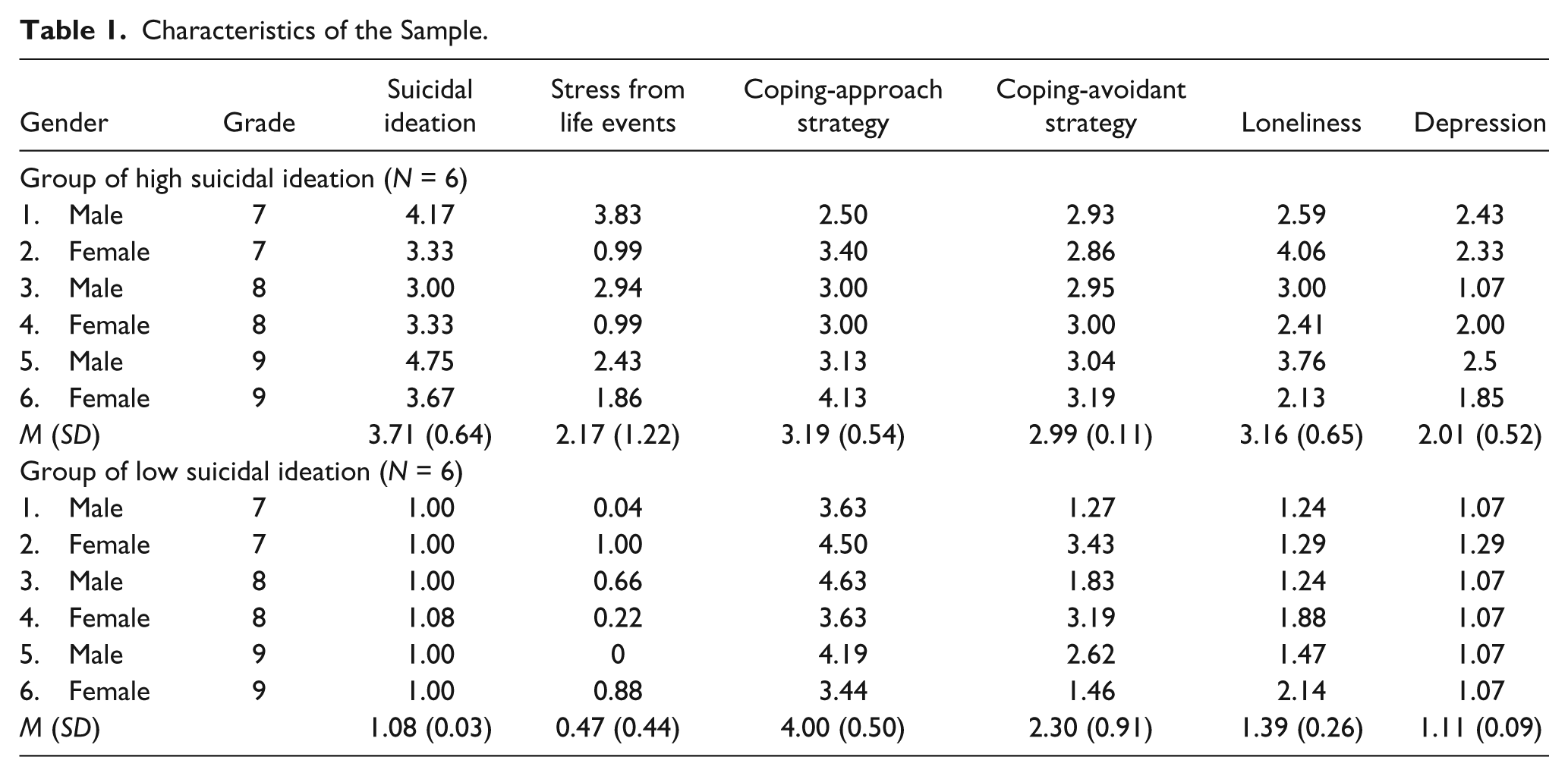
At Time 1, students (N = 723) from Grades 6 to 8 (Mage = 13.42 years, SD = 1.08), attending two junior middle schools in Shanghai, P.R. China, completed a suicidal ideation scale. One year later at Time 2, the same students (now in Grades 7-9) completed a series of self-report questionnaires, including the same suicidal ideation scale used at Time 1. Based on scores on the scale at Time 1 and Time 2, students with suicidal ideation scores in the top 27% of the sample at both time points were classified as the high suicidal ideation group (n = 116), and those in the bottom 27% at both time points were classified as the low suicidal ideation group (n = 88). This selection of upper and lower groups by 27% at each extreme was validated to indubitably differentiate the traits in question (Cureton, 1957; Kelley, 1939). For balance of gender and grade, we chose one male and one female from each grade. We obtained six students from the high suicidal ideation group based on the suicidal ideation scores according to the order from high to low. Similarly, we got six students from the low suicidal ideation group based on the suicidal ideation scores according to the order from low to high. Thus, representative participants (N = 12, six girls) in the qualitative interview study were selected from the high and low suicidal ideation groups described above because the features of adolescents with suicidal ideation may be more explicit by comparison of the two groups. A detailed description of these participants is provided in Table 1.
Characteristics of the Sample.
Measures
A series of Chinese versions of self-report questionnaires that were originally constructed using translation and back-translation, include the (a) Positive and Negative Suicide Ideation Scale (PANIS; Osman, Gutierrez, Kopper, Barrios, & Chiros, 1998). It includes a six-item subscale of positive suicidal ideation and an eight-item subscale of negative suicidal ideation. Each item is rated on a 5-point scale. The measure has been shown to be reliable (α = .86 in the present sample) and valid (e.g., Muehlenkamp, Gutierrez, Osman, & Barrios, 2005). (b) Loneliness Scale (Asher, Hymel, & Renshaw, 1984). It contains 16 items rated on a 5-point scale and has been shown to be reliable (α = .89 in the present sample) and valid with Chinese adolescents (e.g., Liu & Chen, 2003). (c) Child Depression Inventory (CDI; Kovacs, 1992). The measure includes 14 items (rated on a 3-point scale) assessing thoughts, feelings, and behaviors associated with depression and is reliable (α = .84 in the present sample) and valid in Chinese adolescents (e.g., Chen, Rubin, & Li, 1995). (d) Adolescent Self-Rating Life Events Checklist (ASLEC; Liu et al., 1997). It consists of 43 items rated on a 5-point scale describing adolescents’ daily events that influence negatively their mood and has been shown to be reliable (α = .95 in the present sample) and valid in Chinese adolescents (Liu et al., 1997). (e) Self-Report Coping Scale (SRCS; Causey & Dubow, 1992). It consists of 34 items rated on a 5-point scale describing coping-approach strategies (i.e., help-seeking, problem-solving) and coping-avoidant strategies (i.e., internal behavior, external behavior and avoidance) and has been shown to be reliable (α = .83 in the present sample) and valid in Chinese adolescents (Kingsbury, Liu, Coplan, Chen, & Li, 2014).
Procedures
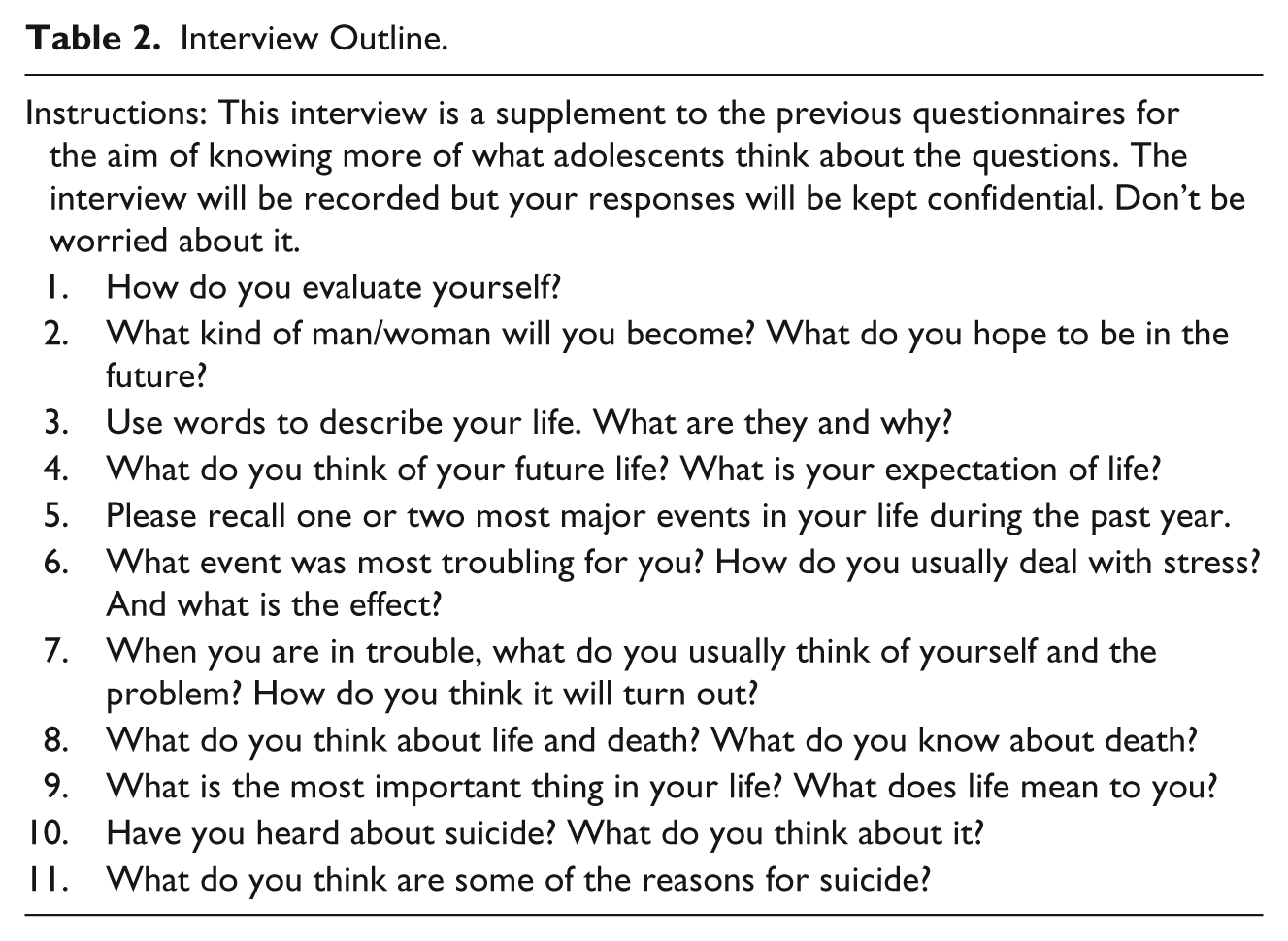
The schools’ institutional review board approved the study in advance of data collection, and ethical procedures were followed throughout the study. First, adolescents with high and low suicidal ideation (n = 204) were selected as previously described. Second, an exploratory mixed-methods design was adopted. Quantitative analyses were conducted to examine statistical group differences in terms of the studied variables. In addition, we also explored statistical gender differences to exclude its effect. Qualitative interviews were then conducted (drawing upon the quantitative results) in order to further explore sources of stress and the underlying reasons why early adolescents with different levels of suicidal ideation had diverse outcomes when suffering the same stress (Creswell, Klassen, Plano Clark, & Smith, 2011). That is why early adolescents differed in levels of suicidal ideation in the same or similar situations. The interview content was guided by the rationale of the present study. An English translation of the interview instructions and questions is provided in Table 2. Interviewers (i.e., research assistants) were blind to the participant’s status (i.e., high vs. low suicidal ideation groups). The interview was semistructured. Participants were encouraged to elaborate and provide more details in their responses. However, participants were also told that they could refuse to answer any question or withdraw. The duration of an average interview was about 1 hour.The 1-hour interview included three stages: (a) greetings and instruction, (b) ask and answer, and (c) thanks and confidentiality. We echoed that we must obey the principle of confidentiality. Each interview was recorded and later transcribed verbatim for subsequent analysis. All transcripts were subjected to thematic analysis, a widely used qualitative analytic method within psychology (Braun & Clarke, 2006). Students were given a small gift (e.g., a pen) for their participation in the interview after debriefing and those who scored 4 points or higher in the PANIS and clearly expressed much sense of meaninglessness in life during the interview were provided psychological counseling and treatment by school psychologists untill they felt good and their scores on suicidal ideation were lower than 3. Their classmates would also care and support them in all aspects for at least 2 weeks.
Interview Outline.
Data Analysis
Quantitative data was analyzed using IBM SPSS Statistics 22.0. For the larger sample of 204 students, MANOVA was conducted to compare the high and low suicidal ideation groups on study variables. Qualitative data from the subsets of 12 participants who participated in the semistructured interviews were processed by the procedures outlined by Elo and Kyngäs (2008) for conducting a qualitative content analysis. Data were processed in three phases: preparation, organizing, and reporting. First, two researchers read through the responses several times without coding any of the data. Then, an inductive and constant comparative method was used to open code all of the responses. Researchers extracted seven themes from the written contents, met to discuss the thematic codes, and went through a consensus process. Finally, researchers further condensed the themes categories, rendering four thematic categories that were presented in the “Results” section. The coding method was shown to be valid by Dispenza, Harper, and Harrigan (2016).
Results
Group and Gender Quantitative Comparisons
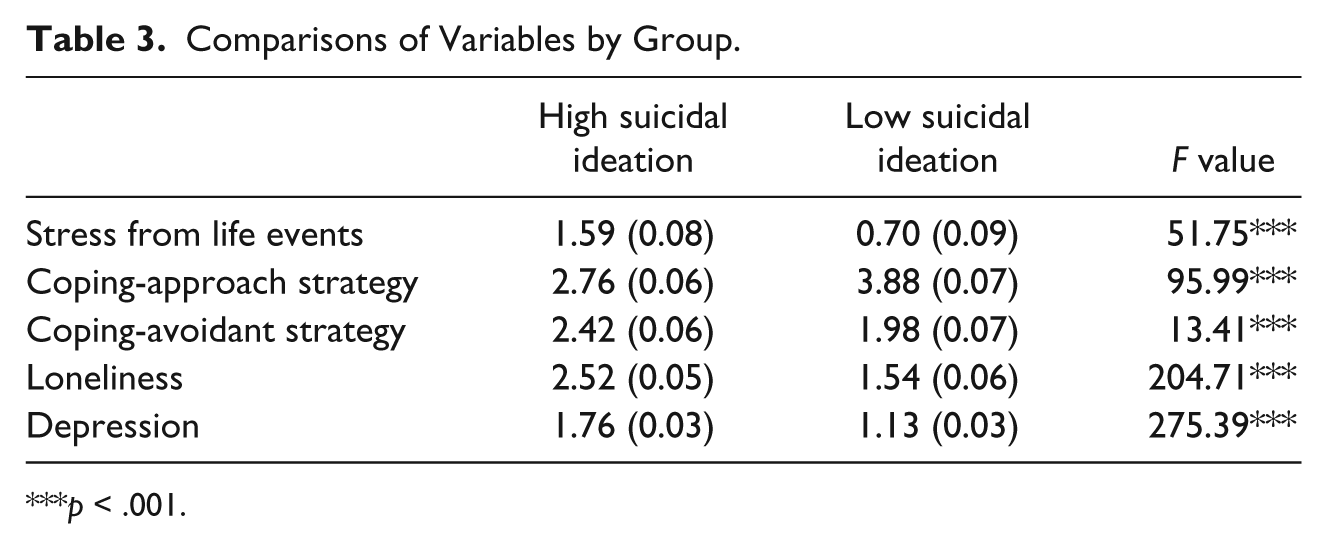
The mean suicidal ideation score of high suicidal ideation group was 2.92 (SD = 0.50), and the mean suicidal ideation score of low suicidal ideation group is 1.22 (SD = 0.19); both were under the midpoint, on a scale ranging from 1 (none or a little of the time) to 5 (most or all of the time). There were 52 adolescents who scored 3 or higher, and most of them (N = 152) scored lower than 3. Also, An independent samples t test showed a significant difference in suicidal ideation between the two groups, t = 30.11, p < .001, d = 4.49. A MANOVA was conducted to examine the overall effects of Group (high suicidal ideation vs. low suicidal ideation), Gender, and their interactions on stress from life events, coping-approach strategies, coping-avoidant strategies, loneliness, and depression. A significant main effect of group was found, Wilks’s λ = 0.29, F(5, 196) = 94.32, p < .001, η2 = 0.71. No other significant main effect or interaction effect was found. Results from follow-up analyses revealed significant univariate group differences for stress from life events, F(1, 200) = 51.75, p < .001, η2 = 0.21, coping-approach strategies, F(1, 200) = 95.99, p < .001, η2 = 0.32, coping-avoidant strategies, F(1, 200) = 13.41, p < .001, η2 = 0.06, loneliness, F(1, 200) = 204.71, p < .001, η2 = 0.51, and depression, F(1, 200) = 275.39, p < .001, η2 = 0.68. Relevant means and standard deviations are displayed in Table 3. As compared with the low suicidal ideation group, students in the high suicidal ideation group reported significantly higher scores for stress from life events, coping-avoidant strategies, loneliness, and depression, as well as significantly lower scores for coping-approach strategies.
Comparisons of Variables by Group.
p < .001.
Group Qualitative Comparisons
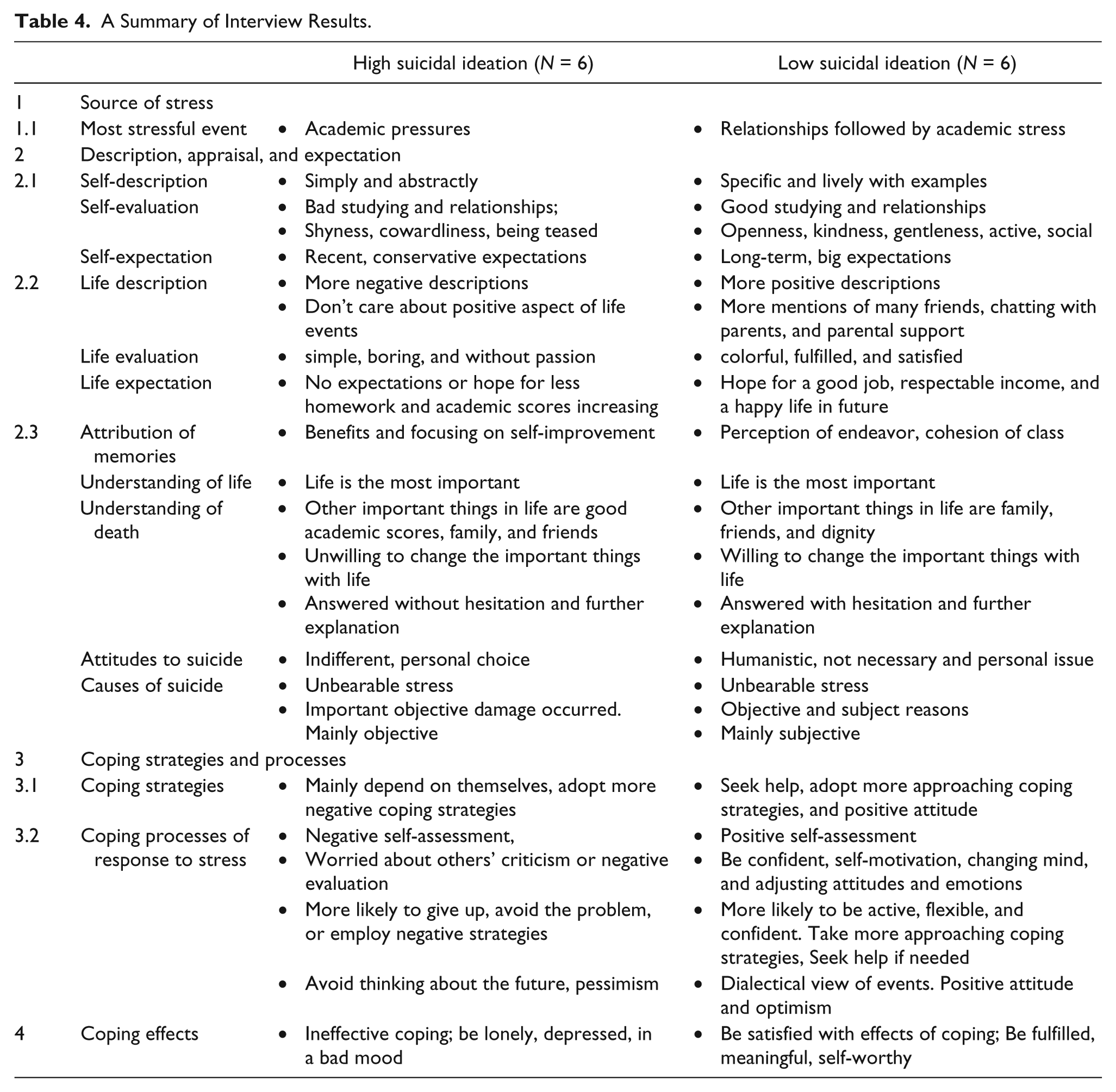
The mean suicidal ideation score of the high suicidal ideation interview group was 3.71 (SD = 0.64), over the midpoint ranged from 3 to 4.75, while the mean suicidal ideation score of the low suicidal ideation interview group was 1.01 (SD = 0.03) and under the midpoint ranged from 1 to 1.08. The independent-samples t test showed that there was significant difference on suicidal ideation score between the two groups for interview, t = 10.22, p < .001, d = 5.96. To further explore specific reasons of differences and obtain the features of adolescents with suicidal ideation, four themes were identified according to the qualitative analysis of the interview contents. They were described as follows: (a) stressors and stress, (b) appraisals and expectations, (c) coping strategies and processes, and (d) coping effects. Notable differences in the themes were found between the two groups. Interview results are summarized in Table 4.
A Summary of Interview Results.
Stressors and stress
The two suicidal ideation subgroups were characteristically distinct in terms of their identification of most stressful events. Whereas adolescents reporting relatively higher suicidal ideation regarded academic pressures as being most stressful, adolescents with lower suicidal ideation considered their greatest stress as stemming from relationships (followed by academic pressures). The former were troubled by their academics and relationships because they couldn’t cope with them (e.g., “I am hoping my academic scores will be better . . .,” “I am easy to be nervous, lacking of courage, and don’t deal well with relationships . . .”), whereas the later benefited from academics and relationships because they could do well with them (e.g., “I always take initiative to say hello to others when meeting each other. I like to make friends . . .,” “. . . I have good scores and capability of problem-solving . . .”).
Cognitions: Description, appraisal, and expectation
Participants in the high suicidal ideation subgroup were inclined to describe themselves more simply and abstractly (e.g., “such as just so-so, good man, and not bad”) without specific accounts, and to highlight their negative personality traits. Also, the high suicidal ideation group described themselves as being not good at studying and as dissatisfied with their social relationships. Improving academic scores was their biggest hope (e.g., “I am just so-so and hoping my academic scores will be better . . .; I am easily nervous, lacking of courage, and don’t deal well with relationships . . .”).
In contrast, participants in the low suicidal ideation group provided accounts about themselves that were comparatively more specific and lively (e.g., “I am open so I have many friends. I often chat with them sharing our secrets . . .”), included more examples or explanations, and highlighted their positive personality traits. Also, this group perceived themselves as being positive (e.g., “good at studying, open, kind, gentle, active, helpful, and social to others . . .”), and were satisfied with their social relationships. They were not troubled by trifles, and tended to set long-term and big self-expectations (e.g., “I am open and easygoing compared with other classmates, and have many friends. I have good scores and capability of problem-solving . . .”).
A prominent area of content for the high suicidal ideation group was a focus on negative aspects of life. Among these adolescents, life was described as being negative (e.g., “simple, boring, troublesome, unfulfilled, and without passion . . .”). Moreover, they often neglected the positive points in life, which are meaningful, and were most trapped by the present difficulties such as homework, scores, and without optimism expectations (e.g., “There is so much homework to do. Life is boring; There are some troubles from time to time in my life, and I hope for less homework and troubles such as crowded traffic”).
In contrast, adolescents in the low suicidal ideation group reported a more positive view, suggesting that life is colorful, fulfilling, and that they felt high in well-being and satisfaction. This group reported experiencing meaningful lives through good relationships and social support, such as sharing opinions with peers and parents and getting support from them. Their outlook was also optimistic, expecting good jobs, respectable income, and a happy life in future, for example, I feel very happy. In my family I have father, mother and a little sister who is 9 years younger than me. I hope my life will be so forever; I feel fulfilled. After my class I can chat with my parents in my home . . .
Attribution of memories for major events
During the interview, interviewees were asked to recall one or two of their most influential events and explain why these events made such an impression. A similarity was observed between groups as both indicated they could learn and benefit from these major events. However, it was noted that adolescents with high suicidal ideation paid more attention to aspects of self-improvement, defined as an individual-orientation (e.g., “I got a surprising result in the sports meeting with the help of classmates; I got the good scores in an exam with teacher’s extra tutoring . . .”). In contrast, adolescents with low suicidal ideation were more likely to focus on demonstrating abilities, endeavors, and peer relationships, defined as a collective-orientation (e.g., “I will be happy when helping classmates who are in trouble; I cherish the time sharing with friends. We used to hold a farewell party for classmates who are leaving to another city . . .”).
Understanding of life and death
Of note, both the suicidal ideation subgroups agreed that life is the most important. Both groups knew about death mainly through the death of their relatives or pets, as well as news or reading about death. Overall, death recognition was related to age and personal experiences across the two suicidal ideation subgroups. Each subgroup also ranked the three most important things in life. Adolescents in the high suicidal ideation group listed more concrete constructs, such as academic scores, family, and friends (e.g., “For me, the most important things are studying, family and friend except life.”). They also feared death and were unwilling to exchange other meaningful things with their lives. However, for the low suicidal ideation subgroup, dignity was also included in the three most important things in life. Moreover, adolescents with low suicidal ideation explained that as a human, kinship, friendship, and dignity or other things are at least as important as life (e.g., “When my friends are in trouble, I will try my best to help them even though losing my life; I think the lives of my family members are more important than mine.”).
Attitudes to suicide
When probed about their attitudes toward suicide, the high suicidal ideation subgroup displayed some indifference, and argued that suicide was a personal choice (e.g., “. . . death is none of others’ business”). Furthermore, adolescents in this group cited serious damage and unbearable stress as the main causes of suicide (e.g., “There must be something stressful happening. Sometimes I hope I can die in a traffic accident especially when I didn’t have expected scores in an important test; Maybe they [suicides] are not afraid of pain . . .”).
In contrast, the low suicidal ideation subgroup manifested more humanistic attitudes toward suicide and suggested that it was not necessary to commit suicide (although they agreed that there could be something unbearable that happened to those that did). They also admitted the role of objective reasons, but paid more attention to subjective reasons, such as viewing things from diverse perspectives, for example, Although the stress seems like it is unbearable, there must be ways to cope if they try hard enough. Furthermore, parents will be heartbroken if suicide is completed; life is meaningful although there are some troubles. Suicide is an understandable but unwise behavior . . .
Coping: Coping strategies and processes
The stress-coping model suggests that coping behaviors follow the appraisal of stress. In this critical stage, coping strategies and coping processes are deterministic of outcomes. The high and low suicidal ideation groups could be distinguished from each other in terms of both their coping strategies and coping processes.
Coping strategies
Adolescents with high suicidal ideation reported that a lack of social support (e.g., “for unclear reasons, . . . being not good at sociality, shyness, or negative thinking . . .”) resulted in independent coping when facing difficulties. Moreover, they tended to adopt negative coping strategies, such as avoiding the difficulties (e.g., “I just ruminate why I am in the bad fortune, why the problem is so difficult . . .”). In contrast, adolescents with low suicidal ideation would seek help from parents and friends when they were in trouble, and adopt more approaching coping strategies (e.g., active communication, problem solving) and positive attitudes to handle relationship problems or other stresses (e.g., “when I encounter something I cannot handle, I tend to talk with my Mom or set a lower goal for it . . .”).
Coping processes
The adolescents with high suicidal ideation typically reported something negative about themselves (e.g.,” I am lacking abilities. I am always in a bad fortune . . .”). Consequently, they became pessimistic and vulnerable and very worried about others’ criticisms or negative evaluations. As such, they were inclined to give up or avoid the stressful events or problems and tried to employ negative coping styles (which they perceived as appropriate). Interestingly, the adolescents with low suicidal ideation did not think or act in the same ways. They tended to positively consider themselves. They were more active, optimistic, flexible, and confident in the same situation. They flexibly changed their minds (e.g., to view things dialectically), adjusted their attitudes and emotions in time, and were good at self-motivating (e.g., “. . . a little disappointed, but I bestir myself quite quickly . . .”). Also, they were not shy to seek help from parents and friends if needed.
Coping outcomes
According to the stress-coping model, outcomes depend upon relevant cognitions and behaviors. The high suicidal ideation subgroup complained more about their bad fortunes and unexplainable psychological distress (i.e., loneliness, depression) resulting from ineffective coping (e.g.,” Why do my efforts not work? Why does God punish me? Life is meaningless . . .”). In contrast, most of the low suicidal ideation subgroup reported that they were eventually satisfied with outcomes, experiencing only relatively temporary discomfort. Moreover, their strategies were effective, which encouraged them persistently. They were filled with a sense of fulfillment, meaningfulness, and self-worth (e.g., “Life is beautiful and colorful. I will become better and better although there are some difficulties on my way . . .”).
Discussion
The goal of this study was to examine differences between adolescents classified as high versus low in suicidal ideation for the summary characteristics of adolescents with suicidal ideation in an urban community in China. Results from quantitative analyses demonstrated that there were substantive differences between the high and low suicidal ideation groups in all studied variables. Specifically, compared with those in the low suicidal ideation groups, adolescents with high suicidal ideation reported significantly higher scores for stress from life events, coping-avoidant strategies, loneliness, and depression, as well as significantly lower scores for coping-approach strategies. Interestingly, the present findings indicated that there were no gender differences on these studied variables in the quantitative study. In addition, although the mean suicidal ideation score of the high suicidal ideation group was significantly higher than that of the low suicidal ideation group (d = 4.49), they both were lower than midpoint (i.e., 3), which demonstrated that the level of suicidal ideation of the study sample was not high as a whole. Still, a few adolescents (N = 52) in the present competitive context scored 3 or more in suicidal ideation test and were provided psychological counseling and treatment. Moreover, we well understood the significant difference on suicidal ideation between the two groups by backtracking or ascribing to the quantitative differences of perceived stress from life events, coping strategies, and psychological distress (e.g., loneliness and depression).
Also, the suicidal ideation level of adolescents in the high suicidal ideation interviewee group was much higher than that of adolescents in the low suicidal ideation interviewees group (d = 5.96). The former’s suicidal ideation scores ranged from 3 to 4.75, which reminded us that these interviewees also reached a level warranting psychological counseling and treatment. They were provided the psychological counseling and treatment as soon as they finished interviewing. Follow-up qualitative analysis provided strong support for the findings of these quantitative analysis, and further revealed that group differences centered around four themes that further explored the mechanism of suicidal ideation: (a) stressor and stress, (b) appraisals and expectations, (c) coping strategies and processes, and (d) coping effects. These findings were consistent with Erikson’s theory of psychosocial development (Erikson, 1968,), the stress and coping model (Lazarus & Folkman, 1984), and further complemented or extended them with the distress-to-meaninglessness model (DMM) that suggests that the possible process of suicidal ideation is a chain of stress, coping’s failure, distress along with meaninglessness, and suicidal ideation, which was consistent with the finding by Zhang, Li, Chen, Ewalds-Kvist, and Liu (2017). This is the theoretical contribution of the present study to the extant literature. The findings also suggested that differences in the links between life events and results among adolescents with high and low suicidal ideation can be primarily attributed to self-cognitions along with the relevant coping skills. And improving positive self-evaluation may be a focus of suicide or suicidal ideation preventive intervention, which is the most important practical contribution to methods of preventive intervention.
Primary Stressor: Academics and Interpersonal Relationships
Nowadays, China is experiencing the industrialization that Western countries have experienced (Nolan, 2007). People care for the development of science and economy rather than themselves (Mok, Wong, & Wong, 2010). Mental problems and suicide are increasing, especially in the group of adolescents with enormous social changes (Phillips et al., 2002; Phillips, Liu, & Zhang, 1999; Rueter & Kwon, 2005), because adolescents undertake much stress from future possible success. The present study revealed that both academic and interpersonal issues represented adolescents’ primary sources of stress. These findings were in agreement with previous results (Hamilton, 2015; Låftman, Almquist, & Östberg, 2013; Shaunessy-Dedrick, Suldo, Roth, & Fefer, 2014). For example, a qualitative study of successful and struggling high school students showed that students’ primary sources of stress involved meeting numerous academic demands and seeking a balance between academic goals, social needs, and extracurricular activities (Shaunessy-Dedrick et al., 2014). Interestingly, we found that academics and interpersonal relationships were also the primary sources of stress of both subgroups in the present study. High suicidal ideation adolescents were trapped by them, but low suicidal ideation adolescents benefited from them because they could deal well them, so they could transform the stress into benefits. This suggests that stressors would also have positive functions if they were handled suitably.
Origins of Differences: Appraisals of Self, Events, Life, and Death
The stress and coping model was supported by the findings of the present study, which indicated there were characterized differences in many aspects of appraisals between the high and low suicidal ideation subgroups. Significantly, the present study elaborated the cognitive characteristics of adolescents with suicidal ideation. Cognitive appraisals of self, events, and resources available for coping play a central role in one’s perceptions of stress, which may explain why the two subgroups in a similar context differed in stress and how stressful life events evolved into psychological distress (Lazarus & Folkman, 1984).
Self-evaluation
The differences between high and low suicidal ideation adolescents in self-cognition likely contributed to the differences in follow-up secondary appraisals, perceiving stress and coping (Rey & Extremera, 2015). To some degree, the simple and abstract self-descriptions of adolescents with high suicidal ideation appeared as ego defense. Moreover, the adolescents with high suicidal ideation had short-term and conservative self-expectations (such as improvements in academic scores), whereas the adolescents with low suicidal ideation were confident enough to expect long-term and more substantive achievements in the future. With regard to personality, the adolescents with low suicidal ideation had the character strengths from what they self-evaluated in comparison with the adolescents with high suicidal ideation. These differences were consistent with previous literatures suggesting that character strengths can be defined as positive traits reflected in thoughts, feelings, and behaviors, which may, in turn, lead to positive outcomes (Park, Peterson, & Seligman, 2004). These differences in self-appraisals may also represent the origins of other differences (Abramson, Metalsky, & Alloy, 1989).
Life evaluation
The most prominent differential feature between the two subgroups was along the dimension of negative (e.g., “simple, boring, unfulfilled, exhausted”) versus positive (e.g., “colorful, fulfilled, satisfied, full of well-being”) life evaluation. With the exception of academics (less homework, better academic scores), adolescents with high suicidal ideation were invested more in negative aspects of life events (e.g., “nobody can share my blue mood, life is boring”). In contrast, adolescents with low suicidal ideation cared more about positive things, particularly happy times with friends and parents, and reported more extended hopes for the future (e.g., “good job and income, happy life”). These findings were in line with previous findings indicating that negative cognitive appraisals prospectively predicted negative mental health outcomes in adolescence (Nicolai, Laney, & Mezulis, 2013) and with the hopelessness theory of depression (Abramson et al., 1989), which posits that when a negative event occurs, depression may result from the tendency to make negative inferences about the self, attributions, and consequences of the event.
Attitudes toward life and death
All adolescents in the current study agreed that life was the most important, which may be contrary to the opinion that adolescents with high suicidal ideation considered life was not significant. But adolescents with high and low suicidal ideation varied in their attitudes to life and suicide. The adolescents with high suicidal ideation reported being trapped by academic stress, cared little about other things, and were unwilling to exchange their lives with other important things. To some extent, these views appeared to reflect a fear of life or a lesser sense of life control. As a result, heightened thoughts of the meaninglessness of life appear to have resulted. On the contrary, adolescents with low suicidal ideation valued other things such as relationships and dignity, and were willing to exchange their lives with other important things (although life is most important), which demonstrated their courage and confidence. They can benefit from aspects of life and experience meaning in life. Hence, the diverse degree of their courage and confidence were manifested by the two subgroups’ attitudes toward life. Consistent with the emotion self-confidence model of suicidal ideation (Deeley & Love, 2012, 2013), which is based on the stress-coping framework (Lazarus & Folkman, 1984), adolescents with high suicidal ideation were impaired by their cowardice and self-distrust, whereas adolescents with low suicidal ideation benefited from their courage and confidence.
Previous research showed that experiencing negative life events such as abuse and trauma (Hagstrom & Gutierrez, 1998) were associated with attraction to death and repulsion by life, which were high-risk factors of suicide. In accordance with these findings, results of the present study demonstrated all adolescents agreed there must have been some unbearable stress that happened to those who committed suicide. However, the adolescents with higher suicidal ideation had permissive attitudes toward suicide and argued that suicide was a personal choice, whereas adolescents with lower suicidal ideation felt that subjective responses to the objective stressors may be effective in avoiding this kind of tragedy. They also showed a more humanistic attitude toward suicide, arguing that various views of issues may lead to better results. Thus, flexible cognitions (i.e., viewing things from various perspectives) versus stubborn cognitions, and humanism versus indifference may be used to distinguish the low and high suicidal ideation subgroups.
Coping: Strategies, Processes, and Effects
Results from the current study also revealed that diverse coping skills led to different outcomes among adolescents who varied in suicidal ideation. Seeking help, adopting coping-approach strategies (e.g., problem solving), and keeping positive thinking, emotions, and attitudes were key distinctions between adolescents in the high and low suicidal ideation subgroups. These may stem from their substantive differences in appraisals of self, events, life, and death. Therefore, during coping with stressful life events, adolescents with higher suicidal ideation were more likely to be worried and hopeless, avoid or escape, and give up trying with ego defensive reasons (such as bad luck, lack of ability) and then experience deep psychological distress. Adolescents in the lower suicidal ideation subgroup were more inclined to self-motivate, flexibly change their mind, regulate emotion, suitably seek help, and be active, confident, and optimistic. Overall, in the circle of life events resulting in suicidal ideation, negative self-evaluation led to low or negative self-expectation (e.g., “I must have a bad result or fortune . . .”) and higher risk-oriented perception, which in turn, triggered cowardice and avoidance, along with negative coping behaviors. In the end, consequences ended up being the same as what they expected (i.e., self-fulfilling prophesy; Biggs, 2009).
The findings of the present study were compatible with previous results indicating that passive coping styles (e.g., higher emotional-focused coping skills) were associated with increased suicidal ideation, and that active coping approaches (e.g., higher task or problem-focused coping skills) were related to decreased suicidal ideation (Kim, Baek, Han, Lee, & Yurgelun-Todd, 2015; Nrugham, Holen, & Sund, 2012; Stratta et al., 2014; Zhang, Wang, Xia, Liu, & Jung, 2012). For example, avoidant, escaping, or unhealthy coping strategies (such as heavy alcohol or drug use), hopeless or negative self-talk, low academic achievement, high perceived stress, and poor social support predicted suicidal ideation in a sample of 73,238 adolescents aged 12 to 19 years (Kim et al., 2015). Of note, emotion-focused coping and problem-focused coping were by no means mutually exclusive: after an initial reaction (emotion-focused), a problem-oriented intervention can lead to clarification and adequate management of the stressor (Folkman, 1984). Furthermore, not all emotion-focused coping (such as encouraging self-talk, deep relaxation) were related to negative outcomes, and some kinds of problem-focused coping (such as violence or planning revenge against perceived source of distress) may also be associated with negative outcomes (Deeley & Love, 2012, 2013). So, other coping strategies and processes should be explored in more depth using dynamic research methods that can function as a conduit to deeper understanding of a phenomenon.
Implications
Several practical implications can be derived from the present findings. First, good academic scores increase the likelihood of future success, and are the embodiment of social competition in school in China. Our results suggest that the most challenging stressors for adolescents (particularly among those in the higher suicidal ideation subgroup) were academics and relationships. Thus, educators and parents should be more optimistic, hopeful, and relaxed, and might seek to help adolescents with their studying or reduce their study demands, and build more harmonious peer- or parent-child relations. Second, core self-evaluation (CSE; comprising self-esteem, locus of control, neuroticism, and self-efficacy) represents the fundamental evaluations that people make about themselves and their functioning in their environment (Judge & Cable, 1997). And people’s thoughts about themselves change throughout life in self-development theory (Brown, 1998). Given that adolescents with higher suicidal ideation were particularly likely to negatively evaluate themselves, we should attempt to foster CSE of students at any opportunity. The improving positive self-evaluation may be a focus of prevention and intervention. Also, unconditional self-acceptance, the core of positive self-evaluation, may be achieved by mindfulness (Carson & Langer, 2006). Third, the present findings indicate that adolescents with higher suicidal ideation felt deeply trapped by academic pressures, which were regarded as a central focus of their lives—to the exclusion of enjoyment of other aspects of lives. In reality, life consists of numerous compositions, including all kinds of life events (positive or negative) and experiences (good or bad), and academic score is just quite a small part of them. Recognition of the meaningfulness of life should be reached with the help of meaningful engagement (Armstrong & Manion, 2015) and positively experiencing life such as enjoying a cup of coffee with friends or parents in the cold winter afternoon (Heintzelman & King, 2014).
Also, in the Chinese context, suicide is not an issue of personal choice. One death may result in at least six people suffering psychological distress in the Chinese family (Zhang, 2013). And it is one’s most miserable failure in life that his or her children die before him or her. Moreover, issues are also raised in terms of who would provide filial piety for aged parents, which is regarded as the individual’s responsibility (Chow, 2001) if they commit completed suicide. Life is regarded as the responsibilities of raising children and older adult care in Chinese cultural context. Furthermore, dying might be a way of escape from reality rather than the best means of self-extrication. Thus, a deeper understanding of the meanings of life and death, based on Chinese traditional culture and context, should be cultivated in adolescents. Finally, positive attributions or appraisals of life events and adoption of long-term effective coping strategies appeared to be particularly lacking among adolescents with high suicidal ideation. Intervention strategies could include training to first pretend to think, experience, and behave positively, which may result in better overall outcomes (Frydenberg, 2010).
Limitations and Future Studies
Although the findings through a comparison of high versus low suicidal ideation groups is useful for understanding the features of adolescents with suicidal ideation, several limitations of the present study should be noted. First, qualitative studies of the type reported herein may be criticized for their subjectivity and focus on narratives provided by small samples. The themes that emerged from the present study arose from inductive analyses and may not be generalized to the broader youth population. A larger sample of healthy community and patients, with mixed-methods designs and integration of quantitative and qualitative data, is required to further clarify to what extent the discrepancies between high and low suicidal ideation adolescents are replicated. Second, coding was conducted by two researchers and went through a consensus by discussion according to the method used by Elo and Kyngäs (2008). The ICC should be complemented for more reliability in a future study. Furthermore, there are of course a number of other more detailed features that might account for the differences between the two subgroups (which may be helpful to the intervention or prevention of psychological crises). Future qualitative studies from diverse perspectives for the purpose of preliminary investigation may be conducted with the follow-up quantitative studies providing confirmation of results.
To summarize, based on the mixed-methods approach, our results demonstrated that the primary characteristics of adolescents suffering more suicidal ideation are as follows: (a) most troubled by academic pressures and relations (particularly academic issues); (b) negative self-evaluations (such as considering themselves as being not good, lacking of capacity, easily changeable mood, low confidence, and bad self-expectations), which may be the origin of their problems; (c) maladaptive understanding of life and death (such as academic issues are most important in life, indifferent and permissive attitude toward suicide); (d) individual-oriented attributions (such as benefits for academics and mood improvement—indicating their bad emotional regulation); and (e) negative coping strategies (such as worrying, avoiding, being distant, and giving up with self-defensive excuses) and processes (such as negative self-fulfilling prophesy). The characteristics concerning stressor, coping, and consequences including loneliness, depression, and meaninglessness, were theorized by the distress-meaninglessness model which expanded the stress-coping model and contributed to the extant literature. Also, the characteristics are helpful to understand the process of suicidal ideation and gain practical preventive intervention.
Footnotes
Acknowledgements
We are grateful to all the participants in our study. We thank Dr. Robert J. Coplan at Carleton University, Ottawa, Canada for the review.
Declaration of Conflicting Interests
The author(s) declared no potential conflicts of interest with respect to the research, authorship, and/or publication of this article.
Funding
The author(s) disclosed receipt of the following financial support for the research, authorship, and/or publication of this article: The study was supported by funds from Humanities and Social Sciences Key Research Bases under the Chinese Ministry of Education (16JJD840001), Research Project of Fujian Young & Middle-aged Teachers’ Education (JAS160900), Shanghai Planning Project of Philosophy and Social Science (A-9103-16-006006), and Social Science Project of Fujian Polytechnic of Information Technology (Y15303).