







Abstract
Variability in parental academic involvement and socialization practices could explain academic disparities among adolescents. Academic socialization during adolescence is likely to vary based on students’ educational histories and ability levels. Thus, adolescents were purposively selected, from a larger longitudinal study, to vary in their grade point average (GPA) and academic tracking (e.g., Advanced Placement [AP]/honors, remedial). We examined 24 qualitative ecocultural family interviews with parents (n = 12) and their Mexican-origin high school–attending children (n = 12), conducted simultaneously but separately. Guided by the interpretative paradigmatic framework via thematic analysis, we examined practices in school, at home, and in the fostering of academic aspirations. Although families were met with low expectations from school personnel, we found variability in parents’ abilities to overcome challenges. At home, parents of low-achieving students reacted to unmet expectations during academic emergencies (e.g., risk for failing a class), while parents of high-achieving students reacted on a daily basis by incorporating communication regarding academics into the family’s routine. Although all parents aspired that their adolescents at least finish college, parents differed in their specific expectations of grades. Adolescents, in turn, differed in their own value of education. Understanding within-group differences in academic socialization practices may inform the way educators and interventionists work with families.
Keywords
Parental academic involvement, generally defined, is associated with the academic achievement of adolescents (Hill & Tyson, 2009), and this is also true for Latino students across development (Ceballo, Jocson, & Alers-Rojas, 2017). However, the specific ways in which parents attempt to socialize academically, as well as the specific needs of the child, may change the effectiveness of these behaviors (Pomerantz, Moorman, & Litwack, 2007). For example, a study employing a national dataset found that parental interactions with schools were most beneficial for adolescents with low grades, but, assistance with selecting courses was more useful for adolescents with high grades (Benner, Boyle, & Sadler, 2016). Such nuances may be important to inform recommendations that bolster parental academic involvement, particularly for Latino parents who may not have attended college or been educated in American school systems (Ceballo et al., 2017). Some research with Latino families also finds parental behaviors not typically included in traditional quantitative measures of academic involvement such as exposing children to the difficulties of manual labor as a way to encourage them toward academics (Lopez, Scribner, & Mahitivanichcha, 2001). To better understand variability in parental academic involvement, and how it is linked with adolescents’ academic values and achievement, this qualitative study examined within-group differences in the methods Mexican-origin parents use to socialize their adolescents academically and the meaning that their adolescents make of this involvement.
Latino Parental Involvement
There are several reasons why a qualitative study of Mexican-origin parental academic involvement is needed. Latino parental academic involvement may be different from other groups because it is embedded within the context of an immigrant narrative that socializes children to place value on upward social mobility (Suárez-Orozco, Suárez-Orozco, & Todorova, 2008). Latino parents encourage academics often as a means to make up for the sacrifices of migrating and to improve the family’s socioeconomic standing (Ceballo, Maurizi, Suarez, & Aretakis, 2014). Moreover, education is even included in the definition of moral development for many Latino parents as many describe a child with academic success as one who is on “the good path” (Azmitia & Brown, 2000). Yet, despite consistently high levels of academic aspirations for their children (Goldenberg, Gallimore, Reese, & Garnier, 2001), Latino adolescents show, overall, the highest high school dropout rates relative to other ethnic groups (Krogstad, 2016), with Mexican American students showing the lowest rates of high school completion, compared with Whites, Blacks, Asians, and Pacific Islander groups, and other Latino subgroups (U.S. Department of Education, 2012). Even so, 35% of Latino young adults, ages 18 to 24 are enrolled in postsecondary education (Krogstad, 2016). Differences in parental academic involvement techniques that lead some adolescents to develop academic resilience, while others fall behind, are unclear.
Studies with other populations suggest that not all involvement methods are equal, and that more involvement is not always better (Pomerantz et al., 2007), but even these findings are not always straightforward. For example, connections with school personnel seem to be more beneficial for adolescents who are high achievers in some studies (Sumow & Miller, 2001), but for low achievers in others (Benner et al., 2016). This could be because nuances such as the quality and the reasons behind these connections with school are unclear (Fan & Williams, 2010). Adding adolescents’ perspectives further complicates findings. Some studies find that adolescents do not want parents to be involved in their academics (Deslandes & Cloutier, 2002), but others find that, except for help with homework, most do (Narh, 2009). Adolescents’ preferences may be dictated by their own achievement and academic values (Benner et al., 2016). Given the variability in Latino adolescent achievement (Borman & Overman, 2004), it is likely that Latino parents employ different methods of academic involvement that also vary in their effectiveness. As well, it is likely that parents will engage academically in different ways depending on their beliefs about their childrens’ ability or their achievement level. For example, parents who have high-achieving students provide more advanced explanations when fostering academic skills (for review see Pomerantz et al., 2007), and their advice about academics may be more effective for high-achieving students (Benner et al., 2016). Hence, we sought to understand the academic behaviors of parents of Mexican-origin youth who are academically resilient, as well as of adolescents who are at-risk for low achievement.
Academic Socialization Among Latino Adolescents
During high school, classes become more challenging (Neild, 2009), communication with teachers decreases (Adams & Christenson, 2000), and dropout rates increase, especially for Latino students. Still, research finds a variety of ways that Latino parents employ to socialize their adolescents toward a value of education—such as meetings with school personnel, conversations about academics, or exposing their children to the hard labor they endure (Lopez et al., 2001). During adolescence, cognitive skills necessary to understand complex issues such as morality become available (Hart & Carlo, 2005), and some adolescents may perceive their academic success a responsibility to the sacrifice their parents have engaged in for them. Indeed, perceptions of their parents’ hard work as a gift to their future, and family obligations have been found to be associated with adolescents’ academic motivation (Ceballo et al., 2014; Fuligni, Tseng, & Lam, 1999). Another key marker of adolescence is autonomy development, which expands to academic domains (Hill & Tyson, 2009). While continuing to work with school personnel, conversations between Latino parents and adolescents become important for academic socialization and performance (Ceballo et al., 2014). For example, an exploratory factor analysis with a diverse sample of Latino adolescents found that two of the three methods of parental academic involvement that were linked with academic outcomes included verbal connections (Ceballo et al., 2014). Given the need for autonomy coupled with the cognitive abilities of adolescents, more complex discussions regarding academics and their purpose may become salient during this period of development. Even though parents may shift their academic socialization strategies when their children enter high school, both school and home academic involvement are still effective (Ceballo et al., 2017). In fact, a study with Mexican American students found that the link between parents’ school involvement and adolescents’ GPA was stronger for parents of high school students than middle school adolescents (Kuperminc, Darnell, & Alvarez-Jimenez, 2008). Academic disparities within Mexican-origin adolescents persist, and it is unclear if the nuances in these academic socialization methods such as quality or timing makes a difference. Finally, by the time students reach high school, most have been tracked into remedial, standard, or advanced courses—and qualitative research with Latino families finds that parents are strong determining factors influencing the track to which their students belong (Walker & Pearsall, 2012). Understanding parental academic involvement may be critical during adolescence, given that the academic track to which students belong is related to their long-term academic success (Rosenbaum, 1980).
Theoretical Frameworks
To frame the current study we drew from two theoretical frameworks. First, Okagaki’s (2001) triarchic model of minority children’s school achievement proposes that academic achievement of minority students is multiply determined by (a) the form and perceived function of school, (b) the family’s implicit theories of education and development, and (c) a child’s resilient academic identity. In addition, cultural ecology theory (Weisner, 2002) explains that parents socialize their children culturally through activities that occur within daily routines, which employ various resources, values, goals and scripts that guide such activities. With these frameworks, our study not only examined parents perceptions of the utility of school and education, but also the way that parents employ daily academic routines to pass these values to their children. Finally, we also examined adolescents’ adoption of their parents’ academic values (Weisner, 2002) or their academic identity (Okagaki, 2001). The value of education and high academic aspirations is common among parents (Goldenberg et al., 2001), however, the nature or quality of daily practices that parents utilize to pass on their high academic values is largely unexamined. Researchers tend to examine the quantity of parental academic involvement, typically assuming more is better. According to the cultural ecology theory, these values may be most effectively passed on to adolescents when coupled with daily academic practices.
Yet, as proposed by Okagaki’s (2001) triarchic model, whether adolescents adopt their parents’ academic values is likely multiply determined not just by quantity, but by the quality of parents’ academic involvement, as well as characteristics of the adolescent and external contexts, such as the school or stressors faced by the family (Camacho-Thompson, Gillen-O’Neel, Gonzales, & Fuligni, 2016; Ramirez, 2003). Furthermore, the cultural ecology theory posits that the meaning adolescents make of their parents’ involvement may be an amalgamation of cultural and psychological characteristics. The way adolescents adopt their parent’s goal of academic achievement may be due to the meaning or importance they place on the academic activities their parents encourage in their daily life (Bernheimer, Gallimore, & Weisner, 1990). For adolescents who lack interest in school, for example, parents’ attempts to motivate them may be perceived as incompatible with their own goals. The adolescents’ current achievement level likely also plays a role in whether, when, and how parents choose to become involved in their adolescents’ academic goals and activities, and how adolescents perceive and respond to their parents’ behaviors (Pomerantz et al., 2007). To better understand these nuances, we examined how families of Mexican-origin adolescents that systemically vary in their achievement level use daily academic activities in three previously examined domains: at school, at home, and through the promotion of “academic aspirations” (Ceballo et al., 2017; Hill & Tyson, 2009). In addition, we analyze adolescent reports of their own academic values and practices, which allowed us not only to compare parental behaviors but also to understand how adolescents internalize parents’ academic involvement.
Current Study
We examined how parents describe daily activities relevant to the three previously identified domains of parental academic involvement: at school, at home, and through fostering academic aspirations. School-based academic involvement has been defined as attending school programs, such as Parent Teacher Association (PTA) meetings, open houses, volunteering at school, attending extracurricular activities and communicating with school personnel (Hill & Tyson, 2009). This type of behavior has been linked with adolescent academic motivation, engagement, and achievement (e.g., LeFevre & Shaw, 2012). Home-based academic involvement has been defined as creating an environment in the home that fosters learning such as providing books, newspapers, as well as educational toys and materials (e.g., Eamon, 2005). With the exception of academic pressure and help with homework, most involvement at home has been linked with academic achievement (Hill & Tyson, 2009). Finally, promoting academic aspirations requires that parents communicate their hopes, expectations, and academic goals as well as the value and utility of education, and prepare adolescents for the future (Hill & Tyson, 2009). Parental academic aspirations are linked with adolescent academic values, achievement and occupational aspirations (Jodl, Michael, Malanchuk, Eccles, & Sameroff, 2001) consistently across time and even over and above previous levels of achievement, socioeconomic status (SES) and self-perceptions (Trusty, Plata, & Salazar, 2003). Across these three domains, this study used qualitative methods (i.e., semistructured, open-ended conversational individual interviews) to identify and describe activities in daily life that Mexican-origin parents use to socialize their adolescents academically. Interviews with adolescents were used to examine the meaning they make of these interactions and how they internalize their parents’ messages about achievement. Comparisons in these patterns were made between families with students in different high school academic tracks to better capture the full range of family experiences and to understand differences based on student achievement levels.
Method
This qualitative study (n = 24) is part of a larger 2-year mixed-methods study that examined a variety of factors including family relationships, socioeconomic resources, and mental health. In the parent study, qualitative data were collected from a 10% random subsample (n = 42 dyads) of 428 Mexican-origin ninth- and 10th-grade (51%) students (Mage = 15.02, SD = 0.83, age range = 13-18 years) and one of their parents (Mage = 41.93, SD = 6.75). At the end of the academic year, official school records were obtained from schools.
Families in the original study were sampled from two large high schools in the Los Angeles area, which were predominantly Latino (93.9% and 62.4%) with high levels of students receiving free or reduced-price lunch (70.8% and 73.2%). The sample was evenly split by gender (49% female), and primary caretakers consisted mostly of mothers (83.3%; fathers, 13.5%; other relatives, 2.9%). Most parents were born in Mexico (77.1%), with smaller proportions born in the United States (17.5%) and other countries (5.4%). The average age of migration for parents was 20.20 years (SD = 8.80, age range = 0-55 years). The majority of parents (82.5%) were first generation (i.e., both they and their parents were born in Mexico), 11.2% were second generation (i.e., they were born in the United States and at least one of their parents was born in Mexico), and the remaining 6.3% were third generation or more (i.e., they and both of their parents were born in the United States). Adolescents also varied in their generational status: 12.6% were first, 68.9% were second, and 18.5% were third generation or higher. Finally, parents reported their current level of education (see Table 1 note for full-scale responses). Parents, on average, had completed between junior high school and some high school (M = 4.50, SD = 2.53; Mfirst generation = 4.07, SD = 2.46; Msecond generation = 6.45, SD = 1.90; Mthird generation = 6.05, SD = 2.17). Parents rated how far they would like their child to go in school (see Table 1 note for full-scale responses; Stevens, Puchtell, Ryu, & Mortimer, 1992). The mean parent response (M = 5.50, SD = 0.52) was between attaining a bachelor’s and a postgraduate degree. Adolescents reported slightly lower aspirations than their parents, with a mean rating closer to 4 (2-year college degree; M = 4.33, SD = 1.57).
Qualitative Participant Characteristics.
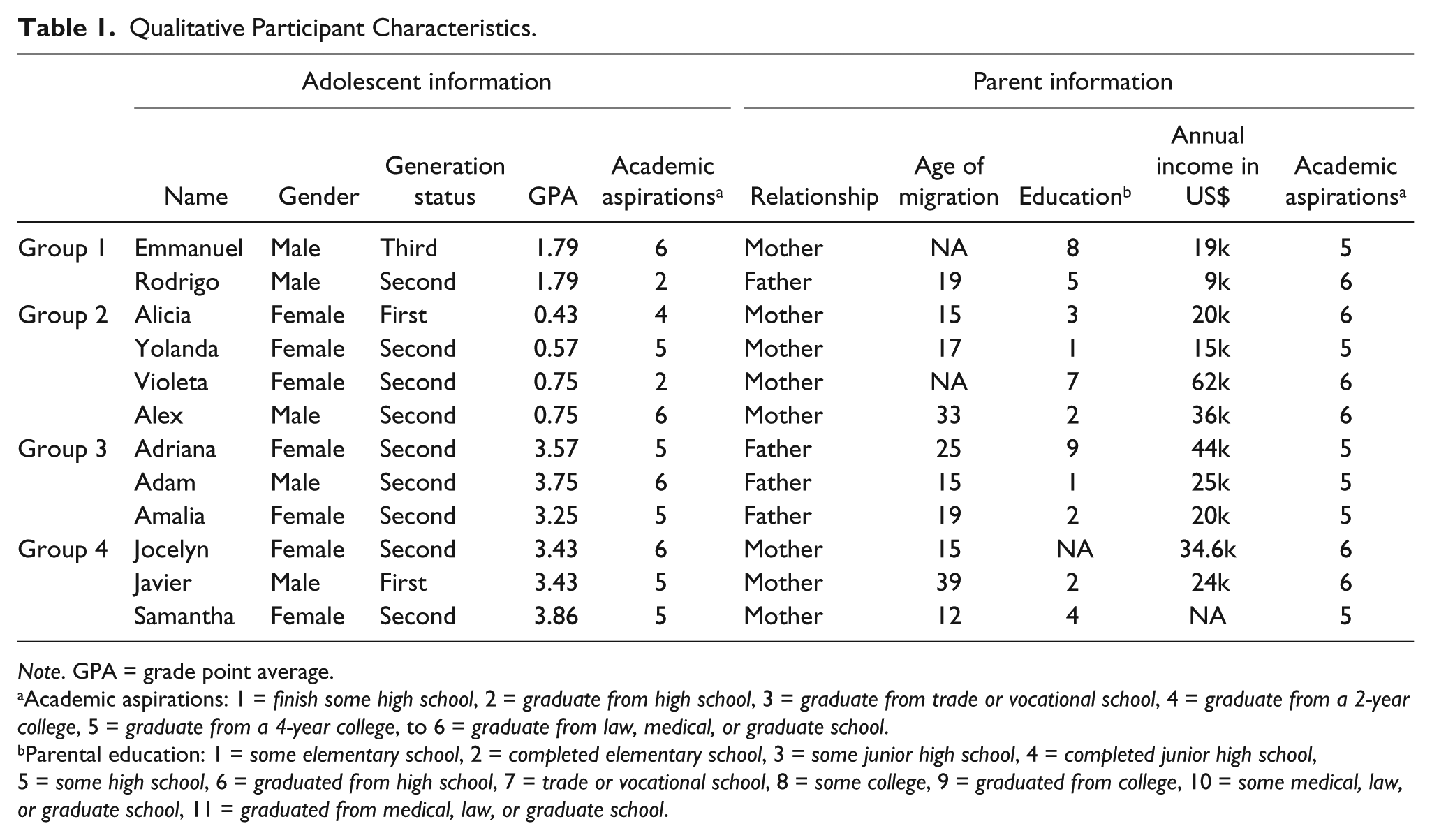
Note. GPA = grade point average.
Academic aspirations: 1 = finish some high school, 2 = graduate from high school, 3 = graduate from trade or vocational school, 4 = graduate from a 2-year college, 5 = graduate from a 4-year college, to 6 = graduate from law, medical, or graduate school.
Parental education: 1 = some elementary school, 2 = completed elementary school, 3 = some junior high school, 4 = completed junior high school, 5 = some high school, 6 = graduated from high school, 7 = trade or vocational school, 8 = some college, 9 = graduated from college, 10 = some medical, law, or graduate school, 11 = graduated from medical, law, or graduate school.
Analytic Sample
To determine the sample for the current study, grades from official school records were coded (A = 4-F = 0) and a GPA was calculated. Each class on the student’s record was coded as 1 (remedial), 2 (standard), or 3 (AP/honors) and an average of all their classes determined a Course-Level Tracking Score. In order to compare across a select group of families whose adolescent children systematically varied by GPA and course-level tracking, study participants were purposively selected from the full qualitative sample. The analytic sample for this study was selected based on crosstabs of students’ GPA and Course-Level Score, and was comprised of 12 families from four groups: Group 1 (Low GPA in Remedial-Level Courses), Group 2 (Low GPA in Standard Courses), Group 3 (High GPA in Standard Courses), and Group 4 (High GPA in honors or Advanced Placement Courses). Table 1 lists demographic information and reports of academic aspirations for each participant in the current study.
Procedure
To recruit the original sample, the home phone numbers and addresses of students at the two high schools were acquired. From these records, families were recruited throughout the academic year through class presentations, home mailings, and phone calls to parents. About 60% of the families were reached by phone, and of those reached, 63% (N = 428) were determined to be eligible by having a Mexican background, regardless of current immigrant status, and were willing to participate in the study. Participants for the qualitative study were interviewed in their homes using the Ecocultural Family Interview (EFI; Weisner, 2002). This method employs systematic probes fostering a focused conversation about the daily family routines, with particular attention to topics of socialization, family obligations, well-being, and school engagement. In addition, each adolescent was provided with a digital camera prior to the interview, to take 25 photos of people, activities, objects, and places that were meaningful to them. The photos served as conversation catalysts in the EFI, leading to rich discussions of the topics central to our study. Parents and adolescents were interviewed separately during the same home visit in different rooms to ensure privacy. Interviews took approximately 90 minutes to complete, but, in the analytic subsample, ranged from 61 to 209 minutes with means for parents being 120 (SD = 46) minutes (75%, n = 9 in Spanish) and 91 (SD = 15) minutes (83%, n = 10 in English) for adolescents.
Analytic Plan
Interviews conducted in Spanish were translated to English and transcribed using Dedoose software. After transcribing the interviews, data were analyzed employing the interpretative paradigmatic framework (Morrow, 2005) via inductive thematic analysis (Braun & Clarke, 2006). The interpretive framework employs the personal and subjective experiences of participants (Whitehead & McNiff, 2006), and thus allowed us to conduct an in-depth examination of the variability of behaviors in parental academic involvement. This framework has been useful in previous research that seeks to describe a phenomenon through the perspectives of a marginalized group (e.g., Abrams, Maxwell, Pope, & Belgrave, 2014). Furthermore, by capturing both parental and adolescent perspectives, a strength of our design was the triangulation of data (Morrow, 2005; Patton, 2002); a suggested technique for increasing authenticity in qualitative research (Lincoln & Guba, 1985).
For this study, thematic analysis of data was conducted using the six guidelines offered by Braun and Clarke (2006). First, the lead author familiarized herself with the data by reading the field notes and then listening to the original recordings of the interviews and reading along with the transcription. Second, initial codes were generated in a three-step process: (a) a preliminary coding scheme for the larger qualitative sample (i.e., the 42 dyads) had been created, indexed, and checked for reliability (i.e., κ < .80 on all codes) by six experts in developmental psychology based on the overall goals of the study (e.g., family obligations and routines). For this study, the lead author took codes from the larger study that pertained to academics (e.g., academic routines, academic motivation, etc.) to employ in the analyses. The second and third steps included (b) adding theory-driven codes (e.g., parental interactions with school; Kuperminc et al., 2008), and (c) codes generated during the familiarization phase (e.g., moral academic aspirations). Prior to the final step of producing a report, Braun and Clarkes’ (2006) antepenultimate and penultimate instructions include reviewing and defining or naming themes, respectively. To do so, in the reviewing phase, the lead author reread the 24 interviews in order to confirm the codes were indeed valid for these data and to code any data that were unperceived in the initial coding. Subthemes were generated during the fifth step, where themes were defined. The final report was then organized such that subthemes (e.g., quality of interactions with school personnel, or timing of reactions to unmet expectations) explicated the novelty of the current study by expanding on the main themes, which were previously identified in research with parental academic involvement among adolescents (i.e., school and home involvement, and academic aspirations and expectations).
Results
The academic socialization methods of 12 parents with adolescents that varied by GPA and course levels were examined. In total, four groups were compared: Group 1 (Low GPA in Remedial-Level Courses), Group 2 (Low GPA in Standard Courses), Group 3 (High GPA in Standard Courses), and Group 4 (High GPA in honors or AP courses). Parents differed by group in the quality of their interactions with school personnel, the timing of their academic involvement at home, and their specific aspirations and expectations for grades.
School-Based Academic Involvement
Parents, regardless of their adolescents’ GPA and academic track, reported that they attended parent-teacher conferences and were aware of the academic track of their adolescent. In Group 1, the Low GPA-Remedial group, parents felt that notices from the school were typically unhelpful because they came too late. For example, one parent explained, “I always get calls from his teachers, like he’s not turning in his homework whatever, but at the end [of the year].” Her son expressed a desire for teachers to communicate high academic expectations and intervene when his grades were suffering. He compared his track with the honors one saying, The teachers actually are there for their students. You know, they’re failing. They, right away, you know, they call their parents. Or, they have them come in, and like sit ’em down, you know, like, “You need to do this, this, and that. Here’s extra credit you can do in order to pass the class.” [In our track], we don’t do that.
Despite their desires for higher expectations and assistance, these teenagers reported that they had low-quality teachers whom they perceived as apathetic and who lacked control of the classroom, (e.g., “They just give up. She just gives up. Like, she just sits down, you know, everyone’s screaming, throwing things around”).
In Group 2, the Low GPA-Standard group, parents not only attended conferences, but also parent workshops offered at school and sought counselors out on a regular basis. One mother, for example, learned at a parent workshop that she could track her daughter’s progress by visiting her counselor: I went to . . . ask her counselors how she is doing, they tell me she is doing well . . . I have to go ask, because we already went to, like in school they sometimes give parent classes, [and] they have advised us to go ask the counselor [to see] how she is doing in her classes.
However, even though these teenagers showed the lowest GPA (see Table 1), counselors fostered low expectations for grades by assuring parents that their child was performing at an acceptable level. Adolescents in this group judged their teachers by the difficulty of the course. That is, if they judged the content and work to be easy, then they reported liking their teachers.
Parents in Group 3, the High GPA-Standard group, also visited counselors periodically to confirm that their adolescents were indeed completing their homework and that their grades were As and Bs, but unlike Group 2, these parents did not always trust standards set for their children by the school staff. These parents tended to strongly resist administrators when their adolescent was at risk of exclusion from college-preparatory programs or being placed in a lower academic track, even though it was taxing dealing with bureaucratic systems (e.g., calling the school and district offices repeatedly—“I called the school and they were very rude to me, saying I should stop bothering them, and that she wasn’t going to get in”). Students in this group reported lower expectations from some of their counselors or teachers, but found advocates in other teachers.
Parents in Group 4, the High Standard-Advanced group, tended to hear good things about the academic progress of their adolescents, but if a teacher called with a behavioral complaint, it was usually dismissed. Parents would talk to their child about it and typically be satisfied with the explanation they received from her or him.
Like one time she said they were watching this movie and she was kind of falling asleep and the teacher sent me a message saying that, “Your daughter was sleeping in class.” So then I asked her and she said, “The movie was really boring . . . my other friend next to me, he was literally sleeping. Maybe they thought it was me,” and I believed her . . .
Students were aware that teachers had high perceptions of them due to the praise they received from them (e.g., “she [my teacher] said, like, ‘Oh, it was like so much higher level,’ and like no one in the other classes ever used that high [of] a level [in their] writing.”)
Overall, parents in Group 1, the Low GPA-Remedial group, and Group 4, the High GPA-Advanced group, tended to minimize complaints that came from teachers, but for different reasons. Those in Group 2, the Low GPA-Standard group, and those in Group 3, the High GPA-Standard group, actively sought feedback from school administrators—and both received messages that communicated low expectations. Those in Group 2 accepted these messages, but those in Group 3 tended to challenge them.
Home-Based Academic Involvement
At home, parents across all groups reported not helping adolescents with homework directly (e.g., supervising or checking assignments). Although parents reported wanting their adolescents to earn high grades, groups differed in their overt connections between homework and grades, and in their routines. In Group 1, homework was not monitored nor a salient part of daily routines (e.g., “It is his responsibility! I do not need to check his homework”). In Group 2, the Low GPA-Standard group, parents encouraged academic performance implicitly and occasionally in daily life by making value statements about education such as I want to see them graduate from college. And sometimes they tell me, “Look, I like that car.” And I tell them, okay, well study so that you can get a job and you, on your own, can get a car.
These parents also made implicit connections to homework and grades by loosely monitoring its completion for a time, after report cards were distributed. Despite high aspirations regarding educational attainment, the role of homework among these families was not salient in daily routines. Conversely, parents in Group 3, the High GPA-Standard group, encouraged homework on a daily basis by providing adolescents with quiet spaces to study and having their younger siblings carry out chores. These parents also modeled reading and shared reading materials with their adolescents. Finally, Group 4 parents, the High GPA-Advanced group, casually asked teens if they had homework and talked about grades, classes, and school on a daily basis. These adolescents generally self-monitored homework completion and, at times, even taught parents about the topics they learned at school.
Adolescents in all groups reported that grades were important and that schoolwork was difficult. Students in Group 2, the Low GPA-Standard group, wanted to improve their grades, but were unwilling to exert the effort required of their courses. For example, one adolescent explained that she thought she could be a nurse, “I would just have to get good grades,” but also expressed disinterest in her schoolwork, “Well, to me [school], it’s really important, but sometimes I like don’t care [because of] yeah the stress [of] like the studying and stuff.” Conversely, students in Group 3, the High GPA-Standard group, overcame difficulties and made daily sacrifices when it came to their homework. Amalia, whose family faced dire economic strain (see Table 1), explained that she sacrificed having a job for the sake of her daily time spent on schoolwork.
I don’t have a job. I want to, but my classes . . . I think that would interfere with my school so I really don’t want to do that . . . I really wanna keep up with my thing.
Adolescents in Group 4, the High GPA-Advanced group, were generally able to self-monitor homework completion with few obstacles to their daily homework routines, besides the difficulty of the topic at hand. Overall, students seemed to understand that persistence was required to complete their homework and earn high grades. However, those with lower grades were less likely to connect academic persistence to future goals such as a career or a higher income. Conversely, it appeared that adolescents with higher grades had internalized the notion that perseverance in their homework was beneficial for their own goals (e.g., “I do it because it’s my homework; it is not theirs. I am the one who is going to benefit”) and therefore were willing to overcome obstacles associated with maintaining high school grades.
Timing of Reactions to Unmet Expectations
Findings regarding timing developed a new subtheme, revealed as coding of interviews progressed. Parents of adolescents with lower grades responded infrequently and only to academic emergencies (e.g., when there was risk for failing classes and therefore a grade). Parents of adolescents with higher grades responded more frequently (e.g., on a daily basis). Although all parents reacted with concern if grades were lower than they expected, parents greatly differed in the timing of their reactions to unmet expectations (e.g., at the end of a semester for those with low GPAs, or after a test for those with high GPAs). Adolescents, in turn, met expectations for grades that were set for them at the time parents intervened.
Academic emergencies: A focus on immediate goals
Parents in Group 1, the Low GPA-Remedial group, typically addressed performance when there was an academic emergency with anger and then bargained for better performance. Good grades were temporally dependent on parental rewards and challenges—which were, in turn, dependent on the adolescent’s poor performance (i.e., an “academic emergency”). The expectation might be only to improve when the academic performance threatened repeating a grade (e.g., “and, then I just need to pass the classes for 10th grade and then go on to 11th, and just, yeah graduate”). Therefore, actions for improving grades did not become habits. The adolescent repeatedly demonstrated that he was capable and did improve his grades, but these behaviors this did not become a part of his daily routine (e.g., “he got mad at me and he told me that if I got my grades up [I’d get] another [game console] . . . I don’t know how I did it . . . It used to be a C, so I went up to an A”).
Group 2 parents, those in the Low GPA-Standard group, reprimanded their adolescents when they saw bad grades and punished them by removing computer, phone, and socializing privileges. Like those in Group 1, these teenagers worked only until they met expectations set for them. For example, one teenager worked to meet the minimum GPA requirement to play baseball: “I just have to get my grades up . . . I just gotta get a 2.0. I have a like 1.95.” Parents limited their interventions to situations when they saw Ds or Fs on a report card or when their school contacted them about their child’s bad behavior (e.g., “his grades aren’t fantastic, but better, and at least I don’t get calls for behavior”). Adolescents in these groups, in turn, tended to improve poor grades, but only until they met expectations set for them in the moment.
Daily academic value: A focus on long-term goals
When adolescents in Group 3, the High GPA-Standard group showed very low grades on their report card or progress report, parents also reacted with anger, taking away television and video game privileges (e.g., “As soon as we drop grades . . . she takes the games, the TV, the computer. There’s times where I ignored her, and then she turned off the power, so the only thing that was on was the light”). However, these parents also encouraged their children to work hard (e.g., “I have told her ‘when something seems difficult then you have to try harder in it, even if it is harder’”), take advantage of their opportunities (e.g., “If you are gifted and have the opportunity to study, then you should do a good job”), and reminded them that bad grades could affect their college enrollment (e.g., “she starts talking about college and how I shouldn’t be screwing up right now”).
In addition, not only did they intervene when the school contacted them about low grades or bad behavior, but they also intervened if they noticed their adolescent was not engaging in homework routinely. Teenagers in this group internalized their parents’ advice because they were in agreement with their goals. By high school, this high-achieving group had already internalized the connection between homework, scholastic achievement, and their future careers. Thus, they embraced their parent’s encouragement toward academic resilience. For example, this teenager describes that her parents “always talk about how I’m doing in school . . . Like they will always sit me down and be like ‘so how are your grades?’” This, in turn, seemed to motivate her to persist through difficulties in her class: Geometry man that kept me up all night. I had that much trouble with it. It was horrible. I’m just not good at [it]. At first it was hopeless, I felt like I was never going to learn it, but I did . . . I got better, so I’m proud of myself.
Group 4 parents, those in the High GPA-Advanced group, talked about school on a daily basis, so they were aware if adolescents did not perform well on a test—and could therefore respond during this early stage. These parents trusted that their children had already internalized the connection between grades and success (i.e., surpassing the previous generation). Therefore, these parents usually intervened with a motivational talk that reminded adolescents of their value to do well in school: “Since God gave you that great intelligence that you have, sal adelente” (i.e., come out ahead). Her son similarly reported, “They don’t punish me, they just speak to me about it because they know that I can do better and that I can raise it to an A or a B.” Similarly, a mother whose child reported persisting through her math class stated, “Math is very hard, but she can do it.” These adolescents spoke extensively about valuing the outcomes of the work endured through AP classes (i.e., learning new materials or embellishing transcripts for college) and had high expectations of themselves when it came to grades: That’s my first certificate on the honor roll . . . if I didn’t get a B in biology, I could have, probably gotten on the principal’s honor roll. . . . I felt proud. Like, my first time, you know, my first final grades and I get on the counselor’s honor roll . . . It’s not amazing, but you know, it’s still good.
These teenagers sought difficult courses and persisted routinely because they knew this was important to college applications: “I think it will be worth it in the end, like taking honors and AP classes. It would look better on my record than just normal classes . . . it’s really good.”
Academic Aspirations and Expectations
As reported in Table 1, all parents aspired for their adolescent to attend college. However, parents differed in their specific expectations for grades. For those in Group 1, it was unclear what letter grades parents expected from their teenagers: “He is not straight A, but he is fine. I do not want to push him that much. As long as he goes to school and he understands that it is important, I am fine.” Parents in Group 2 expected no Ds or Fs, whereas parents in Group 3 and 4 explicitly expected As and Bs (e.g., “I have noticed that it is not bad to expect a lot from my kids . . . I know that they can bring me As, all they have to do is do their homework and follow the rules of school”). Teenagers mirrored the expectations for grades that their parents had (e.g., in Group 2: “My grades? they’re alright . . . I have a like 1.95,” relative to a teen in Group 3: “my GPA is 3.3; I think, [but] I want to have a better GPA”).
Adolescents with lower grades differed from their parents regarding their sentiments toward college. Group 1 teenagers did not adopt their parent’s aspirations, instead they wished these were different: I care about school, but it’s like I kinda don’t care about school. Sometimes I don’t care about it and sometimes I do. My dad really cares about it . . . So, I kinda wished he cared a little bit less.
Conversely, adolescents with higher grades agreed with their parents’ high academic goals for them. In her interview, a mom from Group 4 mentioned, Sometimes Adam leaves things to the last minute. So I told him he should not be rushing on his work and should work on it slowly and take his time, and he says yes, so right now I haven’t had problems with him.
In his interview, Adam was asked if he agreed with his mother’s academic goals for him, and he stated, “Yeah. It’s by far the best thing that I need to do, ’cause I need—for what I wanna be, I need a JD degree and the master’s business.”
An important note about the expectations of teenagers in Group 3, the High GPA-Standard classes group, is that in spite of valuing good grades and their willingness to persist through difficulties, they did not take honors classes. It seemed that neither they nor their parents understood the significance of taking honors courses. It is likely that these families were unaware that honors classes would make them an even more competitive applicant for college.
Discussion
Despite the lower general levels of achievement among Latino adolescents (Krogstad, 2016), research examining parental academic involvement within a cultural framework is limited (Hill & Torres, 2010). Employing the triarchic model (Okagaki, 2001), and the ecocultural family theory (Weisner, 2002), this study sought to understand the ways parents are involved in multiple facets of their adolescents’ academics and the meaning that adolescents make of these behaviors and values. This is important because Latinos may differ in the reasons and ways in which they are involved in the academics of their adolescents which could, in turn, be linked to the effectiveness of these behaviors (Ceballo et al., 2017; Pomerantz et al., 2007). Parental academic involvement was important to examine among adolescents, given this unique developmental period is marked by gains in complex thinking (e.g., academics as means to morally give back to family) as well as autonomy and identity development. Parental academic involvement also is likely to vary developmentally, as youth’s academic identity and abilities become more crystallized, and as they are tracked on the basis of their prior performance. Despite changes in the high school context being characterized by limited connections between school personnel and parents relative to younger children (Adams & Christenson, 2000), and more challenging curriculum (Neild, 2009), parental academic involvement has been found to be effective among Mexican-origin adolescents (e.g., Kuperminc et al., 2008). To better understand academic socialization, parental academic involvement in the lives of Mexican-origin high school students who varied in their academic achievement and tracking levels were examined.
School-Based Involvement
Okagaki’s (2001) triarchic model explains that the ways schools are structured can affect achievement. A salient structural component of schools suggested by our study was that academic tracks were associated with teacher perceptions of students. Adolescents in lower tracks reported lower quality interactions with teachers and the perception that teachers were less invested in their educational success. In fact, in all but the most advanced classes with high-achieving honors students, adolescents reported that the teachers or counselors held low expectations of them. Previous research finds that minority students tend to be overrepresented in lower academic tracks (Miller, 1995), which could be a reason that teachers report lower academic expectations for adolescents from minority backgrounds (Tenenbaum & Ruck, 2007). The experiences of these families also raise questions about the role of societal biases and stereotypes of low achievement directed at Mexican-origin students. Training programs to reduce implicit biases, and that allow teachers to develop the abilities of students in remedial tracks may be important to prevent teachers from underestimating or giving up on students with unrealized potential, especially among minority adolescents (Gregory, Clawson, Davis, & Gerewitz, 2016).
Parents in all groups reported traditional school involvement (e.g., contact with school personnel, attending workshops). Our findings suggest that the effects of academic tracking carried over into the quality of parents’ academic involvement, and that parents were typically aware of their adolescents’ academic track. Specifically, both parents of students in AP/honors and parents of students in remedial tracks were less involved at school than parents with adolescents in standard tracks. These parents, also, typically received contact from teachers or administrators concerning problems with their adolescents. Research shows that benign contact from school personnel, such as notifications about school programs, elicits higher parental academic involvement than when parents are contacted regarding behavior or academic performance problems (Fan & Williams, 2010). Furthermore, parents of adolescents in remedial and AP/honors classes typically dealt with issues regarding school notices at home. Parents of adolescents with high GPAs responded to school feedback by talking with their adolescent and typically dismissing schools’ complaints. The role of relationship quality may be an important mediator that explains the link between parental academic involvement and adolescent achievement (Camacho-Thompson et al., 2016). Finally, parents of adolescents in the remedial track reported not finding school notices meaningful. Although family interventions with middle school students exist (e.g., Gonzales et al., 2014), future studies should examine high school “boosters,” that teach parents how to engage with high schools as parental academic involvement among Mexican-origin parents at school has been found to be especially beneficial for Mexican-origin high school students (Kuperminc et al., 2008).
Like adolescents, parents of adolescents in standard tracks were met with low expectations for their adolescents and taxing bureaucratic systems if they sought resources. Interestingly, parents of students with higher GPAs were able to overcome these systemic obstacles. Research with Latino families shows that parents generally defer to academic personnel (Ramirez, 2003; Suárez-Orozco et al., 2008), but in our study this proved to be an important differentiating factor between families. Moreover, our study showed that families in standard tracks, even if they have high grades, may face unique barriers in that they are “unmarked,” and thus may have to prove their desire for achievement to school systems that stigmatize and perceive Latino parents as underengaged (DePlanty, Coulter-Kern, & Duchane, 2007). Among Mexican-origin adolescents, belonging to a certain academic track may not affect how much risk they are exposed to, but rather the type of risk. Those in “AP/Honors” tracks may find their ethnic group underrepresented in their classes (Walker & Pearsall, 2012), but those in standard and remedial tracks may face low expectations from teachers. It was unclear in this study why some parents were able to overcome challenges associated with school participation, given that socioeconomic and migration demographics did not vary by group. There may be additional characteristics that are meaningful to examine, in addition to traditional demographics (e.g., SES, language use). Other skills and social capital markers could prove useful to helping parents navigate American school systems, such as resources prior to migration (Coddington, Mistry, & Bailey, 2014), and networks with social capital that help fill these gaps in familiarity with American school systems (Angel & Angel, 1992). These findings reveal the importance of future research examining the role of parental school involvement within the context of family dynamics during this unique developmental period. Specifically, factors that foment parental academic involvement and the mechanisms that parents utilize to build resilience in American school systems should be examined.
Home-Based Involvement and Academic Socialization
In our sample, parents across all achievement and tracking levels reported not helping with homework directly. Several meta-analyses have found that that excessive homework assistance is associated with lower levels of achievement (Hill & Tyson, 2009; Pomerantz et al., 2007). By high school, direct homework assistance may interfere with autonomy development, a key characteristic of adolescence, and thus may be developmentally inappropriate (Hill & Tyson, 2009). It is likely that the most effective parental academic involvement during adolescence combines a supportive familial structure that allows the adolescent to develop autonomy and understand the utility of their educational behaviors (Hill & Tyson, 2009). Our study expands previous research by differentiating these nuanced academic behaviors among a variety of students. Specifically, we found that adolescents with high grades understood that persisting through the challenges presented by their homework would earn them high grades, which would facilitate their vocational aspirations. Students with lower GPAs also understood that earning high grades was important for their vocational aspirations. However, they did not make a connection between their homework assignments and their future careers, and thus did not regularly overcome barriers to homework completion. Consistent with the cultural ecological theory, parents’ consistency in daily monitoring and expectations about homework likely contributed to students’ homework habits and, in turn, to their grades and academic identity. These findings expand Okagaki’s (2001) triarchic model, by explaining key markers of the process by which the behaviors of parents may influence their adolescents’ academic identity.
Finally, the timing of communication regarding academics may be a critical component through which parents socialize youth toward academic autonomy—a key marker of adolescence. We found that parents differed in the timing of their reactions to unmet expectations, and that the most effective responses occurred on a daily basis. Parents of youth with lower GPAs tended to intervene less frequently and their reactions seemed to be catalyzed by “academic emergencies” (e.g., when the student was at risk for failing a course or grade level). Parents of youth with higher GPAs communicated daily about school and homework, making them aware of adolescents’ academic experiences more regularly. Thus, they were able to intervene earlier, such as when a student needed a break from chores or a quiet space to study, or with encouragement when they did not do well on a test or assignment. Weisner’s (2002) cultural ecology theory posits that parents socialize children’s values through daily activities. These daily communication habits regarding academics may provide the supportive familial context necessary for development of academic motivation, persistence, and autonomy in some circumstances. Daily conversations regarding assignments may provide more opportunities and support for adolescents to make a habit of overcoming difficulties in their academics. These daily habits may foster autonomy development, which may be especially beneficial for Latino adolescents as they challenge stereotypes associated with their ethnicity and academic track, as well as seek opportunities that students from more resourced backgrounds may access from their parents (Hill & Tyson, 2009; Simpkins, Fredricks, & Lin, 2016).
Limitations and Future Directions
Although this study purposively selected students based on their achievement and tracking level to compare between groups, this sample of 12 families may not be representative of students outside of these categories (e.g., high-achieving students in remedial courses). Future studies might examine longitudinal trajectories of desistance and persistence in honors courses, as well as trajectories of students who improve in performance over time. Our study only examined students from two schools, but given these findings, it would be important to examine school characteristics when seeking to understand parental academic involvement at schools. Previous research finds that some schools may be perceived as more welcoming and may be better suited for engaging parents (Fan & Williams, 2010; Ramirez, 2003).
Our findings were primarily interpreted from a cultural ecology perspective, which posits that parents socialize adolescents through daily activities (Weisner, 2002). For example, parents differed in the specific grades they expected from their children and talked about school achievement and homework using different cues and timing, and adolescents seemed to meet the academic aspirations set by their parents at the time that parents intervened (i.e., during academic emergencies or on a daily basis). However, it could be that parents of students with lower GPAs adjusted their own academic aspirations to meet the lower academic motivation of their adolescents. Research shows that, over time, poor school performance is associated with decreased parental academic expectations (Goldenberg et al., 2001). Qualitative research suggests that because Latino parents rely on their children for information about American systems, these adolescents may influence their parents’ behaviors (Ceballo et al., 2017). Still, longitudinal research with European American families shows that adolescents do not influence parental beliefs and behaviors concerning academics (Simpkins, 2015). It was not our aim to test causal mechanisms with our cross-sectional data, thus, directionality in our study is unclear. Nevertheless, our findings raise important questions for future hypothesis testing regarding the bidirectionality and shifting nature of parents’ academic involvement and adolescents’ academic socialization across developmental stages. It could be that the effects of certain types of parental academic involvement are especially pronounced at younger ages when cognitive ability and motivation may be more malleable (Hill & Tyson, 2009). By the time children enter adolescence, parents and youths may have mutually shaped a family context in which academic success and persistence have become firmly engrained in daily family expectations and habits. Accordingly, intervention scientists may choose to intervene prior to or early in adolescence to equip parents with the skills, knowledge, and cultural capital to promote access to educational resources and thus develop ways to work with families to sustain practices and expectations that support academic success.
Parental academic involvement is important for the achievement of Latino students at all levels of education, from preschool through college (Ceballo et al., 2017). The current study contributes findings that could inform measures for studying parental academic involvement during adolescence. It is important for future researchers to develop instruments that focus on parental academic involvement among Latino adolescents (e.g., communication with school personnel, or fostering adolescent self-monitoring and academic autonomy). It may be important not just to develop measures that are valid for Latino families (McWayne & Melzi, 2014), but also those that take into account this unique developmental period.
Conclusion
Our study builds both on current theoretical frameworks and has implications for adolescent development. As Okagaki’s (2001) triarchic model suggests, academic outcomes are multiply determined. This exploratory study revealed variability in the involvement behaviors that parents engaged in to promote the academic socialization of their adolescents. Parents were involved in parent-teacher conferences, workshops, and communicating with school personnel. However, parents of adolescents in remedial and standard academic tracks reported challenges such as unresponsive personnel and low academic expectations from teachers and counselors. Moreover, parents were involved at home by setting academic expectations for their adolescents. Although all parents reported wanting their children to attend college, our study contributes to current literature on parental academic expectations by revealing meaningful variability in daily academic practices in the family routine. As proposed by Weisner (2002), parental values are passed through daily routines. Our study found that, overall, parents of adolescents with higher grades explicitly expected higher grades and were involved in the academics of their adolescents on a daily basis, as opposed to primarily intervening during “academic emergencies.” This, in turn, seemed to contribute to adolescents’ value of education and academic resilience. These findings suggest that Latino parents are involved in the academics of their adolescents though in different ways and with different timing, emphasis, and embedding in daily routines. It is possible that interventions teaching parents effective methods of being involved should train parents to make their adolescents’ academics a part of their daily lives.
Footnotes
Acknowledgements
DECT participated in the design, performed the statistical analysis and interpretation of the data, as well as helped draft the manuscript. NAG conceived of the study, participated in its design and coordination, and helped revise the manuscript. AJF conceived of the study, and participated in its design and coordination, interpretation of the data, and helped draft the manuscript. All authors read and approved the final manuscript.
Authors’ Note
The content does not necessarily represent the official views of the National Institute of Child Health and Human Development or the National Institutes of Health.
Declaration of Conflicting Interests
The author(s) declared no potential conflicts of interest with respect to the research, authorship, and/or publication of this article.
Funding
The author(s) disclosed receipt of the following financial support for the research, authorship, and/or publication of this article: The research was supported by funding from the Eunice Kennedy Shriver National Institute of Child Health and Human Development (R01-HD057164) and the University of California, Los Angeles (UCLA) California Center for Population Research, which is supported by the National Institute of Child Health and Human Development (R24-HD041022). Daisy E. Camacho-Thompson was supported by funding from the Eugene V. Cota-Robles Fellowship, a Supplement to an award from the Eunice Kennedy Shriver National Institute of Child Health and Human Development (3R01HD059882-06S1), and a National Institutes of Health-supported grant (T32 DA039772).