







Abstract
Political elections have been shown to influence youth civic development. The election of Donald Trump is historic and has elevated precarity for people of color and immigrants, yet we know little about how young people with these identities experienced this potentially catalytic event. Using ethnographic methods, we examined youth and adult discussions that occurred during youth participatory action research in four sites of one after-school program between October 2016 and May 2017, to investigate how the development of critical consciousness occurs among early adolescent youth of color in the context of catalyzing political events. We identified emergent patterns in how young people (a) engaged in critical reflection, (b) weighed political efficacy, and (c) considered engagement in critical action in the wake of Trump’s election. The data revealed that young people’s critical consciousness development ranged from basic to advanced levels. This research highlights the ways that politically catalytic events shape critical consciousness development among early adolescents of color.
Keywords
Diverse youth are coming of age in a politically divisive time that may significantly shape the ways that they understand their relationship with the nation and with civil society. National surveys have revealed that young people register the lowest approval ratings of Trump (Karl, 2017). Events leading up to the election and during the first 100 days of the presidency of Donald Trump were divisive for many, but often dangerous for people from Mexico and Muslim-majority countries. These groups represent a growing population in the United States (Batalova & Terrazas, 2010; Modi, 2012), and shifting demographics are particularly evident among young people. However, there is very little research about how the election of Trump has been interpreted by early adolescent youth of color. One study conducted shortly after President Trump’s inauguration found themes in adolescent Latinx responses about immigration including feeling afraid and/or anxious; expressing anger, contempt, and/or disgust; recognizing and experiencing racism; offering pro-immigrant narratives; and increasing civic engagement (Wray-Lake et al., 2018). It is worth exploring the ways in which young people develop civic identity amid the dramatic changes in the U.S. political landscape.
Literature Review
Our analysis focuses on early adolescent critical consciousness development, a process associated with sociopolitical development. Sociopolitical development is a “process of growth of a person’s knowledge, analytical skills, emotional faculties, and capacity for action in political and social systems” (Watts, Williams, & Jagers, 2003, p. 185). As a developmental process, sociopolitical development is described as an interactional journey from uninformed inaction to sustained and informed strategic action on the social forces that affect people’s lives (Watts et al., 2003). The concept of critical consciousness, or conscientizicatión, originates from the classical theoretical work of Paulo Freire (1970/2000), who argued that human development occurs as an individual engages in critical reflection on and takes action to transform the world. Watts, Diemer, and Voight (2011) have further conceptualized critical consciousness as having three interdependent and reciprocal components: critical reflection, political efficacy, and critical action. Critical reflection involves observing, understanding, and analyzing social inequalities to try to find causal relationships and is an important prerequisite for social action. The second component, political efficacy, refers to the belief that individuals or the community can effect change. People are more likely to engage in critical action if they believe their actions can create change (Hope & Bañales, 2019). Critical action involves taking individual or collective action on unjust social or political policies or practices (Watts et al., 2011). The development of critical consciousness, therefore, enables a civic identity to emerge (Flanagan & Faison, 2001).
This article sets out to explore the development of critical consciousness among young people during the early days of the Trump presidency. We observed early adolescent youth of color in four after-school program sites from October 2016 through May 2017. This article begins with a review of research on young people and the development of civic identities. After a brief discussion of the current study and our methods, we present our findings in relation to Watts et al.’s (2011) articulation of critical consciousness development and its three interrelated elements of critical reflection, political efficacy, and critical action. We close with a discussion of how historic political events can be utilized to support youth critical consciousness development.
Civic Identity Development Among Young People
Studies of the youthful development of civic identity have generally taken one of two approaches. Some scholarship focuses on how adults provide young people with avenues that help them prepare for a gradual extension of rights and an enhanced identification with the nation state. Such approaches, which focus on the socializing influences of parents, education, peers, and the media, presume that young people need to learn about citizenship so that when they are adults, they will be equipped to participate in the civic life (Hart & Atkins, 2002; Hart, Atkins, & Ford, 1999; Torney-Purta, 1988). However, as Buckingham (2000) has noted about such approaches, There is often an assumption in traditional work on youth and citizenship . . . that young citizens—to the extent that they have rights, which are often limited—must be socialized into adult norms of political involvement rather than being thinking agents who may express important critiques of citizenship and nationhood. (Buckingham, 2000, p. 13; see also Maira & Soep, 2005)
Other scholars have focused on the role of young people themselves in the development of their civic identities. Rooted in Bronfenbrenner and Kiesler’s (1977) ecological systems theory of development, scholarship in this school of thought begins with the idea that everything in a young person’s environment plays a role in shaping that person’s development (Spencer, Dupree, & Hartman, 1997). The development of civic identity becomes more salient during early adolescence, as Flanagan (2013) has argued, because of the young person’s increased capacities for critical thinking, perspective taking, and abstract thought. It is therefore important to consider how young people themselves respond to the social conditions of their lives through new forms of political expression.
As Bennett (2008) has argued, traditional scholarship on youth civic identity often assumes that young people grow up in a context where their basic rights are assured and where they can look forward to a future in which their rights and responsibilities will expand (see also Gordon & Taft, 2011). Yet, experiences of discrimination and differences in socialization related to race, class, and nationality inevitably shape the development of civic identity. Experiences of discrimination are compounded by institutionalized power imbalances (Causadias & Umana-Taylor, 2018), which result in people feeling alienated from traditional political participation (Sloam, 2014). The feelings of alienation and lack of belonging result in diminished attitudes regarding citizenship (Abu El-Haj, 2007). This is consistent with Gordon and Taft’s (2011) finding that while “apathy” is a word that came up among White teens in discussions of civic identity and action, Black and Latinx young people used the words “cynicism” and “hopelessness” to describe why their peers were not involved in civic life. Some young people who have experienced forms of marginality nevertheless become politically involved, and scholars have found that among these young people, holding critical perspectives on political actors and policies is a motivator for civic engagement (Diemer & Li, 2011; Hope & Spencer, 2017). Research, therefore, suggests that it is possible for young people’s feelings of alienation to lead to hopelessness and disengagement or anger and rage at those who are responsible for creating and maintaining those systems of power. The latter is a critical stance that research has found as a motivator for political action and civic engagement.
Presidential elections, which provide information-rich events for the discussion of politics with parents, friends, and teachers, have consistently been shown to shape political actions and viewpoints among young people (Longo, Drury, & Battistoni, 2006; Sears & Valentino, 1997; Seongyi & Woo-Young, 2011; Wong & Tseng, 2008). As young people come to conceive of themselves as civic actors in the context of political elections, therefore, our study can provide insights into how youthful critical consciousness may be developed and expressed in catalyzing political moments.
Donald Trump’s election to the U.S. presidency has been described as a profound moment of change that will have lasting effects on the shape of U.S. society and on the office of the presidency (Levitsky & Ziblatt, 2018). It was a catalyzing political event in that it heightened precarity among many of society’s most vulnerable constituents and accelerated the movement toward a society more divided than ever before. Nationalism, racism, and isolationist views have been some of the defining characteristics of this presidency, according to many (Giroux, 2017; Goldstein & Hall, 2017). Emblematic of his nationalist agenda, Donald Trump pledged that his foreign policy would be one of “America first” (Trump, 2017a), that he would build a wall across the southern U.S. border (Trump, 2016, 2017b) and prohibit immigration and travel for individuals who come from countries where terrorism is widespread and vetting is poor (BBC News, 2016). Immigrants from Mexico were likened to drug dealers, criminals, and rapists (Reilly, 2016). The day after Donald Trump’s inauguration, more than two million people participated in the inaugural Women’s March (Fisher, Dow, & Ray, 2017). In January 2017, the president made an executive order to ban travel for persons from majority Muslim countries (Executive Order 13769, 2017). In mid-February, immigrants and their allies planned and executed a 1-day strike called “A Day Without Immigrants” (Stein, 2017). In March 2017, Federal Bureau of Investigation (FBI) Director James Comey announced that there would be an investigation into Russia’s role in the 2016 presidential election (Strobel, 2018). These events dominated news headlines, contributed to a cultural context surrounding race, and provided the backdrop for this inquiry.
The Current Study
This article focuses on the observations from October 2016 through May 2017 of young people’s discussions related to Donald Trump and his presidency. It considers how youth voiced concerns related to the president’s rhetoric or policies, spoke of the extent to which they believed that they or others in their communities could effect change, and discussed and engaged in critical actions.
This study addresses a gap in the extant literature on sociopolitical development and critical consciousness among early adolescents of color in three distinct ways. First, there has been a call for qualitative work that explores the nuances of sociopolitical development, particularly among youth of color (Anyiwo, Banales, Rowley, Watkins, & Richards-Schuster, 2018; Diemer, Rapa, Voight, & McWhirter, 2016; Hope & Bañales, 2019). Second, recent scholarship has called for a greater understanding of how different contexts influence reflections on this president and his rhetoric (Wray-Lake et al., 2018). Third, by foregrounding the unique moment of a divisive presidency, this study seeks to contribute to theories regarding how critical consciousness develops among youth of color in the context of catalyzing political moments. We suggest that conversations between youth and adults allowed youth to move along a continuum of critical consciousness: from individually focused remarks to complex discussions related to fear and power grounded in the commitment to action.
Method
Setting and Participants
Given the importance of the institutional context on civic identity development (Suad Nasir & Kirshner, 2003), we describe the program and the four sites where data collection took place. We examined youth and adult discussions that occurred between October 2016 and May 2017 as part of a youth participatory action research (YPAR) program called Youth Engaged in Leadership and Learning (YELL). YELL is one curriculum offered as part of an after-school youth program in a large urban city that serves four public housing neighborhoods: Mountain Vista, Riverwood, Rose Park, and North Kennedy (all names are pseudonyms). YELL is an evidence-informed curriculum developed by scholars and practitioners at the John W. Gardner Center for Youth and their communities at Stanford University (Anyon et al., 2007). In YELL, youth and adults work in partnership to conceptualize an issue of social inequity, collect information about that topic, and engage in education and advocacy around their selected social issue (for more information on YPAR, see Cammarota & Fine, 2010; Schensul, 2014). In YELL, adults supported youth to discuss important social issues; collect data about their chosen topic using interviews, photography, and videography; create arts-based products to showcase their findings; and share their products with a group of youth and adults in May 2017. While the 22-session YELL program manual guides adults in facilitating discussions with youth regarding pressing social issues, the curriculum itself does not include prompts, activities, or other content explicitly related to electoral politics.
YELL was one of the weekly offerings for middle-school youth who attended programming at one of the four sites (Mountain Vista, Riverwood, Rose Park, and North Kennedy). Mountain Vista is located in the heart of the city and is the largest site, serving more than 150 students annually. Students at Mountain Vista are mostly African or Black, most are refugees, and a significant portion of students are from Somalia. Riverwood is the second largest site, and its participants are primarily Asian and Latinx. Rose Park participants are predominantly Latinx and African. North Kennedy, the smallest site, is situated in an area of high gang activity and serves a diverse mix of Latinx and Black youth.
The average age of the 77 youth participants was 12.7 years (range was 10-15 years). Riverwood had the highest YELL participation, with 30 students attending at least one session, followed by 21 youth at Mountain Vista, 15 youth at Rose Park, and 10 youth at North Kennedy. On average, participants attended 13.7 YELL sessions (SD = 8.28, range = 1-27). The racial composition of youth in the after-school program was 59% Black or African Refugee, 16% Asian, 16% Latinx, 5% White, 1% Alaskan Native, 1% Multiracial, and 1% Other. While youth participants were from a range of countries, the primary countries of origin for youth in our sample were Sudan, Congo, Kenya, Mexico, and Vietnam.
During this study, each of the four groups selected a social issue; two sites picked a politically oriented topic. At Mountain Vista, the larger group broke into two subgroups: one focusing on immigration and the other on people experiencing homelessness. Students at Rose Park chose cyberbullying as the focus of their action research project. At Riverwood, youth chose suicide and depression. At North Kennedy, the students selected racism as their topic.
The day after the election, the University that the facilitators’ attended hosted a debrief session to discuss students’ emotions and strategize potential implications of the election results on the clients with whom they worked. On the same day, the after-school program canceled regular programming to provide a safe space for youth to express their feelings or concerns related to the election. The choice to cancel regular programming and hold space for students to process emotions likely contributed to an overall program culture that encouraged the expression of certain political attitudes or opinions.
Positionality of the adult facilitators and research team
Each site had an adult facilitator in addition to the adult members of the research team who served as participant observers for this study. The facilitators and several members of the research team were social work students who engaged in regular self-reflexivity around issues of power, privilege, and oppression consistent with the social work Code of Ethics (National Association of Social Workers, 2017; see also Greenfield, Atteberry Ash, & Plassmeyer, 2018). While all adult facilitators and eight of our research team members identify as White, one research team member identifies as African and one as Latino. One research team member identifies as an immigrant and another as a child of immigrants. There were three males and seven females on the research team and three female and one male adult facilitators, and all identify as cisgender. Our multidisciplinary research team of faculty and students in social work, education, and media studies consists of four members who were politically unaffiliated, one member who was not eligible to vote, and five members who were registered Democrats. We do not know the political ideologies of the adult facilitators.
During research team meetings, we engaged in reflexivity about our racial, class, political, and religious identities and our role in YELL sessions (Strauss & Corbin, 1990). We discussed and reflected upon the impact that our attendance and participation may have had on the data we were collecting (Barusch, Gringeri, & George, 2011). Our research team members were deeply embedded in each of the groups. We spent on average 40 hours with the youth and thus were able to create relationships with the youth and adults. Research team members often made evidence-informed inferences about intonation and nonverbal cues related to certain statements or actions youth said or took. As a team, we regularly engaged in reflexivity while discussing codes or excerpts and revisited the data to check for the validity of interpretation. An instance of reflexivity involved the code of “violence.” As adults who are predominately White, we found that we had aggrandized youths mentions of violence and perceived them to be widespread when in reality, mentions of violence were rare and often served as precursors to further reflection and discussion.
Data Collection
This study was approved by the Institutional Review Board at the authors’ institution. Parents of youth participants and adult facilitators all consented to participate in this study. After receiving training on observational data collection procedures, six of our research team members served as participant observers and took field notes during each of the weekly 90-minute YELL program sessions, recording interactions between the youth and adults at the site. In total, we observed more than 108 hours of programming. Participant observers were trained to record reported speech (direct quotes and speech reported indirectly), speech that is summarized or paraphrased, and the nonverbal actions of participants (Wood & Kroger, 2000). Notes were typically handwritten and transcribed within 48 hours of the initial observation. The first and third authors of this manuscript, who were senior members of the research team, verified data by reading each field note and commenting on potential bias, assumptions, inferences, and ambiguities. Once the observers addressed ambiguities or inferences, the field note was considered complete. Data verification during data collection is one tool to ensure the trustworthiness of qualitative research (Creswell & Miller, 2000).
In this article, we focus our analysis on conversations related to the presidential election. Research team members were assigned field notes to read and asked to pull all excerpts from the field notes that were related to the president, his policies, or rhetoric. If there was uncertainty as to whether an excerpt was relevant, it was included. All related excerpts were compiled into a single document and analyzed using multiple rounds of inductive and deductive coding.
Data Analysis
We used an inductive and deductive applied thematic analytical approach (Guest, MacQueen, & Namey, 2011) to understand youth’s perceptions of the election and early days of Trump’s presidency. Applied thematic analysis enabled the use of innovative and traditional theme-based analytical tools within applied research settings (Guest et al., 2011). During the first rounds of coding, the process was inductive, the entire research team read and discussed each excerpt and used open coding to establish an initial set of 13 codes. The research team then combined codes to reduce discrepancies, leading to a final set of seven distinct codes, for which the team created a codebook. The codebook included definitions and inclusion and exclusion criteria for each code. The process of creating the codebook was iterative and required multiple rounds of reading the data. All members of the research team participated in the above analysis, except for authors C. J. and S. N.
During the second round of coding, we imported data into Dedoose Version 7.6.17 to be further analyzed. Dedoose is a web-based platform for managing and analyzing qualitative and mixed methods research data (SocioCultural Research Consultants, LLC, 2017). Dedoose enabled the creation of an audit trail, a process important to ensuring trustworthiness of qualitative research. Three members of our research team (S. M., C. E., & M. W.) applied the final codebook of both manifest and latent codes to all excerpts. These coders reached .75 Kappa for intercoder reliability, which is in the acceptable range (Cohen, 1968). In the synthesis stage, to triangulate findings, the core and subthemes were compared to the available literature. The literature regarding critical consciousness (Watts et al., 2011) seemed to map well onto our data. Table 1 illustrates the connection between our original inductively derived themes and the stages of critical consciousness.
Recoding of Original Codes by Three Stages of Critical Consciousness.
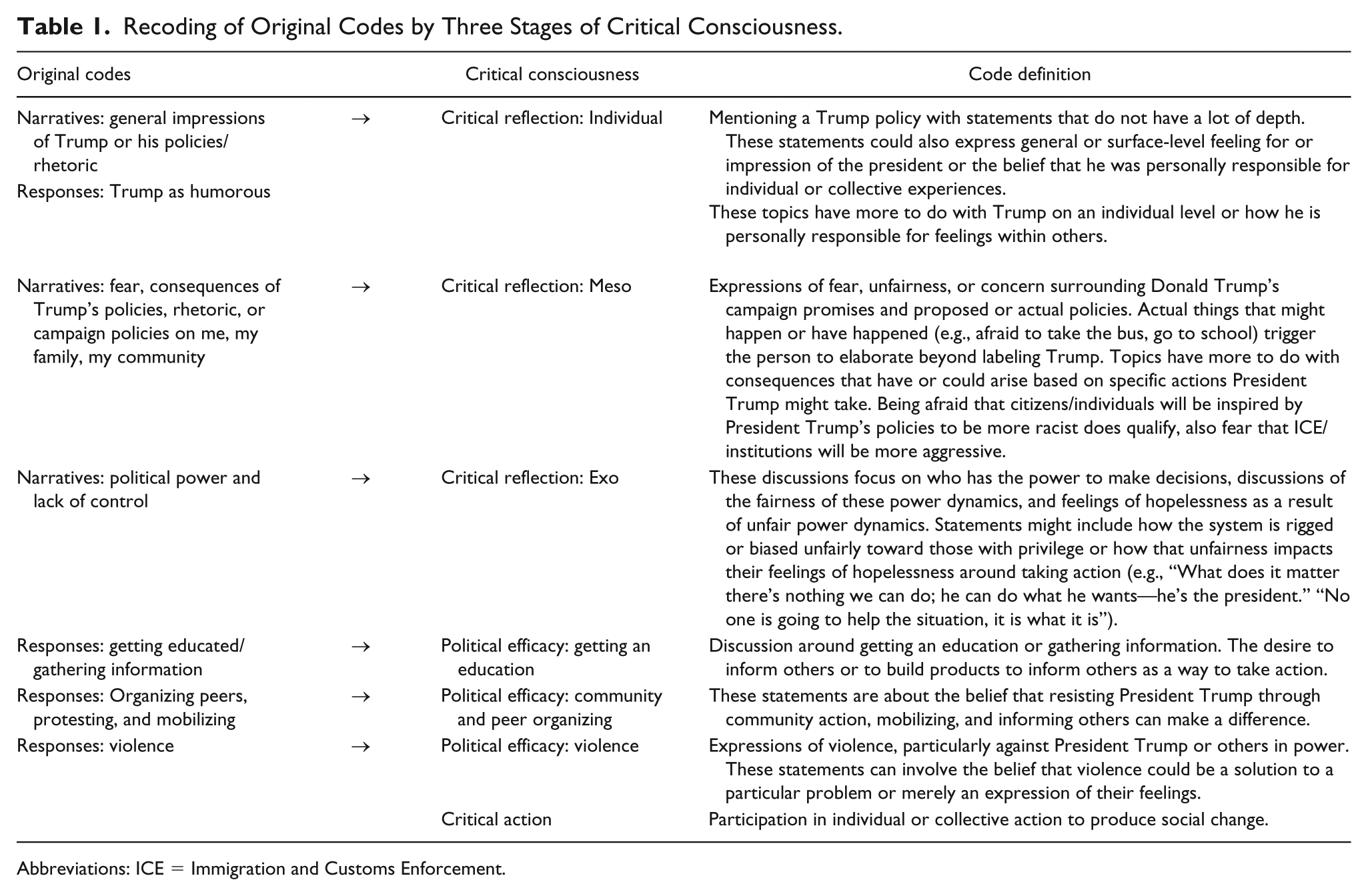
Abbreviations: ICE = Immigration and Customs Enforcement.
While it appeared that our themes mapped well unto the stages of critical consciousness (critical reflection, political efficacy, and critical action), the bulk of our excerpts were related to critical reflection. Three subcategories within critical reflection indicated different levels of analysis: individual attributions, impacts on friends/family, and systems attributions. Because of this, we organized these findings within the context of Bronfenbrenner’s systems theory and labeled our subcategories individual-, meso-, and exo-levels of analysis. Excerpts coded as individual-level analysis were those in which a young person expressed a general or surface-level feeling for or impression of the president or the belief that he was personally responsible for individual or collective experiences. When participants engaged in more in-depth discussions of potential or real consequences of the president’s rhetoric or policies on their families, schools, or broader community, we categorized this as meso-level analysis. Finally, exo-level critical reflections were those that demonstrated youth’s understanding of broader social dynamics such as class, race, power, or status, as being responsible for the inequities they experienced in their lives and communities.
The other two stages of critical consciousness—political efficacy and critical action—did not seem to follow Bronfenbrenner’s framework. We categorized excerpts as political efficacy when they involved the discussion of potential actions and their ability to facilitate social change. These excerpts included the discussion of the feasibility and utility of employing methods such as engaging in violence, getting educated, and educating or mobilizing others. Excerpts coded as critical action included times when youth took action, organized meetings, or participated in rallies or marches. After renaming our themes, we revisited the observations again to ensure theoretical sensitivity to the defining characteristics of these themes and our data (Glaser, 1978). Finally, using Dedoose’s data visualization tools, we examined patterns at the excerpt and field note level.
Results
Throughout the 7-month observation period, youth inserted comments related to Donald Trump’s policies and rhetoric during most YELL sessions. The overall tenor of conversations was critical of the president and his actions. Less than 5% of excerpts included youth expressing neutral or hopeful comments. Almost all of the youth who participated in YELL were refugees resettled in the United States or first- and second-generation immigrants. The three higher order themes were critical reflection, political efficacy, and critical action (Watts et al., 2011), each theme is described and accompanied by excerpts.
Critical Reflection
Critical reflection, as outlined by Watts et al. (2011), is thought of as the initial stage of critical consciousness. Youth engage in critical reflection when establishing causality between policy and personal or social consequences. As such, critically reflective statements came up frequently and were sometimes a springboard for deeper levels of discussion.
Individual-level analysis
There were two main ways youth demonstrated individual-level analysis: general impressions and humor. While these comments did not generally indicate critical thinking, youth drew connections between the president and the things that had happened in their lives—which caused us to categorize these responses as critical reflections at a basic level.
Although less frequent than other comments about the president, youth sometimes made general statements about President Trump. A few excerpts included instances in which youth were neutral. For instance, one young person from North Kennedy stated, “while I didn’t like Trump, he’s elected and so maybe we should try to give him a chance” (Field Note, 11.9.16, North Kennedy). At two other sites, youth expressed that, “while they personally didn’t like the president, that he provided a voice for others” (Field Note, 3.15.17, Mountain Vista) or that “he was at least better than Pence” (Field Note, 2.15.17, Rose Park).
However, the majority of general statements were critical. These statements did not involve detailed political analysis, tended to lack depth, and were largely ad hominem attacks on the president’s character, for example, by saying that he was “racist,” doesn’t care about others, was bad, or that they didn’t like him.
Several individual-level analyses directly linked Donald Trump and his rhetoric to youth’s well-being. For example, in one observation, during a check-in activity, participants were asked to rank their day on a scale of 1 to 10 (1 being the worst day ever): [An adult] said that her day was a bad one because of what was happening in the news [travel ban]. Others in the group were able to relate to her, and several youth mentioned that their anger was caused by Donald Trump. One youth said ‘Donald Trump sucks’. (Field Note, 1.30.17, Riverwood)
In another example, a facilitator reported that he was sick and a youth responded, “that’s because of Donald Trump” (Field Note, 2.27.17, Riverwood).
In several other instances, Donald Trump and his policies were used by youth as a punchline or with the intention of making others laugh. For example, the facilitator at Rose Park asked the youth if they had invited anyone to an upcoming project presentation, and one young person responded, “I tried calling the president, and he was like, ‘heeeell no’— Donald Trump was like, ‘I just want you so I can kill you’” (Field Note, 4.26.17). At a different site, one young man spontaneously, dramatically, and seemingly sarcastically declared, “Donald Trump is my God, we need to build a wall!” (Field Note, 11.30.16, Mountain Vista). Another time, two girls were giggling and painting a pumpkin with a blond swath of hair and sent a picture message to a friend with the caption, “Trumpkin” (Field Note, 10.31.16, Riverwood).
Surface-level comments regarding Donald Trump were significant in the way that they were often woven throughout the conversation, as in the following excerpt: The discussion from last week about the Muslim march was resumed, and one of the pictures from the Muslim march (not done by participants) features Donald Trump sitting on a toilet tweeting with the Constitution being used as toilet paper. One young Black man says he likes the picture because “Donald Trump sucks and he is racist, and I hope he dies.” The new boy, also a Black male, next to him repeats, “Donald Trump sucks.” (Field Note, 2.15.17, North Kennedy)
In this excerpt, a discussion about political action and protesting became a way for youth to gain solidarity in their feelings of dislike for President Trump, and they linked these sentiments to racism and the expression of violence.
Meso-level analysis
In meso-level analyses, youth made statements that moved beyond general impressions or humor and articulated perceived consequences of proposed or actual policies on their mesosystems, including their families, peers, and immediate communities. Within this theme, two different policies prompted the greatest response: the restriction of travel between the United States and seven majority Muslim countries (colloquially referred to as the “travel ban”) and increased funding for Immigration and Customs Enforcement (ICE).
Students discussed how Donald Trump’s policies incited Islamophobia and racism. The day after the election, one girl stated, “it’s scary to walk out of the house with your head scarf on” and that she and another girl felt “afraid to ride the bus knowing you have a president who says these things about Muslims” (Field Note, 11.9.16, Rose Park). During the intentionally structured debrief at all sites following the election, one adult asked youth, “What is the hardest thing for you to deal with regarding the election?” The following field note exemplifies several different young people’s reflections: One young African teen boy expressed how upset he was that different races are being stereotyped, and even that people might believe that all white people are racist because of Donald Trump. He also said that he was afraid that people might start harassing him because of how he looked. A young African teen girl expressed that she was afraid that people are going to be deported because of Donald Trump. Another African teen girl said that she was afraid that people would start fighting because of their different political views. A second African teen boy expressed his fear that our country and humankind is “evolving backward” and that Trump is undoing all the progress that we have made as a country. (Field Note, 11.9.17, Mountain Vista)
This excerpt illustrates how youth speculated about potential consequences of Donald Trump’s narratives and policies on racism in their immediate lives. It also illustrates that youth were able to connect their experiences to larger themes (e.g., deportation, fighting).
In early February, after President Trump announced the travel ban, one youth reflected on how the policy affected everyone in his neighborhood because all youth at the site were immigrants or children of immigrants. The same youth later said that selecting Donald Trump as their topic for YELL was important because “[Trump] is going to be president for four years and will deport 11 million people” (Field note, 2.1.17, Mountain Vista). This youth not only reacted to these policies but understood the potential impacts on his community.
Exo-level analysis
Students dug further into political decisions or rhetoric by identifying unfairness in systems, though they often did so without identifying precisely what made a policy unfair. Expressions of unfairness came up frequently in discussions about issues of immigration and the travel ban: [What] I think about the immigration policy is . . . [that it is] unfair, and just picking seven countries to ban is stupid, because those seven countries didn’t even attack America. People just come from other countries to start a new life, new family, new education, and stuff. (Field note, 4.19.17, Mountain Vista)
On several occasions youth identified different types of societal power, such as the ability to control the media or to make policy decisions. They also identified characteristics of those who held such power. Youth articulated a belief that older adults and people who were White held significant power—as illustrated in the following field note excerpt: Later on, we discussed if it was dangerous to be a person of color. One African teen boy said, “if you are Black, you die.” The facilitator asked, “What about if you are White?” A Latina teen said, “NO, cuz Donald Trump will protect them.” One Latino boy said, “Donald Trump is gonna kick us back to our country.” One of the kids asks why racism is happening and another teen said, “It is the White people, they voted for Donald Trump.” (Field Note, 12.7.16, North Kennedy)
Such reflections illustrate youth’s understanding of the ways that power, privilege, and race play a role in shaping who has political influence. Fear was also discussed as a tool of power, a young person at Rose Park says, “Fear is power. If you make someone fear you, you take their power” (Field Note, 11.9.16, Rose Park). However, youth also expressed feeling powerless because of their age, observing, “No one listens to us ‘cause we’re kids” (Field Note, 11.9.16, Rose Park). While sometimes the lack of power was assumed, youth also expressed powerlessness as hopelessness: “It’s not like we can really do anything about him, he’s already our president” (Field Note, 2.1.17, Mountain Vista).
Topics started by adults were sometimes carried to a deeper investigatory level by peers. Youth demonstrated an understanding of the systems that perpetuate inequality and oppression and would routinely offer counterpoints to facilitators: At one point a facilitator clarifies that there are Mexican people in the U.S. who are not immigrants, and one Latino teen boy says it does not matter if you are not an immigrant, Donald Trump will kick them out anyway. [Participant observer] asked him if he was talking about the Supreme Court, he said yeah. He then said that didn’t matter because most are Republican. [Participant observer] reminded them that judges aren’t supposed to have political affiliations . . . Another Latino boy then said, “Yeah, but they are still biased, and they all are pretty much Republican, so it doesn’t matter.” (Field note 2.1.17, North Kennedy)
Adults in this excerpt offer factual information, while youth seem to be expressing distrust in our partisan political system.
Political Efficacy
The most common expression of political efficacy was when youth discussed a desire to organize; this was followed closely by youth expressing that they wanted to get an education for themselves. The least frequent expression of political efficacy was the discussion of violence. Although some youth did express frustration and hopelessness, others rebutted these statements by discussing ways to make a change, such as exercising civil disobedience.
Community and peer organizing
Youth talked about their perceptions of the effect of direct community action (e.g., protest) as a strategy to create changes to specific policies. For example, a facilitator posed the question, “Who has the power to make changes?” and a young person responded, “Us” (Field Note, 3.15.17, Mountain Vista).
Many youth thought of protesting and participating in marches as ways that they could make a difference, and they referenced both historical protests and present-day marches in Washington, D.C. and locally. The youth suggested these actions emphatically: “All you can do for Donald Trump’s immigration policies is protest” (Field Note, 2.1.17, Mountain Vista). Similarly, youth mentioned other nonviolent forms of social action such as marching as a potential response to policies proposed by the president: One Latino teen boy describes his hope in the power of organizing and speaking out: “Speeches help inspire people and help the people get treated right.” Some of the other youth argued that, “We could persuade/inspire/convince (different youth argued over the best word) people to help them.” (Field Note, 2.8.17, Mountain Vista)
Youth seemed to believe that marching led to spreading information and ideas which could change people’s minds.
Getting an education
Some youth stated that they believed that becoming educated was a critical component of organizing, resisting, and creating social change. One of the more civically active youth articulated how this desire to be educated was itself a valid form of activism by saying, “that’s why we need to go to college, to show them. We get our degree, and then we use our power; we show them that we aren’t rapists and drug dealers” (Field Note, 11.17.16, North Kennedy).
One youth seemed to demonstrate a belief that the knowledge that he had gained could be used as a tool to inspire others to action. Facilitators at two different sites asked participating youth how they would respond to the upcoming “Day Without Immigrants.” While some youth expressed that they were participating or knew people who were, another said that going to school was a form of protest: “[I am going to] go to school tomorrow instead of protesting because if I don’t, then Donald Trump can say that we [Mexicans] don’t care about school” (Field Note, 2.15.17, North Kennedy).
Furthermore, youth were interested in spreading their knowledge to others by presenting their findings to their peers. At Mountain Vista, as they created their video stories, the youth were eager to be heard and showed enthusiasm when selecting music, taking pictures, and editing for their final project.
Violence
Youth occasionally mentioned violence against President Trump as a response to his policies. Most of the interactions coded for violence included hyperbolic ideas related to killing the president, such as, “I wish El Chapo would get out of prison so he could kill Trump” (Field Note, 11.6.16, North Kennedy). Male group members mostly expressed violence as a response to broader feelings of dislike or unrest, and these statements usually prompted laughter from the group. However, occasionally, youth seemed to indicate that violence could lead to social change, such as in the following excerpt: “One of the kids asks why racism is happening, and [one youth] said ‘it’s the white people, they voted for Donald Trump,’ to which another youth responded that he would kill Trump if he had the means” (Field Note, 12.7.16, North Kennedy). At a different site, a young person responded to a discussion about immigration practices by saying, “There’s nothing to do but kill Donald Trump” (Field Note, 4.19.17, Mountain Vista). These statements were made in response to discussions of specific policies, suggesting a belief that violence against the president could lead to a different political landscape.
In at least one instance, an adult examined this “violence as a response” more closely with the youth: [Adult observer] said, “I hear a lot of people talking about how Trump should be assassinated” [and] asked the youth to think about what would happen if someone did assassinate [Trump] and if that would help stop discrimination and racism. One African young man thought that his supporters would just shut up, but others thought that it would just make things worse and turn him into a martyr. One of the older youth then explained that a lot of civil rights had been attained through peaceful protest. (Field Note, 11.9.16, Mountain Vista)
This example illustrates that, although violence seemed to be a reflexive response for some youth, others were able to engage in a more critical examination regarding the efficacy of violence in creating social change.
Critical Action
The final higher order theme was critical action, which included instances in which youth took (or reported taking) individual or collective action. Critical action included individual protests, organizing or attending educational events, and participating in other political events within the community. Critical action occurred somewhat infrequently, but the impact that these actions had on individuals and their larger group was significant. In one such example, a youth at North Kennedy created a sign and walked around his neighborhood with it taped to himself that stated, “End Racism, don’t vote for Fucken [sic] Trump” on the day of the election (Field Note, 11.7.16, North Kennedy). This young man had made this sign of his own volition.
This same young person also wrote a letter to President Trump as part of a class project and then brought the letter to YELL.
[A youth] has written a letter to Trump (I think for a class); [adult participant observer] asks him if they all wrote letters to Donald Trump, would it make a difference? Another youth says no, cuz Donald Trump doesn’t care about anything. The letter is thoughtful and well-written. Some quotes: “Immigrants are not like what you say,” “This state was created so immigrants could come and get a better life,” “You should care because immigrants contribute to the economy,” and that Trump should not build the wall because of the cost to build it, and “Not all of us are criminals.” (Field Note, 2.22.17, North Kennedy)
Youth also took action by organizing or attending community informational events. For example, youth at North Kennedy arranged a presentation about immigrants’ rights to be held at their community center (Field Note, 5.3.17). As a group, youth created flyers about the event and went door-to-door inviting community members to attend and learn about their legal rights in the event of being stopped by law enforcement. At another meeting, the same youth who had just organized the immigration rights training discussed creating a safety plan for community members who needed to seek refuge from ICE.
Youth also participated in broader social movements such as protests and walkouts. Youth from each of the sites participated in the following: the Women’s March (January 21, 2017), Protect Our Muslim Neighbors Rally (February 4, 2017), and A Day Without Immigrants (February 16, 2017). At one site, youth took critical action by educating themselves on how racism and humor were intertwined by attending a university-sponsored talk (Field Note, 2.22.17, Mountain Vista).
Discussion
This research contributes to our understanding of the influence of catalyzing political moments on critical consciousness development among youth of color involved in a semistructured YPAR program, from their initial reflexive reactions to eventually taking action. Regular, sustained dialogues between youth and adults facilitated opportunities for critical reflection and provided the space for young people to demonstrate political efficacy. When adults or their peers encouraged deeper levels of analysis, youth discussed potential actions that they could take. In some cases, young people participated in individual or collective protest or committed to getting an education. These findings are particularly important because talking about racial discrimination, developing a social analysis around social inequality, and engaging in sociopolitical action are all ways that youth can cope with racism (Anyiwo et al., 2018).
Youth used humor as a way to insert Donald Trump or his policies into conversations when the agenda or current topic was not explicitly related to politics. Despite the fact that adults in our study sometimes ignored or discouraged youth’s attempts at humor or comments like “Trump sucks,” these reflexive responses and attacks frequently preceded a more substantive political discussion about President Trump or his policies. Ignoring or discouraging such expression did not enhance critical consciousness development. Our findings suggest that enabling and exploring surface-level comments may provide youth with an opportunity to practice proactive coping and build social analysis skills over time (Hope & Spencer, 2017).
As a journey, sociopolitical development occurs when transactions build upon one another (Watts et al., 2003). When adults in the room facilitated further discussion by asking open-ended questions (e.g., What would happen if someone did assassinate the president? Who has the power to make changes?), youth were encouraged to go further in their political understanding. This is supported by other research that found that negatively valenced expressions can lead to deeper levels of critical analysis and are important to youth’s sociopolitical development because it may be one way that youth cope with experiences of collective discrimination (Diemer & Li, 2011; Wray-Lake et al., 2018).
Youth who were Muslim or Latinx spoke up during discussions of policies or political actions associated with those identities. Youth who were either Muslim or who were from countries included in President Trump’s Muslim travel ban talked about this more often during that period. Youth who were Latinx discussed the implications of building a wall between the United States and Mexico border and debated participating in the “Day Without Immigrants.” Youth’s awareness of racial inequality was heightened. Understanding that inequality exists and forming an ethical commitment to others is central to moral identity development for youth of color (Suad Nasir & Kirshner, 2003), our study underscores the ways in which catalytic political events provide unique opportunities for moral identity development. This finding aligns with other studies regarding the ways in which Black youth experience cultural race-related stress, perceive society’s low regard for Black people, and experience discrimination and how these youth engage in increased activism (Hope, Gugwor, Riddick, & Pender, 2019; Szymanski & Lewis, 2015). Furthermore, internalized racism has been linked to mental health and behavioral problems in children and teens (Priest et al., 2013), while opportunities to understand and act on oppressive forces have been linked to radical healing (Ginwright, 2010). For youth in our study, offering the space and time to critically reflect on these identities and their perceived lack of power allowed them to generate proactive coping responses and counter-narratives that they were powerful, hard-working, and dedicated to their education.
After reflecting on and discussing their political reality, youth expressed ways that they could take action including organizing their peers and community, getting an education, and considering violence. Youth verbalized a belief that they could mobilize their peers and community to resist anti-immigrant rhetoric and policies. Youth believed that their community and peers shared a commitment to a common purpose—in this case, resisting Trump (Watts & Flanagan, 2007). Seeing education as resistance aligns with the work of Carter (2008) who found that, instead of developing maladaptive behaviors because of racially hostile environments, some Black youth learned to embody a “critical race achievement ideology” in which academic achievement was a form of disruption (p. 478). While politically motivated expressions of violence were surprising to us as researchers, previous scholarship has found that talking about and engaging in violence may be common in youth and young adults (Johnston, 2008). Given that many of the participating youth were from countries outside of the United States where violence is sometimes a normative response to political unrest, it seems relevant to consider how youth proposed it as a “solution” to the problems created by President Trump’s policies.
While occurring with less frequency than the other two stages of critical consciousness, some youth in our study engaged in critical action. Critical action is theorized to be the result of critical reflection and political efficacy (Diemer & Li, 2011). All youth who participated in YELL presented their final product (videos and presentations) at a joint year-end celebration held at Riverwood. Watts and Hipolito-Delgado (2015) consider this type of critical action as lower level because the impact is on participating youth, facilitators, and adult allies. Beyond this event, however, several youth participated in rallies and protests and organized an immigrants’ rights presentation. While external individual and collective actions were infrequent among early adolescents in this study, given that critical reflection and political efficacy are not ends unto themselves and that few critical consciousness programs described findings associated with critical action (Watts and Hipolito-Delgado, 2015), early adolescents taking action to disrupt systems of power are significant.
There was an interesting pattern in our data regarding the overlap between political power and fear. Fear was discussed mostly the day directly following the election, a day that was intended to draw out youth’s emotions and concerns. Conversations about fear based on racism, Islamophobia, and deportation fueled discussions about youth’s lack of political power. Anger, laughter, violence, and feeling defeated were common reactions among youth experiencing fear or powerlessness. The practice of openly discussing perceptions of and experiences with discrimination and systemic inequality is central to helping youth of color cope effectively (Anyiwo et al., 2018).
When considering the significance of our study’s findings, it is important to highlight that our observations of youth critical consciousness took place within the context of an YPAR program. We are unable to make strong claims about the impact of youth engagement in YPAR based on our findings because we did not observe other programs at the after-school program, where it is possible that similar conversations about the election took place. Although the YELL curriculum was designed to facilitate discussions related to community issues, potential solutions, and strategies for creating social change (Anyon et al., 2007), it did not include prompts for facilitators to lead discussions related to political candidates or presidential elections. It is likely that YELL, a semistructured YPAR program, influenced deepening levels of analysis, given that well-designed YPAR efforts balance critical thinking, reflection, analysis, and action (Akom, Cammarota, & Ginwright, 2008). YELL seemed to support critical dialogue related to race, electoral politics, and social issues. YELL may be a program that can “promote critical dialogue around racially oppressive sociopolitical systems” (Hope et al., 2019, p. 10). YELL did enable several proven practices that contribute to civic learning, including deliberating over current controversial issues, participating in groups where young people work on projects over time, having the opportunity to exercise their voice and make choices, and discussing the underlying causes of social issues (Gould, Jamieson, Levine, McConnell, & Smith, 2011). Thus, our findings are consistent with other studies that have found YPAR may create unique opportunities for young people to develop critical consciousness (Kornbluh, Ozer, Allen, & Kirshner, 2015) especially for youth with multiple intersecting and marginalized identities who are less likely to have access to civic conversations at school (Levine & Kawashima-Ginsberg, 2017). What our study added to this literature is an examination of how such critical consciousness develops in politically charged moments. Future research is needed to explore the relative influence of parents, peers, education, and the media in the development of critical consciousness during such moments, as well as in less tumultuous situations.
While we are not sure which factors enabled youth to feel comfortable vocalizing personal resistance and other kinds of political dissent, we speculate that the following factors may have promoted such conversations: a shared space and culture within their public housing neighborhoods; a community-based youth organization in which participants engaged in an explicit process of community building and norm setting; openness of adults within these programs to invite youth perspectives on politics; youth’s personal investment in some of the topics; and competitive relationships among youth that pushed them to deeper levels of analysis. These factors contribute to our understanding of the nuanced way programs can foster sociopolitical development and responds to calls for research in this area (Diemer et al., 2016; Hope & Bañales, 2019). While neutral or optimistic comments were infrequent, the overall critical tenor of conversations may have resulted in the silencing of youth who had more positive opinions of the president or his policies.
Although we are unable to isolate the impact of any one of these factors, we are aware that all of these factors operated in different ways at each of the four sites. Therefore, we believe it is a confluence of factors that created an atmosphere in which sociopolitical development occurred. Indeed, there are many historical examples of how school and community organizations help youth develop critical consciousness, engage in political action, and shape social movements; the involvement of the Student Nonviolent Coordinating Committee (SNCC) during the civil rights movement is a prime example of such engagement (Davies & Morgan, 2012). Our research demonstrates that such work may be particularly relevant during moments of political strife.
Limitations
Our study has a few notable limitations. First, our research included weekly observations of an YPAR program embedded in an after-school program that focuses on academic enrichment. Many of the young people who were involved in YELL also participated in other programming during the same period (e.g., tutoring, social, emotional learning groups, and science, technology, engineering, and mathematics [STEM]). We did not observe youth in these different programs to assess the degree to which they demonstrated critical consciousness. Given our study design, we cannot make causal inferences regarding the role that YPAR specifically played in facilitating critical reflection, the demonstration of political efficacy, or critical action. Because we did not follow youth beyond the 7-month observation period and into early adulthood, we also cannot make any claims about the impact of critical consciousness development on future voting behavior or other markers of traditional civic engagement. However, we hope this study has highlighted the need to investigate further how catalytic political events give shape to the ways that particular approaches like YPAR, with its goals of supporting the development of political and civic identity, might enable critical consciousness.
While we have noted several instances in which the adult facilitated or deepened conversations, we did not systematically code our data to consider the role of adults; this seems like a promising area for future study. We were unable to capture specific site or program norms related to political conversations. We make some inference about the acceptability of political conversations, but this can be studied explicitly. We cannot speak about particular characteristics of the setting or the adults that may have influenced participants’ willingness to engage in conversations about electoral politics. For example, the political orientation of the adult facilitator may have been related to their willingness to engage in certain types of political conversations, but we did not ask the adult facilitators about their political ideologies. Additional scholarship will be needed to prospectively document how adults’ political ideologies shape the ways that they facilitate programming or participate in partisan dialogue.
Higher levels of political communication and messaging have been shown to result in more significant gains regarding political socialization (Valentino & Sears, 1998). In this study, we did not assess the level of exposure to politically related communication, but our data suggest that youth were receiving messages from multiple sources (e.g., CNN and Twitter). Future scholarship can pair quantitative surveys or interviews with observations to explore patterns associated with political communication exposure and critical consciousness development.
Implications
Our research points to the importance of managing facilitators’ roles and expectations in the context of after-school programs, such that youth can engage in critical reflection, demonstrate political efficacy, and participate in critical action. Other research has documented the ways that adult facilitators sometimes steer youth away from talk of racism or politics within youth-serving programs (Phillips, Berg, Rodriguez, & Morgan, 2010); our research suggests that these interventions may limit the depth of youth political expression. As adult facilitators in our study viewed dislike of President Trump and humor as distractions, it may be important for adult facilitators to reconcile and examine their biases regarding political humor, as this research shows the promise of political discussions when they are allowed to develop.
This research highlights the importance of understanding the role that politically catalytic events play in shaping the context for critical consciousness development among early adolescents. Within the context of the YELL program and through sustained dialogue, young people were afforded opportunities to explore how race and other sociocultural factors were implicated in the national political context, which in turn gave them a chance to explore their own views, consider the efficacy of possible responses, and then consider taking action. Our research has demonstrated that as youth gain the capacity for critical thinking, perspective taking, and abstract thought in early adolescence, catalyzing political moments can result in critical consciousness development. It is imperative that we capitalize on opportunities and afford space for the formation of productive and resilient civic and racial identities in early adolescence.
Footnotes
Acknowledgements
The authors would like to thank the editor and reviewers for their feedback on early versions of this manuscript. The authors would also like to thank Baylee Suskin Kelley for her editorial work.
Declaration of Conflicting Interests
The author(s) declared no potential conflicts of interest with respect to the research, authorship, and/or publication of this article.
Funding
The author(s) received no financial support for the research, authorship, and/or publication of this article.
