







Abstract
Qualitative interview data were used to explore the experiences of college students with foster care or homelessness experiences. Participants, with an average age of 21 years, included 18 female and nine male students with a history of homelessness or foster care enrolled in several independent 4-year colleges in one Southeastern state. Participants were recruited through a flyer that was distributed via an email message to individuals and organizations who worked with prospective participants. The qualitative data were collected over the course of an academic year from several in-depth, semi-structured interviews. Interviews were analyzed using a directed content analysis approach to identify key themes: getting by on their own, meeting material needs requires agency, and the Catch-22 of managing academic and material needs. Findings suggest that many of the students in the study experienced a fragile and seemingly unsustainable balance between meeting material needs and academic demands. The current financial aid model, which relies on significant contributions from parents, was insufficient for most students in the study. Results support the need for interventions that improve the ability of students with foster care and homelessness histories to manage their material and academic needs as college students.
Liz Murray’s (2010) incredible story of her journey from a teenager who was homeless and living on her own to Harvard University student received widespread publicity when her book, Breaking Night, was published in 2010. In the past 10 years, a handful of similar success stories of college students who have experienced homelessness or foster care during high school have become the source of news stories. The fact that these stories are national news highlights the challenge students with homelessness or foster care histories face in obtaining a college degree. Only a small portion of young adults with foster care or homelessness experience succeed in graduating from college, despite aspirations and motivations to achieve this goal (Geiger & Beltran, 2017; U.S. Government Accountability Office, 2016). Among youth with a history of foster care, an estimated 10% enroll in 4-year colleges and a smaller portion goes on to receive a degree (Geiger & Beltran, 2017). While data on college enrollment and completion among youth who have experienced homelessness are scant, available research suggests patterns are similar to foster youth (U.S. Government Accountability Office, 2016).
Although foster care and homelessness are different experiences, there is overlap between the two populations throughout the life course (Zlotnick, 2009). Adverse events in childhood, lack of a stable home, and family dysfunction are prevalent among youth who have experienced foster care and youth who have experienced homelessness (Zlotnick, 2009). Early independence in adolescence is common among both populations (Osgood et al., 2010; Schmitz & Tyler, 2016). For these early independent students, the transition into adulthood is compressed and often occurs during late childhood as life circumstances require greater self-sufficiency and the taking on of adult-level responsibilities (Cunningham & Diversi, 2013; Osgood et al., 2010; Tyler & Schmitz, 2013). Another commonality between the two populations is the lack of a family safety net that provides housing supports in adolescence and early adulthood, which increases the risk of homelessness (Fowler et al., 2019). Under the McKinney-Vento Homeless Assistance Act, youth are considered homeless if they lack fixed, regular, and adequate housing. This definition includes a range of circumstances including living in hotels and homeless shelters, couch surfing or doubling-up with other people, and sleeping in cars, parks, or camp grounds (U.S. Government Accountability Office, 2016). While these define the situation for homeless youth, they are also a common experience among foster youth, with between one fifth to one half experiencing homelessness by the age of 26 years (Fowler et al., 2019). The commonalities between the experiences of foster care and homelessness have led to the inclusion of both populations in research studies as well as support programs in college (Dworsky & Perez, 2010; Huang et al., 2018; U.S. Government Accountability Office, 2016; Zlotnick, 2009).
Youth who have experienced foster care or homelessness often struggle to pay for college and meet material needs. Deficiencies in family support and insufficient financial resources to cover basic needs often persist into young adulthood making the transition to college especially difficult (Osgood et al., 2010; Tierney et al., 2008; U.S. Government Accountability Office, 2016). As students who are responsible for paying their way using financial aid and employment, economic difficulties and the need to work can serve as barriers to maintaining college enrollment (Merdinger et al., 2005). The economic realities for students, especially those who lack family support, has become increasingly challenging over the past decade as tuition, fees, and room and board have increased by 31% (U.S. Department of Education, National Center for Education Statistics, 2019). The increasing financial pressures come at a time when more young adults in the United States are receiving material and time support into their late 20s and early 30s due to a longer transition into independent adulthood (Schoeni & Ross, 2005). Without adequate financial support, balancing academic and basic needs is challenging. The stress of managing the financial and time demands of college with the responsibility of meeting all living expenses results in students “burning the candle at both ends.” Brooke Evans, a college student who had experienced homelessness throughout her childhood, aptly summarizes the conundrum homeless and foster youth face trying to pay for college and basic needs in order to improve long-term circumstances by earning a college degree: Investing in knowledge is an expensive pursuit with delayed material return. I thought college would be the answer to my prayers for food and shelter, but I discovered that poor children don’t become non-poor adults when they enter college. (Evans, 2016, p. 28)
In this article, we build on previous research to understand how young adults who have experienced foster care or homelessness meet material needs while attending college. This study uses an emerging adulthood framework and a qualitative methodology to explore how college students with foster care or homelessness histories balance material needs at a time when rising college costs have outpaced financial aid packages. Our research draws upon the life and education pathways of 27 college students, all attending 4-year institutions, who had a history of foster care placement, homelessness, or both. This research examines the following questions:
Our aim to is to add to the body of literature on this vulnerable student population for which a college education is increasingly more important in achieving financial self-sufficiency and improved quality of life.
Literature Review
Responsibilities of Homeless and Foster Youth Through the Lens of Emerging Adulthood
During emerging adulthood, which begins in the late teens and extends to the late twenties, young adults often receive a substantial amount of material and social support from their families (Arnett, 2004; Swartz, 2008). This extended path to adulthood has been shaped by cultural, demographic, and economic changes that have complicated the path to independence for young adults. Among the forces affecting the extended path to adulthood include hindered residential independence due to rising housing costs, delayed marriage, and the need for a college education (Settersten & Ray, 2010). These forces have resulted in delayed independence in adulthood, with majority of young adults in the United States unable to achieve self-sufficiency until they reach their early 30s (Cunningham & Diversi, 2013). While the inability to reach financial and residential independence reaches across income groups, some young adults receive more parental support than others. Schoeni and Ross (2005) found that parents provide adult children, aged 18 through 34 years, with an average of US$38,000 in total material assistance (housing, food, educational expenses, or direct cash assistance), with an average of US$2,200 per year. In addition to material support, parents in the study provided an average of 367 hours of time support. High income families provide 3 times as much material support as lower-income families; the amount of time assistance provided by parents is the same across income groups (Schoeni & Ross, 2005).
At a time when young adults in the United States are typically experiencing a longer transition to adulthood, homeless and foster youth are experiencing a foreshortened path. For young adults who are homeless or leaving foster care, this material and time support from parents is often not available. Instead, they experience a more compressed transition into adulthood and carry a broader range of responsibilities at an earlier age than their peers (Tyler & Schmitz, 2013; Wade & Dixon, 2006). A study by Singer and Berzin (2015) found that while the general population experiences a gradual adult identity through the emerging adulthood phase, youth with foster care experience were more likely to feel like an adult all the time during this transitional period. Early independence among youth who experience foster care or homelessness is associated with some positive attributes, though these attributes do not always offset negative consequences. Burton (2007) identifies leadership skills and greater social awareness as assets gained from early responsibilities and duties. Youth in foster care often develop a strong sense of self-reliance and an adult identity prior to reaching adulthood (Samuels & Pryce, 2008; Singer & Berzin, 2015). Although homeless and foster youth may display a high level of self-reliance, research suggests that they continue to struggle to maintain financial and residential independence in adulthood (Collins & Curtis, 2011; Cunningham & Diversi, 2013; Tyler & Schmitz, 2013; Wade & Dixon, 2006). Accelerated adulthood is linked to difficulties in adulthood in gaining financial security, careers, and relationships (Osgood et al., 2008).
Materials Needs, Academic Success, and Financial Support in College
While there is limited research on college students with homelessness or foster care histories, the available information suggests they face numerous challenges managing the financial burden of college expenses, materials needs, and academic demands (National Center for Homeless Education, 2015). A growing body of research by Goldrick-Rab and colleagues points to the challenges college students face in meeting material needs (see Broton & Goldrick-Rab, 2018; Goldrick-Rab et al., 2017). While this body of research does not specifically focus on students with foster care and homelessness histories in youth, it highlights the implications of rising higher education costs on unmet material needs, particularly food and housing insecurity, among undergraduate students who are independent from parents. A large portion (70%) of the sample in one multistate study included community college students who were independent for financial aid purposes (Goldrick-Rab et al., 2017). This study found high levels of food insecurity (33%) and housing insecurity (14%) among the students in the survey. Among students with a history of foster care (homelessness in adolescence was not tracked), 30% were homeless while attending community college.
While on-campus housing removes some obstacles to stable housing, financial aid packages may not cover the total cost, and many students are left with nowhere to go when the campus housing closes for holidays, semester and summer breaks that are part of the academic calendar (Hallett, 2010; National Center for Homeless Education, 2015). Insufficient financial resources and the lack of time for college engagement due to managing basic needs independently are also significant barriers for youth with foster care and homelessness experiences who are transitioning to college (Hallett, 2010).
Financial Aid and Campus Support
Although federal financial aid packages provide a variety of grant programs, they are typically not enough to cover the cost of attending a 4-year institution without scholarships or loans. The average cost of tuition, fees, room and board at 4-year public institutions was US$26,593 in 2016–2017 (U.S. Department of Education, National Center for Education Statistics, 2019). The Federal Pell Grant Program and Federal Supplemental Educational Opportunity Grant Program provided a maximum possible total of US$9,775, though typical grants were much smaller. The Federal Work Study program contributed an average of US$1,669. State and institutional grants and scholarships help but are often insufficient in closing the gap. Unmet financial aid need, the gap between the college costs and student funding that does not need to be repaid, increased by 23% between the 2011–2012 and 2015–2016 academic years (Walizer, 2018). Low-income and students of color attending 4-year institutions face the greatest gap. This gap corresponds to student loan usage data among graduates of 4-year institutions, with recipients of the Pell Grant, a proxy for low-income students, and students of color graduating with higher levels of student loan debt (Institute for College Access & Success, 2019).
While inadequate funding presents a challenge for all low-income students, previous research suggests that students with foster care and homeless histories struggle with an array of issues, including economic needs that result in a lack of stable housing, food insecurity, the need for long work hours, mental health issues, and challenges related to relationships while attending school (Geiger & Beltran, 2017; Kull et al., 2019). These multiple stressors likely have a cumulative effect, making it more difficult to achieve success in college. The purpose of this article is to explore the material needs during college among young adults who experienced homelessness or foster care in adolescence to better understand their economic circumstances and the ways in which they affect academic experiences.
Research Design and Method
The research used a qualitative research design, with semi-structured, in-depth interviews, to explore the transition into and the experiences of college among students who experienced foster care or homelessness. The study is based on the experiences of 27 young adult students with a history of homelessness or foster care enrolled in several different 4-year colleges in one Southeastern state. Participants were recruited through a flyer that was distributed in an email message to individuals and organizations who worked with prospective participants, including designated points of contact for homeless and foster youth at academic institutions, a network of group home service providers, and staff of a state-funded independent living program that serves eligible youth. The message included a link to a brief survey that was used as a screening tool for study eligibility, which included being age 18 years or older, having experienced foster care any time after 14 years of age, or having experienced homelessness or a precarious living situation. A list of circumstances, similar to the McKinney-Vento Act definition, was provided. This list included situations such as living in motels, hotels, campgrounds due to the lack of adequate accommodations, doubling-up, living in emergency or transitional shelters, awaiting foster care placement, and living in public or private places not designed for humans to live. A total of 34 participants who had been accepted into college, were attending college, or had previously attended college but were not enrolled at the time of the interviews took part in the study. For this research, we examined a subset of 27 students who were enrolled in college at the first interview to better understand current academic experiences and the ways in which they utilized life skills in their education. Therefore, seven participants were filtered out for this study because they were either not enrolled as an undergraduate student or were older adults.
Data Collection and Analysis
Data were collected over the course of one academic year. The initial face-to-face interview, conducted prior to or during the first few weeks of fall semester, covered the participants’ biographical information since the age of 15 years, including housing, family experiences, education, employment, and other life circumstances. The researchers conducted two follow-up interviews about 3 and 9 months after the initial interview, which focused on specific topics and provided the opportunity to gather updates on any changes in the participants’ academic or life circumstances. The first follow-up interview was completed by 26 of the 27 participants. This interview, which was conducted about 3 months after the initial interview and near the end of the first semester of the academic year, included a series of questions about academic and social support and material hardship. The third interview, conducted midway through spring semester, focused on participants’ perceptions of their future and input on ways to improve the college experience for students who had experienced foster care or homelessness. The third interview was completed by 25 of the 27 participants, the remaining two participants did not respond to our contacts. These follow-up interviews also provided the opportunity to clarify any content from previous interviews for participant validation. This study is based on the data collected during the initial interview and the first follow-up interview. We limited the analysis to these first two interviews because the content from these two interviews provided a narrative of students’ experiences from high school through the first semester of the study year, which aligned with our research question and allowed for a greater focus on how students manage material needs and experiences with self-reliance in adolescence and young adulthood.
To ensure the accuracy of the data, each interview was recorded and transcribed and a case summary was prepared for each of the participants in the study that included interview notes. We employed a process of dialogic engagement throughout data collection by actively engaging research team members, colleagues, and research participants to examine findings and discuss and challenge interpretations and biases (Ravitch & Carl, 2016). This process, along with previous research, informed the research questions for this study. The researchers used a directed, content analysis approach to analyze the data. We first used a deductive approach, reading through the transcripts independently and conducting preliminary pre-coding of the broader themes related to our research questions. After completing this process independently, the researchers met to discuss and determine pre-coding for the study. This first engagement resulted in the identification of a pre-coding scheme, which included self-reliance, finances, employment, and material hardship, which helped organize our data. One researcher then manually coded the data in Atlas.ti, identifying all interview content that included any aspect of these four areas of pre-coding. This researcher then pulled all of the coded interview content for each of these four areas into documents, which were again reviewed by the research team, this time using an inductive process. The researchers then worked together to actively identify, discuss, and develop themes. The themes from this analysis are summarized in the following section. All of the research protocols described above were approved through the human research protection program at the researchers’ institution. Pseudonyms are used to protect the privacy of the individuals in the study.
Results
Description of Participants
The 27 participants in this study included 18 women and nine men from seven different 4-year, public colleges across the state (see Table 1). The participants ranged in age from 18 to 29 years, the mean age was 21 years. About three quarters of the participants were Black. Less than half (11) had been in foster care at some point in their life. Most of the participants (24) had been homeless at least once since the age of 14 years. None of the 27 participants had children. The mean number of academic credits completed was 49, with a range of 0 to 130. Among the 14 students who were employed at the first interview, the average number of hours worked each week was 22 hours, with a range from 12 to 40 hours per week.
Demographic Characteristics and Independence Pathways.
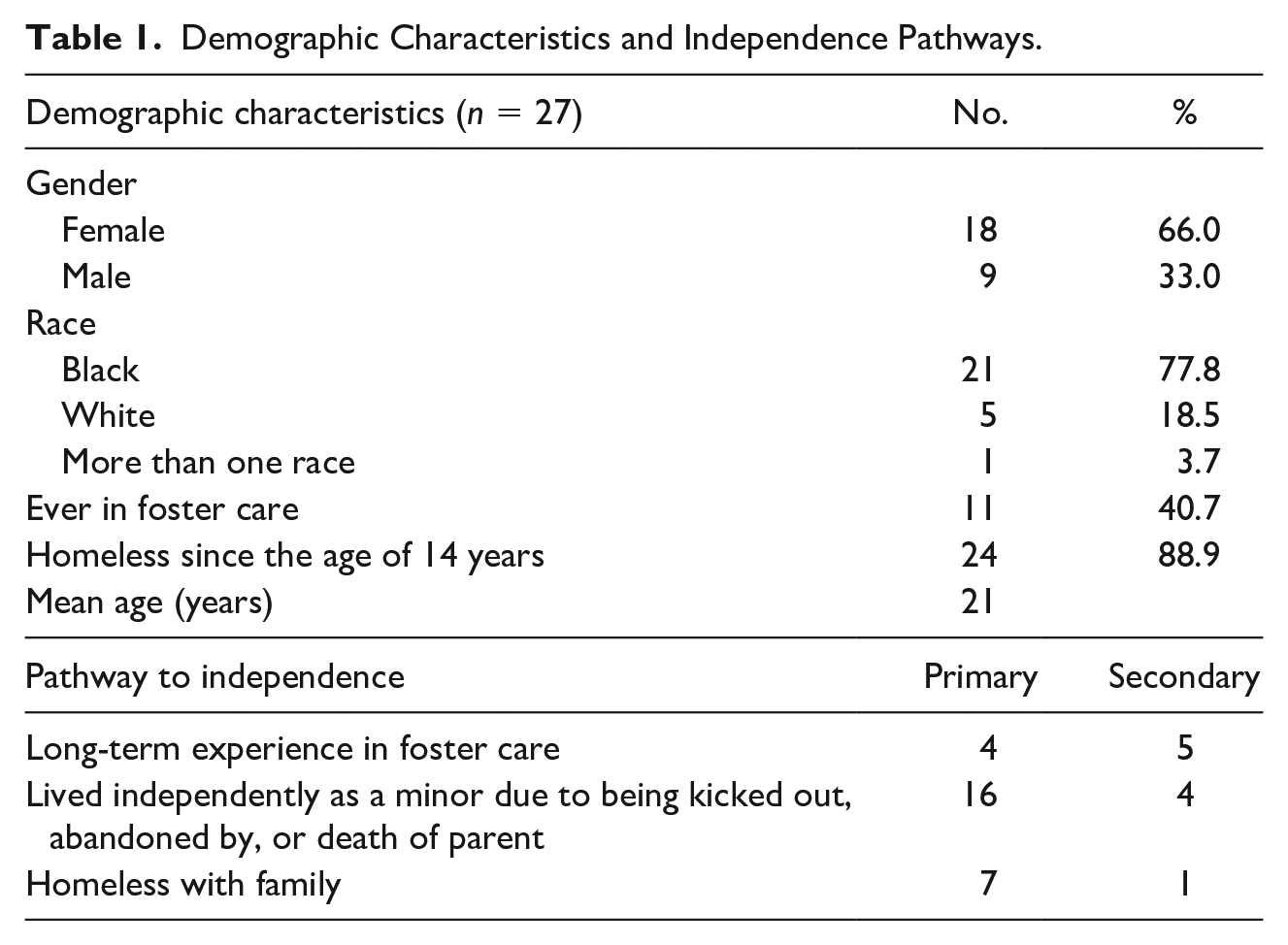
In general, the students in this study experienced early independence in three ways: (a) through long-term experience in foster care; (b) living independently as a minor due to running away, being kicked out, abandoned, or death of a parent, or (c) homeless with their family. These pathways into homelessness and care were similar to the findings of previous research summarized by Tierney and Hallet (2012). While there was typically a predominant path to early independence, some students experienced more than one situation during high school. Sixteen participants chronicled life experiences during high school that included loss of a parent, abuse, abandonment or conflict with parents and caregivers, which led to them living without formal caregivers in high school. Seven were homeless with family members and were often required to assume adult responsibilities because their parents needed family members to help out financially, or the participant had to leave the family to live with others due to financial pressures and lack of stable housing. Four participants had long-term experiences in foster care. For students who had experience in foster care, earlier life experiences included taking care of siblings or parents or living without family members in a group home.
The data analysis resulted in three primary themes, which we have labeled as follows: (a) getting by on their own, (b) meeting material needs requires creative strategies, and (c) the Catch-22 of managing academic and material needs. A description of the themes is provided below.
Theme: Getting By on Their Own
For most of the students in our study, early independence in high school was followed by a need for self-reliance during college. Achieving financial and residential independence in emerging adulthood is difficult without the support of parents or other family. Yet, most of the students in the study described being on their own, responsible for their material needs while in school and receiving no or very limited support from family members. This theme was present for 24 of the 27 students in the study. Many students described the struggle of trying to get through college on their own: It’s not been very pleasant. Just put it that way. In some moments, it’s been a reprieve, but for the most part it’s been more of a burden. In a sense that, you want to get a better job because you have to. You have to look out for your well-being. (Jeremiah) I think that one thing that is important is that I have to maintain a job and work. I mean, work and school work and go to classes, and that’s really hard because it’s easy to get burnt out doing that. Because I have to pay for some of my books out of pocket. I have to pay my own food and all that stuff. And I don’t think it’s understood as much as it should be, how hard it is for students to go to school full time and work full time. I get off work at 1:00 in the morning, and turn around and have classes at 8. When I get off work I have to do homework. Yeah, we come to school really tired and I think they should understand why. (Jamie) Like, I basically do everything for myself. I pay my own car note. I pay for my phone, necessities and little stuff like that. I get them by myself. I bought my own car. (Gabby)
Working to stay in school
These comments reflect a continuation into adulthood of a pattern observed by Burton (2007), in which children who experience early adulthood responsibilities also experience the stress from “burning the candle at both ends.” In adulthood, the trade-off in educational performance is usually due to individual financial responsibilities, rather than family responsibilities. Some students described working long hours, which required a trade-off with time spent on academic activities. This was the situation for Haley, who by the second interview had acquired multiple jobs to make ends meet: Well, I mean, it started that that I owed a bill. And then so my one job went to two jobs and then that didn’t work. So I had to get a third job and then I owed more and more. And then I got a fourth job. And then I had four jobs on top of pretty much an entire like end to an entirely other job [as a residence hall assistant]. So like I had five jobs and I was spending with those four jobs and RHA probably about 70 hours a week doing those things. (Haley)
Haley’s experience of taking on more work hours to pay an unexpected bill, and the toll that this has on academic performance was echoed by several students in the study. Jamie described how she had been working 40 hours a week with a full course load, which was affecting her mental health: Because before I was working 40 hours a week and it was killing my panic disorder because I have six classes. So I was just like this all the time. And I kept breaking down. I was overly stressed. I was staying up to about two or four in the morning doing homework and waking up at seven. And then like going in everyday. (Jamie)
Being self-reliant in college means that the loss of a job leads to academic and material hardship. Jamie was fired from her full-time job, which meant she did not have money to pay for her on-campus housing. Jasmine had recently been laid off from her job and was in search of employment:
So, I’ve been looking. I even went to two interviews. And I guess I just didn’t get it. Yea, so, I was definitely looking. I didn’t know that my job wasn’t covered under unemployment benefits until I got the lovely letter that says it wasn’t covered.
How are you going to pay for stuff?
I have no idea. Besides getting food stamps to go get food, who knows?
Samuel, who was also looking for a job, expressed concerns about finding a job that would work with his school schedule: I don’t know because, usually most of the time, I feel like I am going to have to spend something and I don’t have a job and I am trying to get a job. Trying to get a campus job because I feel like if I get a job outside campus they are not going to be considerate of my class schedule. (Samuel)
The need to work long hours, sometimes at multiple jobs, was more common among students who had experienced homeless or were independent of their parents in high school than it was among those who were in foster care when they graduated from high school.
Finding and keeping a place to live
Maintaining stable housing was also difficult for students in our study to manage on their own. Housing costs tend to make up a large portion of a student’s financial responsibilities. It was not surprising then to find that students in both on- and off-campus housing arrangements struggled to pay for their housing. Some students experienced extreme hardships related to housing. Three students experienced eviction while they were in school, a process that lead to a period of homelessness or insecure, short-term housing arrangements. Jasmine was one of these students. The loss of her job led to an eviction from her off-campus student housing: I live in [student housing apartments]. Because I lost my job, I can’t pay rent. So they are going to start eviction tomorrow. (Jasmine)
McKenzie’s experience highlights the difficulty of managing the high cost of rent as an independent student. She describes trying to catch up on her rent after falling behind, but ultimately was evicted: They were basically saying we need $650 up front. And I was like, well, I can pay you by the week because I get like three hundred dollars that I can just, you know, pay you at a time. [The landlord responded] No. We need all the money upfront. So April rolls around and I paid up. We paid up March and then April comes around. So April comes around and we still trying to pay up and the balance is like two hundred dollars left. So May falls around and it’s like I got a new job. I’m working a new job. Like waiting on checks to pay that much rent. And before I can do it, it was like, I remember going to work and headed out for door and there is a police officer standing at the door saying, you got 24 hours to leave the premises. (McKenzie)
Eleven students described having at least one period of homelessness since beginning college. Four students were homeless, living in their cars for several weeks to a few months. In some of these situations, the homeless episode was triggered by a break in the academic calendar. Breaks were difficult to manage if on-campus housing closed and the student did not have a place to go or if the student lacked summer financial aid funding to supplement their income. Shawn described having nowhere to go when housing closed after summer session: So after summer school ended, I had to leave. They were saying, like, we can’t provide you with housing. You gotta go. My mom, she couldn’t like, she didn’t have enough funds to even come get me. So just like, what do you do? So from that moment, we both [he and his girlfriend] ended up staying with our friend at her house. (Shawn)
Summer session also created housing problems for Jeremiah, who lived in his car for 2 months in the summer after he had to move out of his campus housing because he did not receive summer funding for school, did not have enough money from his job to pay for a place to live, and was estranged from his family after he told them he was gay: . . . I was sleeping in my car and several different places. I stayed out of view. I really didn’t want anyone seeing me. I had to do things like piss in a Gatorade bottle. The only way I was able to make it work so that people couldn’t really tell if I was homeless is that I had a gym membership and a laundry card. So my laundry got done. My trunk was big enough to fit all of my clothing. (Jeremiah)
The findings highlight the extreme housing instability experienced by many of the students in our study. Their housing experiences reflect that of lower-income households in the United States, where rising housing costs and income inequality mean that even full-time work in a low-wage job is not enough to afford a rental apartment (National Low Income Housing Coalition, 2020). Students who had more generous funding support did not appear to experience housing instability during the school year compared with students whose financial aid packages did not cover all of their expenses. This suggests that relatively small amounts of funding make a significant difference in the ability to achieve residential independence. However, breaks in the academic schedule were problematic for students with and without generous support, suggesting that in addition to financial resources, adult support networks may play a role in navigating short-term housing needs.
Three students did not have experiences that reflected the “getting by on their own” theme. Two students with long-term foster care experiences, Kayla and Angelica, described having less responsibility for their material and educational needs. Angelica had been adopted in her late teen years, and Kayla had her housing and living expenses paid through a transitional living program. Both were eligible for more financial aid resources as foster care youth. The third student, Mikayla, had been homeless with her family and took on adult responsibilities at an early age. However, as a college student she received a great deal of emotional support from her family and financial support from her father that was sufficient to avoid material hardship.
Theme: Meeting Material Needs Requires Creative Strategies
Despite working long hours, and receiving various forms of financial aid, program, and scholarship support, students in the study struggled to meet one or more basic needs. Students adopted a range of strategies to address gaps in their material needs, particularly housing, food, and course textbooks. This theme was present for 21 of the 27 students in the study. This theme was most prevalent among students whose path to early independence was due to being kicked out, abandoned by, or death of parent and those who were homeless with their families. Of the four students whose primary pathway to independence was due to long-term experience in foster care, only one described the need to use creative strategies to meet basic needs.
Obtaining housing through networks
The lack of money to pay for housing meant students often relied on living with friends or acquaintances in doubled-up, informal housing arrangements. This was the case for Nathan, who had been couch surfing for the first few months of college, a process that began in high school: Mostly at my girlfriend’s grandparent’s house and sometimes at my friends. One of my friends comes back home every weekend. I’ll be there Thursday through Saturday. But I keep to myself. I’m a really clean individual. You won’t even notice I’m there. And not to mention all the things I help out doing. (Nathan)
Living doubled-up with friends or acquaintances, which is considered a form of homelessness under federal definitions, is a common strategy to address housing needs in the short-term. However, it is a strategy that is linked to cyclical residential instability and homelessness (Rog & Buckner, 2007; Skobba & Goetz, 2015). Nathan was able to find an affordable apartment at the end of the first semester of his freshman year of college, other students in the study had experienced more long-term periods of instability, moving between doubled-up accommodations. Another strategy used by several students was to find a campus position that covered housing costs. Several students were residence hall assistants (RA) or were in the process of applying to become an RA. The ability to secure a position that provided housing was an effective strategy to resolve a housing affordability problem. This position on campus comes with no or minimal pay but usually provides free housing and, in some cases, a full or partial meal plan.
Coping strategies to mitigate food insecurity
Not having the money to buy adequate amount of food was common. Meal plans for on-campus dining are expensive and were an area where students could realize cost savings. Students living on campus described a range of strategies, including going without the meal plan or selecting the least expensive plan which provided limited access as ways of coping with the expenses. When students encountered more immediate needs, they typically sought the help of friends, visited campus food pantries, or purchased inexpensive food: I was not on the meal plan. I have a meal plan next semester because my grandparents are helping me with that. But what I can eat, my boyfriend is the manager of the dining hall, so I can get food . . . I mean, the whole semester I had trouble having enough food. (Jamie) I mean, sometimes, like, you just go to the store and buy a few noodles. Those can get you through. Sometimes, like a lot of times, you know, people tell you to call, but you just, it’s hard. Calling people and saying like, hey, can I have like 20 bucks just to get some groceries? (Danielle)
Danielle notes that asking for help for food is difficult, both due to a sense of pride and not wanting to trouble anyone.
Strategies when course textbooks are out of reach
About half of the students we interviewed were unable to buy the required books for their classes. For some students, not being able to purchase the book adversely impacted their academic performance and, in a few cases, the need to repeat a course. This was particularly apparent with math and language courses, where textbooks are both expensive and essential to academic success. The students who lacked funds to purchase textbooks described a variety of strategies used to succeed in their coursework. Several students went directly to the course instructor to obtain a copy of the book or asked if it was needed to be successful in the course, whereas others found ways to gain access to the book or the information provided in the textbook through friends or study groups: I was taught a trick by a lady at my church. Always go to the professor. Shake your hand, like I shake your hand. Always do that, look in their eyes and introduce yourself. The next day, send them an email. Just make up a question about the syllabus. You already have gained a relationship with that professor. Next thing, go to the professor’s office. Ask them two questions. Do I need the book? Can I borrow your book? It has worked for me every semester. Every semester. I pay for some books, but you know, they’re online and they’re real cheap. Every semester, it works every semester. Either they’ll say no or they give me their books because no student thinks to ask this. Students are just trying to rush out of class because, you know, first day of class, classes get out early. (Jada) Sometimes it’s best to hook up with somebody in class who has the book. You can copy [a book on reserve]. Sometimes teachers let you use the book. I’ve even got an app on my phone that I can look up any book, any textbook we ever created a say it’s page fifteen, chapter twenty, section two, line three. I can find it to a T. (Briana) Yeah, I mean, sometimes for the most part I’ve learned how to adapt like by, you know, slipping into a study group and, you know, borrowing someone’s book or something like that, even if it’s just, you know, spending like $2 on the tip, the old tests or on the study guides that someone puts online. (Haley)
The findings above suggest that the students in our study developed a wide range of coping strategies to address the gap between available financial resources and material needs while in college.
Theme: The Catch-22 of Managing Academic and Material Needs
Students in the study described the difficulty of managing academic and material needs, where a solution to one problem often created a new barrier or problem. Fifteen students in the study who varied in their pathways to independence described these “Catch-22” situations. Several examples below highlight the cyclical problems that arise when students are managing academic and material needs on their own. Haley, the student who had acquired multiple jobs before the end of her freshman year to make ends meet, describes the problematic cycle of managing work and academic loads. Her escalated work hours began with a US$200 charge on her student account: And like all of the jobs were taking away from me going to class and me studying and doing this. And because for me to stay here, I had to pay those bills. I had to go to work to pay those bills to stay here. (Haley)
Working to pay fees was not the only challenge she faced during our study. Haley describes the conundrum of having to decide between having a place to stay during the summer and pursuing internship opportunities: And so there comes a point where you say, well, do I want this? Like, do I want this job that only pays $7.50 an hour, but it gives me like a secure place to stay all summer and work and earn to earn a little extra money. But there are other opportunities out there. And so like right now I’m struggling with, do I want to be a summer R.A. so I stay on campus for free and I get that little extra money and I can also take summer classes or do I want to do something like an internship? But then if I do an internship, where will I live? (Haley)
Students who lived off campus to reduce housing costs also provided examples of how solving one problem generated another. Living off campus provided a solution to a housing problem by lowering housing costs but often generated a transportation problem. All of the students were attending school in small cities with limited public transportation options. Students who did not own or have access to a car often spent large amounts of time in the day to get places. Taking the bus to campus required planning and a time commitment, which made it difficult to get to class on time: I had to end up dropping 2 classes because I was having trouble getting to campus on time [due to a 2 hour bus trip]. (Shawn) If I’m riding the bus, it takes, probably about two hours. Because if I have a class at 10, I would have to get on the bus at 7:53 and wait at the bus station until about 8:45. And then I would get to the school at 9 o’clock. If I get on the bus at 8:53, then I would get to the school at 10:05 or something like that. Because sometimes the bus runs late so you have to get on the bus two hours before your class. (Kayla)
Owning a car made it easier to get to campus classes and activities or to an off-campus destination. Yet, the expenses of car ownership required students to work longer hours, which as noted above, impeded their ability to attend classes and complete academic work. Jocelyn describes how car repairs came at a crucial point in the semester: It’s hard. I mean, not only do you have to worry about your school. My car’s starting to mess up now too. So it’s like I don’t want to get overtime because then my grades might start slipping right and this is not the time for them to start slipping. (Jocelyn)
Despite generating the cycle of increased work hours and reduced hours for academics, car ownership was considered essential, something that not only made life easier but also allowed for independence. Students who owned cars considered them prize possessions and paying for and maintaining cars was often considered a priority. The responsibility of paying for college and living expenses, however, interfered with the ability to fully participate in important college experiences for some students in the study.
Discussion
For the students in our study, adult responsibilities in childhood were often followed by a transition to financial and residential independence in their late teens. Many of the students in the study described a fragile and seemingly unsustainable balance between meeting material needs and academic demands. While we only followed students for 1 year, the path to completing a college degree seemed challenging. This unsustainable balancing act relied on strategizing to secure basic and academic needs in the absence of financial resources. These unmet needs ranged from a short-term shortage of food, to the inability to pay for a course textbook, to longer-term housing insecurity. Although all of these needs are part of the cost of attending college, they are not always covered by financial aid packages.
It is not surprising to find that students with a history of homelessness or foster care struggle to meet basic needs in college. Previous research on emerging adulthood suggests that young adults are experiencing a longer transition to full independence and during this transition, parents are providing substantial material and time support (Schoeni & Ross, 2005). The transition to college without parental support is difficult. The current financial aid model relies on significant contributions from parents or family members. Our findings suggest that students who have experienced homelessness or foster care lack financial support from parents and family, which results in unmet needs in college. In attempting to resolve unmet needs, students with a history of homelessness or foster care may engage in a cyclical pattern, often through added work hours or going without housing, which generates new problems that interfere with academic success.
Our findings also suggest that a relatively small amount of funding may have helped close the gap for the students in our study, all of whom attended 4-year, public institutions. While all students experienced unmet needs, some students who had experience in foster care received more ample funding and were able to avoid more serious cases of material hardship while in school. Students who have experienced foster care may have access to the Education and Training Voucher (ETV) program, which helps eligible foster youth by providing funding for college costs. While the funds vary from state to state, the state funds for students in the study provide up to US$12,500 from ages 18 to 21 years, US$10,000 from ages 22 to 23 years, and then US$5,000 from ages 24 to 25 years. Programs that supplement financial aid packages, such as ETV and Independent Living Program (ILP), may ease the burden for students who have experienced foster care. ETV and ILP funding appeared to provide the level of support needed to allow students who had experienced foster care to participate in academic life, maintain a higher level of housing stability, and avoid the need to work hours that interfered with academic success. This type of funding was not available for the students in our study who had experienced homelessness. Instead, these students were reliant on the financial aid packages offered by their school, which were inadequate in covering school and living expenses in the absence of parental support. Our findings suggest that more research is needed to better understand how a similar program for students who have experienced homelessness would impact educational and basic needs outcomes.
Our research also highlights the importance of longitudinal research when studying young adults who have experienced foster care or homelessness. We conducted two follow-up interviews over the course of an academic year. This allowed us to see how academic, financial, and housing instability unfold over the course of an academic year. We were able to observe how lack of adequate financial assistance results in the need to address the gap often by taking on more jobs and/or finding lower-cost housing accommodations. While we observed this phenomenon for many participants, it was particularly apparent for two participants who were freshman attending higher cost, more selective schools. For these participants, the excitement of being accepted into college, moving into a dorm, and living their lives as college students eroded over the course of the academic year as the reality of meeting financial and academic responsibilities on their own set it. The findings for these two students at higher cost, selective schools are consistent with Jack’s (2019) research on the “doubly disadvantaged” which highlights how getting into college can mark the beginning of the struggle as university policies, practices, and norms place burdens and further marginalize low-income students. We were also able to see housing instability change over the course of an academic year. For example, students who were homeless at the first interview, right before school started, found a place to live during the first semester but were on the verge of eviction by spring semester. Our findings suggest that including data collected at multiple points in time will allow for a more nuanced understanding of the experiences of young adults who experience early independence.
Finding solutions to improve the ability of students with foster care and homelessness histories to manage material and academic need is a worthy endeavor. Completing a college degree offers a path to greater economic and residential self-sufficiency and a higher quality of life (Salazar, 2013). Yet, the pursuit of a college degree should not be limited to those with highly developed survival skills, nor should it sacrifice the health and well-being of these students while they are enrolled in school. Well aware of the economic benefits a college degree would bring them, students in the study expressed that they were determined to graduate. Yet, several students acknowledged that attending college was a struggle.
Our research has several limitations. This study represents data from a small number of students across several institutions in one state and is intended to provide a rich, context-relevant description of these students’ experiences, rather than generalizable knowledge. In addition, the students in this study were typically referred to the researchers through contacts within campus support programs for students who have experienced homelessness and foster care. These programs are designed to provide material and social support by providing services and connections to campus-based resources to help overcome barriers. Therefore, students in this study likely have more information, support, and resources than students who are attending colleges where this support is not available. Further research that examines a larger number of students in different educational contexts would add to our understanding of how students with homelessness and foster care experience balance academic and material needs in the absence of parental and adequate financial support. Finally, we examined commonalities between students with foster care and homelessness experience within a rather narrow scope (material needs in college). There are likely differences between these two groups that were not accounted for or examined in this study.
Footnotes
Declaration of Conflicting Interests
The author(s) declared no potential conflicts of interest with respect to the research, authorship, and/or publication of this article.
Funding
The author(s) disclosed receipt of the following financial support for the research, authorship, and/or publication of this article: This research was funded by a grant from the Spencer Foundation’s Small Research Grant program. The grant, Life pathways and the transition to higher education for homeless and foster youth, was awarded in 2015.
