







Abstract
While there is emerging literature addressing the gendered nature of digital communication between youth, research about the everyday communications, friendships, and social relations of LGBTQ+ youth remains sparse. This study explores how 14 to 18-year-old, cisgender lesbian, bisexual, and queer girls living in the United States come to understand themselves and others in dyadic text messaging conversations of girls who were previously unknown to each other. Using grounded theory, this secondary data analysis identified the pervasiveness of heteronormative frameworks in participants’ communications with each other. Findings indicate that both digitally-mediated expressions of selfhood and queer identity are dynamic processes significantly shaped by normative discourses and participants’ desire to connect. Drawing on and contributing to girlhood and youth studies, this research provides insight into how queer cisgender girls construct literacies of self, sexuality, and gender, and establish connection, and how they resist heteronormativity to validate their own and each other’s sexual identities.
Introduction
As youth communication has moved online, the ability to capture the everyday exchanges and thinking of young people in their daily world has altered. We now have new and potentially easier ways of capturing their exchanges because of social media and other digital communication technologies. Exploring short message service (SMS) or text messaging discussions of girls who identify as queer and cisgender offers a view into their worlds.
During adolescence, youth learn to integrate with key peers and continue processes of differentiating from adult caregivers (Erikson, 1968). Both forms of socialization contribute to identity formation, which also includes experiences with, and explorations of, sexual behaviors (Tolman & McClelland, 2011). Although family relationships still play a key role in the lives of youth (Årseth et al., 2009; Scabini & Manzi, 2011), adolescents spend more time interacting with their friends than they do with adults (Rideout, 2012), and friends assume a central role in their lives. Peers become important sources of emotional support and may provide influential cues for behavioral decisions (van de Bongardt et al., 2015). The influence of the peer group as a source of identification begins to expand (Jones, 2014). Peer group interaction and social support have moved, in part, to social media and other virtual communications such as instant messaging and text messaging modes (Marwick & Boyd, 2014; Sylwander & Gottzén, 2020). A growing body of research is documenting how navigating online interaction spaces contributes to communication, identity development, and friendships among young people, including among sexual minority youth (Craig & McInroy, 2014; Fish et al., 2022; Fox & Ralston, 2016). Much of the extant literature is based upon youth self-report about their digital interactions, rather than direct observations of those interactions; or data have been reported from adult-moderated online spaces designed for specific interactions (e.g., support groups) rather than observations of more spontaneous interactions of sexual minority young people.
As part of a larger study, our current analysis explores the text messaging-based interactions between 52 pairs of sexual minority cisgender girls who took part in Girl2Girl, a national teen pregnancy prevention program (Ybarra et al., 2020). The participants were strangers to each other prior to their participation in the intervention program. The resulting data and analysis offer a unique documentation of adolescent queer life and relationship formation in text message format. These seemingly everyday moments where relationships, sex, popular culture, family, and wellness were discussed also revealed significant insights into how heteronormative logics inform adolescent behavior and understandings of self, sexuality, gender, and queerness for cisgender sexual minority girls. Heteronormativity, according to Warner (1993), is the assumption of heterosexuality and, by association, binary sex/gender systems and its attendant norms. In this research, we seek to contribute to an understanding of a queer girlhood that accounts for both the pervasive normativity that structures the everyday lives of the girls included in our analyses, and that is attentive to how they navigate, reproduce, and subvert these same norms. In doing so, we highlight gender and sexuality as dynamic elements that shape sociality and inform participants’ sense of self and others.
Our analysis attempts to account for and acknowledge the navigational skill required for queer girls participating in a networked online environment to try on, take up and perform sexual, romantic, and social identities in the intentionally queer space of the Girl2Girl text buddy dyads. We ask:
Theoretical Framework
Feminist and constructivist theories of youth studies, as well as New Literacy Studies—especially digital media literacies, sexuality studies, and queer studies framed our analysis, providing a robust conceptual frame to examine our participants’ articulations of self in networked communications (Blackburn, 2010; Brickman & Willoughby, 2017; Kehily & Nayak, 2014; Lesko & Talburt, 2012; Marshall, 2008; Raby, 2010; Tuck & Yang, 2011). Together, these frameworks allow the interactions between the participants to be understood as both unique to each text buddy dyad, while also attending to the wider normative discourses informing their discussions with each other. Youth studies aids us in thinking about who youth “are” and how they are understood to be; that is, youth/adolescence is not purely a developmental stage on the way to adulthood (Lesko, 2001; Loutzenheiser & Stiegler, 2016). New Literacy studies recognize that textual (written and read) social communication is influenced by the social and political discourses that structure people’s social contexts, that is, “meaning making and reading are connected to identity negotiation and broader dominating discourses in society that control beliefs about the way the world works” (Richardson, 2013, p. 330). The new literacies of online and digital communications also recognize gendered ambiguities and rule-based expressions in online spaces that render it similar to, yet distinct from, in-person communications (Marshall, 2008). Highlighting the complex nature of these girls’ text message-based exchanges allows for interrogations of the “intricate articulations of care between selves and others that crisscross boundaries of online communications” (Driver, 2017, p. 300).
Because this research explores the self-articulated experiences of sexual minority girls, the youth studies and girlhood studies literature help situate our findings. For example, McRobbie (2007) discusses how girlhood is materially and discursively constructed in the 21st century as “a constant stream of incitement and enticements to engage in a range of specified practices which are understood to be both progressive but also consummately and reassuringly feminine” (p. 721). Here, girls are not passive consumers of bought-and-sold femininity. Rather, they are skilled navigators where femaleness and femininity are considered both ideal and insult (Rickman, 2018). We take as a premise that thinking through girlhood—and queer girlhood in particular—outside the framing of polarizing “can-do” and “at-risk” discourses of girlhood (Aapola et al., 2005) complicates what it means to be a girl in helpful ways, unearthing how common understandings of girlhood produce certain norms (Driver, 2005). Following Driver’s (2005) lead, explorations of queer girlhood, in particular, throw “into question binary gender and sexual norms that constitute and regulate youth subjectivities. In this way, the very term ‘girl’ is questioned and exceeded” (p. 111). Like many girls, the participants in the study exercise agency at the same time that they must also navigate the limits of how their gender and sexualities are socially constructed and understood in relationship to girlhood itself, and how they read others’ messages, and are read in text messaging exchanges with girls like themselves.
Method
We collected and analyzed the text message exchanges, some of which were prompted, between 52 dyads of intentionally paired and geographically separated cisgender queer girls. The Chesapeake Institutional Review Board and the University of British Columbia Research Ethics Board approved all procedures.
Participants and Recruitment
Cisgender queer girls were recruited nationally in the United States via online advertising, including Facebook, to participate in Girl2Girl, a text messaging-based teen pregnancy prevention program. The advertising did not specifically mention pregnancy prevention, but did describe a text messaging program for sexual health education for “girls who are into girls.” Eligible participants included those who identified as: a sexual minority (e.g., lesbian/gay, bisexual, pansexual, queer, questioning, unsure) and cisgender (i.e., assigned female sex at birth and currently identify as a girl). Eligibility also included being between the ages of 14- and 18-years-old, speaking and reading English, not having graduated high school (including those who have dropped out), owning a cell phone with an unlimited text messaging plan which they had used for at least 6 months, and being able to provide informed assent, including a self-safety assessment. A waiver of parental permission was granted by the IRBs.
After they enrolled in the program, buddies were matched by the intervention software program based on the girls’ sexual experience, sexual identities, time zone (to be within two time zones of one another to facilitate communication), and location (at least 500 miles apart based on zip code to reduce the likelihood of in-person meet-ups), where possible. Sexual experience was defined as anal or vaginal penetration with a penis or dildo, categorized as yes or no. Those who indicated yes were matched, as were noes to noes. Because preliminary findings from online focus groups in developing the intervention noted important differences in sexual decision motivations and ways of thinking about pregnancy prevention by sexual orientation, the resulting intervention provided two different content “paths” that were based upon sexual identity. Accordingly, for text buddies, lesbian and gay girls were matched with each other, and bisexual/pansexual girls were matched with each other. Given that queer was a more general identity, information about attractions was used to pair girls who identified exclusively as queer. This allowed text buddies to experience the same intervention messaging for their program discussions. Occasional exceptions were made to the matching criteria as needed, mostly around sexual identity or location, not around sexual experience.
Data Collection
The program lasted 21 weeks: During the 7-week main intervention, the program covered different topics about teen pregnancy prevention. There then was a “latent period” when girls received messages only periodically (weeks 8–20). The final week was a review week of topics discussed in the main program. Text buddies connected with each other for 21 weeks through a dedicated “buddy line” telephone number. Participants were encouraged to discuss the program content with their assigned text buddy, although they were free to discuss whatever they wished during the program. Some dyads were in touch with each other regularly throughout the 21 weeks and texted each other daily for several days in a row with gaps in between ranging from 1 day to a few weeks. Other dyads communicated with each other sporadically; these dyads may have messaged each other every few days or even every few weeks. In the process, broader discussions developed between many of the dyads that were not related to the program content. Investigators in the original study found that girls who engaged in text message discussions were offering rich data on what it means to be a cisgender sexual minority girl and noticed how text messaging offered particular opportunities for youth-driven communication. However, these discussions were not the goal of the original study. Seeing the opportunity to investigate queer girls and the everyday discussions that text messaging affords, a secondary analysis with a new team was undertaken. The extra-programmatic content is the focus of this secondary analysis. Except for two of the original investigators of the larger study, none of the research team for this secondary analysis were involved with the data collection or the original study. Most members of the research team, including senior investigators, identified as lesbian, bisexual, or queer, with lived experiences growing up in the United States and in Canada. Authors were from a variety of diverse ethnic backgrounds. Although investigators have the privileged status of graduate education, one or more of them grew up in working-class households. Everyone on the team identified as cisgender women.
All text buddies who completed the program were sent a text message asking if they agreed for their buddy conversations to be analyzed. A dyad’s exchange was included in the analysis if both text buddies agreed for their buddy conversations to be analyzed.
Data Analysis
Fifty-two text messaging dyads’ exchanges were analyzed out of a total of 58 dyads who assented/consented to have their exchanges included. Six exchanges were excluded from the analysis because the exchanges were too sparse to provide a significant contribution. We analyzed all large text communication between the remaining 52 dyads. “All large text communication” was defined as non-project communication, that is, exchanges that were not solely brief responses to the prompts from the intervention to tell your text buddy an answer to a question. The amount of communication considered comprehensive enough to be analyzed included communications where text buddies had back-and-forth discussions of more than a few words and a few lines.
We employed a grounded theory methodology using a constructivist lens (Charmaz, 2014) that engages the data in ways that are both layered and analytical (Mills et al., 2006), rather than categorical. Grounded theory offered an approach to focus on and explore participants’ lived experiences, including their beliefs, feelings, assumptions, and ideologies (Charmaz, 2014; Creswell, 2007; Strauss & Corbin, 1990).
Following Charmaz (2014), we explored the data reflexively and anchored the analysis in a constructivist framing to enhance an iterative and emergent understanding of the data. Throughout the analytical process, we viewed the data in conversation with theories of youth and girlhood studies and the framework of new literacy studies noted above. Participants’ articulations of self and the dyad conversational snapshots provide glimpses of day-to-day lived experiences of queer girls inclusive of place, sexual identity, gender expression, and adolescent familial systems and social connections. The coding and analysis of the data were revisited often and linked closely to the theoretical framework throughout each step of the coding processes. Our coding schema was attentive to the ways in which dominant discourses of sexuality and gender were expressed by the participants. After initial coding, we returned to the theory and read through the initial codes, which then allowed us a particular focus on themes of heteronormativity. By looking to theories of heteronormativity, we were reminded of systemic and individual experiences within sexualities. This is in keeping with the application of grounded theory in its more constructivist form, that is, to provide structure to the analysis (Strauss & Corbin, 1990).
Transcripts were coded using NVivo qualitative software. NVivo facilitated a rigorous engagement with the data in order to: (a) think about analyzing interview transcripts, encapsulate noteworthy material, and formulate codes or containers; (b) consider, as a team, the meaning of each code; (c) sort codes into larger categories or parent codes according to similarities, differences or other distinctive associations; and (d) engage with the categories to create themes that address our research questions and build theory concurrently and reflexively. Four members of the research team engaged in the coding process, progressing through open coding, focused coding, and selective coding. To establish rigor, the four members started by reviewing the same 12 transcripts independently and subsequently as a coding team to familiarize themselves with the dataset, note emerging ideas, draft a codebook, and code the transcripts. After ensuring consistent coding amongst the team members through closely reviewing and talking through the coding of those 12 manuscripts, the team divided the remaining transcripts evenly to code individually, but met weekly to share coding insights, reflect upon the explicit and implicit meanings of the emerging themes, and revisit the coding schema to adjust reflexively as needed, adding and removing codes based on collective feedback, decided by consensus. We created memos to surface and work through potential biases. Moving from coding and thematic categories to building on theory occurred throughout the data analysis, shifting us away from linearity and illuminating how data analysis is a recursive process.
Theoretical sampling and saturation resulted in the emergence of two substantive theories stemming from the “back-and-forth interaction” articulated above (Akcam et al., 2019, p. 40). These theories are literacies of self and heteronormative logics. We used these two theories to further organize the findings and weave theoretically through the data, concepts, and analysis (Charmaz, 2014). These theories and the sub-themes described are not meant to be “distinct” categories, but rather, to provide different nuances and insights into how sexual minority girls negotiate their presentations of self in text communications, how they see themselves in relation to gender, sexuality, and adolescence, and the tensions within how they demonstrate their queerness and “girlness” in their messaging.
Results
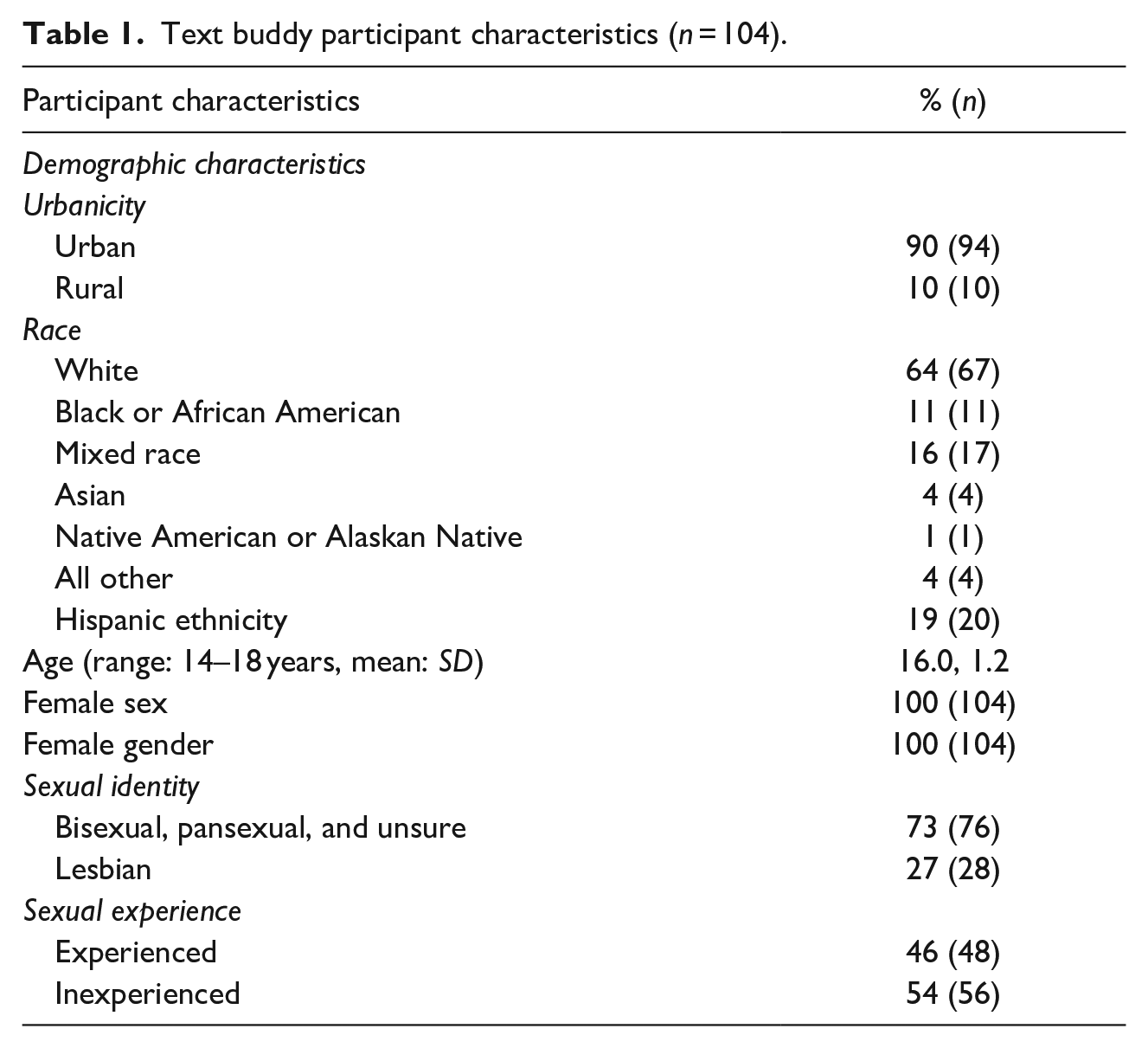
Demographic information about the participants is provided in Table 1. Participants’ ages ranged from 14 to 18 years old. Most participants were White (64%) and lived in an urban area (90%). Almost half the participants reported that they were sexually experienced (46%).
Text buddy participant characteristics (n = 104).
Literacies of Self
The ways the participants chose to self-identify, the elements of daily life they chose to elaborate on and share with each other, and their respective and collective responses to each other are what we are calling literacies of self. These articulations provide important insight about how youth see themselves as queer and what they also consider as relevant to being read as LGBTQ+ (lesbian, gay, bisexual, transgender, queer, and other sexual orientations and gender identities) through those articulations in this particular space. As Boyd (2014) argues, “Teens have grown sophisticated with how they manage contexts and present themselves in order to be read by their intended audience” (p. 43). The interactions between the participant dyads reveal moments of vulnerability, support, confidence, and self-doubt. We suggest that connections between and amongst the program-mediated—and arguably, intimate—exchanges leave intentional tracings (even ones unknown to the girls). These tracings indicate connections, which we argue denote a desire for connection, with sub-themes of mirroring, role modeling, and sharing romantic relations, through which participants constructed a literacy of self in the text messaging.
Online communities often serve as important spaces of self-representation and support for youth who are marginalized (Marshall, 2008). In this way, the girls were curious to know about each other. Participants sought to establish a connection with each other through sharing their sexual orientation, discussing sexual experiences and romantic attractions, discussing hobbies, school activities, or a favorite band. The girls’ communication indicated a desire for the other to accept or like them: “Hmmm, I wanna ask what you look like, but if you want to stay anonymous and keep it a surprise then that’s okay too! Sorry to ask if i seem intruding”; (Dyad #37) and “sometimes you don’t even need alot, just a friend you know, thank you for being my friend.” (Dyad #16) The desire for a relationship extended past the program as most dyads wanted to add each other on various social media platforms to continue their connection.
Mirroring
We are defining mirroring as the repetition of the language between text buddies. Sometimes this occurred when one participant saw their lives reflected by another whose experiences mirrored their own. Mirroring also was present in the dyad conversation when a participant imitated or copied a peer. Each type of mirroring was followed by the experience being acknowledged by their peer, which we read as affirming a sense of self that is seen, heard, and included.
Mirroring often occurred in discussions about popular culture preferences, which included everything from favorite TV shows to favorite bands. In the following excerpt from Dyad #53, participant two (P2) not only mirrors participant one’s (P1) interest in the show “Master Ink,” she also concurs that one of the characters is “talented” and “hot”: P1 I can’t stop watching Ink Master it’s becoming a problem haha P2 Aye that’s my show P1 Dude yesss I’m behind tho I’m only on season 8 P1 I’m pulling for Ryan tho she’s so talented (and hot too) P2 I know right! (Dyad #53)
We suggest that mirroring is significant to youth’s desire for connection and affirmation of homosocial connection (Sanders, 2015). When a participant says “aye, that’s my show” and “I know, right” it indicates how participants strove to be recognized and accepted by their peers through shared experiences both in popular culture and in the text message exchanges themselves. Devor (2004) argues that mirroring offers moments of “insiderness” or feeling validated and confirmed.
Mirroring was observed across a diversity of subjects, including their buddies’ sexual orientation, personalities, moral beliefs, and aspirations. For instance, when one participant said, “Idk maybe I’m just really nice . . . Ill cuddle anyone I’m comfortable w basically lol,” her text buddy responded, “SAME ASF.” (Dyad #55) Another participant texted that she shared her text buddy’s relationship values in terms of dating for marriage and not for flings. These examples indicate that girls are not only using mediated communications to establish connections with each other, but are also using their connections as moments of affirmation and belonging. In doing so, they take a risk in presenting themselves in ways that are recognizable. While this risk could backfire, here it built intimacy and connection with their text buddy or is otherwise affirming of how they see themselves. Espousing each other’s ideas and language is one way that girls can maintain acceptance among their friends (Bortree, 2005). Thus, sexual minority girls in the dyads found that mirroring, or the imitating of one’s peers is both “intrinsically rewarding, as it contributes to a favorable sense of self” (van de Bongardt et al., 2015, p. 1794) and extrinsically motivated by an increased sense of inclusion or exclusion.
The process of maintaining acceptance and intimacy through mirroring was also seen in text exchanges focusing on violence and trauma. Many participants disclosed experiences of personal trauma or shared traumatic interactions experienced by their family, friends, peers, or community members. As one participant stated, “I am super cautious of abusive tendencies in relationships due to the environment in which I was raised”; (Dyad #3) to which her text buddy later commented, “While I haven’t personally been in any situation like that, my mom was killed after trying to escape an abusive relationship with my step-dad. I think it’s important to look for things like that.” By echoing her buddy’s experience and need for protective measures, this participant created intimacy through disclosure while also validating the difficulty of everyday experiences of violence. The sharing of the experiences and normalizing how trauma affects relationships and how one feels about one’s self is especially significant since gender roles and abusive dating patterns are often solidified during adolescence (Reyes et al., 2016). By building intimacy and connection through mirroring, the participants demonstrate how tools such as text messaging, which are situated within the everydayness, offer opportunities to normalize difficult conversations or experiences and offer girls spaces for acknowledgment. For researchers, the dyad conversations present exchanges not often heard, and offer a glimpse of the often-undisclosed lives of queer girls.
Role Modelling
According to Driver (2006), “Connecting with other queer youth through new media becomes a vital way for youth to access and sustain links with queer mentors, friends, and acquaintances” (p. 229). While many queer youth say they have a role model in their lives, often they lack access to LGBTQ+ affirming adults, and consequently turn to “less accessible role models, such as entertainers or public figures, encountered largely through the media” (Bird et al., 2012, p. 354). The dyads would often offer guidance, both solicited and unsolicited, on subjects such as relationships, college applications, travel, condom and dental dam storage and use. For example, participants often sought sexual advice from each other as a strategy for connection and information sharing: “Haha my only advice is make sure the girl isn’t straight.” (Dyad #11) As another text buddy recommended, “fuckboys r fine as long as ur playing the game . . . Like don’t go in expecting anything besides a hookup and don’t catch feels.” (Dyad #36)
The participants also expressed interest in “helping” others, either through professional ambitions or through providing immediate emotional support to someone they knew. For example, when discussing why they joined this program, one text buddy said, “I think it’s cool. I’m just happy to help girls like us in the future.” (Dyad #1) The other buddy in this dyad then responded, “I’m always happy to help anyone so I feel you.” This interaction reveals the importance text buddies placed on being role models and providing support not only amongst themselves, but to the wider communities (LGBTQ+ and straight) to which they belonged.
The management of mental health was another reoccurring topic. Buddies referred to each other and sought guidance, with some participants sharing their own strategies for dealing with anxiety and depression: “i even went to see the school psychologist who referred me to a program for LGBT youth so 'm going to one of their events tomorrow night.” 1 (Dyad #10) In these exchanges, we can see that the teen pregnancy prevention program offered opportunities for the youth to set positive example for one another, especially in terms of finding community and maintaining healthy relationships.
This dyadic role modeling can be read as indicative of and responsive to a lack of queer role models for queer youth to look up to, rely on, and see themselves in. Our participants often positioned—and actively located themselves—as role models for each other in a social context where positive queer role models are few. For example, one participant turned to her text buddy after discovering, “Google doesnt have any answers for me.” (Dyad #25) 1 min later, her buddy immediately asked what the question was, describing herself as an “expert in existentialism” (Dyad #25) and therefore capable of providing support.
The participants also looked to, and discussed how, celebrities, TV shows, social media influencers, actors, and models as their role models, citing queer representation as the primary reason for engaging with what MacIntosh (2014) refers to as “social texts” (p. 63). Although The L Word (2004–2009) has been criticized in the queer community for its narrow representation of queer identities, one text buddy explained, “it’s pretty much just 10 lesbians having drama. it’s soo good tho lmao, I just love the representation.” (Dyad #12) Overlooking the problematic aspects of media in favor of visibility for one’s marginalized experiences and identity speaks to the persistent lack of available role models for queer girls (Monaghan, 2016). Although shows such as Shameless (2011–2020), The Fosters (2013–2018), Orange is the New Black (2013–2019), and 13 Reasons Why (2017–2020) were recognized by the participants as having “controversial character[s]” (Dyad #35) or were “bad for people who get triggered,” (Dyad #25) the queer representation within these shows were frequently seen as positive. In the words of one buddy, and echoed between other dyads, “I will literally watch any show, as long as it’s gay in SOME way.” (Dyad #4) Thus, text buddies served as necessary, real-life role models for each other, and as companions in discussing popular culture representations that were read by the girls as authentic in some way. The consistency of these exchanges pointed to the scarcity of available role models and the importance of critical engagement with popular culture as one site of belonging, that furthers the connection the participants suggested they felt.
Sharing New Romantic Relationships
We found the desire for connection and acknowledgment in participants’ eagerness to discuss their romantic relationships with their text buddy. Those who were in a relationship were almost given an elevated status in the dyad, for example, “you’re the one in a Strong Relationship” (Dyad #25) and positioned as more able to give advice and validation. Participants not only disclosed new relationships, but also shared the challenges of their past relationships, including their breakups. Their text buddies were supportive: “I’m here if you want to talk about it” (Dyad #25) and empathetic in these discussions: “what happened w your ex tho?? i’m so sorry.” (Dyad #10)
When new relationships emerged, text buddies were excited for each other and expressed curiosity about the relationships in the same and future conversations. For example, in one dyad exchange (Dyad #44), a participant talked about her crush on a guy and appeared excited that he reciprocated her feelings: “Aghhh I like him a lot. . . I was being weird and awkward and I apologized for being weird and awkward and [h]e said ‘you may be a weirdo but I’m very happy to have you be my weirdo’.” Her text buddy pried her for more details and then offered supports: “Hey if you’re happy then that’s all that matters.” In this and other instances, participants’ romantic feelings were expressed for the first time online with their text buddy, perhaps because these spaces seemed safer or less open to public scorn. Driver (2006) suggests that the romantic secrets of sexual minority girls are often divulged for the first time with other sexual minority girls because the girls are able to relate and share recognizable feelings. More broadly, this aligns with the research in girl sociality studies, which suggest that conversations among girls are oriented toward intimacy and self-disclosure (Liang et al., 2013). McKenna et al. (2002) found that the disclosure of one’s self online can create close relationships. Participants in this study shared the details of their romantic relationships to initiate, maintain, and keep their friendships with their text buddies. This disclosure therefore served a similar function to mirroring, in that both allow youth to develop a connection with each other, discuss intimate details of queer relationships that may be less possible outside of their dyad, and see how others start, maintain boundaries and/or end relationships.
Heteronormative Logics
There was a tendency for participants to explain their own sexual relationships to their text buddy, particularly if their relationship was not within the bounds of identifiably queer relationships. This social interaction is identified here as an internally regulating effect of homonormativity. For our purposes, homonormative describes how, at times, participants defined their own and each other’s queerness and the (self-)regulatory exchanges that occurred within heteronormative constructs. Homonormativity suggests that a neoliberal LGBTQ+ identity politic does not “contest dominant heteronormative assumptions” (Duggan, 2002, p. 179). Homonormativity shaped their understanding of queer identity in such a way that the boundaries of what “counts” as queer were narrowly defined. This understanding is steeped in heteronormative interpretations of what queer bodies can and ought to look like, who queer bodies should have sex with, and how queer bodies express and articulate attraction and desire. For example, one buddy felt the need to explain their decision to date a person whose gender did not fall within their previously stated desire. In another dyad exchange, a participant texted her buddy to announce that she started dating someone. Her buddy supportively said, “Yay!! I’m happy for you! It is pretty weird that I can feel happy for someone I know nothing about lol.” (Dyad #53) The buddy then asked how they knew each other: “Was she your friend before or how did you know her?” Participant 1 replied, “It’s actually a him. . . I’ve been talking to him on and off since December[.] But I was always hesitant bc im gay. But I’m super attracted to him and I think that I love him so I don’t care anymore. I want to be with him!” These exchanges indicate the ways participants navigated their identities and new friendships, while striving to be understood and respected within the confines of heteronormative ideals about relationships. In these complicated spaces of queer girlhood, the lives of our participants exceeded and pushed back at more scripted heteronormatively informed ideas of what it means to be a self-identified lesbian and bisexual girl.
As a social, cultural and political system, heteronormativity reproduces and perpetuates “heterosexual culture’s exclusive ability to interpret itself as society” (Warner, 1993, p. xxi). As demonstrated above, heteronormativity vis-à-vis the dyad text-based exchanges provides an opportunity for both constructive and complicating interpretations of queer youth. Aspects such as intimacy and sexuality (e.g., “real sex” and “dick talk”), along with material manifestations of identity via the body (e.g., clothing, hairstyles, body shaming), were reoccurring topics of discussion as text buddies interacted with each other through the program. For instance, one participant shared her hesitation about dating a girl with short hair because of how others would perceive that:
I’ve always dated girls with long hair who leaned more towards the stem side but now i’m dating a girl who has short hair. . .and honestly at first i was a little scared about what people would think and wasn’t sure how everyone would react but honestly she’s the best gf i’ve ever had. (Dyad #10)
While there were several examples throughout the data of representations of self and discussions of sexuality and romantic attraction as queer, at other times, the dyads’ articulations of sex, desire, and romantic attractions expressed a more regulated heteronormative understanding of sexuality and gender. This is not to imply that there is a singular or authentic way of performing or expressing one’s queerness or sexual exploration, only that there were notable tensions in the ways our participants were able to think about their sexual identity as queer and what queer sex is or can be. For example, one participant wondered if their dyad partner’s previous queer relationships would negatively affect a new non-queer relationship, asking if “he [new partner] has ever shown any resentment toward you because of you identifying as lesbian for awhile?” (Dyad #44) The same-gender queer relationship was read as transitory or phase-like (Monaghan, 2016), recentering the primacy of what the participant is reading as her buddy’s other-gender perceived straight relationship. This frames the participant’s previous “lesbian” identity as both temporary and potentially objectionable, and leaves no room for bisexual or pansexual identities and types of queer sex.
Moments of Resistance to Heteronormativity
Despite the salience of heteronormativity as an overarching structure that dyads often (in)advertently reproduced, there were also important moments of intentional resistance in the girls’ conversations that directly challenged heteronormativity as a constructing force in their lives. For example, when a participant shared that her mom trivialized her sexuality as a “phase” when she came out to her, her text buddy mocked the discourse of queerness as a “phase”: “Ugh that’s the worse, like did they ever think heterosexuality is a phase??” (Dyad #52) Here the participants demonstrate their refusal of a heteronormative positioning as inevitable. Similarly, another dyad exchange, where participants reacted to program content asking them about whether they had gotten condoms or dental dams that week, suggests that queer sex and queerness is “not about dicks”:
PI show of hands who went and bought condoms this week?
P2 Not me I’m busy w real life that doesnt involve dicks
P1 I go to the store for food and tampons not condoms smh
P2 yeah i thought this was for gay chicks Gay Chicks Don’t Fuck With Dicks (Dyad #25)
In a third example, the participants’ exchange seems to acknowledge the tension surrounding ideas of authentic sex and the delegitimization of sex without a penis attached to a cis-male body. Here the participant describes her girlfriend’s ideas about sex and her own thoughts:
Yeah the day before when I was with her all night, she said that she felt that, and I’m sorry if this is a lot, “dick was necessary” for a sexual relationship to work. She also said that “there’s such a thing as too much pussy” and she said that she liked the guy she ended up cheating with. But then said that she didn’t mean any of it. Which regardless of the relationship, implying that you can’t have real sex without a penis is not okay. (Dyad #27)
Her dyad partner responds that “that is absolutely ridiculous. I’ve had better sex with some girls than I’ve had with some guys. (I’m bi, by the way).” For these young women, sexuality and sexual expression are complicated and limited by the discourses available to them. This is not altogether surprising given the still-limited availability of inclusive sexual health education and lack of role models.
Queer youth often have learned to mobilize heteronormative and homophobic discourses strategically to subvert the same sexual and gender norms they enact, as one participant’s discussion of penetrative sex demonstrates: “I like toys not the actual dick sooo. . . Plus I [can’t] with like everything that’s attached to them.” (Dyad #25) These short but complex exchanges between the participants further reveal the complicated terrain of being a LGBTQ+ identified youth, and the complexities of navigating social spaces, and sexual discourses steeped in heteronormativity. With our participants, the data speak to these complexities and to the ways young queer girls speak back to, navigate, and resist the presumptive heteronormative narratives of adolescent sexual development.
These excerpts demonstrate how sexual experiences and identities are constantly reoriented and renegotiated around heterosexist constructions of what “counts” as sex between which bodies, genders, and people (Doull et al., 2018; Ybarra et al., 2020). Such alignments with normative expectations of behavior and experience often mean that youth inadvertently “reproduce oppressive narratives that can profoundly shape the connections between identity. . . particularly in relation to self and one’s relationship to the wider social order” (MacIntosh, 2014, p. 5). Text buddy conversations between dyads revealed that being a self-identified lesbian or bisexual girl in the United States does not mean being unsusceptible to heteronormative discourse and conforming social pressures. For many participants, identity production and queerness remained narrowly defined through and against heteronormativity. As one participant noted, for many queer girls it is “hard to be noticeable.” (Dyad #10)
Discussion
While there is emerging literature addressing the gendered nature of mobile and online communications as it relates to “girls,” “boys,” and “adolescents” (Marshall, 2008), very little of the existing literature addresses issues of everyday communications, friendship formation, and social relations of LGBTQ+ youth (for an exception, see Craig & McInroy, 2014). This study examined how cisgender queer, lesbian, and bisexual girls used text messaging conversations to develop friendships with each other as well as mirror and role model for each other. Social connectivity through text messaging is, therefore, a productive way for queer, lesbian, and bisexual girls to collaboratively navigate through and practice resistance to the heteronormative logics that inform their sense of self, sexual identities, and day-to-day lives.
Results from this study indicate that text buddies were exploring the possibility of friendship with each other and consciously exhibited a desire for common points of connection and affirmation with each other. Their exchanges reveal a complicated social process filled with both normativity and resistance, as gender and sexual minority youth come to know, see, and recognize both themselves and others in digitally mediated encounters. Intimacy between participants was actively achieved through social processes of mirroring, role modeling, and sharing the details of new romantic relationships with each other. While the same might be true for cisgender heterosexual girls, mirroring here was shown to be affirmative of dyads’ connection to each other and each text buddy’s production of queer selfhood. Due to a general and persistent lack of accessible queer role models, participants relied on each other for advice and guidance on a range of topics related to their sexual identities and decision making. As a central element of these dyadic conversations, participants shared the details of new romantic relationships as a way of giving and receiving social and emotional support for their queer desires and experiences. In these ways, the validation, emulation, and empathetic connection characteristic of girlhood homosociality (Sanders, 2015) is shown to be important to the queer sexual identity formation of text buddies in this study.
Through most of the interactions, girls were in some way seeking to develop social supports that they were possibly not able to access outside of the dyad conversations. In the current peer-to-peer exchanges, queer girls provided emotional and informational supports for each other, which has shown to be important in helping sexual minority youth in normalizing, processing, and navigating their identity (Button & Levine, 2021). The participants overwhelmingly showed through mirroring, role modeling, and rejecting/navigating a heteronormative world that these peer-to-peer conversations were providing them a platform to access these essential support systems.
Participants demonstrated adeptness at confronting heteronormativity as often as navigating its persistent social restrictions, communicating with each other in ways that revealed how daily life is full of seemingly contradictory desires. Their active reshaping of heteronormative logics—including conformity to, resistance against, and an active negotiation within heteronormative discourses—were central to their text messaging communication.
Implications for Supporting Lesbian, Bisexual, and Queer Girls in Digital Spaces
Most importantly, their interactions highlight how the heteronormative systems through which their heterosexual peers create literacies of self are not necessarily appropriate nor helpful for queer girls. Social workers, counselors, and other community agencies should note that the social interactions and support systems that these girls are forced to navigate may not be meeting their specific needs for connections and affirmation of who they are. Given the limited number of queer, lesbian, and bisexual girls in many local contexts, based on both the small population overall and the further risks of being out in some social settings, community agencies that aim to support queer girls may want to consider creating intentionally safe online social spaces for them to find queer friends as they navigate their identities. Such moderated digital spaces, for example, the Q Chat space described by Fish et al. (2022) may offer queer-friendly environments to help girls resist some of the heteronormative logics pervasive in wider society. Education settings, as well as recreation and community social groups, could also challenge these heteronormative logics, by explicitly supporting broader ranges of sexuality and gender inclusion within education content, in policies, and in staffing for role models.
It is important to note that these data were collected before the COVID-19 pandemic. While the type of constructed relationship formation in this program was unusual at the time, it may have become more common during the pandemic. Regardless, the findings of this study suggest that the purposeful pairing of LGBTQ+ girls who do not know each other, with some guided opportunities to connect with each other, could have a positive impact as part of health promotion programs or other social programs.
This study explored technology-based friendship formation and examined the negotiated ways in which cisgender queer, lesbian, and bisexual girls in the US came to know themselves, as well as negotiate and confront heteronormativity in their everyday lives through text messaging. LGBTQ+ identity is as much enmeshed in culturally negotiated notions of girlhood as it is both a collective and uniquely individual expression of gender and sexuality. As the participants in this study have demonstrated, the overlapping social pressures of being a queer, lesbian, or bisexual girl in the US are neither inevitable nor inescapable; the negotiation of this intersecting marginalization (Gray, 2009) is made possible and even empowering through connection and awareness supported by one another in digital spaces.
Limitations and Implications for Research
The researchers note a few limitations of this study. First, there is the limitation of working with qualitative data in a secondary data analysis. While the data of the dyads’ text messaging interactions are rich in detail, our analysis is ultimately limited by our inability to “conduct further interviews to clarify or validate thematic findings” (Ruggiano & Perry, 2019, p. 91). Second, it is important to note that this study was limited to cisgender sexual minority girls, because the original intervention study recognized the contexts of sexual decision making and pregnancy prevention for transgender, non-binary, and other gender diverse youth may differ substantially from their cisgender peers, and so may need different interventions. The findings of this study cannot be extended to include transgender, non-binary, and other gender diverse youth. Future research might examine how youth who identify as gender nonconforming, transgender, or Two Spirit support each other and negotiate systemic power relations, similar to the heteronormative logics explored in this paper. In addition, while the insights from this study are limited to sexual minority girls and are transferable to other sexual minority girls, it is uncertain whether these same insights would occur between sexual minority and heterosexual girl dyads. Similar research among mixed-orientation dyads or heterosexual dyads would be useful. Finally, participation in the study was only available to girls with cell phone plans and unlimited text messaging. Girls without cell phones or unlimited text plans may have provided different insights than described in this paper.
Although working with secondary data has unavoidable limitations, the secondary analysis undertaken for this project opens space for numerous avenues for future research focused on queer youths’ understandings of their digital lives, including what makes a dyad model (based on the two not knowing each other in real life first) different from text messages with existing friends or family. It is important to explore the dyad model, where the two people are unknown to each other, as a manner by which friendships can develop. Like the dyads in this study, it is not uncommon for young people to be introduced to each other via text messaging or direct messages on social media or friends. In some cases, their initial conversations may evolve into longer-lasting friendships. How this looks post-pandemic, when this type of pairing may have become more common or normative, may be especially helpful to better understand.
Conclusion
The findings presented in this paper speak to a gap in girl studies, specifically the homosociality (Sanders, 2015) of girlhood which seldom accounts for queer and LGBTQ+ youth, particularly in areas of 21st-century modes of digital communication. Text buddies often mirrored and role modeled literacies of selfhood to each other, validating queer identities and experiences for one another. While heteronormative logic as an overarching system of sociality was found to shape the conversations of the lesbian and bisexual girls in this study, the participants also resisted, redirected, and confronted these same logics with intention and awareness.
Consistent with findings about adolescent online communication described by Malvini Redden and Way (2017), our secondary analysis of the dyads highlights how youth have a complicated agency in their digital worlds (facilitated by their participation in a larger study which afforded them the opportunity to interact in a digital space). For queer girls who may not have friendship supports in other places and spaces in their lives, the participants made decisions to tell their stories, share trauma, and support others. The everydayness of these short conversations offers a glimpse into the tension-filled lives of queer girls who negotiate homonormative and heteronormative social discourses that push them to pattern their relationships and sexual identities on heterosexual and binary gender norms. To some degree, the dyads offered the girls a chance to unpack some of these normative pressures, while at other times reproducing them. We are not suggesting that these exchanges made it possible for the youth to thwart embedded sexual norms, but in recognizing the similar and/or disparate experiences of their peer, the girls may be better able to negotiate them.
The dyads offer adults a glimpse into the everydayness of these youths’ lives as they traverse their teenage years. The exceptionality juxtaposed with the everydayness of the text message exchanges demonstrate how our (often singular) definitions and interpretations of who youth are misses an opportunity to delve into the complexities of how they understand themselves. These secondary data offered the researchers important insights into text messaging-based socialities of lesbian, bisexual, and queer girls, and the tension-centered communications of Twenty-first century identity development (Malvini Redden & Way, 2017). We are left asking how these spaces of everyday conversation might be fostered with intentionality to better inform research on LGBTQ+ youth more broadly.
Footnotes
Acknowledgements
We would like to acknowledge all the youth who participated in the study.
Declaration of Conflicting Interests
The author(s) declared no potential conflicts of interest with respect to the research, authorship, and/or publication of this article.
Funding
The author(s) disclosed receipt of the following financial support for the research, authorship, and/or publication of this article: This study was supported by the Canadian Institutes of Health Research (grant number FDN15433), the Office of Population Affairs (grant number TP2AH000035), and the National Institute of Child Health and Human Development (grant number R01HD095648). The content is solely the responsibility of the authors and does not necessarily represent the official views of the Canadian Institutes of Health Research, Office of Population Affairs, or the National Institutes of Health.
