







Abstract
Parents and peers play an important role in adolescents’ body image and embodiment. Messages girls receive about sex and puberty during these formative years can contribute to either positive embodiment or disrupted/disconnected embodiment. To better understand how these messages are constructed in adolescence, we conducted a comparative thematic analysis of self-reported, retrospective accounts of messages conveyed by parents and peers. We administered an online survey using Prolific, which included open-text questions that we analyzed for this study. Participants were 339 cisgender women aged 19 to 29 (M = 24.4, SD = 2.84). Participants identified as Asian/Pacific Islander (23.0%), Black (22.4%), Latina (26.0%), Mixed (3.2%), and White (25.4%). We analyzed the open-text responses using template analysis and constructed five themes: dressing modestly versus dressing for sexual appeal, reinforcement of beauty ideals versus promoting body appreciation, stigmatizing versus normalizing sexual development, emphasizing bodily purity versus bodily autonomy, and parents/peers did not talk about sex. Parental messages emphasized the thin ideal, covering up, body appreciation, and messages about bodily purity. Peers reinforced the curvy ideal, appearance compliments, sexual appeal, and normalized sexuality. Understanding how girls are socialized to think and feel about their bodies during adolescent development is essential for improving body image and sexual health outcomes.
Adolescence is a formative stage for young girls’ body image development. Young girls are confronted with the physical and psychological changes of puberty while facing increasing social pressures to achieve cultural body ideals (Stice, 2003; Voelker et al., 2015). Body changes associated with puberty include weight and height gain, breast development, menstruation, broadening of the hips, body hair growth, as well as other physical consequences of hormonal changes (including acne), all of which can adversely influence adolescent girls’ cognitive and affective evaluations of their bodies (Stice, 2003; Voelker et al., 2015). Evidence suggests that the age of pubertal development in U.S. girls is trending earlier than in previous age cohorts, with Black girls continuing to develop breasts earlier than their peers (at 8.8 years of age; Biro et al., 2013). Concerningly, college-aged women who reported early pubertal timing also reported greater body image concerns (Grower et al., 2019), and early breast development has also been prospectively linked to depression and disordered eating in adolescent girls (Lewis-Smith et al., 2020; see Ullsperger & Nikolas, 2017 for a review). Given the earlier onset of puberty and its association with adverse outcomes, it is imperative that adolescent girls are encouraged to accept and adjust to their developing bodies. Although previous work has examined the impact of parent and peer appearance pressures more broadly (e.g., Mills & Fuller-Tyszkiewicz, 2017; Siegel, Ramseyer Winter, & Cook, 2021), little research to date has examined the construction of messages about the body in the context of puberty and sexual development.
Developmental Theory of Embodiment
The developmental theory of embodiment is a useful framework for understanding how social factors influence the way girls and women experience their bodies, beginning in childhood and into adulthood (Piran, 2017; Piran & Teall, 2012). Embodiment is a multi-dimensional construct that incorporates cognitive, affective, and behavioral aspects of body image, but also consists of body functionality, attunement, and emotional connectedness with the body (Piran, 2017). Embodiment can be conceptualized along a spectrum from positive to negative embodiment, with positive embodiment consisting of being attuned to the needs and desires of the body, experiencing connection and comfort in the body, and engaging in self-care behaviors. Alternatively, negative or disrupted embodiment consists of bodily disconnection, experiencing the body as an object, or being unable to attend to bodily cues (Piran, 2017).
Social factors, including the ability to exercise voice and agency in relationships, experiencing gender equity, freedom of physical expression and movement, and resisting objectifying discourses, can contribute to experiences of positive embodiment (Piran, 2017). Conversely, being exposed to constraining discourses about the body can contribute to bodily disconnection and disembodiment (Piran, 2017). These discourses are culturally embedded and represent feminine expectations around appearance and sexuality. The following discourses become magnified in adolescence: “Body as an Object of Gaze,” “Woman’s Body as Deficient,” and “Woman as Desired by Desire-less” (Piran, 2017, p. 171). In congruence with the developmental theory of embodiment, we organize the following literature review using these three discourses. Understanding the messages girls receive about their bodies and how such messages reinforce or resist these discourses can help to inform strategies for improving girls’ quality of embodiment. Therefore, the aim of this study was to capture the breadth of messages that parents and peers convey about girls’ bodies in the context of puberty and sexual development.
Body as Object of Gaze
The first social discourse that girls must contend with is the “body as object of gaze” (Piran, 2017). Coinciding with the changes in bodily appearance and function marked by adolescence is the increased sexual objectification of the female body. Girls may experience interpersonal sexual objectification, such as inappropriate body comments or gazing directed at their developing bodies, as well as more severe forms of objectification, such as inappropriate touching or sexual harassment, which may become more common beginning in early adolescence (ages 9–14; Piran, 2017). Therefore, girls are socialized from an early age to view their bodies as an object of the male gaze.
Women and girls of color experience the intersection of racialized and gendered assumptions and representations of their sexuality, which are often characterized as hyper-sexualized or aggressive for Black and Latina women, and submissive or fetishized for Asian women, and rooted in the historical oppression and objectification of their bodies (e.g., Brady et al., 2017; Fasula et al., 2014; French, 2013; Tolman & Chmielewski, 2018; Velez et al., 2015). Sexual scripts, then, become confining and oppressive stereotypes that women and girls of color must resist and navigate (French, 2013; Leath et al., 2020). These stereotypical representations of women of color’s sexuality can be traced back centuries across the globe, illuminating how it is not just sexuality that is controlled and denigrated, but it is the body itself that is the site of oppression, with roots in anti-Black and anti-fat ideology (e.g., Strings, 2019).
Experiencing sexual objectification can have harmful psychological consequences, including self-objectification, described as viewing one’s own body through an outsider’s perspective or believing one’s worth is attached to appearance (Fredrickson & Roberts, 1997; Talmon & Ginzburg, 2016). Self-objectification has been associated with body shame, appearance anxiety, and disordered eating in adolescent girls (Slater & Tiggemann, 2002). Meta-analytic evidence suggests that girls’ self-objectification increases from childhood, with the highest levels reached in seventh grade (i.e., 12–13 years) and continuing into high school (Daniels et al., 2020). However, additional research is needed to understand how socializing messages might reinforce this objectifying discourse and, alternatively, how messaging might promote positive embodiment during puberty and sexual development.
Body as Deficient
The second discourse relevant to this study is the “body as deficient” discourse (Piran, 2017). In addition to experiencing the body as an objectified site, girls may learn to view their body as a constant project that must be improved upon (Piran, 2017). Intersecting with the systemic objectification of women and girls, sociocultural models propose that girls also learn how bodies “should” look and behave from parents, peers, and the media (e.g., Tripartite Influence Model; Thompson et al., 1999). In late adolescence (ages 15–17), appearance modification becomes more central to girls’ experience of their bodies as they navigate dating relationships and a broader peer culture that values appearance (Jones et al., 2004; Piran, 2017). This emphasis on managing or modifying one’s appearance in adolescence stands in contrast to the emphasis on physical play and exploring bodily functionality in childhood. Appearance-oriented activities include experimenting with make-up, clothing, and dieting for the purpose of improving one’s appearance and becoming more desirable (Piran, 2017). Increased appearance pressures can lead girls to internalize restrictive appearance ideals and make appearance comparisons, which have been associated with negative body image, disordered eating behaviors, and reduced psychological functioning (Keery et al., 2004; Thompson et al., 1999).
Whereas as a growing body of research has examined the impact of media and social media content on adolescent’ body attitudes (e.g., Bell & Dittmar, 2011; Hargreaves & Tiggemann, 2004; Rodgers et al., 2021), research is more scarce regarding the content of messaging from parents and peers about the sexual body. Studies exploring the influence of parents and peers have primarily focused on appearance messages related to weight, dieting, or exercise (e.g., Keery et al., 2004; Shroff & Thompson, 2006) and have overlooked the influence of messages that specifically relate to the body’s changes during puberty. Further, much of this research is quantitative, such as exploring relationships between constructs (e.g., between the degree of perceived appearance pressures and body dissatisfaction; Keery et al., 2004), rather than investigating the actual content of these appearance-related messages using qualitative methods.
Studies examining the sociocultural influences on body image have also largely focused on White women, and less so on racially/ethnically diverse samples. Nonetheless, a handful of studies have qualitatively examined family/parental messaging in non-White samples, including a study examining the construction of family weight teasing in a diverse sample of families (Berge et al., 2015) and another on how Latina immigrant mothers discuss body esteem through compliments about weight and shape with their daughters (Romo et al., 2016). The thin-ideal is internalized among many women, though scholars have theorized that “skinny culture” is particularly salient in White communities. For example, Black women report lower thin-ideal internalization and body dissatisfaction compared to their peers (Burke et al., 2021); the curvy ideal (vs. the thin ideal) may be more culturally relevant in Latinx and Mexican American women (Romo et al., 2016; Romo & Mireles-Rios, 2016); and Asian women may be particularly concerned with appearance related to thinness, breast size, facial features including eye shape, and skin tone (Brady et al., 2017). Appearance pressures affect women of all racial/ethnic backgrounds in culturally-specific ways; however, women of color also face distinct sexualization or exoticization in comparison to their White peers (Brady et al., 2017; French, 2013).
While parents can be a key source of pressure regarding appearance during adolescence, there is evidence to suggest that peers may be more influential (Shroff & Thompson, 2006). Indeed, it is not uncommon for girls to engage in appearance comparisons with each other (Carey et al., 2014) while also participating in “fat talk” as a normalized aspect of socializing and connecting with friends (Nichter & Vuckovic, 1994; Salk & Engeln-Maddox, 2011). Engaging in such negative body talk reinforces the importance of appearance and viewing the body as deficient and in need of improvement. Negative body talk has been associated with a range of body image disturbances, including body dissatisfaction, body surveillance, body shame, feeling pressure to be thin, and internalizing the thin ideal (Mills & Fuller-Tyszkiewicz, 2017). However, the fat talk literature examining what is communicated to women and girls about their bodies has focused on weight, shape, or dieting, but less so on body-related aspects of puberty and sexual development, let alone how such messages might promote positive embodiment. Furthermore, we are currently unaware of how peer messages might compare to what parents communicate to their daughters about bodies and sexuality during adolescence.
Desired but Desireless
Finally, the third discourse girls must contend with relates to their sexuality: “desired but desireless” (Piran, 2017). In addition to navigating messages about appearance, girls must also contend with the gendered and racialized “rules” of sexuality and sexual expression as they begin to engage in romantic relationships, which can have important implications for their ability to feel connected to their bodies. Girls are confronted with the cultural discourse that sees girls as desirable objects, but devoid of sexual desire (Piran, 2017). The stigmatization of female sexual desire is rooted in a sexual double standard, where the expression of sexuality is more normative and permissible for men than women (Bay-Cheng, 2015; Tolman & Chmielewski, 2018). For example, girls are more likely to receive abstinence messages compared to boys, illustrating how gendered norms are emphasized in adolescence (Levin et al., 2012). Furthermore, sex-positive messages or those that emphasize the acceptance of casual sex are more commonly received from peers than from parents (Epstein & Ward, 2008; Levin et al., 2012), demonstrating the competing messages adolescents receive about sex.
Piran (2017) also characterizes early adolescence (ages 13–14) as the developmental stage when girls are initially confronted with the double bind of the slut/prude dichotomy, whereby girls who engage in sexual activity may be judged as promiscuous, and conversely, girls who do not engage in the dating or sexual scene may be labeled as prudes. The intensity of “desired but desire-less” discourse is magnified in later adolescence (ages 15–17), when girls may become (more) sexually active, and therefore, more susceptible to judgment or violation of their sexuality (Piran, 2017). Finally, messages related to girls’ developing bodies exist within racialized contexts. Leath et al. (2020) found that Black girls receive messages about modesty and sexual restraint in terms of projecting respectability, in addition to both positive and negative appearance messages, including about skin tone. The young women’s accounts in this study illustrate how messaging can be both positive and shaming, and how racialized expectations of beauty and sexual norms impact Black women’s well-being (Leath et al., 2020). We build on this important work by further exploring body image messages in puberty and what communication about sexual values says about the body (e.g., do strict abstinence messages convey shameful narratives about the body?), and comparing these messages by parents and peers.
Purpose of Study
The messages that girls receive about their bodies and sexuality during adolescence inform their understanding of and care for their bodies and can contribute to either positive embodiment or disrupted/disconnected embodiment (Piran, 2017). Understanding the similarities and differences between parent and peer messages can help illuminate the nuances of how objectifying discourses are maintained or challenged. We collected open-ended data in a large online sample of diverse young women to capture a range of messages they encountered in adolescence. We aimed to explore the following questions: (1) What messages did young women receive during adolescence from their parents and peers in relation to their bodies and navigating sex/sexuality? (2) How do these messages compare between parents and peers?
Method
Participants and Procedure
The study consisted of 339 cisgender women residing in the United States (U.S.), aged 19 to 29 years (M = 24.4, SD = 2.84). Participants identified as Asian/Pacific Islander (23.0%), Black (22.4%), Latina (26.0%), Mixed (3.2%), and White (25.4%). In terms of sexual orientation, nearly a third (26.8%) identified as bisexual, half (58.4%) as heterosexual, and a minority as lesbian (5.0%), pansexual (5.6%), queer (2.7%), and other (1.5%). Most participants (60.8%) were in a relationship, but not married, with nearly a third (27.7%) not currently in a relationship, and a minority (11.5%) married. Nearly half the sample (45.7%) indicated their parents’ highest education as college or higher.
The study was approved through the Institutional Review Board at the University of Texas at Austin. We collected data in November 2022 using Prolific, a web-based research participant pool designed for online academic studies (see Palan & Schitter, 2018). The data from this study came from the first author’s dissertation research project, which assessed the impact of sexual communication and body image outcomes in sexually active young women. The dissertation research project consisted of collecting data via Qualtrics, an online survey tool, and included quantitative measures of body image and sexuality topics, followed by open-ended questions, which were analyzed for this study. Eligibility requirements for the larger research project included (1) identifying both sex and gender as female, (2) being between the ages of 18 and 29 (based on the likelihood that young adult women might more easily recall specific messaging while growing up), and (3) having at least one sexual partner in the past year (based on criteria for the larger study examining sexual well-being outcomes in young women). Participants were paid $5.00, in accordance with the recommended pay rate of Prolific.
Materials
The following open-text questions were asked to gage the specific types of messages participants received about their bodies: “We also receive all sorts of messages about
Analysis
The purpose of this study was to conduct a comparative thematic analysis of self-reported parent and peer messages about the body in the context of puberty and sexual development. We used template analysis to describe conceptual thematic patterns within and across the parent and peer open-text survey response sets. Template analysis is a pragmatic and flexible analytic method and involves the development of a multi-level coding template that can be used to descriptively capture a breadth of themes and differentiations (Brooks et al., 2015; King, 2012). We have presented our multi-level coding structure, which consists of the five main themes, sub-themes, codes, and code counts in Table 1. We balanced the coding efficiency of template development and application (pragmatism) with generating themes that are still grounded in participants’ experiences, which are also shaped by the social context (constructivist; Brooks et al., 2015; King, 2012).
Results of Template Analysis with Code Counts.
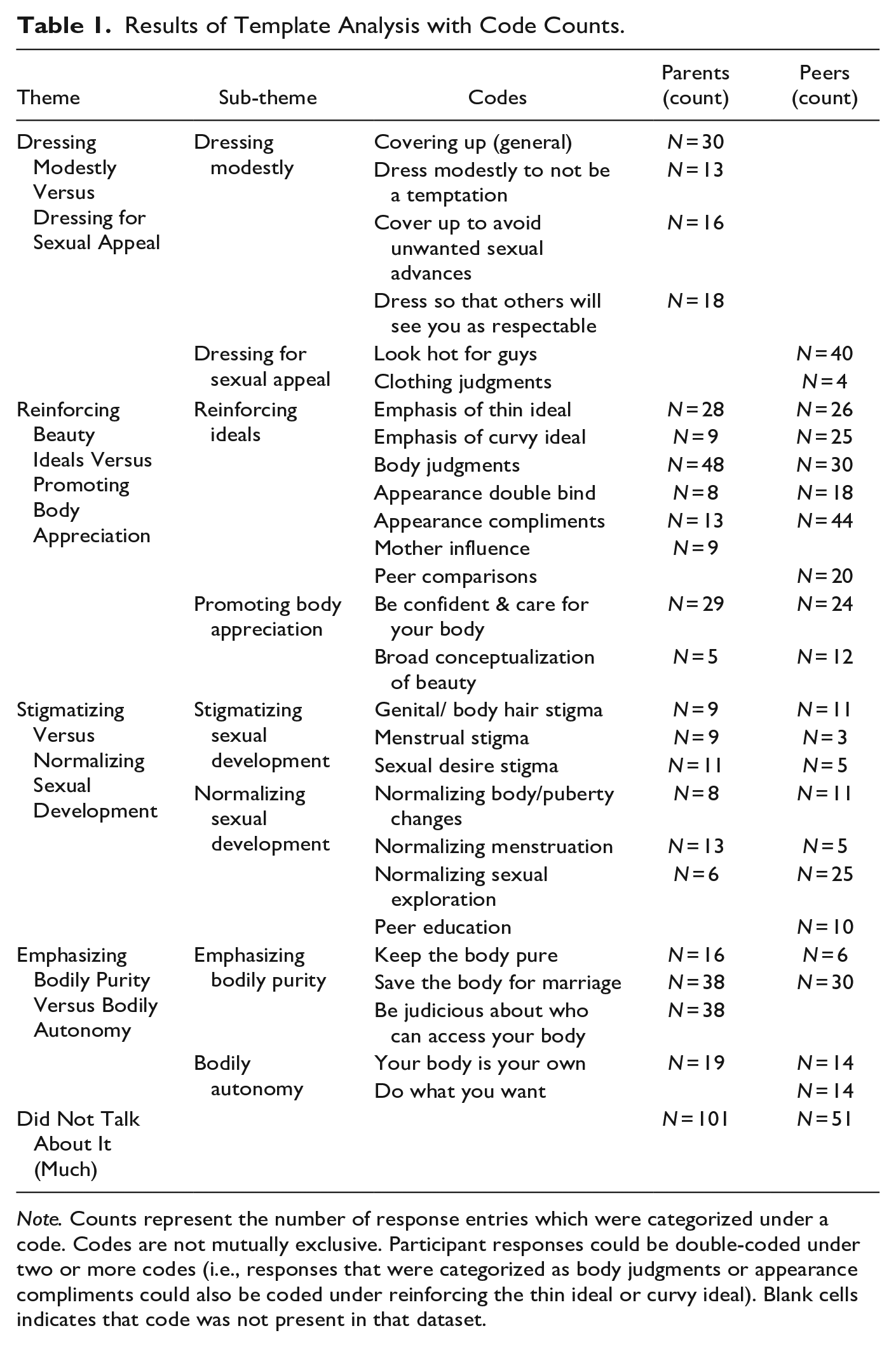
Note. Counts represent the number of response entries which were categorized under a code. Codes are not mutually exclusive. Participant responses could be double-coded under two or more codes (i.e., responses that were categorized as body judgments or appearance compliments could also be coded under reinforcing the thin ideal or curvy ideal). Blank cells indicates that code was not present in that dataset.
The first author familiarized herself with the parent messages, reading through the entire dataset, writing memos to describe the data, and creating an initial list of codes and ideas for themes. The data and initial list of codes were sent to the fourth author so that she could provide initial impressions of the data and suggestions for analytic direction. Based on the fourth author’s suggested revisions, the first author went back into the data to code the entire parent dataset.
Next, the first author went into the peer message response set to familiarize herself with the data. Based on a subset of about 30 open-text responses, she continued to revise and clarify the initial template, which included overlapping codes from the parent data as well as codes unique to the peer data. This second iteration was an integrated coding template based on both the parent and peer data. The first author then applied the integrated template to the remainder of the peer dataset. Finally, the first author went back into the parent dataset and applied the integrated template to the parent data to ensure that she conceptually applied codes in a systematic and consistent manner. The responses were collated for each relevant code to identify patterns, or divergences, in the parent and peer datasets. There were numerous codes that overlapped both parents/peers datasets, as well as codes that were distinct to each dataset. The codes were then grouped into broader themes, which conceptually described the divergence of meaning within and across the datasets (e.g., reinforcement of beauty ideals vs. body appreciation). Most open-ended responses were coded under more than one code (e.g., double-coded).
To ensure credibility and dependability of the analysis (Nowell et al., 2017), the first author documented her thoughts and experiences with the data methodological and coding decisions, descriptive summaries, and evolving versions of the coding template. We used Microsoft Excel to code and collate the data, including creating tabbed versions of the coded dataset to show iterative steps of coding. Furthermore, the fourth author reviewed the data independently and then discussed how her reflections were similar to or different from the initial coding template. The first and fourth authors worked together to refine the codes and continued this through the writing and interpretation stage to enhance confirmability.
Positionality
We recognize that our social locations as researchers shape our understanding and interpretation of the data. The research team consisted of four researchers, three of whom were based in the U.S. and one in the U.K. The first and second authors identify as White, the third as South Asian, and the fourth (senior) author as mixed (White and Hispanic). The first author approaches this topic from a place of privilege (e.g., White, middle-class, cisgender). She lives in a body that is not culturally stigmatized in a way that women of color or individuals living in larger bodies might experience. To engage in critical reflexivity, the first author wrote reflexive memos on the data from initial analysis stage to the interpretation stage, which included cognitive and emotional reactions to participants’ responses, identified the ways her axes of privilege may have influenced her understanding of the data, and raised questions and topics to discuss with the co-authors. The fourth author is a senior researcher who specializes in body image and eating disorder prevention, and she served as a topical and analytical consultant in the study by helping to inform the development of the study and direction of the analysis. The authors engaged in ongoing, reflexive conversations about the data to process the richness of participants’ accounts and to make room for multiple interpretations of the data.
Results
Participants described messages they received from parents and peers in the context of puberty and sexual development. We focused the analysis specifically on messages related to appearance and sexual objectification in adolescence and constructed five themes: dressing modestly versus dressing for sexual appeal, reinforcement of beauty ideals versus promoting body appreciation, stigmatizing versus normalizing sexual development, emphasizing bodily purity versus bodily autonomy, and parents/peers did not talk about sex. We describe the conceptual contrast of comments conveyed by parents and peers, drawing attention to the nuance of comments within and across the parent/peer datasets. We present the five themes in more detail below, summarizing how the theme was reflected in the parental comments first, followed by the peer comments. As previously stated, in Table 1, we present the themes, codes, and code frequencies to demonstrate the prevalence of messages from parents and peers as reported by participants. Additional quotes are provided in Table 2. All participant quotes are presented verbatim, including grammatical errors.
Comparison of Exemplary Quotes by Parents and Peers.
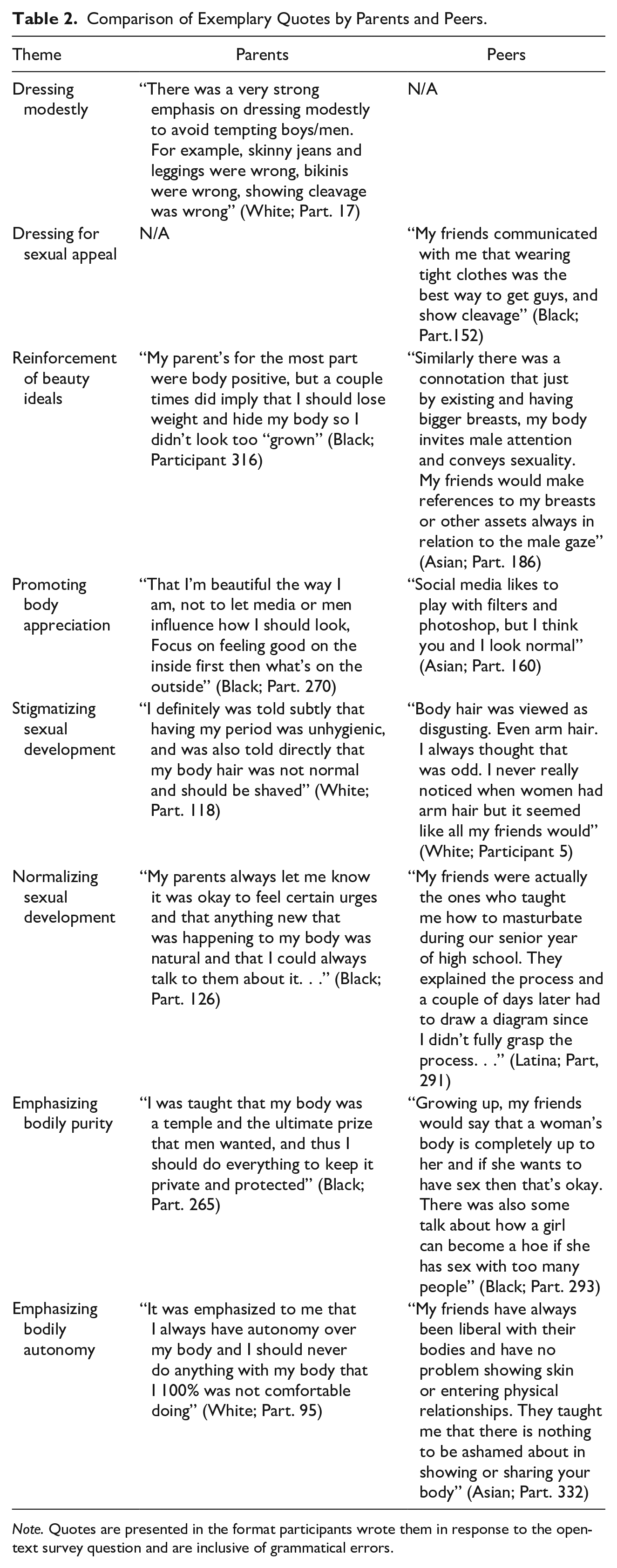
Note. Quotes are presented in the format participants wrote them in response to the open-text survey question and are inclusive of grammatical errors.
Dressing Modestly Versus Dressing for Sexual Appeal
Both parents and peers emphasized (implicitly or explicitly) that clothes send certain “signals,” not just to boys and men, but to the broader public. These types of comments reflected the notion that dressing is an action oriented to others.
Parents’ Emphasis on Dressing Modestly
Participants described comments from their parents as largely rule-based, telling daughters to cover up and dress modestly. Some parental messages stressed the need for their daughter to manage male attention. One participant recalled a time when she was with her friends at the beach having photos taken, and her parent “told me I should cover up more since there are other guys around, and that made me felt shameful of showing my body when in a public setting” (Asian; Participant 21). Whereas many parents may have simply wanted to protect their daughters from negative attention, some parental messages blamed their daughters for their clothes: “My body would attract men (because I developed early & heavily) and I would have to be conscious to cover up to avoid being preyed on, otherwise I deserved it” (Latina; Participant 108). This participant’s parent(s) communicated that it was up to her to ensure her safety. Other parental messages indicated that clothing should project feminine respectability, including dressing ladylike and feminine, or being aware that clothing can make one appear promiscuous:
My mom often told me I was “too fast” whenever I wore anything that vaguely showed my body shape. I was taught to think of my body as too sexual. I to this day feel uncomfortable if my chest is even somewhat exposed (Latina; Participant 262).
Participants reported that they were told clothing can function as a signal (e.g., an invitation for sexual behavior or objectification), or the idea that boys will be boys, and it is up to girls to protect themselves. According to many participants’ parents, how one presents oneself sends a message, whether intended or not, about what kind of attention they will receive. In response, participants recalled feelings of shame and discomfort about their bodies.
Peers’ Emphasis on Dressing to Be Sexually Appealing
Whereas parental messages warned against sexual attention, peer messages actively encouraged sexual attention, such as to show off the body. Some comments were seemingly reactionary to their parents’ rules about clothing, where peers encouraged (and sometimes pressured) each other to dress a certain way. For peers, clothes were meant to be seen and experienced by others: “My friends communicated to me that I should dress for what men like” (White; Participant 53). Another participant recalled that peers would say to “wear makeup and wear revealing clothing to get a boyfriend” (Latina; Participant 154). Not only did peers communicate that clothes should signal sexual appeal, they also communicated how clothes function as social power, including the ability to participate in a romantic/sexual relationship. While there were some responses relating to clothing judgments from peers (e.g., such as not to dress “too revealing”), there were very few. Similarly, only a couple of comments emphasized the notion of dressing for yourself (e.g., wear what makes you comfortable), but this was not common for either parents or peers. Rather, most comments regarding clothing from both parents and peers conveyed that one could (and should) use clothes to either avoid or gain attention from boys/men.
Reinforcing Beauty Ideals Versus Promoting Body Appreciation
Participants received mixed messages about their appearance from parents and peers. Reinforcing beauty ideals consisted of judgments and compliments about participants’ appearance growing up, often connected to how to attract the opposite sex. Messages that reinforced appearance ideals were common in participants’ parent and peer messages, and included the “thin ideal” (e.g., being small, petite, or skinny) and the “curvy ideal” (e.g., large breasts, large bottom, small waist). In contrast to the reinforcement of beauty ideals, some comments from parents and peers promoted body appreciation, or supported participants to respect and take care of their bodies. We first discuss how the reinforcement of beauty ideals is reflected in the parent and peer messages, and then discuss how promoting body appreciation is reflected in the parent and peer messages.
Parents’ Reinforcement of Beauty Ideals
Parental comments frequently mentioned references to appearance, most commonly referencing weight or body size and, to a lesser degree, skin color. One Asian participant recalled:
Growing up in an Asian household, my body was heavily criticized by my family. I would always hear remarks concerning my weight or my bodily appearance, even though I’ve always been at a healthy weight. I noticed more of this once I hit puberty and my body started going through changes (Asian; Participant 233).
In addition to negative body remarks, some participants recalled their parents offering them compliments, but these still reinforced the thin ideal. There were a couple of instances when parental messages emphasized White or light-skinned appearance ideals. For example, one participant said: “I have been told that I am too dark skinned to be considered attractive” (Asian; Participant 57). Some parental comments illustrated the double bind that many girls experience when negotiating multiple (and at times, competing) appearance pressures. These mixed messages illustrated how navigating varying appearance pressures is like walking a tightrope: “. . . I was always shamed for my body in some way. I was either too skinny, or too fat” (Asian; Participant 324). Parents reinforced beauty ideals through judgments, compliments, and even competing or contradictory messages; all reinforcing the White, thin ideal.
Peers’ Reinforcement of Beauty Ideals
Peers’ comments reinforcement of beauty ideals also consisted of judgments and compliments, but peers primarily focused on the developing body and achieving the curvy ideal. Some of these body judgments functioned as peer comparisons: “I got compared and criticized for my body in comparison to other girls: face, boobs, butt, stomach” (Asian; Participant 280). Appearance compliments were more common in messages from peers compared with parents, but again, these reinforced the curvy ideal: “You have a hot body show it off even if your ass is small. Small tits are in these days” (Latina; Participant 226).
Peer comments also illustrated an appearance double bind, but this was more evident in peer messages than parent messages. These comments focused on competing demands of body size: One White participant described a more general comment about competing expectations of breast size: “there were also comments about small boobs being worse than big boobs, but big boobs would also be made fun of if they were particularly big” (White; Participant 47). While these pressures are universal, Black and Brown girls experience further constraints on the basis of body size judgment and skin color or tone:
We wanted to look like black female celebrities, but we also worried about being sexualized constantly even at that age because the boys always had comments. I was naturally skinny, which is not as adored in the black community, but due to colorism I was treated better even if my body was not always the ideal (Black and Latina; Participant 123).
This participant describes how she did not meet the curvy ideal, but how her skin tone privilege served as a form of social protection when it came to how others treated her. In summary, whereas parent messages reinforced the thin ideal (e.g., emphasis on weight) and peer messages reinforced the curvy ideal (e.g., comments on body parts). Taken together, these comments illustrated the varied and competing appearance messages participants received growing up.
Parents’ Promotion of Body Appreciation
Whereas many parental comments reinforced appearance pressures, participants also reported comments that extended beyond appearance to encourage participants to love, accept, and appreciate their bodies; however, this theme was less common and nuanced in the data compared to the reinforcement of beauty ideals. This included taking a resistant stance toward media pressures related to appearance standards, and emphasizing being comfortable and respecting their own body. One participant recalled that despite some of the negative sexuality messaging she received growing up, she felt protected from cultural appearance pressures:
I was raised with a pretty wholesome relationship to my body outside of the confines of sex/dating specifically because I was homeschooled, I wasn’t exposed to a lot of media with very negative body image issues or diet culture like teen magazines, Project Runway. Instead, I grew up in a farming family and our bodies were seen as strong and useful, something to keep healthy (White; Participant 17).
This participant emphasizes learning to experience her body not as an object or project to be worked on, but to appreciate its functionality. Furthermore, participants described comments which emphasized a broad conceptualization of beauty, one that promoted beauty diversity: “You are beautiful in your ow special way” (Latina; Participant 143) and “That I’m beautiful the way I am, Not to let media or men influence how I should look, Focus on feeling good on the inside first then what’s on the outside” (Black; Participant 270). These participants described learning how to experience their bodies from the inside out, believing their bodies were good and capable, beyond their appearance.
Peers’ Promotion of Body Appreciation
Some peer comments also promoted body appreciation and, to a greater extent than parental comments, a broader conceptualization of beauty. Another participant recalled that peer comments were “always positive, and always messages about loving myself first, and not loving or fixing my body because of a romantic partner” (Asian; Participant 282). In contrast to the other peer messages that emphasized appearance to be sexually appealing to boys, participants also recalled messaging that supported her in appreciating the inherent value of her body regardless of boys’ appraisal of it. Similarly, in addition to combating media pressures, participants described beauty in more general terms. One participant recalled her friends talking about how “beauty comes in all shapes and sizes” (Black; Participant 306). Participants described the ways their friends helped to promote a more inclusive understanding of beauty (“Expressing yourself is GREAT, and there is no such thing as an ugly body”). Therefore, in addition to respect and care, comments that emphasized a diverse understanding of beauty were more common in peer comments than parental comments.
Stigmatizing Versus Normalizing Sexual Development
In addition to the clothing and beauty expectations, participants also recalled messages that either stigmatized or normalized sexual development from parents and peers. These comments centered around menstruation, genitalia, body hair, and sexuality. We first discuss how stigmatizing messages were reflected in the parent and peer comments, followed by how normalizing messages are reflected in the parent and peer comments.
Parents’ Stigmatizing Messages
Many participants also recalled that their parents communicated stigmatizing messages, including about genitalia, body hair, menstruation, or sexual desire. Many of these comments related to body hair, shaving, and concealing menstruation: “I’m not supposed to have body hair, talk about my period, and got insecure for having small boobs.” Comments like these related to presenting oneself in a feminine manner, and that body hair was unfeminine. Some messages discouraged sexual exploration: “It’s wrong to masturbate. My body should be for only a man not a woman” (Black; Participant 286). Many participants were discouraged from exploring their own sexual desire or attraction, and these comments were commonly related to saving sex for marriage, or being sure to keep the body pure or clean (see Emphasizing Bodily Purity vs. Bodily Autonomy).
One participant recalled a formative story where her mother made her feel ashamed of her genitalia:
I personally have a large inner labia and when I was going through puberty my mother noticed this and thought something was wrong with me. She also brought in my grandmother to look at me when I was sitting on the toilet. I was taken to a gynecologist only to be told that my body was perfectly normal, and that all vulva look different. I might have a small amount of trauma from this situation (White; Participant 47).
These participants described how they were made to feel ashamed of their natural bodies or sexual desire; as if they were inherently wrong and in need of treatment or management.
Peers’ Stigmatizing Messages
From their peers, stigmatizing comments largely centered around hair and grooming, with only a couple of comments about stigmatizing menstruation (of which mainly came from male peers, as indicated by participants). A Latina participant wrote that she was told “that body hair is weird to have and as a female I should not have too much of it because only men have a lot of body hair” (Participant 148). This participant described the gendered expectations of grooming, and the pressure she felt from her friends to follow those “rules.” Participants reported their peers’ emphasis on shaving to ensure attractiveness to the opposite sex, with some indicating that having body hair was not a feminine quality.
While there were fewer instances of stigmatizing sexual desire in peer comments compared to parental comments, a few participants noted that they were told by peers that girls have to avoid being seen as promiscuous: “Someone is a slut if they sleep with men easily and don’t wait, or if they have a lot of sexual partners” (Participant 167). For these participants, they were warned by their peers about how to ensure that the keep a safe sexual reputation, one that implied that a certain level of sexual activity or sexual exploration is socially sanctioned.
Parents’ Normalizing Messages
Despite these stigmatizing messages, some comments normalized pubertal changes, including menstruation and sexual desire. Participants reported fewer normalizing messages from parents when compared to peers, but these messages promoted normalizing menstruation and body changes associated with puberty. For these messages, participants recalled having specific aspects of puberty or sexuality being explained to them:
. . .If I’m not feeling well or have cramps, I was supported and allowed to take the day off to recover and care for myself. I wasn’t punished or ignored. I was always encouraged to respect myself and to carry myself with confidence and care. Everything I experienced relating to puberty was always explained to me and reassured that everything I feel is normal (Asian; Participant 122).
As a result of learning about how menstruation would affect her body and mood, this participant was encouraged to listen to her own body and to attend to her own needs. One participant shared that her parents supported her in resisting oppressive narratives about Black women’s sexuality:
. . .I remember having really deep conversations from 5 yo on about sex and how it works for women especially black womens who have been over sexualized or even about how my body being bigger would need more love (double-coded with bodily autonomy; Black; Participant 205).
For this participant, her parents helped to explain sex in a way that helped her to resist sexualized stereotypes that exist for Black women, and also showed her that people living in larger bodies are deserving of love and respect. In this way, normalization functioned as a form of resistance.
Peers’ Normalizing Messages
Whereas participants described their parents’ messages as normalizing menstruation and body changes, peer comments largely normalized the changing body in addition to sexual desire/sexual exploration. Many of these messages functioned as peer education. For example, one participant indicated they first learned what an orgasm was from a friend. Other comments illustrated how peers shared information and experiences with one another:
My friends were always interested in each others bodies especially as we hit puberty and certain areas started to grow. We always wanted to know the details of what happened and when regarding breast growth, menstruation, and if we did anything remotely sexual to ourselves or others. (Black; Participant 126)
Peer comments that normalized puberty and sexuality were supportive, helping to dispel myths about sexuality and sexual expression. Taken together, there was a combination of comments from parents and peers about body changes and sexual development, ranging from stigmatizing to normalizing messages.
Emphasizing Bodily Purity Versus Bodily Autonomy
Participants also reported messages that emphasized bodily purity and sexual self-control, which largely came from parents. These messages included religious references, such as parents telling their daughters that “the body is a temple” or references to purity often followed by an admonishment about saving sex for marriage or dressing modestly. Alternatively, participants reported messages that supported bodily autonomy, which were present in both parent and peer comments, but more so in the latter.
Parents’ Emphasis on Bodily Purity
Abstinence messages, specifically those that emphasized saving sex for marriage or dressing or behaving in ways that exhibit restraint, were common in parental comments. When specifically referencing the body, participants recalled messages laden with religious language. Several participants were told by parents that their “body is a temple,” with an emphasis on saving your body and sex for marriage. Parents emphasized that to respect the body is to be judicious about who has access to it. Some comments had much more explicit language about possession, purity, and becoming tainted. Another Latina participant said,
God wants you to be a virgin until marriage. Save yourself for one person. Giving in to sexual desires is a sin and unacceptable. It will make you dirty or unclean/unworthy of love. Men don’t want women who are easy or are sluts. If you tease a man it’s your fault whatever happens next (Participant 209).
This participant was told that sexual activity before marriage makes one’s body dirty or unclean, indicating that one’s sexual behavior, or even the presence of sexual desire, can make one’s body tainted. Not all comments used this strong language, but still emphasized saving sex before marriage, with the implication that the body can become impure. In tandem with these messages of purity, participants recalled messages about being judicious about who has access to her body, even if it was not as explicit as saving sex for marriage. Whereas some of these comments related to being protective or careful regarding who she chose to have sex with (e.g., “be protected and safe;” “only have sex if I trust them”), other comments were more judgmental:
My mother gave me a sex talk and explained . . . that sex is something precious that shouldn’t just be given out. She often told me that I needed to not be sexual with men too early or they wouldn’t want to date me because “why buy the cow when you can drink the milk for free” or something like that (Mixed; Participant 208).
This quote represents how parents might reinforce the gendered sexual double standard, where girls and women may be harshly judged for their sexuality, which would then impact their desirability or dating prospects. Furthermore, the language of “buying the cow” reinforces objectifying scripts about girls’ bodies.
Parents’ Encouragement of Bodily Autonomy
Despite many messages of telling participants to wait until marriage to have sex because the body is a temple, other parental comments encouraged bodily autonomy, explaining the importance of using one’s own voice to advocate for how others view or treat her body:
I received empowering messages. I learned early on how to respect myself and therefore showing others how to respect me. No always means no, and you are to know your limits so you can always be aware of your surroundings. You have to look out for yourself (White; Participant 59).
This participant was taught about sexual consent and the power of using her words to tell others what she does and does not want.
In summary, parental comments advising bodily purity emphasized the need to be in control of one’s sexuality (less the body becomes impure), whereas comments supporting bodily autonomy emphasized getting to be in control of one’s sexuality (because her body is her own).
Peers’ Encouragement of Sexual Self-Control (But Not Necessarily Purity)
While parental messages emphasized the religious or moral grounds for saving sex until marriage, peer messages encouraged participants to be judicious about who they shared their bodies with, including being told not to let anyone take advantage of you. There were some comments from peers that encouraged participants to exhibit at least some restraint, again, hinting at the gendered sexual double standard. One participant said:
I had mixed messages. Some friends conveyed that my body is my own and I ought to do as I please with it as long as it is consensual. Others conveyed that it was fine for boys to have multiple sexual partners, but if I, as a girl, do the same I would be considered “tainted” and promiscuous. Basically, my value as a person would go down (Participant 235; Black).
There is evidence of language about not becoming tainted. Whereas parents’ concerns about purity centered around sexual abstinence altogether, peers’ concerns centered around not being too sexual or promiscuous.
Peers’ Emphasis on Bodily Autonomy
Despite messages encouraging sexual self-control, participants also recalled comments from peers which encouraged projecting a confident and empowered sexuality, one which she could negotiate on her own terms:
My friends communicated that your body is your choice, to never say yes to anything you’re uncertain about, that you have control over who touches your body, and never to be afraid to reject anyone. You should never change your body for anyone. . . (Asian; Participant 206).
Furthermore, a few participants described their sexuality in terms of social currency. Another participant recalled messaging about how “sexual prowess is power” and another said that “women are powerful and all have complete control over our bodies.” These comments illustrate the idea that sexuality can be a form of currency and underscore the neoliberal discourse that it is possible to be in total control of one’s body.
Did Not Talk About It
Finally, participants also indicated that parents and peers either talked very little or not at all about sex, sexuality, or their body, though avoidance of the topic was more common in parental comments. Not all participants indicated why parents/peers chose not to discuss it, but a commonly cited reason included parents being uncomfortable with the topic, and some peer comments indicated there were other things to worry/talk about than those topics. One participant recalled that her parents assumed she was not interested in sex and therefore did not bring up the topic:
It was more so ignoring the topics (besides the basic “how babies are made” talk) due to the assumption that I wouldn’t/ wasn’t interested in having sex (which wasn’t incorrect.) However the moments sex was brought it, it was usually at the expense of my integrity (making a “joke” about me being pregnant because of the food I wanted to eat etc.) (Participant 92; Black).
This quote also illustrates how her parents deflected an uncomfortable topic by teasing their daughter. Some participants recalled that they did not talk much about sex or each others’ bodies growing up because they were less active in the dating scene. A few participants described talking about other things that were more important at the time, like school, games, and celebrities otherwise other interests and hobbies of teenagers.
Discussion
The present study identified and compared messages that parents and peers conveyed about girls’ bodies in the context of puberty and sexual development. Given that adolescence is a formative stage for the development of body attitudes, understanding how girls are socialized to think and feel about their bodies is important. Taken together, participants received mixed messages about their bodies and sexuality from parents and peers. We interpret the results of the study in the context of the developmental theory of embodiment, paying specific attention to how these themes maintain or challenge discourses about the body (Piran, 2017).
Regarding the parental messages, there was a heavy emphasis on covering up the body to prevent sexual attention and unwanted advances, as well as to protect her feminine reputation. This is congruent with previous qualitative work investigating how Black girls interpret sexual messages (Leath et al., 2020). Leath et al. (2020) found that “covering up” was a common message and illustrates how Black girls especially must navigate an oppressive standard of respectability and reputation. While the intention behind these parental messages may have been to prevent their daughters from being sexually objectified, communicating that it is necessary to cover up so as not to be a temptation reinforces the “body as object” discourse (Piran, 2017). Indeed, such messages can sexualize young girls, making them feel ashamed and exposed in their bodies, as indicated by a few participants in this study. Body shame is often conceptualized as the shame that can result from feeling like one does not “measure up” to beauty standards (e.g., McKinley & Hyde, 1996; Siegel, Huellemann et al., 2021). The shame referenced by some participants in this study illustrated the internalization of a view of their body as a temptation or sexual distraction, a conceptualization of body shame that should be investigated further.
Many of the modesty messages were connected to religious themes that emphasized saving sex for marriage and sexual purity (e.g., “the body is a temple,” or “the body is sacred”). These religious themes are characteristic of a patriarchal interpretation of sexual purity. Purity culture is a religious and cultural movement born out of Christian evangelicalism that emphasizes the value of virginity (especially for women), remaining sexually pure, and limiting holistic sexual education (e.g., Owens, 2021). Whereas the purity movement was popularized and commercialized via evangelical culture, patriarchal interpretations of sexual ethics are evident in other religions as well, including Hinduism, Islam, and Buddhism. Encouraging one to treat the body as a temple can promote care and respect for the body, in line with positive body image (Tylka & Wood-Barcalow, 2015). However, when abstinence messages reinforce the idea that the body can become corrupted or dirty, and that purity is under the control of women, women’s sexual and relational well-being suffers (Gregoire et al., 2021). Previous work has highlighted how purity messaging can uniquely impact young women of color, given that this a construct of white supremacy (see Natarajan et al., 2022; Owens, 2021). Therefore, purity messages also reinforce the racialized reality that Black women must contend with the Jezebel stereotype of being seen as inherently sexually promiscuous, further emphasizing the “body as object” discourse (French, 2013; Piran, 2017). Importantly, these are messages that might further constrain girls’ ability to connect to their sexual desire (e.g., “desired by desireless” discourse), engage in healthy and consensual sexual activity, and to experience sexual pleasure (Piran, 2017).
Despite peers’ comments being more permissive of clothes and styling, they still emphasized that dressing is an action oriented toward others and is intended to modify sexual attention. Indeed, many of the appearance compliments offered by peers were in reference to being sexually appealing to boys. Indeed, previous research has found that endorsing an “objectified dating script,” or the belief that one must look “hot” to attract a male romantic partner, was associated with higher self-objectification than those who did not endorse the script (Rousseau & Eggermont, 2018). Ascribing social value and personal worth to romantic or sexual relationships is a feminine expectation that intensifies in later adolescence and further reinforces beauty standards, in line with the “body as deficient” or “body as project” discourses (Piran, 2017).
Nonetheless, peer comments also emphasized owning one’s own sexual appeal. Bay-Cheng (2015) suggests that culturally, society has shifted from a purely moralizing discourse (e.g., virgin/whore and slut/prude dichotomy), which was somewhat present in the parental messages, to a neoliberal discourse, which expects women to “project an empowered sexuality” (Tolman & Chmielewski, 2018, p. 203), as was evident in the peer messages. However, Bay-Cheng (2015) suggests that the social expectation that girls and women always be in control of their sexuality presents another measure by which to judge women’s sexuality. Placing the onus on girls to be fully in charge of their sexuality ignores the systemic realities which constrain their sexual agency in the first place (Bay-Cheng, 2015; Fahs & McClelland, 2016). Promoting positive embodiment in girls must consist of promoting bodily autonomy and improving the social conditions which currently prevent women and girls from being able to own their sexuality in the first place (Bay-Cheng, 2015).
Regarding messages relating to appearance ideals and pressures, participants received numerous, and often competing messages, reinforcing the “body as a project” discourse. Parental comments largely reinforced the thin ideal, while peers emphasized the curvy ideal, in addition to communicating mixed messages, like the importance having larger breasts, as long as they are not too big. Despite messages about dressing modestly from parents, many of the comments about weight, shape, or skin color related to the parents’ intention that their daughters be attractive to the opposite sex, again underscoring the “body as object” discourse.
Extant evidence suggests that the thin ideal is primarily adopted by White women, who are more likely to be dissatisfied with their bodies than Black women (e.g., Burke et al., 2021). However, recent scholarship indicates that this gap may be shrinking, with dissatisfaction relating to non-weight-related features (e.g., skin tone, hair texture) increasingly common in Black women (see Watson et al., 2019 for review). Indeed, a few participants of color in the present study, including Asian women, indicated that they were told their skin tone was too dark, underscoring the racialized context of beauty ideals, where White/light skin is considered societally more attractive, which corroborates previous research suggesting that parents and peers can reinforce White, thin ideals in Asian women (Brady et al., 2017). Therefore, objectified dating scripts also consisted of skin tone expectations. In addition to experiencing oppressive stereotypes about their body and appearance, women of color must also navigate Western beauty ideals, including White/light skin.
The present findings also demonstrated how participants received stigmatizing messages from both parents and peers during adolescence, which reinforced the “body as object” discourse. These messages included judgments about the size of the labia, to shave body hair, and to conceal menstruation. Although some participants recalled receiving normalizing messages about body changes from their parents, these were more commonly received from peers. Feeling shameful about menstruation has been linked to body shame, self-objectification, and lower sexual assertiveness in young adult women (Johnston-Robledo et al., 2007; Schooler et al., 2005). Similarly, experiencing shame related to menstruation and one’s genitalia has been linked to self-objectification, which in turn was associated with less comfort in communicating with a sexual partner about their sexual needs and desires (Holland et al., 2021). How one feels about the appearance and function of their genitals is an important and often overlooked component of body image (see Sharp & Fernando, 2023). Therefore, being exposed to stigmatizing messages about the female body and sexuality may have important implications for girls’ body image and sexual well-being.
Nonetheless, comments from parents and peers also consisted of helping participants to appreciate, care for and respect their bodies, as well as supporting them to normalize sexual body changes. These comments help to push back against the “body as an object” and “body as deficient” discourses (Piran, 2017). Indeed, positive body image has important implications for sexual health and well-being. Body appreciation has been associated with higher sexual satisfaction, sexual functioning, sexual desire, and increased comfort communicating about sex with a partner (Grower & Ward, 2018; Ramseyer Winter et al., 2018; Satinsky et al., 2012). However, previous work has suggested that parents, and fathers in particular, may feel unsure or lack confidence regarding how to talk to their daughters about their bodies (Siegel, Ramseyer Winter, & Cook, 2021). Furthermore, whereas “fat talk” can reinforce appearance ideals, conversations about the body can also function to resist cultural appearance pressures. This study adds to the body of literature by demonstrating how comments can help to normalize puberty changes and sexual desire. Furthermore, peer support related to puberty and sexual development is an important consideration for promoting body appreciation among adolescents.
Strengths, Limitations, and Implications
This study builds on previous work on sexual socialization and body image influences in adolescences (e.g., Leath et al., 2020) by comparing the parent and peer messages about the body in the context of puberty and sexual development. First, we chose to collect data using two open-ended questions in a large online survey format so that we could capture a breadth of descriptive themes and to facilitate a more comprehensive understanding of the mixed messages young women receive about their bodies; we were able to capture a diverse range of messages and patterns across the dataset. Previous studies examining sexual socialization messages have used brief retrospective methodologies in young adult samples (e.g., Epstein & Ward, 2008). While there may be challenges related to memory recall, we anticipated that participants would be able to respond by filtering these messages through the lens of adulthood, likely recalling “stand out” messages from growing up. By using this methodology, however, we recognize that we sacrificed depth for breadth, whereby we were not able to examine context, ask for clarity, or assess to what extent participants subscribe to beliefs inherent in such messages. Lastly, this sample consisted of only cis-gender women. Future research should investigate sexual messaging of trans and non-binary individuals, particularly given that this population is disproportionately objectified and discriminated against.
This study builds upon the developmental theory of embodiment (Piran, 2017) by identifying the range of messages girls receive about their sexual body and how those messages either reinforce or resist objectifying discourses. Girls are confronted with binding discourses about their body and sexual behavior in childhood and adolescence, and resisting such scripts can support more positive embodiment. Second, we suggest that messages which reinforce certain purity-related behaviors (e.g., sexual abstinence, dressing modestly) can reinforce objectification, reducing girls to a sexualized object, constraining their sexual agency, and promoting a disconnection from sexual desire (see also Leath et al., 2020). Therefore, purity discourses about the body and sexuality should be further investigated in relation to objectification theory (Fredrickson & Roberts, 1997). This study adds to the literature on the tripartite influence model (Thompson et al., 1999) by examining the qualitative content of messages from parents and peers while growing up. Therefore, in addition to the impact of appearance pressures from parents, peers on girls’ body attitudes, understanding what messages are conveyed helps us to further interrogate how appearance pressures are proliferated in adolescence (e.g., Western beauty ideals). Finally, we build on the growing literature base of positive body image (e.g., Tylka & Wood-Barcalow, 2015) by identifying how parents and peers can promote positive body image and embodiment in the context of puberty and sexual development, including normalizing sexual development, encouraging bodily autonomy, and promoting an appreciation and respect for the developing body.
In terms of practical implications, parent/child interventions and puberty education programs might consider content about objectification and body image (Ramseyer Winter et al., 2019). This could include a discussion of how emotions or body changes are felt in the body (not just how the appear), celebrating the diversity of bodies, encouraging a broad conceptualization of beauty, and promoting body functionality appreciation (e.g., Alleva & Tylka, 2021; see also Blazek et al., 2024). Promoting bodily autonomy in puberty and sex education is essential, and messaging should be careful to not conflate purity with virginity (Gregoire et al., 2021) as this may lead to body shame and bodily disconnection. Normalizing genitalia development, including helping girls to develop positive attitudes about their vulva, is an important component of body image development (Sharp & Fernando, 2023). Girls can be encouraged to dress in a way that emphasizes comfort, creative self-expression, and functionality (as opposed to being told to hide the body or dress to be sexually appealing).
Conclusion
Parents and peers play a prominent role in girls’ experiences and attitudes about their body. Taken together, the findings of this study demonstrate the nuance of messages girls receive about their sexual body, which can either maintain or challenge objectified discourses about the body. Given that girls, on average, are starting puberty earlier than previous cohorts, understanding how girls are socialized to understand and care for their developing bodies is important so that they can live embodied lives, with a positive body image and attuned sexuality.
Footnotes
Acknowledgements
We have no acknowledgments.
Declaration of Conflicting Interests
The author(s) declared no potential conflicts of interest with respect to the research, authorship, and/or publication of this article.
Funding
The author(s) disclosed receipt of the following financial support for the research, authorship, and/or publication of this article: The authors received funding support from a fellowship through the Steve Hicks School of Social Work and a professorship endowment held by Dr. Catherine Cubbin.
