







Abstract
Ethnic-racial inequalities persist in learning opportunities related to science, technology, engineering, and mathematics (STEM) and contribute to the underrepresentation of racial minorities in STEM-related careers. Previous research has explored different ecological contexts in relation to youth development; however, perspectives from minoritized youth about STEM programming are an underexplored element in relation to STEM equity. Utilizing the Phenomenological Variant Ecological Systems Theory as our framework, this study examines how minoritized youth perceive barriers and facilitators to accessing STEM programs across different ecological contexts. Data for this qualitative community-based, youth-led research study consisted of six focus groups. Participants (N = 55) ranged in age from 13 to 24 years old. Findings highlight the often-overlooked exosystem as a critical influence on adolescents’ perceptions of STEM opportunities and academic success. Furthermore, minoritized youth are perceiving disproportional rates of negative barriers compared to facilitators in accessing STEM programming. Directions for future research and policy is discussed.
Keywords
Introduction
Ethnic-racial inequalities persist in learning opportunities related to science, technology, engineering, and math (STEM) and contribute to the underrepresentation of racial/ethnic minorities in STEM careers (Bottia et al., 2018; Oh et al., 2022; Oh & Leventhal, 2023; Park-Taylor et al., 2022). To illustrate, Black and Latine professionals are vastly underrepresented in STEM, comprising only 8% and 14.8% of the workforce, respectively, despite representing 11% and 18.2% of the overall U.S. workforce (National Science Board, National Science Foundation, 2024). Such low numbers are also consistent when looking at STEM college graduates. These disparities reflect early emerging structural barriers, such as high costs, educator bias, and discriminatory policies, that limit access to STEM opportunities and contribute to inequitable representation, reducing the field’s capacity to serve diverse communities. As demand grows for students equipped with the knowledge and skills needed for STEM careers, scholars and policymakers increasingly advocate for strengthening STEM education and diversifying the STEM field to be globally competitive (Oh et al., 2022; Park-Taylor et al., 2022). Yet, at the secondary and college level, ethnic-racial minoritized students lose interest in STEM subjects and eventually turn away from STEM careers at a higher rate than their white 1 counterparts (Oh et al., 2022). Research shows that expanding culturally relevant, high-quality STEM opportunities during adolescence can awaken and/or reinforce an early interest in STEM and effectively broaden participation in higher education and professional fields (Bottia et al., 2018; Dabney et al., 2012; Mohr-Schroeder et al., 2014; Schmidt et al., 2020).
This study centers on the perspectives of minoritized adolescents from low-income, non-white backgrounds, a population often excluded from STEM pathways. Understanding their perceptions is a critical step in unpacking how they view STEM opportunities (e.g., accessing STEM education, STEM programming, STEM career exposure) and what deters them from pursuing a career in STEM (e.g., microaggressions from teachers, limited school funding). While perceptions represent just one way of measuring how youth access STEM opportunities, they are inseparable from structural variables and highlight how structural inequalities can both shape and dissuade STEM motivation. Capturing patterns in youth’s perceptions of STEM opportunities can illuminate key trends in their experience (i.e., perceived facilitators and barriers to pursuing STEM) and can inform policy related to STEM programming for minoritized populations. To address this aim, we conducted a community-based participatory research study in collaboration with the Alliance for Educational Solutions (AES), a non-profit organization based in Sacramento, California. The aim of this study is to identify and understand minoritized youths’ perspectives across different ecological contexts. Specifically, we examine the barriers that limit access to STEM skill development and the supports that enable students to pursue their career aspirations.
In the following sections, we highlight our guiding conceptual framework, the Phenomenological Variant Ecological Systems Theory (PVEST). Particularly, we note how this framework might help us understand the balance of barriers and facilitators minoritized youth experience in achieving their STEM aspirations. Next, we present qualitative data from six focus groups that were conducted by paid youth organizers. Lastly, implications are discussed to inform the development of STEM programming and policy to better serve minoritized youth.
Phenomenological Variant Ecological Systems Theory (PVEST)
Conceptualized by Dr. Margaret Beale Spencer et al. (1997), PVEST expands Bronfenbrenner’s (1977, 1979) Ecological Systems Theory. Bronfenbrenner’s model outlines four systems—microsystem, mesosystem, exosystem, and macrosystem—situated around the individual and across a period of time (chronosystem; Bronfenbrenner, 1979). PVEST further accounts for net vulnerability level, stress engagement, reactive coping methods, emergent identities, and life stage outcomes, and how these processes interact dynamically with their ecological context (Spencer, 2008). Spencer (2008) emphasizes that perceptions of one’s environment provide an important understanding of long-term identity development and behavioral responses over time. As Spencer (1982) highlights, the ratio of risk (structural challenges and oppressive forces) and supports (such as family, peers, and culture) is central to understanding youth development. Importantly, PVEST situates these processes within structural inequality, highlighting how positive and negative experiences across multiple ecological levels shape youths’ emerging identities (see Figure 1). Psychologists emphasize re-envisioning Ecological System Theory by centering history and culture, enabling a more nuanced understanding of how individual factors are embedded within structural systems (Causadias, 2013; Fish & Syed, 2018). In this framing, racism and poverty are not merely contexts in which adolescents live but constitute forces in adolescent development. Rogers et al. (2021) capture this with the term “m(ai)cro,” underscoring how systems of power permeate all aspects of development and shape youths’ identities and trajectories over time.
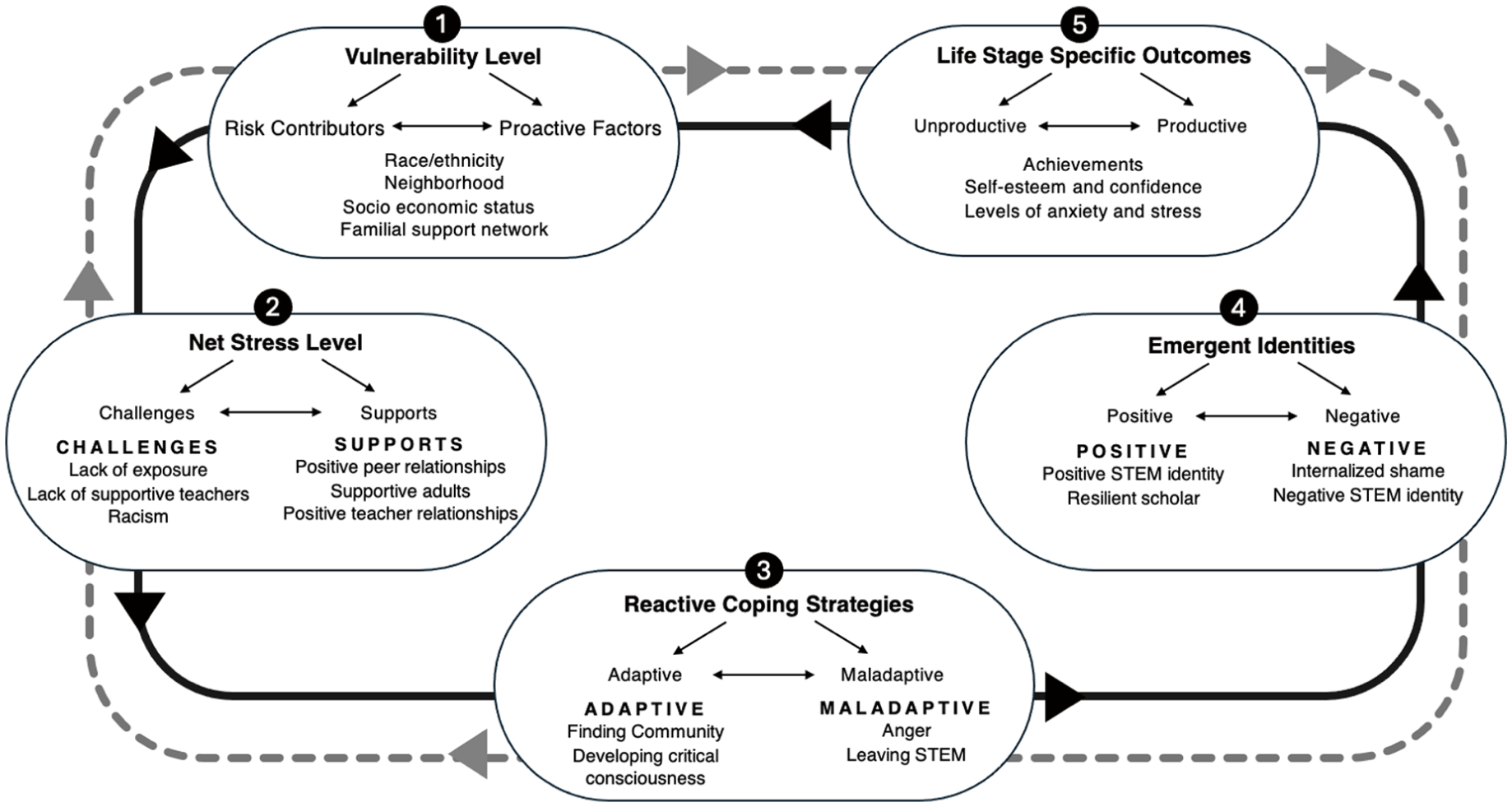
Modified PVEST diagram.
PVEST has been applied in STEM education research to examine how structural barriers and cultural assets influence minoritized youths’ engagement and persistence in STEM fields (see McGee & Spencer, 2013; Morton & Parsons, 2018; Scherer et al., 2017). For example, Morton and Parsons (2018) examined net vulnerability, a component of PVEST, among Black undergraduate women, focusing on how race and gender shaped their STEM identity development and engagement. Applying this framework to minoritized youth in STEM reveals how structural inequities—such as limited funding and suppressed opportunities—shape perceptions of barriers and supports, as well as experiences, coping strategies, and emergent identities. Contributing to this important body of research, this youth-led, community-based study centers youth voices to inform STEM programming that addresses both structural realities and developmental needs.
Due to space constraints, we focus our exploration of literature on pertinent environments that adolescents encounter (e.g., individual characteristics, proximal microsystems, influences from the exosystem, interactions with the macrosystem). Microsystems are immediate settings in which a youth has direct experiences with and interpersonal social interactions with others. An example of this would be a youth given support and guidance from their parents about their career goals in life. Exosystems entail social structures (e.g., government policies, community resources) that do not directly interact with youth but still influence them. For instance, youth might discuss how public transportation, a community resource, is unreliable, therefore becoming a barrier to accessing STEM developmental opportunities. Macrosystems encompass broad cultural influences and ideologies that have long-ranging consequences for children. For example, youth might find it difficult to enter their career field of choice due to it being a white, male-dominated industry.
Literature Review
In this section, we highlight various factors within the literature including individual psychological tools (e.g., sense of self), microsystemic factors (e.g., interactions with family, teachers, and peers), exosystemic factors (e.g., public transportation, limited funding in minoritized schools), and macrosystemic factors (e.g., stereotype threat, discrimination), which may impact youths’ perceptions of the quantity and quality of the STEM programming they receive and their ability to achieve their career aspirations. Furthermore, we elaborate on how PVEST may provide mechanisms in which to further unpack patterns in youth perspectives of barriers and facilitators in accessing STEM programming.
Individual
Research has identified a range of individual-level psychological tools and strategies that youth draw on to support engagement and success in STEM, including motivational strategies, self-efficacy, sense of self, and perceived competency (Davis et al., 2019; Park-Taylor et al., 2022; Schmidt et al., 2020). As understood by PVEST, these traits are not static individual characteristics but dynamic strategies that youth deploy to navigate their developmental contexts (Spencer et al., 1997). Situated Expectancy Value Theory (SEVT) by Eccles and Wigfield (2020) further underscores how youths’ motivation, choices, and academic success are predicted by their academic self-concept and perceived task value. Thus, an individual’s engagement and achievement in STEM areas are heavily influenced by self-evaluations of their abilities as well as the perceived value of engaging in such subjects. For instance, a study by Davis et al. (2019) examined STEM persistence among Black students at historically Black colleges. Multiple linear regression findings underscored the importance of self-expectancy in predicting final grades (Davis et al., 2019).
Furthermore, research has also indicated that when Black youth are provided opportunities for STEM-rich making in maker-spaces (i.e., counterspace/community program)—projects and experiences that integrate science and engineering with cultural, familial, and personal knowledge—they express feelings of efficacy, confidence, psychological empowerment, and joy (Calabrese Barton & Tan, 2018; Worsley & Roby, 2021). The success of these counterspaces highlights the transactional nature of PVEST: youths’ strategies and perceptions of competency are shaped by the microsystems that surround them. Although the overall percentage of minoritized students earning STEM degrees is notably small, over one quarter of African American students with a bachelor’s degree in STEM are HBCU alumni (Fiegener & Proudfoot, 2013). Thus, illustrating how supportive institutional contexts interact with individual strategies to influence outcomes.
An additional individualized factor that can affect minoritized youths’ engagement and success in STEM is perceived competency (i.e., how well they think they will perform). Often for minoritized youth, gaps in perceived competencies (i.e., such as how they view their own ability in math and science and their expectations for school performance in these subjects) are shaped by structural inequalities, including inequal access to resources, bias in school practices, and systematic underrepresentation in STEM (Collins et al., 2020; Edwards & King, 2023; Schmidt et al., 2020). Research has shown that Black and Latine youth who partake in STEM programming and who believe they are highly competent in STEM areas may have the confidence to engage more fully in STEM activities, embrace the challenges inherent in STEM-focused activities, and employ a wider range of learning strategies (Schmidt et al., 2020).
Early exposure to STEM education can strengthen these psychological strategies, increasing youths’ STEM self-concept, motivation, and perceived competency (Bottia et al., 2018; Oh et al., 2022). However, underrepresented minoritized youth often face limited access to STEM programming, constraining opportunities to develop these strategies (Mathews et al., 2025; Oh et al., 2022). Scholars have stressed the importance of counterspaces that recognize and embrace cultural knowledge in informing science and engineering products (Ashford et al., 2017; Lane, 2016; Moses et al., 2025; Ong et al., 2018). For example, King and Pringle (2019) looked at counterstories from Black girls who participated in a community-based STEM program. Findings revealed that the program sparked interest in STEM learning. Furthermore, the environment embraced their identity and culture in relation to scientific and engineering meaning-making, thereby facilitating their engagement and perceived identity within STEM (King & Pringle, 2019).
Much of the existing STEM research focuses solely on individual traits. A PVEST framing, however, emphasizes that these traits are psychological strategies continuously shaped by, and responsive to, the social and structural contexts in which youth are embedded. Individual tools such as motivation, perceived competency, and self-efficacy are thus best understood in relation to microsystem supports, counterspaces, and broader ecological influences (Davis et al., 2019; King & Pringle, 2019; Schmidt et al., 2020).
Microsystems
Research indicates that direct interactions and experiences in youths’ immediate settings (e.g., family, educators, peers, or mentors) significantly influence engagement and success in STEM (Belgrave et al., 2022; Martin & Collie, 2016; Sánchez et al., 2022; Song et al., 2015; Starr et al., 2022). These interactions shape youths’ net vulnerability levels and influence their stress engagement—how they experience and respond to challenges within these contexts. For example, support from family positively affects academic motivation, school engagement, and career ambitions, not necessarily through direct academic help, but through emotional and psychological support for youths’ education and career trajectories (Carey, 2022; Park-Taylor et al., 2022; Song et al., 2015; Starr et al., 2022). Perceived emotional support—the belief that family members respect youth as individuals and attend to their well-being—can facilitate reactive coping methods, including seeking help, persistence, and adaptive goal setting (Song et al., 2015). This support includes monitoring schoolwork, facilitating experiential learning, instilling education values, and providing strength through culturally grounded practices (Park-Taylor et al., 2022; Starr et al., 2022). Such supports foster autonomy, skill development, and reduced academic anxiety, and have been linked to positive academic outcomes, especially among low-income students (Leung et al., 2010; Park-Taylor et al., 2022; Roksa & Kinsley, 2019; Song et al, 2015). Caregivers are also recognized as agentic actors in shaping children’s socialization and STEM identities (Cian et al, 2022; Dou et al., 2025; Gergely & Watson, 1999). Socialization can take many forms, but Dou et al. (2019) found that frequent childhood conversations with caregivers about science were more strongly associated with college students’ identification as a “STEM person” than participation in out-of-school STEM learning experiences and increased their likelihood to choose a STEM career in college.
The familial setting is not the only context that influences academic engagement and achievement. Experiences in school and STEM courses have a significant impact on youths’ socialization and STEM engagement. During early adolescence, friendships become increasingly valued compared to other interpersonal relationships, and friends greatly influence a variety of academic behaviors and attitudes (Vit et al., 2024). In this developmental period, youth often modify and adjust their academic aspirations, motivations, and behaviors to match the academic standards, values, and ambitions of their peers (Vit et al., 2024). Friends have shown to set standards for students regarding the importance of academic success, school-related norms, beliefs, prosocial behaviors, and the amount of effort put into schoolwork (Altermatt & Pomerantz, 2003; Eccles & Wigfield, 2020; Vit et al., 2024). Youth with supportive academic peer relationships and role models demonstrate more adaptive reactive coping methods and strategies leading to improved adjustment and motivation (Park-Taylor et al., 2022; Song et al., 2015). In a longitudinal study by Song et al. (2015), students in the study who perceived stronger peer support (e.g., empathy, providing study tips, sharing of information) reported stronger mastery goals, weaker performance-avoidance goals (e.g., more help-seeking behavior, less self-handicapping), and lower test anxiety.
Interactions with educators similarly impact youth stress engagement and life stage outcomes. Positive teacher-student relationships, characterized by warmth, autonomy support, emotional safety, and instrumental guidance, facilitate internalization of academic values and beliefs, with youth then enact through goal striving, self-regulation, and adaptive coping strategies (Martin & Collie, 2016; Martin & Dowson, 2009; Skinner et al., 2022; Wentzel, 2009). These supportive interactions also have an energizing function that solicits positive academic-related emotions the impacts the structural features of classrooms that students experience, in which students experience higher levels of autonomy and more supportive peer relationships (Martin & Collie, 2016, Ruzek et al., 2016). Conversely, chronic negative teacher-student interactions may increase net vulnerability level, contributing to peer rejection, retention, or externalizing behaviors (Hughes, 2011; Roorda et al., 2011). Teachers are integral in creating a bridge for students who express interests in STEM by connecting them to needed resources.
Research has demonstrated that involvement in out-of-school STEM programming and community-based organizations can have positive influences on youth (King & Pringle, 2019; Oh et al., 2022; Park-Taylor et al., 2022; Schmidt et al., 2020). STEM learning opportunities in summer and out-of-school have been linked to higher levels of engagement and interest in STEM and help youth to improve work habits and task persistence (Dabney et al., 2012; Mohr-Schroeder et al., 2014; Schmidt et al., 2020). Young and Young (2018) found that Black students who participated in out-of-school science activities participated more in advanced science courses in high school. During the high school-to-college transition, involvement in community service and community-based organizations offers students meaningful opportunities for exploring higher education and diverse career paths (Oh et al., 2022). In a study by Park-Taylor et al. (2022), youth perceived that their involvement in community-based organizations improved their grades, exposed them to higher education and career pathways, and motivated them to achieve academically and professionally. These immediate interactions and experiences that minoritized youth have are often influenced by external factors and outside events that do not directly involve them (exosystem). With this in mind, we explore external environments that indirectly influence minoritized youths’ academic achievement.
Exosystems
Restrictive zoning, poor transportation planning, school placement, and school consolidations, decided by city planners, city councils, mayors, and the citizens that elect them, have a cumulative effect on increasing the distance and commute time for students to schools (Block et al., 2018; Lutz et al., 2024; McDonald, 2007; Metcalf, 2018; Yeung & Nguyen-Hoang, 2019). These structural constraints may elevate youth net vulnerability levels by introducing stressors into daily life that require ongoing stress engagement and reactive coping methods. There is evidence that lengthy commute times can increase stress and thus lead to adverse physical and mental health outcomes (e.g., hypertension, obesity, stress; Block et al., 2018; Hoehner et al., 2012). Specifically for children, there is evidence that longer commutes adversely affect academic achievement by limiting students’ time for completing homework, consuming breakfast, participating in extracurricular activities, parental involvement, and spending time with family (Liu et al., 2022; Lutz et al., 2024; Tigre et al., 2017).
Gentrification is another component that is controlled by city governments. City governments have increasingly looked to urban development strategies, such as gentrification, to address social problems (i.e., low academic performance in grade schools, poverty, crime; Barton & Cohen, 2019). Gentrification is defined as “the process in which central urban neighborhoods that have undergone disinvestment and economic decline experience reversal, reinvestment, and the in-migration of relatively well-off middle- and upper-middle-class population” (Smith, 1998, p. 198). A study conducted with public schools in New York City found mixed results about the effects of gentrification on academic performance (Barton & Cohen, 2019). The study discovered that gentrification had positive effects on academic performance for third graders; however, for fifth graders, academic performance declined. They argued that the reason for this effect was that the gentrifier parents were more likely to have younger children (Barton & Cohen, 2019). Though gentrification has often been heralded for reversing urban decline, empirical research shows it produces both positive and negative outcomes for youth, in part by reshaping school access and increasing commute burdens through the strategic displacement of low-income families (Barton & Cohen, 2019; Butler & Quarles, 2024).
An exosystem level factor affecting the quality of STEM education youth receive is increased teacher shortages and teacher turnover. As previously discussed, teachers and teacher-student interactions have a large influence on how youth view themselves academically and how they function in an academic setting (Martin & Dowson, 2009; Skinner et al., 2022). Increased teacher shortages and turnovers can affect the development of those relationships. Educational theory holds that one cause of inadequate school performance is the inability of schools to adequately staff classrooms with qualified teachers, primarily due to teacher shortages (Ingersoll, 2001). Fields with the highest turnover rates and educator shortages are special education, mathematics, and science (Boe et al., 1997). Teacher turnover rates can be high, particularly in schools serving low-income and non-white populations, as well as schools in urban areas (Ronfeldt et al., 2013; Kornbluh, 2020). Researchers and policymakers often assume that teacher turnover harms student learning. For example, they believe teacher turnover leads to institutional memory being lost (i.e., organizational knowledge that is important to the effective implementation of programs; Abelson & Baysinger, 1984) and financial and human resources being used for recruiting, hiring, and training new teachers (Barnes et al., 2007). Furthermore, Kornbluh (2020), through focus groups, found that minoritized students described the harm of teacher turnover on their perceived school climate and existing relationships with school staff. Decisions by city governments and school districts are often influenced by social and cultural phenomena. Considering this, we explore macrosystem-level ideologies and their consequences for minoritized youth.
Macrosystems
STEM students in higher education in the U.S. have traditionally been white and male (National Academies of Sciences, Engineering, and Medicine, 2018). The reason for this is that historical and contemporary social processes have constructed a racialized hierarchy of students’ academic abilities (Martin, 2009). The ethnic-racial hierarchy begins in K-12 within STEM education, which in turn normalizes academic disparities experienced by Black and Latine students (Gholson & Wilkes, 2017; Miles et al., 2020). These structural inequities elevate minoritized youths’ net vulnerability levels, requiring the development of adaptive reactive coping methods to navigate a context in which their abilities are systematically undervalued.
Through the course of their schooling, minoritized students have been taught many ways in which their identities do not fit those of exemplary STEM students (Fries-Britt & Griffin, 2007; McGee, 2016). A way this has been taught is through blatant forms of ethnic-racial discrimination and subtle ethnic-racial microaggressions. Microaggressions are subtler and unconscious persistent forms of discrimination seen in brief everyday exchanges that send harmful messages (Compton-Lilly, 2020; D’hondt et al., 2024; McGee, 2016; Sue et al., 2007). Ethnic-racial microaggressions have pronounced adverse effects on the experiences and academic outcomes of minoritized students in STEM, such as racial anxiety, minority status stress, and thoughts and actions of leaving STEM altogether (Cvencek et al., 2014; Perna et al., 2010). While microaggressions represent disparaging messages about ethnic-racial minorities that are expressed in micro-interactions, they have their origins in structural racial inequalities.
Enacted as part of ethnic-racial microaggressions, ethnic-racial stereotypes are upheld by educators, thus exposing minoritized students to stereotype threat. Stereotype threat is being at risk of conforming, as self-characteristic, a negative stereotype about one’s group (Steele & Aronson, 1995). People who are subjected to widely known negative stereotypes that call into question the intelligence of their group are aware of these negative characteristics. When allegations of stereotypes are increasingly negative, the resulting predicament may be self-threatening enough to have disruptive effects. With increased exposure to stereotype threats, Black youth are likely to internalize an inferiority self-concept, leading to underperformance in school achievement (Steele & Aronson, 1995). A longitudinal study by Totonchi et al. (2021) investigated the growth of ethnic-racial stereotype threat and science motivation with undergraduate students from underrepresented racial/ethnic groups in STEM across their 4 years of college. Results indicated that although the students started their college careers with relatively high levels of academic self-efficacy and values, these beliefs declined over time. When looking at perceptions of racial stereotype threat, the students started with moderate perceptions of such threats, and unfortunately, these beliefs increased significantly over time (Totonchi et al., 2021).
Although racial discrimination is a documented risk factor that can negatively affect academic outcomes for Black and Latine adolescents, critical consciousness has been identified as a protective factor that buffers against such consequences (Gale et al., 2025; Hope & Spencer, 2017). Rooted in Paulo Freire’s (1970/2007, pp. 65–80) work, critical consciousness refers to the process by which individuals become aware of systems of oppression (macrosystem norms and values) and act against inequitable systems. Gale et al. (2025) found that in a sample of 205 Black adolescents, key components of critical consciousness—critical reflection (awareness of inequity) and critical agency (motivation to challenge such inequities)—were directly associated with academic attitudes and mitigated the negative effects of racial discrimination. It is important to note that scholarship warns that critical consciousness is not a blanket approach to empowering Black youth; rather, such awareness needs to be developed in the context of relational support (Hope & Spencer, 2017).
Summary
In this study, the PVEST framework is used to understand youths’ social location and cultural context within several key domains of the ecological system (individual, microsystem, exosystem, macrosystem) as it relates to their perception of the inequalities they perceive in accessing STEM opportunities. Exploring patterns in minoritized youths’ perceptions of barriers and facilitators can strengthen future models in protective and risk factors related to STEM pursuits. This study is unique in being community-based and youth-led, which may have allowed for more candid discussions of structural inequalities. By examining these dynamics through the PVEST framework—with particular attention to the exosystem level structural inequalities such as school funding, community resources, and policy decisions that shape opportunity—this project aims to inform the development of STEM interventions that are responsive to both structural realities and youths’ lived experiences.
Current Study
Informed by this guiding theoretical framework, our study explores the following research questions:
Applying the Phenomenological Variant Ecological Systems Theory, what key ecological settings (individual, microsystem, exosystem, macrosystem) and dynamic interactions influence minoritized youths’ perspectives on STEM development opportunities and their career aspirations?
Unpacking the Phenomenological Variant Ecological Systems Theory, what do minoritized youth perceive as barriers and facilitators, particularly at the exosystem level, in accessing STEM development opportunities?
Method
Study Context
In this community-based partnership, AES was approached by the Mayor of Sacramento to conduct a community needs assessment focused on understanding minoritized youths’ perspectives of STEM programming in the area and their career aspirations to inform the development of a youth Excel Summit.
Recruitment
AES received a grant from the mayor of Sacramento to recruit participants from the most minoritized communities and districts in Sacramento. They partnered with community organizations (i.e., high schools, community centers) working with youth who are between the ages of 13 and 18 years old who are not involved in STEM and come from low-income communities. The grant also allowed AES to hire and pay youth organizers, between the ages of 18 and 24 years old, to recruit participants from their own personal network and conduct focus groups. Participants received $50 gift cards for participation in the focus groups.
Sample
Six 1-hr focus groups were conducted with an average of 10 participants. Participants (N = 55) ranged in age from 13 to 24 years old. 2 The participants identified as male, and 90% identified as Black. 3
Focus Groups
In collaboration with the AES team, youth organizers, and members of the Sacramento mayor’s office, our research team developed a focus group protocol to explore youths’ career aspirations, perceptions of skill development opportunities, and what support they would want from their community to help achieve their goals, with a particular focus on STEM. The focus group protocol was developed over two sessions, incorporating questions that addressed the grant’s requirements, the mayor’s office priorities, and direct input from youth organizers. The hour-long focus groups were conducted by paid youth organizers. Participants were initially asked what their dream jobs are and the skills they deemed to be necessary to be successful in said position. The community partners and youth organizers stressed the importance of the interview protocol capturing various environments, settings, factors, and inequities that influenced their perceived access to STEM opportunities (see Focus Group Protocol Supplemental Appendix A). For example, youth were asked whether they had opportunities to build the skills they previously identified and whether such opportunities were available through their school, neighborhood, community, or family (e.g., “Right now, do you feel as though you have the opportunity to develop those skills? Why or why not?”). The protocol also explored desired but inaccessible opportunities, youth perceptions of what prevented participation, and potential supports that could have improved accessibility (e.g., “Have there been any skill-development opportunities that you wanted to go to but weren’t able to?”). Finally, youth identified barriers to gaining the skills they considered necessary for their career aspirations (e.g., “What are some barriers for gaining these skills?”). Our analysis for this paper focuses specifically on youth responses that highlight the ecological structural forces and identity-relevant processes shaping their perceptions of skill-development opportunities and the barriers and facilitators to accessing STEM programs.
Data Analysis
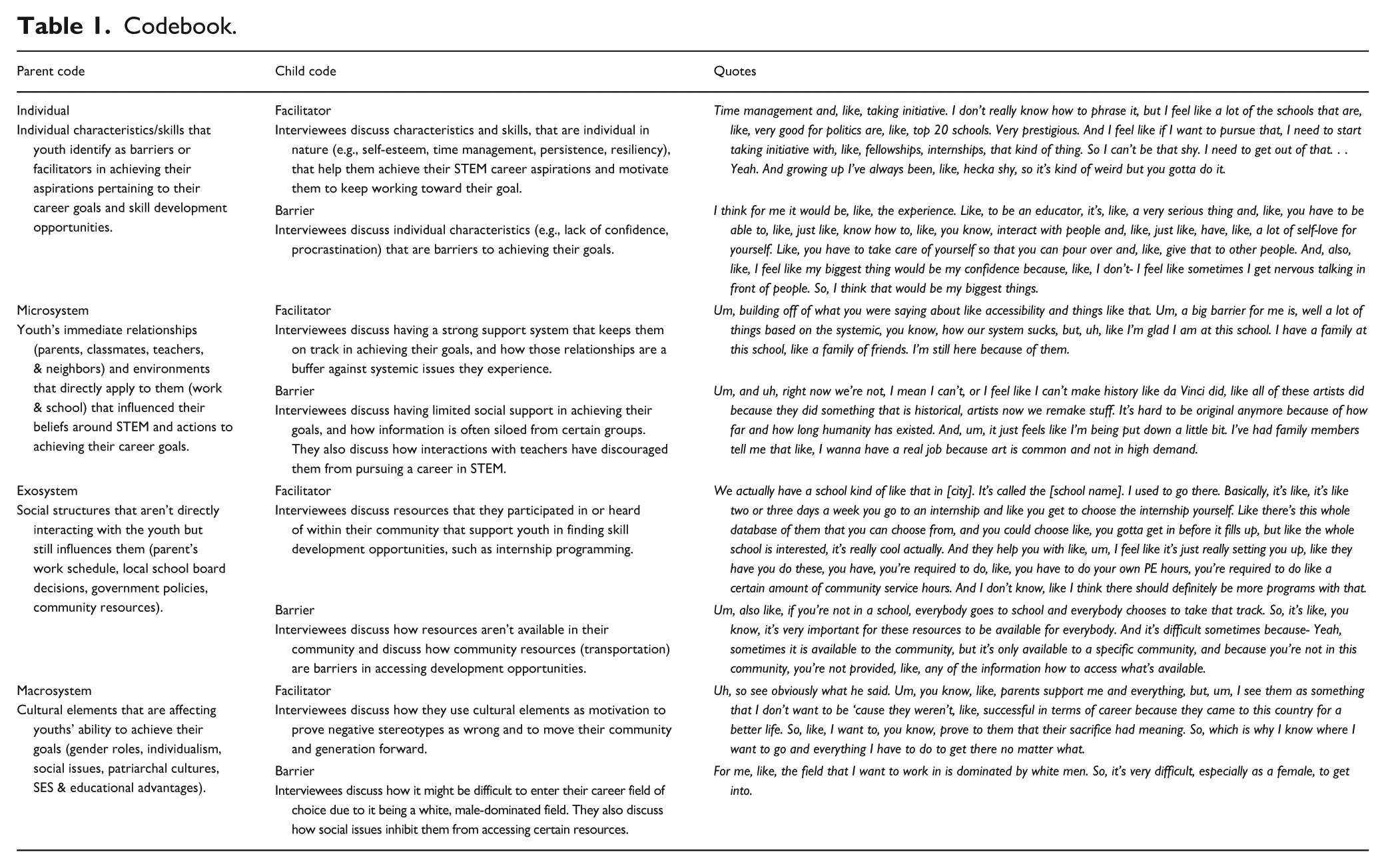
The authors employed an iterative interpretive data analysis process, integrating both deductive and inductive reason, though four steps (see Denzin, 1989 for full description; Kornbluh et al., 2025): (1) memoing, in which the first and third author reviewed the focus groups, compiled field notes, developed thematic categories, and assessed for saturation; (2) team discussions, where all authors reflected on the data and shared points of discovery; (3) codebook development and piloting, during which codes generated through the first two steps were tested by the first and third authors (see Table 1); and (4) coding, where the first author and a research assistant double-coded all transcripts. The first author then reviewed each coded transcript to identify any omissions or inconsistencies in code application (Lincoln & Guba, 1985). Coders independently reviewed every transcript and systematically checked the accuracy of code application throughout each text to ensure consistency across all sections. Any discrepancies were resolved through discussion. In this study, “positive” and “negative” were defined by the researchers based on thematic analysis of the focus group data and the framing of the questions (i.e., educator stereotypes as negative interactions), rather than being explicitly identified by the youth. These categorizations reflect how participants discussed experiences and opportunities as reflecting positive (i.e., rewarding, engaging, and affirming experiences) and negative (i.e., isolating, stressful, and discouraging).
Codebook.
Positionality
As a writing team, the authors hold multiple identities and spaces encompassing bi-racial, Latine, white, cisgender, and first-generation. Notably, the first and second authors both identify as ethnic minorities within the STEM field. The first author led the analysis and writing. The second and third authors engaged in the co-creation of the focus group protocol, initial focus group analysis for the city, and supported manuscript development (i.e., writing specific sections and offering feedback). We acknowledge that our ethno-racial backgrounds shape our perspectives and interpretations of the data. To hold such biases at the forefront, we grounded this study in a community-based partnership (i.e., the third author had worked with AES and several of the youth organizers for many years), working closely with our community partner and youth organizers throughout the research process (i.e., protocol development, piloting instruments, initial data analysis, and dissemination). The youth organizers, who conducted the focus groups, identified as Black or Latine and are from the same community, which allowed the study participants to feel comfortable sharing their lived experiences. Both the author’s positionalities and the youth organizers’ perspectives informed the development of the focus group protocol, shaping the questions asked to ensure cultural relevance, avoiding deficit framing, and center youths’ own understandings of their opportunities and challenges.
We examine our findings with a specific lens, guided by our sociocultural background embedded with assumptions and inherent blind spots. Applying Foulger’s (2010) concept of a “critical friend,” we were part of an intentional critical research community focused on issues of racial inequity that encompassed student organizers who identified as Black and Latino/a. Engaging in member checks also allowed opportunities for collaborative dialogue surrounding the findings, as well as critical reflexivity surrounding our own positionality (Kornbluh, 2015). Member checks were conducted when we shared our initial findings back with the city and the youth organizers for input. Later drafts of the manuscript were shared with AES staff to ensure cultural relevance.
Findings
Notable themes across focus groups focused on several ecological levels (i.e., individual, microsystem, exosystem, and macrosystem) and dynamic interactions in which minoritized youth experience and perceive as impacting their access to STEM skill development opportunities. Below, we highlight the key influences on youths’ experiences and perceptions of STEM skill development opportunities. We also discuss the balance between positive and negative experiences impacting their behaviors, perceived ability, and sense of self (Figure 2). Findings emphasize prominent strategies, relationships, environments, settings, and constructs that impact youths’ perception of STEM skill development opportunities and their access to them. In the discussion section, we reflect on such findings and share ideas surrounding future research and opportunities for intervention policy and programming.
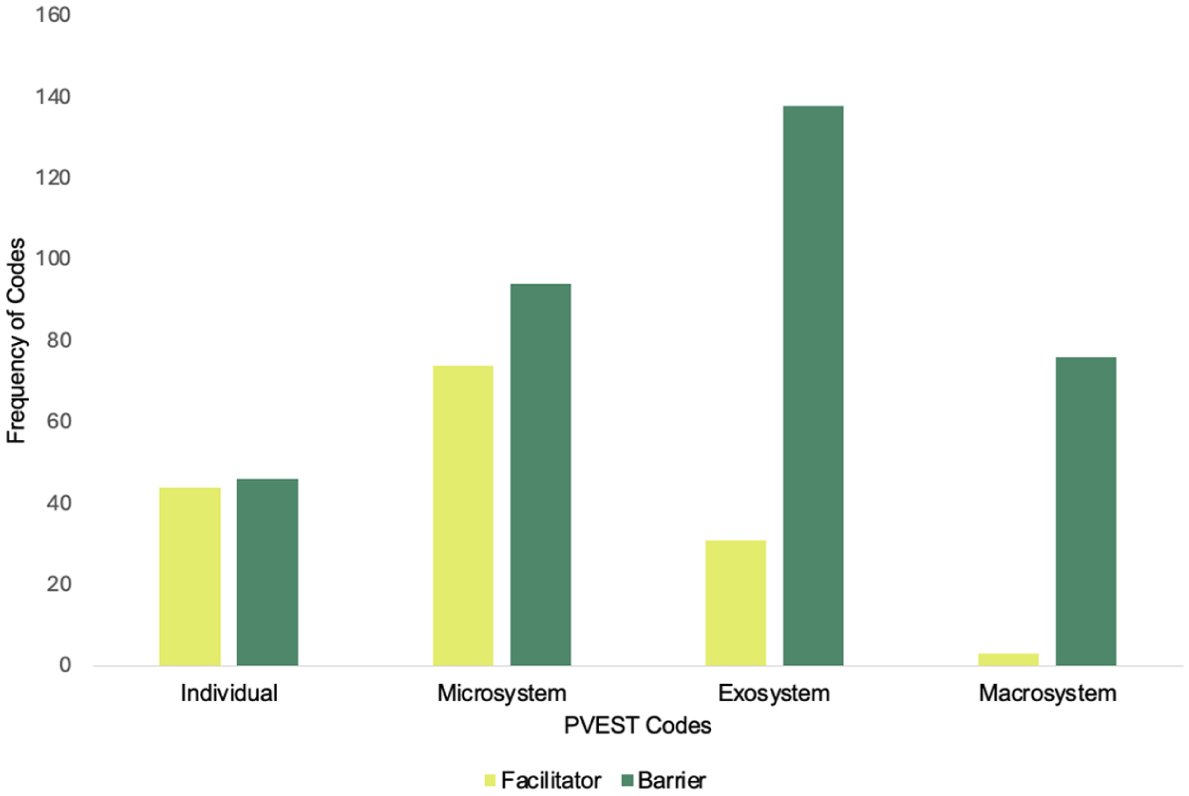
Frequency of PVEST codes applied.
Individual
All 55-youth highlighted and identified specific personal skills and strategies as important for achieving their career aspirations and being successful. Collectively, youth identified 44 adaptive and 46 maladaptive strategies they possess that influence their ability to succeed academically and in their career. Notably, they also acknowledged how certain strategies outweigh potential barriers. For example, some youth disclosed how adaptive strategies and skills they possessed allow them to pursue their goals. Illustrated in the following quote, one youth shared how their persistence allows them to continue their education and remain in college, despite the difficult rigor of college and being a first-generation college student: I think that persistence is really important because without persistence, I probably would have dropped out of college already because I’m also a first-generation college student as well. So, I just find college, kind of like, difficult to go through.
Participants also noted how their skills allow them to overcome many difficulties they experience within different ecological levels (i.e., relationships, school environment). A participant noted that because education is highly valued within society, it requires a lot of dedication and effort to be successful, but that they do possess the skills necessary to succeed.
Me personally, it is just education. Just a lot of time I have to put forward into it, ‘cause how important it is in modern day society. But also thinking about it, I feel like I could overcome it with my patience and my willingness to succeed.
This youth acknowledges the value society puts on education and how this societal emphasis on education is overwhelming. It is perceived that to be successful in school requires a lot of time and effort.
Alternatively, youth also identified maladaptive strategies and skills they possessed that can interfere with their ability to achieve. One youth identified their developing confidence as their biggest barrier in achieving their goals and access to development opportunities: “And also, I feel like my biggest thing would be my confidence because I feel like sometimes I get nervous talking in front of people. So, I think that would be my biggest things.” Other strategies and skill areas identified by youth in these focus groups included thoughtful self-evaluation, an evolving self-concept, developing effective time-structuring skills, and a need for support with task initiation. To illustrate, one youth shares how their thoughtful self-evaluation and strong desire for success can inhibit them from seeking out opportunities that can support their trajectory and achieve their aspirations: “For me, I think it’s the self-doubt and scared to fail, you know? That’s scary, you know, it makes me feel like I’m letting down my family or something like that. You know? Scary.” Within the PVEST framework, self-doubt is conceptualized as a maladaptive strategy, rather than an individual trait, that youth may express in response to structural inequality and racism (McGee et al., 2022). For instance, McGee et al. (2022) document impostorism among some Black doctoral students in STEM education as both a reaction to and a strategy for navigating ongoing racism.
Microsystem
A running theme throughout all six focus groups was the influence of interpersonal relationships and interactions (e.g., family, peers, educators, organizations) on adolescents’ perception of STEM opportunities, skill-development programming, and overall ability to be academically successful. Notably, 74 positive instances in which micro-level facilitators were coded compared to the 94 instances of negative micro-level barriers. One key factor in pursuing STEM opportunities through the focus groups was receiving emotional support from family. Familial support provided adolescents with the motivation to pursue their STEM career aspirations. As one youth noted, “I would say family because my family’s support is unconditional no matter how high or how low I am, or whatever I’m doing.” Unconditional support from family was highly valued by many youths throughout four of the six focus groups. They identified such support as a key facilitating factor for being able to achieve their career aspirations.
Educators also played a central role in gatekeeping STEM opportunities and aspirations for youth. Specifically, youth recalled 14 negative experiences with STEM educators compared to 10 positive experiences, in which oppressive encounters deterred them from engaging in STEM curriculum. One youth states, I feel for me, I was always interested in it [STEM], but I’ve always had really bad teachers in mathematics and sciences. I’ve had really bad track records with my math and science teachers. Like, it was ridiculous. And they were just so mean. . . When it comes to traditional settings, I feel like I’ve just had really bad teachers, personally. So that just kind of turned me off it. . . It’s just not my place that I feel comfortable in, you know?
The oppressive interactions with STEM educators made this youth no longer feel safe and obstructed their ability to develop a sense of belonging within STEM-promoting settings. STEM was indeed an interest for this youth; however, ongoing negative experiences with STEM educators deterred them from imagining or actively pursuing a career in STEM. In such instances of positive interactions, educators offered them tangible support to access opportunities and develop the necessary skills to be successful. To illustrate, this quote concerns a youth reflecting on their experience with an educator who provides tangible resources and opportunities for their students, “He gives you links and stuff to jobs and housing opportunities. . . And he also helps us with making resumes and cover letters and stuff.” Within the focus group, four participants, who shared experiences with this educator, voiced appreciation for the tangible support they provided.
Some youth also identified their neighborhood and school community as an additional setting for accessing needed STEM career skills. As one youth shares: I lean on family too. But I feel like my school made me a better person ‘cause I’m from [neighborhood] side and it said that it is ghetto over there and people, they don’t become successful as I was told. But I feel like moving out of [neighborhood] became important to my [program] made me do better, feel better. I was with the wrong environment, with the wrong people that bring me down. So, I feel like going to Health Professions and, like, focusing on my career path made me realize, like, you know, I’m not just from [neighborhood], I could be bigger.
This quote demonstrates the impact of schools and the school environment on youths’ perception of themselves and their abilities. This youth identified that their neighborhood environment was not the most helpful space for them to be in. In reality, it was them moving and going to a different school that allowed them to see possibilities within the STEM field. The school they now attend provides support, allowing them to focus on their career path and provides them with ample resources.
Another microsystem barrier that was identified by youth in these focus groups was a lack of role models and or mentorship opportunities. To illustrate, one youth described not having guidance from a mentor: I think lack of guidance also goes into it. Lack of role models or mentors for people of specific backgrounds. At least I can speak for myself. I don’t have anyone to look up to when it came to just college alone. So, I can’t even imagine what it would be like to be in the actual workforce. . . So, I think that’s mostly what’s lacking or definitely a barrier for me. ‘Cause I have that lack of guidance, I don’t know which step to go, what’s next, or anything like that.
This youth identified role models and mentors as important relational needs to pursue their STEM career aspirations. In this quote, the youth perceive mentors as providing needed social capital and brokering opportunities. More importantly, they are also highlighting the need for mentors who come from similar backgrounds as them, to generate guidance, inspiration, and hope.
Exosystem
Across all six focus groups, youth identified barriers within the exosystem related to community resources, government policies, commute times, gentrification, and teacher shortages. Youth highlighted their awareness of programming opportunities being available but not having access to them due to geographic barriers (i.e., not offered in their neighborhood or community). One youth discussed how they are aware that the schools in their neighborhood are not well-resourced and that better-resourced schools are in neighborhoods further away.
I haven’t been able to go to certain schools because those schools are in neighborhoods that were too far. And a majority of them were people that don’t look like me. . . So, um, accessibility to better education. This is a great school, but like in my neighborhood, the best schools aren’t in my neighborhood. I notice a lot of people that look like me, a lot of Mexicans, a lot of black people, a lot of Asians, a lot of everybody. It’s a low-income neighborhood with a low-income school. And like people say that they’re trying to give money into schools and stuff, but few changes are actually happening. So, I think education is a really big one because education is the gateway to internships and to life.
This youth identifies their school being in a low-income neighborhood. They also share that the school they are currently in is not located in their neighborhood. This youth perceives that the low-income school in their neighborhood cannot provide the needed opportunities for them to be successful. They further comment on inequities in the allocations of funds to low-income schools and limited policy change.
Resourced schools are often not available in low-income neighborhoods, which can intersect with interlocking systems of oppression within minoritized communities (Ruiz et al., 2018; Thapa et al., 2013). Professional skill development opportunities (i.e., workshops, programs) are also pushed out of these neighborhoods. A youth shares how it is challenging for them to obtain needed internships.
I would say mines were like internships. Just because a lot of the internships they try place me at they’re like really far out and a lot of the internships are normally far out. And then they also, then a lot of the internships that like are willing to help, it’s like, you gotta be there daily 24/7. This, this, and this day, you can’t miss a day. And that’s not a problem. But like the problem would be like transportation or like how to get there and then what time and then the times you get outta school.
This youth comments on the lack of internship opportunities in their neighborhood and community. With internships not being readily available in their neighborhood, transportation is a huge barrier restricting their access to needed job development opportunities.
Another barrier discussed at length in one focus group was the effect of experiencing teacher shortages, teacher turnovers, and a teacher strike during their academic careers. One youth shared how they did not have consistent teachers for a whole year. They stated, “I had teachers that were just gone. Half my classes were just subs for like the whole year.” This youth perceived this experience as negatively affecting their academic achievement. Another youth commented on the 2-week teacher strike their school and district experienced: I’d say the city can enforce the allocation of funds ‘cause the event of last year, the strike with the teachers was because the [City] City School district received so much money during the pandemic, but thousands of it were unaccounted for, right? And it’s like, what did they do with that money? Like no one supervised it, no one enforced that it’d be allocated to the appropriate corresponding activities or agencies or subjects.
This youth is blaming the city and policymakers for the teacher strike. This youth is aware that their school was given significant funds to support the education of their students; however, due to inadequate allocations of those funds, the teachers went on strike, and the students suffered from that.
Throughout four of the focus groups, adolescents expressed the importance of having more resources and opportunities made available within minoritized communities. The youth in these focus groups were aware of other opportunities in neighboring communities that had access to more resources. One youth shares how they heard of a STEM-focused skill development workshop for youth being offered in a more resourced community.
But I definitely have heard about this other community. They’re about to get a six-week workshop, I guess. And I just wanna see that more in underserved communities, like [city], that kind of stuff. I just want kids to know that they can go into STEM, they can go into art. We need more of that.
The youth note the need for greater resources and opportunities to be offered to minoritized communities. This youth highlights how workshops and different programming can instill hope and direction for youth in those neighborhoods to pursue their interests. Another youth talks about how gentrified communities offer different resources and workshops that they can attend, at a cost. However, that cost is often a barrier for many, and this youth believes a way to address this barrier is through state funding or grants.
In more gentrified communities, I’ve seen they have these workshop areas where you pay, and you come and use their resources. Say if you want to get into sewing, they’ll have the space available for you to use this really expensive equipment. But you have to pay for that, you know. And so, I feel like having something, like, that where it’s like maybe state funded, like, you know? Like, maybe you have a grant to be there, you know? [It] would be really helpful because not everybody has that extra income to be able to direct towards that.
Throughout these focus groups, youth identified and acknowledged many exosystem-level barriers. There was a deafening call among all youth in the focus groups to make more resources and opportunities available in their neighborhoods and communities.
Macrosystem
Throughout all six focus groups, youth identified and highlighted different societal constructs (e.g., gender bias, ethnic-racial stereotypes) that have impacted their access to professional development opportunities, which trickles into their sense of self and perceived ability in achieving career aspirations. Alarmingly, youth in these focus groups perceived 76 negative macrosystem level barriers compared to only three positive macrosystem level facilitators. Perception and understanding of one’s economic status and resources, or lack thereof, greatly influenced youths’ perception of their ability to be successful. For example, one youth expressed frustration in not having access to SAT resources due to their lower socioeconomic status.
Okay, so I’m a junior and we had our SAT in March, and you can do more, but it costs money and thankfully with fee waiver codes, which I was very grateful for, but I was kind of pissed. I should say that people will pay for college advisors, and they’ll help you through the whole process and they’ll pay for all these fancy SAT classes from Princeton Review and they’re $500. And then they get an amazing 1500. And they get to go to an Ivy and then there’s another kid that can work super hard and they have been trying and trying on SATs and trying to prep on their own or finding lower cost classes and stuff. And it’s just more difficult. So, you can keep on practicing and preparing, but it just sucks when there’s that other person that is working hard but they have more resources.
The youth is aware that no matter how much work they put into preparing for the SAT, other students from a higher economic status have structural advantages (e.g., money, tutors, etc.). This youth is not disregarding all the work students put into preparing for the SAT, rather they are acknowledging discrepancies in access to resources based on socioeconomic status. With this knowledge, this youth is perceiving themself as being further behind their peers who are from a higher economic status.
When discussing barriers youth face in accessing STEM skill development opportunities and resources, some youth discussed experiences of discrimination. The quote below comes from a youth who experienced racial discrimination when taking the bus: I would say accessibility because they [schools] give kids bus passes and all that stuff, but honestly, we went through a time period where we were riding the light rail, riding the bus and these bus drivers will just look at you and leave you. They won’t even stop. And it’s crazy because, say I really got somewhere to be that’s important, and you just left me. Don’t even care to stop. I feel like transportation is such a big thing because 9 times out of 10, kids have to go somewhere else to get these resources, and if you’re leaving people and you’re being prejudice and stereotyping people. . . this could be very discouraging.
This experience of racial discrimination from bus drivers yielded unreliable transportation. This youth acknowledges that resources and opportunities are outside their neighborhood, and they must take the bus to access them. Yet, ongoing experiences of being left at a bus stop directly discourage them from trying to access such opportunities.
The youth in these focus groups discussed the need for change at the macro level. For instance, they unpacked the negative narratives surrounding the label “underserved communities.”
We label these communities as underserved communities or underrepresented communities, but we’ve been saying that for years now. How do we make them represented? How do we make them overserved? Like, how do we change that narrative about it? And I think that definitely starts with us.
Other societal level critical questioning that came up were about the negative perceptions that are placed on these youths and those in their community.
People need to stop solely focusing on the actions of the youth instead of it- More so focus on the voices because even through all the actions, it’s a cry for help. You see people running the streets, you know, feeding into their communities. But it’s always, like, ‘They’re doing this’ instead of ‘How did they even come to this?’
This youth is asking for a shift in focus from the actions of youth to a larger systemic discussion on the structural and environmental reasons as to why youth are engaging in certain behaviors. For this youth, specific actions and behaviors youth engage in are perceived as a cry for help, and they believe many are missing that call.
Although many of the youth have experienced and are aware of these macro-level barriers, they are overcoming them and taking the steps to move their communities forward. For example, the quote below demonstrates a youth engaging in critical consciousness in which they are aware of the structural inequalities put in place by society.
I think going further into that, it’s not just, you know, so the next generation knows what to do, but it’s also thinking about it as more of a social justice type of spectrum where we’re slowly erasing things that are basically a construct made by others. You know what I mean? So, by slowly knocking those walls down, not only are we moving forward together, as humanity is supposed to, but we’re also growing together in terms of knowledge that can be given to future children or future aspects of life.
This youth is recognizing that many of the barriers they face are constructs made by systems of oppression and have a long history. They are fighting back against internalizing such constructs and placing the blame on structural and economic injustice. Knowing this, they are using it as critical motivation to break down those barriers to move their community and generation forward.
Discussion
Minoritized youth in STEM encounter numerous factors and environments that influence their perception of their ability to be successful in STEM, with implications for their long-term career trajectories. These ecological systems include personal skills and attributes (individual), family, peers, and educators (microsystem), local government policies and neighborhood zoning (exosystem), and broad cultural ideologies of racism and classism (macrosystem). Prior literature has documented various characteristics and skills that youth often possess of those who are successful in STEM (Park-Taylor et al., 2022; Schmidt et al., 2020), and findings from this study corroborate that literature base. Findings from this community-based, youth-led study also bring to the forefront unique exosystemic influences on STEM achievement that are often overlooked, advancing understanding of how structural and contextual factors shape minoritized youths’ STEM pathways.
Individual
The findings of this study are consistent with existing literature on the adaptive psychological tools and strategies employed by minoritized youth to pursue career aspirations and achieve success in STEM. Participants highlighted persistence and positive self-evaluations of STEM-related skills as key tools supporting their engagement and success. Conversely, youth with maladaptive academic self-concepts indicated lower self-evaluations of their abilities, which sometimes influence decisions to move away from STEM careers. For example, participants described developing intrinsic motivation, growing self-confidence, and reflective self-evaluation as areas of ongoing growth that influenced their ability to achieve in STEM. These strategies also reflected the complex interplay between internalized messages and structural constraints. Instances of self-doubt, for example, signaled the influence of internalized oppression, while skills emphasizing perseverance illustrated how societal expectations of individual effort are shaped by structural forces, such as the coping style known as John Henryism (James, 1994). Structural and cultural barriers, including systemic racism, create conditions that demand perseverance, often at substantial social, emotional, and psychological cost. Our findings extend the literature on individual strategies necessary for STEM success by emphasizing how minoritized youth actively use psychological tools to navigate these structural challenges. Importantly, while perseverance and individual effort were often emphasized, youth narratives also revealed the personal costs of navigating systemic barriers, highlighting how structural inequities, rather than individual shortcomings, drive the challenges they face.
Microsystem
Youth indicated value in the emotional support they received from their families. Notably, youth perceived their family’s support as a valuable facilitator to motivation and furthermore decreased their anxiety around potential failure. They emphasized how having the support of their family encouraged them to go after opportunities that further allowed them to develop needed career skills. Our findings are consistent with the literature in that emotional support from family members is highly valued and demonstrates positive effects on STEM identity and engagement (Cian et al, 2022; Dou et al., 2025; Gergely & Watson, 1999). Within literature, peers have been identified as critical socializing actors influencing a variety of behaviors and attributes, with application to academic achievement (Vit et al., 2024). However, in our findings, peers and friends were not identified as having as large an influence on adolescents’ perception of their academic achievement and skill development, as compared to their family and educators. The result of this study contradicts some of the value research has put on the influence of peer relationships on academic achievement. The literature positions social and emotional support from family, peers, and educators on the same value scale, and research would benefit from evaluating and comparing adolescents’ perceived value of support from these different interpersonal relationships. Also, most research looks at peer relationships broadly in the context of academics. Future research would benefit from examining the influence of peer relationships on STEM-specific domains.
Educators were another interpersonal relationship that many youths identified when discussing facilitators and barriers in pursuing STEM opportunities. Youth who identified positive teacher-student interactions attributed such relationships as the main source of accessing skill development opportunities. In contrast, youth who recounted persistent negative teacher-student interactions credited such interactions as contributing to their desire to no longer want to pursue a career in STEM. They ascribe these interactions as the reason for feeling unsafe in these settings and not having a sense of belonging within the STEM field. The findings of the microsystem level facilitators and barriers are consistent with the literature. Emotional support from family members positively influenced the youths’ perception of their academic abilities (Leung et al., 2010; Song et al., 2015). Positive interactions with educators allowed them to internalize some of the positive beliefs and values of their teachers (Skinner et al., 2022). The narratives of unfavorable interactions with educators illustrate the well-documented negative academic effects, such as externalizing behaviors and attrition from STEM (Hughes, 2011; Martin & Collie, 2016; Roorda et al., 2011). These persistent and pervasive interactions also underscore the structural barriers of racism embedded within education that not only manifest these relational exchanges but also contribute directly to inequitable access, persistence, and success in STEM for minoritized youth.
Exosystem
Exosystem-level barriers were identified as one of the most influential factors in youths’ perception of STEM opportunities within their neighborhood. Unfortunately, these influential factors were disproportionately perceived as barriers compared to facilitators. Throughout all six focus groups, youth were aware of the lack of resources made available to them in their communities and neighborhoods. Many noted how better-resourced schools and more development opportunities and programming were available in higher-income neighborhoods. Youth were able to identify discrepancies and economic inequalities in the allocation of resources throughout their city. Although unable to explicitly name the source for this inequality (e.g., restrictive zoning), they were conscious of the effect such policies had on their community and themselves. Unfortunately, the effects of restrictive zoning were often perceived as having significant negative outcomes by adolescents (e.g., long commutes, inequitably allocated funds). One negative outcome identified was longer commute times. Many noted that they had to travel to other neighborhoods to attend better-resourced schools that could fit their needs. Consistent with the literature, longer commutes increased adolescents’ stress and anxiety levels and impeded the time they have to commit to their schoolwork and thus affected their academic achievement (Block et al., 2018; Hoehner et al., 2012; Tigre et al., 2017).
Most of the literature excludes student perspectives on how government policies shape STEM equity and academic achievement. By centering youths’ perception of exosystem-level barriers and facilitators, this study adds critical and underexplored insights to the literature by elevating the voices of those most directly affected by policy decisions. These perspectives not only highlight where STEM skill development programs are most needed but also illuminate how structural forces (e.g., funding decisions, district policies, and inequitable resource allocation) filter down into the everyday experiences of Black and Latine youth. Importantly, this direct engagement with the exosystem is a novel contribution, as most research acknowledges the exosystem only in discussion or implication sections rather than in the analysis itself. By foregrounding how youth perceive and navigate exosystemic influences, this study advances understanding of how policy and structural contexts actively shape participation, persistence, and identity development in STEM.
Macrosystem
Broad cultural ideologies and constructs were frequently identified as negative influences on adolescents’ ability to access skill development opportunities and achieve their career aspirations. Consistent with the literature, youth perceived STEM spaces as being white and male-dominated (National Science Foundation, National Science Board, 2018). Narratives of STEM spaces lacking cues of safety for minoritized students, created by persistent hostile experiences with STEM educators, allude to their perception of the ethnic-racial hierarchy of students’ academic abilities in STEM (Martin, 2009). Not explicitly labeled as ethnic-racial microaggressions, but the hostile interactions with educators experienced by some youth in the focus groups are examples of stereotype threat. Unfortunately for those youth, such interactions deterred them from pursuing STEM careers. These acts of racial discrimination are not just identified within the school context. Youth are experiencing overt examples of racial discrimination in their community, too. The example of the discrimination experienced on the bus by youth directly impacts their access to STEM programming and skill development opportunities in other neighborhoods. Consistent exposure to racial discrimination can lead to the development of racial anxiety and minority status stress (Cvencek et al., 2014; Perna et al., 2010).
Fortunately, some youth in the focus groups are demonstrating critical consciousness when discussing macro-level barriers. Youth identify such barriers as larger societal issues, as opposed to internalizing those deficit-focused narratives. Youth notably emphasize the importance of structural changes needed to reallocate and offer opportunities to underrepresented youth within STEM. Youth stress that societal inequalities are strategically placing them at a structural disadvantage. Research shows that when youth demonstrate higher levels of critical consciousness, they are more likely to remain invested in their academic career and vocational future (O’Connor, 1997), as well as serve as an internal resource for youth in achieving their desired outcomes (Diemer & Blustein, 2006). Notably, opportunities to share and discuss such challenges with the focus group also spurred narratives of resistance and motivation to push for a larger change.
Summary
Youth identified key Ecological Systems (individual skills, interpersonal relationships, government policies, cultural ideologies) barriers and facilitators that both influenced their perception of STEM opportunities, as well as impacted their career aspirations. PVEST offers a valuable framework to capture youths’ cultural context, social location, and structural barriers (e.g., poverty, racism, gentrification), and how these shape their opportunities to pursue desired STEM careers. To illustrate, PVEST highlighted that minoritized youth do not simply perceive their identity within STEM, rather these perceptions are formed through actively navigating micro-aggressive messaging around their ability to be in STEM from educators, restricted in resources within their schools and neighborhoods to explore such career opportunities, and face financial, racialized, and time-sensitive barriers when opting to pursue such programming. Furthermore, many of these youth actively pushed back against negative messaging and pursued STEM opportunities through interpersonal and cultural supports of parents, teachers, and community centers, and actively pursued environments where such opportunities were available. Often ignored by traditional developmental theories, this framework highlights the problem of inequality as experienced through multiple systems. These systems cannot be understood in isolation; rather, their relationality underscores how structural inequities, cultural context, and ecological forces intersect to influence how youth perceive STEM, navigate barriers, and make decisions about persisting in or leaving the field. The PVEST framework also enabled an exosystem-level analysis of factors shaping adolescent STEM identity, an aspect that is often overlooked in this context. This more nuanced application of PVEST deepens the analysis and points toward stronger implications for addressing inequalities in STEM pathways and helps inform future development of STEM programming to responsively meet the needs of minoritized youth.
Implications for Developmental Research and Intervention
Across the focus groups, youth identified the type of support and resources they would like to see from their city. Guided by the youth of the focus groups, recommendations are to increase STEM programming for young children, mentorship programs, and implicit bias training for teachers. Themes of early intervention emerged in adolescents’ desire to have earlier exposure to STEM opportunities. Research shows that underrepresented youth have limited access to STEM programming (Oh et al., 2022). The youths in the focus groups wanted the city to develop and fund programs that bring high-quality STEM programming to young children. Throughout the focus groups, some youth shared how they do not have access to a mentor but would like a mentor who provides them guidance in their academic and career journey. Research shows that mentors are essential interpersonal relationships that positively influence young people’s development, serving as an ecological asset and socializing agent against experiences of systemic racism and school safety (Flitner et al., 2024). With the narratives of youth experiencing stereotype threat and racial microaggressions from their teachers, it is imperative that educators get high-quality implicit bias training that also includes cultural humility training. Cultural humility is the critical knowledge about self in addition to other groups (Anderson et al., 2024; Fisher-Borne et al., 2015). It is imperative to train educators to be aware of the negative stereotypes they hold and be aware of their own identity in relation to the students they serve, so they can create a safe environment within schools where minoritized students may feel a sense of belonging.
Limitations and Future Research
Focus group participants were notably recruited from community-based organizations, local high schools, and personal networks. Thus, we are cautious regarding the generalizability of our findings. Adolescents involved in community organizations or with personal connections to the research team might have had greater exposure to the types of conversations in which they are identifying barriers and facilitators in accessing programs where minoritized youth are often left out and underrepresented. Furthermore, youth organizers recorded demographic data for each focus and thus, we were limited in the identities that could be explored further. Greater representations of female perspectives would also allow us to unpack potential gender-based differences in relation to STEM academic achievement. Our analysis solely focuses on adolescents’ perceptions regarding key factors and environments and how such experiences influence their STEM academic achievement and career aspirations. Multistakeholder interviews could allow us to explore and unpack the perspective of the behaviors of key actors (educators, STEM programming brokers) as well as their intentions and behaviors to influence minoritized youth to choose a career in STEM. Given this study’s focus on only four systems, further research should explore the mesosystem and chronosystem in relation to STEM equity, particularly using longitudinal and dynamic data.
Conclusion
It is critical to understand perceptions of STEM opportunities from adolescence often underrepresented in this domain. This study highlights system-level factors (individual, microsystem, exosystem, and macrosystem) in shaping youths’ perceptions of STEM programming and career aspirations. Corresponding with a Phenomenological Variant Ecological Systems approach, adolescents described how individual skills, interpersonal relationships, policy decisions, and broader social structures intersect to influence their experiences of inequity. Importantly, our analysis emphasizes the exosystem, often overlooked in prior research, showing how structural factors (e.g., funding, school and community policies, program accessibility) shape perceptions of barriers and facilitators. While youth identified facilitators, structural and relational barriers disproportionately limited access. Focus groups led by youth organizers generated more empowering, less deficit-focused narratives than might have emerged with external researchers, underscoring the value of participatory methods. These findings reveal how structural determinants, experienced through exosystemic channels, intersect with youth’s skills, relationships, and agency to shape stem engagement and emerging identities.
Supplemental Material
sj-docx-1-jar-10.1177_07435584261451749 – Supplemental material for Using PVEST as a Framework to Understand Minoritized Youths’ Perceptions of STEM Opportunities
Supplemental material, sj-docx-1-jar-10.1177_07435584261451749 for Using PVEST as a Framework to Understand Minoritized Youths’ Perceptions of STEM Opportunities by Raquel Amador, Sherry Bell and Mariah Kornbluh in Journal of Adolescent Research
Footnotes
Acknowledgements
The authors would like to express their gratitude to the adolescents who participated in the study, the nonprofit Alliance for Educational Solutions for their collaboration, and the youth paid organizers that helped with recruitment efforts and facilitation of focus groups.

Ethical Considerations
This study was approved by the institutional review board at the University of Oregon.
Consent to Participate
Due to this study being IRB exempt, participant consent was not collected.
Funding
The authors disclosed receipt of the following financial support for the research, authorship, and/or publication of this article: This study was funded by the Youth Excel: Cities Advancing Equitable Youth Economic Recovery and Empowerment initiative from the National League of Cities.
Declaration of Conflicting Interests
The authors declared no potential conflicts of interest with respect to the research, authorship, and/or publication of this article.
Data Availability Statement
We provide our interview protocol and codebook as appendixes. Due to the sensitive nature of the data (focus groups with adolescents), we do not provide open access to such transcripts. Interested readers are encouraged to reach out.
Supplemental Material
Supplemental material for this article is available online.
Notes
Author Biographies
References
Supplementary Material
Please find the following supplemental material available below.
For Open Access articles published under a Creative Commons License, all supplemental material carries the same license as the article it is associated with.
For non-Open Access articles published, all supplemental material carries a non-exclusive license, and permission requests for re-use of supplemental material or any part of supplemental material shall be sent directly to the copyright owner as specified in the copyright notice associated with the article.
