







Abstract
The classical approach in sociology, as much as in other scientific fields, consists in the use of hypotheses and hypothesis testing processes to determine what, if any, effects can be attributed to particular factors in the case being studied. Other scholars however propose another procedure that eliminates the presence of previous hypotheses and privileges an interpretive – as opposed to a hypothetic-deductive – approach to data analysis. However, in the latter approach crucial questions appear for the researcher: how does one approach the data and data analyses to ensure the credibility of findings? Blumer's suggestion of “sensitizing concepts” seems to be appropriate in order to reach not only reliable interpretations of data but also to retain the possibility of “building theory”. This process could be supported by computer-assisted research.
Introduction
The presence of multiple and even conflicting theories to explain a social phenomenon makes it more and more enticing to build a theory starting from data rather than from theory-driven hypothesis testing. The latter opens a new debate between competing and perhaps conflicting positions: the classical approach through previously-established hypotheses, and an orientation influenced by Grounded Theory (Glaser and Strauss, 1967; Charmaz, 2006; Corbin and Strauss, 2008), which eliminates any kind of hypothesis and offers a range of different scientific views, also thanks to the added presence of “sensitizing concepts” (Blumer, 1954) coming out from empirical results, therefore not previously established but inserted after fieldwork.
The Grounded Theory Approach
Actually, in adherence to Grounded Theory, the aim is to build sociological theory starting from the collected data: before the analysis, researchers are involved in the construction of a list of nodes, keywords and items, all considered meaningful for both the analysis of the material and the purpose of the research. A first draft of this list can be useful to check if chosen “sensitizing concepts” are present or not in the contents of interviews. The purpose is to construct a reliable grid of concepts for the analysis and interpretation of data, a kind of “dictionary”, formed by words selected to support the qualitative approach.
It is not by chance that Paul Boghossian (2006) has suggested overcoming the constructionist approach to come back to the empirical data themselves. Of course, the existing computer packages, and probably those that will developed in the future, can be helpful tools but cannot substitute for the work of a researcher, engaged in a theory-building process (Urquhart, 2007: 348-50). The Grounded Theory approach refers precisely to a research process where “the researcher analyzes the data and identifies analytic leads and tentative categories to develop through further data collection. A grounded theory of a studied topic starts with concrete data and ends with rendering them in an explanatory theory” (Charmaz 2007: 2023).
Sociological Implications
Many programs of qualitative analysis have been developed to reply to theoretical demands of contemporary researchers. But rather than producing results in the way that statistical processing packages analyse data sets and produce statistics, QDA (Qualitative Data Analysis) programs (Lewins and Silver, 2007) are powerful supports in treating and controlling data. In the richness of elements offered by qualitative contents, researchers can find new concepts, new categories, raise other issues, and generate theories.
For instance, software like NVivo or Atlas-ti supply many functions besides retrieval and encoding. NVivo, in particular, supports qualitative research, and it is classifiable, at least in part, as tailored to the construction and representation of theory. However, according to Bryant and Charmaz (2007: 24), the research process must ultimately remain under the control of the researcher(s). Glaser and others are correct to be wary of the use of software, particularly when researchers come to rely upon it. Yet, cases abound where use of some form of electronic repository, plus sorting and retrieval facilities, has proved to be useful. Researchers must understand both the benefits and the dangers of use (and reliance upon) software support.
It is in the choice of “sensitizing concepts” that researcher plays a key role because “such theoretical categories can sensitize the researcher to identify theoretically relevant phenomena in their field” (Kelle, 2007: 207). This helps to distinguish between common sense categories, coming from common sense language and knowledge, and directions along which to look in a methodological and heuristic perspective. As a matter of fact, sensitizing concepts can fulfill an important role in empirical research, since their lack of empirical contents permits researchers to apply them to a wide array of phenomena. Regardless how empirically contentless and vague they are, they may serve as heuristic devices for the construction of empirically grounded categories (Kelle, 2007: 208).
Reconsidering Grounded Theory
In the context of the “building theory” process, Grounded Theory has gone through many and significant changes since its first introduction. “Quite apart from the question of whether it is desirable to defer theoretical reflection, the notion that one may conduct research in a theory-neutral way is open to some doubt”, says Alan Bryman (1988: 84-85), a quantitative and qualitative methodologist. Besides, there may be considerable practical difficulties associated with fieldwork conducted within a Grounded Theory approach. For instance, Hammersley (1984), drawing on his experience of conducting school ethnography, has suggested that when fieldwork entails tape recording of conversations, interviews, lessons, and the like, the time needed to transcribe such materials may render the Grounded Theory framework − involving a constant interweaving of categories and data − almost impossible to realize. One might also question whether or not what the Grounded Theory approach provides really is a theory. Much of the discussion of the approach and its associated procedures seems to concentrate on the generation of categories rather than theory as such (Bryman, 1988: 85).
Some changes had been initially co-proposed by Glaser and Strauss (1967), and then developed separately by these two, thus generating two different groups following one or the other scientist.
According to Bryant and Charmaz (2007: 33), through developing this method, Glaser and Strauss intended to provide a clear basis for systematic qualitative research, although Glaser has always argued that the method applies equally to quantitative inquiry. They intended to show how such research projects could produce outcomes of equal significance to those produced by the predominant statistical-quantitative, primarily mass survey methods of the day. What they also achieved was a redirection of positivist-oriented concern among qualitative researchers seeking reliability and validity in response to criticism from quantitative methodologists. Glaser and Strauss offered a method with a solid core of data analysis and theory construction. Their method contrasted with the strategy of those who sought procedural respectability through collection of vast amounts of unanalysed, and often un-analysable, data.
After Strauss died, Glaser has been holding the stage with his strongly committed attitude and fully oriented towards “his” Grounded Theory. Barney Glaser (1992) has pushed through his scientific and methodological option far from the former framework, which was already quite revolutionary for sociological tradition in the US, and not only there. The most problematic issue of Grounded Theory is the total absence of an orienting sociological research perspective. In other words, if the idea of abandoning detailed hypotheses in research may be considered, not the same can be said regarding other potential inquiries to introduce research guidelines. However, once traditional initial research hypotheses are refused, a first insight can be a good solution for starting and, though temporary and open, it can represent a referral point, a focus, an orientating point, a common basis whence inquiries can begin. Therefore, reconsidering Grounded Theory is even more advantageous if we take into account what Herbert Blumer maintained, the same Blumer who criticized the supposed absence of methodology of Thomas and Znaniecki (1918-1920) in their famous qualitative fieldwork in The Polish Peasant. On this note, as Blumer suggested (1954: 7), “sensitizing concepts” can be a good solution, so to have at least some conceptually defined contents, which may represent some sort of guidelines, or a rough draft that, even though of generic references, could help to guide operative choices during the research.
“Sensitizing Concepts”
As Blumer maintains, “sensitizing concepts” offer a wide general sense of reference and guidance in approaching empirical instances. In such a way, there is a close relation between concepts and data. Use of “sensitizing concepts” can be very diversified. Concepts can be taken directly from data, which is the case for Grounded Theory purists who refuse any other solution that does not start from data (the leader of this integral and militant approach is Barney Glaser). According to other scientists, “sensitizing concepts” must be confronted with data and they have to be formulated starting from already existing sociological literature on the subject. In this way, the relation with empirical data is quite loose, because conceptualization comes before any data collection. However, there is another solution that accumulates advantages from the store of previously accumulated scientific knowledge and collected empirical information. It intends to retain memory of previous research on the same subject and formulate a first draft of some guiding or “sensitizing” concepts to be verified by fieldwork during the research. In operative terms, the researcher can propose his or her own results, at least during a first step, or results acquired by other research on the same subject. Therefore, the researcher can prepare a list of temporary concepts, as far as possible.
In the second phase, the temporary list of concepts is compared with empirical collected data to verify, through a simple table of presences and absences of single concepts, whether or not conceptual formulas can be found in the texts, in interviews, in the data base available. Such verification can be carried out with a certain precision on all data or on just a significant part of them. However, before setting up a definite series of “sensitizing concepts” to be used in subsequent data analysis steps, a good approach would be to discuss every choice with all researchers and data collectors involved in the research so as to decide which concepts should be definitely included, excluded or added. If research is conducted by an individual, the choice can be made by the same person in different steps, one after another, before reaching a final decision.
Actually, in Kelle’s (2007: 209) terms, a wide array of sensitizing categories from different theoretical traditions can be used to develop empirically grounded categories. Many researchers find it easier to let categories emerge if one stays within one particular theoretical tradition. However, Glaser is convinced and frequently warnings that the utilization of a single pet theory will almost always lead to the neglect of heuristic concepts better suited to the specific domain under scrutiny. There are heuristic concepts which capture a broad variety of different processes and events but nevertheless may exclude certain phenomena from being analysed: thus the extended use of concepts from micro-sociological action theory (such as actors, goals and strategies) can preclude a system theory and a macro perspective of the research domain. A strategy of coding which uses different and even competing theoretical perspectives may often be superior to a strategy which remains restricted to a limited number of pet concepts. Furthermore, analysts should always ask themselves whether or not the chosen heuristic categories lead to the exclusion of certain processes and events from being analysed and coded, since this would be an attribute of a category with high empirical content which refers to a circumscribed set of phenomena.
Abduction and Retroduction
At this juncture, the old dilemma between induction and deduction is resolved because the modality of “sensitizing concepts” acts as a sort of abduction or retroduction (Fann, 1980) that explains phenomena starting from facts, but not only in an inductive way. According to Peirce (1868 [1984]), father of the pragmatist movement, one abduces or retroduces with the acceptation of a hypothesis to explain a given phenomenon. However, the starting point is always the formulation of a hypothesis that has to be verified by facts. This is Peirce’s logic of science. Furthermore, according to Peirce, a concept is significant when it produces effects. For “sensitizing concepts”, it is quite evident that they are directly related to data. Finally, categories (or concepts) have to be determined both at the beginning and at the end of the analytical procedure.
One might say that knowledge is based on observing facts (Peirce 2001: 289). The following example can be useful: observing an inkpot, this is a fact. However, before one can say that, one can have sensorial impressions, in which there is no idea of an ink pot, or of any separate object, or of a “self”, or of the act of observing; and the fact of seeing an ink pot in front of oneself is the outcome of a number of mental operations on such sensorial impressions. Only when the cognitive action has developed into a proposition or idea concerning a fact, can one directly address the process. As a matter of fact, it is an idle question to discuss “legitimacy” of what cannot be checked. Therefore, all observations should be accepted as they occur. In a certain way, Peirce's use of language in his 1931-1958 collected papers is quite old fashioned, and above we have presented a paraphrase of his speech, but the intuitions involved are significant and anticipate things to come. This is particularly explicit is the following statement: “The first thing to do is to propose a questioning hypothesis. Secondly, one should verify feasibility limits with experimental tests”. Such a hypothesis is an instrument of Peirce’s scientific and philosophic work (2001: 290). He maintains that with such a hypothesis he means not only a supposition concerning an observed object in particular, but also the initial position of such a hypothesis and how it is considered, either as a simple question and, for any degree of preference, can be seen as an inferential step that Peirce suggests could be called abduction. This includes the preference for a hypothesis over others to explain the facts, when such a preferred hypothesis has been neither proven with previous relevant knowledge, nor verified more than other hypotheses already considered proven. Finally, Peirce (2001: 304) mentions some of the problems with the absolute absence of hypotheses in research. There are scholars who affirm that no hypothesis can be accepted, not even as a conjecture, until its rightness or wrongness can be directly perceived. Peirce holds the opinion that this is what Auguste Comte – the social philosopher who actually first made this formulation – had in mind. Of course, this abduction presupposes that we should believe only what we see, and there are authors who maintain that to make predictions is not a scientific attitude. Therefore, this should also mean as well that expecting something from research is not a scientific attitude. One’s opinion should be limited to what effectively can be perceived, maintains Peirce. He seems to be perfectly aware that such a position cannot be coherently held. In a certain way, this position is self-defeating because it is an opinion based on more than what can effectively be perceived.
Computer-assisted Qualitative Analysis
Analysis of qualitative data, according to the methodological indications of Grounded Theory, and the feasibility offered by the software NVivo, operate at two major levels: nodes, that is to say the key concepts, and memos, that is to say observations, considerations, theoretical and scientific perceptions coming from handling data. Sometimes one may work a lot, or mainly, on nodes and just a little with memos, which may be neglected and rarely written up. The absence or insufficient number of memos may represent a serious disadvantage for more important research operations. As a matter of fact, not only nodes can be related to each other, but also memos can, and memos can be related to nodes, thus enriching with no limit researchers’ interpretive potential. The group of memos, but also every single memo, is a vital piece of the chain through which one should pass to build a theory, attempt to make interpretations, set up significant relations with different parts, and establish research results. Memos are the traces of our thoughts concerning the research problem. Such thoughts in progress may change, but can also be consolidated, using central and marginal variables, with a hierarchy at any level; with the tree system, which defines priorities and gradual differences in the considered elements. The next passage, which defines one or more theories, is the peculiar job of the social scientist, who assumes the role of transforming empirical data into abstract theory.
Quantity and Quality in Research on Jubilant People
Many of the results of our inquiry with the questionnaire carried out with pilgrims at the Jubilee 2000 (Cipriani, 2002) are validated by qualitative research among the 96 jubilant people interviewed (Cipolla and Cipriani, 2002). Not only do we have confirmations, but there are also details that strengthen what is said in the conclusion of the quantitative volume Pellegrini del Giubileo (Pilgrims of the Jubilee).
The Jubilee has represented many different things for the participants, both for individual subjects and for the various “pilgrims” compared. In this sense, it is possible to understand a more-or-less strong attitude − which is a praxis as well − that can be considered a form of self-direction (scarce institutional direction), which includes one-third of the sample. On the other hand, we find faithful believers, who are another third of the sample, with a further third who are in an intermediate position or of a more solipsistic nature… [Moreover,] from our data emerge a critical ability and an autonomy on the part of jubilant people that is dearly greater than what we would have expected, owing to an interplay of orthodoxy and heterodoxy which is not easy to understand and is highly articulated. (Cipolla, 2002: 14)
The hypothesis formulated by Luigi Berzano and Daniela Teagno, according to which “the pilgrim, arriving in Rome in 2000, perceived and lived the Jubilee according to his sensibility and religious education” is confirmed. “The importance of tradition, spiritual experience, cultural events, and touristic occasion expresses a wide variety of possibilities of approaching religion (belief, experience, belonging, practice, etc.), which are realized in just as many forms of sensibilities and religious subcultures”. Our group of 96 interviewees is likewise “situated within a religious model of Catholic origins, which is why one seems not to notice the process of secularization: such a strong presence of regular practicing believers is particularly significant”. It is not by chance that the pilgrimage to Rome “is, for the faithful, a way to express one’s real religiosity: which is a religious practice more than an intellectual activity, made of materiality and symbolism”. Moreover it is “difficult to talk about a pilgrimage, not only for quantitative reasons, but also for the great number of participants coming from all over the world, because those have different orientations and behaviors, which lead to a plural modality of interpreting and living the Jubilee event” (Berzano and Teagno, 2002: 44-46).
An Experiment with the Jubilee of the Year 2000
Our results of a qualitative research on jubilant people − pilgrims participating in the Jubilee of the Year 2000 in Rome − contribute to the sociological analysis and interpretation of a collective phenomenon of mobility (be it religious or not), and to the process of “building theory”.
The qualitative research carried out in 2000 and the following years, starting with data collected from 96 pilgrims in Rome (from 18 countries, and speaking 8 different languages) on the occasion of the Great Jubilee of 2000 (Cipriani, 2003; 2006), has been, as far as we know, the first research in Italy based on Grounded Theory and realized with NVivo. Actually not all resources of the software were used. However, the results can be considered quite promising, even if further interpretations of the collected data are still possible. This research shows the outcome of a triangulation between the software DiscAn, invented by Pierre Maranda (a Canadian anthropologist), the Analysis of Lexical Correspondences, and the results of operations with NVivo.
The interviewees, both men and women, presented diverse backgrounds, resulting from their freedom of expression, without any kind of restriction and with no pre-defined questions and pre-coded responses, permitting a high level of spontaneity in the answers and, as a consequence, a deeper knowledge of some issues concerning the Jubilee.
When the qualitative and quantitative approaches are used simultaneously, the outcome is very rich and permits one to suggest further possibilities. To give an example, at the end the most important concepts were situated in the following manner:
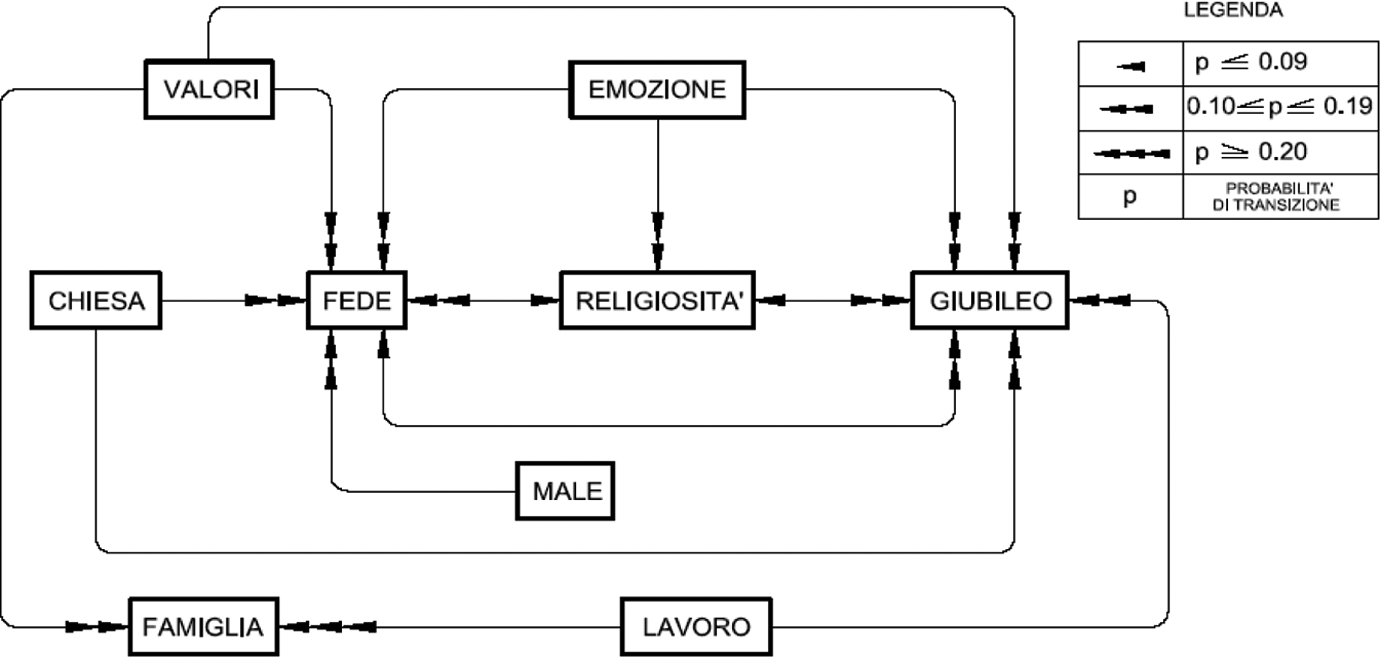
Qualitative and quantitative approaches are used simultaneously.
Religiosity (religiosità) appears as the core category, together with jubilee (giubileo) and faith (fede), and also emotion (emozione). Church is marginal, and the family too is peripheral. Another similar graphic construction is suggested by the software NVivo, which presents a clear relationship between the same primary concepts (religiosity, faith, jubilee, emotion):
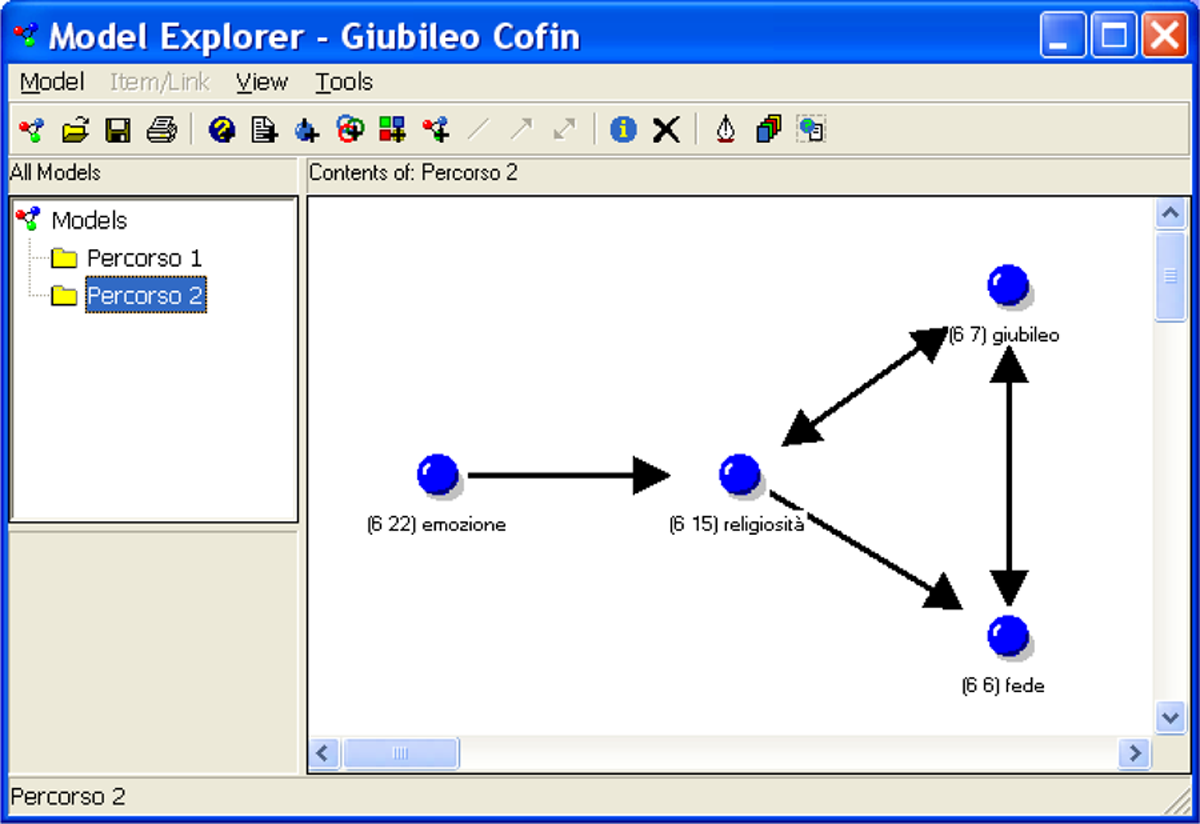
A similar NVIO graphic construction.
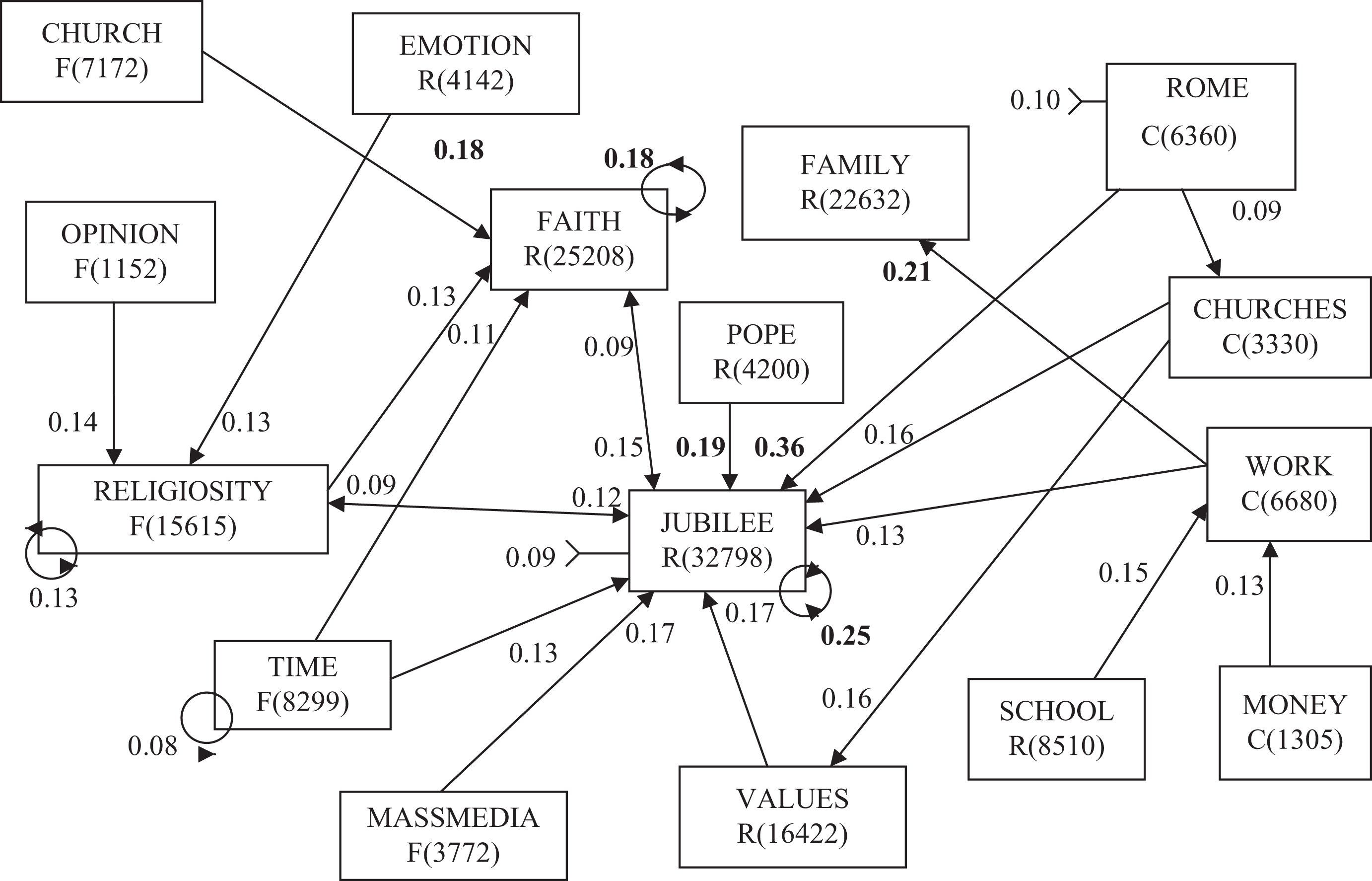
A similar DiscAn semantic map.
To complete the illustration of results, a semantic map, created with DiscAn, confirms the key role of jubilee (as a central relay=R), religiosity (as a source=F), and faith (as a relay=R). In this case, however, emotion doesn’t seem so relevant: it is a relay but is isolated.
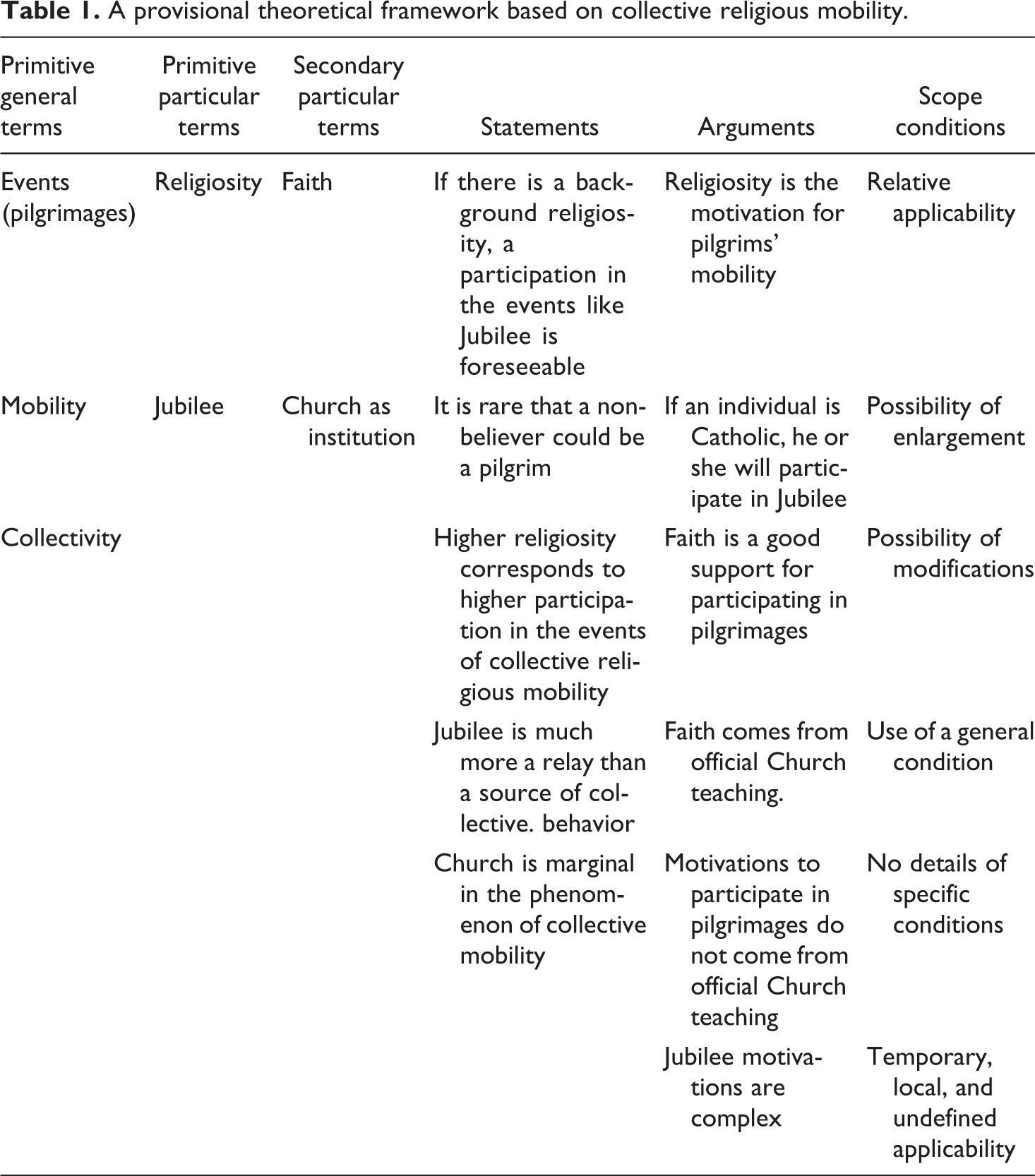
The documents gathered could be used for other interpretations too, but our outcome has been useful to build a provisional theory based on collective religious mobility. The final theoretical framework is the following, in short:
A provisional theoretical framework based on collective religious mobility.
A quantitative approach and a qualitative approach can be very fertile if treated and balanced together with methodological rigor and scientific attention, which means to aim at keeping the best of both different approaches. These can unveil useful elements concerning social action motivations, the preeminent values orienting experience, more recurring sociological categories in the perception of social reality, and finally the connections that motivate the most significant choices.
Conclusions
As a general rule, according to the content analysis of the 96 biographies gathered, some conclusions can be drawn. Without pushing through a certain limit on the level of analysis, according to the usual criteria of Grounded Theory (Glaser and Strauss 1967; Strauss and Corbin 1990), we suggest some interpretation, the validity of which remains partial and temporary, but can be considered rather innovative in light of previous attempts. The plurality of scientific modalities and techniques applied, from the software NVivo to psycho-sociological perspectives, offers sufficient guarantees of reliability not always acquired with other solutions. Hence, with these cautions, it is possible to explain some significant or exemplary trends.