






Abstract
Relationships with teachers are a central component of a student’s school environment, and have been shown to be related to school engagement and persistence in secondary school. Working alliance is a conceptualization of professional relationships that emphasizes not only the emotional bond between a professional and their client, but also their collaboration on the goals and tasks of their work together. While this theory has garnered considerable support in the fields of counseling and healthcare, working alliance has only recently begun to be investigated in an education setting. The present study sought to investigate working alliance between students and teachers as a broader framework for relationships in a high school setting. Specifically, the primary objective was to examine the use of the working alliance framework in teacher-student relationships to predict risk of high school student drop-out. A series of multiple regressions was used to test this objective. Results demonstrated that student-rated school working alliance predicted risk of drop-out, and that the relationship was partially mediated by student engagement. These results provide evidence for the validity of the construct of working alliance as a useful conceptualization for teacher-student relationships, and enhance our understanding of working alliance in a secondary school setting. Implications for educators and practitioners are discussed.
Statistics Canada reports that roughly 27% of Canadian youth aged 16 to 19 drop-out of high school (Statistics Canada, 2015). Young people that fail to complete high school frequently struggle to find work relative to their graduated peers, as unemployment among young adults that have dropped out of high school was approximately 54% in 2016, twice as high as that of high school graduates in Canada (Uppal, 2017). However, these statistics may understate the problem, as 35% to 50% of young Canadians without a high school diploma had completely dropped out of the labor force and were therefore not included in the statistics (Uppal, 2017).
It is clear that high school drop-out is a pervasive and serious problem within Canada. Finding support for Finn’s (1989) participation-identification model that engagement at school leads to successful academic outcomes, research has demonstrated the importance of positive teacher-student relationships in promoting student engagement in school and reducing risk of high school drop-out (Barile et al., 2012). By offering a more complete conceptualization of teacher-student relationships through the application of a working alliance framework, the present paper seeks to explore how teacher-student relationships may provide greater understanding and possible means of mitigating high school drop-out, and to inform school psychologists who are in a unique position to collaborate with both teachers and students (Forlin, 2010).
Finn’s Participation-Identification Model
Finn’s Participation-Identification model (Finn, 1989) posits that emotional and physical withdrawal from school is the result of compromised engagement in school and classroom activities. Finn (1989) and Finn and Rock (1997) argued that engagement, which includes behavioral engagement (e.g., class preparedness) and emotional engagement (e.g., showing interest in the class), is necessary to obtain successful performance outcomes, and to develop a sense of identification with the school. Students that develop an identification with the school feel a sense of belonging and value, which in turn promotes more engagement that leads to further successful performance. When students do not engage in school, school identification is undermined, and students are less likely to value their school or feel that they belong in school. This increases risk of drop-out (Finn, 1989). Recent literature has found support for this model and of the importance of student engagement in preventing drop-out (see Reschly et al., 2020 for review of the literature). Importantly, Finn (1989) noted that quality of instruction contributes to students’ engagement, and that discussion and interaction with their teachers promotes enthusiasm in students. Thus, an important factor in Finn’s Participation-Identification model in predicting student engagement may be the teacher-student relationship.
Teacher-Student Relationships and High School Drop-Out
Teacher-student relationships have been associated with high school drop-out (Barile et al., 2012; Bergeron et al., 2011). For example, Bergeron et al. (2011) evaluated the relationship between teacher-student relationships and intention to drop-out in a large sample of Canadian students. Whereas positive teacher-student relationships inversely predicted drop-out, negative relationships with teachers was a particularly strong predictor of drop-out, accounting for 14% of the variance in drop-out intention above and beyond gender, age, and socioeconomic status. Barile and colleagues (2012) examined teacher-student relationships on a school level, using data from the US National Education Longitudinal Study (n = 7,779) and rated overall teacher-student relationship climate. Students’ ratings of teacher-student relationship climate in their sophomore year were significantly and negatively related to the odds of dropping out of school two years later, suggesting that teacher-student relationships may be particularly important in student drop-out.
While the literature demonstrates the importance of positive teacher-student relationships in fostering student engagement and supports the association between teacher-student relationships and risk of high school drop-out, important gaps remain. A primary gap concerns the way in which teacher-student relationships have been conceptualized. Pianta and colleagues’ definition of relationship, measured in terms of closeness, dependency, and conflict (e.g., Hamre & Pianta, 2005), has been widely cited, but this and other models of teacher-student relationships are typically conceptualized based on attachment or self-determination theory (e.g., Krane et al., 2016; Quin, 2017), and may too narrowly define relationships and overlook important aspects of the relationship.
Despite the popular attachment-based conceptualizations of teacher-student relationships, engagement is an active process that may not arise passively from students experiencing warmth and caring from their teachers; a working relationship typically involves input from all parties. While the trust, attachment, and emotional support appear to be demonstrably important in influencing students’ classroom engagement and persistence (Quin, 2017), emotional attachment may not be the sole aspect to a relationship between two working partners. The student’s active collaboration with their teachers in decisions about the direction and value of their education is not measured in this literature, and may have an impact on the active behaviors of classroom engagement and participation. Addressing this gap in the research would allow us to better understand the association between teacher-student relationships and engagement that is necessary to determine the association with drop-out.
The Teacher-Student Relationship as a Working Alliance
Working alliance is the collaborative relationship between a client and professional, and is an important aspect of a helping relationship. Working alliance involves consensus on the goals of the intervention, and of the tasks or activities that will be undertaken to achieve those goals. It also involves the working context of mutual trust, respect, and liking between the pair (e.g., Martin et al., 2000).
Recently, researchers have begun to investigate working alliance in teacher-student relationships within educational settings (e.g., Rogers, 2012; Toste et al., 2010). Toste and colleagues (Toste et al., 2010, 2015) have investigated working alliance in a classroom setting between elementary school students and their teachers using a measure adapted from the Working Alliance Inventory (WAI), the Classroom Working Alliance Inventory (CWAI; Heath et al., 2007). Toste and colleagues (2015) evaluated the factor structure of a student- and teacher-rated CWAI and found that both measures had the same underlying factor structure; emotional connection (i.e., bond) and collaboration (i.e., tasks, goals). The authors further determined the domains of alliance (i.e., bond and task/goal) differentially predicted student perceptions. Given these results, it seems that accounting for a collaborative element in teacher-student relationships can offer increased understanding regarding student engagement and drop-out.
The teacher-student working alliance framework may advance our understanding of student drop-out. Given the importance of active classroom participation as proposed by Finn’s (1989) participation-identification model, the study of teacher-student relationships may benefit from a conceptualization that includes an active collaborative component. Building on the findings of Toste et al. (2015) at the elementary school level, working alliance theory may provide a framework for a more complete conceptualization that encapsulates the collaborative aspect of teacher-student relationships at the secondary school level. From a practice perspective, the current study has particular importance as Canadian school psychologists frequently engage with and support school staff in the implementation of strategies, such as those that foster teacher-student relationships and student engagement in the classroom (Jordan et al., 2009). The present study seeks to fill the current gap in the literature by evaluating the association between working alliance, student engagement, and student reports of risk of drop-out. Considering Finn’s (1989) Participation-Identification model, we expect that student rated school working alliance (SWAIS) will predict student perceptions of risk of drop-out (DEMS), and will be fully mediated by student ratings of school engagement (SEQ).
Methods
Participants
A total of 137 adolescents from grades seven to 11 (Mage = 14.67, SD = 1.68; 53.7% female) participated in the study. Participants were recruited from three high schools in a large Canadian city. The three schools were selected for their higher rates of drop-out. The specific demographics of the participants in the three high schools were not collected, but demographics of the boroughs are as follows (Statistics Canada, 2019). School A had approximately 800 students, was located in a borough where the median household income was 16.9% lower than the provincial median income, and 22.2% of residents reported being immigrants. School B, with over 1000 students, was in a borough where the median household income was 17.4% higher than the provincial median, and 28.5% of residents reported being immigrants. School C, with <100 students, was located in a borough where the median household income was 19.1% lower than the provincial median, and 32.0% of residents reported being immigrants.
Measures
Risk of drop-out
Students’ rating of risk of dropping out of high school was measured using the Questionnaire d’évaluation du décrochage en milieu scolaire (DEMS), translated to English as the School Dropout Assessment Questionnaire (Potvin et al., 2004). The DEMS is a student self-report questionnaire that assesses the risk of high school drop-out based on five associated domains: parental involvement, attitude towards school, perception of school achievement, parental supervision, and academic aspirations. The inventory consists of 33 questions with multiple-choice responses, and yields a total risk intensity score of low, moderate, or severe, as well as a risk score for each domain. The questionnaire was translated into English for this study by the primary author, and the translation was back-translated by a translator not associated with the study. This back-translation was compared to the original to assess validity of the translation. The inventory was originally validated using a sample of high school students in regions of Quebec, and has been shown to have good reliability and validity (Potvin et al., 2004). In this study, the internal reliability of the subscales ranged from acceptable to very good (alpha = .55 to .89). For this study, total scores on the DEMS were used as a continuous variable.
Student-teacher working alliance
Working alliance for student participants was measured using the School Working Alliance Inventory – Student (SWAIS), which was adapted from the Classroom Working Alliance Inventory (CWAI; Heath et al., 2007) and consists of three subscales each containing four items: Bond, Goal, and Task. The items align with the three factors of working alliance presented by Bordin (1979). For example, the Bond domain was measured using items such as “My teachers and I trust each other.” The Goal domain was measured using items such as “My teachers and I are working towards goals that we both agree on,” and the Task domain was measured with items such as “My teacher and I agree on what is important for me to work on.” The items are measured using a five-point Likert scale (i.e., 1 = Never; 5 = Always). A recent factor-analytic study examined the structure and psychometrics of the SWAIS and found good fit and reliability for the three-factor model (Noble, 2019).
Student engagement
Student engagement was measured using the School Engagement Questionnaire (SEQ; Dornbusch & Steinberg, 1990). The SEQ consists of 12 multiple choice items measuring behavioral engagement in class. Items include “How often do you really pay attention in English class,” and “How often does your mind wander in Math class.” A total engagement score was calculated from responses on the SEQ. The SEQ was selected because it had previously been used to evaluate engagement and school identification in diverse groups of high school students (e.g., Perry, 2008), and had been shown to have psychometric properties that were equivalent or better than other measures of engagement (Fredricks et al., 2011). The SEQ has good internal reliability, with reported Cronbach’s alphas of .70 to .86 (Dornbusch & Steinberg, 1990; Perry, 2008), and evidence of criterion and construct validity (Fredricks et al., 2011).
Procedure
Participants were recruited from their respective high schools; research assistants attended designated classrooms and presented the study to the students. The research procedure was reviewed and approved by the university’s Research Ethics Board, and by a research committee at participating school boards. Consent forms were distributed to each student to be brought home and completed by a parent. A similar assent form was provided for students at the time they completed the questionnaires. Students were compensated for returning the consent forms, whether they agreed or disagreed to participate. Each student that returned the consent form was entered in a draw to receive a 50-dollar gift certificate to a local entertainment venue.
Data collection for each student participant took place during school time and consisted of the self-report questionnaires listed above. Measures were presented in an envelope and all forms were identified with a confidential participant identification number. Participants were brought to a central location in the school in groups of ten to twenty participants, but data packages were completed individually. Research assistants were available to answer questions.
Data Cleaning
Data was initially screened for missing values using the Missing Values Analysis of SPSS. For student data (Table 1), <5% of data was missing for each variable, and data was assumed to be missing completely at random (Schafer, 1999).
Descriptive Statistics for Sample.
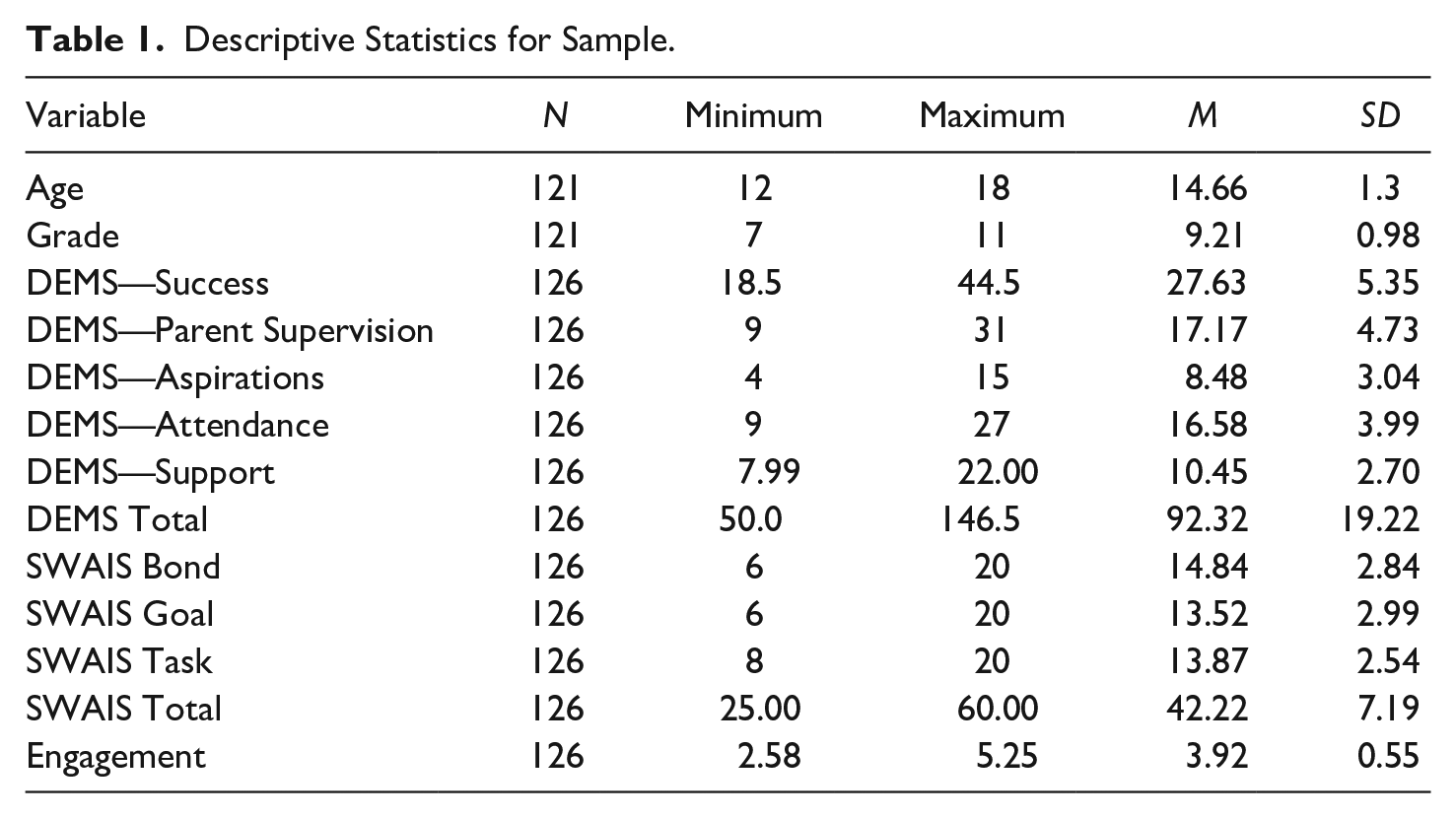
The presence of univariate outliers was investigated by observing the descriptive statistics (Table 1). Univariate outliers were identified for age, grade, and subscale scores obtained on the DEMS, SWAIS (Bond, Task, Goal, Total), and SEQ. A threshold of three standard deviations above or below the mean was used: one outlier was identified for the SEQ, and one for Bond domain of the SWAIS. Participants with outlying values were removed from the sample set.
After removing the participants with outliers, the initial data set of 137 participants was pared to a final data set of 126 student participants.
Skewness and kurtosis analyses used to check for data normality assumptions fell within acceptable ranges (West et al., 1995).
Analytic Strategy
The study objective was to evaluate our hypothesis that working alliance between teachers and students predicts student reports of risk of drop-out, and is fully mediated by student engagement. Regression analysis was used to demonstrate a mediation effect of engagement (Jose, 2013). Due to a smaller sample size, in this study, Hayes (2013) PROCESS method was used to test the indirect effect of the partially mediated model. This methodology integrates bootstrapping, and provides an output of effect size of the indirect effect. Using the Linear Multiple Regression process in SPSS, the total DEMS score was added as the dependent variable in each step. The total SWAIS score was entered as the independent variable in the first step, the total SEQ score was entered as the independent variable in the second step, and the total SWAIS score and total SEQ score were entered as independent variables in the final step.
Results
The causal variable, total school working alliance predicted student reports of risk of dropping out of high school, F(1, 124) = 36.57, p < .001, R2 = .23 (see Table 2 for all results). The effect size was medium, f2 = .30. The coefficient for total SWAIS was significant, b = −1.28, SE = 0.18, p = .001, and negative, indicating that school working alliance and student reports of risk of drop-out were negatively related. The observed power was 1.0. SWAIS was also related to the mediator variable, SEQ, F(1, 124) = 25.57, p < .001, R2 = .17, and the coefficient for total SEQ was significant and positive, b = 0.03, SE = .01, p = .001. The observed power was 1.0. In the final step that used total SWAIS and SEQ as predictor variables, the model predicted student reports of risk of drop-out, F(2, 123) = 34.50, p < .001, R2 = .36. The effect size was large, f2 = .56. However, the coefficients for both total SWAI, b = −.84, SE = .19, p = .001, and SEQ, b = −14.01, SE = 3.00, p = .001, were significant. The observed power for the analysis was 1.0. The relationship between school working alliance and student reports of risk of drop-out was therefore not completely mediated by the effect of the school engagement, and a direct effect of working alliance on student reports of risk of drop-out was identified. As the coefficient for the total SWAIS decreased from −1.28 to −.84 when SEQ was incorporated, there appeared to be a partial mediation effect. This indirect effect was found to be significant, b = −.44, SE = .12, confirming that SEQ partially mediated the relationship between SWAIS and DEMS scores. Therefore, the hypothesis was partially supported. Student school working alliance predicted student reports of risk of drop-out and was partially mediated by school engagement.
Results of Multiple Linear Regression Analysis.
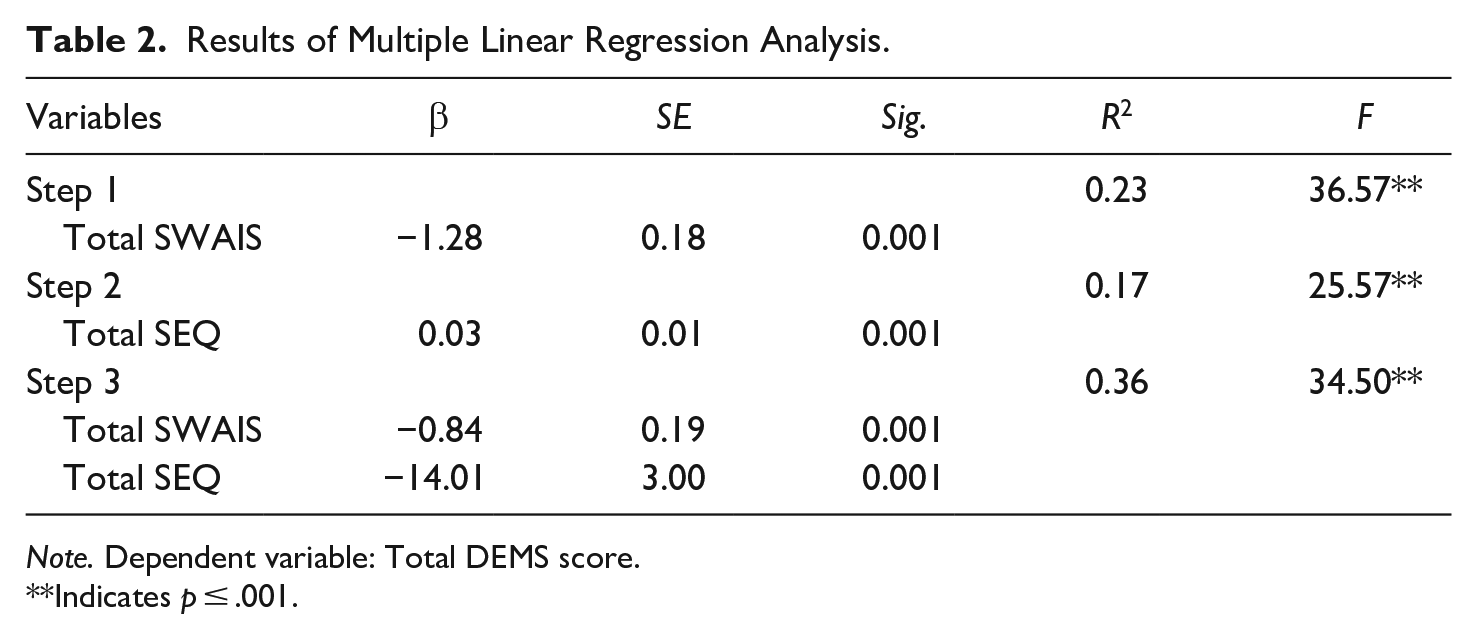
Note. Dependent variable: Total DEMS score.
Indicates p ≤ .001.
Discussion
While relationships between students and teachers has been shown to predict high school drop-out (e.g., Quin, 2017), the present study sought to investigate working alliance as a framework for conceptualizing this relationship. Working alliance has shown promise as a useful construct in predicting school-related outcomes (Toste et al., 2015). The results of this study contribute to the development of Finn’s (1989) participation-identification model by finding support for the application of working alliance in teacher-student relationships in predicting student reported risk of drop-out, and of engagement as a critical mediator in the association.
An important difference in this study relative to earlier work is the use of an adolescent sample. First, adolescents have undergone greater brain maturation (Fuhrmann et al., 2015) and may be better able to differentiate between different aspects of collaboration with their teachers compared to younger children. Second, secondary school students have several teachers and we do not know if adolescents develop a sense of relationship with the faculty as a unit, rather than with an individual teacher as in elementary school. The SWAIS queries students’ perception of relationship with all teachers as opposed to an individual teacher, which demonstrated that working alliance was a valid way of conceptualizing and measuring relationships between adolescents and their group of educators.
Results indicated that students’ perception of working alliance with their teachers predicted student reports of risk of drop-out. Student-rated working alliance alone predicted 23% of the variance in reported risk of drop-out, a medium to high effect size. This is consistent with or greater than the effect size seen in literature evaluating the effect of teacher-student relationships on reported risk of drop-out, which is typically of medium strength (Krane et al., 2016). The conceptualization of teacher-student relationships as school working alliance appears to be as effective as previous formulations, while tapping the element of collaboration that has been seldomly investigated to date. However, this association was mediated by engagement. While school working alliance appeared to predict reports of risk of drop-out, a large part of this effect occurred through the intercession of engagement. Students who had poor school working alliance with their teachers, and reported a combination of poor emotional bond or poor collaboration on goals or tasks, were more likely to be disengaged in school. In turn, those students that were disengaged in school were more likely to report behaviors that put them at risk of dropping out of school. Alternatively, students who perceived positive school working alliance with their teachers were more engaged in their classroom work, which in turn was associated with reports of reduced risk of drop-out.
The literature on teacher-student relationships in high school has been inconsistent regarding teacher-student relationships and student engagement. Considering the structure of high school, students must divide their day between multiple teachers. Interactions also tend to be less frequent but also less personal, more formal, and more evaluative (Lynch & Cicchetti, 1997; Murray et al., 2014). Historically, some researchers have argued that due to these changes in structure, students become less connected with teachers as they enter high school (e.g., Hamre & Pianta, 2001; Murray et al., 2014). However, there is also evidence supporting the protective role of teacher-student relationships in adolescence (Krane et al., 2016; Quin, 2017; Roorda et al., 2011). In a meta-analysis of teacher-student relationship literature, Roorda and colleagues (2011) argued that teacher-student relationships may be more important in high school. They determined that effect size of associations between teacher-student relationship and student engagement increased with student grade level. Considering the findings of the present study, the regression between SWAIS total scores and engagement scores had a medium effect size, on par with the effect sizes seen in the literature when evaluating the relationship between teacher-student relationship and student engagement (Roorda et al., 2011).
These results also contribute to the teacher-student relationships literature by suggesting a different mechanism for the effect of teacher-student relationships on engagement. The association between teacher-student relationships and engagement had previously been explained in terms of attachment or self-determination theory (e.g., Krane et al., 2016; Roorda et al., 2011); when students feel emotionally secure, or when their basic needs of autonomy or competence are fulfilled, they become more engaged in the school tasks. These aspects of the relationship have been shown to be important but working alliance also emphasizes the collaborative nature of the working relationship. While the SWAIS includes items related to attachment or bond (e.g., trust), it also taps into a working relationship that is more inclusive than attachment and self-determination constructs, focusing on the student’s role and the perceived collaboration with their educators. The present study is the first to investigate this significant construct in high school teacher-student relationships.
Although engagement mediated the relationship between school working alliance and reported risk of drop-out, there was also a direct effect of school working alliance on risk of drop-out. This suggests that engagement is only partially responsible for predicting the risk of dropping out of high school. This speaks to a need to further examine working alliance as a predictor of risk of drop-out and as a meaningful conceptualization of teacher-student relationships. Working alliance has been shown to relate to retention in therapeutic settings, as clients that report stronger working alliance are more likely to remain in therapy (Horvath et al., 2011). Engagement was measured only as behavioral engagement in this study. As working alliance incorporates a collaborative aspect, a cognitive process, further examination of cognitive engagement as a mediator of the relationship may be a promising direction.
Relevance to the Practice of School Psychology
The results of this research have intervention implications for school psychologists and educators. Conceptualizing teacher-student relationships in terms of emotional bond can make it difficult for educators to overcome deficits in their relationships with students. This research extends the work of Toste and colleagues (2015), and supports the importance of the construct of working alliance in a school setting, beyond the elementary school years. Specifically, school psychologists can support educators in developing ways to not only focus on building trust with students, but to also focus efforts on establishing working goals and tasks with students. Moreover, they can help teachers improve collaboration with students by explicitly seeking students’ input on their goals for their own education, as well as their thoughts on effective ways of achieving those goals. Research investigating teachers’ understanding of high school drop-out has found that while teachers report making an effort to connect with students is important, few teachers place the responsibility for student drop-out on themselves (e.g., Knesting-Lund et al., 2013). Using a working alliance framework, school psychologists can help educators to think differently about the critical role teacher-student relationships have regarding student success, and how to foster effective working relationships with students.
Our results also point to a need for greater attention and resources to be placed in relationally-based intervention and prevention programs for high school student drop-out. Within these programs, there is a need to focus on the development of social and emotional competencies for educators, as these are critical for the development of collaborative teacher-student relationships. Skills such as attunement to the social dynamics of students, communicating warmth and trust to students, and cultivating a sense of mindfulness of self and other (Jennings & Greenberg, 2009) are essential educator competencies that promote close and collaborative relationships with even the most at-risk students.
Past research has emphasized the bidirectional nature of student outcomes (Quin, 2017); while teacher-student relationships appear to affect student engagement, students that display more engagement and pro-academic behaviors tend to develop better relationships with their teachers. Research has also found evidence that certain student characteristics including externalizing behavior problems, as well as demographic characteristics such as race, gender, and disabilities can place barriers to the development of close teacher-student relationships (Murray & Murray, 2004; Nurmi, 2012). For example, research has found that teachers tend to report more conflictual relationships with Black students compared to White or Asian students (Murray & Murray, 2004). In their consultative role, school psychologists can help teachers and students to overcome particular barriers to forming collaborative relationships, and assist in fostering active and positive collaborations that promote both directions - improving working alliance and stimulating engagement behaviors.
This research may also have implications at the policy level. School boards concerned with student drop-out and disengagement can utilize school psychology staff to encourage educators - including principals, teachers, and guidance counselors - to actively aim to build collaborative environments with students in establishing goals for their education, ultimately leading to more behavioral engagement.
Limitations
A primary limitation of the study was the small sample size, which reduced the power of the analyzes and may limit the generalizability of the findings. Another potential concern of the study is the cross-sectional design that limits the ability to draw conclusions about the direction of the associations. Future studies would benefit from measuring several time points. A third causal factor, such as learning disabilities, could be responsible for the associations seen in the results since research documents links between learning disabilities and lack of school engagement (Reschly & Christenson, 2006) as well as less close and more conflictual relationships between teachers and students with disabilities (e.g., Murray & Murray, 2004). It is also possible that the measures used did not effectively detect changes in engagement. This study measured student engagement in behavioral terms, querying attendance, attention, and focus during class. However, recent research has increasingly conceptualized engagement to include psychological, emotional, or affective engagement (e.g., Quin, 2017). Students may continue to be behaviorally engaged but become disengaged in less overt ways that were not measured in this study. Further research may be needed to clarify this distinction.
Conclusion
Despite limitations and the need for further research, this study makes important original contributions to the existing literature in the fields of teacher-student relationships and working alliance. The results of this study demonstrate the usefulness of working alliance as a conceptualization of relationships between students and teachers in a high school setting and broadens the understanding of relationships by including a collaborative element, rather than simply emotional attachment. Furthermore, this study underscores the potential value of the variable of working alliance in research and opens new avenues for investigation.
This study also contributes to our understanding of factors related to school engagement and risk of school drop-out. An effective working alliance between students and their teachers, defined in terms of the emotional bond as well as the collaboration on goals and tasks, predicts a student’s engagement in school, and ultimately their risk of dropping out of school.
Footnotes
Declaration of Conflicting Interests
The author(s) declared no potential conflicts of interest with respect to the research, authorship, and/or publication of this article.
Funding
The author(s) disclosed receipt of the following financial support for the research, authorship, and/or publication of this article: The authors received financial support from a research fellowship from the Social Sciences and Humanities Research Council of Canada.
