







Abstract
This article reviews perceptions of Canada’s public and health professionals regarding access and quality of healthcare. Principal data sources were 13 sequential Health Care in Canada (HCIC) surveys, from 1998 to 2018. Over time, the data series reveals that an increasing majority of the public report receiving quality care, rising from a national average of 53% in 2002 to 61% in 2018. Regionally, the variation in quality care has been relatively narrow, ranging from 52% in the Atlantic and Prairie provinces to 65% in Ontario in 2018. Professionals’ ratings for delivery of quality care in 2018 were slightly higher than the public, averaging 65% and ranging from 58% among nurses to 72% and 74% among physicians and administrators. Despite the favourable ratings received for quality of healthcare, a persistent and growing issue in all regions of the country is concern around timely access to care. In 1998, 4% of the public rated prolonged wait times as a concern; in 2018, 43% rated it as their greatest concern. Regionally, the variation in 2018 ranged from 34% in the Atlantic provinces to 49% in Alberta. This concern about timely access involves all major components of healthcare delivery and is anticipated to worsen. Proposals to improve timely access have been suggested, with interdisciplinary, team-based care being the most strongly supported proposal. The Canadian Medicare system is currently recognized as a valued component of our national identity. However, sub-optimal access continues to undermine quality of care. In the absence of improved access, healthcare quality and outcomes will also remain sub-optimal.
Introduction
Canada’s universal healthcare system, Medicare, continues to embrace and evolve the ideal of putting patients first. 1 Although its early development was not without discord, the Canadian public and health professionals have come to embrace Medicare as an integral part of the national mosaic. An accompanying evolution has been the increased focus on measurement, person-centred care, and end-of-life care. 2 –6
To facilitate evidence-based healthcare strategy and implementation, the Health Care in Canada (HCIC) partnership and surveys were initiated in 1998. The objective was to regularly measure and timely report on the public’s and a broad spectrum of healthcare professionals’ opinions on Medicare’s operational performances, challenges, and opportunities. 2 –7 The purpose of this article, reviewing data from all 13 HCIC surveys, from 1998 to 2018, is two-fold: first, to provide an overview of Medicare’s past and present, focusing on stakeholders’ perceptions of quality care, with a focus on timely access to care, and second, to report priorities to improve future care.
About the HCIC survey
Current HCIC survey members are: Canadian Cancer Society, Canadian Home Care Association, Canadian Hospice Palliative Care Association, Canadian Medical Association, Canadian Nurses Association, Canadian Pharmacists Association, Constance Lethbridge Rehabilitation Centre/Centre for Interdisciplinary Research in Rehabilitation (McGill University), Health Charities Coalition of Canada, HealthCareCAN, Innovative Medicines Canada, Institute of Health Economics, Studer Group Canada, Merck Canada, Strive Health Management, CareNet Health Management, and POLLARA Strategic Insights that has consistently provided professional leadership regarding question design and formatting, as well as data collection and collation for all surveys—in collaboration with the HCIC members.
Data sources for all HCIC surveys have been representative samples of the Canadian public and a broad sampling of clinical and administrative health professionals from coast to coast. To illustrate perceptions of the Canadian public by region, sample groups include British Columbia, Alberta, the Prairies (Saskatchewan and Manitoba), Ontario, Quebec, and the Atlantic provinces. In recent surveys, the public sample sizes were 1,500, and the professional samples averaged 100 for each professional group: doctors, nurses, pharmacists, administrators, and other providers (including nutritionists, dietitians, occupational therapists, physical therapists, psychologists, and social workers). The number of healthcare professionals were sufficient for the analyses conducted however did not permit regional analyses for the healthcare professional categories. The sample sizes provide an estimated ±2.5% margin of error for the public responses and ±9.8% for each professional group, except for the sub-set of “other providers” where a comparable margin of error is not available.
Quality of healthcare
Canadians are healthier than ever before. Overall rates of mortality and life expectancy have improved considerably over the past several decades. 8 Despite this, the quality of the Canadian healthcare system has been called into question. For years, the US-based Commonwealth Fund has consistently ranked Canada’s healthcare system 9th or 10th of 11 nations. Among the weaknesses cited, the report calls into question a key measure of high-quality healthcare: timeliness. 9 Results from HCIC surveys administered over the past two decades indicate a similar trend. While the majority of Canadians surveyed rate the healthcare they receive to be of high quality, survey results point to a prevalent concern regarding timely access to care.
This concern regarding timely access to care is significant. A number of recognized quality care frameworks, including the framework developed by Accreditation Canada that forms the foundation of their Qmentum Accreditation Program, suggest that access is a key determinant of quality care. 10 Developed through a partnership between the Canadian Patient Safety Institute and Health Standards Organization, the “Canadian Quality and Patient Safety Framework for Health Services” further identifies accessible care as an overarching principle for safe, high quality health and social services in Canada. 11
As illustrated in Figure 1, results from sequential HCIC surveys indicate that the majority of Canadians consistently rate the healthcare they receive to be of high quality. Regionally, the public’s perception of healthcare quality has also been consistent over time, within a relatively narrow range around the national average. In 2018, Ontario and Quebec reported the highest quality of care rankings, rated at 65% and 64%, respectively, followed by 61% and 59% in Alberta and British Columbia and 52% in the Atlantic and Prairie regions.
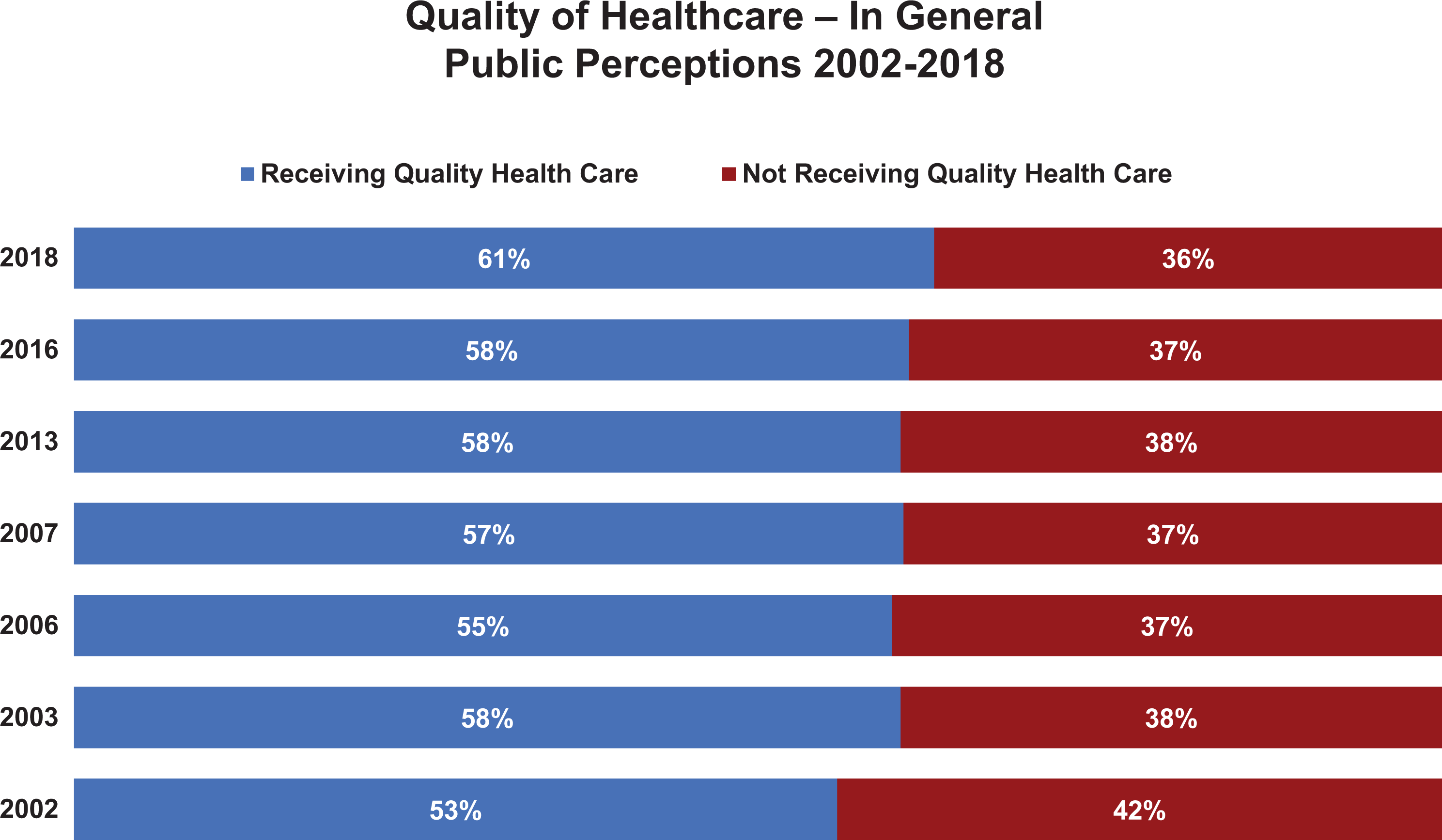
The Canadian public’s responses when asked in Health Care in Canada surveys: “Overall, would you say that Canadians are or are not receiving quality healthcare services right now?”
The majority of Canadian health professionals have also consistently rated healthcare delivered to patients over the last 20 years to be of high quality, more so than the public, as illustrated in Figure 2.
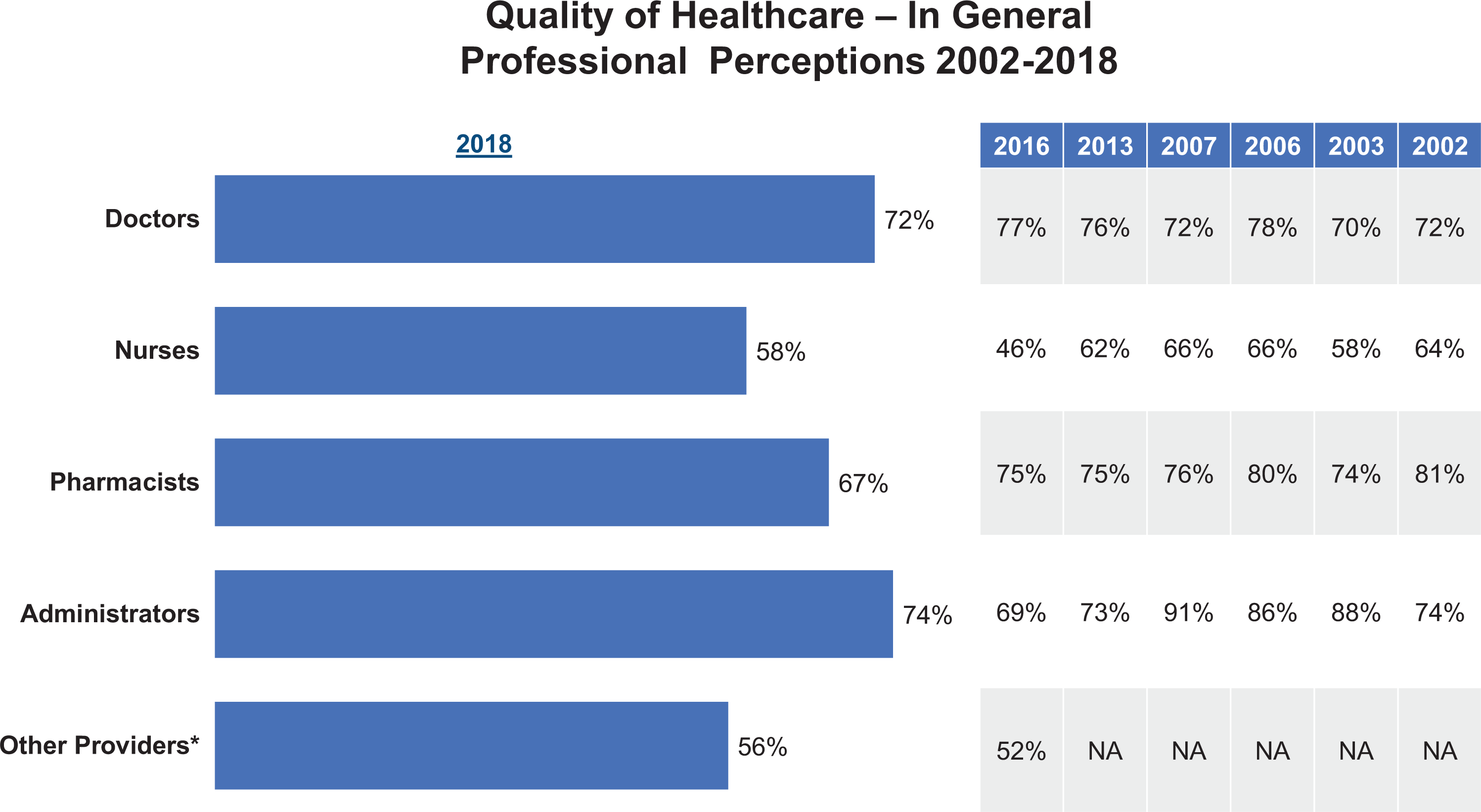
Canadian health professionals’ responses when asked in Health Care in Canada surveys: “Overall, would you say that Canadians are or are not receiving quality healthcare services right now?” *New category beginning in 2016.
Timeliness of healthcare
Canadians’ primary healthcare concern over the last 20 years has been long wait times to access care. As illustrated in Figure 3, an increasing fraction of public respondents indicate that wait times are the single most important healthcare issue facing Canada today. The majority of Canadian health professionals have also consistently ranked wait times as their primary healthcare concern (Figure 4).
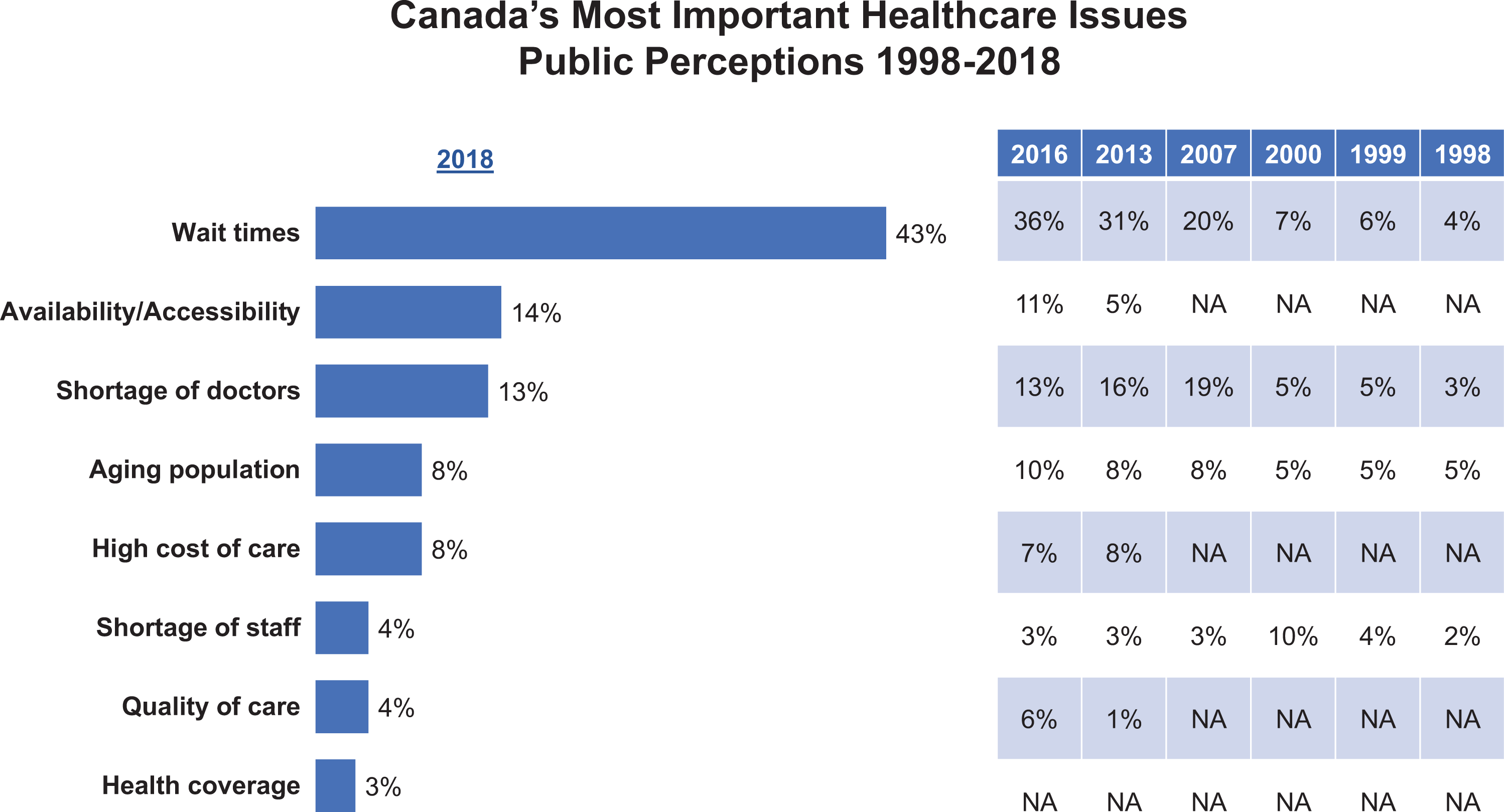
The Canadian public’s responses when asked in Health Care in Canada surveys: “What is the most important healthcare issue facing Canada today?”
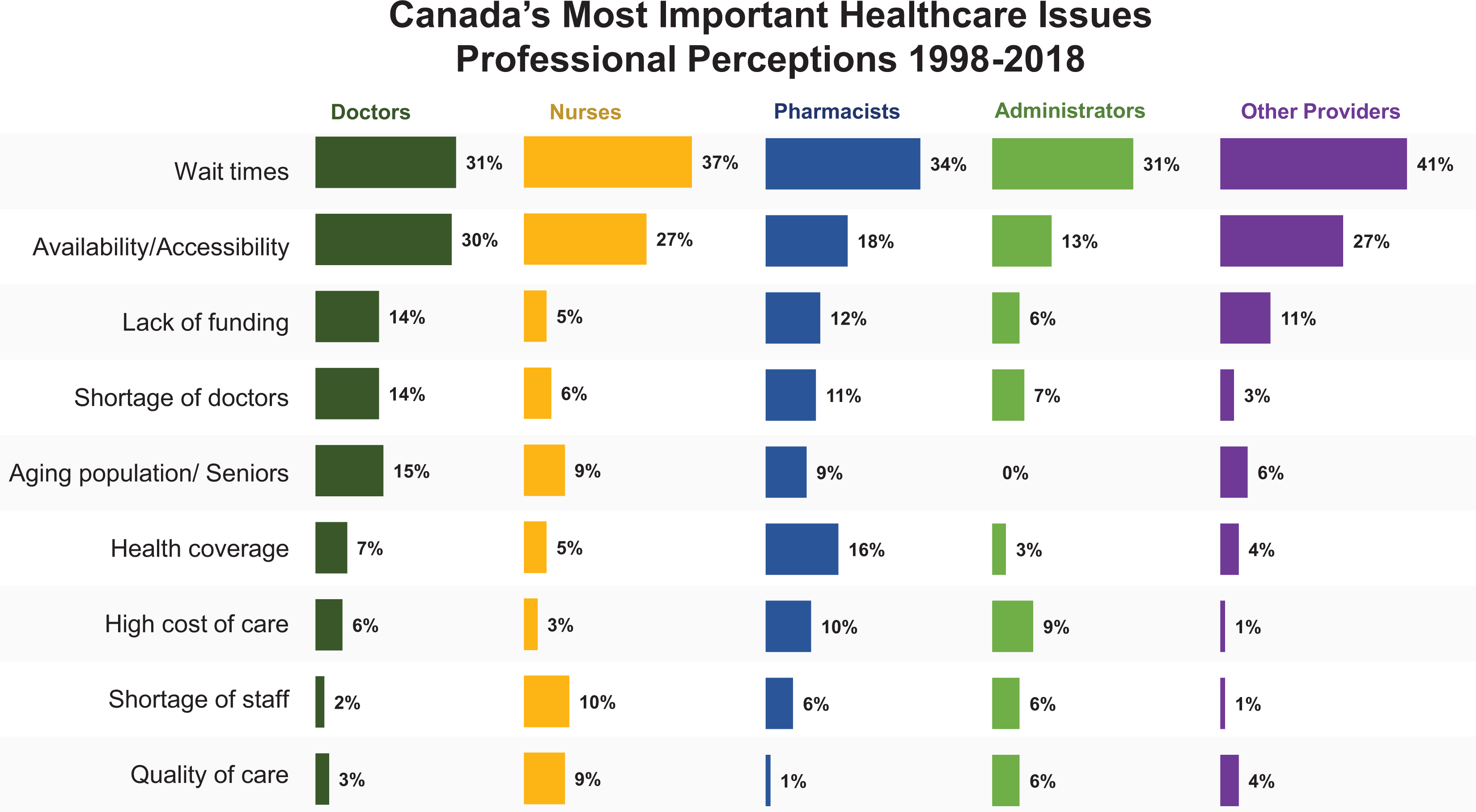
Canadian health professionals’ responses in 2018 when asked: “What is the most important healthcare issue facing Canada today?”
The HCIC survey results regarding timely access to care are consistent with the Canadian Institute for Health Information (CIHI) report entitled “How Canada Compares.” 12 Based on the results of a 2016 Commonwealth Fund survey of adults in 11 countries, the CIHI report suggests that Canadians wait longer for healthcare than in other countries. In the CIHI analysis, 43% of Canadians reported being able to get a same- or next-day appointment with their family doctor, compared to the international average of 57%. Canadians also reported the longest wait times for specialists, with 56% waiting longer than 4 weeks to see a specialist, compared to the international average of 36%. Following their visit, however, Canadians are generally happy with the quality of their care, with 74% indicating that they received excellent or very good care from their doctor, which is above the international average of 65%.
When asked to consider whether timely access to care has improved over time, HCIC survey results strongly indicate that the public does not believe change is occurring in the right direction. Rather, the reported change for timely access to care over the last three surveys, including many key services, appears to be on a continuing, downhill trajectory.
Health professionals’ views support the likelihood of worsening negative perceptions of timely access to care. Interestingly, however, there is a quantitative difference between the opinions of clinical care professionals and professional administrators. Among administrators, perceived improvement in timely access is considerably more prevalent than the evaluations of their clinical colleagues.
Priorities to improve care
Consistent data from the sequence of recent HCIC surveys suggests that the Canadian public and health professionals have a strong interest in policies to improve care. The public favours enhanced and enabled team-based care, allowing professionals to work to their full scope of practice. Eighty percent of the public supports enhanced team-based care. An increase in medical and nursing enrolment and training is also supported, with 73% support. Canada’s health professionals closely reflect the public’s preferences for future policies to improve patient care, particularly increased team-based care. Sixty-four percent of physicians, 85% of nurses, 91% of pharmacists, and 82% of administrators support this proposal.
Although Canada’s public and health professionals perceive a high quality of care, they remain concerned over the timeliness to practically acquire care. Most stakeholder groups predict this dichotomy of perceived care quality and untimely access will continue, although health administrators have a more optimistic view, with 39% indicating that timely access over the past 5 years has improved, compared to 10% of physicians, 16% of nurses, and 11% of pharmacists.
The difference between the opinions of clinical care professionals and professional administrators is significant. While administrators perceive some improvement in timely access, clinicians and the public are less optimistic. This suggests that the closer one is to the point of care, the more concerned one is about the system. It is essential that planning for policy and operational changes to improve access and quality of care must involve extensive consultation with stakeholders representing a breadth of experience—including clinicians, allied health professionals, administrators, patients, and the general public.
Where to from here?
Six in 10 Canadians believe they are receiving quality healthcare, which has been a consistent finding over the past 15 years. With public perceptions of quality care steadily on the rise since the early 2000s, one must consider that this increasing perception of quality healthcare may be due to the Government of Canada’s establishment of a Primary Health Care Transition Fund (PHCTF) in September 2000.
Over a 6-year period, from 2000 to 2006, the PHCTF supported provinces and territories in their efforts to reform the primary healthcare system. Specifically, the Fund provided support for the costs associated with introducing new approaches to primary healthcare delivery, such as the introduction of multi-disciplinary teams. Although the PHCTF was time limited, the novel approaches it supported have had a lasting and sustainable impact on Canada’s healthcare system. 13
Timely access to care continues to be the biggest challenge our healthcare system faces, with perceptions of this problem worsening each year. Wait times and access to care are becoming increasingly problematic for Canadians, yet Canadians are generally happy with the quality of care they receive. Why, then, does quality of care in Canada appear to be improving, while wait times and access to care are seeming to worsen?
As in other high income countries, a major demographic shift linked to an increasingly aging population is underway in Canada. As a result of this trend, our healthcare system is struggling to manage increased chronic disease. The HCIC survey results suggest that half of Canadians suffer from one or more chronic health conditions. One in 10 Canadians have been hospitalized in the past year as a result of their chronic conditions, and one in six has been seen in the emergency department. As acute care hospitals are increasingly required to care for patients with long-term and complex illnesses, they experience overcrowding and longer wait times.
Improving healthcare practices and outcomes is a worthy goal for any population. So, how might we reduce wait times and improve timely access to care? The responsibility for health system improvement is distributed across the entire continuum of care, but as we have seen through the Government of Canada’s establishment of the PHCTF, federal investment in new and innovative approaches to care delivery, such as the introduction of team-based care, has a significant and lasting positive impact on the healthcare system.
A national public opinion poll of 1,500 Canadians conducted in May 2019 by Abacus Data for the June National Health Leadership Conference organized by HealthCareCAN and the Canadian College of Health Leaders further suggests that equal access to quality care is a core problem facing Canada’s health system, and Canadians are looking to the federal government for leadership. The results suggest that one in two Canadians, or 54%, wanted healthcare to be a focus of federal political parties in the October 2019 federal election. 14 Key findings from Canada Speaks! 2019, a national public opinion poll on health research and innovation, suggest that an overwhelming majority of Canadians, 86%, were more likely to vote for a candidate who supported increased funding for health and medical research. 15
When asked to consider the impact that investment in research, innovation, and technology would have on quality of care in Canada, 55% of Canadians believed that doubling the funding for health research and innovation would reduce response and wait times, and 52% of Canadians believed that these investments would improve patient care. When asked to consider the impact that heavily investing in the digitization of health records throughout the country would have on quality of care, 49% of Canadians surveyed believed that the digitization of health records would reduce wait times and 46% believed that these investments would improve patient care. 14
Canadians believe that equal and timely access to quality care is a core problem facing Canada’s health system. A number of survey results indicate that federal leadership in this area is needed. Innovative models of care, such as team-based care, and investments in research, innovation, and technology are seen as solutions. In consideration of policies aimed at improving access and quality of care, it is essential that health leaders and federal policy-makers consider the impact and importance of investments in these areas.
As Canada’s healthcare system evolves, it is imperative that health leaders and policy-makers extensively explore and better understand the challenges and uncertainties facing Canada’s health system. In particular, can key impediments to timely access be improved? If not, then an improved quality of care for all Canadians may slip away.
Footnotes
Data accessibility
Data Access Health Care in Canada raw data, owned by Merck Canada, are overseen by McGill University, Montreal, Quebec, Canada. HCIC data can be accessed via request to:
Funding
The Health Care in Canada survey is supported by HCIC member organizations, with financial contributions in 2016 and 2018 from Merck Canada. The HCIC Knowledge Translation Committee received financial support from Merck Canada (2016, 2018) and Innovative Medicines Canada (2018).
