






Abstract
As demand for homecare services continues to rise, homecare worker retention remains a critical issue for the sector which impacts access to care and operational efficiency. To design evidence-based retention policies within a fiscally constrained context, it is important to understand the sector-specific costs of turnover. Using data from a large homecare provider organization in Ontario, Canada, we have developed the first known homecare Personal Support Workers (PSWs) cost of turnover estimate. We estimate a turnover cost of $22,000 (CAD 2024) per homecare PSW, based on an employer-level homecare-specific model. The primary driver of turnover costs was opportunity costs from reduced capacity; other more direct costs such as recruitment and training were smaller contributors. Decision-makers at both the organizational and broader health system level can use this estimate in considering the cost-benefit ratio and return on investment of interventions designed to promote the retention of homecare PSWs, such as enhanced training, benefits, and preceptorship programs.
Introduction
Global healthcare systems have an increasing reliance on homecare to meet the needs of ageing populations. 1 Health workforce stability is required to create a basis for the growth that is needed to scale homecare capacity to meet this rising demand. Currently, the homecare sector faces some of the lowest retention rates in healthcare. 2 Frequent employee turnover reduces the availability and consistency of homecare providers, increases system costs to provide care, and introduces inefficiencies for healthcare employers. The impacts of turnover are uneven, with variations by occupation and sector. In particular, Personal Support Workers (PSWs) in homecare have some of the highest turnover rates (44-65%),3,4 exceeding those observed for hospital-based nurses (15-44%) 5 and physicians (5-7%). 6 Homecare PSWs have a higher likelihood of leaving their jobs compared to those working in the hospital and long-term care home sectors,7,8 with commonly-reported reasons including low wages, stressful workloads, precarious employment, and high rates of injury.9-12 With heightened demand for homecare services to support ageing in place, efforts to reduce turnover to achieve workforce scale and stability are needed to meet health system requirements.
Turnover imposes avoidable and often-hidden costs which are incurred to replace staff. In a not-for-profit organization, this results in a reduction of available funds for reinvestment in direct care, education, and other improvements. Managing the impacts of employee turnover also affects the productivity of the whole organization, reducing the potential for growth in the care workforce and limiting access to care. Beyond the impact on individual care provider organizations, this is a vital societal-level concern when healthcare systems consistently struggle to meet demands for care, in large part due to a scarcity of healthcare providers. In homecare, where infrastructure demands are limited, the availability of skilled healthcare providers is the key barrier to growing healthcare system capacity and alleviating pressures on the broader healthcare system. As retention interventions typically include a monetary cost, benchmarking the cost of turnover can inform data-driven resource allocation decisions for workforce stability.
The costs of turnover are difficult to quantify because they are spread across a range of organizational departments and activities. While cost of turnover estimates for homecare PSWs are lacking in the current literature, estimates are available for nursing. In the United States, average hospital nurse turnover costs are often reported at 0.75-3.0 times an employee’s salary 13 and one Canadian study found the average cost of turnover per nurse to be $25,000 (CAD in 2001). 14 While these estimates do provide a healthcare-based reference point, the multitude of distinctions between hospital nurses and homecare PSWs necessitate differences in the calculation of turnover costs for employers. 15 Estimates of nursing turnover costs in institutional environments have commonly been based on the Nursing Turnover Cost Calculation Methodology (NTCCM). 13 This has recently been updated and adapted to reflect current human resources tools and practices as well as the pay-per-visit basis upon which most homecare in Canada is provided. The resulting Homecare Cost of Turnover Model (HCTM) 15 provides a basis for developing a specific cost estimate for homecare PSW turnover.
Objective
The objective of this study was to provide an estimate for the cost of turnover of PSWs in the homecare sector at an employer level, guided by the HCTM. 15
Methods
The HCTM was applied to estimate the cost of homecare PSW turnover from an employer perspective. This model identifies turnover-related costs experienced by homecare employers operating under pay-per-visit models in both the pre- and post-hire phases.
Data Source
Using data from a large homecare organization located in Ontario, Canada, we collected PSW-related employee turnover and costing data from relevant organizational departments from January 1, 2024, to December 31, 2024. Most inputs were captured precisely within organizational records (e.g., visit volumes, costs and revenues per visit, referral rejection rates, visits fulfilled by subcontractors, direct salary and supply costs, and software licences); costs that were not routinely recorded were calculated using estimates provided by subject matter experts within each applicable department (e.g., time to complete required activities and extra time required for supervisors and coordinators to support new hires).
Key Metrics and Definitions
Turnover Rate
PSW turnover was calculated in alignment with the ISO 30414 standard (2025)
16
as:

In this equation, the number of terminated PSWs captures all PSW departures for any reason (voluntary or involuntary).
Turnover Costs
Application of Homecare Cost of Turnover Model (HCTM) to PSWs
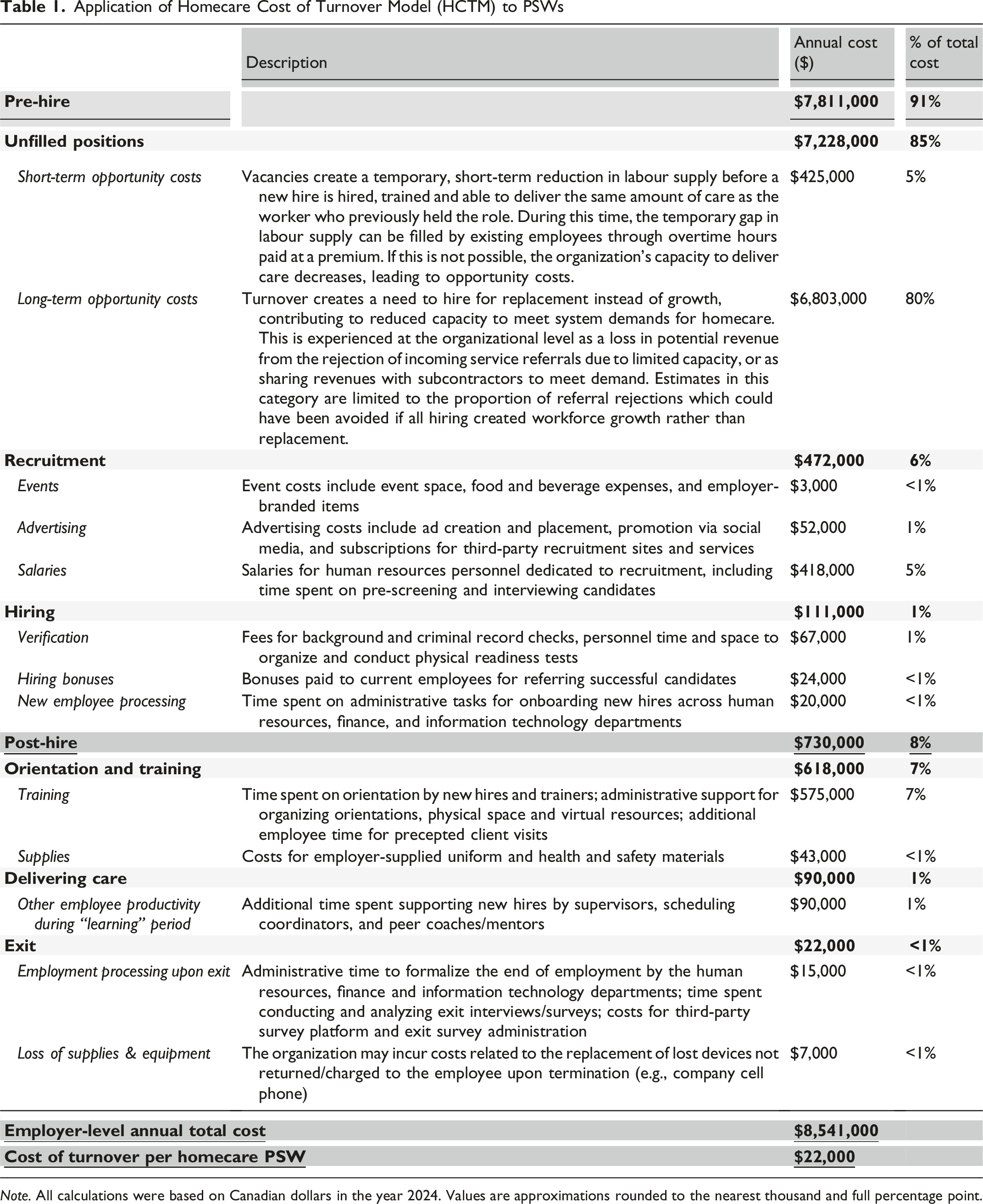
Note. All calculations were based on Canadian dollars in the year 2024. Values are approximations rounded to the nearest thousand and full percentage point.
Results
Details of each cost input are provided in Table 1. The PSW turnover rate at the case organization during the study period (calendar year 2024) was 23%. During the study period, the proportion of new hires who replaced outgoing PSWs rather than contributing to a growth in capacity was 85%. The estimated annual cost of turnover for the study period was $8.6 million or $22,000 per PSW who left employment during that year.
Opportunity costs related to unfilled positions accounted for 85% of the total cost of turnover. The greatest cost contributions were from the loss of growth potential when new hires replace outgoing staff (85% of PSWs hired in 2024), rather than contributing to new growth in a care economy where demand exceeds supply. 17 There was a smaller but still notable contribution from short-term opportunity costs, which included both overtime paid to existing staff and financial consequences related to a temporary inability to meet existing care obligations. Compared to costs from unfilled positions, other costs of turnover were minor. The second, third, and fourth largest cost drivers were related to orienting and training (7%) and recruiting (6%) new staff.
Discussion
This article presents the first known homecare PSW cost of turnover estimate at $22,000, or approximately 50% of the average Ontario homecare PSW’s annual income. 18 This cost was calculated at an employer level, based on the Homecare Cost of Turnover Model. 15 The application of this model using contemporary data provides insights to drive cost-effective and evidence-informed decision-making related to retention strategies. This cost of turnover estimate provides timely information for employers to understand the fiscal consequences of relatively high turnover rates within this occupation. This estimate also provides a valuable reference point for policy-makers working to meet rising demand for in-home PSW services, where access and continuity of care are currently limited by workforce instability and high turnover.19,20
Valuable insights into impactful areas of focus for reducing turnover costs can be gained by examining the categorical distribution of costs provided by the HCTM. The majority of costs were from the opportunity costs related to unfilled positions (85%), which is slightly higher than but comparable to estimates from the hospital nursing literature (72-78% from Jones 21 and 40-83% from Duffield 5 ). This homecare-specific estimate reveals that the financial impacts of stabilizing and expanding the workforce to address further demand for care could be substantial and would outweigh many of the costs associated with investments in retention. Comparatively, expected savings from reducing other turnover cost contributors (e.g., streamlining recruitment, training, and offboarding) would be relatively small. Examination of this categorical distribution of costs highlights how investments into relatively low-cost activities which have been demonstrated to improve retention, such as more comprehensive onboarding 22 and improving supervisory support, 20 are likely to be impactful targets for intervention by employers and policy-makers.
When comparing this homecare-based cost of turnover estimate to other sectors, it is important to understand how sector-specific payment models can affect turnover costs. The $22,000 per homecare PSW cost estimate reported here, representing 50% of the average Ontario homecare PSW’s annual income, 18 is comparatively lower than typically-reported values for hospital-based nurses, which range from 75% to 300% of an employee’s annual income. 13 In hospital settings, nurses are typically paid the same regardless of the number of individuals who receive their care, with employers absorbing the costs of reduced productivity (or other staff extending themselves to provide additional support) during the onboarding and offboarding phases of employment. In contrast, the employer does not absorb these types of productivity-related costs in a pay-per-visit system (such as the Ontario homecare system) in which PSWs are paid only for the visits they complete. The cost of homecare PSW turnover presented here should therefore be interpreted within the context of a pay-per-visit model which is already relatively efficient in terms of reducing employer costs.
Beyond the employer-level costs captured in this model, there are much broader societal-level costs and implications to homecare PSW turnover which should be acknowledged. The availability of homecare, of which the substantial majority is provided by PSWs, is vital for access to care and patient flow within the broader healthcare system. Homecare already provides the lowest-cost option to care for an ageing population,23,24 and current demand for homecare services vastly exceeds supply.17,25 Given that an estimated 40% of homecare PSWs who leave a job are not just switching employers, but are leaving the occupation or workforce entirely, 8 limiting turnover can be expected to grow the overall homecare PSW workforce. This in turn can improve homecare capacity, protect against unnecessary and expensive long-term care home and hospital admission,23-27 and increase the ability of the healthcare system as a whole to meet population-level care needs. 7 Without addressing homecare turnover, reduced homecare capacity contributes to avoidable downstream challenges and costs beyond the community, including heightened strain on the hospital and institutional long-term care sectors. At the individual client level, high turnover disrupts care continuity, reduces care quality, 28 and has been linked to increased adverse events,29,30 resulting in worsened health outcomes and higher overall costs of care. The high rate of sector-level turnover also creates additional pressures on those who remain as homecare PSWs, with heightened risk of burnout (and exit) as they struggle to meet demands for care. 31 This drives further turnover in this already understaffed sector. 25 These broader workforce-level and societal-level implications are of interest to policy-makers responsible for ensuring access to care which can meet the needs of the ageing population. 1
Across the Organisation for Economic Co-operation and Development (OECD), the majority of countries have implemented policy-level measures to improve retention of direct care workers in homecare, including wage enhancements, stress management programs for workers, and other measures designed to improve working conditions. 1 Within Canada, investments in homecare PSW retention have been made at both the federal and provincial levels. For example, a federal tax break has been offered to individuals working as PSWs, 32 while at the provincial level this focus is seen though investments into wage enhancements33-35 and retention bonuses. 36 Future policies aimed at addressing homecare PSW retention would benefit from considering the financial implications of underinvestment into this workforce, including drawing from evidence provided in this article.
As employers and governments work to stabilize and grow the homecare workforce through improved retention, evidence-based estimates of the cost of turnover create visibility into the potential value of investing in retention—such as through initiatives to enhance orientation, strengthen supervisory supports, offer professional growth opportunities, and increase compensation. These estimates emphasize the costs of inaction and supports conversations to move from a focus only on the costs of retention initiatives to more balanced financial decision-making with quantification of the potential benefits of these investments.
Limitations
The calculated costs of turnover were based on a large, urban, Ontario homecare organization operating within a unionized environment. The relatively low turnover rate within this particular organization compared to other reported rates (23% vs. up to 65% in United States homecare3,4) should be considered when interpreting these. These costs were captured for an organization which primarily provided publicly-funded homecare services, operating within a pay-per-visit model of care (versus salaried or strictly hourly payment structures), which may impact the degree to which these estimates apply in other jurisdictions and employment contexts.
This study concentrated on turnover costs for employers, but there are additional, broader implications of homecare PSW turnover, beyond the level of individual homecare provider organizations. Homecare employee turnover affects workers directly through disrupted income and increased workloads for those remaining, reduces care continuity for individuals receiving care, limits access for those seeking care, and contributes to the cost of healthcare services as individuals are more likely to receive care in more expensive settings.23-26 Additional cost of turnover modelling at a broader health system level may further support policy-makers in evaluating potential investments in sector-level retention strategies.
Conclusion
This article offers a first known published estimate of homecare PSW turnover costs. In doing so, it provides financial insights for employers and policy-makers as to where the greatest costs of turnover lie—in the financial impacts of restricting the growth of care capacity, not in the direct costs required to recruit, hire, and onboard staff. This aligns with the social impacts, where unmet needs and access to care are of primary concern across the healthcare system. The financial insights offered by applying the homecare cost of turnover model can support decision-makers in assessing the potential benefits of a wide variety of retention strategies.
Visibility into the costs of losing an employee at approximately 50% of PSWs’ salary emphasizes the financial implications of any decision which could impact retention. In the homecare sector, which has persistently experienced high rates of turnover, the presented cost of PSW turnover offers a concrete estimate to compare against when designing and evaluating evidence-informed solutions to improve retention. When decision-making about retention strategies can be based on evidence regarding both the anticipated costs and benefits of interventions, this creates the conditions for fiscally responsible and cost-effective decision-making. Downstream impacts of improved retention can include improved operational efficiency, team stability and care continuity. Policy-makers within homecare provider organizations and governments can leverage evidence on the financial impact of turnover to make targeted investments to strengthen and stabilize the homecare workforce and expand access to care.
Footnotes
Authors’ Note
This work is original and has not been published elsewhere. All listed authors have met authorship criteria and agree to its submission.

Ethical Approval
Institutional Research Ethics Board (REB) approval was not required for this study as it did not involve human participants but relied entirely on secondary analysis of aggregated organizational data.
Funding
The authors disclosed receipt of the following financial support for the research, authorship, and/or publication of this article: This article draws on research supported by the Social Sciences and Humanities Research Council (SSHRC) (430-2025-01551).
Declaration of Conflicting Interests
The authors declared the following potential conflicts of interest with respect to the research, authorship, and/or publication of this article: The authors are employed by VHA Home HealthCare at the time of writing.