







Abstract
At the end of August 1781, the combined fleets of France and Spain appeared in the mouth of the English Channel. Stormy weather and sickness soon forced them to retire to their home ports of Brest and Cadiz, and so this brief invasion threat attracts little more than passing reference in most studies of eighteenth-century Britain. This article examines the reporting of this crisis in London newspapers, which provides evidence of public interest in the navy and anxiety about the security of Britain.
Keywords
Britain and Ireland faced the threat of invasion numerous times during the long Anglo-French struggle in the eighteenth century, and the cultural impact of these threats has attracted some attention. Fear of invasion strengthened the anti-French attitudes that Linda Colley has argued were central to the forging of a British national identity. 1 The American War of Independence impacted on Britain in many ways, particularly after a large Franco-Spanish ‘armada’ threatened invasion in 1779. 2 That invasion threat inspired the formation of numerous volunteer regiments in Britain and Ireland, and campaigns for parliamentary reform aimed at making government more representative of the will of the people. And, of course, scholars have considered the various ways in which the threat of invasion impacted on Britain during the French Revolutionary and Napoleonic Wars. 3 Nevertheless, in comparison to scholarship on the impact of empire on Britain, public perception of invasion threats has been relatively neglected. 4
It is often assumed that the natural defence provided by a stormy English Channel allowed Britain to have a low taxing government that freed its economy to develop the world's first industrial revolution. 5 Revisionist historical research has revealed this view to be false. Per capita taxation in Britain was at least twice as high as in France, and the state borrowed vast sums of money to build and maintain its expensive navy. 6 Like experts in naval history today, the eighteenth-century public knew that islands were vulnerable to attack if not guarded by a formidable navy. 7 Funded by a growing public debt serviced by increasing taxes, Britain's fiscal-naval state relied on the public maintaining confidence in its financial system. Yet, this also made Britain vulnerable. Both friend and foe believed that an invasion, a damaging raid on a key naval base, or a significant disruption of trade caused by naval defeat could spark a financial crisis that would undermine Britain's military strength.
As tax and debt grew during the eighteenth century, accounting became central to political debate, with numbers tossed around in print and parliament. 8 Politicians nevertheless found it better to face protest about tax and debt than to risk the consequences of not investing in the navy. As a result, much of the debate focussed on the efficiency and effectiveness of military expenditure. As scholars have come to appreciate, vast sums of revenue could be raised by early modern states, but translating that into increased military power depended to a large extent on how well the money was spent. 9 The eighteenth-century public were aware of this and, along with the performance of the army and navy, government spending came under increasing scrutiny.
The study of empire has become increasingly prominent, if not dominant, in the researching and teaching of modern British history. 10 As N. A. M. Rodger has observed, this has fostered a widespread ‘idea that Britain became a naval and imperial power in order to plunder the rest of the world’, which is a view that ‘has too many political attractions to die merely from a lack of evidence’. 11 While vocal commercial interests championed the growth of empire, it was primarily valued as aiding the defence of Britain within the competitive context of European international relations. 12
This article discusses the response of newspapers in London to one brief and neglected ‘invasion scare’ in 1781, in order to further illustrate British anxieties and public interest in the ‘fiscal-naval state’. 13 Using the Admiralty records, David Syrett has expertly analysed the operation of the Channel Fleet in 1781. 14 Building on his work, this article details the anxious and uncertain reporting of the threat posed by the combined French and Spanish fleet, providing a detailed example of the circulation of news during an invasion scare. It then discusses public perceptions of the navy during this particular moment of threat to Britain's security.
The strategic context
Having suffered humiliating colonial losses in the Seven Years War, in the years following 1763 the French worked at building a navy that could, in alliance with Spain, outnumber the British. The American rebellion provided an opportunity for revenge. Worried about the size of the national debt, and over the protests of Lord Sandwich and the Admiralty, Lord North's government did not fully mobilise the navy at the start of the American rebellion, effectively treating suppression of the rebellion as a large police action. 15 As a result, when France and Spain entered the war in 1778 and 1779 respectively the British navy found itself outgunned. This was exacerbated in 1780 when Britain declared war on the Dutch to try to stop them supplying naval stores to the French.
In hindsight, we know that it was only in 1779 that Britain faced the threat of a major invasion during the War of American Independence. After the failure of the 1779 ‘armada’, the French and Spanish concentrated on trying to capture British colonial possessions in the Western Mediterranean, India and the West Indies, while supporting the rebellion in British North America. That said, in early 1781 the French foreign minister, Vergennes, was keen to mount another attempt to invade Britain. Yet, this was not possible owing to a lack of troop transports and opposition to the idea on the part of the Spanish and the French ministers for the navy. 16 Instead, the French agreed to support Spanish attacks on Minorca and Gibraltar, during which a combined fleet would block the mouth of the English Channel and disrupt British commerce and reinforcements. 17
In early 1781, the British decided to send a winter convoy of nearly 100 ships, escorted by Admiral Darby's Channel fleet, to re-supply Gibraltar, which was suffering a long siege by the Spanish. Yet, while busy with this relief mission, Darby missed an opportunity to intercept Admiral de Grasse's fleet of French warships as it sailed from Brest escorting 156 merchant ships and troop transports. This was to have profound strategic consequences. With a detachment peeling off for India, and reinforcements sent to the French army in North America, the rest of de Grasse's fleet sailed for the Caribbean. 18 This led to French victories in India, the West Indies, and enabled de Grasse to cut supply to Cornwallis's army at Yorktown, causing Britain's loss of North America.
Reflecting the stretched resources of the British navy, Darby's relief of Gibraltar also left the English Channel undefended in springtime. Cruisers were sent out to divert incoming convoys away from the Channel and around Scotland, yet one fleet carrying plunder from St Eustatius sailed into a French squadron in early May and two thirds of its ships were captured. This caused a public outcry, especially among merchants, and so the North Sea became a crucial alternative route for British shipping to and from the Atlantic. 19
The Channel fleet arrived home to Portsmouth in late May. With the small North Sea squadron fighting a bloody battle in early June at Dogger Bank to bottle up the Dutch, Darby's Channel fleet was left with just over 20 ships of the line. In light of the convoy loss in May, in mid-June an anxious Admiralty ordered Darby to meet and guard two incoming West India fleets. With the Jamaica convoy diverted north, Darby escorted the Leeward Islands convoy of around 50 ships into the English Channel, and after shielding an outward-bound East India convoy, ‘scurvy, lack of beer, and adverse weather’ forced him to return to Portsmouth on 9 July. 20
While Darby's weakened force was thus occupied, a French fleet of 18 ships of the line under Admiral Guichen sailed from Brest to join the Spaniards at Cadiz. At the start of July, the British Admiralty suspected that Guichen had sailed, but had no idea where he might have gone. On 12 July, Darby was ordered by the Admiralty to escort three ships of the line out of the Channel on their way to reinforce North America, and then find and fight de Guichen's fleet before he could join the Spanish (not knowing that he had already arrived in Cadiz). After some delays, Darby sailed on 19 July and began to cruise off Cape Finisterre at the start of August.
Meanwhile, on 23 July, the combined fleet sailed south, escorting soldiers on their way to attack the British garrison on Minorca. After seeing the troop ships safely through the straits of Gibraltar, the combined fleet of 49 ships of the line headed west and then north to the entrance of the English Channel. The British Admiralty did not learn of their departure from Cadiz until the end of July, and only learned of the plan to invade Minorca on 20 August, by which time the attack was under way. 21
The fog of war
In the 1770s, the reporting of parliamentary speeches had been legalised and the newspaper market in Britain was booming. 22 The politically divisive War of American Independence saw some newspapers adopt a partisan stance. For example, in 1781, the Morning Herald was obviously supportive of Lord North's ministry, while the London Courant was relentlessly critical – accusing the Herald of being a ‘filthy and scandalous paper … patronized and pensioned into existence by a nefarious and callous-hearted administration’. 23 Yet, any financial inducements to adopt a political line were negligible compared to the scale of profits made from advertising and mass circulation. Newspapers competed to provide the best and most accurate information, and advertised their claims to superior quality sources. Aside from interest in Britain's strategic security, many readers had investments or employment linked to maritime trade that could be disrupted by war. By the time of the American Revolution, according to Troy Bickham, the British press had created a ‘hypercritical environment in which every move of the nation's politicians and generals underwent close public scrutiny’; and ‘ministers of state regularly read about war events at the same time as the rest of the newspaper reading public’. 24
The phrase ‘the fog of war’ is particularly applicable to naval operations in the age of sail. Sightings of enemy ships were often fleeting and uncertain, and messages took days or weeks to travel between admirals and the Admiralty. Newspapers were filled with accounts based on ‘advice’ from merchants and political contacts, letters from the Continent and naval officers, and reports from merchant ships recently arrived in British ports. The state of naval affairs at any point could only be guessed at based on uncertain recent reports, with only the position of fleets in past weeks being known with any confidence. The further away the theatre, the further back in time one could be confident of events. News from America, for example, took at least a month to reach London.
The Admiralty's uncertainty about the movement of enemy fleets in mid-1781 was echoed in the newspapers. Throughout June and July reports appeared of the French fleet at Brest preparing to sail and join with the Spanish, and that the 110-gun Majestueux had left Toulon to join them. 25 In mid-July, it was reported that the ministry have ‘authentic intelligence’ that a ‘formidable squadron’ of French ships had sailed from Brest and were expected to join the Spanish off Corunna, forming a combined fleet of over 40 ships of the line, with the intention of attacking the Channel Islands of Guernsey and Jersey. With Darby having returned to port, the London Courant sarcastically observed that ‘the same good look out is still continued by our naval commanders, as has distinguished us throughout the war’, while at ‘the very moment the French fleet came out of Brest, Lord Sandwich's admiral came away’. 26
In early August a letter from a Spaniard in Cadiz dated 4 July appeared in the newspapers declaring that ‘there is an extraordinary bustle’, with soldiers and generals having ‘rendered the town as noisy as the port’. Everyone was expecting that Gibraltar would be attacked and hoped the French would soon join them from Brest. The Majestueux had already arrived and ‘nothing will be able to stand before the combined fleet’. 27 In mid-August, various reports were published of the combined fleet having sailed from Cadiz with around 50 ships of the line. 28 The St. James's Chronicle noted that ‘the attention of the public is at present principally taken up with two objects, each of no small concern to Great Britain’. The first was the sailing of the Combined Fleet from Cadiz in late July:
not with the design, as is now pretended, of attacking either Gibraltar or Minorca, but of going, as some think, to intercept our ships coming home from the West Indies, after which they are to proceed to Jamaica. If, as is asserted, they have indeed more than ten thousand troops on board, with six months provisions, this destination of them may not be impossible; but their real object has been kept such a profound secret, and so many contradictory reports have been purposefully thrown out to disguise it, that it must be confessed the whole remains at present involved in mystery. 29
The second object of concern was the destination of a convoy of troop transports seen near Guernsey. The ‘general opinion’ was that they were merely shifting base from St Malo to another port in the bay. But if so, why risk sailing so far out? Some would also have read a letter from Paris in the London Courant that reported: ‘The march of large bodies of our troops toward Brest is the only intelligence we receive from our ports.’ 30 In what amphibious operation might they be employed?
With reports arriving from the Continent, by late August it appeared the combined fleet had supported an attack on Minorca. 31 At the same time, there was an air of confidence in the press about the security of home waters. According to the London Chronicle, Darby was heading to Gibraltar with 25 sail of the line, and as they were ‘the flower of the navy, 12 of them three-deckers, and all of them most completely officered and manned, it is thought he will give the combined fleet battle, if they dare to meet him’. 32 With merchant fleets expected to arrive from the West Indies, the pro-government Morning Herald assured readers that the ‘convoys will keep so far to the northward, there is very little fear of their falling in with the combined fleet; for while Admiral Darby keeps the sea, he will lie between the enemy and our commercial fleets’. 33 And the Public Advertiser noted that ‘the arrival of the West India fleets will provide near 3,000 seamen, which will equip six ships of the line, that will be ready for sea about their time of coming home’. 34
While cruising off Cape Finisterre, on 17 August Admiral Darby was warned by a Portuguese merchant ship that it had seen a large combined fleet sailing for the English Channel. Greatly outnumbered, Darby sailed back to protect the Channel and anchored in a defensive crescent at Torbay on 24 August. 35 On the same day, the Morning Herald noted unconfirmed reports that the combined fleet might be ‘in or near the British Channel’. 36 Four days later, most newspapers remained sceptical. ‘The town were yesterday morning pretty much alarmed by an account, in some of the morning papers, that the combined fleet, to the number of 66 sail of the line, had appeared off the Lizard,’ observed the St. James's Chronicle. Yet, it assured readers the report was probably caused by ‘the appearance of Admiral Darby's squadron off Torbay’. 37 Others assured readers that the combined fleet was busy supporting attacks on Minorca and Gibraltar, and that the captain of the Portuguese ship must have mistaken a merchant convoy for the enemy fleet. 38 The Morning Chronicle observed that the ‘conjecture’ that it was the combined fleet that the Portuguese ship had seen ‘is highly improbable’, and that there was certainly no ‘ground for alarm for the safety of our coasts, Admiral Darby being at this time in Torbay’. The next day, however, the same paper reported that the Portuguese ship had docked in Cork, and the ‘probability’ of its having seen the combined fleet was strengthened by the ‘certainty’ that the enemy's French West India and Spanish Mexico convoys were homeward bound. These fleets would need to be protected, because if captured ‘Spain could no longer carry on the war for want of money’. 39 Yet, on August 31, the Public Advertiser declared ‘it is now generally believed by Government’ that the report of the combined fleets in the Channel ‘was a manoeuvre of the French’ to distract attention from their operations in the Western Mediterranean. 40 With the official government newspaper, The London Gazette, silent on the issue, the Whitehall Evening Post thought ‘it extraordinary that one morning paper should be so positive, through the whole of this week’ that the combined fleet were in the Channel, while no other paper was ‘hardy enough to flatly contradict it; and yet the fact is not ascertained!’ It expressed frustration with government in this ‘important affair’ for not telling the public the whereabouts of the combined fleet, as ‘they certainly know, or ought to know’. 41
In fact, the Admiralty was not certain. With unreliable reports circulating, on 31 August the Admiralty agreed that Darby should stay at Torbay, but send some cruisers to intercept and divert two incoming West India convoys. With a second convoy from the Leeward Islands also inbound, the Admiralty scrambled numerous cruisers to find and escort them north and away from danger. 42 On 1 September, Darby received a letter from Admiral Shuldham, commander at Plymouth, reporting that HMS Agamemnon had encountered the combined fleet on 30 August west of the Lizard and counted it at between 44 and 47 ships of the line.
The Admiralty received this report on 3 September, along with intelligence from the continent confirming the combined fleet was west of the Scilly Islands and numbered 49 ships of the line. 43 On that day newspapers were still variously reporting that the combined fleet was ‘at the entrance of the Channel’, with a squadron ‘cruizing on the coast of Ireland, to intercept the English merchant ships’; was sailing from Cape St Vincent to the Azores; and was preparing to intercept any British reinforcement for Gibraltar. In this climate of uncertainty, anxiety was expressed for the two incoming British West India convoys said to be worth nearly £4 million. 44
The next day, London newspapers reported that many ‘letters and advices’ appeared to confirm the enemy was in the Channel. The St. James’s Chronicle observed that some merchants still doubted the truth of the reports, arguing that ‘they derive from the invention of Underwriters, who have cunningly propagated such rumours, to raise the price of insurance’. Yet the ‘general opinion’ now accepted the ‘truth of this intelligence’. 45 The London Courant reported that the commanders at Plymouth had distributed ‘70 ball cartridges to each man’ and regiments were marshalling at Roborough Down and Ashburton. 46 With a full board of the Admiralty meeting, the Public Advertiser reported that messages had been sent to all ports to ‘stop the sailing of all trading vessels’. 47 One letter to the newspaper reflected the sense of crisis, saying that ‘the present moment exhibits Great Britain and her dependencies in such a state as the world never saw’. While suffering defeats in North America, convoys in danger, Minorca invaded, and Gibraltar besieged, ‘the grand consideration of all is – Great Britain … is herself besieged and environed by Enemies all round!’ 48
Invasion?
The Admiralty assumed the objective of the combined fleet was to intercept West India convoys. They had no reports of an invasion force gathering on the French coast and the autumn weather would soon turn against amphibious operations. It was possible, however, that the enemy might intend a ‘descent’ on Ireland or an attack on the naval base at Portsmouth. 49
The newspapers were full of reports and speculation about the aims of the combined fleet. Accounts came in from foreign merchant ships that had passed through the fleet. One said they were near the southwest tip of Cornwall in three divisions under ‘close reefed top sails’. 50 An Italian ship arrived in London reporting that they were 60 sail, and the ‘large ships had their lower ports fastened up, the better to disguise their force and pass for a merchant's fleet’ at a distance. 51
A raid on the coast of Britain was not out of the question, but this was thought unlikely. Britain had become better defended with fortifications and militia since the invasion scare of 1779. A letter from Plymouth was published, declaring they expected a ‘visit from the combined fleet … having our guns loaded, and our men in high spirits. We have near 8000 troops stationed at the different fortifications, and whenever the enemy thinks proper to pay us a visit, we intend to give them a warm reception.’ 52 Another newspaper noted a report was circulated ‘with some degree of confidence’ on 7 September that ‘the French had landed 5000 men at Plymouth … but they had been attacked, and obliged to re-embark, with very considerable loss’. Yet, the truth of this was dismissed with the claim that nobody now believed the enemy intended to attack the British coast. 53
There were, nevertheless, patriotic calls for volunteer mobilization. ‘An ENGLISHMAN’ urged that ‘in the present dangerous crisis, when we are disturbed by rebellious insurrections abroad, and threatened with powerful invasions at home, it is impossible to tell how soon every Englishman may be called on to take his share of danger in defence of the best constitution, and the purest religion under heaven.’ History, recent experience, and ‘the gallant spirit, which seems to be diffusing itself through all ranks of people’ indicated Britain would stand strong during the crisis. To ensure that there is not the ‘least degree of cool or lukewarm apathy in the national cause’, he urged all ‘enlightened’ people to expound ‘with all possible force and clearness’ the blessings of British liberty to those who are ignorant and in a ‘low station in life’. Failure to defend Britain would result in ‘the terrors and miseries of civil and religious tyranny’. Reflecting on what was at stake should inspire ‘warm and noble sentiments, which would have fired the breast of an ancient Roman on a similar occasion’. ‘This Temple of Liberty, that has stood firm so many ages … can never be shaken by the barbarous and sacrilegious hands of our invading enemies.’ 54 Similarly, the ‘historical correspondent’ for the Morning Chronicle urged that ‘under our present circumstances’ people should look back to the state of England in 1588, when Spain was the most powerful nation and Philip II had ‘a fixed hatred to protestants’, and all Europe's states had thought ‘England was doomed’. Yet, a love of ‘liberty and the Protestant religion’ kindled a ‘real patriotic enthusiasm’ and saw England defeat the Spanish threat. Hopefully a similar patriotism would now inspire the navy to ‘great actions, and convince the world that we are neither to be intimidated nor defeated’. 55
If a landing in Britain appeared unlikely, there were high expectations of a raid on the vital port of Cork in Ireland. A letter from Londonderry said that a ‘large fleet of ships’ seen off the coast ‘seemed to be steering towards Cork’. This had ‘greatly alarmed all the country, and notice was sent to different parts of the kingdom that their landing might be opposed’. 56 A letter from Dublin dated 5 September and published on the 12th said that, as a result of ‘some important intelligence received by express’, the commander in chief, Sir John Irwin, had set off for Cork using ‘relays of horses the whole way’ to ‘prevent the landing of the enemy’. 57 Another said that there was ‘certain intelligence’ that ‘the enemy were landing troops at Cloughnakilty’ in Cork. 58 A few days after this, with no landing having taken place, another letter from Dublin said that the rumour of a landing on the south west coast ‘has vanished like a dream’. 59 If they had tried to land, according to a letter from Cork, the town had ‘10,000 men within ten miles of us’, was ‘well fortified’, and ‘we were prepared to give them a warm reception’. 60 Likewise, a letter from Dublin observed that, in contrast to the ‘dismay and confusion’ in response to the small French landing in 1760, the current ‘strength and discipline of the Volunteer army’ encouraged ‘publick complacency, confidence and security’ in the face of an expected invasion. 61
Both politicians and press assumed that intercepting Britain's wealthy West India convoys was the main aim of the enemy. 62 The danger the ‘homeward-bound fleets are supposed to be in’, declared the London Courant on 6 September, ‘gives a real alarm to every person interested in its safe arrival’. It complained that, while Lord Sandwich was ‘paid for providing a fleet superior to that of the enemy’, when confronted by the pleas of merchantmen about the danger to their ships ‘his Lordship pleasantly tells them, that if they should fall into the hands of the enemy, it must be considered as the fortune of war!’ 63 A letter from Liverpool claimed that an enemy squadron of 13 sail of the line was sighted cruising in the Irish Sea, and it was assumed that this squadron intended to intercept any of the West Indian convoys who tried to sail around Ireland and dock at Bristol, Liverpool or Dublin. 64
Contrary to criticisms, the government was particularly anxious to protect the West India convoys. Their loss would cause great economic damage, public outrage and deny the British state valuable tax revenue and seamen who could be pressed into service on navy ships. At the same time, the enemy could gain considerable wealth and goods. Loss of convoys in previous years had caused bankruptcies among merchants and insurance underwriters.
65
Even unconfirmed sightings of the enemy fleet could cause stock market jitters. On the last day of August 1781, the Public Advertiser declared: The report so current for these few days past, that the combined fleets were in the Channel, was certainly propagated to answer some stock-jobbing purpose, as no information except the supposition of a Portuguese captain, has come to town … it is to be lamented that there is no way of punishing those, who for sinister purposes of fraud, give wings to rumours totally unsupported by facts.
66
When the presence of the combined fleet became more certain, underwriters reportedly stopped providing insurance for any outward or homeward bound merchant ships. 67 While the London Courant claimed on 7 September that ‘the ministerial runners were working double tides in the city yesterday’ around the stock exchange ‘in order to puff off a report that the combined fleets, driven from their station in the chops of the Channel by the strong northerly winds, were preparing to separate and go for their respective ports’. 68
Yet, Lord Sandwich and the Admiralty were confronted with difficult choices: should Darby remain in defensive anchorage at Torbay? Should he send some ships to the North Sea in case the combined fleet sent some ships to help the Dutch convoy? Should he sail to the west to shadow the combined fleet? The Admiralty was confident of the last option, as all of Darby's fleet were copper bottomed and thus faster than the enemy. 69
George III urged a policy that would have been dangerous. Keen to believe reports that a detachment from the combined fleet had gone to raid Cork, he urged that Darby sail out to engage and boldly defeat the remainder of the fleet. Sandwich was more cautious, heeding intelligence that indicated no ships had detached. For his part, Admiral Darby wrote asking for explicit orders to ensure he was not blamed for a risky operation going wrong. Sandwich tried to call a cabinet meeting, which was difficult with several members summering on country estates. On 6 September, half a dozen ministers met, including Lord North. Showing them a draft order by Middleton, Sandwich argued that Darby should use the speed of his fully copper-bottomed fleet to shadow the enemy, but avoid battle unless the enemy became divided or otherwise presented an opportunity for advantageous attack. Acting as a ‘Western Squadron’, Darby could shield the incoming convoys and the Irish coast. The cabinet agreed, and the fleet was ordered to ‘put to sea immediately’ because of ‘real intelligence’ that the West India fleet was expected to arrive in a few days. 70 Feeling that ‘I have a greater task to play than perhaps any man in my station almost ever had’, Admiral Darby warned Lord Sandwich that he would not be able to both protect the convoy and prevent a raid on Ireland; and the much larger enemy fleet might be able to use some of their own copper-bottomed ships to engage him while their slower ships came up to join battle. 71 Fortunately, however, by the time the wind allowed Darby to sail on 15 September the combined fleet had long gone.
With his ships suffering shortages and scurvy, on 5 September Admiral Cordoba had ordered the French and Spanish fleets to split up and return to their ports. While reports came in that the French had returned to Brest, it was only on 22 September that the Admiralty received firm intelligence from Paris that the combined fleet had returned to their ports. 72 ‘As in 1779,’ according to Stephen Conway, ‘sickness on board the allied armada may have spared the British Isles from attack, but on this occasion the excessive caution of the elderly Spanish admiral, Don Luis de Cordoba, was perhaps just as important.’ 73
As Darby was finally setting sail in search of an enemy that had disappeared, London newspapers were publishing an account of a ‘council of war’ that had been held by commanders of the combined fleet. According to the report, with instructions to fight the British fleet, the question they debated was whether they should attack it in its defensive position at Torbay. The French admiral Guichen urged an attack which, aided by fire-ships, could end the war ‘at a blow’. Don Vincent Doz agreed, offering to lead the attack. M. de Beauffet disagreed, however, arguing they would have to attack in single line, and thus lose their numerical advantage, making it likely they ‘would be all shattered and torn to pieces by the angular fire’ of the British. He urged a focus on intercepting the West India convoys, which would be a ‘blow which England could not recover this war’. Cordova and all six Spanish flag officers other than Doz agreed that attacking was too dangerous, and so it was not undertaken, ‘to the great mortification of the politicians of Paris’. 74
In mid-September, the British remained uncertain as to the whereabouts of the combined fleet. The Whitehall Evening Post complained that it was ‘over three weeks since the combined fleet appeared in the chops of the Channel, and the public is yet very slightly acquainted with their number, force and position, their real or apparent destination’. With ministers professing ignorance, everything was ‘in the greatest uncertainty and suspense’. There was also little information about Darby's fleet ‘on which so much British property and public safety depend’. 75
Reports began to suggest, however, that the enemy had sailed home. On 17 September, the Gazetteer observed that there were ‘letters in town’ reporting that the combined fleet had returned to their ports, but also that it been ordered to cruise in the mouth of the Channel until mid-October. To reconcile these conflicting accounts, the Gazetteer concluded they had received orders to stay out, but had been forced by sickness and storms to return to port. 76 On 20 September, the Public Advertiser was ‘pretty certain’ the combined fleet was sailing to Brest, noting that the equinoctial winds had started and it would be too dangerous to continue cruising near the rocky Scilly islands. Four days later, however, the Gazetteer said that, according to a report ‘from a very good quarter’, the combined fleet had not gone into port, and was still cruising to the westward. 77 For its part, the Whitehall Evening Post continued to express frustration at the lack of solid information from government, and that Darby's fleet appeared to have gone on a ‘wild-goose chase’. 78
The Admiralty received solid intelligence on 22 September that the enemy had returned to port, and this began to appear in the newspapers.
79
Citing a letter from Paris that said storms had forced the combined fleet to return home, the Public Advertiser declared: Thus have the alarms and apprehensions of the English; thus has ended a cruise, which might have determined the fate of England, by the capture of her homeward bound fleets, which would have forced her to sue for peace. This event is a fresh proof of the fragility and uncertainty of naval triumphs; the commotion of the elements often dashes from the victor's brow the laurels of victory.
80
A few days later, the same paper reported that the French crews who returned to Brest ‘were in a very sickly state’ and the ‘hospitals were all filled with invalids’. 81 The Morning Herald reported that the ships of ‘the late combined armada’ were in ‘so bad a state’ after getting back to port that ‘it was deemed impossible for either nation to send out another channel fleet before the middle of next summer’. 82 Britain was fortunate that a series of mistakes by the enemy had ‘put an end to an expedition, which was, in appearance, big with the ruin of this country’. 83
With the danger passed, some newspapers continued to complain that the combined fleet ‘should or should not be … six weeks in the chops of the channel without the Admiralty Board taking the least notice of it in their official capacity’.
84
And the Whitehall Evening Post declared: The combined fleet, or the shadow, the ghost of it has alarmed the nation these five weeks, as if appearing upon our coasts, without one man standing forth to say or swear that he actually saw them. Government has neither said they were there, to guard us against them, nor that they were not there, to free the people from groundless alarms, and needless difficulties and interruptions to trade and navigation.
85
Ridicule was directed at the fact Darby's fleet had sailed just before reports appeared to confirm the combined fleet had left the Channel. ‘Keeping Admiral Darby out at sea when the combined fleet is gone into port,’ the London Courant thundered, ‘is a state farce that must equally provoke the laughter and contempt of the public.’ 86 With the Channel scare over, attentions turned to the Western Mediterranean, the West Indies and Virginia, with news arriving in London on 5 October that the French navy had cut supply to Lord Cornwallis's besieged army at Yorktown.
The public and the navy
As the ‘wooden walls of old England’, and the most expensive arm of the state, the navy carried the greatest expectations. While the surrender of Cornwallis's army at Yorktown was a political disaster for Lord North's government, and led to the start of peace negotiations, it was not a military catastrophe. Britain could, and did, fight on with some success during 1782. A significant naval defeat in the Channel, however, would have been both a military and political disaster, leaving Britain open to invasion.
The eighteenth-century public appreciated the importance of weather and luck, and this was particularly so when the British navy was in a relatively weak position. In early September 1781, newspapers eagerly published reports of storms, of wreckage washing up on the Irish coast, and of French ships returning home with damaged masts. 87 Much hope was placed in the imminent arrival of ‘equinoctial winds’ that would blow the enemy home or severely damage their fleet – and for some that was the only hope given the numerical superiority of the combined fleet. 88 When it was clear that sickness and storms had driven the French and Spanish ships away, the London Courant declared that ‘never did so much good fortune attend such consummate mismanagement as appears to superintend the mercantile and naval affairs of Great Britain at present’. 89 Yet, stormy weather could only act as an aid to the navy in defending the coasts of Britain and Ireland.
The press response to the 1781 invasion scare attests to the high level of public attention the British navy attracted. 90 In the course of trying to give readers a reasonable idea of what was happening in the Channel, newspapers fed a public appetite for details about naval officers, ships and logistics – some of which appears to have been supplied by sources in the Admiralty.
Admirals commanded their fleets under a high level of public scrutiny. Thus, at the height of the 1781 invasion scare, the London Courant published a diagram showing the order of ships in Darby's defensive crescent at Torbay. 91 The Morning Herald provided a good example of Enlightenment quantification when it published a ‘SCALE of the professional talents of the FLAG OFFICERS of the BRITISH NAVY who have served in the present war’. Each admiral was given a score between 1 and 20 on each of the following ‘talents’: nautical knowledge, manoeuvring, temper, enterprise, and ‘zeal for the service’. 92 While Admiral Darby's likeable character saw him scoring 19 for ‘temper’, he was unfairly rated only ¾ out of 20 for ‘manoeuvring’ by this pro-government newspaper.
Admiral Darby was well aware that his outnumbered fleet could lose the war in an afternoon, and accordingly acted cautiously. Unfortunately for his reputation, the public expected the kind of highly skilled and risky behaviour that Admiral Hawke had demonstrated with resounding success at Quiberon Bay in 1759. 93 Eighteenth-century Britons expected their admirals to be heroes, and some used their popular appeal to play an active part in politics. 94 Criticism of Darby was intensified by the fact that during the politically divisive American War of Independence a number of leading admirals resigned and lent their weight to criticism by the parliamentary opposition. Naval historians view Darby as ‘an officer of great firmness, spirit, knowledge, and experience’ – one of a new class of professional officers that Lord Sandwich fostered. 95 But in terms of public perception, it was his misfortune to be placed in command of a significantly outnumbered Channel fleet with the best course of action being to adopt a cautious defensive position.
The newspapers were almost obsessive in counting the number of ships of the line available to the combatants. Along with varying reports of the number of ships sighted at sea, newspapers published detailed lists of the ships that admirals had under their command. 96 They also reported on the condition of individual ships. For example, after the combined fleet returned to its ports, it was reported that the 110-gun Majestueux ‘performed so badly, that they begin to talk at Brest of cutting her down to a two decker’. 97 While the British navy was slow to mobilize during the American Revolution, once the war became global the Admiralty was allowed to embark upon a large-scale shipbuilding programme, with many 74 gun ships of the line contracted for construction in private shipyards. This was a slow process, and while some of the new ships helped Britain turn the tide in the last year of the American war, others were not launched until after the war had ended. In mid-August 1781, however, the London Courant called for a parliamentary enquiry into ‘the cause of our having an inferior fleet in every part of the world’, arguing that Lord Sandwich ‘our first naval un-doer’ could not point to a lack of funding, ‘for he has had whatever sums he required; nor to any loss of ships by fighting the enemy’. 98 In response to such criticism, the Morning Chronicle's ‘Naval Correspondent’ published a detailed list of all British ships in service, under repair and due to be launched. Observing that the number of serviceable enemy ships was often inflated, he claimed the figures refuted ‘complaints so artfully and industriously disseminated of our navy being neglected, or its alleged inferiority to the combined force of our enemies’. 99 While not all of the new 74 gun ships were completed before the end of hostilities, Lord Sandwich's building programme helped bolster public confidence and produced ships that helped win Nelson's victories in the next round of Anglo-French warfare. 100
All navies in the age of sail struggled to crew their ships, and often resorted to impressment. In another example of the importance of accounting, the St. James's Chronicle published an estimate of the number of seamen in the major navies (see Table 1).
An estimate of the number of seamen in the major navies, excluding those employed ‘by the belligerents in the transport service’. St. James's Chronicle, 16 August 1781.
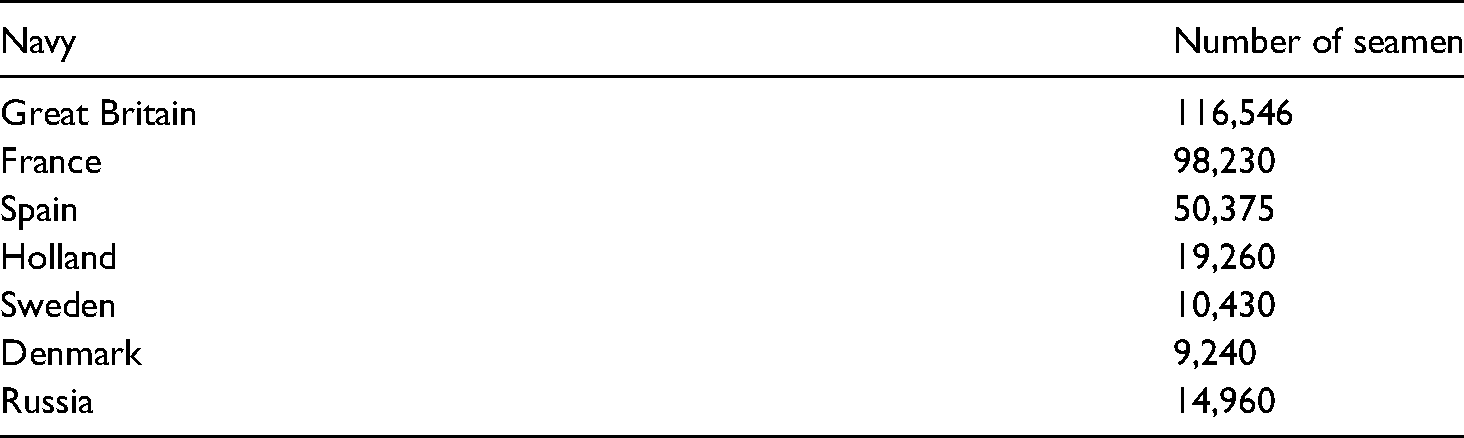
These numbers were simply listed with no comment, leaving them to be discussed in coffee house or tavern. 101 Britain's incoming merchant convoys were seen as a crucial source of skilled seamen who could be pressed into Royal Navy ships. The London Courant claimed that the loss of the West India convoys would ‘do us a greater injury than any descent on the coast of this kingdom or Ireland’ as it would both ‘give a violent blow to trade’ and ‘deprive us of the seamen’ needed to man navy ships nearly ready to be launched. 102 Newspapers also eagerly reported accounts of the enemy's manpower problems. For example, it was claimed that M. de Castries had told Louis XVI that a ‘general embargo’ on merchant shipping was required in order to man naval reinforcements for the West Indies. 103
Maintaining and supplying ships was also crucial, and Britain's sophisticated system of dockyards and contracting for food and equipment gave it a significant advantage over the French and Spanish. 104 Put simply, the British were better able to mobilise and maintain their ships at sea. While the newspapers placed most emphasis on the number of ships in service, they also noted the key role of dockyard workers. With the combined fleet in the Channel, the St. James's Chronicle reported an ‘extraordinary instance of zeal and exertion’ on the part of dockyard workers, who managed to finish repairs and coppering of HMS Anson in half the time expected, ‘to the astonishment and satisfaction of the whole place’. 105 Knowing the importance of provisions, the press published reports on the state of the Combined Fleet. Early in September, for example, it was noted that the enemy was suffering a ‘great want of both stores and provisions’ and was seizing many goods from neutral ships, but that there was also ‘a vast number of provision vessels sailing to them from France … as they mean to remain on our coasts so long as the mildness of the equinoctial winds will let them’. 106 In Britain, the Admiralty had developed a sophisticated system of contracting for provisions that enabled it to have crews at sea longer and healthier than its rivals, and accounted for ‘a fifth of all products traded on the national agricultural market’. 107 From this position of logistical strength the press could include humorous reports, such as that of a cattle sale at Tavistock. A contractor paying a high price for some bullocks stopped on receiving an express post that Admiral Darby's fleet had sailed. The farmers ‘grumbling, drove home their cattle’. The next day, with the fleet in fact having not sailed, the contractor was able to purchase most of the bullocks at the fair for a third less. The ‘farmers hung their heads’ when they realized they had been ‘so taken in’. 108
Conclusion
There was no major conflict on the British Isles after the Jacobite Rebellion of 1745, and it can be argued that in the late eighteenth century, in the words of Mary Favret, Britons experienced ‘warfare primarily at a distance’. 109 Most Britons encountered war as mediated by paintings, letters, publications, theatre or through song. In this way, war increasingly influenced the way people thought and the metaphors they used in communication. This study of the London press in 1781 illustrates how the British public experienced war at a distance via the media, but also how the distance could become short and even threaten to disappear. It also highlights how the navy operated under a high level of public expectation and attention, and in the context of uncertain information. It was generally assumed that a smaller British force should be able to defeat a larger Franco-Spanish fleet, and so criticism focussed on political leadership, strategy and the behaviour of particular admirals. Eighteenth-century naval officers were arguably more exposed to public comment and criticism than postmodern military commanders who are shielded by media management.
1781 was not a repeat of 1779. The possibility that Britain faced a full-scale invasion force was soon ruled out, and the press fell to speculating about the intentions of the Franco-Spanish fleet. Did it plan to intercept the West India convoy or launch a coastal raid? The danger passed, but Britain remained vulnerable. In mid-1782, the British public prepared for the possibility that the combined fleet might again ‘parade on our insulted coasts’. With a new ministry in power, and ‘extraordinary efforts’ being made by the Admiralty and dockyard workers, the Whitehall Evening Post asked: ‘Where is our Channel Fleet? What is it to consist of? And when does it muster? The people of England wait these particulars with anxious expectation!’ 110 When the enemy did return to the Channel, Admiral Howe, who had criticised the management of the navy from the opposition benches in parliament in 1781, found himself commanding the Channel fleet with a similar degree of prudence as Darby. 111 Eighteenth-century admirals knew that they could lose a war in an afternoon, and leave Britain open to invasion.
