






Abstract
Background and purpose
Access to healthcare remains difficult for many, particularly in underserved areas. In Italy's Marche Region, parish nursing agencies have been introduced as a territorial care strategy for enhancing access to healthcare and strengthening community-based services. The aim of this study is to assess the socio-demographic characteristics, service utilization, and satisfaction of users attending a parish nursing agency in the Marche Region.
Methods and procedures
This quantitative, cross-sectional explorative study drew on original data collected through an anonymous questionnaire completed by clients of a parish nursing agency. The responses were analyzed using descriptive statistical methods.
Results
82 individuals participated; 77% were autonomous, while 23% were accompanied by a caregiver. Among those without caregivers, 24% were foreigners, significantly higher than the regional average. Most users had a high educational level and at least one chronic condition. Frequently requested services included medical appointment scheduling, vital sign monitoring, and health information. Satisfaction was high: 83% rated the service as “excellent”, and 17% as “satisfying”.
Conclusion
These preliminary findings indicate that parish nursing can provide accessible, person-centered, and satisfactory care to vulnerable individuals from diverse educational and socioeconomic backgrounds and suggest that parish nursing agencies could be considered a valuable component in shaping health policy recommendations.
Keywords
Background & Purpose
The current epidemiological context is marked by significant shifts in the health needs of the population. The increasing demand for social-welfare services, coupled with the shortened hospital stays and the progressive reduction in hospital beds, highlights the importance of encouraging the integration among diverse health and social services to ensure the effective continuity of patient care (Rasanathan & Evans, 2020). Furthermore, the socio-demographic changes that occurred in recent decades, including the rise in the elderly population, the heightened prevalence of non-communicable diseases, and the impact of the COVID-19 pandemic, have resulted in exacerbating challenges and inequities in accessing healthcare services (Haileamlak, 2022). The growth of the migrant population introduces additional challenges in ensuring equitable access to healthcare, due to cultural, linguistic, and economic barriers (Camedda & Righi, 2024; Sierra-Heredia et al., 2024). Although the root causes of health inequalities remain poorly explored, there is a growing recognition that healthcare must become more connected, flexible, inclusive, and community-embedded (Gkiouleka et al., 2024). In response to these challenges, the PNRR “Health” program aims to fortify territorial care services, modernize and digitize the healthcare system, and ensure equitable access to care. The Ministerial Decree 77/2022, published in the Gazzetta Ufficiale no. 144 of June 22, 2022, launched the new model of territorial organization, where the Family and Community Nurse was defined (Gazzetta ufficiale, 2022). Hence, proximity medicine was consolidated, aiming to transition patient care from the hospital setting to the local community and reduce the hospital re-admission of elderly that often are made through hospital emergency room (Gasperini et al., 2017).
Persons encountering difficulties in effectively accessing health services, especially vulnerable subjects such as elderly people and foreign born migrants, necessitate novel approaches allowing greater ease, inclusiveness, effectiveness, and satisfaction. Consequently, new professional figures, including community nurses, family nurses, home care nurses and parish nurses, are emerging (Devido et al., 2019). Health policy frameworks, theories, and models can help create more focused and meaningful healthcare strategies that respond to the real needs of communities. A recent review explored how these tools have been applied in different countries (Australia, the United States, the United Kingdom, Canada, Iran, and Lebanon) and found that none of the existing frameworks were specifically designed for health policy (Diamandis et al., 2025). Most of the frameworks were used to support broad public health goals, such as promoting health equity, improving women's health, encouraging physical activity, and addressing obesity and nutrition, but they were used much less frequently at the local level, where health policies often need to be more tailored to the specific needs of individual communities (Diamandis et al., 2025). The parish fits into this context, since it is not only a meeting place for the faithful, but also a vital point of the territorial reality: its widespread distribution and constant accessibility make it a welcoming space for anyone in need of assistance or financial support. Parish nursing agencies can make a valuable contribution in settings where the formal healthcare system is under pressure, particularly as the population grows older and more people suffer from multiple chronic conditions (Millerd et al., 2021). Their work includes providing health education, assisting patients and caregivers with medication management, and offering practical guidance for self-care, all tailored to the person's overall well-being (Devido et al., 2019). In addition, parish nursing can smooth the transition from hospital to home or community care, thus helping to maintain continuity of care. A recent U.S. study showed that this kind of support can help reduce hospital readmissions and even shorten the length of hospital stays (Ahn et al., 2025). From a European perspective, the Spanish model of community nursing centered on proximity, health education, and chronic disease management (Miguélez-Chamorro & Ferrer-Arnedo, 2014) shares many of parish nursing goals of continuity and sustainability of care. By establishing collaborative connections with the third sector and non-profit organizations, parish nursing has the potential to reduce the workload of community nurses, thus contributing to the overall effectiveness of healthcare initiatives and to establish more comprehensive and supportive network for community well-being (Ellis & Morzinski, 2018; Wordsworth et al., 2016). For instance, partnerships between parish nurses and the American Red Cross have been involved in organizing blood donation campaigns (Harris, 2018), showing that these initiatives reinforce the sense of belonging and community solidarity and demonstrate the ability of parish nurses to integrate public health actions. Besides medical care, parish nurses offer emotional support and spiritual connection, essential factors in empowering older adults to engage in health-related activities and in fostering culturally meaningful approaches to health promotion (Ziebarth, 2016).
In Italy, the widespread presence of parishes in both urban and rural areas makes parish nursing agencies uniquely positioned to reach even underserved communities. This approach aligns with the goals of the Italian National Health Service (NHS), which seeks to reduce geographic and socioeconomic inequalities in healthcare access, related to long waiting times for specialist care, expensive diagnostic tests, and other out-of-pocket costs that disproportionately affect low-income, less-educated, and unemployed individuals (Matranga & Maniscalco, 2022). Recently, parish nursing services were established in specific parish settings in Italy, including Rome (Lazio), Alba (Piemonte) and Tricarico (Basilicata) (ANSA, 2019). The present study was aimed at assessing, in a group of patients turning to a parish nursing agency operating in Marche Region, central Italy: i) the socio-demographic and disease-related characteristics of patients, ii) the type of services requested and iii) the level of patients’ satisfaction.
Methods and Procedures
This was an explorative, descriptive study of the activities carried out at a parish nursing agency in Marche region. The study followed the Ethical Code of the Polytechnic University of Marche (UNIVPM), which emphasizes integrity in all aspects of research, and the study protocol was approved by the UNIVPM Ethics Committee on August 2, 2024 (protocol no. 0198640).
A parish nursing agency was opened in March 2022 at the parish of “San Pietro in Calibano” in Pesaro (Marche Region, Central Italy) with the aim to offer healthcare support to frail patients and build partnerships with local organizations to ensure continuity and coordination of patients’ care. The parish nursing agency was open twice a week (mornings from 9:00 to 11:00 a.m. and afternoons from 4:30 to 6:30 p.m.) and was run by a dedicated team of 10 volunteers, including 8 parish nurses and 2 doctors. All services were offered free of charge, including: checking vital signs; helping patients book medical appointments; giving information about chronic illnesses, screenings, vaccinations, local health services, community associations, social transport, and other available support; public meeting with healthcare professionals; training courses on cardiopulmonary resuscitation, airway unblocking, and basic first aid. While the agency mainly served people from the local area, it also welcomed patients from nearby districts. Deeply rooted in the community, its mission was to support frail individuals by offering practical guidance, emotional support, and connections to local resources, ensuring they received the best care possible.
As an early-stage exploration, this study was based on a small group of participants. Data was collected anonymously between August and September 2024. Convenience sampling was chosen, a method often used in pilot studies to quickly gather initial insights from smaller samples (Jager et al., 2017). Everyone who visited the parish nursing agency was invited to take part in the study, providing that they gave their informed consent. No exclusion criteria were applied. The parish nurses invited each person who requested services to fill out a questionnaire.
The questionnaire was created after performing a literature search for “parish nursing”, “frail and older adults’ care”, and “healthcare inequalities”. Key items were selected and grouped into a structured questionnaire, which was first tested on a small pilot group of 25 patients and checked for reliability using Cronbach's alpha, which gave a score of 0.75, showing good internal consistency. After this initial testing, we continued collecting data, eventually reaching a total of 82 participants. The items of the questionnaire were divided into the following domains: i) socio-demographic characteristics (age, gender, level of education, nationality, residence in the local district); ii) health-related variables (chronic diseases and vaccination status); iii) type of service received and number of accesses to the parish nursing agency; iv) level of satisfaction with the requested services (four rating points scale: “excellent”, “satisfying”, “not at all satisfying”, “I will never come back”).
A descriptive analysis was performed to summarize the socio-demographic characteristics and health condition of the patients: age was reported as median and ranges; frequencies were reported as percentages. Socio-demographic and health-related characteristics of patients with caregiver were compared with those of patients without caregiver. Moreover, characteristics of patients who accessed the agency were analyzed as a function satisfaction level for the service received. The categorization of variables (age, gender, and others) assumed that patients with a caregiver were likely to be older and to have more chronic conditions, all factors that could influence how often they accessed the parish nursing agency. In addition, we assumed that satisfaction with the services requested might be linked to education level and gender. To explore these possible differences, univariate analyses using the chi-square test were used, since most of data was categorical. A significance level of p < 0.05 was used. All statistical analyses were performed using Stata version 18.
Results
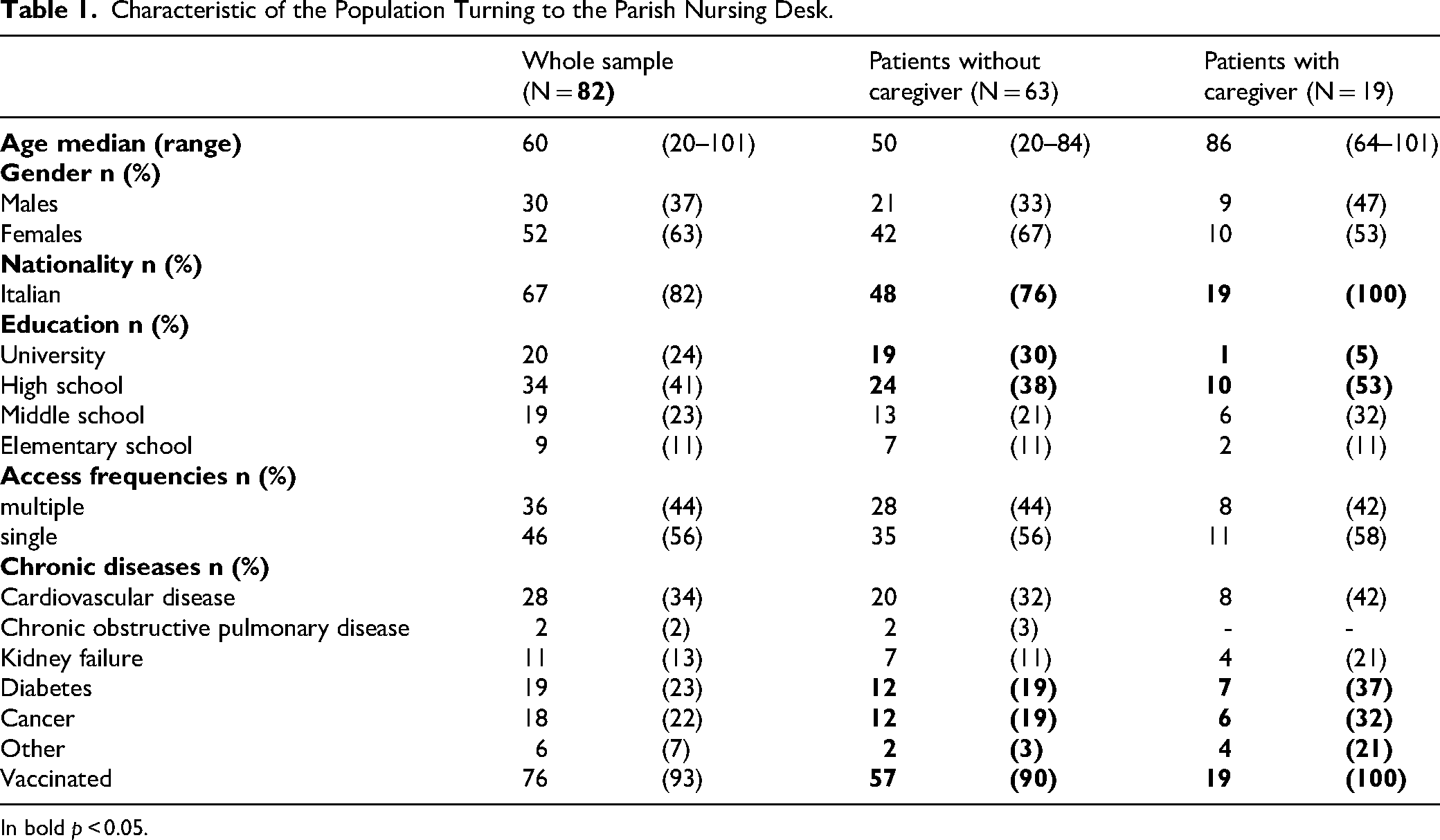
The sample included 82 patients, 19 (33%) had a caregiver and 43 (52%) were residents in the local district, whereas 48% lived in different districts without nursing service and 44% of the whole sample reported multiple access (Table 1).
Characteristic of the Population Turning to the Parish Nursing Desk.
In bold p < 0.05.
Patients with caregivers were older (median age 86 years vs 50 years; p < 0.001) had a higher percentage of females (77% vs 53%; p = 0.043) and university education (30% vs 5%; p < 0.001) than patients without caregivers and were all Italians (vs 24% foreigners among patients without caregiver; p < 0.001).
As concerning chronic diseases, a greater number of patients with caregivers had diabetes (37% vs 19%, p = 0.005) or cancer (32% vs 19%, p = 0.035) than patients without caregivers. The percentage of vaccinated people was high in both groups, yet prevalent among patients with caregivers (100% vs 90%, p < 0.001) (Table 1).
The most frequently required services were vital signs measurement (28%) and booking of medical visits (23%), followed by info requests on various topics, such as: public meetings with specialists (15%), training courses on cardiopulmonary resuscitation, airway unblocking and first aid (13%), screening and vaccinations (10%), districts, associations, social transport and social switchboard (9%) and chronic pathologies (2%) (Table 1).
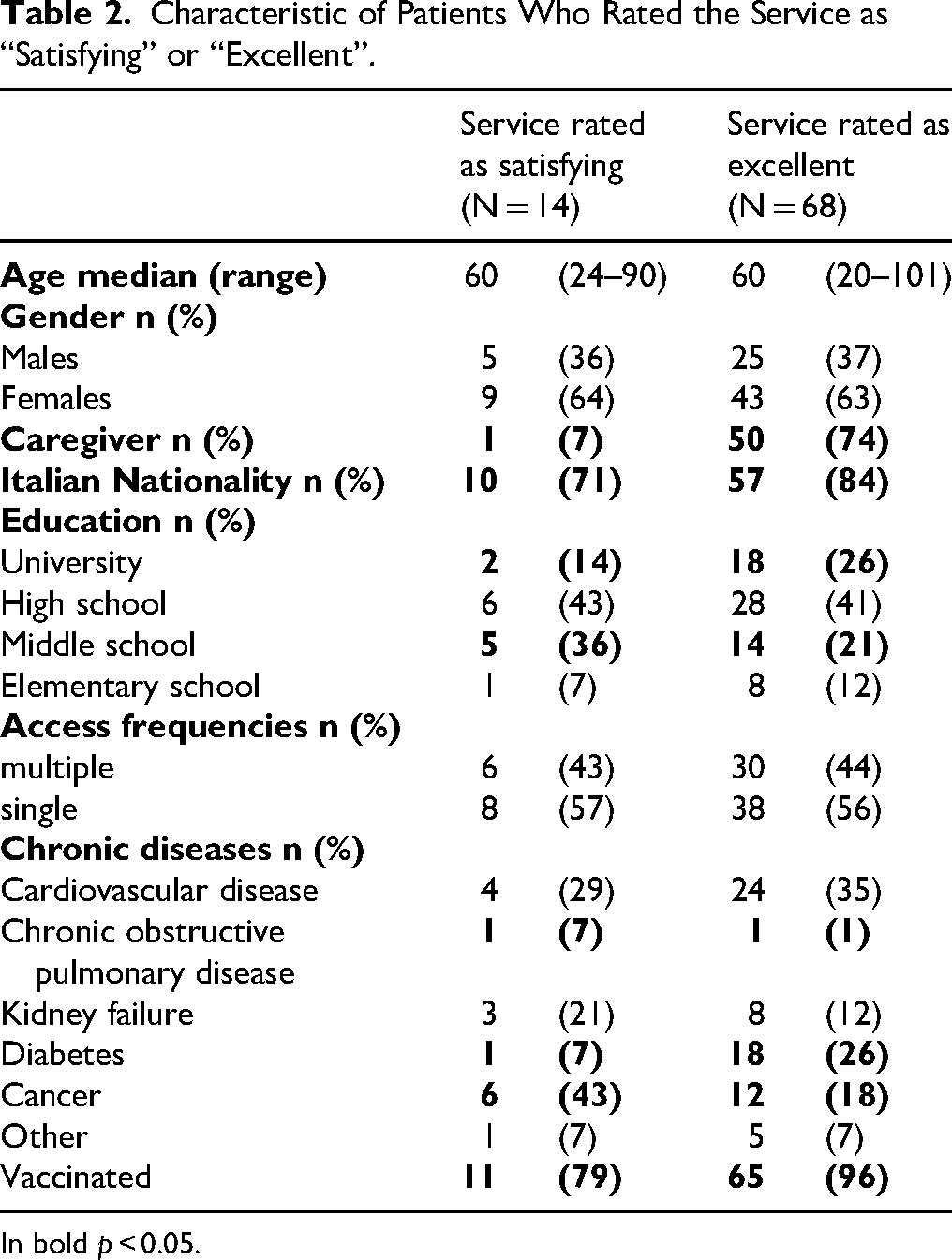
The service offered by the parish nursing agency was rated as “excellent” by 83% of the whole sample (n = 68) and “satisfying” by 17% (n = 14); no negative judgment was expressed (Table 2). The comparison between patients who rated the service as “excellent” vs “satisfying” revealed no between-group differences in the median age (60 years). Instead, a greater number of patients rating the service as “excellent” were Italian (84% vs 71%, p = 0.028), had a caregiver (74% vs 7%, p < 0.001), university education (36% vs 21%, p = 0.019), diabetes (26% vs 7%, p < 0.001) and were vaccinated (96%vs79%, p < 0.001). Among the group of patients who rated the service as “satisfying”, a greater percentage of subjects had middle school education (26% vs 14%, p = 0.034), reported chronic obstructive pulmonary disease (7% vs 1%, p = 0.030) and cancer (43% vs 18%, p < 0.001) (Table 2).
Characteristic of Patients Who Rated the Service as “Satisfying” or “Excellent”.
In bold p < 0.05.
Discussion
This survey aimed to assess the socio-demographic characteristics, service utilization, and satisfaction levels of users attending a parish nursing agency in Italy's Marche Region. The results showed that parish nursing provides a range of person-centered, highly satisfactory services for vulnerable individuals from different places of origin and various educational and socioeconomic contexts.
WHO has defined primary health care as an approach to health that focuses on the needs and preferences of individuals, families and communities, based on integrated, accessible, equitable, person-centered care provided as close as possible to where people live and work. The 2018 Astana Declaration updated the principles of the 1978 Alma Declaration, by emphasizing the involvement of people in communities both in managing their own health and in accessing services. Ensuring healthcare system sustainability and enhancing the quality of services are contingent upon prioritizing territorial care. As such, the primary care system plays a crucial role in achieving health outcomes and equity (Shi, 2012). The demand for social and health services is particularly strong in Marche region (Central Italy). Marche Region had 1.482.746 residents on 31rst December 2023 of these, 132.011 (8.9%) were foreigners (Istat, 2025). The life expectancy at birth for the overall resident population was 83.4 years, and around 24% of the population is over 65 (ISTAT, 2022, 2025). In response to these challenges, a parish nursing agency operated by professional nurses and doctors was established in March 2022 to enhance territorial care for frail patients. The agency cared for both autonomous patients (77%) and patients with caregivers (23%). Not surprisingly, patients with caregivers were older in line with recent evidence (median age: 86 vs 50 years, p < 0.001) (Zaalberg et al., 2023). These observations are in agreement with studies from other countries, such as United States, UK and Canada that highlighted the important role played by parish nursing among older adults and their caregiver to promote health education and counseling, meeting personal and health needs, and acting as a liaison with other community services (Castro et al., 2016; Fernández-Gutiérrez et al., 2018; Grebeldinger & Buckley, 2016; Millerd et al., 2021; Wordsworth et al., 2016). However, we found that parish nursing agency in Pesaro served a broad spectrum of individuals of all ages, thus suggesting that its services accommodate not only elderly people.
As for the nationality of people turning to the parish nurse, we found that patients with caregiver were all Italians, while 24% of patients without caregivers were foreigners. This percentage is higher than that of foreign residents in the Marche region (8.9%, p < 0.01), thus showing that parish nurse agency attracted a notably larger share of patients from abroad. In many countries, various strategies have been introduced to render healthcare more inclusive, especially for people in vulnerable situations such as migrants, who often face multiple barriers, including language and cultural differences, bureaucratic obstacles, and financial hardships, that limit their access to mainstream healthcare systems. In addition to the efforts of non-governmental organizations that provide cultural mediation, free nursing, medical, and specialist care, other initiatives focus on bringing healthcare closer to people's homes through community-based services. Professionals such as Family and Community Nurses and parish nurses are at the heart of these initiatives. Their work, beyond treating illness, actively promotes healthy living and preventive care, helping people make lifestyle choices that lower their risk of serious health issues over time (Camedda & Righi, 2024; Fernández-Gutiérrez et al., 2018; Millerd et al., 2021). In particular, parish nurses can serve as easily approachable, more equitable and trusted points of contact. In Canada, for instance, where immigrants often face challenges in accessing healthcare, including systemic racism, restrictive employment conditions, and policing practices (Sierra-Heredia et al., 2024), parish nursing have been reported to offer a model of care designed to help address some of these barriers (Millerd et al., 2021; Olson et al., 1999).
People seeking assistance at the parish nursing agency reported at least one chronic pathology, underlying the potential relevance of the services offered in reinforcing secondary prevention. This finding gains relevance from international evidence reporting significant equity gaps and worse outcomes for fragile patients with multiple chronic diseases (obesity, diabetes, etc.) or higher overall disease burden (Diamandis et al., 2025; Dickman et al., 2017; GBD, 2024). Moreover, a recent review on migrants in Europe and North America reports their major predisposition to develop hypertension, obesity, diabetes and other metabolic syndromes and highlights efforts to promote inclusive health care by the local health care systems (Rosenthal et al., 2022). The role of parish nursing can be relevant in this context. For example, in Minnesota's growing immigrant communities, parish nurses have contributed to address important health needs by focusing on education and early intervention to prevent chronic conditions, such as heart disease (Ghobadzadeh et al., 2015). The finding that most individuals seeking assistance were affected by chronic conditions underscores the need for targeted training of parish nursing personnel to effectively address the complex and long-term needs associated with such conditions.
Faith community nursing programs have spread across North America, Europe, Asia, and Africa, with the goal of integrating healthcare and spiritual care to offer interventions that have been reported to improve the management of chronic conditions while strengthening public trust in local health services (Dandridge, 2014). In Europe, British model of Parish Nursing Ministries UK offers a compelling example of how public healthcare can be meaningfully integrated with church networks: parish nurses work alongside general practitioners, district nurses, and chaplains to provide a range of services, including health education, home visits and spiritual support, which are open to individuals of all faiths, actively promoting mental wellbeing, good nutrition, and social connection, thus supporting more sustainable chronic disease management and truly person-centered model of care (Wordsworth et al., 2016). Spirituality is often viewed as an inner resource that supports health: it can inspire hope, build resilience, and strengthen coping skills during times of illness, thus encouraging individuals to take care of their health and contributing to better outcomes overall (de Diego-Cordero et al., 2022; Vincensi, 2019). Numerous epidemiological studies have shown that higher levels of spirituality and religiosity are linked to better physical and mental health, as well as lower rates of morbidity and mortality (Dominguez et al., 2024; Lucchetti et al., 2019). Building on this, a recent study proposed a faith-practice framework as a practical starting point for incorporating spirituality and religiosity into patient-centered care (Faries et al., 2024). Therefore, health policy models should begin to include spirituality and religiosity assessments, as well as related intervention programs, that can help nurses and healthcare professionals deliver more holistic, person-centered care (Steinhorn et al., 2017). In this respect, parish nursing agencies provide an ideal setting to bring together sense of community, emotional support, and spiritual connection, all elements that are highly meaningful for individuals facing isolation, chronic illness, or social vulnerability. This combination of practical help and human connection underscores the unique role that parish nursing agencies can play in building a more inclusive, compassionate model of community care.
A further noteworthy aspect of our findings is the high vaccination rate among users, with 93% of the sample being vaccinated. This indicates a general attitude of attentiveness and compliance with healthcare programs among those accessing the parish nursing agency. Interestingly, most patients registered at the parish nursing agency had a high level of education, with 41% of the whole sample having high school diploma and 24% university degree; this finding shows that the service is useful to the whole community, regardless of education level.
Users turning to the parish nursing agency expressed interest in various additional services, including public meetings with specialists (15%), training courses on cardiopulmonary resuscitation, airway unblocking and first aid (13%) and receiving detailed info on screening and vaccinations (10%). These findings collectively suggest that parish nurses can contribute in multiple ways to improve the efficacy of primary care, such as fostering individual empowerment (defined as a process enabling patients to exert more influence over their individual health), reinforcing motivation and autonomy in health decisions and expanding health literacy. The latter is regarded as a social determinant of health, which contributes to reinforce patient empowerment and reduce health inequalities in agreement with previous studies on US, Canada, Australia and the UK (Castro et al., 2016; Fernández-Gutiérrez et al., 2018; Smithman et al., 2020; Trinitapoli et al., 2009).
Notably, the subjective satisfaction with the parish nursing agency was high, with a significant percentage rating the service as “excellent”. Interestingly, a significantly higher percentage of “excellent” rating was found amongst Italian people with university education, thus indicating that the level of satisfaction was highest especially among those people who are expected to face fewer barriers to accessing healthcare services.
This study has some important limitations. The small sample size and the use of convenience sampling from just one parish nursing agency in the Marche Region may have introduced some selection bias. In addition, the study was descriptive in nature and based on interviews from a convenience sample, which may have introduced reporting bias. Given the exploratory nature of the study, the results of these inferential tests should be interpreted with caution. That said, convenience sampling is often used in early-stage or exploratory research because it's practical and helps gather initial insights. While acknowledging that our findings can’t be generalized to broader populations, they still offer meaningful starting points and could help shape more targeted interventions or guide future, larger-scale studies.
Conclusions
This study adds to the ongoing discussion on the need to strengthen health policies that promote accessible community-based healthcare services to disadvantaged groups, and on the role of parish nursing agencies in this context. While exploratory and descriptive, and based on data from a single agency in Central Italy, this survey shows that parish nursing can provide support to vulnerable patients from diverse places of origin and various educational and socioeconomic backgrounds, with services achieving a high level of user satisfaction. Although the limitations of the present study hamper drawing definitive conclusions and limit results’ generalizability, these preliminary findings suggest that parish nursing agencies may be considered as potential recommendation for health frame policies to provide inclusive, community-based, and patient-focused healthcare. Further multicenter research with larger sample sizes and validated tools is needed to confirm these results and inform policy recommendations.
Footnotes
Acknowledgements
Not applicable

Ethical Approval and Consent to Participate
The local institutional board gave the consent for the study and study participants gave their consent for participating to the study (Port. N. 0198640 of 02/08/2024)
Consent for Publication
Not applicable
Author Contributions
FM, DS and EP designed the study and produced the study questions. EP and DS carried out the analyses and drafted the manuscript. AM, DS, AC provided critical insight into the manuscript. All authors read and approved the final manuscript.
Funding
The authors received no financial support for the research, authorship, and/or publication of this article.
Declarations of Competing Interests
The authors declared no potential conflicts of interest with respect to the research, authorship, and/or publication of this article.
Availability of Data and Materials
The datasets used and analyzed during the current study are available from the corresponding author upon request.