






Abstract
A mass casualty incident (MCI) is an event that generates more patients at one time than locally available resources can manage using routine procedures. By their nature, many of these incidents have no prior notice but result in large numbers of casualties with injuries that range in severity. They can happen anywhere and at any time and regional hospitals and health-care providers have to mount a response quickly and effectively to save as many lives as possible. Radiologists must go from passenger to pilot when it comes to MCI planning. When involved at the hospital-wide planning stage, they can offer valuable expertise on how radiology can improve triage accuracy and at what cost in terms of time and resources and thereby contribute a pragmatic understanding of radiology’s role and value during MCIs. By taking ownership of MCI planning in their own departments, radiologists can ensure that the radiology department can respond quickly and effectively to unforeseen emergencies. Well-designed radiology protocols will save lives in an MCI setting.
Introduction
Mass casualty incidents (MCIs) are becoming more common. 1,2 Almost daily, news media carries reports of natural disasters such as earthquakes or hurricanes, bombings in areas of civil and political unrest, large-scale transportation accidents such as bus, train, or airplane crashes and mass shootings. In the past 3 decades, the number of natural disasters alone reported annually has quadrupled. 3,4 Despite occurring throughout history, pandemics appear to be increasing in frequency, particularly because of the increasing emergence of viral disease from animals as seen with recent outbreaks of the severe acute respiratory syndrome, Avian flu (H1N1), and Novel Coronavirus (2019-nCoV). 5 Gun violence and mass shootings are also on the rise. 6 Over 400 mass shooting events occurred in the United States in 2019 alone, which were increased by 150 since 2014. 7 By their nature, many of these incidents have no prior notice but resulted in large numbers of casualties with injuries that range in severity. They can happen anywhere and at any time and regional hospitals and health-care providers have to mount a response quickly and effectively to save as many lives as possible.
Emergency preparedness has never been more important in healthcare than it is at present. 1 Medical education and training do not, and often cannot, prepare medical personnel for these scenarios but responding to a mass casualty situation is a skill set that is necessary in medical practice in today’s world. An emergency plan is a set of arrangements for responding to and recovering from emergencies; in health care, these center on protecting life. 2 Failure to plan, train, and exercise for these situations may risk the lives of both patient and provider.
Definition of MCI
An MCI, used interchangeably with Code Orange in many trauma centers, is an event, which generates more patients at one time than locally available resources that can manage using routine procedures. 1,8,9 It disrupts the normal course of emergency and health-care services and requires exceptional emergency arrangements and additional or extraordinary assistance. 2 However, this definition covers a wide range of incidents of varying degrees of severity so planning needs to be scalable to very different challenges. There is no specified number of casualties that defines an incident as an MCI since baseline capacity of an institution is variable and the point at which resources become overwhelmed varies accordingly. 1,9 In an MCI, resources are stretched and the capacity for individualized care is exceeded so the model of care switches to minimum acceptable care.
For radiology, MCI events generally happen within the context of a hospital-wide or regional MCI. However, it should be noted that the demand for radiology services might exceed availability and disrupt normal workflows without general hospital operations being exceeded. This is particularly true of out-of-hours MCI events where on-call radiology coverage for a hospital may be provided by 1 radiologist with or without a resident or fellow and a single computed tomography (CT) technologist. In these cases, while the workload generated by 5 casualties from a motor vehicle accident may be easily absorbed by the emergency medicine and trauma surgery teams, the maximum capacity of radiology services will be exceeded. The responsibility for planning for such occurrences lies with radiology leaders, who must determine the departmental maximum capacity. 1,8,10 Depending on local factors, this may be related to staffing or scanner numbers, ability to scan, image transfer capabilities, or numbers of radiologists to report scans. Allowing contingency plans to be put in place enables radiology departments to mobilize more radiologists to read images and/or more technologists to open more CT scanners.
Mass casualty incident is an umbrella term for many different types of incident, spanning natural and man-made happenings, accidental and intentional in nature. The term encompasses diverse happenings from earthquakes to transportation accidents to mass shootings to pandemics. The number of natural MCIs reported annually has quadrupled in the last 3 decades. 1,3,4 Other MCIs relate to geopolitical issues and are cyclical with national and international conflict. Others such as transportation accidents and terrorist attacks are sporadic and time and location cannot be predicted although mass shooting incidents have also increased in frequency and severity in the United States since 2000. 11 The essence is that, although relatively rare, MCIs can occur at any given moment without notice. Mounting an appropriate response to provide the best care to the sudden influx of casualties requires planning, training, and practice.
For completeness, we wish to briefly mention emergency radiologists. Where available, emergency radiologists have a most valuable role in MCI planning due to the nature of their training and daily workload, as well as often having well-developed clinical relationships with other emergency medical providers such as emergency department (ED) physicians, trauma surgeons, and intensivists. 10 They are often best placed to coordinate and lead the drive of MCI planning in radiology departments. 10 However, not all hospitals and health services have dedicated emergency radiologists and yet all these institutions and services need to be prepared. This review aims to provide information of value to both emergency and nonemergency radiologists alike so does not specifically focus on their role.
Policy and Planning
Different authorities and bodies play different roles in MCI planning and it can be difficult to precisely define where guidance comes from and what responsibilities exist for service planning in MCIs. In large-scale disasters or conflict, international bodies such as the World Health Organization (WHO) or Red Cross may provide guidance and coordinated national responses. Reflecting and recognizing that disaster reduction in an integral part of sustainable development, in 1995, the WHO clearly differentiated its role in “emergency preparedness and disaster reduction” from its responsibilities in “emergency response and humanitarian action.” 2
The primary responsibility for the protection of public safety and provision of emergency relief in a crisis lies with the national government. Often coordination, planning, and policy development are variably executed by the national and provincial Ministries of Health and Emergency Management bodies. In Canada, national guidance comes from the Emergency Management Framework for Canada 12 and in the United States by the Joint Commission. 13,14 This guidance is often then incorporated into policies at a provincial or local level.
Each hospital is required to have an Emergency Operations Plan or equivalent describing how a facility will respond to and recover from all hazardous incidents. The plans, which should be compatible with national standards, should encompass planning, response, and recovery phases and should allocate role and responsibilities to all sections of the health-care facility. However, recommendations do not require hospitals to include specialty departments, such as radiology, so imaging needs are often underestimated or left out when hospital emergency preparedness plans are being developed. 1,8,10
While no health facility can fully prepare for the unpredictability of such an incident, having an emergency plan in place is necessary to mitigate the impact. Anticipating these scenarios will optimize preparedness when these events happen. Mass casualty planning requires a complex multi-institutional and multidisciplinary approach to handle a large influx of casualties in a short time period. 8,15 The cornerstone of effective MCI management are well prepared and resilient health-care facilities with staff who have received training and are familiar with and practiced in drills and exercises. 1 Building up both their everyday capacity and their ability to cope with surge must be a priority. At the same time, thought should be given to the standards of care appropriate to MCIs. Hospitals need to take a proactive and iterative approach, emergency plans remain a work in progress and every disaster or mock scenario and the after-action assessment offers opportunities to learn and update the emergency plan where needed. 1,16
The arrival of an influx of patients may be the initial notification a hospital receives that an MCI has occurred. The hospital’s emergency operations center should be activated as early as possible in the MCI and should activate call-backs and notification procedures for key personnel, establish communications with Emergency Medical Services (EMS) and other external partners, support the ED and all involved areas and departments with needed supplies and staff, act proactively to help open inpatient beds, track incident patients, ensure the hospital secures its campus, staff and patients, support coordination, and communication efforts, including the activation of any staff or supply sharing between facilities. Hospitals must implement access controls for the entire facility and direct victims to the ED or designated entrances. 17
Effective emergency and trauma care systems are key factors to the success of health-care facilities in preventing avoidable mortality and morbidity during MCIs. A considerable amount of guidance and information exists for MCI planning at a hospital level, although this does not carry through to the subspecialty level. Hospital MCI plans usually include the use of radiology services but if radiologists are not engaged with hospital leadership during the creation of these plans, there may be misconceptions and false assumptions regarding radiology capabilities during disaster management. 1,10 The amount of imaging required and system constraints are often underestimated. In many hospital MCI plans, radiology gets ranked under ancillary services and is often not included in the early rounds of notification. 18 Previous MCI after-action reviews recommend a move toward earlier notification 19 -24 of radiology, along with theaters, critical care, blood bank, and surgical specialties.
Radiology Planning
Radiologists must form part of the hospital-wide response to MCI. The radiologist is a critical, if currently underutilized, member of the disaster response team during an MCI. 1,10 Underrepresentation of radiologists and radiology departments in emergency plan development of practice drills/exercises is common, even in level 1 trauma centers. 1 Radiologists included in planning can contribute an understanding of the role and value of radiology in an MCI and can quantify and qualify how radiology can improve triage accuracy and the cost in terms of time and resources. A radiologist who understands the requirements of an MCI situation is invaluable in developing a departmental plan ensuring that the radiology department can respond quickly and effectively to unforeseen emergencies. 10 A prepared radiology department with a process map of workflow and patient movement through the hospital and radiology departments can efficiently process and image a large number of patients. Radiology leaders can advocate for radiology and ensure medical imaging is included in disaster drills. 1
The amount of imaging required during an MCI depends on the nature of the individual MCI and on the number of casualties. It is hard to plan for such variability so the response must be flexible and scalable. Developing a plan for one type of MCI may not address the needs of all incidents. Recent mass shootings have challenged historical paradigms for emergency planning. 18,25 Given the paradigm shift to the greatest good for the greatest number of patients, those who may be imaged in a non-MCI setting may not get imaged acutely. Unusual injury mechanisms and unfamiliar pathology are the hallmark of MCI patients. Hospital disaster processes should reflect daily practices whenever possible. The stress of managing an acutely ill patient may impede attention, memory, and decision making. 26 Cognitive limitations from incident stress may cause health-care providers to default to usual (“muscle memory”) practices unless substantial training and job aids support an alternate practice. For example, despite training and practice on disaster triage, EMS providers in multiple real-world incidents often failed to use their triage systems. 18
An understanding of the trauma system and its resources can benefit all stakeholders. Well-designed radiology protocols will save lives in an MCI setting. Each community has a unique set of resources and needs and may therefore require different solutions than other jurisdictions. The utilization of imaging in the MCI setting is quite variable, depending on the institution and the nature of the incident has been reported up to 93%. 1,24 The imaging modality of choice for the detection of direct and direct injuries in polytrauma is CT. The role of CT imaging in acute trauma is well established 27 -29 and after-event reports of radiology response in real-world MCIs describe widespread use of CT. 1,3,20,21,23 -25,30 -42 However, imaging can act as a bottleneck in an MCI setting, hampering forward flow of patients. The large volume of images generated in rapid succession can also exceed network capabilities, leading to a wait time before data sets are viewable. For adequate MCI and polytrauma preparation, hospitals should have a CT scanner within the ED, ideally with direct access from the resuscitation area.
Reports from radiology experience of the Christchurch Earthquake highlight the potential for power outages or other systems failures, including backup power with an almost 5-hour delay before the first CTs could be performed. 20 Backup generator power to CT and reporting stations is crucial but may fail in the setting of a natural disaster. Plans for battery-powered ultrasound and portable radiography-based secondary triage should be part of the MCI plan, with redistribution of technologists, sonographers, and radiologists to these modalities. Portable ultrasound can facilitate focused assessment with sonography for trauma for operative triage, assessment of hemo/pneumothorax, solid organ injury, pregnancy, vascular injuries as well as vascular access, and even pediatric head exams. 43
Roles of Radiology in an MCI
The roles of radiology in an MCI are 2-fold.
1,8,37,41
Triage: prompt identification of those critically ill patients who require immediate intervention and rapid Communication: accurate communication of critical imaging findings to clinical teams.
Triage
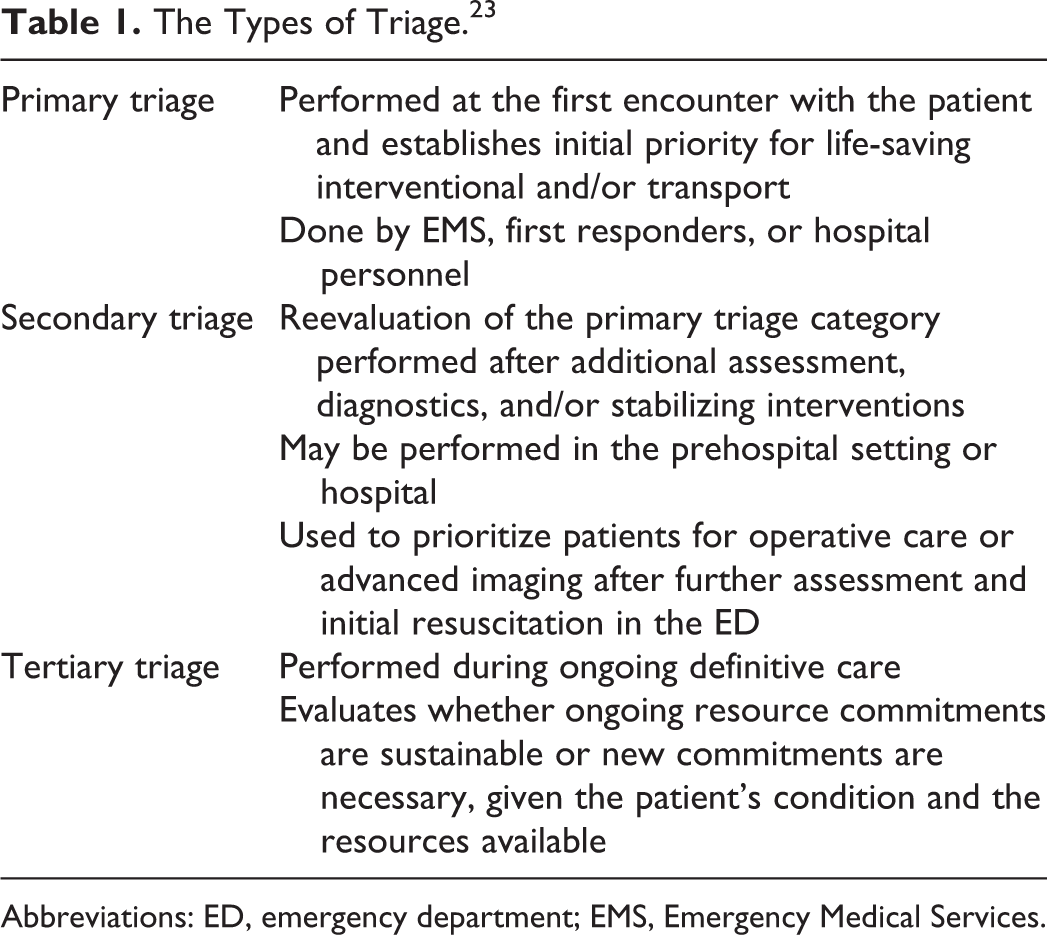
Triage is an inherent concept in MCI response and is key to patient outcomes. 1,34,44,45 Triage is not the same as patient assessment; it is an assignment of resources based on the initial patient assessment and consideration of available resources in the context of the number and types of casualties—this applies to the roles of both clinical and radiology teams. Hospitals must ensure they have a system in place to implement controls and rapidly triage, track, and place patients. Triage should be dynamic, on-going, and is not a discrete activity; serial re-triage is necessary as patients who initially seem stable can deteriorate and critical patients can stabilize 1,46 (Table 1). Also, as additional resources become available, prioritization or treatment may change.
The Types of Triage. 23
Abbreviations: ED, emergency department; EMS, Emergency Medical Services.
Patients arrive at hospital during an MCI via a variety of means, depending on the location and nature of the event. 1,47,48 Many arriving by ambulance/EMS tend to be the most critically injured. Depending on the proximity to the incident site, less badly injured patients may self-present—the “walking wounded.” Several recent MCIs have described less conventional means of transport such as taxis and ride-sharing services 18,25,48 and even by London Bus. 47 Every hospital must be prepared for large numbers of privately transported and walk-in casualties, particularly from nearby MCIs. All community (nontrauma) hospitals should be prepared to receive large numbers of casualties either because of their proximity to the incident or deliberate diversion of less injured patients from the trauma centers when they are saturated. Hospitals should plan for their unique resource challenges and processes. Radiology rarely has control over which patients get triaged to their center.
Primary triage usually happens at the incident site, deciding which patients need to be transferred to which hospital and in which order, although it may occur at the hospital if the patients self-present via an alternate transport. Disaster field triage systems are designed to be used by those with minimal medical training to efficiently sort casualties. 18 While triage systems used under daily conditions (particularly for time-sensitive emergencies such as stroke and traumatic injury) have a significant amount of supporting evidence, most MCI triage systems have little evidence other than expert consensus to support their use. 18
Over- and undertriage are both dangerous and can affect mortality. 1,44 Undertriage (placing a patient in a lower category than their actual injuries require) means critical injuries were not recognized. Overtriage (placing a patient in a higher category than their actual injuries require) diverts assessment and treatment resources from those who need it more. There is a linear positive correlation between overtriage rate and mortality when several MCIs were analyzed 44 ; mortality increases as limited as critical resources such as operating theaters become saturated.
Secondary triage prioritizes the patient for further diagnostics, operative intervention, or care location (floor vs intensive care unit). This may occur after initial stabilizing interventions. Radiologists form part of secondary triage. They can use imaging tools to quickly evaluate patients and provide emergency physician and surgeons with precise information on life-threatening injuries, helping to correct errors in prior triage and prioritize the best allocation of limited resources. By increasing triage accuracy, resource burden and hopefully mortality may be reduced. 1,44
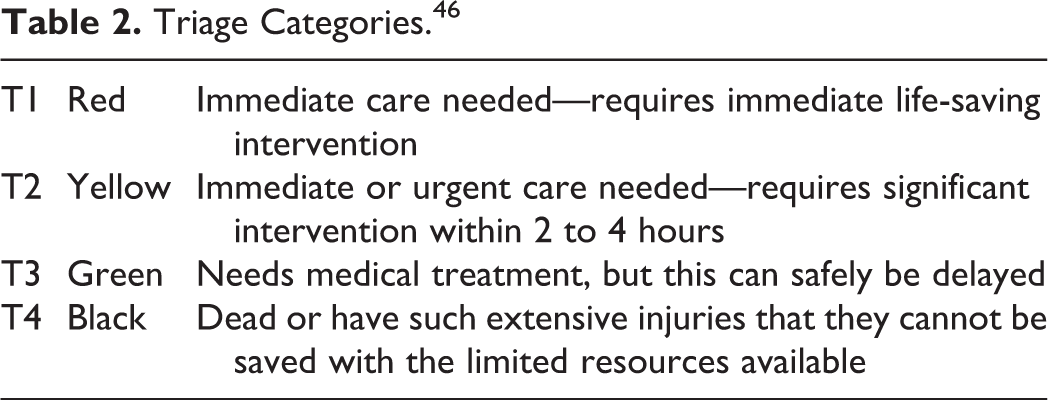
To maintain the availability of radiology resources for the most urgent patients, it is critical that patients undergo reassessment by a triage team when they reach the hospital and any walking wounded who escaped field triage should be assigned a category at this stage. 1 Imaging should be reserved for those patients where imaging findings will alter management 1,47 (Table 2). Due to competing demands, usually imaging in the acute phase is centered on category yellow (T2) patients. Imaging in category red (T1) patients is reserved for those stable enough to undergo whole-body CT prior to surgery. Some patients with severe injuries may not be saved during the MCI surge period and resources should instead be directed to those patients with a higher likelihood of survival. 1,31
Triage Categories. 46
Planning secondary triage is important as coordinating triage decisions among the ED, perioperative areas, and CT scanner can prove challenging. It is common for experienced radiologists to feel that they are best suited to image interpretation and therefore, they may appoint more junior personnel to the role of triage officer. However, review of recent MCIs indicate that experienced providers, particularly those with military or field experience, should perform triage and this should apply to radiology too. 18 The presence of the lead radiologist at the care huddle with the lead emergency physician, anesthesiologist, and trauma surgeon is critical. This provides each with situational awareness of the overall number and types of patients, their clinical conditions, patient needs, and the associated demands on resources. Facilitating communication between senior decision-makers helps direct emergent care most effectively.
As the response to the incident continues, additional resources often become available which may change the clinical decisions. Tertiary triage is performed during ongoing definitive care and involves reassessing the patient’s condition to determine if a change in care is warranted based on the patient’s response to treatment and the status of resources at the hospital. This often happens after the MCI activation has been stood down. Often at this stage, the imaging requirements surge to a second peak, as those who were not imaged initially require imaging and those who underwent treatment often need reassessment. Radiology MCI plans need to take this into account when planning staffing requirements as the “radiology surge” often continues for weeks post-MCI. 47
Communication
Communication is core to normal radiology practice, and good communication becomes of utmost importance in MCI scenarios. 49 By their nature, MCIs disrupt normal services and make communication difficult. Only by anticipating the barriers can radiology leaders institute plans that effectively deal with and work around such barriers. Many existing radiology MCI plans, where in place, address only staffing, equipment availability, cancellation of routine cases, and mobilizing manpower but fail to anticipate the amount of imaging required and the altered workflow that needs to be implemented to allow patient flow. 1,3,9,15,24,30,31
Radiologists form part of the hospital-wide response to an MCI. 20 They should be notified early following MCI activations, ideally at the same time as blood bank, perioperative care, and operating theaters. The radiology MCI plan should clearly identify roles and responsibilities. A radiology MCI supply box is a valuable resource; this may contain bibs for staff identification, walkie-talkies and batteries in case of communications failures, pre-printed requisitions for whole-body CT minimizing delays at the time of imaging, and so on. Basic job aids/prompts on a card attached to all radiology staff identification cards may be a reasonable reference for staff to review when notified of an MCI to refresh initial actions and assignment of command and general principles tailored to local protocols. More detailed duties and job lists attached to role-specific bibs help guide each individual as to their roles and responsibilities even when limited by cognitive incident stress. 18
Several key radiology roles exist. There should be radiology representation at the hospital emergency operations center (EOC); generally, this is a senior administrative leader such as the head of medical imaging or equivalent. They are responsible for coordinating staff and supply mobilization, decanting non-MCI patients including routine outpatients from the radiology department, and tailoring the radiology response in the context of the overall hospital response. On the ground in the radiology department, there should be the lead radiologist—a radiologist who takes ownership of the radiology department and its response to the MCI. They are ideally situated at the triage huddle liaising with the lead emergency physician, trauma surgeon, and anesthesiologist but should be in continual communication with the EOC radiology representative with 2-way updates and status reports. The lead radiologist should understand the risk of over- and undertriage, the resources available to them in terms of staff and scanners, the altered workflow in the department, and the flow of patients through the department. This role is best suited to an emergency radiologist, if available, as they often have excellent experience in triaging trauma imaging and direct communication with emergency and trauma clinicians. 10 All other radiologists are responsible for image interpretation, either providing “hot reads” at the imaging modalities or formal reporting of cases. These duties are assigned by the lead radiologist.
Imaging studies should undergo a hot-read on the scanner immediately following imaging to look for life-threatening injuries that may require immediate intervention, such as tension pneumothorax or active hemorrhage, or injuries that may significantly alter the patient’s immediate clinical course or prognosis, such as extensive intracranial hemorrhage. Diagnostic information can be obtained from the moment the planning scout images are obtained, possibly facilitating immediate life-saving interventions such as endotracheal tube repositioning, tension pneumothorax decompression, or pelvic binder attachment. 50 In a chaotic MCI setting, a pre-printed carbon copy tick box form detailing major life-threatening injuries in each body system 8,21,51 can be rapidly filled by the interpreting radiologist at the modality and copies sent with the patient, caring clinician, and kept in radiology. These findings can be communicated to the lead radiologist who will document changes in triage status based on imaging.
Imaging reports issued in an MCI setting focus on the acute traumatic findings and by their nature are different from conventional radiology reports. The value of describing important nontraumatic findings acutely is limited, detailed reporting of these imaging findings has the equivalent effect of over triage and the potential to increase mortality. 44 At the planning stage, it may be appropriate to institute a policy of second reads for studies reported during an MCI activation to allow for such findings. 52 Also, cognitive limitations in stressful MCI conditions may limit diagnostic interpretation and a second read over the days after the incident can act as a safety net in such instances. There is a potential role for teleradiology in MCI settings for this purpose, with remote radiologists not providing the primary trauma read but instead the comprehensive diagnostic read.
Key to timely result communication is adequate patient identification and tracking, something which becomes challenging during the chaos of an MCI. Information technology issues related to network architecture and structure should be assessed in terms of reliability and speed when planning radiology department procedures for emergency plan activation conditions. Many incidents have demonstrated that electronic health records may not accurately reflect the names and locations of casualties until several hours into the incident. 8,20,36,37 Radiologists should be familiar with the system in place in their hospital and ideally be present at the planning stage to ensure compatibility of the system with their workflow. 10 Within several minutes, an influx of unidentified patients can arrive at the hospital for care. The hospital’s system should be capable of registering large numbers of patients without identification, using protocols that do not cause overlap, cause confusion, or lead to multiple patients being assigned the same temporary name or number or create conflict. Following daily processes for unidentified patients is always preferable to having a separate process for MCIs. Emergency Medical Services tags can provide continuity for tracking but can also create problems when a patient’s condition/triage category changes. 18 Many hospitals default to allocated pseudonyms for all patients, regardless of known identity or not, and maintain these during all phases of the MCI to avoid confusion with results and mistaken identity when details are updated. Alternative means of matching images with patients have also been proposed including radiopaque identification skin markers affixed to and scanned with the patient, mitigating the potential for misidentification of imaging findings. 53,54
It is important for emergency planners, including radiologists, to be familiar with lessons learned from recent MCI events to stay informed, update their emergency operations plans as appropriate, and test any new processes required. Processes should be robust enough to account for dynamic and unsafe situations, exceedingly large numbers of victims, multiple unidentified victims, and a high incidence of life-threatening injuries. After-action reviews or debrief of all real-life MCIs and drills are exceedingly valuable in the information they provide and the lessons that can be learnt and are a vital component of MCI response. 1,8,20,11,23,55 -57 All participants should be thanked for their contribution to the MCI response and given a chance to voice opinions and provide feedback on what was done well and what was not. Lessons taken from published literature pertaining to learning points from MCIs elsewhere should also be incorporated where appropriate. Mass casualty incident planning makes an excellent quality improvement topic for departments, with iterative adjustments to the plan after each local drill or taking the information learned from actual real-life MCI occurrences in the literature.
Legal Issues
Legal protections during disasters vary by jurisdiction, highlighting the importance of approved disaster practices that can be invoked when required. In an MCI, a different standard of care is adopted. Minimum acceptable care should be defined in a multidisciplinary setting with legal and ethics representatives in attendance; this may vary depending on local factors specific to each hospital. 10,46 Such measures provide important protection to the radiology team.
Recommendations
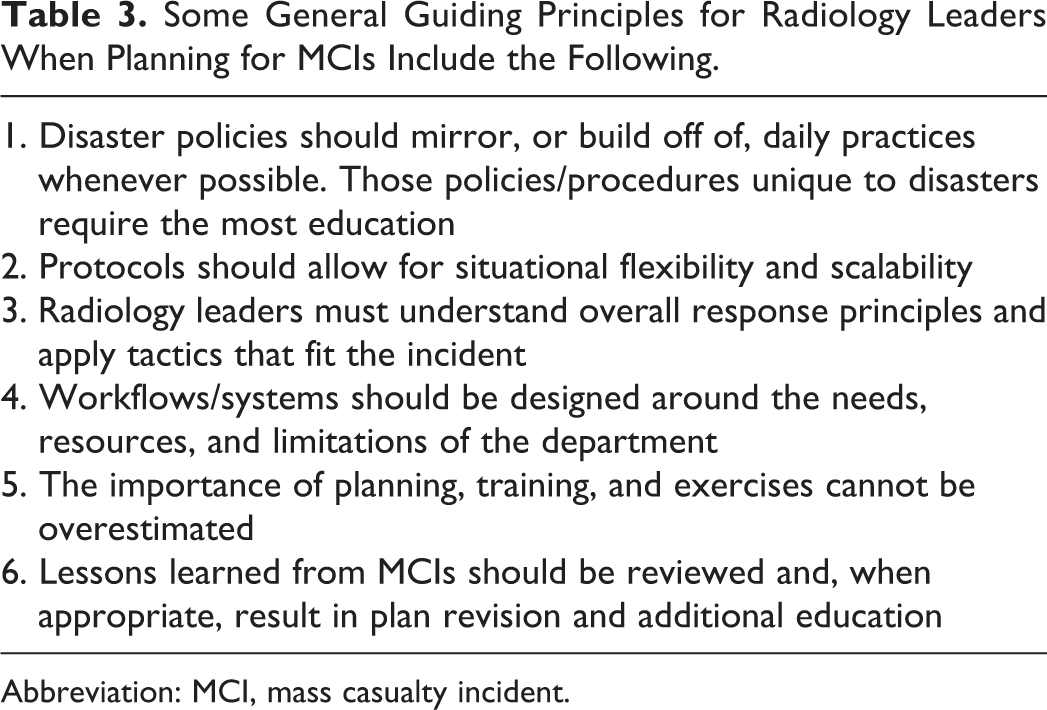
Radiologists must go from passenger to pilot when it comes to MCI planning (Table 3). When involved at the hospital-wide planning stage, they can offer valuable expertise on how radiology can improve triage accuracy and at what cost in terms of time and resources, and thereby contribute a pragmatic understanding of radiology’s role and value during MCIs. By taking ownership of MCI planning in their own departments, radiologists can ensure that the radiology department can respond quickly and effectively to unforeseen emergencies. Well-designed radiology protocols will save lives in an MCI setting.
Some General Guiding Principles for Radiology Leaders When Planning for MCIs Include the Following.
Abbreviation: MCI, mass casualty incident.
Footnotes
Declaration of Conflicting Interests
The author(s) declared no potential conflicts of interest with respect to the research, authorship, and/or publication of this article.
Funding
The author(s) received no financial support for the research, authorship, and/or publication of this article.