






Abstract
Background
Obesity among youth with epilepsy has multifactorial etiology, yet socioecologic obesity risk factors (eg, neighborhood factors) have not been examined in this population. This study examined (1) the prevalence of obesity adjusting for relevant covariates and (2) socioecologic correlates of obesity in adolescents with epilepsy aged 10-17 years.
Methods
This cross-sectional study used 2017-2018 National Survey of Children's Health data (total n = 27,094; epilepsy n = 184). Chi-square tests compared weighted prevalence of obesity with relevant covariates among all adolescents and adolescents with epilepsy. Weighted multiple logistic regression models were conducted to adjust for covariates.
Results
The prevalence of obesity in adolescents with epilepsy was 27.8% (95% confidence interval [CI] 15.4%-40.3%) vs 15.1% (95% CI 14.1%-16.2%) for the non-epilepsy group. Adolescents with epilepsy also had higher odds of obesity after adjusting for age, gender, race/ethnicity, household income, physical activity, and medical home (odds ratio [OR] 2.1, 95% CI 1.2-3.8). Adjusting for sociodemographics, anxiety (OR 4.5, 95% CI 1.3-15.6), 2 or more adverse childhood experiences (OR 7.3, 95% CI 1.6-33.4), neighborhood detracting elements (eg, OR 5.2, 95% CI 1.5-18.5 for 1 detracting element), and forgone care (ie, unmet health care needs) (OR 22.4, 95% CI 3.8-132.8) were associated with obesity in adolescents with epilepsy. Adjusting for multiple comparisons, neighborhood detracting elements (P < .0001) and forgone care (P < .0007) remained significant.
Conclusion
Variables related to mental health, family functioning, built environment, and forgone care were associated with obesity in adolescents with epilepsy, but the association was not fully explained by these factors. Obesity interventions for this population should consider multiple levels of influence including the community and special health care needs of this population.
Epilepsy is a neurologic disorder characterized by recurrent seizures and their social, neurobiologic, cognitive, and psychologic, consequences.1,2 Epilepsy affects approximately 1.2% of the US population, and more than 75% of individuals with a seizure disorder or diagnosed epilepsy are untreated.3,4 Approximately 470,000 children have epilepsy, 3 and up to 80% of children with epilepsy have at least 1 comorbid condition (ie, medical, neurologic, developmental, or psychiatric). 5
Obesity and epilepsy are common co-occurring conditions in children and adolescents.6–10 A study investigating obesity risk in adolescents with a range of neurodevelopmental and mental health disabilities found that adolescents with epilepsy or seizure disorder exhibited the greatest prevalence of obesity (28%) compared to adolescents with other disabilities, and the increased odds of obesity remained after adjusting for sociodemographic characteristics (odds ratio [OR] 2.2, 95% confidence interval [CI] 1.2-3.8). 6 The high prevalence of obesity in this population continues into adulthood; one study reported 31.2% obesity prevalence and 55.2% overweight or obesity prevalence among adults with epilepsy. 8 Explanations for such disparity have included the role of poor physical conditions that can affect dietary patterns and limit physical activity, as well as low household income and low parent education level. 9 Nevertheless, contextual factors such as the neighborhood environment (eg, recreational opportunities, levels of crime) or health care factors (eg, medical home) have not been accounted for despite their importance in the childhood obesity epidemic in the United States. 11 Neighborhood factors such as neighborhood safety play a major role in children's ability to participate in physical activity and families’ dietary patterns. However, the contribution of neighborhood and health care factors has not been investigated among children with epilepsy.
A multilayer or socioecologic approach to the risk and protective factors for childhood obesity provides a broader context for understanding its etiology and opportunities for prevention. Known obesity risk factors in individuals with epilepsy include genetic risk, hormone disruption from seizures and antiepileptic drugs, and lifestyle factors. 12 For example, the antiepileptic drug valproic acid has been shown to contribute to the development of obesity and metabolic syndrome. 13 Regarding lifestyle behaviors, previous research has shown that adolescents with epilepsy may be less likely to participate in physical activity levels and more likely to have overweight/obesity compared to siblings without epilepsy. 14 Although there is a body of evidence on the individual-, family-, community-, and organizational-level factors that are associated with childhood obesity in the general population, 15 there is a lack of research focusing on the factors that are specifically related to prevalence of obesity among children and adolescents with epilepsy. There is a need for research on obesity risk factors outside of individual- and household-level factors in adolescents with epilepsy.
The socioecologic model considers the complex interplay between individual, relationship, community, and societal factors to allow us to understand the range of factors that put people at risk for health issues, including obesity. 16 This study aimed to apply the socioecologic model to understand obesity risk in adolescents with epilepsy or seizure disorder (“epilepsy”), with a focus on community and health care access factors that have been overlooked in prior research. The objectives of this study were (1) to examine the prevalence of obesity adjusting for sociodemographic characteristics and relevant covariates in adolescents with epilepsy aged 10-17 years and (2) determine socioecologic correlates of obesity in adolescents with epilepsy aged 10-17 years, including individual, family, community, and organizational factors.
Methods
This cross-sectional study used complex survey data from the combined 2017-2018 NSCH data set.17,18 The NSCH is a nationally representative survey conducted by the US Census Bureau with a reference population of noninstitutionalized children aged 0-17 years living in the United States; the weighted response rates were 37% to 43% for the 2017 and 2018 data sets. 17 All data are parent reported (ie, completed by a parent, guardian, or other adult familiar with the child's health). For this study, observations for adolescents aged 10-17 years were included because the NSCH only collects body mass index data for that age range. As the NSCH calculates body mass index based on parent-reported height and weight, and parents typically overestimate height and underestimate weight of children younger than 10 years of age, 19 body mass index was not assessed among children younger than 10 years of age.
The study sample size was 27,094 (weighted n = 33,136,088), including 184 adolescents with epilepsy (weighted n = 204,266). All observations for adolescents aged 10-17 years with and without epilepsy were included. To handle missing data, demographic variables in the NSCH were multiply imputed because of known reporting bias from complete case analysis; imputation methods vary by variable type, including hot-deck imputation for sex and race/ethnicity and sequential regression for household income. 20 Complete case analysis was performed for other variables because the amount of missing data was low (≤4.5%), and preliminary sensitivity analyses did not suggest significantly different results. In sensitivity analyses, multiple imputation models were compared with the initial analyses for key variables, and P values and CIs remained largely consistent.
Measures
Epilepsy and Sociodemographic Variables
Epilepsy was coded dichotomously as currently has epilepsy vs does not have epilepsy. Co-occurring conditions that may be associated with epilepsy and/or obesity were selected from the data set for preliminary chi-square tests to select co-occurring conditions that were indeed significantly associated with epilepsy (Supplementary Table 1). The resulting co-occurring conditions variable for adolescents with and without epilepsy was coded to include adolescents who currently have 1 or more of the following co-occurring conditions: autism spectrum disorder, cerebral palsy, asthma, allergies, hearing problems, learning disability, speech problems, intellectual disability, developmental delay vs not having 1 or more co-occurring conditions. The same list of co-occurring conditions was investigated for significant associations with obesity among those with epilepsy, but hearing problems was the only significant co-occurring condition (P < .001); it was excluded from Table 2 because of small sample size (4 adolescents with obesity vs 5 adolescents without obesity). Age was dichotomized as 10-13 years vs 14-17 years, and sex was coded as male vs female. Race/ethnicity was coded by the NSCH as Hispanic; White, non-Hispanic; Black, non-Hispanic; and Multiracial/Other, non-Hispanic. Household income was coded as 0% to 99% federal poverty level (FPL), 100% to 199% FPL, 200% to 399% FPL, 400% FPL or greater.
Outcome Variable: Obesity
Childhood obesity was measured based on the body mass index percentiles for age and gender of the child. The NSCH calculates body mass index from parent-reported height and weight. Although responses to the questions about child's current height and weight were not independently verified (eg, measurement and health records), parental reports have been found to approximate objective body mass index measures. 19 Body mass index in youth varies by age and gender, with the NSCH providing 4 categories: underweight (less than the 5th percentile), healthy weight (5th percentile to less than the 85th percentile), overweight (85th to less than the 95th percentile), and obesity (equal to or greater than the 95th percentile) based on age- and gender-specific percentiles. For this study, obesity was coded dichotomously as obesity vs nonobesity (ie, underweight, healthy weight, or overweight body mass index).
Socioecologic Variables
Additional, socioecologic factors were investigated among adolescents with epilepsy, including variables related to the child's physical and mental health (ie, depression, anxiety, and physical activity), family (ie, adverse childhood experiences), community (ie, supportive neighborhood, safe neighborhood, safe school, neighborhood amenities, and neighborhood detracting elements), and health care access (ie, medical home, health insurance, and forgone care).
Child factors. Depression and anxiety were coded as dichotomous variables (currently has vs does not have condition). Physical activity was categorized as exercising, playing a sport, or participating in physical activity for at least 60 minutes 0 days per week, 1-3 days per week, 4-6 days per week, or every day.
Family and neighborhood factors. The NSCH collects information on ongoing adverse childhood experiences that are related to economic hardship, witnessing violence domestic violence, and other forms of family dysfunction. The NSCH's adverse childhood experience questions also include peer- and community-level adversities including exposure to neighborhood violence and racism and discrimination. Because these measures are based on parent report, the adverse childhood experience questions do not include any information about child abuse or neglect like other adverse childhood experience instruments and is a limitation of this instrument. The adverse childhood experiences variable was coded using the NSCH categorical adverse childhood experiences variable, including categories of no adverse childhood experiences, 1 adverse childhood experience, or 2 or more adverse childhood experiences from a list of 9 adverse childhood experiences: hard to cover basics on family's income; parent or guardian divorced or separated; parent or guardian died; parent or guardian served time in jail; saw or heard parents or adults slap, hit, kick, punch one another in the home; was a victim of violence or witness violence in neighborhood; lived with anyone who was mentally ill, suicidal, or severely depressed; lived with anyone who had a problem with alcohol or drugs; and treated or judged unfairly because of race/ethnicity.
Supportive neighborhood was coded following the NSCH operationalizaton as lives in supportive neighborhoods if parents responded definitely agree to at least 1 of the following items and somewhat agree or definitely agree to the other 2 items: people in this neighborhood help each other out; we watch out for each other's children in this neighborhood; and when we encounter difficulties, we know where to go for help in our community. Safe neighborhood was coded as parents definitely agree, somewhat agree, or somewhat or definitely disagree that their children are safe in the neighborhood. Safe school was coded as parents definitely agree, somewhat agree, or somewhat or definitely disagree that their children are safe at school.
Neighborhood amenities counted how many of 4 amenities are present in the child's neighborhood: sidewalks or walking paths; park or playground area; recreation center, community center, or boys’/girls’ club; or library or bookmobile. Neighborhood detracting elements counts how many of 3 detracting elements are present in the child's neighborhood: litter or garbage on the street or sidewalk, poorly kept or rundown housing, or vandalism such as broken windows or graffiti.
Health care factors. Pediatric health care providers play a crucial role in recognizing and managing childhood obesity, yet at-risk children often lack adequate access to a medical home, have inadequate insurance, or end up forgoing care that can provide the resources and support systems for effective management of childhood obesity. Thus, we examined the role of these health care factors as covariates that influence obesity risk among children. Medical home was coded as care meeting medical home criteria vs not meeting medical home criteria, measured by the NSCH based on the following domains: personal doctor or nurse, usual source for sick case, family-centered care, problems getting needed referrals, and effective care coordination when needed. 21 Health insurance was coded as having health insurance coverage and benefits that usually or always meet their needs and allow hem to see needed providers and having either no out-of-pocket expenses or out-of-pocket expenses that are usually or always reasonable vs not having adequate health insurance coverage. Forgone care was a dichotomous response to whether the child needed health care but did not receive it in the past 12 months.
Analysis
All analyses were weighted to account for selection and nonresponse bias to be representative of the population of adolescents aged 10-17 years nationally. Chi-square tests were conducted to compare the prevalence of obesity with socioecologic factors among all adolescents and adolescents with epilepsy. Multiple logistic regression was conducted to adjust for age, sex, race/ethnicity, household income, physical activity, and medical home in the association between obesity and epilepsy diagnosis among all adolescents. Six multiple logistic regression models were conducted to adjust for age, sex, race/ethnicity, and household income in the association between obesity and relevant mental health, community, and health care variables among adolescents with epilepsy. The P value for the primary covariate of interest in each of these 6 regression models was adjusted for type I error inflation using the Holm-Bonferroni multiple comparison correction method. Analyses were conducted in SAS (Version 9.4; SAS Institute, Inc; Cary, NC) using the PROC SURVEYLOGISTIC command, with an alpha level of 0.05. Crude and adjusted odds ratios were estimated with a CI of 95%. Weighting was conducted using the STRATA, CLUSTER, and WEIGHT statements in SAS to identify the strata, PSUs, and sampling weights.
Results
The prevalence of obesity was 27.8% (95% CI 15.4-40.3%) in adolescents with epilepsy compared to 15.1% (95% 14.1-16.2%) in adolescents without epilepsy (P = .132). Most adolescents with epilepsy had 1 or more co-occurring condition (65.4%, 95% CI 53.4-77.4%, compared to 18.8%, 95% CI 17.8-19.8%, among those without epilepsy, P < .0001). Other sociodemographic characteristics did not differ between adolescents with and without epilepsy (Table 1).
Obesity and Sociodemographic Characteristics in Adolescents 10-17 Years With and Without Epilepsy (N = 27,094). a
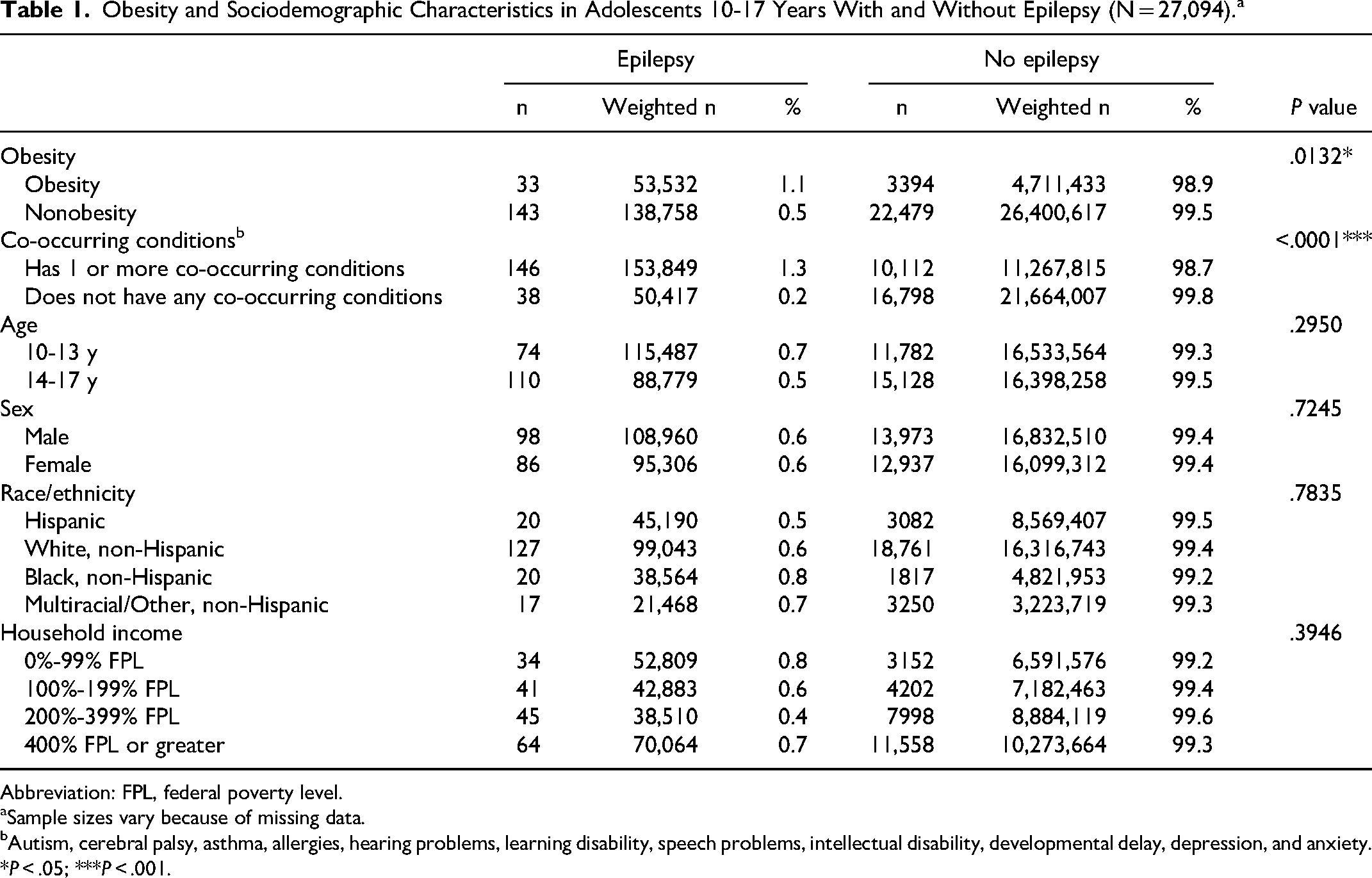
Abbreviation: FPL, federal poverty level.
Sample sizes vary because of missing data.
Autism, cerebral palsy, asthma, allergies, hearing problems, learning disability, speech problems, intellectual disability, developmental delay, depression, and anxiety.
*P < .05; ***P < .001.
Table 2 presents findings from chi-square tests in adolescents with epilepsy with and without obesity. Among adolescents with epilepsy, obesity was associated with race/ethnicity (P = .0122), household income (P < .0001), depression (P = .0126), anxiety (P = .0270), adverse childhood experiences (P < .0001), neighborhood safety (P = .0234), neighborhood detracting elements (P < .0001), and forgone care (P < .0001).
Socioecologic Characteristics in Adolescents 10-17 Years With Epilepsy With and Without Obesity (n = 184). a

Abbreviations: ACEs, adverse childhood experiences; FPL, federal poverty level.
Sample sizes vary because of missing data.
*P < .05; ***P < .001.
Crude and adjusted odds of obesity in adolescents by epilepsy diagnosis are depicted in Table 3. Adolescents with epilepsy had higher odds of obesity adjusting for age, sex, race/ethnicity, household income, physical activity, and medical home compared to adolescents without epilepsy (OR 2.1, 95% CI 1.2-3.8).
Odds of Obesity Compared to Nonobesity in Adolescents Aged 10-17 Years by Epilepsy Diagnosis (N = 27,094).

Abbreviations: CI, confidence interval; FPL, federal poverty level; OR, odds ratio; ref, reference value.
*P < .05.
Results from 6 separate regression models for significant independent variables from the chi-square tests in adolescents with epilepsy are presented in Table 4. Adjusting for sociodemographic characteristics (age, sex, race/ethnicity, and household income), anxiety (OR 4.5, 95% CI 1.3-15.6), 2 or more adverse childhood experiences (OR 7.3, 95% CI 1.6-33.4), neighborhood detracting elements (OR 5.2, 95% CI 1.5-18.5 for 1 detracting element; OR 82.9, 95% CI 14.3-479.7 for 2 detracting elements), and forgone care (OR 22.4, 95% CI 3.8-132.8) remained significantly associated with obesity. However, after adjusting for multiple comparisons, neighborhood detracting elements (P < .0001) and forgone care (P < .0007) were the only primary covariates that remained statistically significant. In all adjusted models, household income of 0% to 99% FPL and 100% to 199% FPL remained significantly associated with obesity. In adjusted models for depression, anxiety, adverse childhood experiences, neighborhood detracting elements, and forgone care, Black, non-Hispanic race/ethnicity was significantly associated with obesity.
Odds of Obesity Compared to Nonobesity in Adolescents Aged 10-17 Years With Epilepsy by Relevant Mental Health, Community, and Health Care Variables (n = 184).

Abbreviations: ACE, adverse childhood experience; CI, confidence interval; FPL, federal poverty level; OR, odds ratio; ref, reference value.
*P < .05.
P value remained significant after adjusting for type I error inflation using the Holm-Bonferroni multiple comparison correction method (the primary covariate of interest in each model was adjusted).
Discussion
This cross-sectional study investigated obesity prevalence and socioecologic correlates in adolescents with epilepsy aged 10-17 years using 2017-2018 NSCH data. The prevalence of obesity was 27.8% among adolescents with epilepsy compared to 15.1% in adolescents without epilepsy (P = .0132). In separate regression models, anxiety, adverse childhood experiences, neighborhood detracting elements, and forgone care were significantly associated with obesity; neighborhood detracting elements and forgone care remained significant after adjusting for multiple comparisons. In all models, adolescents from low-income families had a greater risk of obesity, and in all models but one, Black, non-Hispanic adolescents had a greater risk of obesity. Our study applied the socioecologic model to assess child, family, neighborhood, and health care access risk factors for obesity in individuals with epilepsy; findings can inform future research in this area and aid in the development of multilevel obesity interventions for this population.
Previous research indicates that obesity and anxiety are common co-occurring conditions in the general population. 22 However, there is a lack of prior literature on obesity and mental health in individuals with epilepsy. As most adolescents with epilepsy (73.7%) in our sample had at least 1 co-occurring condition (eg, autism spectrum disorder, cerebral palsy), future studies should explore associations between obesity, mental health, and other co-occurring conditions in this population.
Parents of adolescents with obesity were more likely to report adverse childhood experiences and to have more adverse childhood experiences based on 2018 NSCH data, but prior research has not looked at this association in adolescents with epilepsy specifically. 23 Because our findings indicated that adolescents with epilepsy more frequently reported having 2 or more adverse childhood experiences, additional research on the relationship between adverse childhood experience prevalence and epilepsy is needed. Additionally, prior research has reported higher rates of childhood trauma in patients with psychogenic nonepileptic seizure disorder and stress-precipitated seizures.24,25 Those with psychogenic nonepileptic seizure disorder are more likely to report childhood trauma 26 ; future research on obesity, adverse childhood experiences, and epilepsy may consider epilepsy and/or seizure type to better understand this relationship, as the epilepsy or seizure disorder variable in our study did not differentiate adolescents with psychogenic nonepileptic seizure disorder, a neurologic disorder that is distinct from epilepsy. 27 Previous research indicates that the incidence rate of psychogenic nonepileptic seizure disorder is approximately 7.4 per 100,000 person-years, and although psychogenic nonepileptic seizure disorder diagnoses are increasing in children and adolescents, there is still a low prevalence of comorbidity with epilepsy. 28
The neighborhood built environment (eg, walkable spaces and food environment)29,30 and social environment (eg, crime and social capital) 31 have been identified as important targets for obesity prevention efforts for the general population. In particular, increased crime and low perceived safety may be risk factors for weight gain. 32 Our findings suggest that neighborhood detracting elements may be a strong predictor for obesity in adolescents with epilepsy. However, research is needed to confirm these findings with different measures of the neighborhood built and social environment. Other neighborhood variables (eg, safe neighborhood) were not significant in our unadjusted or adjusted models.
Disparities in health care access and utilization by obesity status have been reported among the general population of children and adolescents. 33 Previous studies have reported various unmet health care needs in patients with epilepsy in the United States, including poor availability of health services, lack of health services, lack of health information, difficulty getting needed health information, accessibility issues, and uncoordinated care. 34 Additional research on associations between health care access and utilization and obesity in adolescents with epilepsy is warranted.
Although several socioecologic obesity risk factors were identified in this study, obesity and epilepsy remained significantly associated in the adjusted models. The pathophysiology of obesity among adolescents with epilepsy is complex, as some neurologic electrical issues may affect cortical areas that are involved in impulse control or even appetite, and some medications for the treatment of seizures also have side effects on body weight. 12 Certain types of epilepsy may also keep children sedated, contributing to poor control over dietary and physical activity habits, and some antiepileptic drugs can stimulate appetite and cause lethargy, contributing to decreased activity and higher caloric intake. 12 Further research examining epilepsy diagnosis and treatment variables in addition to socioecologic variables is needed to better understand obesity risk in this population.
This study was limited by its cross-sectional nature, for which causality cannot be inferred. The direction of associations identified in this study could also be examined through a reverse causality hypothesis because of the survey's cross-sectional nature. However, the direction of our hypotheses was guided by theory, and longitudinal studies are recommended to verify the associations in this study. Moreover, the fact that this study relied on parent-reported epilepsy or seizure disorder diagnosis and parent-reported height and weight for body mass index could introduce measurement bias. However, previous studies have demonstrated that parental reports about children's body mass index for ages 10-17 years are approximate to objective measures. The lack of specificity of the term epilepsy in this study is another limitation. As we were limited to what was available in the NSCH, future research on socioecologic obesity risk factors in this population should define epilepsy and/or seizure type, treatment type, additional relevant co-occurring conditions (eg, hypotonia, spasticity), and behavioral issues. For example, lower socioeconomic status may be associated with health outcomes including behavioral disturbances, quality of life, and treatment adherence in youth with epilepsy and other neurologic disorders.35,36 The study was also limited by a relatively small sample size of adolescents with epilepsy (n = 184); larger sample sizes are needed to apply more comprehensive causal modeling approaches such as path analysis.
Conclusion
Variables related to mental health, family and built environment, and health care access were associated with obesity in adolescents with epilepsy, indicating that multilevel interventions addressing community and health care needs are needed to reduce obesity in this population. Although this study filled a critical gap in the literature on socioecologic obesity risk factors in adolescents in epilepsy, future research is warranted to confirm and better understand these findings. In particular, because of the low co-occurrence of epilepsy and psychogenic nonepileptic seizure disorder, there is a need for analyses that differentiate between these 2 diagnoses. Lastly, the increased prevalence of obesity in adolescents from low-income families and Black, non-Hispanic adolescents in nearly all adjusted models point to the continued need to address racial and socioeconomic disparities in obesity interventions for all adolescents.
Supplemental Material
sj-docx-1-jcn-10.1177_08830738231203761 - Supplemental material for Socioecologic Factors Associated With Obesity in Adolescents With Epilepsy in the United States
Supplemental material, sj-docx-1-jcn-10.1177_08830738231203761 for Socioecologic Factors Associated With Obesity in Adolescents With Epilepsy in the United States by Acadia W. Buro, Rachel Sauls, Abraham Salinas-Miranda and Russell S. Kirby in Journal of Child Neurology
Footnotes
Author Contributions
AWB, AS, and RSK contributed to conception and design. AWB and RMS contributed to acquisition, analysis, and interpretation of data and drafted the manuscript. All authors critically revised the manuscript, gave final approval, and agree to be accountable for all aspects of the work to ensure integrity and accuracy.
Declaration of Conflicting Interests
The authors declared no potential conflicts of interest with respect to the research, authorship, and/or publication of this article.
Ethical Approval
This study was reviewed by the University of South Florida Institutional Review Board and determined exempt.
Funding
AWB was supported by the National Cancer Institute Behavioral Oncology Education and Career Development Grant (T32CA090314, MPIs Vadaparampil/Brandon).

Supplemental Material
Supplemental material for this article is available online.
References
Supplementary Material
Please find the following supplemental material available below.
For Open Access articles published under a Creative Commons License, all supplemental material carries the same license as the article it is associated with.
For non-Open Access articles published, all supplemental material carries a non-exclusive license, and permission requests for re-use of supplemental material or any part of supplemental material shall be sent directly to the copyright owner as specified in the copyright notice associated with the article.
