






Abstract
How a support provider responds to disclosure of sexual victimization has important implications for the process of recovery. The present study examines the associations between various positive and negative social reactions to sexual assault disclosure and psychological distress, coping behavior, social support, and self-esteem in a sample of college women (N = 374). Social reactions to assault disclosure that attempted to control the survivor’s decisions were associated with increased symptoms of posttraumatic stress, depression, and anxiety and lower perceptions of reassurance of worth from others. Blaming social reactions were associated with less self-esteem and engagement in coping via problem solving. Social reactions that provided emotional support to the survivor were associated with increased coping by seeking emotional support. Contrary to expectations, social reactions that treated the survivor differently were associated with higher self-esteem. Implications are discussed.
Rates of sexual victimization are particularly high among college women (Lawyer, Resnick, Bakanic, Burkett, & Kilpatrick, 2010). Over a 3-month period, approximately 15% of college women experience some form of sexual victimization, ranging from unwanted sexual contact to completed rape (Gidycz, Orchowski, King, & Rich, 2008). Sexual victimization is associated with an array of consequences, including substance use (Kaysen, Neighbors, Martell, Fossos, & Larimer, 2006; Ullman, Filipas, Townsend, & Starzynski, 2006), mood and anxiety disorders (Ullman & Brecklin, 2003), and posttraumatic stress disorder (Brown, Testa, & Messman-Moore, 2009; Najdowski & Ullman, 2009). Given the prevalence of sexual victimization among college women and the consequences of such experiences, understanding the factors that influence postassault adjustment is of high public health significance.
Disclosure of sexual victimization plays an important role in postassault adjustment (Ullman, 2010). Upward of 75% of college women who experience sexual victimization discuss the experience with someone, most often a peer (Fisher, Daigle, Cullen, & Turner, 2003; Orchowski & Gidycz, 2012). Data from the National College Women Sexual Victimization Study suggest that only 4% of college women who experience sexual assault discuss the experience with a campus authority and 1% disclose to a counselor (Fisher et al., 2003). Notably, women who do not disclose sexual victimization experience higher rates of depression and posttraumatic stress than do survivors who discuss the experience with someone (Ahrens, Stansell, & Jennings, 2010).
When disclosing sexual victimization, survivors receive a range of both positive and negative responses (see Ullman, 2010, for a review). Positive reactions to sexual assault disclosure include the provision of resources and emotional validation, whereas negative reactions to sexual assault disclosure include responses that leave the survivor feeling blamed, hurt, stigmatized, or not believed (Ullman, 2000). Data regarding the role of positive social reactions in promoting adjustment following sexual victimization are mixed. Some research identifies a positive association between positive social reactions and adjustment (Ullman & Siegel, 1995), whereas other studies indicate a nonsignificant or minimal association (Andrews, Brewin, & Rose, 2003; Zoellner, Foa, & Brigidi, 1999).
Even though there are clear benefits to disclosing experiences of sexual victimization, many of these benefits can be negated if women disclose to individuals who respond negatively (Ahrens et al., 2010). Alarmingly, 75% of women receive some form of negative response to disclosure of sexual victimization (Ahrens, Cabral, & Abeling, 2009), and 20% regret the initial decision to disclose (Jacques-Tiura, Tkatch, Abbey, & Wegner, 2010). Data indicate an association between negative social reactions and the presence and severity of symptoms of posttraumatic stress (Borja, Callahan, & Long, 2006; Jacques-Tiura et al., 2010; Ullman & Filipas, 2001), poor physical health (Ullman & Siegel, 1995), alcohol consumption (Ullman, Starzynski, Long, Mason, & Long, 2008), and characterological self-blame and use of avoidant coping strategies (Ullman, 1996).
To our knowledge, only one study has examined the association between social reactions to sexual assault disclosure and adjustment among college women (e.g., Borja et al., 2006). Given that college-age women are at higher risk to experience sexual assault compared to community-residing women (American Academy of Pediatrics, 2001), research targeting college women is strongly warranted. The current research therefore sought to examine the association between various social reactions to disclosure of sexual victimization and levels of psychological distress, social support, coping behavior, and self-esteem among college women. In light of prior research documenting an association between assault severity and social reactions to disclosure of sexual victimization (Ullman & Siegel, 1995), analyses accounted for assault severity. Furthermore, to address a potential bias in responding, participants completed a measure of social desirability.
The Current Study
Drawing from existing research, Hypothesis 1 proposed that negative social reactions to disclosure of sexual victimization would be associated with increased symptoms of posttraumatic stress, depression, and anxiety, lower levels of self-esteem, increased avoidance coping, and decreased problem and emotion-focused coping. Hypothesis 2 proposed that negative social reactions would be associated with lower endorsement of the following forms of social support: reliable social alliances, nurturance, guidance, social integration, and reassurance of worth. The aforementioned forms of social support are clarified in the method section. In light of prior research suggesting a minimal or null relationship between positive social reactions and adjustment, Hypothesis 3 proposed that positive social reactions would not demonstrate significant associations with measures of distress, self-esteem, coping, or social support.
Method
Participants
Participants consisted of 374 freshman college women living in campus residence halls and enrolled at a medium-sized Midwestern University. The majority of participants were 18 or 19 years old (n = 367, 98.1%), were identified as heterosexual (n = 367, 98.7%), and were not married (n = 369, 98.7%). When asked about their race, 94% of participants self-identified as Caucasian (n = 353), 2.9% as African American (n = 11), 0.8% as Native Hawaiian or Pacific Islander (n = 3), 0.3% as Asian American (n = 1), 0.3% as American Indian or Alaska Native (n = 1), and 1.3% as Other (n = 5). When reporting on annual family income, 26% of women indicated an annual family income of more than $100,000 (n = 88), 32.3% reported $50,000 to $100,000 (n = 121), and 18.4% indicated $50,000 or less (n = 69). More than 25% of women did not know their annual family income (n = 86).
Measures
Demographics questionnaire
A brief questionnaire assessed participant characteristics such as age, sexual orientation, marital status, annual family income, and race.
Sexual victimization
Unwanted sexual experiences from the age of 14 to the time of the baseline survey were assessed with the Sexual Experiences Survey (SES; Koss & Oros, 1982). The SES consists of 10 behaviorally specific questions regarding unwanted sexual behaviors ranging from unwanted sexual contact to completed rape. Following prior research (Koss & Dinero, 1989), sexual victimization was classified according to the most severe experience indicated, including (a) no experience, (b) unwanted sexual contact (i.e., continual arguments, authority, or physical force was used to coerce the woman into fondling, kissing, or petting), (c) attempted rape (i.e., physical force, alcohol, or drugs was used to attempt sexual intercourse), (d) sexual coercion (i.e., authority, continual arguments, or pressure was used to coerce the woman into engaging in oral, anal, or vaginal intercourse), and (e) rape (i.e., alcohol, drugs, or physical force was used to coerce the woman into engaging in oral, anal, or vaginal intercourse). This five-level categorization scheme was utilized as a measure of assault severity. Participants who identified experiences of sexual victimization completed a series of follow-up questions indicating characteristics of the most severe assault, including disclosure of the assault, victim and perpetrator substance use at the time of the assault, and the level of acquaintance with the perpetrator. Gylys and McNamara (1996) and Koss and Gidycz (1985) suggest that the SES demonstrates adequate reliability and validity.
Social reactions
Assault-specific reactions to disclosure of sexual victimization were assessed through the Social Reactions Questionnaire (SRQ; Ullman, 2000). The SRQ consists of 48 items. Five subscales assess negative social reactions, including (a) controlling the survivor’s decisions (e.g., “told others about your experience without your permission”), (b) blaming (e.g., “told you that you were to blame or shameful because of the experience”), (c) treating you differently (e.g., “pulled away from you”), (d) distraction (e.g., “distracted you with other things”), and (e) egocentric behavior (e.g., “expressed so much anger at the perpetrator that you had to calm him/her down”). Two subscales assess positive social reactions, including (a) emotional support (e.g., “told you it was not your fault”) and (b) information/tangible aid (e.g., “helped you get medical care”). Ullman (2000) suggests that the reliability and validity for the scale are high. Cronbach’s alphas for the controlling the survivor’s decisions, blaming, treating differently, distraction, and egocentric behavior subscales were .89, .84., .86, .89, and .84, respectively. Cronbach’s alphas for the emotional support and information/tangible aid subscales were .98 and .86, respectively.
Psychological distress
The Hopkins Symptom Checklist–90 (SCL-90; Derogatis, Lipman, & Covi, 1973) assessed current levels of psychosocial symptomatology. The SCL-90 consists of 90 items responded to along a 5-point scale ranging from not at all to extremely. For the purpose of the present study, the depression, anxiety, and posttraumatic stress indexes were examined (see Neal et al., 1994). The SCL-90 has adequate reliability and validity (Holi, 2003). Cronbach’s alphas for the depression, anxiety, and posttraumatic stress subscales were .90, .88, and .93, respectively.
Social support
Perceptions of various domains of social support were assessed with the Social Provisions Scale (Cutrona & Russell, 1987). The scale consists of 24 items responded to along a 4-point continuum, ranging from strongly disagree to strongly agree, with higher scores reflecting higher perceptions of social support. The six subscales of social support include (a) guidance (e.g., “I have a trustworthy person to turn to if I have problems”), (b) reliable alliances (e.g., “there are people I know will help me if I really need it”), (c) reassurance of worth (e.g., “there are people who value my skills and abilities”), (d) attachment (e.g., “I have close relationships that make me feel good”), (e) social integration (e.g., “there are people who like the same social activities I do”), and (f) opportunity for nurturance (e.g., “there are people who call on me to help them”). The scale demonstrates adequate reliability, and scores on this measure have been shown to correlate with other measures of social support (Cutrona & Russell, 1987). Cronbach’s alphas of the subscales ranged from .54 to .74.
Coping strategies
Women’s use of various coping skills was assessed with the Coping Strategy Indicator (Amirkhan, 1990). The scale consists of 33 items responded to along a 3-point continuum, ranging from a lot to not at all. Scores were reverse coded such that higher scores indicated more frequent engagement in each coping strategy. The subscales include (a) coping via problem solving (e.g., “formed a plan of action in your mind”), (b) coping via seeking emotional support (e.g., “sought reassurance from those who know you best”), and (c) avoidance coping (e.g., “fantasized about how things could have been different”). Amirkhan (1990) suggests that the subscales have good internal consistency, test–retest reliability, and convergent and divergent validity. Cronbach’s alphas for the coping via problem solving, coping via seeking emotional support, and avoidance coping subscales were .91, .93, and .80, respectively.
Social desirability
To account for potential bias in responding, participants completed the short form of the Marlowe-Crowne Social Desirability Scale (Crowne & Marlowe, 1960). The scale consists of 13 true–false items. According to Reynolds (1982), the scale demonstrates good internal consistency and a high correlation with the original 33-item scale. Test–retest reliability is also adequate (Zook & Sipps, 1985). Cronbach’s alpha of the scale in the current sample was .73.
Procedure
Prior to data collection, this study was approved by the university’s Institutional Review Board. Data were collected within a larger study examining the effectiveness of sexual assault risk reduction and prevention programming for college women and men within freshman residence halls (Gidycz, Orchowski, & Berkowitz, 2011). Data were collected during the 2006 and 2007 academic years. Only women randomly assigned to the control group of the larger study were included in analyses. Although men were included in the larger study, they did not complete measures of victimization, assault disclosure, and social reactions. The study was advertised as a survey of social and dating behaviors. Participants were recruited via posters, email correspondence, and personal contact from Residence Life staff. Women received $20 for completing paper-and-pencil questionnaires, which were administered in a private classroom or study hall by a trained female graduate student.
Data Preparation and Analysis
A series of multivariate linear regression analyses were conducted to examine the associations between various positive and negative social reactions to disclosure and measures of adjustment, accounting for assault severity and the participant’s level of social desirability in responding to questionnaires. Independent variables in each analysis included the following: assault severity, social desirability, receiving emotional support, receiving tangible aid, blaming social reactions, being treated differently, egocentric social reactions, receiving social reactions that controlled the survivor’s decisions, and distracting social reactions. Correlations between predictor variables are presented in Table 1. Given the associations between constructs and the number of correlation analyses conducted, a Bonferroni (1936) correction was applied to correlation analyses. Assessments for problems from multicollinearity were performed as a result of associations between independent variables. All variance inflation factors fell within normal limits (Belsley, Kuh, & Welsch, 1980). Of the women who disclosed sexual victimization, one participant did not complete the SRQ and was omitted from data analyses. Statistical tests were evaluated at α < .05 using SPSS software. Analyses where p = .05 are reported as marginally significant.
Correlations Among Predictor Variables (N = 99).
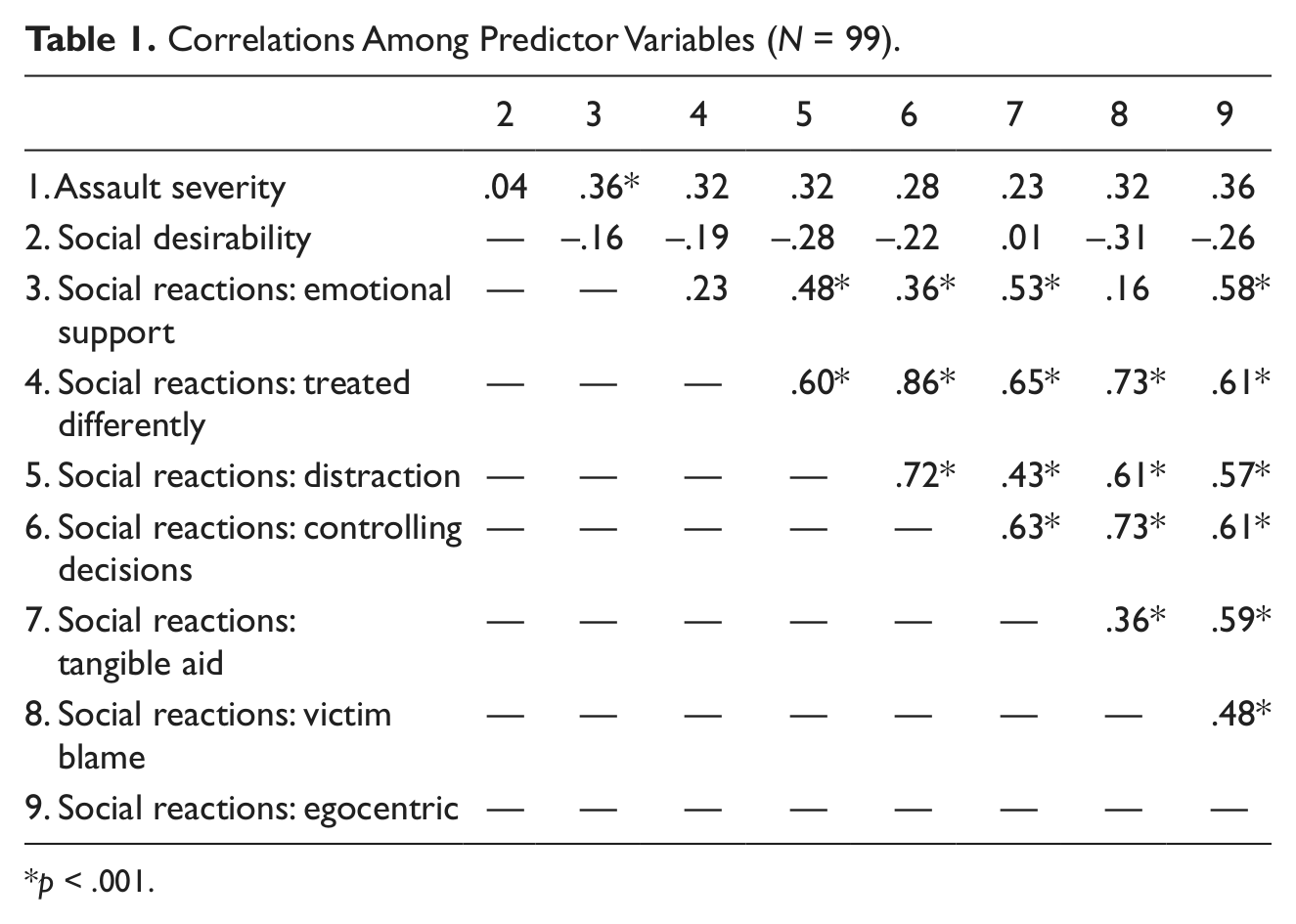
p < .001.
Results
Sexual Victimization History
Unwanted sexual experiences from the age of 14 to the time of the assessment were reported by 35.8% (n = 134) of the participants, and 74.6% (n = 100) of these women discussed the experience with someone. As noted previously, sexual victimization experiences were classified according to the most severe experience indicated. With this in mind, 15% of the study sample reported experiences of unwanted sexual contact (n = 56), 2.9% reported experiences of sexual coercion (n = 11), 9.6% reported experiences of attempted rape (n = 36), and 8.3% reported experiences of completed rape (n = 31). In addition, 97% of the assaults were perpetrated by someone known to the victim (n = 130) and 63% of perpetrators (n = 65) and 55% of victims (n = 57) were consuming alcohol and/or drugs at the time of the assault.
Associations Between Independent Variables
Applying a Bonferroni (1936) correction (p < .00136), a series of bivariate correlations were conducted to examine associations between independent variables. Social reactions that provided emotional support were positively associated with assault severity, provision of tangible aid, egocentric social reactions, and social reactions that controlled the survivor’s decisions or distracted her from focusing on her own needs. The following social reactions also demonstrated significant positive associations with one another: social reactions that treated the survivor differently, egocentric reactions, provision of tangible aid, blaming reactions, and responses that controlled the survivor’s decisions or distracted her from her own needs. Statistics are reported in Table 1.
Social Reactions and Measures of Psychological Distress
Three multivariate linear regression analyses were conducted to examine whether, accounting for assault severity and social desirability, various social reactions were associated with symptoms of posttraumatic stress, depression, and anxiety (see Table 2). Accounting for assault severity and social desirability, social reactions were associated with symptoms of posttraumatic stress, F(9, 85) = 5.06, p < .001, R2 = .35, such that controlling social reactions were associated with increased symptoms of posttraumatic stress, t(94) = 2.61, p < .05. Accounting for assault severity and social desirability, social reactions were also associated with symptoms of depression, F(9, 87) = 3.76, p < .001, R2 = .28, such that controlling social reactions were associated with increased symptoms of depression, t(96) = 2.10, p < .05. In the presence of assault severity and social desirability, social reactions also predicted symptoms of anxiety, F(9, 87) = 3.83, p < .001, R2 = .28, such that controlling social reactions were associated with increased symptoms of anxiety, t(96) = 3.00, p < .01.
Social Reactions and Psychological Symptomatology.
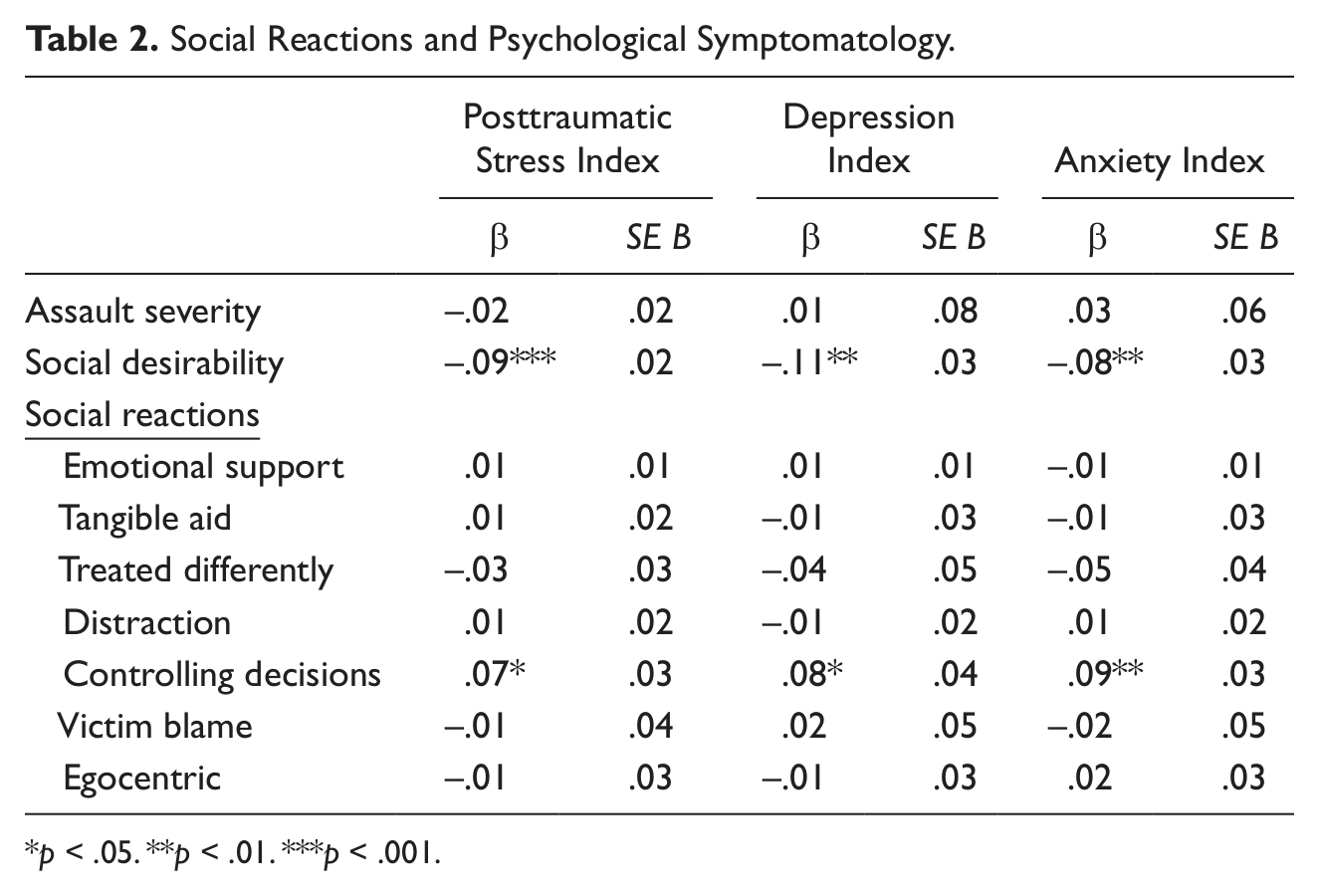
p < .05. **p < .01. ***p < .001.
Social Reactions and Social Support
Five multivariate linear regression analyses were conducted to examine whether, accounting for assault severity and social desirability, various social reactions were associated with receiving guidance from others, reassurance of worth, attachments to others, social integration, reliable alliances, and the opportunity for nurturance (see Table 3). In the presence of assault severity and social desirability, social reactions were associated with reassurance of worth, F(9, 88) = 2.13, p < .05, R2 = .18, such that reactions that attempted to control the survivor’s decisions were associated with less reassurance of worth, t(97) = −2.05, p < .05. Accounting for assault severity and social desirability, social reactions demonstrated a marginal association with provision of guidance from others, F(9, 88) = 1.98, p = .05, R2 = .17, such that receiving emotional support demonstrated a marginally positive association with receiving guidance from others, t(97) = 1.95, p = .05.
Social Reactions, Social Support, Self-Esteem and Coping.
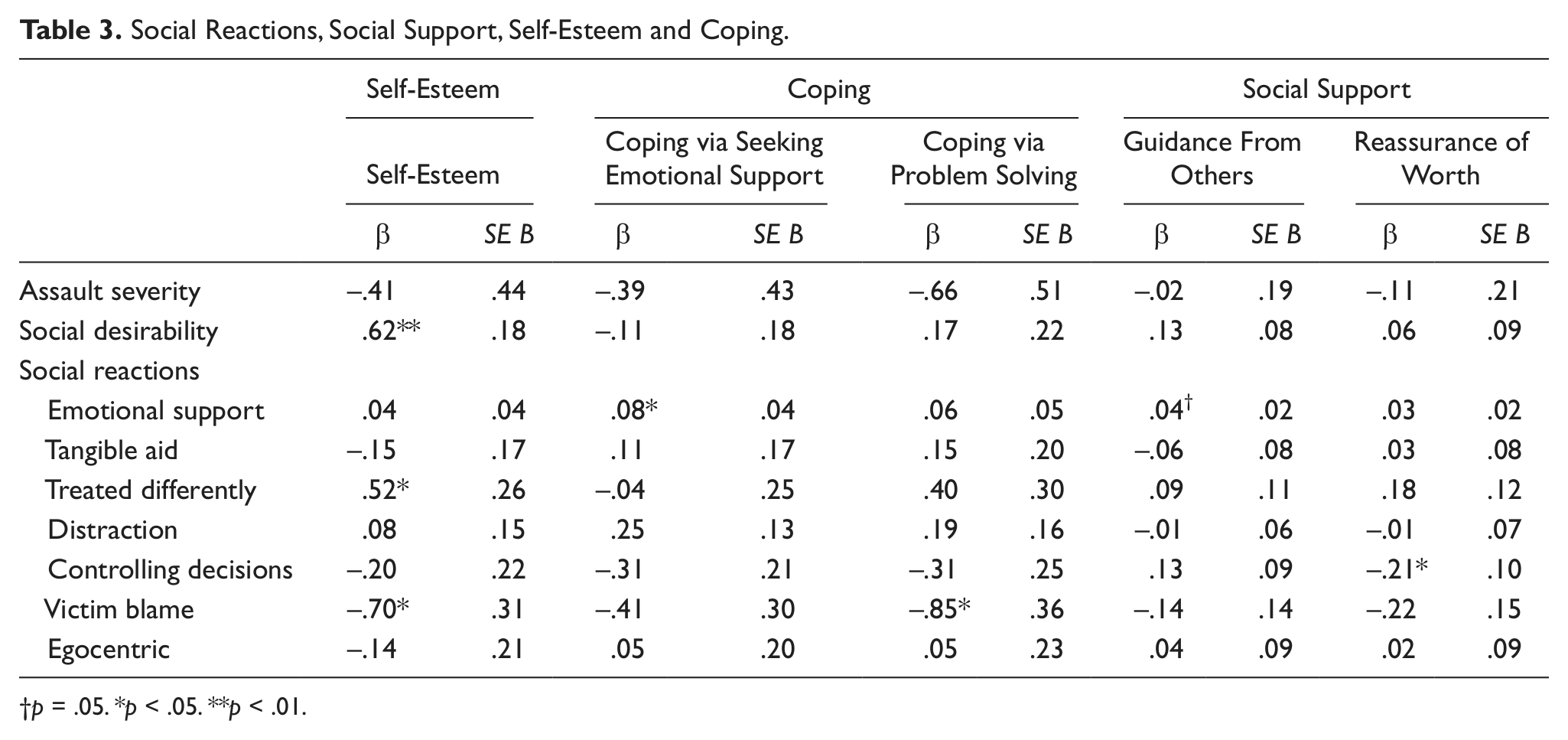
p = .05. *p < .05. **p < .01.
Social Reactions, Self-Esteem, and Coping
Four multivariate linear regression analyses were conducted to examine whether, accounting for assault severity and social desirability, social reactions were associated with self-esteem, coping via seeking emotional support, avoidance coping, and coping via problem solving. Accounting for assault severity and social desirability, social reactions were associated with self-esteem, F(9, 84) = 3.25, p < .01, R2 = .26, such that blaming social reactions were associated with lower self-esteem, t(93) = −2.25, p < .05, and social reactions that treated the survivor differently were associated with increased self-esteem, t(93) = 2.02, p < .05. In the presence of assault severity and social desirability, social reactions were also associated with coping via seeking emotional support, F(9, 87) = 2.96, p < .01, R2 = .23, such that the provision of emotional support was associated with increased coping via seeking emotional support, t(96) = 2.01, p < .05. Accounting for assault severity and social desirability, social reactions predicted engagement in coping via problem solving, F(9, 88) = 2.17, p < .05, R2 = .18, such that blaming social reactions were associated with less coping via problem solving, t(97) = −2.36, p < .05.
Discussion
The current study advances existing research by exploring the association between various positive and negative social reactions to disclosure of sexual victimization and levels of psychological distress, coping behavior, social support, and self-esteem among college women. Strengths of the study include the use of psychometrically sound and commonly used measures and accounting for the role of assault severity and social desirability in analyses. Advertising the research as a study of social and dating behaviors (instead of a survey of sexual assault experiences) may have also resulted in a less biased sample. Overall, several notable associations were documented between social reactions to sexual assault disclosure and indicators of psychological distress, coping, and social support.
First, social reactions that attempted to control a survivor’s decisions were associated with higher symptoms of posttraumatic stress, depression, and anxiety as well as lower reassurance of worth from others. It is unclear why controlling social reactions to disclosure of sexual victimization—and not other forms of negative social reactions—were associated with increased psychological distress. However, studies of sexual assault survivors indicate that the perception of being in control of the recovery process is an important protective factor against posttraumatic stress and depressive symptomatology (Walsh & Bruce, 2011). Social reactions that attempt to control a survivor’s decisions may therefore be particularly harmful.
Second, blaming social reactions to sexual assault disclosure were associated with lower levels of self-esteem and less engagement in problem-focused coping. Problem-focused coping includes making changes so that a problem had the best chance of being resolved, brainstorming solutions before deciding what to do, setting goals for actively dealing with the situation, and weighing potential options (Amirkhan, 1990). The association between receiving blaming social reactions and less engagement in problem-focused coping is concerning since active coping strategies tend to promote adjustment following sexual assault (Frazier & Burnett, 1994). Compared to avoidant coping behavior, action-oriented coping styles such as problem solving and emotional expression tend to be associated with fewer symptoms of posttraumatic stress (Johnsen, Eid, Laberg, & Thayer, 2002).
Since treating the survivor differently is classified as a negative social reaction (Ullman, 2000), it was surprising that this response was associated with increased levels of self-esteem in this sample. Whereas the present study did not query women regarding whether certain social reactions were perceived as helpful or hurtful, it may be that women in this college sample did not identify being treated differently as particularly hurtful. Several studies indicate that not all social reactions to sexual assault disclosure are perceived as uniformly hurtful or healing (Ahrens, Campbell, Ternier-Thames, Wasco, & Sefl, 2007; Campbell, Ahrens, Sefl, Wasco, & Barnes, 2001; Muganyizi et al., 2009). Continued research is needed to better understand why being responded to differently after a sexual assault can result in increased self-esteem among survivors. However, it may be that being treated differently following disclosure of sexual assault fostered posttraumatic growth by encouraging women to process the experience. Problem-focused coping, interpreting traumatic events in a positive manner, cognitive processing, and acceptance are often associated with positive growth following trauma (Linley & Joseph, 2004; Woodward & Joseph, 2003).
In light of prior studies documenting a minimal or null relationship between positive social reactions and adjustment, it was surprising that providing emotional support to the survivor was associated with increased coping by seeking emotional support. Although the directionality of this association is unclear, it may be that women who receive emotional support when disclosing sexual victimization have access to a social network that can provide an appropriate and supportive response to the trauma. Coping by seeking emotional support can also be conceptualized as a manifestation of resilience, indicative of the survivor’s capacity to garner resources that reduce the impact of the trauma (Hoge, Austin, & Pollack, 2007).
When interpreting study findings, it is important to keep in mind that analyses accounted for assault severity and social desirability. Notably, the measure of social desirability was significantly associated with several study constructs, including assault severity, self-esteem, and symptoms of posttraumatic stress, depression, and anxiety. These associations underscore the importance of accounting for social desirability in studies that use pencil-and-paper surveys to examine sensitive subjects. Despite data suggesting that women who experience a severe assault report more negative social reactions to disclosure compared to women who experience a less severe assault (Ullman & Siegel, 1995), there were very few significant associations between assault severity and study constructs. In this study, assault severity was classified along a five-level continuous scale according to the type of assault reported (see Koss & Dinero, 1989). In future studies, researchers may consider using a more complex classification of assault severity, such as composite score of the type of assault, the tactic utilized by the perpetrator, and the survivor’s perceived rating of severity. Since women who experience a more severe sexual assault also tend to disclose more frequently and have a higher probability of receiving negative social reactions (Ullman et al., 2008), future studies may also account for the number of support providers an individual discloses to.
Finally, it should be noted that none of the social reactions were associated with several subtypes of social support. Furthermore, contrary to prior research (Ullman, 1996), social reactions to assault disclosure were also not associated with engagement in avoidance coping. When examining these null findings, it is important to keep in mind that the present study included only women who disclosed sexual victimization. Women who disclose sexual victimization vary along a number of dimensions from women who acknowledge sexual assault on a self-report survey but do not disclose the experience (Ahrens et al., 2010; Washington, 2001). For example, lack of access to a social support network or the presence of a low-quality social support network may preclude some women from disclosing experiences of trauma. It is also possible that women who disclose sexual victimization are less likely to engage in avoidance coping than women who do not disclose the experience.
There are several ways that future research can build on the current study. First, receiving emotional support following sexual assault disclosure evidenced a marginally positive association with social support via guidance from others (p = .05). Marginal associations should be interpreted with caution, and future research is warranted to explore this finding. Second, since sexual victimization was surveyed from the age of 14 to the time of the baseline assessment, it is possible that some of the assaults occurred prior to college. Future research among college women may consider distinguishing between adolescent and adulthood sexual victimization. Third, it is not clear why some types of social reactions (i.e., controlling social reactions, blaming social reactions, treating the survivor differently, provision of emotional support) demonstrated associations with study constructs, whereas other types of social reactions (i.e., egocentric reactions, distracting the survivor, provision of tangible aid/information) did not. Mixed-methods designs that utilize both quantitative and qualitative analyses would be particularly useful in examining how social reactions to sexual assault disclosure influence the process of recovery.
Whereas the current study adds to the literature in several ways, some limitations should be noted. The present study utilized self-report measures, which may be subject to potential bias and lack the level of contextual information garnered via interview-based survey methodologies. It is possible that some women with a history of sexual victimization did not report the experience on the survey measures. Furthermore, a revised version of the SES (Koss & Oros, 1982) now exists and may be utilized in future research. The revised SES (Koss et al., 2007) was not available for use at the time the present data were collected. In addition, although the sample was consistent with the demographics of the study site, the study included primarily Caucasian women between 18 and 19 years of age. It is therefore unclear how the present data may generalize to non-Caucasian samples outside of a college setting. This study also did not parse out whether the assaults reported by participants occurred prior to or while attending college. The retrospective nature of the present study also leaves several questions unanswered regarding the directionality of the relationship between social reactions to sexual victimization and postassault adjustment. It is vital for future research examining the aftereffects of sexual victimization to employ longitudinal designs that include both qualitative and quantitative measures of adjustment following sexual victimization.
In conclusion, this study adds to the literature by examining the associations between social reactions to sexual assault disclosure and adjustment among college women. Although recovery following sexual victimization is affected by a variety of factors, it is clear the way in which a survivor is responded to following the assault plays an important role in the process of recovery. Certain social reactions to assault disclosure—such as controlling a survivor’s decisions and providing blaming reactions—were associated with negative psychological outcomes, whereas the provision of emotional support was associated with more adaptive postassault adjustment. These findings highlight the importance of educating support providers on how to respond to disclosure of sexual victimization in a manner that prioritizes the survivor’s needs and promotes recovery.
Footnotes
Authors’ Note
The funding agency had no role in the study design, collection, analysis, or interpretation of the data, writing the manuscript, or decision to submit the manuscript for publication. The content is solely the responsibility of the authors and does not necessarily represent the official views of the Centers for Disease Control and Prevention.
Declaration of Conflicting Interests
The author(s) declared no potential conflicts of interest with respect to the research, authorship, and/or publication of this article.
Funding
The author(s) disclosed receipt of the following financial support for the research, authorship, and/or publication of this article: The larger project from which these data were drawn was supported by the Centers for Disease Control and Prevention Grant Number 1 R49 CE0009239 (PI: Gidycz).