







Abstract
From an evidentiary point of view, the project Ross Cheit seeks to accomplish in his book, The Witch-Hunt Narrative: Politics, Psychology, and the Sexual Abuse of Children, is remarkably complex. I examine the methodology that underlies Cheit’s scholarship to assess the strength of his claims. Cheit’s work has a strong methodological core in which he asserts the existence of a “Witch-Hunt Narrative” (WHN), public perception that there are “hundreds” of legal cases involving innocent adults wrongly criminally pursued for child sexual abuse. He identifies three foundational cases in this WHN, McMartin, Michaels, and Fuster, along with dozens of others, which he distills from published lists. Using broadly collected archival and other data, Cheit investigates the veracity of this WHN. He concludes there is insufficient evidence to substantiate the witch-hunt claim. Methodologically, Cheit’s research veers into more problematic territory when he seeks to extend his WHN claims beyond this central core and extend it to the academy, particularly the research of several prominent academics, including psychologists Stephen J. Ceci and Maggie Bruck. I examine these claims and argue Cheit has not paid sufficient attention to the methods and methodology upon which he bases his claims. I conclude by noting the complexity of evaluating evidence produced and utilized in, and across, disciplinary boundaries, including journalism, law, and the academy. Nonetheless, Cheit’s scholarship raises a plethora of important questions and possibilities for future research.
Keywords
From an evidentiary point of view, the project Ross Cheit seeks to accomplish in his book, The Witch-Hunt Narrative: Politics, Psychology, and the Sexual Abuse of Children, is remarkably complex. This complexity is both the book’s strength and its Achilles’ heel.
In its essence, Cheit seeks to test the validity of something he calls the “Witch-Hunt Narrative” (WHN). He claims that this metanarrative was introduced in the media in the early 1980s and, since its inception, it has added layers of complexity and has become embedded in our collective cultural psyche. Specifically, Cheit raises concerns about its extension to academic fields, particularly psychology. Cheit’s underlying worry is that this widespread metanarrative fuels public perception that hundreds of innocent adults have been wrongly accused of child sexual abuse. As a result of this public perception the WHN negatively affects children, particularly young children, who actually have been sexual assaulted.
Cheit calls his scholarship, “Extreme Research” and for good reason (Cheit, 2014, p. xiii). By his own account, it took him 15 years to produce this book. He worked with “more than eighty research assistants” and “spent a small fortune on photocopying” and transcription (Cheit, 2014, p. xiii). The book itself is an impressive 508 pages long and includes 68 pages of endnotes. In short, Cheit’s project is enormous in scale and scope. More importantly, however, it is large because of the expansive research questions he seeks to answer and the claims he wants to make.
I am honored to participate in this special issue of the Journal of Interpersonal Violence, reflecting on Cheit’s research, alongside some of the most distinguished scholars in the field of child sexual abuse. However, I do so with considerable trepidation, so I will start with an important disclaimer. I am not an expert in the area of child sexual abuse. Nor am I intimately familiar with the academic literatures in political science, psychology, medicine, or even social work in this area. The other scholars—represented on surrounding pages of this journal—are those experts.
This fact would seem to make me a particularly poor candidate for contributing to this discussion. So, I offer a bit of explanation. As an experienced qualitative researcher, I have long been interested in both the role that evidence plays in scientific inquiry, and the politics of evidence in the academy. More specifically I’m interested in what counts as legitimate evidence and legitimate ways of knowing (Staller, 2006a, 2007, 2013, 2015a, 2015b, 2016). My contributions, to a few research projects involving child sexual abuse, have been primarily methodological in nature (Staller and Faller, 2009; Staller and Nelsen-Gardell, 2005).
Much of my own research is historical and I have also conducted a good deal of archival research, working with primary documents (Staller, 2006b, 2014). In doing so, I have struggled mightily with the relationship between evidence, interpretation, and appropriate claims. In short, how people construct claims, how they frame them, support them, and draw implications or inferences from them, is of intellectual interest to me.
The scholars invited to participate in this project were asked to “reflect upon, amplify, and/or dispute Cheit’s research and conclusions.” I leave it to others in this special issue and beyond, to attend to the relative strengths between competing substantive knowledge claims. My examination, and my interest, is in Cheit’s methodology. How did he construct his study? What evidence is it based on? How was it analyzed? What claims is he making as a result? Should we trust them? In the end, I believe we can learn a great deal from Cheit’s work, but there are some cautionary lessons here as well. I now turn to these discussions.
The WHN Itself: An Object of Investigation
Ross Cheit makes some critical assumptions, and bold assertions, at the outset of his book that warrant further examination. The most important is that there exists a dominant cultural metanarrative that “has been disseminated and accepted so widely” that Cheit (2014) labels it, “The Witch-Hunt Narrative” (p. xiii). In his introductory chapter, he locates the origin of the WHN in media accounts from the 1980s, and argues it has become so pervasive that, “this narrative appears in newspapers, magazines, and a range of academic publications from psychology and law to history and cultural studies” (Cheit, 2014, p. xiii). Cheit uses a series of illustrations—newspaper articles, television shows, movies, academic journal articles, and books— to make this point.
Cheit (2014) argues, at its core, the WHN is a basic claim that “there were at least a hundred, maybe several hundred, cases ‘just like McMartin’” and alleges that this generalized assertion “has been widely accepted as fact” (p. 14). Cheit argues that the “best evidence” offered by proponents of the WHN consists of “studies of a handful of cases, along with lists of additional case names without any elaboration about the facts” (p. 14). The result is that, “The witch-hunt narrative is now the conventional wisdom about these cases” (Cheit, 2014, p. 13). Cheit argues that “almost all the major witch-hunt writings have been in magazines, often without any footnotes to verify or assess the claims made” (p. 13). He opines, “In my view there were some injustices during this period that merit serious concern . . . But the claim that those cases define a whole period is to adopt a view not borne out by the evidence” (Cheit, 2014, p. xi).
Central to my discussion—and my understanding—of Cheit’s scholarship, is his basic assertion, as a matter of fact, that a WHN exists and that this metanarrative is based on generalized assertions about legal cases, numbering in the hundreds, in which innocent adults were wrongly pursued in cases of alleged child sexual abuse. Given the existence of the WHN, it becomes an appropriate object (or phenomenon) for investigation. To some extent, readers of this book must accept this assertion to continue reading. However, it is worth noting that Cheit has not established the existence of the WHN through an empirical study. Although some social scientists study the construction of social problems and might have made the production of the metanarrative the primary object of investigation, Cheit does not do this (Best, 1990; Staller, 2003, 2009). Instead, he asserts its existence and then seeks to examine its legitimacy.
Cheit establishes the existence of the WHN through a series of examples. He does not explicitly define the term, nor explain what elements constitute the metanarrative’s building blocks or foundational elements, beyond his generalized “tip-of-the-iceberg” assertions that journalists reportedly say “hundreds” of cases exist. As the core elements of this metanarrative are not established at the outset of the book, the reader has no yardstick with which to independently assess its existence and must merely accept Cheit’s ad hoc assertions sprinkled throughout the book that this or that finding supports the metanarrative thesis. This became most difficult in his discussions about the alleged introduction of the WHN to the academy. Although Cheit sees the WHN as pervasive, it is difficult to evaluate its static and dynamic features, as it moved into a variety of different forums (say from the media into the academy), without an operationalized definition.
For these reasons, in my assessment of Cheit’s project, I am going to separate out what I see as a methodologically strong core study as it relates to the “hundreds” of cases claims in the media. However, I will discuss separately what I see as a much weaker methodological approach to locating the WHN in the academy.
Cheit’s Strong Methodology Core: From the Implicit to Explicit
Any social scientist, attempting to answer a large research question, is faced with a predictable set of steps to accomplish the task. How will I frame the study question and sub-questions? Where will I find evidence to answer these questions? What sample will I draw? How will I collect this evidence (or data)? Once collected, how will I analyze the evidence (data)? What interpretations will I make from this analysis? What conclusions can I logically, and soundly, draw? How do I establish the rules—statistical or interpretative—for answering the original research questions posed? What are the implications? Strongly written social science reports—be they journal or book length—answer these methodological questions in a seamless integrated narrative that is well organized and transparent (Staller, 2015c; Staller and Krumer-Nevo, 2013).
Cheit lays out a comprehensive framework for his book and explains the basic relationship among its sections, however, he does not explicitly use the language of social science inquiry. That said, his assertions and claims seem to invite, in fact demand, a reading through a social scientific lens. In this section, I attempt to make sense of Cheit’s scholarship by making explicit some implicit features of his methodology, focusing on the strong central core and ignoring some aspects that seem less rigorously constructed (this will be the topic of my next section). Admittedly, I am imposing this construction on his scholarship, but I do so because I believe it helps the reader assess the strength of his claims. Briefly, I will discuss his implicit research design including his research question, sampling strategy, data collection and data limitations, data analysis, data interpretation, study findings, and reporting.
Research Question
Cheit does not articulate an overarching research question for his book, however the implicit one, broadly framed, would be something akin to: Is the WHN supported by the evidence used by its proponents? This question can be derived from Cheit’s introductory material and the answers he provides in the subsequent chapters.
Sampling Strategy
Significantly, Cheit locates the origin of the WHN in the media. Cheit (2014) argues, “The witch-hunt narrative was first written by journalists, and then adopted by academics. It was never based on comprehensive research of multiple cases” (p. 199). So Cheit identifies legal cases that have been offered as support for the journalists’ arguments that “hundreds” of cases exist. Cheit sorts these legal cases into two categories. First, he identifies three foundational legal cases that he argues are virtually always cited by proponents of the WHN. Cheit writes, “Although the witch-hunt narrative often refers to ‘hundreds’ of these cases, the same handful of cases are at the core of most publications” (p. xi). These cases are the McMartin Preschool case, State v. Michaels, and State v. Fuster, and they form the backbone of the WHN. All involve allegations of sexual abuse arising in a particular kind of institutional setting, day care centers. Therefore, the children in these settings are very young.
Second, Cheit identifies two publications important in establishing the WHN, one published in 1988 and another in 1995. Both of them contained lists of cases purporting to support their authors’ claims of a widespread “witch-hunt.” The first of these publications appeared as a six-part series, titled Justice Abused: A 1980’s Witch-Hunt written by Tom Charlier and Shirley Dowling and was published in a Tennessee newspaper, Commercial Appeal. Charlier and Dowling identified 36 legal cases in their series. The second is a book written by journalist Debbie Nathan and defense attorney Michael Snedeker called Satan’s Silence: Ritual Abuse and the Making of a Modern Day Witch-Hunt. This book was dedicated to “the men and women still incarcerated including those whose names we know.” The authors provide a list of 54 individuals, (including 20 cases not on the Charlier and Dowling list), who were purportedly wrongly incarcerated. Cheit uses these combined lists (henceforth “Case Lists”) in his investigation.
It is important to recognize that Cheit sees these two sources of evidence supporting the WHN as qualitatively different. The foundational cases are important for their salience. They are central to the WHN claim. On the other hand, the Case Lists are important for their quantity. They add bulk to the WHN argument. Together, Cheit targets these cases for investigation. So they serve as the study sample for testing two aspects of the WHN. First, whether individuals have been wrongly investigated for child sexual abuse thereby providing viable evidence of a “witch-hunt” and second, whether enough of these cases exist to support the generalized claim that there are “hundreds” of them out there. Of course, taken together, these cases do not come close to the alleged “hundreds” purported to exist, nonetheless, Cheit persuasively argues that investigating them is a logical first step.
Empirical Evidence (“Data”) Collection and Limitations
Having decided on a sample of cases for study, Cheit sets out to identify the empirical evidence (data), necessary to answer his research question. Among the most impressive aspects of Cheit’s work are these collected data, in terms of breath, quantity, and quality. Cheit sought to gather all the primary documents associated with all of these cases. As noted, these efforts took 15 years and required the help of 80 research assistants to accomplish.
Cheit appropriately offers a nuanced description of his data, often discussing both its strengths, as well as its weaknesses. For the purpose of my discussion, however, there are some important features worthy of note. First, Cheit sought out primary, not secondary sources. This is significant because he returned to the best available evidence relating to each case. His data are not filtered through the editing, interpretations, evaluations, or secondhand reporting of others. The use of primary documents is essential to the best quality historical work.
Second, Cheit did not limit his data collection to the final phase of the legal proceedings but rather gathered comprehensive information over the life course of each case. This included all the information from initial concern to the final resolution. Significantly, this means that Cheit examined the entire universe of children associated with each case, rather than the selective and distilled few who may have testified at trial.
Third, Cheit collected a variety of types of evidence for each child. So, for example, he did not restrict his data collection to child interviews, but rather attempted to gather information on each individual child, in each individual case, holistically. In doing so, Cheit considered medical evidence; reports on child behavior from parents and investigators, interviews recorded in videotapes, audiotapes, and transcripts; handwritten investigator notes; and police logs among other things. This allowed him to corroborate information by child, and between children, as it emerged.
In short, by comprehensively collecting primary documents associated with each child in each case, Cheit was in a position to conduct an independent and systematic historical analysis, reconstructing the evolution of the case itself. Merely compiling this material is laudable and the result of herculean efforts. All told, these data offer a treasure trove of information.
Appropriately, Cheit is transparent about limitations in his data. So, sometimes records were simply not available. Other times important information was missing from records, such as interview transcripts which did not contain descriptions of the child’s behavior or trial transcripts which did not contain exhibits, such as medical slides, which accompanied the testimony. Cheit acknowledges that he did not witness the trials, interviews or other events himself and had to rely on the archival records. Considering these limitations against the total quantity and quality of his evidence, they are relatively minor and to be expected in historical work.
Data Analysis
Once collected, Cheit’s methods for analyzing these qualitative data are not made explicit, however, they can be garnered from his reporting. In my view, the most impressive and important of his analyses involve the painstakingly constructed chronological profile he generated for each of the three foundational cases. This careful mapping of historical timelines is time-consuming but critical.
Once the events have been sequenced, it is possible to do additional analysis and provide more nuanced, and contextual, interpretations. For example, once the chronology is clear, it is possible to see longitudinal rhythms in the evidence and document phases, or stages of the process, that might not otherwise be obvious. Second, once a chronology is established, it is possible to contextualize and historically situated events alongside other historical information and events. This allows the researcher to begin to consider the relationships between and among various events at points in time as well as over time. Events themselves can be triangulated with multiple sources of evidence.
Cheit summarizes a great deal of data in the book’s figures (see Table 1). This is particularly true for the three foundational cases, McMartin, Michaels, and Fuster. Each of the figures is the result of a careful analysis and integration of dozens of archival records. They summarize the sequence of events within phases of each case. His work here is meticulous and should serve as exemplars for other researchers.
Cheit’s Figures Summarizing Chronological Data by Case.
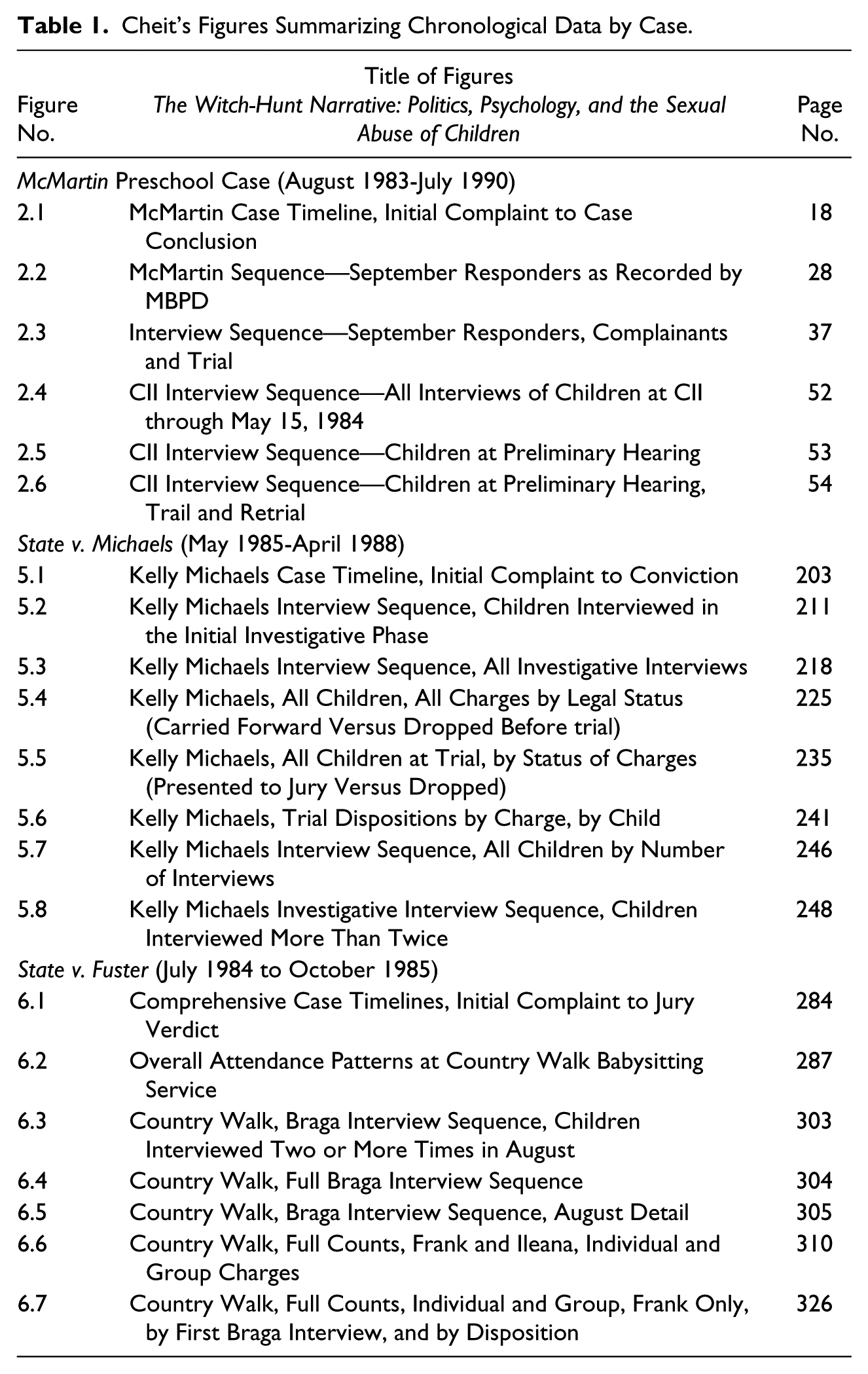
For example, the McMartin case was initially triggered in August 1983. A Grand Jury was convened in March 1984. The preliminary hearing in this case stretched an excruciating 18 months, from August 1984 to January 1986. The first trial took another 2 years, running from July 1987 to January 1990. Finally, a second trial took place between May and July 1990. In short, the entire case spanned from 1983 to 1990. In McMartin, there were 41 complainants, 14 children appeared at the preliminary hearing, 11 at the first trial and only three at the second trial. Investigators conducted no fewer than 226 interviews, between November 1983 and May 1984. Similarly, in the State v Michaels case 131 charges ended up going to the jury, an additional 105 charges were dropped before trial and another 38 were dropped at trial. In short, making sense of the historical ordering of all this material is no small task.
This analysis permits Cheit to ask and answer a number of empirical questions: In what order did children enter the investigation? Was the corroborating evidence in that child’s case strong or not? How many times was a particular child interviewed? In what sequence were children re-interviewed? Where did these interviews fall relative to the history of the overall investigation and other events?
How many charges were brought based on each child? Which charges were based on what evidence? How many charges went to the jury, how many charges were dropped, and when did this happen? By answering these questions, Cheit can offer a nuanced interpretative account of how events unfolded almost in real time, how strong or weak the evidence was by child (as well as in its entirety), what other events—including media reporting—may have influenced public perception at a particular point in time, and how best practices in other professions—such as medicine—were advancing, as the legal case itself progressed.
In short, Cheit can make empirical, evidence-based claims about the evolution of these important child sexual abuse cases which are sophisticated, detailed, and contextual.
Cheit argues that WHN itself collapses these complicated timelines, and omits the messiness that exists in the investigation and prosecution of child sexual abuse cases, particularly with young children. In doing so, the WHN greatly simplifies the basic “story” informing the public view. Cheit not only resists that collapsed version of these cases but also challenges their veracity. Arguably, among the most important of Cheit’s findings is the information unearthed about the very earliest stages of these cases. The original triggering events, and the evidence associated with them, are often lost to history. Yet this is some of the most crucial and compelling evidence pointing to sexual abuse, including such things as dramatic changes in a child’s behavior, curious spontaneous statements, or the repeated appearance of rashes or irritations in the genital region requiring medical attention.
Interpretative Standards/Analytical Findings
Cheit clearly articulates the threshold standards by which he will evaluate his findings. He sets a higher threshold for the three foundational cases than for the cases from the Case List. The higher threshold was, “whether there was substantial evidence supporting the state’s case” (Cheit, 2014, p. xv). The analytical question for the Case List cases was set lower, “was there credible evidence of abuse sufficient to have justified the state in bringing the case to trial?” (Cheit, 2014, p. xiv).
As the foundational cases were investigated because of their salience to the WHN, interpreting the data against a “substantial evidence standard” is appropriate. This is a high level of interpretive scrutiny, although lower than the standard that would be applied in a criminal case. In Cheit’s (2014) words, substantial evidence involves much more than the showing necessary to justify investigations or even arrest and indictment. It is more than enough evidence to support carrying the charges forward and withstanding a motion to dismiss the case for lack of sufficient evidence. (p. xv)
It is logical to establish a lower threshold for the Case List cases, as this group was selected more for the bulk they add to the WHN claim. Cheit reasons that if the state had sufficient evidence to take a case to trial—with or without a conviction—by definition it is not a witch-hunt.
In setting his evidentiary standards, Cheit makes clear two things. First, that his conclusions are based on his own interpretation of the evidence. He understands that others might draw different conclusions from the same evidence. This is consistent with any qualitative inquiry where the researcher is playing an interpretative role. The best qualitative scholarship is transparent about the process and supports findings with empirical evidence. Cheit does this. Others may disagree but they would need to ground their opposition in an alternative view of the evidence. Second, Cheit makes clear that his study findings should not be confused with an assessment of the legal guilt or innocence of the defendants. He writes, “There is an important difference between scholarly arguments about cases and legal judgments about the same case” (Cheit, 2014, p. xv). Therefore, Cheit’s thresholds are set for the exclusive purpose of answering his research question about the legitimacy of the WHN. Again, this is appropriate and it acknowledges the important difference between social science and legal investigations.
Study Findings
An abbreviated version of Cheit’s findings, relative to the research question, can be summarized as follows. First, McMartin began with a credible medical report and considerable evidence of abuse exists from the earliest phase of the case. However, over time, the investigation faltered on a number of fronts. In the end, overwhelming errors and over reaching in the case gave rise to a simplified WHN claim which not only eliminated the case’s complexity but also ignored, or negated, credible evidence of abuse. All nuances were lost and replaced with a “narrative without ambiguity” (Cheit, 2014, p. 86). In Michaels, Cheit (2014) finds that “the conventional wisdom is wrong” and is “built on misrepresentations about the earliest children in the case and the investigative interviews that followed” (p. 280). In particular, Cheit finds that the WHN is built on the “complete denial of the well-documented history of extreme behavioral symptoms and pediatric visits during 1984—1985” (p. 280). In Fuster, Cheit finds overwhelming evidence of sexual abuse, including a positive sexually transmitted disease (STD) test involving the throat of Fuster’s son.
In terms of the Case List, Cheit’s (2014) findings are varied but, in essence, he found many of these cases included, “credible evidence of abuse, or even something stronger than that” (p. 14). Cheit summarizes the important characteristics in figures throughout the chapter (see Table 1). These include information on whether the case went to trial, whether there was significant evidence of abuse, whether criminal charges were unjustified and/or defendants wrongly convicted. Cheit concedes, “there were clearly some poorly investigated and poorly charged cases” but that they were, “fewer and far between what the witch-hunt narrative claims” and “even taken at face value, do not add up to one hundred cases” (p. 14).
In short, Cheit’s interpretation of his empirical evidence leads him to conclude that the metanarrative of a widespread “witch-hunt” consisting of hundreds of cases is unsubstantiated.
Reporting
Cheit structures his book, and reports his empirical findings in seven chapters (see Figure 1). Each of the three foundational cases, McMartin, State v. Michaels, and State v. Fuster is presented in its own chapter (see Figure 1). In the fourth empirical chapter, Cheit reports his findings from the Case List.

The organizational structure of The Witch-Hunt Narrative, by parts and chapters.
Summary
In conclusion, Cheit’s overall research methodology for what I am calling the “strong central core” might be summarized this way. The WHN is based on a pervasive public perception that there has been a widespread criminal “witch-hunt” of adults alleged to have sexually abused children. The support for these claims comes from three salient cases and a list of other cases. Cheit asks an empirical question about whether this WHN claim is valid. His study sample consists of all the identified cases. He collects comprehensive, archival, and primary source data on each of these cases. He analyzed these data and held it to two different interpretative standards, a higher threshold for the foundational cases, and lower threshold for the Case List. He reports his analysis and findings in four empirical chapters. Based on his study findings, he answers his research question about the veracity of the WHN in the negative. He concludes, there is not sufficient evidence to justify the WHN’s claim that there are hundreds of groundless cases out there constituting a witch-hunt. At very least, he shifts the burden of proof in supporting this claim back to its proponents.
Up to this point, I find Cheit’s methodological framework sound. He asks and answers a research question. The methods are identified—implicitly if not explicitly. The findings are supported with empirical evidence and reported. The implications drawn are reasonable and based on the evidence presented. If Cheit had stopped here, I think it would have been a strong work. However, I have extracted this material, while ignoring other claims. The problem, in my view, is that he pushed his claims beyond this core design. I turn my attention to what I call his weaker methodological claims next.
Cheit’s Weaker Methodological Claims: Taking on the Academics
Cheit’s book is laid out in three parts grouped by time frame relative to the WHN (see Figure 1). Part I is designated, “the rise of the Witch-Hunt Narrative”; Part II is, “the triumph of the Witch-Hunt Narrative,” and Part III considers, “recent developments” and discusses the legacy of the WHN. This chronological structuring suggests an interest in how the metanarrative evolved over time. In keeping with this view, both Chapters 5 and 8—which each cover a foundational WHN case—start with a summary of Cheit’s research on that case and then turn to sections allegedly associated with the WHN’s evolution. In Chapter 5, he looks at “rewriting the story of the case” and in Chapter 8, “revisionist history (1993-present).” Of particular interest to me, is a subsection in Chapter 5 titled, “Academics Enter the Fray” (Cheit, 2014, p. 271).
In doing this, Cheit appears to deviate from the core research question in two important ways. First, he wants to make claims about the evolution of the WHN, which assumes it had different characteristics over time. Second, he wants to say something about its transition from one forum (media) to another (the academy). In my view, Cheit’s empirical work is on shakier grounds, methodologically, when he attempts to make this evolutionary claim about the WHN and even more significantly, when he extends the WHN outside the media and into the academy. My major argument is that while the “core research” project identified above is logically constructed, little attention has been paid to the methodology extending these claims. Instead, these arguments are made through a set of disparate assertions using selective evidence, which has not been linked clearly to the metanarrative.
I will limit my illustrations to the purported “turning point” in the WHN because this represents the juncture at which Cheit’s book extends to the academy. Although Cheit identifies academics not associated with the metanarrative, such as Gail Goodman, he identifies several prominent researchers whom he links directly to the WHN. These scholars are primarily, but not exclusively, a “pair of high-stature academic psychologists,” Stephen Ceci and Maggie Bruck (Cheit, 2014, p. 272).
Cheit’s arguments, in this section of the book, go something like this. When the McMartin case began the, “law was slanted against children as witnesses” (Cheit, 2014, p. 271). This changed with a New York Times article published in 1984 which “summarized studies of children as witnesses from a special issue of the Journal of Social Issues” (Cheit, 2014, p. 271). In it, “one study found that five- and six-year olds were as accurate as college students in recounting a staged event” (Cheit, 2014, p. 271). According to Cheit, these studies, “contributed to legal reform that allowed younger children to testify” (among other things). However, in the wake of the overall McMartin debacle, attitudes changed. At this point, some academics warned about a potential backlash against children. Cheit (2014) points to an article in the Los Angeles Times, in which “psychologist Carol Tavris referred to Gail Goodman’s research with approval and worried that ‘legitimate concerns about falsely accusing an innocent adult . . . not cause us to falsely disbelieve an innocent child” (pp. 271-272). However, Cheit argues this warning was not heeded and instead, “there was a concerted effort to discredit Goodman’s research and promote a new line of studies to emphasize that children were highly suggestible” (p. 271). Cheit characterizes these activities as “more like a political campaign than a scientific endeavor” (Cheit, 2014, p. 272). The converging forces “came to a head,” during the appeal of the Michaels case (Cheit, 2014, p. 271).
In this section of the book, Cheit (2014) offers four examples of Ceci and Bruck’s entrance into the “fray” (p. 272). These are as follows: (a) The publication of two academic articles, (b) publicity received in the New York Times (NYT) and 20/20 Newsmagazine on the “Mousetrap Study,” (c) a publication about translating research into policy, and (d) an amicus (friend-of-the-court) brief filed during the appeal of the Kelly Michaels’s conviction and later published in a psychology journal. Taken together, these four sections of Cheit’s text occupy 18 paragraphs (seven pages) of a 79-page chapter, in a 508-page book. Cheit challenges the motivations and methods of these researchers. In my view, the claims are large and grave, but the central focus of his investigation in this matter is unclear, and the analysis of the evidence sparse, selective, and inadequate.
Although I am loathe to wade into a substantive debate of these scientific claims given my admittedly limited expertise, I will offer four observations as a critical reader of Cheit’s text with an eye toward the evidence he is using and the claims he is making.
First, Cheit (2014) attributes a political motivation to the academics involved in discrediting Goodman’s research and promoting a “new line of studies” (p. 272). This ignores an alternative explanation that the researchers might have begun a new and legitimate line of scientific inquiry. New researchers ask new empirical questions and follow new lines of investigation that yield results that need to be distinguished from, or reconciled with, earlier scientific findings. In general, that is how scientific knowledge is built over time. It appears Ceci and Bruck have done this.
Second, Cheit is highly critical of Ceci and Bruck’s “mousetrap study” as reported in the NYT and in the TV newsmagazine, 20/20. In particular, Cheit extracts a quote from the 20/20 report in which Ceci links his research to the Kelly Michaels’s case. This sentence reads, “What we do [in our experiments] is a pale version of what happens in real cases. It doesn’t come close, for example, to what was done in the Kelly Michaels case” (Cheit, 2014, p. 274). Cheit (2014) calls Ceci’s statement a “serious misrepresentation of what happened in the Michael’s case” (p. 274). What Ceci actually meant by linking scientific experiments with the Michaels’s case, is unclear from the quotation presented. Nonetheless, Cheit goes on and supplies his explanation about what Ceci meant. This may or may not be an accurate portray of Ceci’s own reasoning. A reader has no way of knowing. Once Cheit identifies the alleged critical factors, he proceeds to discredit them.
In addition, it is worth noting that it is unlikely that Ceci had much control over how the journalist constructed the news segment reporting on his research. Undoubtedly this bit of interview tape was extracted from a longer interview with Ceci. Therefore, at best, the quote is twice removed from its original context, first by the journalist and second by Cheit. Nonetheless, Cheit’s claim that Ceci engaged in “serious misrepresentation” is directed against the scholar. This treatment of interview transcript data is incongruous with Cheit’s meticulous handling of the children’s interviews in his case-based research in the rest of the book.
Third, Cheit is critical of the “Mouse trap study” which he cites in Footnote 238, as an article published in 1994 in the journal of Consciousness & Cognition (Ceci, Huffman, Smith, & Loftus, 1994). Cheit (2014) seems to chide the researchers for failing to support their initial hypothesis, for labeling a subsequent study a “‘replication study’ containing a ‘modification’ in protocol” which he argues “made it a significantly different study” (p. 275). Cheit says of the article, “the results did not demonstrate the kind of suggestibility that had been hypothesized,” and he implies that the research team altered their protocol for the purpose of obtaining the desired results (p. 274). Cheit writes, “But the difference between the first study—which did not create the hypothesized results—and the ‘modified’ version, which did, was lost on the media” (p. 275).
In reading the original article, it is clear the Ceci and his colleagues are reporting a preliminary study from an ongoing line of research which sought to understand the causal mechanisms by which children might say something was true that actually was not. Subsequent studies extend this scientific line of inquiry (Ceci & Huffman, 1997; Ceci, Loftus, Leichtman, & Bruck, 1994). However, in summarizing the first study, Cheit makes no mention of the fact that researchers were examining the source of misattribution in two age groups (3- to 4-year-olds) and (5- to 6-year-olds). In the researchers’ own words, “of primary interest is age differences in the generation of true and false reports during the initial interview, and growth in false reports between the initial interview and the terminal interview” (Ceci, Huffman, et al., 1994, p. 394). In short, the researchers were interested in two age groups, relative to two questions, (a) initial reporting and (b) growth of false reporting between the first and terminal interviews (Ceci, Loftus, Leichtman, & Bruck, 1994, p. 394).
The authors admit, “our expectation that children would begin by denying that they remembered the fictitious events, but over time increasingly assent to them, is not borne out, at least not overall” (Ceci, Loftus, Leichtman, & Bruck, 1994, pp. 395-396). Nonetheless, this research team did report an alarming finding that 44% of the younger children assented to false events at the first interview, while 25% of the older children did. The fact that these researchers found considerable misattribution at the first interview, and continued to modify their study design, in response to the preliminary study results, is the hallmark of building scientific knowledge. The fact that they reported that their initial hypothesis was not confirmed is exactly what we should expect from social scientists.
In addition, it is worth noting that the second part of this study, published the same year, is titled “the Possible Role of Source Misattributions in the Creation of False Beliefs Among Preschoolers” (emphasis added). In this article, the research team reports changing, “one major parameter of the paradigm” (Ceci, Loftus, Leichtman, & Bruck, 1994, p. 307). At very least, three things are apparent. First, judging from the title, they appear to be cautious about stating their claim. Second, the researchers are reporting findings as they proceed with their program of inquiry. Third, they are engaged in ongoing experimentation and incremental knowledge building. On its face, this appears to be a careful and thoughtful program of science.
To the extent the media commingled the results of two studies which were published nearly simultaneously in two different academic journals in 1994 is understandable, if problematic (Ceci, Huffman, et al., 1994; Ceci, Loftus, Leichtman, & Bruck, 1994). Judging from the date of the NYT article, I suspect the journalist was reporting on conference papers and not finished academic articles (Goleman, 1993). It is difficult to determine whether Cheit’s complaints are directed against the journalists, the scientists, the science, the translation of science to journalism, or the examples used. Although there may be criticism to be made, they have not been clearly stated or rigorously investigated.
Fourth, Cheit is particularly critical of Ceci and Bruck’s involvement in filing an amicus brief in the Michaels appeal. In the three-page discussion of this legal brief—which Cheit points to as a pivotal moment in the WHN—he accuses Ceci and Bruck of the following: working with defense attorneys, misrepresenting how close were their ties to the defense while publically claiming a centrist position, mischaracterizing Goodman’s position, misrepresenting the case evidence in emails to other scholars soliciting support for the brief, misrepresenting the state of consensus in the academic literature on child witnesses by discounting Goodman’s scientific studies and promoting their own recent studies, misrepresenting the facts in the Michaels case, and misapplying the existing research to the Michaels case. Cheit (2014) characterizes the actions of Ceci and Bruck, as looking “a lot more like politics than science” (p. 278).
In a footnote, Cheit (2014) reports that an appendix in the brief is “riddled with errors and misleading statements” (p. 279). Cheit notes that “all of the errors that I have identified in the [Ceci and Bruck] appendix are in the same direction: They all promote the witch-hunt narrative.” (p. 465). Although Cheit gives us a list of examples, he does not tell us exactly how this list is conceptually linked to the academy’s version of the purported WHN.
In short, in my view, Cheit levels a stunning array of accusations against Ceci and Bruck, with sparse and selective evidence offered for support. The actual brief in question covers seven lines of academic research including sections on child suggestibility, interview bias, repeating misinformation, emotional tone of the interview, peer pressure, stereotype inducement, and source attributions (Bruck & Ceci, 1995). An alternative explanation of Ceci and Bruck’s actions might be that they believed in the merit of the most recent scientific findings (including their own work) and in their professional view, this science supported the defense’s version of the case. They constructed the brief accordingly, working with experts in the case. Their motivation may have been a desire to make their research useful and available to the public. Although this may look like a form of advocacy, it might also be characterized as engaged scholarship. In fact, the State’s motion seeking to exclude the amicus brief was denied. Cheit (2014) excuses the court by saying, “one would not expect [the Court] to get involved in an academic dispute” (p. 278).
My point here is not to weigh in on who has the more correct view of the state of the academic literature or its application to the Michaels case. However, it is to suggest that while Cheit laid out a clear methodology for studying the WHN as it applied to the “hundreds” of cases identified by several journalists discussed above, he has not been nearly as careful or clear about investigating these social scientists. What is the question under investigation? How is this question linked to the WHN? What evidence is identified to answer the question posed and how is it related to the research question? Has that evidence been systematically and comprehensively collected and analyzed? Has it been reported fairly? Are the claims justified? Have alternative explanations been considered? I fully appreciate that Ceci and Bruck’s position makes life more difficult for professionals working with children, but to conclude it was faulty, groundless, or politically motivated in its entirety would require a more systematic investigation to be persuasive.
Given Cheit’s concerns, any number of legitimate empirical questions could be framed for investigation: How is science reported in newspapers or TV news shows? What is the boundary between science and advocacy? How should lab studies or experiments be translated into the real world? What is the intersection between science and law? What happens at the boundaries between science and journalism? Each of these research questions would require a different study, a different design, different evaluation standards, and yield different kinds of implications. I could easily be persuaded that these are important empirical questions. However, I would expect them to be investigated and answered according to the rules of social science using a rigorous and transparent methodological plan.
I suspect that Cheit’s primary concern involves the extremely critical issue about how scientific findings are translated, or applied, in real-world situations. I share his concern. The federal government is increasingly funding “translation science” projects—that is, research that is supposed to rigorously bridge the gap between the rarefied and controlled world of experimental studies and their messy real-world applications. This translation is fraught with complications. In child sexual abuse cases, particularly those involving the youngest, most vulnerable, children, the stakes are extremely high. Nonetheless, getting the answers wrong endangers all of us no matter which side of the advocacy continuum one sits.
Conclusions and Future Directions
Evidence is used to construct many different kinds of narrative accounts. What constitutes evidence, and the terms professionals use to define it, differs by professional domain. Lawyers, social scientists, and journalists identify, locate, collect, analyze, and interpret evidence differently. Not surprisingly, the narratives produced in different forums also differ in their goals and objectives. Peer-reviewed articles, newspaper accounts, legal briefs, or case law all have their distinct narrative styles, functions, and target audiences. In constructing these various narrative accounts, professionals must handle their evidence according to rules established by their own discipline or profession. So, for example, when journalists make generalized claims about social problems, they do not do so pursuant to the standards of generalizability established in scientific communities.
Given the complexity of producing narratives within a particular profession, it is all the harder when the boundaries between them are messy and porous. Journalists report on scientific studies or legal cases. Social scientists testify before judges or talk to the media. Lawyers talk with social science experts, they subpoena journalists and they face news cameras in front of courthouses. Prosecutors, defense attorneys, and judges will assess and evaluate evidence, including expert opinions, differently. These translations across domains are complicated and require a melding of evidentiary material. In short, the activity of moving information between these forums, while absolutely crucial, is also inherently fraught with the possibility of selection bias, over simplification, over generalization, miscommunication, misunderstanding, and error.
Cheit has tackled the enormously complicated task of challenging a metanarrative—the WHN—which transcends neat boundaries and by definition has life in a variety of public forums. Grand metanarratives, like the WHN, require simplicity to thrive. They cannot tolerate ambiguity. They rarely grapple with negative examples or alternative explanations. They are often one dimensional and morally clear. They tend to be ahistorical and lack discussion of messy contexts. They often use “typical case examples” to make sweeping “tip-of-the-iceberg” claims (Best, 1990; Staller, 2003, 2009).
In The Witch-Hunt Narrative, Cheit has subjected a generalized claim, largely produced by journalists, to scientific scrutiny. In doing so, he has contributed mightily to the academic literature on key legal cases associated with WHN. I have argued that this core study is rigorously executed and important. Cheit has unpacked these legal cases in all their complexity and messiness. He has unearthed their chronology and offered corroborating evidence. He has resurrected their evolutionary paths and re-invigorated academic examination. In doing so, he has challenged the veracity of dominant narrative tropes. He has warned us that simplified presentations—those that obliterate complexity—do a disservice to everyone. Having done so, one can only hope that journalists and academics—including those Cheit has singled out for criticism—will re-examine their own work in light of his impressive scholarship. That said, where Cheit’s book seems to veer into more problematic territory is when he attempts to extend the WHN’s reach to academics and their research. He has not attended to this part of his investigation with the same meticulous detail as that of his investigation of the media. I do not doubt he raises a variety of questions worthy of investigation, and I have offered a number of possibilities. Perhaps, one of these questions could serve as the focus for Cheit’s next “Extreme Research” project.
Footnotes
Declaration of Conflicting Interests
The author(s) declared no potential conflicts of interest with respect to the research, authorship, and/or publication of this article.
Funding
The author(s) received no financial support for the research, authorship, and/or publication of this article.