






Abstract
Although existing research has advanced our understanding of participant roles in bullying, it is limited by its focus on a single participant role and reliance on samples of children or adolescents in Western nations. Under a “multiple participant roles” perspective based on adaptive strategy hypothesis, the current study used a modified version of the Participant Role Scale approach to identify participant roles in 523 Chinese eighth graders (47.0% boys; M = 14.43) based on peer ratings using two role classification methods: single participant role (using standardized scores) and multiple participant role (using raw scores). First, the single-role method was used. Second, primary, secondary, and tertiary roles were assigned to each adolescent according to his or her three highest scores; they also were assigned to various combinations of roles. Associations between variation in bullying roles and peer social preference (i.e., peer acceptance and rejection) were examined. Overall, the results regarding single-role classification showed that the distribution of and gender differences in roles were consistent with previous studies of Western adolescents. Results regarding multiple-role classification revealed wide variation: primary roles, 85.3% of the sample; secondary roles, 54.2%; tertiary roles, 43.2%. Girls tended to occupy only one role, whereas boys occupied multiple roles. Furthermore, 11 role combinations were identified (e.g., probully-defender; probully-defender-outsider) that were dominated by boys, but also included some girls. Youth whose combination included the role of defender had higher peer acceptance and lower rejection, compared with those without the defender role—a “defender protective effect.” The findings have important implications for understanding and reducing bullying.
Introduction
Bullying in schools is defined as a subset of aggressive behavior in which the victim cannot easily defend him- or herself (Olweus, 1993, 2000; Zhang, Chen, & Chen, 2016). As a group process, most children or adolescents (approximately 80%) are involved in bullying episodes, and they assume a participant role such as bully, assistant of the bully, reinforcer of the bullying, victim, defender of the victim, or outsider (Goossens, Olthof, & Dekker, 2006; Lucas-Molina, Williamson, Pulido, & Calderón, 2014; Menesini, Codecasa, Benelli, & Cowie, 2003; Salmivalli, Lagerspetz, Björkqvist, Österman, & Kaukiainen, 1996; Sutton & Smith, 1999). In addition, the literature has shown evidence for the importance of one particular “multiple-role combination”—the bully-victim (Goossens et al., 2006; Salmivalli et al., 1996; Sutton & Smith, 1999). As important as this specific multiple-role combination may be, there may be other multiple-role combinations that exist that are as or more important to the propagation or reduction of bullying. Furthermore, the bullying literature relevant to multiple participant roles is dominated by studies of Western children and adolescents, and relatively little is known about bullying in Asian populations. Thus, the goal of the current study was to sample Chinese adolescents, and to investigate all potential multiple-role combinations in up to three roles (primary, secondary, and tertiary) and their associations with peer social preference (i.e., acceptance and rejection).
Bullying Is a Group Process in Western Samples
As a pivotal dynamic interpersonal interaction in the peer group, bullying involves many students who become involved through acting in different participant roles. Salmivalli and colleagues (Salmivalli, 2010; Salmivalli et al., 1996; Salmivalli, Lappalainen, & Lagerspetz, 1998) found empirical support to the conceptualization of bullying as a group process and demonstrated the six participant roles and their stability over time. Within bullying situations, bullies are active initiative takers and leaders; they are supported by assistants who can join the bullying attack and by reinforcers who usually laugh or provide an audience for the bullying incidents. Victims are children who get bullied by other children; they are helped by defenders who show supportive, consoling behaviors and make efforts to stop the bullying. Finally, the children who do nothing or stay outside the bullying situations are identified as outsiders.
The Participant Role Scales (PRS) measure, developed by Salmivalli et al. (1996), assesses the different behaviors and roles in bullying situations. We provide some detail on the instrument and measurement approach here, because it served as the foundation for the method used in the current study. In this method, each child is identified with a particular participant role if their peer-rated score on that role’s scale is both higher than the class mean (of the role score standardized by class) and higher on that role scale than on any of the other role scales. The one exception to this scoring method is that children are designated as victims if they are identified as such by 30% or more of their classmates. Using this approach, Salmivalli et al. (1996) found more than 87% pupils in Finland assumed a participant role considered as mutually exclusive, and the most common participant roles were outsider, reinforcer, and defender. There were significant gender differences, with more defenders and outsiders among girls, and more bullies, assistants and reinforcers among boys.
Then, a shorter version of the PRS, consisting of fewer items plus one victim-nomination item (23 items in total), was used to investigate the stability of the participant roles over a 2-year period (Salmivalli et al., 1998). This study found substantial stability in participant roles for boys and girls, with a classroom change producing lower stability. Furthermore, factor analysis of the short version items (with the exception of the victim-nomination item) showed three major factors: a “probully” factor (which combined the roles of bully, assistant and reinforcer), a defender factor, and a noninvolved factor.
More recently, short PRS was subsequently applied and adapted in a series of studies using Western samples. Sutton and Smith (1999) investigated British children (7-10 years) by interview, using Salmivalli’s original criteria of standardization by class as well as three new methods for assigning participant roles, i.e., no standardization method, whole sample standardization method, and a factor role method (that is probully, defender, victim, and outsider). Goossens and colleagues (2006) also used Salmivalli’s criteria and three other new criteria for classifying participant roles (i.e., nominated by at least 10%, 15%, and 20% classmates), in Dutch children (10 years) based on peer nominations. Most recently, Crapanzano, Frick, Childs, and Terranova (2011) and then Lucas-Molina and colleagues (2014) examined the characteristics of participant roles and the validity of the PRS in American (9-14 years) and Spanish (8-13 years) by peer reports, respectively. Results from these studies showed that bullying scenarios are one kind of peer interaction in which the majority of classmates play a role, and that there are gender differences in these role patterns. However, the studies also showed that the prevalence of each type of role varied by study due to sample differences (e.g., culture, age) and scaling methods being used.
With this work in Western samples as our foundation, our first aim was to apply Salmivalli et al.’s original standardized method for single-role assignment, in a large urban Chinese sample of 14-year-olds. To our knowledge, the PRS has not yet been adapted for and validated in a Chinese population. As a significant aspect of culture in China, Confucian-collectivism emphasizes the value of maintenance of social harmony and smooth interpersonal relationships in both traditional and contemporary Chinese societies (Chen, Bian, Xin, Wang, & Silbereisen, 2010; Liu & Chen, 2003; Zhang, Chen, Yu, Wang, & Nurmi, 2015). Adolescents who intentionally hurt others and cause interpersonal conflicts (e.g., bullying) probably face greater peer pressure from others. We hypothesized that most of the Chinese adolescents would report that they take part in bullying scenarios, but that there would be fewer bullies than defenders in their peer group.
From Single Participant Role to Multiple Participant Roles
Although identifying the major single-role that Chinese youth play in bullying episodes is an important first step, there is a problem to address: Children might act in more than one role which can vary across particular bullying episodes. To examine this possibility, Salmivalli and colleagues (1996) compared the scores of victims on the Bully, Reinforcer, Assistant, Defender, and Outsider scales of their measure, with the scores of nonvictimized children. The results indicated that the victims scored significantly higher on the Defender scale and on the Outsider scale; that is to say, some children classified as victim could play also a defender or outsider role in bullying incidents. Furthermore, they initially examined the secondary roles of the victims and found that three male victims and one female victim had the secondary role of bully.
More importantly, if unstandardized “raw” scores are used for assigning roles, secondary participant roles can be identified according to the second highest role score of each child (suggested by Sutton & Smith, 1999). Their results showed that within each primary role, children had different secondary roles. For instance, 44.0% of the bullies with the highest score on Bully scale had a secondary role of reinforcer, while 28.0%, 20.0%, and 8.0% of the bullies, respectively, acted as assistant, defender, and victim in their secondary roles. Goossens and colleagues (2006) found that children in different primary roles could have the same secondary role. For example, 18 followers, four defenders, and two victims had the same secondary role of bully.
Although existing studies have shown that most children have a primary role and only one secondary participant role, no study has yet investigated the prevalence and characteristics of these multiple roles. In addition, virtually nothing is known about possible tertiary roles that some children may play in bullying episodes. Given this gap, our second aim was to investigate the distribution of, and gender differences in, the primary, secondary, and even tertiary roles assigned, respectively, by children’s first, second, and third highest raw peer-rating scores. A tertiary role is the third role of the total six participant roles for one adolescent. As such, it can help to completely map out the characteristics of participant roles in bullying. Furthermore, the tertiary role provides one more component for examining potential multiple-role combinations. We hypothesized that most adolescents would also have a secondary participant role, and that some would also have a tertiary role. We also explored whether the distributions of these multiple-role combinations differed for boys and girls.
Adaptive Strategy Hypothesis and Multiple-Role Combinations in Bullying
As suggested by Olweus (2000), children will likely occupy different roles based on their attitudes toward bullying, and their physical and social power. In line with this idea, we proposed that playing six different single participant roles, with the exception of passive victim role, represents children’s adaptive selection based on balancing costs and benefits of specific behaviors in dynamic peer interactions. In addition, Resource Control Theory claims that older children and adolescents tend to use two different strategies—coercive and prosocial—to gain resources that enhance their adaptation in the peer group (Hawley, 1999, 2003; Volk, Camilleri, Dane, & Marini, 2012). Based on Resource Control Theory, in the present study, we proposed the adaptive strategy hypothesis that acting in more than one participant role (i.e., in a multiple-role combination, such as bully-defender or victim-defender) was also an adaptive strategy. Specifically, it is more adaptive for peer relations if adolescents use multiple-role identities in bullying interactions.
Until now, existing research has advanced our understanding of different participant roles in bullying, but it has not gone beyond the scope of the main role for each child with the exception of the specific “bully-victim” role combination (Olweus, 1993, 2000). The participant role of each child is usually defined according to the highest score each child receives on the six participant subscales of the PRS. However, as already noted above, many children have elevated scores on multiple dimensions and fulfill multiple roles—and not just in the “bully-victim” combination. Therefore, our third aim was to examine role combinations to describe these types of children, defined as the combination of primary, secondary, and other participant roles (e.g., a role combination of bully-victim-defender with primary role of bully, secondary role of victim, and tertiary role of defender—not to mention many other potential combinations).
Furthermore, some findings in the literature have shown that some roles covary (e.g., Bully scores are correlated with assistant and reinforcer role scores; Goossens et al., 2006). Specifically, factor analyses of the PRS conducted by Sutton and Smith (1999) and Goossens et al. (2006), both indicated the existence of four factors: a “probully” factor (including bully, assistant, and reinforcer), a “defending” (defender) factor, a “victimization” (victim) factor, and a “non-involved” (outsider) factor. In addition, the overlarge number of possible role combinations based on six participant roles should be taken into consideration. Therefore, the four-factor role scoring of the PRS was used and formed the component role of multiple-role combinations in the current study.
Associations With Peer Sociometric Status
The participant roles in bullying scenarios are identified through the process of peer interaction. At the same time, peer sociometric status of each child in the peer group is one outcome of peer interaction. To account for the effects of different participant roles on peer sociometric status, theorists have designated peer sociometric status as a key indicator of peer-group adaptation, among children who have acted in different roles (Olweus, 2000; Salmivalli et al., 1996; Veenstra, Lindenberg, Munniksma, & Dijkstra, 2010). The literature has clearly shown that bullies and victims are socially rejected because of their aggressive or withdrawn behaviors (Lagerspetz, Björkqvist, Berts, & King, 1982; Olweus, 1993, 2000; Veenstra et al., 2010). Salmivalli et al. (1996) found, for both males and females, that victims had low social acceptance and high social rejection. However, bullies had “controversial” social status, with low acceptance and high rejection among male bullies but average levels of rejection and acceptance for female bullies. Defenders of victims scored highest on social acceptance and lowest on social rejection, and outsiders who avoided bullying episodes scored below average on both social acceptance and social rejection. Similar patterns of distinct associations with peer acceptance and rejection were found among Dutch and Spanish youth (Goossens et al., 2006; Lucas-Molina et al., 2014). Overall, prosocial behavior by defenders was associated with popularity, whereas aggressive behavior by bullies or bully-victims was associated with rejection, and even the experience of victimization consistently was linked with rejection.
The final question we addressed was whether or not the different multiple-role combinations were distinctly related to peer-reported sociometric status. Based on the prior studies that examined single bullying roles and their links with acceptance and rejection, we hypothesized that the role of defender would have a protective effect for adolescents, and that being a defender in any multiple-role combination would mitigate any negative effect on peer sociometric status of the component roles of probully or victim. Beyond this hypothesis, we also explored patterns of peer acceptance and rejection in the most prevalent primary/secondary/tertiary role combinations, to describe the results and move beyond prior work that has described only the bully-victim combination.
In sum, we had four aims. First, we examined bullying roles in an urban Chinese sample. Second, we sought to identify and describe the prevalence of primary, secondary, and tertiary roles based on first, second, and third highest raw scores on the PRS scales. Third, we identified patterns of multiple-role combinations which were formed according to four-factor roles of children’s primary, secondary, and tertiary roles. Finally, we explored the associations between different role combinations and peer acceptance/rejection.
Method
Participants
A total of 523 Grade 8 adolescents (246 boys, 47.0% of sample; Mage= 14.43 years, SD = 0.71) were recruited from 12 classes in two secondary schools located in two eastern Chinese cities (six classes from Jinan, 233 students; six classes from Jining, 290 students). The class sizes varied from 44 to 52 students, and 67 adolescents did not finish the investigation or disagree to attend. Most were only children, although 29% had a sibling. Most (92%) were from two-parent or extended families, with 8% from single-parent families. Forty-eight percent of the fathers and 45% of the mothers had a college education. The remainder had either a high school education (39% of fathers and 36% of mothers), a junior high school education, or less (13% of fathers and 19% of mothers).
Procedure
After parent and adolescent consent were obtained, adolescents independently completed the Modified Participant Role Scale (MPRS) and peer nominations with regard to their “best friends” and those they “disliked” among their classmates, during classroom hours. The data collection procedures were approved by the Institutional Review Board at Shandong Normal University.
Measures
Individual and combinations of bullying roles
The PRS developed by Salmivalli et al. (1996) includes five subscales to identify Bully, Assistant, Reinforcer, Defender, and Outsider. Each of these is described in the literature review above. Participants were asked to identify those classmates who behaved in the manner described in statements of the instrument and to quantify how often they behaved in this manner using a 3-point Likert-type scale ranging from 0 (never) to 2 (often). The peer-estimated scores on the Bully, Reinforcer, Assistant, Defender, and Outsider subscales were standardized by class. The scale was then adapted to the reduced version for children developed by Sutton and Smith (1999), and the raw role scores were analyzed by four different sets of scoring criteria: standardization by class, no standardization, whole sample standardization, and factor role. Goossens et al. (2006) also reduced the original 48 PRS items to 28, and verified their validity for classifying participant roles.
The Modified PRS used in the current study included a few additional modifications from the already shortened version by Sutton and Smith (1999). Salmivalli et al. (1996) had no items for victim role by peer nomination. Therefore, we added four items involving physical, verbal, relational, and social victimization from the Olweus Bully/Victim Questionnaire (Olweus, 1996): “being hit, kicked, or slapped by others”; “being laughed at by others”; “being excluded by others”; and “being spread rumors by others.” They were modified to use the same 0- to 2-point Likert-type scale as the other MPRS items.
A pilot study was conducted with 213 eighth-grade students from four other classes in March 2005 in Jinan. The results of this pilot study indicated that several changes were needed before conducting the formal study, due to lack of clarity of several of the items. Consequently, one item was deleted from the Assistant subscale, and some items were modified for easier reading. Chinese psychologists evaluated the modified scales for their appropriateness within the Chinese context. Each of the six subscales had good internal consistency: Bully (α = .98), Reinforcer (α = .97), Assistant (α = .91), Defender (α = .87), Outsider (α = .78), and Victim (α = .85). The results of a confirmatory factor analysis showed that the structures of the modified subscales were identical to the original PRS, and 27 items chosen to characterize the different participant roles were Bully (five items), Reinforcer (five items), Assistant (three items), Defender (six items), Outsider (four items), and Victim (four items).
For identifying multiple-role combinations, raw scores were used to quantify how often participants assumed various participant roles. Each adolescent was identified with a primary, secondary, and tertiary role if their scores by peer rating on three of six roles were both (a) higher than the class mean and (b) being ranked by their scores for first, second, and third role in order. Four individual case examples were provided in Table 1 to illustrate our method. For instance, if the first three high scores on the MPRS for one adolescent were scores on defender, victim, and bully in sequence, and they were all higher than the class mean on Defender, Victim, and Bully subscales, respectively, the adolescent was assigned into a subgroup of defender-victim-bully role combination. If the raw score on one or two of the adolescent’s three highest role scores was under the mean score of that same subscale in the sample, the adolescent was not assigned that role. In addition, the order of component roles in the name of role combination is not taken into consideration.
Identification of Multiple-Role Combinations: Four Example Cases.
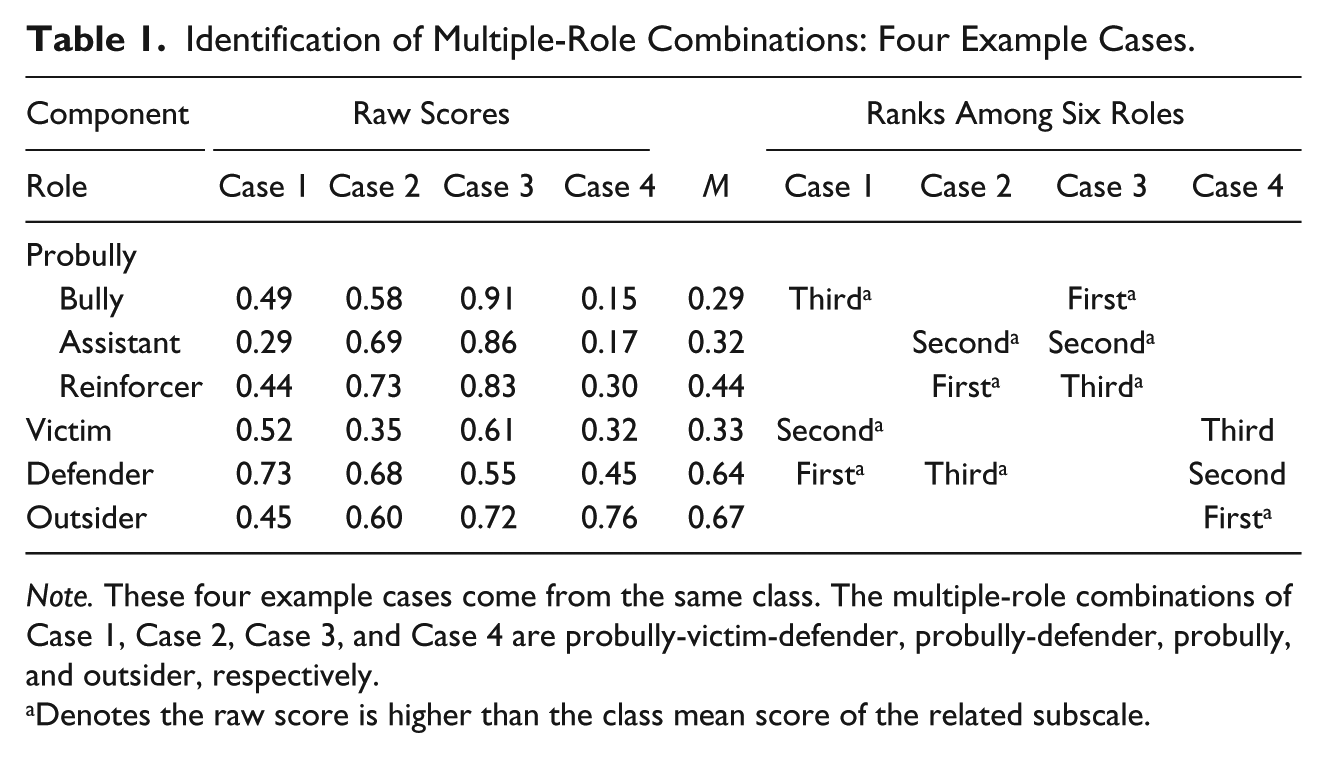
Note. These four example cases come from the same class. The multiple-role combinations of Case 1, Case 2, Case 3, and Case 4 are probully-victim-defender, probully-defender, probully, and outsider, respectively.
Denotes the raw score is higher than the class mean score of the related subscale.
In a final step, role combinations were calculated based on primary, secondary, and tertiary roles of each adolescent using the criteria noted above. Some had only a single role, whereas others had secondary and tertiary roles as well. Therefore, the role combinations could include a single-role pattern (e.g., victim, defender, or an outsider), two-role pattern (e.g., defender-victim), or three-role pattern (i.e., defender-victim-outsider). There was one exception: For the “probully factor” combination of roles noted by Sutton and Smith (1999) consisting of bully, assistant, and/or reinforcer, we used the “probully” designation for youth who had any or all three of these in combination. This was exemplified by Case 3 in Table 1. As in the example case, if an adolescent had a primary role of bully, secondary role of assistant, and tertiary role of reinforcer, the assigned role combination was labeled “probully.”
Peer acceptance and rejection
Participants were asked to identify the three classmates they liked the most and the three classmates they liked the least (Coie, Dodge, & Coppotelli, 1982). The number of liked most (“acceptance”) and liked least (“rejection”) nominations was summed for each adolescent, and nomination sums were standardized by class as done by Salmivalli et al. (1996).
Results
Aim 1: Participant Roles (Original Standardized Method)
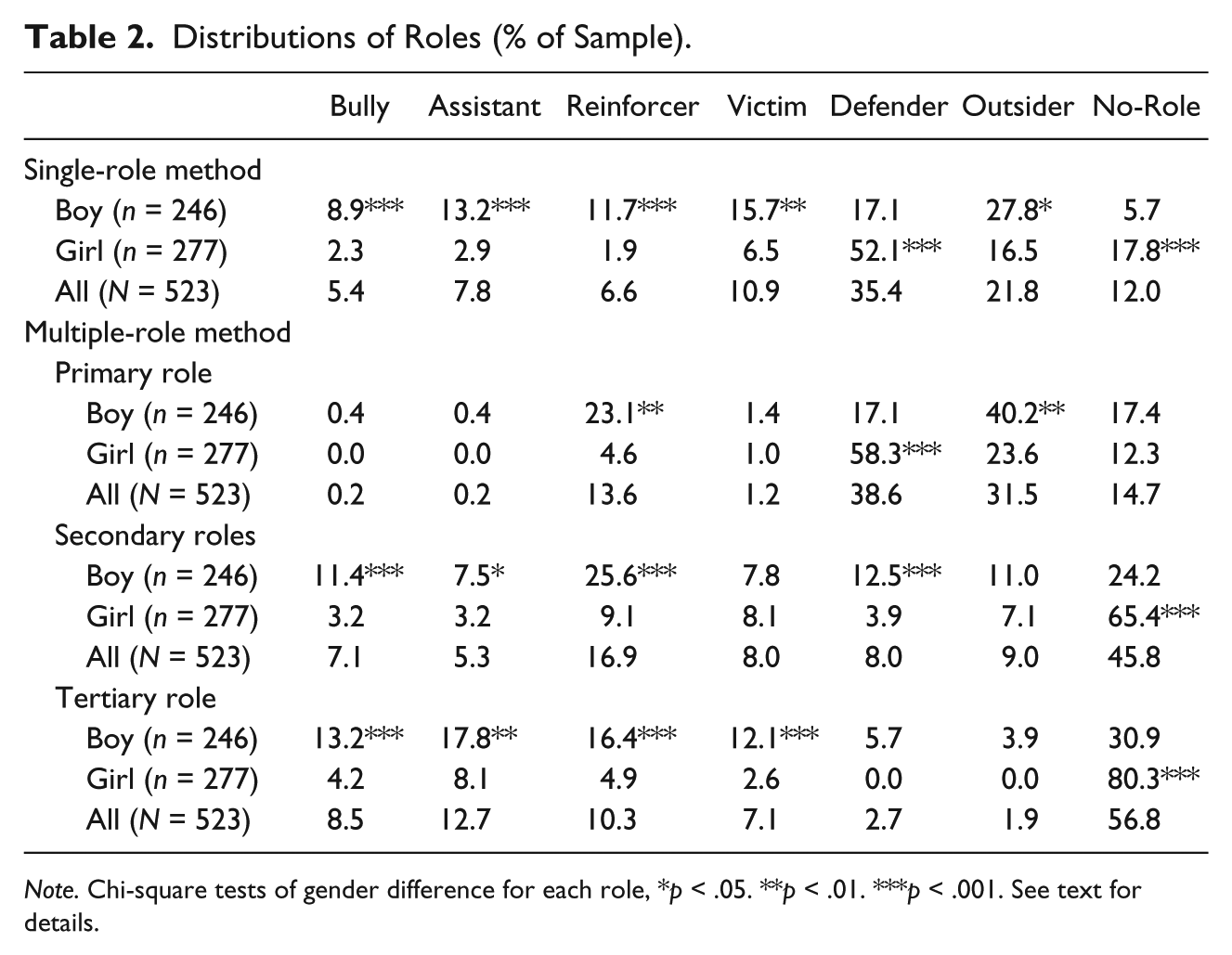
Using the original traditional assignment method, 88% of the adolescents were assigned to a main participant role; these are shown in Table 2. The most common participant roles were defender (35.4%) and outsider (21.8%). Gender comparisons revealed that girls were more likely to be defenders, χ2(1) = 61.10, p < .001, and have “no-role,” χ2(1) = 21.42, p < .001. In contrast, boys were more likely to be bully, χ2(1) = 10.13, p < .001; assistant, χ2(1) = 17.04, p < .001; reinforcer, χ2(1) = 18.69, p < .001; victim, χ2(1) = 9.00, p < .01; and outsider, χ2(1) = 5.65, p < .05.
Distributions of Roles (% of Sample).
Note. Chi-square tests of gender difference for each role, *p < .05. **p < .01. ***p < .001. See text for details.
Aim 2: Multiple Participant Roles (Raw-Score Method)
Next, we turned to the assignment of up to three roles. According to each adolescent’s highest score among the six potential roles, 85.2% were assigned to a primary participant role. The primary participant roles selected most often were defender (38.6%) and outsider (31.5%), as shown in Table 2. Girls were more likely to be defenders, χ2(1) = 76.42, p < .001, and boys were more likely to be reinforcers, χ2(1) = 31.25, p < .001, and outsiders, χ2(1) = 8.60, p < .01. Unexpectedly, there were no significant differences by gender in roles of bully, assistant, victim, and “no-role.” Furthermore, nearly all (99.6%) were assigned to roles other than bully or assistant.
Next, we examined the secondary role; 54.2% could be assigned to such a role, with reinforcer (16.9%) and outsider (9.0%) being the most common as shown in Table 2. Girls were more likely to have a secondary “no-role” assignment, χ2(1) = 75.57, p < .001, whereas boys were more likely to have secondary roles as bully, χ2(1) = 11.52, p < .001, assistant, χ2(1) = 3.90, p < .05, reinforcer, χ2(1) = 19.36, p < .001, or defender, χ2(1) = 11.26, p < .001. There were no gender differences in prevalence of victim or outsider secondary roles.
Turning to the tertiary role, 46.3% were assigned—most were either assistant (12.7%) or reinforcer (10.3%) as shown in Table 2. Girls were more prevalent in the “no-role” category, χ2(1) = 85.33, p < .001, whereas boys were more frequently in tertiary roles as bully, χ2(1) = 11.52, p < .001, assistant, χ2(1) = 8.33, p < .01, reinforcer, χ2(1) = 15.75, p < .001, or victim, χ2(1) = 16.10, p < .001.
Aim 3: Role Combinations
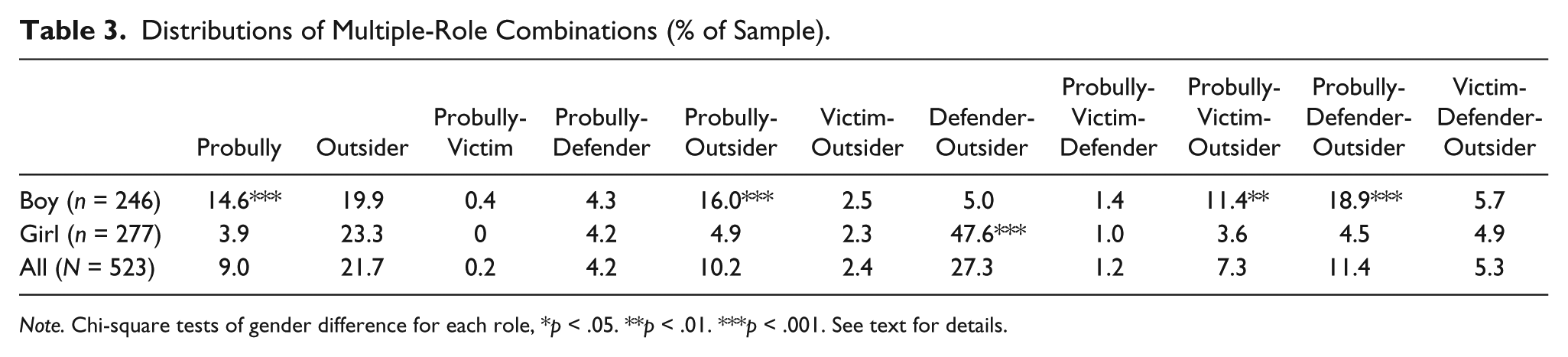
Using the scoring methods described in “Measures” section above, we identified 11 role-combination groups by considering primary, secondary, and tertiary participant roles together. The distributions of these role combinations were shown by gender in Table 3. The most common role combinations were defender-outsider (27.3%) and outsider (21.7%), followed by (in order of prevalence) probully-defender-outsider, probully-outsider, probully, probully-victim-outsider, victim-defender-outsider, probully-defender, victim-outsider, probully-victim-defender, and probully-victim.
Distributions of Multiple-Role Combinations (% of Sample).
Note. Chi-square tests of gender difference for each role, *p < .05. **p < .01. ***p < .001. See text for details.
The results of chi-square test further showed that there were more defender-outsiders among the girls: χ2(1) = 109.87, p < .001. However, among the boys, the role combinations of probully, χ2(1) = 15.87, p < .001, probully-outsider, χ2(1) = 15.00, p < .001, probully-victim-outsider, χ2(1) = 10.26, p < .01, and probully-defender-outsider, χ2(1) = 22.70, p < .001, were more frequent.
Aim 4: Role Combinations and Peer Status
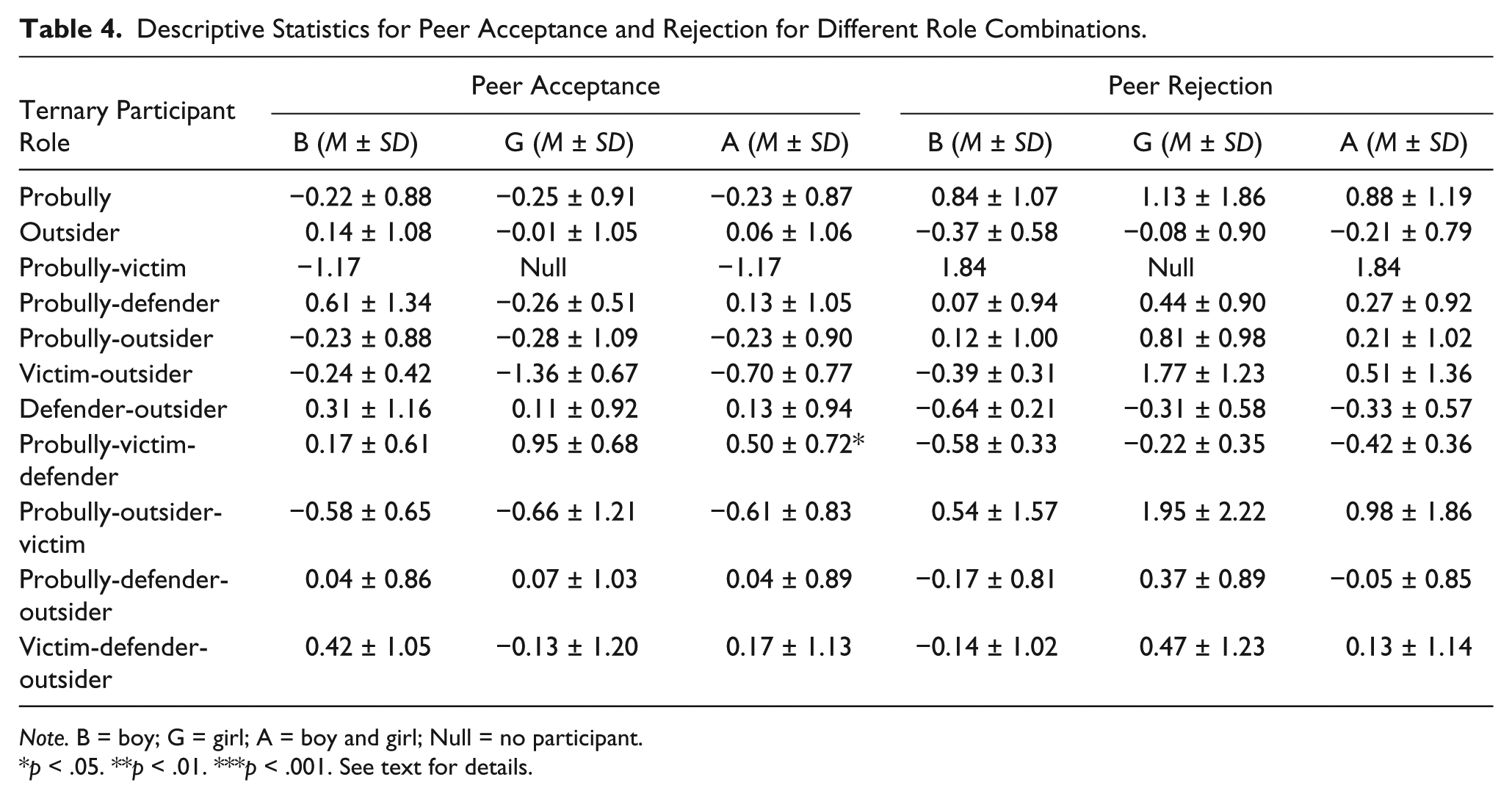
Our final aim was to examine associations between role combinations and peer status. Acceptance and rejection were analyzed separately, with gender (codes as boy = 1 and girl = 2) and role combination (as an unordered categorical variable including 11 categories coded from 1 to 11 and excluding the category of probully-victim, which had only one adolescent assigned to it) as between-subject factors. In other words, a univariate ANOVA, 2 (Gender) × 10 (Role Combination) was conducted. Means/SDs for each variable, as a function of gender and role-combination group, were shown in Table 4. The results showed that role combination was a significant main effect for peer acceptance, F(9, 522) = 2.75, p < .01, but neither gender, F(1, 522) = 2.66, p = .10, nor the gender-role combination interaction, F(9, 522) = 1.04, p = .41, was significant. Mean scores of peer acceptance, from highest to lowest, were found for probully-victim-defender (highest peer acceptance), then victim-defender-outsider, probully-defender, defender-outsider, outsider, probully-defender-outsider, probully, probully-outsider, probully-victim-outsider, and victim-outsider. In addition, the peer acceptance score of the only probully-victim was lower than any means of other role combinations.
Descriptive Statistics for Peer Acceptance and Rejection for Different Role Combinations.
Note. B = boy; G = girl; A = boy and girl; Null = no participant.
p < .05. **p < .01. ***p < .001. See text for details.
Univariate ANOVA controlling for gender and excluding the category of probully-victim (only one participant) was conducted. Pairwise comparisons were conducted based on estimated marginal means with least significant differences. The results of the pairwise comparisons showed that the role combinations of probully-victim-defender, victim-defender-outsider, probully-defender, defender-outsider, and outsider all had higher levels of peer acceptance than the combinations of probully, probully-outsider, probully-victim-outsider, and victim-outsider, ps < .05. In addition, probully-defender-outsider had higher peer acceptance than probully-victim-outsider and victim-outsider, ps < .05.
Next, we conducted the same sets of analyses again, this time for peer rejection. Again, role combination was a significant factor, F(9, 522) = 11.15, p < .001, but unlike the model for peer acceptance, there also were significant main effects for gender, F(1, 522) = 32.15, p < .001, and the gender by role-combination interaction, F(9, 522) = 2.04, p < .05. Therefore, we conducted the subsequent analyses separately for boys and girls. Among boys, mean scores of peer rejection, from highest to lowest, were found for probully, probully-victim-outsider, probully-outsider, probully-defender, victim-defender-outsider, probully-defender-outsider, outsider, victim-outsider, probully-victim-defender, and defender-outsider (lowest peer rejection). In addition, the peer rejection score of the only probully-victim (boy) was higher than any means of other role combinations. Among girls, mean scores of peer rejection from highest to lowest were found for probully-victim-outsider (highest peer rejection), victim-outsider, probully, probully-outsider, victim-defender-outsider, probully-defender, probully-defender-outsider, outsider, probully-victim-defender, and defender-outsider (lowest peer rejection).
Univariate ANOVA separately by gender and excluding the category of probully-victim (only one participant) was conducted. The results of pairwise comparisons were examined. For boys, the role combinations of probully and probully-victim-outsider were no different than probully-outsider or probully-defender, respectively; however, they were higher in peer rejection than victim-defender-outsider, probully-defender-outsider, outsider, victim-outsider, probully-victim-defender, and defender-outsider, ps < .05. For girls, the role combinations of probully-victim-outsider and victim-outsider were no different than probully and probully-outsider, respectively; however, they were higher in peer rejection than victim-defender-outsider, probully-defender, probully-defender-outsider, outsider, probully-victim-defender, and defender-outsider, ps < .05. Notably, defender-outsiders also were lowest on peer rejection compared with the other role combinations, ps < .05.
Discussion
The first aim of the current study was to investigate bullying participant roles in a Chinese urban sample of 14-year-old adolescents, based on the framework and analyzing procedures from Salmivalli et al. (1996). Overall, the results with respect to the gender differences and distributions of various bullying roles corroborated the findings from Salmivalli et al.’s (1996) study of 12 to 13 years in Finland, Sutton and Smith’s (1999) study of 7 to 10 years in Britain, and Goossens et al.’s (2006) longitudinal study of 9 to 11 years in Netherlands. Like those three studies that used the original role classification method, there were more defenders among girls than boys and more bullies, assistants, and reinforcers among boys than girls in our Chinese sample.
However, there were some important differences too. Our findings revealed many more victims among Chinese boys than girls, which was not the case in the three above-mentioned Western samples. The frequency of the victims was about the same for boys and girls in Finland sample (Salmivalli et al., 1996), but girls were more often victims in Netherlands sample (Goossens et al., 2006), and there was the higher number of male than female victims with no significantly higher score on victim role in Britain sample (Sutton & Smith, 1999). However, our findings in present study were consistently with two other large epidemiological bullying investigations in China, both of which reported more male than female victims in 12 to 16 years (Chen & Yue, 2002, included 568 boys and 622 girls; Zhang, 2002, included 2,697 boys and 2,551 girls; see also Zhang et al., 2016). These results showed that the gender difference pattern on victim was consistent in Chinese samples and was different from Western samples.
Acknowledging that the single-role categorization method does not capture the complexity of the multiple roles involved, we then turned to the multiple-role classification approach as our second aim. A majority or plurality of the adolescents occupied a primary role (85.3%), along with a secondary role (54.2%) and even a tertiary role (43.2%), based on the raw-score scaling method. These results clearly indicated that adolescents would occupy multiple diverse roles in bullying, and that these roles co-occur in a variety of combinations (a point to which we return later). Under the adaptive strategy hypothesis mentioned above, adolescents will likely occupy different roles based on their attitudes toward bullying and their physical and social power. Accordingly, in any given bullying episode, each adolescent witnessing the episode compares his or her power with others (including the potential victim) before taking a particular action, or not taking any action. For example, some children who do not approve of bullying still may be afraid to challenge the bully; they would most likely take the role of outsider. However, in a different scenario in which the witness had more power than the bully, that child might act as a defender (Olweus, 2000).
It is also understandable that bully-victims can bully those who are weak in the peer group, yet suffer from victimization themselves when they lack power in bullying situations. According to the “strategy-based” perspective on bullying, older children and adolescents use two different strategies—coercive and prosocial—to compete with peers and gain social dominance (Hawley, 1999, 2003; Volk et al., 2012). Bullying or aggression is one alternative strategy (compared with prosocial behavior, for instance) for acquiring more social resources, but some youth exhibit both types of strategies. As a result, an adaptive strategy to peer interactions involves acting in multiple roles, even the seemingly contradictory roles of bully and defender for some adolescents.
Another notable finding was that there were different patterns of multiple participant roles as a function of gender. Although most boys and girls were assigned a primary role (boy: 82.9%; girl: 87.7%), far fewer girls had secondary or tertiary roles (secondary: 34.6%; tertiary: 19.7%) compared with boys (secondary: 75.8%; tertiary: 69.1%). Furthermore, boys were more widely distributed across all six participants’ primary, secondary, and tertiary roles, but the majority of girls (58.3%) were designated as defender in the primary role and as “no-role” for secondary (65.4%) and tertiary (80.3%) roles. In other words, boys tended to play different multiple roles in bullying, whereas girls tended to act in a single participant role. This gender difference may be because bullying is a more common phenomenon among boys than girls (Olweus, 1993; Rigby & Slee, 1999; Whitney & Smith, 1993; Zhang, 2002)—in part because relational or social bullying may be more common for girls, and those behaviors are more difficult to capture in peer reports of bullying (Crick & Grotpeter, 1995; Crick et al., 2006). Therefore, boys have the opportunity to make more frequent and diverse bullying episodes that may influence the roles they play compared with girls.
The third study aim was to describe the patterns of role combinations of adolescents’ primary, secondary, and tertiary roles. We identified 11 kinds of combinations of roles. The distribution of, and gender differences in, these combinations to some extent were consistent with the findings of the first participant single-role study (Salmivalli et al., 1996) as well as more recent studies (Crapanzano et al., 2011; Goossens et al., 2006; Lucas-Molina et al., 2014; Sutton & Smith, 1999). Consistent with those prior studies, the most common combinations in the current study were defender-outsider (27.3%) and outsider (21.7%), and there were more defender-outsiders among girls and probullies among boys. We also found the probully-victim combination, although it was rare (0.2%).
However, there were novel findings as well. Many adolescents acted in complicated role combinations such as probully-defender (boy: 4.3%; girl: 4.2%), probully-defender-outsider (boy: 18.9%; girl: 4.5%), probully-victim-defender (boy: 1.4%; girl: 1.0%), and victim-defender-outsider (boy: 5.7%; girl: 4.9%). We argue that the various role combinations reflect the diverse peer ecology of social interactions in which some adolescents act consistently in one major role across different bullying episodes, whereas others play multiple roles. Probully-defenders and probully-defender-outsiders may be implementing coercive and prosocial strategies as mentioned above, to avoid being victims themselves. More puzzling was the combination of probully-victim-defenders, who not only have power to aggress and protect victims of bullying but also suffer victimization from peers. Even more unexpected was that some adolescents acted as victim-defender-outsiders, although that combination could make sense within the strategy-based perspective (Hawley, 1999, 2007). Perhaps these adolescents use prosocial strategies to achieve social dominance, so they usually defend victims of bullying but also suffer victimization from others and simultaneously avoid behaving coercive behaviors. In contrast, probully-victims could be regarded as adolescents who rely on coercive strategies in peer interactions.
The fourth and final study aim was to investigate the relationship between role combinations and peer status. As an important outcome of peer interaction (Asher & McDonald, 2009), social status is usually influenced by different participating behaviors in bullying episodes (Salmivalli, 2010; Salmivalli et al., 1996). In the current study, we found that role combinations were associated with different levels of peer acceptance and rejection. In particular, adolescents with multiple-role combinations that included “defender” had higher peer acceptance and lower peer rejection compared with adolescents that lacked “defender” in their role combinations. Thus, the defender role may have a protective effect on peer status (i.e., higher acceptance and lower rejection), even when it co-occurs with more problematic roles for peer status (e.g., probully, victim, outsider). We call this a “defender protective effect.” This effect is understandable under the adaptive strategy hypothesis, and it could help to explain why some bullies classified using the traditional single-role approach are not rejected by their peers. That is, they may also be defenders, but this is not captured without examining multiple-role combinations.
It is important to consider the results in light of Chinese cultural emphasis on collectivism. People from more collectivist cultures, such as the Chinese, are generally encouraged by socializing agents and institutions to be socially subordinate, cooperative, and harmonious. In contrast, people in more individualist cultures tend to be reinforced for social dominance, competition, and assertiveness (Triandis & Gelfand, 1998). Specifically, collectivist individuals tend to show more sensitivity to fear of negative evaluation from their peers than do those who hold more individualistic values (Liew, Ma, Han, & Aziz-Zadeh, 2011; Markus & Kitayama, 1991). Bullying may well be a short-term strategy used by some adolescents to achieve status and dominance. However, it erodes or destroys harmony in peers’ interpersonal relationships and results in declines in social status over time. Given how antithetical such behaviors are to collectivist values of harmony and cooperation, Chinese adolescents may exercise a wide variety of participant roles during different bullying scenarios (and perhaps the defender role especially) to make their negative role behaviors (such as bullying or victimization) less apparent. To do so would be culturally adaptive in such a context that emphasizes social cohesion as well as deference to authority.
Limitations
These findings need to be considered in light of several limitations. First, all the measures used a peer-rating procedure; future research should consider the inclusion of other informants, especially self-report for the Victim subscale. Second, the primary, secondary, and tertiary roles were classified according to adolescents’ three highest raw peer-rating scores within their class, and there could be class-level differences overall in bullying episodes that could affect the results. Specifically, bullies from a class with high levels of bullying would have higher mean scores on the Bully subscale than would their counterparts in classes with low levels of bullying. Third, we were unable to examine particular ordering of multiple roles within the role combinations—For example, we did not distinguish probully-victim-defenders and defender-victim-probullies in our analyses of differences in peer acceptance and rejection. To do so would require a much larger sample. Finally, the defender protective effect based on the multiple-roles perspective should not be regarded as unique or specific to collectivist cultural norms and values. Testing that idea in future research will require cross-cultural research designs.
Conclusion and Implications
Within the context of these limitations, the findings have at least three important implications for understanding and reducing bullying in Chinese adolescents. First, unlike previous studies that have adopted the PRS under the conceptualization of a single participant role and the single-role combination of bully-victim, the current study used a multiple-roles perspective. In addition, to our knowledge, the current study was the first to attempt to compare particular role combinations with regard to peer status. This provided a novel extended approach from prior studies to understand school bullying as a more complex peer interaction system. Second, an important practical implication was the identification of a potential defender protective effect within the 11 identified role combinations. Interventions would do well to address adolescents’ multiple-role combinations generally and those with the role of defender particularly. Furthermore, encouraging defending behaviors in bullying interventions may promote better peer relationships, especially for youth who are sometimes bullies or victims themselves; these multiple-role “defenders” may then be able to gain social status and even more powerfully influence an antibullying culture in their class and school. Third and finally, the present study examined the validity of the original PRS among urban Chinese 14-year-old adolescents and provided relevant information about distribution and gender differences of roles that represent the largest and most definitive study to date of bullying roles of Chinese youth. The current study’s findings serve as a basis for comparison in future replication studies of Chinese youth living in mainland China, Taiwan, and elsewhere throughout Asia, Oceania, and the rest of the globe.
Footnotes
Acknowledgements
The authors are grateful for all the adolescents who participated in and graduates who helped to collect data for this study.
Author Contributions
The individual contributions of four authors to this article were as follows: Guanghui Chen and Wenxin Zhang conceived of the study, participated in its design and coordination, and drafted the article; Wenjuan Zhang participated in the design and collected the data; Kirby Deater-Deckard participated in its design and helped to draft the article. And, all authors read and approved the final article.
Authors’ Note
All procedures performed in studies involving human participants were in accordance with the ethical standards of the institutional and national research committee and with the 1964 Helsinki declaration and its later amendments or comparable ethical standards. Informed consent was obtained from all individual participants included in the study.
Declaration of Conflicting Interests
The author(s) declared no potential conflicts of interest with respect to the research, authorship, and/or publication of this article.
Funding
The author(s) disclosed receipt of the following financial support for the research, authorship, and/or publication of this article: This study was supported by Project of the National Social Science Foundation of China (15CSH019), Outstanding Young Scientists of Shandong Province (BS2013SF017), Shandong Social Science Planning Project (13CJYJ10), and The Key Discipline Construction Program of Shandong Province (Developmental and Educational Psychology, 2010-2015).