







Abstract
Older persons’ perspectives regarding elder abuse remain little studied. However, definitions of elder abuse and effective prevention strategies require adaptation to the needs and cultures of targeted populations. This study explored the views of older persons and professionals to evaluate their converging and diverging perspectives toward elder abuse and its prevention. The study employed a qualitative approach where six focus groups were held in Western Switzerland (the French-speaking part of the country). Four focus groups with 25 older persons from varying socioeconomic backgrounds, and the other two focus groups were carried out with 16 professionals working in the field of elder abuse prevention. For the focus groups, we used the technique of free associations to begin the discussions and vignette-like statements to explore participants’ attitudes toward elder abuse. These were followed by open-ended questions. The transcripts from the focus groups were analyzed thematically and resulted in four main themes: (a) varied associations of the term “abuse,” (b) judging elder abuse situations in terms of abuse and severity, (c) self-identification with elder abuse, and (d) prevention of elder abuse. Study findings demonstrated that older persons hold views that are partly different from the views of professionals. Furthermore, perceptions of older persons could be stratified based on the socioeconomic status of the participants. These diverging perspectives reflect the heterogeneity of the senior citizen population and highlight the need for research cognizant of these differences. The results of this study provide strategies for improved targeting of preventive measures, underline the importance of integrating the perspectives of older persons, and reveal the need to expand the commonly accepted definitions of elder abuse so that they better reflect the affected individuals.
Introduction
The aging of the global population means a growing number of older people are at risk of abuse. Existing literature reports varying prevalence rates of elder abuse: 2% in Ireland (Naughton et al., 2011), 32% in Macedonia (Jordanova Peshevska, Markovik, Sethi, Serafimovska, & Jordanova, 2014), and 61% in Croatia (Ajdukovic, Ogresta, & Rusac, 2009). In Finland, Kivela, Kongas-Saviaro, Kesti, Pahkala, and Ijas (1992) estimated that between 3% and 9% of older adults experienced neglect and abuse since their 65th birthday. Likewise, in the Netherlands, the reported one-year prevalence was 6% (Comijs, Pot, Smit, Bouter, & Jonker, 1998). According to the World Health Organization (WHO) Regional Office for Europe (Sethi et al., 2011), the prevalence of elder abuse may be as high as 25% for very dependant older people. As such, elder abuse is an urgent area of study, as several million older Europeans are potentially at risk of elder abuse.
Even though elder abuse research has developed considerably over the last few decades, there is still no internationally recognized definition of elder abuse (United Nations, 2002). The most frequently used definition is that of the WHO (2002), which defines elder abuse as:
A single or repeated act, or lack of appropriate action, occurring within any relationship where there is an expectation of trust which causes harm or distress to an older person. It can be of various forms: physical, psychological/emotional, sexual, financial or simply reflect intentional or unintentional neglect. (p. 3)
Beyond how this societal concern is defined, it is important to examine how affected individuals perceive and define this issue to optimize the impact of preventive measures (O’Brien et al., 2011). In recent years, several studies have investigated the older persons’ perceptions of elder abuse (Erlingsson, Saveman, & Berg, 2005; Jervis, Sconzert-Hall, & The Shielding American Indian Elders Project Team, 2017; Naughton, Drennan, & Lafferty, 2014; O’Brien et al., 2011; Ploeg, Lohfeld, & Walsh, 2013; Taylor, Killick, O’Brien, Begley, & Carter Anand, 2014; WHO/International Network for the Prevention of Elder Abuse [INPEA], 2002). A few studies have also examined the perceptions of abused older persons (Hightower, Smith, & Hightower, 2006; Montminy, 2005; Pritchard, 1999). Other elder abuse research has been conducted from a specifically multiethnic perspective, which involves comparing perceptions from several groups of elders (Lee, Moon, & Gomez, 2014; Moon, 2000; Mouton et al., 2005). All these studies show that the definition of elder abuse, the perception of at-risk situations, and the attitudes regarding prevention are socially and culturally situated.
Unfortunately, to date, elder abuse policies have generally been developed using a top-down approach (Estes, 2001; O’Brien et al., 2011; Phillips, 1996). Elders are often considered as study objects, but are rarely heard as participants possessing valuable experience and expertise (Beaulieu, Gordon, & Spencer, 2003). Thus, giving a voice to the elderly population is an important approach that will empower them and affirm their rights (O’Brien et al., 2011). Along these lines, this article presents qualitative research conducted to explore the perceptions and attitudes of older persons and of professional groups from Western Switzerland toward elder abuse and its prevention.
The Swiss Context
Switzerland is a country with a population of 8.3 million, of which 18% is over the age of 65 years (Swiss Federal Statistical Office, 2015). It is estimated that by 2045, more than 26% of the population will be over the age of 65 (Swiss Federal Statistical Office, 2015). The issue of elder abuse has garnered attention in the country. Elder abuse rose to prominence in the 1990s because of several scandals in long-term care institutions and televised reports. However, different cantons (i.e., states) have elected to address this issue quite differently, and their responses also vary among cultural and linguistic regions.
In Western Switzerland (French-speaking cantons) and in the Italian-speaking canton, Alter Ego, an association for the prevention of elder abuse, was created in 2002. In several regions of Eastern Switzerland (German-speaking), independent complaint offices for questions related to aging have been established, but these offices are not specifically dedicated to elder abuse concerns. Pro Senectute, the Swiss Organization for Seniors, is also involved in the prevention of elder abuse across the country, but primarily offers only social and administrative assistance. At the federal level, elder abuse is not considered a priority, and as such, there is no prevention strategy to address this issue. In 2010 and in 2015, a member of the National Council sent a postulate calling for a national strategy on elder abuse, but this was rejected as the National Council deemed elder abuse prevention a responsibility of cantons, not the Confederation (federal level). In addition, the National Council argued that there were already national strategies on dementia and palliative care that addressed older persons’ quality of life.
The Swiss Federal Statistical Office (2000) indicates that 3.9% of the people over 65 and living at home had experienced an act of violence over the previous 12 months (including robberies and violence in public places). Because this question was removed of the following national health surveys, there is a specific lack of rigorous data at the national level. The most recent study of elder abuse carried out in the German-speaking part of Switzerland explored factors that result in elder abuse and potential solutions from the perspective of nursing staff members (Wangmo, Nordström, & Kressig, 2017). Another study from the same linguistic region noted that psychological abuse was the most common form of elder abuse reported to cantonal authorities (Lacher, Wettstein, Senna, Rosemanna, & Hasler, 2016). A study from Western Switzerland found that 77% of the managers of health service institutions for older persons (long-term care facilities, home-based care services, hospital services) have been confronted with a situation of elder abuse (Roulet Schwab & Rivoir, 2011) and 54% have experienced a situation in which the perpetrator or witness of an act of abuse was a member of their staff. A nationwide Swiss study—consisting of a secondary data analysis of the Swiss Nursing Homes Human Resources Project (SHURP)—revealed that out of 4,599 care workers in 400 units and 156 facilities, 50.8% observed emotional abuse, 23.7% neglect, and 1.4% physical abuse (Blumenfeld Arens, Fierz, & Zúñiga, 2017). No other data from Switzerland are available; however, one can suppose that prevalence of elder abuse in Switzerland is similar to that of other European countries where it afflicts 10% to 20% of people over 65 (Sethi et al., 2011). This would mean up to 300,000 older people in Switzerland have experienced elder abuse, but this number remains a rough estimation (Roulet Schwab & Rivoir, 2011).
Method
This qualitative study was grounded on the notion that the perceptions of older persons and those working with older persons are critical. Considering the sensitivity of the topic (Kitzinger, 1995; Robinson, 1999) and the study’s target population (Bergeron, Beaulieu, Dubé, & Cousineau, 2006; Krueger & Casey, 2000), the authors determined focus groups would be the most appropriate for this study. A total of six focus groups were conducted: four with community-dwelling older persons and two with professionals working in the field of elder abuse prevention. As stated earlier, this study took place in Western Switzerland, the part of the country that predominantly speaks French. Participants from German- and Italian-speaking regions were excluded because we lacked the resources necessary to carry out a nationwide study in three different languages (French, German, and Italian). Considering the exploratory nature of the study, heterogeneity among the three linguistic regions, and aforementioned findings that elder abuse is socially and culturally dependent (Lee et al., 2014; Moon, 2000; Mouton et al., 2005), it was neither feasible nor methodologically imperative to study all three main linguistic regions.
Participant Criteria and Recruitment
For the four groups of older persons, the general inclusion criteria were that they must be 65 years or older and living in the community. Older adults in the community were chosen because a large majority of people over 65 live at home in Switzerland (Füglister-Dousse, Dutoit, & Pellegrini, 2015) and those living in communities are statistically at a greater risk of mistreatment (Sethi et al., 2011). Furthermore, because of the demonstrated influence of social, demographic, cultural, and economic factors on perceptions of abuse (Kosberg, Lowenstein, Gracia, & Biggs, 2003; Mouton et al., 2005; Schultheis, Frauenfelder, & Delay, 2007; Walsh, Olson, Ploeg, Lohfeld, & MacMillan, 2011), two subcriteria of inclusion were involved to reflect the heterogeneity of the elderly population: (a) age category (65 to 79 years and 80 years and older) and (b) socioeconomic level (disadvantaged- and advantaged-socioeconomic levels). Socioeconomic level was evaluated by considering whether individuals were receiving supplementary social security allowances, which would indicate that their national pension income was too low for them to rent an apartment, pay for a nursing home, or meet their basic needs.
Recruitment of older persons was supported by the following associations and professional organizations: Pro Senectute, Senior Citizen Associations, the Université du 3ème âge (The University of the third age), home-based health care services, and the Geriatric Department at a University Hospital. A flyer presenting the aims of the study, the study design (focus groups), and the inclusion criteria was sent via Email to these organizations. Our partner associations and organizations agreed to distribute this flyer to their older clients, patients, or members. Older clients at a Pro Senectute social counseling section were also recruited for participation in our study. All participants had potentially been exposed to elder abuse as victims, witnesses, or perpetrators. Some participants were probably more vulnerable and at risk of abuse, particularly those having health or financial difficulties. However, they were not representative of the whole Swiss aging population as they were all in contact with associations and/or social and care organizations.
The elder abuse prevention workers recruited to our study belonged to the steering committee of the Association Alter Ego, a Swiss organization for elder abuse prevention. The participants were active members in the Western Switzerland region and composed the first of the two focus groups of professionals. The second focus group was comprised of professionals from a social counseling section of Pro Senectute. Alter Ego and Pro Senectute were selected as field partners of the study because by their function, their members or employees have all been potentially exposed to elder abuse as witnesses or perpetrators.
Focus Group Interview Guide
An interview guide was developed based on existing literature on the topic (Daly & Coffey, 2010; Roulet Schwab, 2008, 2011; Roulet Schwab & Rivoir, 2011). It was composed of three distinct parts.
Part A: Free associations
First, to outline the semantic universe of what the word “maltraitance” (“abuse”/“mistreatment,” from now on will use “abuse” in English) represents to the participants, we used the technique of free associations (Abric, 1994) to encourage spontaneous oral expression. Using a trigger word (i.e., “abuse”), participants were asked to name all the words, images, or expressions that come to mind without censorship.
Part B: Vignette-like statements
Thereafter, the respondents were presented with 10 vignette-like statements. The chosen statements represented situations often identified and discussed during training sessions with nursing homes staff (Roulet Schwab, 2008). Many of these vignette-like statements were adapted from a previous study on health institution managers’ perceptions and experiences of elder abuse (Roulet Schwab & Rivoir, 2011). For each statement, participants were invited to state if they “mostly agreed” or “mostly disagreed” with the assertion and for what reason:
Hitting an older person;
Limiting an older person’s alcohol consumption;
Speaking harshly to an older person;
Putting bedrails on the bed of an older person;
Using the money of an older person without his/her consent;
Professional addressing older person informally;
Placing urinary protection (adult diapers) at night on an older person;
Ignoring an older person who calls repeatedly;
Clearing out the apartment of an older person without his/her consent;
Preventing an older person from acting according to his/her religious beliefs.
Following discussion of their opinions, the principal researcher gave a summary of the group’s position and validated it with the participants. Furthermore, to identify the situations they perceived as the most serious, participants were asked to review the written list of the situations discussed and to circle the three situations they considered to be the most serious. At the end of the focus group session, participants were asked to highlight any other abuse situations that had not been discussed.
Part C: Open-ended questions on elder abuse prevention
In this part, three open-ended questions were posed to the participants: (a) If you were confronted with a situation of elder abuse (as a victim, a perpetrator, and a witness), what would you do? Participants were also asked the reasons for their actions; (b) In your opinion, what can be done to prevent elder abuse? Do you know of any existing prevention measures? (c) What can be done to raise awareness on this issue among older persons? What specific words should be used or avoided when talking about this issue to older persons, such as during awareness campaigns?
Focus Group Interviews
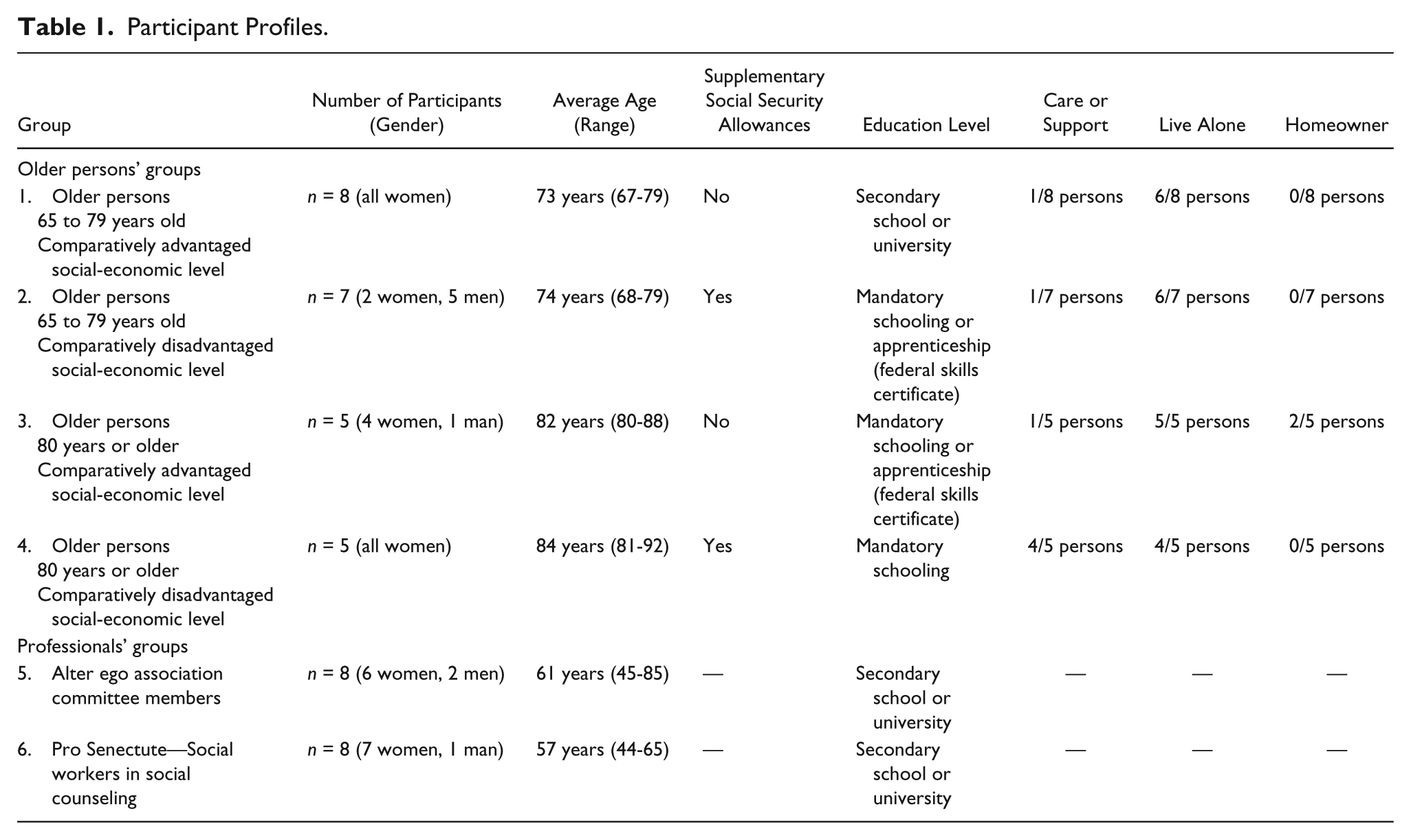
In all, 41 individuals participated in six focus groups (25 older persons and 16 professionals). Each focus group involved between five and eight individuals. Table 1 shows the detailed composition of each group. Women comprised the majority of participants in most groups, except for the group of elders between 65 and 79 years old, whose members also had comparatively disadvantaged social-economic statuses.
Participant Profiles.
All six focus groups were held between April and July 2012 in Pro Senectute offices and community centers. The first author (D.R.S.) led all focus groups to maintain data consistency. A social worker from Pro Senectute helped organize the interviews and was in charge of logistics, welcoming participants, taking notes about the dialogue, and managing time. Focus groups lasted 2 hr on average. At the end of the session, snacks were offered to participants. Written participant consent was obtained, and the focus group discussions were digitally recorded and then transcribed. Participation in the study was voluntary and unpaid. All procedures involving human participants were performed in accordance with the ethical standards of the institutional and/or national research committee, the 1964 Helsinki declaration and its later amendments, or the relevant ethical standards.
Data Analysis
Analysis of the focus group transcripts was done using thematic analysis on MS Word/Excel. Each of the three parts of the focus group interview was analyzed separately. Inductive thematic analysis was performed for Part A (free associations), whereas deductive analysis was used for Parts B and C. In addition, to understand how to optimize prevention, a transversal discourse analysis was conducted for Parts A, B, and C. This allowed us to explore how participants may have felt personally implicated in the issue of elder abuse. Thus, the transversal analysis revealed how older participants might self-identify as both an older person (“we, older people . . . ” type of discourse) or as someone who could be involved in a situation of abuse as a perpetrator, victim, or witness (“as for me,” type of discourse).
The primary analysis was submitted for discussion to a scientific committee composed of four senior researchers from Switzerland and Canada. The researchers on this committee are specialists in the field of gerontology and elder abuse or in abuse of individuals in a handicapped situation. The analysis with the team resulted in the following four main themes: (a) varied associations of the term “abuse,” (b) judging elder abuse situations in terms of abuse and severity, (c) self-identification with elder abuse, and (d) prevention of elder abuse. These themes and subthemes are discussed below.
Results
Varied Associations of the Term “Abuse”
Older participants
Analyzing the free associations with the term “abuse” for each of the four older persons’ groups shows that about a quarter of the terms (34 out of 122) were related to the causes (24 terms) or the consequences of abuse (10 terms). Slightly less than half of the terms associated with “abuse” (48 out of 122 terms) were related to forms and acts of abuse.
Among the forms and acts of abuse, older persons most often mentioned psychological abuse (e.g., hurtful words, scorn, condescension, belittling). Indeed, 19 of the 48 terms associated with forms of abuse were terms related to psychological abuse. Social abuse (e.g., privation of rights, privation of liberty, abandonment by relatives, social exclusion) constituted 12 of the 48 associations. Physical abuse (e.g., roughness, hitting, sequestration) received nine of the 48 associations. Forms of negligence (e.g., disinterest, lack of care and medication, inadequate behavior regarding the age of the older person) were noted in five of the 48 associations. Financial or material abuse (e.g., theft, pickpocketing) accounted for three out of 48 associations, and it was overall, less often mentioned. None of the older persons’ groups mentioned sexual abuse.
Professional participants
About two thirds of the terms associated with “abuse” (94 out of 146 terms) by groups of professionals were related to the causes (47 out of 146 terms) and the consequences of abuse (47 out of 146 terms). An additional one third (35 out of 146 terms) was related to forms and acts of abuse.
The free associations among professionals contrasted those from the older persons’ groups regarding forms and acts of abuse. Psychological abuse (e.g., humiliation, blackmail, authoritarianism, sadism, shouting; 20 out of 35 terms) was the most mentioned by the professionals’ groups. Other forms of abuse were cited less often: physical abuse (e.g., physical restraint, sequestration, injuries) constituted five associations, financial abuse (e.g., theft of money or goods, inheritance) and neglect (e.g., banalization, inadequate expectations regarding the older person’s health and capacities) each had each four associations, and social abuse (e.g., social discrimination, social exclusion) accounted for two associations. Similar to the older persons’ groups, none of the professionals’ groups mentioned sexual abuse.
While the number of associations linked to physical abuse was not the highest (only 14 terms out of 83 terms), it is worth noting that the terms related to this category were the first to be mentioned by the participants in both groups. This observation indicates that physical abuse is well-associated with elder abuse and came quickly to their minds.
Judging Elder Abuse Situations in Terms of Abuse and Severity
Older participants
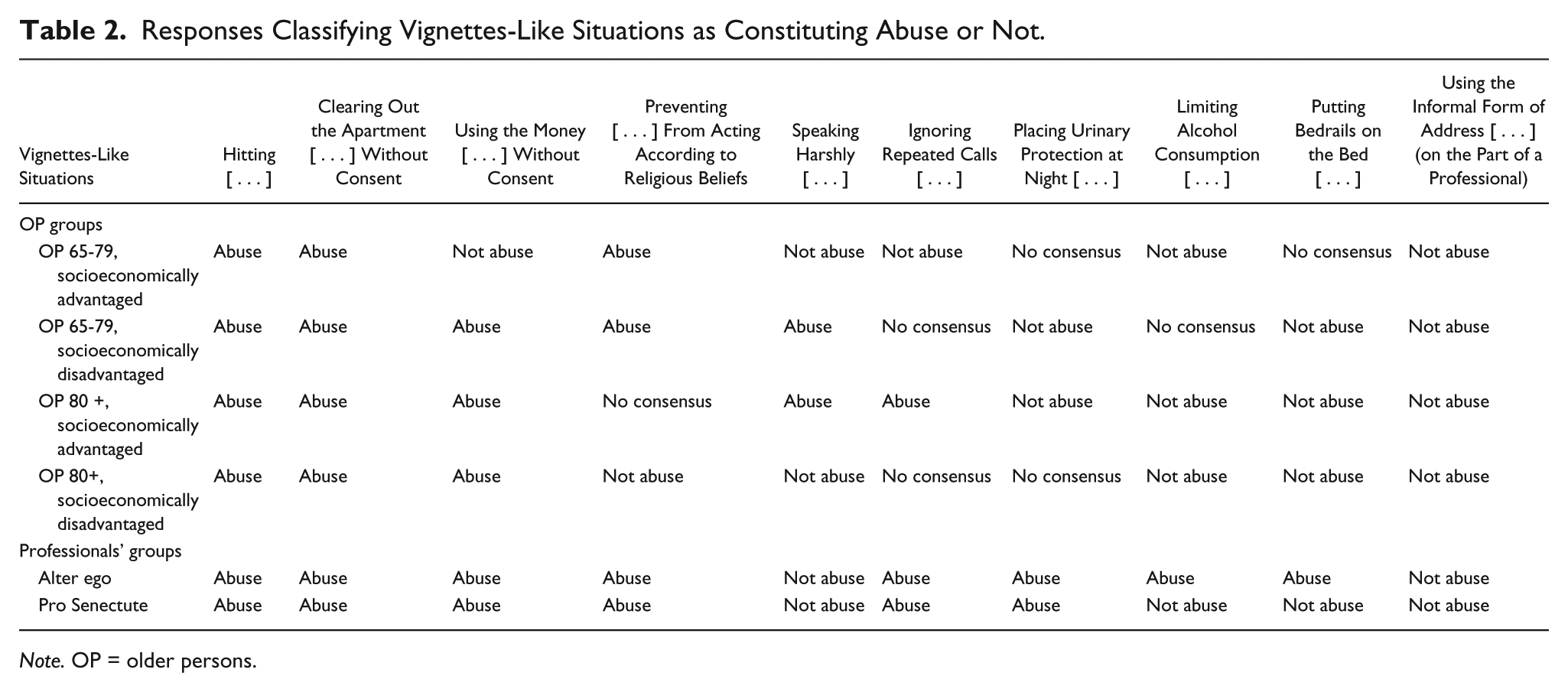
The older persons’ groups perceived about a third of the situations (three out of 10) presented as vignette-like statements as constituting abuse (see Table 2). These situations were (a) hitting [ . . . ], (b) clearing out the apartment [ . . . ] without consent, and (c) using the money [ . . . ] without consent. For the latter two statements (b and c), the perception and concern for material and financial issues were more marked in the groups with comparatively advantaged socioeconomic status. Similarly, vignettes related to money and housing elicited the strongest reactions and identification in the two groups from a comparatively disadvantaged socioeconomic level. One participant stated, “[Using the money of an older person’s money without his/her consent] is not abuse, it’s stealing!” (Man, 65-79 years old, comparatively disadvantaged socioeconomic level). Another noted, “[Clearing out the apartment of an older person without his/her consent], I don’t call that abuse, [ . . . ], it’s unacceptable” (Woman, 80+ years old, comparatively disadvantaged socioeconomic level).
Responses Classifying Vignettes-Like Situations as Constituting Abuse or Not.
Note. OP = older persons.
For most older participants, almost half of the situations (four out of 10) did not generally constitute a form of abuse. These were (a) using the informal form of address [ . . . ] (on the part of a professional), (b) putting bedrails [ . . . ], (c) limiting alcohol consumption [ . . . ], and (d) placing urinary protection at night [ . . . ]. Participants reported that these situations were not serious enough to qualify as abuse, but could lead to abuse or constitute abuse in certain scenarios.
The remaining three situations elicited diverging positions. These situations were (a) preventing [ . . . ] from acting according to religious beliefs, (b) speaking harshly [ . . . ], and (c) ignoring repeated calls [ . . . ]. There was also less consensus within focus groups about the severity of these three situations.
Professional participants
Professionals’ groups perceived about two thirds of the situations (six out of 10) as constituting abuse. These situations were (a) hitting [ . . . ], (b) clearing out the apartment [ . . . ] without consent, (c) using the money [ . . . ] without consent, (d) preventing [ . . . ] from acting according to religious beliefs, (e) ignoring repeated calls [ . . . ], and (f) placing urinary protection at night [ . . . ].
Two other situations were not considered as abuse: (a) speaking harshly [ . . . ] and (b) using the informal form of address [ . . . ] (on the part of a professional). Professionals said that these situations represented a lack of respect, but were not abuse. However, they added that these two scenarios could be considered abuse when this way of speaking is repeated or systematic.
The remaining two situations elicited diverging perceptions between the two groups of professionals: (a) limiting alcohol consumption [ . . . ] and (b) putting bedrails [ . . . ]. While Alter Ego members (primarily caregivers) classified these situations as abuse, Pro Senectute social workers did not.
Comparing the responses of older persons and professional participants
In general, four of the 10 scenarios were deemed as abuse by the majority of participants, namely, (a) hitting [ . . . ] (six out of six groups), (b) clearing out the apartment [ . . . ] without consent (six out of six groups), (c) using the money [ . . . ] without consent (five out of six groups), (d) preventing [ . . . ] from acting according to religious beliefs (four out of six groups).
Another four situations were globally perceived as not constituting abuse by the majority of participants in either group: (a) using the informal form of address [ . . . ] (on the part of a professional) (six out of six groups), (b) speaking harshly [ . . . ] (four out of six groups), (c) limiting alcohol consumption [ . . . ] (four out of six groups), and (d) putting bedrails [ . . . ] (four out of six groups).
Five situations elicited diverging positions between the older persons’ groups and the professionals’ groups. These were (a) placing urinary protection at night [ . . . ], (b) speaking harshly [ . . . ], (c) putting bedrails [ . . . ], (d) limiting alcohol consumption [ . . . ], and (e) ignoring repeated calls [ . . . ]. For the scenario involving placement of nocturnal urinary protection in particular, the perceptions between the older persons’ groups and professionals’ groups were highly divergent. The caring professionals perceived these situations as constituting abuse, while older persons mostly felt these situations are necessary for the comfort or security of the older individual and caregiver. In general, the professionals tended to prioritize respect for the individual’s autonomy and self-determination, while the older persons were more concerned with protection and safety.
At the end of Part B (vignette-like statements) when participants were asked to highlight other abuse situations that had not yet been discussed, some older participants added that speaking to an older person as if she/he was a child constitutes abuse with one participant stating “We should not be spoken to as if we were two years old. There is nothing more humiliating than that.” (Woman, 80+ years, comparatively disadvantaged socioeconomic level). Institutional or social forms of abuse were also brought up in one focus group with older persons, as one participant stated: “I don’t know if this is really abuse, but when we are kept from working, kept from remaining integrated and having an income” (Man, 65-79 years old, from a comparatively disadvantaged socioeconomic level).
Some members of Pro Senectute also added that certain older persons suffer emotional blackmailing from their children. For example, the older person’s child might threaten to forbid them from seeing their grandchildren.
The analysis of participant responses—and the topics debated during the focus groups—made it possible to highlight the criteria used by participants to evaluate the situations presented. These criteria were the following:
The intention of the act
Both professionals and older persons concluded that if the underlying intention of the act is kind, then the act does not constitute abuse. At the same time, they noted that if the intention is not kindness, then it is an act of abuse:
I would say that it is truly the intention that . . . yes, if the intention is to humiliate the person, to diminish them, etc . . . ok, then we could maybe call it [speaking harshly to an older person] abuse, absolutely. If the intention is to be able to go forward with the person, to work and put a framework together . . . Okay, now this is fairly subjective, but I think that I wouldn’t call that abuse. (Social worker—Pro Senectute)
Cognitive impairment
Many participants differentiated between situations by whether the older person was “lucid” or not. For them, if the person is “lucid”, or aware of what is happening, then the described act constitutes abuse. However, if the person is not aware of the situation and does not understand it, then the act does not constitute abuse:
It’s important to be nuanced about this. If the person is completely lucid, and then held in their bed, and is calling, and there is no one coming, I think this is abuse. On the other hand, if we’re talking about someone who, effectively, has gotten into the habit of calling out because she is anxious or because she wants to have someone next to her at all times. This [ignoring the person who calls] is not abuse. (Woman, 65-79 years old, comparatively advantaged socioeconomic level)
Consent and participation in decision making
Several participants, professionals and older persons, highlighted that prior discussion and consent is a key determinant of whether an action imposed on an older person constitutes abuse:
There was a man [suffering from] Alzheimer who said, “Everything you do without me, you are doing it against me.” And he truly wanted to be consulted for everything and I believe this must be respected and it’s also a lesson [ . . . ]. (Social worker–Pro Senectute).
Repetition of the act
Numerous participants mentioned that if the act is systematic, it constitutes abuse: “I think that if a person continually addresses an older person harshly, aggressively, yes, this is abuse. But getting irritated once, that can happen” (Woman, 65-79 years old, comparatively advantaged socioeconomic level).
Behavior as a risk
Many participants mentioned that if the behavior of an older person presents a risk to self or others, then measures taken in response do not constitute abuse. As such, putting up bars as a restraint measure to protect against self-harm is not abuse:
In this case, I do not really think that it’s definitely abuse, because there is a larger danger. In the sense that if she gets out of bed and then falls and breaks a leg, it is better to put bars up. (Man, 65 to 79 years old, comparatively disadvantaged socioeconomic level)
Self-Identification With Elder Abuse
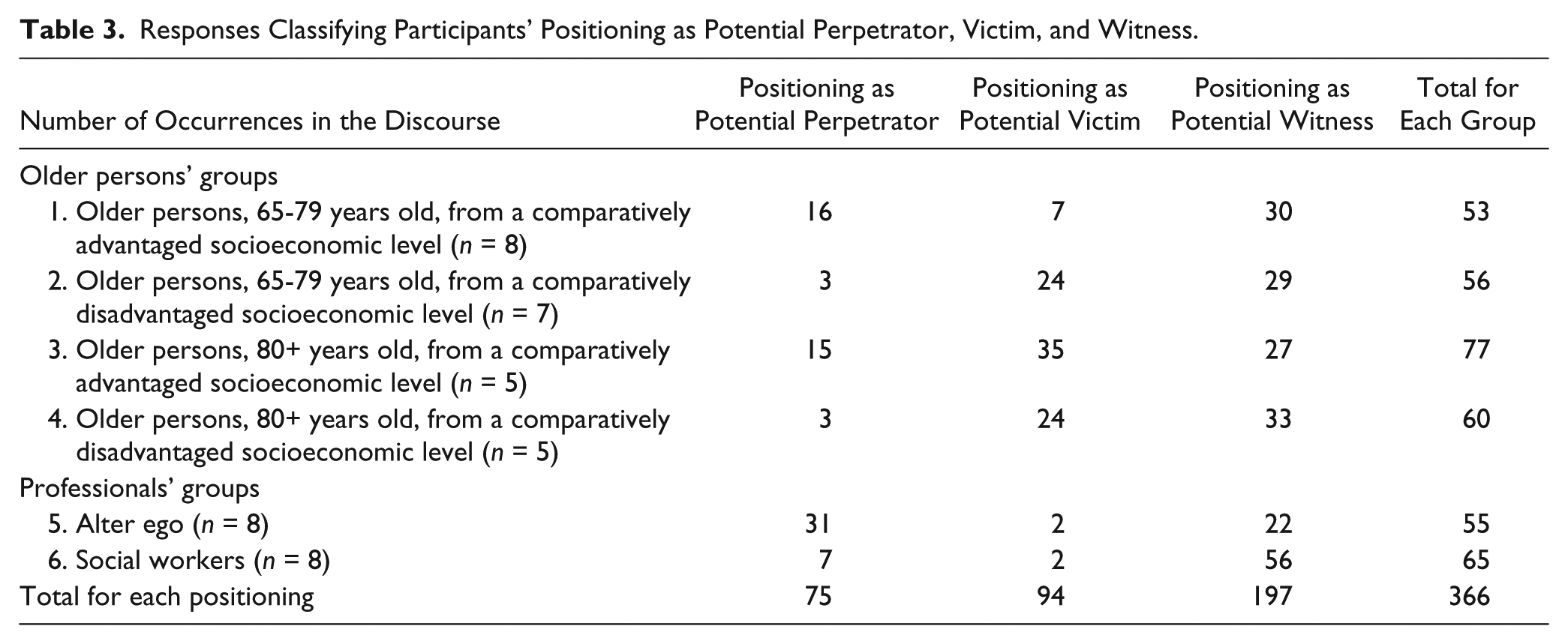
Transversal discourse analysis of the interview segments highlighted differences among participants about how they positioned themselves as witness, victim, or potential perpetrator of abuse (see Table 3). The analysis of participant positioning reveals the most often adopted position by all the groups is that of witness (197 occurrences in the discourse of 366). The second is one of potential victim (94 occurrences in the discourse of 366) and the third and last is one of potential perpetrator (75 occurrences in the discourse of 366). Both older and professional participants considered that potential perpetrators can be family caregivers and relatives, as well as professional caregivers. The only group that positioned itself mostly as potential perpetrator was the group of Alter Ego committee members (31 occurrences in the discourse of a total of 55). Older people aged 80 years or more from a comparatively advantaged socioeconomic level were the only demographic to position themselves mainly as potential victims (35 occurrences in the discourse of a total of 77). The four other groups primarily identified as potential witness, particularly the group of Pro Senectute social workers (56 occurrences in the discourse of a total of 65). Older persons aged 65 to 79 years from a comparatively higher socioeconomic level was the group of older participants that least identified as a potential victim (seven occurrences in the discourse of a total of 53) while the two groups of older persons from a comparatively disadvantaged socioeconomic level (65 to 79 years old/80+) were the ones that least self-identified as potential perpetrators (three occurrences).
Responses Classifying Participants’ Positioning as Potential Perpetrator, Victim, and Witness.
Prevention of Elder Abuse
Analysis of the responses and exchanges between participants in Part C of the focus group made it possible to elucidate perceptions and attitudes with respect to the prevention of elder abuse. Diverging perceptions appeared between the groups of professionals and the groups of older persons, and between the groups of older persons as well.
The first difference was observed between the groups of professionals and groups of older persons regarding the word “abuse” within the framework of prevention campaigns. Professionals believed this word is too violent and inhibits dialogue on the issue. The participating professionals insisted on the importance of positive discourse in promoting the rights and values of older persons:
[I would more likely select this way of going about it:] “I still have rights, of course, I may be, quote-unquote, old and useless and all the representations that society sometimes comes up with, and yet I still have rights”. (Alter Ego Committee Member)
In contrast, the older participants underlined the importance of calling a “spade a spade” and using the word that garners attention: “Nevertheless, it has to be a word that has an impact. [ . . . ] It must be a shocking word, like images of war and all that, it has to shock” (Woman, 65-79 years old, from a comparatively advantaged socioeconomic level). The notion of positive discourse was only found in some of the groups of older persons, and mostly came from individuals between 65 and 79 years old and a comparatively advantaged socioeconomic level.
More broadly, some groups of older participants and some professionals raised the idea that certain older persons are embittered or aggressive to those around them and that it is understandable, though not necessarily excusable, that caregivers react to these behaviors: “Yes, but there are also some difficult [older] persons. [ . . . ] And who push others to their limits just to see how they react.” (Woman, 80+ years old, comparatively advantaged socioeconomic level).
The influence of socioeconomic background on the discourse and attitudes of the older persons interviewed with respect to prevention was evident. The older persons from a comparatively advantaged socioeconomic level emphasized proximity-based prevention (by neighborhood associations, city halls, churches, neighbors). They also suggested several concrete means of improving prevention: notifying older persons living alone to city halls, developing a network of solidarity within the community, making available a phone number to call in case of a problem or suspected abuse, prevention-based television advertisements, and so on. These participants also identified general practitioners as a resource for managing situations of suspected or confirmed abuse.
In a different vein, the two groups of older persons from a comparatively disadvantaged socioeconomic level underscored the role of education and the personality of those involved in abuse situations. They felt that some people are kind and some are malicious, and it would be difficult to change their character:
But if at their age they haven’t yet understood, it’s too late. A pear tree that begins to grow crookedly, well, you can put a stake in to support it, but it will always be crooked. And well, with people, it’s the same thing. (Man, 65-79 years old, comparatively disadvantaged socioeconomic level)
Discussion
The study presents valuable findings on the topic of elder abuse, for which data from Switzerland are lacking. Our results not only confirm information that is already known in the field of elder abuse, but also presents novel findings.
First, the technique of free association is a novel methodology, which enabled us to understand how our participants perceived the meaning of elder abuse. The results highlight consensus between the participants that abuse is mostly understood as psychological abuse. This means that the psychological dimension of abuse is a core element of their understanding of elder abuse, whereas physical and social abuse are perceived as secondary dimensions of elder abuse. Negligence and financial or material abuse appeared to be more anecdotal, as they were rarely mentioned. This is interesting because neglect is often one of the most frequent forms of elder abuse reported in other studies, particularly those where reports of elder abuse are made to Adult Protective Services or similar authorities (Lacher et al., 2016; Wangmo et al., 2014).
Second, it is interesting to note that some participants did not consider financial and material abuse as truly constituting abuse. Other studies in literature report financial and material abuse as one of the most frequent form of abuse committed toward older persons (Beaulieu & Bergeron-Patenaude, 2012; Cooper, Selwood, & Livingston, 2008; Lindert et al., 2013). The fact that this type of abuse was only rarely brought up in certain groups, especially during free association, does not necessarily mean participants were unaware that older persons might be victims of financial and material abuse. Rather, participants believed these actions technically constitute theft, not abuse. In other words, participants’ overall definition of abuse does not include financial and material abuse as a specific form of abuse. This finding echoes results stemming from other studies on elder abuse from Western Switzerland (Roulet Schwab, 2008, 2009; Roulet Schwab & Rivoir, 2011). The dissociation of financial and material abuse from the notion of elder abuse could be culturally dependent, but additional studies are needed to validate this hypothesis.
Third, sexual abuse was not mentioned by professionals or older persons, a finding consistent with the results of an Irish study by O’Brien et al. (2011) on older people’s understandings of elder abuse. This finding can be partially explained by the taboo of older persons’ sexuality and demonstrates the necessity of calling older persons’ and professionals’ attention on the existence of this type of abuse, even though it occurs less frequently and remains less known (Abner et al., 2016; Beaulieu & Bergeron-Patenaude, 2012; Biggs, Manthorpe, Tinker, Doyle, & Erens, 2009; Lowenstein, Eisikovits, Band-Winterstein, & Enosh, 2009; Roberto, Teaster, & Nikzad, 2007; Teaster & Roberto, 2004). It also points out the importance of including this specific topic in prevention campaigns.
Fourth, another important result of our study is that older participants believed treating a person like a child constitutes a form of elder abuse. This finding is consistent with the results of an American study (Salari, 2006) on infantilization of older persons as elder mistreatment. This position on infantilization does not appear in the international definitions of elder abuse, and studies like ours highlight the importance of widening these accepted definitions to acknowledge the perspective of elder persons (O’Brien et al., 2011; Roulet Schwab, 2011). Also relevant to create a clear, global definition of elder abuse, our participants used “intention” as a criterion to assess whether a situation constitutes abuse and as a means to evaluate its severity. This position, however, diverges from the WHO’s definition (WHO, 2002), which specifies that abuse may be intentional or involuntary.
Fifth, with respect to self-identification with elder abuse, our results showed that most of the groups only felt personally concerned with elder abuse in the capacity of potential witnesses. These results support the conclusions of other studies (O’Brien et al., 2011; Roulet Schwab, 2011) that also report that focus groups participants did not identify with the older people being discussed. In essence, gerontological literature often mentions that for older persons, the elderly persons are always “others,” meaning that there is a refusal to self-identify with such a poorly valorized social category (Hummel & Tettamanti, 2008). The fact that professionals have more knowledge about elder abuse and are more aware of risk factors could also explain why they are more likely to perceive themselves as potential perpetrators. The social background and characteristics of the participants appeared to influence their perceptions of being at risk of abusing or at risk of being abused. Older persons from a comparatively disadvantaged socioeconomic level might experience a feeling of very little power over one’s life and environment (Doyle, 2014) and therefore might have more difficulty envisaging abuse of that power. In terms of self-identifying as a potential victim, our study points to a possible age effect. This was particularly marked in the group of older persons aged 80 and older coming from a comparatively advantaged socioeconomic level. This group expressed the greatest feeling of vulnerability linked to age. Similarly, the positioning of professionals was influenced by their professional characteristics and cultures. The Alter Ego group consisted of caregivers (nurses and doctors) and their role situated more upstream in primary prevention could explain its members’ tendency to self-identify as potential perpetrators. On the contrary, social workers of Pro Senectute are more involved in secondary and tertiary prevention and could explain their predominant self-identification as witnesses.
Finally, regarding prevention, our analysis revealed a tendency on the part of professionals to protect older persons from violent discourse, but older persons in our cohort considered such direct discourse to be necessary because “one should not beat about the bush.” However, the social and financial background of older participants seemed to influence their perception of the causes and remedies to elder abuse.
Limitations of the Study
This qualitative study was based on a convenience sample and involved certain limitations related to the selected methodology. Even though deliberate efforts were made to include a diverse profiles of older persons (age, social and economic background, gender), our sample is not representative of the global population of older persons living in Western Switzerland. All the older persons included in our sample were involved with care or social organizations, which is not the case of all older Swiss people. As such, the results of this study cannot be generalized to all older Swiss citizens. The second limitation is due to the method of focus groups. A group’s positioning assumes a certain homogeneity of perceptions between group members, something which could lead to a loss of nuance within the focus group discussions. In the same way, issues of social identification and of social desirability could influence participants’ discourse and encourage them to conform to the group’s norm and to the perceived expectations of the research team. In this sense, face-to-face interviews with elders would be interesting to further analyze the diversity in perceptions of elders and to what extent individual backgrounds weigh on their understandings and attitudes on this topic.
Contributions of the Study
Despite these limitations, the information gathered in this study was extremely rich. Beginning the focus group with a free association activity helped participants ease into the discussion and promoted open debate. This activity was a good method to confront a taboo subject, an aspect that was also noted within the framework of professional awareness training on elder abuse (Roulet Schwab, 2008). The use of vignettes given in statement form also made it possible to anchor the debate and put each group’s discourse into perspective.
This study further contributes to understanding the converging and diverging perspectives between and within older person and professional groups. Differences in understandings and attitudes are intricate and cannot be attributed to any single factor, such as age or socioeconomic level. The diverging viewpoints concern conceptions and attitudes to prevention and, to a lesser extent, to self-identification with respect to the issue of elder abuse. Some differences are however noted in the way that the elder participants understand elder abuse when compared to professionals. These differences were most apparent in relation to financial abuse and infantilization. The socioeconomic level of elder participants seems to weight on the way they perceive financial abuse, influence self-identification with respect to elder abuse, and, generally, determine their attitudes to prevention.
Recommendations for Practice, Education, and Research
The results of this study underscore the necessity of sensitizing elders, professionals, and students to the forms of abuse less known to the public. Financial and material abuse was not considered a form of abuse, and sexual abuse was unmentioned. Thus, there is the need to reiterate the consequences of financial and material abuse on quality of life, health, and safety of older persons, to prevent this type of abuse from becoming a commonplace issue. Furthermore, sexual abuse must be discussed so that it does not become an increasingly taboo subject.
The fact that most participants did not self-identify as possible victims of elder abuse calls attention to the difficulty in ensuring that elder abuse is taken seriously as a problem that could affect them as well. This indicates a need for reflecting on communication methods and messages that promote a sufficiently positive and nonstigmatizing identification.
The differences in perception and positioning observed between the groups of older persons and the groups of professionals demonstrate the benefit of collaborating with older persons, either as consultants or experts, in the design of prevention programs. They are best placed to discuss the realities of aging and the related risks of abuse. It is necessary to ensure heterogeneity because within our limited number of participants, we notice varying positioning, which serves as a reminder that “older persons” does not represent a homogeneous social group. Hence, it is important to tailor the messages, methods, and measures of prevention according to the cultural background and socioeconomic level of the target audience. Moreover, it is valuable to give the floor to older persons from less social and economic resources and to invite them to codesign prevention programs.
Knowing older people’s views on elder abuse is essential to the development and implementation of effective policies and practices. In this study, we found that treating an older person like a child was viewed by older participants as a form of elder abuse. This indicates that older adults want to be considered and treated as “normal” adults able to make choices and take calculated risks. Thus, protectionist and paternalistic policies and practices may have limited effectiveness, and will fail to address elder abuse if they fail to ensure older people’s rights by providing them control over everyday life and care decisions.
Future studies must consider the voices of older persons to better understand their conceptualizations of elder abuse, identify the types of services that they consider useful in response to elder abuse, and define the best ways to spread awareness of this issue among older people. Researchers should also explore how to better promote older persons’ participation in elder abuse research and prevention. Developing action research with older persons as peer researchers could be one method to integrate the perspectives and experiences of older persons.
Conclusion
This study underlines the heterogeneity in perceptions and positions on elder abuse and its prevention from the perspective of older persons and professionals working in the field of elder abuse prevention. It calls for the development of messages and preventive measures specific to the target audience, and also underscores the importance of integrating the perspectives of older people themselves. Moreover, our findings reveal the need to broaden the commonly accepted definitions of elder abuse such that they better reflect the perspectives of the individuals concerned, and in this way, make those definitions more applicable and fully operational.
By highlighting the influence of socioeconomic level of older persons on their understanding of elder abuse and their attitudes toward prevention, this research underscores the importance of framing any preventive approach in the larger perspective of empowerment, social participation, and affirmation of senior citizen rights. This study demonstrates the necessity to develop a common language to address elder abuse, shared by professionals, researchers, older persons, family caregivers, and politicians. Such a challenge requires strengthening the links between theory, research, training, practice, and policy.
Footnotes
Acknowledgements
We thank Pro Senectute Genève, Association alter ego, and older participants for their contribution to the study.
Declaration of Conflicting Interests
The author(s) declared no potential conflicts of interest with respect to the research, authorship, and/or publication of this article.
Funding
The author(s) disclosed receipt of the following financial support for the research, authorship, and/or publication of this article: This research was funded by SNF DoREsearch (Swiss National Science Foundation).