







Abstract
The aim of this study was to investigate how classroom normative climate regarding the perpetration of teen dating violence (TDV) was related to adolescents’ self-reported perpetration of (verbal/emotional, threatening, relational, physical, and sexual) violence within romantic relationships in the previous 12 months. Based on Theory of Normative Conduct, we hypothesized that higher classroom levels of TDV perpetration were associated with a higher likelihood of individual TDV perpetration. Data were drawn from a large survey of ninth-grade students conducted in the state of Lower Saxony, Germany (n = 10,638). From this sample, an analysis sample of n = 4,351 students at risk was drawn (mean age: 15.0, SD: 0.76; 46.6% male). More than half (54.8%) of the at-risk sample reported engagement in any form of TDV within the previous 12 months, whereby rates varied considerably by the dimension of TDV. Controlling for a range of risk factors on the classroom level (proportion of students dependent on social welfare, proportion of students with migration background) and individual level (exposure to family violence, sociodemographic characteristics, TDV victimization, and peer- and school-related factors), regression analyses showed that higher rates of classroom-level TDV perpetration were positively related to individual verbal/emotional TDV perpetration. This pattern of results was observable across all dimensions of TDV. Furthermore, gender-specific patterns of TDV perpetration were observable: Girls were more affected by classroom levels of verbal/emotional and physical TDV than boys, while boys were more affected by classroom levels of relational and sexual TDV. Results highlight the role of the wider peer context in shaping adolescent dating experiences and specifically point to the relevance of the classroom ecology for the socialization of dating violence in adolescents.
Teen dating violence (TDV) is a serious public health concern (Leen et al., 2013) that has been associated with an array of long-lasting adverse effects on victims and perpetrators, including violence in later intimate partnerships (Cui, Ueno, Gordon, & Fincham, 2013), adverse health outcomes (Exner-Cortens, Eckenrode, & Rothman, 2013; Foshee, Reyes, Gottfredson, Chang, & Ennett, 2013; Smith, Ireland, Park, Elwyn, & Thornberry, 2011), and lowered academic performance (Brewer, Thomas, & Higdon, 2018; Wood, Voth, Schrag, & Busch-Armendariz, 2018). The Centers for Disease Control and Prevention, 2014’s definition of TDV comprises several forms of violence including physical (e.g., hitting, pushing, beating someone up), psychological (e.g., name-calling, demeaning), sexual (e.g., force a partner to engage in unwanted sexual acts), and stalking behaviors. Prevalence rates of TDV perpetration vary considerably by the type of aggression, reference period, and cultural setting, although most extant studies focus on physical TDV (e.g., Capaldi & Owen, 2001; Nocentini et al., 2011; Viejo, Monks, Sánchez, & Ortega-Ruiz, 2016). In a recent meta-analysis by Wincentak, Connolly, and Card (2017), average prevalence rates for TDV among adolescents (aged 13-18 years) were reported around 20% for physical TDV (range: 1%-61%), and 9% for sexual TDV (range: 1%-54%). Within European community samples of adolescents, prevalence rates for TDV perpetration are estimated around 30%, and for victimization around 14% to 23% (Hird, 2000; Kliem, Baier, & Bergmann, 2018; Van Ouytsel, Ponnet, & Walrave, 2017; Viejo et al., 2016). For several decades, researchers have sought to gain a greater understanding of the developmental antecedents to later perpetration of violence in romantic relationships among adolescents. Relying on theoretical frameworks such as social learning theory (Bandura, 1977) or the developmental-interactional model of romantic-partner directed aggression (Capaldi & Gorman-Smith, 2003), the majority of studies have focused on family-of-origin factors of TDV (Olsen, Parra, & Bennett, 2010). More specifically, extensive research of both cross-sectional and longitudinal nature has established a relationship between TDV and adverse family environments (such as poverty, parent-to-child aggression, and exposure to intimate partner aggression between parents; see Chiodo et al., 2012; Foshee, Benefield, Ennett, Bauman, & Suchindran, 2004; Karsberg et al., 2019; Renner & Whitney, 2012; Smith et al., 2011). Such adversities are theorized to disrupt the cognitive and social development of children, which may lead to potentially long-lasting detrimental effects, such as involvement in violence within other types of social relationships. According to social learning theory, adolescents who grow up in a violent family environment are more likely to view aggressive behavior as an acceptable way to resolve conflicts. Through the adaption of norms legitimizing or tolerating the use of aggression, such violent acts may then be carried over into own romantic relationships. Yet, TDV may not merely reflect the impact of adverse family conditions. The wider social context in which adolescents develop is likely to influence violent behavior in romantic relationships as well (Barth, Dunlap, Dane, Lochman, & Wells, 2004). Among these, peer settings including classrooms in schools play a crucial role for adolescents’ development. During adolescence, peer relationships become more salient and provide an important platform for shaping individual behavior (Kiesner, Poulin, & Nicotra, 2003; Smetana, Campione-Barr, & Metzger, 2006). Research on TDV has increasingly turned to the role of peer norms and behavior, whereby the focus has been on close friendships. For instance, Foshee, Benefield, et al. (2013) found in their five-wave panel study of U.S. students (mean age: 14.2 years at wave one) that adolescents who had a greater number of friends involved in dating violence across grades 8 through 12 reported higher levels of dating violence across that period. Ellis, Chung-Hall, and Dumas (2013) documented for a sample of adolescents (mean age: 15.5 years) that peer group relational aggression at the beginning of the school year predicted dating abuse victimization and perpetration and negatively predicted relationship quality 6 months later. Reed, Silverman, Raj, Decker, and Miller (2011) showed that male perpetration of TDV was positively related to the belief that their friends had perpetrated TDV. Peer norms are likely to operate not only among self-chosen friends but also among involuntarily created peer groups, such as classrooms in schools (Barth et al., 2004; Juvonen & Galvan, 2010; Müller, Hofmann, Fleischli, & Studer, 2016). Within classrooms, students are together with both close friends and a broader network of similarly situated peers (Giordano, Kaufman, Manning, & Longmore, 2015). Although the classroom has long been recognized as a significant context in which aggressive norms and behaviors can be learned, features of the peer ecology at the classroom level have so far received little attention for explaining violent behavior within adolescent intimate relationships (Müller et al., 2016). In particular, still little is known about the role that classmates’ violent norms in relation to the perpetration of TDV may exert on own violent dating behavior. A further shortcoming is that most extant studies on the role of classroom peers for the perpetration of violent behavior investigated the effects among children but not adolescents (e.g., Henry et al., 2000). This is surprising, seeing that mid-adolescence represents a crucial developmental period in which both romantic relationships start to form and peer influence increases (Brown & Bakken, 2011; Miller-Johnson & Costanzo, 2004).
The Role of Classroom Normative Climate for Individual TDV Perpetration
The classroom provides a relevant site for adolescents’ social interaction because classmates spend most of their time together and share the same social space, experiences, and developmental tasks. The Theory of Normative Conduct (Cialdini, Reno, & Kallgren, 1990; Cialdini & Trost, 1998) emphasizes the importance of social normative influence in affecting behavior. Social norms comprise “the rules and standards that are understood by members of a group, and that guide and/or constrain social behavior without the force of laws” (Cialdini & Trost, 1998, p. 152). The Theory of Normative Conduct contends that norms become effective for action when they are salient within a given context, and individuals will act in accordance with socially normative behavior only when their attention is focused on the behavior that is occurring or that is commonly accepted (Cialdini et al., 1990). Thus, individual violent behavior is likely to differ as a function of the group norm for such behavior, indicated by the presence of that behavior within the group. Classroom peers may serve as reinforcers and models of behavior when that behavior is highly prevalent within the classroom, while it may be inhibited when such behavior is absent or not frequently perpetrated (Barth et al., 2004; Snyder et al., 2005). As TDV typically occurs within the private sphere of romantic relationships, it is less frequent and visible at school than aggressive or disruptive behavior toward peers (Giordano et al., 2015). Nevertheless, classmates are likely to function as relevant frames of reference that shape individual aggression norms beyond the immediate school context. Most notably, TDV may be observed in school or during extracurricular activities with classmates. Furthermore, the communication surrounding TDV (such as gossip or storytelling about a particular incident) may contribute to the adolescents’ understanding about its meaning (see Eder, 1995), prompting “carry-over effects” into own relationships (Giordano et al., 2015). Over the past years, a number of studies have investigated the role of classroom violent norms on individual antisocial behavior (Kuppens, Grietens, Onghena, Michiels, & Subramanian, 2008; LeBlanc, Swisher, Vitaro, & Tremblay, 2008; Thomas, Bierman, & Powers, 2011). Most studies focused, however, on aggressive and disruptive behavior among kindergarten and primary school children (Barth et al., 2004; Henry et al., 2000; Müller et al., 2016; Thomas et al., 2011). In contrast, there is little research on adolescent samples (Dishion & Tipsord, 2011). As an important exception, Müller et al. (2016) found among a sample of seventh graders that classmates’ levels of aggression and delinquency influenced individual antisocial behavior, controlling for other peer influences. Scant research has focused on the specific link between classroom TDV norms and individual TDV perpetration. In their International Dating Study conducted among college students, Straus and Savage (2005) used aggregated intimate-partner violence (IPV) predictors of individual IPV outcomes. They found that attending a university with a high level of dating violence was positively associated with IPV perpetration at the individual level. Using data on 955 adolescents across 32 schools (mean age: 15.4 years), Giordano et al. (2015) examined the effect of variations in school context on TDV perpetration while taking into account parental, peer, and demographic factors. They found that net of parents’ and friends’ use of violence, the normative climate of schools (measured as aggregate levels of reports of TDV) was a significant predictor of respondents’ own violence perpetration. However, this study focused solely on physical TDV, although other forms of TDV are also common in adolescence (Kliem et al., 2018). Although the inverse relationship of individual TDV perpetration affecting classroom-level TDV perpetration is possible, there is some empirical evidence for the hypothesized relationship of classroom contexts shaping individual violent behavior. For example, Kellam, Ling, Merisca, Brown, and Ialongo (1998) showed in their 6-year longitudinal study that highly aggressive first-grade boys in highly aggressive classrooms had an increased likelihood of being equally aggressive in sixth grade compared to similarly aggressive children in non-aggressive first-grade classrooms. Analyzing how the previous years’ classroom environment explained teacher ratings of fifth-grade student aggressive behavior in a normative sample of 589 boys and girls, Barth et al. (2004) did not find any influence of the fourth-grade classroom environment on adolescents’ aggressive behavior. They showed, however, that children with problematic behaviors in fourth grade showed a greater increase in problem behavior if they were placed in poorer fifth-grade classroom environments. More research is needed on the specific role of classrooms to test the effect of peer environments on violent dating behavior during the sensitive developmental period of adolescence.
Cross-Domain Risk Factors Related to TDV
A comprehensive understanding of the role of classroom norms in relation to TDV requires the assessment of the broader social environment within which romantic relationships develop. As noted above, witnessing intimate partner violence among parents and exposure to child abuse are well-known family risk factors for later intimate partner violence (Foshee et al., 2011; Renner & Whitney, 2012). Furthermore, low family socioeconomic status (SES) has been associated with higher perpetration of TDV (Lewis & Fremouw, 2001), as well as growing up in single-parent households (Foshee et al., 2008). With regard to individual demographic factors, available data suggest a curvilinear relationship with age, at least with regard to physical TDV: While perpetration rates increase beginning from early adolescence (Johnson, Giordano, Manning, & Longmore, 2014), they have been found to decline by the end of adolescence and reach even lower levels in young adulthood (Foshee et al., 2009; Halpern, Oslak, Young, Martin, & Kupper, 2001). Findings on gender-specific rates of TDV perpetration are somewhat inconclusive. In general, research has shown that male and female adolescents report comparable TDV perpetration and exposure to victimization, although they perpetrate and experience TDV differently. While it is established that boys have a higher propensity to engage in more severe forms of TDV (Muñoz-Rivas, Graña, O’Leary, & González, 2007), some studies find higher physical perpetration rates in girls compared to boys (Haynie et al., 2013; O’Leary, Smith Slep, Avery-Leaf, & Cascardi, 2008), which also applies to verbal aggression (Haynie et al., 2013). Considering that migration background constitutes an important risk factor for physical aggression among adolescents in Germany (Rabold & Baier, 2011; Windzio & Baier, 2009), ethnic minority status may also be a risk factor for TDV perpetration, reflecting potential differences in gender roles and cultural normativeness of violence perpetration. Some findings from the U.S. context for example indicate higher perpetration rates of TDV by ethnic and racial minority groups compared to non-Hispanic Caucasian adolescents (e.g., Connolly, Friedlander, Pepler, Craig, & Laporte, 2010; Foshee, Reyes, McNaughton, & Susan, 2010). Peer- and school-related factors suggested as risk markers for TDV during adolescence include low school connectedness and lower grades (Chiodo et al., 2012), as well as association with physically aggressive friends (Ellis et al., 2013). Furthermore, lower academic track classrooms are often characterized by more disruptive and antisocial behaviors among students than are higher tracks, also reflecting disadvantaged socioeconomic positions (Rabold & Baier, 2011). Finally, research has established significant bidirectionality in TDV involvement (Cutter-Wilson & Richmond, 2011; Renner & Whitney, 2012; Teten, Ball, Valle, Noonan, & Rosenbluth, 2009), with TDV victimization being an important risk factor of TDV perpetration and vice versa. Renner and Whitney (2012) found for example the percentage of bidirectional violence (54.0%) being greater than unidirectional violence (21.4% perpetration-only; 24.6% victimization-only). Such symmetrical relationships have also been found in adult samples (Straus, 2011).
This Study
Addressing an important gap in the literature, we investigated how the normative climate of secondary school classrooms is related to adolescents’ self-reported TDV perpetration. Based on the Theory of Normative Conduct, we hypothesized the following: The higher the classroom mean of TDV perpetration, the more such behavior will be reported by an individual. In classrooms where TDV is viewed as an acceptable behavior (represented by high aggregate mean levels of TDV), students are hypothesized to adopt more strongly to such norms and emulate similar behavior in their own romantic relationships. According to the conceptualization of Cialdini et al. (1990), the classroom mean of a certain behavior can be considered a descriptive norm that indicates a tendency of group behavior. Classmates are believed to affect own involvement in TDV by functioning as a relevant frame of reference for individual action. To be better able to isolate the role of classroom norms, we additionally controlled for several theoretically and empirically derived risk factors of aggressive behavior in adolescents (sociodemographic background, exposure to family violence, TDV victimization, as well as peer- and school-related factors). Recognizing the importance of the broader classroom environment within which norms about TDV are likely to develop, we also took into account further aspects of classroom composition (proportion of students dependent on social welfare, proportion of students with migration background). Finally, we tested for gender effects in the normative role of classroom environment by the inclusion of two-way interaction terms between the classroom TDV measures and sex.
Materials and Methods
Data and Participants
Data stem from a large school survey conducted in the spring of 2015 among ninth-grade students in Lower Saxony, Germany (Bergmann, Baier, Rehbein, & Mößle, 2017). The survey recorded victimizations and perpetratorships of violence and delinquency as well as their influencing factors. It was authorized by the state school authorities of Lower Saxony and conducted in compliance with the ethical standards defined in the Declaration of Helsinki (World Medical Association Declaration of Helsinki, 2013). These included informed consent, strict anonymity concerning data generation and processing, as well as confidentiality of the research team in all stages of the project. To construct the sample, the research team employed a stratified random sampling procedure (according to school type). A total of K = 672 school classes were drawn from all classes of the ninth grade taught in the school year 2014/2015 in Lower Saxony (with the exception of special needs schools with another focus than learning). As some school principals and teachers refused to participate, the final class sample was reduced to k = 545 school classes (corresponding to a participation rate of 81.4% at class level). Of the N = 12,650 targeted students from these school classes, n = 10,638 took part in the survey (corresponds to a participation rate of 84.1% at student level). The reasons for non-participation were illness (n = 905), lack of parental consent (n = 434), own refusal (n = 255), non-usability (n = 51), and other reasons (n = 367; for example, rewriting of class tests, participation in school events). The research team contacted the school principals, teachers, and parents in the form of a letter informing about the content and scope of the study. All of them could decline participation, while parents were required to sign and return a form if they consent for their child to participate in the survey. In addition, teachers, parents, and students were informed about the voluntary and anonymous nature of the survey. Students had the right to refuse participation themselves, or the answering of single items. They filled out self-administered written questionnaires anonymously and voluntarily in their school class in the presence of a teacher and an instructed test leader (about 90 min). All measures were deemed suitable for migrant students and students in lower school tracks in terms of language, because item formulations were easy to understand and culture-unspecific. Due to the fact that potentially traumatic events (child abuse, witnessing domestic violence, dating violence, and victimization) were surveyed, the test leaders were equipped with the contact details of the trust teachers in the respective schools as well as with the number of a telephone chaplain to address potential consultancy needs of students.
Measures
Dependent variables
Teen-dating-violence
To measure TDV perpetration, a German translation of the short form of the Conflict in Adolescent Dating Relationships Inventory (CADRI, Wolfe et al., 2001), the CADRI-S, was used. The instrument comprises 10 items from the perpetrator’s and victim’s perspective, including the five scales of emotional violence, threats, relational violence, physical violence, and sexual violence (Fernández-González, Wekerle, & Goldstein, 2012). The four-step answer format contained the answer possibilities never (1), once or twice (2), 3 to 5 times (3), and 6 times or more often (4). In the development study, Fernández-González et al. (2012) found an appropriate internal consistency for the CADRI-S (Cronbach’s α = .85; in this study α = .72 from the perpetrator’s perspective) as well as pronounced correlations (rtt = .80-.91 for the total sample [high school]) with the long form. To build the five TDV measures, we took the mean score across the two items belonging to each dimension.
Key Independent Variables: Individual-Level
Parent-to-child physical aggression was assessed by a retrospective and short German version of the Conflict Tactics Scale (Straus, 1979). Adolescents reported the frequency of their mother’s and/or father’s use of physical violence against them before the age of 12, indicating how often they had been “slapped or spanked,” “pushed, grabbed, or shoved,” “thrown something at,” “hit with something,” “hit with a fist or kicked,” or “beaten up.” Response options were never (1), once or twice (2), 3 to 12 times (3), several times a month (4), once a week (5), and several times a week (6). For each item, we constructed a new variable based on the highest value reported across both parents. Then, a mean scale of parent-to-child physical violence was built (Cronbach’s α = .88). Parent-to-child verbal aggression was measured by two items assessing how often respondents were called “silly, ugly, fat or other things like that” by their parents, and how often parents said “other hurtful or insulting things” to them. Items were measured on a 5-point scale with the answer categories never (1), seldom (2), sometimes (3), often (4), and very often (5). In a first step, we built a new variable based on the highest value given across both parents for each item. In a second step, we constructed a mean scale of parent-to-child verbal violence across the two items (Cronbach’s α = .83).
Interparental physical aggression was measured by two items assessing the extent to which students observed physical acts of aggression between their parents within the past 12 months. The items assessed how often “one parent pushed the other around or shook him/her hard,” and how often “parents beat each other up.” Answer categories were never (1), once or twice (2), 3 to 12 times (3), several times a month (4), once a week (5), and several times a week (6). Across these items, a mean scale was constructed (Cronbach’s α = .81).
Interparental verbal aggression was assessed by the mean score across two items (“There was friction between my parents” and “I have seen my parents argue out loud”) that referred to the past 12 months before the survey, using the same answer categories as interparental physical violence (Cronbach’s α =. 81).
Key Independent Variables: Classroom-Level
Classroom-level rates of TDV perpetration were obtained by aggregating individual responses to TDV perpetration. This was done by constructing a mean score across all individuals within the same classroom. Classmates’ reports about the use of violence toward romantic partners were derived from the measures described in the dependent variables section. The proportions of male students, students with migration background, and students dependent on social welfare were calculated from the respective dummy variables on the individual level (each variable ranging between 0 and 1) for all students within the same classroom. For the classroom-level measure of migration background, all students with an ethnic background other than German were merged into a single category.
Control Variables
Sociodemographic indicators included age (in years), sex (0 = female, 1 = male), ethnic background, including the two largest migrant groups in Lower Saxony (four dummy variables: German, Turkish, Former Soviet Union/Eastern European, and Other, whereby German served as the contrast category), single parent-household (0 = no, 1 = yes), social welfare dependence (0 = no, 1 = yes), and school type. After 4 years of primary school, students in the German educational system are tracked within different vertically stratified types of secondary education. Hauptschule and Förderschule (special needs schools) represent lower secondary education, which are in the following defined as “low” school type (1), while Realschule (referring to intermediate secondary school) and integrated secondary schools (Gesamtschule, Oberschule, and integrierte Haupt- und Realschule) are referred to as “medium” school type (2). Finally, students with higher achievement levels are enrolled in a higher level of secondary education, the Gymnasium, which leads to upper secondary education. This is defined as “high” school type (3). Respondents were considered to have a migration background (0 = no, 1 = yes) if they or their parents had a citizenship other than German or if they or their parents were born in a country other than Germany. The reported frequency of TDV victimization within the previous 12 months was assessed in the same way as TDV perpetration, that is, with identical items and answer categories, except that the items were formulated form the victim’s perspective.
Association with physically aggressive friends was assessed by the mean score across two items asking for the number of friends who had “beaten and hurt another person” and who had “taken something from someone by force” in the previous 12 months (Cronbach’s α = .72). Answer categories were zero (1), one (2), two (3), three to five (4), six to 10 (5), and more than 10 (6).
The measure of school connectedness consisted of a mean scale built across six items that belonged to two subscales assessing students’ attitudes toward school and the extent to which there was a feeling of togetherness between classmates (“I like going to school,” “I really like it at my school,” “We stick together in my class,” “if a classmate is in a bad way, we’ll take care of him,” “In case of dispute, we try to solve problems together,” and “I have great faith in my classmates,” Cronbach’s α of .79). Answer categories were disagree (1), hardly agree (2), rather agree (3), and strongly agree (4). Low school achievement was assessed by the average grade points that students reported for the subjects German, mathematics, history, and biology for the last semester (from 1 = very good to 6 = failing). Cronbach’s α for this measure was .71. In addition, we controlled for class size (ranging between 3 and 31 students).
Analytical Strategy
For the following analyses, only respondents who had a partner in the last 12 months were included (sample at risk). Of the 10,326 students with valid information on the initial question of whether or not they ever had a boyfriend or girlfriend, a total of 6,638 (64.3%) answered yes. The average age at which the first relationship was established was at 12.6 years (SD = 2.0). Of all respondents who had ever been in a dating relationship, 2,287 did not have a partner in the last 12 months. Dropping these cases reduced the sample at risk to 4,351 students (mean age = 15.0, SD = 0.76; 46.6% male).
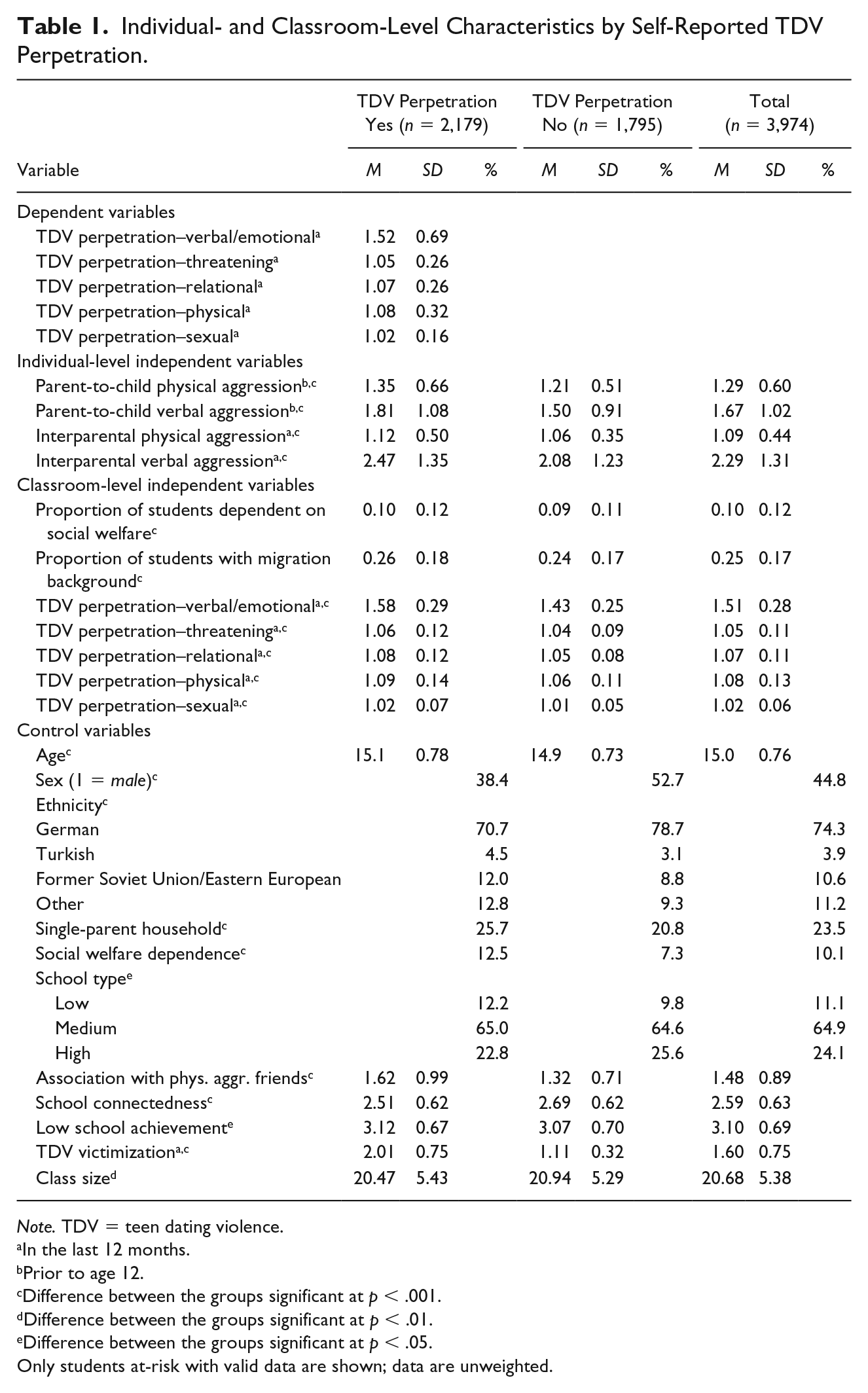
In a first step, descriptive statistics for the study variables based on whether or not respondents reported TDV perpetration within the context of their current or most recent romantic relationship will be presented (Table 1). Of all valid cases, 54.8% (n = 2,179) reported TDV perpetration within the previous 12 months, while 45.2% (n = 1,795) reported no TDV perpetration. T-tests for independent samples and chi-square tests were employed to test for significant differences between the groups. In a second step, spearman correlations between the study variables will be presented (Table 2), followed by the results of linear regression models (Table 3). In the regression models, missing data were addressed by using full-information maximum likelihood (FIML) estimation within the SEM-command of Stata 14.2. To account for the hierarchical data structure of students nested within classrooms, we employed clustered robust standard errors. Control variables and key independent variables were added in a hierarchical fashion: In a first step, TDV was regressed on the set of control variables. In a second step, we added the four family violence measures. Third, the aggregated classroom mean of TDV perpetration was included for each TDV dimension separately, together with the other measures of classroom composition. At the classroom level, variables of classroom normative climate were mean-centered, allowing for a clearer interpretation of the coefficients. To evaluate the explanatory power of each model, the amount of variance explained as well as the changes in the explained variance were considered for each step in the regression.
Individual- and Classroom-Level Characteristics by Self-Reported TDV Perpetration.
Note. TDV = teen dating violence.
In the last 12 months.
Prior to age 12.
Difference between the groups significant at p < .001.
Difference between the groups significant at p < .01.eDifference between the groups significant at p < .05.
Only students at-risk with valid data are shown; data are unweighted.
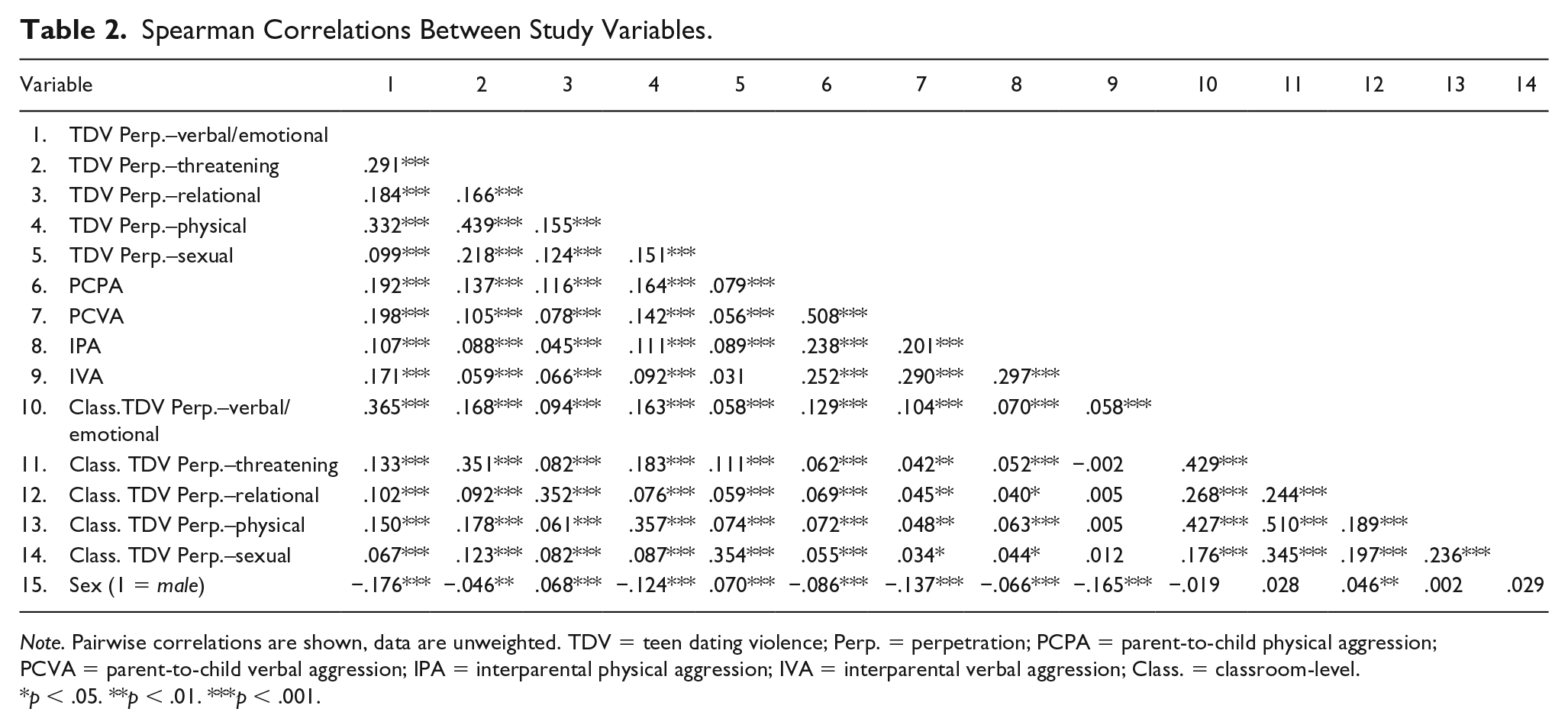
Spearman Correlations Between Study Variables.
Note. Pairwise correlations are shown, data are unweighted. TDV = teen dating violence; Perp. = perpetration; PCPA = parent-to-child physical aggression; PCVA = parent-to-child verbal aggression; IPA = interparental physical aggression; IVA = interparental verbal aggression; Class. = classroom-level.
p < .05. **p < .01. ***p < .001.
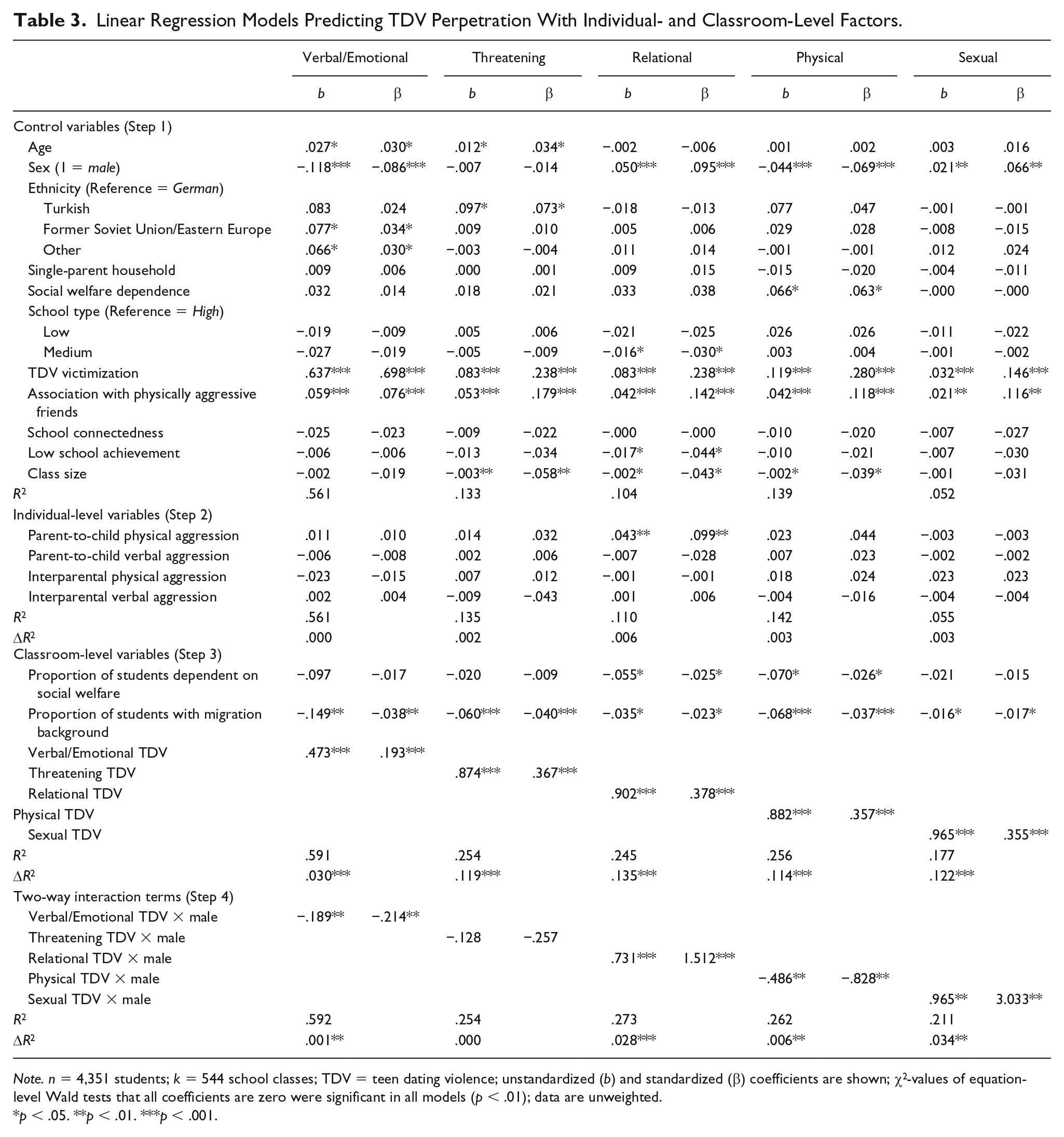
Linear Regression Models Predicting TDV Perpetration With Individual- and Classroom-Level Factors.
Note. n = 4,351 students; k = 544 school classes; TDV = teen dating violence; unstandardized (b) and standardized (β) coefficients are shown; χ2-values of equation-level Wald tests that all coefficients are zero were significant in all models (p < .01); data are unweighted.
p < .05. **p < .01. ***p < .001.
Results
Prevalence of TDV Perpetration
Prevalence rates of TDV perpetration within the past 12 months varied considerably by the specific dimension of TDV (51.8% verbal/emotional violence, n = 2,055; 4.8% threatening, n = 189; 8.8% relational violence, n = 348; 8.7% physical violence, n = 344; 1.6% sexual violence, n = 64). Boys most frequently reported perpetration of verbal/emotional violence (42.7%, n = 760), followed by relational violence (10.9%, n = 193), physical violence (4.8%, n = 85), threatening (3.7%, n = 65), and sexual violence (2.6%, n = 46). A similar pattern was observed for females, although perpetration rates were somewhat higher compared to boys, except for relational and sexual TDV (verbal/emotional: 59.0%, n = 1,290; physical: 11.9%, n = 259; relational: 7.1%, n =155; threatening: 5.7%, n =124; sexual: 0.8%, n =18). Chi-square tests indicated that all rates significantly differed across sex (pall ≤.01). Table 1 presents descriptive statistics for the study variables based on whether or not respondents reported TDV perpetration within their romantic relationships in the previous 12 months (only respondents with valid data). Among those having perpetrated TDV, parent-to-child physical and verbal aggression as well as interparental physical and verbal aggression were higher than in the non-perpetration group. Furthermore, the perpetrator sample scored higher on TDV victimization, association with physically aggressive friends, and low school achievement, while it scored significantly lower on school connectedness. With regard to classroom-level indicators, we find that the average scores of TDV perpetration were significantly higher in the TDV perpetration group across dimensions. In addition, TDV perpetration was slightly more common in school classes with a larger proportion of students dependent on social welfare, as well as in school classes with a larger proportion of students with migration background.
Zero-Order Correlations
Table 2 presents the results of zero-order correlations between the major study variables. We employed spearman correlations to handle non-normal distributions of the variables. All dependent TDV variables were positively correlated with each other, whereby the strongest correlation was observed between physical TDV and threatening (r = .439, p < .001), and weakest between verbal/emotional TDV and sexual TDV (r = .099, p < .001). Individual TDV perpetration was significantly related to classroom-level TDV perpetration, whereby associations were strongest within each specific dimension of TDV. All family aggression measures were positively but in most cases rather weakly correlated with individual TDV perpetration. Interparental verbal aggression and sexual TDV were, however, uncorrelated with each other. The strongest associations appeared between verbal/emotional TDV and exposure to family violence (from r = .107, p < .001 with interparental verbal aggression to r = .198, p < .001 with parent-to-child verbal aggression).
Linear Regression Models on TDV Perpetration
Table 3 shows the results of linear regression models with TDV perpetration (verbal/emotional, threatening, relational, physical, and sexual) as the dependent variable. Intra-class correlations (ICC) ranged from .008 (sexual TDV) to .037 (verbal/emotional TDV), indicating that a substantial part of the variance in TDV was located between classrooms. In Step 1, TDV perpetration was regressed on the control variables. The results show that TDV victimization was the strongest correlate of self-reported TDV perpetration in each model (from β = .146 in the model on sexual TDV to β = .698 in the model on verbal/emotional TDV, all p < .001). In all models except the one on verbal/emotional TDV, the second strongest correlate of TDV perpetration was association with physically aggressive friends, whereby the strongest link was found for threatening (β = .179, p < .001), followed by relational (β = .142, p < .001) and physical (β = .118, p < .001) dating violence. Surprisingly, lower school achievement was associated with less relational TDV, while being in a larger school class was related to less threatening, relational, and physical TDV. With regard to sociodemographic factors, verbal/emotional TDV and threatening significantly increased with age. An inconsistent pattern of results was found regarding sex, with verbal/emotional and physical TDV being more often perpetrated by females, whereas relational and sexual TDV were more strongly associated with male sex. Being of Turkish ethnic background was a significant correlate of threatening, while Eastern European/former Soviet Union and other ethnic origin were significantly associated with higher verbal/emotional TDV. Finally, social welfare dependence was positively related to physical TDV perpetration. A comparison of the explained variance across models revealed that the control variables together explained a great deal of the variation in verbal/emotional TDV (R2 = .561) but only a little amount of variation in the model on sexual TDV (R2 = .052). In Step 2, the key independent variables of violence exposure in the family were entered. The results showed that parent-to-child physical aggression was significantly related to relational TDV (b = .043, β = .099, p < .001), while all other aggression variables were not significantly associated with TDV perpetration. If one compares the change of variance each model accounted for from Step 2 to 3, there were only small improvements in model fit, which were overall not statistically significant. However, parent-to-child physical aggression significantly increased model fit in the model on relational TDV when considered alone (p < .01).
Results of Step 3 demonstrated that classroom-level TDV perpetration was significantly and strongly related to individual TDV perpetration across dimensions. As can be seen from the standardized coefficients, classroom-level TDV was a substantially stronger correlate than the individual-level characteristics, except for TDV victimization in the case of verbal/emotional TDV perpetration. Furthermore, a higher share of classmates dependent on social welfare significantly decreased relational and physical TDV perpetration, while larger proportions of students with migration background were associated with lower TDV perpetration across models. The percentage of explained variation in the dependent variables significantly increased in Step 3 across models (pall < .001), whereby the strongest increase was found for relational TDV. In Step 4, we added two-way interaction terms between classroom-level TDV perpetration and respondents’ sex. The negative interaction terms in the models on verbal/emotional and physical TDV indicate that a higher share of classroom-level TDV for these dimensions was more strongly associated with individual-level TDV perpetration for girls than boys. In contrast, the positive interaction terms in the case of relational and sexual TDV show that boys were more strongly affected by classroom norms favoring these types of dating violence than girls. The amount of additional variation explained by the interaction term was significant in all models except the one on threatening (p < .01). The four significant interactions were also plotted graphically (see Figure 1), depicting the respective regression slopes at low (mean – 1 SD), medium (mean), and high (mean + 1 SD) levels of classroom TDV by sex.
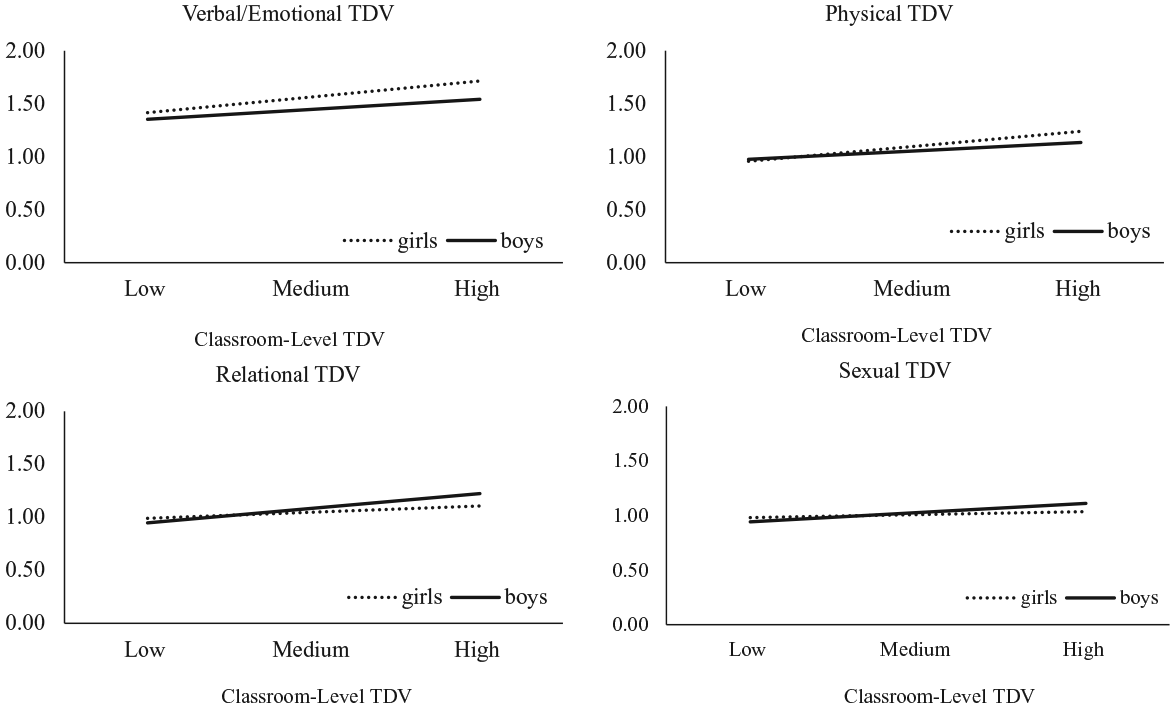
Simple slopes on the relationship between classroom-level TDV perpetration and individual TDV perpetration by sex.
Discussion
This study adds to the yet sparse strand of research on contextual effects of TDV among secondary school students by investigating how the normative climate of TDV perpetration within classrooms (as measured by aggregated individual reports of TDV within classrooms) shapes adolescents’ own TDV perpetration. In line with our central research hypothesis, results showed that individual engagement in TDV perpetration was more likely if the classroom comprised students that were highly involved in dating violence. This was the case even under control of sociodemographic, family, peer, and school risk correlates, as well as other measures of class composition. The aggregated measure of classroom dating violence norms was the strongest correlate in each model except in the model on verbal/emotional TDV, where self-reported TDV victimization was the strongest factor. Among the family and peer risk factors studied, parental physical aggression experienced during childhood as well as affiliation with physically aggressive friends were significant risk factors of later aggression toward dating partners. We also advanced literature on gender-specific patterns of TDV by demonstrating that the normative classroom context in relation to TDV affected boys and girls differentially. Girls were more affected by higher classroom levels of verbal/emotional and physical TDV, while boys were more affected by higher classroom levels of relational and sexual TDV.
The finding that classroom-level dating violence contributed directly to the likelihood of individual TDV perpetration net of critical risk correlates on the individual and classroom level supports prior research on context-level effects on adolescents’ aggressive behavior in general (Müller et al., 2016; Thomas et al., 2011) and TDV in particular (Giordano et al., 2015). It is consistent with the Theory of Normative Conduct (Cialdini et al., 1990) in so far as individuals appear to act in accordance with socially normative behavior if such norms are particularly salient within a given context. The result that classroom normative climate regarding TDV perpetration is associated with individual TDV perpetration is also in line with social learning theory (Bandura, 1977) according to which behavioral norms are learned through observation and modeling. In the context of TDV perpetration, individuals may adopt classroom norms legitimizing or tolerating the use of this form of aggression and then carry it over into their own romantic relationships. This appears to be the case for both serious and milder forms of dating violence.
In our study, aggregated classroom-level dating violence was in most cases even more influential than key risk factors within the family on the individual level. This demonstrates the pivotal role of classroom norms as an additional influence besides parents and close friends. Social learning and socialization processes are likely to be ongoing as adolescents gradually develop understandings about appropriate ways to behave in intimate relationships (Giordano et al., 2015). Considering the key socializing role of peers, future studies should closely examine the underlying pathways through which characteristics of classrooms may contribute to the development of TDV in adolescence. The observation that classrooms with higher aggregate mean levels of TDV were related to more individual TDV perpetration also supports the theory of reciprocal socialization (Cairns, Leung, & Cairns, 1995), which describes the bidirectional process of peers becoming more alike in behavioral tendencies because of their frequent interaction (Espelage, Holt, & Henkel, 2003). This theory would assume a reciprocal relationship between individual TDV perpetration and classroom TDV perpetration. Future studies should use longitudinal data to address changes in TDV perpetration associated with changes in classroom norms. In sum, our findings extend a growing body of research documenting the multifaceted nature of classroom peer influence on aggressive-disruptive behavior in adolescence. The impact of the larger peer group appears to be not only restricted to self-selected friends (e.g., Espelage et al., 2003) but also to the institutionally imposed peer environment of the classroom (see also Müller et al., 2016). It is possible that through reinforcement processes (e.g., gossip, storytelling, teasing), “localized cultural worlds” may be created (Eder, 1995), which serve as a model for behavior and communication in other social contexts, and in which an individual may adopt violence-specific attitudes and behaviors. Such social reinforcement processes within the larger peer context appear to continue even in situations in which a certain type of behavior is typically not directly observed. Our results also stress the bidirectional nature of TDV, which has already been documented in earlier research (Renner & Whitney, 2012) . Conflicting with prior research (Chiodo et al., 2012) and what we hypothesized, lower school achievement was negatively related to TDV perpetration. Low grades may impact on the emotional well-being of students, which is likely to be associated with deficient networks in terms of relationship quality (Miething et al., 2016), including intimate partnerships. Future research might also attempt to explore the role of cultural normativeness of violence as well as different power relations in dating relationships among students with Turkish and former Soviet Union/Eastern European migration background. Such research can help identify certain factors that increase or decrease the risk of TDV among certain ethnic groups. Future research should also more thoroughly assess the role of classroom composition in relation to low family SES as a risk or protective factor of TDV.
Limitations
A major limitation of this study concerns the use of cross-sectional data, which renders the identification of causal relationships between TDV and the presumed risk factors difficult.
Most notably, we cannot fully rule out the possibility that individual TDV perpetration influences classroom-level TDV perpetration, rather than the hypothesized opposite way. Due to the lack of empirical evidence for the hypothesized causal direction, the identified positive relationship between individual and classroom TDV involvement may be to some degree a reflection of the fact that more aggressive classrooms are more likely composed of aggressive individuals. Thus, higher individual reports of TDV perpetration result in higher classroom-aggregated TDV. Creating average measures of norms or behavior within school classes is a common procedure for measuring the distribution of norms in classrooms (see, for example, Beier, 2016; Bernburg & Thorlindsson, 2005). Nevertheless, it is somewhat problematic because its calculation also takes into account an individual’s own behavior. Consequently, the measurements of individual-level TDV and classroom-level TDV are not completely independent. Longitudinal data would be desirable to have a stronger rationale for cause and effect and to foster empirical evidence for the hypothesized causal relationship.
Another difficulty that results from the cross-sectional data base is the following: Although we relied on retrospective measures of exposure to parent-to-child aggression, responses might be affected by current parent-child relationships that overshadow previous memories and thus potentially bias results. Furthermore, we relied on adolescent self-report, which could increase shared method variance, and may be associated with potential misreporting of TDV perpetration. To decrease social desirability bias, however, we stressed the principle of anonymity repeatedly in the data generating process and took care that each student filled out their questionnaire by himself or herself. Another shortcoming concerns the use of measures that sometimes relied on a very small number of items. Future studies should address this concern by employing more extensive validated scales.
Although we could define the specificity of classmates’ influence by statistically controlling for the association with physically aggressive friends, we cannot clearly rule out the possibility that classroom peers are to a great extend made up of close friends. Future studies should include a measure on the relationship status between classroom peers, providing a more exact picture of the role of broader network influences. Nevertheless, the probability that the classroom is congruent with one’s group of close friends may not always be the case, particularly in larger classrooms. Still further research is needed to disentangle the influence of classroom composition from the effect of self-selected friends that include both classmates and outside peers (Müller et al., 2016). In addition, peer influences outside the immediate classroom context, such as the influence of other same-school/grade peers, should be taken into consideration. Furthermore, schools differ in the way students are assigned to classrooms and in the length of time classmates spend together. In our study, it is unclear how long the students knew one another and how many months or years they spent together in the same classroom. A longer time spend together would increase the significance of normative classroom climate. In future studies, it would be helpful to include data on the mean number of months that the adolescents spent together in their classroom.
Finally, the study was conducted in the specific cultural context of Germany, and among ninth-grade adolescents; these factors may affect the generalizability of results. Future studies should explore the role of classroom norms on TDV perpetration within different cultural or demographic groups, seeing that there might be variability in classroom influence and in the cultural understanding of TDV perpetration. These limitations notwithstanding, the results of this study extend the yet scarce evidence on classroom-level effects of violence perpetration within romantic relationships.
Implications for Practice and Intervention
Our results have implications for efforts designed to deter or interrupt TDV. First of all, the findings highlight the importance of institutionally imposed peer contexts, such as classrooms in schools, in affecting violent dating behavior. Classrooms are often-used intervention points that are likely to serve as crucial socialization environments for adolescents in which a specific normative climate on TDV perpetration is created and cultivated. A range of school- and classroom-based interventions have already been implemented that aim to reduce and prevent TDV, for example, through classroom-based curriculum that introduce lessons for students, placement of informational posters in the school hallways, and policies that encourage reporting of violence (for a meta-analysis, see De La Rue, Polanin, Espelage, & Pigott, 2017). In addition, some relationship violence prevention programs have been implemented on the peer level in the U.S. context, which focus on the training of students as potential bystanders who can step in to help diffuse risky situations, identify and challenge perpetrators, and assist victims (e.g., Coker et al., 2011). Our results demonstrate that such normative climates even have the potential to affect individual behavior outside school. The current results also suggest that it may be useful to target violent-free family and peer relationships in preventive interventions for adolescents’ perpetration of TDV. Furthermore, attachment to school should be addressed in prevention strategies as a potential protective factor of TDV. Our results suggest furthermore that it may be useful to establish and promote gender- and type-specific prevention and intervention services. Consistent with previous work on gender differences and the growing documentation of female perpetration of physical TDV (e.g., Carroll, Raj, Noel, & Bauchner, 2011; Haynie et al., 2013), our findings stress the need to target boys and girls differently in relation to the reduction of different types of TDV. As we found significant gender differences not only with regard to prevalence but also the influence of classroom TDV norms, health care providers and clinicians should be sensitive toward boys and girls reacting differently to normative peer contexts. In particular, there appears to be a need to focus on female TDV in the context of high-risk peer contexts that favor verbal/emotional and physical TDV, and a need to focus on male behavior in the context of peer environments in which relational and sexual TDV is frequent. As the explanatory power of some risk factors differed in some cases by the specific type of TDV (e.g., parent-to-child physical aggression, ethnic background), it would also be useful to promote type-specific prevention strategies. Finally, due to the fact that approaches of TDV prevention are not very developed in the German-speaking countries, the adaptation and dissemination of evidence-based prevention offers from the Anglo-American context is of great relevance. Reference can be made to some U.S. programs for which proof of efficacy from randomized controlled trials (RCTs) is already available (DeGue et al., 2014; De Koker, Mathews, Zuch, Bastien, & Mason-Jones, 2014). To conclude, the developmental stage of adolescence appears to be a particularly suitable phase for preventive work, as it can lay the foundations for future relationship competence.
Footnotes
Declaration of Conflicting Interests
The author(s) declared no potential conflicts of interest with respect to the research, authorship, and/or publication of this article.
Funding
The author(s) received no financial support for the research, authorship, and/or publication of this article.
